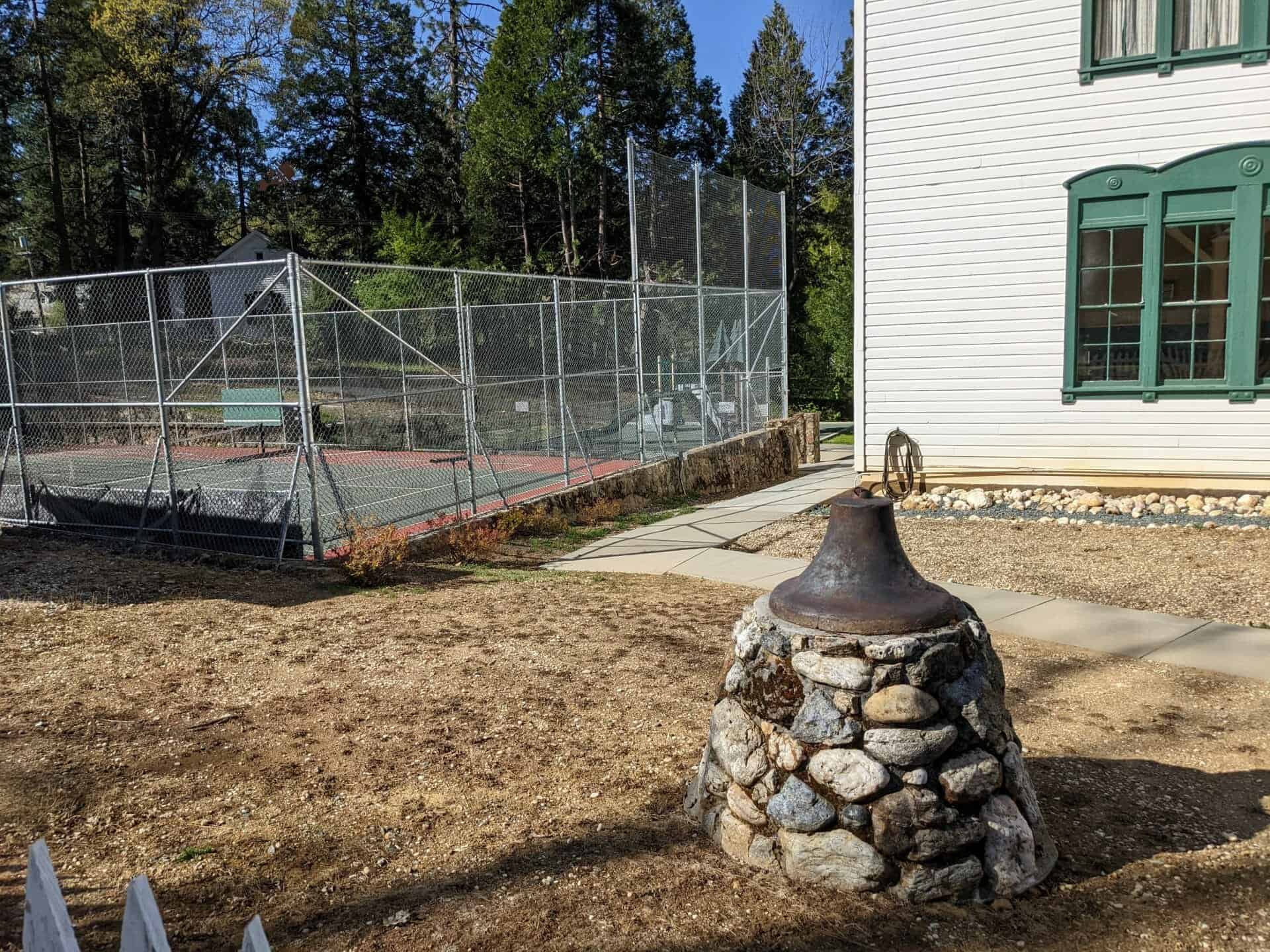
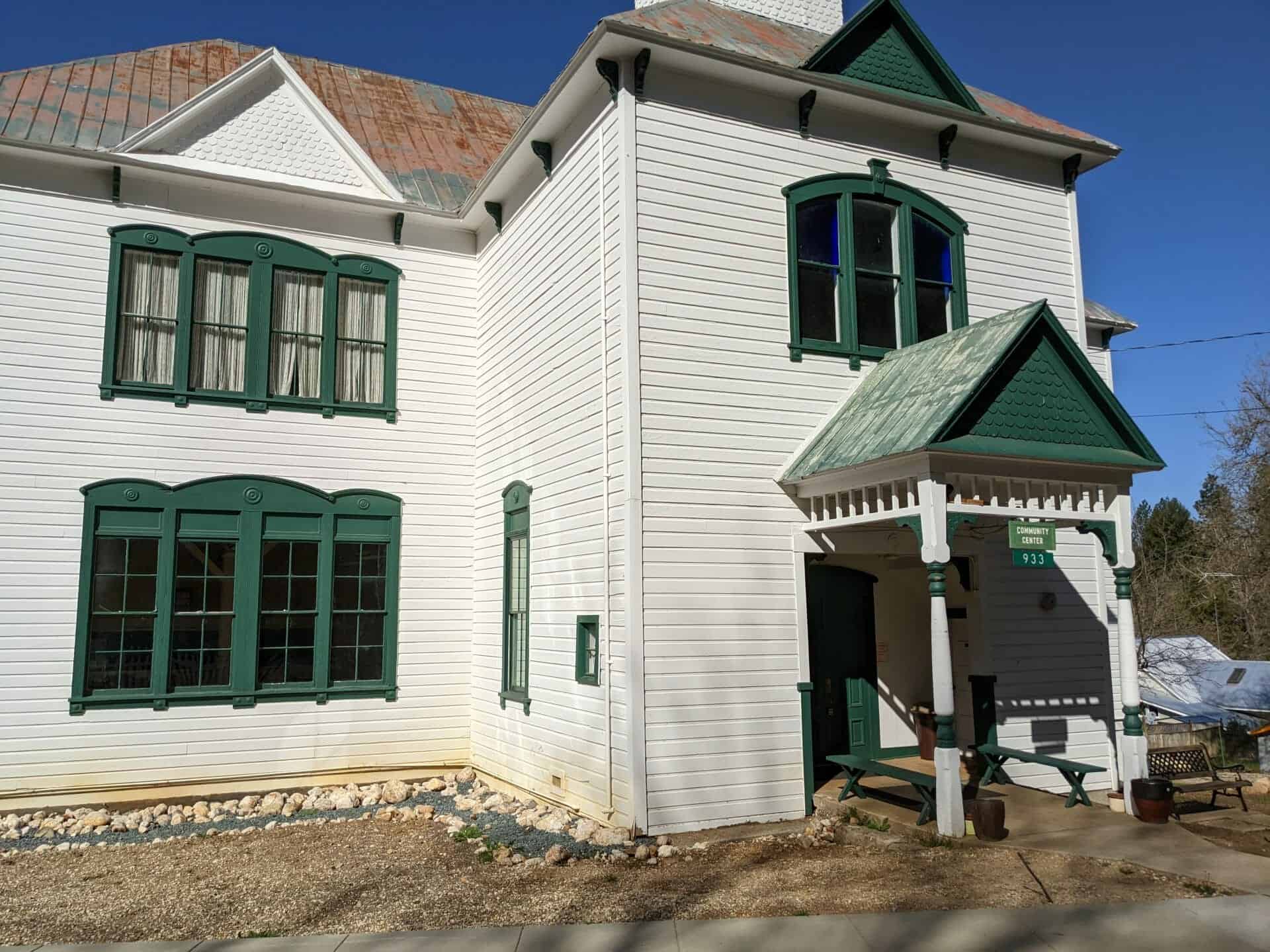
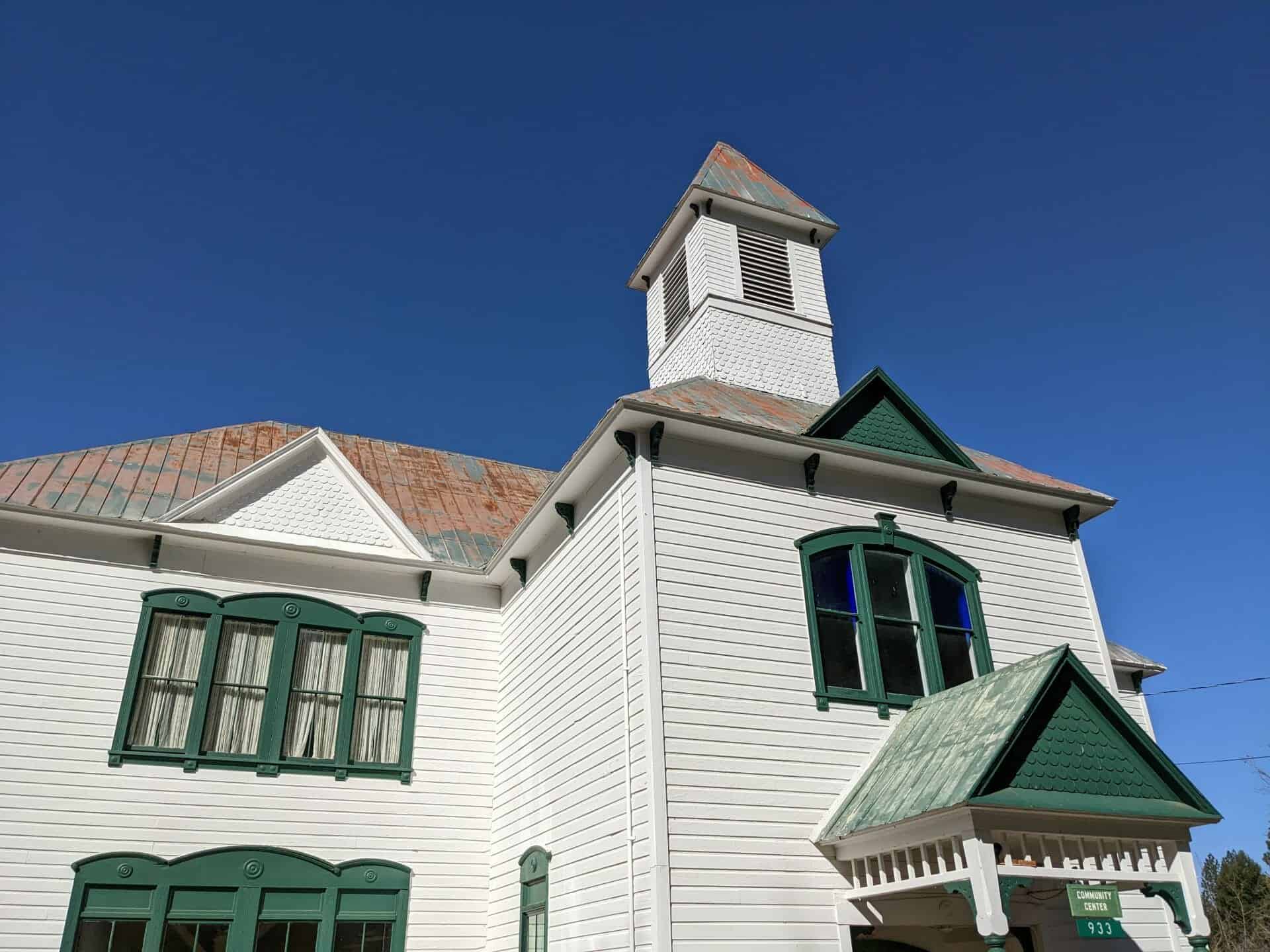
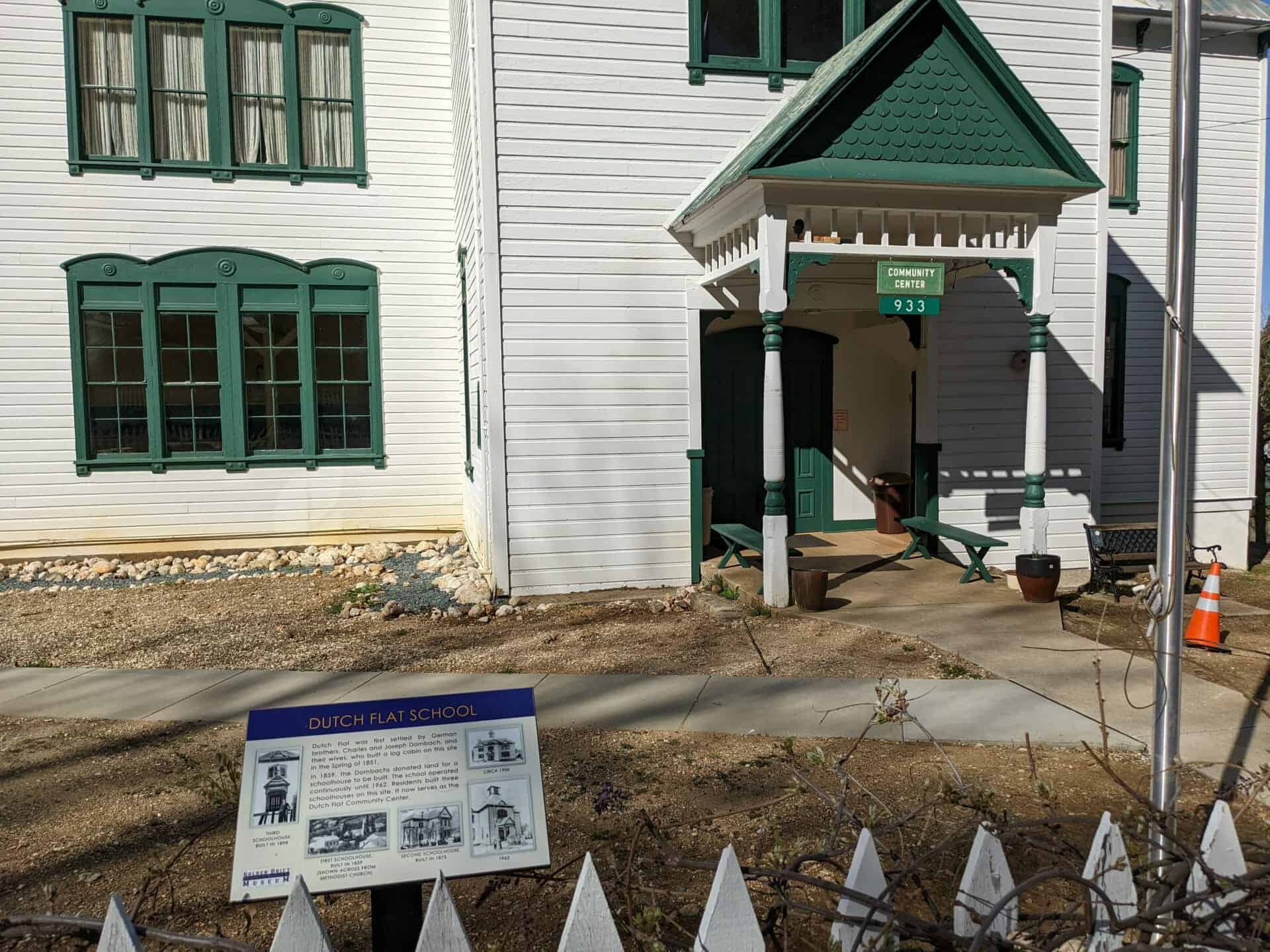
Dutch Flat was first settled by German brothers, Charles and Joseph Dornbach, and their wives, who built a log cabin on this site in the Spring of 1851.
In 1859, the Dornbachs donated land for a schoolhouse to be built. The school operated continuously until 1962. Residents built three schoolhouses on this site. It now serves as the Dutch Flat Community Center.
Independent Order of Odd Fellows This I.O.O.F. hall is the home of Olive Lodge #81 instituted December 8, 1858 and Golden Rule Rebekah Lodge #68 instituted April 26, 1882.
In 1860, brothers William and Philip Nicholls started their bank. IT was one of the longest running businesses in Dutch Flat. The building was torn down in the 1930’s.
In 1883, when Congress passed the Anti-Debris Act, hydraulic mining virtually ceased and the bank ended up owning many mining claims abandoned by their owners.
The second generation of Nicholls, John (son of William) and William (son of Philip), ran the bank until closing in 1912. In order to do business with Chinese citizens of Dutch Flat, John Nicholls learned to speak Mandarin.
This plaque is located on Main Street in Dutch Flat, California.
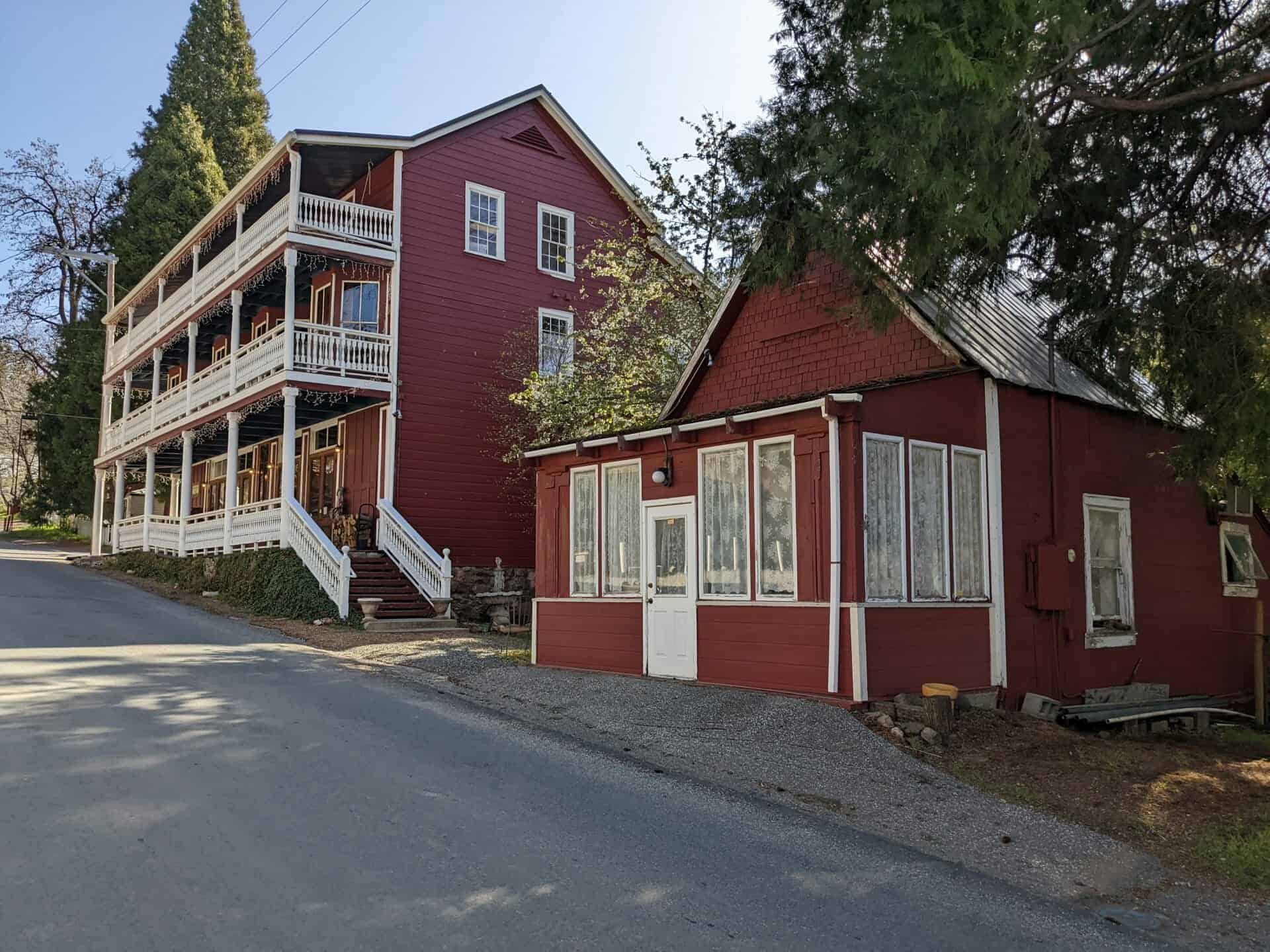
Built in 1852, the Dutch Flat Hotel was a long, narrow, two-story building running along Stockton Street, fronting on Main Street. In 1868, it was expanding in the front to include the building next door and, in 1875, a third story was added. From 1880 to 1900, a bridge connected the Dutch Flat Hotel with the National Hotel across Main Street. In its heyday, the hotel had 52 rooms, a large dining room that could seat 150, and a saloon.
In 1920, the hotel was remodeled to its current size. The hotel closed in 1941 and was a private residence until reopening in 2004.
This plaque is located on Main Street in Dutch Flat, California.
Founded in the Spring of 1861 by Joseph and Charles Dornbach. From 1854 to 1882 it was noted for its rich hydraulic mines. In 1860 had the largest voting population in Placer County. Chinese inhabitants numbered about 2,000. Here Theodore Judah and Dr. D.W. Strong made the original subscriptions to build the First Transcontinental Railroad.
State Registered Landmark No. 397
Tablet placed by California Centennials Commission. Base furnished by Placer County Historical Society Dedicated July 23, 1950.
The Daggett Garage began life in the 1880s at the borax town of Marion, located on the northeast shore of Calico Dry Lake, as a locomotive repair roundhouse for the narrow-gauge Borate and Daggett Railroad. Daggett blacksmith Seymour Alf used a twenty-mule team to move the building to the Waterloo Mill and mine, southwest of Calico, circa 1896, where it served a similar purpose for a silver ore narrow-gauge railroad. Walter Alf, Seymour Alf’s son, moved the building to its current location in Daggett circa 1912.
The building was an auto repair shop on the National Old Trails Highway until World War II, when it became a mess hall for United States Army troops guarding the local railroad bridges. The Fouts brothers bought the building in 1946 and operated an automotive garage and machine shop in the building until the mid-1980s. The building is currently owned and operated by the Golden Mining and Trucking Company.
This plaque (located in Daggett, California) was dedicated May 4, 2003, by the Billy Holcomb chapter of E Clampus Vitus and the Daggett Historical Society, Inc.
This community long served as a supply point and railhead for the mines of Death Valley and Calico. In the early 1880’s the first borax produced in Death Valley was hauled by mule team to the Atlantic & Pacific R.R. (later the Santa Fe) at Daggett. The station formerly Calico, was established in 1882 to service the silver mines, but was soon renamed for Lt. Gov. John Daggett. In 1888 it was connected to Calico by the narrow gauge Calico R.R. Silver prices dropped in the early 1890’s and the mines closed. At this time rich borax deposits were being worked at nearby Borate. 20 mule teams hauled the borax to Daggett for rail shipment. An era ended in 1898 when the famous teams were replaced by the Borate & Daggett R.R. By 1907 borax mining had ceased in favor of richer deposits near Death Valley.
This plaque (located in Daggett, California) was placed by the Billy Holcomb chapter of the ancient and honorable order of E Clampus Vitus, in cooperation with the Daggett Historical Society on Oct. 15, 1995.