April 15, 1865 the following pioneers settled at Weston.
Christopher Funk, his wife Annie Kofoed and children.
John Maughan, his wife Marie Davenport and children.
Samuel Rodgers, and is wife Augusta.
Hanz Funk, his wife Christina Swensen and children.
Warner Hoopes, his wife Pricilla and children.
Rasmus Nelson, his wife Sena Nelson and children, and Wilson Robins.
The text above is from the Daughters of Utah Pioneers historic marker #69, erected April 15, 1941 and located at 27 North Center Street in Weston, Idaho.
The Price family located on the present site of Samaria Feb. 10, 1868. A branch of the Church fo Jesus Christ of Latter-Day Saints was organized Nov. 18, 1868, Thomas S. Thomas, President. Irrigation water was obtained from John Thorpe’s Spring. A log building erected to serve for school and church was dedicated March 1870, David P. Davis, teacher; Jonah Evans, Bishop. Other firsts were Mary D. Davis, Postmistress: John E. Price, Sr., sawmill operator; Heber Sparks, blacksmith.
The above text is from Daughters of Utah Pioneers historic marker #346, erected in 1968 and located at 4421 West 4900 South in Samaria, Idaho.
Iona which means “the beautiful” was named by Apostle John W. Taylor in honor of a town in Palestine. It was originally known as Sand Creek and Embraces a tract of country lying east of Eagle Rock (now Idaho Falls).
The first settlement was made in 1883 by the following pioneers from Utah:
Joseph S Mulliner
Rufus Norton
Cadwaladar Owens and son C. J. Owens
George P. Ward
W. C. Olsen and brother Ole Olsen
H. Dahlstrom
J. C. Reynolds
Joseph Longhurst and brother George
W. J. Rushton
James E. Steele and brother George
H. L. Hansen
John Norton
This is Daughters of Utah Pioneers historic marker #85, erected in 1944 at 3670 North Main Street in Iona, Idaho.
The south part of this area, known as Presto, was settled in 1870 by the Burrell, Just and Shoemaker families. In 1883 the Pritchett family came to Cedar Hollow. Later the Goshen, and the Christensen Monson, Hansen, Jensen, Teeples, Stoddard families and other between 1893-1895. Irrigation water was supplies from Cedar Hollow, Blackfoot River, Sand Creek, and the Idaho Canal. The first schools were held in Presto and served the entire area. Between 1896-1899 a school and Latter-day Saints church were erected in Goshen. The ward was organized in 1900 with Lars Sorensen, bishop.
The above text is from Daughters of Utah Pioneers marker #199 erected in 1954 at 790 North Russel Street Street in Shelley, Idaho.
On November 12, 1888, five years after settlement of Snake River Valley, Bannock Stake Academy opened with 60 students ranging from 6 to 24 years of age. School was held in the first ward L.D.S. chapel during the first years. In 1898 it became a high school and in 1900 all elementary work was discontinued. In 1905 the name was changed to Ricks Academy, honoring Thomas E. Ricks, the founder. In 1936 it became an accredited college. Its objective has been to train young people to adjust to their social environment and meet their community responsibility with moral leadership.
The above text is from Daughters of Utah Pioneers marker #224 erected in 1956 at 525 South Center Street Street in Rexburg, Idaho.
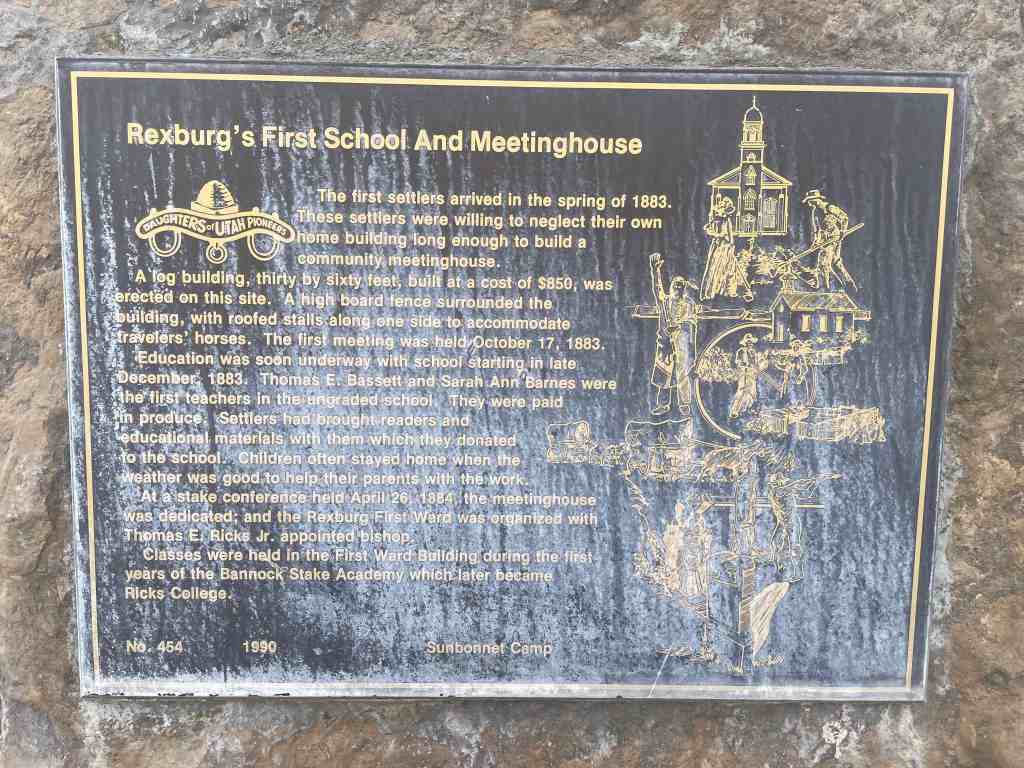
The first settlers arrived in the spring of 1883. These settlers were willing to neglect their own home building long enough to build a community meetinghouse.
A log building, thirty by sixth feet, built at a cost of $8500, was erected on this site. A high board fence surrounded the building, with roofed stalls along one side to accommodate traveler’s horses. The first meeting was held October 17, 1883.
Education was soon underway with school starting in late December 1883. Thomas E. Bassett and Sarah Ann Barnes were the first teachers in the ungraded school. They were paid in produce. Settlers had brought readers and educational material with them which they donated to the school. Children often stayed home when the weather was good to help their parents with the work.
At a stake conference held April 26, 1884, the meetinghouse was dedicated; and the Rexburg First Ward was organized with Thomas E. Ricks Jr. appointed bishop.
Classes were held in the First Ward Building during the first years of the Bannock Stake Academy which later became Ricks College.
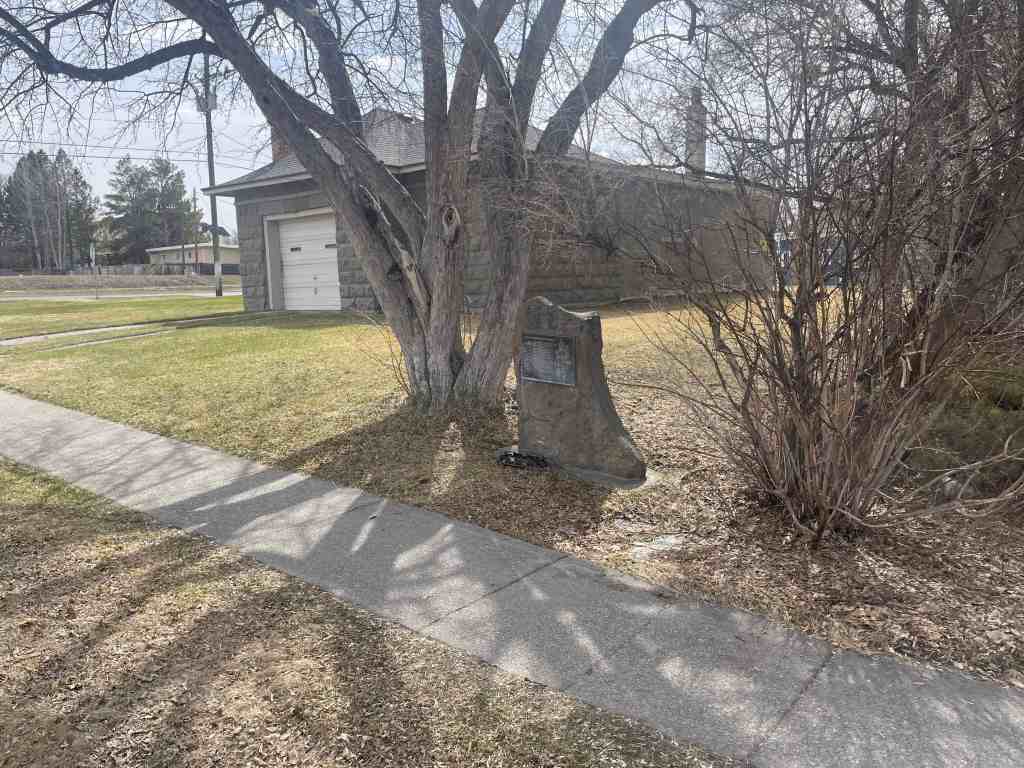
The above text is from Daughters of Utah Pioneers marker #454 erected in 1990 at 66 S 2nd Street in Rexburg, Idaho.
In 1879 the U.&N. Railroad Co. named their water stop, Basalt. Henry R. Whitmill settled in Cedar Point in 1884. Andrew O. Inglestrom filed on land, 1885. Others followed, built canal, homes, L.D.S. church house, cheese factory, two stores, saloon, blacksmith shop, log schoolhouse, L.M. Caps, teacher, postoffice, Marion Kerr, post mistress. Willian Dye dug first well. Cedar Point name changed to Basalt, 1888. Due to railroad improvements, the town was moved east in 1903.
The above text is from Daughters of Utah Pioneers marker #373 erected in 1970 at 824 North 675 East in Bingham, Idaho.
Six men came to this area from Hooper, Utah, to homestead in the early spring of 1885: John, Edward and William Priest, Smith Johnson, and Edwin and Abiah Wadsworth Jr. They each built a log house on their claim before returning to Utah for their families. Leaders of the Church of Jesus Christ of Latter-day Saints (LDS), headquartered in Salt Lake, were informed of this small settlement. In 1886 Apostle John W. Taylor of the LDS Church was sent to organize the group into a branch, a part of the Bannock Stake with headquarters in Rexburg, Idaho. The decision was made to name the ward in honor of Apostle Taylor. William Priest became the first bishop. The first church meetings were held in Abiah Wadsworth Jr.’s home.
By 1886 a log structure was erected for public use on land donated by John Priest. The first teacher was John Henry Evans, the church recorder. A second multi-purpose structured, a two-room, 39 by 60 foot white frame building was built in the mid 1890s. This building burned during the winter of 1904, taking with it all church and school records. In 1905 a two-room brick building was completed. Church, school, and dances were held in the building until a church was constructed in 1915.
To water this arid, sagebrush-covered land, the pioneers had to dig a 10-mile-long irrigation canal from Eagle Rock, located to the north. Hay and grain, their first crops, were grown in 1890.
The beautiful Taylor Cemetery was established in April 1887 when Abiah Wadsworth Jr. and Willian Arave purchased 5 acres of land for $65 to bury Ellen, the infant daughter of Sarah and Abiah Wadsworth, Jr.
The above text is from Daughters of Utah Pioneers marker #527 erected in 2000 at 127 S 1st Street in Taylorville, Idaho.
In 1867 Joseph Chadwick and family settled on Five Mile Creek and built a log cabin. In one room he had a supply store to accommodate the few settlers and freighters. He was followed by Peter Poole, Robert Taylor, Stephen Callan, George Mendenhall, Richard Wickham and their families. The locality was originally known as Five Mile, later Chadville, and in 1890 Card. In 1906 Wm.B. Preston gave it the name of Dayton. Fred Jensen was the first L.D.S. presiding Elder.
The text above is from the Daughters of Utah Pioneers historic marker #171, erected in December of 1951 and located in Dayton, Idaho.
Settlement named in honor of Robert T. Burton, who laid out the townsite in 1882. Early settlers cleared the sagebrush, dug canals, ditches, planted crops, and built modest homes. A branch of the Church of Jesus Christ of Latter-Day Saints was organized in 1884 with George Foss, Presiding Elder.
Church services and school were were held in homes until a 20x30x12 ft. log meetinghouse was erected in 1886-87. It had a dirt roof, red pine floor, four windows, and a door. First school teacher was Jennie Smith; postmaster, H.S. Dudley; first white child born was Annie Thornton.
This is Daughters of Utah Pioneers historic marker #425 located at 3958 West 2000 South in Rexburg, Idaho. The marker was dedicated in 1983.