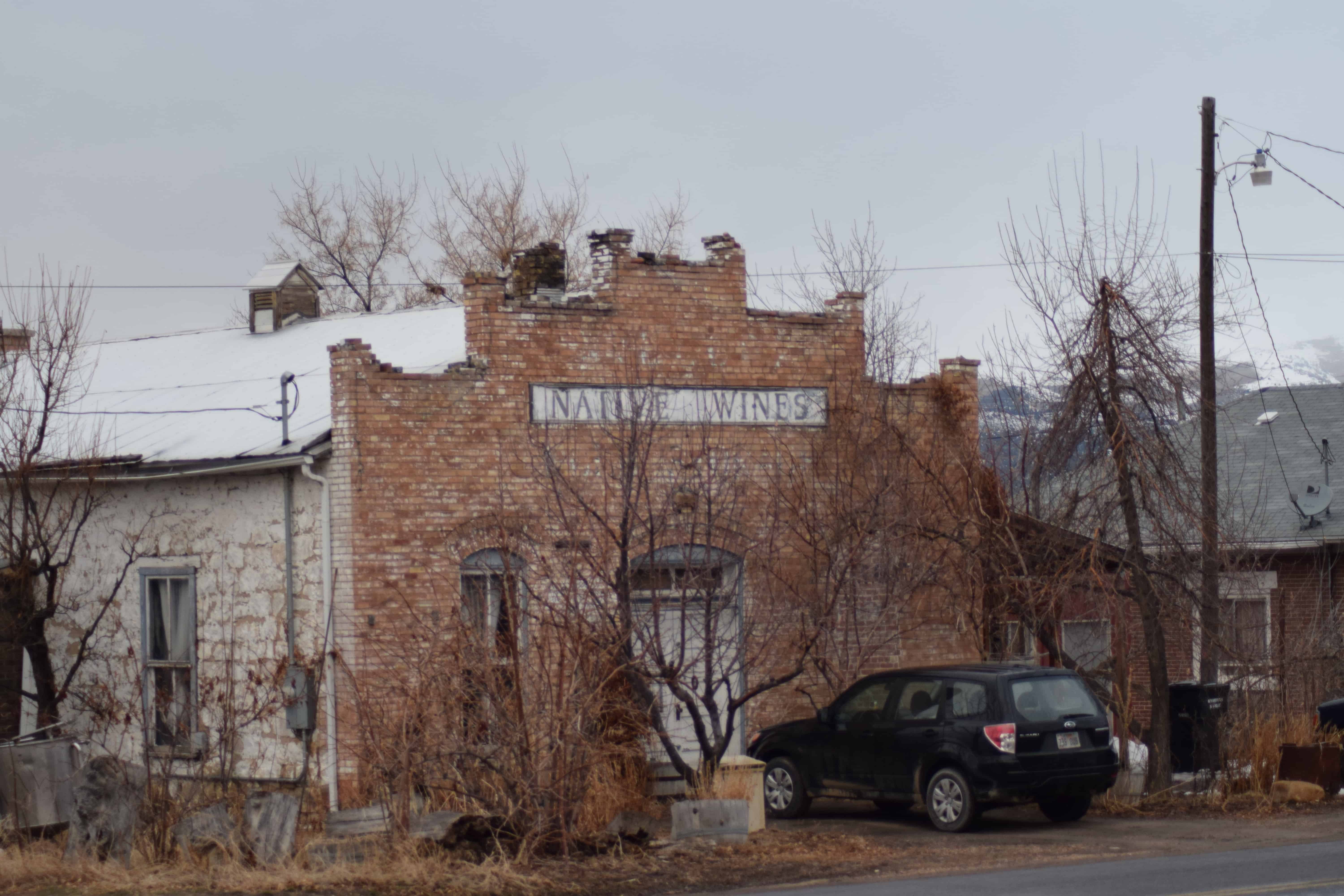
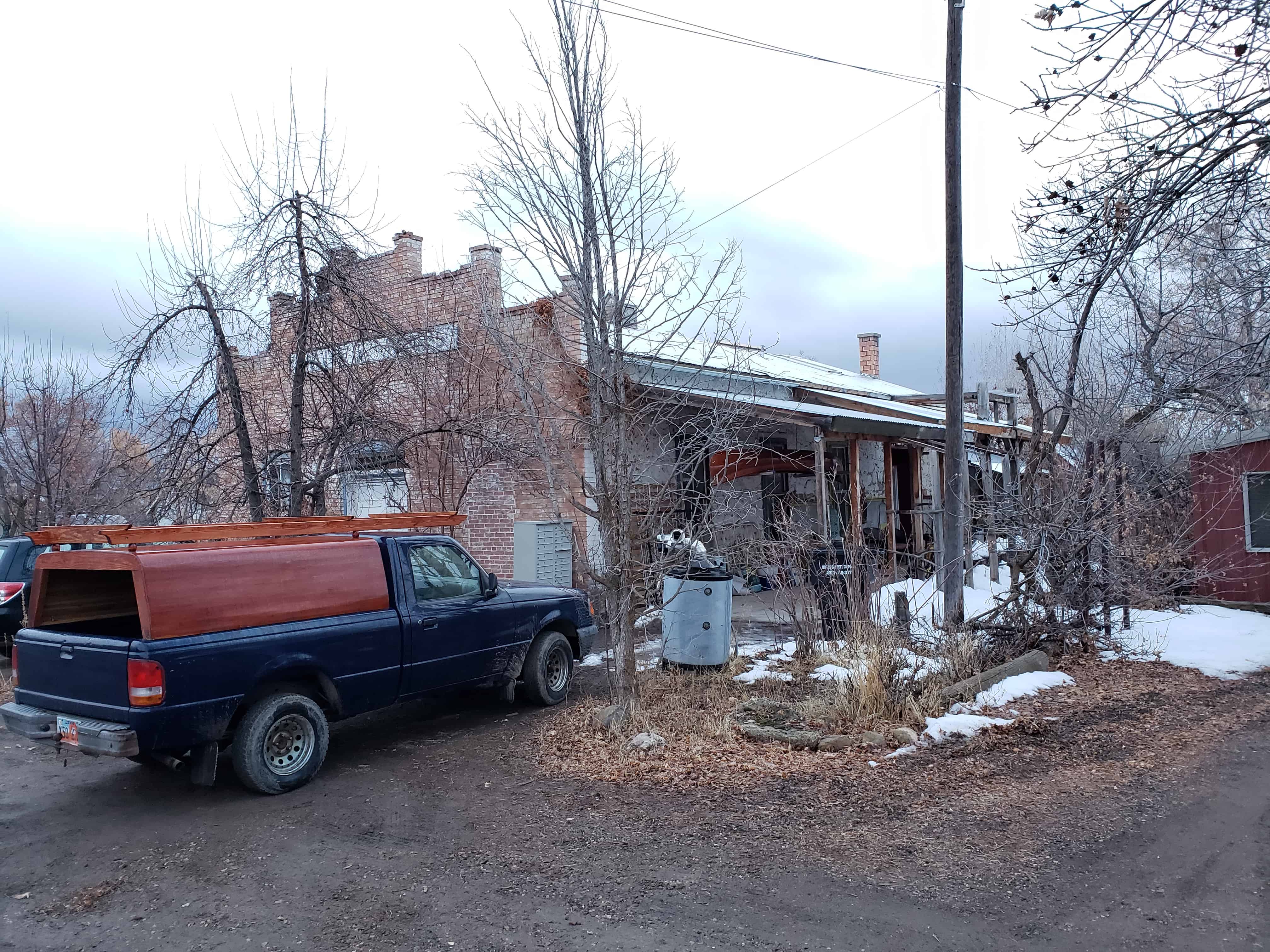
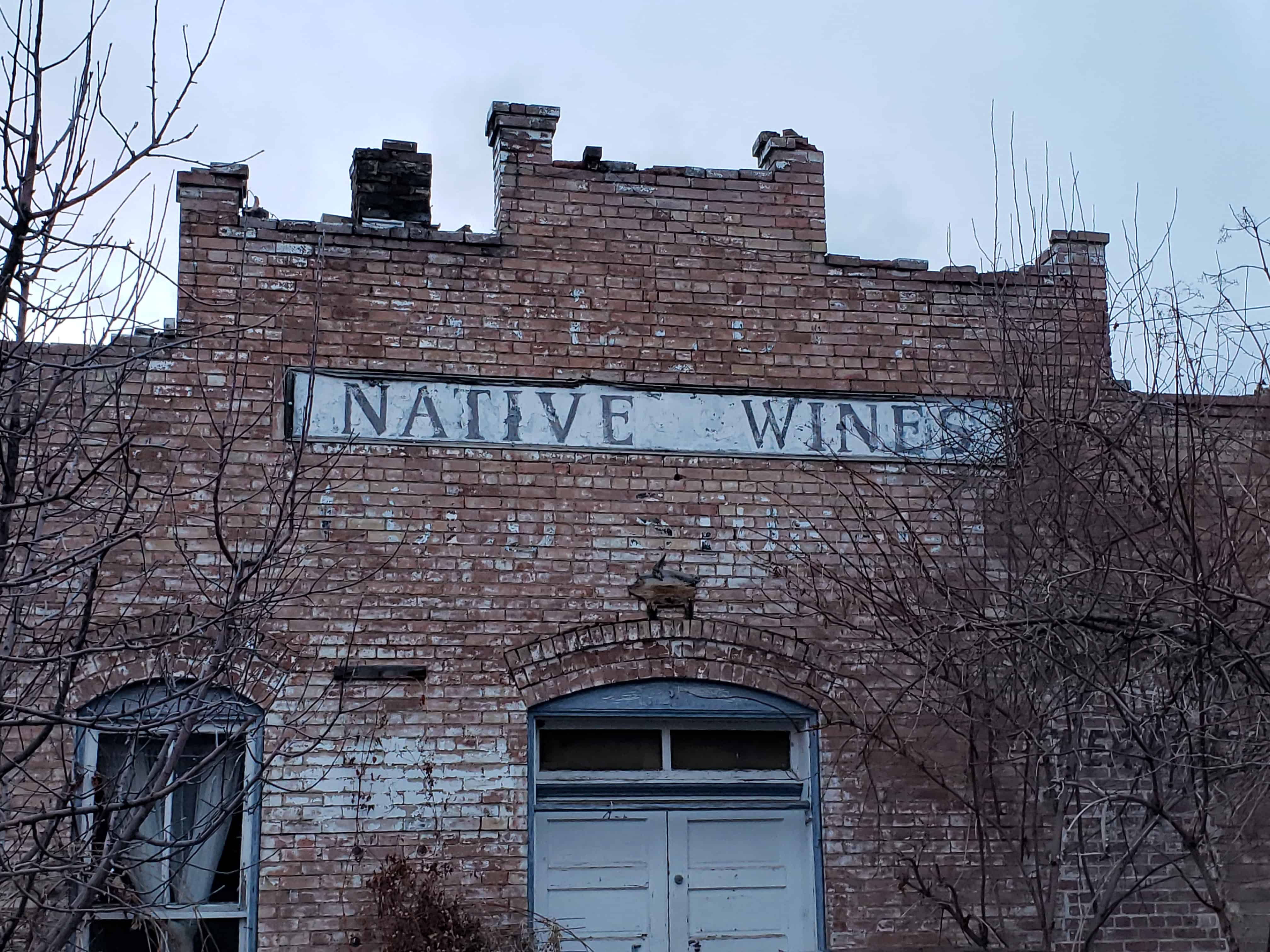
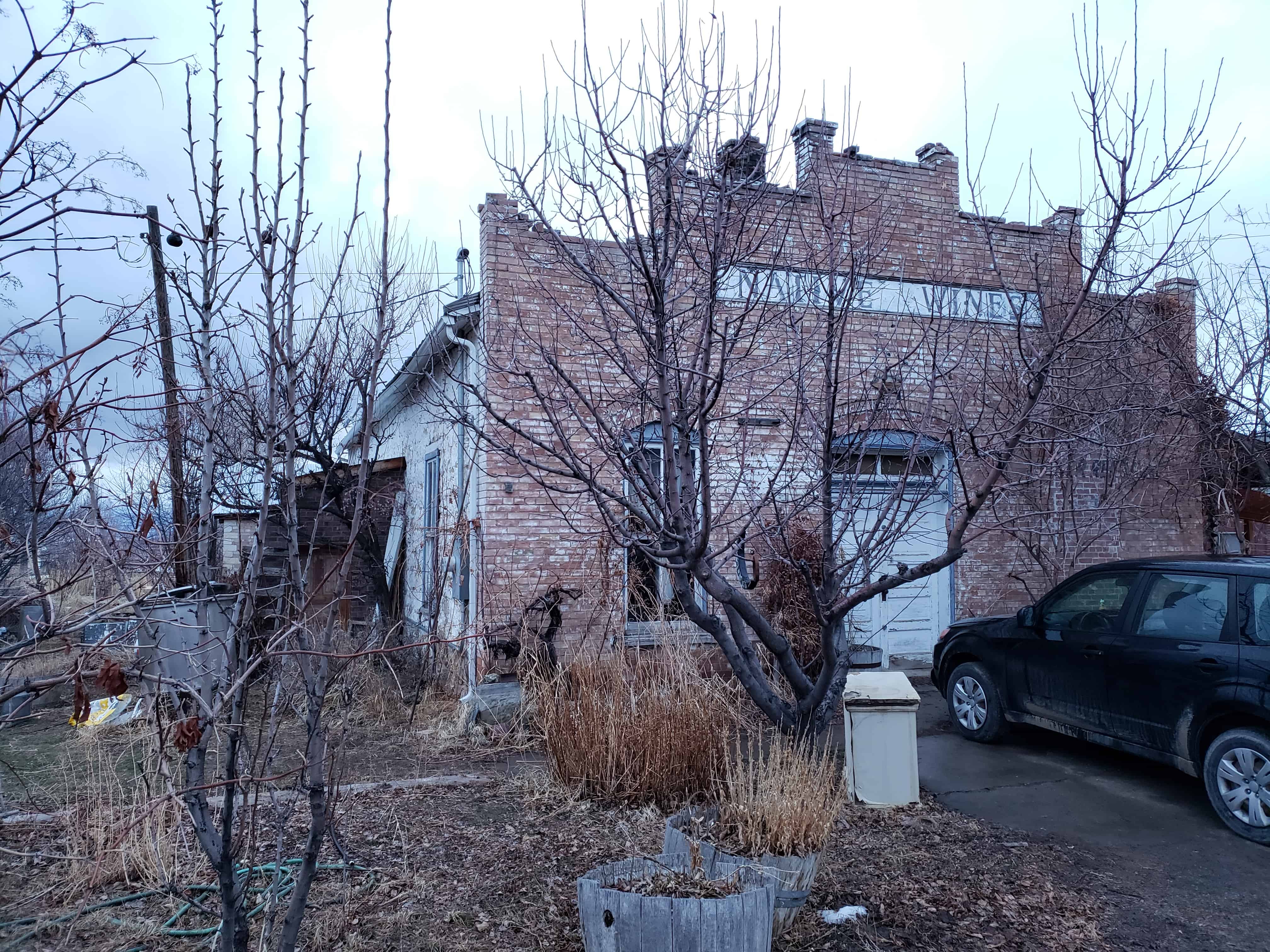
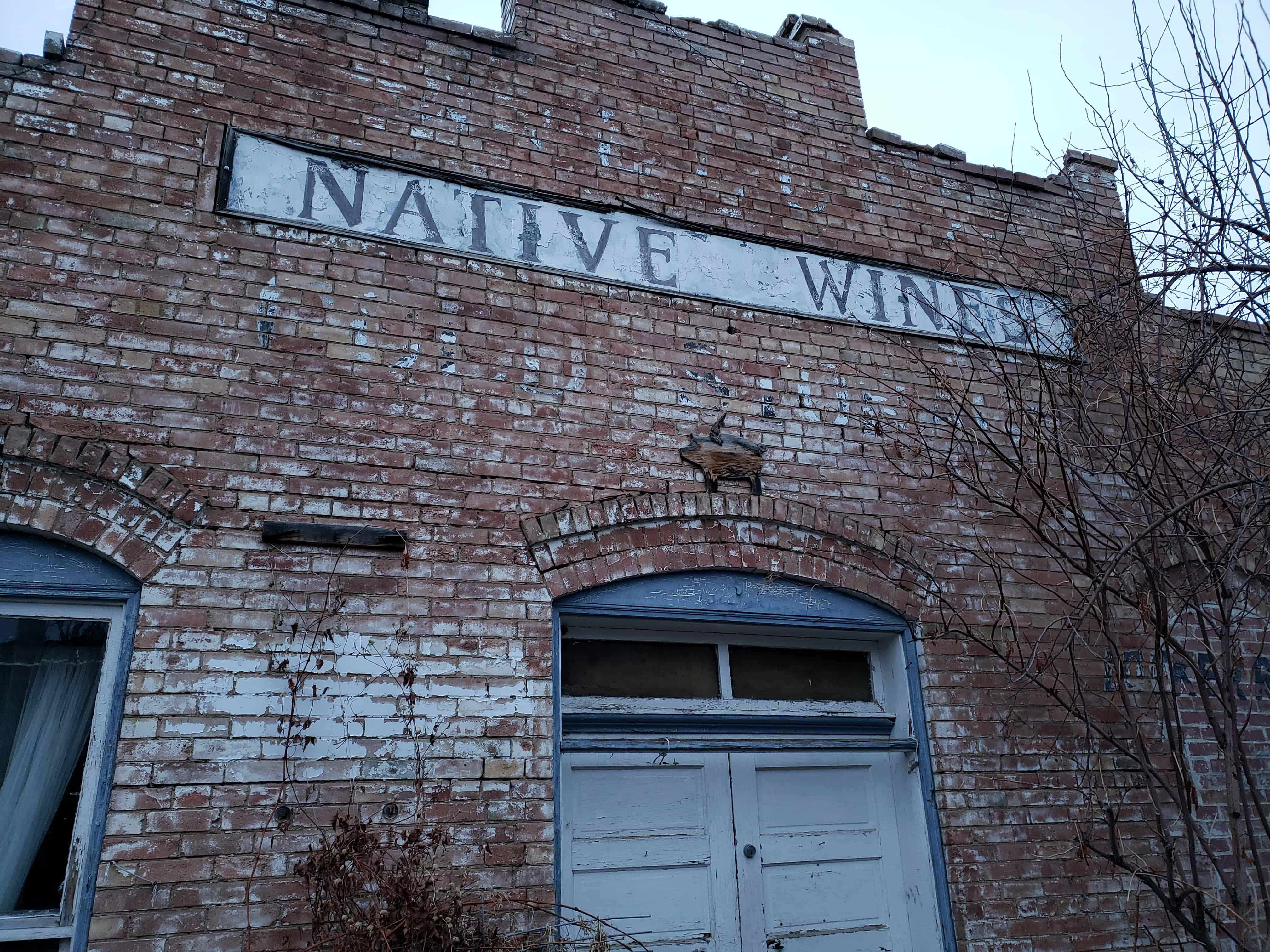
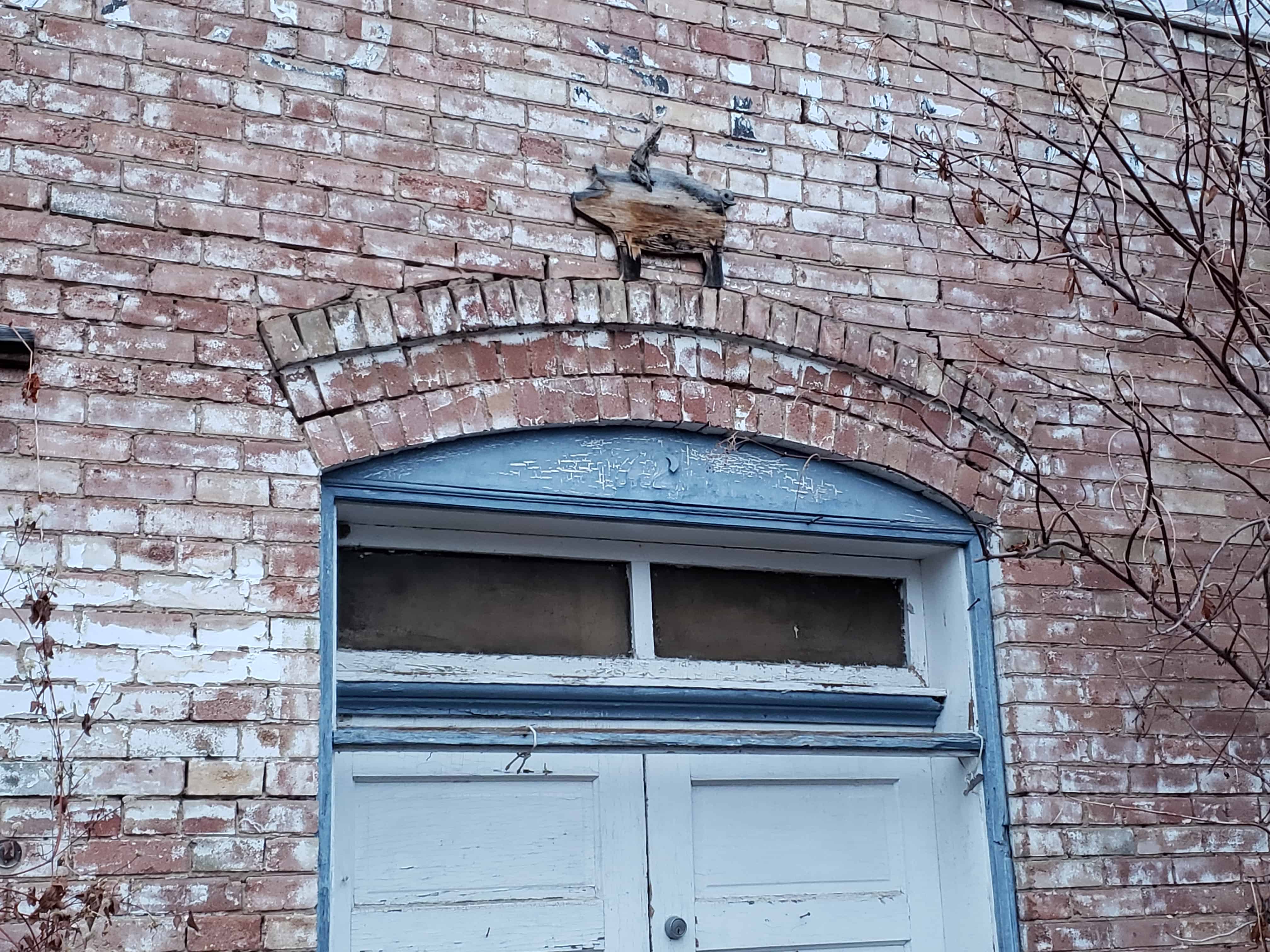
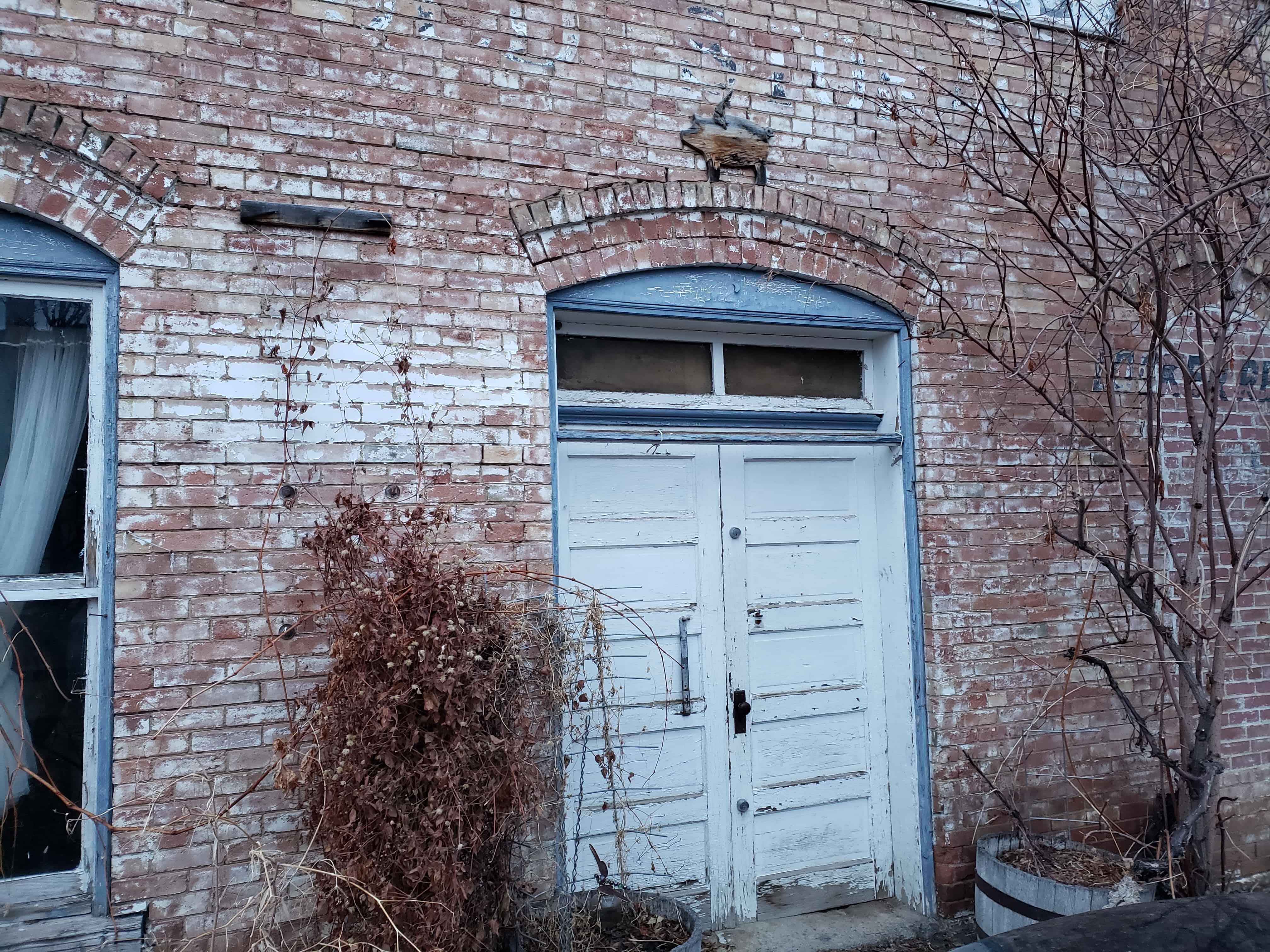
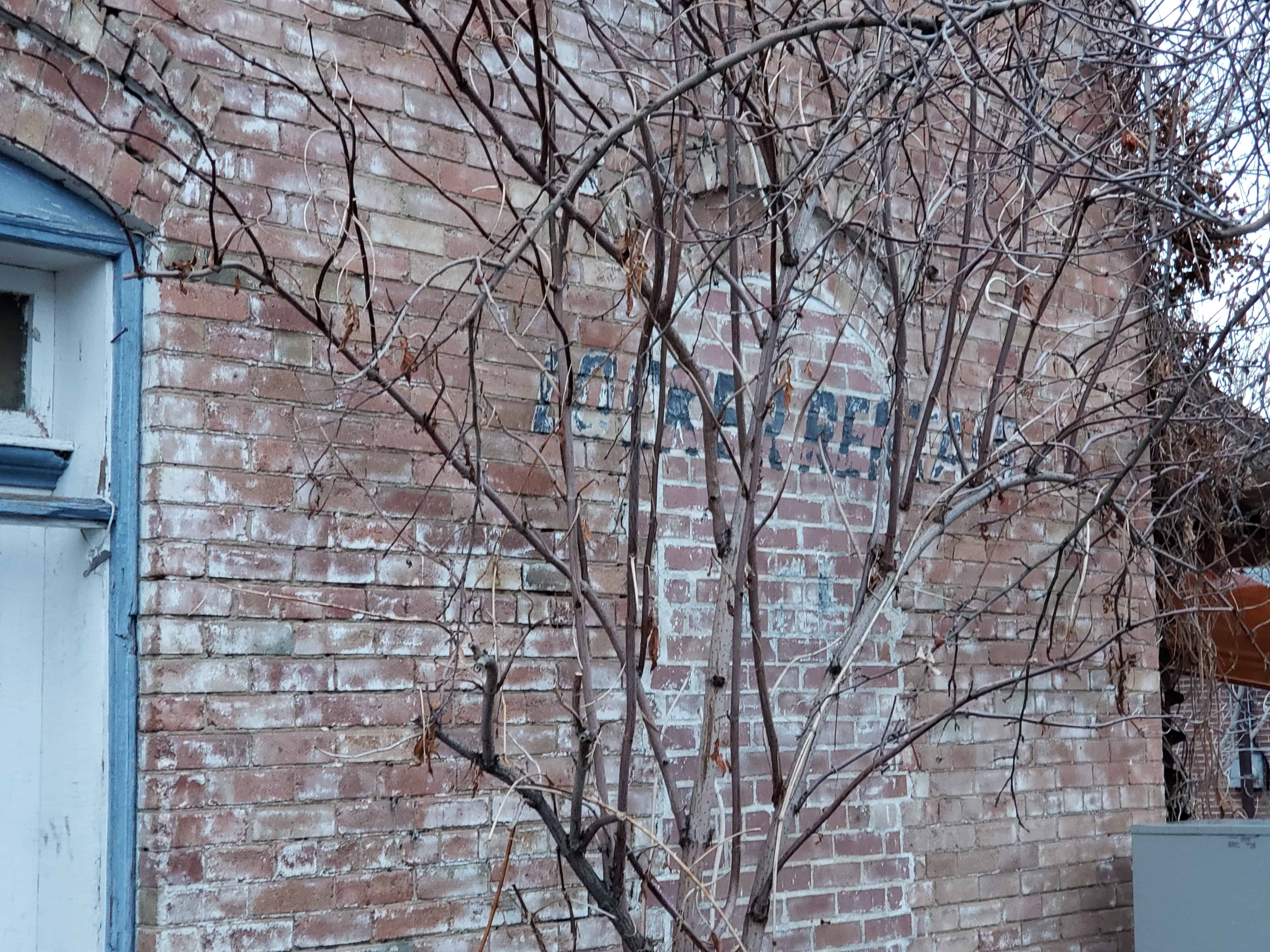
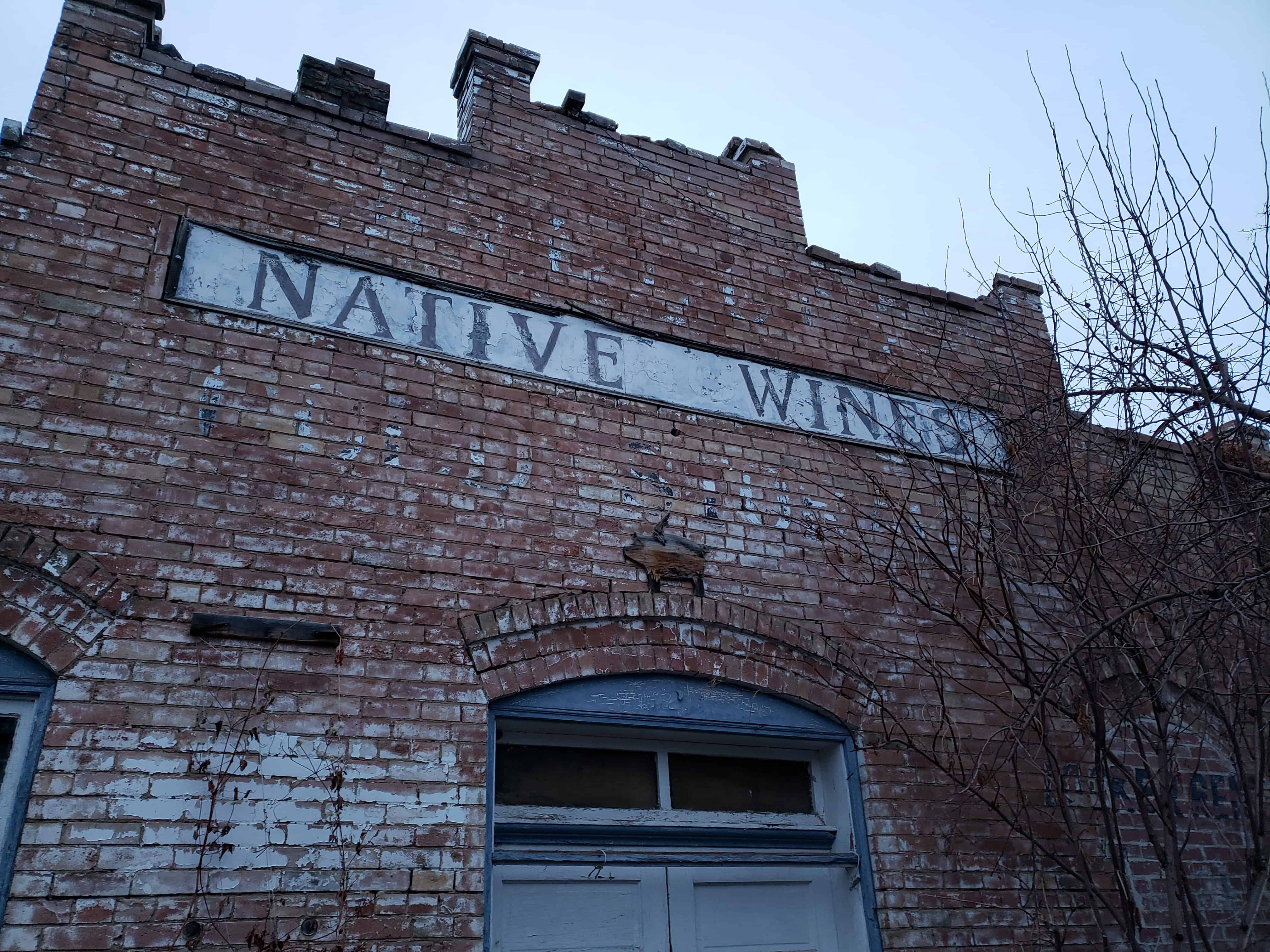
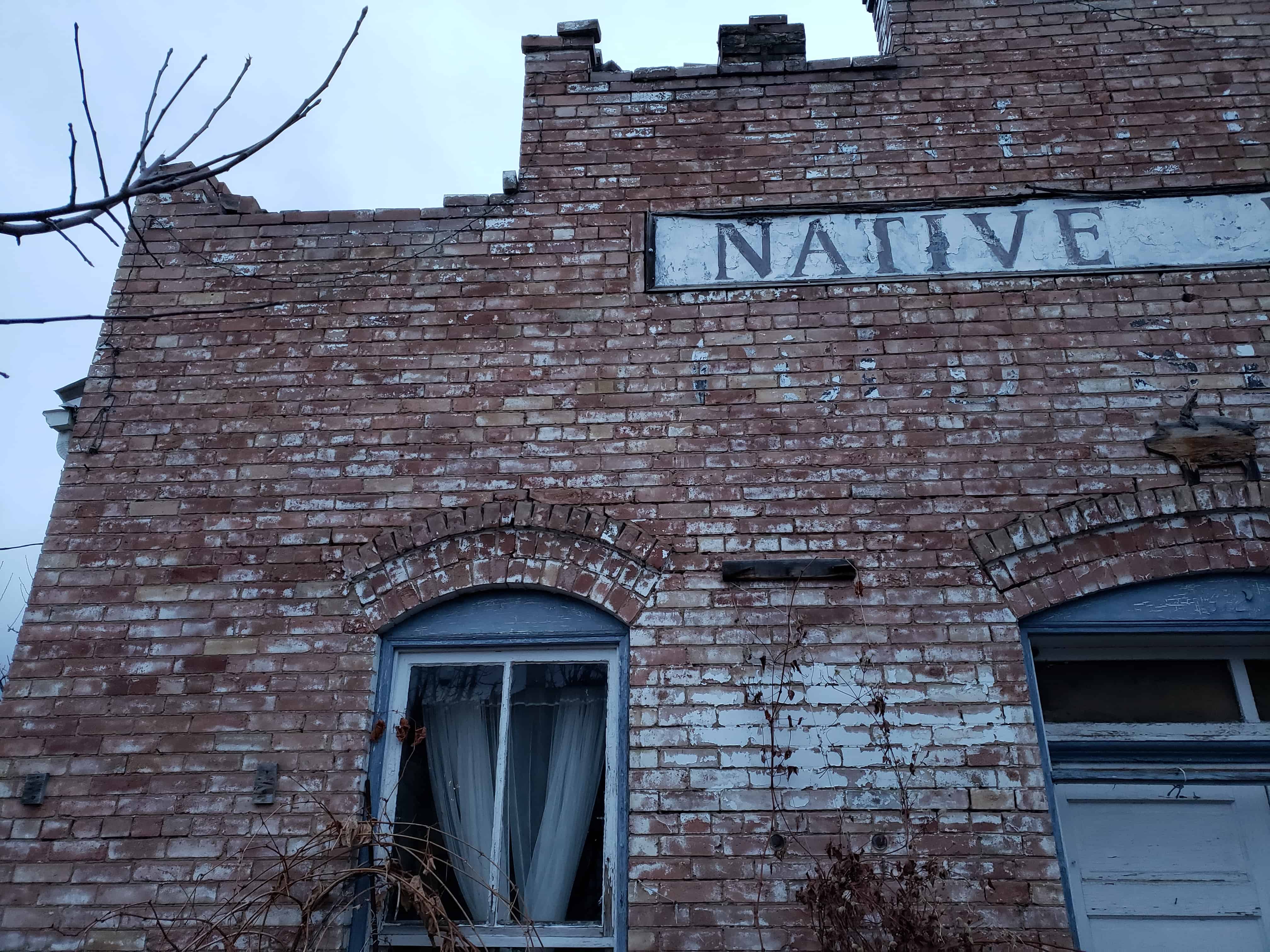
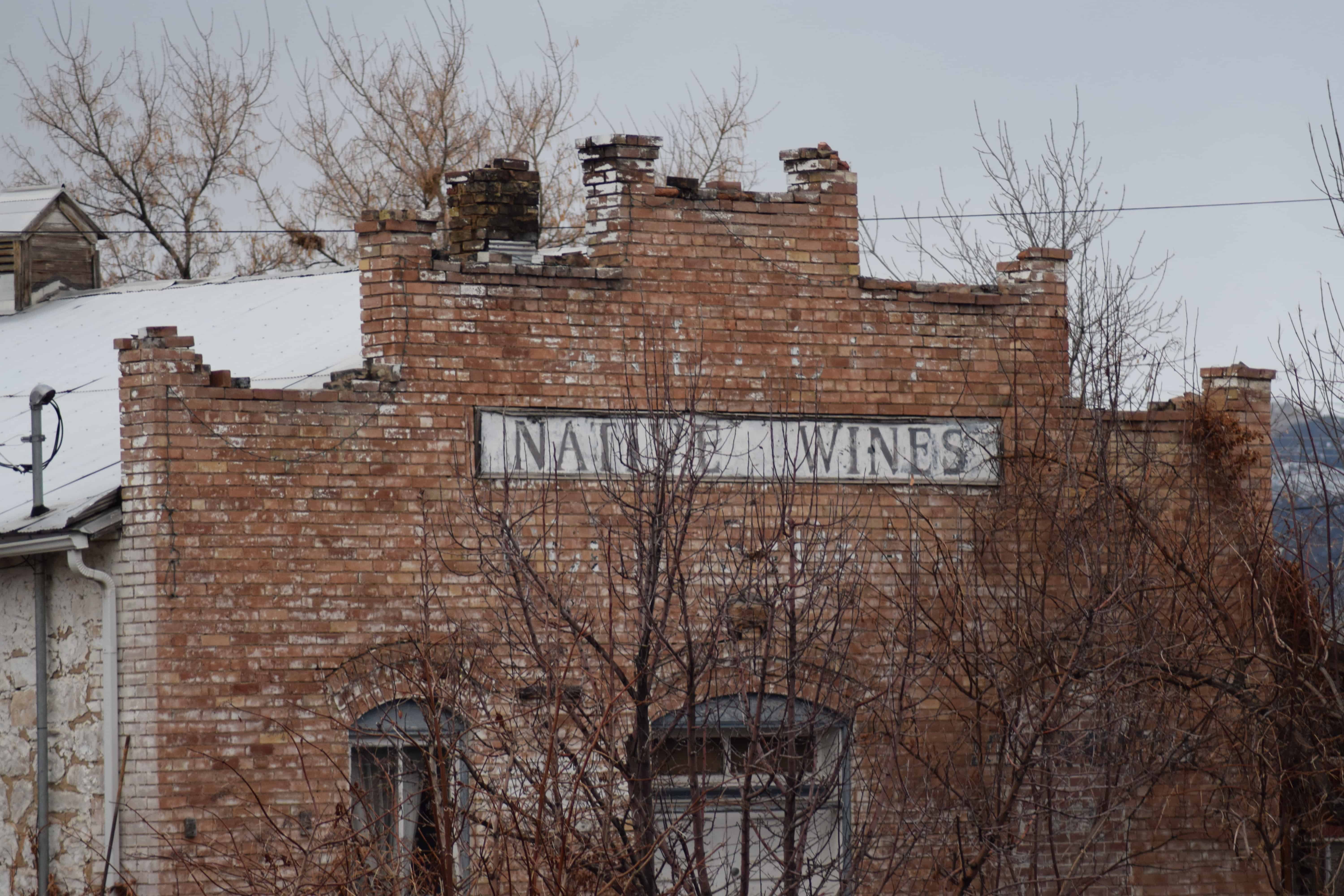
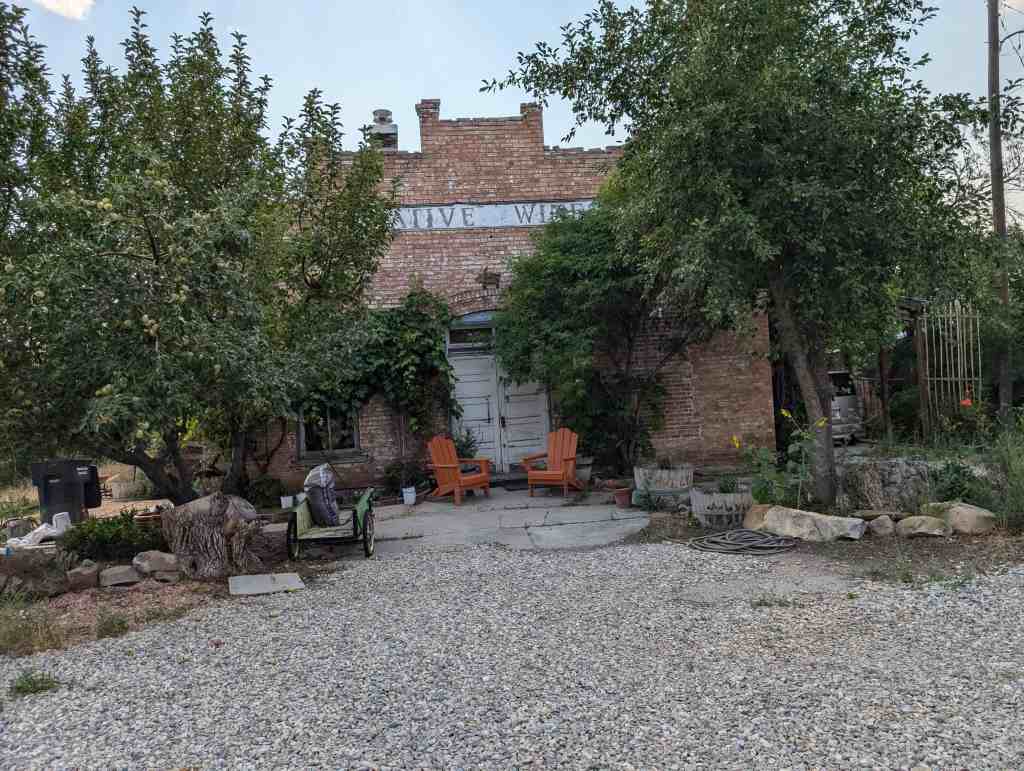
This one-story structure is one of several commercial and industrial buildings that once existed along the west end of Main Street. It was originally a laundry, built at the turn of the century by Wilford Peterson and Ole Hansen of sandstone and brick. It has a stepped front parapet wall concealing a gable roof. The right window has been filled-in but the exterior and interior otherwise retain their original appearance. The central double doors lead to a large, open interior room with wood posts supporting roof trusses. Beyond the original west wall is a masonry addition.
This business collected laundry from Spring City to Thistle using horse-drawn wagons. Here they made their own soap from local tallow, but the scarcity of tallow during World War I caused the closure of this laundry business. Since then, the building has served many uses including a store, a cheese factory, wool storage, ice skating rink, meat processing, cold storage, and wood shop. Many local residents have related childhood memories of gathering soda pop bottles and bringing them here to redeem for money or candy at the old fashioned penny candy counter in the store. It is currently owned by Native Wines.(*)
Located at 15 S 200 E in Fairview, Utah, the James Anderson house is architecturally significant as an extremely ornamented example of folk/vernacular house design. The 1 1/2 story hall and parlor home with wall dormers became a favorite building type for Utah builders in the 1860s, 1870s and 1880s. The basic house has been recorded in the state devoid of stylistic trim, with Greek revival features, Gothic finials, and with decorative features associated with later pattern-book Victorian thinking. The James Anderson house is a classic example of the latter”- the fusion of an older vernacular concept of house plan with an innovative (and quite speculator really) approach to external visual appearance. Given the potential for elaboration, the builder-architect of the Anderson House approached the extravagant. The controlling order of the old symmetrical folk model prevented excesses and the end result is a house of considerable elegance and beauty. (*)
James Anderson was a successful Fairview farmer and merchant and his achievements are mirrored in the fine house he built in the 1880s. Born in 1842, the son of Mormon converts, Archibald and Agnes Anderson, James came to Utah from Scotland with his family in the March of 1860. James married Hannah M. Cheney in 1866 and prospered as local farmer, ultimately acquiring some 70 acres of land and 3000 sheep. He was elected a member of the City Council, was president of the Fairview Co-op, was on the board at Fairview State Bank, was named a director of the Union Roller Mills, and held stock in the local creamery.
The James Anderson house in Fairview is an extremely colorful variant of the folk/vernacular “hall and parlor” house plan. Decorative effects are achieved here by using red brick trim against the dominate yellow brick background to define and dramatize the prominent features of the house.
The Anderson house faces west and is 1 1/2 stories high with a one story rear “T” extension to the east rear. The house’s main western section has four rooms in the normal hall and parlor “two-over-two” arrangement. The house is steedly gabled with a corbelled stove chimney placed slightly off center on the ridge. Porches occur on the sides of the frame one story rear “T” and a brick segmented bay protrudes from the north end. There is a hipped porch on the facade topped by a fine spindled balcony which is reached by the second level front door. The balcony woodwork is repeated on the side bay window. There is a symmetrical three-opening facade with upper wall dormers.
Stylistically the Anderson house is rather eclectic with the colorful red brick bordering its most distinctive feature. The house corners are solid red brick bordered by alternating yellow and red brick courses. This red-yellow marquetry is found around all the doors and windows and on the side bay. The window and door heads are segmented relieving arches with three rows of alternating red and yellow header courses. There are simple cornice returns on the gables. Both the end gables and dormer gables contain intricate fan-bracketing. The house remains unaltered and in excellent condition.
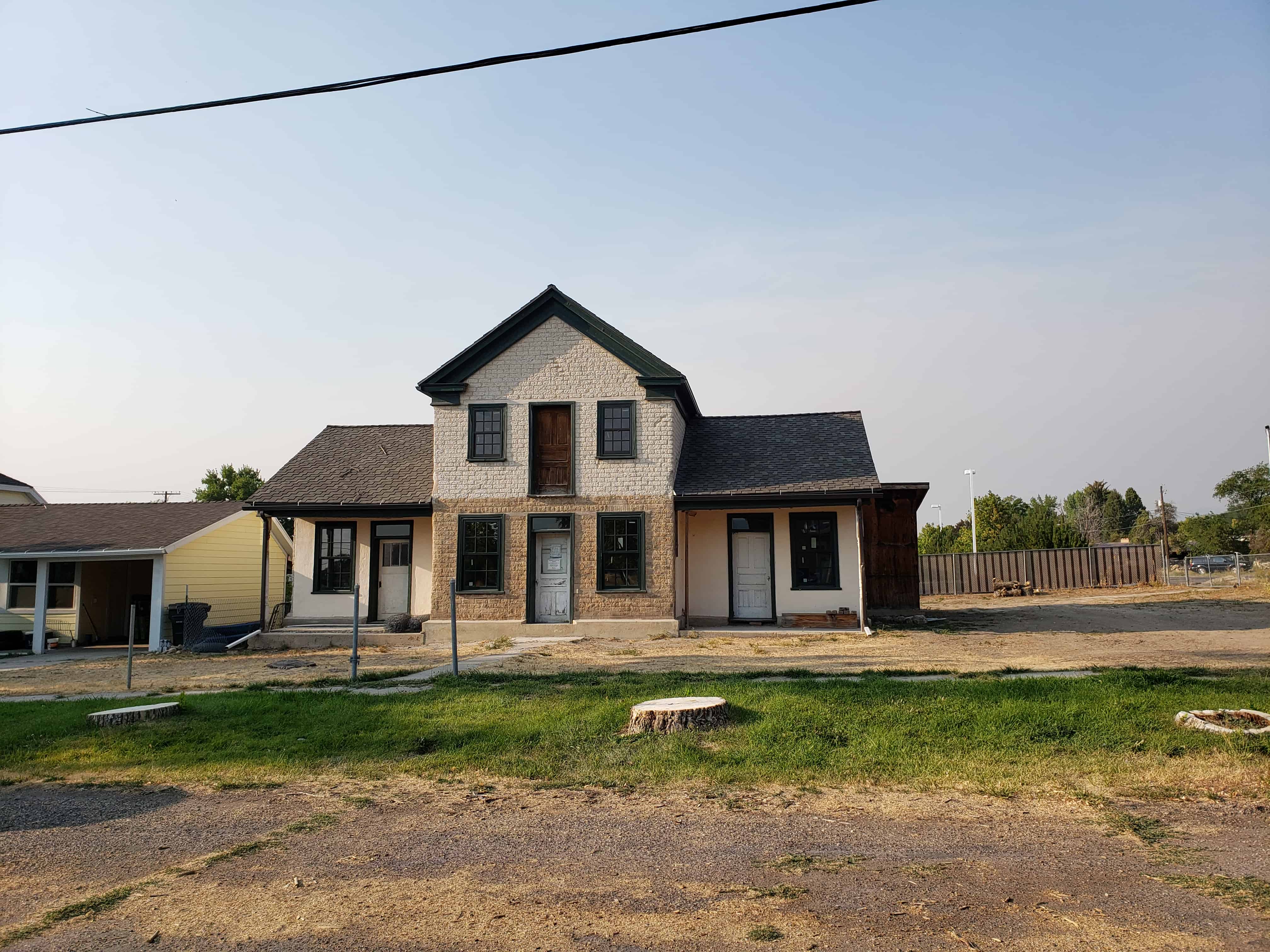
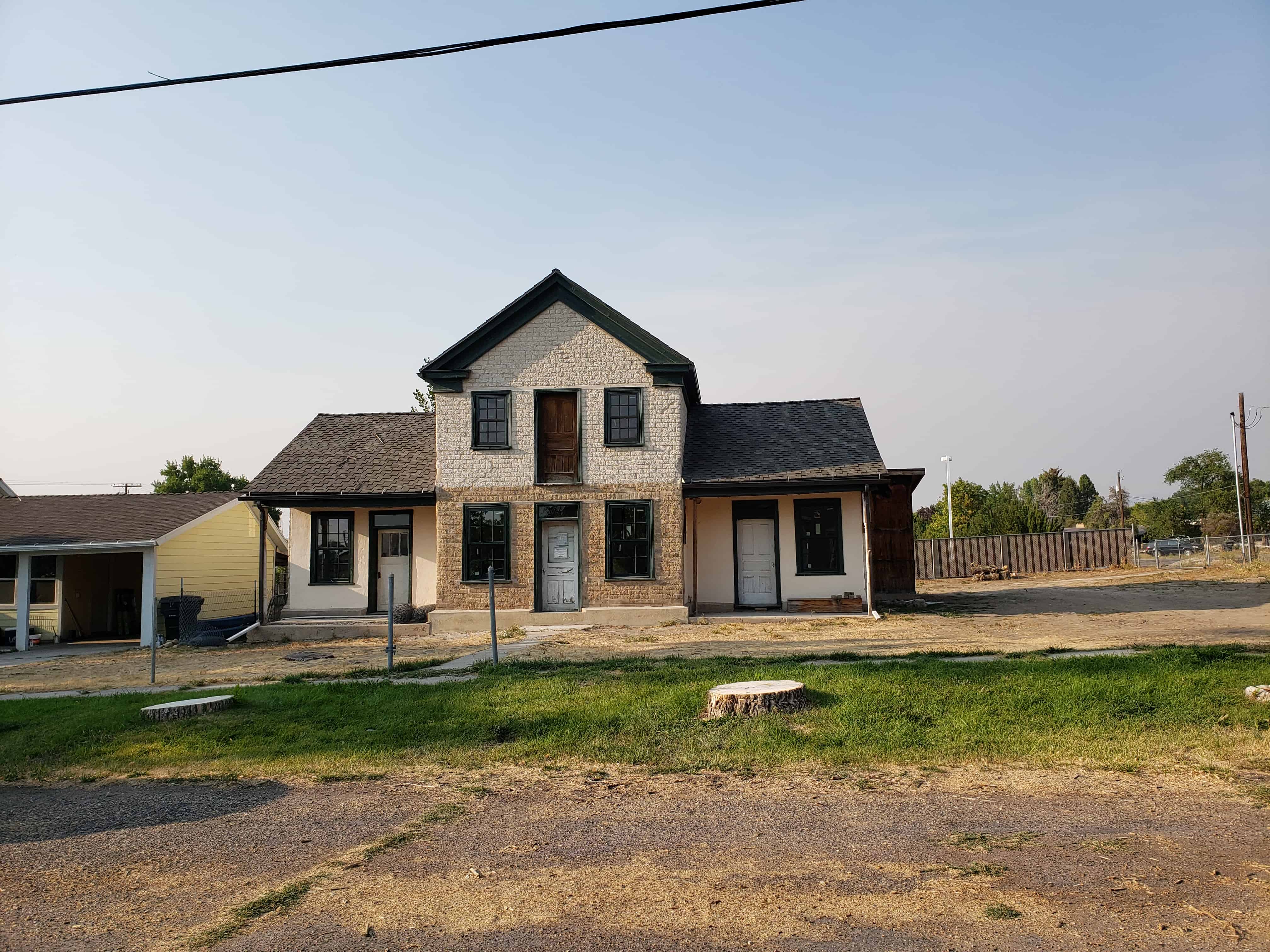
The Jabez Faux Home is significant as an excellent example of one of the first brick pioneer homes constructed in the Sanpete Valley. It is also important as the home of one of the community’s leaders of Moroni.
Jabez Faux was born in Yorkshire, England, March 16, 1837. He learned the trade of a fitter in a machine shop before joining the Mormon Church and emigrating to Utah with the Daniel Robinson Handcart Company in 1860, Shortly after his arrival in Utah, he settled in Moroni which had been established two years earlier in 1858. In Moroni he first built a dugout then a log cabin and finally the brick home in which he lived for over fifty-five years. Mr. Faux worked as a blacksmith for a short time after his arrival in Moroni before turning his attention to farming. He was director of the Moroni Cooperative Mercantile Institution established in 1868 as part of the Mormon Church effort to maintain economic independence in light of threats from the soon to be completed transcontinental railroad and non-Mormon merchants. Because of his long association with the Moroni Co-op, the store was closed in honor of Mr. Faux during his funeral in 1923. In addition to his economic pursuits, Jabez Faux filled many church .and civic positions including Sunday School Superintendent in the Moroni Ward for twenty years, Ward Clerk, and a member of the Board of Directors for the Moroni City Library and Literary Association. After Mr. Faux f s death in 1923, the home passed to members of his family but by 1950 was abandoned and remained unoccupied until 1970 when the Wilsford Clark Family purchased and renovated the home.
The Jabez Faux home is significant architecturally as the oldest known kiln-fired brick structure in its region. History leaves no evidence of the early brick-making industry in Moroni but the brick for the Faux home was probably manufactured locally inasmuch as the railroad did not come to the area until 1874 and transporting brick by freight wagon from northern counties was impractical, especially in light of the on-going Black Hawk War. It may have been the war itself that hastened the development of kilnfired brick, a building material much superior in its permanence to the adobe and wood then being used. Due to the active Black Hawk War, most pioneers in Moroni still lived in the fort. Jabez Faux may have felt the only way to reduce the risk of living outside the fort was to construct a sturdy home of the most permanent materials possible. A brick home built in 1867-68 was a significant advancement in technology for the Sanpete Valley region and nearly corresponded with the introduction of commercial-grade brick in Utah and Salt Lake Counties in 1863-64.
At a time when most homes were at best 1 1/2 stories in height, the 2 story “I-form” Faux residence was also advanced in its structure. While the 2/2 hall-parlor plan was not uncommon by the 1870’s, houses of two full stories and segmented arches in door and window bays were rare, just being introduced. The simple paired brackets and frieze, and scalloped bargeboards may have also found their precedent for the Moroni area in the Faux home. A feature which is definitely unique is the wall construction of the first story. There are seven courses of stone up to and including the course in which the sill stones are set. The remainder of the superstructure is brick. We can only speculate as to the reason stone was discontinued in favor of brick at the sill level. Fresh from England, Jabez Faux demonstrated a desire for residential refinement at an early period of colonial development and helped bring to an end the vernacular style which had previously pervaded the entirety of pioneer architecture in Moroni. (*)
Located at 74 North State Street in Moroni, Utah and added to the National Historic Register (#76001835) on November 7, 1976.
Next door to the south, the Jabez Faux Jr home is a beautiful red brick home. I saw this old photo of it online.
Built in 1934 and located at 313 S 100 E in Mt Pleasant, Utah.
David and Alta Lowry bought the home in 1962, see more on them here.
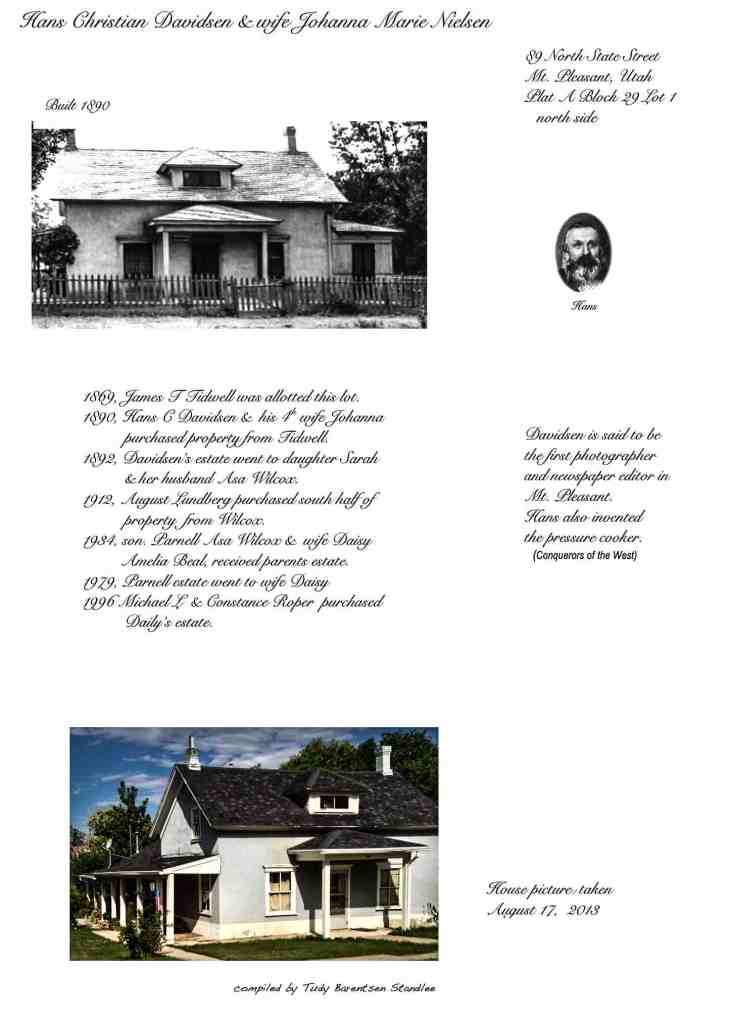
This timeline that was put together by Tudy Barentsen Standlee and the below story by Lee R. Christensen were both found on this webpage.
We started construction on the house we latter called “the white house” mid Spring 1934 and hoped to be in by school starting time or mid-September. Construction was delayed during the summer when our two carpenters, Charles Jacobsen and Ferry Peterson took time away from our job to help build the CCC camp. The Wright family did the cement work. Oscar Amundsen and Charles Christensen (Minnie Rutishauser’s father) did the brick work and the Bohne’s the plumbing and electrical. And we moved in just before Thanksgiving 1934.
Our architect was a Mr. Young from Salt Lake City and rumored within the family as a major architect on a number of LDS temples. He was unhappy with what he considered three major mistakes by our builders. The outside brick wall was to have been constructed with “weeping mortar” giving it a very rough look. While the mortaring is thicker than usual it is not weeping. The exterior 2nd floor walls went into the roof line by about 8 inches and had been curved up to meet the roof.
That curving was to have been carried out thru out the 2nd floor on the interior walls even though they did not need it to meet the roof. And the roof shingling was to have been given a wavy effect (I never knew how).
Our family lived here for 10 happy years with these artistic mistakes until we sold in 1945 to the incoming Superintend of Schools.
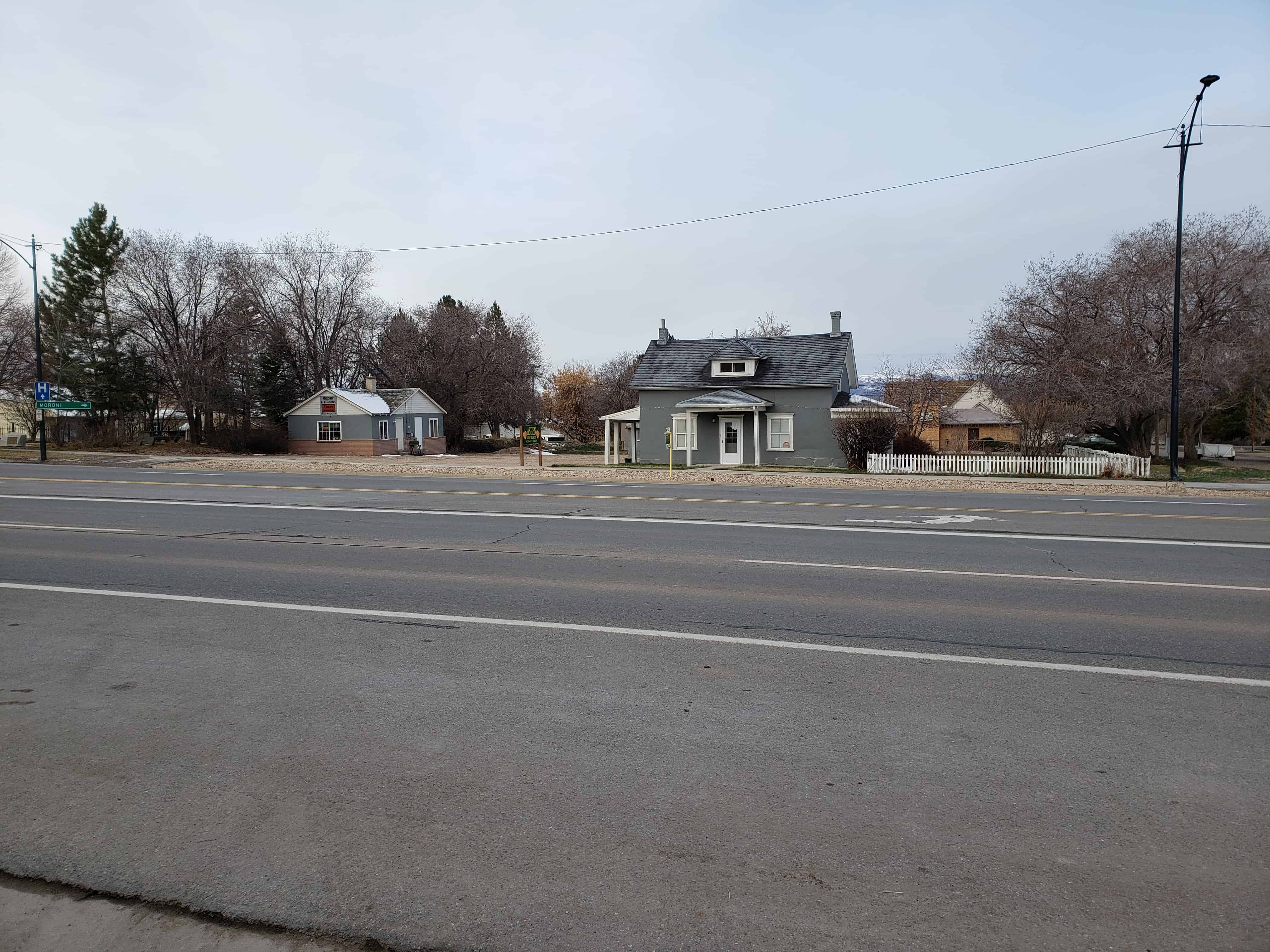
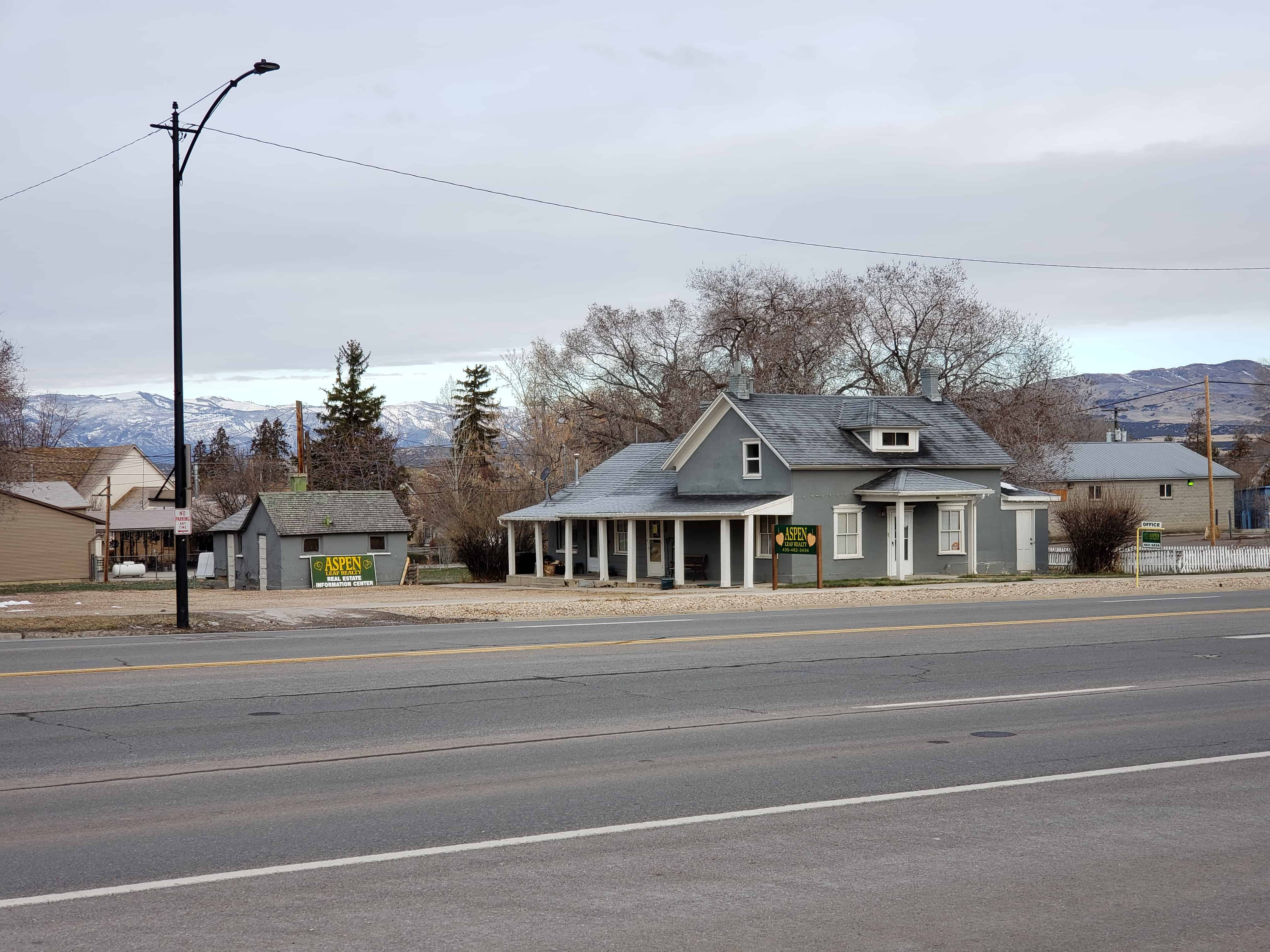
Built in 1890, the Hans Christian Davidsen and Johanna Marie Nielsen home is located at 89 N State Street in Mt Pleasant.
Hans invented the pressure cooker and was also the first photographer and newspaper editor in town. He was born in Denmark and moved to Mount Pleasant in 1866.
Built in 1887, this Victorian Eclectic two-story brick home is made of adobe covered with kiln-dried brick. The foundation is granite. It boasts a traditional bay window in the front and a more rare square bay window on the south. The bay windows are topped by balconies, which are still enjoyed today.
Heber A. Smith built the home with money from raising sheep, banking and selling goods to Bingham Canyon miners. He sold it in 1895 to Soren Rasmussen, an immigrant from Denmark, who was a successful merchant. He lived here until 1924.
From the beautiful woodwork inside, to the ornate brickwork outside, the home exemplifies the original owner’s desire to be surrounded by the best materials and finest craftsmanship of his time. The home is being restored by Craig and Dana Fisher.
Located at 211 N State Street in Mt Pleasant, Utah (209 North on the National Register), the James Staker home is a fine example of folk/vernacular building in the Sanpete Valley. The central passageway type house was built rather sparingly in the early period of local settlement (1850-1870) but became increasingly popular in the area through the late 1870s and early 1880s. The Staker house, while quite elegant in its own right, was typical of the homes that the more affluent members of the community were building during the later pioneer period. In the context of the vernacular architectural style, the Staker house assumes a position near the top of the economic spectrum and illustrates well the building needs of a particular segment of Mt. Pleasant’s 19th century population.
James Staker was born in Pleasant Grove, Utah in 1858, the son of Nathan and Elizabeth Staker. Nathan was an early (1837) Canadian convert to the Church of Jesus Christ of Latter-Day Saints who migrated westward to Utah in 1853. The Stakers moved in 1859 to Mt. Pleasant where young James was educated and raised a farmer. In 1880 James married and in 1881 purchased a building lot from his father for $200. The large brick home was probably built in the early 1880s as James established his family and farming business. In 1892 Staker organised the Planning Mill Company of Hansen, Staker, and Johnson to “manufacture rustic, ceiling, flooring, mouldings, with scroll sawings and turning.” The Staker house remained in the Staker family until the early 1960s when it was acquired by its current owner, Ms. Genevieve Coe Carroll.
The central passageway type vernacular house results from the 18th century marriage of an older two-room wide, one room deep traditional hall and parlor house with the Georgian stylistic preference for an internal entrance hall. The resulting house, two rooms and a hallway wide and one room deep, was distributed widely throughout the eastern united states and quite naturally moved to Utah in 1847. As a building type, it is found in all Utah communities though not in the quantities which some scholars have previously thought. In Sanpete, the central passage entrance hall was found during the early years of settlement only in the homes of the most wealthy and influential individuals. Its frequency increased into the 1870s and by the 1880s most of the larger brick homes – like the James Staker home – were equipped with the entrance hall.
The Ensign-Smith House in Paragonah, built in 1862, is primarily significant due to its association with Silas S. Smith, an important early Utah settler and the leader of the legendary “Hole-in-the-Rock” expedition of 1880 in which a small group of Mormon pioneers cut their way across what is now considered an impassable section of the Colorado River canyon. Listed in the National Register in 1982, the Hole-in-the-Rock trail and expedition has come to reflect the dedication and courage of a people who were convinced they were a part of a divinely inspired and directed mission to build a millennial kingdom of God in Utah’s Great Basin. The trail itself is an important symbol of the Mormon colonization effort in the West and although it came at a relatively late date in this history, the descent through the Hole-in-the-Rock and the struggle to construct a road through one of the most rugged and inhospitable sections of the United States illustrates the fortitude of the Mormon pioneer and serves as a vivid lesson to later generations of the importance of commitment and cooperation in meeting the challenges of their day. As the captain of the Hole-in-the-Rock expedition, Silas S. Smith achieved prominence in the settlement history of early Mormon Utah. He continued as a leader in pioneering endeavors, reportedly having established 35 different residences on the Mormon frontier. However, the Paragonah house, which he owned until 1882 is the only documented one that remains in Utah. The Smith house is also important as an unusually large and well preserved example of early Utah vernacular architecture–the original structure being a “double-pen” type (two rooms), with the later addition a “square cabin” type, forming an essentially new house.
Silas S. Smith was born October 26, 1830 in Stockholm, St. Lawrence County, New York. Born the same year that his cousin Joseph Smith Jr. founded The Church of Jesus Christ of Latter-day Saints, Silas S. Smith’s life was in the mainstream of Mormon history for its first eighty years until his death on October 11, 1910. His parents, Silas Smith and Mary Aikens, were early converts to the Mormon church. In 1836 the family moved to Kirtland, Ohio, the first gathering place for members of the new Mormon faith. Tying their own destiny to that of their relative, Joseph Smith Jr., the Silas Smith family participated in the move to Missouri and the Mormon expulsion from that state to Illinois. Shortly after the move to Illinois the family leader, Silas Smith died leaving Silas S. and Jessie N. to care for their mother.
Following the abandonment of Illinois by the Mormons in 1845, the mother and two sons moved with the main group to Winter Quarters, Nebraska. In 1847, during the first of year of Mormon emigration ot Utah, the family traveled West with the Parley P. Pratt company and reached Salt Lake City on September 25, 1847, two months after Brigham Young’s vanguard group had arrived.
Once in Utah, Silas S. Smith and his younger brother Jessie, (his house in Parowan was listed in the National Register on June 20, 1975) emerged as two of the stalwarts of the Mormon colonization process in the West. Both were continually on the edge of the Mormon frontier as it first pushed north from Salt Lake City into Davis County, then south two hundred miles from the Mormon capitol with the Iron Mission in 1851. Silas and Jessie constructed the first log building in Cedar City to help pay for the use of a home in Parowan, 18 miles away. The two brothers took up farms as part of the Mormon effort to establish an agricultural basis for the intended iron industry of that region.
In 1854 Silas Smith left his two wives both sisters Clarinda and Sarah Ann, to serve a two-and-one-half year proselyting mission in the Hawaiian Islands. After his return home Silas Smith moved to Paragonah, four miles northeast of Parowan, in the Spring of 1857. Here he served as bishop for several years and was elected to terms in the Utah Territorial Legislature from 1859 to 1878. While a resident of Paragonah,. Silas Smith served as a Captain in the Territorial Militia during the Black Hawk War of 1865-1866. During 1864 Silas’ two wives died within four months of each other leaving a total of nine children between the ages of 11 years and 3 weeks. A year later, on July 19, 1865, he married Martha Eliza Bennett who helped raise the nine motherless children in addition to her own twelve children by Silas S. Smith.
During the winter of 1878-79, Silas S. Smith was selected by Mormon church President John Taylor to lead a settlement effort to the San Juan country of southeastern Utah and southwestern Colorado. Accordingly Smith led a scouting party of 26 men, 2 women and 8 children southeast into Arizona then back northeast into Utah, reaching the junction of Montezuma Creek and the San Juan River at the end of May 1879. Here ditches were dug, a diversion dam constructed, crops planted, some cabins constructed, and the surrounding region explored for potential settlement areas before returning to their homes in Parowan and Paragonah in September 1879 via the Old Spanish Trail route through eastern and central Utah.
With word of a direct route to the San Juan River through Potato Valley, later named Escalante, Mormons from a dozen southern Utah communities traveled separately to a rendezvous at 40 Mile Springs. From here exploring parties were sent out to reconnoiter the untraveled route down to the Colorado River and across what most concluded were impassable canyons and cliffs east of the river. With the unfavorable scouting reports, Silas S. Smith faced a difficult decision to push ahead toward the San Juan River with limited supplies and equipment or to return to their homes and follow the circuitous northern route in the spring. Because snow in the mountains would make the return trip dangerous if not impossible, Silas S. Smith asked the group to push ahead. Leaving his assistant, Platte D. Lyman, in charge of work on the road, Silas S. Smith returned to the settlements where he secured 25 pounds of blasting powder, reportedly all that could be found in Southern Utah, and sent it to assist the construction work. In meetings with Erastus Snow, the Mormon Apostle directing affairs in southern Utah, and his brother Jessie N. Smith, both of whom were members of the territorial legislature, he secured their endorsement for a $5000 appropriation for blasting powder, tools, and payment for work on the road. During the winter of 1880 Silas S. Smith was bed-ridden with pneumonia and did not rejoin the San Juan Mission, or Hole-in-the-Rock expedition as it became known, until May 22, nearly two months after the group arrived at Bluff on the San Juan River.
Silas S. Smith had a broad vision of his responsibility as leader of the San Juan Mission. Looking beyond the borders of Utah, He made exploring trips into Colorado with particular attention to Colorado’s San Luis Valley. This southern Colorado valley with its small population of Spanish speaking residents and English speaking ranchers and miners, had drawn a group of Mormon converts from the southern states in 1878-79. Dividing his time between the Utah settlement at Bluff and those in Colorado’s San Luis Valley 250 miles to the east, Smith established a residence at Manassa, Colorado in 1882.
In 1883 two ecclesiastical districts were established and Silas S. Smith, who had jurisdiction for the entire San Juan area until the division, remained in charge of Mormon activities in the San Luis Valley until 1892. Smith returned to Utah in 1901 living in Layton, Davis County, until his death in 1910. In a state which withholds its deepest respect for its pioneers, Silas S. Smith was a pioneer among pioneers. He reportedly established 35 different homes or residences on the Mormon frontier. The Paragonah residence is the only one that remains in Utah from the era of his pioneering endeavors and as such is significant in understanding and documenting the settlement process of Utah.
This large adobe house was originally constructed by Marius Ensign, an early convert to the Mormon church and one of the original settlers of Paragonah. Ensign had come to Utah in 1849 and accompanied the first group of Saints called to open the Iron Mission in central Utah. Ensign and several other men moved to Paragonah in the spring of 1852, the site having been previously selected because of its abundant water supply and suitability for agriculture. By 1853 log cabins and several substantial adobe houses had been erected by the pioneers. Indian hostilities necessitated the evacuation of the town in the summer of 1853 and the community was not resettled until At this time a large adobe fort was constructed and the residents occupied small homes within its protective walls (the fort was located on the block directly across the street west of the Ensign-Smith house). The fort was utilized until about 1860 when a townsite was surveyed and settlers began to move out onto their new city lots to build. It was in the 1860-1862 period that Marius Ensign built the first part of this house, perhaps using adobes secured from the dismantling of the nearby fort.
The original house was a 1-1/2 story adobe structure measuring roughly 33′ x 17′ and consisting of two equal sized rooms on each floor. The rooms conformed to the vernacular “double-pen” type. The façade is asymmetrical because the front door had to be shifted to one side to accommodate the internal wall separating the two front rooms. As the house was nearing completion, Ensign was called by church leaders to settle further south at Santa Clara, in Washington County. The historical documents seem to indicate that Ensign left Paragonah shortly thereafter but it is not clear, however, what immediately became of the house. Silas Smith officially purchased the home from Ensign for $500 in 1872 and the use of the house during the ten years from 1862, when Ensign left for Santa Clara, to the time of the Smith transaction in 1872 is not known. It seems that Ensign could have left one of his plural wives in the home during this time, or that Smith could have bought the home earlier than the recorded deed indicates–not an uncommon practice in Utah during the early years of settlement.
Silas Smith had moved to Paragonah in 1857 and soon became a leader in both church and civic affairs. Plat records for the early 1860s show that Smith owned the city lot just east of Ensign’s house so that the purchasing of the home required a move of only a short distance. Smith soon added a 1-1/2 story adobe section to the north end of the original home. This new addition gave the house its unusually long appearance and was remarkable compatible with the design of the original section. It was at this time that the other adobe sections were added to the rear of the home. Also, a small frame post office was attached to the southeast corner of the house to serve Smith’s duties as town postmaster. After his call to the San Juan Mission, Smith sold the house in 1882 to William H. Dame, another of Paragonah’s original settlers and one of its leading citizens. The Dames held the property until 1902 when it was purchased by William McBride. The house remained in the McBride family until 1976 when it was sold to Girald Smith. It was at this time that the house was remodeled on the inside and some changes were made to the rear exterior fabric. Such changes do not affect the historic integrity of the dwelling.
The Alma Staker house is significant on the basis of its architectural style and plan. The Alma Staker house is one of the two best (now the only) extant examples of the Greek Revival-inspired “temple form” vernacular house type in Utah. Early photographs and documents indicate that the “temple form” plan was quite popular in Salt Lake City and other early settlements, yet few of these structures have survived into the 1970s. While other “temple form” houses can be found in Utah and parts of Idaho, the Alma Staker house is the most complete rendering of the house form. The early building date and use of unsheathed adobe make the house additionally important as an example of early vernacular building in Utah.
During the late 18th and early 19th centuries, American architects self-consciously rejected older English-derived styles and in democratic enthusiasm embraced the classical ideals of Greece. The early 1800s witnessed the growth of the Greek Revival architectural period in American building. While the classic style was used primarily for public buildings, domestic architecture in New England was dramatically influenced by classical motifs. A favorite house developed in the Northeast “with a pedimented end toward the street.” This house is often called a “temple form” house, because pf its similarity to Greek monumental architecture. The Greek Revival called for a “monumental type of house with a two-story central body fronted with a pedimented portico arid flanked by one-story wings.”
This “temple form” house is seen in New England areas usually as a magnificent dwelling fronted by colossal columns. Its popularity, however, carried it into upstate New York in the 1830s where the house was geared down to a modest gable-façade-type house. The type was initially considered a “town house,” but after its widespread acceptance came to be a common farm dwelling all along the northern frontier. Full-blown, the house has a central unit flanked by two side wings. Variants of the temple form house can be found with only one or even no side wings. While the early temple form houses had the main door on the central unit, a modified version of the house which moved the door on to the side wing became increasingly popular during the mid-19th century in the northern Midwest.
The above text is from the National Register of Historic Places, it was nominated (#79002509) July 9, 1979 and is located at 95 East 300 South in Mt Pleasant, Utah. for a few years I lived just across the parking lot from it and watched as they remodeled over 2019 and 2020. Continuing on below is more from the nomination form:
Members of the Church of Jesus Christ of Latter-day Saints were familiar with the “temple form” house in upstate New York, they knew it at Kirtland, Ohio, and built numerous examples at Nauvoo. The Vinson Knight House and the Aaron Johnson houses at Nauvoo are all examples of this house-type which do not have side wing extensions. Brigham Young’s stepped gable façade Nauvoo house has the internal floor plan associated with the temple form house even if it lacks external Greek Revival treatment.
The Mormon exodus to the Great Basin brought this familiar house plan-now deeply imbedded in the folk building tradition to Utah. The modified temple plan, with the front door on the side wing, is the variant of the house plan which is found most readily in Utah. Gable-façade houses consisting of only the center unit are also encountered in parts of Utah and Idaho, but the full blown temple plan with side wings is quite rare within the state’s borders. One house at Willard conforms to the plan but lacks the central gable door. The Jacob Houtz House in Springville and the Alma Staker House in Mt. Pleasant are the only two fully realized temple form houses which have been located in the state. As one of the main vernacular house types imported to Utah, these houses are significant as rare but important segments of the historic landscape. In Sanpete County, an area rich in vernacular building, the Alma Staker house is singular in its form and construction.
The Alma Staker house speaks historically in a number of ways. It illustrates dramatically the syncretism of established eastern tradition (the house form) with novel western environment (the use of adobe construction). It at once demonstrates continuity and change, two essential elements of Mormon settlement in Utah. The house also helps to document the range of variation within the Mormon building tradition. This house, taken along with the many central unit and central unit and wing variants also found in the area, helps paint a picture of the rich diversity found in Utah’s early architectural heritage.
The Staker family was originally from Canada. Nathan Staker, Alma’s father, was born in 1801 on a farm near Cataquera, Ontario Province. Nathan studied as a youth to be a Methodist minister and in the early 1830s was converted to Mormonism. Nathan joined the gathering at Kirtland with his wife Jane Richmond. In 1837 their fourth child, Alma, was born.
Richmond. In 1837 their fourth child, Alma, was born. In March of 1838 the family removed to Jackson County Missouri. On the journey to Missouri Nathan found work at Springfield Missouri and the family remained there until moving to Pike County in Illinois just south of Nauvoo.
1846 found the Stakers at Pigeon Grove, Iowa. Nathan’s wife Jane Richmond died of smallpox. In 1852 as the family was preparing to move west. Nathan took his family to Pleasant Grove in 1853. Nathan Staker remarried here to Eliza Cussworth Burton in 1857.
Alma Staker found a bride in the previous year, marrying Elizabeth Young in 1856 at Mt. Pleasant. Alma received the patent deed to the lot where the house now stands in 1870 but possibly could have been living on the lot much earlier. The 1853 attempt to settle Mt. Pleasant was thwarted by Indian hostilities and the first permanent settlement did not occur until 1859. The fort was built that year and activity centered around its protective walls until the late 1860s when a “Co-op” store was organized (1867) and the city incorporated (1868). While dating the Staker house cannot be precise, it seems that the dwelling was probably completed in the early 1870s.
Staker was a sawyer, carpenter, and farmer and was a United Order member and a high priest in the Church of Jesus Christ of Latter-day Saints.
In 1907, the Staker family sold the house to Charles Augusta Jones for $500. Charles married Augusta O. Madsen in 1895 and Carole J. Burton, the present owner, is their daughter.
The temple-form house was found primarily in an area which changed dramatically during the late nineteenth century, consequently very few of these houses survive today. The pure temple-form was often modified in a number of ways. The most common type is referred to as a “modified” temple form in which the door is set in the side wing. Another variant of the house type is evident in the Staker House. The door is centered on the gable façade, it does not have a central or side passage, and may or may not have side wings (see plan). The Staker House is one of only two houses (now the only one) identified in the state to have a door centered on the gable façade and two side wings. The other example is the John B. Kelly House (422 S. 200 W. in Salt Lake City), also listed in the National Register.(*)
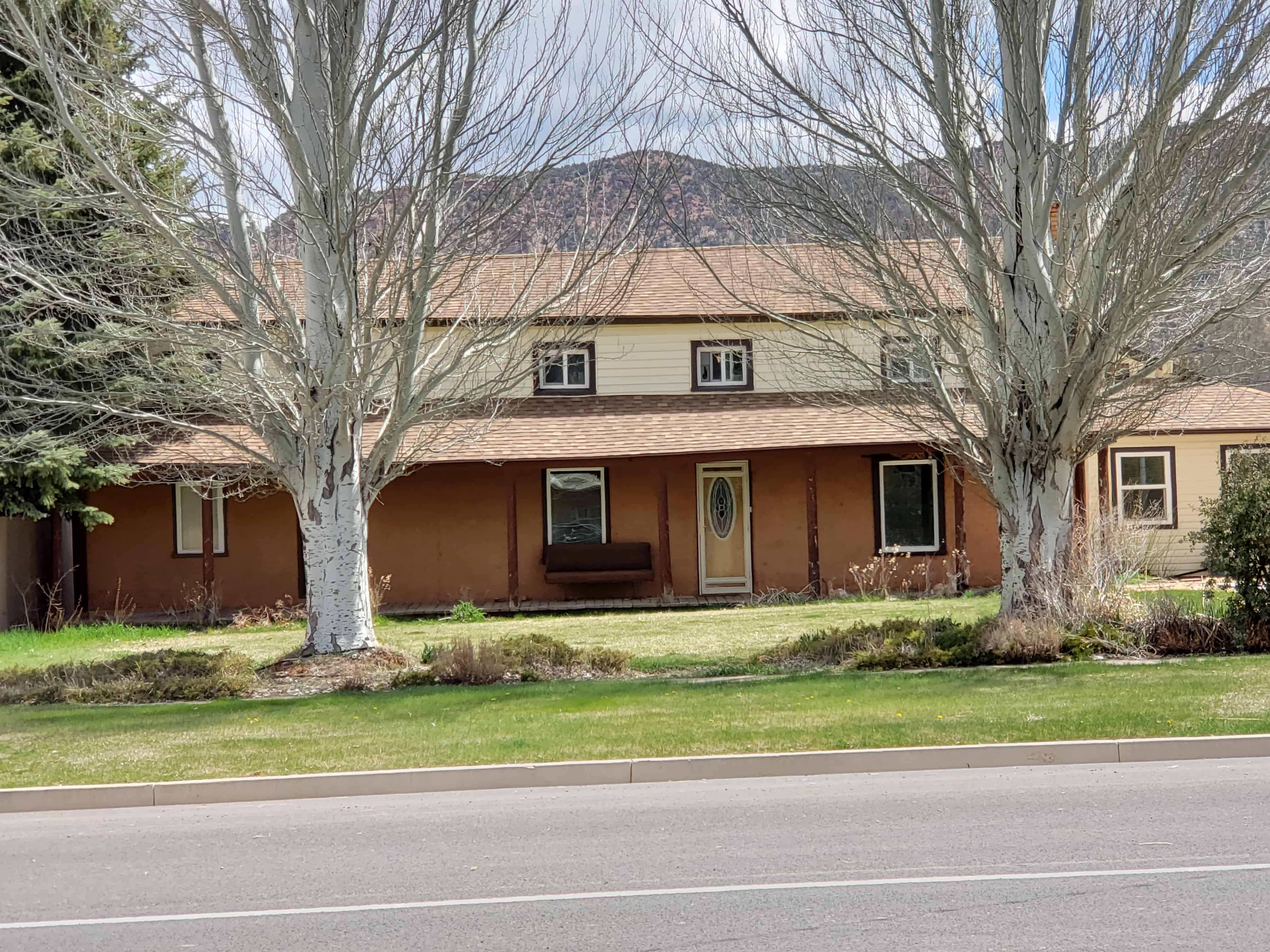
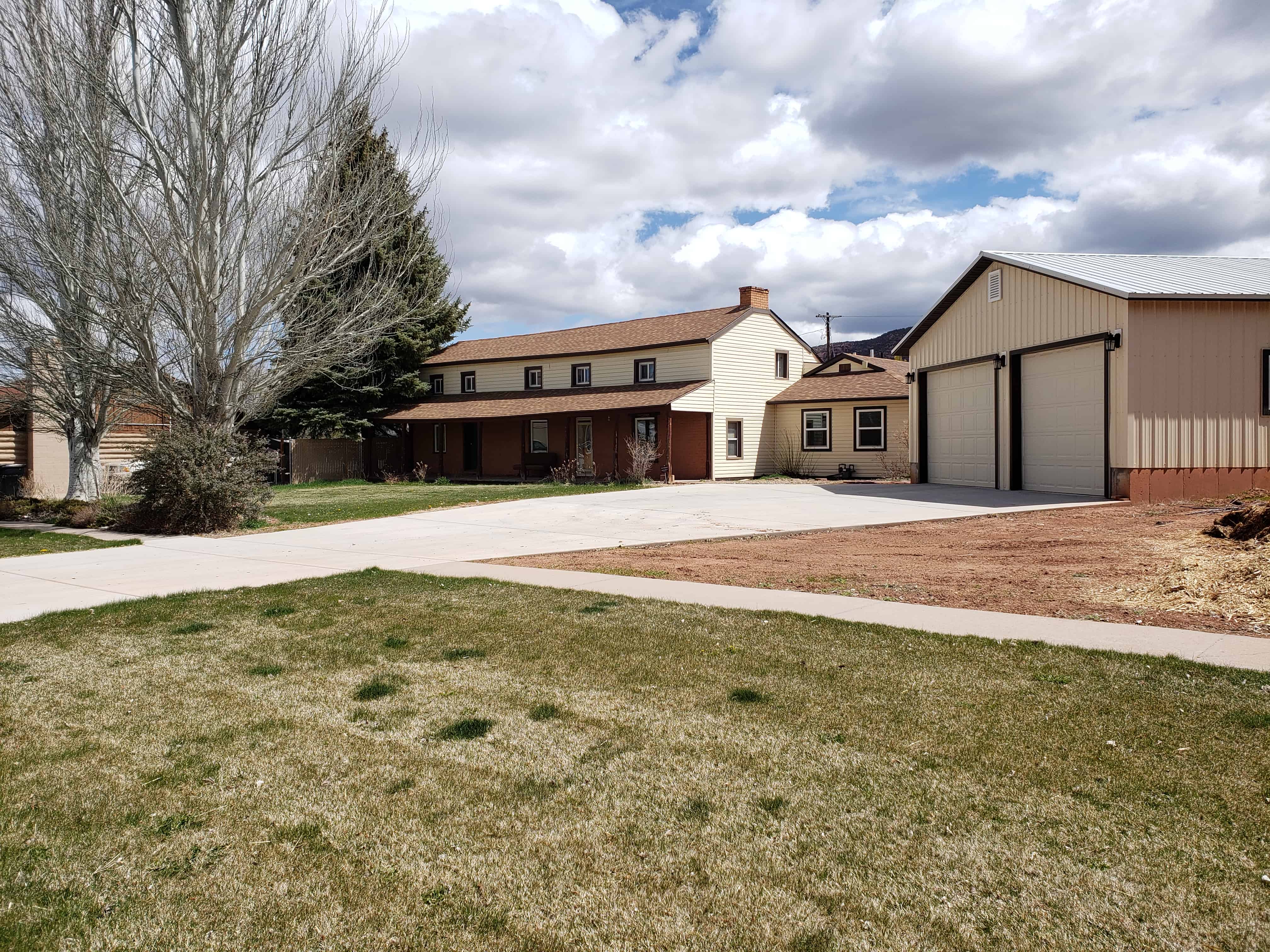
This house was constructed circa 1860s by Frederick Christian Sorensen and his Norwegian wife, Emelia Cecille Marie Flinto. They were some of the first Scandinavians converted to the LDS Church by Elder Erastus Snow. In 1853, with two children, they emigrated from Denmark with the John E. Forsberg Company. That first winter they lived in a wagon box in Manti. In spring if 1854, Frederick was listed as one of the first settlers who helped build Fort Ephraim and lived in a “little house” in the fort.
This 1 1/2-story house is an American variant of the older Scandinavian folk house or “Pair House” type. Built of adobe, the house was covered with red adobe plaster and scored to resemble brick. Frederick was a polygamist so the house was built to accommodate at least two families. It has a central “best room” flanked by a smaller room on each side. The three rooms give this house its “Pair House” or “Parstuga” name. The house has a second story that is reached by two steep stairways on each side. In the rear, a long kitchen adjoins the three main rooms. The roofing system is a heavy timber technique with axe-hewn rafters, rarely found in Sanpete County. Frederick was a skilled blacksmith and crafted hinges, hooks, and latches in the home.
The home’s tall front door was open to many early pioneers, who made their way through Ephraim during its early history. Unaltered through many generations, except for the exterior veneer, this enduring home is an important example of Scandinavian heritage in Utah.
Frederick Christian Sorensen’s marriages that resulted in 22 children: