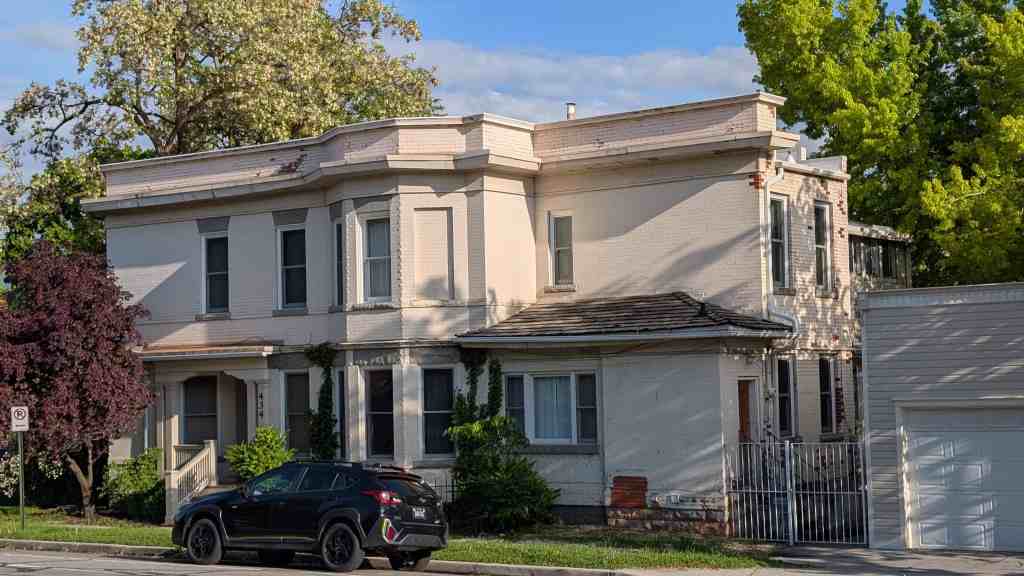
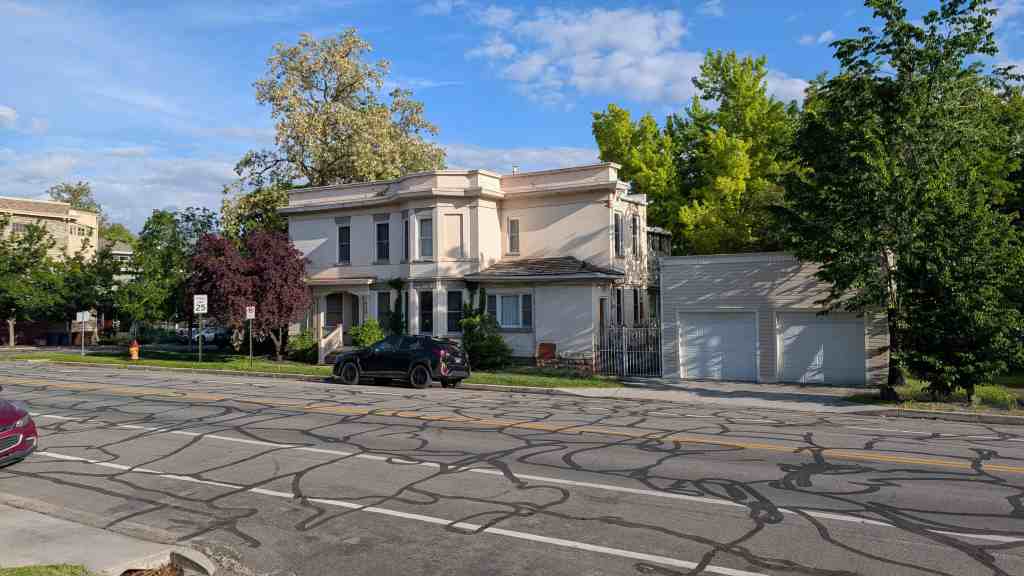
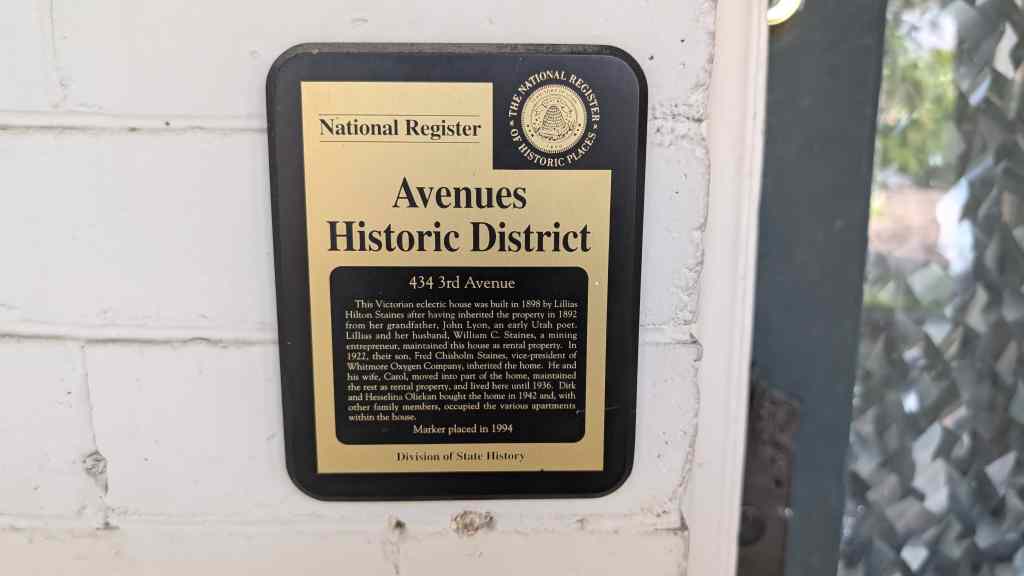
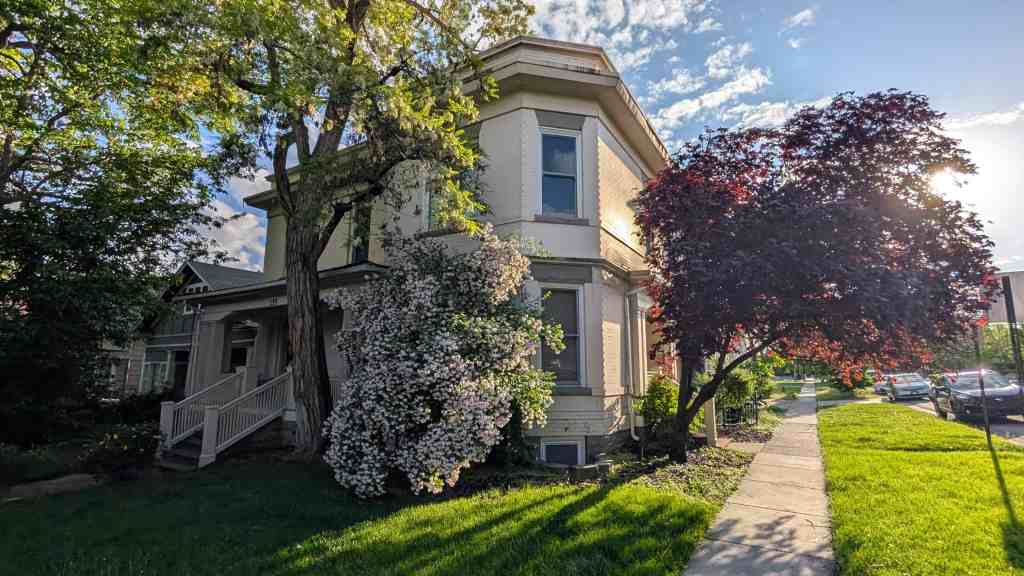
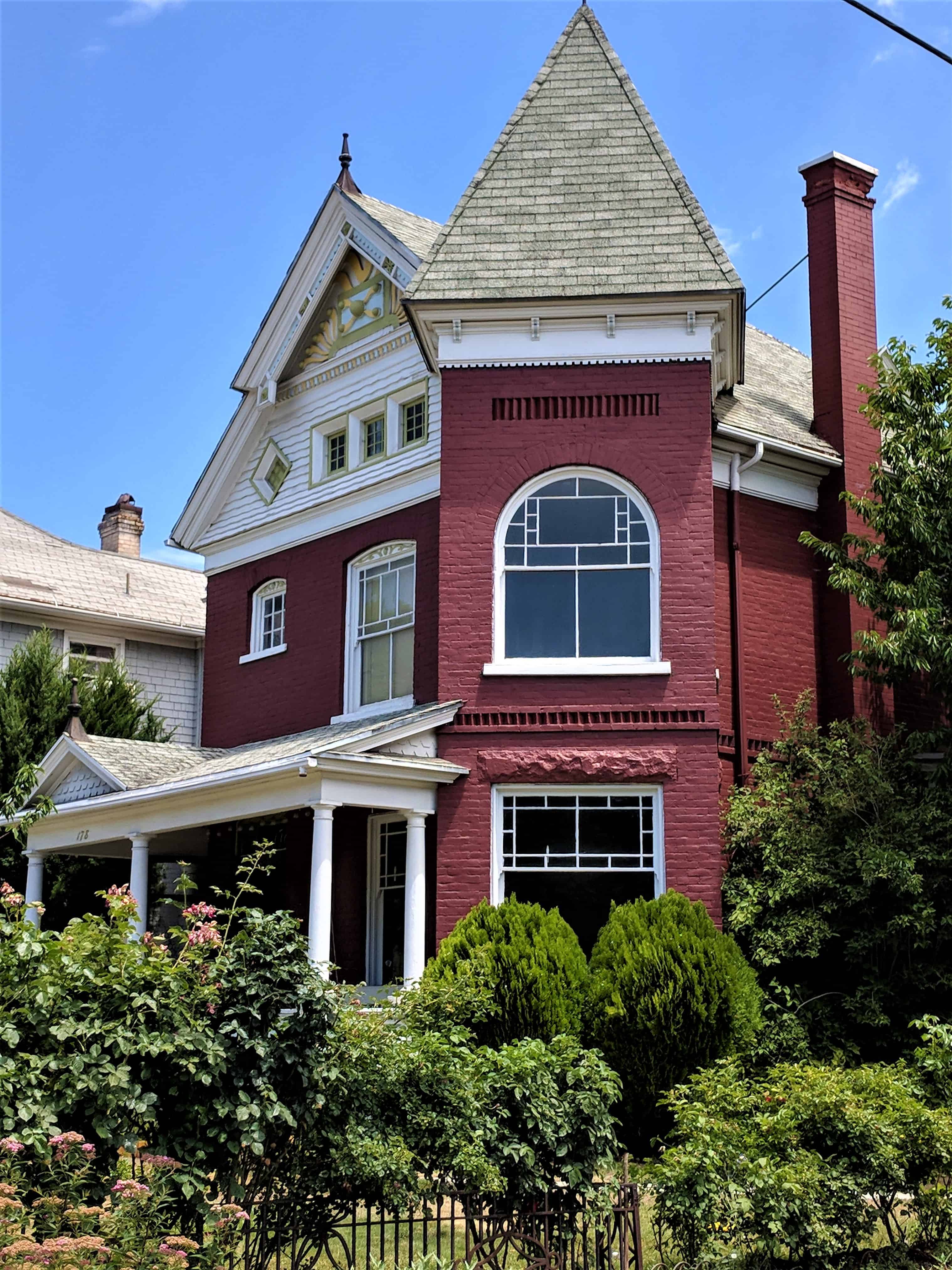
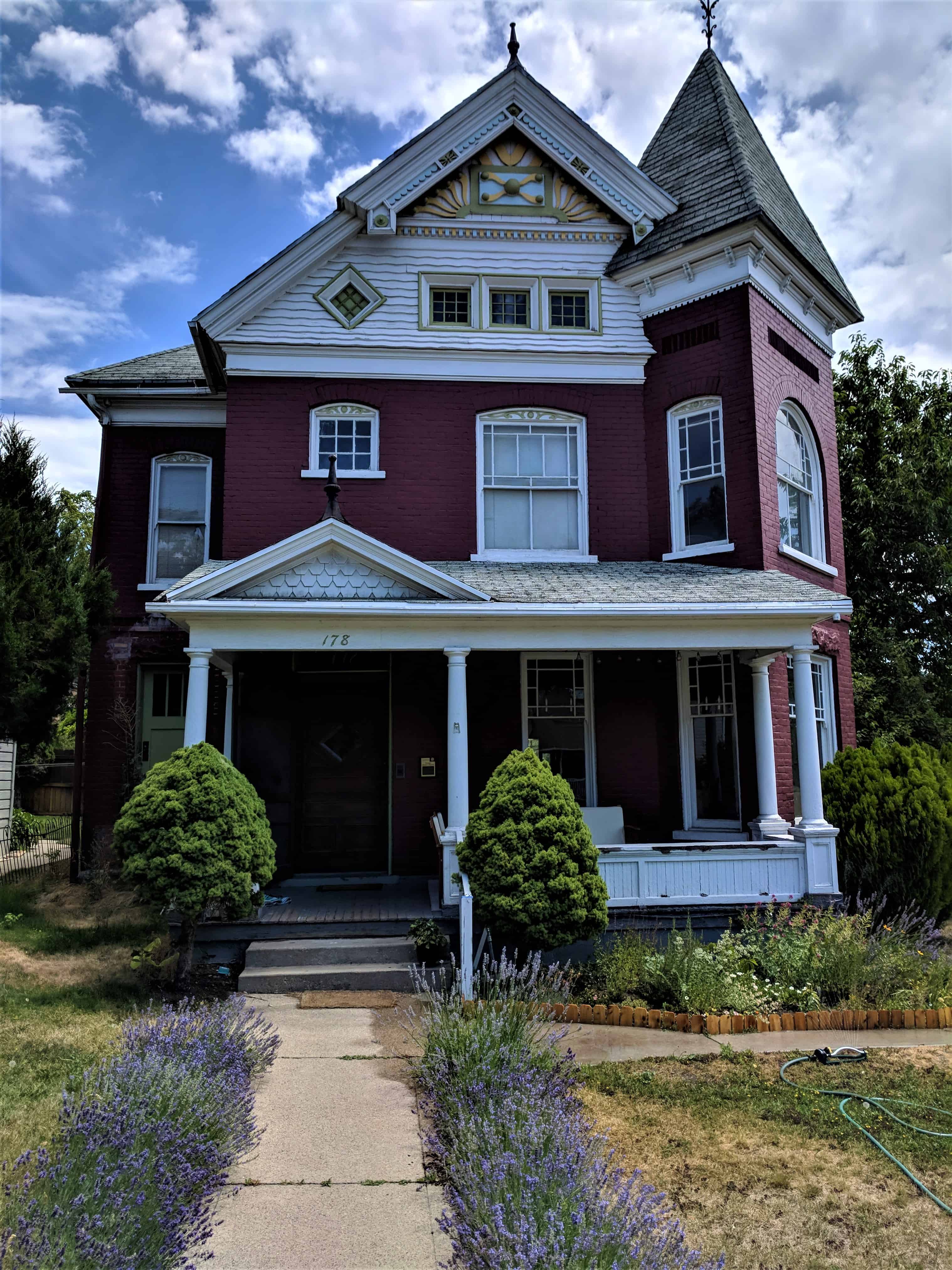
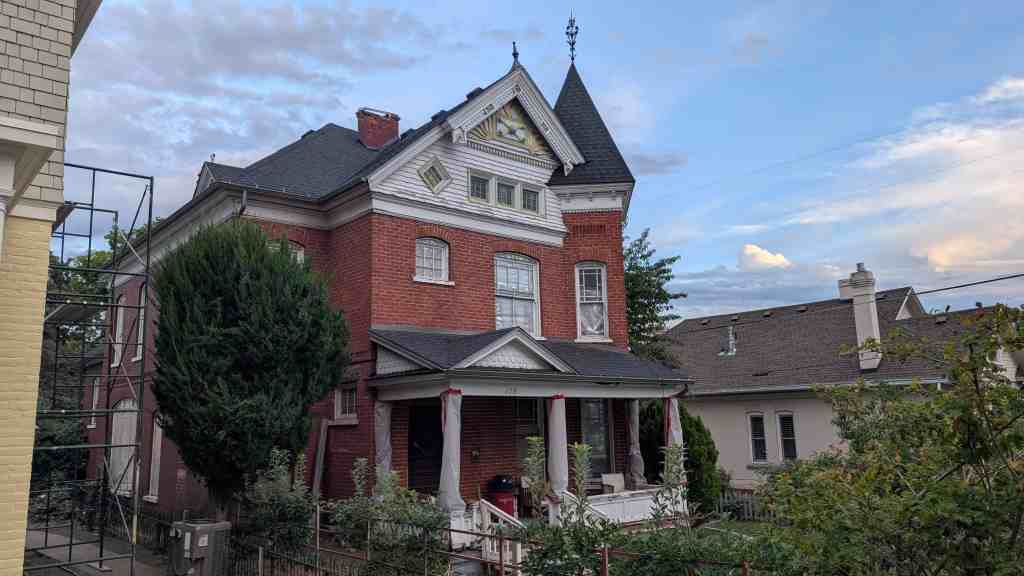
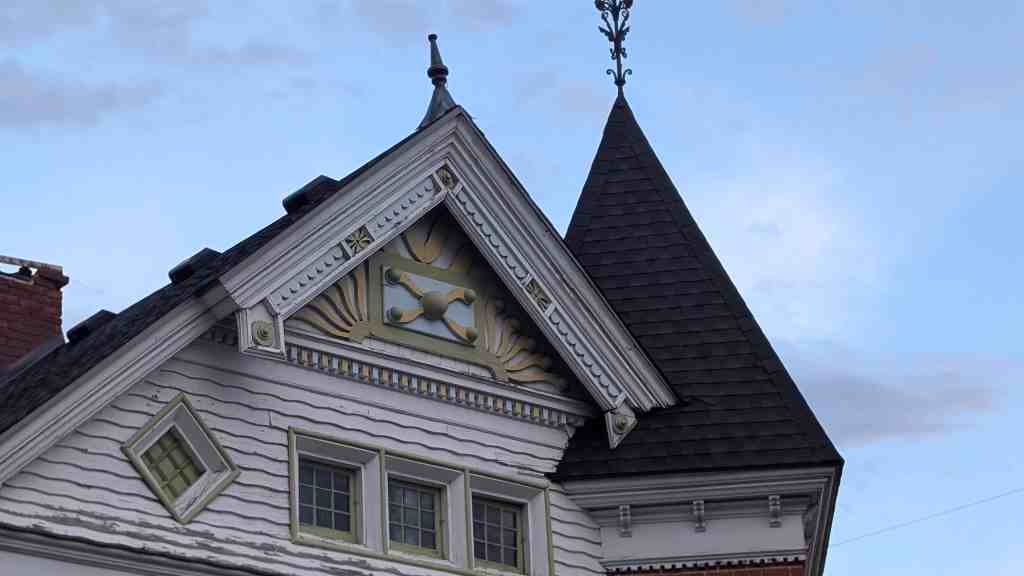
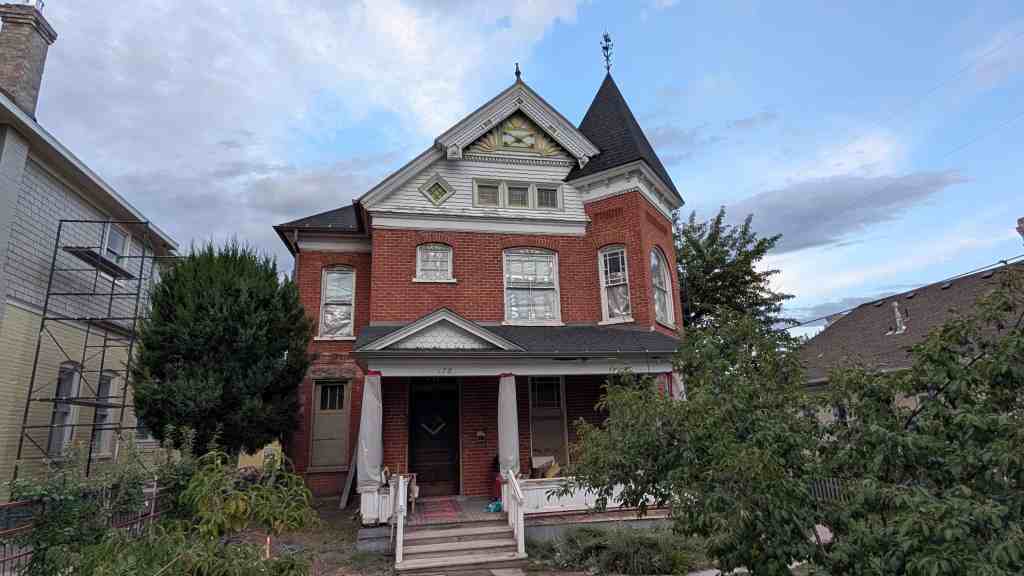
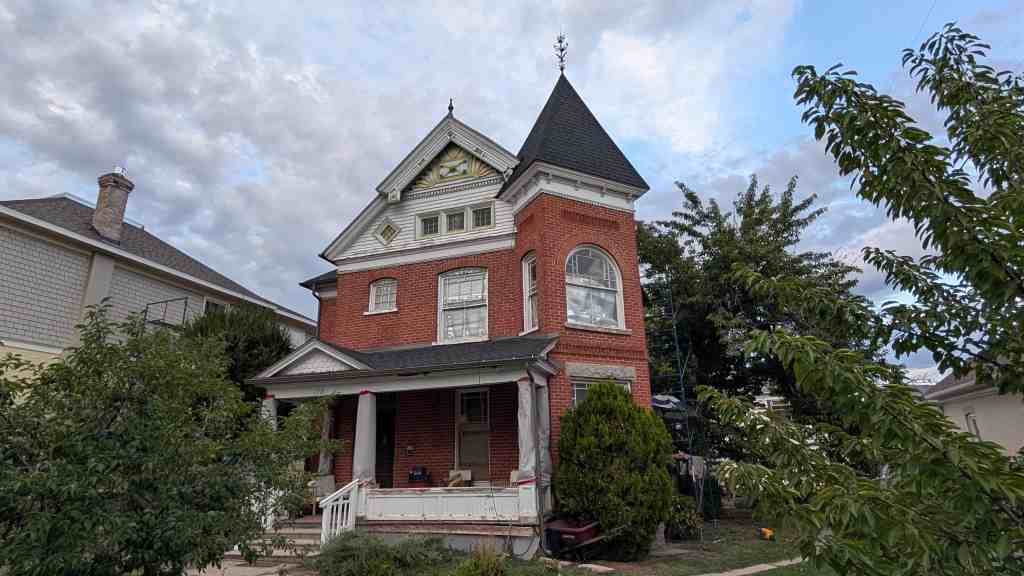
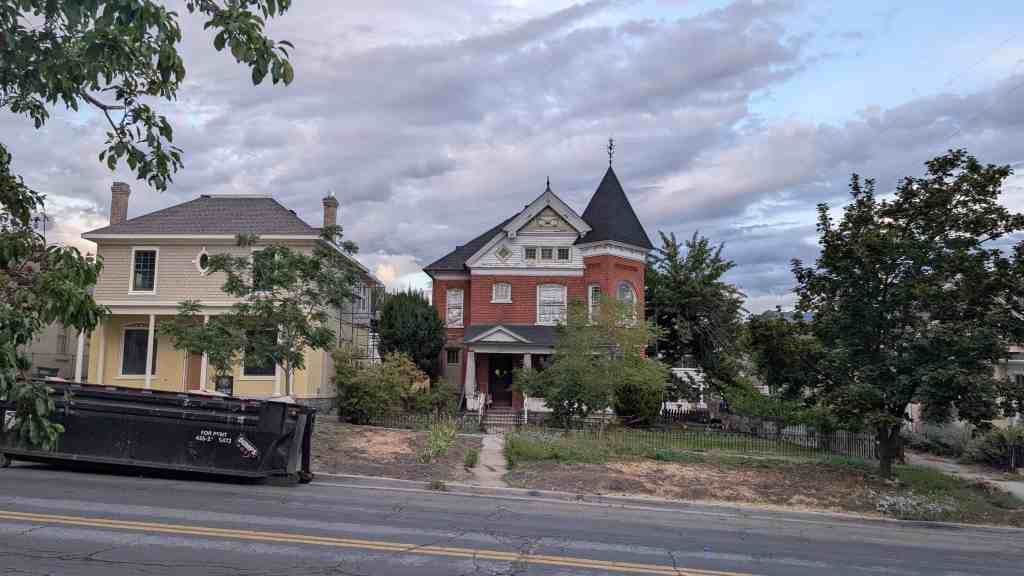
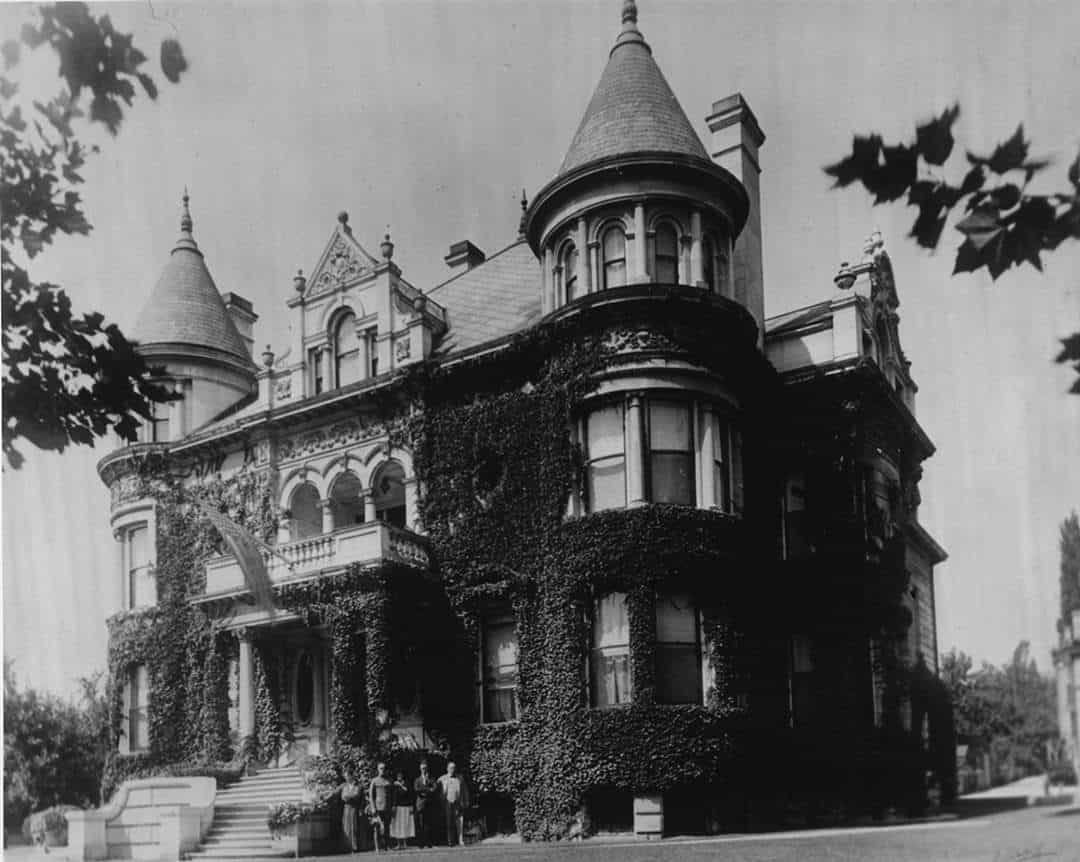
This Victorian eclectic house was built in 1898 by Lillias Hilton Staines after having inherited the property in 1892 from her grandfather, John Lyon, an early Utah poet. Lillias and her husband, William C. Staines, a mining entrepreneur, maintained this house as rental property. In 1922, their son, Fred Chisholm Staines, vice-president of Whitmore Oxygen Company, inherited the home. He and his wife, Carol, moved into part of the home, maintained the rest as rental property, and lived here until 1936. Dirk and Hesselina Oliekan bought the home in 1942 and, with other family members, occupied the various apartments within the house.
Constructed in 1902, this house is a good example of the Colonial Revival style, popular during the early twentieth century. The gambrel roof provides a “Dutch Colonial” appearance.
Mary S. Rutt, wife of mining entrepreneur Levi M. Rutt, had the houes constructed. Although she transferred title to her daughter and son-in-law, the Rutts lived here until 1926, when the house was sold to D.V. and Mary Ann Hyde. The Hydes, in turn, sold it to Jacob and Caroline Peterson. During the late 1930s, the Petersons remodeled the house into a duplex. Three have been several subsequent owners, but it is once again a single family residence.
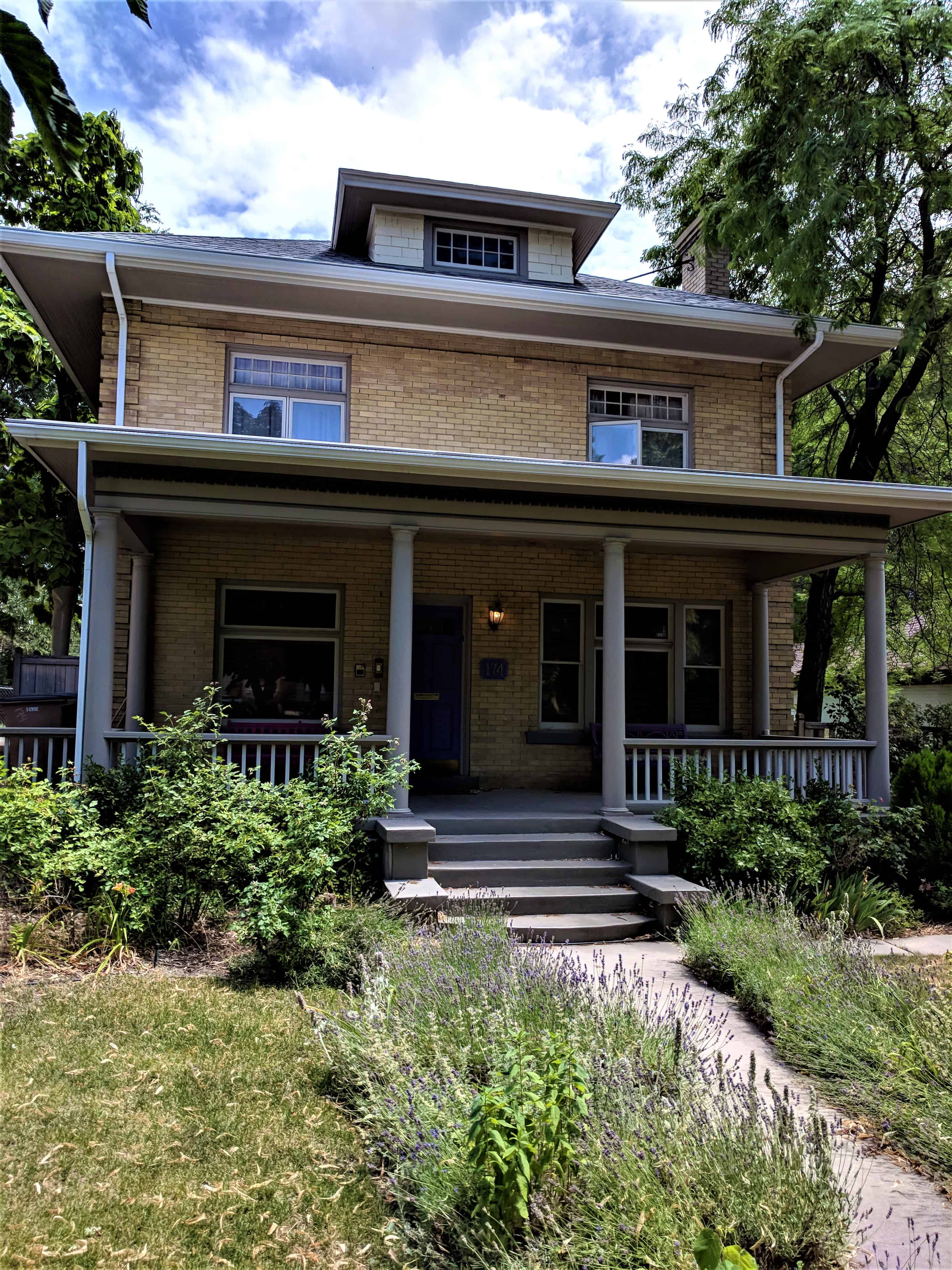
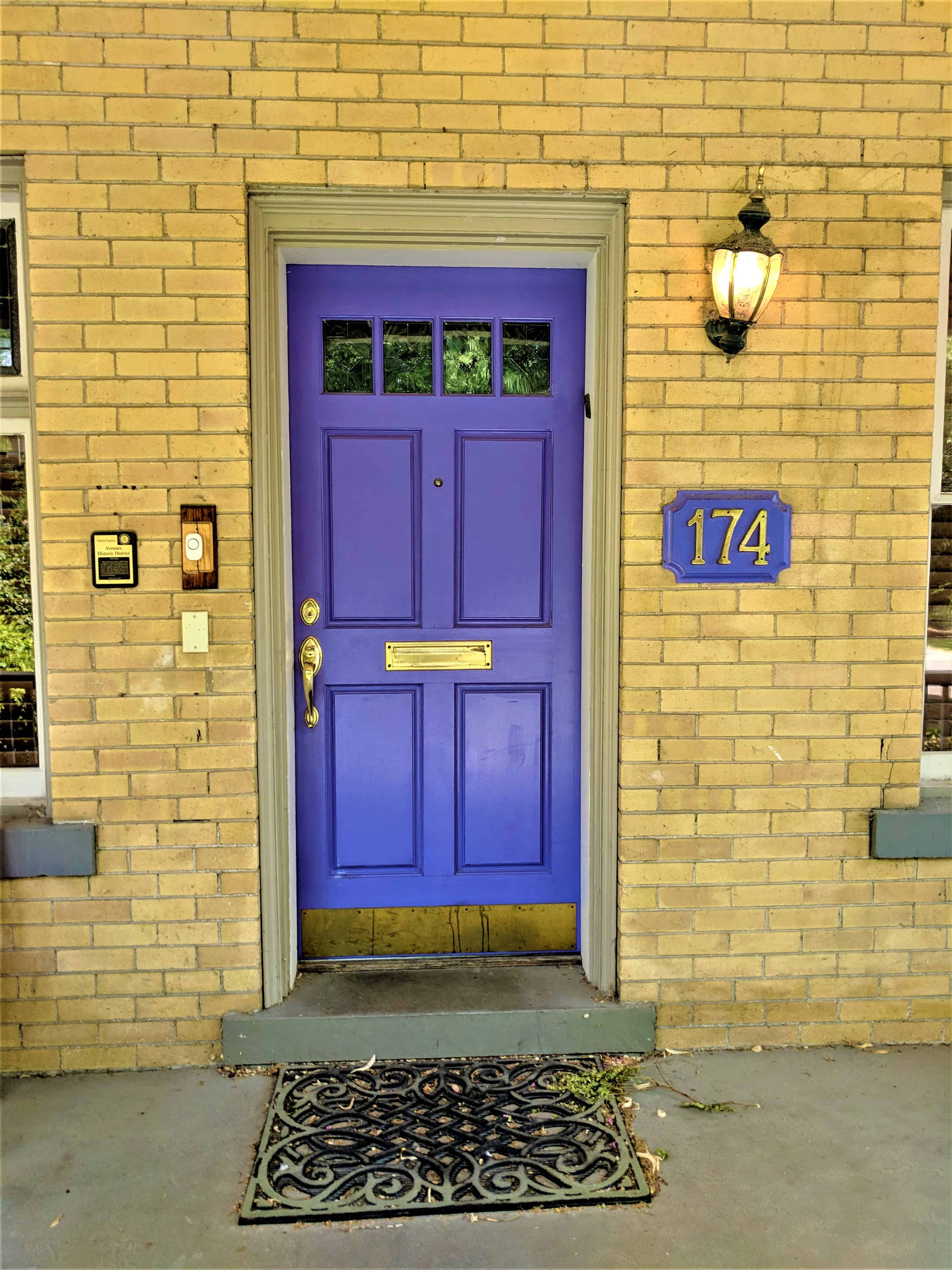
This two-story house was built in 1909 by Charles A. Lanbourne, a postal service employee, and his wife, Emma. It is one of several homes built in the Avenues by members of the Lambourne family. Their sons, Charles, Jr. and Doyles E., inherited the property c.1935. The foursquare house type was popular in Utah between 1900 and 1920 and, as in this house, often incorporated stylistic features such as the broad-eaved hip roof with center dormer and wide one-story front porch.
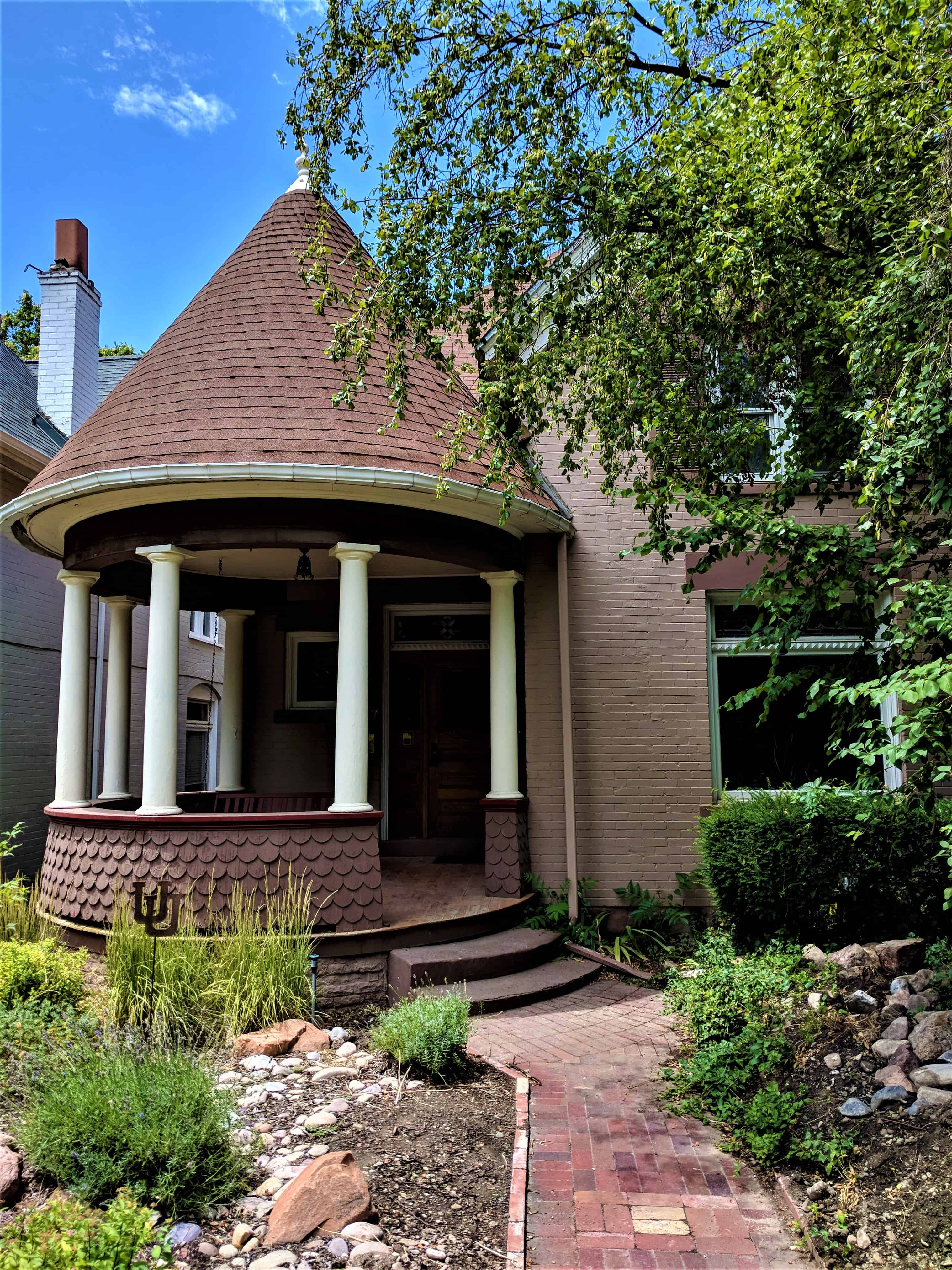
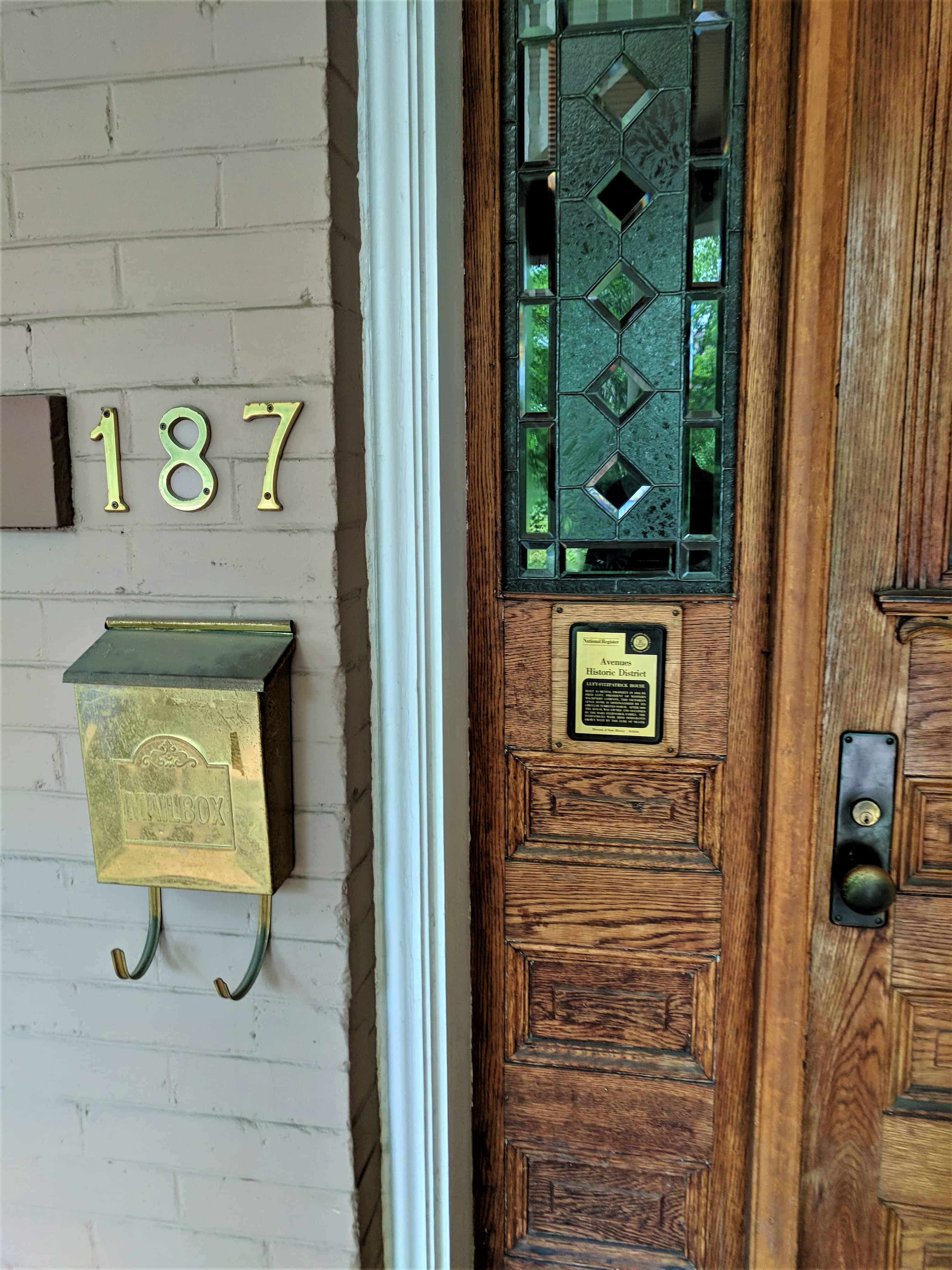
Built as rental property in 1903 by Fred Luft, president of Western Machinery Company, this Victorian style home is distinguished by its circular turreted porch. After 1909 the house was owned and occupied by the Mary Fitzpatrick family. The Fitzpatricks were Irish immigrants drawn west by the lure of silver.
Constructed circa 1895, this exceptional one-story, stucco house is a good example of the Victorian Eclectic style, popular during the late nineteenth century. The gable roof provides a Victorian appearance which contributes to the unique architecture of the Avenues. It was built by Daniel and Agnes Huddleston Stuart, who had come to Utah in 1850 from England. Daniel worked as a blacksmith and farmer. The Stuarts used the home as a rental property and as a residence for family members. In 1905, the home passed out of Daniel’s estate to his daughter Zina Lamborne Watkins, who owned the property for many years.
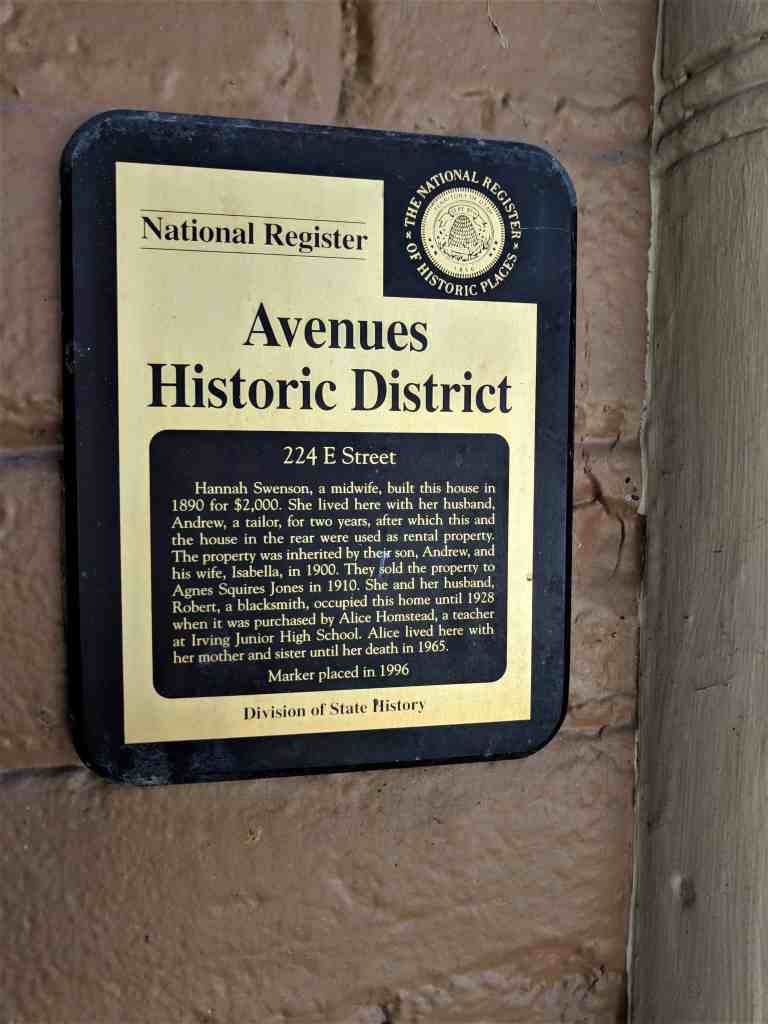
Hannah Swenson, a midwife, built this house in 1890 for $2,000. She lived here with her husband, Andrew, a tailor, for two years, after which this and the house in the rear were used as rental property. The property was inherited by their son, Andrew, and his wife, Isabella, in 1900. They sold the property to Agnes Squires Jones in 1910. She and her husband, Robert, a blacksmith, occupied the home until 1928 when it was purchased by Alice Homstead, a teacher at Irving Junior High School. Alice lived here with her mother and sister until her death in 1965.
This two-story mansion was built by William and Martha Lanbourne c.1870. William, a paper hanger and designer, lived here until his death in 1887. Martha sold the house in 1889 to Joseph Daynes, the first Salt Lake Tabernacle organist. One of the numerous owners between 1900 and 1946 divided the house into three apartments. Even R. Terry, a certified public accountant, and his wife, Joan C., purchased the house in 1947 and continue to live here and maintain one of the apartments for rental purposes.
The house is architecturally significant as an excellent example of the Queen Anne style. The elaborate front gable has a metal finial, a large sunburst panel with dentil molding, diamond-shaped decorative panels, wood shingle siding, a triple attic window with multiple lights, and a corner tower with ornamental brick panels and a rounded arched window. The picturesque Queen Anne style became the favored late-nineteenth-century style in America and its popularity in Utah coincided with the building boom of the late 1880s and 1890s.
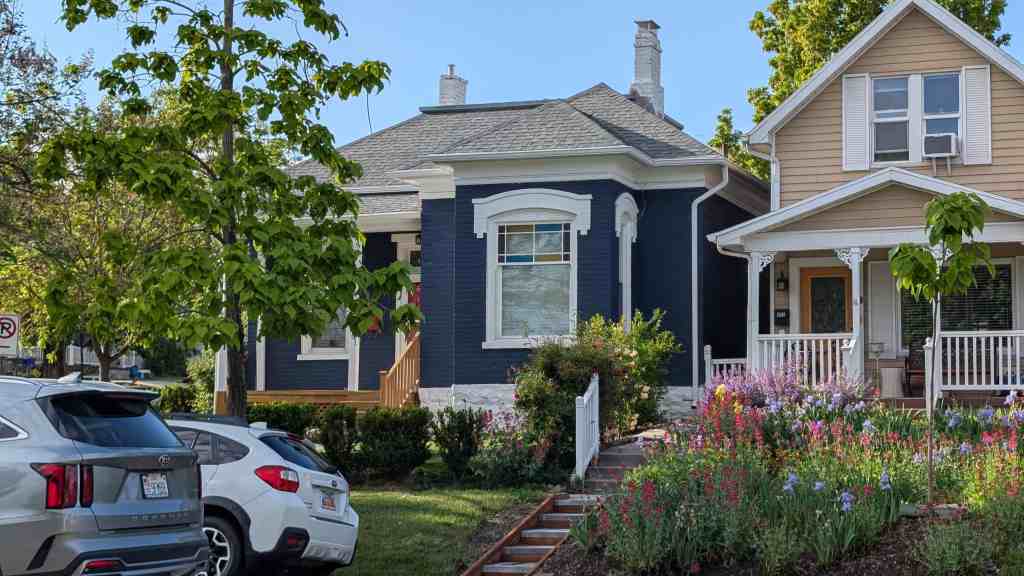
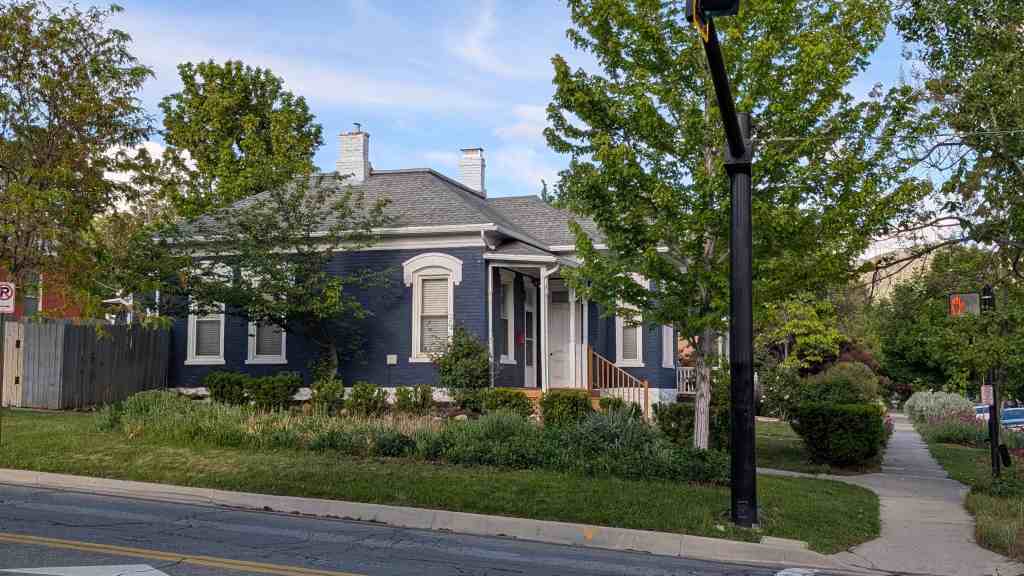
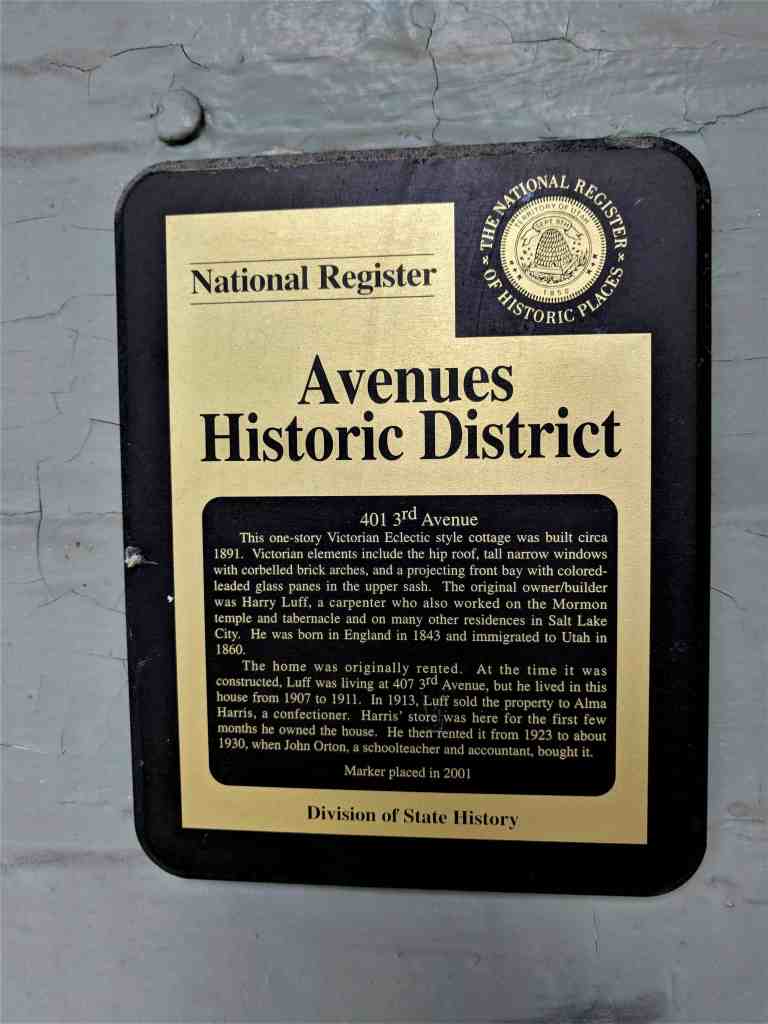
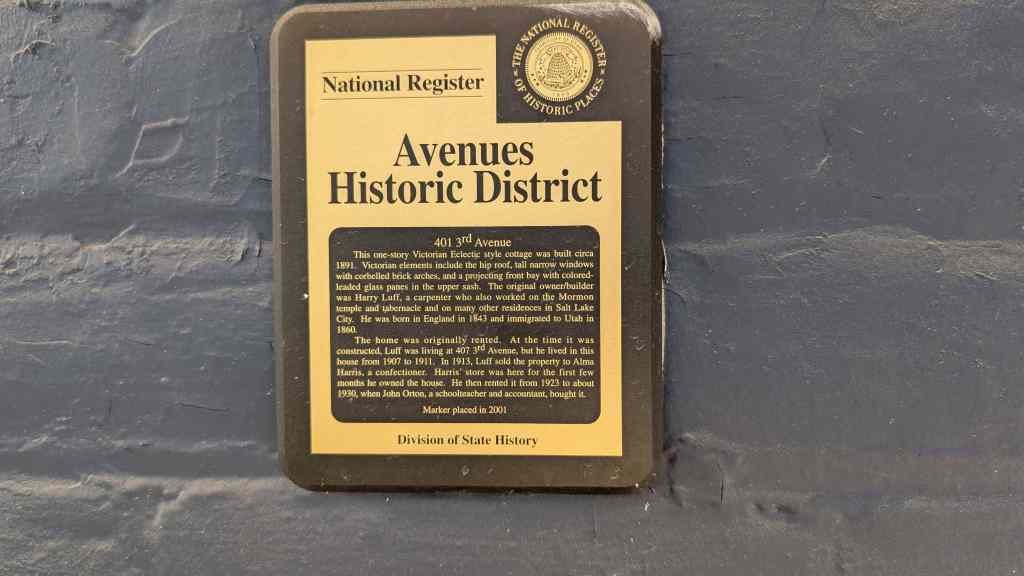
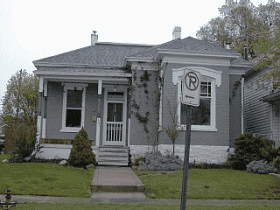
This one-story Victorian Eclectic style cottage was built circa 1891. Victorian elements include the hip roof, tall narrow windows with corbelled brick arches, and a projecting front bay window with colored leaded glass panes in the upper sash. The original owner/builder was Harry Luff, a carpenter who also worked on the Mormon temple and tabernacle and on many other residences in Salt Lake City. He was born in England in 1843 and immigrated to Utah in 1860.
The home was originally rented. At the time it was constructed, Luff was living at 407 3rd Avenue, but he lived in this house from 1907 to 1911. In 1913, Luff sold the property to Alma Harris, a confectioner. Harris’ store was here for the first few months he owned the house. He then rented it from 1923 to about 1930, when John Orton, a schoolteacher and accountant, bought it.
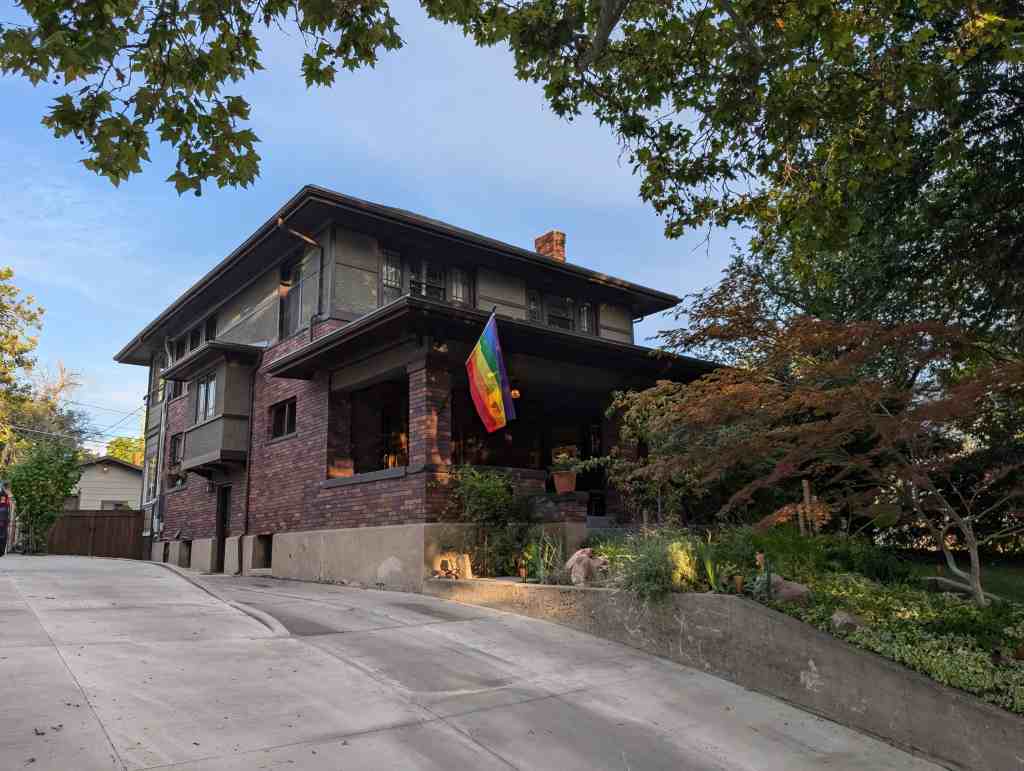
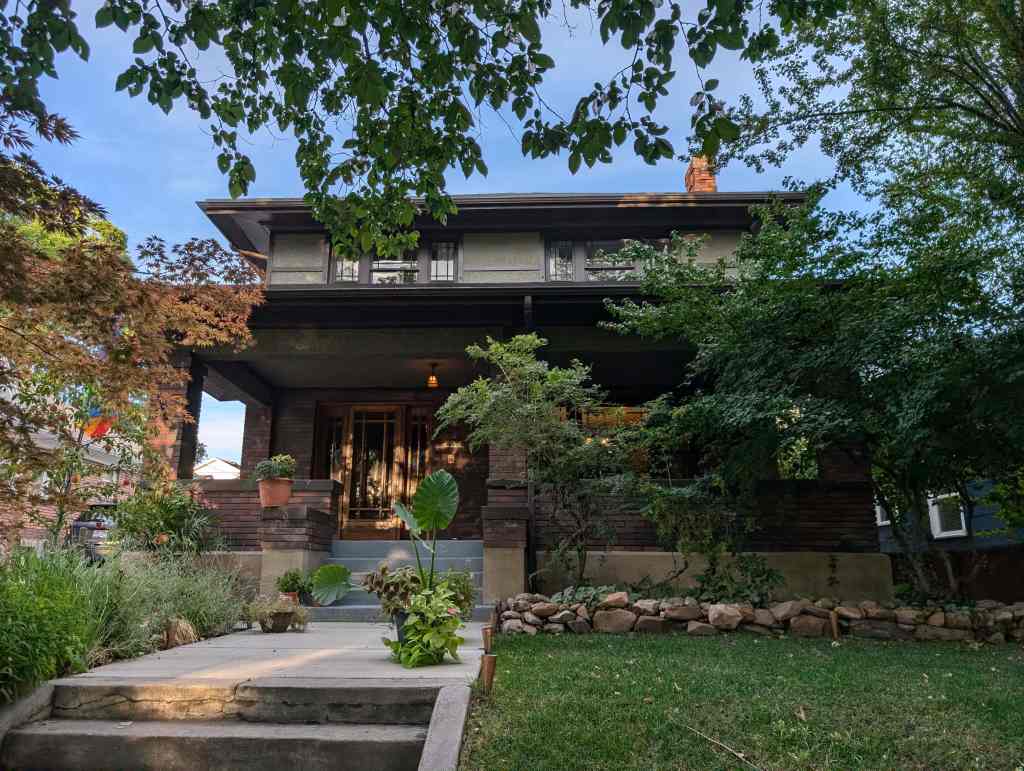
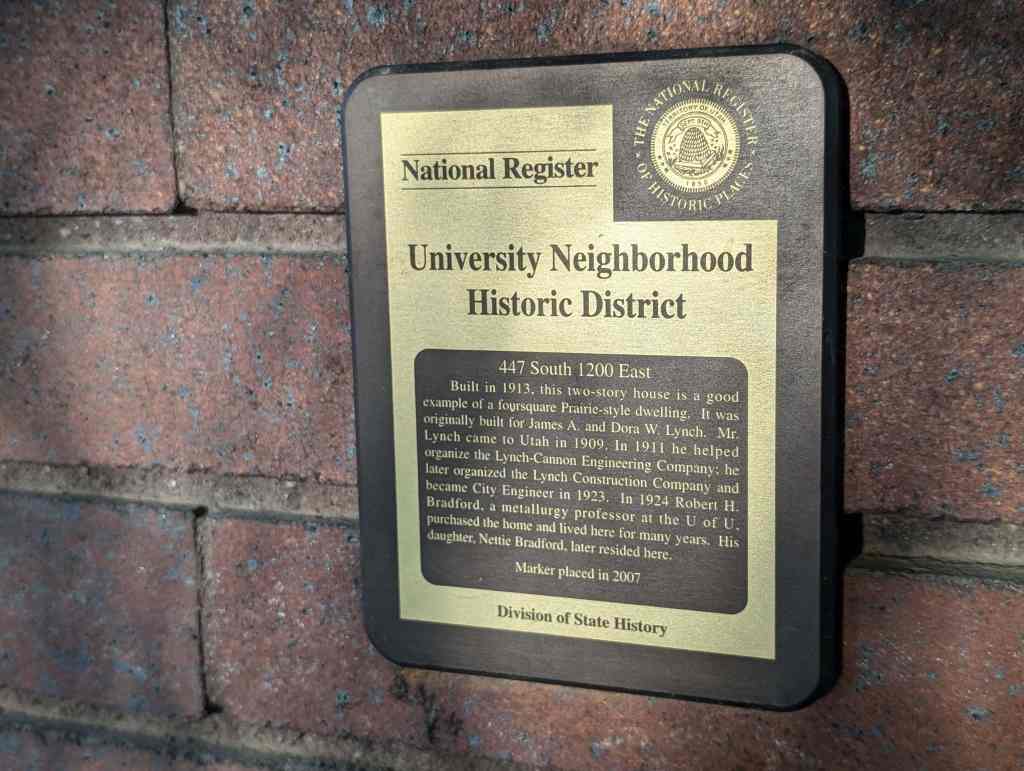
Built in 1913, this two-story house is a good example of a foursquare Prairie-style dwelling. It was originally built for James A. and Dora W. Lynch. Mr Lynch came to Utah in 1909. In 1911 he helped organize the Lynch-Cannon Engineering Company; he later organized the Lynch Construction Company and became City Engineer in 1923. In 1924 Robert H. Bradford, a metallurgy professor at the U of U, purchased the home and lived here for many years. His daughter, Nettie Bradford, later resided here.
This house was built in 1913 for James A. Lynch. Lynch organized the Lynch-Cannon Engineering Company in 1911, and sold his interests several years later before establishing the Lynch Construction Company. Robert Bradford, a professor of metallurgy at the University of Utah, bought the house in 1924.
The Utah Governor’s Mansion is the official residence of the Governor of Utah and family. It is located in the South Temple Historic District in the Avenues neighborhood at 603 East South Temple in Salt Lake City, Utah.
Thomas Kearns rose from modest beginnings to become a successful financier and United States Senator. He was born on April 11, 1862, on a farm in Ontario, Canada, the son of Margaret and Thomas Kearns. His family moved to Nebraska when Thomas was seven. At the age of 17 he went to South Dakota when gold was discovered in the Black Hills» After that he went to Arizona where he worked as a miner and a teamster. In 1883 he arrived in Utah and secured employment with the Denver Rio Grande Railroad. He went to Park City, Utah, in the summer of 1883 and worked in the mines. Working in the Ontario Mine, Kearns met his lifelong friend and advisor, David Keith. By 1892 Kearns, Keith, John Judge and others, leased mining property in Park City and formed the Silver King Mining Company. The profits from this mine were great, and the land holdings of this company increased. In 1907 the Silver King Coalition Mines Company was formed with Kearns as vice-president and Keith as President. In 1901 he acquired the Salt Lake Tribune. He was a noted philanthropist, and erected St. Anne f s Orphanage in Salt Lake City and gave generously to Catholic charities. He was a staunch Republican and was elected to the United States Senate in 1901. In Washington he became a close friend of Theodore Roosevelt.
He married Jennie Judge, of New York, in 1890. They had two sons and two daughters. Kearns died in October 1918. The home remained in the family until 1937 when Mrs. Judge donated it to the State of Utah. It was used as the governor’s mansion from 1937 to 1957, when it became the offices ‘of the Utah State Historical Society. In 1978 the home was vacated for a massive renovation and restoration project. After it was completed it started being used as the governor’s mansion.
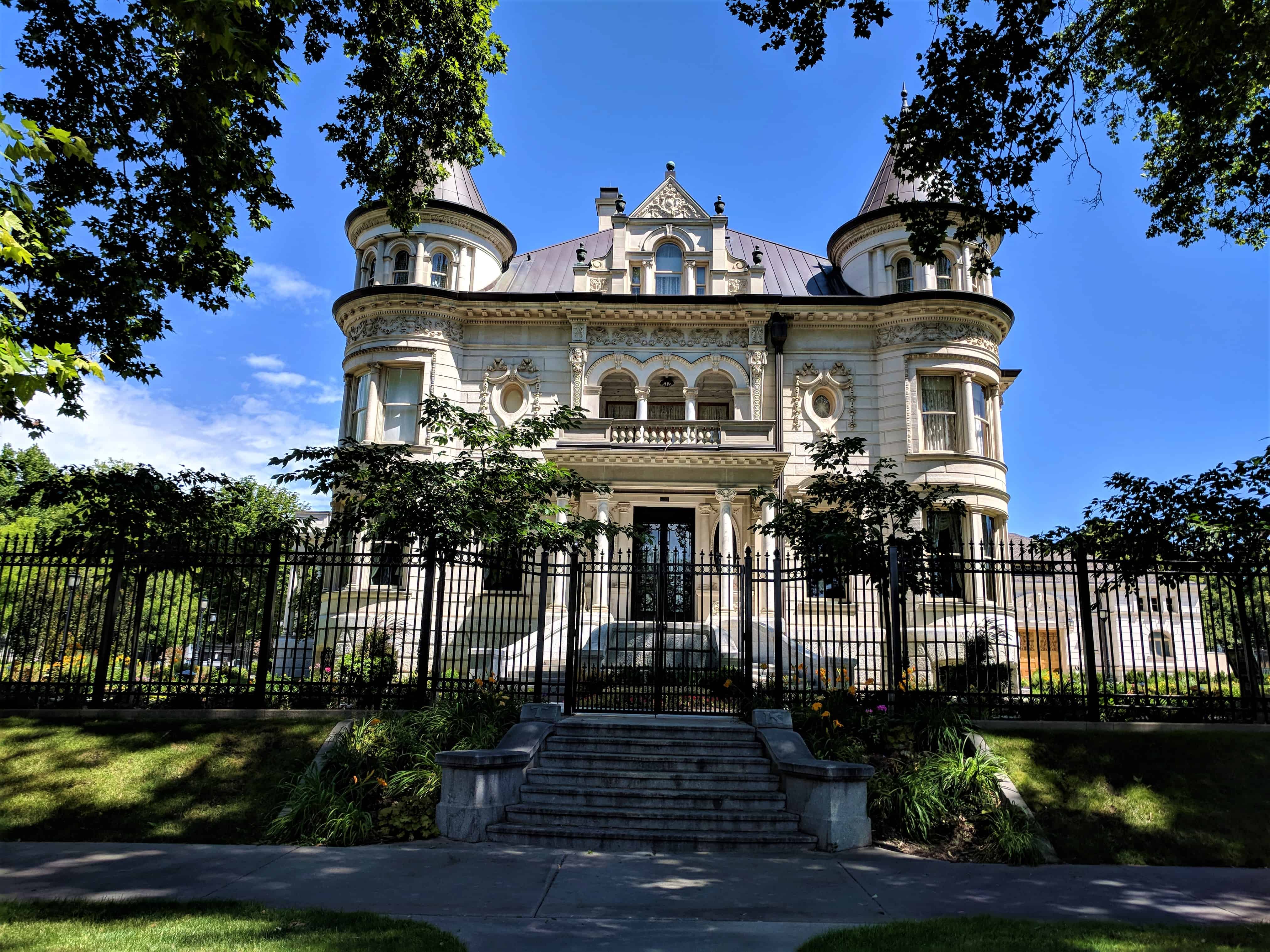
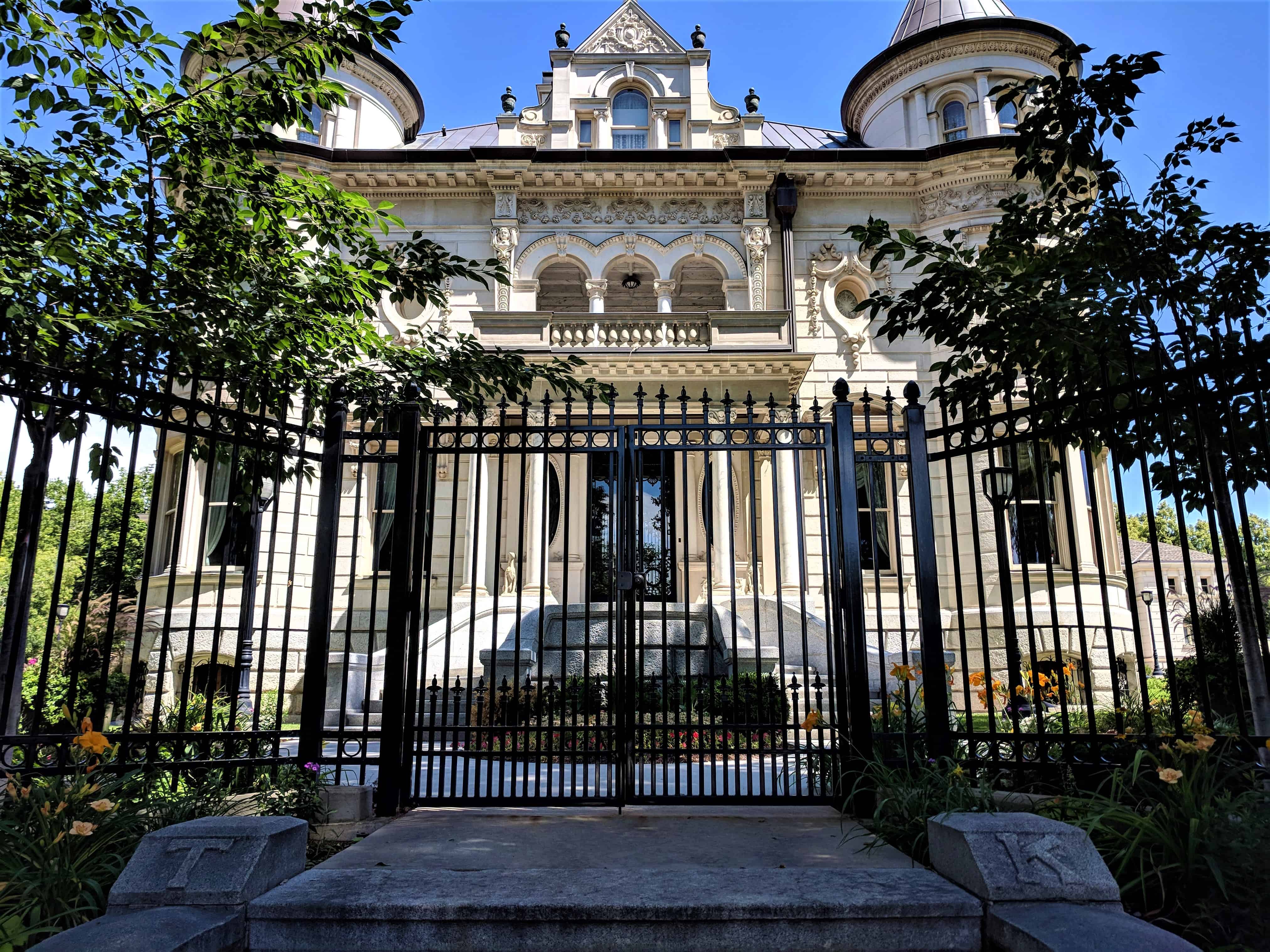
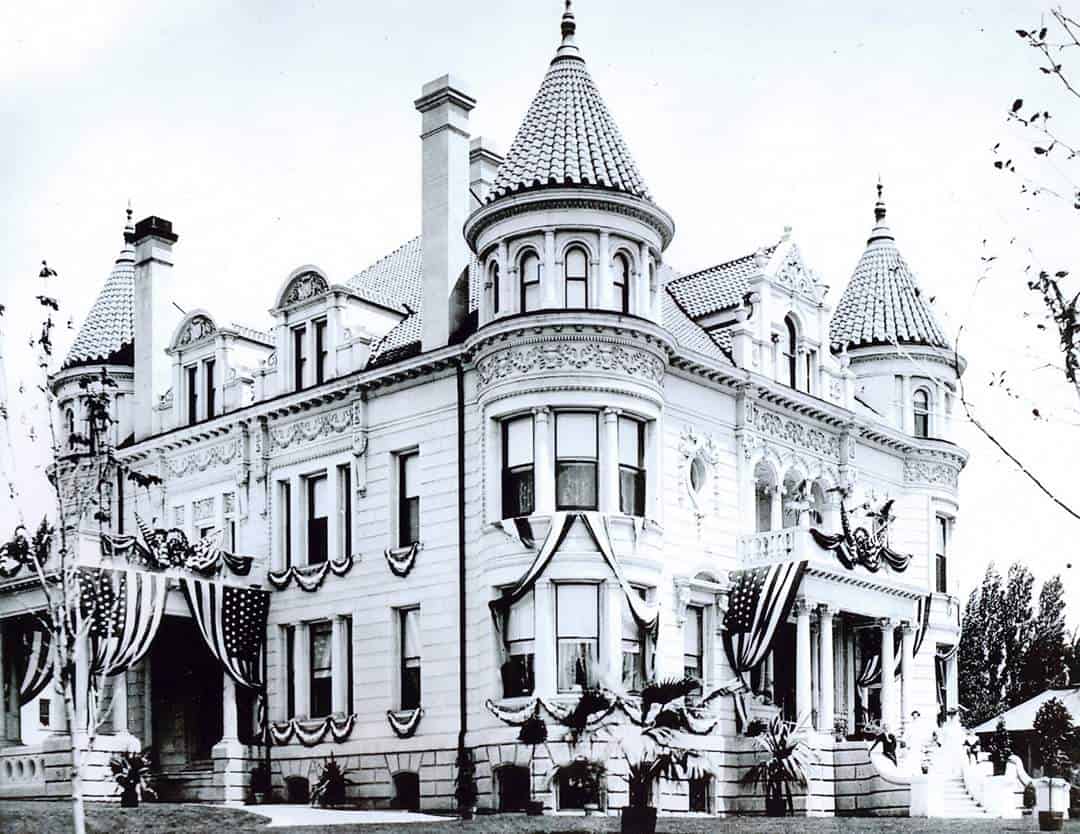
The Kearns Mansion has a stone exterior richly detailed with round towers at three of its four corners.
At the time of the building, the mansion contained 28 rooms: 6 baths, ten fireplaces (of which nine remain), an all-marble kitchen and bathroom, a bowling alley, ballroom, billiard room, two parlors, two dining rooms, and three vaults (one for silver, one for wine, and one for jewelry). Cost of construction was approximately $250,000.00.
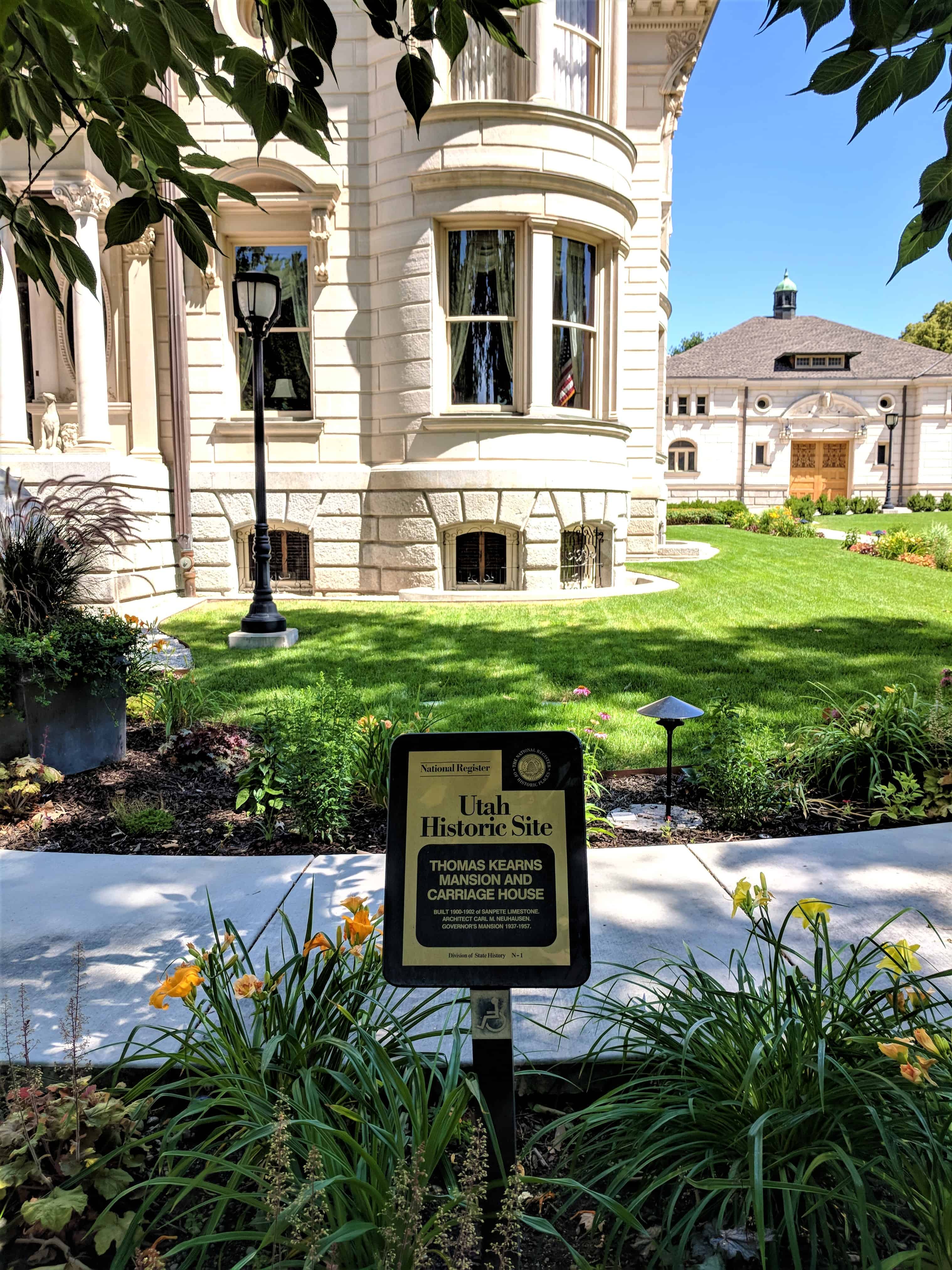
The carriage house is one of Utah’s most elaborate and best preserved carriage houses. It was built to serve-the Kearns Mansion, built by mining magnate Thomas Kearns. For many years it was the home of the Utah State Institute of Fine Arts. In 1978 the Institute moved next door to 617 East South Temple.
The Thomas Kearns Mansion and Carriage House was added to the National Register of Historic Places (#70000631) on February 26, 1970, it is located at 603 East South Temple in the South Temple Historic District of Salt Lake City, Utah – the text below is from the nomination form from the register:
The Kearns Mansion was designed by Architect Carl M. Neuhausen for millionaire mining magnate Thomas Kearns. It is a part of the national culture that shows up in this area. The foundation was laid in the spring of 1900 and the building completed in 1902.
Thomas Kearns came to Utah in 1883 as a young man working on the Denver and Rio Grande Railroad. He gravitated to the mines in Park City where he soon became part owner of the Silver King Coalition Silver Mines. His partner was David Keith. With his newly acquired wealth, Kearns built his lovely mansion on Brigham Street (later South Temple Street) in 1902.
The building itself is a work of art, made of oolite marble, and richly furnished interiors of wood, tile and marble. It reflects the quality that affluence could demand in the new twentieth century.
Thomas Kearns became a millionaire before he was 28 years old and a United States Senator from Utah by the age of 40 (1901-1905). He also was a noted philanthropist, erecting the Kearns St. Ann’s Orphanage, now St. Ann’s School. He became the publisher of the Salt Lake Tribune. Today the Kearns Building, Kearns Corporation, and Kearns, Utah, perpetuate his name.
The Kearns family lived in the mansion for over thirty-five years. In it many distinguished guests were entertained, including two presidents: Theodore Roosevelt and William Howard Taft. President Roosevelt watched a parade on South Temple from the marble loggia on the second floor.
Thomas Kearns died in 1918, but the home remained in the possession of the family until 1937, when Mrs. Jennie Kearns donated it to the state to be used as a governor’s mansion. Three Utah governors lived in the mansion; Henry H. Blood, Herbert B. Maw, and J. Bracken Lee. In 1957 the mansion became the home of the Utah State Historical Society. It is the intention of the Society that this lovely building be preserved and kept open to the public to provide a show place depicting the genteel life that Utah’s mineral resources produced for one of the state’s foremost families.
The Kearns Mansion has a stone exterior richly detailed with round towers at three of its four corners.
At the time of the building, the mansion contained 28 rooms: 6 baths, ten fireplaces (of which nine remain), an all-marble kitchen and bathroom, a bowling alley, bal1 room, fail Hard room, two parlors, two dining rooms, and three vaults (one for silver, one for wine, and one for jewelry). Cost of construction was approximately $250,000.00,
The main entrance on the south leads into a hallway with a floor of handset ceramic tile, one of the few in Utah. The wood-panelled walls and the floating staircase are made of French oak, hand carved by artisans imported from Europe. In the main hallway are two columns carved with allegorical scenes: “The Rape of the Sabines” and “Botticelli’s Graces”. At the end of the main hall (south) are the massive iron and glass doors. The foyer is of African and Roman marble. Above the main hall is a graceful oval ceiling well. To the west of the front hall is the state drawing room converted early in the history of the mansion from two parlors: the Louis XVI and the Moorish parlors.
The first room east of the front hall is the den. The Flemish oak paneling is stained black. North of the den is the state dining room of red stained mahogany. Reportedly all the wood in this room came from the mahogany trees in the Ural Mountains of Russia. Dominating the room, above the table, is a large bronze chandelier. The figures on the newel posts at the foot of the stairs were done by the French sculptor Moreau and were brought from the Paris Exposition of 1900 by Senator Kearns.
Off the main hall of the second floor were the bedrooms and guest rooms of the Kearns family and later the governors. The former bedrooms of the Kearns family and the governors were in the southeast corner of the second-floor, now the library. Across the hall were other bedrooms now housing the picture collections, and the librarian’s office. The director’s office was formerly the nursery. The marble bathroom is in the northeast portion of this floor. At the south end of the hallway on the second floor doors open to a marble loggia.
The third floor contains the ballroom or gymnasium and the billiard room. These rooms now serve as galleries Overlooking the circular hallway on this floor is the beautiful ceiling well which crowns this stately mansion.
In the basement was a two-lane bowling alley and wine vault. This area is now used to house the library’s extensive collections. Only slight alterations have been made to the building; both the grandeur and affluence of its builder and owner remain.
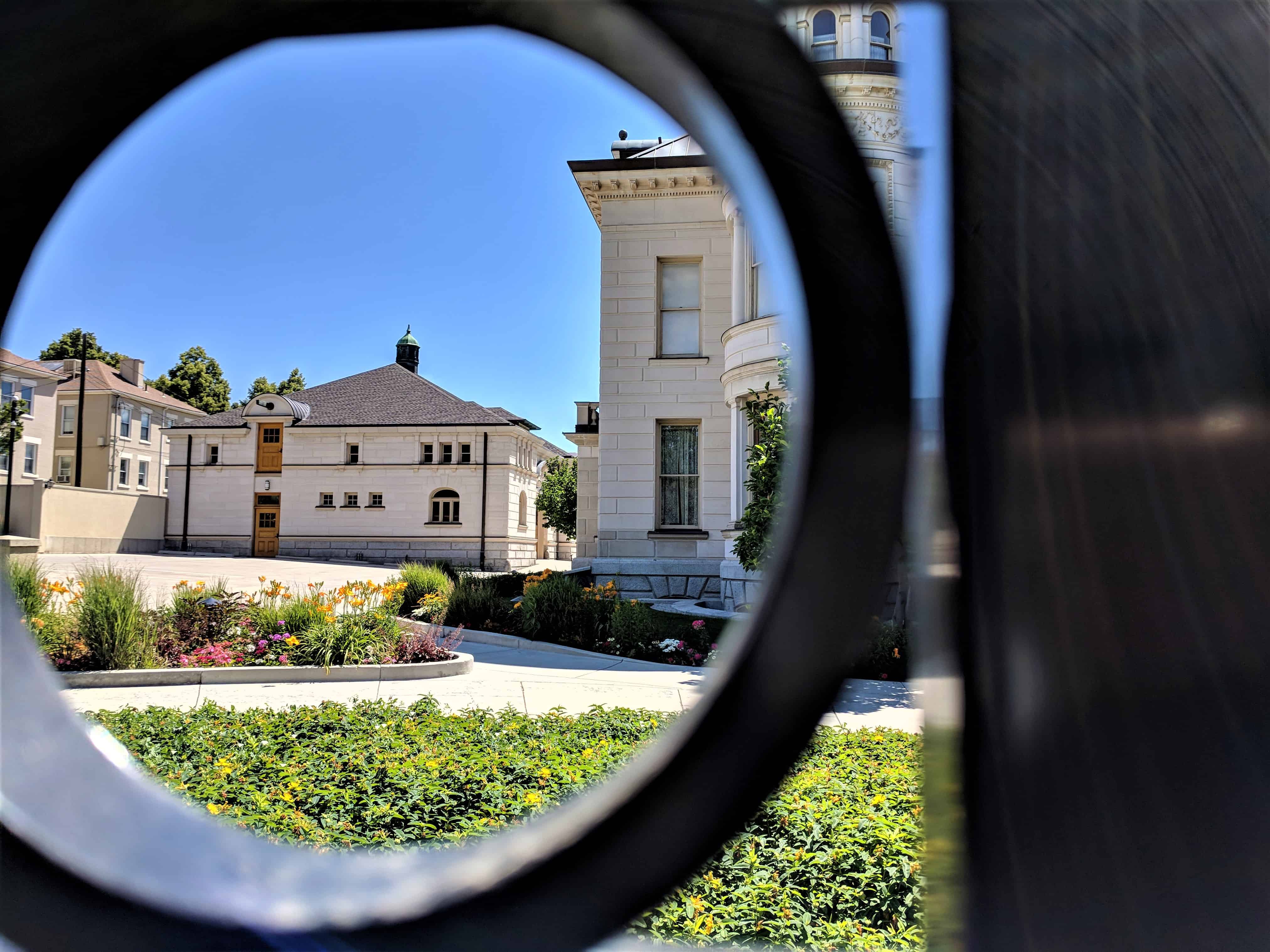
Outside and to the rear of the mansion (north) is the carriage house, also of oolite marble, which now houses the Utah Institute of Fine Arts. This exterior has not been modified; however, the interior has undergone major alterations.
(from Preservation Utah’s walking tour) Thomas & Jennie Kearns Mansion (Utah Governor’s Mansion) 603 E. South Temple 1900- 1902, Carl M. Neuhausen, SLC Tours available April-November on Tuesdays & Thursdays from 2-4 pm.
Thomas Kearns, with his partner David Keith (see entry #12), made a fortune on the silver flowing out of Park City mines. Kearns’ wealth enabled him to become one of Utah’s most influential men. He served a term in the United States Senate (1901-1905) and co-owned the Salt Lake Tribune with Keith.
Every feature of the Chateauesque mansion built for Kearns and his wife, Jennie, speaks of eloquence and opulence. Utilizing the finest craftsmen and materials available, the Kearnses created a residence comparable in quality and style to mansions built by the Vanderbilts and Carnegies in the East. The Kearns Mansion became the dazzling center of Utah’s elite social life. President Theodore Roosevelt, a personal friend of the Kearnses, dined here in 1903.
The Kearns Mansion began a new phase in its history in 1937 when Jennie Kearns donated it to the state for use as Utah’s first official governor’s residence. Between 1937 and 1957, three Utah first families lived in the mansion. In 1957,the state legislature funded the construction of a new governor’s residence and the Utah State Historical Society moved into the building. After a renovation project spearheaded by Governor Scott and Mrs. Norma Matheson, the Kearns Mansion became the Governor’s Mansion once again in 1980.
The Kearns Mansion began a new phase in its history in 1937 when Jennie Kearns donated it to the state for use as Utah’s first official governor’s residence. Between 1937 and 1957, three Utah first families lived in the mansion. In 1957,the state legislature funded the construction of a new governor’s residence and the Utah State Historical Society moved into the building. After a renovation project spearheaded by Governor Scott and Mrs. Norma Matheson, the Kearns Mansion became the Governor’s Mansion once again in 1980.