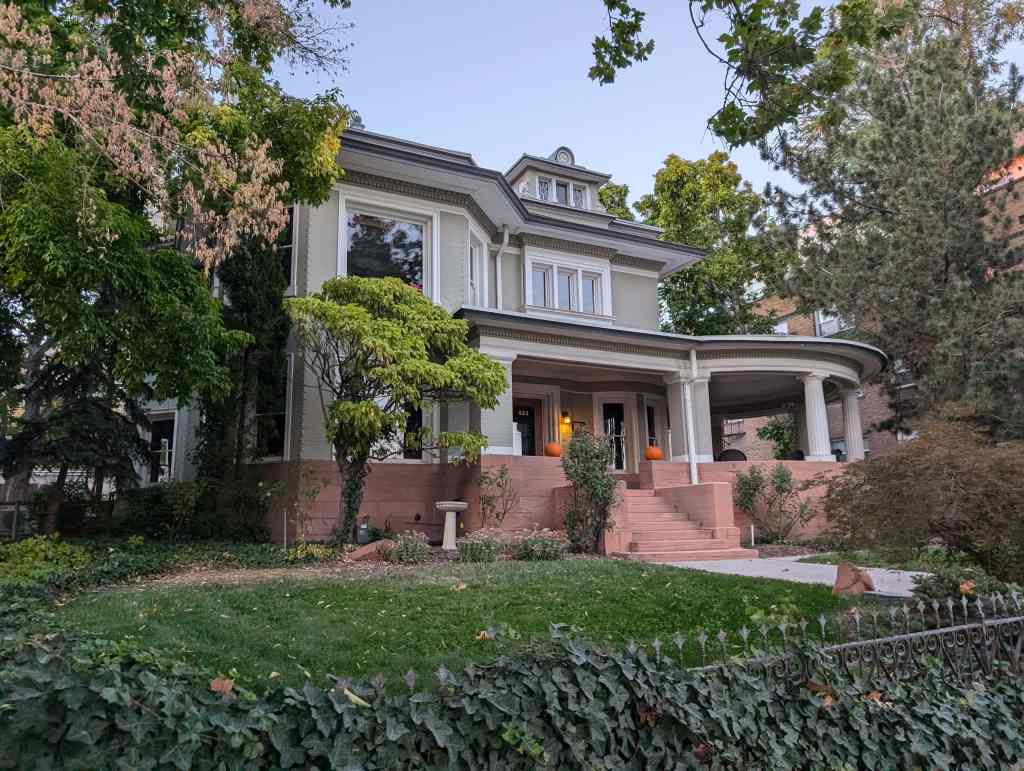
Built in 1909, this Colonial revival house was originally the home of Mrs. Frances Horlick Walker, widow of Samuel S. Walker. The Walker brothers are known for their mining and banking concerns in Utah. Born in England in 1837, Mrs. Walker came to Utah with her parents in 1849. After her death in 1915, the house was rented and owned by carious people, including Charles C. and Denise K. Bintz, who bought the house c.1930. The Bintzes lived here with their family until 1939, when it was sold to Town Club. Town Club was founded by Wynn Conan Schram (Mrs, J. T.) in 1930 to develop and foster charitable, civic, educational, and social activities.
Frances Walker House/Town Club 1081 E. South Temple 1906, architect unknown
Frances Walker built this home on South Temple when her house at 400 South and Main Street was demolished to make way for the Newhouse Hotel. Frances Walker was the widow of Samuel Walker, the eldest of the four brothers who founded the Walker Brothers Dry Goods Store and Walker Brothers Bank. Like her husband, Frances Walker was a native of England and emigrated to Utah with her family in 1849.
The Town Club, an elite women’s group, purchased the building as a clubhouse in 1939. The Town Club was founded in 1930 to foster charitable, civic, educational, and social activities among its members. The club continues to host luncheons, receptions, and cultural activities for members and guests in the house today.
One of the most striking elements of this Colonial Revival style house is the swan’s neck pediment above the front dormer. Also note the leaded glass side lights and heavy stone lintel which accent the front door. The one-story east wing was added after the Town Club acquired the house. (from Preservation Utah’s walking tour)
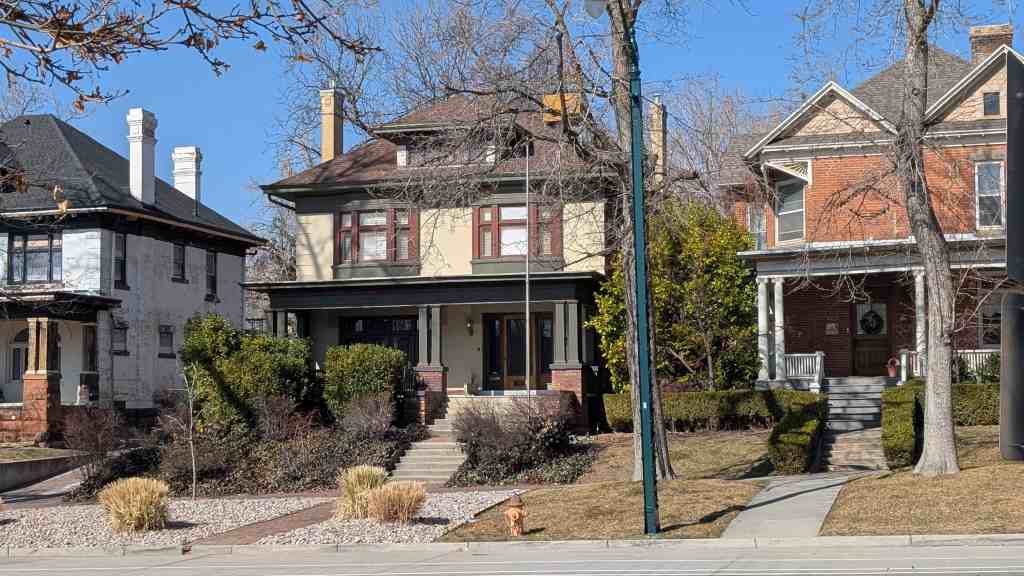
Constructed in 1907, this two-story four-square type house with a hipped roof was designed by the firm of Walter E. Ware and Alberto O. Treganza, two of Utah’s best-known architects. Strongly influenced by the Prairie School style, for which the firm was best known, the design includes a centrally placed hipped dormer in the roof, wide overhanging easves with exposed rafters, and a large one-story front porch. Distinctive interior features include crown moldings, Craftsman bookcases with leaded glass, and a beamed dining room ceiling with recessed breakfront.
The home was first owned by Edward O.Howard, a banker and businessman. Born in Skaneateles, New York, in 1866, he moved to Utah at the age of twenty-four. In Salt Lake City, Howard was involved in many successful business ventures, including the Walker Brothers Bank, National Credit Corporation, Utah Light and Traction Company, and Utah-Idaho Sugar Company. Howard married Annie Payson in 1895. Annie is most noted as a founder of Salt Lake City’s Memory Grove, a memorial park for World War I veterans. The home was sold to Hyrum W. Pingree in 1920, who held the property until 1934. The property had had several subsequent owners.
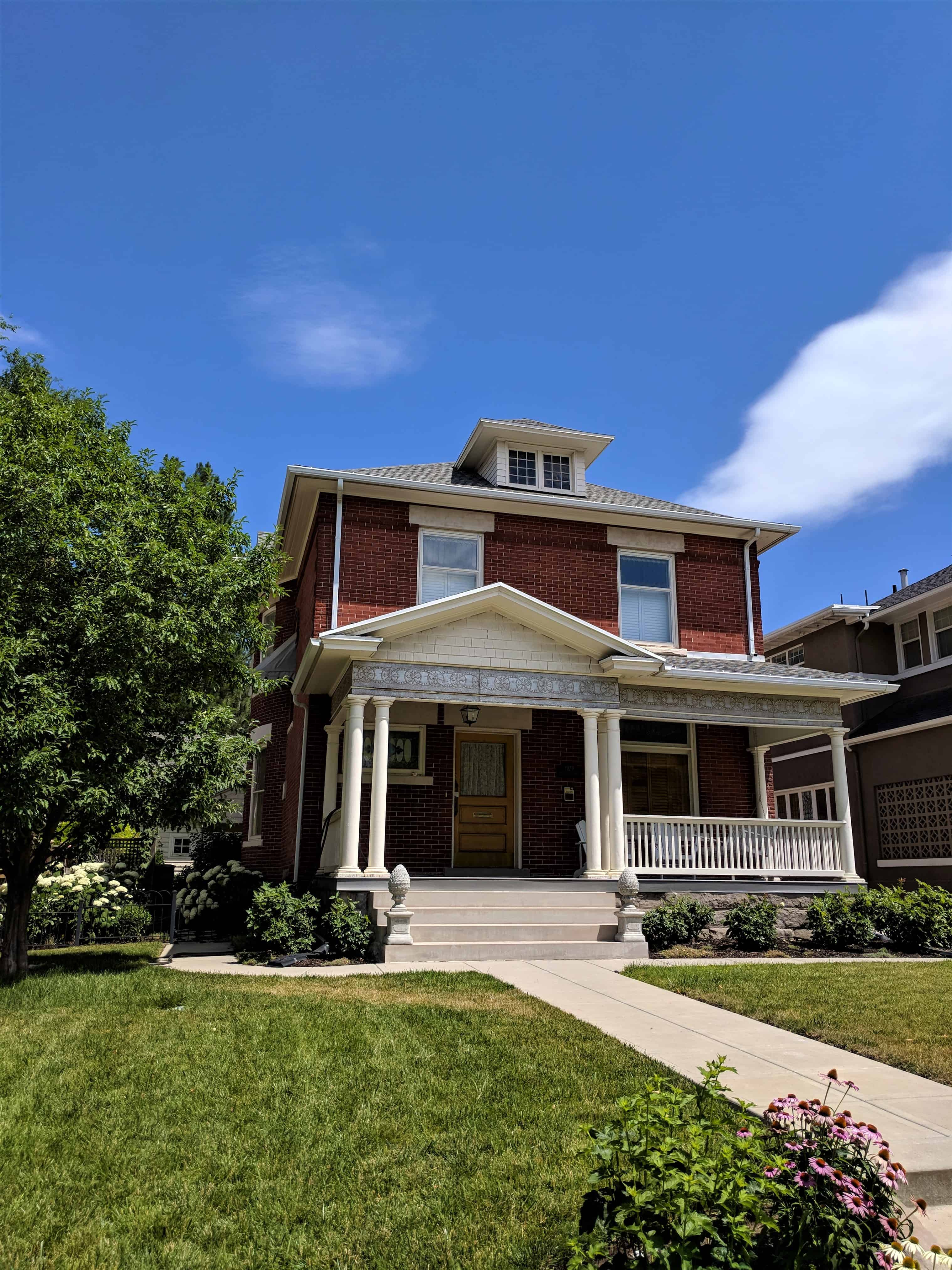
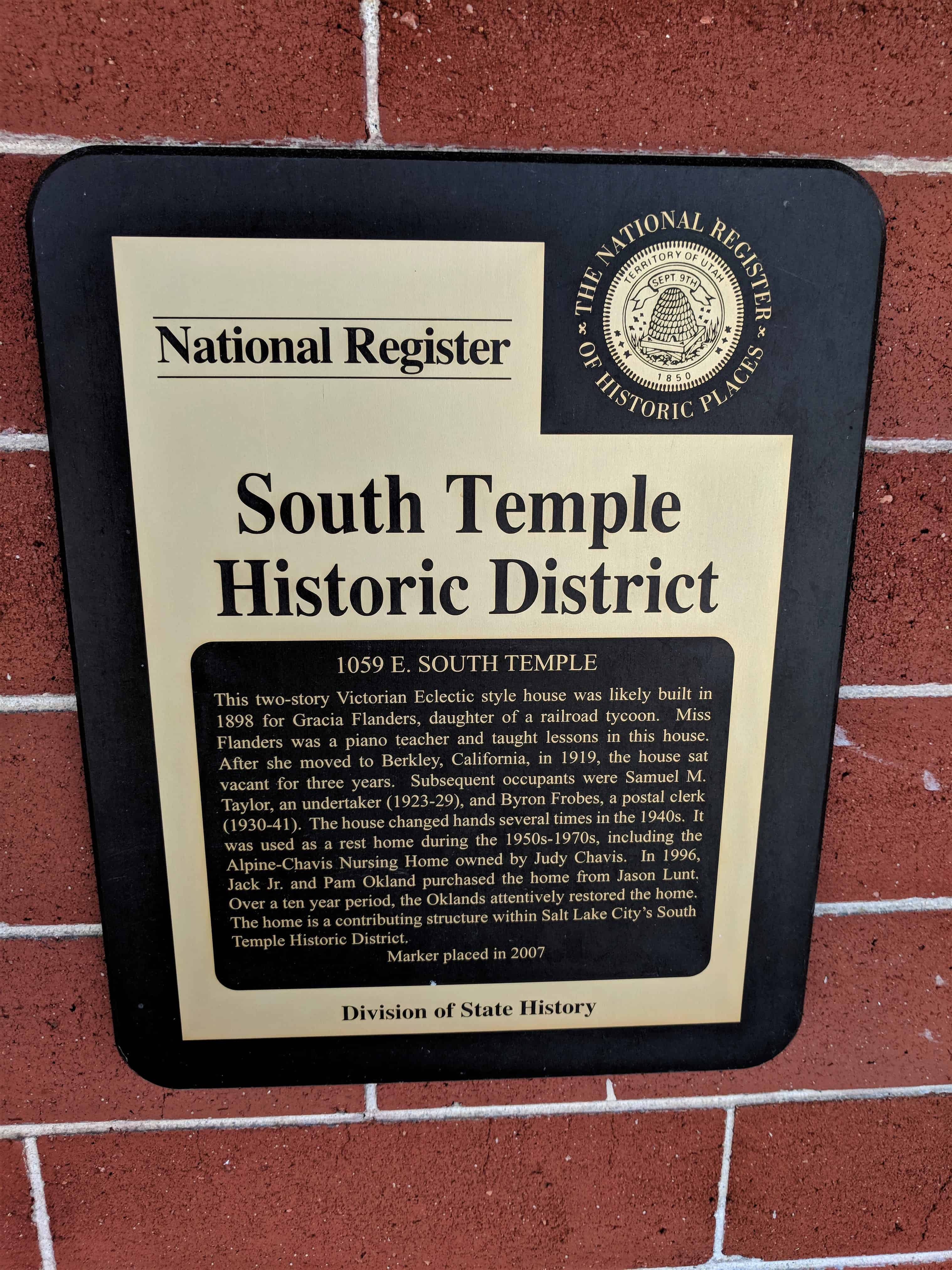
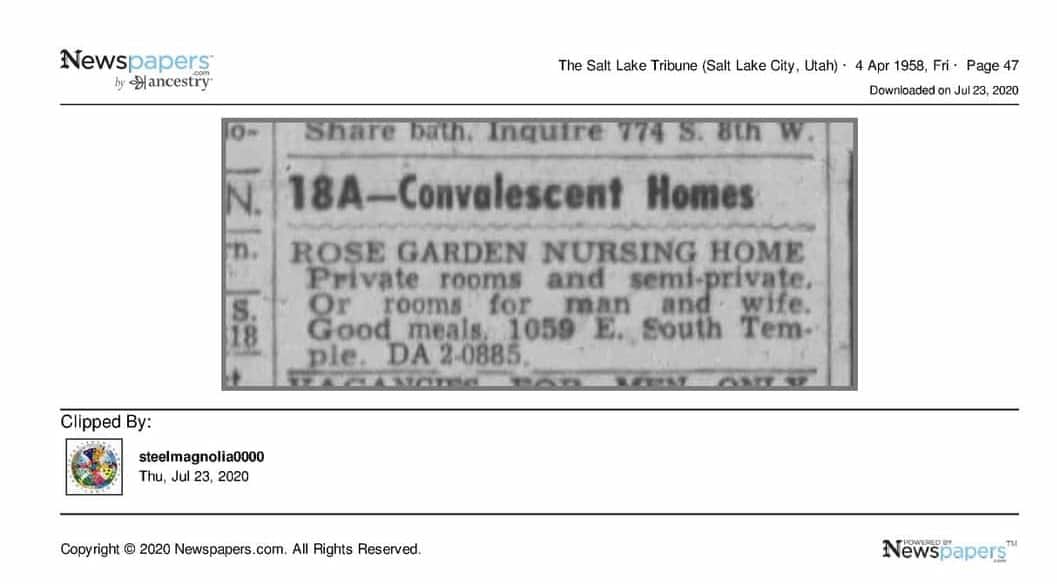
This two-story Victorian Eclectic style house was likely built in 1898 for Gracia Flanders, daughter of a railroad tycoon. Miss Flanders was a piano teacher and taught lessons in this house. After she moved to Berkley, California, in 1919, the house sat vacant for three years. Subsequent occupants were Samuel M. Taylor, an undertaker (1923-29), and Byron Frobes, a postal clerk (1930-41). The house changed hands several times in the 1940s. It was used as a rest home during the 1950s-1970s, including the Alpine-Chavis Nursing Home owned by Judy Chavis. In 1996, Jack Jr. and Pam Okland purchased the home from Jason Lunt. Over a ten year period, the Oklands attentively restored the home. The home is a contributing structure within Salt Lake City’s South Temple Historic District.
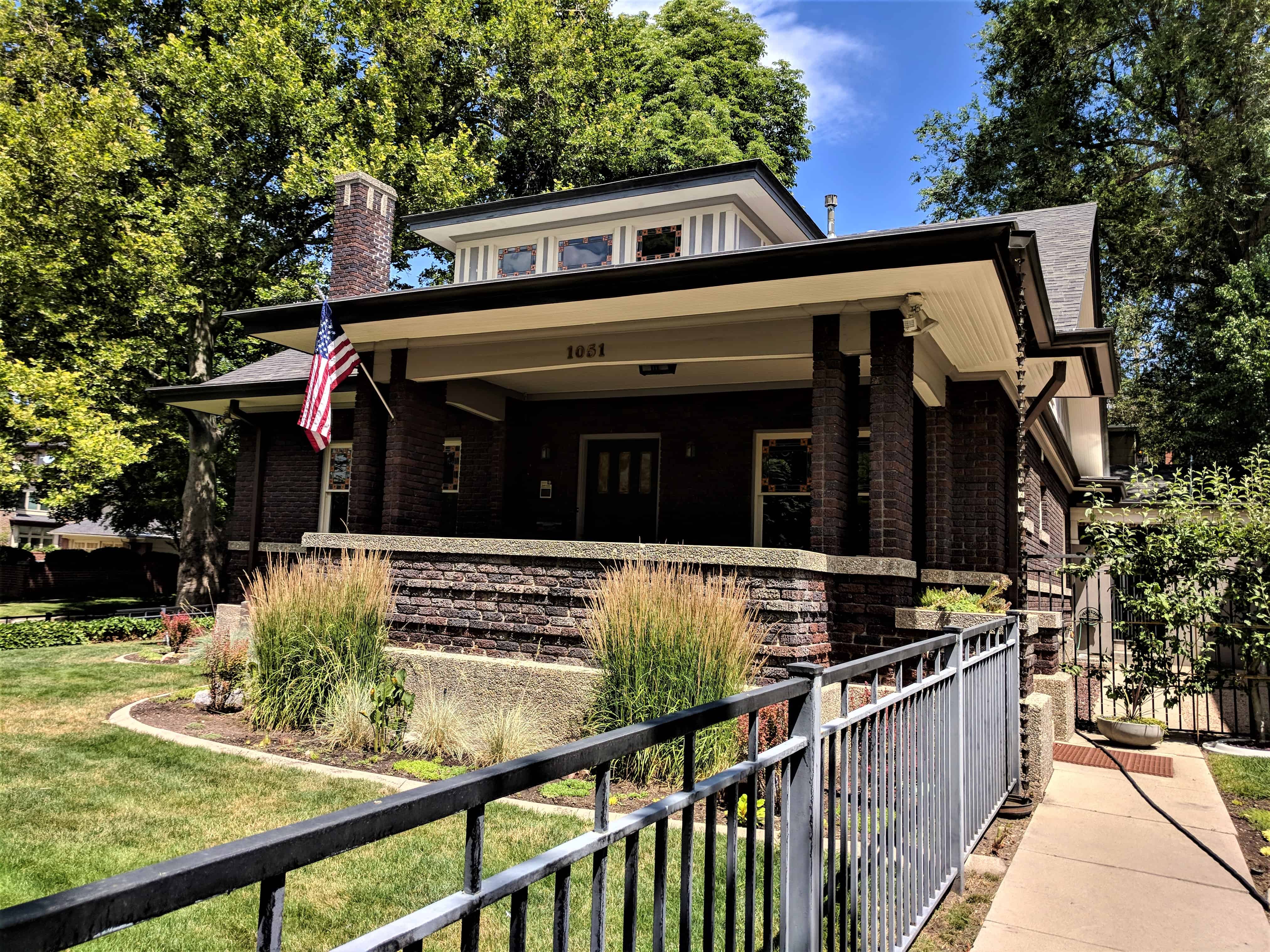
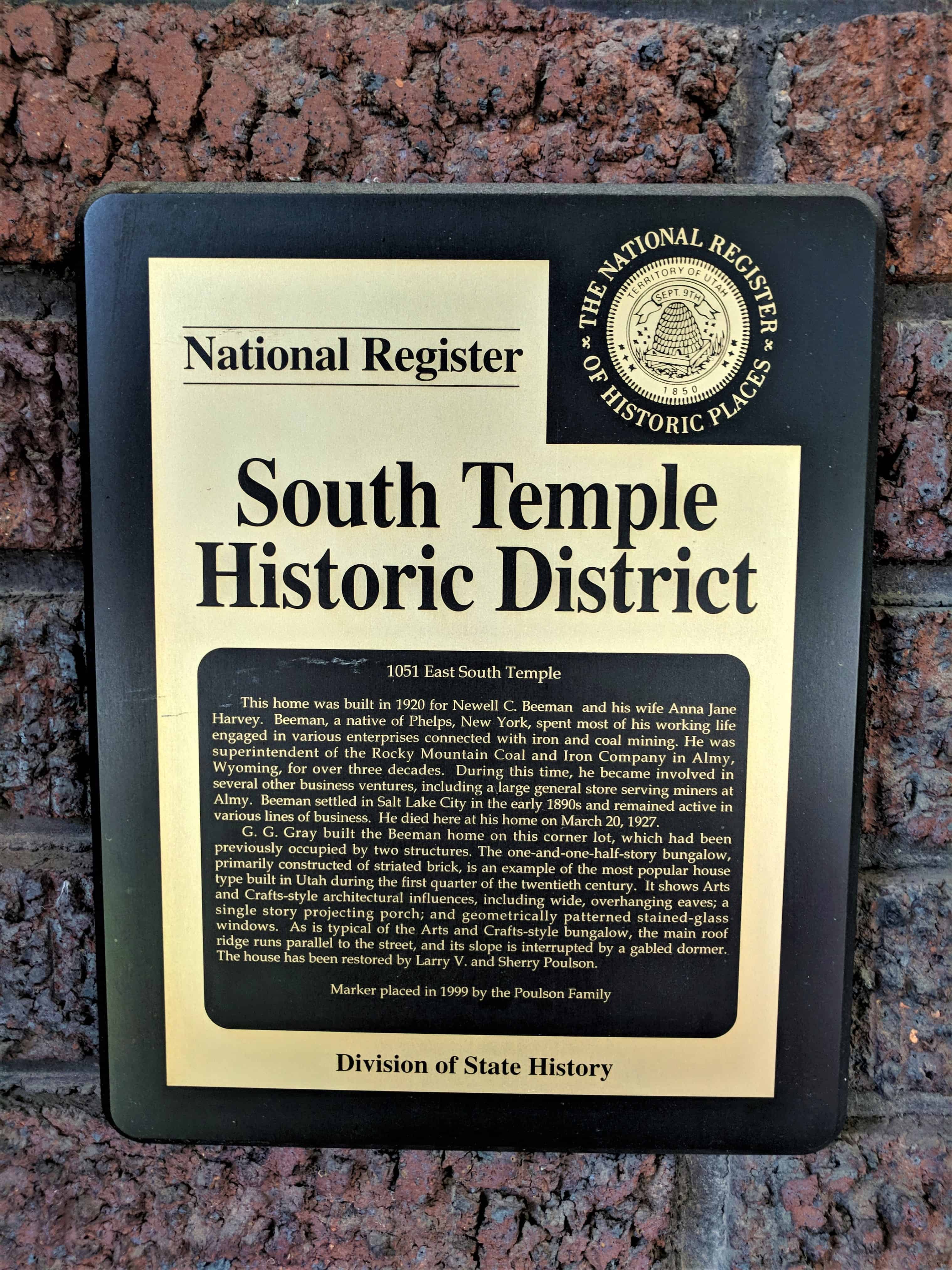
This home was built in 1920 for Newell C. Beeman and his wife Anna Jane Harvey. Beeman, a native of Phelps, New York, spent most of his working life engaged in various enterprises connected with iron and coal mining. He was superintendant of the Rocky Mountain Coal and Iron Company in Almy, Wyoming, for over three decades. During this time, he became involved in several other business ventures, including a large general store serving the miners in Almy. Beeman settled in Salt Lake City in the early 1890s and remained active in various lines of business. He died here at his home on March 20, 1927.
G. G. Gray built the Beeman home on this corner lot, which had been previously occupied by two structures. The one-and-one-half-story bungalow, primarily constructed of striated brick, is an example of the most popular house type built in Utah during the first quarter of the twentieth century. It shows Arts and Crafts-style architectural influences, including wide, overhanging eaves; a single story projecting porch; and geometrically patterned stained-glass windows. As is typical of the Arts and Crafts-style bungalow, the main roof ridge runs parallel to the street, and its slope is interrupted by a gabled dormer. The house has been restored by Larry V. and Sherry Poulson.
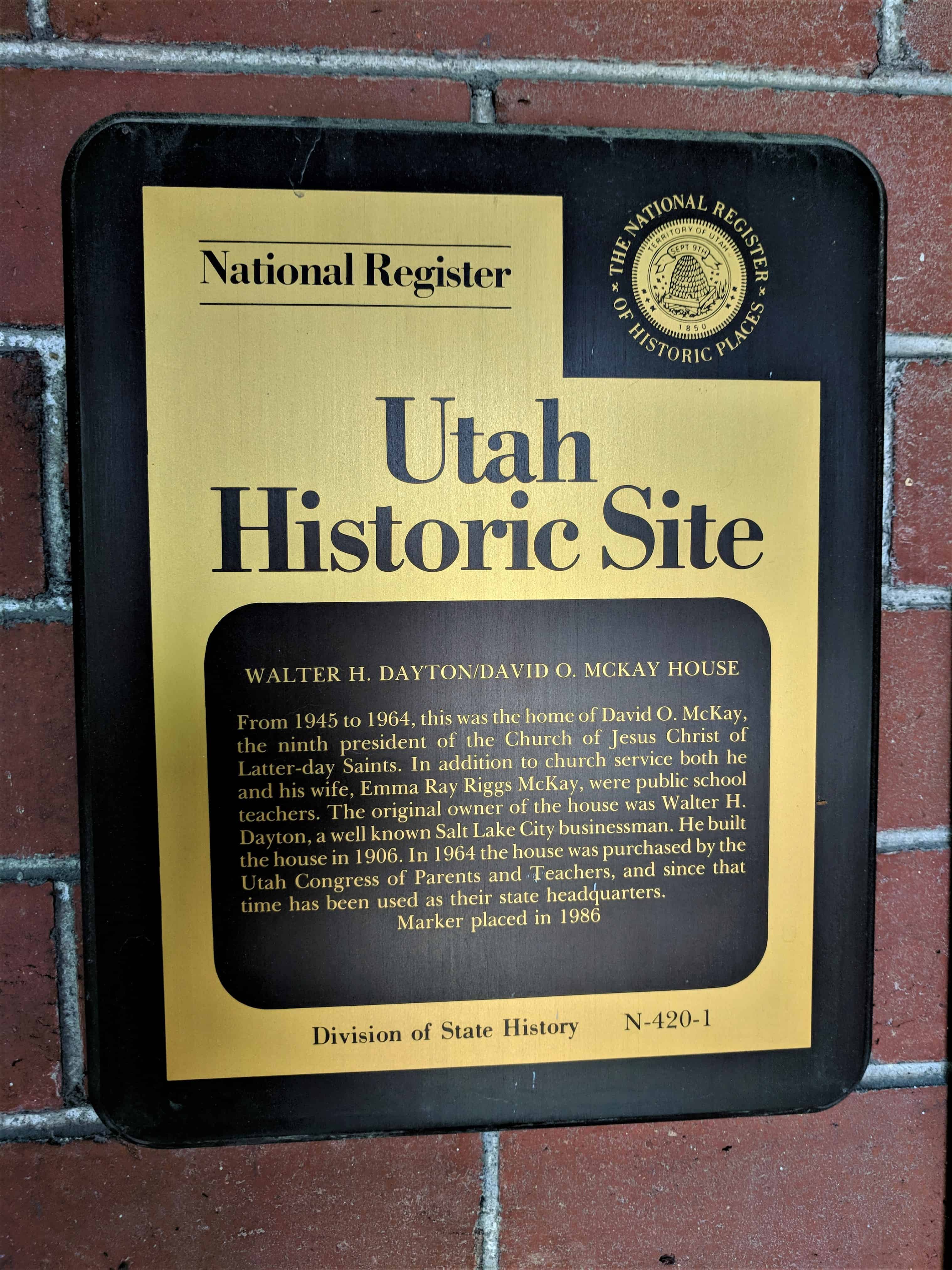
From 1945 to 1964, this was the home of David O. McKay, the ninth president of the Church of Jesus Christ of Latter-day Saints. In addition to church service both he and his wife, Emma Ray Riggs McKay, were public school teachers. The original owner of the house was Walter H. Dayton, a well known Salt Lake City businessman. He built the house in 1906. In 1964 the house was purchased by the Utah Congress of Parents and Teachers, and since that time has been used as their state headquarters.
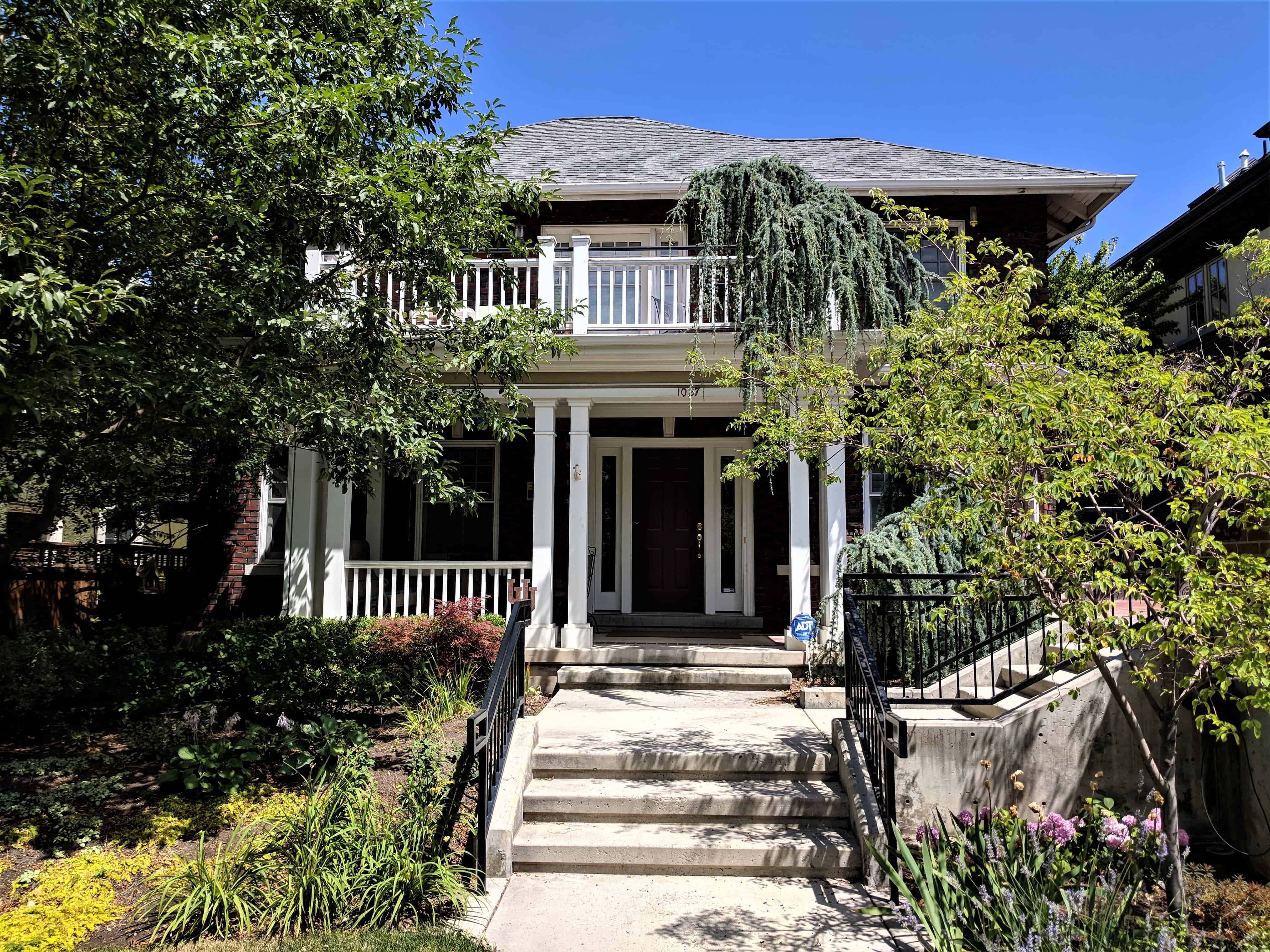
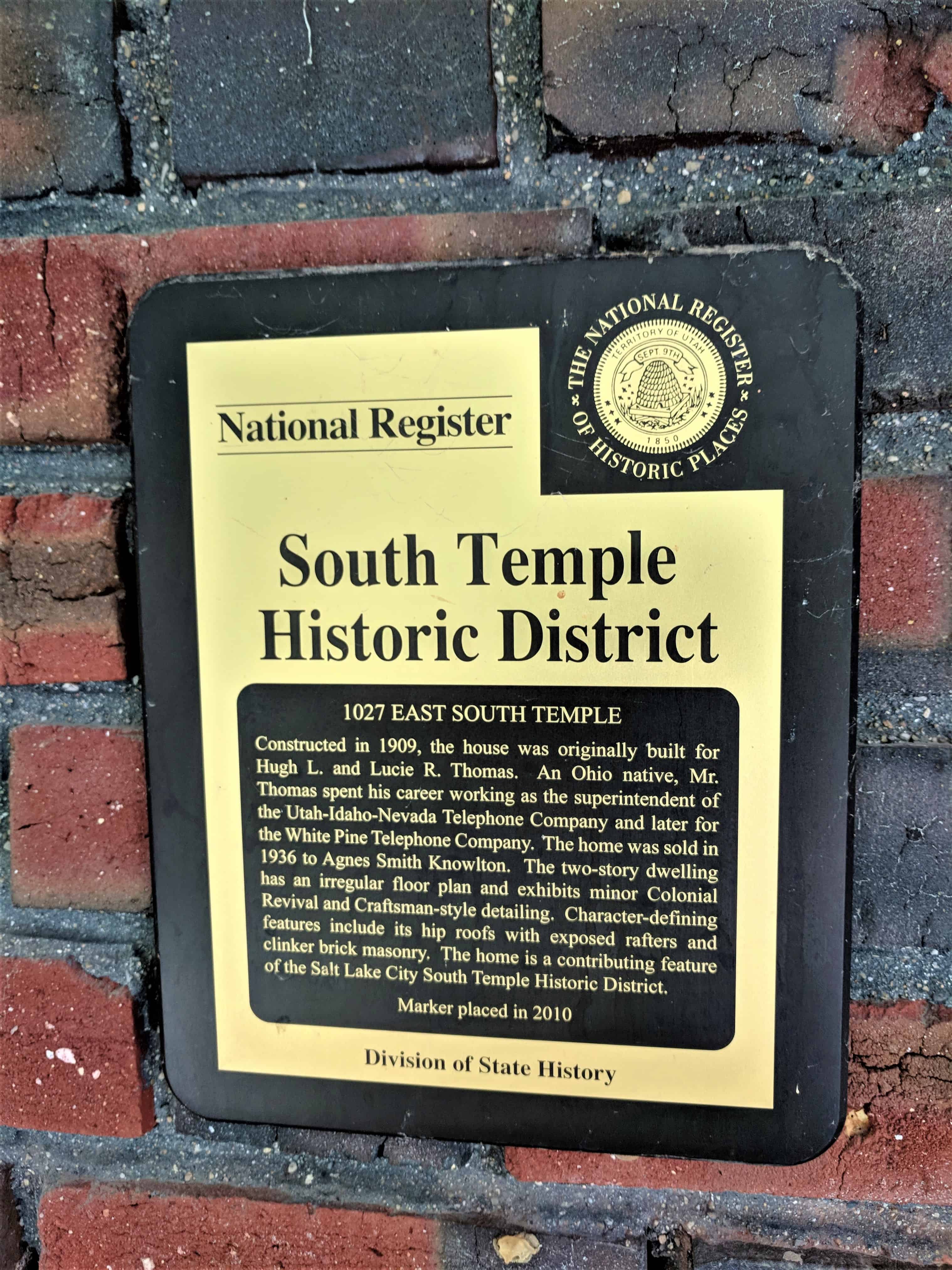
Constructed in 1909, the house was originally built for Hugh L. and Lucie R. Thomas. An Ohio native, Mr. Thomas spent his career working as the superintendent of the Utah-Idaho-Nevada Telephone Company and later for the White Pine Telephone Company. The home was sold in 1936 to Agnes Smith Knowlton. The two-story dwelling has an irregular floor plan and exhibits minor Colonial Revival and Craftsman-style detailing. Character-defining features include its hip roofs with exposed rafters and clinker brick masonry. The home is a contributing feature of the Salt Lake City South Temple Historic District.
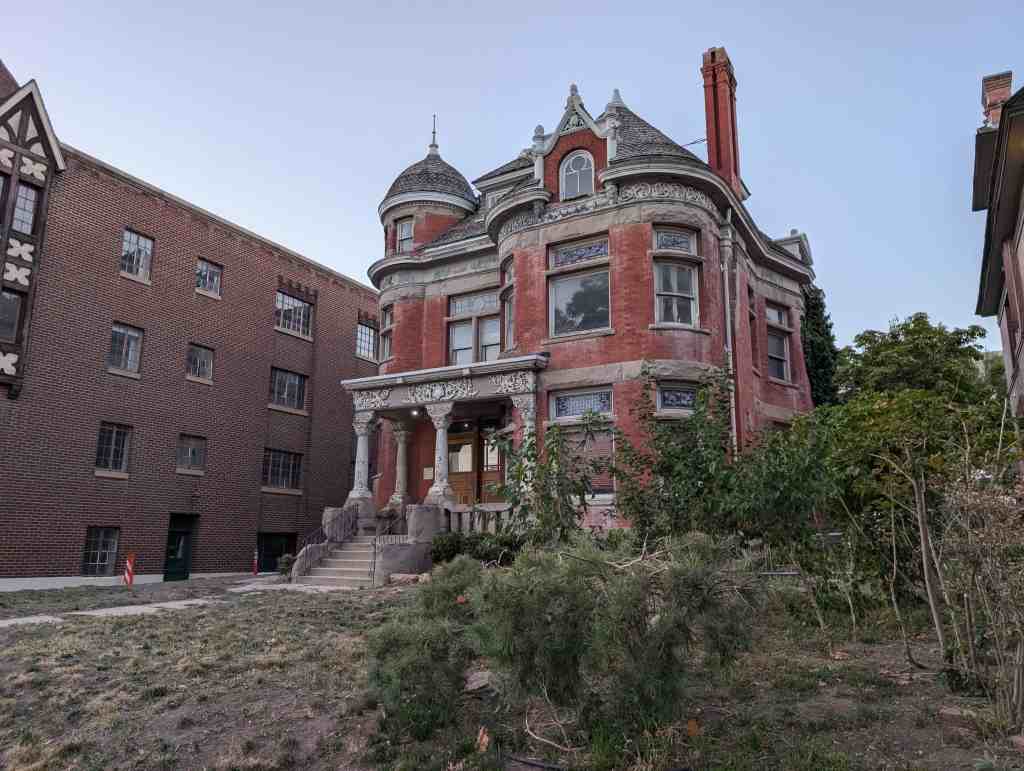
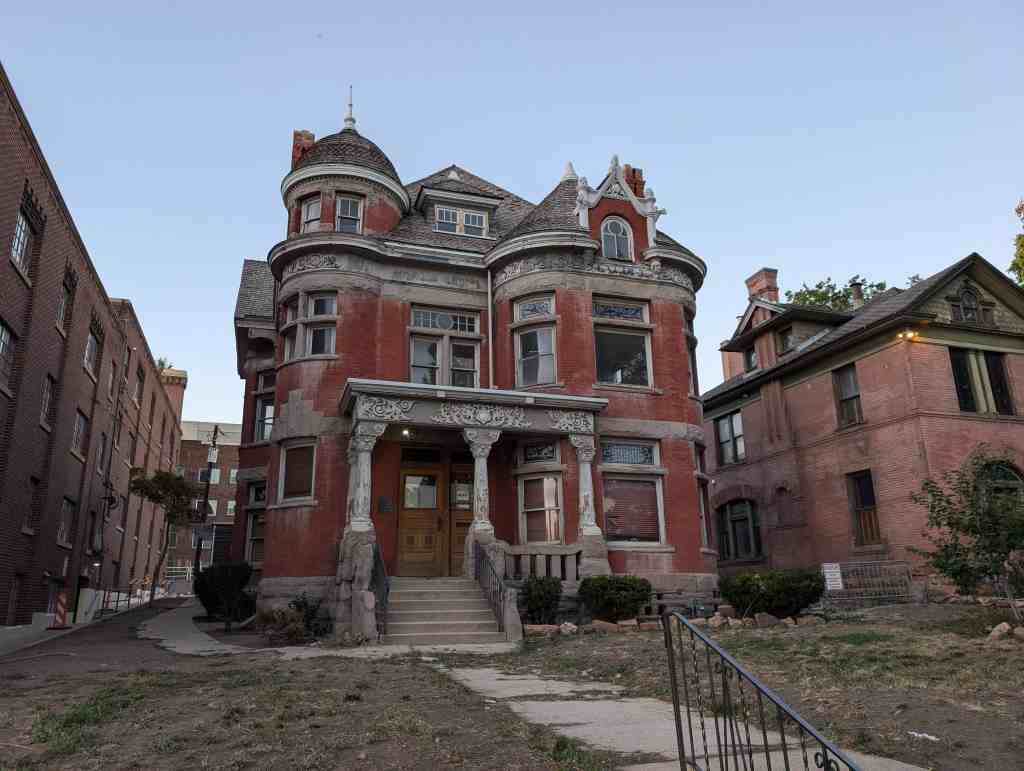
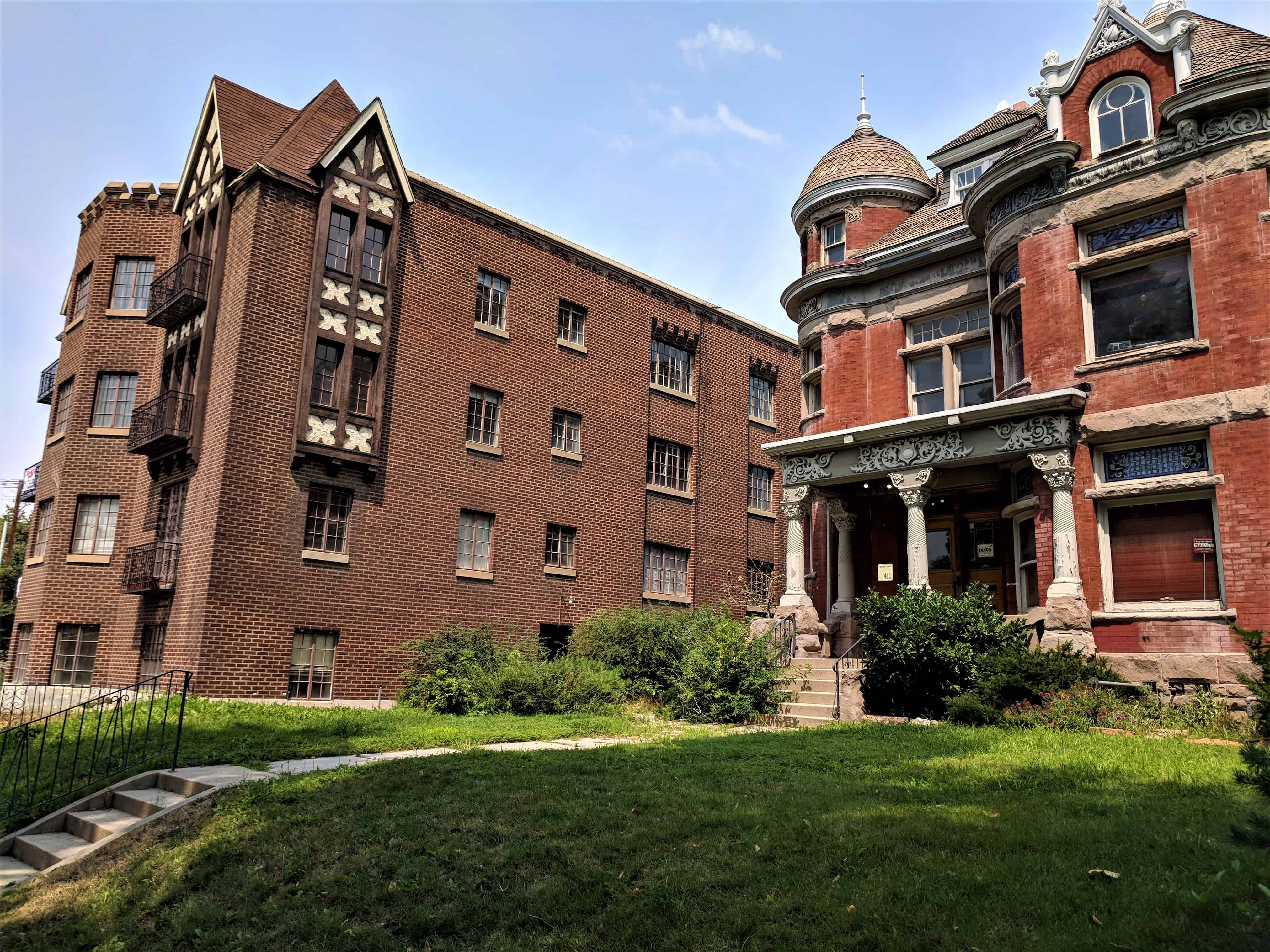
Located at 411 East 100 South, Salt Lake City is this Victorian style home was designed by Richard Kletting ( the architect for Utah’s State Capitol ). It was built of a special burned red brick made In Denver. The exterior decoration is native cut sandstone. The detailed exterior work is in tin. The foundation is red sandstone from the Red Butte Canyon area east of Salt Lake City.
There are three floors and a basement which contains the laundry, furnace room, and two storage rooms. On the main floor is located a vestibule, alcove, front hall, living room, dining room, parlor, kitchen, pantry, and back porch. On the second floor there are two bedrooms, a master bedroom, which has a dressing room connecting it to the bath, and a maid’s room with its own oath. Located in the third floor are two bedrooms and a playroom extending the full front width of the house.
Perhaps the most striking characteristic of the interior is the two story stained glass window which faces the west and the beautiful woodwork. The doors of the vestibule are of oak and contain frosted glass. The front hall woodwork is oak. The living room is decorated with maple trim. The dining room oak trim and the parlor with mahogany trim.
The main floor rooms have hardwood parquet floors. The double doors connecting the rooms are made of two types of wood each side of which is particular to that room.
Each of the main floor rooms and each bedroom has its own fireplace. The dining room fireplace is especially noteworthy because of its detailed inlaid wood.
The home was built with both electrical and gas lighting fixtures. The home was heated with a coal furnace and a hot water system which has been converted to gas.
The home was built in 1890 for Dinwoody’s third wife, Sara Kinersley. Mr. Dinwoody was a polygamist who had joined the Mormon Church in his native land England in 1847. Henry Dinwoody and his first wife, Ellen Gore, left Liverpool for the United States in September 1849. After landing in New Orleans the Dinwoody’s journeyed upriver to St. Louis where they remained until 1855 when they emigrated to Utah.
Once in Utah, Dinwoody began to practice the skills of a carpenter and builder that he had learned in England, He constructed a frame building and began manufacturing furniture. This business, known as the H. Dinwoody Furniture Company grew to become the leading furniture establishment west of the Missouri and east of San Francisco. The furniture store served all of Utah and parts of Wyoming, Idaho, Nevada, and Arizona. The store was an important part of the Mormon economy; and through his enterprise, Dinwoody became one of Utah’s wealthiest and most influential citizens.
In addition to his furniture business, Dinwoody was a director of several local businesses, banks, and insurance companies. He was also active in local political affairs serving as a member of the city council. During the polygamy raids of the mid 1880’s Henry Dinwoody was incarcerated in the territorial prison for unlawful cohabitation. During his incarceration Ellen, his first wife, died. Dinwoody was allowed to attend the funeral but was returned to prison without being permitted to attend the burial.
Henry Dinwoody died in 1905 and his third wife, Sara Kinersley Dinwood in 1908, The home was inherited by their daughter Mrs. James H. Moyle. The Moyle family lived in it from 1908 to 1917 arid 1920-1929. From 1917 to 1920 the home was rented to U.S. Senator William H. King. The home was vacant from 1929 to 1931 at which time James D. Moyle, a grandson of Henry Dinwoody, purchased the home and lived there until 1952. The present owners, Mrs. & Mr. Nephi E. Maclachlan, acquired the house in 1952 and have been successful in their diligent efforts to preserve the integrity of the home.
The significance of the home is primarily in its association with Henry Dinwoody. After his arrival in Utah, Dinwoody worked his way from a poor emigrant to become one of the Interrnountain West’s most successful businessmen. The home also has great merit as one of the state’s most beautiful Victorian style homes.
The home was added to the National Historic Register (#74001936) on July 24, 1974.
Designed and built in 1911 by noted architect Bernard O. Mecklenburg, this example of a large twentieth century brick Foursquare type home is well-preserved. It features a hip roof, dentil molding, brick quoins, and a full-width front porch. The home was built for the notable early Salt Lake City physician Walter S. Ellerbeck, and wife Ellen Lunt. Dr. Ellerbeck was born in Salt Lake City in 1872, attended public schools in Salt Lake City, and graduated from the University of Pennsylvania Medical School in 1894. He then moved back to Utah and practiced medicine in Salt Lake for 31 years, until his death in 1927. In 1930, ownership of the home was turned over to Walter and Ellen’s son, George L. Ellerbeck, who managed the Utah Power and Light Company in Ogden. The home remained in the Ellerbeck family until 1955.
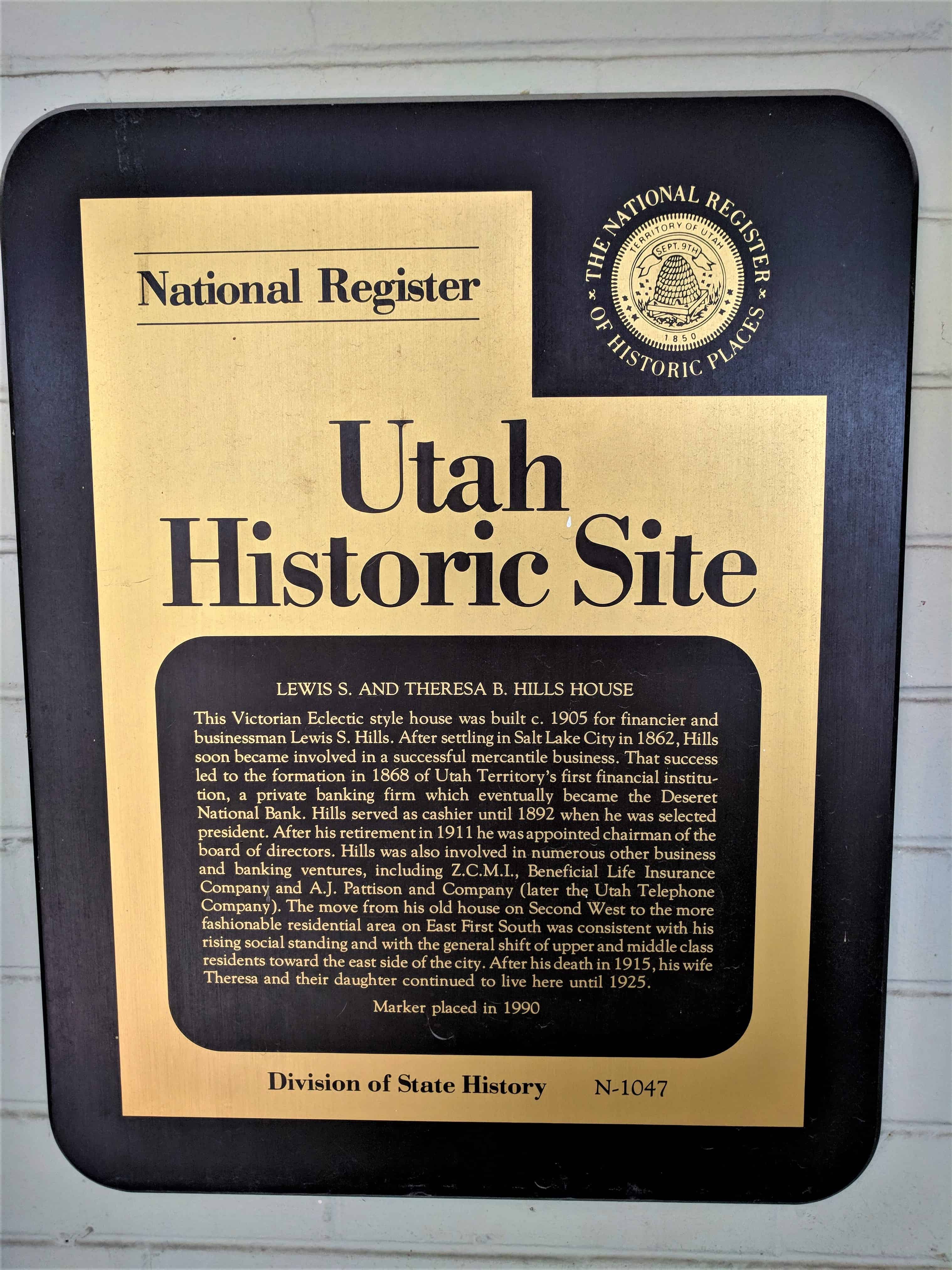
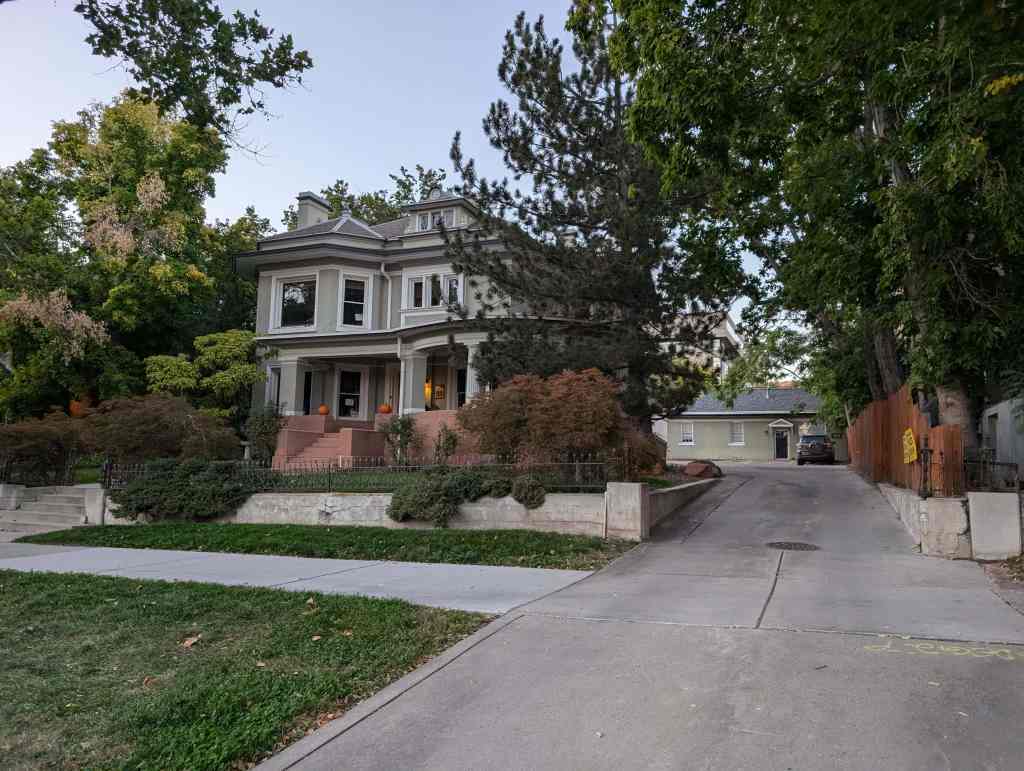
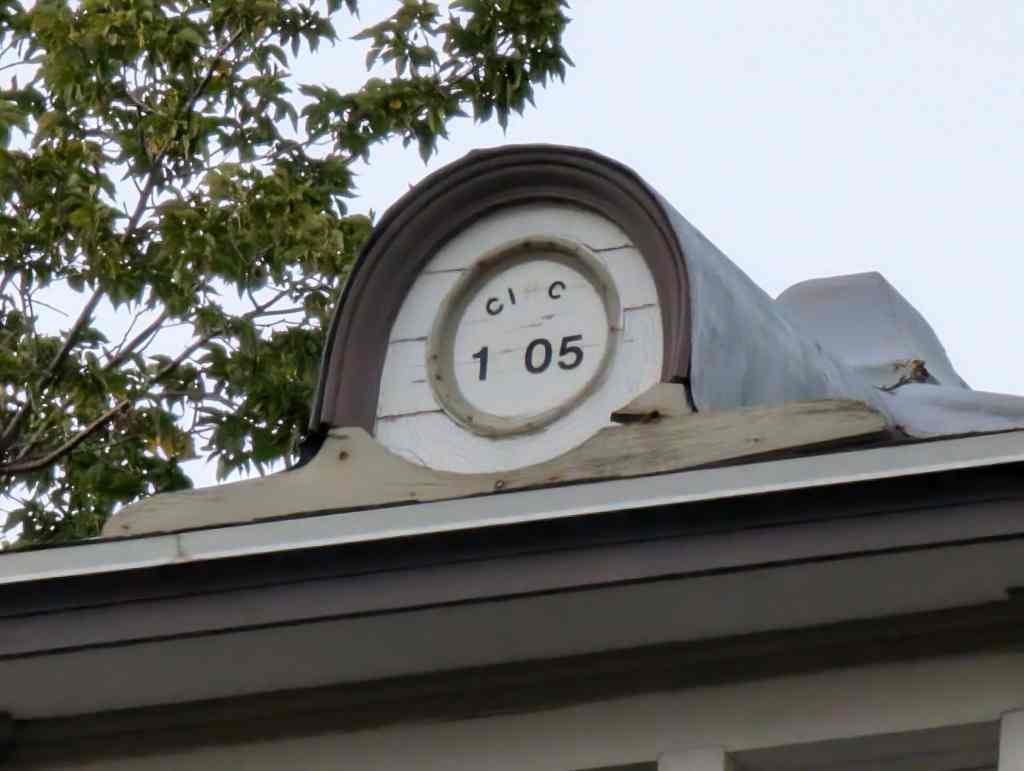
This Victorian Eclectic style house was built c.1905 for financier and businessman Lewis S. Hills. After settling in Salt Lake City in 1862, Hills soon became involved in a successful mercantile business. That success led to the formation in 1868 of Utah Territory’s first financial institution, a private banking firm which eventually became the Deseret National Bank. Hills served as cashier until 1892 when he was selected president. After his retirement in 1911 he was appointed chairman of the board of directors. Hills was also involved in numerous other business and banking ventures, including Z.C.M.I., Beneficial Life Insurance Company and A.J. Pattison and Company (later the Utah Telephone Company). The move from his old house on Second West to the more fashionable residential area on East First South was consistent with his rising social standing and with the general shift of upper middle class residents toward the east side of the city. After his death in 1915, his wife Theresa and their daughter continued to live here until 1925.
Located at 425 East 100 South in the Central City neighborhood of Salt Lake City, Utah and added to the National Register of Historic Places (#90001141)
Constructed c. 1905, the Lewis S. Hills House is both historically and architecturally significant. It is historically significant for its association with Lewis S. Hills, one of the leading financiers and businessmen in Utah during the nineteenth and early twentieth centuries. Hills was a partner in the first financial institution established in the territory in 1868 and served as cashier and later president of Deseret National Bank, one of the principal banks of the period. He also served on the board of directors of numerous smaller banks throughout the state and several major commercial enterprises. Hills was also active in political and civic affairs, serving as first treasurer of the University of Utah and as a Salt Lake City councilman for two terms. There are two other houses closely associated with Hills: a c.1877 house at 126 S. 200 West in Salt Lake City (National Register 1977) and a 1903 summer home located several miles southeast of the city (altered, possibly ineligible). The 1905 house represents the zenith of Hills’ career, having been constructed while he was bank president. It remained his principal residence until his death in 1915. The house is architecturally significant as an excellent local example of the Victorian Eclectic style and as one of the few remaining houses in this East First South neighborhood, which was a fashionable residential area during the late nineteenth and early twentieth centuries. Many of the houses along this street, though less opulent than the mansions on South Temple one block to the north, were good examples of upper-middle class residential architecture. Styles represented here include Italianate, Queen Anne, Victorian Eclectic, Arts and Crafts, and Colonial Revival. Within this local context, the Hills house is architecturally significant.
Lewis S. Hills played a vital role in Utah business and financial affairs from the 1860s until his death in 1915. He was born March 8, 1836, at South Amherst, Massachusetts, then as a young man moved west to Council Bluffs, Iowa, where he worked for a time in a land office. After converting to Mormon ism there, he and a brother decided to join the main body of the church in Utah. They arrived in Salt Lake City in 1862. His brother continued on to California, but Lewis remained in the city and soon became involved in a successful mercantile business. That success led to the formation in 1868 of the Utah Territory’s first financial institution, a private banking firm established in partnership with William H. Hooper and Horace S. Eldredge. The firm Hooper, Eldredge and Company was incorporated in 1871 as the Bank of Deseret, with Mormon church president Brigham Young as president. It was re-incorporated under the National Bank Act of 1872 as the Deseret National Bank, with Lewis S. Hills serving as cashier. He held that position until being appointed president of the bank in 1892. Hills served as president of the Deseret National Bank until resigning in 1911, at which time he was made chairman of the board of directors.
In addition to his career with the Deseret National Bank, Hills was involved in numerous other business and banking ventures throughout the state. He served as a director of Zions Cooperative Mercantile Institution, Consolidated Wagon and Machine Company, Beneficial Life Insurance Company, Home Fire Insurance Company, Utah Fire Clay Company, A.J. Pattison and Company which became the Utah Telephone Company, Neplri Plaster Company, First National Bank of Ogden, First National Bank of Murray, Nephi National Bank, Thatcher Brothers Bank of Logan, Davis County Bank of Farmington and Barnes Banking Company of Kaysville. Mr. Hills was a shareholder in the Oregon Lumber Company, Amalgamated Sugar Company, Utah-Idaho Sugar Company and numerous other large corporations. He was also the first receiver of the U.S. Land Office at Salt Lake, and the first Treasurer of the University of Utah. He was also active in local politics as a member of the People’s Party and served as a Salt Lake City councilman for two terms. In 1866, Lewis married Theresa Burton, and together they raised six children.
Lewis Hills was one of a handful of important pioneer financiers in Utah. His early involvement and long and distinguished career in the banking industry are evidence of his significant contribution. The Deseret National Bank, which he helped establish and with which he was most closely associated, was one of three principal banks in Salt Lake City during the early territorial period. The others are Walker Brothers Bank and Zion’s Savings Bank and Trust Company. A number of other banks and trust companies were established later in the 1880s and 1890s.
Around 1905, while serving as president of the Deseret National Bank, Lewis Hills had a large new house constructed at 425 E. 100 South. His former residence, built c.1877, was a two-story Italianate style house located at 126 S. 200 West (still standing; National Register 1977). That house, typical of many of the finer early homes (1860s-70s) in Salt Lake City, was located near the central business district. By the turn of the century, that area was being encroached on by the expanding central business district to the east and railroad and warehouse districts to the west and was no longer a desirable residential neighborhood.
The East First South neighborhood, where Hills’ new house was constructed, was a fashionable residential area in the late nineteenth and early twentieth centuries. In addition to Hills’ house, other fine, large homes along First South street between 400 and 700 East included, among others, the homes of Governor Simon Bamberger, Salt Lake City Mayor William Armstrong, attorney Jonathan Royle, businessmen Henry Dinwoodey, James Langton (all National Register), P.W. Madsen (demolished), Thomas Weir and Orange Salisbury (both National Register eligible). Part of the attraction of this neighborhood was undoubtedly its proximity to the most fashionable and elite residential area in the city, South Temple street, one block north. The mansions along South Temple (National Register historic district) were clearly the finest in the city. They include the Kearns, Keith-Brown, Wall, and Walker mansions, to name just a few. Hills’ move to this part of the city was consistent with his own social standing and with the general shift of upper and middle class residents toward the east side of the city.
In 1903, just prior to constructing the house on First South, Lewis Hills had a summer home, “Hillsden,” built in the Holladay area, several miles southeast of Salt Lake City. That home was located on extensive acreage near the mouth of Big Cottonwood Canyon. It functioned as a summer home and retreat for the family and their guests. That house was remodeled in 1927 by a daughter, Maria, who inherited the property. Most of the surrounding estate was subdivided in subsequent years. The current address of that house is 2690 E. Hillsden Drive.
The house at 425 E. 100 South was Lewis Hills’ principal residence from its completion until his death. He died July 21, 1915, at his summer home. His wife, Theresa, and daughter, Maria, continued to live in the home until Theresa’s death in 1925. At that time ownership of the house passed to the Hills Corporation. A son, Lewis B., lived there for a time, then the house was rented out. Some remodeling of the house may have taken place at that time.
In 1937, the house was sold to Jack T. and Ethel A. Birkinshaw and remodeled into apartments. Gladys C. Flynn purchased the house in 1956, then, in 1972, the Utah Bar Association bought the home and converted it from residential to office use.
In 1988 the house was purchased by the law firm of Spafford and Spafford. At this time the home was redecorated and necessary work was undertaken to restore the home to its original state. The home has since been used as headquarters and offices of Spafford and Spafford.