• About JacobBarlow.com
  • Cemeteries in Utah
  • D.U.P. Markers
  • Doors
  • Exploring Utah Email List
  • Geocaching
  • Historic Marker Map
  • Links
  • Movie/TV Show Filming Locations
  • Oldest in Utah
  • Other Travels
  • Photos Then and Now
  • S.U.P. Markers
  • U.P.T.L.A. Markers
  • Utah Cities and Places.
  • Utah Homes for Sale
  • Utah Treasure Hunt

JacobBarlow.com

~ Exploring with Jacob Barlow

JacobBarlow.com

Tag Archives: Historic Markers

Land of the Yuta

16 Sunday Oct 2022

Posted by Jacob Barlow in Uncategorized

≈ Leave a comment

Tags

Historic Markers

Land of the Yuta

Historic markers located at the Utah Territorial Statehouse in  Fillmore, Utah

Death of a Chief

The winter of 1854-55 found Walkara and his band camped along Meadow Creek just four miles south of this spot. In January, the chief began to feel ill, and by the later part of the month, he was suffering from pneumonia. On January 29, the Hawk of the Mountains died. Carrying out the wishes of his dead brother, Arapene slashed the throats of Walkara’s two wives so that their spirits might walk with that of the Hawk. On the day of their deaths, the bodies of the chief and his wives were securely strapped to horses and carried to the mountain above what is now the town of Meadow. There, in the talus slopes which overlook the western deserts of the Great Basin, Walkara was interred in a tomb of stone.

The chief was placed on his favorite blue blanket, and the still-bloody bodies of his two wives were laid on either side. A young Paiute girl was also killed and put into the grave while another Paiute child, a small boy, was staked alive in the pit to ward off wild animals. Before the tomb was sealed, an ornate saddle with brocaded cherubim, a Book of Mormon, rifles, bows, steel-tipped arrows, Spanish ornaments and food were placed with the dead chief. To seal the ten foot diameter tomb, logs were placed across the top of the grave. Rocks were then stacked on top of the logs to conceal the posts and the burial vault. With the sealing of the tomb, 14 of Walkara’s favorite horses were led to the grave and killed. A Forest Service survey of the burial site in 1983 revealed the scattered skeletal remains of these horses 128 years after they had been killed. This survey also confirmed what had been unofficially suspected for years: Walkara’s grave had been robbed by relic hunters sometime around 1909.

Two hundred yards north of Walkara’s gravesite are a number of Ute burials from the same general time period; that is, the 1850’s and 1860’s. These burials are not as grand as Walkara’s. Generally, they consist of a small vault in the talus just big enough for a single individual accompanied by a small number of grave goods. Of the 20 burials, 13 have been disturbed by grave robbers. Human bones have been scattered indiscriminately across talus slopes while graves have been looted of the goods that accompanied the dead at burial.

The Ute Domain

First described by Spanish explorers as the YUTA Indians (pronounced Ute-ah), the ancestors of the Ute people are thought to have migrated from the deserts of southeastern California over 700 years ago. The Utes moved into predominately two areas and became somewhat distinct because of that geographical division. The eastern Utes (Colorado) migrated to the east of the Colorado River and settled on the Colorado Plateau. On the other hand, the western Utes (Utah) established their camps in the valleys between the rugged mountain ranges on the eastern margin of the Great Basin.

In south-central Utah, one of the earliest camps has been dated to around A.D. 1380 and consists of stone circle 10 to 15 feet in diameter that would have anchored skin or brush shelters calledĀ wickiups.Ā Unlike the Fremont and Anasazi Indians who preceded them, the ancestors of the Utes were not farmers but rather relied on hunting and gathering for their sustenance.

When encountered by the Dominguez-Escalante Expedition in 1776, theĀ Utes were found living in “houses of grass and earth” near the shores of Utah Lake. Father Escalante, the chronicler of the expedition, describes the Indians as having good features with most of the men wearing long beards. The Indians called themselves theĀ TimpanohtzisĀ or the “fish eaters” but their diet also consisted of plants, herbs and wild game. Escalante wrote that the Utes were a docile and peace-loving people. Over a half century later, an adventurer by the name of Dan Storm spent the winter of 1839-40 with the Utes in an encampment near Utah Lake. The village consisted of two dozen buffalo-hide tipis occupied by 100 men, women and children. The people kept about 300 horses which they had obtained from the Spanish beginning in the early 1800s. The Utah Lake Utes, according to Storm, were one of the strongest of the six independent bands that made up the western Utes. Storm found the Utes considerably more aggressive than had the Spanish, and he writes of participating in a raid on the Gosiute Indians of western Utah. Many prisoners were taken in this raid with women and children ultimately sold as slaves to the Navajos and the Mexicans.

With the arrival of the Mormon pioneers in 1847, relations between the Utes and the newcomers were at first peaceable and friendly. George A. Smith, of the Utah Indian Service wrote that, “They are virtuous, honest andĀ free from licentiousness; they are humane and kind to one another.” Smith described the Utes as typical mountain Indians. They were wanderers and had seasonal camps all over central and southern Utah including those near Spanish Fork, Payson, Nephi, Manti, Fish Lake, Meadow, Kanosh and Parowan. On occasion, the Utes ventured as far as the plains of Colorado in search of buffalo meat and hides. Marriage was polygamous, and a man might take as many wives as he could afford. Women were expected to raise their children, butcher and process wild game and plants, provide meals, and to move camp. The role of the men, in contrast, was that of hunter and warrior.

The greatest warrior and chief during the early pioneer period was a tall, handsome man named Walkara, the “Hawk of the Mountains.” Born somewhere between 1808 and 1815 on the Spanish Fork River near what is now Provo, Walkara rose to power when he assumed the role of war chief in his father’s band, theĀ Tim-pan-ah-gosĀ Utes. The Hawk quickly increased his prominence as a leader by his skill and prowess as a “procurer” of horse flesh. Raiding as far away as the coast of California near San Luis Obispo, Walkara terrorized western ranches for over a quarter of a century until his death in 1855. According to fragmentary accounts, his raids were conducted between 1825 and 1854. The largest number of horses stolen onĀ any one raid was 3,000 with several raids netting at least 1,000 head. Horses could be sold at a mountain rendezvous for as much as $50 per animal or traded to other tribes for Indian children who were then exchanged for ammunition, blankets, pots and pans, and trinkets at the Santa Fe slave market.

Inevitably, the differences in culture, customs and economics brought the Utes and Mormon Pioneers into armed conflict. The Utes found their hunting and camping grounds increasing crowded with settlements while the Christian values of the pioneers prevented them from ignoring the issue of slavery. In 1853-54 and again in 1865-67, smoldering hostilities were fanned into open warfare. In 1872, with their ranks decimated by both war and disease, 1,500 Utes were removed by treaty to the Uintah Indian Reservation in northeastern Utah. Today, headquarters for the Ute Tribe of Utah or the “Northern Ute Tribe” as it is now called is located near the center of the reservation at Ft. Duchesne.

Walkara’s War

When the Utes welcomed Brigham Young and his party of 143 pioneers in 1847, they offered the Mormons the use of the land but had not given them their streams with their fish and beaver. They had also not reckoned with the fact that the white men would fence the land into little squares and tell them to keep out. And, they hadĀ not known that the ever increasing streams of newcomers would build forts as strongholds against them.

In 1853, relations between the pioneers and the Utes were strained to the limits. In July of that year, three Indians from Chief Walkara’s camp on Hobble Creek appeared at the cabin door of James Ivie near Springville to trade fish for flour. An argument followed, and Ivie killed one of the Indians in a hand-to-hand fight with a broken rifle stock. Walkara, upset with this incident and the Mormons’ recent policy opposing his lucrative slave trade, grasped the situation and unleashed a hit-and-run reign of terror that plagued the settlements in Utah, Juab, Sanpete, Millard and Iron Counties for the better part of the next year.

Ironically, the largest “engagement” of the war was not fought by Walkara but by the Pahvant Utes camped at Meadow Creek just south of Fillmore. In the fall of 1853, a wagon train of Missourians enroute to California camped near the Indian village. When a group of Pahvants approached with bundles of buckskin and offered to trade for tobacco and other goods, the settlers surrounded the party and attempted to disarm them. A fight ensued and the father of the Pahvant War Chief Mosnoquap was mortally wounded by a gunshot to his side. In retaliation, Mosnoquap ambushed a United States Army survey team in bivouac near Sevier Lake some 35 miles northwestĀ of Fillmore. Captain John W. Gunnison and 8 of his men died as the Pahvants attacked with a barrage of arrows and bullets as the morning sun rose on the army camp.

When word of the battle reached Fillmore several days later, White officials traveled to the site with Kanosh, Chief of the Pahvant Utes. Kanosh, long considered a friend of the pioneers, was sickened at the sight of the mutilated remains of Gunnison’s men. After ordering the appearance of Mosnoquap, Kanosh admonished the war chief for his actions. Although reproved for his role in the battle, the war chief was never surrendered by Kanosh to either Brigham Young or a U.S. Army detachment which had been sent to the Utah Territory to keep the peace.

With the approach of the spring of 1854, the Utes had grown tired of the fighting, and Walkara found his ranks of supporters growing ever thinner. Governor Young, recognizing the opportunity of the moment, arrived at Walkara’s camp on Chicken Creek near Nephi on May 22 with a contingent of 50 mounted militiamen and 100 wagons filled with gentlemen, their wives and families. The Chief was presented with 16 head of oxen, blankets, clothing, tobacco, whiskey, trinkets, arms and ammunition. During negotiations that lasted into the night, the Utes agreed to cease all hostilities against the pioneers and to give up their slave trade. The Mormons, in return would establishĀ an Indian farm near Utah Lake. The calumet of peace was smoked on the 23rd of May, and thus ended 10 months of violence that had claimed 20 pioneer lives, an undetermined number of Ute deaths, and about $200,000 worth of property damage.

Lake Fork

15 Saturday Oct 2022

Posted by Jacob Barlow in Uncategorized

≈ Leave a comment

Tags

Bells, Duchesne County, DUP, Historic Markers, Post Offices, Upalco, utah

Lake Fork

After 1861 this area was an Indian Reservation until opened for settlement in 1905. Homesteaders arrived, cleared land, dug ditches, planted crops and built cabins. Home erected by David Richardson, moved here, became the first post office; Rhoda Barker Post Mistress. Bell adornment hunt in the Church of Jesus Christ of Latter-day Saints building erected on this site, also used for recreation and school, William Neal, first teacher. Lake Fork was renamed Upalco.

This is Daughters of Utah Pioneers markers #355 located in Upalco, Utah

Related:

  • D.U.P. Markers

The Founding of Southern Utah University

13 Thursday Oct 2022

Posted by Jacob Barlow in Uncategorized

≈ Leave a comment

Tags

Art, Cedar City, Historic Markers, Iron County, Statues, SUP, utah

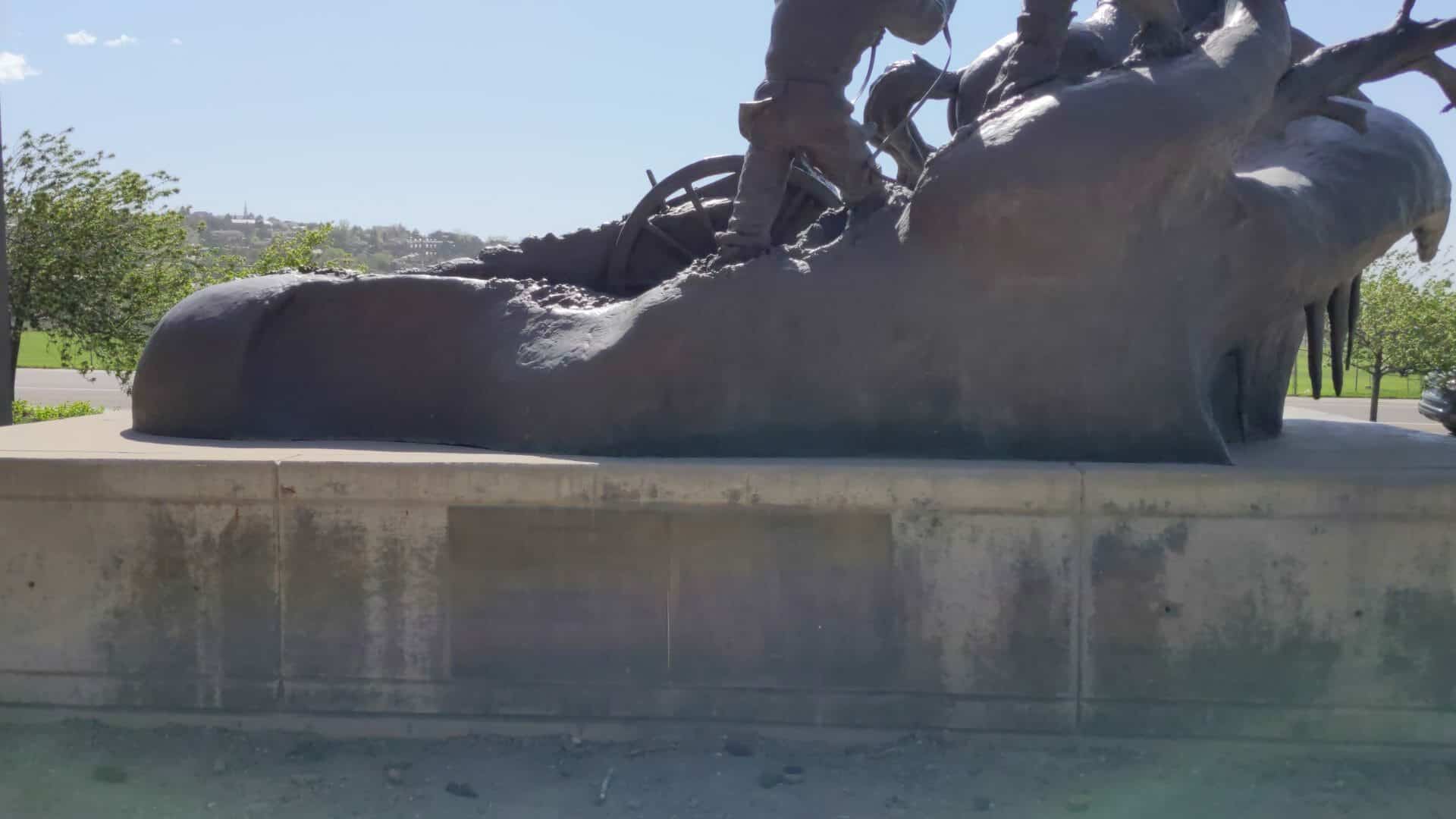
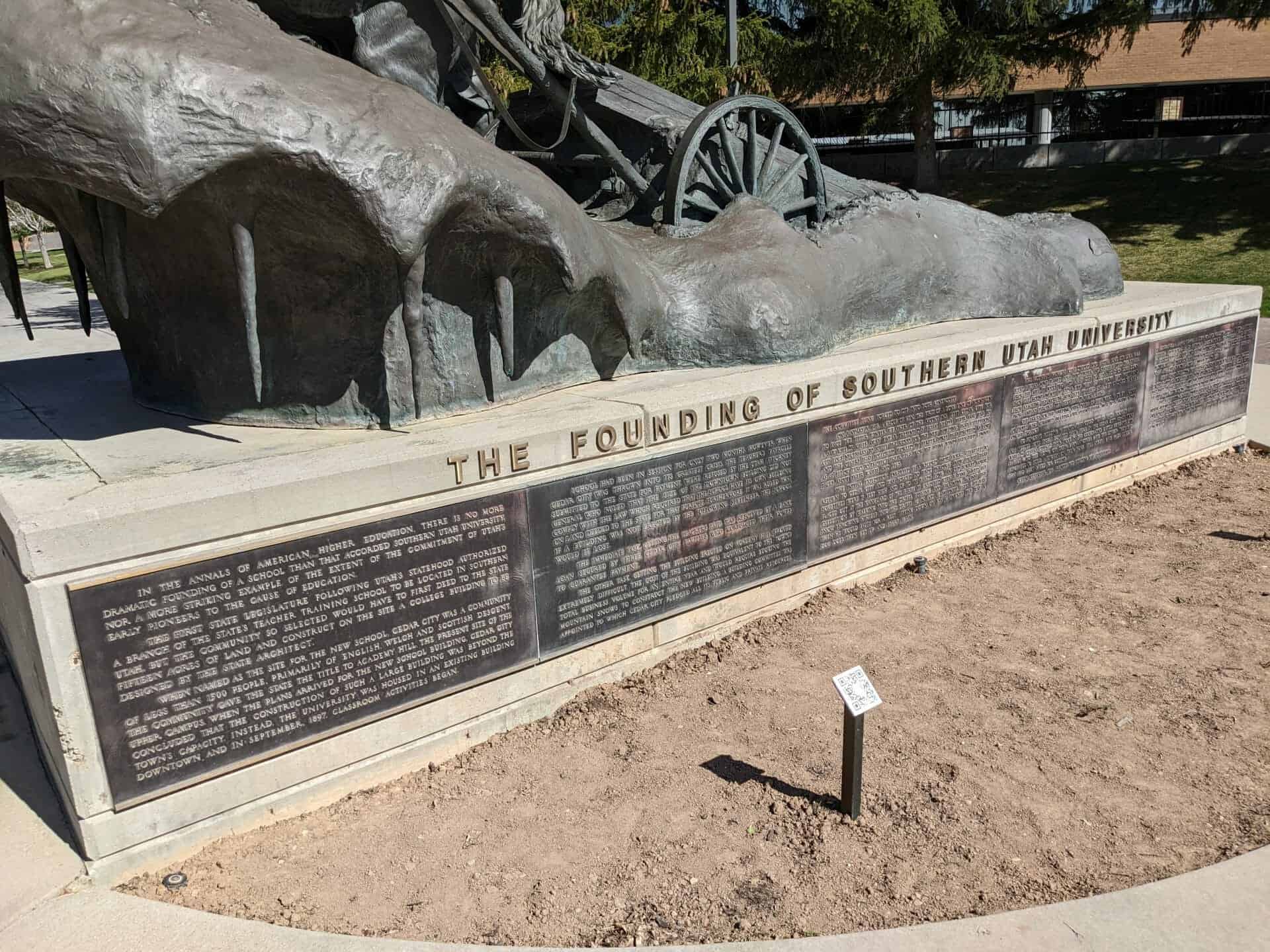
The Founding of Southern Utah University

In the annals of American higher education, there is no more dramatic founding of a school than that accorded Southern Utah University, nor a more striking example of the extent of the commitment of Utah’s early pioneers to the cause of education.

The first State Legislature following Utah’s statehood authorized a branch of the state’s teacher training school to be located in Southern Utah, but the community so selected would have to first deed to the state 15 acres of land and construct on the site a college building to be designed by the state architect.

When named as the site of the new school, Cedar City was a community of less than 1500 people, primarily of English, Welch and the Scottish descent. The community gave the state the title to Academy Hill, plans arrived for the new school building, Cedar City concluded that the construction of such a large building was beyond the town’s capacity. Instead, the University was housed in an existing building downtown and in September 1897 classroom activities began.

School had been in session for only two months, however, when Cedar City was thrown into its greatest crisis. The teacher’s payrolls submitted to the state for payment were refused by the Utah Attorney General who ruled that size of the downtown building did not comply with the law which required that the school have its own building on land deeded to the state for that purpose. Furthermore, it was ruled that if a building was not erected by the following September, the school would be lost.

The immediate task, getting the teachers paid, was resolved by a bank loan secured by three Cedar City families who mortgaged their homes to guarantee payment.

The other task, getting the building erected on Academy Hill, proved extremely difficult. The cost of the building was equivalent to the town’s total business volume for an entire year and would require beating the mountain snows to construct the new building. A building committee was appointed to which Cedar City pledged all its public and private resources, the committee being forced to dip into both generously.

On January 5, 1898, a group of men, the first of a long line of townsmen to face the bitter winter weather of the mountains left Cedar City for a saw mill 35 miles away (near present day Brian Head). Their task was to cut logs necessary to supply the wood for the new building. That expedition, and the others that followed, worked in temperatures that dropped as low as 40 degrees below zero. To protect their legs from the biting winds they tied gunny sacks about their waists and legs.

The initial expedition, engulfed by a record snow storm, attempted to return to Cedar City and was forced to wade through snow drifts that sometimes were 15 feet high and 100 yards long. An old Sorrel horse, placed out at the vanguard of the party, is credited with having saved the expedition by walking into the drifts, pushing and straining against the snow, throwing himself into the drifts again and again until they gave way. Then he would pause for a rest, sitting down on his haunches the way a dog does, then get up and start again.

The mountain workers were divided into groups. Some cut logs, some were sawers, some planed logs into lumber, and others hauled the lumber from the mill. It took two and a half days to get a load of logs down from the mountain tops to Cedar City. When heavy snows kept provisions from reaching the working men, they subsisted on a diet of dried peaches. From January through July they kept up their labors.

The bricks for the building, over 250,000 of them, were made by a corps of people who remained in Cedar City, often putting in 12 to 14 hours a day on the project.

To purchase building materials that could not be made locally, cash was needed. Some people donated their stock in the Cedar City Co-op store while others offered their stock in the cooperative cattle company. One family gave the siding off their barn, another gave the lumber they had purchased to build a kitchen on their home. Still others gave prize lumber that had been saved for coffins.

When September 1890 arrived, the building was completed.

It contained a large chapel, a library, and reading room, a natural history museum, biological and physical laboratories, classrooms, and offices. It stands today at the end of the founders’ walkway, directly east of this monument. Its interior has been remodeled several times but the exterior walls are the original ones constructed in 1898.

That first building was literally torn from icy crags and molded by the hands of more than 100 men and women. The community of Cedar City had met its greatest test, and the University was given a heritage unmatched by any other educational institution in the United States.

The preserving of the University was achieved by people who would never attend it, indeed some of them never had the opportunity of attending any school. They were hardy, rough-spoken, courageous men and women, people of the type without whom the frontiers of the west could never have been conquered.

This monument is Sons of Utah Pioneers historic marker #214 located at Southern Utah University in Cedar City, Utah

Related:

  • S.U.P. Historic Markers

What do you get with a cow, a jug of whiskey, and the city’s ā€œCat?ā€

12 Wednesday Oct 2022

Posted by Jacob Barlow in Uncategorized

≈ Leave a comment

Tags

Historic Markers, Uintah County, utah, Vernal

What do you get with a cow, a jug of whiskey, and the city’s ā€œCat?ā€

The 7-11 Ranch Restaurant, located directly across from you, is the oldest existing restaurant in Vernal. In 1933, Warren ā€œFatā€ Belcher sold a cow and bought a hot dog stand on South Vernal Avenue. Rising to the challenge of getting it moved to East Main Street, he bribed George Ramsey with a jug of whiskey to ā€œborrowā€ the city’s ā€œCat,ā€ (bulldozer) and moved the stand in the middle of the night. George took the bribe and the rest is history.

Warren and his wife, Daisy, operated their restaurant as the Grub Box until their new place was built in 1949. The cafƩ was named the 7-11 and sported four dice on its marquee, supposedly because Warren liked to gamble and shoot craps. It was also said that the Belchers wanted eleven children, but they only had seven.

One night a couple of men came in and after looking around, asked the waitress where the ā€œCrap Roomā€ was located. She hesitated a minute, then directed them to the men’s restroom. They came out looking very sheepish and left. The 7-11 CafĆ© is still owned and operated by one of Warren and Daisy’s daughters, Connie, and her husband, Jerry Pope.

This is #13 of the 21 stop history walking tour in downtownĀ Vernal, Utah. See the other stops on this page:

  • Vernal’s Walking History Tour

This marker is located at The 7-11 Ranch RestaurantĀ at 77 East Main Street inĀ Vernal, Utah

AH-1F Aircraft

12 Wednesday Oct 2022

Posted by Jacob Barlow in Uncategorized

≈ Leave a comment

Tags

Aircraft, Historic Markers, Uintah County, utah, Vernal

AH-1F Aircraft
(Bell AH-1F CORBRA)

Located at 152 East Main Street inĀ Vernal, Utah

Main Street

12 Wednesday Oct 2022

Posted by Jacob Barlow in Uncategorized

≈ Leave a comment

Tags

Dutch Flat, Historic Markers, Placer County

Dutch Flat was a busy commercial center rom the 1860’s through the 1880’s. In 1860, Dutch Flat had the largest voting population of Placer County, with 501 votes.

In 1861, Dutch Flat had:

  • 7 grocery stores
  • 8 clothing stores
  • 1 drug store
  • 2 butcher stalls
  • 1 bakery
  • 17 saloons
  • 2 breweries
  • 3 blacksmith shops
  • 2 tin shops
  • 1 carpenter ship
  • 2 hotels
  • 1 restaurant
  • 1 school
  • 3 churches

Related:

  • Little Library located here

This plaque is located on Main Street in Dutch Flat, California.

Dutch Flat Opera House

10 Monday Oct 2022

Posted by Jacob Barlow in Uncategorized

≈ Leave a comment

Tags

Dutch Flat, Historic Markers, Placer County

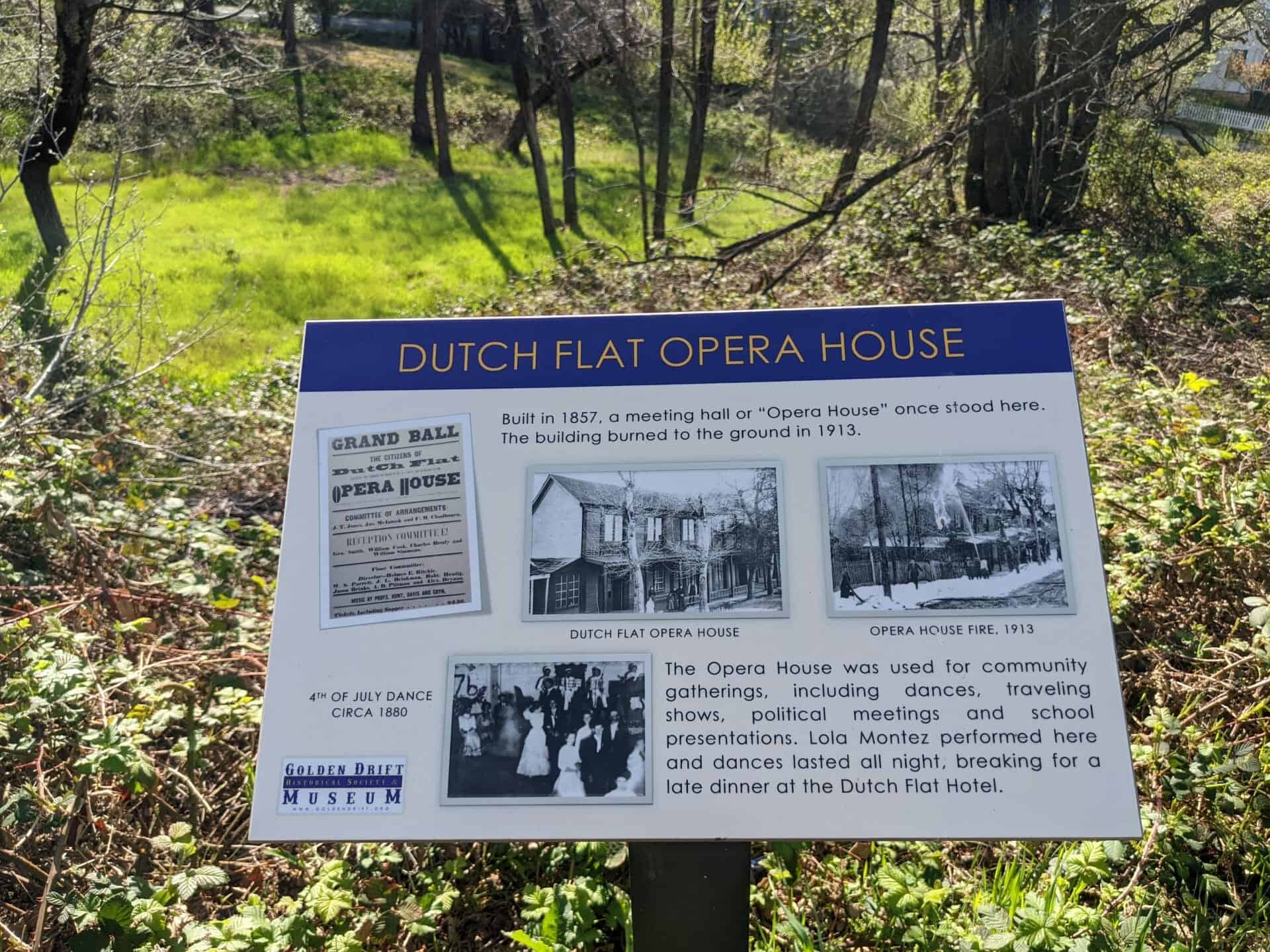
Dutch Flat Opera House

Built in 1857, a meeting hall or “Opera House” once stood here. The building burned to the ground in 1913.

The Opera House was used for community gatherings, including dances, traveling shows, political meetings and school presentations. Lola Montez performed here and dances lasted all night, breaking for a late dinner at the Dutch Flat Hotel.

Located inĀ Dutch Flat, California.

War Eagle Mines

04 Tuesday Oct 2022

Posted by Jacob Barlow in Uncategorized

≈ Leave a comment

Tags

Historic Markers, Idaho, Idaho Historic Markers

War Eagle Mines

For decades after 1884, most of Silver City’s fabulous mineral wealth came from Upper War Eagle Mountain, which rises a vertical mile above here.

With lodes far richer than those found elsewhere, War Eagle miners fought a series of violent wars for control of valuable claims. Troops from Fort Boise finally had to intervene in one-armed clash in 1868. San Francisco bank failures ended production there in 1875 and thriving camps became ghost towns.

This is Idaho Historic Marker #380 located near Murphy, Idaho

Related:

  • Idaho Historic Markers

Diamond Gulch

04 Tuesday Oct 2022

Posted by Jacob Barlow in Uncategorized

≈ Leave a comment

Tags

Historic Markers, Idaho, Idaho Historic Markers

Diamond Gulch

In December, 1865, Idaho’s Governor — Caleb Lyon of Lyonsdale — set off a wild rush to Diamond Gulch, visible a few miles west of here, with as story that was to good to be true.

He told miners in Silver City that a prospector had given him some priceless diamonds from that area. Enough gems of interest to rockhounds were found there to maintain a diamond frenzy that winter. A similar excitement followed in 1892, but no actual diamonds ever were recovered in Diamond Gulch.

This is Idaho Historic Marker #454 located near Murphy, Idaho

Related:

  • Idaho Historic Markers

The Otter Massacre

04 Tuesday Oct 2022

Posted by Jacob Barlow in Uncategorized

≈ Leave a comment

Tags

Historic Markers, Idaho, Massacres

The Otter Massacre

Erected to the memory of the Otter Massacre 1860

Forty four persons ambushed by Shoshoni Indians either killed or scattered. Most awful human experience. Site ten miles east on Sinker Creek.

Erected 1935 by Sons and Daughters of Idaho Pioneers.

Located at the Owyhee County Court House in Murphy, Idaho.

← Older posts
Newer posts →

Follow Jacob

Follow Jacob

Come wander with me on Youtube.

Blog Stats

  • 2,088,525 hits

Social and Other Links

BarlowLinks.com

Recent Posts

  • Provo High School Seminary Building
  • 821 E 100 S
  • 820 E 100 S
  • 817-819 E 100 S
  • 814 E 100 S

Archives

Loading Comments...