Pleasant Grove Historic District
The Pleasant Grove Historic District is locally significant, both historically and architecturally. Under criterion A, the area is significant in describing the early development of the town in a settlement pattern that departed from the standard Mormon town grid. The center corral, divided into four blocks, remained undisturbed when growth occurred and provided the nucleus from which commercial, public, institutional, and residential building grew. Pleasant Grove is the only town in Utah known to have developed its business district within its fort wall boundaries. Under criterion C, the district is significant because of its concentration of commercial, public, institutional, and residential historic buildings. The buildings span a period between 1853 and 1945, and their architectural types and styles express the social influences and growth of this small farming community.
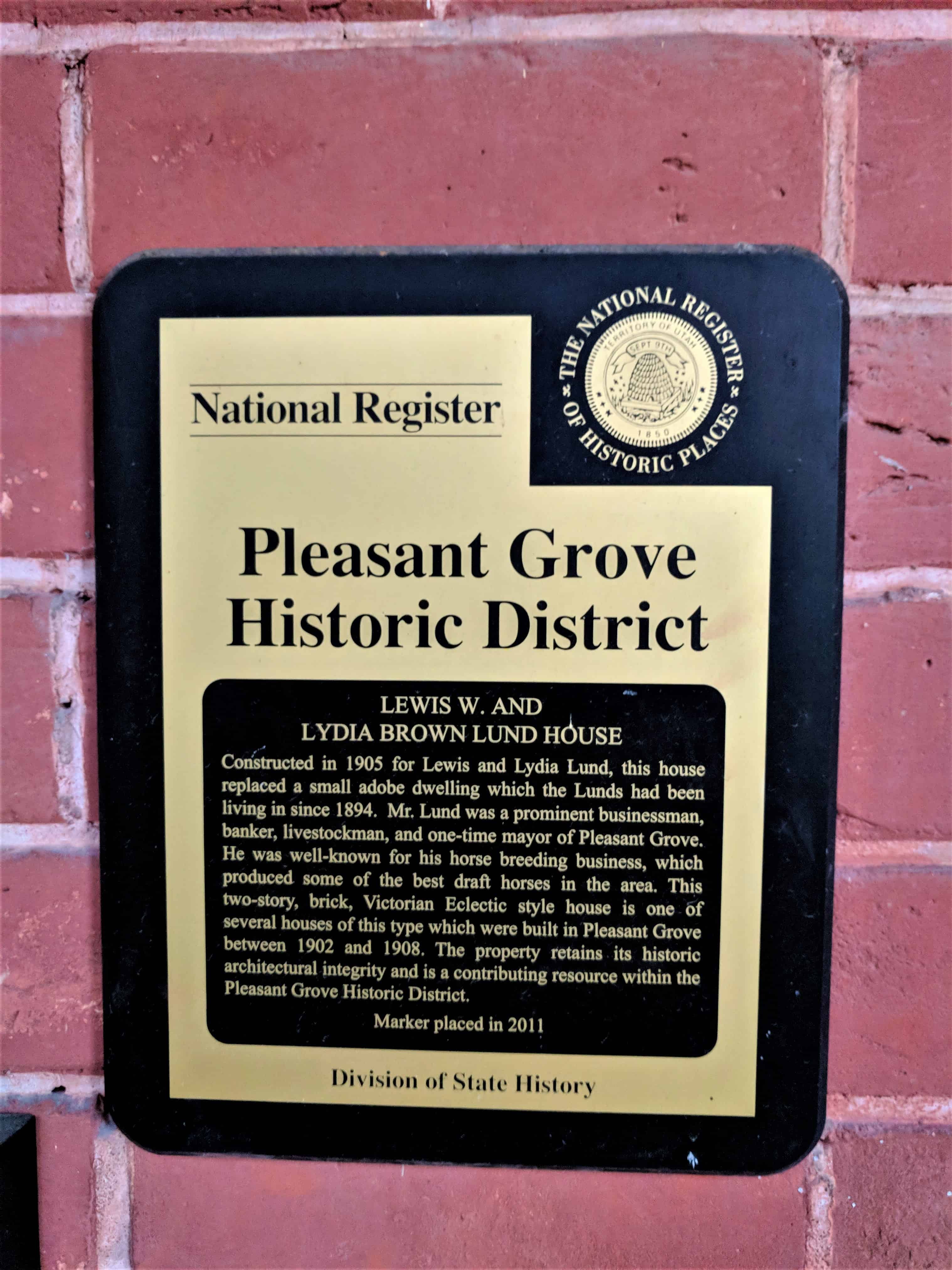
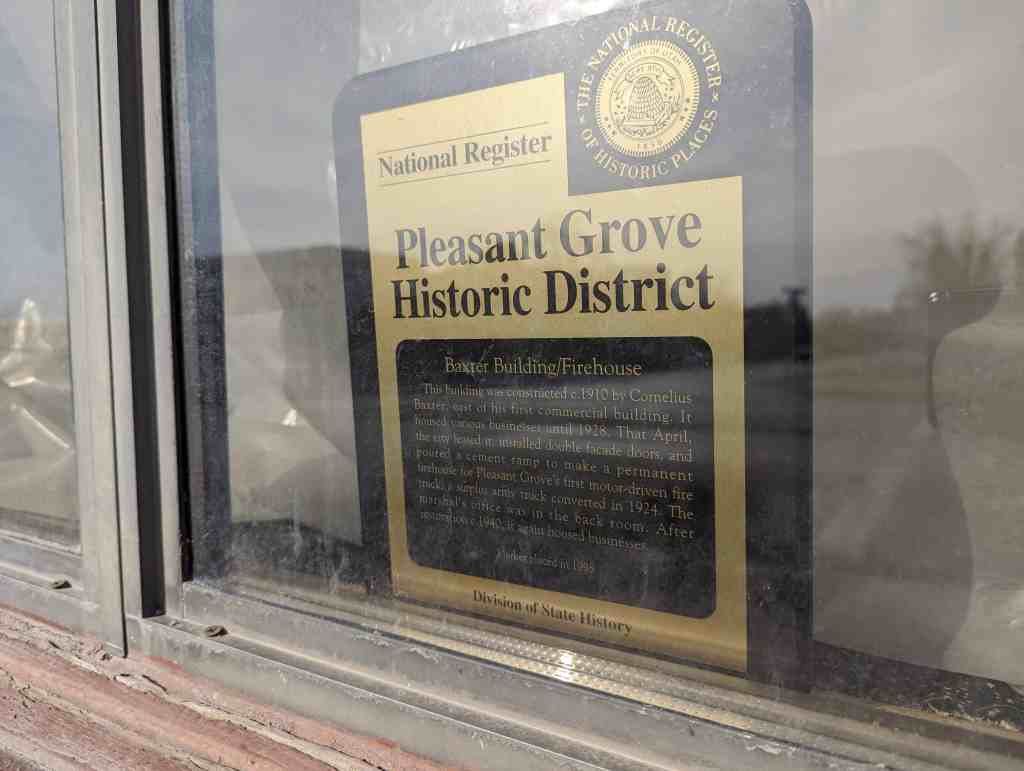
The Pleasant Grove Historic District is roughly bounded by 100 North, 500 South, 300 East, and 100 West in Pleasant Grove, Utah and was added to the National Historic Register (#95001434) on December 13, 1995. The text on this page is from the nomination form for the historic register.
HISTORY:
Pleasant Grove was first founded by Mormon colonizers on September 13, 1850, and became an incorporated city on January 19, 1855. In 1852 George A. Smith, the Mormon apostle appointed to regulate the affairs south of Salt Lake City, wrote that he had “located a site for a town . . . about a quarter of a mile square to possess the conveniences of a town and the security of a fort.” A fort was built in Pleasant Grove and most other Utah towns in 1853 due to an escalation of conflicts with Native Americans known as the Walker War. That fort survey ultimately shaped the town; the established fort was the nucleus from which the town grew.
Smith’s fort plan specified fifteen lots of three rods by ten rods arranged on the four sides of the fort. Most of the fort wall, built only four feet high, did not afford much protection except as a gathering point where a united effort could be launched in case of trouble. All lots and houses faced a large central square that served as a public corral. Outlying residents quickly dismantled their houses and moved them inside the fort. Four large corner lots were reserved for public buildings and community functions. The school house was relocated from outside the fort to the southwest corner lot of the fort. The northeast corner became known as Union Square, where the town’s militia drilled, and a small building was built c.1865 to deposit guns and ammunition. The building still stands at the same location, 64 North 200 East. Four roads exited near the corner lots and a wide road ran inside the fort between the houses and the feedlots.
Thomas Bullock, President Brigham Young’s secretary, reported on the fort ten months after its conception. “Trees are planted inside the fort all around, five rods from the houses, with water ditches running by their side. It measured eighty rods square with 106 houses, and it boasted a population of 149 females and 166 males. This is decidedly the cleanest, neatest, driest and prettiest fort we have yet visited.” The 106 houses almost doubled the sixty lots of the original fort plan, and by that fall 120 houses had been built. The original intent may have been to survey a grid townsite separate from the fort-site, in keeping with traditional Mormon settlement patterns. However, the quick growth forced a second survey to create new blocks to the north.
Development of a city inside a fort survey is unusual in Utah. Most towns throughout Utah abandoned fort sites completely after the fear of Indian attack ended. People either moved back to already surveyed town sites or established town sites through grid surveys. Some used a corner of their fort as a point to survey new town sites and continued to live in houses already established, but all other Utah communities built their business and community centers outside fort boundaries.
Pleasant Grove was not surveyed on the Mormon grid as were other towns in Utah, but developed on a quasi-grid from the fort and subsequent surveys. The established house placement remained with the exception of new outlet roads adjoining the four right-angle streets of the fort to create square, or almost square, city blocks. New surveys outside the fort designated four-acre blocks divided into one-acre building lots and extended mostly to the streets north and east, and to some degree south. These various surveys account for the lack of block uniformity. The average street in Pleasant Grove is only sixty-six feet wide-only two-thirds the width of typical Utah towns that were initially laid out with one-mile square grids and streets ninety-nine feet wide.
Pleasant Grove’s unique fort site development is still evident. The wide fort roads that ran around the central corral perimeter are now 200 South, 200 East, Main Street, and Center Streets. Here fort roads narrow at the junction of the new roads to provide access to the later surveyed area outside the fort. Since houses were already established, narrow accesses to the new surveys outside the fort had to do.
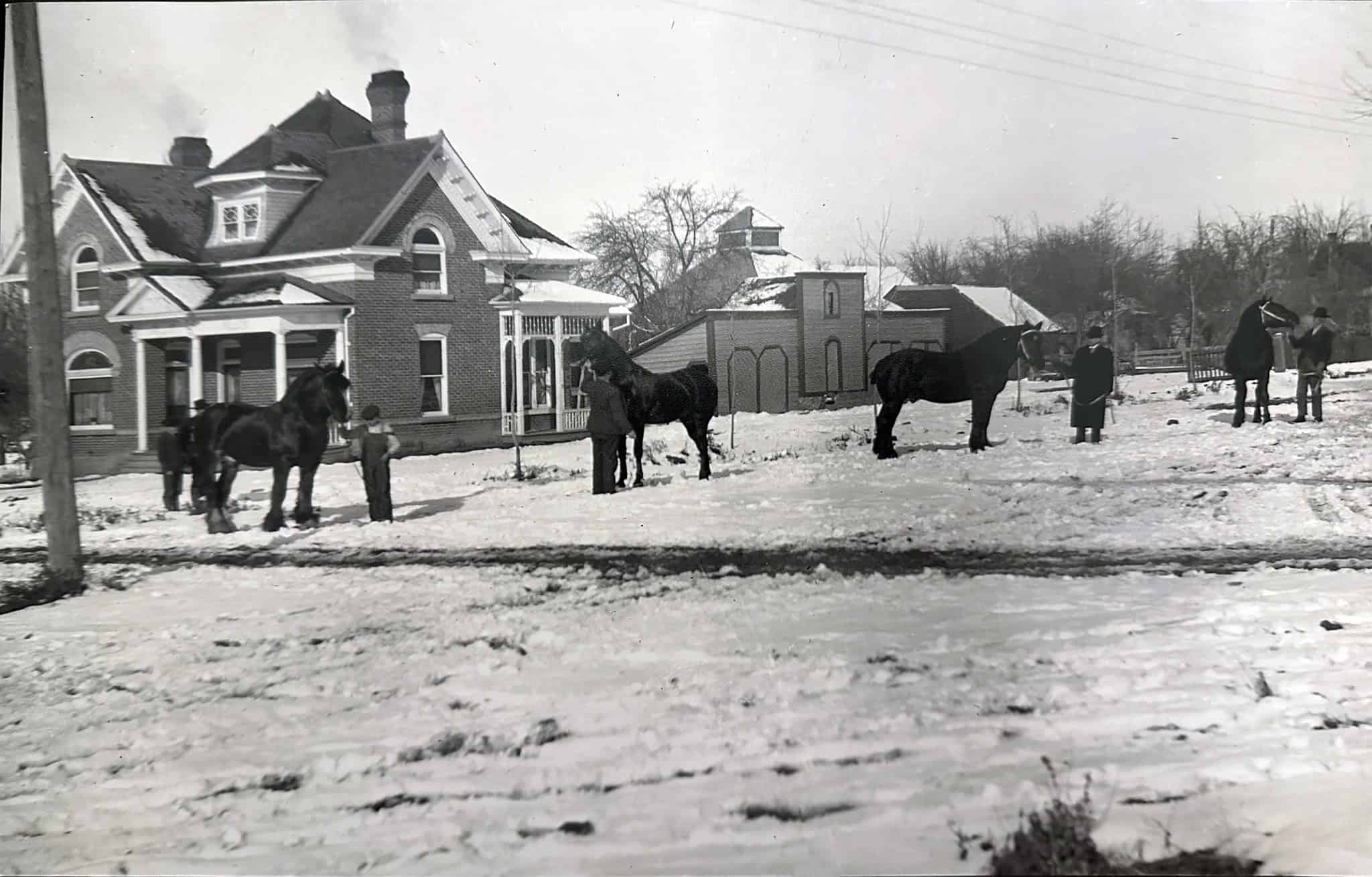
Although the physical nature of Pleasant Grove varies from most Utah communities, its social structure followed typical Mormon farm towns. Small one-acre farmsteads were established inside Pleasant Grove City where houses were built on the corners of the newly surveyed blocks. Kitchen gardens and orchard plots were situated near the houses and the barns and corrals were located at the rear of each acre lot. Farmers commuted daily to their fields surrounding the settlement, a Mormon town settlement pattern that differed from most American West settlements where houses were established on farm lands.
COMMERCIAL AND CIVIC DEVELOPMENTS:
The business district and community area of Pleasant Grove developed from the lower part of the public stock corral that comprised the fort center. The first church house was built, and rebuilt after burning, on the southwest corner of the stock corral at what is now the city park at 200 South and Main. The church basement housed tithing storage and space for a small post office. A blacksmith shop stood two blocks north of the church. George H. A. Harris, in the late 1850s, built the first commercial outlet in town- a two-story rectangular adobe store with a hip-roof and a lean-to at the rear. Harris ran this store, and with his partner, Jacob Foutz between 1860-78.
In 1869, John Brown, Mayor and Bishop, built the second commercial building, the Pleasant Grove Cooperative Mercantile. Directly east of the Pleasant Grove Cooperative Mercantile, the LDS Churchwide Cooperative Movement built the United Order Hall in 1869, the first documented building of soft-rock. In Pleasant Grove thirty-nine men bought stock in the store with the goal of brotherly unity for the welfare of the whole town rather than individual profiteering. The United Order, an extension of the Cooperative Movement, became the fiber of the town from 1874 to 1880 when the large majority of men over eighteen joined. These organizations played a part in the slow growth of merchandizing in Pleasant Grove where individual ownership was looked upon as unbrotherly and boycotted by town residents.
In the 1880s at a time when the Order was beginning to fail, the lone independent store owner, Harris, declared bankruptcy; Franklin Beers and Benjamin Driggs purchased his store, sold stock in it, and renamed it Battle Creek Co-op. A law suit from the Order’s co-op broke up the Beers and Driggs cooperative partnership. In 1884, however, Franklin Beers persisted and opened his own modern department store (razed) on the northwest corner of what is now First East and Center Street. He later built a two-story combination hotel and family house directly north of his store. His wife, Elizabeth, operated the hotel along with a hat shop in his store. The Beers House/Hotel (National Register, 1994) is now restored and used as office space for West Enterprises.
Other commercial buildings in the business district included 1880s frame western-style false front shops built at the sides and fronts of houses on the present Main and Center Streets. One example was the small post office operated by Parmelia Sterritt that stood next to her house. Another was the millinery shop operated by Rosalia Driggs who lived in the Cyrus Benjamin Hawley house at 55 East Center. Shown on the 1890 Sanborn Map, a string of wooden buildings existed across from the Hawley house, housing a barber shop, a dental shop, and a meat shop. A frame saloon stood at the intersection of Main and Center.
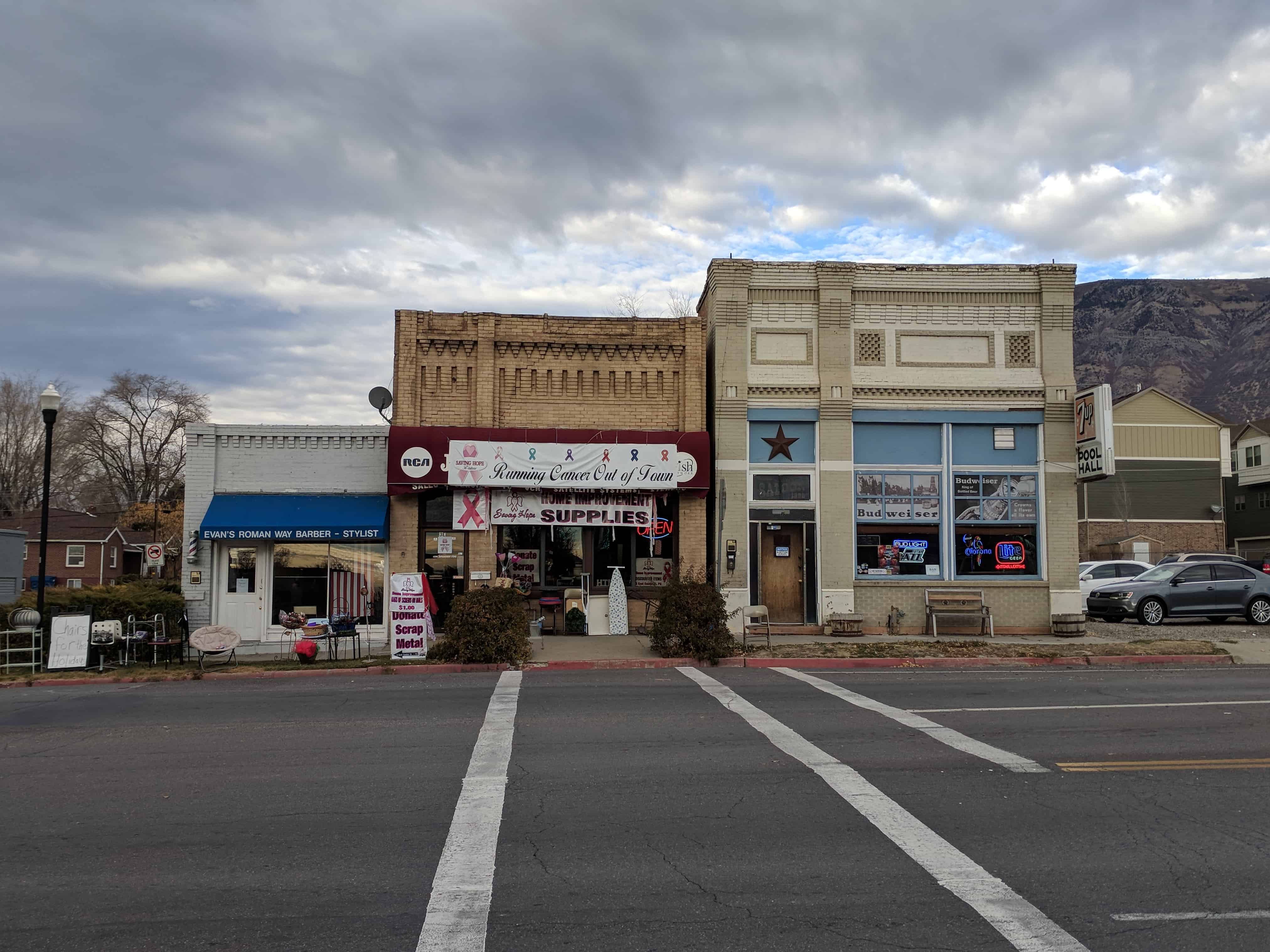
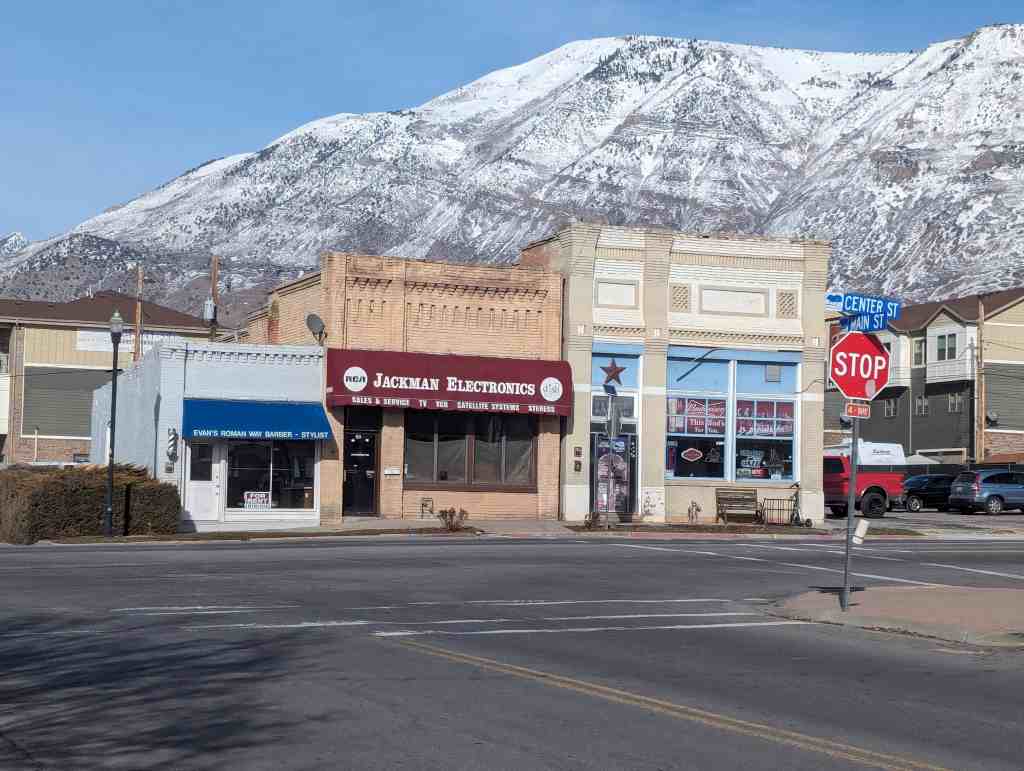
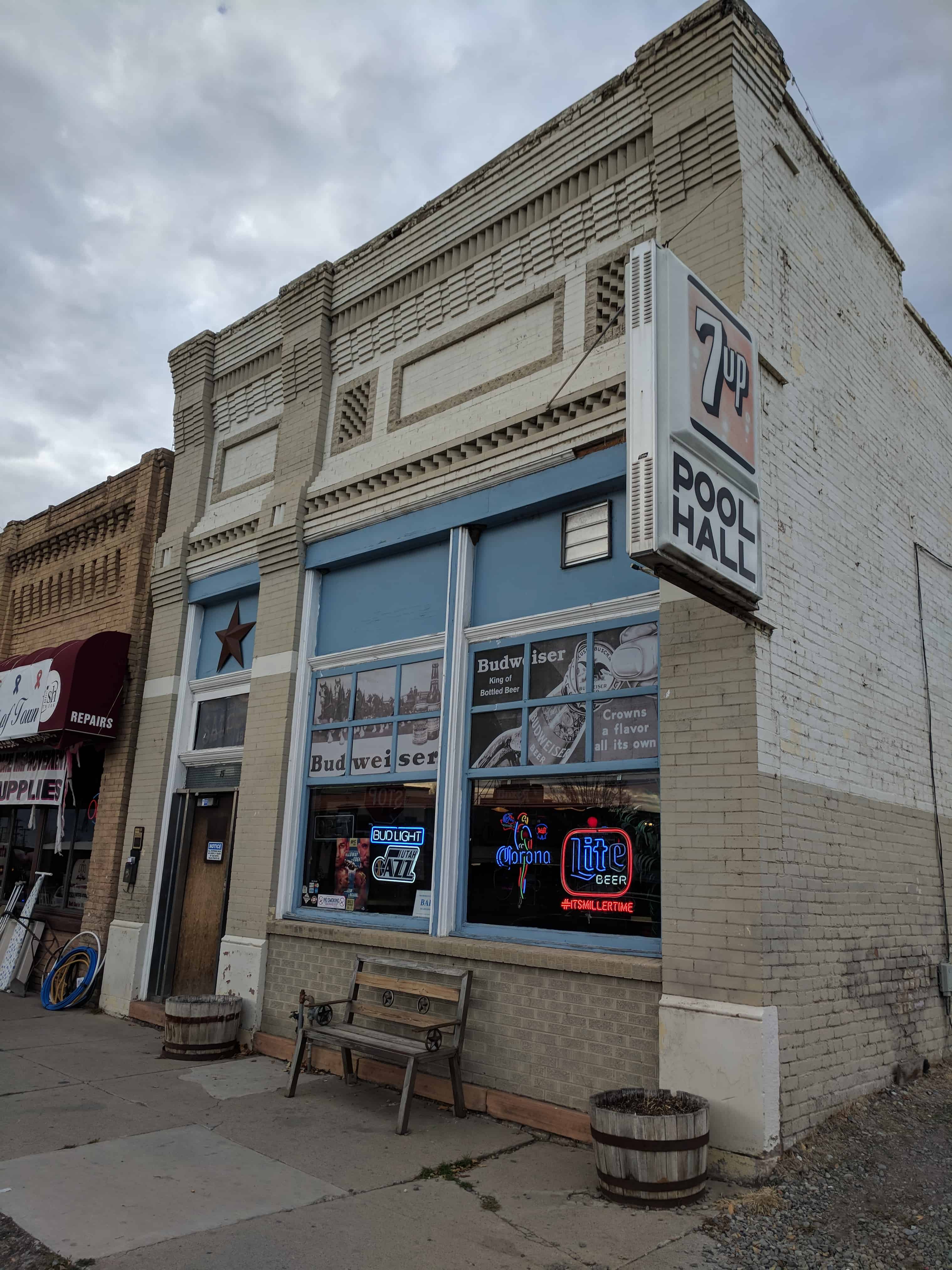
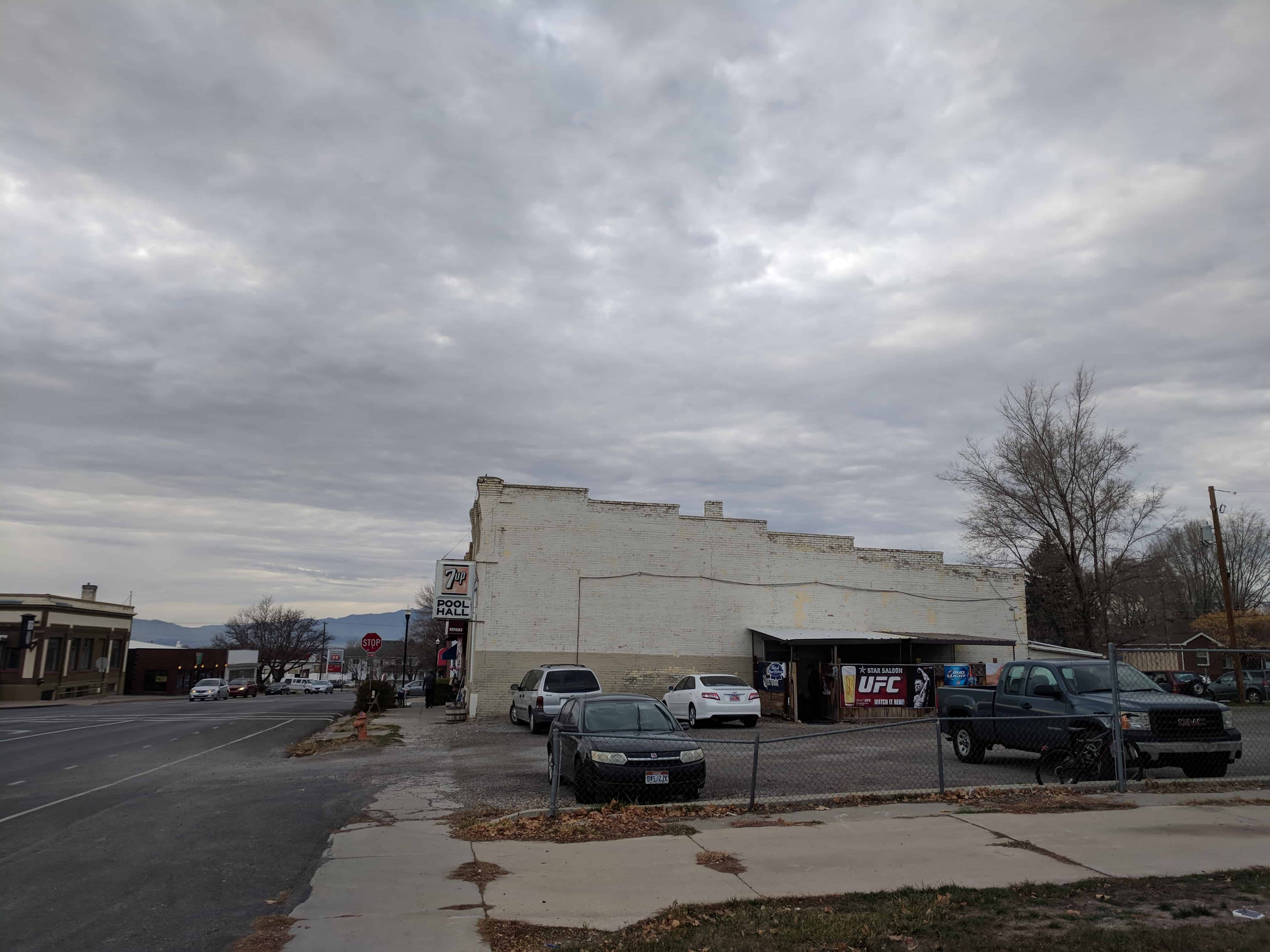
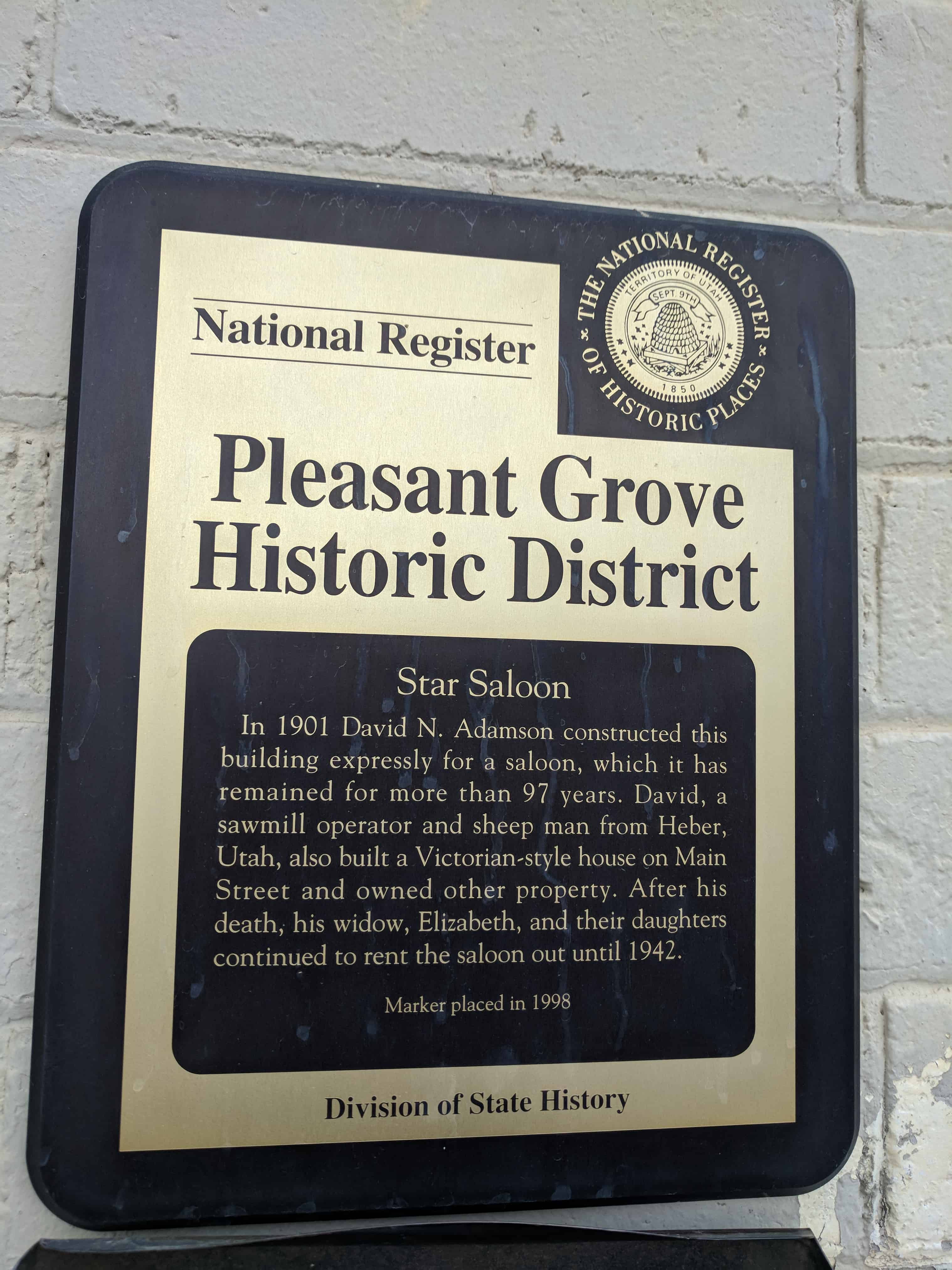
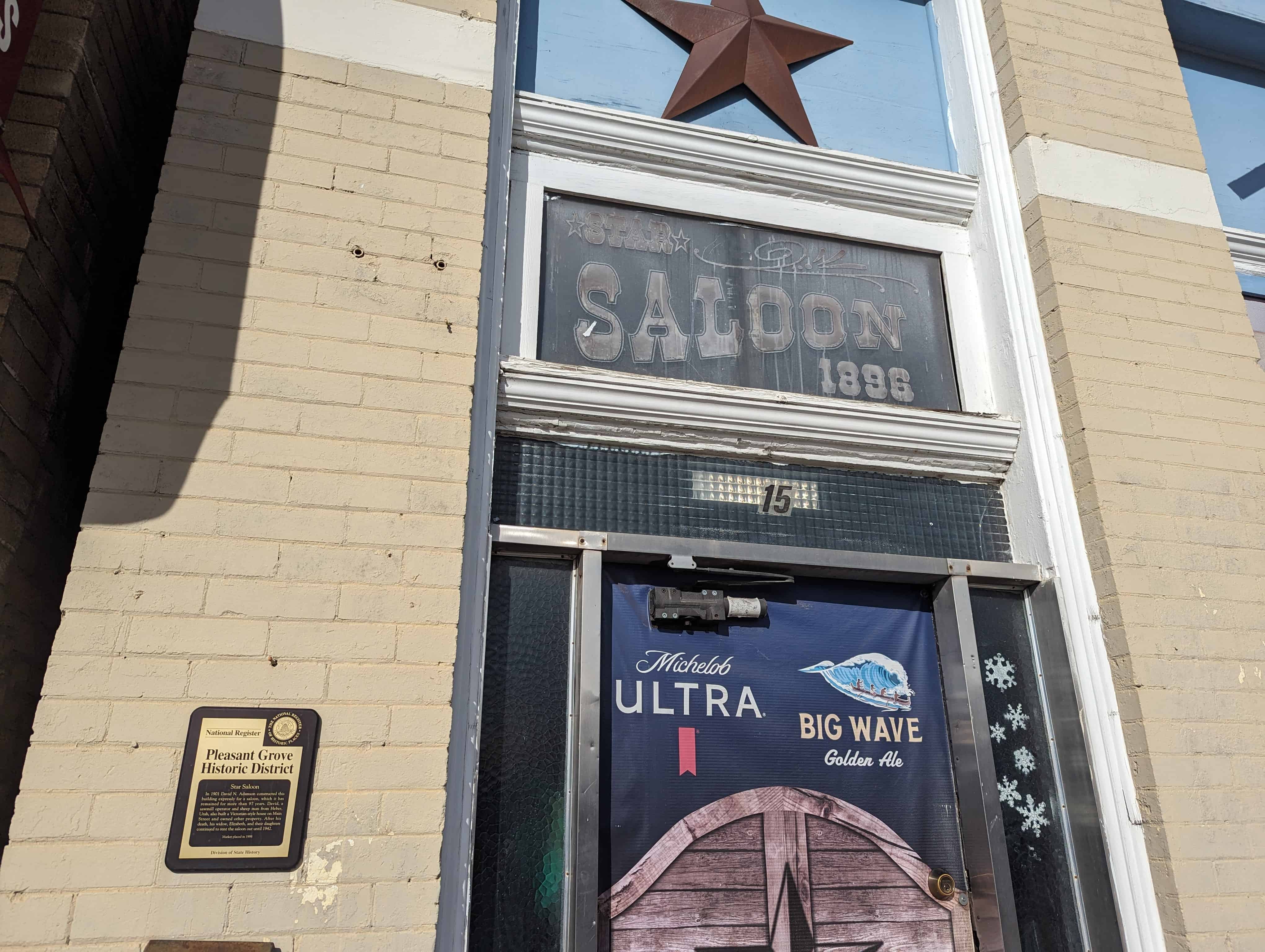
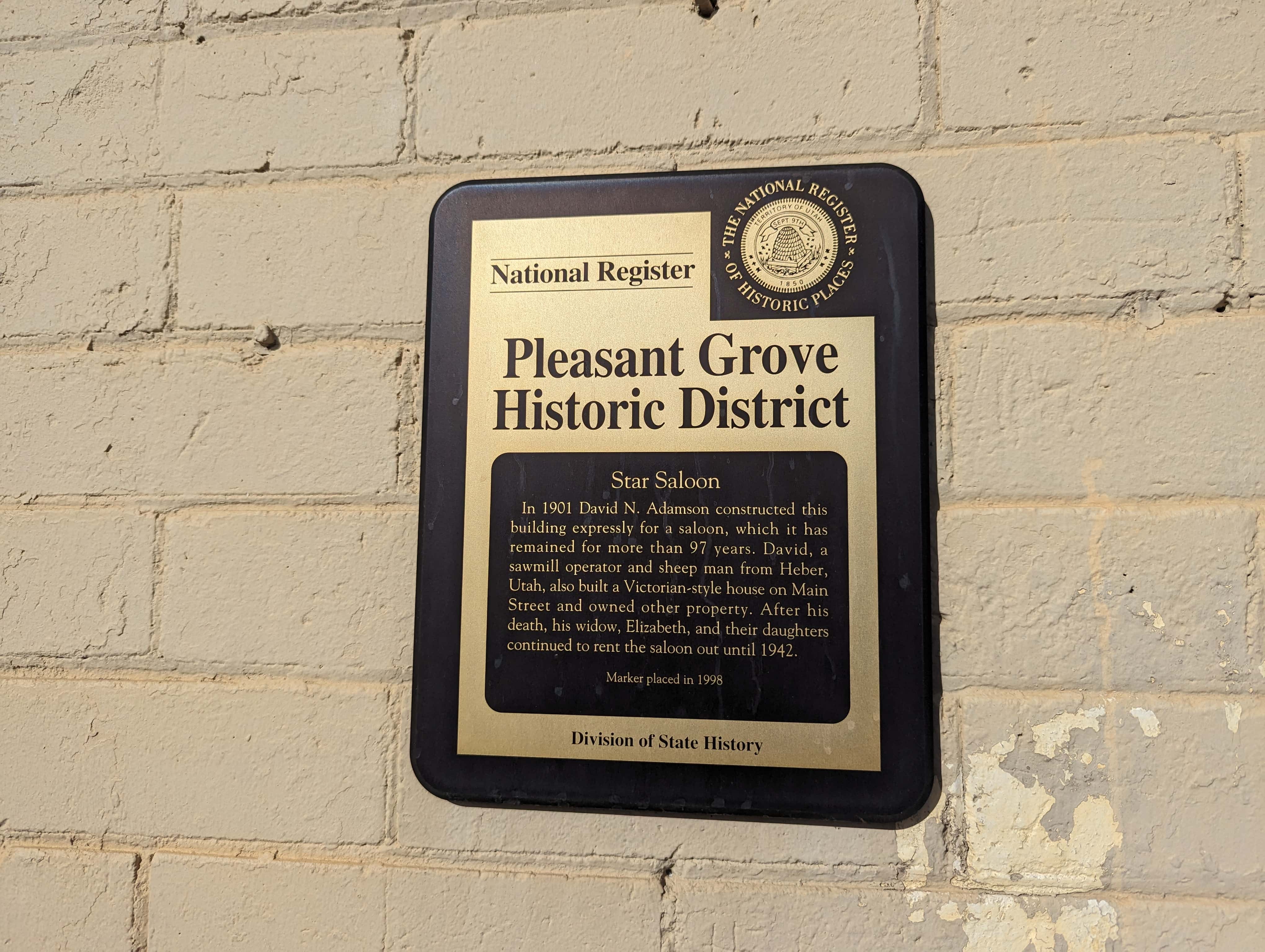
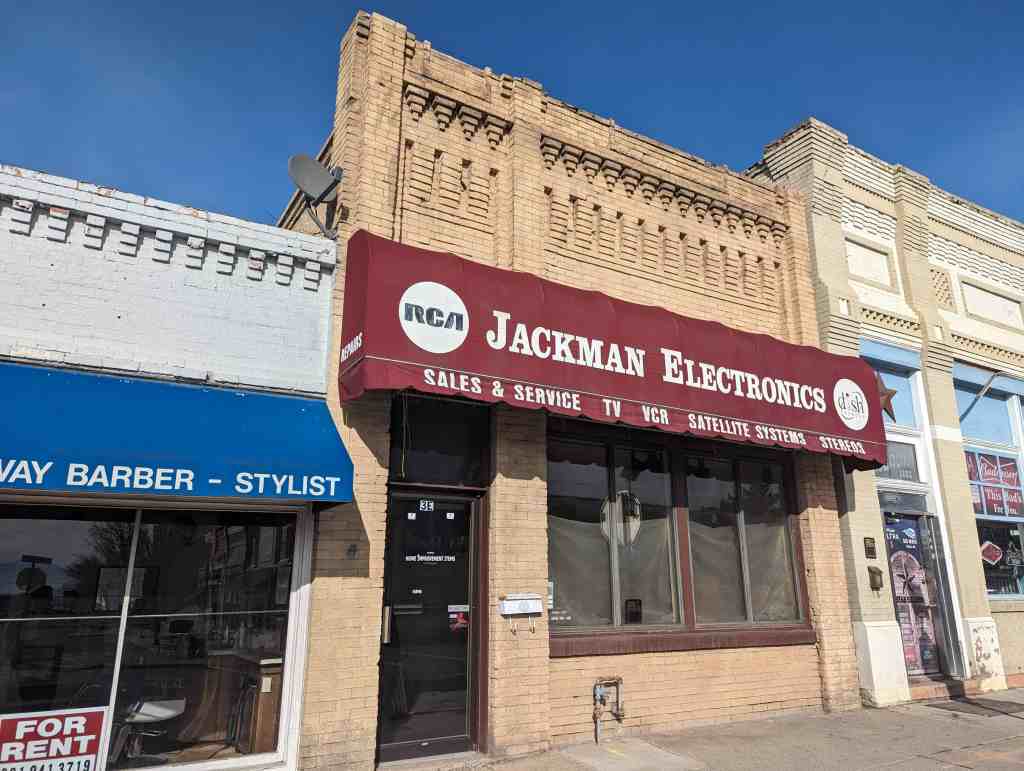
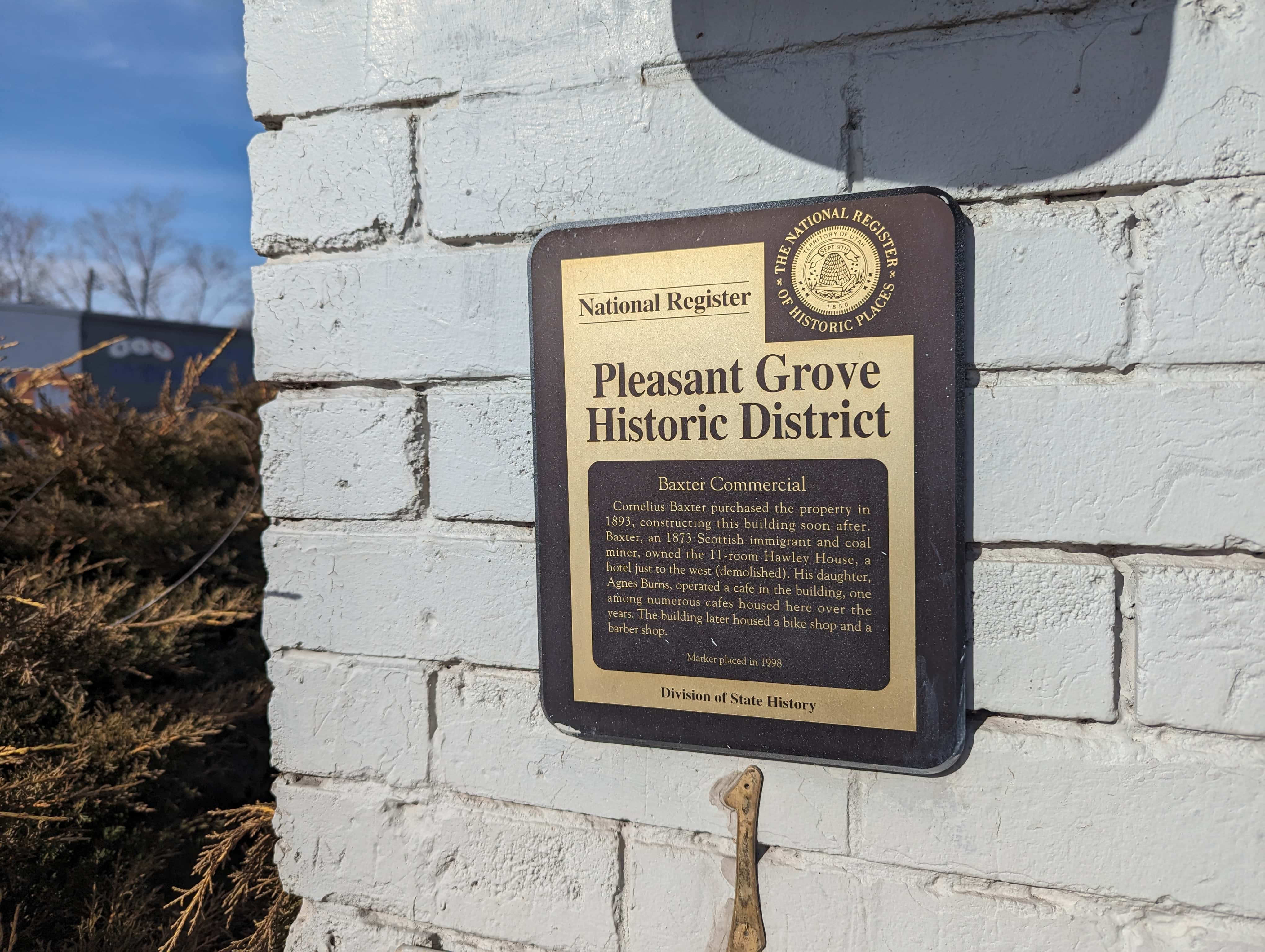
Fire changed the character of Main Street in 1890 as frame buildings were lost and brick and stone buildings were constructed. New Victorian block-form buildings replaced these stores. Near the turn of the century Cornelius Baxter moved to town and with mining money he purchased a house and property at the head of Main on Center. He replaced the frame saloon with a brick Victorian block-form building (1 East Center). He soon built a larger more ornate block-form building (3 East Center) next to it. David Adamson, a sheep man from Heber, moved to town about this same time. He built an even larger and more ornate building (15 East Center) next to those of Baxter’s. The three buildings still stand like stairsteps at the head of the street.
In 1917, the Bank of Pleasant Grove introduced a completely new design to the street-the Prairie-style business building (2 South Main). This building retains its historic integrity. Because of bank’s financial success and the location of the building, it became the business anchor of the community.
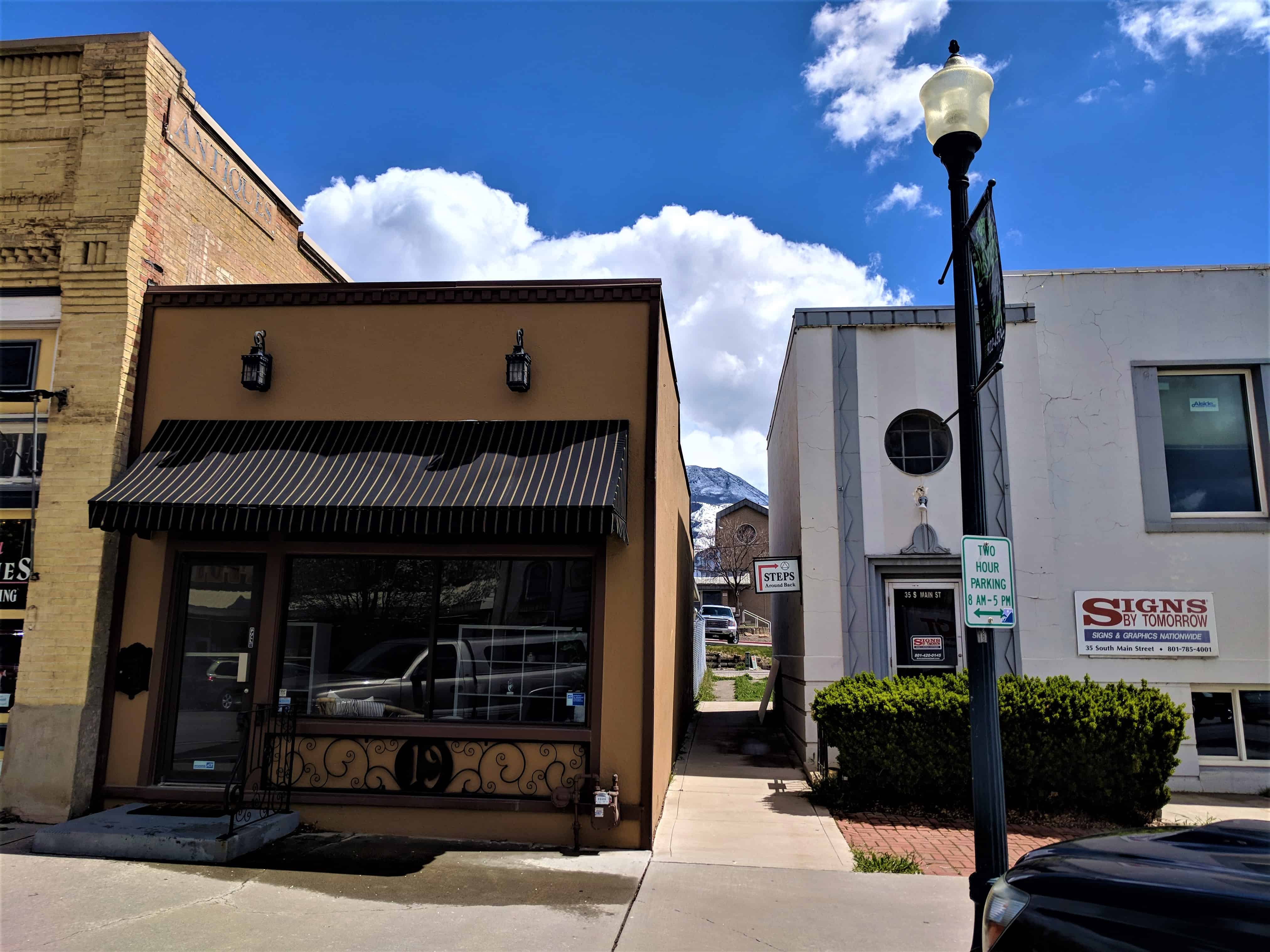
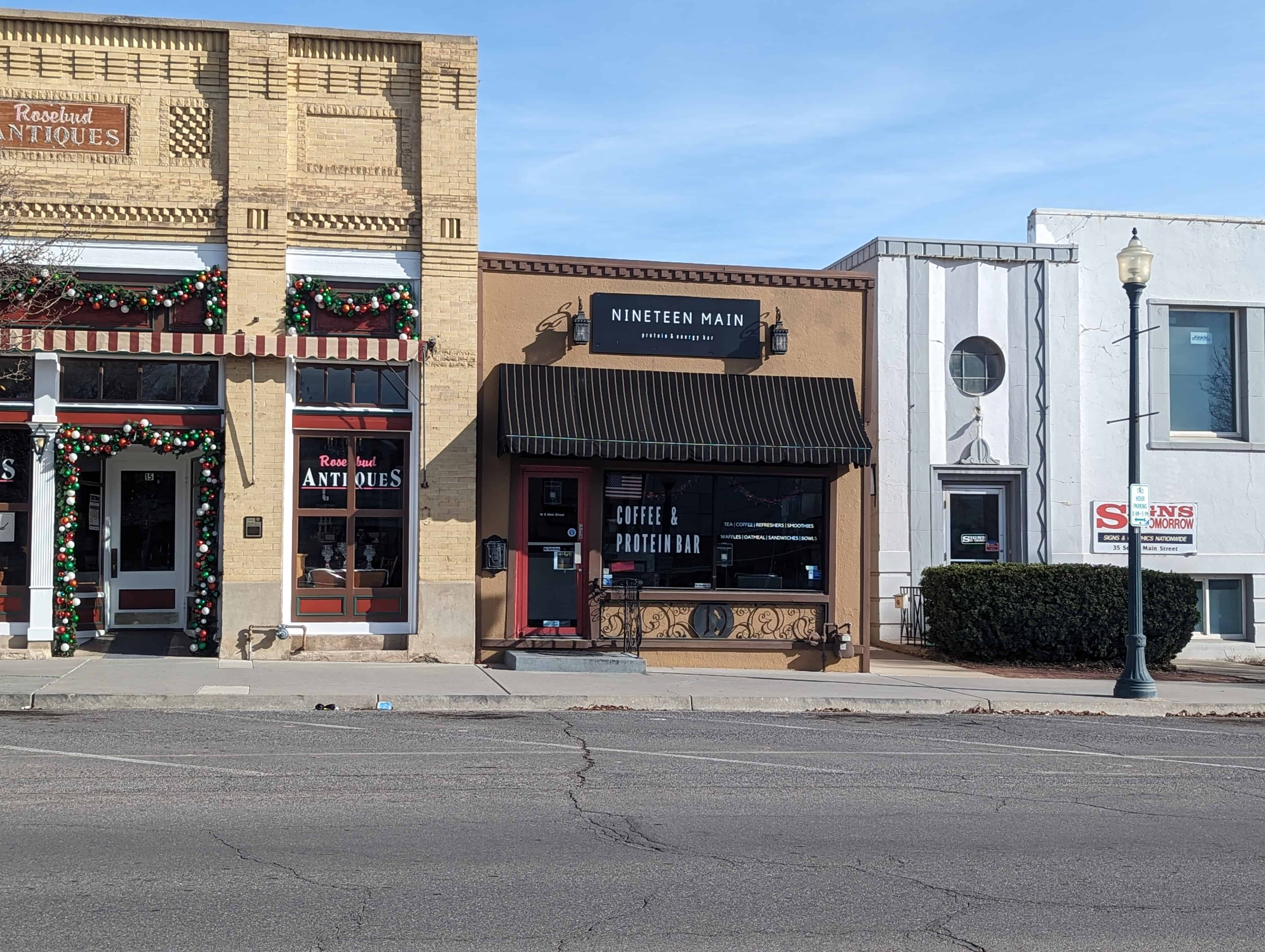
A Spanish Colonial Revival style movie theater and two new block-form buildings on either side of the bank were built in 1927. The depression that followed in the 1930s devastated a number of the businesses on the street and a “Modern” look was established through the auspices of a government sponsored program-the Works Progress Administration. By 1940, an Art Deco style city hall was built at 35 South Main. The new city hall housed all departmental units of city government: police, jail, court, fire, library, and city offices. This building retains its historical integrity but is unused at the present. Other than a medical center and a new bank building built on the southwest end of the street built during the 1950s, little new construction or alterations have occurred in this business block since 1940.
Near the central business district the social center of the town developed during the city’s formative years. A grove of trees planted behind the rebuilt church (along Main between 100 and 200 South) became the first city park and the only city park for many years. The park, combined with the 1909 Orpheus Dance Hall built to the east, now serves the community as the recreational and social center along with Pleasant Grove’s first LDS seminary building constructed in 1922. The seminary contains the office of the Department of Recreation. (Both of these buildings retain their original architecture.) The high school was also located in this block.
One of the oldest known school houses in Utah is located one block east of the business district. The Old Bell School, built c.1861 with additions in 1880 and 1887, houses a pioneer museum. Directly south is a small complex of representative pioneer buildings commemorating the history of the town. Also located on this street is one of the best examples of early soft-rock use-the 1886 town hall that served as such until 1940. The school and city hall have alternately housed the library over the years.
The first Sanborn Maps of Pleasant Grove dated 1890 and 1917 show that the central business district was on 300 West and the crossroad to the north was 100 North. In 1946 a new house numbering system was to be established. The one-block “business main street should be named Main Street as every activity of the town radiates from here, and that the intersection of the highway coming into town at the bank corner is the center of that activity.” Therefore, the road intersecting the new Main Street became Center Street. The new numbering of Pleasant Grove streets began at the Pleasant Grove Bank building. House numbers were assigned for the first time and street numbers were painted on corner Utah Power and Light Company poles. The change in street names created no end of confusion at the Utah County Courthouse with property registration, but the town’s new street names more correctly described the function of the town.
ARCHITECTURE:
The Pleasant Grove Historic District is an important resource where the buildings reflect the architectural and historical development of the town. The residences, commercial buildings, institutional structures, and outbuildings within the district provide a complete representation of a wide range of architectural styles and plans popular in the local region between 1853-1945. The evolution of styles and use of local materials reflect the builders’ desires to remain abreast of “modern” techniques. The primary building material used until 1870 was adobe. Adobe blocks were produced in local yards as well as in an adobe pug-mill near Utah Lake. Adobe was still used to line rock buildings, and to build entire buildings as late as 1885 when the Franklin Beers House/Hotel was built
In 1869, soft-rock quarried from the hills northeast of Pleasant Grove began to be used to construct commercial buildings and houses. Many homes of all sizes were constructed of soft-rock. Cyrus Benjamin Hawley’s house, c.1869, at 55 East Center, is a 1-1/2 story, soft-rock house, one of the first in the and trend-setting residences in Pleasant Grove. Very little of the exposed soft-rock is left the community, but the use of it in Pleasant Grove buildings was extensive until the 1890s, creating a distinctive Pleasant Grove characteristic in building material. At least 125 houses were built of this unique stone.
Again in 1890, a change in architectural styles coincided with a new building material when brick began to be produced in Pleasant Grove. Before this time, the cost of shipping brick or coal to produce brick was prohibitive. When brick yards began production in Pleasant Grove, a noticeable change towards more decorative Victorian houses can be seen. Victorian asymmetrical features and decor, which began in Salt Lake City in the 1870s, took time to filter down to small farming communities. This trend is seen in Pleasant Grove’s downtown district in both the commercial buildings and the houses.
The early twentieth-century styles popular in Utah between 1905-25 began to overlap the Victorian period as Pleasant Grove’s architecture continued to reflect state and national building styles. The Bungalow, Arts and Crafts, and Prairie School styles were absorbed into the state’s building tradition during the first part of the twentieth century. The Period Revival styles, mostly during the 1930s, and the Modern styles, during the early 1940s, are evident in Pleasant Grove as well. The period of building in Pleasant Grove corresponds with its period of significance, 1853-1945, and reflects the way in which the city grew.
AGRICULTURE/INDUSTRY:
The topographical location of Pleasant Grove is a prime factor in the development of small-acreage farms that became prominent fruit and berry producers. Initially agriculture was the primary income producing activity in the area. The early 1890s Utah sugar industry proved a boon to some farmers. Sugar beets provided a labor-intensive crop for the lower, heavier soils, more suited for potatoes and beets. Many of the farmers and laborers worked at the Lehi, Utah, processing plant of the then Utah Sugar Company, and at the company’s Pleasant Grove beet cutting station. Around the turn of the century, some stock raising and dairy farming began to develop and has been carried on through two or three generations in some families. The establishment of brick yards was the only other early industry developed within the community in the 1880s and ’90s.
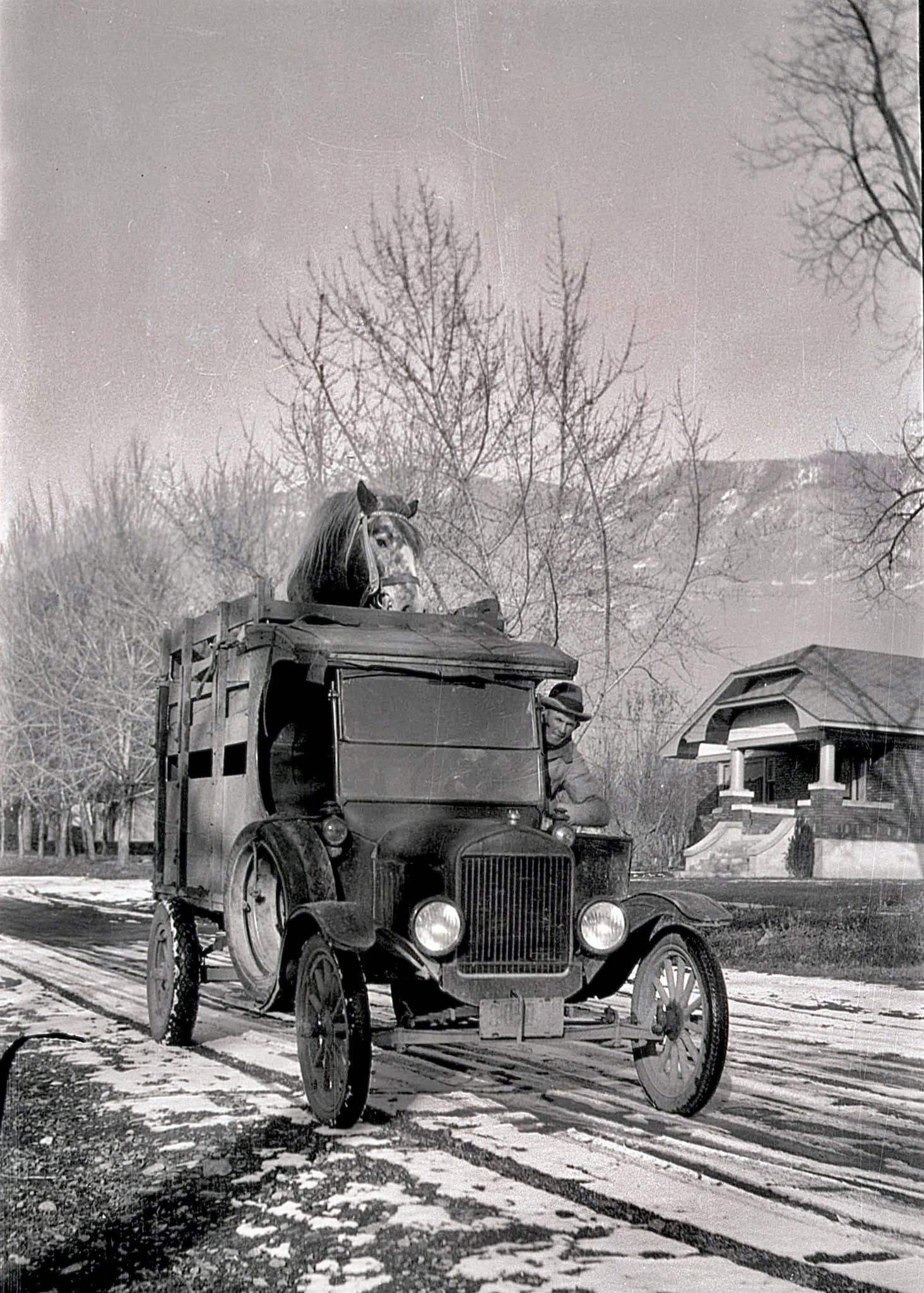
With the coming of inter-state railroad in 1873, several packing companies formed c.1900 to encourage the shipping of the abundant fruit crops by rail to national markets. These were centered around the railroad depot at 200 West and 200 South. By 1913, the Orem Interurban Railway depot was built in that same area. This short-haul railroad with cheaper rates helped considerably in marketing produce and milk within the state. Many of the farmers, however, relied on marketing products through their own resources; farmers hauled produce by wagon and later by truck to mining towns, and personally peddled to households and stores in smaller towns not reached by rail service. In 1915, the Pleasant Grove Cannery was built near the Union Pacific Railroad line; it provided an outlet for row crops, i.e., peas, green beans, corn, tomatoes, and pumpkins, as well as large fruits. With the development of freezer preservation, the cannery also served as a market for fresh-frozen strawberries.
From the 1920s through the 1950s Pleasant Grove farms were major strawberry producers. To promote their product in 1921, the Wasatch Club, a forerunner of the Chamber of Commerce, established a mid-June Strawberry Day celebration. The town became known as Utah’s Strawberry City.
With small farms and little other industry, many men sought work outside the community in logging, mining and railroading. Geneva Steel began its plant three miles south of town in 1941. It was the largest and most significant of several defense-related industries developed in Utah during the World War II period. It was opened in December 1944 but operated as a U.S. government facility for only two years. U.S. Steel bought out the government in 1946 and the company was converted to accommodate peacetime operations. Geneva’s construction and operation significantly impacted the local economy of Utah County by providing jobs and attracting a number of ancillary industries such as fabricating plants. Farmers and their families in Pleasant Grove saw an opportunity for higher wages with fewer work hours invested and many were enticed into giving up small-acreage farming. Farming as a full time area occupation diminished rapidly.
Since World War II, Pleasant Grove has experienced an ever increasing subdivision of farms for residential development. Some light industry slowly crept into the west industrial. Utah Valley as a whole is experiencing increased industrial growth and work opportunities. Growing industrial opportunities have added greatly to the population explosion since 1940; coupled with fast and convenient transportation, Pleasant Grove has been transformed into the third fastest growing and most desirable living area in Utah County in the 1990s. Today few farms remain. Increased commercial growth in closely situated Utah County towns diminished the shopping amenities of Pleasant Grove, changing it into a bedroom community. As a bedroom or residential community, the town has eight parks, a new public library, numerous recreational facilities, and a low crime rate.
The historic district remains amidst the changing surrounding landscape to provide the community of Pleasant Grove with a distinctive sense of place. The heritage of the community is reflected in the commercial, public, and residential buildings that exist within and immediately around the old fort walls. This area has retained the historic qualities of the period 1853-1945 that describe a unique sense of place.
COMMERCIAL BUILDINGS:
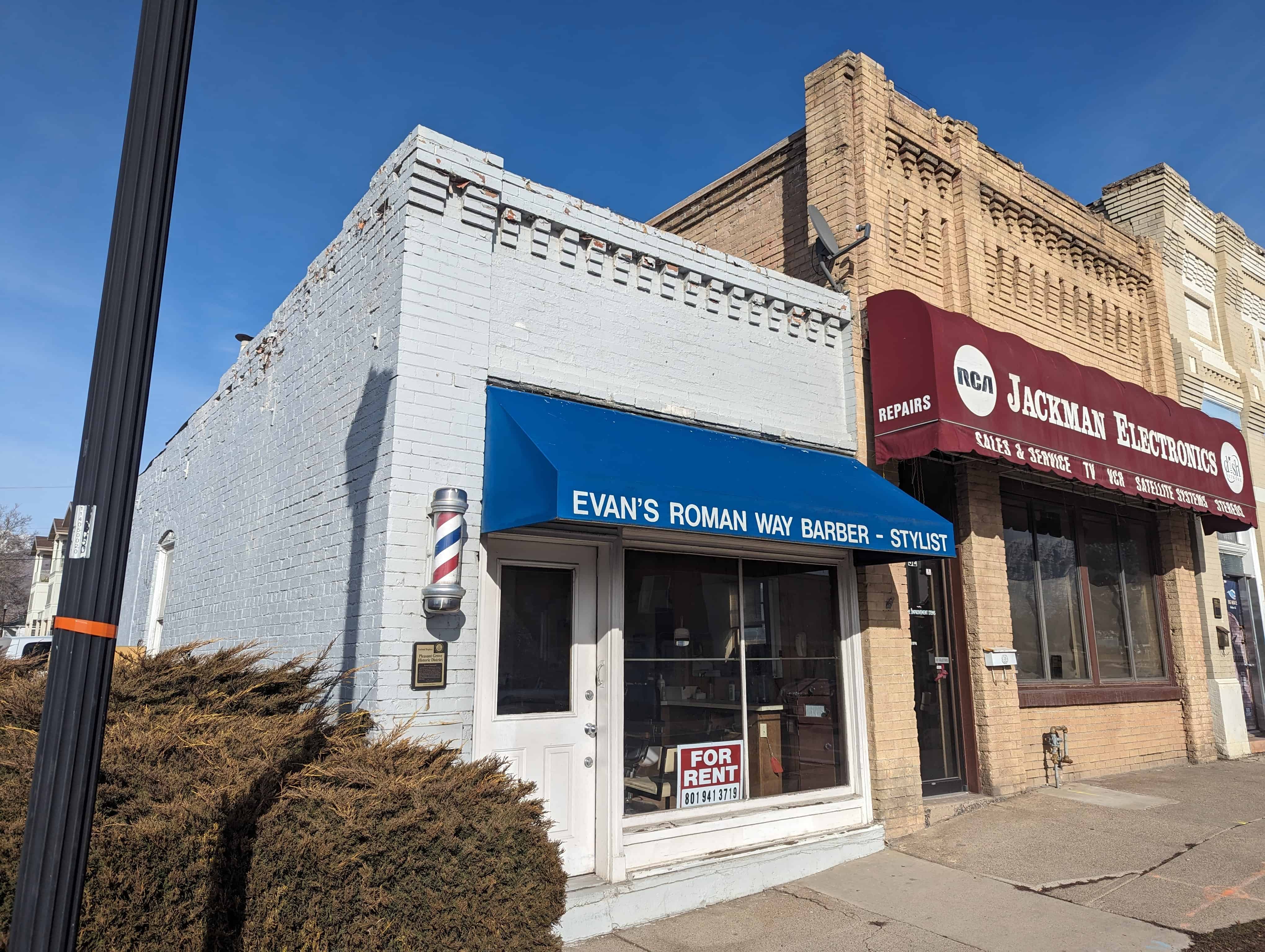
Cornelius Baxter Commercial Buildings, 1 East Center Street and 3 East Center Street
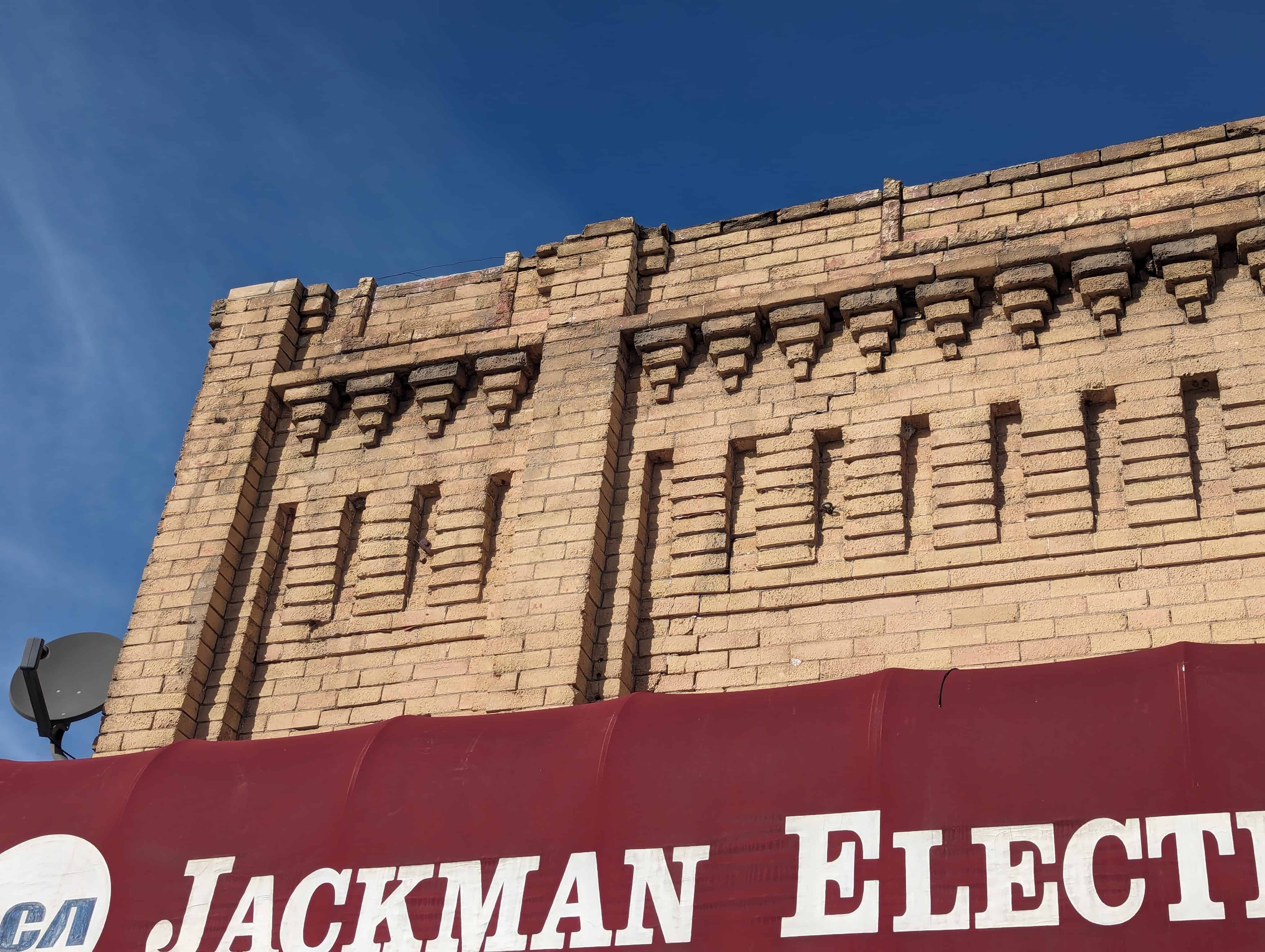
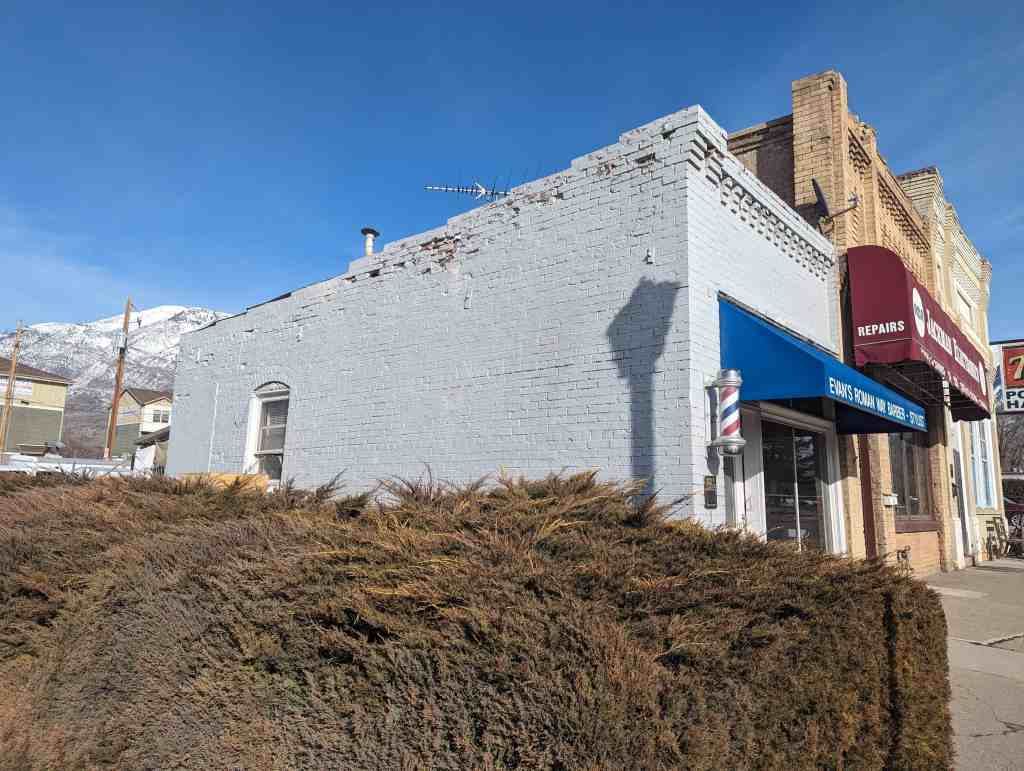
The first of the two buildings is a small two-bay brick commercial-block building at 1 East Center built sometime after 1893. By 1910, Baxter built a similar two-bay brick commercial-block at 3 East Center. The newest built stands snugly against the 1 East Center building; it is twice the size of the first and trimmed more elaborately with Victorian Eclectic features. Both are single street-level two-bay buildings.
David N. Adamson Commercial Building, 15 East Center
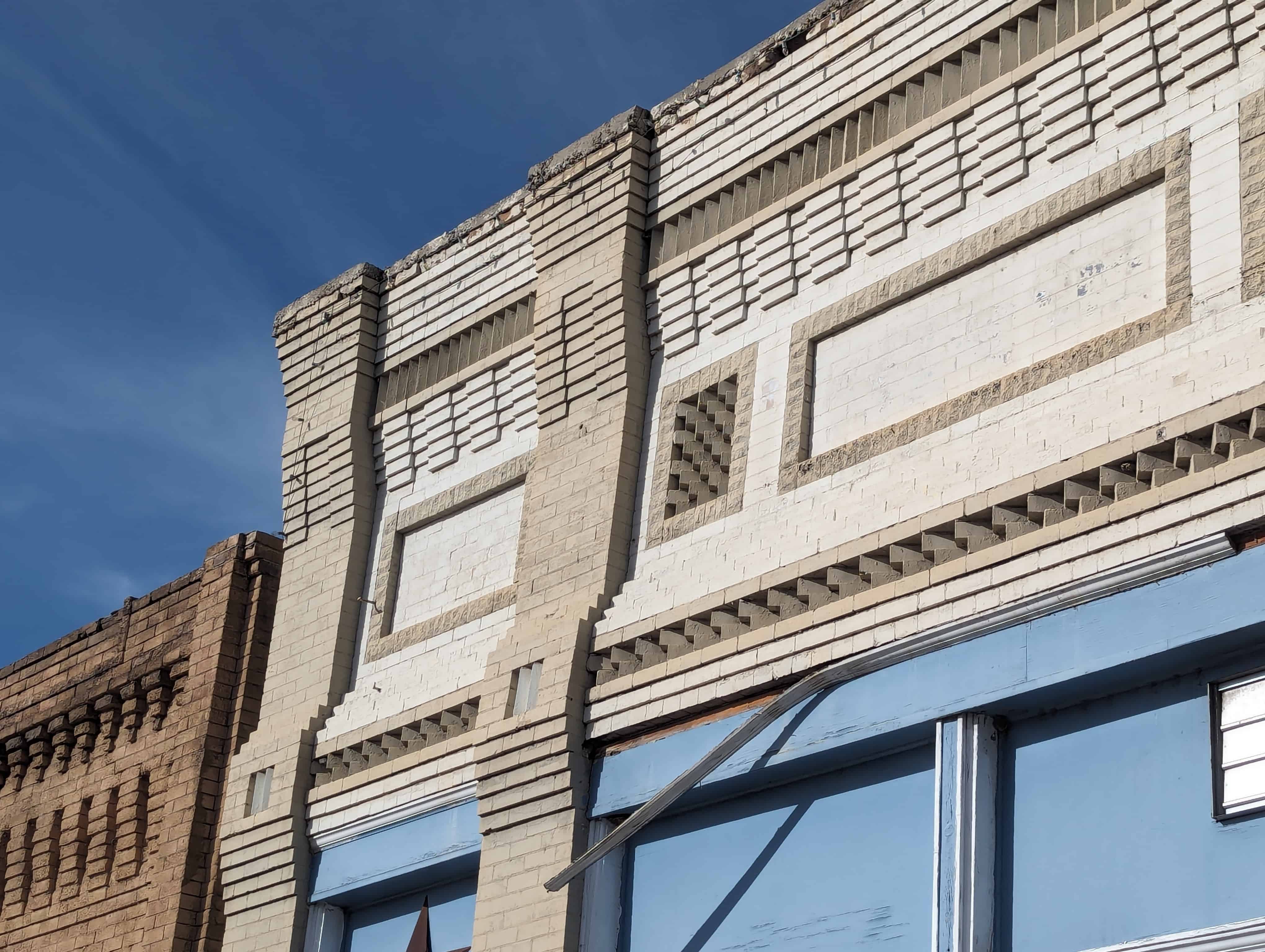
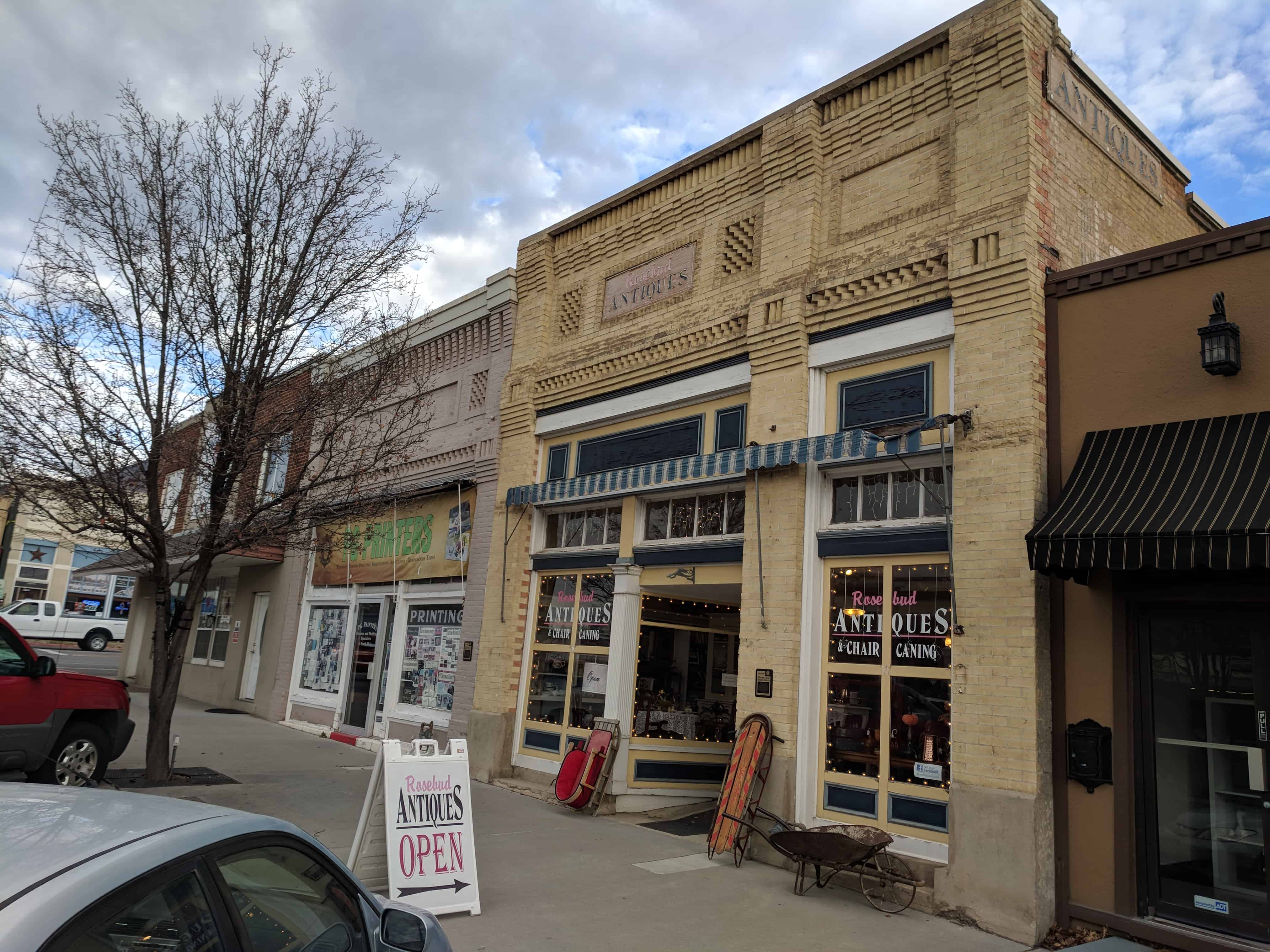
The Adamson building, built in 1910, stands against the building at 3 East Center. Adamson’s is also a two-bay brick block-form but twice the size of the building next to it and even more elaborately decorated with Victorian eclectic features. All three buildings share the single street-level structured appearance with plate-glass display windows, each building with an increasingly larger window. Each also features a flat sloping roof, stepped cornices and brick dentils. The similarly structured but graduated size gives these buildings on Center a stair-like appearance at the head of Main Street.
Clark Brothers Store. 43 South Main
This two-part commercial block was built in 1895. The building has the long back portion constructed of soft-rock and the façade of brick masonry. This was the first brick used for commercial building in Pleasant Grove. It remains the largest and most ornate of the early commercial block-form buildings. Its Victorian eclectic features include six arched windows above the three bays of the street level. These second level windows, in sets of three, each feature a larger center window. Decorative brick form the front cornice and arched window lintels.
Bank of Pleasant Grove. 2 South Main
Built in 1917 on the corner of Main and Center, the building introduced a new style to Main Street-a Prairie School commercial building. Other banks and commercial buildings built during that time in Utah County were classical architectural designs rather than the “modern” Prairie School. A full basement under the bank of stuccoed concrete raises above the sidewalk line; a half-flight of exterior stairs descend to the basement’s Center Street north side entrance. The Main Street building entrance is through an east front recess up a short flight of stairs. Dark brown brick against contrasting cream colored vertical and horizontal stucco panels emphasize the sharply angular yet rectangle Prairie School style; two top horizontal panels are divided by a brick dentiled cornice. Other Prairie School features are a five bay row of vertical casement windows extending the full length of the building with corbeled brickwork above each. Four of the bays have leaded glass panels with diamond patterned glass; a center blind panel, containing the vault, is of recessed brick. A flat-roofed canopy extends over the entrance with a diamond shaped panel set above the porch, linking these geometric designs with the building style. The roof is flat, sloping slightly to the rear.
Pleasant Grove City Hall. 35 South Main
Built in 1938-40, this two-story city government building was financed with money obtained through the Federal Works Project Administration. This WPA Moderne style was often built during the 1930s financed by the Federal Government. Native Soft-rock was salvaged from Clark Hall, the building it replaced, sawed into blocks, and reused in the city hall. Other stone was taken from the hills northeast of town. The Soft-rock building is stuccoed. This building shows the modern streamline design of that period, and is void of ornamentation.
Alhambra Theater. 20 South Main
Van Wagoner brothers built this silent movie theater in 1927 in a Spanish Revival style, the first and only distinctly Spanish architecture in town. The top-half of the building is stuccoed and a dark modeled brick lower-half create a contrast. A center top portion features a front-sloping red tile roof. Between the tile roof and the marquee is a row of recessed arches. Flanking the center portion are two higher square columned parapets with decorative arched brick center cornices creating a symmetry. The two side-fronts have recessed arches matching the center arches. Wrought iron balconies decorate the side arches.
RESIDENTIAL BUILDINGS:
Cyrus Benjamin Hawley House, 55 East Center
Built in 1869 of soft-rock this one and one-half story house with a steeply pitched cross-gable roof illustrates the subtle use of Gothic Revival styling for a vernacular house type. The Hawley house is representative of several houses built near that year. With these houses an attempt began to stylize vernacular house types in Pleasant Grove. Before this year, gable-roofed houses were lower-pitched and undecorative. Near the 1890s, a frame lean-to attached to the rear of the house was replaced by the existing two-story section. At that time Victorian porches were added to the back and front, a second story walk-out porch placed above the front porch, the soft-rock stuccoed and splotched with black paint to resemble granite, and corner quoins scored. The house was extensively renovated and restored in 1984; new decorative wood replaced the old, using the elaborately saw-cut ornamental originals as patterns. All original outbuildings were removed from the property at that time.
Elijah Mayhew House. 214 South Main
Built around 1860, this frame house remains one of the oldest in Pleasant Grove. It is representative of the very few early frame houses built. The rather plain rectangular one and one-half story Federal style features smaller windows above the full windows of the street level, a hip roof, and porch.
Otto L. Mayhew House. 49 South 200 East
Built in the 1870s, the Mayhew house is a temple-form type; a building style used extensively in Utah during the 1850s and 1860s. Few temple-form buildings remain in the state, having been replaced with later building styles. The one and one-half story rectangular clapboard house with the gable-end facing the street and cornice returns is reminiscent of the Greek temple style. A bay-window addition was built on the south side near the back at some undetermined time.
William Black/Reuben Weeks House. 151 East Center
Built in the 1860s or early 1870s probably by William Black, the owner of the property, and from whom Reuben Weeks purchased it in 1873. This is a well preserved example of the hall-parlor plan, the most popular and most often built house in town and on the outlying farm areas of Pleasant Grove. This one level hall-parlor type with a three bay symmetrical facade contained two rooms, the hall room slightly larger. Owners accommodated growing families by building additional rooms onto the back. An addition of log and one of rock (stuccoed) were built at undetermined times before 1890. The front porch with Victorian eclectic styling was added toward the first part of 1900. A barn and stables in the deep lot behind the house have been removed.
Pleasant Grove Hotel/Franklin Beers House. 65 North 100 East
Built in 1885, this two-story hotel and house was built for the family and business purposes. The walls are of oversized adobe brick The Italianate-style detailing includes the hip roof, bracketed eves, and pediment window heads. The house exterior was stuccoed in 1928 and corner quoins added in keeping with the styling. French doors on the front were also added at that time.
Joseph Silas Hillman House. 244 East 200 South
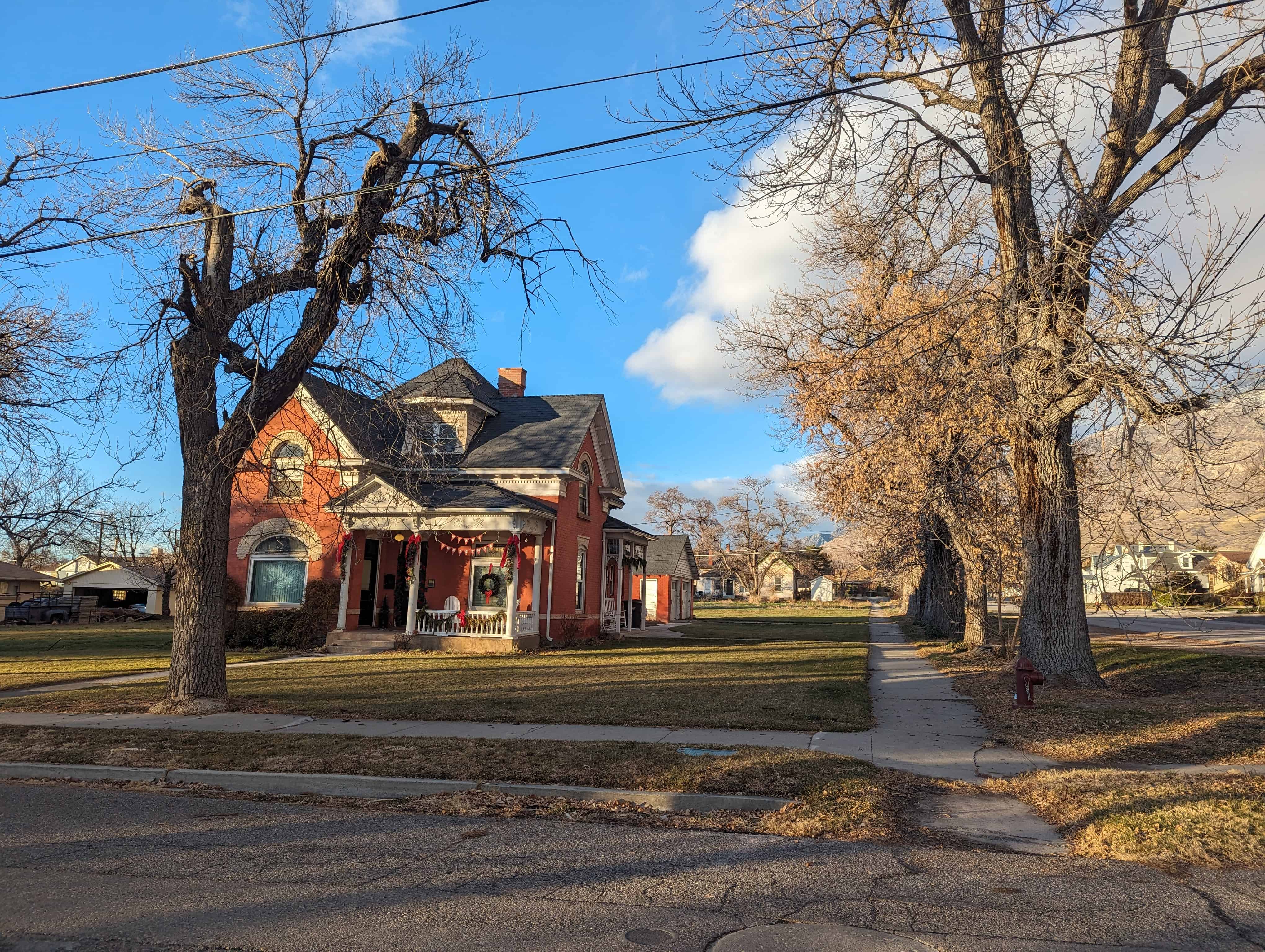
This one and one-half story cross-wing house was built in 1894 with Victorian eclectic stylistic elements. There are Queen Ann shingles inside the triangular pediment above the front window, and a stained glass window below the arched brick lintel. A plain porch is built over the recessed wing.
Edward F. Wadley House, 110 East 200 South
Part of this double cross-wing house was built in 1900, and a second wing added in 1903. The finished house is a one and one-half story variant of the cross-wing form, with two symmetric forward-projecting wings. The gabled ends of the wings have small arched windows surrounded by Queen Ann shingles inside the triangular pediment; These smaller windows sit directly above the lower but larger arched windows that have arched brick lintels. Side columns support the portico between the projecting wings.
Alexander K. Thornton House, 111 West 200 South
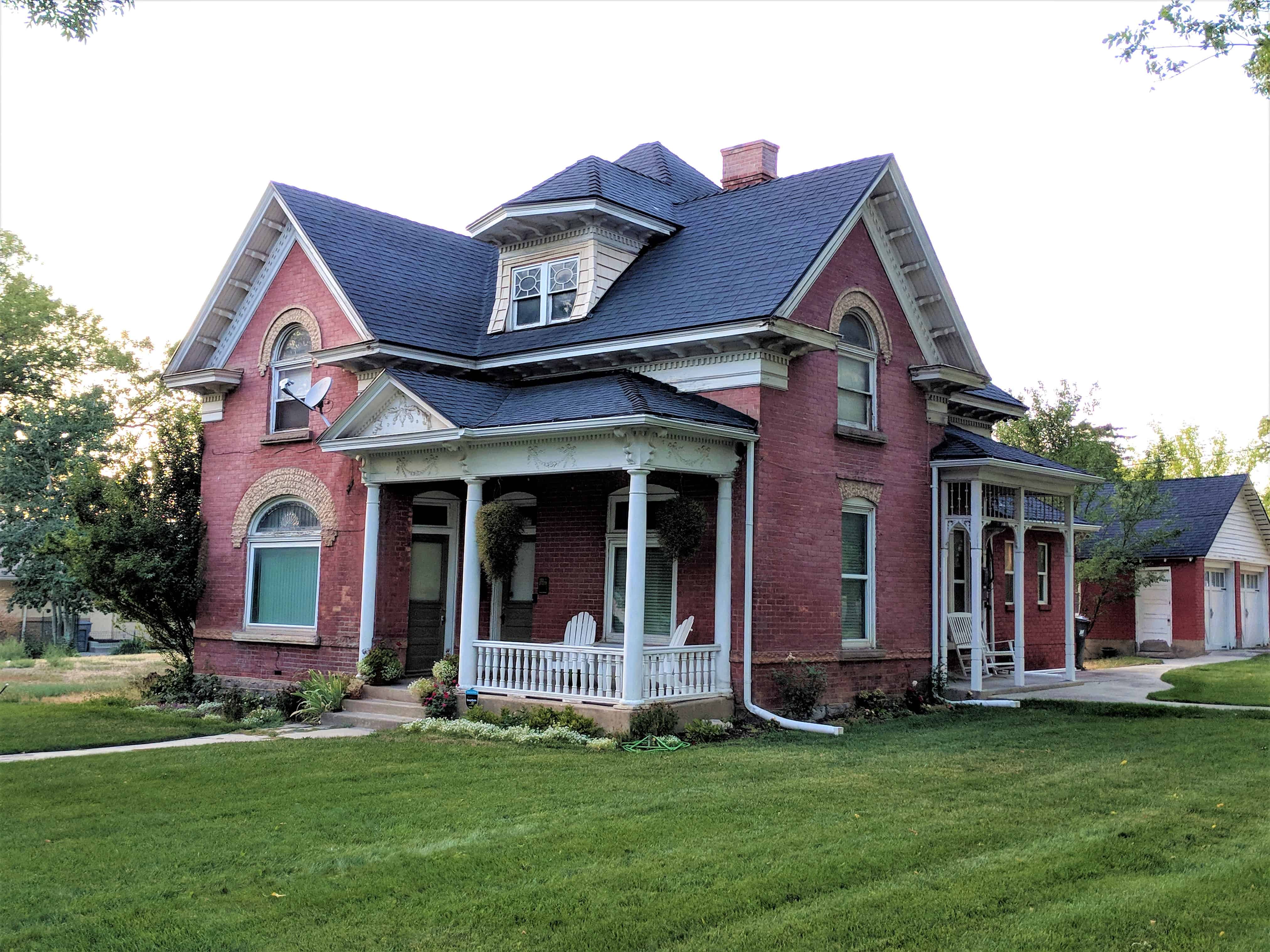
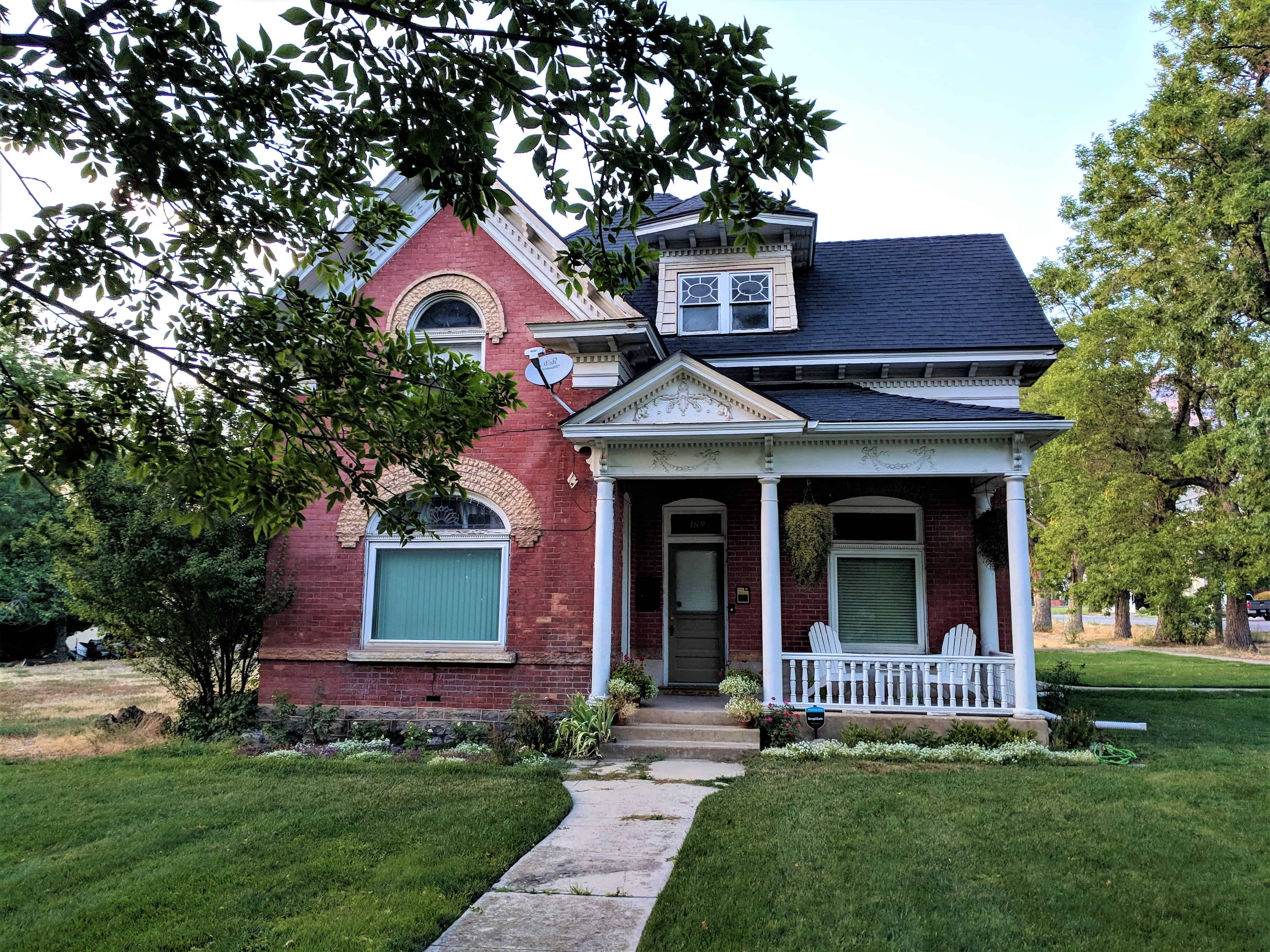
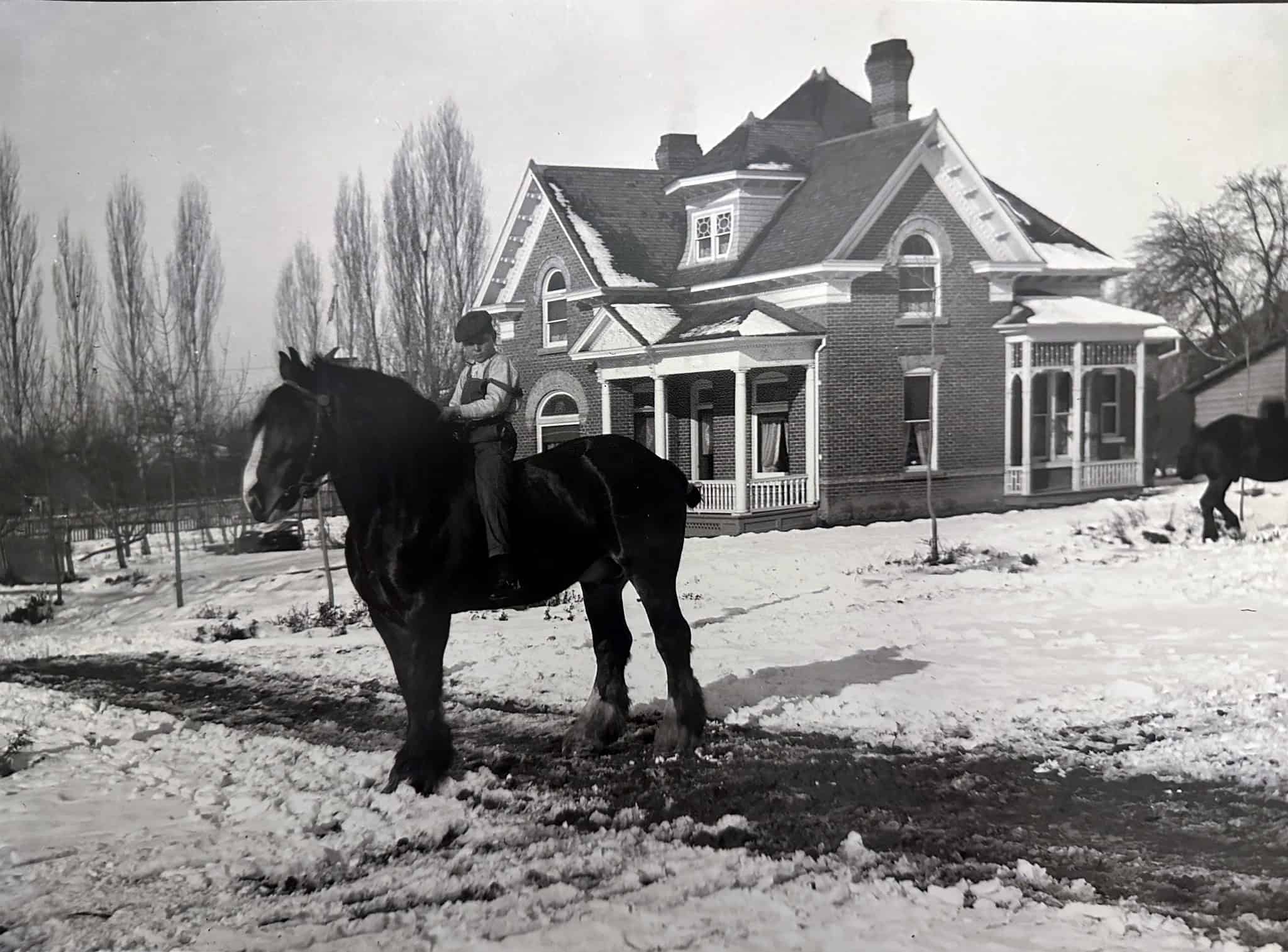
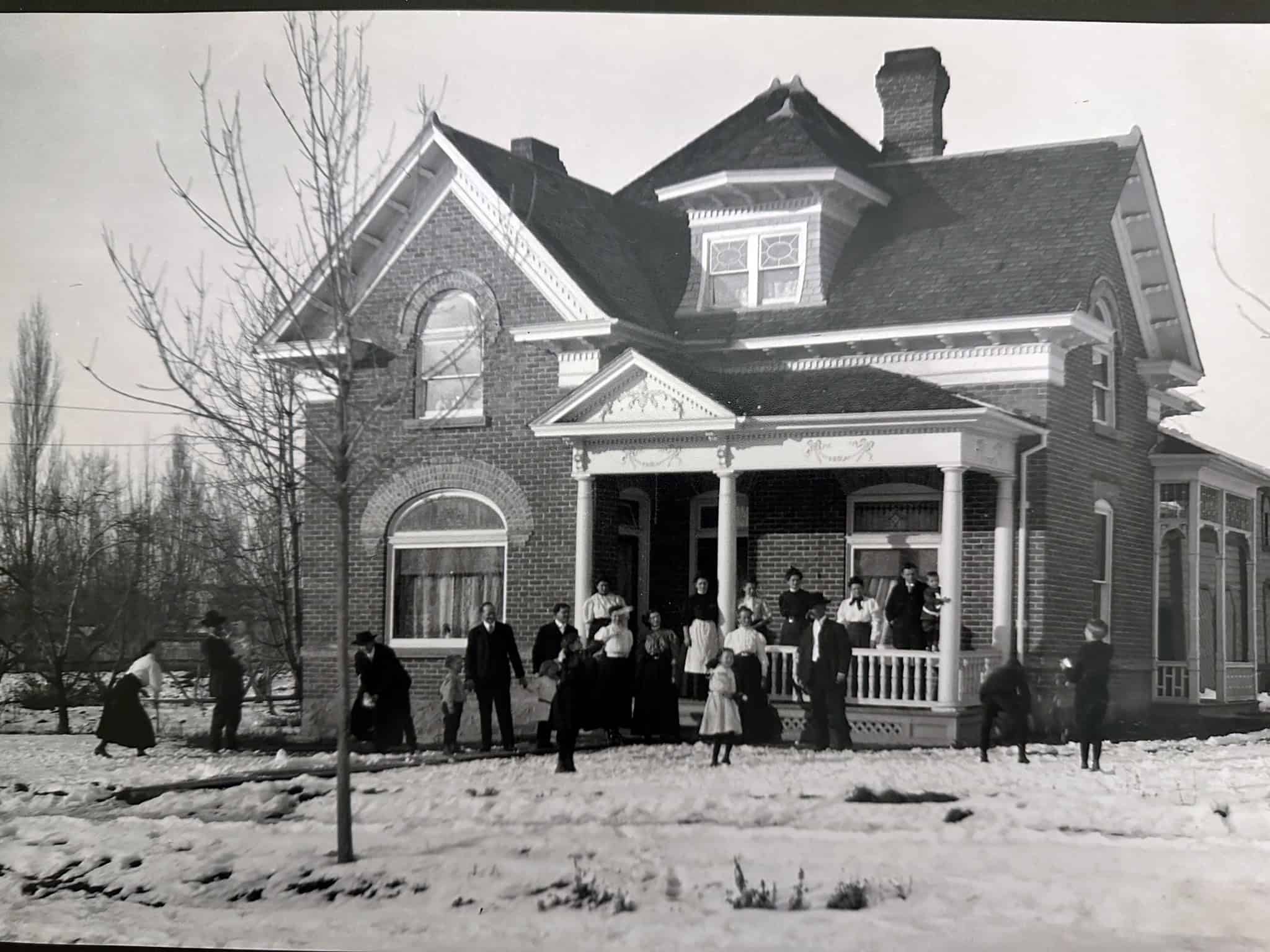
Built in 1905, the Thornton house is one of eight central block houses built in Pleasant Grove between 1902-08. Each features one and one-half or two stories, pyramidal center roof with gables over side and front projections, and round-arched or pointed-arch windows in gable ends. Most have the added feature of eyelid dormer windows. This exclusive design is rarely found outside of Utah County.
Harvey M. Vance/Burleigh C. Linebaugh House, 79 West 200 South
Built in 1917 for a combined house and medical practice. It remains one of the best examples of the California Bungalow style south of Salt Lake City. It is built of native soft-rock, giving it the cobbled texture often used in the California Bungalow. Although widely used for forty years in Pleasant Grove, the stone had been a discontinued building material for some twenty years, since brick began to be produced locally. Other stylistic features are the exposed purlins and rafters under the broad low-pitched gable roof, and bands of casement windows. Built on a corner lot, the lower west elevation accesses a walk-in full basement.
John L. Huchel House, 90 East Center
This one and one-half story Arts and Crafts Bungalow style was built in 1920. The porch base and first floor is a distinctive dark brick unlike other used in Pleasant Grove. Contrasting cream colored shingles cover the front of the porch and the top half-level of the house. The porch wraps around from the façade to the east side. Three moderately pitched gables on different levels display wide overhanging eves and purlins. The lights in numerous casement windows vary in size on different levels. The bungalow stands on a slightly raised corner lot accommodating a walk-in basement at the east back while maintaining a low bungalow profile façade.
Clifford L. Wright House. 90 North 100 East
Built in 1933, this brick masonry English Tudor-style house is representative of the few period cottages built in Pleasant Grove. This one-story vernacular expression of earlier medieval building forms combines the hall-parlor and a variant of the cross-wing. The long narrow building has the narrow end facing the street. The facade is asymmetrical styling with a brick chimney to one side and two steeply pitched gables. The smaller of the gables features an arched entrance. Although the house appears small from the facade street view, it extends deeply into the lot.
Carl Smith House. 155 East 500 South
Built in 1948, this one-story Art Moderne house style is rare in Pleasant Grove. The stucco masonry house displays aerodynamic imagery popular before World War II. A striking asymmetrical facade displays the unusual architectural features: three rounded corner windows set in metal casements, a chimney, glass blocks flanking the main entrance, and a second entrance on the facade, each one covered by an unsupported partially circular porch. An attached garage is on the east side. The flat roof and plain cornice are in keeping with the modern styling.
PUBLIC AND RELIGIOUS BUILDINGS:
Pleasant Grove School/Old Bell School, 65 South 100 East
This stuccoed adobe one-story schoolhouse is a vernacular folk-form set with the narrow gable end facing the street. A symmetrical facade was achieved by flanking the center door with two long narrow windows. Each side of the west wing has the same number of long narrow windows; this rectangular part of the building was built in 1864. A middle section was added in 1880 and a cross-wing added to the back in 1887 with a bell tower and bell added on the south gable-end roof. The entire building is of adobes and is stuccoed.
Pleasant Grove Town Hall. 107 South 100 East
Built in 1887 from the widely used native soft-rock. The one-story rectangular building has the block massing of early Utah civic buildings. The symmetrical three bay façade features the center door covering of an angular pediment portico supported by Roman Doric columns. The angular pediment is repeated on the hip roof as a decorative dormer directly above the portico. Under the roof is a wide plain entablature.
The Orpheus Dance Hall/High School Gym. 55 East 200 South
Built in 1909, this one and one-half story brick masonry building has the classical characteristics of arched pediments displayed in Beaux Arts Classicism. During the first decade of the century this decorative styling was used on public and commercial buildings with spacious interiors. In 1921, dressing rooms were added to the front interior of the building and a smaller addition was built to the rear of the building some time later.
Old Second Ward Chapel. 125 North 100 East
Built in 1930, the chapel is Colonial Revival styling typical of Latter-day Saint churches in Utah around the quarter century. The round arched windows and doors and the cornice returns emphasize the styling of the cross-wing gabled building. This building is of dark brick.
Narrative Description:
Pleasant Grove is located in Utah County twelve miles north of Provo and thirty-six miles south of Salt Lake City. The town is situated along the northeastern edges of Utah Valley and Utah Lake and rests on the western slope of the Wasatch Range at the foot of Mount Timpanogos. The Pleasant Grove Historic District combines the business, public, and the residential core of the city. The one-block historic business section and much of the first residential and public areas were developed within the 1853 fort wall boundaries. Buildings within the historic district were constructed between 1853-1945, with eighty percent built between 1865-1920. They show diversity in materials and style, reflecting this period of development. Residential structures range from the earliest 1853 vernacular style adobe building to Period Revival style brick buildings. The district covers an area of approximately 16 blocks of varying size, with 257 primary buildings and 40 outbuildings. Of these, 133 of the buildings and 18 of the outbuildings, or fifty-one percent, contribute to the historic character of the district. Although out-of-period structures are found throughout the area, the district retains its overall historic feeling and association and its distinctive town grid configuration.
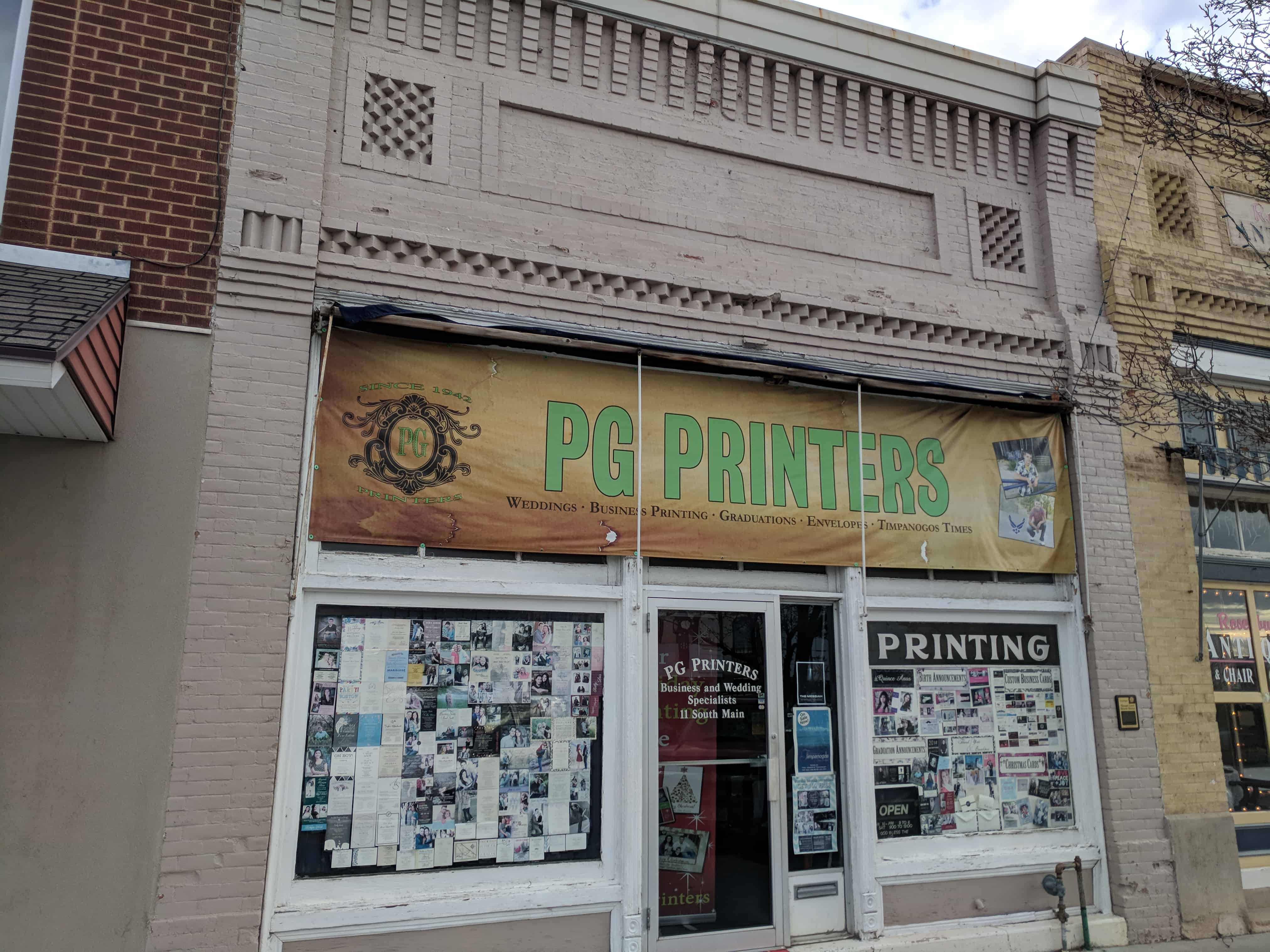
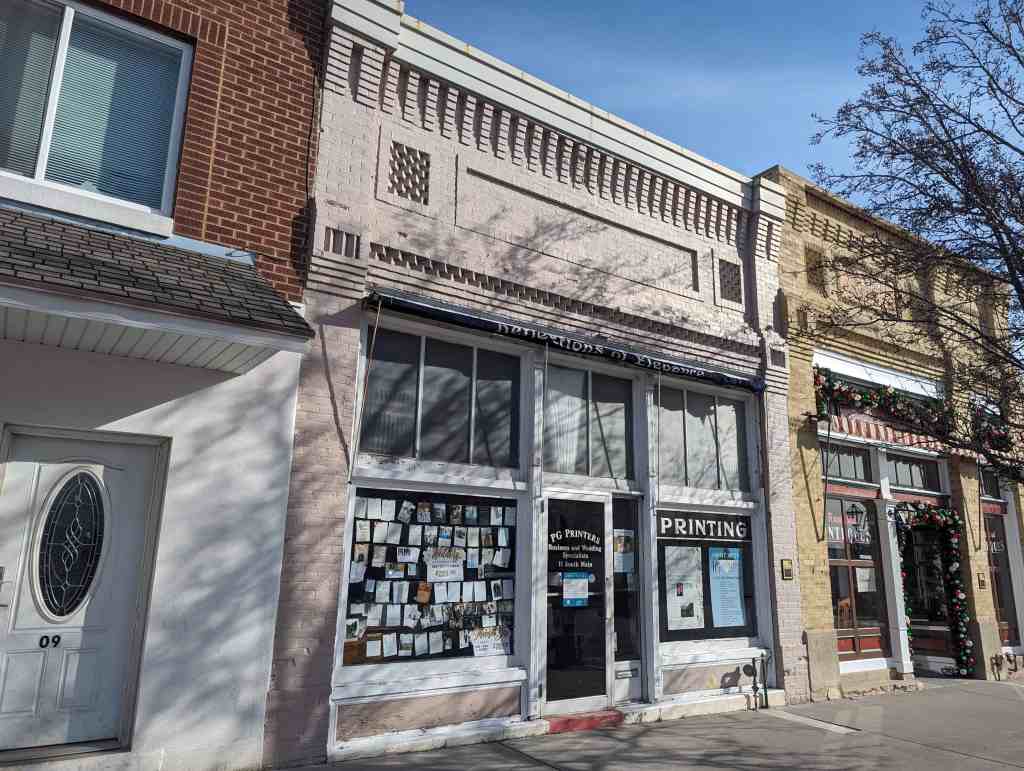
The commercial buildings are located primarily in the one-block business district on Main between Center and 100 South. They are constructed mostly of brick and are typically one-part block Victorian Eclectic buildings. The majority of the one- and two-story buildings are in excellent condition and maintain their historic integrity. The corbelled brick work on many of these buildings provides a decorative quality that illustrates the historic nature of the commercial downtown Pleasant Grove. A good example of a one-part block building is the David N. Adamson Commercial Building (c.1895) at 15 East Center, featuring Victorian eclectic features and stepped parapet walls with brick dentils. The Clark Brothers Store (c.1895) at 43 South Main is an example of the larger two-part commercial block building that is constructed of soft-rock side walls and brick masonry façade and includes Victorian eclectic features such as arched windows and decorative brick work. Various other styles in the commercial area of Pleasant Grove include the Prairie School style commercial Bank of Pleasant Grove (1917) at 2 South Main, the PWA Moderne style City Hall (c.1938) at 35 South Main, and the Spanish Revival style of the Alhambra Theater (c.1927) at 20 South Main. This grouping of commercial buildings provides the range of building types and styles popular in Utah between 1895 and 1940.
Outside the commercial block are public and institutional buildings that also include a representative range of styles and materials that span a wide period of development in Pleasant Grove, c. 1864-1930. A vernacular stuccoed adobe school, built c. 1861-1887, known as the Pleasant Grove School/Old Bell School is located at 61 South 100 East. The Pleasant Grove Town Hall, built in 1887, at 107 South 100 East is built of native soft-rock in the Federal style with Victorian ornamentation. A Colonial Revival chapel, the old Second Ward Chapel at 125 North 100 East, was built in 1930 and is typical of Latter-day Saint churches in Utah at that time. A Church of Jesus Christ of Latter-day Saints (LDS or Mormon) church at 494 South 300 East was built with Art Deco stylistic features c.1940 and has since been turned into a mortuary.
The types, styles, and materials used in the residential buildings in this district cover a broad spectrum. The turn-of-the-century dwellings include hall-parlor, temple-form, crosswing and double crosswing, and central-block-with-projecting-bays house types employing Gothic Revival, Federal, Italianate, and Victorian styling. Various bungalow types and styles built between 1914 and the early 1930s, English Tudor and English Cottage styles built in the late 1920s and early 1930s, and an Art Moderne International style built during the 1940s, are also represented within the district boundaries. These types and styles are built in a variety of building materials throughout the district. Many of the houses built before 1890 are of adobe or a locally quarried stone known as soft-rock. Many of these have been stuccoed. After 1890 the houses were built almost exclusively of locally manufactured brick. Frame construction was used less often. Most of the buildings constructed before 1915 have rubblework foundations.
The residences in Pleasant Grove span the historic period, c. 1860-1945. Approximately ten percent of the houses constructed in town and on outlying farms of Pleasant Grove (and throughout Utah) is the hall-parlor plan, represented by the Black/Weeks House at 151 East Center. Originally built c.1870, log and rock additions were built c.1890, and the front porch with Victorian eclectic detailing was added c.1900. The majority of the historic structures are Vernacular style with modest Classical elements, usually Greek Revival (approximately thirty-three percent). The Cyrus Benjamin Hawley House at 55 East Center is a good example of an early stuccoed soft-rock residence. This one-and-one-half story, crosswing house illustrates the vernacular and Greek Revival styles and is representative of several houses built during the late 1860s and early 1870s in Pleasant Grove. An early frame house is represented by the Elijah Mayhew House at 214 South Main. This house was built c.1860 and is a simple Greek Revival style, one-and-one-half story, rectangular type residence.
Residences built after the turn of the century are also well-represented in Pleasant Grove. The Thornton House at 111 West 200 South, built in 1905, is one of a number of central-block-with-projecting-bays houses constructed in the Pleasant Grove Historic District between about 1900 and 1910. These homes feature one-and-one-half or two-story central block form with pyramidal roof and projecting bays with gable roofs, rounded-arch or pointed-arch windows in the projecting gables, and many have included an eyelid dormer.
Approximately fifteen percent of the homes are constructed in the Bungalow style. One of the best examples of the California Bungalow style in this area is the Vance/Linebaugh House (c.1915) at 79 West 200 South. This house is also built of the native soft rock that was used effectively for creating a natural texture, a common Bungalow style feature. It also includes exposed purlins and rafters under a broad low-pitched gable roof and bands of casements windows.
Approximately ten percent of the houses built during the historic period in Pleasant Grove are in the Period Revival style. The Clifford L. Wright’s House at 90 North 100 East is representative of this style and was built in 1933 of brick in the English Tudor style. It features the typical steeply pitched gable entry with an asymmetrically placed rounded arch doorway.
More examples of commercial, residential, and public buildings are highlighted in Appendix A. The majority (fifty-one percent) of the buildings within the Pleasant Grove Historic District retain a high degree of integrity and contribute to the historic association and feeling of the area. The out-of-period buildings in the district are similar in scale and do not diminish the district’s historic qualities. Seventeen of the buildings within the historic district are individually listed on the National Register of Historic Places.
The landscape features of this district help to define this area as an historic community. Although a grid system was used, the overlapping of several surveys created blocks of irregular size. Irregular spacing of buildings, open green space within the interior of the blocks, and the blending of residential buildings with public and commercial buildings, all work together to provide a unique character to the area. The original fort boundaries are delineated by the change in the width of the roads at the fort’s edges, another character-defining feature of the Pleasant Grove Historic District. The imprint of the original 1853 fort is still reflected in the current grid system. Sections of Center Street and 200 South are wider between 200 East and Main where the interior roads of the old fort were laid out.