• About JacobBarlow.com
  • Cemeteries in Utah
  • D.U.P. Markers
  • Doors
  • Exploring Utah Email List
  • Geocaching
  • Historic Marker Map
  • Links
  • Movie/TV Show Filming Locations
  • Oldest in Utah
  • Other Travels
  • Photos Then and Now
  • S.U.P. Markers
  • U.P.T.L.A. Markers
  • Utah Cities and Places.
  • Utah Homes for Sale
  • Utah Treasure Hunt

JacobBarlow.com

~ Exploring with Jacob Barlow

JacobBarlow.com

Tag Archives: Santa Clara

Jacob Hamblin House

19 Friday May 2023

Posted by Jacob Barlow in Uncategorized

≈ 1 Comment

Tags

Historic Homes, NRHP, Santa Clara, utah, Washington County

Jacob Hamblin House

Jacob Hamblin arrived in Santa Clara, Utah as early as 1854 with several other young Indian missionaries. Their task was to convert the Lamanites to the Mormon Church, if possible, and develop peaceful relationships with them in any case.

The Jacob Hamblin House is located at 3400 Hamblin Drive in Santa Clara, Utah and was added to the National Historic Register (#71000860) on March 11, 1971.

By 1856 the missionaries brought their wives to Fort Clara where a meager livelihood was obtained by hard work and irrigation. In 1857 Jacob was appointed president of all the Southern Indian Missions by Brigham Young His duties increased greatly with the unrest associated with the Mountain Meadows Massacre in September 1857. Hamblin and Thales Haskell both were in the north courting and marrying young wives, The foursome returned to Santa Clara via Mountain Meadows, one of the first groups to witness the carnage. Hamblin aided in the recovery and return of the surviving children.

The Buckskin Apostle had a difficult time pacifying the Indians toward the Mormons, while seeking their alliance against Johnston’s Army during the Mormon War of 1857-1858. Jacob Hamblin was trusted by the Indians. He believed in absolute honesty when dealing with them, in showing no fear under any condition, but he also demanded justice from them as well.

Life at Fort Clara continued difficult. Tragedy came often. In the fall of 1861 Swiss colonists arrived at the new settlements, but barely in time to witness a large flood in the Clara River wipe out the whole settlement early in 1862. As Hamblin was constantly away exploring or negotiating with the Indians, he was unable to provide for his families. Consequently, in 1863 missionaries were called to build Hamblin a home. His two wives moved in as soon as it was finished.

Jacob Hamblin made several exploring trips across the Colorado between 1858-1863, being the first person to circumnavigate the region of the Grand Canyon. He also explored a wagon route to the Colorado River near Callville (Las Vegas area) in 1864. In conjunction with Henry W. Miller and Jesse W. Crosby, Hamblin took a boat to the Colorado River at the mouth of Grand Wash in 1867, and they were the first white men known to have navigated the river from that point to the Virgin Rivers confluence about 75 miles down stream. Hamblin also assisted John Wesley Powell in his surveys of the Colorado River area. Together they helped negotiate a peace treaty with Navajo at Fort Defiance.

When Hamblin moved to Kanab, the home was leased to a Mr. Bauman who used the home to produce wine. Later his daughter married into the Samuel Knight family, which retained control of it until Clara Hamblin Harmon, a granddaughter of Jacob, purchased it. The home was very de lapidated when the State Parks and Recreation Division took custody of it in 1959.

It is fitting that Jacob Hamblin’s church-built home should be preserved as a monument to this southwestern pioneer. Because he was also a polygamist the Buckskin Apostle, when he died August 31, 1886, was a fugitive from justice. His last years were spent in southern Utah, Arizona, New Mexico and Old Mexico.

Santa Clara Merc

12 Wednesday Apr 2023

Posted by Jacob Barlow in Uncategorized

≈ Leave a comment

Tags

Historic Markers, Mercantile Buildings, Santa Clara, utah, Washington County, washington counyu

Santa Clara Merc

Right from the beginning, the Santa Clara Merc developed a presence on the main street of this small western town. Morphing from a one-room operation to a small, free-standing unit to a thriving mercantile that supplied needed essentials to residents and jobs for many of its youth, the Merc was the heart of Santa Clara. The building’s design is simple, reflecting the austere modern influence of the times with little architectural ornamentation, but the operation of the business wove a rich legacy. The story began long before construction took place, and it is best remembered through the writing of Ethel H. McArthur, a woman who personally knew the history.

The early citizens of Santa Clara were tired of having to go by wagon to St. George for their meager supplies, so a group of them got together and decided to open their own store. None of them had any experience running a mercantile business, but they chose John G. Hafen to be the manager… Before long, Grandpa Hafen bought the other stockholders out and with the small capital of ten dollars began to build up a mercantile business of his own. His work took him from home so much that the work in the store was done largely by grandmother.

The store was a small room in their home, but the business continued to increase, so in 1900 a small brick building was erected adjoining their house. The business remained at this location even though grandpa retired in 1917 and sold the business to his son Adolph and two grandchildren. It continued to be a general store, handling all varieties of goods needed by a community. It was the only mercantile ever established in Santa Clara.

In 1928 a new modern building of concrete brick and adobe was constructed one block west of the original site. It was a much larger store and also had space for a large garage. The garage was rented to the Stucki & Wittwer Produce Company, and gas pumps were installed outside the store.

The new store was named the Santa Clara Coop and was still owned by the Hafens. In the late 1930s merchandise became extremely difficult to buy, and the inventory dwindled to almost nothing. The store was sold to Adolph’s daughter Ethel and husband Horace McArthur. They moved home from California and took over operations on September 1, 1945. The majority of Adolph’s business was run on credit, and this tradition became a way of life when dealing with McArthur’s Santa Clara Merc.

Horace and Ethel expanded the store and its merchandise. The Merc was known to sell dishes, appliances, horseshoes, nails, dresses, shoes, fabric, toys, and the town’s first television. In 1960 Horace’s son Douglas was made manager, and he and Ethel operated the business until July 1, 1986. The business started by John G. Hafen was then sold, leaving family hands for the first time in more than one hundred years.

The Santa Clara Merc continued to operate for another ten years until the competition of modern supermarkets forced it to close.

3097 Santa Clara Drive in Santa Clara, Utah

Santa Clara Coop 1930s
Santa Clara Merc 1980s

Fort Santa Clara

18 Wednesday May 2022

Posted by Jacob Barlow in Uncategorized

≈ Leave a comment

Tags

Forts, Historic Markers, Santa Clara, utah, Washington County

As winter gave way to spring in 1855, twelve missionaries were sent to southern Utah by Brigham Young to colonize this region. Fearing an attack by Indians, they began the ambitious project of building a fort. Their energies were initially directed at hauling stone which was plentiful and nearby. Local Indians, whom they trained and who were willing to help in exchange for food, assisted them. As soon as enough stone had been gathered, the work on Fort Santa Clara began in earnest.
Four stone masons from Cedar City directed the work which took approximately three weeks to complete. While inspecting the fort during one of his visits south, Mormon Leader Brigham Young pronounced it, “the best fort in the territory.”

Because of the efforts of the missionaries, there was great peace among everyone who lived in this area. The fort was never attacked by Indians. The fort became the focal point for the Swiss Settlers who arrived in November 1861.

“On Christmas Day 1861, it started to rain. We were known to have a skiff of snow about this time of year, but this year it rained, and it rained for about a month and a half. The ground became completely saturated, and the small creeks feeding the Santa Clara became streams, and the Santa Clara became a torrent. Some small trees and other debris washed down from above, backed up the Santa Clara, and during the night of 4 February 1862, the Santa Clara ran over its bank and started entering the fort from the north gate. Sarah and I awoke with water in our cabin, and we rushed out into the night in our bed clothes to warn others. By then the water was washing away our cabin on the southwest corner of the fort. The women and children were carried to safety. Two hundred bushels of the Indian’s wheat was carried from the northwest cabin to safety before that wall collapsed. We were all exhausted from the effort. Sarah and I lost everything we had except for my horses and saddles. We rushed out into the night without taking time to dress. Many miraculous events took place that night. It was dark and raining, the fort was washing away. Wheat was saved, children led and carried to safety. Some were able to save some valuables, but most was lost. But God was good to them, not one life was taken.

At conference, 22 March 1862, Jacob Hamblin was called to be the new President of the Indian Mission. With the importance of his new position and the disaster of losing the fort in the flood, Jacob started building a new home. Most of Jacob’s garden area and orchard by the fort were destroyed, so he started again. The stone from the north wall of the fort was used in building the structure, and the Swiss people used the rest, so the last of the fort wall disappeared.” – Ira Hatch, Indian Missionary, by Richard Ira Elkins

Today, within the walls of some of the homes in our community, these rock walls still stand as a shelter to the inhabitants of this beautiful city of Santa Clara. Jacob Hamblin’s home, now registered as a historical site and open for public visits, is a reminder of the courage of those who fought the vagaries of nature and made this part of the world their garden.

How Would You Build a Fort?

A single community cabin was the starting point for the fort. The fort was to be one hundred feet long on each side with stone walls twelve feet high and about two feet thick. The plan called for seven cabins on each side of the fort. Each cabin was about twelve and one-half feet wide and twenty feet deep and had one door and one window. Stone fireplaces, placed in the center back wall of each cabin, provided a good portion of the outside wall of the fort. The inside cabin walls were of logs, except for the end cabins which had two walls of rock. The cabin roofs were supported on logs set into the rock on one end and on log walls on the inside of the fort. Protective gun ports were built into the outside rock walls. On the east and west side of the fort, defenders would lie on the roof tops to fire from the gun ports. Wooden ladders gave access to the raised platforms on the north and south sides. The main gate faced south; a smaller cattle gate was built into the center of the north wall. Entrance into the fort was gained by two doors on the south side which faced the road. These doors swung on heavy iron hinges built into the rock; heavy cross members, about three inches thick, were bolted to them for strength. The doors were locked with four by six inch beams placed into carriers. A large iron hasp held them closed when the beams were not needed.

The Stockyard

In 1996, the foundation of the Fort Santa Clara Stockyard was unearthed. The original stockyard was located some distance away from Fort Santa Clara so the animals would not be a nuisance to those living in the fort. The animals could be easily watched from the fort which was south from here toward the Santa Clara River.

The Missionaries

The monument is dedicated to the following men who colonized the Santa Clara area.

The five missionaries were:

  • Jacob Hamblin
  • Ira Hatch
  • Samuel Knight
  • Thales Haskell

Missionaries called at October 1853 General Conference to the Indian Mission, Southwest Territory:

  • Thomas Brown
  • Samuel Atwood
  • Robert Dickson
  • Benjamin Knell
  • Robert Richie
  • David Tullis
  • Hyrum Burgess
  • Lorenzo Roundy
  • John Lott
  • Clark Ames
  • Rufus Allen
  • Richard Robinson
  • Amos Thornton
  • Isaac Riddle
  • Prime Coleman
  • William Henefer
  • David Lewis
  • Elnathan Eldredge
  • John Murdock

Related:

  • Pioneer Forts
  • Santa Clara, Utah

John George and Susette Bosshard Hafen Home

29 Saturday Aug 2020

Posted by Jacob Barlow in Uncategorized

≈ 2 Comments

Tags

Historic Homes, Santa Clara, utah, Washington County

John George and Susette Bosshard Hafen Home

This 1 1/2 story Victorian, eclectic crosswing home is believed to have been built in 1881. The adobe bricks that form the walls were made on the property from sand and clay from the backyard and the nearby hill to the north. Some of the other materials in the home were previously used and came from the mining town of Silver Reef. Silver Reef is located approximately 30 miles north of Santa Clara on Interstate 15 and had been a silver mining boomtown in the 1860s. By the 1880s, the town was being phased out and both materials and entire buildings were up for sale. The Hafens took advantage of this opportunity by purchasing lumber and possibly other materials to build the home. It has received only one addition, a room on the rear, since it was finished.

The home quickly became an integral part of Santa Clara’s early history. It served as Santa Clara’s first official post office, and it also housed the beginning of Santa Clara’s merchandise cooperative. After Zion’s Cooperative Mercantile Institution (ZCMI) was founded in Salt lake City, other cooperative stores were founded throughout Utah. One of these was started in Santa Clara. John George Hafen became its first manager, and he stored the merchandise stock in one of the rooms in the house.

John George Hafen was born in Switzerland in 1838. His mother died a few years later. In 1861, he and his father and sister Barbara traveled from Switzerland to Salt Lake City. Upon arriving at their destination, John George was married to Susette Bosshard, a young woman he had met before leaving Switzerland. They were all new converts to The Church of Jesus Christ of Latter-day Saints and had traveled with other new members who came to Salt Lake City to reside with the main body of the Church. Soon after arriving, however, this group of Swiss settlers was called by Church President Brigham Young to travel on to the southern part of Utah. President Young assigned them the task of establishing a town on the Santa Clara River. Within weeks of their arrival, the town site was surveyed, and on December 22, 1861, it was dedicated.

The new Santa Clara residents intended to establish a grape-growing industry. Residential lots and vineyard plots were assigned through drawings from a hat. John George Hafen, his father Hans George Hafen, and his sister Barbara and her husband drew adjoining lots and vineyard plots. John George Hafen built a small log cabin for himself and Susette on their lot, and Hans George Hafen built a small shanty on his property. Eventually, they built and moved into the large home on Santa Clara Drive that is pictured here.

Related Posts:

  • Santa Clara, Utah

Santa Clara Relief Society House

21 Thursday May 2020

Posted by Jacob Barlow in Uncategorized

≈ 1 Comment

Tags

NRHP, Post Offices, Santa Clara, Schools, utah, Washington County, washington counyu

Santa Clara Relief Society House

Completed in 1908, the Santa Clara Relief Society House is significant as the oldest remaining LDS church building in this pioneer community. Some of the functions of the Relief Society (the women’s auxiliary organization of the Mormon church) continued in this historic hall until completion of the adjacent LDS meetinghouse in 1949. It also served as a school (1908-1913), a makeshift clinic (1939-1950s), and the local post office (1953-1963).

The Victorian Eclectic style Santa Clara Relief Society House is also architecturally significant in the community. While not built as a meetinghouse, it is similar in size, configuration, and use to other “settlement phase” LDS meetinghouses. In 1992 during work to repair and restore the building, it was damaged by an earthquake. Its previously coated brick exterior was reinforced and covered with stucco. It has since been restored through local community efforts to serve as a museum of Relief Society and pioneer memorabilia and a meeting hall.

Related Posts:

  • Santa Clara, Utah

Kayenta, Utah

03 Saturday Dec 2016

Posted by Jacob Barlow in Uncategorized

≈ Leave a comment

Tags

Ivins, Kayenta, Santa Clara, St. George, utah, Washington County

2016-11-22-12-48-38

Kayenta is a community near Ivins and Santa Clara named for the Kayenta Anasazi Natives.

2016-11-22-14-04-58

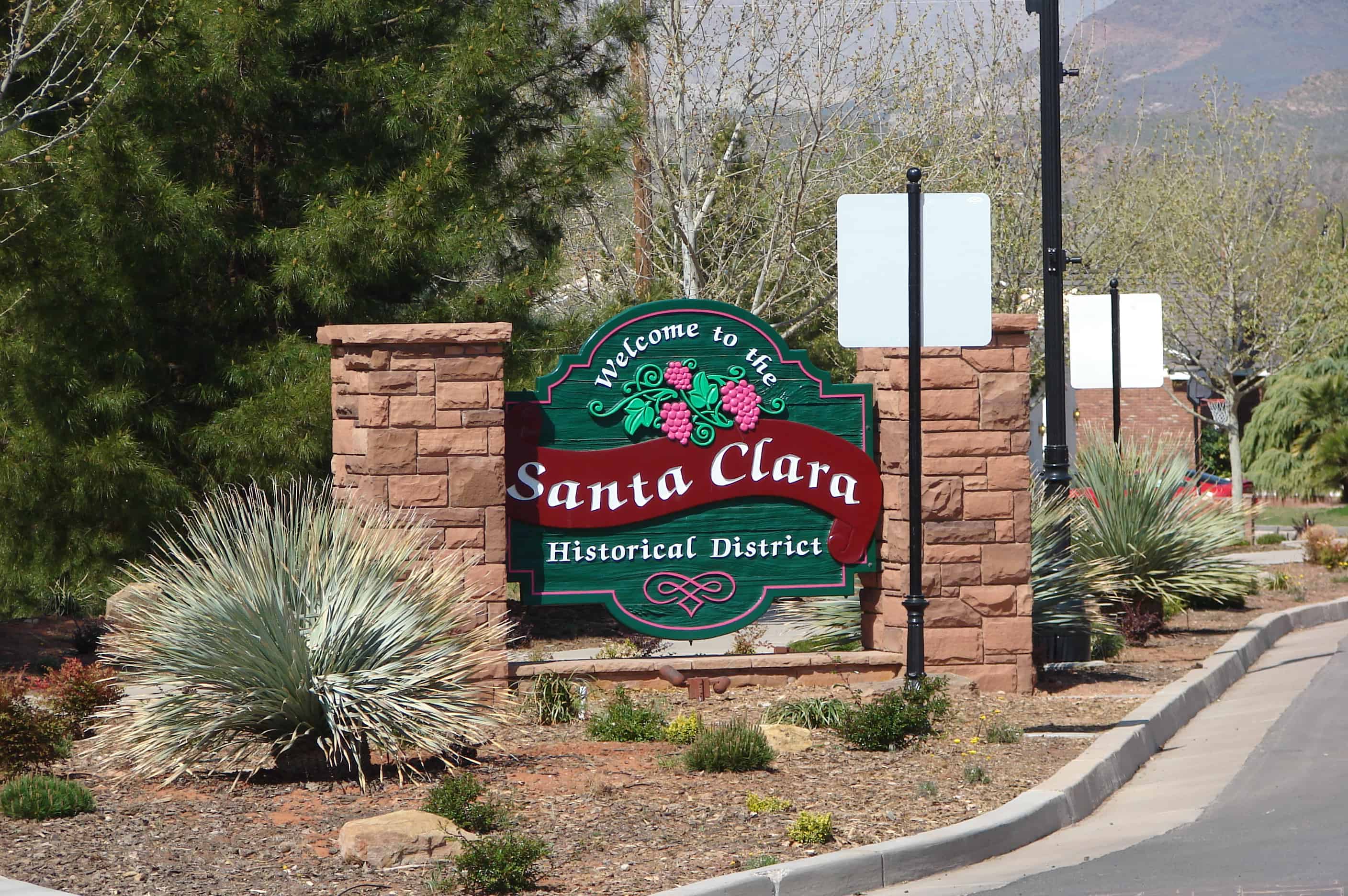
Santa Clara, Utah

03 Monday Oct 2016

Posted by Jacob Barlow in Uncategorized

≈ 6 Comments

Tags

Santa Clara, St. George, utah, Washington County

picture09apr08-024

See also, Swiss Colony.

In 1854, Jacob Hamblin was called by Brigham Young to serve a mission to the southern Paiute and settled at Santa Clara in the vicinity of the modern city of St. George, Utah.

The first settlers built Fort Clara or Fort Santa Clara, in the winter of 1855-1856. In the fall of 1861, Swiss Mormon colonists arrived at the new settlement, but shortly afterward were victims of the large flood in the Clara River that wiped out the fort and most other buildings, its irrigation dams and ditches, in early in 1862. This flood was part of the Great Flood of 1862.

Hamblin’s first home there was included in the destruction of this flood. His second wife Rachael saved one of their young children from drowning, but the child soon after died from exposure. Rachael never fully recovered from the exposure she got from the flood. Swearing to avoid the risk of flood, Hamblin built a new home on a hill in Santa Clara. Owned today by the Church of Jesus Christ of Latter Day Saints, it is operated as a house museum, where Mormon missionaries give daily tours.

19th-century Santa Clara was largely inhabited by Mormon immigrants from Switzerland. Among these was Daniel Bonelli, who after the destruction of the flood went on to be a pioneer colonist of St. Thomas, Nevada in the Moapa Valley, a farmer, later a salt miner and the owner of Bonelli’s Ferry, at Rioville, Nevada on the road between southwestern Utah and Arizona on the Colorado River at its confluence with the Virgin River.

Related Posts:

  • Fort Santa Clara
  • Jacob Hamblin House
  • John George and Susette Bosshard Hafen Home
  • Santa Clara Merc
  • Santa Clara Relief Society House
  • Santa Clara posts sorted by address
picture01march08-013

Swiss Colony

22 Thursday May 2014

Posted by Jacob Barlow in Uncategorized

≈ 1 Comment

Tags

DUP, historic, Santa Clara, utah, Washington County

November 28, 1861, about 93 pioneers under the leadership of Daniel Bonelli, were sent by President Brigham Young to settle southern Utah and raise cotton and grapes. They located at the fort built by Jacob Hamblin and others along the Santa Clara Creek, one mile west of the present townsite. The fort and many other buildings, dam and ditches were washed away by floods January 1, 1862. Lack of food, shelter and clothing tested their endurance for years.

picture09apr08-021
picture09apr08-022
picture09apr08-023

Check out all of the historic markers placed by the Daughters of Utah Pioneers at JacobBarlow. com/dup

Follow Jacob

Follow Jacob

Blog Stats

  • 2,001,818 hits

Social and Other Links

BarlowLinks.com

Recent Posts

  • Julie Budge Nibley Home
  • Elias and Agnes Beckstrand House
  • Ophir Town Hall
  • John Blanchard Home
  • Seth H. Blair Home

Archives


Loading Comments...