• About JacobBarlow.com
  • Cemeteries in Utah
  • D.U.P. Markers
  • Doors
  • Exploring Utah Email List
  • Geocaching
  • Historic Marker Map
  • Links
  • Movie/TV Show Filming Locations
  • Oldest in Utah
  • Other Travels
  • Photos Then and Now
  • S.U.P. Markers
  • U.P.T.L.A. Markers
  • Utah Cities and Places.
  • Utah Homes for Sale
  • Utah Treasure Hunt

JacobBarlow.com

~ Exploring with Jacob Barlow

JacobBarlow.com

Tag Archives: Coalville

Summit County Courthouse

31 Saturday Jan 2026

Posted by Jacob Barlow in Uncategorized

≈ Leave a comment

Tags

Coalville, Courthouses, NRHP, summit county

Summit County Courthouse

Erected in 1903-04, the Summit County Courthouse stands out both architecturally, in the Romanesque Revival style, and politically as the symbol of the county’s growth and development at the beginning of the Twentieth Century.

The Summit County Courthouse is located at 54 North Main Street in Coalville, Utah and was added to the National Register of Historic Places (#78002694) on December 15, 1978.

In the fall of 1902, Summit County voters geared for a vote concerning the removal or retention of the County Seat in Coalville, Utah. Residents of Park City, a prosperous and booming silver mining camp, contended that since the town functioned as the county’s commercial center, it should be the county seat. Coalville citizens countered by stating it was their town that supplied the foodstuffs essential to Park City’s livelihood. It was ultimately put to the vote, with Coalville victorious.

Tensions between the two towns appeared to decrease after the vote. Apparently, one of the contentions of the Coalville supporters was that the then “present” courthouse was adequate. However, in May 1903, the Summit County Commissioners, Freeman Malin, J. C. Paskett, and William H. Smith decided unanimously to erect a new county building. Editorial ppinion in The Coalville Times quickly backed the action by stating: “While there are some in the county who will object to the erection of a new building we believe the majority will be in favor of the proposition, as it is believed that this will be the means of settling the county seat questions.”

The Park Record editorial countered by asserting “What the people of this and of the county ought to do, is to get up a petition protesting against this building and force the other end to live up to its election pledges.” Despite the joust, newspaper opinion from the Park eventually conceded that, although Park City was the proper place for it, the building as planned was “most conveniently arranged and is just what Summit County has needed for a long time.. .had it not been for a few measly and narrow minded ‘chumps’ who call themselves citizens, it would have been erected [in Park City], we nevertheless are glad the commissioners have decided to build…”

Shortly after the decision was made to build, the lot of J. S. Salmon, north of the L.D.S. Stake House, was purchased for $1,500.00 with the city presenting to the County part of its property adjoining the Salmon lot. A contract was awarded to F. C. Woods & Co. , Ogden architects, to design the structure; and it was speculated that the building would be constructed of white sandstone located in Summit County since the money for the material would then be kept in the county.

Ironically, the contractors selected were E. J. Beggs, of Park City, and J. H. Salmon, Coalville. Their low bid was $19,887.00; a Colorado firm had bid lower, but withdrew from competition. Salmon also owned the stone from which the courthouse would be constructed. County commissioners had visited Park City earlier with the plans for the building to seek approval that such approval be received was undoubtedly of high importance; and as stated, approval, at least in The Park Record, was eventually voiced.

Work commenced on the courthouse in August-September 1903. The making of brick began in early September; and work continued until mid-November, when it was discontinued for the winter months. Laborers returned to the job in the spring of 1904 and completed the building, which was turned over to the Summit County Commissioners in November 1904.

The Romanesque Revival style of the structure, marked by its fortress-like appearance, renders the building a unique and prominent feature of Coal vi lie’s Main Street area.

The building continues to function as the County Courthouse. Present plans call for an addition on the Courthouse which will enable the structure to continue to function as the county offices. Plans for the addition are being prepared by Sterling R. Lyon, Ogden, Utah, and illustrate a sympathy with the texture and style of the older structure. The jail, a separate building that sits behind the courthouse and built in the same style in 1905 by T. L. Allen, will be removed in order to make way for the addition. Although the jail will be lost, the addition will ensure the preservation of the courthouse, and its continued use.

The Summit County Courthouse is built in a Romanesque Revival style, typified by a rough textured, rock-faced coursed ashlar finish. The two and one-half story rectangular structure is topped by a broad hip roof with a centrally located-cross gable, to the west, which forms the main entry. The protruding entrance bay is characterized by a segmental arched entry arcade with colonettes,, and three-arched windows openings and deep set double-hung windows with transoms on the second level.

The stepped gable at the attic level is decorated with two pairs of volute buttresses. The two round arched windows in the gable have the same pronounced archivolt trim and impost course as the three windows below. The cornice of the entrance bay is not decorated with the dentil molding used on the rest of the cornice; instead, a dentilled cornice appears above the paired arched windows.

On the south façade, a second entry is marked by a square, slightly projecting tower. An unusual pre-modern element of the tower design is the flat, three-story recession in the south tower façade, giving it a very rectilinear appearance. The four gabled dormers in the pyramidal roof of the tower are faced in matching stone.

Coalville, Utah

09 Friday Jan 2015

Posted by Jacob Barlow in Uncategorized

≈ Leave a comment

Tags

Coalville, summit county, utah

coalville

Coalville’s population was 1,382 at the 2000 census. It is the county seat of Summit County. Interstate 80 runs through the town, as well as the Weber River which runs into the Echo Reservoir just north of Coalville.
Coalville was founded in 1859 by William Henderson Smith, an early Mormon freighter. He noticed that wheat spilled by other wagons moving through the area would grow to maturity. He subsequently convinced four families to settle in the area with him. The settlement was originally called Chalk Creek.
Early life in Chalk Creek was difficult, and during winters the settlers dealt with a constant scarcity of food. When food ran out, they would travel to Salt Lake City for supplies. The local Native Americans were also hostile for a time, and the settlers built a fort on advice of Brigham Young.

In 1854 the territorial government in Utah offered a $1000 reward to anyone who could find coal within 40 miles of Salt Lake City. Four years later, Thomas Rhodes found a coal vein in the Chalk Creek area, and coal mining began in earnest. Hundreds of tons of coal were shipped to Salt Lake City, and soon a narrow gauge railroad was built. The settlement was renamed Coalville as a result of this early success mining coal.

The Thomas L. Allen House in Coalville is listed on the National Register of Historic Places.

Related posts:

  • Historic Buildings in Coalville
  • Historic Homes in Coalville
  • Old Rock School House
  • Parks in Coalville
  • Summit County Courthouse
  • Summit Stake Tabernacle

A timeline from Coalville’s website:

  • 1858 – The settlement was first called Chalk Creek, but discovery of coal soon changed the name to Coalville.
  • 1860 – Coal was discovered. The first school began.
  • 1869 – July 30, small pox outbreak, the town was quarantined.
  • 1865 – Old Rock School House was the first church built, and is still standing. (Owned by T. E. Moor)
  • 1867 – Coalville is incorporated. Mayor was W. W. Cluff.
  • 1870 – R.J. Porter built a water power grist mill.
  • 1882 – Union Pacific rail road goes through Coalville on its way to Park City.
  • 1904 – County Courthouse is built.
  • 1906 – A power house is completed and lights are turned on for the first time on New year’s night.
  • 1912 – One of the best school district schools in the state was built costing $37,000. It was 133 feet long, 66 feet wide and two stories high. A hospital was opened by Dr. O. W. French in the second story of the Summit Furniture Building.

ingress_20131011_160300_2

ingress_20131011_161032_0

Click here to see other places in Utah.

Hoytsville, Utah

01 Tuesday Jul 2014

Posted by Jacob Barlow in Uncategorized

≈ Leave a comment

Tags

Coalville, Hoytsville, summit county, utah, Wanship

Hoytsville isbetween Coalville and Wanship. It was first known as East Plymouth, then Unionville, because the people united here in time of Indian troubles. In 1875 the name was changed to Hoytsville honoring Samuel P. Hoyt.

  • picture2aug07-041

The LDS chapel in Hoytsville is the site of Historical Marker #37 of the Daughters of Utah Pioneers, which was erected on August 27, 1938. The plaque reads:

This monument is near the site of the old fort, 300 ft. So. west of here. It was on old emigrant trail. Route also used by Overland Stage and part of Johnston’s Army going east in 1861, to participate in the civil war. The fort was built during the black hawk war in 1866, on advice of Pres. Brigham Young to Bishop Winters. 25 families moved their log cabins there. Centrally located it provided protection for families, livestock and grist mill. The mill was the first in this county. Built in 1862 by Samuel P. Hoyt.

Echo, Utah

14 Saturday Jun 2014

Posted by Jacob Barlow in Uncategorized

≈ 1 Comment

Tags

Coalville, Echo, summit county, utah

picture16aug07-024

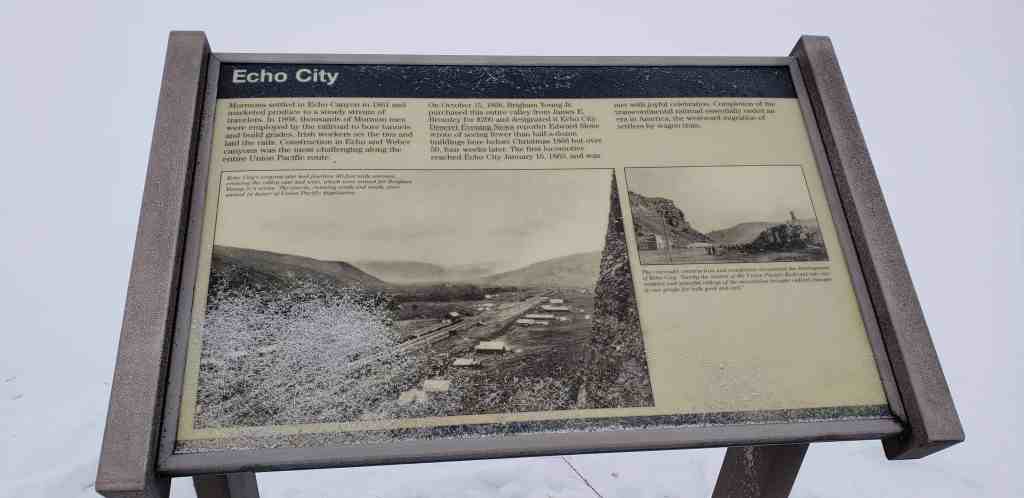
Mormons settled in Echo Canyon in 1861 and marketed produce to a steady stream of travelers. In 1868, thousands of Mormon men were employed by the railroad to bore tunnels and build grades. Irish workers set the ties and laid the rails. Construction in Echo and Weber canyons was the most challenging along the entire Union Pacific route. On October 15, 1868, Brigham Young Jr. purchased this entire valley from James E. Bromley for $200 and designated it Echo City. Deseret Evening News reporter Edward Slone wrote of seeing fewer than half-a-dozen buildings here before Christmas 1868 but over 50, four weeks later. The first locomotive reached Echo City January 16, 1869, and was met with joyful celebration. Completion of the transcontinental railroad essentially ended an era in America, the westward migration of settlers by wagon train.

Echo City’s original plat had fourteen 80-foot-wide avenues, crossing the valley cast and west, which were named for Brigham Young Jr.’s wives. The streets, running north and south, were named in honor of Union Pacific dignitaries.

The railroad’s construction and completion stimulated the development of Echo City. “Surely the advent of the Union Pacific Railroad into our isolated and peaceful valleys of the mountains brought radical changes to our people for both good and evil.”

Related Posts:

  • Bromley’s Cathedral
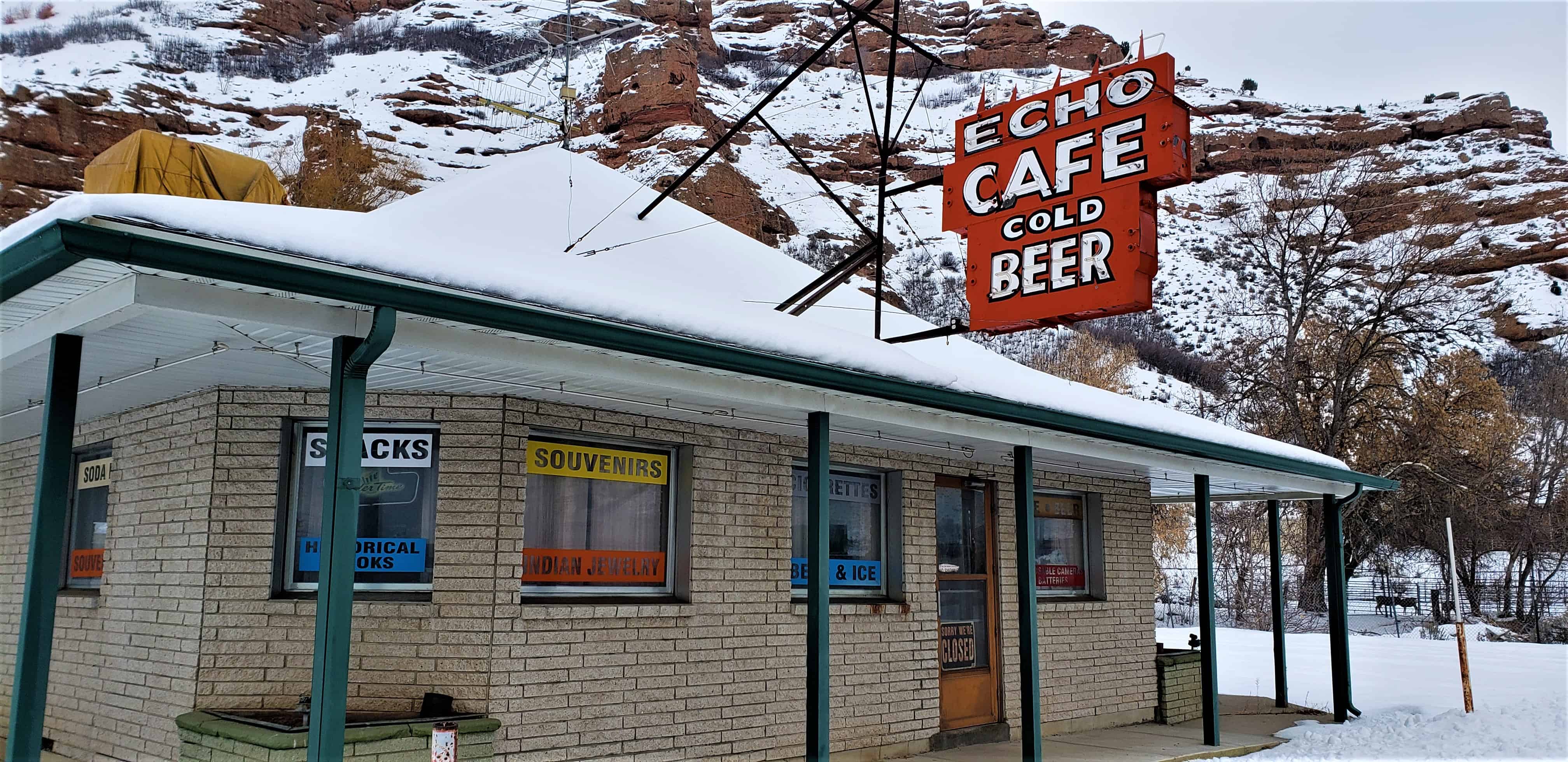
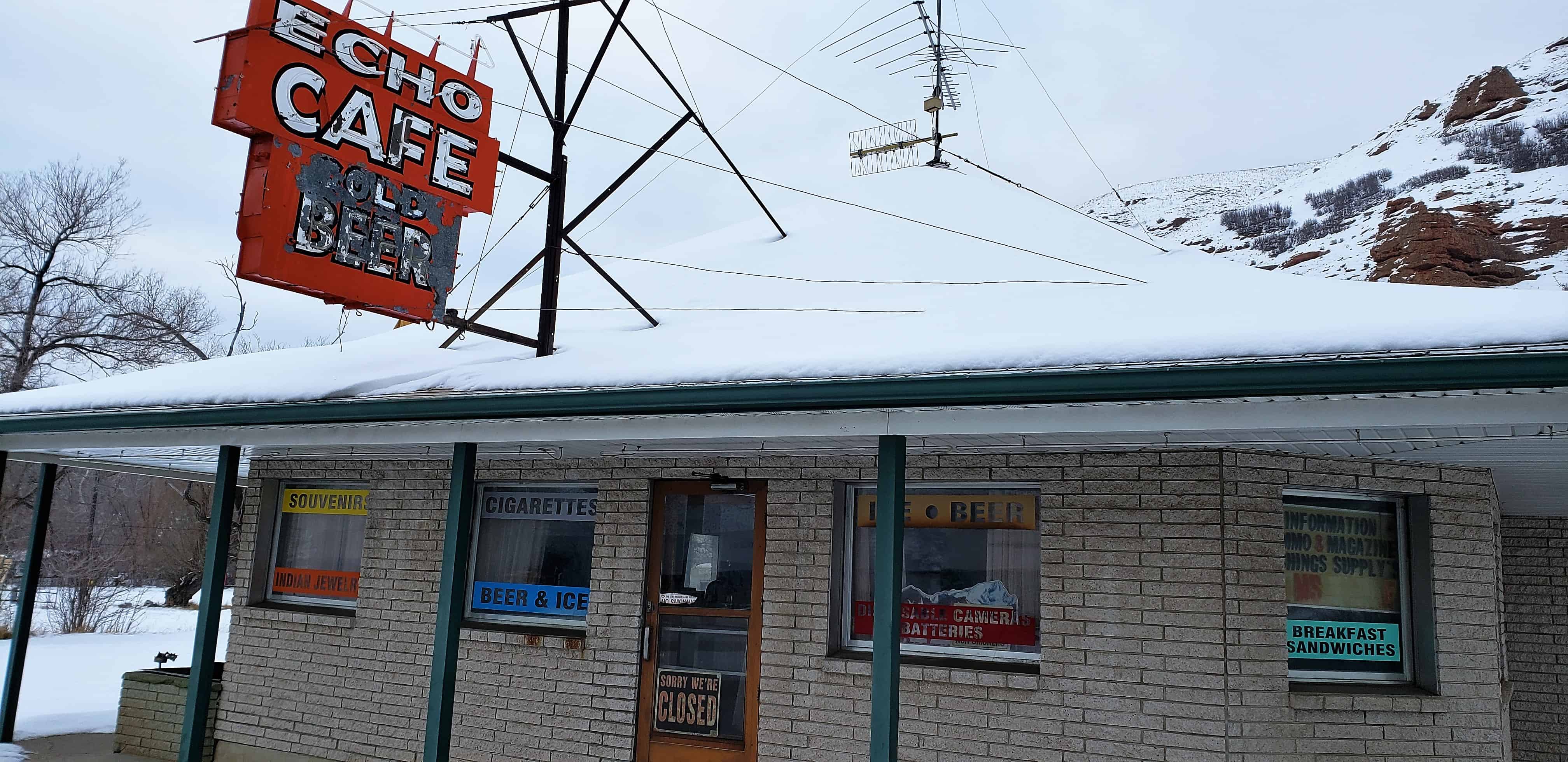
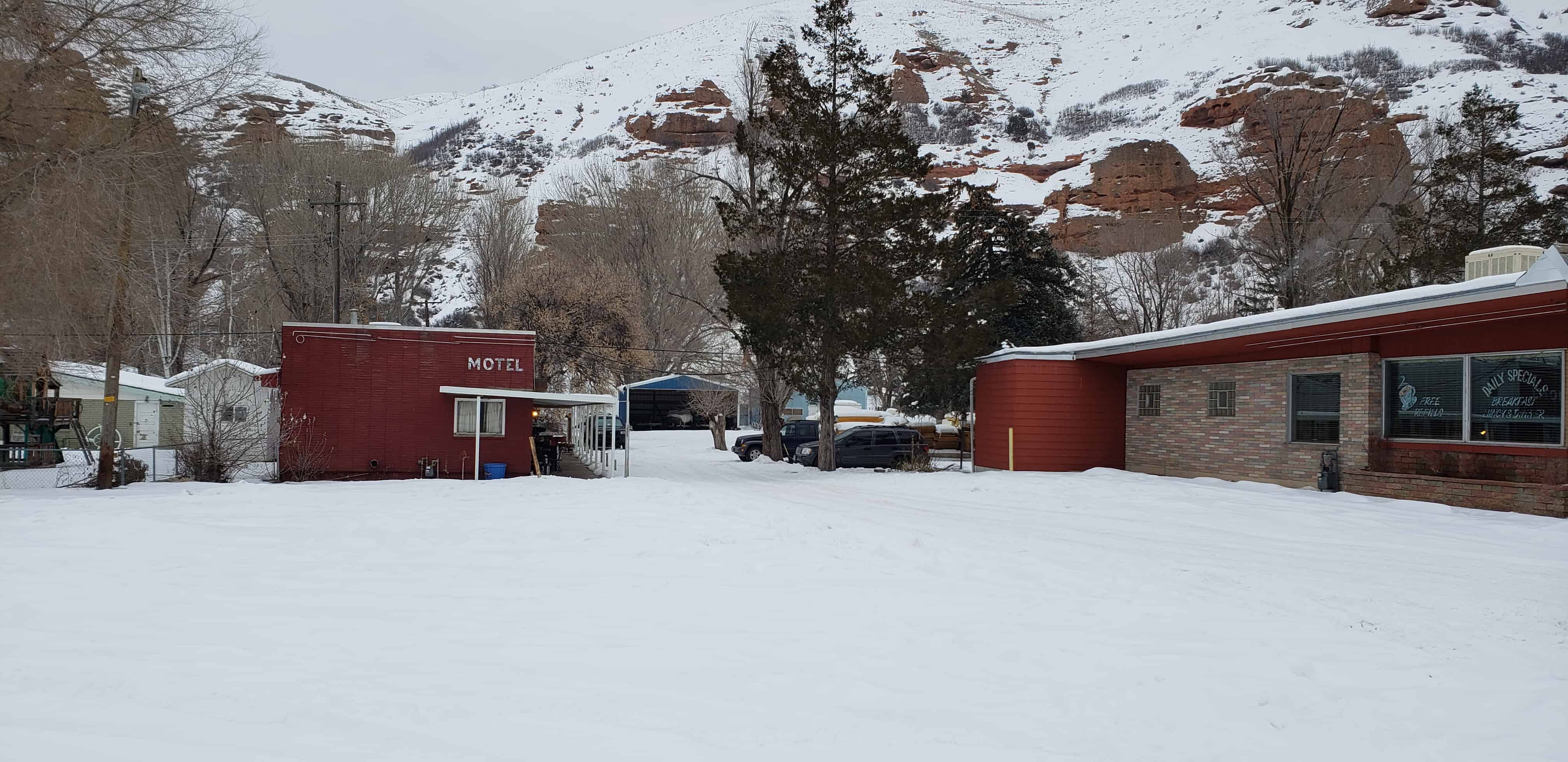
  • Echo Café
  • Echo Canyon
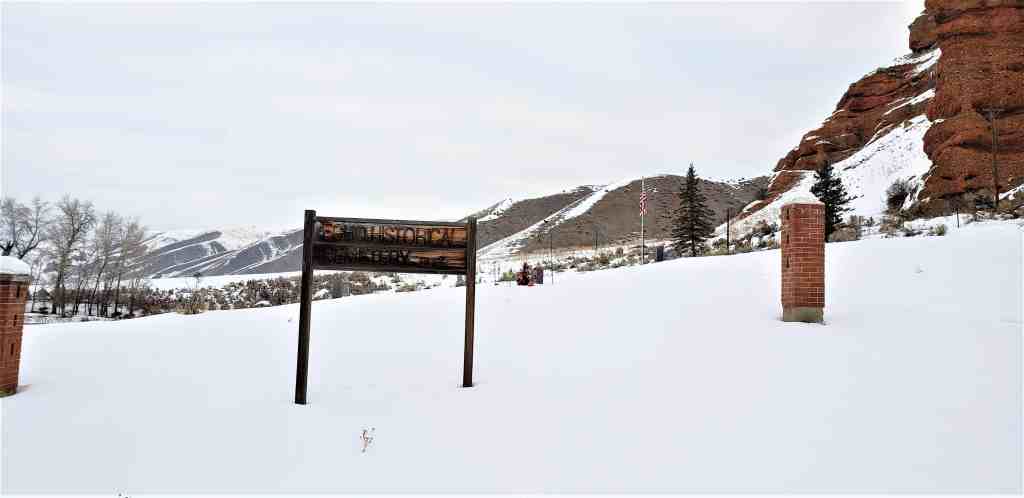
  • Echo Cemetery
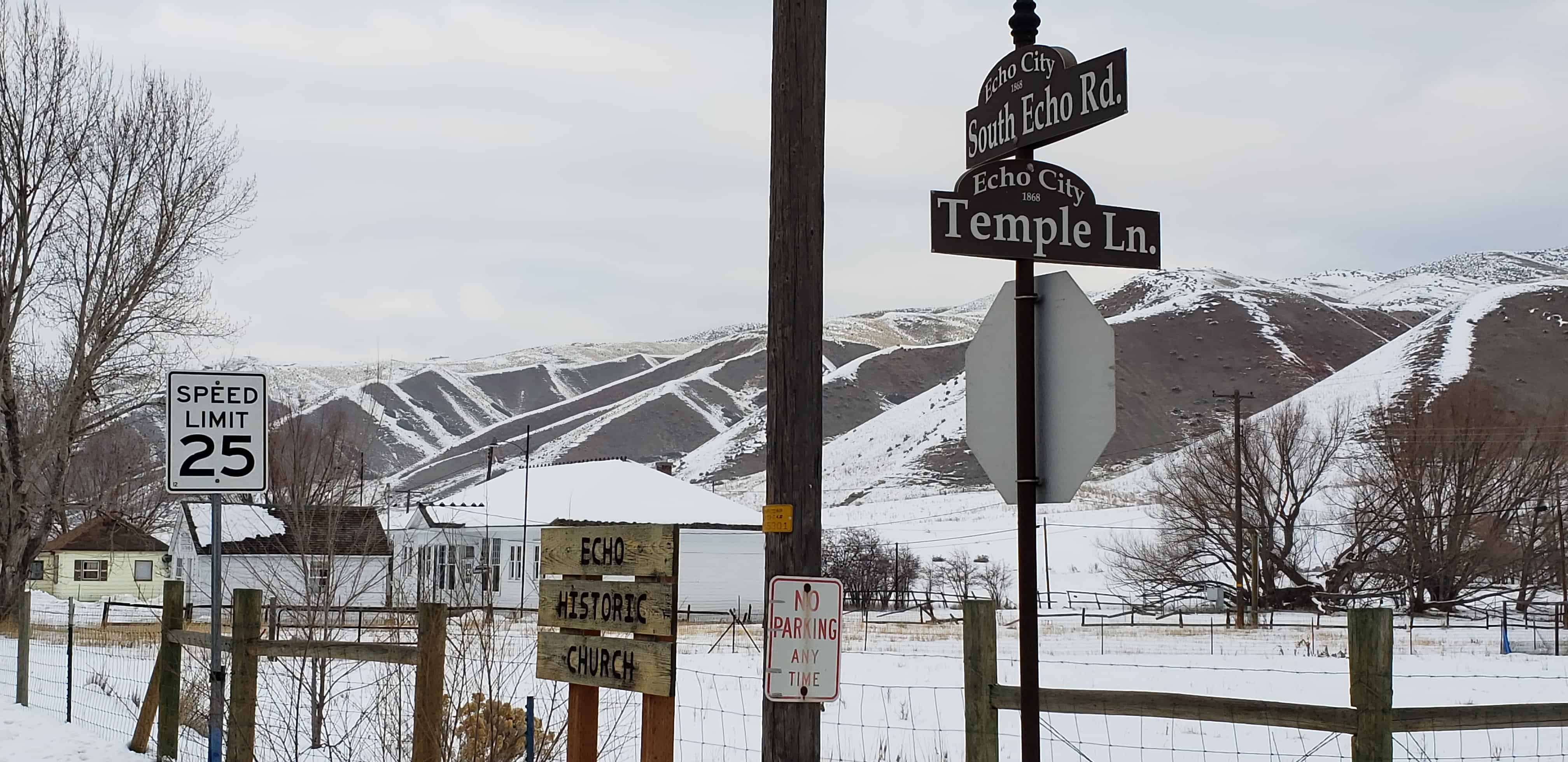
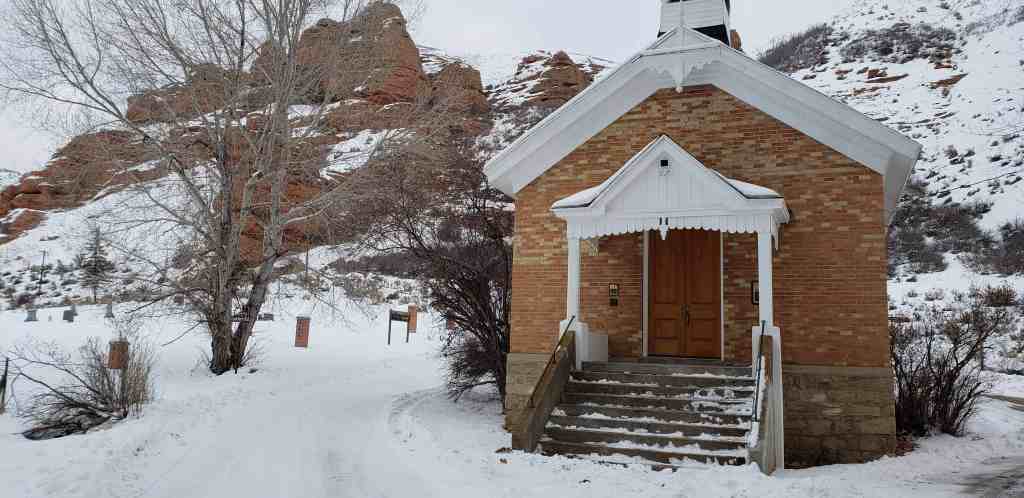
  • Echo Church and School
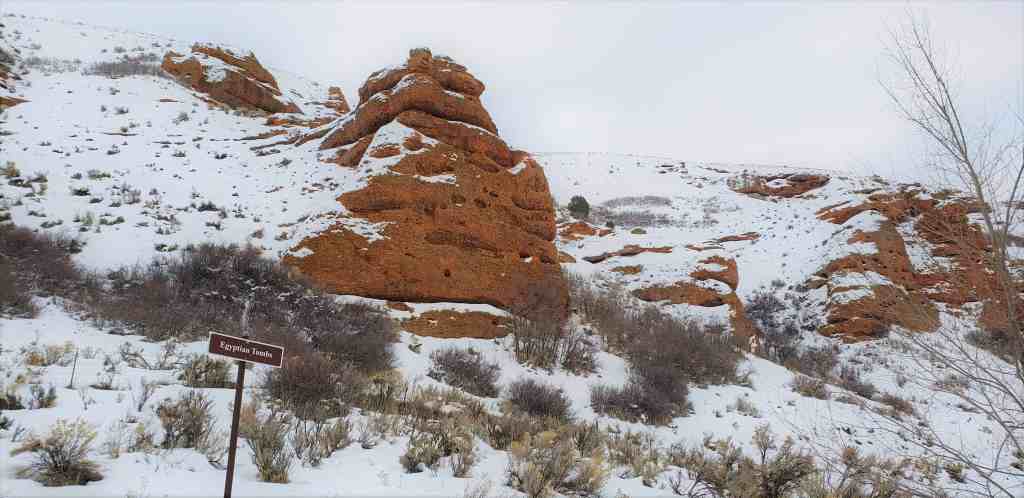
  • Egyptian Tombs
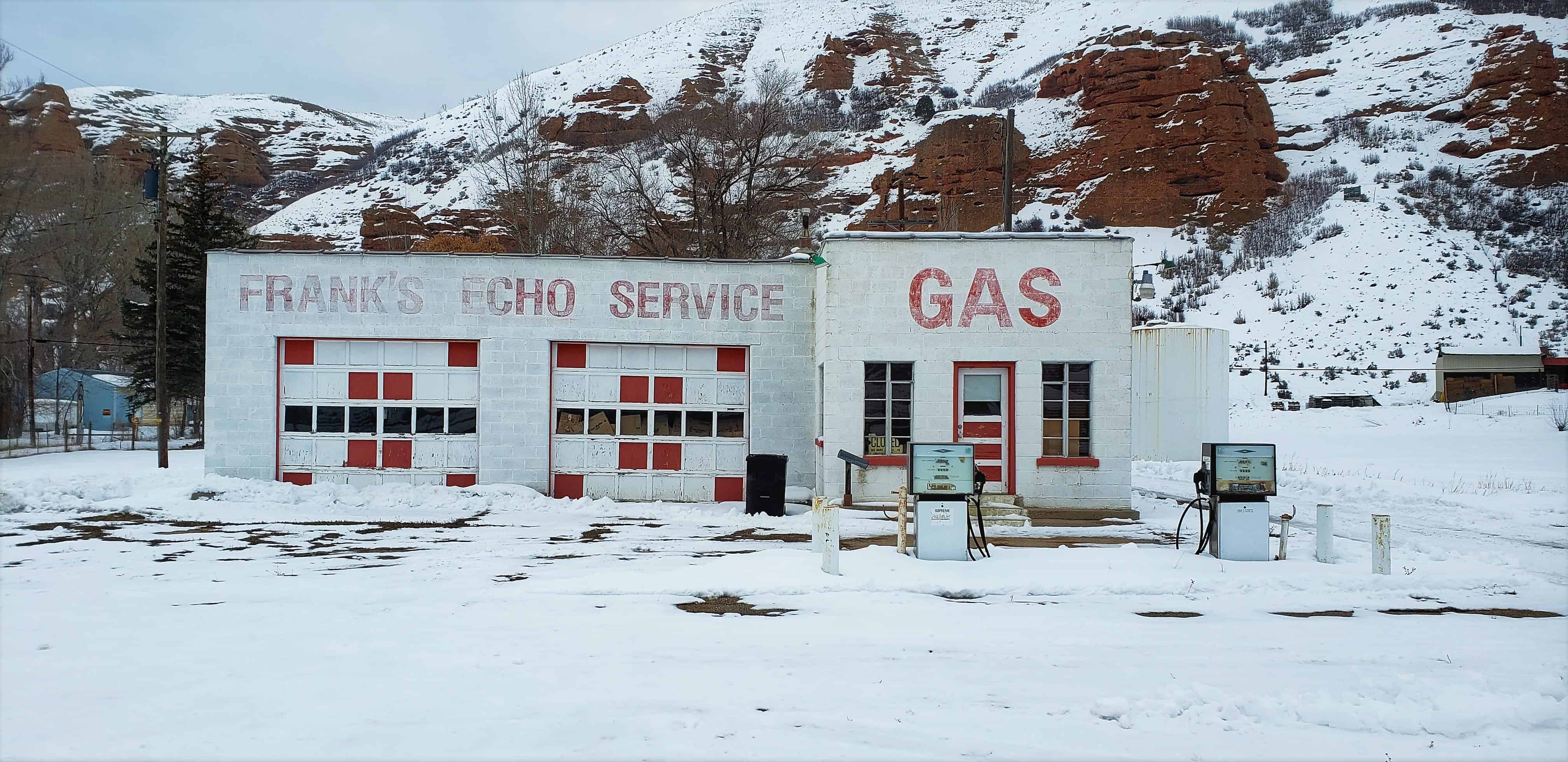
  • Frank’s Echo Service
  • Kozy Café
  • Pony Express Station – Weber
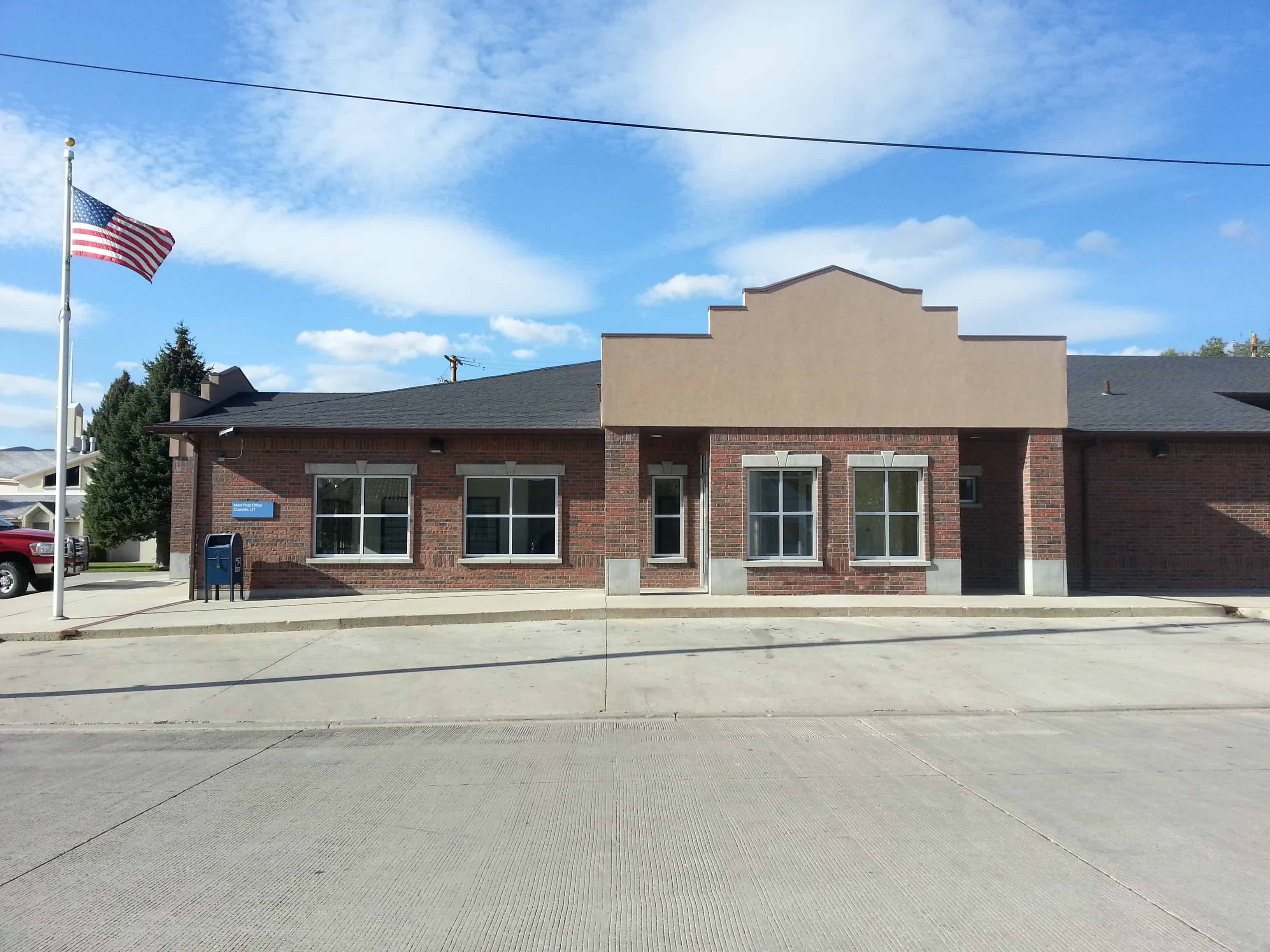
  • Post Office
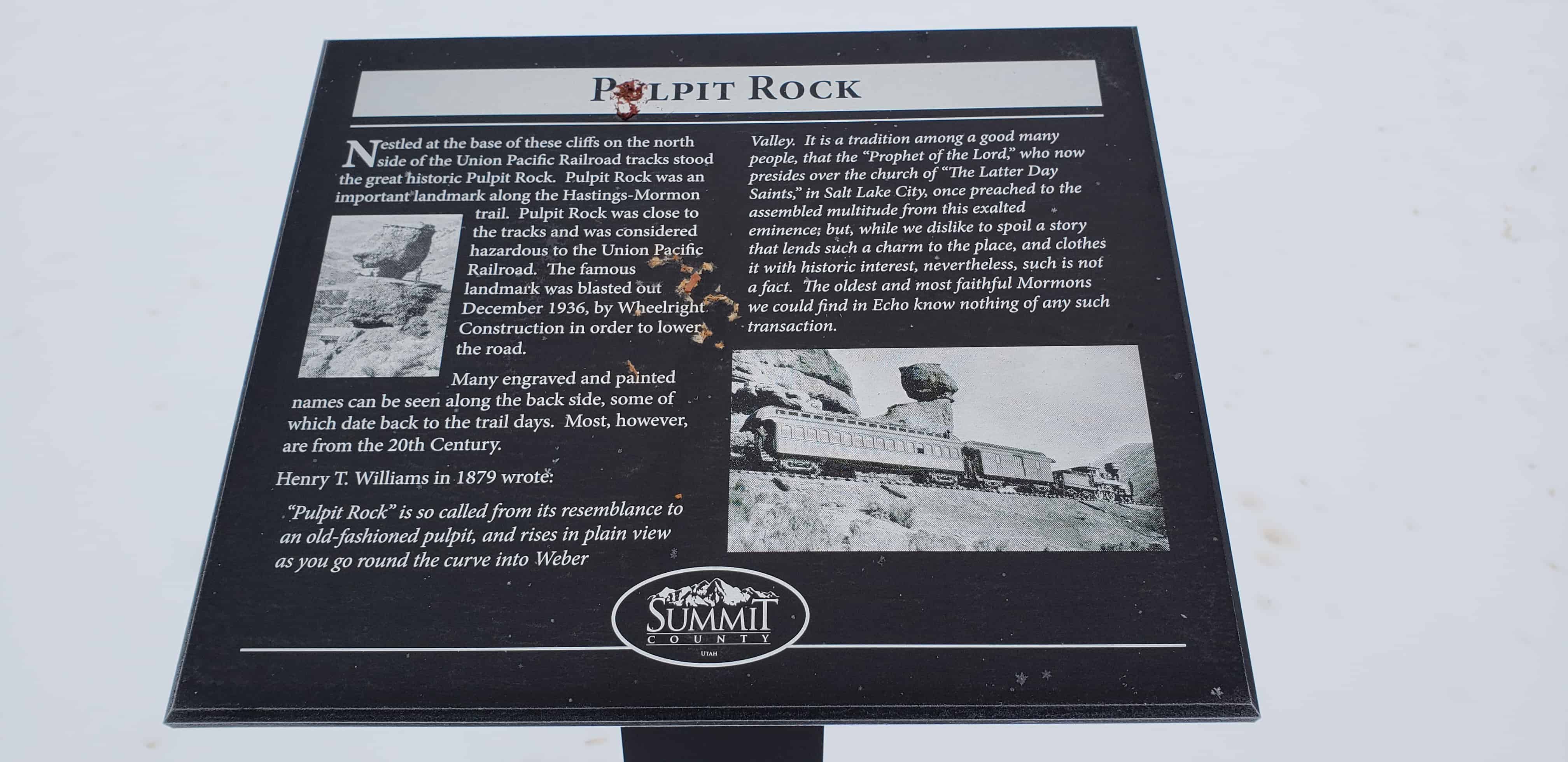
  • Pulpit Rock / Witches Cave
  • Temple Rock Amphitheater
  • Historic Markers
    • Control of Influence
    • Echo City
    • “Enterprising Young Men”
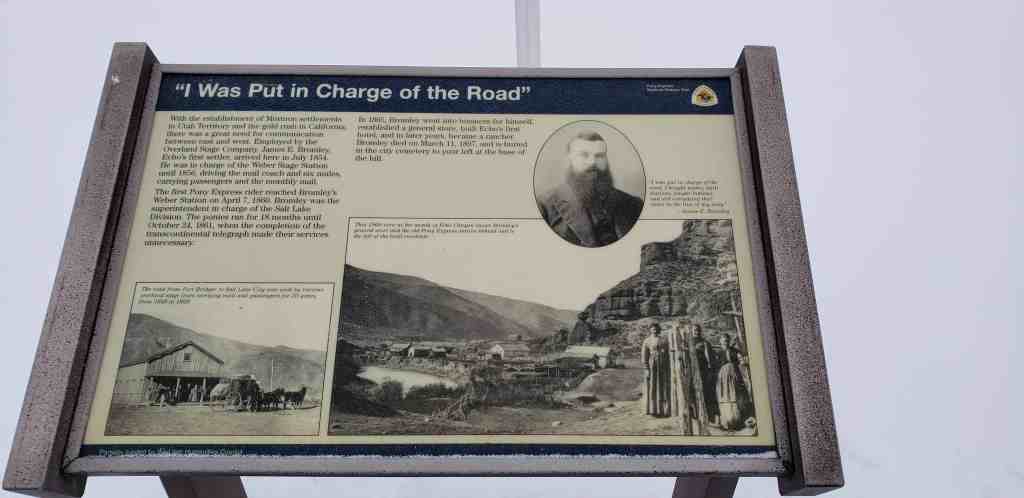
    • “I Was Put in Charge of the Road“
    • Iron Rails and Silver Dreams
    • Temple Camp and Supplication Hills
    • The Battle of the Signs
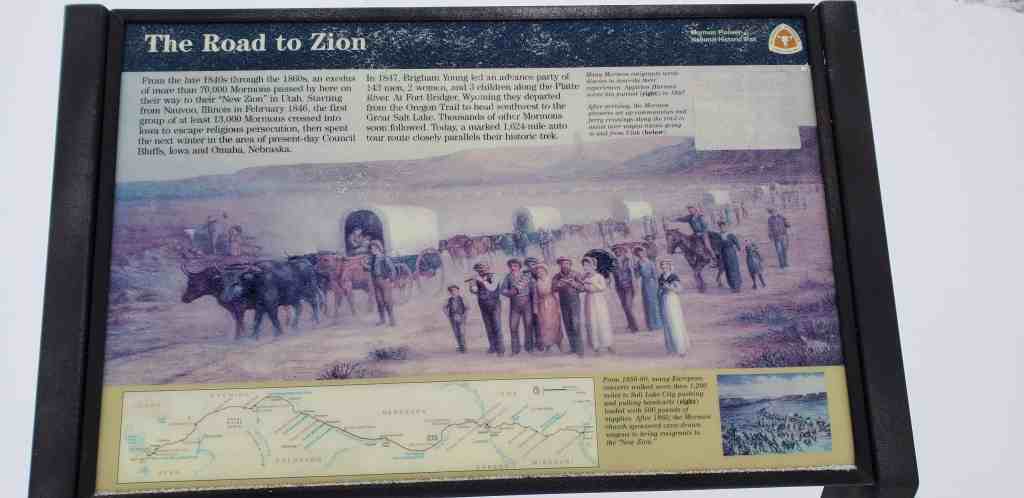
    • The Road to Zion
2019-01-11 08.32.15
2019-01-11 08.32.40
2019-01-11 08.32.54
2019-01-11 08.33.31
2019-01-11 08.33.44
2019-01-11 08.34.03
2019-01-11 08.34.17
2019-01-11 08.34.24
2019-01-11 08.34.31
2019-01-11 08.34.37
2019-01-11 08.36.55
2019-01-11 08.38.41
2019-01-11 08.38.43
2019-01-11 08.38.47
Kozy Café
2019-01-11 08.40.19
2019-01-11 08.41.18
Echo Church and School
2019-01-11 08.43.56
Egyptian Tombs
2019-01-11 08.43.59
Egyptian Tombs
2019-01-11 08.44.13
Echo Cemetery
2019-01-11 08.50.28
Post Office
2019-01-11 08.51.31
“I Was Put in Charge of the Road“
2019-01-11 08.51.35
“I Was Put in Charge of the Road“
2019-01-11 08.51.39
The Road to Zion
2019-01-11 08.51.42
“Enterprising Young Men”
2019-01-11 08.51.46
Echo City
2019-01-11 08.51.49
2019-01-11 08.51.55
20190111_083832-PANO
Kozy Café

Summit Stake Tabernacle

05 Thursday Jun 2014

Posted by Jacob Barlow in Uncategorized

≈ 1 Comment

Tags

Coalville, DUP, historic, summit county, utah

picture2aug07-038

Summit stake was organized July 9, 1877, William W. Cluff, George G. Snyder, Alma E. Eldridge, Presidency, in 1879 ground was broken for a tabernacle, Thomas L. Allen, Architect and builder. Plans approved by Truman O. Angell, church Architect. Cornerstone laid by Franklin D. Richards August 7, 1879. Built of native lumber and Oregon red pine, secured with 1/2 inch bolts, and 600,000 bricks made in Coalville. About 1886 a gallery was added, three gothic stained glass windows, and pictures of church leaders painted on ceiling by C. M. Olsen. Original cost $55,000. Dedicated May 14, 1899, by Pres. Lorenzo Snow. General L.D.S. conference held in tabernacle October 6, 1886.

Related posts:

  • DUP Markers
  • Coalville

Demolition:

After serving the Summit Stake and greater Coalville community for over 70 years, church administrators went through with plans to demolish the tabernacle. The building was listed on the Utah State Register of Historic Sites in 1970 and the National Register of Historic Places in 1971 shortly before demolition as attempts to preserve the building. There were other attempts to preserve the building, including a group of residents that tried to place a restraining order on the church, which garnered much media attention, including reports from the New York Times. However, two days after a judge struck down the restraining order, and amidst much controversy, church leaders removed some historically significant items from the tabernacle before bulldozers arrived. On March 5, 1971, the building was razed.

Summit_Stake_House

Old Rock School House

21 Wednesday May 2014

Posted by Jacob Barlow in Uncategorized

≈ 1 Comment

Tags

Coalville, DUP, historic, summit county, utah

picture2aug07-039

First Public building in Summit County, built in 1865. Originally used as county building, meeting house and amusement hall, later as school house. Dedicated by President Brigham Young in the fall of 1868. Summit Stake was organized in this building July 9, 1877 with W.W. Cluff as President, George Snyder first and Alma Eldredge second counselors. The building had a belfry and large bell that was used for alarm and curfew. The bell was last rung on the morning that the World War armistice was signed, November 11, 1918.

picture2aug07-037

Check out all of the historic markers placed by the Daughters of Utah Pioneers at JacobBarlow.com/dup

Follow Jacob

Follow Jacob

Blog Stats

  • 2,035,969 hits

Social and Other Links

BarlowLinks.com

Recent Posts

  • Grain Reaper
  • Early Pioneer Granary and Home
  • Dixie Sorghum (Molasses) Mill
  • This is the Place State Park
  • Eyes Westward

Archives


Loading Comments...