• About JacobBarlow.com
  • Cemeteries in Utah
  • D.U.P. Markers
  • Doors
  • Exploring Utah Email List
  • Geocaching
  • Historic Marker Map
  • Links
  • Movie/TV Show Filming Locations
  • Oldest in Utah
  • Other Travels
  • Photos Then and Now
  • S.U.P. Markers
  • U.P.T.L.A. Markers
  • Utah Cities and Places.
  • Utah Homes for Sale
  • Utah Treasure Hunt

JacobBarlow.com

~ Exploring with Jacob Barlow

JacobBarlow.com

Tag Archives: Garfield County

Boulder Elementary School

31 Saturday Jan 2026

Posted by Jacob Barlow in Uncategorized

≈ Leave a comment

Tags

Boulder, City Hall Buildings, Garfield County, New Deal Funded, NRHP, PWA Moderne, PWA Projects, Schools, utah

Boulder Elementary School

Built in 1935-36, the Boulder Elementary School is part of the Public o Works Buildings Thematic Resources nomination and is significant because it w helps document the impact of New Deal programs in Utah, which was one of the states that the Great Depression of the 1930s most severely affected. In 1933 Utah had an unemployment rate of 36 percent, the fourth highest in the country, and for the period 1932-1940 Utah’s unemployment rate averaged 25 percent. Because the depression hit Utah so hard, federal programs were extensive in the state. Overall, per capita federal spending in Utah during the 1930s was 9th among the 48 states, and the percentage of workers on federal work projects was far above the national average. Building programs were of great importance. During the 1930s virtually every public building constructed in Utah, including county courthouses, city halls, fire stations, national guard armories, public school buildings, and a variety of others, were built under federal programs by one of several agencies, including the Civil Works Administration (CWA), the Federal Emergency Relief Administration (FERA), the National Youth Administration (NYA), the Works Progress Administration (WPA), or the Public Works Administration (PWA), and almost without exception none of the buildings would have been built when they were without the assistance of the federal government.

Boulder Elementary School is located in 351 North 100 East in Boulder, Utah and was added to the National Register of Historic Places (#85000805) on April 1, 1985.

  • New Deal Projects in Utah

The Boulder Elementary School is one of 233 public works buildings identified in Utah that were built during the 1930s and early 1940s. Only 130 of the 233 buildings are known to remain today and retain their historic integrity. Of the 233, 107 were public school buildings and 55 of them remain. This is one of 43 elementary schools built, 19 of which remain. In Garfield County 7 buildings were constructed; 5 are left. The Boulder Elementary School was built in 1935 and 1936. Construction began in September of 1935 and was completed in the early spring of 1936. It was a Works Progress Administration (WPA) project. Superintendent of construction was Arthur McNelly of Escalante.

This is a one-story frame school building displaying the blending of classical and moderne elements that characterizes the PWA-sponsored architecture in Utah. It has a hipped roof over a basic rectangular plan. There is a projecting gabled porch on the front that contains a recessed entrance and small flanking windows. A long hipped roof extension on the rear appears to be original. The siding consists of narrow, 4″ clapboards and there is a plain cornice and frieze under the overhanging eaves. Classical motifs dominate the front entrance porch in the form of cornice returns, a pedimented head over the recessed doorway, and a transom above the door itself. The formality of the porch is broken by a zig-zag belt course that circles the building and gives it a sense of the abstract geometric quality associated with the moderne movement. The building remains in excellent original condition.

Pole Hollow Archeological Site

31 Saturday Jan 2026

Posted by Jacob Barlow in Uncategorized

≈ Leave a comment

Tags

Garfield County, NRHP

Pole Hollow Archeological Site

Pole Hollow Archeological Site is located in Garfield County, Utah and was added to the National Register of Historic Places (#81000581) on July 16, 1981.

Starr Ranch

19 Monday Aug 2024

Posted by Jacob Barlow in Uncategorized

≈ Leave a comment

Tags

Garfield County, NRHP, Ranches, utah

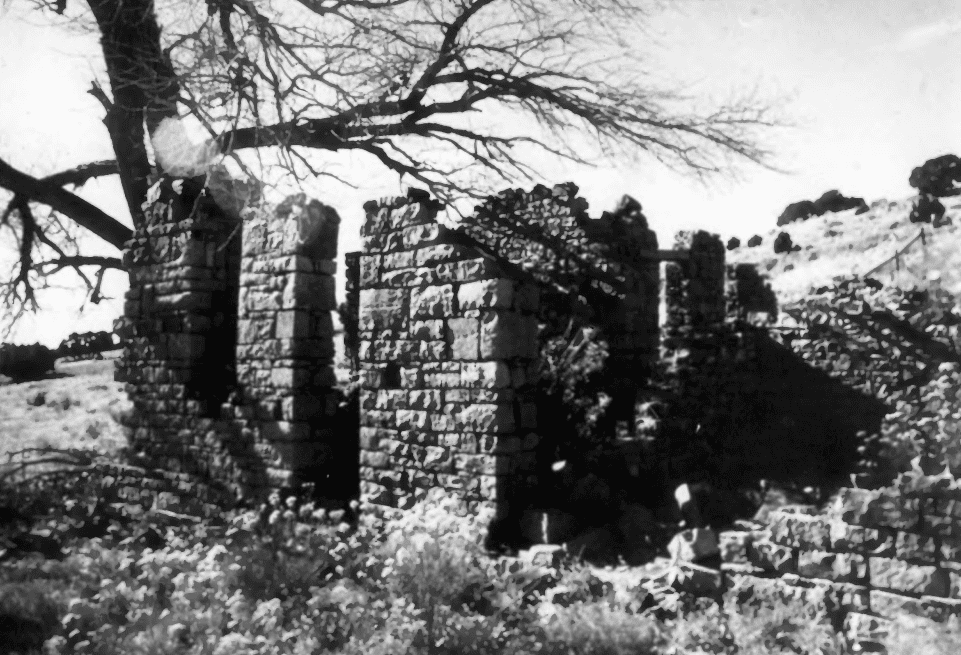
Al Starr entered the Henry Mountains as an early prospector in the 1880’s He started a mine on Mt. Killer which he worked a few years. Evidently the mine was not a paying operation and in 1890 he settled at Starr’s Spring to start a cattle operation. This operation too succumbed to economic disaster and by 1900 the ranch was abandoned.

The significance of the site lies not in its role in history, but in the unique form of construction of the ranch house and smoke house. As mentioned, it is now a scenic attraction at Starr Springs Campground.

The site is of local significance since Al Starr was not a major figure head in the early settlement of the Henry Mountains or the West.

Local legend has it that the ranch was often visited by Butch Cassidy and his cohorts.

A short lived venture, Starr Ranch failed probably because of overgrazing. Today, the region’s primary economic base is ranching, and the Starr Ranch represents an early effort at this occupation in the south end of the Henry Mountains,

Of unusual construction for the area, the ranch house, was built of dressed granite (diorite) and chinked with mud. Much time and care was taken in the construction of the building in relation to its relatively short use span.

The smoke house, too, is uniquely built. A dugout, its only visible support is the earthen sides of the structure, and its arched roof. The only wooden posts found in the building are two pole stringers used as meat drying racks.

Starr Ranch is located in Garfield County and was added to the National Register of Historic Places (#76001816) on April 23, 1976.

The site represents the first permanent ranch in the southern end of the Henry Mountain in 1890. The site consists of a ranch house and smoke house. The smoke house appears to have been the residence while construction of the house was taking place. The roof of this subterranean structure was made of fitted granite rocks in an arched form of construction. There is no internal or external form of support for this roof. No mortar was used in construction of either the smoke house or the ranch house. The ranch house was also constructed of closely fitting granite rocks with soil used for sealing of the rock walls. The walls were about two feet thick.

The site is now protected by a fence. Vandalism is evident on the main ranch house, with many of the interesting sculptured window sills removed. The smoke house is still intact.

The terrain is rolling hills to flats, near a large spring which bears Starr’s name, The surrounding area is now a developed recreation area and is one of the points of interest in the southern end of the mountains.

The buildings have been altered by deterioration and vandalism

Mount Hillers

31 Sunday Mar 2024

Posted by Jacob Barlow in Uncategorized

≈ Leave a comment

Tags

Garfield County, utah

Mount Hillers

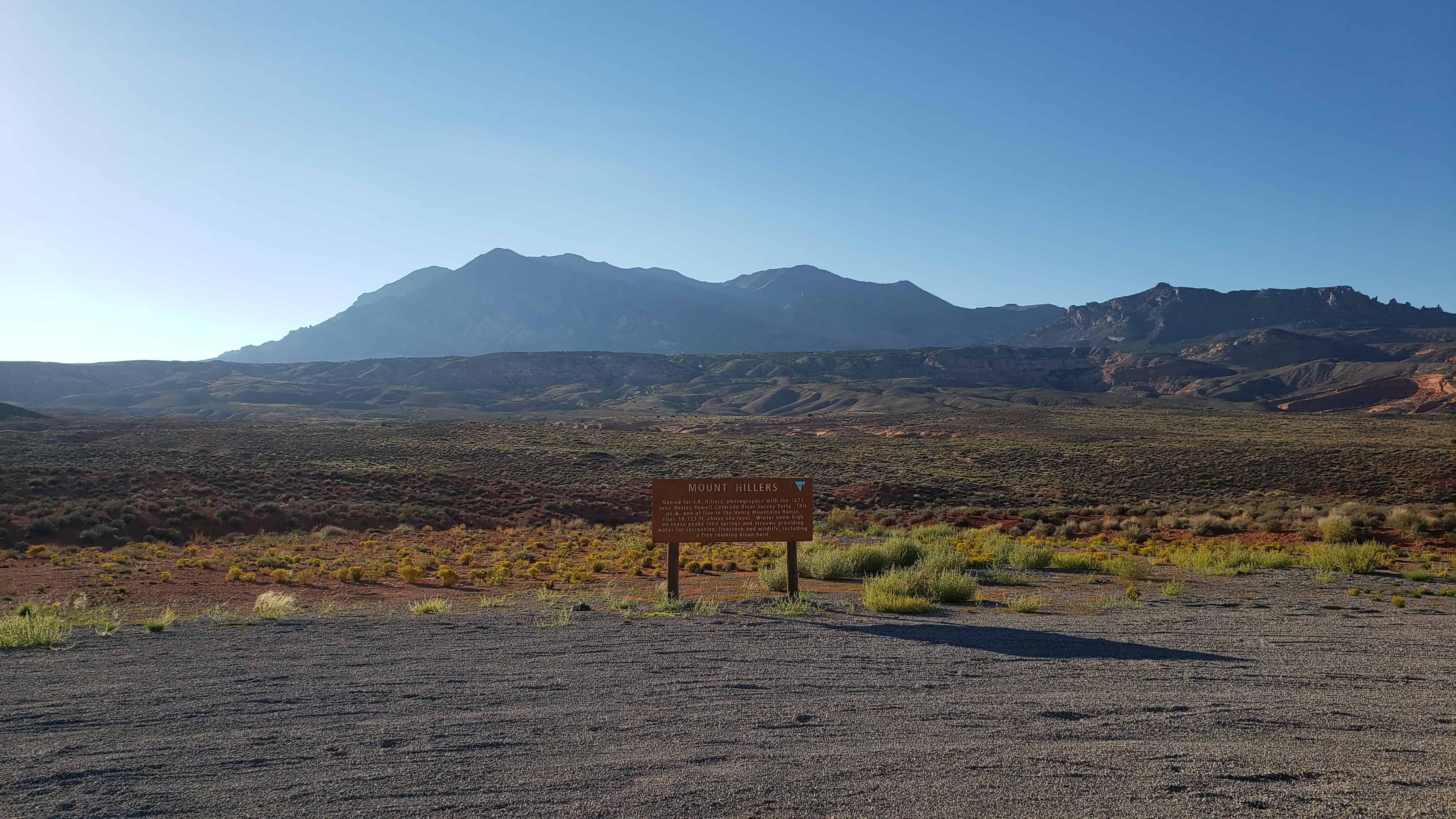
Named for J.K. Hillers, photographer with the 1871 John Wesley Powell Colorado River Survey Party. This peak, one of five in the Henry Mountains Range, rises 10,723 ft. above sea level. Winter snow high on these peaks feed springs and streams providing water for recreation, livestock and wildlife, including a free roaming bison herd.

The information sign at the highway pull out is located at N 37.85053 W 110.57930.

Coombs Village Site

13 Wednesday Mar 2024

Posted by Jacob Barlow in Uncategorized

≈ Leave a comment

Tags

Garfield County, NRHP, utah

Coombs Village Site

The Coombs Site appears to have been the largest settlement along the southern slopes of the Aquarius Plateau; as such, it must have exerted considerable influence on peoples residing in its immediate environs. Large open sites are not common in this area or In the adjacent areas which have been subject to investigations (e.g., the Kaiparowits Plateau, the Escalante River drainage, the triangle area between the San Juan and Colorado Rivers, and the right bank tributaries of the Colorado). Excavated sites simply do not approach the Coombs Site in complexity of architectural form, wealth of artifacts, amount of refuse, or sheer size.

The Coombs Village Site is part of Anasazi State Park Museum at 460 North Highway 12 in Boulder, Utah and was listed on the National Historic Register on (#76001815) on January 1, 1976

The analysis of the large quantity of data recovered during excavation of the site is extremely significant, in that it shed considerable light on our understanding of various aspects of prehistoric lifeways, and the relationship of various groups over a wide geographic region. On the basis of pottery analysis, the site is believed to have been occupied for a relatively short period of time from A.D, 1075 to perhaps 1150, by a population of approximately 200 people.

The village is believed to have been established by people from the San Juan drainage to the southeast. The ceramic assemblage from the site is strongly affiliated with the Kayenta region. However, based on the amount of Fremont ceramics, there was also considerable contact with Fremont populations. There is also evidence for contact with the Virgin, Mesa Verde, and Chaco areas, based on ceramic as well as other kinds of evidence.

The reason for the abandonment of the site after a short period of time is not known. Ultimate cause may be associated with fire. It is postulated that a major holocaust spread through the village at its termination. “Whether it was a result of conflict, accident or intentional action we cannot state, although the latter seems most probable. The town was never reoccupied. The Coombs site is but one more example of the burning of Anasazi villages in the San Juan. Morris (1939, 41-2) has written of the great frequency of burning in archeological sites in the La Plata area.” (Lister and Lister 1961I:I0).

The Coombs Site (42GA34) is a 12* century Ancestral Puebloan (Anasazi) habitation site located at Anasazi State Park Museum in Boulder, Utah. Cumulatively, excavations over the past half-century have yielded approximately 162,000 artifacts distributed across nearly 100 room structures. Dendrochronological data indicate that the site was constructed at latest by about A.D. 1160 (Marwitt and Fry 1973) and was occupied until approximately AD 1235.

Three types of architecture have been identified at this site: jacal, Kayenta masonry, and pit structures (Lister and Lister 1961). hi addition, one example of a four-post roofed shade, or ramada, was identified on the southern slope of the site (Lister 1960). A minimum of two distinct pueblo units, one L-shaped and one U-shaped, were also identified. These consist of both habitation and storage units, while additional isolated habitation and storage units are scattered across the site. In addition, ten pit structures have been excavated on the southern slope of the site. Features within the pithouses suggest they were likely used for habitation rather than ceremony, thus the reference to them as pithouses rather than kivas (Lister and Lister 1961). To date, no confirmed kivas have been identified at the Coombs Site.

Estimates suggest that although the major structures have been identified, only about 50 percent of the site has been investigated. In fact, outlines of unexcavated rooms are visible across the site. Excavations conducted since the Park opened in 1970 have modified our interpretation of the site structure and future excavations will undoubtedly modify it further. A full re-recording of the site is currently in progress.

Based on architectural forms, artifact types, and the ceramic assemblage retrieved from the site, the original interpretation of the site places it firmly within the Kayenta branch of the Anasazi (Lister 1959; Lister, Ambler, and Lister 1960; Lister and Lister 1961). The presence of intrusive ceramic wares, as demonstrated by design elements and temper type, indicate contact with neighboring Virgin Anasazi and Fremont peoples (Lister and Lister 1961). A small percentage of Mesa Verdean ceramics also suggests contact or trade with that distant center (Lister and Lister 1961).

In 1889, Sam Sheffield established a homestead just southeast of the prehistoric village and before long discovered the “Indian Mound” (LeFevre 1973). From the pottery, projectile points, and grinding stones he found on the surface, Sheffield believed the site to be a burial ground of a more ancient group than those he had previously encountered in Utah.

The site attracted little attention from the early residents of Boulder, although they sometimes collected “arrow heads” and other stone tools, metates, manos, and pottery sherds. As Boulder developed, so did construction activities and the resulting knowledge of the presence of an “Indian Mound.” Morss (1931) reported that some burials had been uncovered when the southern slope of the site was being used as a “sand pit.” Lister (1959) indicates that widening of a road along the base of the hill exposed additional burials and cultural material, thus stimulating local pot hunting activities at the site. Despite these non-archaeological collecting activities, the majority of the site deposits remained relatively undisturbed.

Professional archaeological investigations at the Coombs Site were initiated in 1927 when members of the Claflin-Emerson Expedition of the Peabody Museum visited the site (Morss 1931). Although primarily a reconnaissance program, the Expedition prompted Peabody Museum personnel to initiate a program of survey and excavation a year later (Gunnerson 1969). Directing work in this geographic area was archaeologist Noel Morss, who tested the Coombs Site in 1928 and reported his findings in 1931. Morss (1931) identified the remnants of several masonry rooms at the top of the hill, and described the finding of three burials in a sandy drift along the southern slope of the site. Morss reported that the burials were in a flexed position and all skulls were occipitally deformed. He also described mortuary offerings found with the remains, primarily ceramic vessels (Morss 1931).

In addition to the vessels from the burials, Morss collected a sample of sherds for analytical purposes. The vast majority of pottery was corrugated, followed by black-on-white, red ware, polychrome, and plain gray sherds. He identified the pottery as “Proto-Kayenta,” or what is now called Tusayan ware, concluding that pueblo peoples occupied the Coombs Site, whose material culture resembled that of the Kayenta peoples in northern Arizona. Morss also noted that the material remains at Coombs differed from those of the Fremont culture to the north.

LeFevre (1973) indicated that a “Dr. Kerr, a Utah professor,” also conducted a small excavation in 1928 with the assistance of local residents. LeFevre reports that a skeleton was exhumed and put on display at the University of Utah.

In 1955, the Coombs Site was examined and recorded by James H. Gunnerson as part of a reconnaissance conducted by the Utah Statewide Archaeological Survey for the Department of Anthropology of the University of Utah. Because Gunnerson’s primary research concern at that time was the Fremont culture, little was said about the site except to note that the artifacts from the site did not resemble those of the Fremont. Gunnerson recommended that no further work be conducted at the site (Gunnerson 1955).

Despite Gunnerson’s recommendation, extensive excavations would begin three years later as an adjunct to the 1957 Upper Colorado River Basin Archaeological Salvage Project. Participants in the project failed to locate any sites in the Glen Canyon area that would compare with the Coombs Site either in size or in volume of cultural remains. Additional importance was assigned the site because of its intermediate position between the Anasazi in the south and the Fremont to the north (Lister 1959). The 1958 excavation succeeded in uncovering three distinct structures, a borrow pit, three burials, and thousands of artifacts. The excavations verified the importance of the site to the prehistory of the area. Subsequently, plans were formulated-even before the 1958 excavation was completed-to return during the summer of 1959 to continue investigations (Lister et al. 1960).

The 1959 season revealed a much larger portion of the site than had been exposed in 1958. Excavations continued in those areas explored in 1958 and expanded into other portions of the site. Twelve additional exploratory trenches were opened, which identified 12 surface structures, 10 pit houses, 11 burials, and several miscellaneous structures. As with the 1958 excavation, thousands of artifacts were recovered and analyzed (Lister, Ambler, and Lister 1960).

Following the 1959 season, all structures were covered with plastic and backfilled in anticipation of including the site in the Utah State Park system. The results of the University of Utah excavations have been published in three volumes that comprise the original Coombs Site Report (Lister 1959; Lister et al. 1960; Lister and Lister 1961). In all, the University of Utah excavations identified 77 masonry or jacal rooms, 10 pit houses, one ramada, and 14 burials.

The site was designated a State Park in 1960 after the State, the town of Boulder, and Garfield County purchased the private lands containing the ruins. Prior to the construction of the Visitors Center, the University of Utah conducted a magnetometer survey and limited test excavations in 1969 (Hammond and Marwitt 1970). As a result of these investigations, the location of the Visitors Center was moved to avoid a pit house and extramural activity areas. The visitor center opened in 1970 and the Coombs Site became the first State Park featuring archaeology and archaeological ruins. Subsequently, the site was placed in the National Register of Historic Places in 1976.

Small-scale excavations were conducted intermittently between 1970 and 2002 under the supervision of Anasazi State Park staff. These investigations, in conjunction with laboratory analyses of the collections (Morgenstein and Latady 1997; Prince et al. 1997; Roberts 1997), identified several additional structures and a number of burials. A more thorough discussion of the site history is provided in a number of sources, listed in the bibliography below.

Hole-in-the-Rock Trail

14 Wednesday Jun 2023

Posted by Jacob Barlow in Uncategorized

≈ 1 Comment

Tags

Bluff, Escalante, Garfield County, Kane County, NRHP, San Juan County, utah

Hole-in-the-Rock Trail

The Hole-in-the-Rock Trail is significant because of its importance in the Mormon exploration and settlement of Utah and the San Juan country of the southwest. The trail reflects the commitment and courage of a people who were convinced they were a part of a divinely inspired and directed mission. The Hole-in-the-Rock Trail is an important symbol of the Mormon colonization effort in the intermountain west during the last half of the nineteenth century. Although the settlement ..cane at a relatively late date in this history, the descent through the Hole-in-the-Rock and the persistence in constructing a road through one of the most rugged and isolated sections of the United States illustrates the fortitude of the American pioneer and serves as a vivid lesson to other generations of the importance of commitment and cooperation in meeting the challenges of their day.

Hole-in-the-Rock Trail is in Garfield, Kane and San Juan Counties in Utah and was added to the National Historic Register (#82004792) on August 9, 1982.

The Hole-in-the-Rock Trail is significant as one of the last remaining and best preserved pioneer trails in Utah and the United States. While almost all routes used by pioneers in Utah have evolved into major highways, the Hole-in-the-Rock Trail, except for a few sections, has not. Because of the lack of development along the trail, it has, in many places, remained unchanged. Original cribbing, cuts blasted out by the road builders, stumps of trees cut to allow passage through the cedar forests, traces across the mesas and along the valley floors, important natural landmarks and Indian ruins remain unchanged since they were described by the travelers. In a few places, parts of original wagons are found along the trail.

The construction techniques and engineering of the pioneer road which are still visible illustrate the needs and limitations of a different form of transportation than we know today.

The Hole-in-the-Rock Trail is also unique in that it was not used very much after it was constructed. Most trails and roads are significant because of the heavy use they received and the role they playsd in the history of transportation. The Hole-in-the-Rock Trail, in contrast, is important primarily for its construction.

The settlement of the San Juan region by Mormons in 1880 was a continuation of the practice initiated with the arrival of the first Mormon pioneers in Utah in 1847 and which lasted more than fifty years into the twentieth century. The colonizing effort by Mormons in the intermountain west led to the establishment of nearly four hundred communities found as far north as Canada and into Mexico on the south. While each of these settlement efforts required, in some measure, the sacrifice, commitment and pioneering ability of Utah’s first Mormon settlers, the efforts of those men and women who built and crossed the Hole-in-the-Rock Trail, loom, in retrospect, larger than any other pioneering endeavor in Utah and perhaps the entire west. As the historian of the Hole-in-the-Rock expedition, David E. Miller, noted it was truly “An Epic in the Colonization of the Great American West.”

The San Juan region was, and is still, one of the most isolated parts of the United States. The country is extremely rough and broken. The canyons of the Colorado River and San Juan River and their tributaries are usually characterized by sheer walled cliffs several hundred feet high, while the surrounding mesas, hills and washes with their bone jarring slick rock, cedar forests and sand presented their own obstacles to transportation. In addition, by 1880 the San Juan Region was the last area in Utah of occupation by a large number of Indians as the San Juan River was something of a natural meeting area for Navajos, Utes and Paiutes who occupied the region.

Given the isolation from other Mormon settlements, the closest was Escalante about two hundred miles away, the ruggedness of the country, the questionable agricultural potential of the region, the availability of more assessible virgin agricultural land in other areas, and the threat of Indian hostilities, it is understandable why the settlement of the San Juan area came in the twilight of the Mormon settlement effort. That the settlement was not delayed longer than 1880 was due to the need to cultivate better relations with the Indians, to insure Mormon control of the area thereby increasing the security of Mormon settlements to the west and providing a springboard for future Mormon settlements to the east, south and north.

Despite an avowed Church policy to feed rather than fight the Indians, as Mormon settlements pushed into southern Utah and Northern Arizona, the roving bands of Navajos and Paiutes found the flocks and herds of the Mormon settlers an easily available and irresistible booty. As David E. Miller notes:

Being well acquainted with all possible crossings of the Colorado, small parties of Indians often raided the outlying settlements, drove off stock and disappeared into secret hideouts southeast of the river, beyond the reach of their pursuers. At times this plundering assumed rather important proportions. One writer states that in 1867 a herd of soma twelve hundred stolen animals was pushed across the Colorado at the Crossing of the Fathers and that in one year more than a million dollars’ worth of horses, cattle and sheep was looted from the impoverished Utah frontier…

By the mid-1870s the San Juan area of southeastern Utah had for some time been known as a refuge for lawless men, white as well as red; it was literally an outlaw hideout, as the settlers would soon learn. A colony there would act as a buffer to absorb any possible hostilities far short of the rest of settled Utah. (Miller, Hole-in-the-Rock pp. 7-8).

Also of great concern to Church leaders was the occupation of all usable farm and grazing land, especially as non-Mormons threatened to acquire the land. The San Juan Region was also felt to provide a more satisfactory home for converts from the Southern states who found the winters too cold yet, according to church leaders, needed the pioneer experience to get “… a good foundation temporally and spiritually.” (John Morgan to Erastus Snow, May 9, 1978, quoted in Miller, Hole-in-the-Rock p. 6.).

Finally members of the Hole-in-the-Rock expedition were convinced that they were carrying out the work of the Lord. As one member of the expedition wrote in later years:

My purpose in this humble effort in writing about it (the Hole-in-the-Rock trek) is to convince my children and my descendants of the fact that this San Juan Mission was planned, and has been carried on thus far, by prophets of the Lord, and that the people engaged in it have been blessed and preserved by the power of the Lord according to their faith and obedience to the counsels of their leaders. No plainer case of the truth of this manifestation of the power of the lord has ever been shown in ancient or in modern times. (Kumen Jones quoted in Miller, Hole-in-the-Rock p.13)

Plans for a colonizing mission to San Juan were announced at the quarterly conference of the Parowan Stake held December 28 and 29, 1878. Although the specific location of the settlement had not been selected, people were issued calls to participate in the endeavor. For many this meant giving up comfortable homes in the older settlements of Parowan, Cedar City, Paragonah, Panguitch, and other communities. While those called were not compelled to go, many firmly believed that the call was divinely inspired and wherever church authorities directed, they would go.

In the spring of 1879 an exploring party consisting of 26 men, two women and eight children under the leader ship of Silas S. Smith, left to explore the trail to the San Juan River and select a permanent settlement location. Traveling southeast into Arizona they crossed the Colorado River at Lee’s Ferry and continued on to Moenkopi where they turned northeast and traveling through Navajo country recrossed the Utah-Arizona border and made their way to Montezuma on the San Juan River. Here they spent two and one half months exploring the area, building a dam, digging irrigation ditches and building a few houses before returning to the settlements for their families and equipment.

The trail from Moencopi to the San Juan River had proven very dry, and severe Indian threats led to the abandonment of this route as a practical way to the San Juan Region from the Southern Utah settlements. The exploring party returned to their homes by traveling north past the future site of Monticello and to the Old Spanish Trail at the south end of the LaSal Mountains. They followed the Old Spanish Tail west to the crossing of the Colorado River at present-day Moab, the Green River at present-day Green River, through Castle Valley, and down Salina Canyon to the Sevier Valley then south back to Parowan. In retrospect this northern route along the Spanish Trail would have been the most practical. However the circuitous route covered a distance of more than five hundred miles whereas a direct route would be less than half the distance.

To those called to settle the San Juan region, the report that a direct route from Escalante to the San Juan River had been found must have been taken as evidence of God’s help in the endeavor. During the summer of 1879 Andrew P. Schow and Reuben Collett of Escalante, in response to a request by Silas S. Smith the leader of the San Juan mission, explored east from Escalante with a two wheeled cart carrying a wagon box boat to the Colorado River. After crossing the river they returned to Parowan with a favorable report of the trail. Silas Smith, who was good friends with the men, was anxious to avoid both the southern and northern routes of the exploring expedition and on the strength of the Schow-Collett report, announced in September 1879 that the Expedition would proceed to the San Juan via the Escalante route.

Shortly after the announcement, members of the expedition began their journey to Escalante then on to Forty-Mile Spring which was the first major camp site and general point of rendezvous for the groups coming from different communities.

From Forty-Mile Spring exploring parties were sent out to reconoiter the trail east of the river. Despite negative reports of the feasibility of constructing a wagon road east of the river, Silas S. Smith was left with little choice but to push on ahead since the winter snows in the Escalante mountains blocked the return to their former homes. The decision to push on was welcomed in the camp and confident that the decision was divinely inspired a spirit of optimism and good will prevailed as the expedition began its push to the Colorado River and the descent through the Hole-in-the-Rock. This section of the trail was not without difficulty. Miller writes:

From a road builder’s point of view, the sixty-five mile region between the town of Escalante and the Colorado River at Hole-in-the-Rock grows progressively worse as one proceeds southward into the desert. The San Juan pioneers had experienced considerable difficulty on the first forty miles of the road, but the remaining fifteen miles they found several times more difficult. This country is very deceptive: What appears to be a fairly level plain, lying between the Straight Cliffs of Fifty-Mile Mountain and the Escalante River, is literally almost straight-walled gorges and canyons which head in the Kaiparowits and cut deeper and deeper as they extend eastward toward the Escalante River gorge….

From Forty-Mile Spring southward the washes, gulches, and canyons not only become progressively more numerous, but also much more difficult to cross. If the San Juan pioneers had merely succeeded in building a wagon road through that part of the country—to Fifty-Mile Spring—and then returned to the settlements, their achievement would have been outstanding. But this was really easy terrain to cross compared to what lay ahead. (Miller, Hole-in-the-Rock pp. 70-71).

By early December 1879 the expedition had arrived at the Hole-in-the-Rock where they would spend the next eight weeks on three major road building tasks: the notch itself; the road from the base of the cliffs to the Colorado River; and the dugway out of the river gorge to the east which had to be cut from the Solid Rock Wall.

Before work started down through the Hole-in-the-Rock, the cleft was nothing more than a very narrow crack—described as “…too narrow to allow passage for man or beast.” (Miller, Hole-in-the-Rock p. 101).

Because of the shortage of blasting powder and tools and the limited working space at the top of the Hole, the men were divided into three crews and work proceeded simultaneously on all three projects. Those working at the top of the Hole had to be lowered over the cliff with ropes until a suitable grade had been cut. Jens Nielson, Benjamin Perk ins and Hyrum Perk ins were in charge of the blasting. THe Perkins brothers became proficient in the use of blasting powder in the coal mines of Wales before emigrating to the United States.

The descent by wagon through the Hole required rough-locking the wheels and attaching long ropes to the wagon so that a dozen or more men could hang on and help slow the descent of the wagon. Women and children walked down through the Hole and were forced to slide down the forty feet at the top because it was so steep they could not walk. Writing to her parents Elizabeth Morris Decker gave this contemporary account of the descent to the river:

It is about a mile from the top down to the river and it is almost straight down, the cliffs on each side are five hundred ft. high and there is just room enough for a wagon to go down. It nearly scared me to death. The first wagon I saw go down they put the brake on and rough locked the hind wheels and had a big rope fastened to the wagon and about ten men holding back on it and then they went down like they would smash everything. I’ll never forget that day. When we was walking down Willie looked back and cried and asked me how we would ever get home, (quoted in Miller, Hole-in-the-Rock p. 116).

Despite the dangerous descent there was no major tragedy—no animals were killed and no wagons were tipped over or seriously damaged.

While the road was being cut through the Hole-in-the-Rock, four scouts were sent ahead to explore the rest of the trail to Montezuma. Setting out on December 17th the scouts readied the present site of Bluff December 28th. Despite an extremely difficult trek, marked by snowy cold weather and no food for the last four days, the scouts did locate the trail at the San Juan River and returned to the Expedition at the Hole-in-the-Rock with their report on January 14, 1880.

Although the descent through the Hole-in-the-Rock would symbolize the courage and commitment of the San Juan pioneers once across the Colorado River they would be tested at several other locations including Cottonwood Hill, The Chute, Clay Hill Pass, and San Juan Hill. This journey of 125 miles took over two months with much of the time spent in road construction.

The last great test was only a few miles from their final destination at San Juan Hill. Because of the sheer cliffs on Comb Ridge, the expedition was forced to follow Comb Wash to its junction with the San Juan River. With no choice but to go up onto Comb Ridge the pioneers spent several days building a road up the steep slope of San Juan Hill. The ascent up San Juan Hill seemed, in many ways, more difficult than the descent through the Hole-in-the-Rock. Charles Redd, whose father L.H. Redd was a member of the original expedition, wrote the following account of the climb up San Juan Hill:

Aside from the Hole-in-the-Rack, itself, this was the steepest crossing on the journey. Here again seven span of horses were used, so that when some of the horses were on their knees, fighting to get up to find a foothold, the still-erect horses could plunge upward against the sharp grade. On the worst slopes the men were forced to beat their jaded animals into giving all they had. After several pulls, rests, and pulls, many of the horses took to spasms and near convulsions, so exhausted were they. By the tine irost of the outfits were across, the worst stretches could easily be identified by the dried blood and matted hair from the forelegs of the struggling teams. My father (L.H. Redd, Jr) was a strong man, and reluctant to display emotion; but whenever in later years the full pathos of San Juan Hill was recalled either by himself or by someone else, the memory of such bitter struggles was too much for him and he wept. (Miller, Hole-in-the-Rock pp. 139-140).

Once on top of Comb Ridge the road, with the exception of constructing dugways into and out of Butler Wash, was relatively easy on to the San Juan River. However, the expedition stopped eighteen miles short of the intended destination of Montezuma and named the site of their new settlement Bluff.

Although he Hole-in-the-Rock Trail did not become a major highway, it was used on occasion until the Hall’s Crossing route was opened several years later. However, much of the trail, with the exception of the difficult stretch from Lake Canyon to the Hole-in-the-Rock, was used as part of the Hall’s Crossing route. Jeep expeditions and hikers still follow the trail and major commemoration activities are planned for the Centennial Anniversary of the Hole-in-the-Rock Expedition in 1980.

Hite Overlook

30 Sunday Apr 2023

Posted by Jacob Barlow in Uncategorized

≈ Leave a comment

Tags

Garfield County, Hite, utah

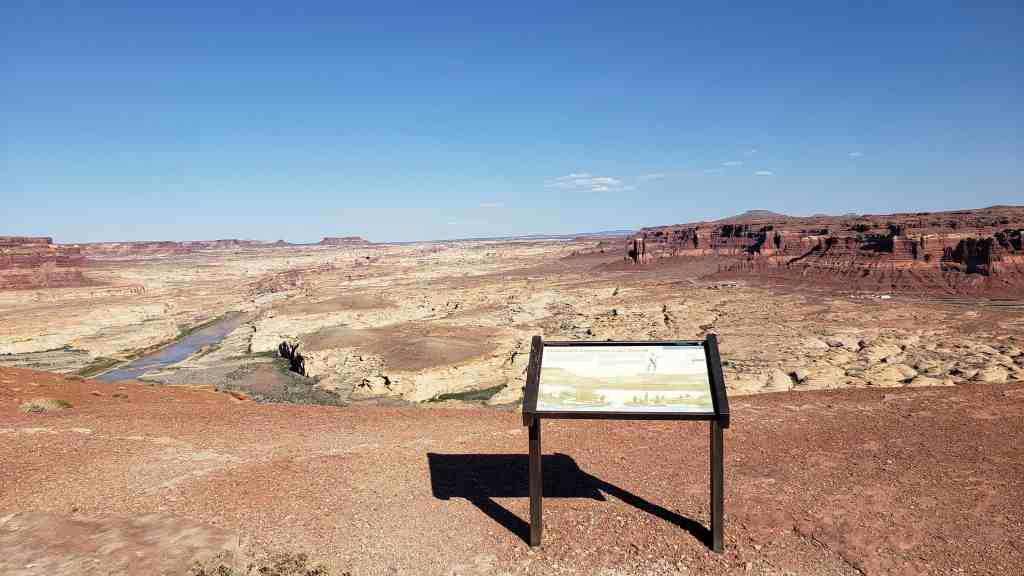
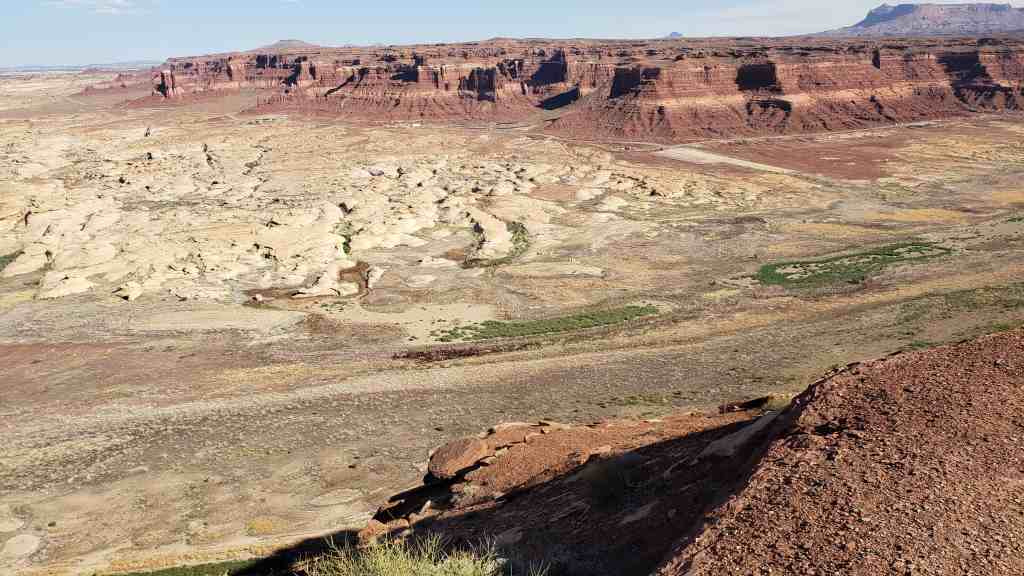
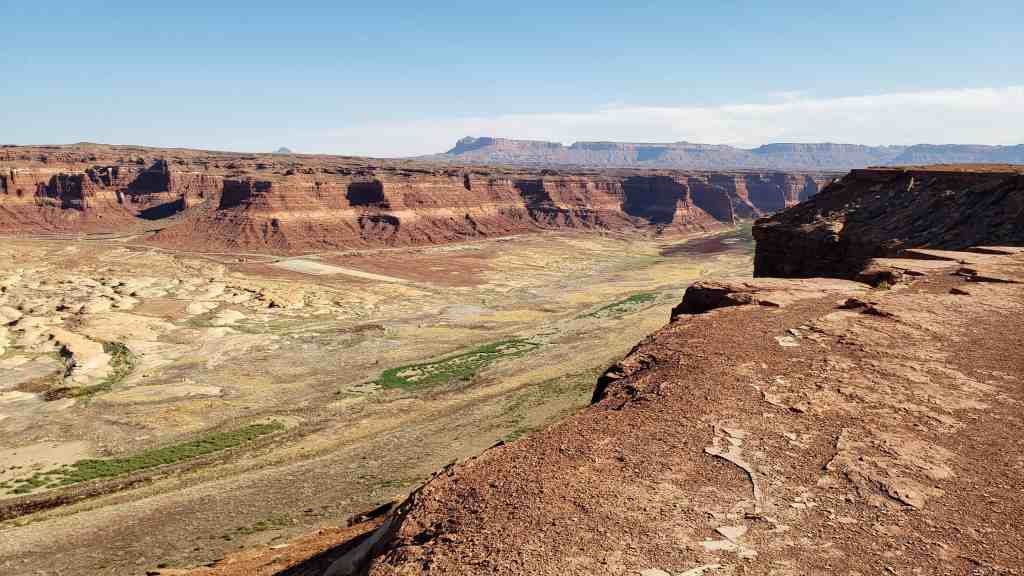
Hite Overlook, overlooking Hite, Utah and the Hite Crossing Bridge.

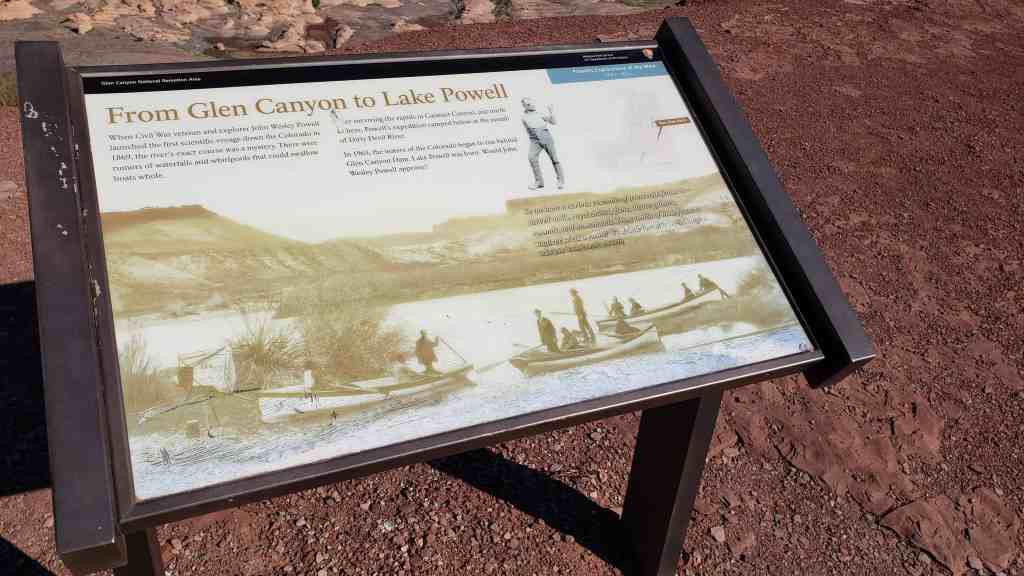
From Glen Canyon to Lake Powell

When Civil War veteran and explorer John Wesley Powell launched the first scientific voyage down the Colorado in 1869, the river’s exact course was a mystery. There were rumors of waterfalls and whirlpools that could swallow boats whole.

After surviving the rapids in Cataract Canyon, just north here, Powell’s expedition camped below at the mouth of Dirty Devil River.

In 1963, the waters of the Colorado began to rise behind Glen Canyon Dam. Lake Powell was born. Would John Wesley Powell approve?

So we have a curious ensemble of wonderful features- carved walls, royal arches, glens, alcove gulches, mounds, and monuments. From which of these features shall we select a name? We decide to call it Glen Canyon. – Major John Wesley Powell (1834-1902)

Searching For Hidden Wealth

In 1883, Navajo Chief Hoskininni led Cass Hite to the canyon below. Hite found gold. He then added to his earnings by opening a small store and post office a few miles from here. Miners provided much of the business at Hite City.

After World War II, a new wave of people rushed in. The town’s population swelled to more than 200
Locals said miners had “uranium on the cranium” as they searched for “hot” rocks.

Like so many mining booms, this one eventually went bust. Hite returned to a small-town existence. In 1964, the rising waters of Lake Powell swallowed up Hite, ending forever what dreams of hidden wealth had begun. Today, the surrounding scenery remains a treasure in full view.

Hite Crossing Bridge

30 Sunday Apr 2023

Posted by Jacob Barlow in Uncategorized

≈ Leave a comment

Tags

Bridges, Garfield County, Hite, San Juan County

Hite Crossing Bridge at Hite, Utah

Quilt Walk Park

01 Tuesday Nov 2022

Posted by Jacob Barlow in Uncategorized

≈ Leave a comment

Tags

Garfield County, Panguitch, Parks, utah

The Panguitch Quilt Walk History

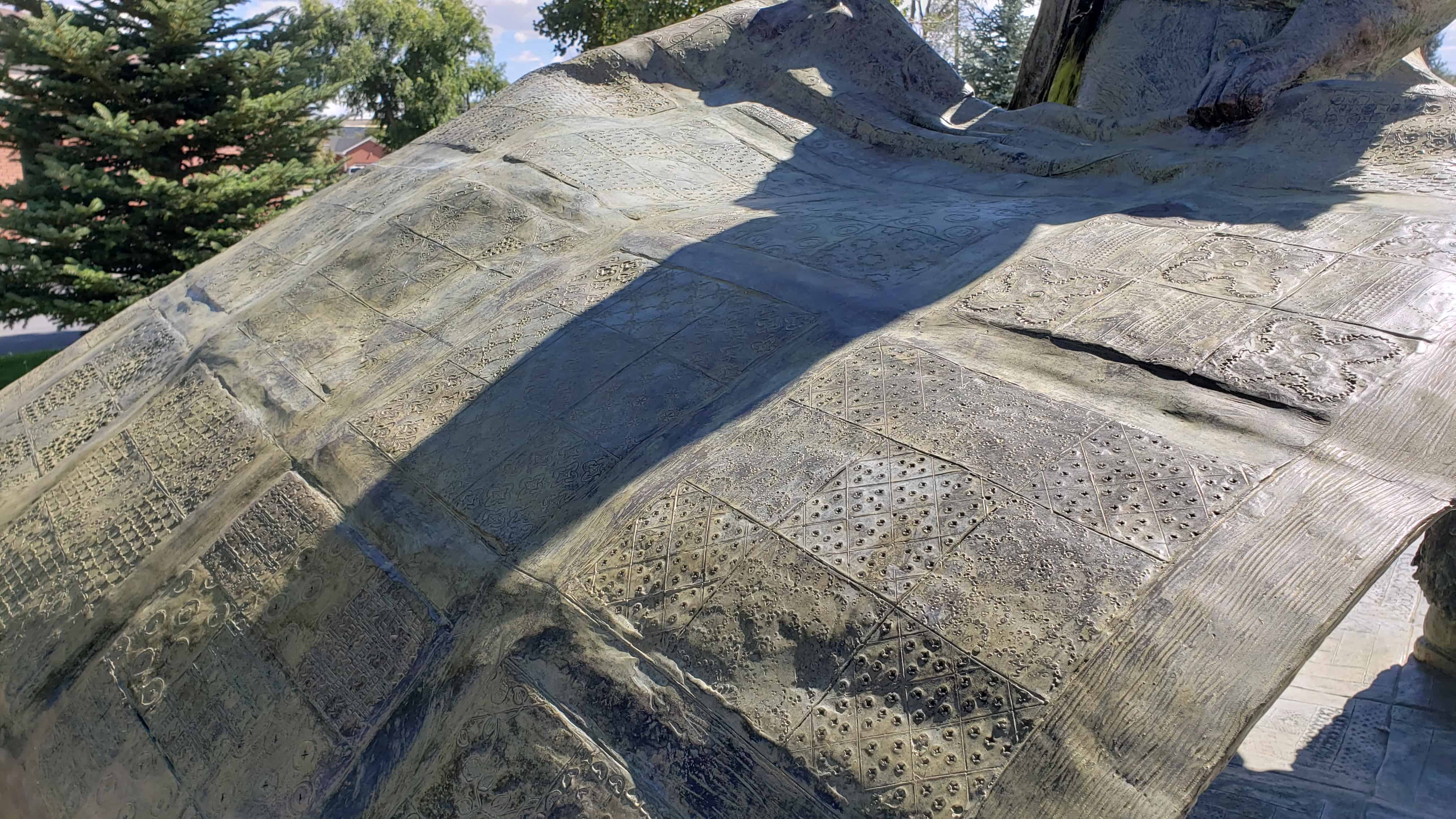
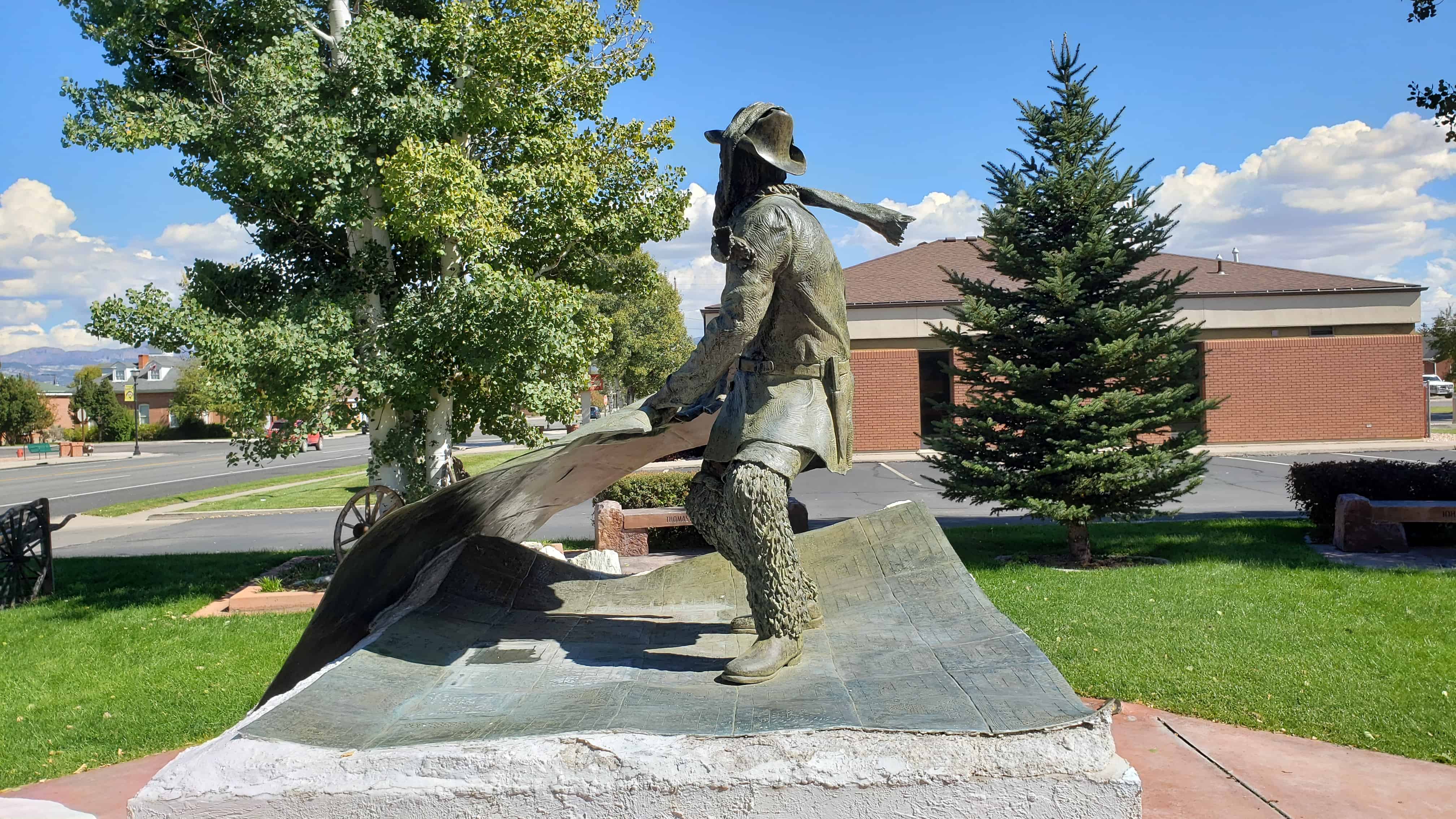
In 1864 a group of hardy pioneers braved the mountain snows to save their families from starvation. This group of men encountered snows that were impassable. According to their faith they knelt on a quilt in a prayer circle.
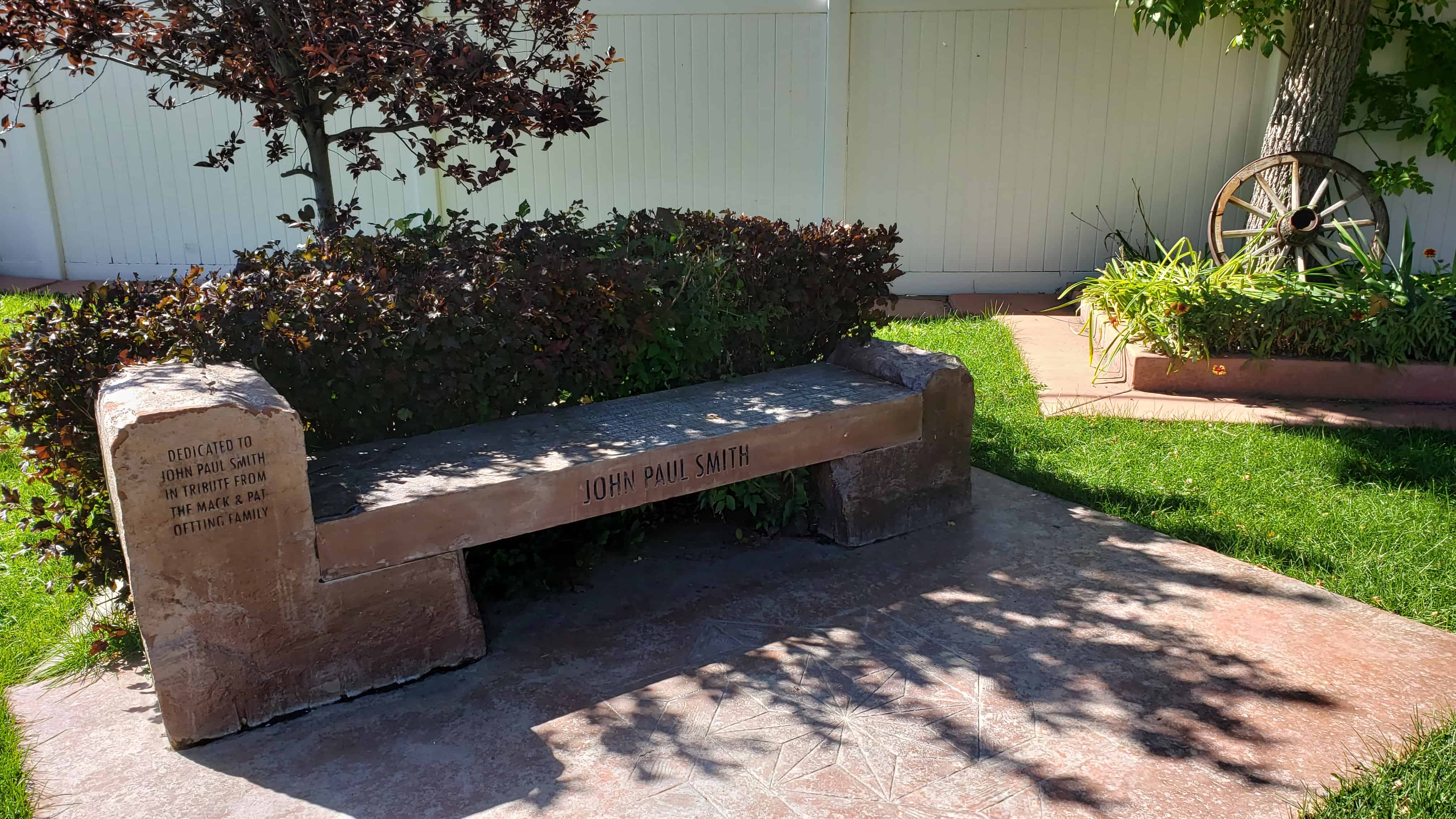
The answer to their prayer was to walk on the quilts. Thus we honor seven men as the Panguitch Quilt Walkers. They are Jessie Louder, Alexander Matheson, William Talbot, Thomas Jefferson Adair, Thomas Morgan Richards, John Lowe Butler II, and John Paul Smith.

  • Artist: Stanley Q. Johnson

Located at 70 East Center Street in Panguitch, Utah

Related:

  • The Panguitch Quilt Walk

Thomas Jefferson Adair, Jr.

Thomas was born in Pickins, Alabama in 1814. After converting to the LDS faith, he and his wife Frances Rogers moved their young family to Nauvoo, Illinois. Following the mass expulsion from Illinois, Thomas and his family fled to Ohio where Frances and two of their four children died. Before coming to Utah, Thomas married Mary Vancil. They joined a group of settlers going to Panguitch in 1864. Thomas was one of the seven men who risked his life to save the settlement of Panguitch; he was age 50 at the time. He was also instrumental in settling the areas of Paria in southern Utah and Adairville and Showlow in Arizona.

John Lowe Butler, II

John was born in Nauvoo, Illinois and was only eight years old when he crossed the plains with his family. When his father died, John was left to help his widowed mother provide for his eleven brothers and sister. Although only twenty years of age, it was important to John to be part of the journey to Parowan – his family needed food to survive the rest of the winter. In later years, John took part in the Black Hawk Indian War; he also led the San Juan Expedition of the Colorado River.

Jesse Louder

Alexander Matheson

Thomas Morgan Richards

John Paul Smith

William Talbot

William was born in Hampshire, England. As a young man he became a carter, one who contracts to haul goods in a wagon. He joined the LDS Church in 1850, and married Charlotte Newman the next year. They set sail for America with their two small boys but their youngest son died soon after they arrived. William answered the call to settle Parowan, and later to settle Panguitch. Besides working his farm William was also a wagon maker. He, along with six other men, showed courage and faith as they went to Parowan in the winter snow for food. Eventually they abandoned the oxen pulled wagon and struggled with every footstep until they were inspired to walk on quilts. He was 39 years old when he made the trek to Parowan, he and his descendants returned to Panguitch after the second settlement.

Historic Fort Sanford

08 Sunday May 2022

Posted by Jacob Barlow in Uncategorized

≈ Leave a comment

Tags

DUP, Forts, Garfield County, Historic Markers, utah

Historic Fort Sanford

Numerous fortifications were erected in Central and Southern Utah in 1865 and 1866 during the Black Hawk Indian War to protect small settlements against attack by bands of Ute, Paiute, and Navajo Indians. Most were built around the towns themselves, and generally by the local citizens, but Fort Sanford was unique in design, construction, and purpose.

By orders from the commanding officers of the Territorial Militia and the Iron Military District, Major Silas Sanford Smith was directed to raise a force of fifty well-armed men to help protect the settlements of Circleville and Panguitch and to construct a fortification near the confluence of Bear Creek and the Sevier River. This was a strategic location commanding the Ute Indian Trail as well as the north-south route taken by pioneer settlers traveling through the area and along the Old Spanish Trail. Each provided access to the western regions.

Although Fort Sanford was in operation for a relatively short period of time, it represented a unique chapter in the history of this area. This monument is a tribute to the soldiers who built the Fort and the pioneers it protected.

There are two monuments/plaques that are both Daughters of Utah Pioneers historic marker(s) #588, the first is seen above and the second, below.

There is little evidence today that Fort Sanford once existed. A land survey indicates it stood approximately 1.5 miles to the south of this marker.

The Fort was built in 1866 to protect the settlers in Circleville and Panguitch during the Black Hawk Indian War and to prevent the Indians from stealing livestock. Fort Sanford also served as a supply depot for cavalry troops.

Fort Sanford was designed, built, and named by Major Silas Sanford Smith and his troops. It was constructed entirely of cedar (juniper) pickets that stood eight feet above the ground. A deep ditch at the base of the wall encompassed the entire Fort. The dimensions were 363 feet by 363 feet, or approximately three acres with “block houses.”

Within just three months of completion, President Brigham Young directed the evacuation of smaller towns for great protection. Most Panguitch residents moved to Parowan; Circleville settlers went to Beaver. With the evacuation of these two communities, the need for the Fort also ended. Eventually farmers would salvage the poles of the stockade to build houses, outbuildings and fences.

Related:

  • DUP Markers
  • Forts

← Older posts

Follow Jacob

Follow Jacob

Blog Stats

  • 1,975,346 hits

Social and Other Links

BarlowLinks.com

Recent Posts

  • John L. and Elizabeth Dalton Home
  • Harold and Margaret Tomlinson Home
  • Westminster College President’s House
  • Joseph Fielding Smith House
  • 666-670 N 1200 W

Archives


Loading Comments...