Tags
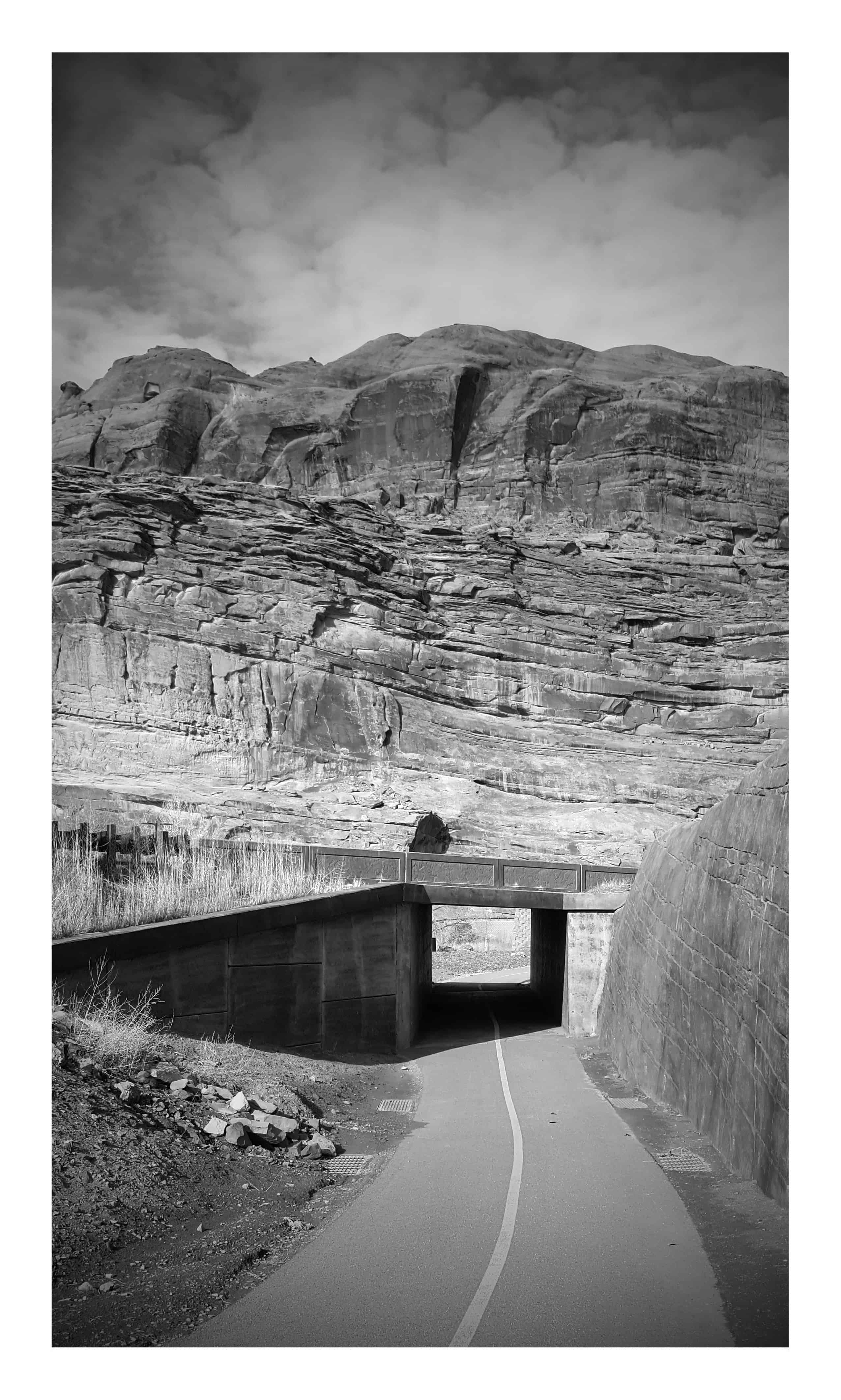
Above Castle Valley to the east, Adobe Mesa according to Utah Place Names

13 Thursday Feb 2020
Posted in Uncategorized
Tags
Above Castle Valley to the east, Adobe Mesa according to Utah Place Names
01 Wednesday Jan 2020
Posted in Uncategorized
Tags

I’ve read several articles online about the King America, King World carving (1935) in Moab and have really wanted to find it because it is the kind of thing I am fascinated by.
Related Articles:
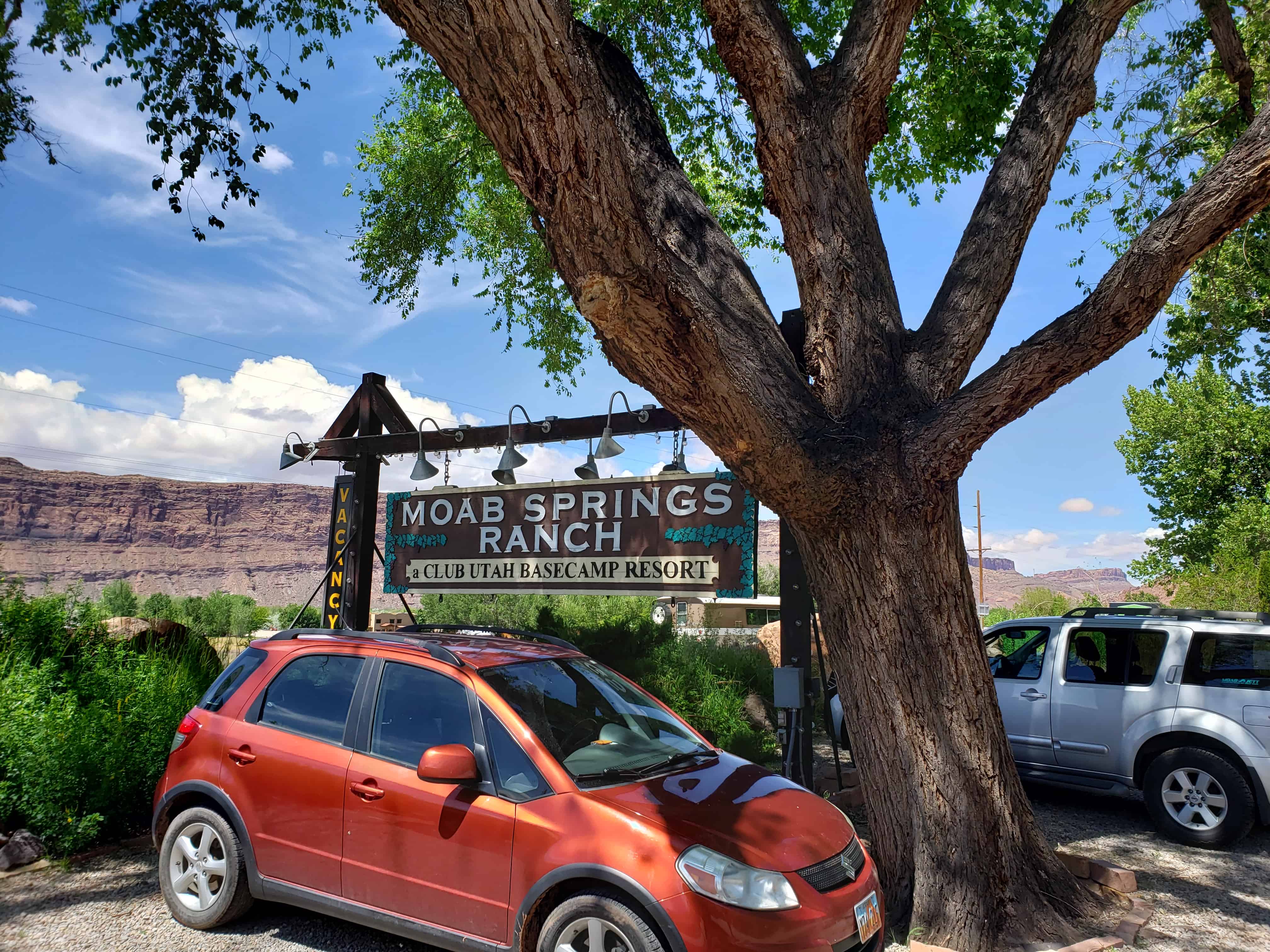
I looked for this location many times, learning that it was where the King World Water Park used to be, over behind the Arthur Taylor House / Moab Springs Ranch. The Water Park being named after the carving. I finally learned that the rock that was carved was moved over to the hospital in town and was able to go see it.
Related Posts:


28 Saturday Dec 2019
Posted in Uncategorized

This historic marker is located in the Old City Park in Moab, Utah.
The Old Spanish Trail
About 1750 the Old Spanish Trail was formed as a means to reach Ute Indian country where New Mexican corn, tobacco, blankets, iron tools for pelts, deer skins, and slaves were traded. Immigrants and Mountain Men pushed the trail into California in 1830. A yearly trading expedition between New Mexico and California began. California miles and horses were traded for New Mexico wool and cotton woven goods. Up to 200 men with pack animals engaged in this trade which became important to the economy of New Mexico, providing miles to trade to the United States and deer hides to trade to Chihuahua, Mexico. Wagons eventually replaced the pack animals. The route avoided deep canyons and unfriendly natives to the south. Today, highways follow much of the route.
The spring located here was a major water source for the mail or south branch of the trail. The north branch through western Colorado joined the south just east of Green River.
The Old City Park
In 1934 Moab’s city fathers took advantage of federal programs and passed a bond issue to buy Westwood Spring and the land around it for $1,000. The spring became the principal water source for the town, and the land was quickly made into a park with the aid of the local Lions Club and others.


27 Friday Dec 2019
Posted in Uncategorized
Tags

In 1934 Moab’s city fathers took advantage of federal programs and passed a bond issue to buy Westwood Spring and the land around it for $1,000. The spring became the principal water source for the town, and the land was quickly made into a park with the aid of the local Lions Club and others.
Related Posts:

10 Saturday Aug 2019
Posted in Uncategorized
04 Tuesday Jun 2019
Posted in Uncategorized
Tags

The Arthur Taylor House documents and illuminates some of the social and economic aspects of ranching in Southeastern Utah. Its size and sophistication, in comparison with the crude homes of most of Moab’s citizens, clearly marks the importance of ranching in the area during the late 19th century. Equally important are the home’s associations with members of the Taylor family who were pre-eminent in the promotion of ranching in Grand County. The Old Taylor Homestead is one of the few remaining historical and architectural assets of the town of Moab, which has suffered the baleful effects of uranium booms and tourist infestations, It is an essentially intact late nineteenth century farm complex, with a two story, T-plan main house of brick.
Located at 1266 U.S. Highway 191 in Moab, Utah and added to the National Historic Register (#80003908) on February 28, 1980.
The Taylor family arrived in Moab in 1881, and with their arrival, large scale cattle ranching got under way. The industry suffered from a grat deal, of lawlessness in the area, and cattle rustling was a continual problem. Amusingly, and accurately, local lore recalls that many local ranchers actually got their start in cattle ranching by establishing their herds with cattle stolen from longer established neighbors. The Taylor’s were the principal targets 6f much of this rustling, and the losses they were suffering contributed to their decision to switch to sheep ranching. The first to introduce sheep into Grand County, they were inevitably involved-in the range war that followed.
It was profits from sheep that enabled the construction of the Taylor Homestead to begin in 1894. The bricks were made in Moab by another member of the family, Elmer Taylor, while paints from the interior walls came from the Carter Brothers of Prove. When the Arthur Taylor’s moved into the house, the GJ:and Valley Times reported,, “Mr and Mrs Arthur Taylor had a parTy on Monday evening to celebrate the occupancy of their new mansion.” The Taylors were thus established as the leading family of Moab, and the object of considerable envy by the residents of the log cabins that constituted most of the dwellings in town.
Following Arthur Taylor, the home passed to his brother Lester Taylor and later went through a succession of hands residence, it is now used for refrigerated storage. Materials and building techniques place this structure at a date close to that of the main house. Of brick on a rough faced, ashlar foundation (now stuccoed with concrete), the gable areas are shingled. Segmental arches and wooden segmental insets complete the two-over-two windows treatment. A screened frame porch was part of this structure originally, resting on the same stone foundation.
Though adapted for use as a restaurant, the present owners have restored the interior of the Taylor home to its original character as much as possible. Woodwork was refinished and missing millwork has been reproduced and replaced. Facsimile wallpapers and paint colors were made after consulting a surviving early resident, Lydia Taylor Skewes.
The home has been rewired and period fixtures used. A second floor bathroom added ca 1945 was left intact. The first floor bathroom was divided into men’s and women’s sections in accordance with the restaurant code.
Outbuildings formed an integral part of any farm complex. At the Taylor farmstead the many extant outbuildings contribute to preserving the character of the original site.
Three original, rough-faced sandstone outbuildings survive, all with gable roofs. For the one story smoke-house, sandstone was used for the lower elevation level, while yellow brick was used on the upper portion. Dug partly into the hill is the icehouse. The creamery also remains, though the stone has been stuccoed. Frame storage sheds, corrals and chicken coops dot the complex.
The Taylor home exemplifies a common approach to domestic architecture in America. An established vernacular form with comfortable associations socially and historically was chosen. Yet in desire to keep up with current taste, details were applied which were not integral to the overall form.
The social and economic conditions which allowed the Taylor family to prosper and build are gone, but the home that was the result remains as a landmark of later nineteenth century architecture in rural Utah.

The Taylor Farmstead in Moab, Utah, remains as an essentially intact late nineteenth century farm complex. Begun in 1894, the farmhouse is similar in form and detail to other domestic architecture of the period. The T plan, one of the popular pattern book plans, was used extensively during this era throughout the West. Applying period ornament to a vernacular architectural type in order to update the appearance was a popular move – a comfortable step – embracing the vogue and the traditonal at once. Substantial scale and materials added to the pretentious detail crate an imposing result.
A full two stories, the Taylor home is large in comparison to other homes in the region. Brick for the walls was made locally by a family member. The lighter colored quoins may have been from another source. Rough faced, regular coursed sandstone was used for the massive window sills and the foundation (now stuccoed with concrete).
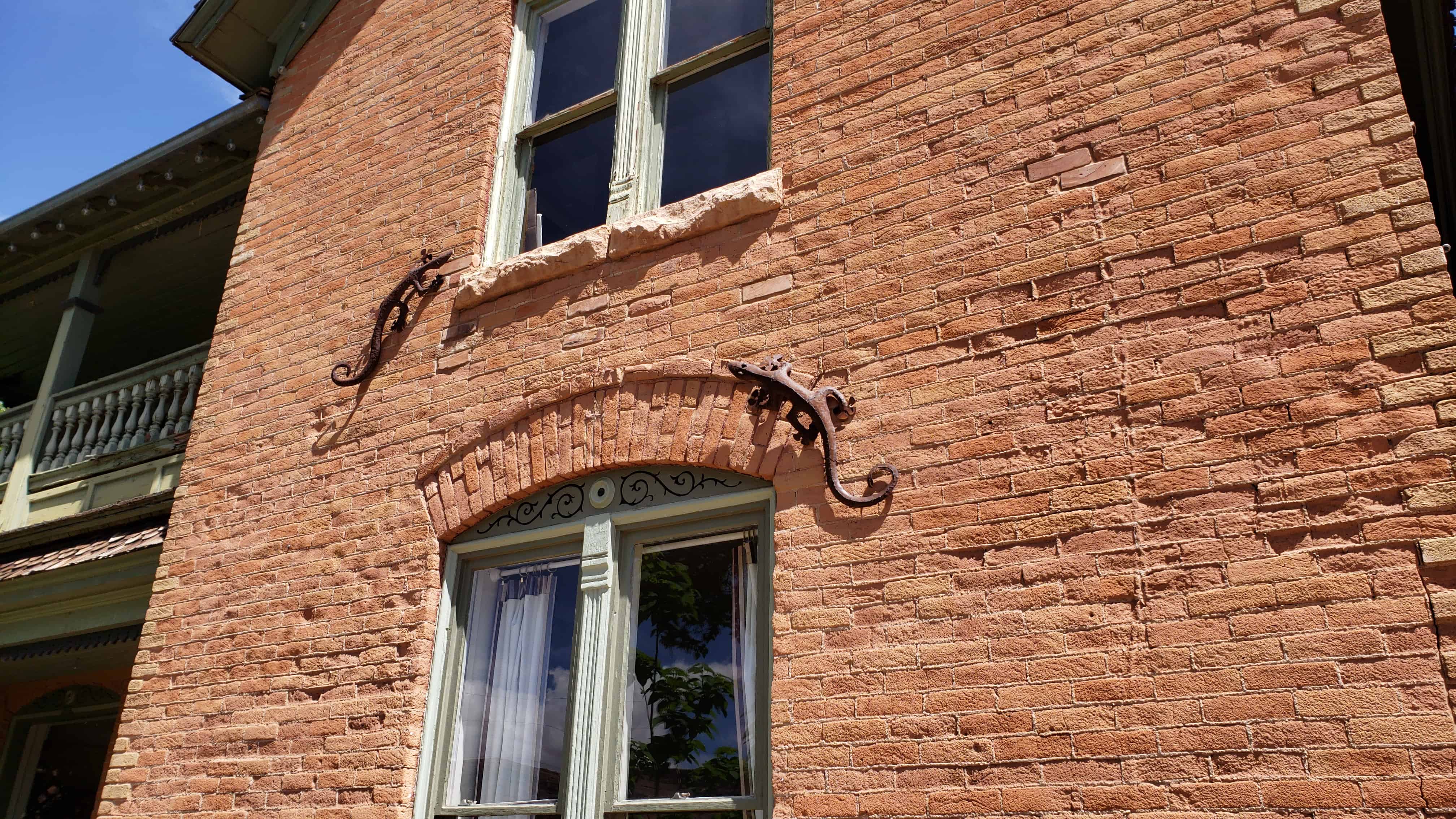
Window treatment for the Taylor Home is arranged around double hung, sash windows. Brick segmental arches with archivolt bands, and wooden segmental insets with an incised scroll motif seen commonly in Utah architecture are uniform. In the double unit window configurations, a classical vernacular pilaster divides the windows. Surrounds are of a plain, moulded style.
A porch and balcony in the Eastlake Style mark the main façade. The original arrangement (see ca. 1896 photo) was later modified by the addition of a roof over the second story balcony. Originally polychromed, the porch is now painted white. Scalloped shingles on the pent roof complimented the vergeboard drapery of quatrafoil motif, which is now missing. Later modifications were made to include the roof over the second story balcony. Here, square posts with milled bracketing replaced the turned balusters. Rafter ends have decorative rounded shapes.
Rear extensions and interior modifications began ca. 1943 and continued until the present ownership, under which a readaptive restoration was launched. The original rear porch has been enclosed. To accommodate the home’s present use as a restaurant, a kitchen has been added at the rear.
This modern kitchen connects the farmhouse to a one-story, rectangular brick structure. Probably originally a three-room before finally ending up as a prize to be carefully restored to its former grandeur. The present owners are making a worthwhile effort to rescue the building from dilapidation and to make it once more a showplace of Moab, and a reminder of the colorful ranchers who built Moab and Grand County.


12 Friday May 2017
Posted in Uncategorized
Tags

North of Moab near the entrance to Arches National Park is a huge, steep hill of sand that usually has people hiking up to roll/fall/jump down. It’s a good place to stop and let everyone get sandy and playful after a long drive.
24 Monday Apr 2017
Posted in Uncategorized
Tags
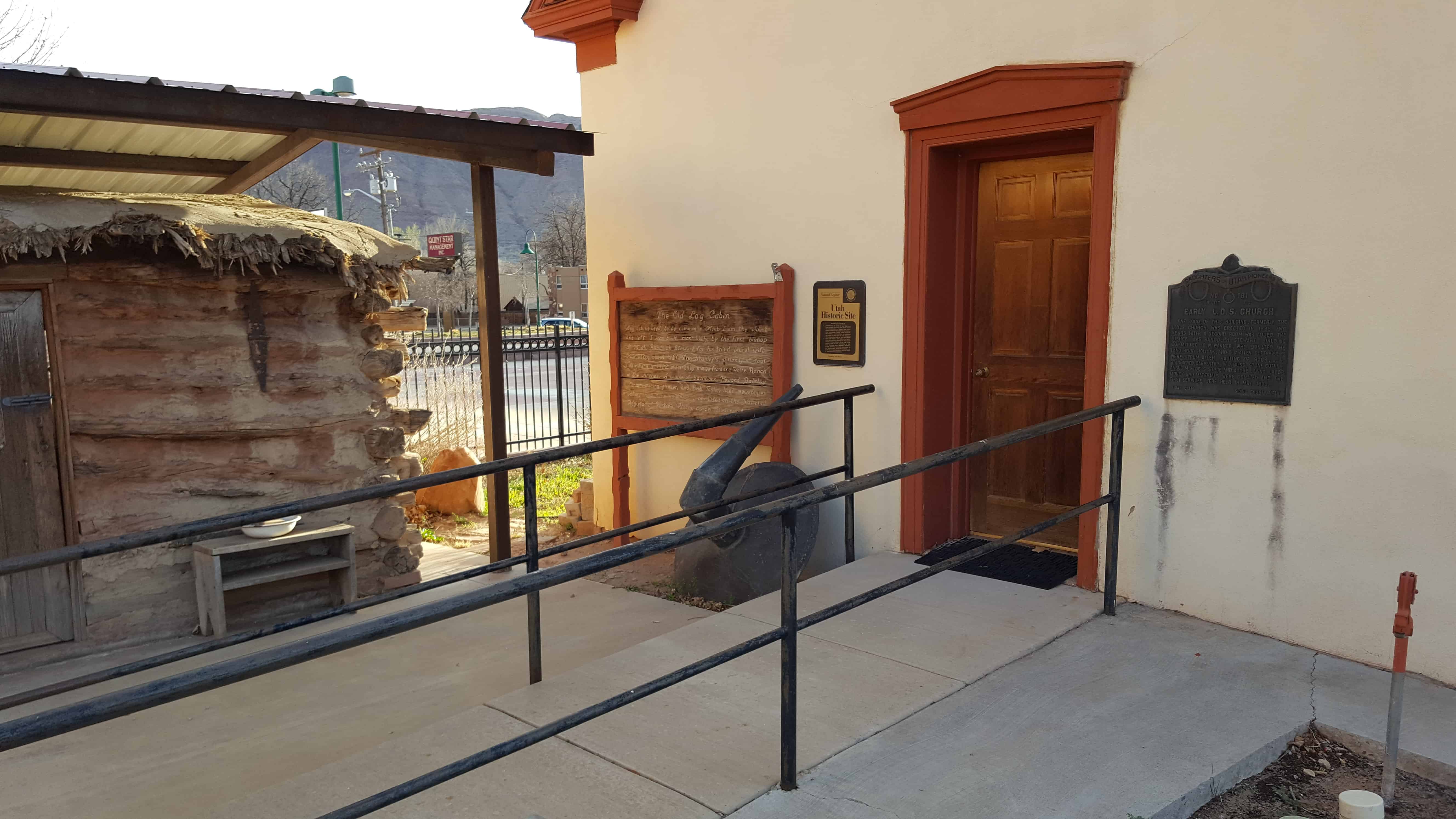
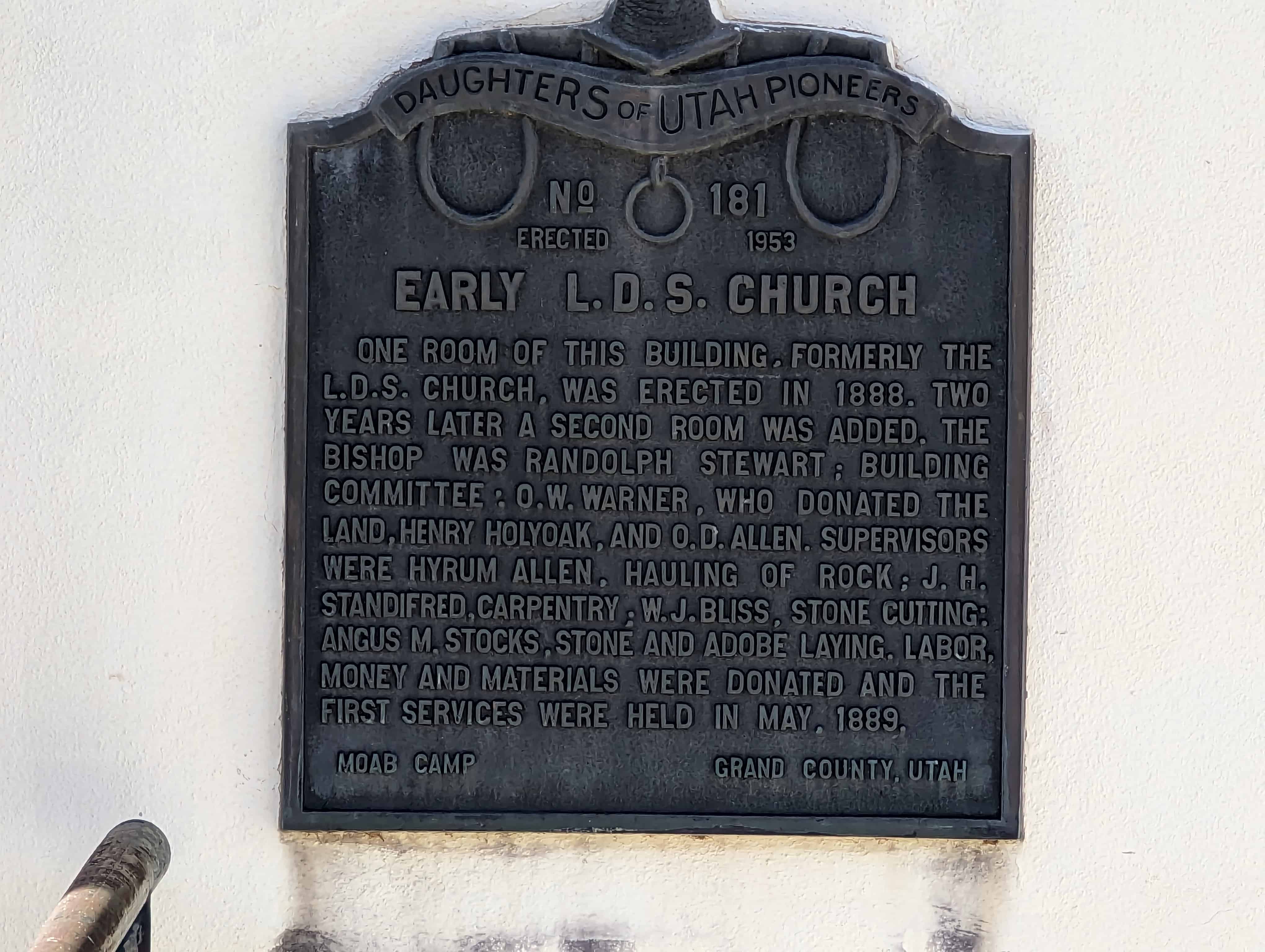
Early L.D.S. Church
One room of this building, formerly the L.D.S. church, was erected in 1888. Two years later a second room was added. The Bishop was Randolph Stewart; Building Committee: O.W. Warner, who donated the land, Henry Holyoak, and O.D. Allen. Supervisors were Hyrum Allen, hauling of rock; J.H. Standifred, carpentry; W.J. Bliss, stone cutting; Angus M. Stocks, stone and adobe laying. Labor, money and materials were donated and the first services were held in May, 1889.
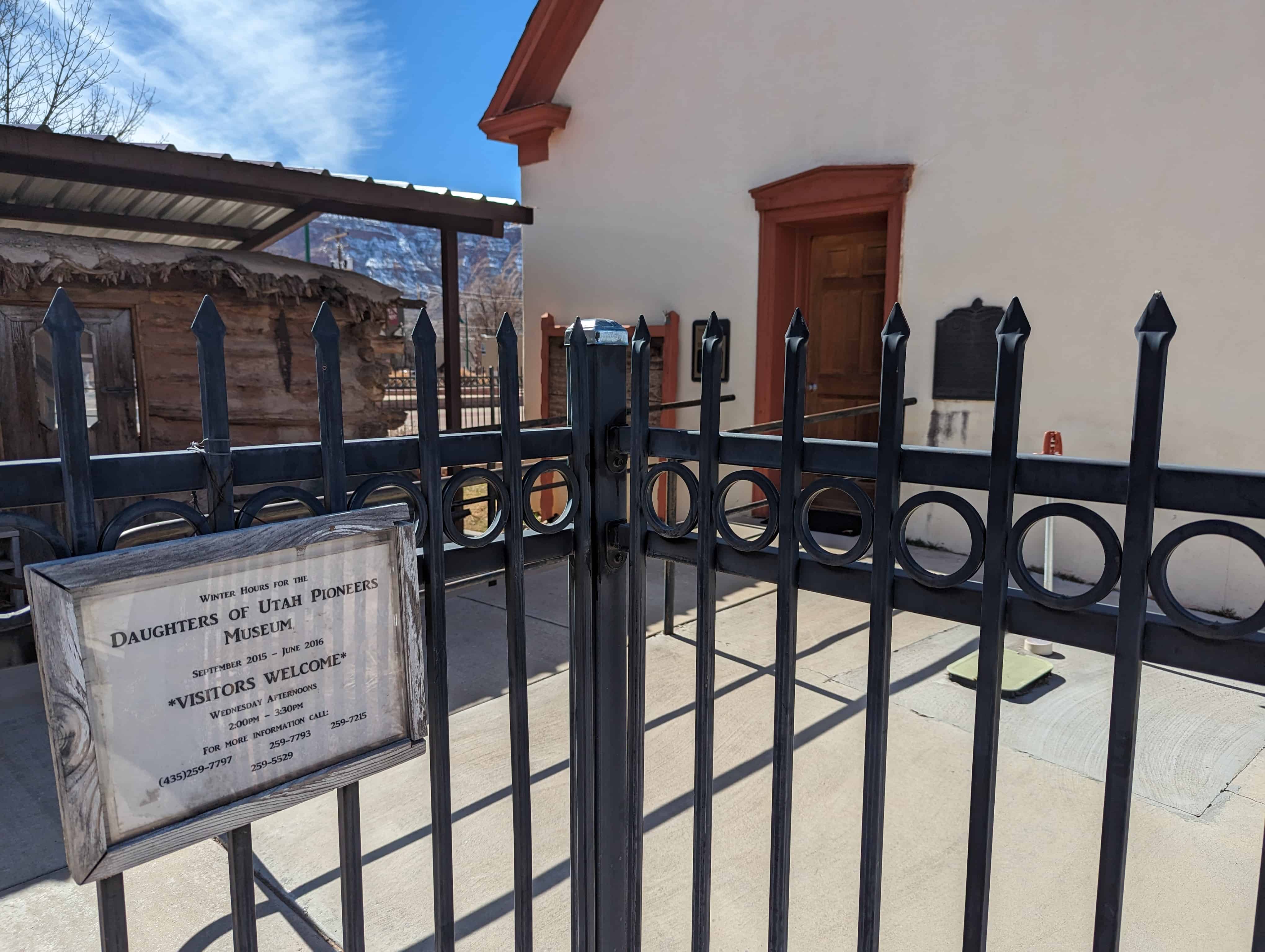
Daughters of Utah Pioneers historic marker #181, located outside the Moab L.D.S. Church/D.U.P. Museum at 45 North 200 East in Moab, Utah.


24 Monday Apr 2017
Posted in Uncategorized
Tags
DUP, Forts, Grand County, historic, Historic Markers, Moab, utah

Elk Mountain Mission
In April 1855, forty-one men under the leadership of Alfred N. Billings were called to establish a mission in the Elk Mountains. They left Salt Lake City May 7, 1855, arriving at Grand River June 11, and selected the site for a fort. By July 15, they had built a fort 64 feet square, with stone walls, 12 feet high, 4 feet at the base and 1 & 1/2 feet at the top. Three of the pioneers, James. W. Hunt, Edward Edwards and William Behunin were buried within the fort which was located about 800 feet from this monument.
This monument was relocated in April 2006. The monument was formerly located at 995 North Highway 191 (Main Street), which is 1.5 miles northwest of where the monument now stands. The location of the Old Fort was 3000 feet west, 1320 feet from the Northwest corner of Section 35 Township 25 South, Range 21 East, Salt Lake Base Meridian.
(Fort Location: N 38.59301 W 109.57712 )
Daughters of Utah Pioneers historic marker #65, located outside the Moab L.D.S. Church/D.U.P. Museum at 45 North 200 East in Moab, Utah.


22 Sunday Jan 2017
Posted in Uncategorized
Tags
Grand County, Moab, Parks, Trails, utah
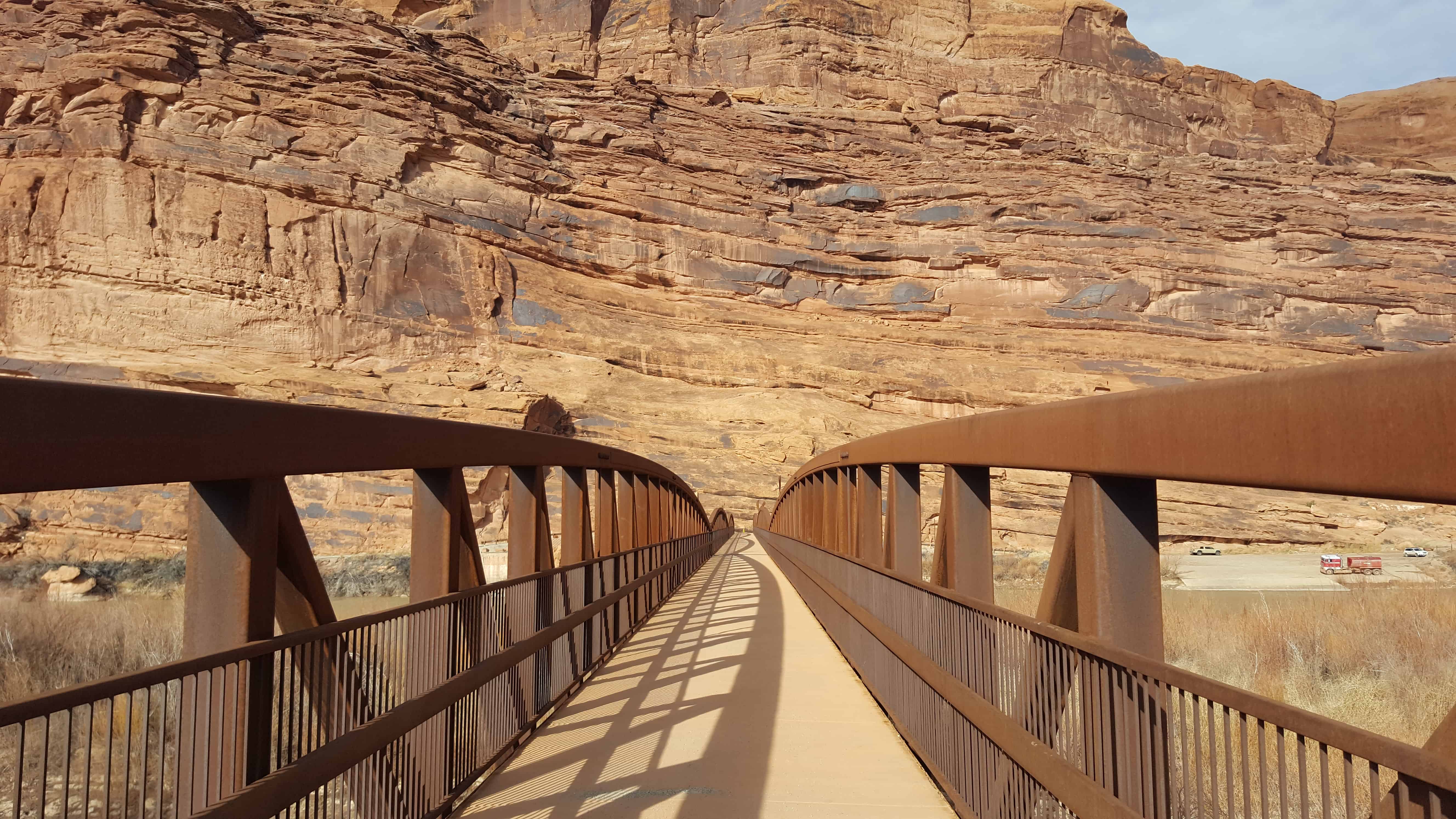
The park has a grassy area, picnic tables, a pedestrian bridge over the river, as well as trails for walking and biking.