• About JacobBarlow.com
  • Cemeteries in Utah
  • D.U.P. Markers
  • Doors
  • Exploring Utah Email List
  • Geocaching
  • Historic Marker Map
  • Links
  • Movie/TV Show Filming Locations
  • Oldest in Utah
  • Other Travels
  • Photos Then and Now
  • S.U.P. Markers
  • U.P.T.L.A. Markers
  • Utah Cities and Places.
  • Utah Homes for Sale
  • Utah Treasure Hunt

JacobBarlow.com

~ Exploring with Jacob Barlow

JacobBarlow.com

Tag Archives: Historic Homes

Dyre and Maria Amundsen House

27 Monday Mar 2023

Posted by Jacob Barlow in Uncategorized

≈ Leave a comment

Tags

Historic Homes, Murray, NRHP, Salt Lake County, utah

Dyre and Maria Amundsen House

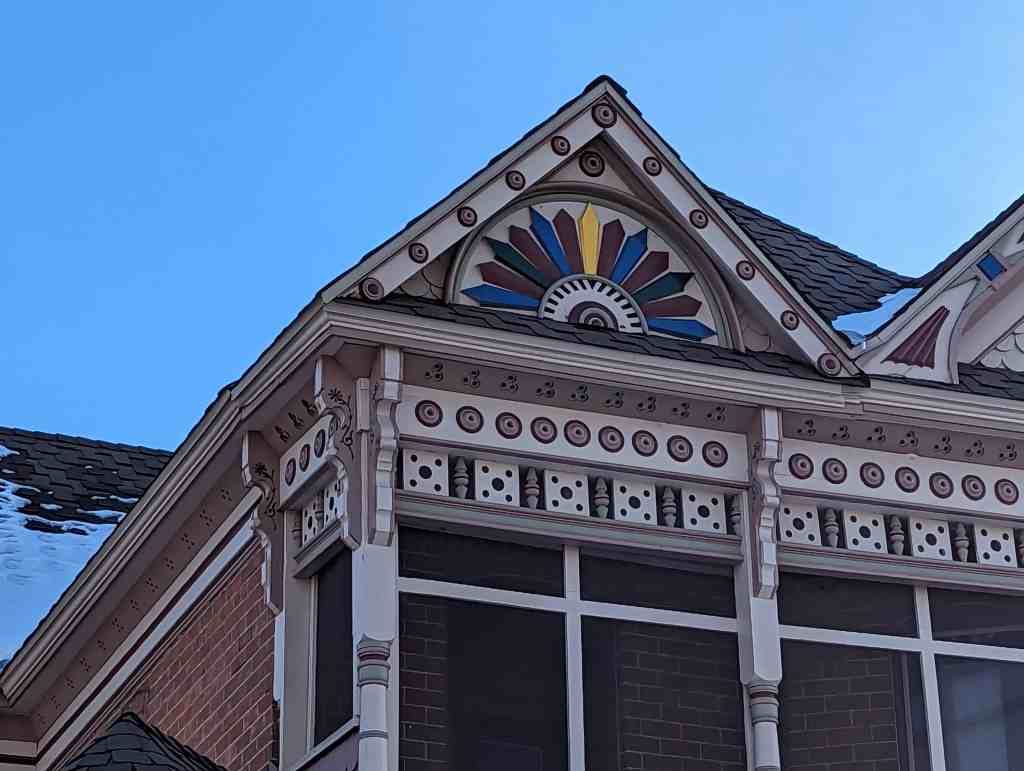
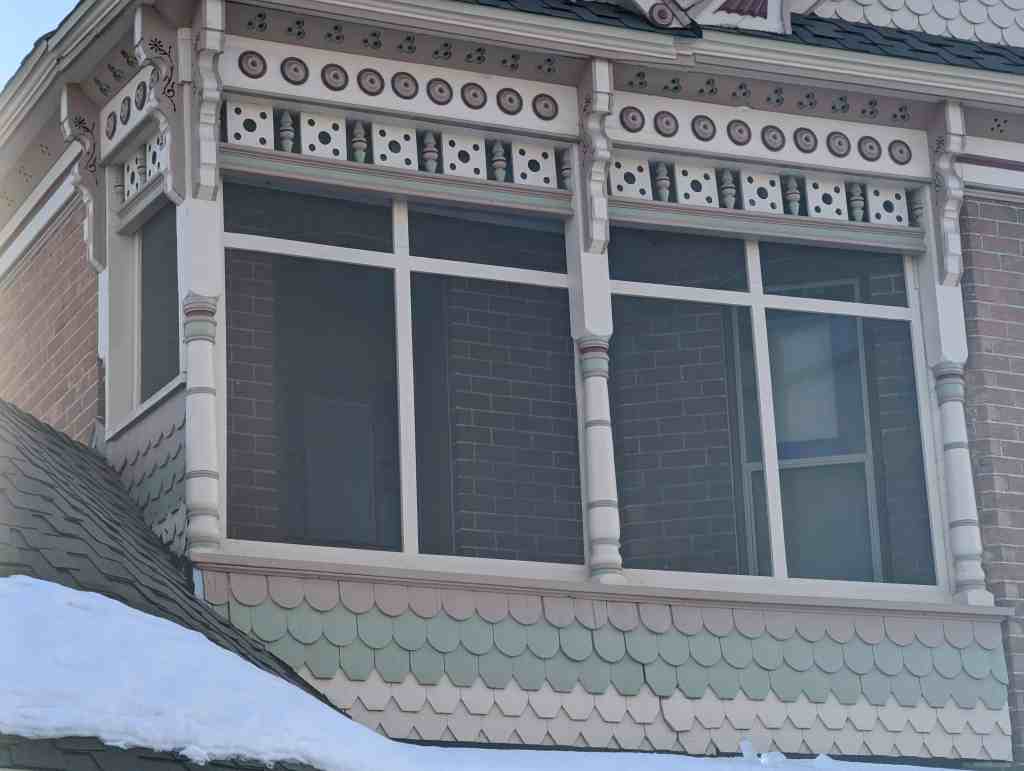
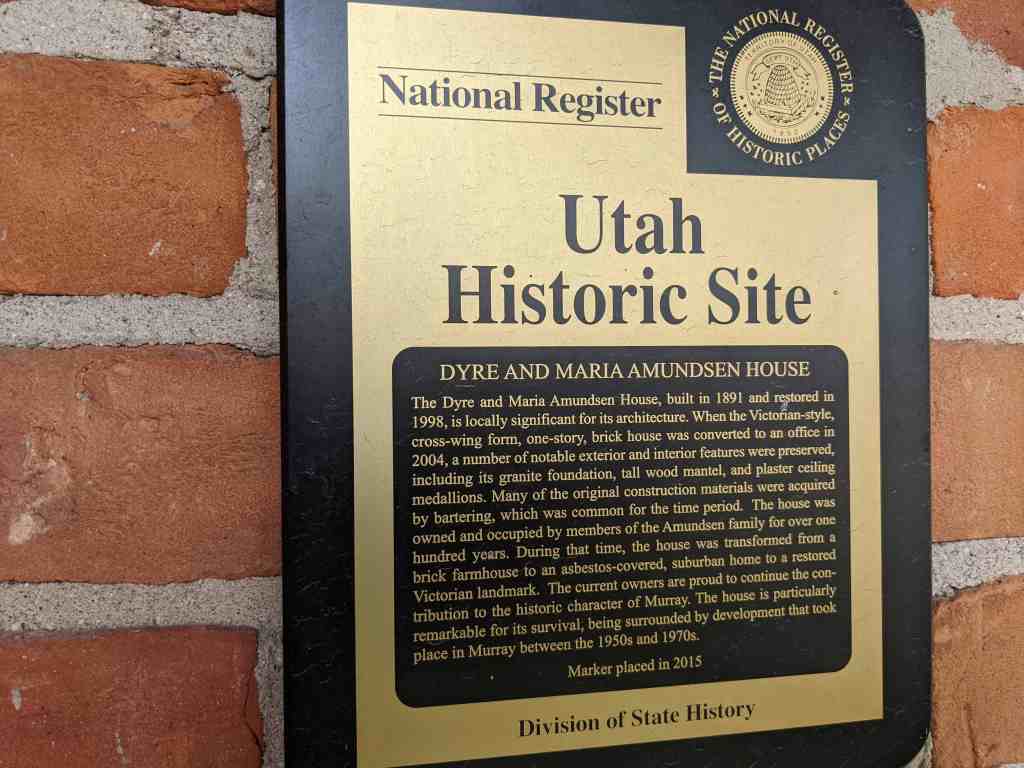
The Dyre and Maria Amundsen House, built in 1891 and restored in 1998, is locally significant for its architecture. When the Victorian-style, cross-wing form, one-story, brick house was converted to an office in 2004, a number of notable exterior and interior features were preserved, including its granite foundation, tall wood mantel, and plaster ceiling medallions. Many of the original construction materials were acquired by bartering, which was common for the time period. The house was owned and occupied by members of the Amundsen family for over one hundred years. During that time, the house was transformed from a brick farmhouse to an asbestos-covered, suburban home to a restored Victorian landmark. The current owners are proud to continue the contribution to the historic character of Murray. The house is particularly remarkable for its survival, being surrounded by development that took place in Murray between the 1950s and 1970s.

Located at 307 East Winchester Street in Murray, Utah and added to the National Historic Register (#15000131) on April 6, 2015.

The Dyre and Maria Amundsen House, built in 1891 and restored in 1998, is locally significant under Criterion C in the area of Architecture. Although the Victorian-style one-story brick house was converted to an office in 2004, a number of notable exterior and interior features have been preserved. These include the granite foundation, a tall wood mantel, and plaster ceiling medallions. The house was owned and occupied by members of the Amundsen family for over one hundred years. During that time, the house was transformed from a brick farmhouse for a major farmstead to an asbestos covered suburban home to a restored Victorian landmark. The house is particularly remarkable for its survival at the edge of an explosion of residential and commercial development that took place in Murray between the 1950s and 1970s. The period of significance dates from the construction of the house in 1891 to the remodeling in 1951. The house is a particularly elaborate early example of a cross-wing Victorian cottage in Murray, especially considering the construction materials were acquired by the barter system common for the time period. The property meets the registration requirements under the Multiple Property Submission, Historic Resources of Murray City, Utah, 1850–1967. The associated historic contexts are “Early Residential and Agricultural Buildings of Murray, 1850-1910” and the “Americanization of Murray’s Residential Architecture, 1902-1965.” The Dyre and Maria Amundsen House has good historic integrity and contributes to the historic character of its Murray neighborhood.

When the Amundsen House was built in 1891 in the Victorian Eclectic style, it did not have the visual complexity of contemporaneous homes in the fashionable urban neighborhoods of Salt Lake City. The house did have a simple elegance that was suited to its rural setting. The unknown builder used a modified cross wing plan and a variety of materials to achieve the visual interest that is characteristic of the Victorian-era domestic architecture in Utah. Dyre Amundsen helped to haul granite blocks for the construction of the Salt Lake City LDS temple and family oral tradition suggests that Amundsen was given permission to select cast-off blocks for personal use. Much of the wood used in the house came from locust trees that Dyre Amundsen planted in the late 1860s or early 1870s. The red and contrasting yellow bricks were likely produced at the local brickyard in Murray. The brick and windows were paid for by a one-acre crop of potatoes. The interior spaces in the south half of the house are larger than the typical house of the period. Family tradition states that Dyre Amundsen received the two large plaster ceiling medallion moldings from the LDS Church as payment for hauling the granite blocks. The brick moldings, granite blocks, ceiling medallions, wide corridors, are atypical for a Victorian-era cross-wing house of the period in Murray.

The Amundsen House as a product of the Victorian period marks a pivotal point in Murray’s history. The availability of kiln-dried brick in the 1860s and the coming of the railroad in the 1870s transformed Murray’s domestic architecture from vernacular buildings to Victorian forms with asymmetrical massing and a variety of texture. The Victorian cottage was the most popular house type in Murray between 1884 and 1910. Dyre and Maria Amundsen originally built an adobe house on their homestead in the late 1860s, then worked many years to afford the spacious brick home that built in 1891. In the post World War-II era, the old brick house may have seemed out-of-date as frame cottages and brick ranch houses were built on the former Amundsen homestead. The family had the house covered with asbestos siding in 1951 effectively suburbanizing it for the next generation. The 1996 to 1998 rehabilitation of the house restored much of the Victorian elegance and was awarded a Utah Heritage Foundation award in 1999.

Dyre Amundsen was born on June 11, 1837, in Gernserud Buskerud, Norway. The family name was Anunsen in Norway. Dyre immigrated to Utah in 1862. While helping to bring other immigrants across the plains in 1863, Dyre Anunsen met and married Beata Erickson, who died in October 1863, only a month after their marriage. Dyre was living in South Cottonwood in 1865 when he met Sophia Maria Person. Maria Person was born in Marna, Sweden, in 1833.2 She immigrated to Utah in 1864.

Dyre and Maria were married in October 1865.3 They lived with the Wheeler family until a small cabin was built for them on Andrew Hammer’s property. Their son, John David, was born in the cabin in December 1867. Dyre Anunsen served in Utah’s Black Hawk War in 1866 and was award a medal for his service. Sometime in 1867 or 1868, Dyre Anunsen claimed a homestead on land along the angled land that would become 6400 South. As a latecomer to the area, his homestead of 160 and 37/100s of an acre was in the shape of an upside down “T” and claimed in three separate parcels. Dyre built a two-room adobe house for his family where a daughter, Sarah Ann, was born in January 1870. A second daughter, Marinda, was born there in April 1873. The adobe house was located west of the later brick house. Dyre was a logger and a farmer. One of the first projects he completed on his homestead was planting a grove of locust trees. The family would later use the wood to build a barn, fences, and the woodwork in the brick house. On February 20, 1875, Dyre Anunsen was granted a land patent for his homestead property.

The Anunsen begin using the name “Amundsen” in the 1880s. In 1891, Dyre filed a deposition with Salt Lake County to change the name on his deeds. The brick house was built in 1891. The builder is unknown, but Dyre himself may have placed the granite foundation blocks that he acquired. The bricks, windows, and other building materials were paid for by an acre of potato crop. The plaster ceiling medallions were reportedly given to Dyre in payment for hauling some of the granite for the Salt Lake temple.4 The Amundsen house and property were at the southern edge of Murray City after annexation in 1905. Dyre Amundsen died on November 17, 1906. He is buried in the Murray Cemetery. At the time of his death, the homestead property had been reduced by more than a half. The land and its water shares were divided between Maria Sophia Amundsen and her three children. Both daughters, Sarah Ann Amundsen Jensen and Marinda Amundsen Boyce, had been married several years and were living in Idaho. In 1909, Maria Amundsen deeded her acreage to her son John David, but retained a life estate. Maria Sophia Amundsen died on August 9, 1918. Her funeral was held in the Grant Ward meetinghouse and she was buried in the Murray Cemetery.

John David Amundsen married Alma Pauline Janson on September 19, 1899. Alma was born in Sweden in 1860 and immigrated to Utah in 1897. On the 1900 census, John David (as David) and Alma are living with his parents, Dyre and Maria. David and Alma had three children: Alice Engre Sophia (born in 1901), Edith Selma Lenora (1903), and Wallace Janson (1906). In a letter describing the history of the house, Edith’s daughter-in-law, Linda Adams, wrote that “the house became two dwellings [Edith’s] parents occupying the three rooms on the West side and her grandparents the two rooms on the East.”5 Edith recalled the driveway was lined with “tall stately poplar trees” and her grandmother had planted the front yard with “yellow roses and Mormon tea vine.” The rest of the yard was planted with “as many shrubs as possible to keep the dust down.”6 David and Alma kept the land as productive as they could, raising vegetable, hay, and sugar beets.
The early settlement of the area began soon after the members of the Church of Jesus Christ of Latter-day Saints (LDS or Mormon) began arriving in the Salt Lake Valley in 1847. Mormon pioneers quickly spread out from Salt Lake City in search of suitable agricultural land. By 1848 a settlement in the area later known as Murray was established eight miles south of Salt Lake City. The settlement was first called South Cottonwood and was a community of scattered farmsteads originally extending from the Big Cottonwood Creek to the southern end of the Salt Lake Valley, east to the Wasatch Mountains, and west to the Jordan River. As more settlements were established in the south valley, the name South Cottonwood was retained by a group of farmers organized as the South Cottonwood Ward of the LDS Church. An adobe meetinghouse, located at the corner of Vine Street and 5600 South, was the community center for the group. The main north-south corridor was the Territorial Road (later State Street). The Salt Lake City & Jordan Canal and the East Jordan Canal were dug to bring water from the Big and Little Cottonwood Creeks to the farmsteads between South Cottonwood and the settlement of Union to the southeast.

The north half of the South Cottonwood did not remain rural. At the west end Vine Street, an industrial and commercial center began to grow in response to several smelters that were established near the railroad lines west of State Street in the early 1870s. In 1883, the name Murray (after the territorial governor, Eli Murray) was adopted for the town’s official postal designation. The name Murray became official during the incorporation of the city in 1903. At the time of incorporation the boundaries of the city extended from approximately 4500 South to 5600 South, and 900 East to 900 West. In 1905, the city boundaries were extended south to include both sides of 6400 South, which was the main east-west corridor and marked the south boundary of the historic South Cottonwood community.

During the first half of the twentieth-century, Murray City was an industrial town with its own power plant, water system, and school district. Residential development took place near the city center or along the major transportation routes, while the outlying areas continued as farmland. After the last remaining smelter closed in 1950, Murray City with its stable infrastructure and centralized location experienced a post-war suburban building boom. The population jumped from 5,740 in 1940 to 21,206 in 1970. Between 1946 and 1967, sixty seven subdivisions of mostly single-family ranch houses were platted within the boundaries of Murray City. In 1972, commercial property along State Street between 6100 and 6400 South was consolidated for the construction of the Fashion Place Mall. The opening of the mall was planned to coincide with the construction of the Interstate-215 belt route just south of 6400 South. Since the 1970s, the commercial development around the mall has spread along 6400 South east to 900 East. Only a few historic homes, such as the Dyre and Maria Amundsen House, remain to tell the story of the neighborhood’s agricultural past

The census indicates all three grown children were living at home in 1930. Alice worked as a stenographer, Edith was a saleslady for a dry goods store, and David and Wallace worked the farm. David deeded approximately eleven acres in the north half of the property to Wallace in 1931. Alice Amundsen died of influenza in May 1933. One month later, Edith Amundsen married Bronson Adams. Bronson Howard Adams was born in Beaver, Utah, in 1908. Bronson and Edith moved away for a short time, but returned to live at the Amundsen House in 1934. It would be the only time in her life that Edith did not live in the family house on 6400 South. Alma Pauline Janson Amundsen died in February 1936. John David Amundsen died in December 1939. That year, Wallace Amundsen, who remained a bachelor, gave Edith his share of the property with the family home. Wallace Amundsen was living with Edith’s family on the 1940 census, but later moved to an adjacent home at 353 E. 6400 South. He died in 1979.

Edith and Bronson Adams had three children, Kathleen, Patricia, and Howard. Bronson worked in sales and as a warehouseman before starting a career with the Union Pacific Railroad. In July 1949, Bronson Howard Adams died during an operation at the age of forty. In order to care for her family and pay the taxes, Edith sold off much of the family property by the mid-1950s. The covering of the brick house in asbestos shingles in 1951 occurred just after the first postwar subdivision in the south half of Murray was developed between 1946 and 1950. Two of the largest subdivision developments in Murray, Murray Dale and the Murray Dale Addition, were platted in 1953 and 1954, north and east of the Amundsen house on land that was formerly part of the Amundsen farmstead. Edith Adams graduated from the Salt Lake Business School and worked for the Frank Edward Company until her retirement in 1970. When she passed away on October 15, 1995, she was recognized as a lifelong resident of Murray. After her death, her son Howard and his wife Linda, restored the family home. They were assisted by Dan Lossee, a local architect. The home was rented intermittently by family members and others before being sold to Tamra Lee, the owner of the Mt. Olympus Title Company in 2004.9 Although a busy title company office, the house maintains its domestic charm.

Narrative Description

The original footprint of the Amundsen House is a rectangle of 40 feet by 26 feet with a six-foot projecting wing at the southwest corner. The foundation is made from large rock-faced granite blocks. The red brick is laid in a common (American) bond with headers every seventh course. The mortar joints are flush and are a contrasting light tan. There is plain wooden frieze (painted tan) under the eaves. The west projecting wing has a hipped roof. The main wing runs west to east with a simple gable that has been extended to the north. The bell cast extension of the roof above the front porch was made during the 1998 renovations. The wood shingles were installed at the same time. The south projection has two narrow Victorian windows with ornamental drip hood moldings of segmented and corbelled brick in a contrasting tan color. The sills are corbelled rowlock brick. The moldings and the original wood sills were damaged and replaced in 1998.

The current wood windows were installed in 1998, but are similar to the original one-over-one, double-hung windows, which were too damaged to repair. The west elevation has three openings with similar windows with a pair in the center. The treatment of the front door and two windows on the main wing’s façade are the same. The half-glass front door with transom is original, although the glass has been replaced with decorative leadedglass. The front porch is the only major modification to the façade. It is full width rather than the entrance-only porch of the original and wraps around the east side to the bay addition. The new Victorian-style porch features a concrete base with a wood plank deck. The slender lathe-turned posts and balustrade were installed in 1998, but are compatible with the Victorian-style.

The north half of the house was slightly lower and set back on the east elevation. Tax records indicate that by the late 1930s, the house had a 9 feet by 14 feet lean-to addition and a 5 by 7 feet screened porch on the rear elevation. The original east elevation had two windows, one in the taller south half and one in the shorter north half. The rear porch was enclosed and expanded around 1951 when the entire house was clad in pink asbestos siding. The 1951 remodeling included wood surrounds for each opening and wrought-iron supports over the front stoop. In 1996, the siding was removed. The rehabilitation of the house was completed in 1998 including installing a new roof, cleaning the brick, and installing the replacement wood windows. The brick chimney at the center of the house was originally much taller with a corbelled cap. In 1951, it was shortened, but is still operable. A compatible brick addition on a concrete foundation was designed to replace the rear lean-to and enclosed porch addition. A new bay window has altered the historic footprint along the east elevation. The addition matches the details on the original house, but can be distinguished by the use of newer materials.

On the interior, the Amundsen House has 1,844 square feet of space on the main floor. The house has no basement or cellar. The attic space is not useable. The interior features an unusually wide central passage and 12-foot-high ceilings. The parlor to the west features the original carved wood mantel with a mirror inset. The hearth and firebox was replaced with stone tile in 1998. Other original woodwork such as the fluted and paterae window casings and the tall baseboards are intact. The ornamental plaster ceiling medallions in the parlor and living room are original, but the light fixtures are period antiques that were obtained from the Hotel Utah in Salt Lake City. Behind the parlor is the original home’s only bedroom (closet added in 1998). The kitchen is north of the living room on the east side of the house. The east projection, built in 1998, is a conference room. The wallpaper was selected to match the original as seen in family photographs. The French doors and newer woodwork match the style of the original features. The bathroom at the north end of the hall was moved to the east, to provide access for the rear addition. The addition features two rooms and a central bathroom. The spaces have been used for offices since 2004; however, the house could be returned to residential use.

The current 0.53 acre site is only a fraction of the original 160-acre homestead. The unusual shape of the parcel is partially a result of a number of factors: subdivision development to the north, substation expansion to the west, and the busy Winchester Street (6400 South) and Fashion Boulevard intersection, which leads to the Interstate-215 interchange. The driveway originally accessed 6400 South, but was reconfigured in 1998 to provide access from 300 East. The contributing 1930 frame one-car garage is located northeast of the house.1 The space between the concrete driveway and 6400 South is landscaped with evergreens and bark. There is lawn on three sides of the house. There is a large vegetable garden plot in the northeast portion of the lot. Fencing is a combination of brick pier, white vinyl, and chain link.

The immediate neighborhood is a mix of large-scale commercial and single-family residential. The Fashion Place Mall (1972) is directly west of the substation and commercial development has spread along the south side of Winchester Street. On the north side of Winchester Street are historic homes, mostly from the 1940s. The neighborhood north and east of the Amundsen property is a subdivision that was developed in the mid to late 1950s. The original setting of the house has been somewhat compromised by later development, but the house has integrity of location. Minor alterations were made to the design and materials of house in 1998, but the house retains high integrity in terms of workmanship, feeling, and association of the original Victorian-style brick house. Because of its surroundings, the restored Dyre and Maria Amundsen House is a distinctive landmark and a contributing resource in its south Murray neighborhood.

Dr. George Fennemore House

23 Thursday Mar 2023

Posted by Jacob Barlow in Uncategorized

≈ Leave a comment

Tags

Beaver, Beaver County, Historic Homes, NRHP, utah

Dr. George Fennemore House


The Dr. George Fennemore House is located at 90 South 100 West in Beaver, Utah and was added to the National Historic Register (#80003885) on February 1, 1980.

The text below is from the historic register nomination form:

George Fennemore was a doctor of medicine who originally came to Beaver with his family as refugees from San Bernardino, California. They arrived in Beaver c. 1858 when Brigham Young, the Mormon leader, deemed it hazardous to have Mormon colonies spread so thinly between Utah and California and therefore ordered the San Bernardino colony evacuated. Dr. Fennemore probably had the house built but there is some possibility that his son Albert may have been responsible for its construction.

Neils Peter Ipson and his family were the second residents of the Fennemoe House. His mother Georgina, was originally from Denmark and settled in Parowan, Utah. She was a polygamist wife, but became unhappy under those marital conditions and left Parowan with her children for Beaver. In her new town she practiced her skills as a midwife.

Her son Neils became the “cashier” of the State Bank of Beaver and a part owner, a “cashier” being the approximate equivalent of today’s bank manager. Neils was also a school trustee for some time before compulsory education became the law. His wife was Mary Ann Ipson, affectionately known as “Aunt Polly,” and was remembered for her immaculate housekeeping in a home that was one of the town’s mansions. The Ipsons owned the house from 1906 until 1924 when they left so Neils could accept employment with the State of Utah in Salt Lake City.

The house is significant because of its style of architecture, its historic date and its preserved historic character. Its style may be described as a vernacular translation of a Second Empire style. However, this house represents a different phase of vernacular architecture, a phase that is more sophisticated than the one that preceded it. The home has a very pleasing design and this is remarkable when it is considered that the second owner, Mr. Ipson, altered the appearance substantially. Mr. Ipson had the second floor built, which included the four bedrooms and the dormer windows. He also installed cast iron roof cresting which is no longer extant. Unlike most additions, Mr. Ipson did not destroy the home’s design but in fact improved it. With its hardwood trim and its hand-grained paneling, this home has the finest extant interior of any home in Beaver.

John Henry Shafer House

01 Wednesday Mar 2023

Posted by Jacob Barlow in Uncategorized

≈ Leave a comment

Tags

Grand County, Historic Homes, Moab, NRHP, utah

John Henry Shafer House

The John Henry Shafer House, constructed in 1884, is significant under Criteria B and C. Under Criterion C, it is significant as possibly the oldest extant residence in Moab, Utah, and is identified with the colonization of the area. The cross-wing form of the house, although not an early type of residence in Utah, was early for that region. The home is also significant under Criterion B for its association with John Henry Shafer, the original owner, who was a prominent citizen during the settlement era of Moab and Grand County. Mr. Shafer contributed to both the local government and the education system. He helped organize the county government and select the first county employees, was Grand County’s first representative to the Utah State Legislature, commissioner of Grand County for several years, and served on the school board. The site retains much of its integrity, with several mature trees and vegetable gardens. Although the house has been abandoned for years, a complete restoration is planned for use as office space.

Ownership:
1884-1891 – J. Shafer
1891-1916 – J. Tangren
1916-1919 – D. Parriot
1919-1930 – M. Martin
1930-1941 – D. Perkins
1941-1973 – R. Holyoak
2002 – Restored by Grand County Historical Preservation Commission

Located at 530 South 400 East in Moab, Utah and added to the National Historic Register (#94000366) on May 2, 2001.

The Moab area, located along the Old Spanish Trail in an area known as Spanish Valley, has been important to many groups throughout Utah’s history because the Colorado River could be easily crossed at that point. Both Ute and Piute Indian tribes claimed the land, and were partially responsible for the quick demise of the Elk Mountain Mission (National Register listed), an early Mormon colonization effort from 1854 to 1855. The area was also used sporadically as grazing lands for cattlemen from both Utah and Colorado in the 1860s and 1870s.

The idea of colonization was revisited in 1878 when settlers established the town of Plainsfield in upper Spanish Valley. The present town of Moab was officially founded with the establishment of the Post Office on March 23, 1880. The town served as a regular stop on the mail route from Salina, Utah to the northwest, to Ouray, Colorado to the southeast. At the time, it was the only route in southeastern Utah and much of western Colorado.

John Henry Shafer

The original owner, John Henry Shafer, was born in Salt Lake City, Utah on April 25, 1851, the son of Mormon immigrants. Although Shafer worked primarily as a rancher, he took part in many colonization efforts. When he was about twenty, he packed supplies for Major John Wesley Powell’s expedition when they emerged from the depths of the Grand Canyon at the mouth of the Virgin River. In 1878, Shafer arrived in the Moab area with other settlers and colonized the upper Spanish Valley, southeast of Moab in San Juan County. He helped build the grade for the Denver & Rio Grande Railroad through Grand County in the early 1880s, having charge of a crew of men, and also hauled freight for the construction of the first telegraph line between Denver and Cheyenne.

John Henry Shafer moved to Moab in 1880 and married Mary Forbush in 1881. Very little is known about Mary except that she was born October 7, 1865, and died May 14, 1889. John married Sariah Eveline (Essie) Johnson in November that same year. Sariah Johnson was born December 18, 1872, in Mona, Utah, and moved to Moab with her parents when she was 10 years old. As a midwife, “Aunt Essie” helped Dr. Williams deliver a number of Moab babies. She was also an accomplished seamstress and made dresses for many of the women in town.

“Uncle” John Shafer made many significant contributions in the formation and development of the community. He was referred to as the “father of the Grand County school system,” and it was largely through his efforts, aided by a few other citizens, that the county was established and maintained as a political entity. In 1890, he was one of three selectmen appointed under the Territorial Legislature to organize a county government. During his appointment, he helped select the first county clerk/recorder, assessor/collector, coroner, prosecuting attorney, and sheriff. When Grand County was created, Shafer was named as a member of the school board. The new county had no funds, and inevitably, there was no money available for the operation of schools. Shafer advanced the funds to build the first schoolhouse in Moab and to pay the teachers’ salaries. Shafer was Grand County’s first representative to the Utah State Legislature, serving two terms, and was elected to the position of county commissioner several times. He was also politically active and organized the Republican party of Grand County, being chairman for many years. John Henry Shafer died two weeks before his 80th birthday in 1931.

Other Owners

In 1891, the property was deeded to John and Ester Tangren. In 1912, the property was bought by Dale M. Parriot. Richard L. and Sarah Schofield Holyoak purchased it in 1941. Since then, the property has been known as the Holyoak Farm.

John Tangren was born July 27,1859 in Sweden and moved to Salt Lake City, Utah with his parents at the age of 12. He married Ester Alien in1878 and they moved to Moab 1890. In addition to ranching and farming, he was a member of the board of trustees of the Grand County high School for many years, serving in that capacity until his death January 18, 1912. Ester Alien Tangren was born September 27, 1859 in Ogden, Utah. She served as president of the Relief Society and president of the Primary Association for the local ward of the Church of Jesus Christ of Latter-day Saints. She died October 6, 1924.

Dale Martin Parriott was born April 13, 1885 in London, Iowa. He came to Utah with his mother and father in 1890 and moved to Moab in 1904. In 1914, he leased his land while he operated one of the first motor stage lines in the area. Two years later, he soled his interest in the stage line to the Moab Garage Company and returned to farming. He married Ruth Cartwright of Delta, Colorado in 1920. No information regarding her has been found. Grand County is the leading corn producing county in Utah and Moab corn has a history of national recognition. For example, at the 1925 Hay and Grain show in Chicago, Moab corn was awarded four out of five possible places with Mr. Parriott receiving second prize. In addition to farming, Parriott served a 2-year term as Grand County commissioner. He died November 19, 1958.

Richard Leroy Holyoak, a lifetime resident of Moab, was born January 11,1898. He was well known locally as a guide, a great camp cook, and as having a knack for treating both people and animals when they were sick. He married Sarah Victoria Schofield in 1922. In addition to being a farmer and a rancher, Holyoak served as president of the Young Men’s Mutual Improvement Association and the Sunday School Superintendent for the local ward of the Church of Jesus Christ of Later-day Saints. He also served as president of the Moab Irrigation Company, director of the Water Conservancy District, and was a member of the Grazing Service Advisory Board for the Taylor Grazing Act. Richard Holyoak died June 2 1975. Sarah Victoria Schofield Holyoak was born June 2, 1897 in Manassa, Colorado where she grew up and taught school prior to getting married in 1922. She served as secretary, and later president, of the Relief Society for the local ward of the Church of Jesus Christ of Latter-day Saints. Sarah Holyoak also sang with the Singing Mothers, and was a member of the Daughters of Utah Pioneers. Sarah died June 6, 1979.

Architectural Significance

According to survey information at the Utah State Historic Preservation Office, this simple, one-and-one-half-story, Victorian Eclectic style building with a cross-wing plan is architecturally significant for a number of reasons. There are only four known adobe residences, two with a cross-wing plan, left in Moab; the Shafer House is the oldest of the city’s seventeen remaining Victorian style; and of the six Victorian Eclectic style residences in the city with a cross-wing plan.

The cross-wing house plays an ever-present role in Utah. Because Mormon town planning based on Joseph Smith’s “Plat of the City of Zion” was promoted early on, nucleated villages were set up in a gridiron fashion. With a prescribed number of lots per block, housing, a garden, and a small family farm were incorporated into each homestead. Houses were usually placed at the corner of the lot nearest the intersection of the streets, which left two sides of the house as potential formal facades. With symmetry being a principle concern in the design of a house, the ambiguity of placement was somewhat disconcerting to the designers.

Nevertheless, house builders devised solutions that were also in keeping with changing architectural trends. By adding another wing to the common single-cell or hall-parlor, another less-formal façade was created so that there was now an entrance onto both streets. With the addition of the wing, the classical form of the house was altered to a Victorian type. Thus, not only was space increased, but the entire appearance of the house was updated as well. The familiar, and proven, hall parlor plan was maintained with the addition of another room, usually in the form of a kitchen.

By approximately 1880, cross-wings were being constructed as a general type, rather than just as additions to previously existing homes, although cross-wing additions continued to be a popular way to update and enlarge an existing home. The cross-wing ushered in the Victorian house type in Utah that would dominate through the first decade of the twentieth century.

In rural areas of Utah, the Victorian Eclectic was the most common of the Victorian styles. This style allowed builders and architects great freedom in selecting decorative motifs to achieve picturesque intricacy and enhancement of the irregular massing of their designs. As the name implies, however, this late-nineteenth-century expression is not a distinct style, but a term used to identify buildings that show a combination of elements from popular styles. Like other late picturesque styles, it was applied to cottages and other small residences in scaled-down form. The characteristics that the John Henry Shafer house exhibits are irregular plan, asymmetrical façade and roof silhouette, and arched windows and door openings.

Narrative Description – Residence

The John Henry Shafer House, built in 1884, is a simple, one-and-one-half-story, Victorian Eclectic style building with a cross-wing plan. It is constructed from adobe brick with a stucco finish. It has a relatively steep cross-gable roof with open eaves, and the asphalt shingles are mostly failing, revealing the original wood shingles. Two brick chimneys extend from the ridge of the roof, one on the south wing approximately two thirds of the way toward the gable end and the other on the north section just east of where the two wings intersect. The main and upper stories of the original portion of the building have single-hung, two-over-two sash windows with simple details such as brick segmental relieving arches. Outside entrances are located on every elevation of the house and are all similar, having segmental arches and transoms.

There have been two additions to the house, a kitchen (southeast corner) built in the 1920s and a bathroom (east-center) built in 1972. 1 These two shed roof additions are attached to the east side of the south wing, constructed of brick with a stucco finish, and covered with a corrugated steel roofing. Overall, this historic structure is in fair condition; the primary structural failure is the stucco which has fallen from all the walls except the north wall and the additions, i.e. kitchen and bathroom; also the gable end has fallen in on the south wing. Many of the windows and doors have been boarded up and their condition is unknown. Those that have not been boarded up are missing their glazing. A complete restoration using tax credits is planned pending National Register listing.

Narrative Description – Outbuildings

One non-contributing structure is located within the boundary area of the nomination. This is a small (6′ x 10′) frame and plywood shed used for storage of gardening equipment. This was placed on the property in the late 1990s. There are no other contributing or non-contributing outbuildings located within the nomination boundaries.

Narrative Description – Site

The house is surrounded by open, sandy land adjacent to a schoolyard. To the north of the house, the property slopes down to the banks of a creek. Landscaping on the property consists of mainly native vegetation including several large cottonwood trees near the creek, a few fruit trees adjacent to the residence, and an adjacent community garden to the north and west of the house.

The Stone House

01 Wednesday Mar 2023

Posted by Jacob Barlow in Uncategorized

≈ 1 Comment

Tags

Historic Homes, Victorian

The patterned beds feature Victorian-era flowers. The modest house, built in 1893, has typical Victorian features — a wrap-around porch, and rake board and eave brackets on the gable end.

Swedish immigrants Emil and Mary Sandstrom were the first owners. William Henry Stone, known locally as “Wild Bill from Huntsville,” bought the house in 1915. He died in a bike accident on Ogden’s 12th Street, in 1952. Noises in the house are attributed to Stone, and his wife Luna Adele, who died in 1920. He’s said to still work in the basement, while his wife paces the floors and slams doors. The current owner removed interior doors to cut down on the slamming.*

531 17th Street in Ogden, Utah

Edwin Dix Home

01 Wednesday Mar 2023

Posted by Jacob Barlow in Uncategorized

≈ Leave a comment

Tags

Historic Homes, Ogden, utah, Weber County

Edwin Dix served as Weber County assessor from 1894 to 1904. He came to Utah around 1860, as a member of The Church of Jesus Christ of Latter-day Saints, then left that church and helped establish the Episcopal Church in Plain City. Dix worked as a stonecutter on the LDS temple in Salt Lake City, and is believed to have built this house over several years, between 1895 and 1903.*

462 17th Street in Ogden, Utah

Charles W. Cross Home

17 Saturday Dec 2022

Posted by Jacob Barlow in Uncategorized

≈ Leave a comment

Tags

Historic Homes, NRHP, Ogden, Queen Anne style, utah, Victorian, Victorian Eclectic, Weber County

Charles W. Cross Home

Built c. 1891, the Charles W. Cross House is architecturally significant as one of about fourteen well preserved, documented, extant examples of houses in the Ogden area that reflect the influence of the Queen Anne Style in that area. Of those fourteen, three houses are high style examples, and three are Queen Anne cottages. Eight of the houses are two story examples whose plans and designs, like those of the Queen Anne cottages, were probably either drawn from or influenced by house pattern books. As one of those eight houses, the Cross House is one of the best preserved examples. In addition, it is also more clearly tied to pattern book sources than are the other houses, because its plan and elevation are almost identical to 462 17th Street, the house across the street.

This home was added to the National Historic Register (#84002434) July 12, 1984 and is located at 451 17th Street in Ogden, Utah

Charles W. Cross was born at London, England in 1861. He came to Utah sometime in 1880. Cross was a harness maker and established a shop in Ogden, Utah. He had a frame building on stiles built to serve as his shop. About ten years later, apparently to expand his business, Cross had a two-story building constructed and took on his brother, Alfred Cross, as a partner. His brother died several years later and Cross continued on with the business. Cross apparently acquired a large holding of Ogden area property. An obituary that appeared in the Deseret News states, “It is believed that he was the heaviest taxpayer for his years in the city [Ogden].” In addition to his harness and saddlery business Cross managed his real estate interests.

Cross married Annie Cave and they had five children. In 1900 Cross was elected as an Ogden City councilman and was re-elected in 1901. He served as the chairman of the committee on public buildings and grounds as well as on “several other important committees, where he rendered conspicuous service.” Cross was serving on the city council when he died , at the age of 44, on April 29, 1903 in the house on 17th Street.

In 1903, after Cross’s death, the harness and saddlery company was incorporated with his son, Charles Cross Jr., his mother, Avis Cross, and his sister listed as the owners. The business continued to operate under the name of the C.W. Cross Company and is now known as the Cross Western Store.

The Cross house is significant as an example of the type of houses that were built during Ogden’s early 1890s boom period which resulted in the building of numerous houses and the formation of many additions and subdivisions. Ogden newspapers indicated that in 1890 the area was experiencing a building boom and a proliferation of subdivisions and additions. On March 19, 1890 The Semi-Weekly Standard commented, “The question of house room is becoming too serious. Unless the builders get more force into the field, tents will be in demand.” Later, on July, 19, 1890 another article on the building situation was headlined, “The Building Boon Our Residence Supply Fearfully Inadequate-Demand For Houses Is Enormous.”

The growth of the city was attributed to the publicity that the city had been receiving. The publicity was probably of a promotional nature since local businessmen and eastern investors were interested in seeing the area grow. From interviews with real estate men in the city it was claimed that each company was receiving twenty calls per day and that if housing the were available it would be immediately rented or purchased.

One means of meeting the need for more housing was shipping in 11 ready-made” houses by train from St. Paul. These houses were substantial buildings. They cost from $600 to $5,000 and were two stories with four rooms on the first floor and two rooms on the second. The company putting up the buildings promised a foundation that was 18 inches deep, two coats of plaster, two coats of paint, outhouses in the rear, a board fence around the lot, and a picket fence in front of the house.

On June 25, 1890, the Semi-Weekly Standard announced, in a regular article, that the Riverside Park addition, the area where the C.W. Cross house was built, was open for sale by the Utah Loan and Trust Company. The N. Farr Land, Loan and Trust Company served as the agents for the addition. The advantage of the Riverside Park addition was its proximity to the center of town. Since such property was scarce the addition was felt to be valuable. However, it appears that only several houses were built in the addition at this time. The Cross House and the house across the street, 467 17th Street, are the only identified houses in the vicinity that date from this period. By 1892 C.W. Cross was living in the house. It is not known whether Cross had the house built or whether the house was built by the developers of the Riverside Park addition. The similarity of the Cross house with the one across the street, 467 17th Street, might indicate that the area was developed according to a plan and that the developers relied on house pattern book sources.

Built in 1890-91, the Charles W, Cross house is a two story example of the typical expression of the Queen Anne style in Utah. It is likely that the design for this house was derived from pattern books of the late nineteenth century. It is a brick house with an irregular plan, a stone foundation, and a pyramid roof off of which three gable roof cross-wings project. The house is oriented north, and the cross-wings are on the east, west and north sides. Each of the cross-wings terminates in a three part bay topped by a decorative gable. The main double door entrance is on the east half of the north façade. The porch over the entrance wraps around the northeast corner of the building, and is distinguished at the corner by a conical roof which caps a circular projection of the porch floor. A second smaller entrance opens off the porch into a panel of the east façade three part bay. Fluted columns support the porch roof, and there is a lathe-turned balustrade. There is a small second story screen porch over the main entrance which is topped by a small gable roof projection off the main roof. That porch is connected to the east panel of the north façade three part bay.

Double hung sash windows pierce each of the panels of the three part bays. There is a single double hung sash window per story on all panels of each window bay. The relieving arches of the first story windows are accented by decorative brickwork, compared with the simple arches of the second story windows. A band of stained glass lights frame the upper sash of each window the three part bays. The pediments of the gable section over each three part window bay are highlighted by fish-scale patterned shingles, a bargeboard into which a decorative pattern has been incised, and a small rectangular window with a simple pediment over it. Large decorative brackets intersect below the corners of each pediment. Decorative posts support the second story screen porch, and a unique spindle band spans the spaces between posts. A sunburst decorative element fills the pediment of the porch gable.

A one story brick kitchen wing is attached to the rear of the house. It is more elaborate than most extensions of this type, resembling a small Victorian cottage. It has a multi-hip roof which terminates in a gable projecting over a three part bay at the rear of the house. The use of diamond patterned shingles in the gable section reflects an attempt to visually tie the rear extension with the rest of the house. A back entrance opens off a small open porch which is attached to the east side of the three part bay. The windows of the kitchen wing are the double hung sash type. Some of them are Distinguished by rough cut red sandstone sills. The sills of the main section as well as those of the first section of the kitchen have smooth concrete sills. It is possible that the rear section of the kitchen wing was added some time after the construction of both the main body of the house and the first section of the kitchen wing. A slight difference between the color of the brick of the two story section and that of the kitchen wing suggest that the entire kitchen wing may not be original. If not original, however, the wing was probably built soon after the original construction, and complements the house in materials, style, decorative elements and massing. A one story gable roof extension was added to the west side of the kitchen extension. It has asbestos siding, and was probably added in the 1950s. Because of its scale and location it is an unobtrusive alteration which does not affect the original character of the building.

The organization of rooms on the interior of the house is typical of Victorian design. The plan is asymmetrically arranged with a hall on the east side, from which a staircase rises to the second floor. Behind the hall is a dining room. On the west side of the house are two parlors, one behind the other. Upstairs, two bedrooms are aligned one behind the other over the parlors, and there is a third bedroom over the dining room. There is no hall on the second story, except for the foyer where the stairs come up from the first floor. The rooms merely open one into the other. All of the original moldings are intact. They are grooved moldings with distinctive corner blocks typical of Victorian design. The moldings in the front parlor, which flanks the hall, are hand grained, and are accented with gold leaf. The fireplace in that room has an ornate oak mantel with a distinctive hearth of decorative tiles. The kitchen wing consists of three rooms built within the historic period, and three rooms that are in the asbestos sided wing. The three rooms in the brick section include an entry hall flanked by a small room behind which is a large kitchen. A second set of stairs rises from that room to an attic section which has been converted to several small bedrooms, and connects with the second story of the main section of the house. A bathroom, one long hall, and a single work room occupy the space of the asbestos sided addition.

This house is a fine example of Utah’s expression of the Queen Anne style. Typical of the Queen Anne style is the asymmetrical composition, and the variety of materials, texture, and color. Brick was used instead of wood, the common building material for examples of the style in other parts of the country, because it was probably the most readily available material. The brick, however, contrasts with the stone of the foundation and the wood of the gable sections and porches. An active visual image was created by topping the irregular form with a hip roof from which several gable sections project in various directions. The decorative brickwork over the windows and along the major chimney flue, in combination with the patterned shingles and bargeboards of the gable sections and the stained glass panels of the window sashes provide a variety of textures and patterns. Two colors have been combined on the gable sections and contrast with the red bricks. The conical roof on the porch, the multi-planed roof, the fish-scale shingles on the gable sections, the stained glass lights around the upper sashes of the windows, the bargeboards, and the wrap around porch are elements that are typical of the Queen Anne style.

It is likely that the basis for the plan and design of the Cross house probably originated in popular plan books. The Cross house was built at a time when there was a nation wide trend to own a home in the suburbs. Architectural pattern books provided the source of inspiration for the prospective suburb homeowner who desired a home that would meet personal needs, announce financial and social aspirations, and be a singular and personal expression of taste and preference.’ Because the Cross House is very similar to the house across the street, 462 17th Street, and the plan of the house is similar to other houses whose designs have been attributed to pattern book sources, it seems probable that the design of the Cross house is in part the product of a pattern book design.

The Charles W. Cross home was built in 1891 as one of the first homes to be constructed in the newly platted Riverside Addition to the City of Ogden. The Home incorporates many of the best elements of the late Victorian Ecclecticism, seen in the broad use of color and texture and in the extensive efforts to achieve visual variety and interest.

C.W. Cross, Sr. was a local harness maker, with a store located on Washington Boulevard. He was serving as an Ogden City Councilman at the time of his death in 1903.

The elaborate Queen Anne front porch was added by Mr. Cross in an effort to out-do his neighbor, fellow entrepreneur and long-time rival William Craig. Mr. Craig had built his family home at 462 17th Street, across the street. The original Cross porch looked very similar to the Craig front porch, before it was altered. In the spirit of competition Mr. Craig sold this property and built a second family home directly across Adams Avenue.

Crawford / Dyreng home

08 Thursday Dec 2022

Posted by Jacob Barlow in Uncategorized

≈ 1 Comment

Tags

Historic Homes, Manti, Sanpete County, utah

Crawford / Dyreng home

The Victorian influenced home was built in 1894 for James Crawford. It includes an oak staircase, stained glass and etched windows and carved fireplaces. Each room has an outside door with its own private balcony. Crawford was a successful sheep rancher and hired the work done for ten cents an hour. A man and his team were paid $2 for a ten-hour day. Behind the house is a well-preserved barn and carriage house. The home has been in the Dyreng family since the 1930s.

Located at 202 South Main Street in Manti, Utah

736 Third Avenue

01 Thursday Dec 2022

Posted by Jacob Barlow in Uncategorized

≈ 1 Comment

Tags

Avenues, Historic Homes, NRHP, Salt Lake City, Salt Lake County, utah, Victorian

736 Third Avenue

Built in 1906, this two-story Victorian home is one of several houses built in the Avenues by developer Anna K. Kjergard and her husband, Louis, a building contractor. Frank Birdreho, a miner in Utah and Idaho, and his wife, Pearl, bought and moved into the home in 1908. In the late 1930s the house was converted into small apartments and remained a multiple family dwelling until 1995 when an extensive renovation returned it to a single family home.

736 East 3rd Avenue in the Avenues Historic District in Salt Lake City, Utah.

Abraham Powell Home

30 Wednesday Nov 2022

Posted by Jacob Barlow in Uncategorized

≈ Leave a comment

Tags

Cabins, Carbon County, Historic cabins, Historic Homes, Historic Markers, Price, utah

About 1000 ft. west of this spot is the site of the first cabin built in this valley in the summer of 1877 by Abraham Powell.
This marker erected by Explorer Troop #284
Nov. 1936 – Wm Campbell, SM.

Vincent Paul Anella Troop 296
Eagle Scout Project

Reestablished marker recognizing the first cabin built in Price by Abraham Powell in 1877. Original marker was at 600 South Carbon Avenue.

December 22, 2011
Price Centennial 1911 – 2011
Chase Greenhalgh, Scoutmaster

This historic marker is located at the 600 South Trailhead of the Price River Trail, approximately 600 South Carbon Avenue in Price, Utah.

735 3rd Avenue

30 Wednesday Nov 2022

Posted by Jacob Barlow in Uncategorized

≈ Leave a comment

Tags

Avenues, Historic Homes, NRHP, Salt Lake City, Salt Lake County, utah

735 3rd Avenue

In 1902, Josiah and Harriett Longmore Burrows purchased this property and apparently expanded and remodeled the existing c. 1890 brick house into its current configuration. The Burrows, who operated a clothing store on Main Street, lived here until 1948.

735 East 3rd Avenue in the Avenues Historic District in Salt Lake City, Utah.

← Older posts
Newer posts →

Follow Jacob

Follow Jacob

Come wander with me on Youtube.

Blog Stats

  • 2,099,294 hits

Social and Other Links

BarlowLinks.com

Recent Posts

  • Scout Monument
  • Provo High School Seminary Building
  • 821 E 100 S
  • 820 E 100 S
  • 817-819 E 100 S

Archives

Loading Comments...