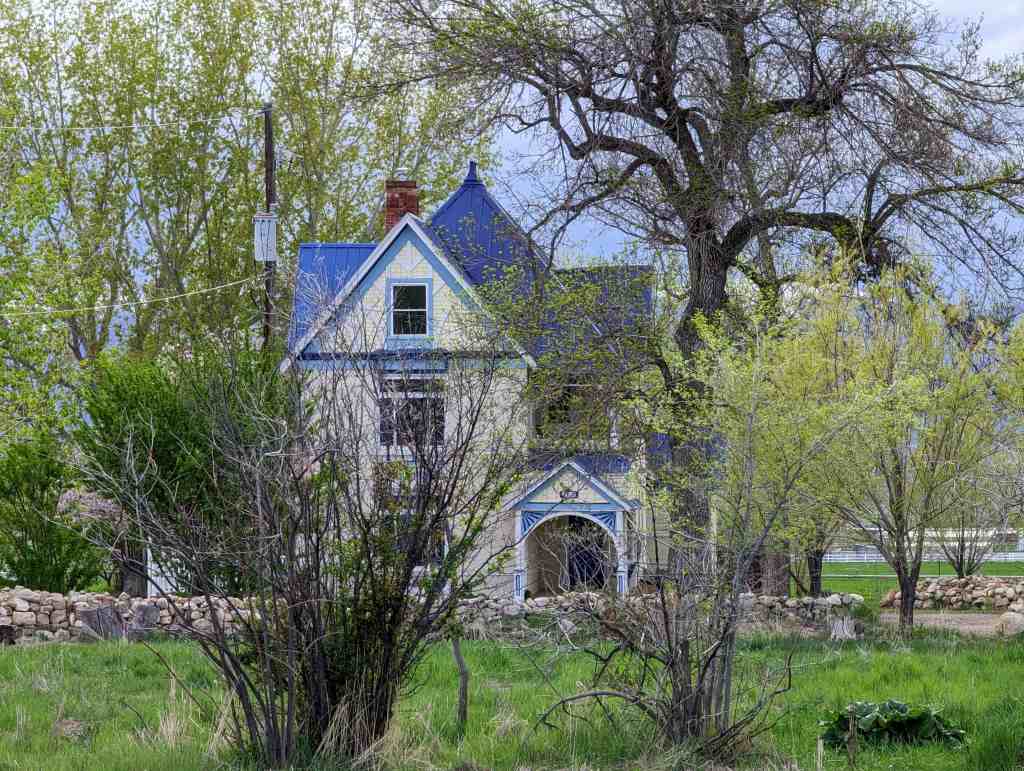
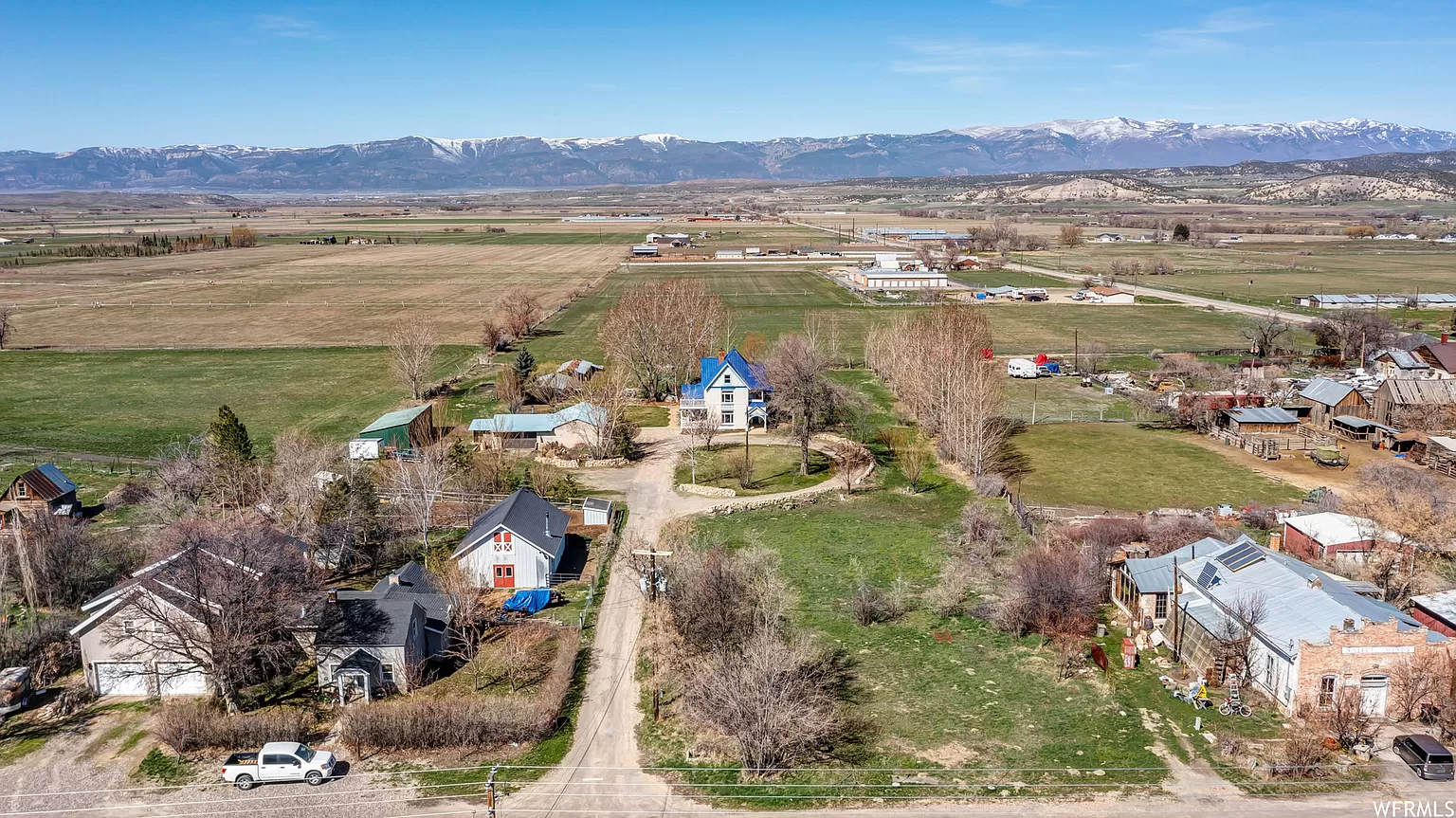
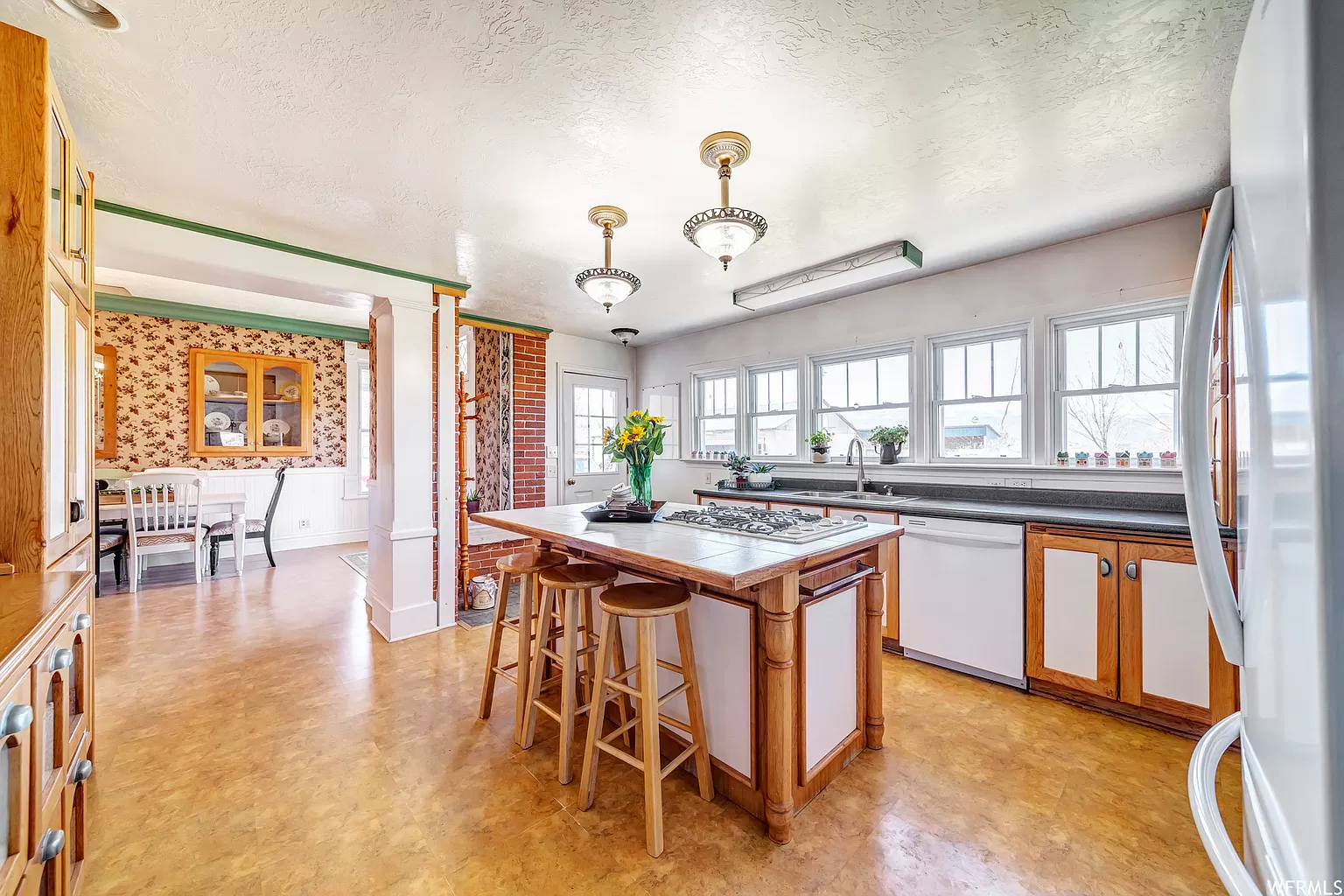
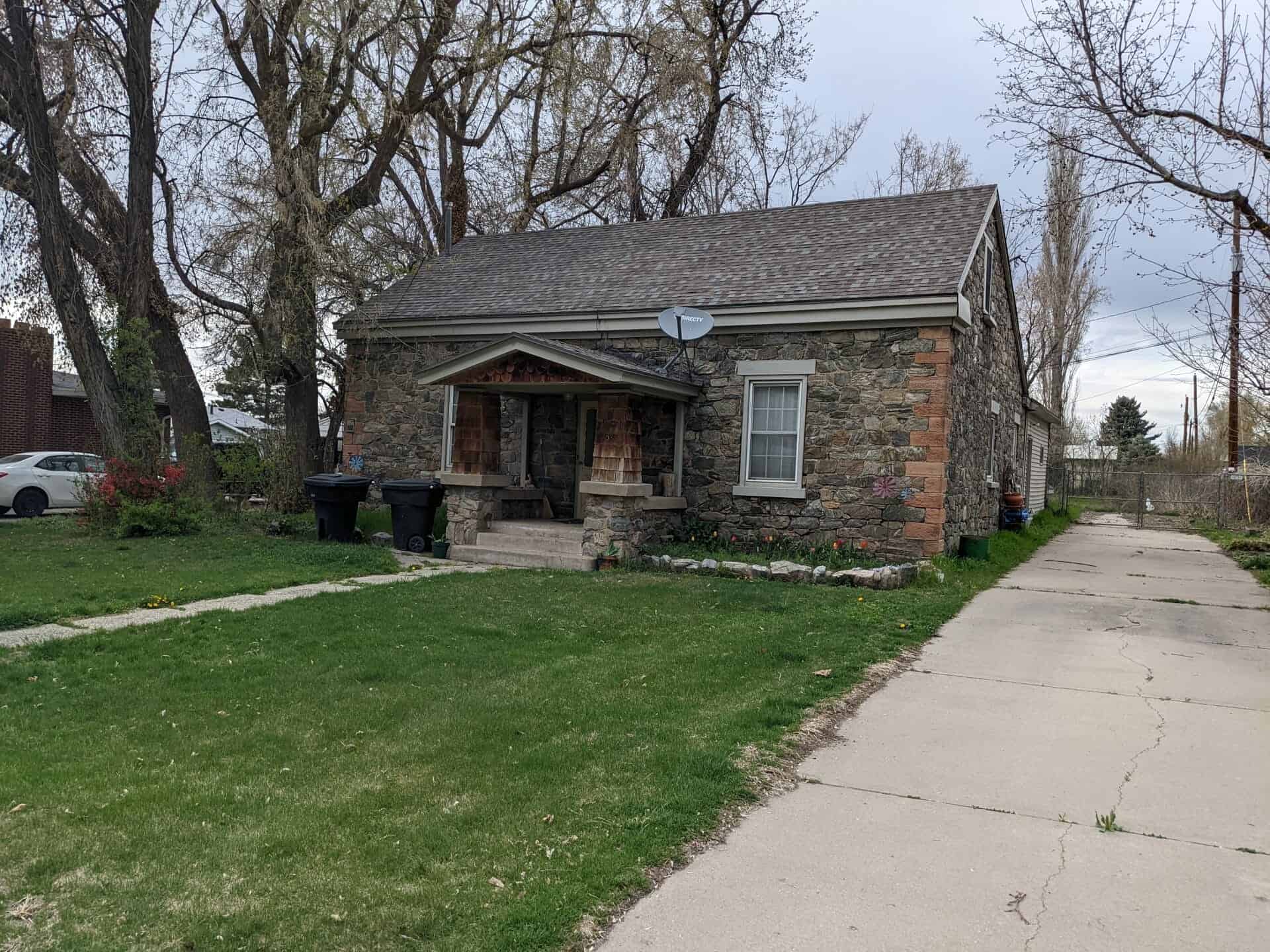
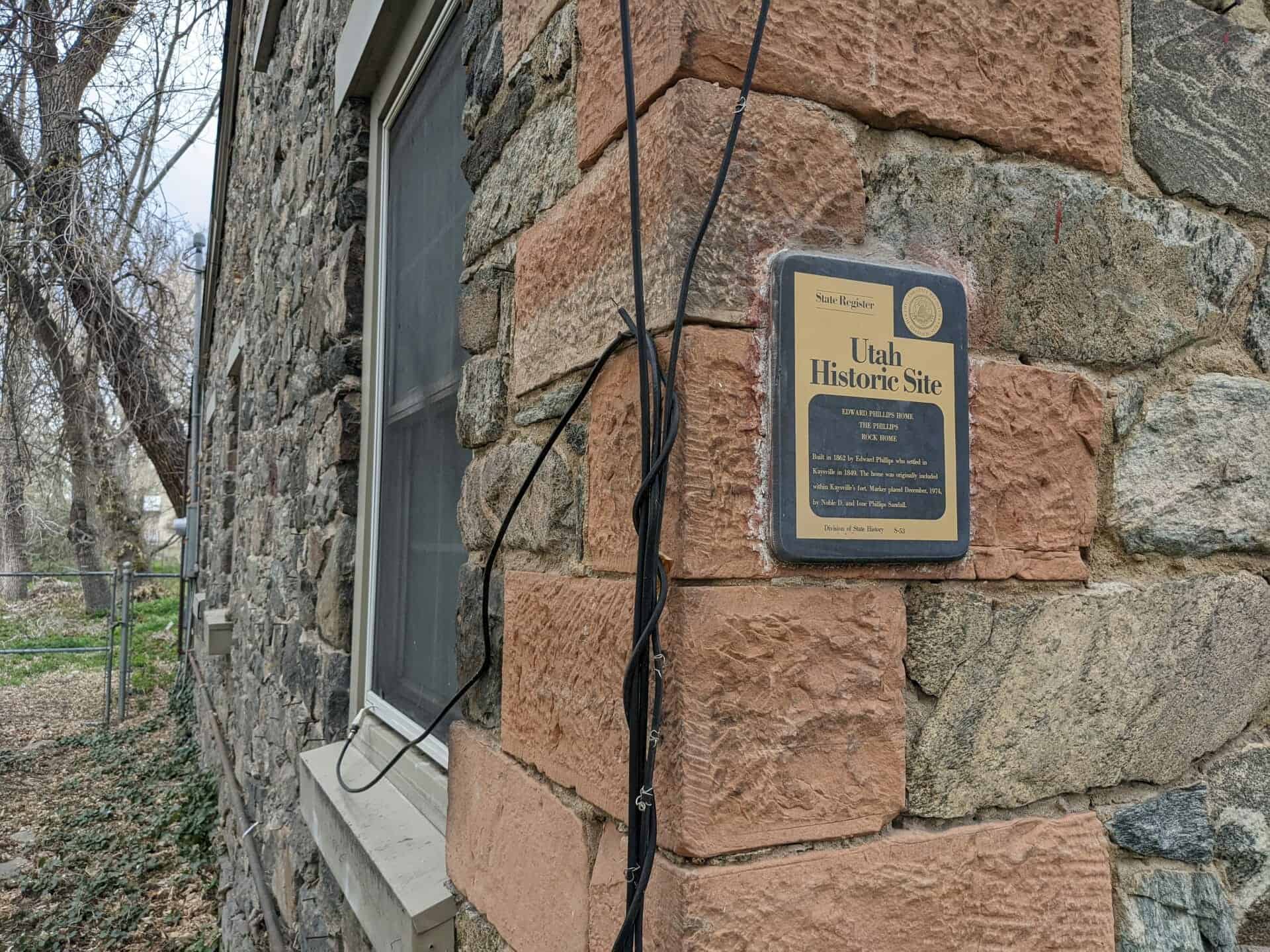
Constructed in 1904, this two-story brick Victorian residence was built for Frank M. Castleton. The home is of pattern book design and some of its key architectural details include its projecting bay, stone foundation, and windows with stone sills and wide lintels. For many years the original owner of the home, Mr. Castleton, helped run the family store, Castleton Brothers General Store, which was located nearby at 740 2nd Avenue. Mr. Castleton lived in the home until his death in 1943; his widow Louise remained in the home for several more years.
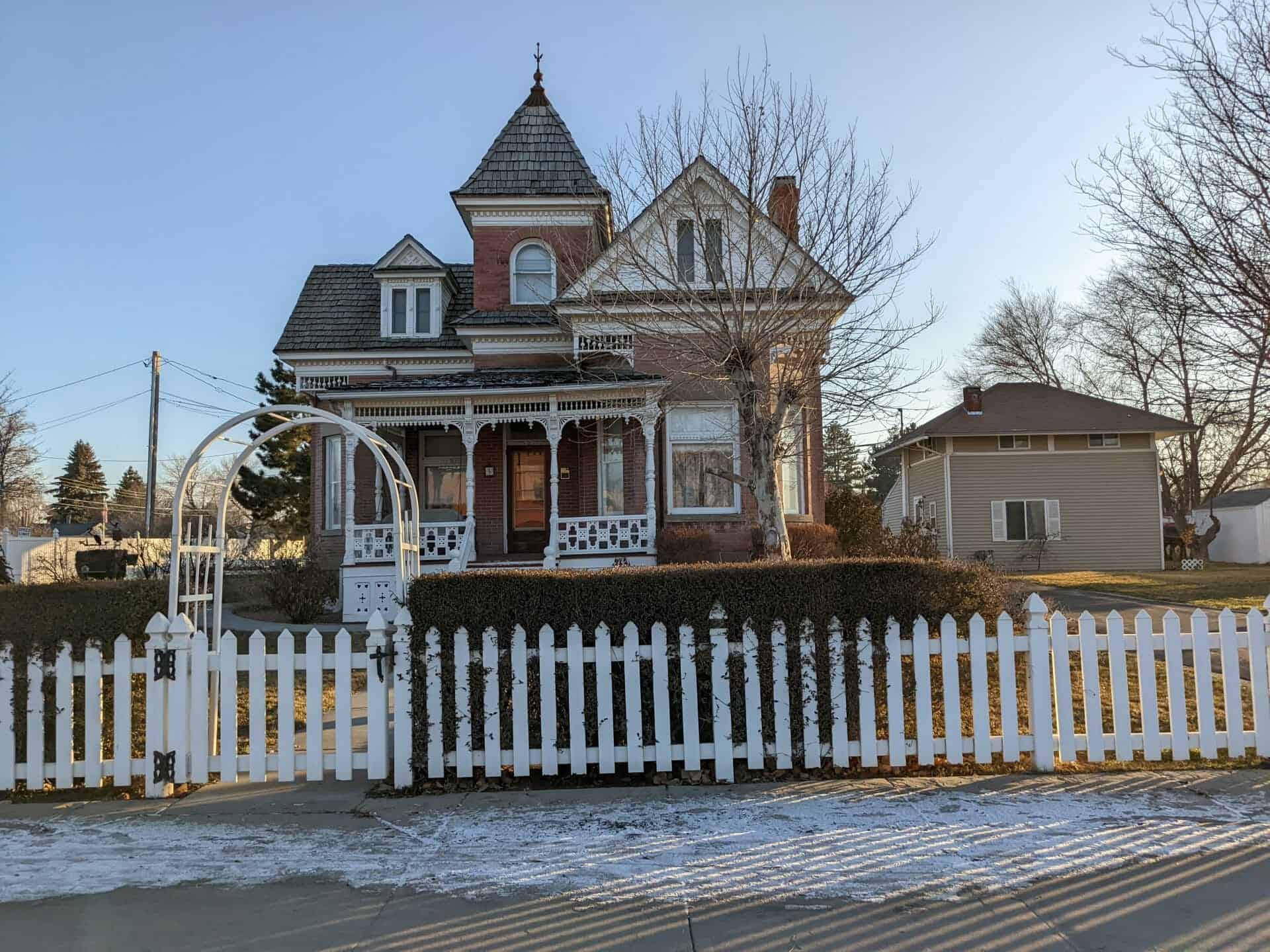
The Alex and Mary Alice Johnson House is located at the corner of Main Street and Hale Street in Grantsville. It is a one-and-one-half story brick home in the Queen Anne style built in 1900. The plan of the main floor gives the impression of a cross-wing house with a square tower at the intersection of the wings. However, more substantial than a typical cross-wing, it may also be considered a modified central-block with projecting bays. The house is on a one-half acre property with three outbuildings that retain their historic integrity but do not contribute to the historic significance of the house.
The house sits on a coursed rubble foundation. The masonry consists of two types of brick. It is faced with a fired red brick and lined with adobe. The courses are laid in a running bond with 4″ projections at the corners of the octagonal bays. The lintels, sills, and water table are of sandstone. The main floor fenestration is a combination of large fixed sash windows with transoms and smaller double-hung windows. There are paired double-hung windows in each of the four gable ends and the two small dormers. The tower has round arched windows, brick voussoirs, and decorative brick-work at the imposts. The tower’s pyramidal roof is capped with a metal finial.
Probably the most striking part of the house is the decorative woodwork, which according to one source, has always been painted white. The gable trim includes octagonal shingling with lozenge patternwork in the peak. Engaged pilasters with bracket “capitals” flank the windows. Similar details occur on the dormers. Dentils are found on the main cornice completely surrounding the house, as well as on the tower cornice. Corner brackets with lathe-turned spools and spindles occur at either side of the bays. The north and east porches are particularly elaborate. Each consists of lathe-turned columns and console brackets which support a spool and spindle frieze. Other decorative elements on the porches include dentils, fan-shaped brackets, pendants, and paterae. Scroll-cut woodwork is found on the balustrades and the base enclosure.
The principle elevations of the building have remained virtually unaltered since its construction. Minor alterations have been made to the rear, or south elevation, and concrete steps have been added to the east porch. A porch which spanned the length of the rear elevation was enclosed probably within a decade of the original construction. The east half of the porch was screened and the west half was fully enclosed to form a room. A doorway was cut from the main house to this room. In the 1950s, both the room and the screened porch were removed. They were replaced by a concrete porch supported by simple metal columns. Two other changes occurred in 1993: the cellar stair enclosure on the west elevation was repaired and the mid-century asphalt roof was replaced with wood shingles.
( This was added to the National Register of Historic Places (#95001433) on December 13, 1995 and is located at 5 West Main Street in Grantsville, Utah )
The interior of the house consists of several large well-lighted rooms with eleven-foot high ceilings. A small entrance foyer is at the base of the tower and contains separate doors to the dining room and parlor. The two rooms are also connected by a set of double doors. A large kitchen runs the east length of the house, with an enclosed staircase parallel to it. A second set of cellar stairs is found under the main staircase. The west side is separated into two smaller rooms: one was probably used as a bedroom, while the other was the family bathroom (the house was reportedly one of the first to have indoor plumbing in Grantsville). On the second floor there are four bedrooms, a nursery and a small office in the tower. The attic can be accessed from a trap door near the stairs.
Except for some changes in wallpaper and paint, the interior is in good historic condition. Some woodwork has been painted, however, most of the panelled doors, window casings, and other woodwork are stained and varnished. With one exception, both interior and exterior doors have working hopper transoms and all original hardware. Decorative elements at the doors and windows include corner blocks and paterae. Most of the glass appears to be original.
The house has a full fireplace in the parlor and stove-pipe flues in the kitchen and main floor bedroom. The parlor boasts a tall mirrored mantel with Ionic columns and a carved festoon/wreath. The interior is remarkably well-preserved. In the 1950s the kitchen was partitioned to create a laundry room and new appliances were added. There was also some work done to the kitchen in the 1970s. However, the original wainscotting is still visible on two sides of the room and only the lattice at the top of the partition seems out of period. The bathroom also contains fixtures from the 1950s remodel and includes the blocked door to the missing back room. Other than paint, wallpaper and new flooring, the second floor has seen little modification since a second bathroom was added in the 1950s. The house is still heated by its original boiler and radiators.
The site has three outbuildings which were used by the original household. The small pumphouse at the rear most likely dates to the original construction and supplied water to the house. A small chicken pen has been added to the pumphouse. In the southwest corner of the property sits a large framed three-car garage, built sometime after 1910. The garage also includes a room originally used as an icehouse. A two-story frame summerhouse sits west of the house, and was probably built after the garage (around 1915-1920). The main floor of this building served as a laundry and the upper floor was used for bedrooms. This building has been partially covered with aluminum siding and is currently rented as a residence. An L-shaped asphalt driveway covers a large portion of the property, but the remainder consists of trees, lawns, and flower beds. A rock garden and fountain have been built near the east porch. Sidewalks run from the perimeter to the north and east porches. The property has a combination of picket, post, and chain-link fences.
The Alex and Mary Alice Johnson House, built in 1900, is an excellent example of the Victorian Queen Anne style. This style of architecture documents an important period of growth in Utah. The design, though executed by a local builder influenced by pattern-books, combines a remarkable unity of composition with elaborate decoration. With its prominent position on Main Street, the Johnson House is one of the most distinctive architectural landmarks of Grantsville. Both the exterior and interior details of the home have been extraordinarily well-preserved. The house meets National Register Criterion C in the area of Architecture as the most outstanding example of a Queen Anne house in the community.
Alexander Johnson began construction on the home in 1899, just after his marriage to Mary Alice Anderson. Both were natives of Grantsville, born in 1870 and 1878 respectively. His parents were Charles Johnson and Charlotte Erickson, Swedish immigrants to Grantsville in 1863. Her parents were John Anderson and Mary Ann Clark. Alex and May built their house on the property was just south and across Main Street from the Deseret Mercantile (Johnson Hall) built in 1898, where Alex was engaged in the family business with his father and brothers. During his lifetime Alex also raised sheep, cattle, and horses. A successful businessman, he served as the director of the Grantsville Deseret Bank. He and his wife Alice were both members of the Church of Jesus Christ of Latter-day Saints (Mormon) and served the community in both church and civic positions.
The builder of the Johnson House was Charles Zephaniah Shaffer. He was born in Pennsylvania in 1842, listed as a carpenter in the 1900 business gazetteer, and died in 1904. Shaffer also constructed a Queen Anne home at 5 North Center Street. It is not known whether he was responsible for other Queen Anne homes in the Grantsville area. 2 The Johnson house contains all the characteristics of the style: an asymmetrical plan and façade, a variety of materials and textures, decorative shingling and brick, elaborate woodwork, and a tower.
Great care was taken in the construction of the house. According to Mildred J. Conway, a daughter of Alex and Mary Alice, each red brick, imported from California, came individually wrapped in paper. When completed in 1900 at a cost of $4,500, the home was one of the most elegant and modern (with its indoor plumbing) in the community. The ornate mantelpiece cost $75.
Alex and Mary Alice Johnson raised ten children in the home. In addition, they also took in Alex’s three nephews and a niece, who had been orphaned. The already spacious home was augmented by the building of the summerhouse, c.1920. The three-car garage was reportedly built for the four Model-T Fords the Johnsons acquired to transport their large family. Alex’s mother also lived with them and a room was built on the back porch for her. The home was literally at the center of community life in Grantsville. From his office at home in the second floor tower, Alex could view his mercantile business just across the street, known as Johnson Hall, and also used as at various times as the town’s bank, post office, and dance hall.
During the depression, with most of their children grown, Alex and Mary Alice took in boarders. Throughout the thirties and forties, the house was called the Lone Pine Tourist Home after the large pine tree in the front yard. Its distinctive architecture, its proximity to the Lincoln Highway, and a scarcity of housing near the Tooele Army Depot insured the lodge never lacked tenants.
Alex died in 1943 and Mary Alice in 1952. The Johnson’s daughter, Mildred J. Conway, moved into the house after her mother died. The few alterations which have made to the house were done while Mildred was the owner. She lived in the house until 1989 and died in 1991. In November of 1989, the house was sold to Grantsville natives, Gary and Janet Fawson. The Fawsons only lived in the house one month before moving to California. It was then used as a rental property. It was sold to Francis and Betty Menalis in October 1992. Betty had seen the house several years earlier and was determined to purchase it if ever it became available. She and her husband are committed to preserving and restoring the original appearance of the house, including re-roofing the house in 1993 with wood shingles. Betty has also been able to purchase some of the original furnishings and return them to the house.
Despite its use as a boarding house and a rental property, the Alex and Mary Alice Johnson house is in excellent condition and retains its historic integrity. This is due in part to its remaining in the same family for eighty-nine years, as well as the appreciation of subsequent owners of the artistic value of the architecture.
The Victorian Queen Anne style is reflective of changes that occurred in Utah near the turn of the century. The architecture in Utah was founded in American building traditions and the early builders had been, for the most part, isolated from the secular influences of much of the country and used established methods brought with them from their homes of origin. As Utah grew and became more integrated with non-Mormons, the architectural styles that were made popular through pattern books were readily available to Utah builders. The building boom of the 1880s and 1890s corresponded with the growth of the non-Mormon population in Utah and brought with it the opportunity to bring in new building traditions such as those published in the style books, popular in Utah during the late nineteenth and early twentieth centuries. With the introduction of plan books, “the former isolation of rural areas was no longer an obstacle to building due to the widespread dissemination of information and building materials.” Plan book Victorian stylistic features were based upon the use of multiple forms and elements and were probably influential in building the uniquely stylized, eclectic, Alex and Mary Johnson residence. The Queen Anne style is one of the most picturesque of the late-nineteenth-century styles and became the most popular style of the period in America. It was popular in Utah between 1885-1905.
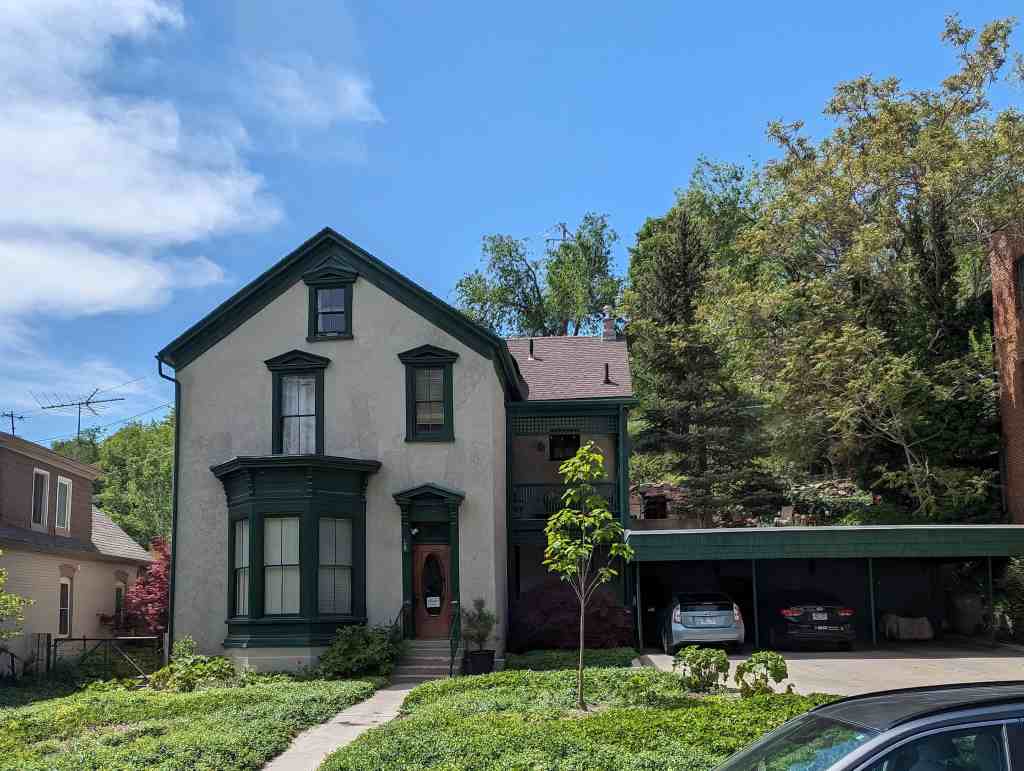
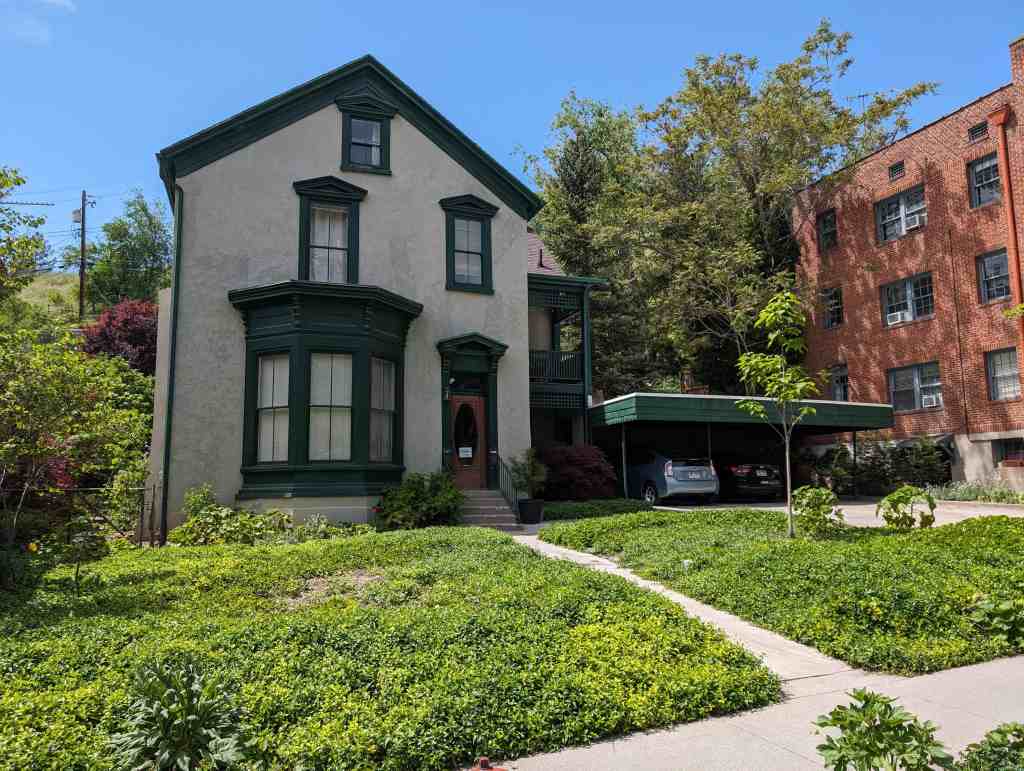
This two and one-half stone house is a good example of pre-Victorian high styled pioneer architecture. It has slanted bay windows with brackets and Greek Revival type wood lintel trim, quarter round windows in attic and plain frieze and cornice. There is an oval pane front door. The roof is gable and the plan is L-shape.
A carport has been added, and the stucco wall and two story porch are intrusions. But despite intrusions it is a good example of design and craftsmanship of the late pioneer period.
Erastus Snow, an early Utah pioneer and LDS Church apostle, built this home for his second wife, Minerva White. She was a close friend of his first wife, Artimesia Beman. The house, which was built in 1888, is a good example of pre-Victorian high styled pioneer architecture.
Minerva Snow was born in Massachusetts in 1822. She and her mother joined the Mormon Church when Minerva was eighteen years old. She married Erastus Snow on April 2, 1844. She came to Salt Lake Valley in 1848. In 1861, she went to Southern Utah with her husband and families. She served in the Relief Society in St. George.
She moved to Salt Lake and Snow built this house for her. She was a counselor in the Relief Society in the Eighteenth ward while she lived here.
Erastus Snow-came to Salt Lake in 1888 and stayed in this house. He was living here when he died May 27, 1888. Shortly after her husband’s death, Snow was called to go to Manti to work in the temple.
Franklin Richards Snow, son of Erastus and Artimesia Beman, lived in this home for a number of years until his home on the other side of Canyon Road was finished.
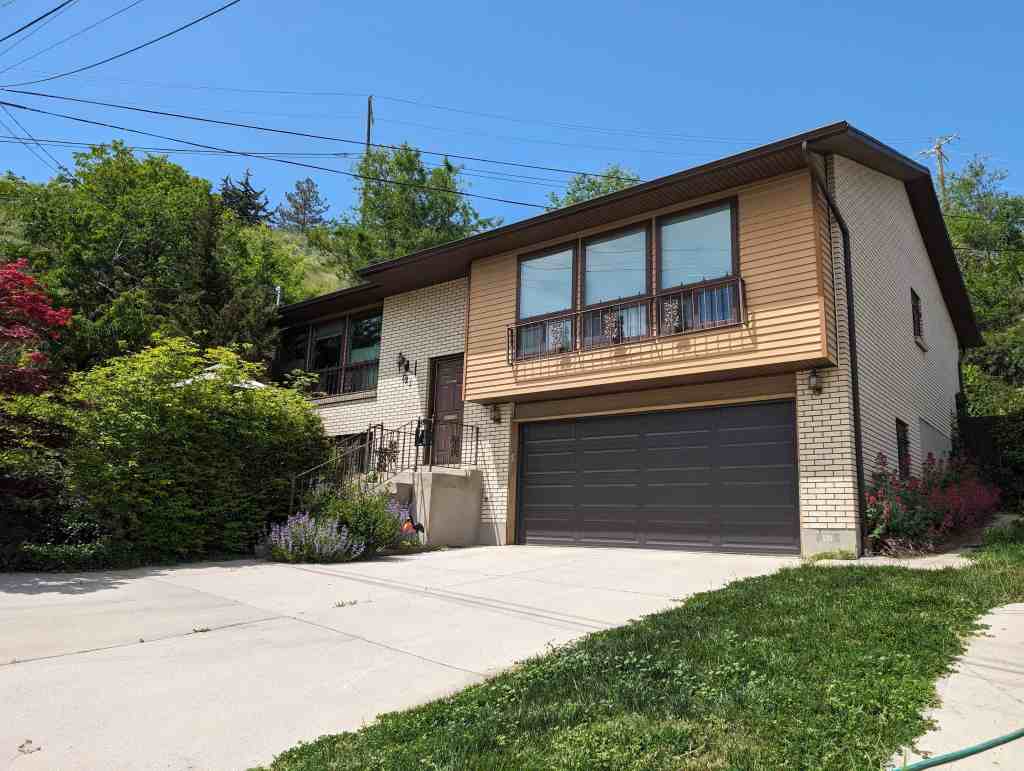
This one and a-half story house has been altered and siding added so it is hard to recognize. The roof is hipped.
This 1897 house pattern book house has been so altered that it is hard to recognize the original character. However, the general style still contributes to the historic character of the district.
Brigamina N. Pratt, the widow of Parley P. Pratt, Jr. lived in this home and rented the one next to it. She was a resident of Salt Lake City for forty years, and a Relief Society worker.
Traveling mason and plasterer George Dunford built at least three rock homes in Wanship as well as the rock schoolhouse (ca 1879-1912) and the original brick LDS church (1887-1958). He apparently built his home in three sections beginning about 1860 with the rear single-room house. A front addition and cross-wing turned the home into the L-shaped house evident today. Each section was constructed of local stone with 18-inch thick walls. Joshua and Delpha Stewart Pendleton purchased the stone house in 1890 for eleven hundred dollars. By 1880, Wanship had become a crossroads for east/west railroad traffic and wagon traffic south to the Kamas Valley. Augmenting his blacksmith business, Pendleton added a wooden structure to the home’s street façade to serve as a store, post office and restaurant. During summer months, Delpha cooked meals for travelers on an outdoor wood stove. One month before she died in 1937, Delpha sold the home to her oldest son, William, who continued to live in the home with his wife, Millie Irene Lee. In 1987 Dale Nelson purchased the homestead including the house, outbuildings and blacksmith shop, to provide storage for his many historic stagecoaches, hay wagons, fire engines and other large artifacts. It became affectionately known as “Dale’s roadside attraction” on the old Lincoln Highway.
Located at 30049 Old Lincoln Highway in Wanship, Utah
This 2 1/2 story brick home was built in 1895. Its site orientation is unusual, being set far back from the street down a long driveway. The English Tudor half-timbering is also unusual in a house that is otherwise Victorian-influenced, as evident from the front portico, large front windows, south bay window and multiple gables. The home has beautiful hand-grained woodwork in the stairway and hall. The foundation is reportedly unique in that the stones below ground are not cemented but laid loosely to support the house and keep it level. A fireplace, in the central room, was designed with an air intake pipe that brought in outside air and heated it in pipes in the back of the fireplace, then carried it to two of the upstairs rooms. That has been replaced by a modern heating system.
This home is located at 598 West 100 South in Mount Pleasant, Utah
The below documentation and timeline were borrowed from this page:
The Henry H. Blood House was built about 1896. The house is important because of its association with Henry H. Blood, prominent Davis County Businessman and Governor of Utah from 1933 to 1940. The house was designed and built by William Allen. One of Utah’s most prominent architects, Allen designed many Davis County buildings although he was largely self-trained. Architecturally the house remains intact and sound and is an illustrative model of the late nineteenth century architectural tradition.
Henry H. Blood was born October 1, 1872 in Kaysville, Utah. The son of William Blood and Jane Wilkie Hooper, Henry H. Blood worked on his fathers farm and attended school until 1901 when he left to serve a mission for the Church of Jesus Christ Of latter-day Saints in England. After returning home in 1904 he taught one year at the Brigham Young College in Logan then in June 1905 accepted a position of secretary, treasurer and manager of the Kaysville Milling Company.
Henry H. Blood married Minnie A. Barnes June 4, 1896. A native of Kaysville, she was born the day after Henry Blood, October 2, 1872. They had four children, two sons and two daughters. Their house in Kaysville was apparently constructed shortly before or after their marriage in 1896. The lot in which the house is constructed was acquired by Henry Blood’s father, William Blood, in 1890 and sold to Henry in April 1895 for $200.
Architect for the house was William Allen. Born January 1, 1870 in London England, Allen left England in 1862 at the age of 12 and arrived in Utah in 1863. He moved to Kaysville where he remained until his death on October 11, 1928. Allen worked as a farmhand then followed the trade of his father as a brick mason. He studied architecture and drafting by correspondence; and became Davis County’s most prominent architect. In addition to the Henry H. Blood house, he designed the Kaysville Presbyterian Church, (1888) Davis County Courthouse (1889-90), Barnes Brick Building (1910), Kaysville Tabernacle (1912), Kaysville Elementary School (1918) and homes for John R. Barnes, John G.M. Barnes, Hyurum Stewart, James Smith, John Barton and his own home. Davis County, with its emphasis on agriculture was not a highly prosperous area of the state and the Henry H. Blood home, along with the John G.M. Barnes home is one of the largest and most elaborate homes in Kaysville.
Henry Blood did not aspire to the Governorship until fellow Democrats urged him to seek the nomination in the best interest of the party. Entering the race three weeks before the State Democratic Convention, Blood succeeded in overtaking Clarence Neslen, former State Legislator and Salt Lake City Mayor, and won the nomination 463 votes to Neslen’s 337.
The election of Henry H. Blood and other Democratic candidates for State and National offices in Utah was the result of the strong appeal of Franklin D. Roosevelt. In Utah Roosevelt received 116,750 votes while Blood’s total was 116,031. Blood’s Republican opponent, William W. Seegmiller received 85,913 votes. In 1936 Blood won re-election with 109,656 votes compared with 80,118 votes for Ray E. Dillman a Republican and 24,754 for Herman W. Perry and Independent candidate. Despite the efforts of many, Blood declined to run for a third term in 1940.
As Governor Henry Blood adopted a conservative fiscal philosophy along with a whole hearted acceptance of the New Deal Programs. While drastically cutting state expenditures, except for welfare for which he secured the passage of a 2% sales tax, Blood actively sought Federal funds for Relief Projects. He recognized that the depression was caused by under-consumption rather than over production and since the state could not inflate currency by fiscal or monetary policies as the Federal Government could he saw his role as an executor of Federal Relief projects. Thus he made many trips to Washington in the interests of Utah Relief Projects. Blood found strong resistance to proposed Reclamation Projects, nevertheless, he and other Utah officials were persistent in behalf of the State’s interests. Harold Ickes, director of the Public Water Administration wrote,
“A delegation from Utah, headed by Secretary Dern, and including Governor Blood, came in to nag again about some Reclamation Projects for this state. This group has been hanging about Washington for more than three weeks. At intervals they came to see me, then they go to see Colonel Waite (Ickes second-in-command) and then they go over to the White House. They seem to be proceeding on the theory that they can just wear down our resistance and get what they want.“
To New Deal Administrators Utah’s request for funds for reclamation projects, which would serve to increase Utah’s agricultural capabilities, seemed incongruous with the New Deal Agricultural program to resist production. Nevertheless, Blood’s efforts were successful and several important reclamation projects including the Deer Creek and Moon Lake projects were undertaken.
While seeking every possible Federal dollar for his state, Blood emphasized that his efforts depended, in large measure, on a strong relief commitment from the State. He strongly advocated the 2% sales tax for welfare relief at the same time he drastically reduced state expenditures with a program of economy, retrenchment and curtailment of services. By the end of his second term, he had reduced the states net $3,655,000.
With 33,000 Utah families on relief in 1933 economics was the prime career of Blood during hte 1930s. However other issues were also important during Blood’s administration.
The repeal of the 18th Amendment was a difficult issue for Blood. As a loyal member of the Church of Jesus Christ of Latter-day Saints he was opposed to the consumption of alcohol and supportive of prohibition. Nevertheless, it was apparent that Utah’s citizens favored repeal and on November 6, 1933 Blood telegraphed President Roosevelt that Utah had become the 36th state to ratify the Twenty-first amendment.
Another issue was the attempt by the National Miners Union to secure control of Utah’s Coal fields. In open conflict with the United Mine Workers of America, the National Miners Union were pro-communist and advocated what others felt were extreme measures to meet the needs of Utah’s coal miners. When a strike broke out, Blood, well aware of the potential financial cost to the state, refused to call out the National Guard as his predecessors had done in similar labor difficulties and insisted that local officials handle the situation.
Henry Blood was also the first Governor to occupy the Thomas Kearns Mansion the present official Governor’s Residence.
In reflecting on Blood’s career as Governor, his biographer wrote: “It must said, the Blood was not a ‘popular ‘ governor. The people’s reaction to him was not one of great emotionalism. He was admired and respected but not loved, and he had no sizable personal following among the electorate. One astute political observer doubted that Blood could have been elected governor on his own, that is, if there had been no depression a factor beneficial to virtually all Democratic candidates.“
“Carried into office by the tide of history or not, Blood was the governor and an outstanding one during these crucial years…he was outstanding in his capacity for work; his total immersion in the day-in, day-out grind of overseeing state government attests to this. Secondly, he was outstanding in that if there was any possibility of receiving aid from Washington or of increasing the flow of monies he spared no effort. Though some might feel that his assiduous pursuit of the federal dollar somehow represents a compromise with his own financial conservativeness, this writer does not. One may practice frugality and humanitarian ism at one and the same time without conflict. As long as people were suffering, and as long as their suffering might be relieved somewhat by the soothing balm of federal aid his willingness, even eagerness, to initiate or to enhance the stream of cash into Utah is considered human and wise. If he had spurned aid from the federal government which unlike the state can “create” funds by the stroke of a pen he would have been derelict in his duty as governor and as a human being. On the other hand, Blood has nothing to do with the creation of the New Deal, and his statements and actions during the period prior to the inauguration of Franklin Roosevelt make clear that he had no intentions of foreshadowing the president’s program on a state level. Blood was no innovator or original thinker in the area of social and economic equality. As has been stated before, he was merely the expediter of federal programs within his state, but he did that well and willingly. He accepted the necessity of those parts of the New Deal which provided work, money, and goods for the jobless and destitute.“
In 1941 Henry Blood was called by IDS Church leaders to serve as President of the California Mission. On June 19, 1942 he died in a Salt Lake City Hospital of a cerebral hemorrhage and pneumonia. In October 1942 Mrs. Blood deeded the home to her daughter Evelyn B. Sims. In 1947 ownership of the home passed from the Blood family to Bimden and Ila Cottrell. In October 1961 the Cottrells sold the home to LeGrande Evans. In 1963 Evans sold the house to Donna H. MsCowen and in June 1971 Mr. MsCowan sold the house to the present owners Dennis and Genene Hill. The house is well maintained and continues to function as a residence.
Henry Blood’s home in Kaysville is a two story structure in the Queen Anne style. It was designed by William Allen, a largely self-trained architect/brick mason who worked extensively in Davis County. Allen’s influence may be seen in other substantial brick and stone homes in Kaysville.
Begun ca 1896 (possibly as early as 1895) the original house was a multiple hipped roof structure, square in general plan. An octagonal corner tower, side bays and hipped dormers vitalized the scheme.
Victorian exterior ornament abounds. Carved segmental window insets, turnings of porch elements and dormer ornament are fanciful Queen Anne characteristics.
In 1915 the home was extensively enlarged with a rear addition. With this addition a new kitchen, pantry and screen porch were added on the ground floor and bedrooms on the second floor. ‘The original kitchen became a dining room. This extension was sympathetic to the original in scale, proportions, materials and detail. The rear dormer dating from this period is a facsimile of the originals. A hipped roof porch off the kitchen entrance has Tuscan supports and a low balustrade.
The interior of the hone retains its original integrity, and reflects the high Victorian style. The 1915 addition was as compatible and well-executed inside as it was outside, though the interior details reflected the Classical Revival style of the period and not the earlier Victorian exuberance.
Door and window surrounds are wide molded elements in the period fashion. Rectangular terminations contain circular molded or floral motifs. Doors have molded panels. Brass door hardware is extant. Sconces and girandoles for electric lights date from an early period, though possibly not original. The Dado of the dining room is Linerusta Walton molded in a low relief pattern.
The parlor fireplace displays Adamesque characteristics in the proportions of the flanking capitols and the applied swags. Elegantly carved, the oak balustrade of the stairway exhibits the eclectic tendencies of Victorian interior design.
Constructed in 1922 for notable Utah painter LeConte Stewart, this 1 1/2-story cottage was designed in the English Tudor Revival style by prominent Utah architects Harold Burton and Hyrum Pope. The house and the remainder of the buildings on the property, including the art studio, maintain their architectural integrity.
LeConte Stewart played a major role in the evolution of regional landscape painting in Utah and made major contributions to art education in the Salt Lake valley, Davis County, and Ogden. By the time the Stewart family moved into the house in January of 1923, he was already well-established as an artist. He lived in this house – the only home he ever owned – from 1923 until his death in 1990. As the place where LeConte Stewart created most of his work, the home and studio represent his art and the landscape that gave him his greatest inspiration.