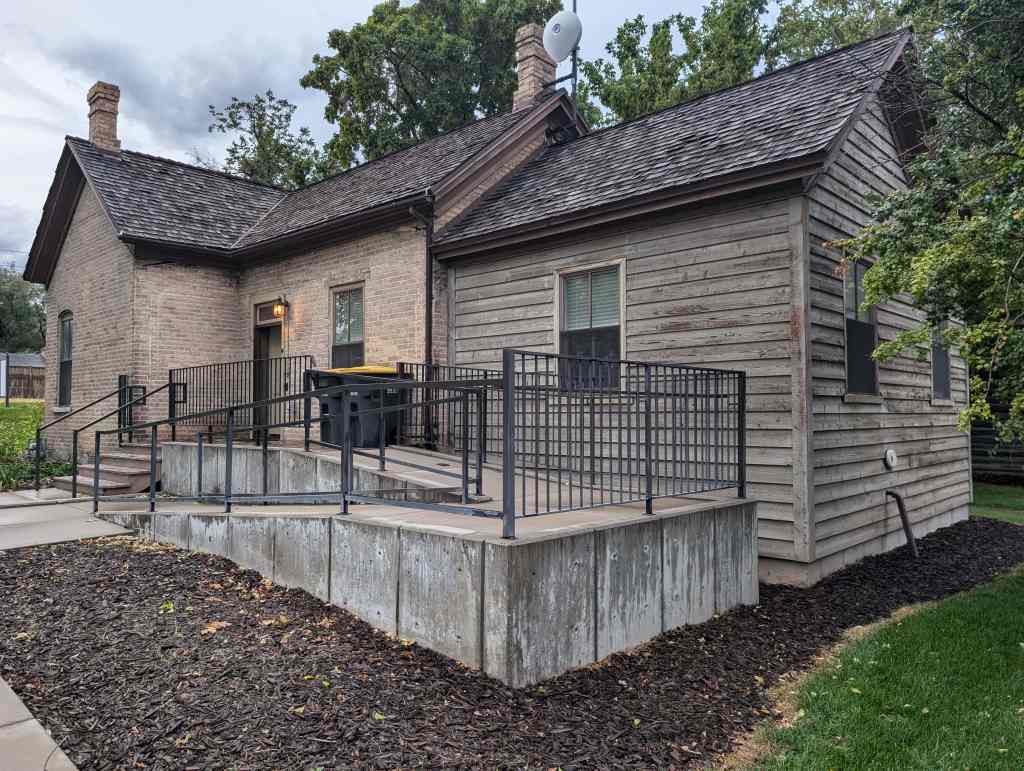
This home off 1700 South in Salt Lake was built in 1894 for William and Margaret Ann Cornick. Margaret’s brother, Seth Rigby, had previously owned the land where the home was built. They operated a farm on the remaining Rigby property. ⠀⠀⠀⠀⠀⠀⠀⠀⠀ William and Margaret Ann raised three children in this home. After their passing, their son Clyde and his wife Ruby took over the home. They added on a brick sunporch during their tenure. Ruby ended up dying on the sunporch at age 90. ⠀⠀⠀⠀⠀⠀⠀⠀⠀ The property used to contain a two-story barn with a hayloft, a toolshed, a chicken coop and a vegetable garden. All of these elements have since been removed. ⠀⠀⠀⠀⠀⠀⠀⠀⠀ The home has since become an office space and is now surrounded by other commercial buildings, but still maintains its historic charm.
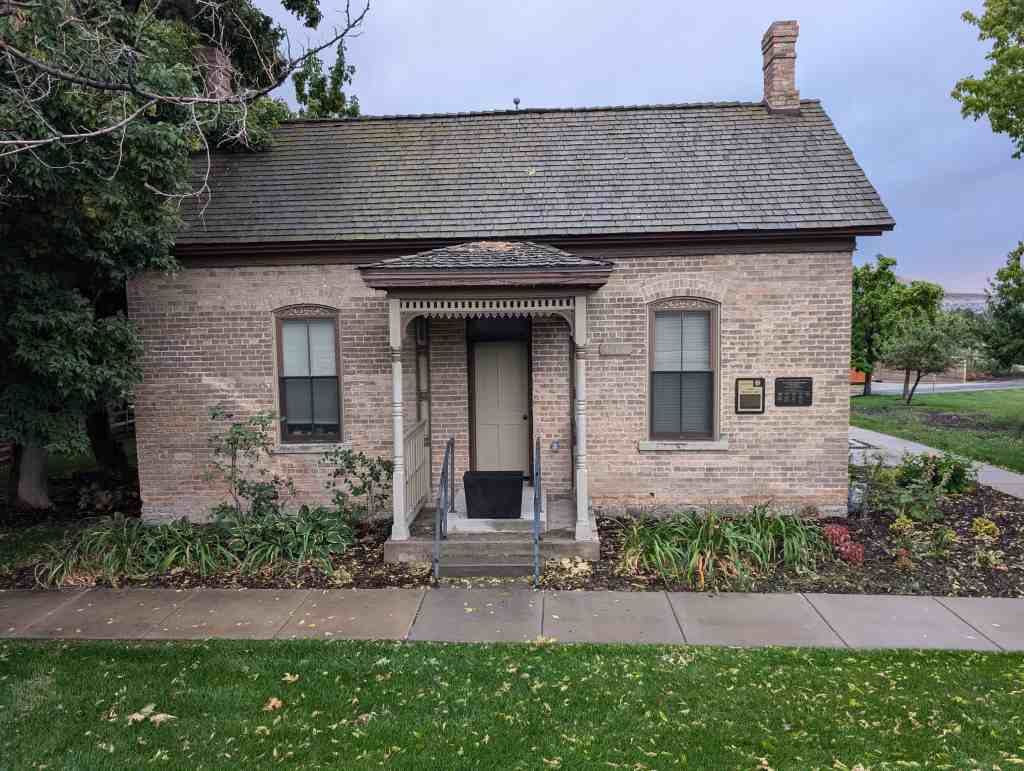
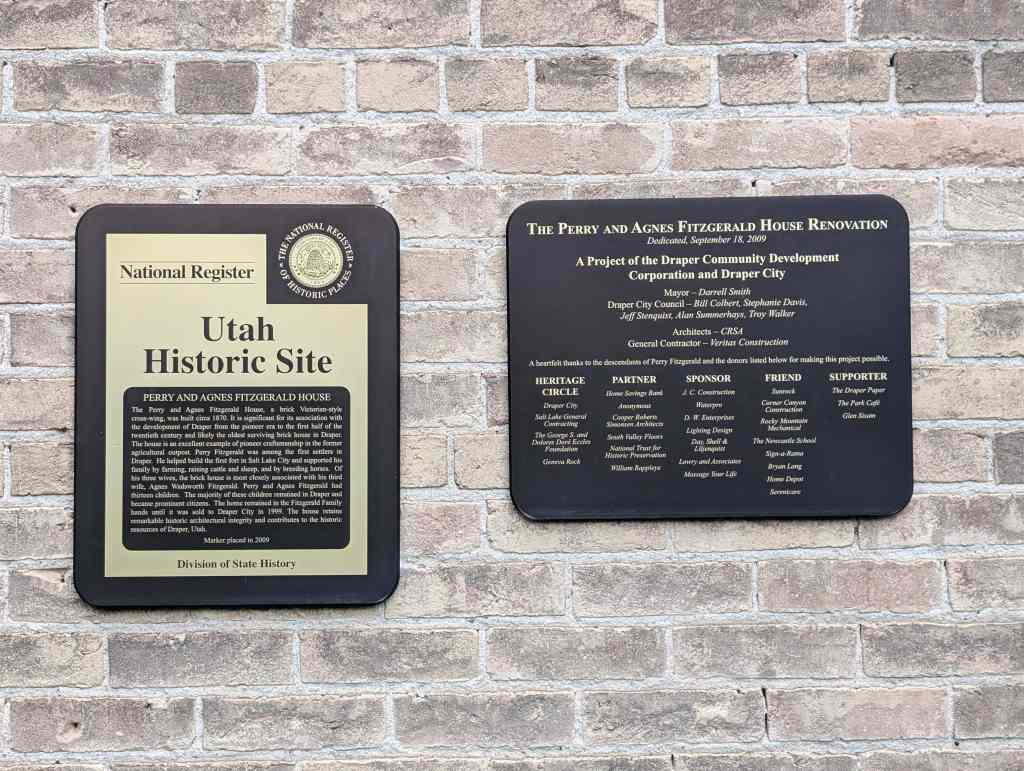
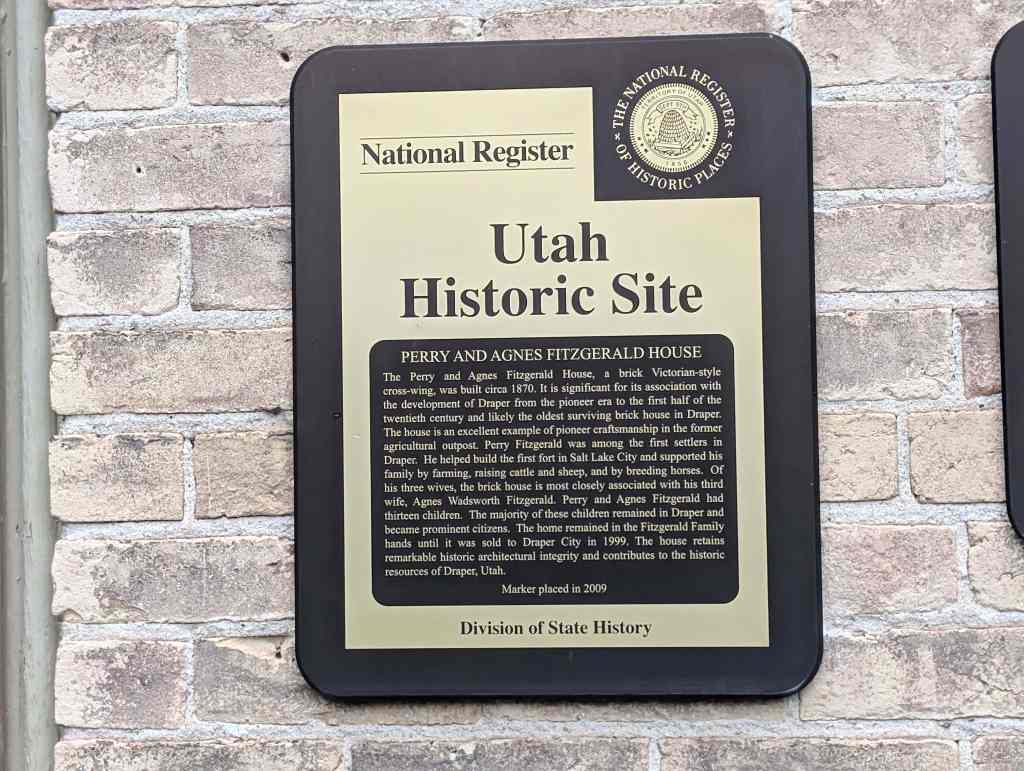
The Perry and Agnes Fitzgerald House, a brick Victorian-style cross-wing, was built circa 1870. It is significant for its association with the development of Draper from the pioneer era to the first half of the twentieth century and likely the oldest surviving brick house in Draper.
The house is an excellent example of pioneer craftsmanship in the former agricultural outpost. Perry Fitzgerald was among the first settlers in Draper. He helped built the first fort in Salt Lake City and supported his family by farming, raising cattle and sheep, and by breeding horses. Of his three wives, the brick house is most closely associated with his third wife, Agnes Wadsworth Fitzgerald. Perry and Agnes Fitzgerald had thirteen children. The majority of these children remained in Draper and became prominent citizens. The home remained in the Fitzgerald family hands until it was sold to Draper City in 1999. The house retains remarkable historic architectural integrity and contributes to the historic resources of Draper, Utah.
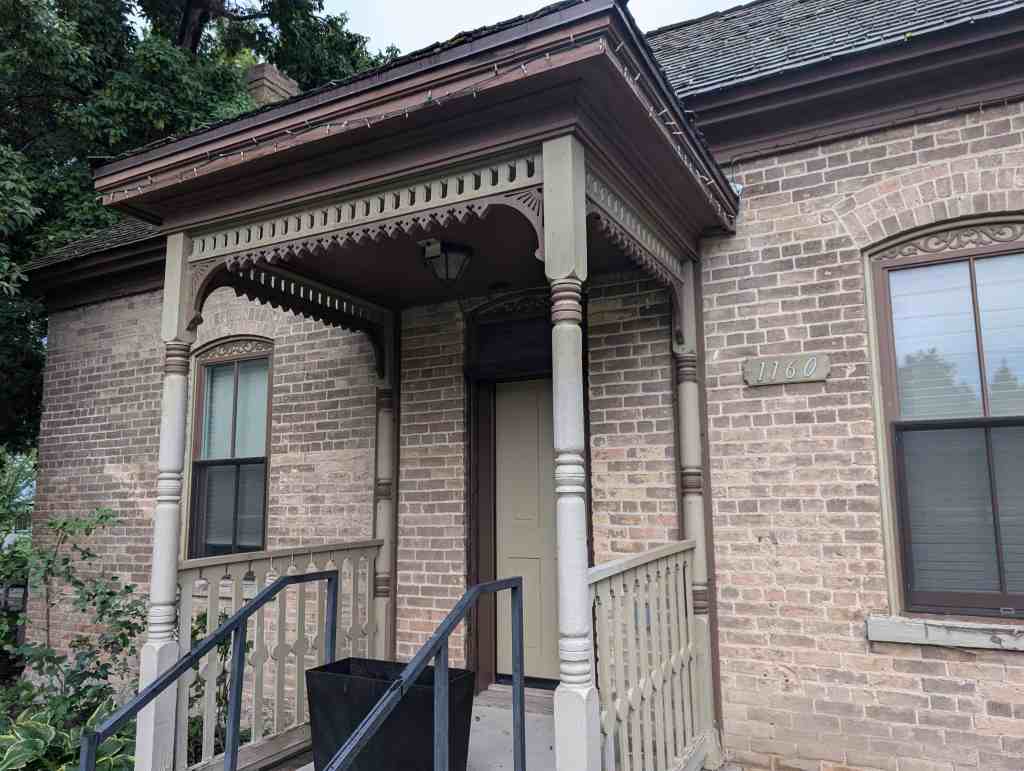
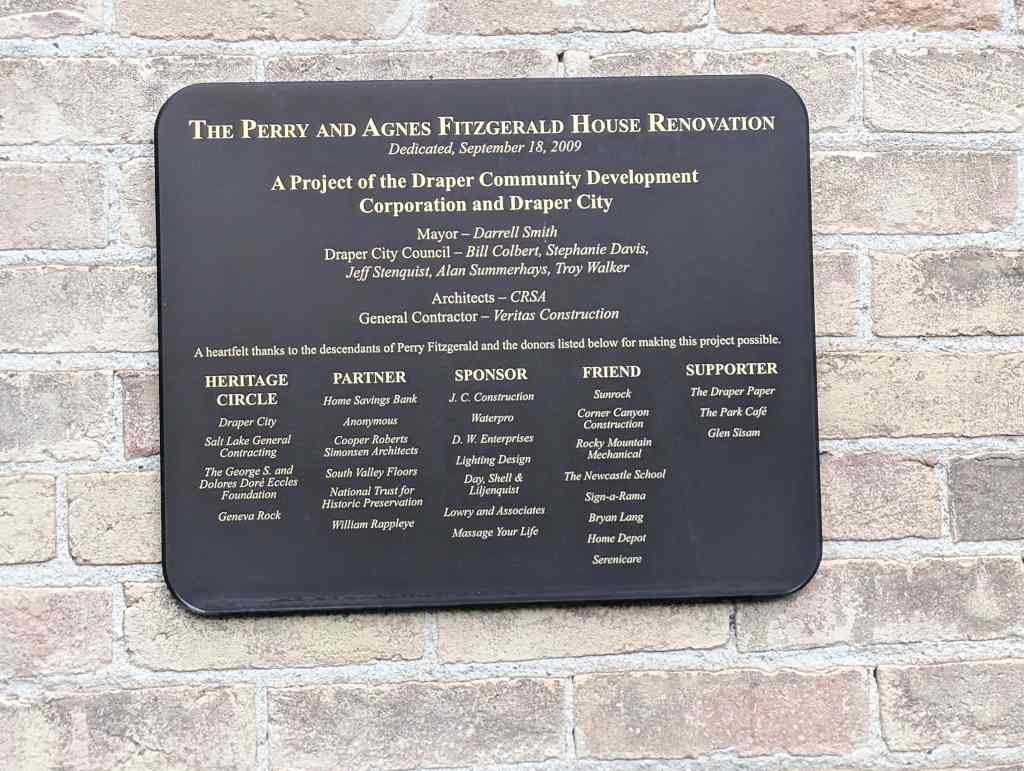
The home is located in Draper Pioneer Square at 1160 East Pioneer Road in Draper, Utah and was added to the National Register of Historic Places (#04000404) on May 6th, 2004.
Narrative Statement of Significance
The Perry and Agnes Fitzgerald House, a brick Victorian-style crosswing, built circa 1870, is significant under Criterion A for its association with the development of Draper from the pioneer era to the first half of the twentieth century. It is also significant under Criterion C as the oldest surviving brick house in Draper and an excellent example of pioneer craftsmanship in the former agricultural outpost. The house is eligible under the Multiple Property Listing, Historic Resources of Draper, 1848-1954. The primary associated historic context is the “Early Settlement Period, 1848-1876.” Perry Fitzgerald was among the first settlers in Draper. Of his three wives, the brick house is most closely associated with his third wife, Agnes Wadsworth Fitzgerald. Perry and Agnes Fitzgerald had thirteen children. The majority of these children remained in Draper and became prominent citizens. The house retains remarkable historic integrity. The Fitzgerald House contributes to the historic resources of Draper, Utah.
History of the Perry and Agnes Wadsworth Fitzgerald House
Perry Fitzgerald was born in Fayette County, Pennsylvania on December 22, 1815. When he was about 20 years old, he moved to Vermillion, Illinois, where he met and married Mary Ann Casot in 1839. Mary Ann was born in Kentucky on September 30, 1821. In 1842 the couple became members of the Church of Jesus Christ of Latter-day Saints (LDS or Mormon Church). They moved to Nauvoo where the church had its headquarters. When the church members began their exodus from Nauvoo to the Salt Lake valley, Perry Fitzgerald was chosen by church leader Brigham Young to serve as a guide in the first pioneer company. Perry left Mary Ann and his oldest son, John, to follow with the main body of the church. Two other sons had died from cholera.
Perry Fitzgerald helped to build the first fort in Salt Lake City. After the family was reunited, they moved from Salt Lake to the Millcreek area, ten miles south and east of Salt Lake City where they spent two winters. Two more sons, Manesseh, and Perry Jr., were born there. The family is listed on the 1850 census in Draper, a settlement at the southeast end of the valley known as Willow Creek. Mary Ann Fitzgerald died on April 19, 1851, probably in Millcreek, Utah. Elizabeth Shipley took the boys to care for at her home in Draper. Family tradition states that, after Mary Ann’s death, Perry Fitzgerald moved permanently to Draper. He built a three-room log cabin on the north banks of the Willow Creek and homesteaded a parcel of farmland in the area between what is now 12400 South and 13100 South. In late 1851, Perry Fitzgerald married Ann Wilson (the exact date is unknown). Ann Wilson was born in England on November 10, 1812. Ann Fitzgerald had two daughters, Mary Ann (born in 1852 and probably named for Mary Ann Casot) and Alfreda (born in 1854).
Around 1852, Agnes Wadsworth, a young convert to the LDS Church, moved to Draper and worked as a nanny in the Fitzgerald home. Agnes Wadsworth was born in Manchester, England on July 30, 1836. Perry Fitzgerald married Agnes Wadsworth on March 21,1853, within the then church-sanctioned system of polygamy. Agnes Fitzgerald bore thirteen children between 1854 and 1879, and remarkably for the time period, all lived to maturity, married and had children of their own. Indeed, Agnes was considered to have some healing powers in the community, due to the fact that her children survived several epidemics. During the late 1850s, Perry Fitzgerald and his son John, assumed military duties during the Utah War and the Walker Indian War. The Fitzgerald household is all under one roof, the log cabin, on the 1860 census enumeration. The log cabin had three rooms, a loft and a fire pit. After a particularly fierce storm in the early 1860s, the cabin was flooded by the creek and moved to higher ground close to where the brick house would be located. The log cabin later was used as a barn and outbuilding. According to various sources, Perry Fitzgerald built the brick house either during or just after the Civil War. The family claims it was the first brick home built south of Midvale. While this claim is uncertain, the Fitzgerald house is one of the oldest surviving brick homes in Draper.
Perry Fitzgerald supported his large family by farming and raising cattle and sheep. He was also a horse breeder. He had a large holding that required hired hands (two are listed on the 1860 and 1870 census enumerations) as well as his grown sons. The 1870 census enumeration taken in September records Perry, Agnes and her children in the household Ann Wilson Fitzgerald and her teenage daughters do not appear in the census records, and it is unclear whether Ann had her own dwelling by the time the brick house was built. If not, she lived in the brick house only for a few years. She died on November 21, 1870, in Draper. Agnes Fitzgerald’s third son, born in 1864, was given Wilson as his middle name, so it is presumed the two wives had a good relationship.
Agnes Fitzgerald was associated with the house through most of her life and bore probably half her children in the home. The Fitzgerald home was known as a haven in the community. One evening, Orrin Porter Rockwell, a bodyguard to Brigham Young, rode to Draper pursued by a posse. Porter asked his friend Perry Fitzgerald to hide him, so Perry turned his back on Porter and pointed with his hand to a thicket where Porter could safely hide. Minutes later Perry Fitzgerald truthfully informed the posse that Porter had been there, but didn’t see which way he went. 3 Though Perry Fitzgerald was a faithful church attendee, many of his children were more relaxed and numerous young people in Draper would congregate at the Fitzgerald home on Sundays. One writer records “there were more wagons and horses at the Fitzgerald’s than at church. If Agnes would insist on taking all those who would come to her home and lead them down to church, it would fill the meeting house.”
After suffering from back pain for several years, Perry Fitzgerald died in his home on October 4,1889. The property was deeded to Agnes Wadsworth Fitzgerald in December 1889. She remained in the home with several of her children until her death on March 23, 1902. The estate was divided among her children and the house was eventually deeded to Royal T. Fitzgerald on June 8,1907. Royal Truth Fitzgerald was bom on October 28,1879. He was just shy often years old when his father died. Royal T. Fitzgerald married Alice Snow on December 10, 1902. Alice Snow was born in Draper on December 24, 1881. The couple lived in the Fitzgerald house their entire married life. The couple had one son and three daughters. Royal T. Fitzgerald continued to operate the family farmstead. Alice Snow Fitzgerald died on July 12, 1954. Royal died on December 1, 1971.
The property passed to Royal and Alice’s daughter, and then to her brother Royal Snow Fitzgerald in 1972. It was then sold to Royal Snow’s son and daughter in-law, R. Dale and Jolyn S. Fitzgerald. The family lived in California and used the old home as a rental property. The house was sold to the City of Draper in 1999. It has been sitting vacant since. Feasibility studies are currently underway to determine if the house can be rehabilitated for use as a restaurant.
Architecture
The Fitzgerald house is architecturally significant as a very early brick home in the south end of the Salt Lake Valley. In the mid-1860s, brick kilns were relatively rare, even in the more populous Salt Lake City, and most homes were built using adobe brick. 5 According to local histories, there were several adobe yards in Draper in the 1860s and 1870s, and numerous adobe and part-adobe homes are still standing. There is no record of the first brickyard, so it is likely the Fitzgerald bricks were hauled to Draper from Salt Lake City, to provide the exterior face of the house with adobe lining the inner walls. The hall-parlor configuration of the Fitzgerald further suggests a construction date in the 1870s. The roughly shaped brick and the common bond masonry also suggest an early construction period. However, some of the details such as the segmental relieving arches of brick and the lathe-turned posts may date from the 1870s. One possible contemporary of the Fitzgerald house is the Andrew and Harriet Burnham house at 12735 South Fort Street. The Burnham house is a central-passage house constructed of brick facing with an adobe lining. The Burnham house has been modified somewhat on the interior and exterior. Another is the Lauritz Smith house at 1230 Pioneer Road was also built around the same time. It is a brick saltbox with Greek Revival details.
The Fitzgerald house is more of a transitional house than either the Burnham or Smith houses. During the 1860s and 1870s, the most common house types were classically styled one-story adobe dwellings with vernacular Greek-Revival details. The same was true in communities throughout the Salt Lake Valley. Though there were several brick kilns in operation, fired brick residences became ubiquitous only in the 1880s. The early brick houses of Draper represent a measure of early prosperity in the isolated community. The Fitzgerald house combines an early and basic brick masonry tradition with the more sophisticated Victorian details found primarily on houses near the more urbanized Salt Lake City in the 1860s and 1870s.
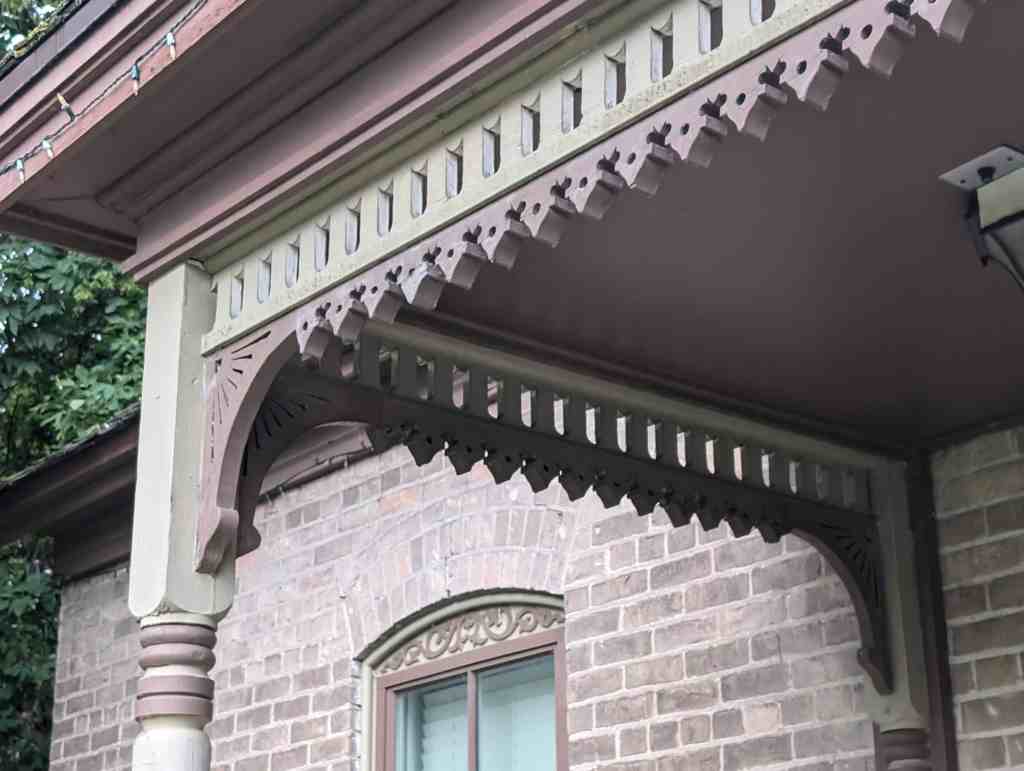
If the Fitzgerald house cannot lay legitimate claim to being the oldest brick house in Draper, it is certainly the best preserved. With the exception of the newer roofing and siding on the rear addition, the house maintains a near pristine integrity. Architectural features such as the Victorian porch details are rare in homes of the period. Most remarkable are the interiors of the front rooms, which have not been altered, and including extant plaster moldings and Mormon oak finishes. The proposed rehabilitation and adaptive reuse of the Fitzgerald house, thereby opening it to the general public, will be a significant contribution of the historic resources of Draper.
Narrative Description
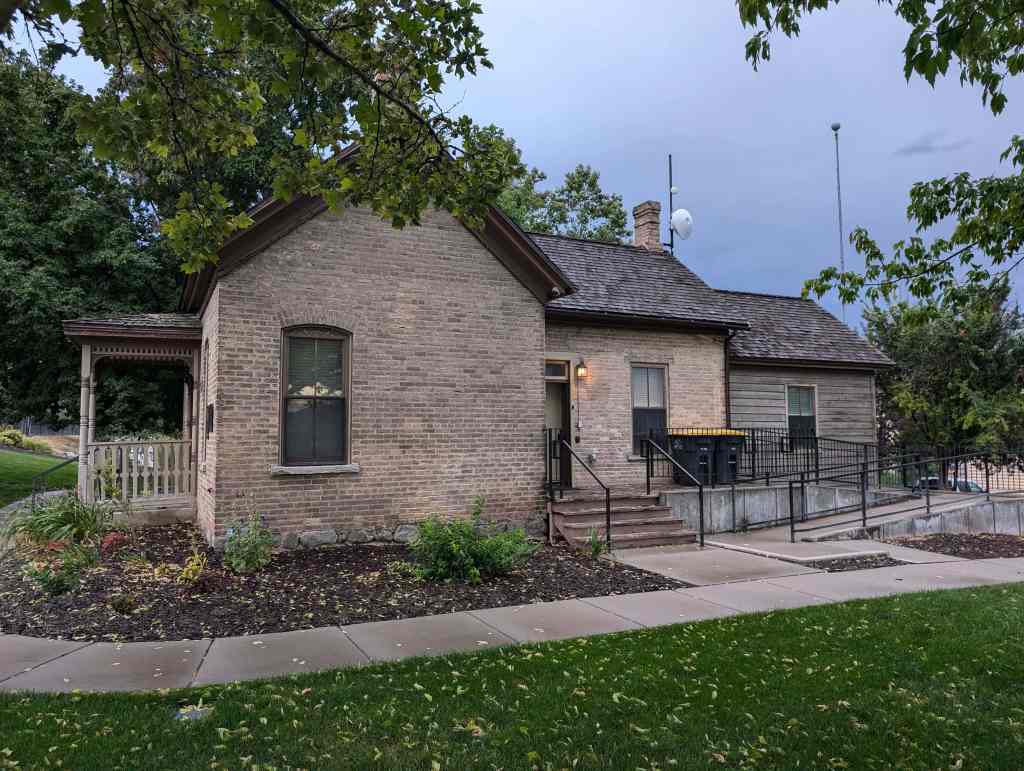
The Perry and Agnes Fitzgerald House, is a one-story brick crosswing, built circa 1870. The house is classically styled with Victorian Eclectic details. The crosswing house appears as a hall parlor on the fa9ade (north elevation). It also has a small rear addition (circa 1915). The residence sits on a foundation of coursed granite rubble. The roof is covered with composition shingles (circa 1980). The house faces north and is located at 1144 East Pioneer Road (12400 South) in Draper, Utah. The original 6.91-acre parcel was once a large farmstead with numerous outbuildings, including a circa 1850 log cabin. The log cabin was moved from the property to the Draper City Park, and the rest of the outbuildings were demolished in the 1980s. The City of Draper currently owns the land and a new library branch will be built at the rear of the property. Feasibility studies are being conducted on the house to determine if the house can be preserved and rehabilitated for use as a restaurant. If feasible, the house will be rehabilitated using the federal rehabilitation tax credit project. The project is tentatively scheduled for completion in late 2004.
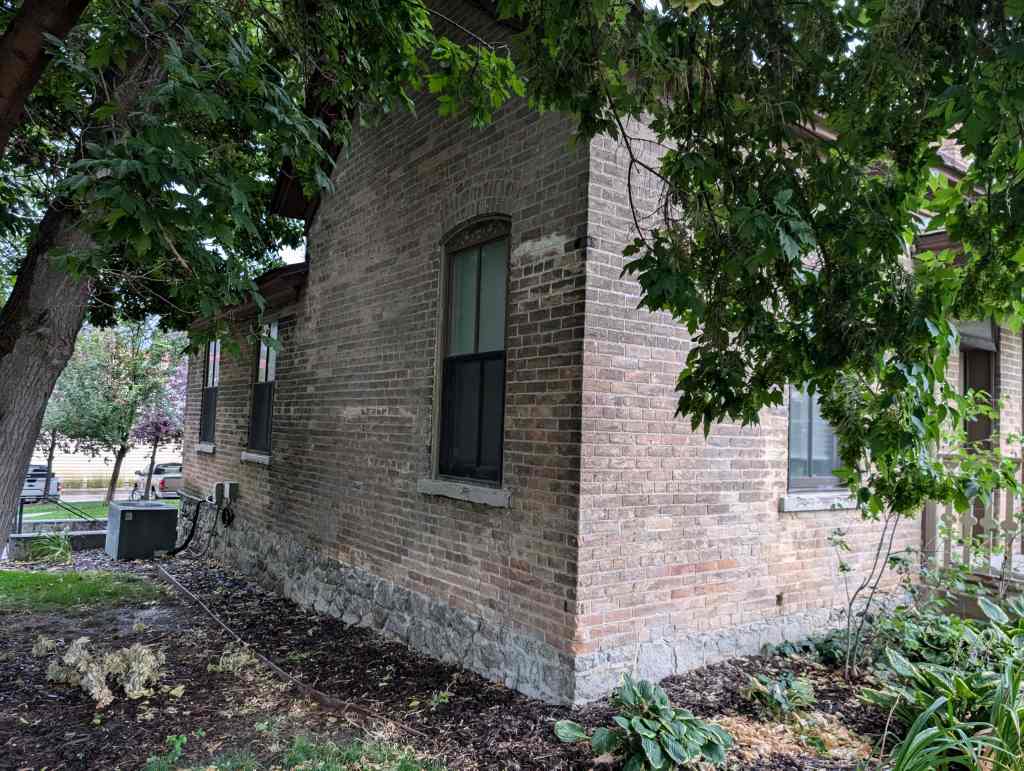
Family tradition suggests that the home was constructed just after the Civil War, but some elements of the house such as the segmental arched windows, and Eastlake-style trim more-likely date the house from the 1870s. The red brick masonry, which is laid in American or common bond with headers every seventh course, is consistent throughout the structure and appears to have been built as a single unit. However, each elevation is distinct. The facade (north elevation) appears similar to a symmetric hall-parlor with a main door flanked by windows. The ridge is parallel to the street with brick chimneys at either end. A small concrete porch (probably circa 1915) projects from the front door. It has a hipped roof supported by lathe-turned posts with decorative brackets. The porch trim and balustrade is original and painted a light yellow. The cornice boards are also painted yellow. They are fairly plain and narrow with a single bead. The windows are two-over-two double-hung windows in a wood sash. The windows feature segmental relieving arches of rowlock brick and stone sills with a decorative inset under the arch. All windows on the home are currently boarded up. Some glass has been broken, but most window features are intact.
The crosswing is visible on the west elevation. The elevation features a recessed porch with trim similar to the front porch. The porch deck is mainly concrete with rubble stone at the foundation level. Concrete steps were poured and block lines on the concrete were scored probably around 1915. The porch shelters the west entrance and one window. Another window is located in the west end of the north wing. The brick masonry is built to the apex of the gable at both ends of this wing. On the east elevation, the masonry continues to the rear to form an original lean-to making the footprint of the original house roughly square. There are three windows, one in the front wing and two in the lean-to, on this elevation. The rear windows have flat wood lintel rather than relieving arches.
The rear (south) elevation is partially obscured by a rear addition to the west, built circa 1915. This addition is a simple gable structure of frame and siding on a brick and concrete foundation. The addition sits four feet above grade on the slightly sloping site and appears to have been part of an original root cellar. Part of the foundation has been compromised with a large hole at the southeast corner. The addition was originally covered in drop siding and later covered with rust-colored aluminum siding, probably in the 1960s. The structure features a small aluminum window (circa 1960) on each of the three elevations. There are doors on the west and east elevations. No steps are extant, and were perhaps demolished at the same time an attached utility shed on the south elevation was demolished (sometime after 1996). On the south elevation of the original house, the foundation is covered with scored cement. There is a large patch of stucco on the rear elevation, probably a repair although the exact reason is unknown.
On the interior, the house is laid out as a typical crosswing. The north portion is divided into a living room and a parlor. Many original features of the interior are intact. The nine-foot ceilings have not been lowered. There are decorative plaster features on the molding and in the center of the largest room. The faux oak finish (locally called Mormon oak) on the baseboards and window casings is original. Most of the wallpaper is at least fifty years old. Unfortunately, there has been some damage by vandals, including damage to the original four-panel front door. The crosswing is one large room with some built-in cabinetry (probably 1920s or 1930s). There are two small bedrooms to the east (in the lean-to). To the rear, the addition houses a kitchen and bathroom.
As noted previously, there is very little remaining of the original landscape for the 6.91-acre parcel. The outbuildings have all been removed or demolished. The most significant of the outbuildings was a circa 1850 log cabin, the first home of the Perry Fitzgerald family in Draper. The three-room log cabin was disassembled (circa 1980) and reassembled in the Draper City Park (circa 1990). Other outbuildings included a barn (circa 1880), a brick granary (circa 1880) and a Butler-type round metal silo (circa 1940). The farmland around the house has been graded for the construction of a new library. Only a few mature elm trees are left near Pioneer Road and the house. With the exception of some vines near the front porch, no other landscaping remains. There are remnants of concrete sidewalk around the house.
The house sits just off Pioneer Road in Draper not far from where the railroad crosses the street. The house is just east of the Draper City center. To the southeast is the Willow Creek stream and the city park where the log cabin is located. The Pioneer Road area is a mix of Victorian and twentieth-century residences, industrial plants, and the new Draper municipal building. The library complex and a rehabilitated Fitzgerald house are part of planned economic development in the area. The Perry and Agnes Fitzgerald house retains its historic integrity and contributes to the historic resources of Draper.
Ross Hame, also known as the historic William Harvey and Sarah Seegmiller Ross House, was constructed 1922-1923. William Harvey Ross was president of the Gunnison Valley Sugar Company and a business partner to famed chewing gum industrialist William Wrigley, Jr.
Ross Hame and its grounds are locally significant as they represent a rare collaboration between three important Utah architects, namely Walter Ware, Alberto Treganza, and Georgius Cannon. Ross Hame was designed during the final year of Ware and Treganza’s eighteen-year partnership and was a project its architects were particularly proud of as evidenced by their submittal of the home’s plan to a 1924 exhibition in Los Angeles sponsored by the American Institute of Architects. Although such estates continue to shape Holladay’s twenty-first century identity, very few of Holladay’s first-generation estates have survived excessive alteration or outright demolition and even fewer have retained much of their historic landscape. In the case of Ross Hame, however, the house, its adjacent stable/caretaker’s cottage, and much of its landscape convey the original intent of their designers, and grants the passerby a rare glimpse into Holladay’s rural past which contrasts greatly with the city’s twenty-first-century redevelopment.
Located at 4769 S Holladay Blvd in Holladay, Utah and listed on the National Historic Register (#100002703) July 23, 2018.
The house was built c. 1877 for Joseph Tattersall, an early settler of Beaver City. It is one-and-a-half-story tall building constructed of black rock – a hard, dense volcanic stone that is commonly found in the nearby foothills in small outcroppings; it was a fairly common historic building material used in Beaver. The house features a steeply pitched roof, end-wall chimneys, two dormer windows, center gable with a door, and two bay windows that are located on the main façade. The home is the work of Thomas Frazer, a Scottish pioneer stonemason who did a lot of building in Southern Utah, particularly in Beaver.
The Edward Bird House, with its distinctive mansard roof, is an excellent example of the Second Empire style of architecture in Beaver. The house was built in 1893 for Edward Bird, who lived there until 1905. The second owner, David Edwards, and his family owned the house for the next 72 years. In 1984, the house was restored by its owners, Orvis and Ruby Bowers.
The John George Moroni Barnes house was constructed c. 1884, with an 1896 addition, this brick home is an excellent example of Victorian design. Designed by William Allen, it stands as a monument to its original owner, John George Moroni Barnes. Born March 5, 1860, in Kaysville, Barnes became one of the town’s leading businessmen and helped in founding Kaysville’s first bank.
Located at 42 West Center Street in Kaysville, Utah
The John George Moroni Barnes House is significant because of its association with John G. M. Barnes, who succeeded his father, John R. Barnes, as the dominant business and political figure in Kaysville. It is also significant as an outstanding example of a Victorian mansion built in two sections and at least partially architect-designed. Because the integrity of both the older and the newer sections of the house have been maintained, one can discern the subtle changes that occurred during the construction of monumental houses within a ten to fifteen year period of the Nineteenth Century. William Alien, an architect known to have designed a number of important buildings in Davis County, including the Kaysville Presbyterian Church (1888), the Kaysville Tabernacle (1912), the Barnes Bank Building (1910), and the houses of Henry H. Blood, John R. Barnes, and Hyrum Stewart, is reported to have designed this house. The front and more recent section of the house has details that appear in other houses by Alien and seems to indicate that he had a hand in this one. Particularly unique to this design is the rounded bellcast roof tower with its unique gable roof dormer and the treatment of the second story door. The house was built in two sections for John George Moroni Barnes. The first section was constructed in the early 1880s, the second ca. 1896.
Barnes was born in Kaysville, March 5, 1860 to John R. and Emily Shelton Barnes. An early settler of Kaysville, his father became one of the town’s prominent citizens and by the early Twentieth Century owned the town’s leading store, its bank, its cannery, its mill, and operated one of the largest farms in Davis County. John G. M. Barnes left school at the age of fourteen to work in his father’s general store. Eventually he became its president and, through his involvement in other enterprises, succeeded his father as the town’s leading businessman. He was involved with his father in founding Kaysville’s first bank, he organized the Kaysville Irrigation Co. and was a pioneer in dry farming in Davis County. In this connection, he founded the Utah Fruit Juice Co., which, he said, was dedicated to proving that concord grapes and cherries could be grown on a commercial scale without the use of Irrigation. He was involved with his father in founding the Kaysville Canning Co. in 1902 and the Kaysville Milling Co. in 1904, and he established the Kaysville Brick and Tile Co., and the Kaysville Canning Corporation. He was vice-president and a director of the Davis and Weber County Canal Co., President of the Utah Canner’s Association, and a director of the National Canner’s Association.
Active in politics as a Democratic, and as a Populists in the 1890s, when that third party was a viable force both in Utah and the nation, he was elected Kaysville City Treasurer in 1882, served on the City Council from 1892 to 1896, was Mayor from 1898 to 1902 and again from 1922 to 1928, served in the Utah State Senate from 1901 to 1903, and was a delegate to the Democratic National Convention in 1900 and 1924.
Following Battles’ death in 1932, the house remained in the Barnes family until the early 1970’s, when the present owners bought it.
The home was listed on the National Historic Register (#82004120) on February 11, 1982.
The Morgan Hughes Home. The address is 190 N 200 W but it is on the parcel of land at 195 West 200 North in Spanish Fork, Utah, the parcel is shared with the Hughes Memorial Hospital and the John Babcock Home, both of which have been joined together and are an apartment building now.
It was built in 1856 and is the oldest adobe home in Spanish Fork, Morgan was born in Wales and moved to Palmyra, Utah in 1851 and to this home in Spanish Fork in 1856.
The Original portion of the Barnes-Gibson Home was constructed of adobe in 1851 by John R. Barnes. In 1867-1869 he built the two story brick structure and it was purchased in 1941 by Mr. & Mrs. James R. Gibson.
The John R. Barnes House is located at 10 South 100 West in Kaysville, Utah and was added to the National Historic Register (#82004121) on July 23, 1982.
This house is significant because of its association with John R. Barnes, the dominant economic figure in Kaysville during the late Nineteenth and early Twentieth centuries, and because it represents several distinct stages of architectural design in Utah. Originally built ca. 1869 as a small adobe structure, the house was extensively remodeled in the mid-1870s using a folk/vernacular plan, and in the early 1890s it received a Victorian addition that dramatically changed its character. Epitomizing the height of fashion in two distinct buildings styles, the house reflects John R. Barnes’ attempt to maintain a residence fully consistent with his economic status and social position in Kaysville.
Barnes was born in England, July 28, 1833 and emigrated to Utah as a convert to the Mormon Church in 1853. He settled in the newly established community of Kaysville, twenty five miles north of Salt Lake City, and for the next ten years, farmed and taught school. In 1863 he opened the first general merchandise store in Kaysville. The business flourished and became the foundation for other business ventures, and he operated it for the rest of his life. He also remained in farming throughout his life, becoming one of the largest landowners in Davis County. In 1891 he established the Barnes Banking Co. in Kaysville, in 1902 the Kaysville Canning Co., in 1905 the Kaysville Milling Co., and in 1907 the Davis County Canning Co. Thus, by the early twentieth Century, he was the dominant force in Kaysville’s economic life, owning the towns’ leading store, its bank, its cannery, its mill, and running one of the largest farming operations in the county.
Barnes was also active in political affairs. He was a member of the Kaysville City Council from 1868 until 1882, mayor from 1916 to 1918, a member of Utah’s Constitutional Convention in 1895, and a member of the first Utah State Legislature as senator from Davis County. Also active in Mormon Church affairs, he served in the bishopric of the Kaysville Ward for thirty years, from 1877 until 1907.
Barnes was a polygamist and married three wives, Emily Shelton in 1853, Elizabeth Geeves in 1865, and Emily Stewart in 1869. According to his son and biographer, “He was gradually becoming a man of affairs, indeed so much that he felt he was able to follow the practice of the one principle of the Gospel he had embraced that was enjoined as essential to the highest glory in the Celestial kingdom of God, plurality of wives.” Barnes built this house for his third wife, Emily Stewart, following his marriage to her in 1869. At the time, he was living with his first two wives and their children in a house about one block south of this one. Barnes evidently divided his time between the two houses. In 1875 his first wife died. It is not clear whether her five children remained with the second wife in the house in which they had been raised, or whether they moved in with the third wife, who now had three children of her own. In 1887 Barnes was convicted of “unlawful cohabitation” under the Edmunds Act of 1882, fined $300 and sentenced to three months in prison. To avoid further prosecution following his release from prison, he decided to legally marry and live with one of his two wives. With the consent of Elizabeth, his second wife, he married Emily Stewart, and lived with her and their children in this house. If they had not done so earlier, the children from his marriage with his first wife now moved into this house.
The architect of the second section of the house was William Allen, a largely self-trained architect/brick mason who worked extensively in Davis County. His influence may be seen in other substantial brick and stone houses in Kaysville. Born January 1870 in London, England, he emigrated to Utah as a Mormon convert in 1863 and settled in Kaysville. He worked first as a farmhand and then followed his father’s trade as a brick mason. After studying architecture and drafting by correspondence, he became Davis County’s most prominent architect. In addition to this house, he designed the Kaysville Presbyterian Church (1888), the Davis County Courthouse (1889-1890) , the Barnes Bank Building (1910), the Kaysville Tabernacle (1912), the Kaysville Elementary School (1918), and homes for Henry H. Bloc4, governor of Utah from 1932 to 1940, John G. M. Barnes, Hyrum Stewart, James Smith, John Barton and his own house.
This building was constructed in approximately 1899 by Dr. Zerick Logan. He served as the Ophir doctor at the time and lived in the house for 30 years. Later James St. Young Sr. purchased the house where he resided until 1959. The house sat vacant until 2008 when it was donated by the Young children to the Ophir Historic District to be used as a representation of the first school in Ophir.