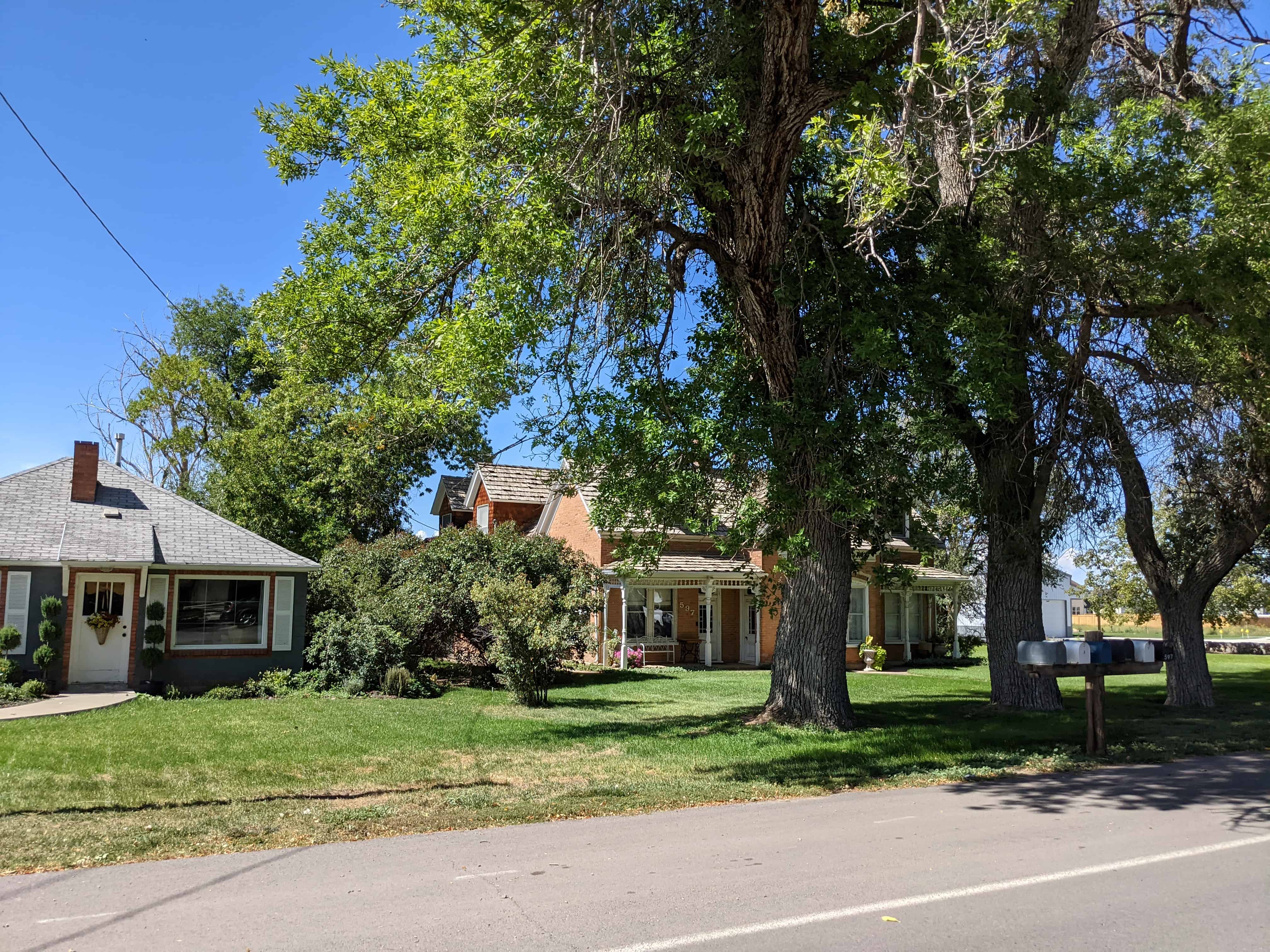
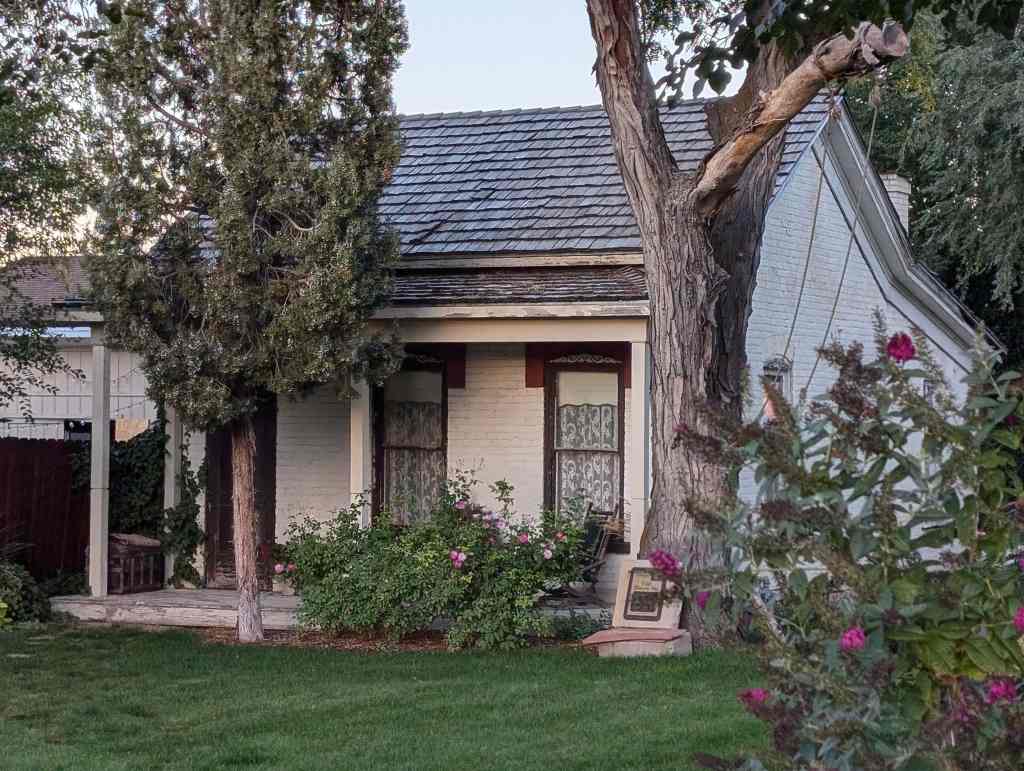
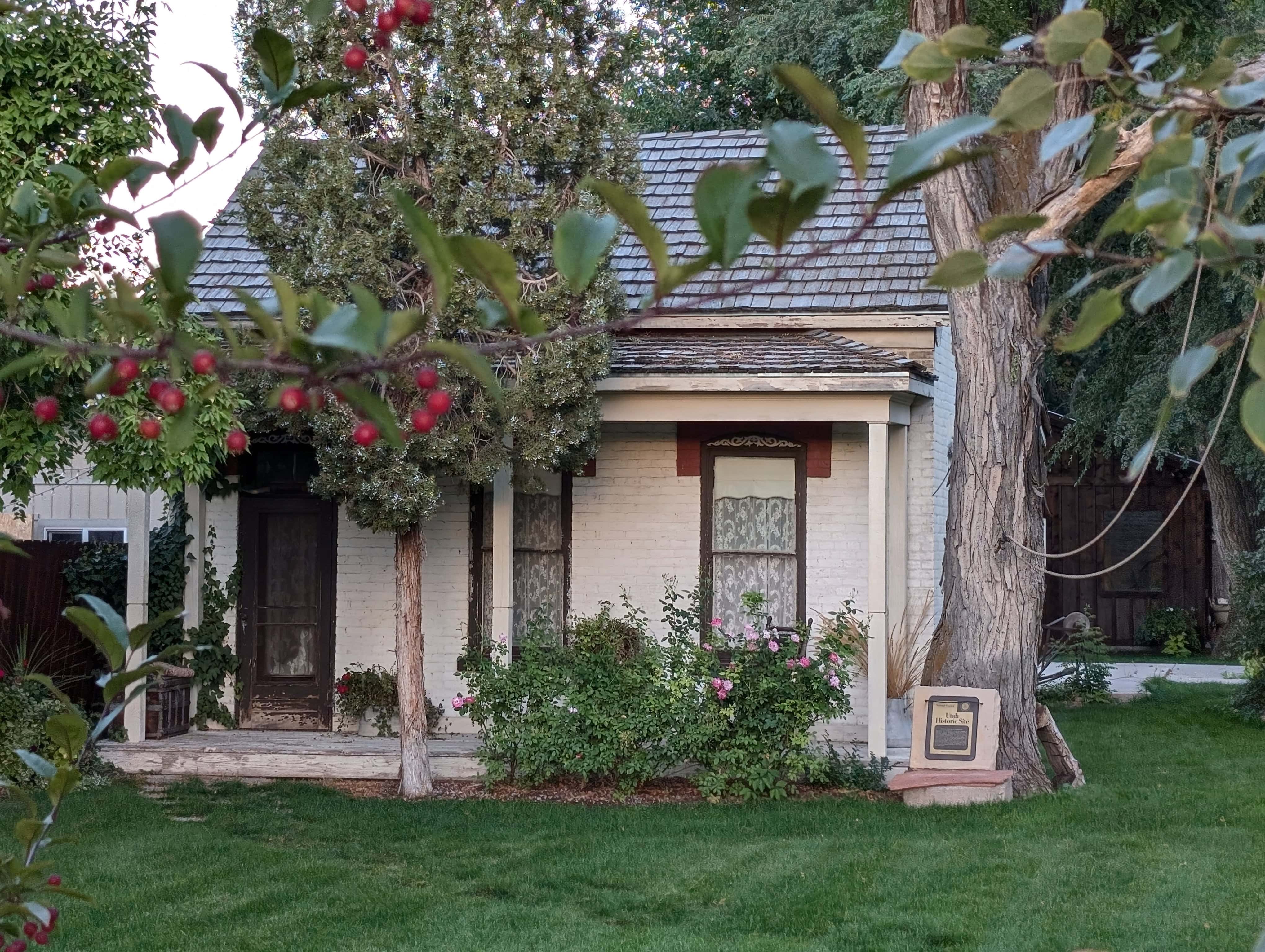
This house was built by Carl “Charley” Berg at this original location. He repaired shoes for the people of Ophir. After his death, it was occupied by several couples and small families. Poker games were played as a regular pass time.
This one room house was built by Carl Berg at this original location. It was used as a rental, mostly by bachelor miners. It has been restored to its old time appearance.
The William McLachlan Farmhouse is located at 4499 South 3200 West in West Valley City, Utah and was added to the National Register of Historic Places (#80003928) on February 14, 1980.
The William McLachlan farmhouse is significant because it is a particularly good example of the small “homestead” farmhouse which was atypical in Mormon settlement areas, where the “farm-village” system of in-town residence coupled with daily commuting to surrounding agricultural areas was generally favored. However, isolated farmsteads did begin to occur in Utah in the 1870’s following the arrival of the general land office. The practice received further impetus in the 1880 ‘s when many polygamists reputedly built homes in out-of-the-way places to shelter plural wives from the raids of the federal “polygamy .hunters”. While there are written and folklore references to this practice, the McLachlan farmhouse is exceptional in the completeness of the documentation of actual construction and of the events that brought it about. The house type is unusual, and the only one known in the Salt Lake Valley region of “over Jordan”.
William McLachlan was born in Thornhill, Dumfrieshire , Scotland, in 1840. Trained as a carpenter and contractor, McLachlan converted to the Mormon Church and immigrated to America in 1863. He was clerk of the Church emigrant company aboard the ship Amazon, assigned to keep a historical record o£ the group. This interest in record keeping persisted throughout his life, as did his high level of activity in the Mormon Church … serving as President of the mission in New Zealand (1875-77) and later as President of the Pioneer Stake.
McLachlan was a polygamist, and like many of the less wealthy polygamists of the period, extremely distressed by the consequences of anti-polygamy raids. In order that his wives not be left penniless should he be arrested and imprisoned, McLachlan purchased land and built this home in a then-remote area “over Jordan”. When it was completed in March 1885 it became home for Maggie Naismith, his second wife, and her five children. McLachlan himself vanished into the underground” for nearly eight years. Part of the time he was employed as a carpenter on the Manti temple and used his earnings there to support his families. His wives were visited as often as it was safe, and Margaret received title to her house in 1886 to protect her and her husband from loss of property should he be caught and prosecuted. Fortunately, McLachlan was never brought to trial.
Constructed in 1906 for Ira W. Bennion, this house was named “Hawarden” after his father’s boyhood home in Wales. Ira W. Bennion and other members of the Bennion family played an important rile in the development of the cattle and sheep industry in Utah, Nevada, Idaho and Wyoming.
“Hawarden,” a Granger landmark since its construction, is a locally significant example of the kind of imposing residence that the Bennions, successful agricultural entrepreneurs, could afford to mark their social and economic achievements “over Jordan”. Its Box Style design reflects the contemporary tastes in large, single family homes. The simplicity of form and detail, square massing and box-like proportions are characteristic of this mode. The Bennion family was prominent in local history, and “Hawarden” is one of the few historical reminders of past eras in a rapidly growing community known principally for extensive tracts of ranch-style homes.
Located at 4396 South 3200 West in the Granger area of West Valley City, Utah – it was listed on the National Historic Register (#80003924) on February 14, 1980.
Ira Wainwright Bennion, who built the house in 1906, was born in the neighboring “over Jordan” community of Taylorsville. Building on the work of his pioneer parents, Ira Bennion expanded the family interests to encompass cattle ranching in Utah and sheep operations in Idaho, Wyoming, Nevada, and Utah.
Because of its heavy demands on time, and the necessity of being separated from his family for many weeks of each year, Ira Bennion eventually withdrew from the family business. During one of his missions for the Church of Jesus Christ of Latter-day Saints, Ira had visited Hawarden, his father’s boyhood home in Wales. This beautiful and historic spot, alive with memories of border wars between England and Wales was the site of a major confrontation between Parliamentarians and Royalists during the English Civil War. At the time of Bennion’s visit, Hawarden was also the country seat of William Evart Gladstone, a major figure of 19th Century English politics and a Prime Minister of the United Kingdom.
Impressed by these family associations, Ira Bennion returned to the United States and upon retiring from the family business, acquired farm land on the “Jordan range” where he had once herded cows as a boy. When his very substantial family home was built, he had a tablet of stone engraved with the name “Hawarden” placed on the front wall – a practice common in Great Britain. Eight of his fifteen children were born in the house, which he continued to occupy until his death in 1927.
Built in 1906, “Hawarden” in Granger stands as a stately representative of early twentieth century residential architecture in rural Utah. Constructed of red brick using common bond coursing, the two and a half story home rests on a concrete foundation. The Box style regularity of the hipped roof and rectangular plan is broken by a gabled side bay, for whose curving portion rough faced brick of identical color was used. The pedimental gable is shingled, has a moulded wood cornice and pent end. A. one story, hipped roof front porch has coupled Tuscan supports and a plain balustrade. At the foundation level of the porch, coupled rough faced ashlar stones are located beneath the columns. The symmetry of the primary façade changes with the side entrance placement, a typical feature of this architectural style. A. later, one story brick addition at the rear of the home replaces the original rear porch. A. wide moulded cornice marks the top of the wall.
Window treatment on the Hawarden House is plain but sensitively varied. Facade piercing respects the proportions of the home and its horizontal orientation. The main entance features a two-panel door with upper light and transom light, framed by Classical Revival pilasters. Side panels have leaded glass upper lights. The entire entrance configuration creates a Greek Revival allusion, which is consistent with the ornamental scheme.
At the second story level of the main façade are a pair of tripartite windows. A. central double hung, sash window is flanked by pilasters similar to those at the entrance, and by oblong side lights of the same height which have leaded glass border designs. Centered between these windows is a carved stone tablet with a foliated scroll ornament bearing the inscription HAWARDEN, the Welsh estate after which the home was named. Sills for these windows are dressed red sandstone.
Side elevation windows are generally double hung, sash types with dressed red sandstone lintels and brick of red sandstone sills. In the gable area of the southern projecting bay, however, is a fine Palladian window, contributing further to the emphasis on classical detail.
North elevation windows conform to the given window configurations in type and proportion, except for a double-hung and semicircular window combination creating a round arched window unit which lights the interior stairway. Lighting the upstairs hall is a double hung, sash stained glass window.
The original façade piercing pattern on the West (rear) façade has been altered by the later brick porch enclosure. The second story door probably opened onto a balcony.
Interior alterations of the Hawarden House include updating by the installation of electricity, a bathroom on each floor and a natural gas furnace. The original large kitchen has been converted into a formal dining room. Closets have been added to the upstairs bedrooms, and two of the bedrooms have been combined to create a master bedroom suite.
The present owners are carefully restoring the home, reversing later modifications by removing false ceilings and stripping woodwork. The original main fireplace with carved mantel is extant.
Hawarden and the surrounding grounds stand together in the midst of urban sprawl as an imposing remnant of the culture they represented. Structurally sound and with only sympathetic modifications, Hawarden is an important local example of early twentieth century domestic architecture in a rural setting.
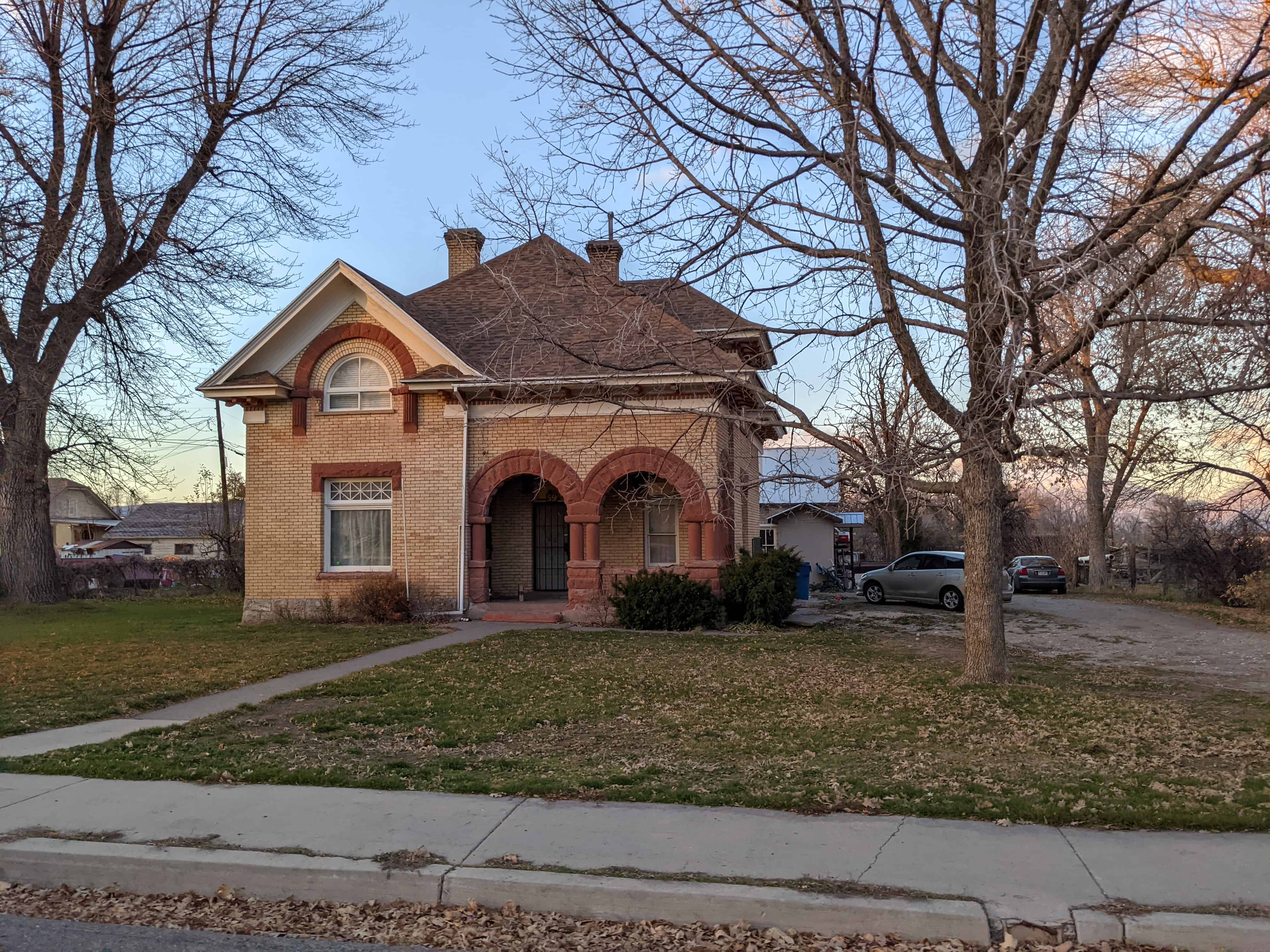
A good example of the Victorian Eclectic with Romanesque sandstone elements in Payson. Built in 1904, it is on a large parcel of that includes a granary built in 1900 of the same brick.
Built in 1857, the first home built outside the fort.
William and Grace Wignall immigrated to Utah in 1856. After a few months of living in the Payson fort, Grace told William “if he didn’t build her a home by March she would take the children and go back to England.” Her adobe home at 389 N. 100 East, completed in 1857, is oldest surviving residence within the boundaries of the historic district.
(Taken from: James Gray Willie, Man of Faith and Devotion By Glenna King Austin September 1997) James was born on November 1, 1814, at Murrell-Green, Southampton, Hampshire, England, to good parents who were industrious and had financial means. James was the seventh of eight children in the family; one older brother and one younger brother died in their youth. He lived in Taunton, Somersetshire with his parents, Mary and William, four sisters (Mary, Amy, Elizabeth, and Amelia), and a brother (John).
On June 1, 1836, when he was 21 years old he set sail for America, the land of adventure and opportunity. In New York City he found employment in the tanning business.
Five years later in December 1841 he was introduced to The Church of Jesus Christ of Latter-day Saints and was baptized a month later in January 1842 by Charles Wandell.
While living in New York City, James met a lovely young lady, Elizabeth Ann Pettit. She was born on December 3, 1818, in New Rochelle, New York, the daughter of Mary and William Pettit. James and Elizabeth were married in New York on June 13, 1846 by Samuel Brannan.
James and Elizabeth started across the plains on June 17, 1847, in Jedediah M. Grant’s company.
In a special conference of the Elders held at the Salt Lake Tabernacle on August 28-29, 1852, James was called and set apart for a mission to England. During his four-year mission, James kept a daily diary. He was diligent in making daily entries of his travels, meetings, association with the saints and presiding brethren, events, sightseeing, correspondences, health, feelings, and where he obtained food and lodging.
James was released as a pastor (Presiding Elder) of the Southampton and Dorsetshire Conferences February 1, 1856. When James was released from his mission, he was appointed president of the 764 saints bound for Zion on the ship Thornton. They left England on May 4, 1856, and arrived at New York on June 14, 1856.
The Saints proceeded by train to Iowa City, arriving there on June 26. In Iowa City, James was appointed captain of the fourth handcart company, consisting of 500 saints from the ship Thornton, 120 handcarts, 5 wagons, 24 oxen, and 45 beef cattle and cows. From James’ account, “On the 12th [of July] President [Daniel] Spencer appointed me as captain over the Fourth Handcart Company, consisting of the passengers of the ship Thornton, with Elders Millen Atwood, Levi Savage, William Woodward, John Chislett, and Johan A. Ahmanson respectively captains of hundreds.” An official account of their trek was recorded by camp clerks, one of which was William Woodward.
The Willie Handcart Company arrived in the valley of the Great Salt Lake Sunday, November 9, 1856.
James was ordained a bishop and set apart as the bishop of the Seventh Ward in Salt Lake City on December 27, 1856.
James served as bishop until the spring of 1859, when he and his family were called by Brigham Young to settle Cache Valley. James, his wife Elizabeth, and their four children settled in Mendon, on the west side of Cache Valley.
James served faithfully for many years in various calling in the community in Mendon, and on the 9th of September 1895, the earthly mission of James Grey Willie came to it’s conclusion. He died as he had lived a faithful Latter-day Saint.
James G. Willie is buried in the Mendon, Utah Cemetery.
The Sylvanus Cyrus Hulet home at 25 East Main Street in Summit, Utah along with the historic marker in front of it.
Sylvanus Cyrus Hulet 1826-1901 A convert of 1831 Utah pioneer 1850 Settled in Springville Called to the Dixie Mission 1861 Moved to Summit 1872
Children by Catherine Stoker John Riley Barbara Adlinda Sylvester Silas Emma Tryphenia Luella Sarah Ann Sylvanus Cyrus Cathryn Melissa Charles Franklin Oscar Willard
Children by Elzina R. Miller Nora Dean Minnie Elzina Eliza Ellen Theresa Cora