Tags
The Peter Axel Johnson House is located at 1075 North 100 East in Pleasant Grove, Utah. It was built in 1876. Peter Axel Johnson worked as a farmer and railroad worker.
Related:

26 Friday Nov 2021
Posted in Uncategorized
Tags

The Peter Axel Johnson House is located at 1075 North 100 East in Pleasant Grove, Utah. It was built in 1876. Peter Axel Johnson worked as a farmer and railroad worker.
Related:

10 Wednesday Nov 2021
Posted in Uncategorized
Tags
Castle Valley, Eastlake Cottage, Emery County, Ferron, Frame Eastlake Cottage, Historic Homes, NRHP, utah

The Samuel Singleton House is significant as one of the best preserved examples of a frame Eastlake Cottage in Southeastern Utah, a late-developing area of the state where few architecturally elaborate structures were built. Examples of full-blown Eastlake style occurred infrequently in Utah, which was still relatively isolated at the height of the style’s national popularity. Eastlake ornament on simpler cottages, like Samuel Singleton’s, was often removed later for want of maintenance. The Singleton house is also significant for its association with one of the area’s earliest and most prominent settlers. The house, constructed in 1896, symbolizes the transition from the Castle Valley frontier of the late 1870’s and 1880’s to a community society by 1900. Samuel Singleton, who arrived in Castle Valley in the 1870’s, played an important role in this transition which saw the evolution of housing from dugouts and log cabins, to more substantial brick and wood frame homes. The Samuel Singleton House, constructed in 1896 for one of the area’s most prominent livestockmen, merchants and businessmen, symbolizes the changes that occurred during the twenty-year period that Castle Valley and Ferron evolved from a livestock frontier to a permanent community.
Located at 320 South State Street in Ferron, Utah
Related:

Southeastern Utah including the communities of Bluff, Moab and the Castle Valley settlements of Huntington, Castle Dale, Orangeville, and Ferron was the last large area of Utah to be settled by Mormons. The large area, located on the Colorado Plateau rather than the Great Basin, was separated from the earlier Mormon towns of Sanpete, Iron, and Washington Counties by the Wasatch Plateau. The miles of rugged canyons and deserts offered little promise of settlement and only hard work for the livestockmen who hoped to feed their animals on its land.
Nevertheless, by the mid 1870’s the need for new rangeland, primarily by livestockmen from Sanpete and Utah valleys, brought a small, but important number of herders and cattlemen into Castle Valley, many of whom stayed to make it their home. These herders were, for the most part, sons of first generation Mormons. They had grown up on the Mormon frontier and while there was no question of their loyalty to the Mormon Church, the frontier experience in Utah made their generation distinctly different from that of their fathers – most of whom had grown up in the East or England and Scandinavia. As young men, many of these second generation Mormons, spent many weeks in the wilderness herding cattle and sheep. Not visiting a community of church for long periods, they let their hair grow while their language and mannerisms took on the color and roughness of the cattlemen’s frontier.
This was the world of Samuel Singleton, born November 9, 1859, in American Fork, Utah, to John Singleton and Hannah Binns. John Singleton died in 1865 and Samuel Singleton was required at an early age to assume the duties of helping to support his family. As a consequence, Samuel received little formal schooling, but instead, as soon as he was old enough, began to work for various cattle and sheep men in the American Fork area. At the age of 14, he accepted a job with Billy Grant, a sheepman in the Salina Canyon area. He was offered $25 per month as a cook. He worked for Grant only a short time then took a job with Tom Simpers, a cattleman in the area. Saving most of his $25 a month wage, in a little over a year Samuel earned $300 which he gave to his mother to study obstetrics and children’s diseases under Dr. Pratt. According to family accounts, “This profession made her an independent individual and she became one of prominent women of American Fork”.
After providing his mother the $300, Samuel Singleton continued working with cattlemen in Castle Valley, but began taking his wages in cattle in order to build up his own herd. During this time, he married Clara Bill Lowey, January 17, 1884. They had first met in 1879 when Clara came from Manti to stay with her half-sister Eunice Molen, wife of Mike Molen, a Castle Valley cattleman.
Samuel Singleton’s success in the livestock business became the springboard to other local business ventures. Following the custom in other Mormon communities, church leaders in Ferron decided to open a cooperative store. The Ferron bishopric asked Samuel Singleton to organize the cooperative and travel to Salt Lake City to purchase $250
worth of goods for the store. The $250 was not sufficient to outfit the store and Singleton invested $1600 of his livestock earnings. The cooperative store was successful and Singleton continued as manager for several years until he purchased stock from other stockholders and became the owner of the store.
A roller mill was organized as a cooperative in 1897. Samuel Singleton was one of the principle stockholders of this establishment. A creamery was also needed in the area so he organized another stock company in about 1905 for the establishment of a creamery. In order to make this a more successful enterprise, he and another stockholder, William Killpack, went to Iowa and purchased a carload of Jersey cows which was sold to the dairymen of Ferron.
The Emery County bank was organized in 1906. Sam, an ardent supporter of the bank, was a stockholder and became vice-president; he later became the president and held this position until his death.
It was after he became a merchant the the Singleton House was constructed in 1896. The work was done by local craftsmen, Tom Jones and Will McKenzie were carpenters and Swain Ross the painter. The interior was lined with adobes from an older house in Ferron. Yellow was the original color and the house has not been painted any other color.
Samuel Singleton was also active in local politics running as Perron’s first Mayor after its incorporation in 1900 and as an Emery County Commissioner. He died July 5, 1929. The house remained in the possession of his widow, Clara Bell Singleton until May 1, 1955 when she sold it to her grandson and present owner, Samuel M. Singleton.
Samuel M. Singleton was born in Ferron and is currently (1979) Principal of the San Rafael Junior High School in Ferron. He has been involved in education in Emery County since 1948 teaching at South Emery High School in 1948 then 1952 to 1963 and at Emery County High School from 1963 to 1973 when he became Principal at San Rafael Junior High School. Mr. Singleton is active in the Singleton family organization and was the principal editor of A History of John Singleton of American Fork, Utah, and His Ancestors and Descendants. Mr. Singleton is currently committed to the preservation of the house and its retention by the Singleton family.

The Singleton House is a wood frame pattern book cottage. It is built following an H-plan, the least common of the “alphabet” play types common in early Utah. The front façade is composed of two projecting gabled bays, one hexagonal and one rectangular, connected by a sloped-roof porch. Although the porch balusters are gone, the turned porch columns and full-width spindle band remain. The gables over the bays are covered two-thirds in alternating plain and imbricate shingles, with the upper third in wood siding painted in a brick-like pattern. All of the front and side windows are one-over-one sash, with the upper sash done in round rich glass set in rectangular frames and Eastlake surrounds. Outside doors open from every room but one. The interior includes a cherrywood fireplace. The interior ceilings have been lowered from eleven to eight and a half feet.

19 Tuesday Oct 2021
Posted in Uncategorized
Tags
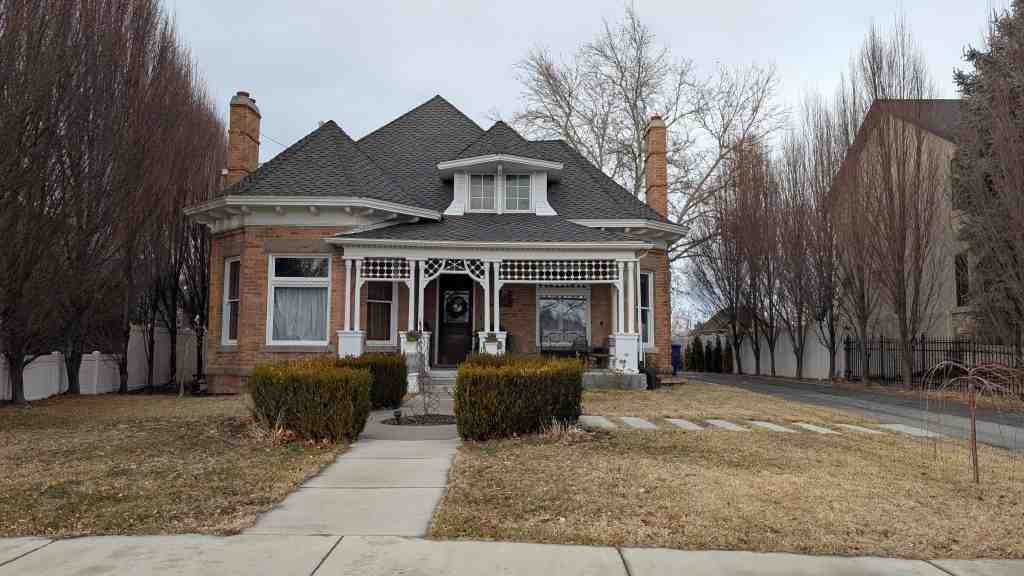
The Brinton-Dahl Home is significant as a very well maintained example of an elaborate example for it’s size and location of a pattern book, Queen Anne influenced residence. The design includes an unusually complex flared roof form which dominates the front and side facades of the house. It is one of the most attractive farm houses built in the Big Cottonwood area of the Salt Lake Valley, and one of the few which survives. It stands on a rise above the surrounding area. A. brick cellar and milk house are included in the site.
History of early residents:
The Brinton-Dahl Home was constructed in 1885 as a two family residence for Caleb Dilworth Brinton and his younger brother, David Branson Brinton. David’s rapidly expanding family occupied the larger west side, while Dilworth and his wife, the former Emily Elizabeth Maxfield, who were childless, lived in the smaller east portion. David soon moved and Dilworth lived in the house until 1904.
Caleb Dilworth Brinton was born in Savannah, Andrew Co., Missouri on November 21, 1848, on route to Utah. His accomplishments include exploring southeastern Utah for colonization, hauling stone for the Salt Lake Temple and construction work. He stated, “There is nothing pertaining to the opening up, building and colonization of a new and desolate country in which I have not taken an active part.” He filled two missions for the Mormon church and worked in the Salt Lake temple. About 1904 a nephew, David Brinton Bagley, remembers going to the house to take his Saturday bath because it “was the only place in the neighborhood that had running water in the house”.
However, of greater significance than the prominent Brinton family was the Mormon pioneer family of Alexander Dahl who bought the Dilworth Brinton farm in 1904. Alexander Dahl was born August 11, 1831, in Frederikstad, Norway. He and his brother, Christian, joined the Mormon church and immigrated to America in 1854. Christian died on the way to Utah, but Alexander arrived in Salt Lake City on September 27, 1855. In 1857 he served with Lot Smith in Echo Canyon during the Utah War. After his release he walked over 200 miles to Spanish Fork to join a community of Scandinavian Mormons. In Spanish Fork he met sixteen year old Ellen Yorgensen.
Ellen was born in Lyngby Malmohus, Sweden on March 9, 1842. She arrived in New York City with her family in 1856 after a rough ten week voyage during which forty-five of the passengers died. The family worked for a short time in New York to earn funds to continue their journey to Utah. In Keokuk, Iowa they contributed their means to assist less fortunate members of the Mormon church to migrate to Utah. Ellen worked as a nurse and a baby sitter, learning the English language from the children for which she cared. A. year later on her trek to Utah she gave her place in the wagon to an expectant mother. Ellen’s long career as a midwife began when she assisted the mother in the birth of the child.
assisted the mother in the birth of the child. In 1857 Ellen’s family moved to Spanish Fork. Ellen received several offers to become a plural wife. She refused indignantly. When she met Alexander Dahl he was so shy that she was sure he would want only one wife. According to reports it took only a little persuasion to convince Alexander to marry her.
The Dahls were among the first settlers in East Jordan (Midvale) They started their family in a dug-out, but later built a large adobe home. Alexander found no employment in his trade as a carpenter so he began buying land and became a dairy farmer. After forty-five years residence in Midvale, Dahl sold his property to U.S. Steel for the Midvale smelter. They bought a farm and house from Dilworth Brinton in Big Cottonwood where they started a dairy.
Alexander Dahl died on February 11, 1911, and Ellen died November 8, 1912. The Dahls were among the first residents of Big Cottonwood to establish a commercial dairy business. They built a large cow barn and milked about fifty cows, at first selling their milk from a cellar near their house and delivering milk to various outlets in the area. A. neighbor, D. Brinton Bagley, reported that in 1905 the great Dahl milk truck with enormous wooden wheels and chain drive was the first automobile he remembers seeing. The milk was cooled in an adobe trough within the milk house, which still stands, through which ran a constant stream of cold water from one of the farm’s three or more flowing wells. About 1911 the Dahl Brothers opened a retail outlet at 478 East 2nd South which advertised “High Grade Milk, Cream, Buttermilk, etc., all from our own tested cows. Baby Milk a speciality ” Later business improved to the point that they bought milk from small producers. The Dahl Brothers were the sons and the daughter of Alexander Dahl.
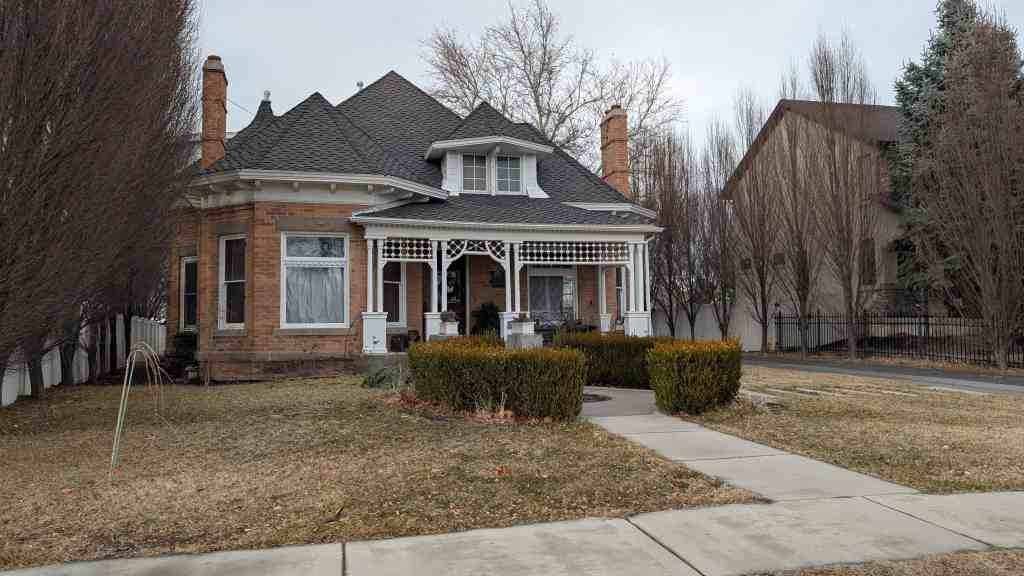
Located at 1501 E. Spring Lane in Holladay, Utah
Related:
14 Tuesday Sep 2021
Posted in Uncategorized
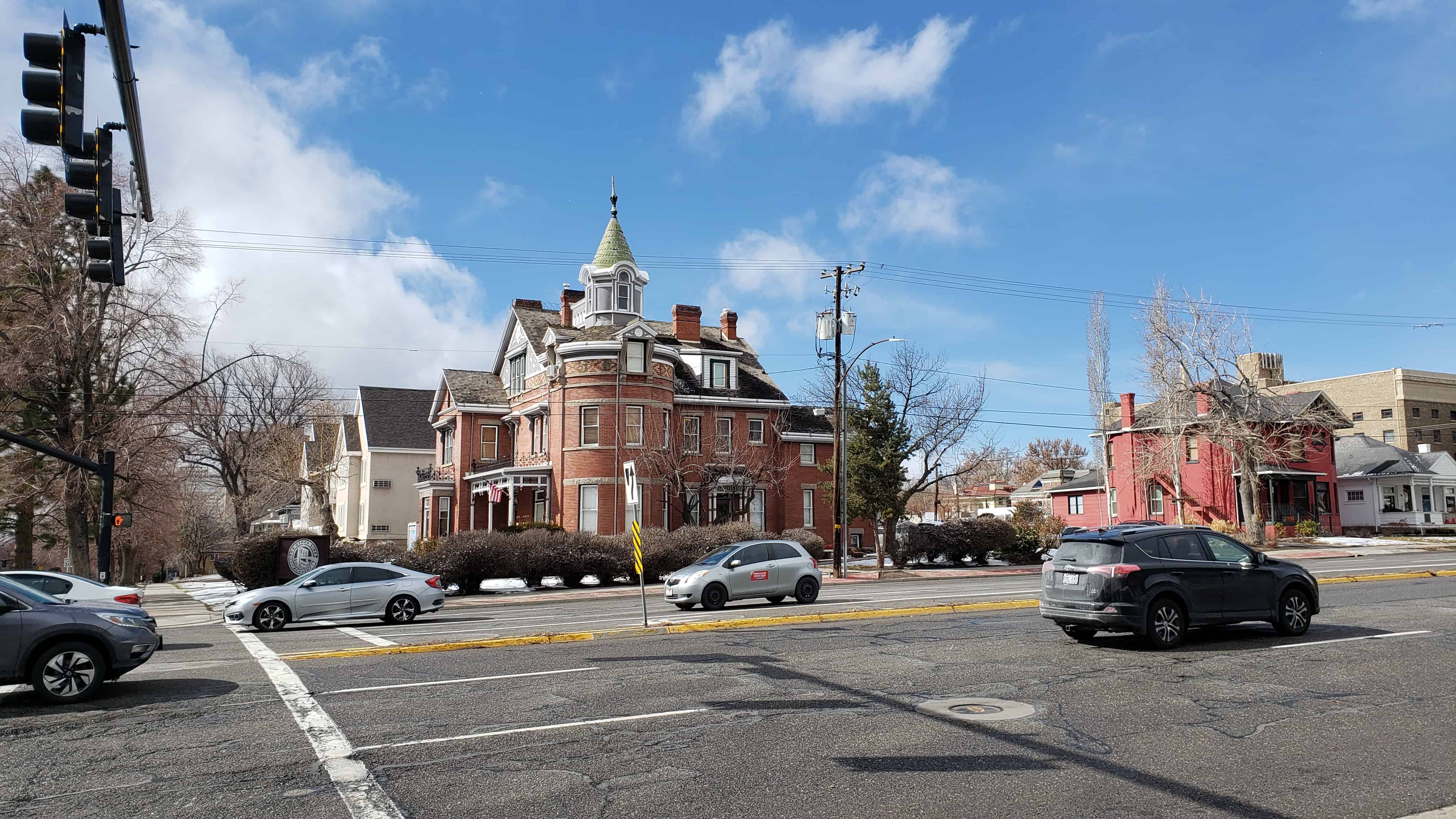
This house is significant as the residence of Francis Armstrong for whom it was built in 1892. He was an entrepreneur, civic leader and Mayor of Salt Lake. It is significant also as one of the finest example of Queen Anne Style architecture in Salt Lake City.
Armstrong was born October 3, 1839 in Plainmiller, Northumberland, England, to William Armstrong, a machinist, and Mary Kirk. The family emigrated to Canada in 1851. At nineteen Francis went to Missouri and then in 1861 drove an ox-team to Salt lake City, His early employment in sawmills led eventually to a partnership in Taylor, Romney, & Armstrong Lumber and Construction, the foundation of a considerable fortune. At the time of his death in 1899 he was President of the Utah Commercial Savings Bank, the Western Valley loan & Trust Company/ the Utah Power and Light Company, Vice-President of Taylor, Romney & Armstrong Company, and a director of many other firms.
He was active in public affairs, elected to a number of city and county offices in the 1870’s and 1880’s and to the office of Mayor of Salt Lake City in 1886 and in 1888. Hs had been elected to his second term as chairman of the Board of County Commissioner shortly before his death in 1899.
On December 10, 1864 he married Isabelle Sidoway, by whom he had eleven children. In May of 1870 he took a second wife, Sarah Carruth. She died in 1883, survived by only one of her seven children. A member and staunch supporter of the LDS Church, he was remembered for his blunt integrity, energy, and determination in public and business life rather than for involvement in church governance.
Armstrong’s widow occupied the house until her death, December 11, 1930. In 1931 the house passed to Mary Hannah Armstrong Madsen. Following her death the house passed to her husband Richard W. Madsen in 1933. Madsen was manager of the Standard Furniture Co, President of the Western Loan & Building Co. and of the Utah State National Bank.
The house stood vacant for several years and in 1934 was converted into apartments, Madsonia Realty received title in 1953 following his death. Jones O. and Amelia Petersen received title the same year and resold it to Ira and Myrtle
H. Oviatt. They sold it to George W and Martha Linnes in 1974 and they resold it to Navalco of Utah the same year. Navalco sold it to Armstrong Manor Associates in 1980 and they deeded a 48 8/10 undivided interest to Suzanne Carson Erickson the same year.
Located at 667 East 100 South in Salt Lake City, Utah
Related:


08 Wednesday Sep 2021
Posted in Uncategorized
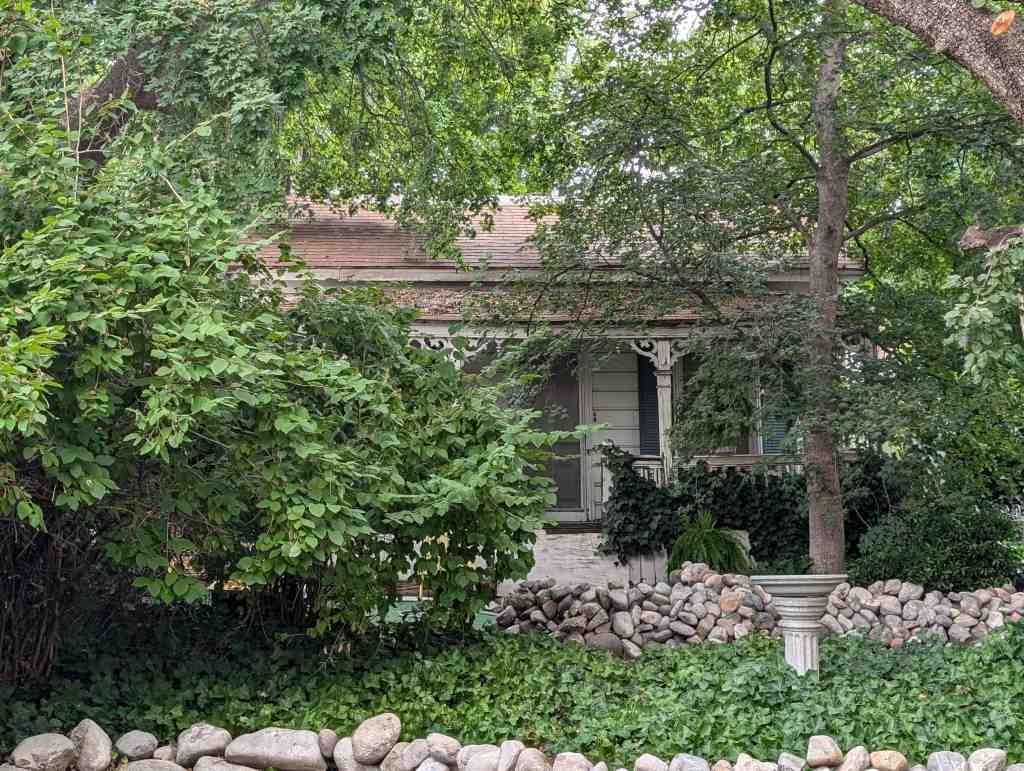
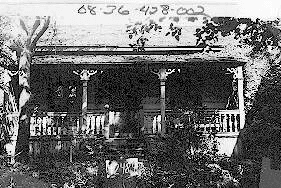
This one story home of rectangular plan has a gable roof. The front porch extends the full length of the main façade, with a roof supported by square posts with decorative mouldings with turned balusters between. Windows are two over two, double hung type. A frame extension of lean-to variety is located at the side.
Evidence of title, directories, and sanborn maps suggest this house was built about 1873, by Edwin Rawlings.
Rawlings was born February 1, 1838 in England. He emigrated to Utah in 1862. He worked as a cabinet maker and carpenter for ZCMI and later for the Co-Op Furniture Co. An accomplished musician, he was a charter member of the martial band organized by Dimick Huntington and associated with the Nauvoo Legion. His wife Annie and three children survived upon his death September 7, 1914.
Located at 322 Almond Street in the Capitol Hill Historic District in Salt Lake City, Utah
He owned the duplex next door to the south.

04 Saturday Sep 2021
Posted in Uncategorized
Tags
Avenues, Avenues Historic District, Historic Homes, NRHP, Salt Lake City, Salt Lake County, utah
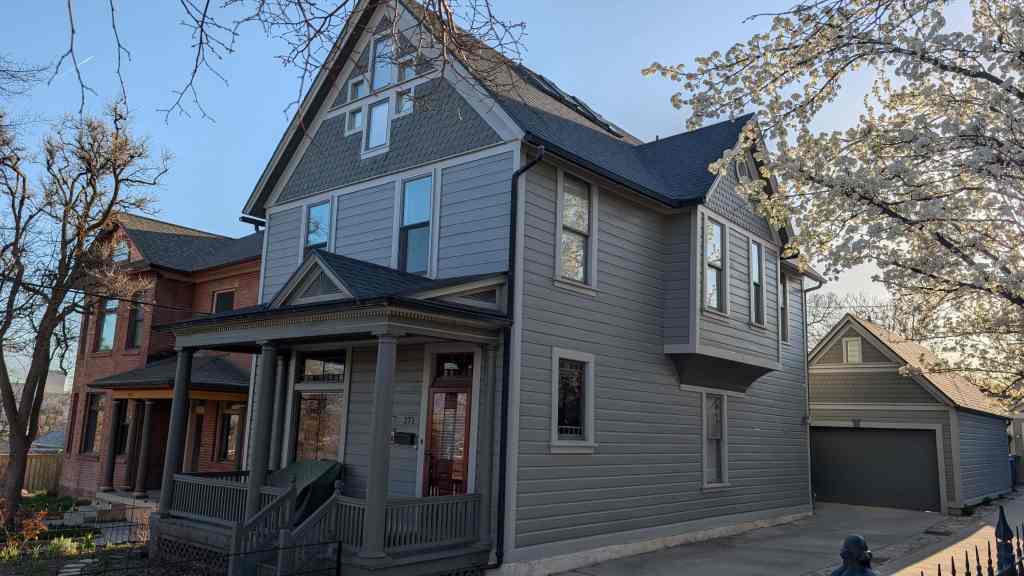
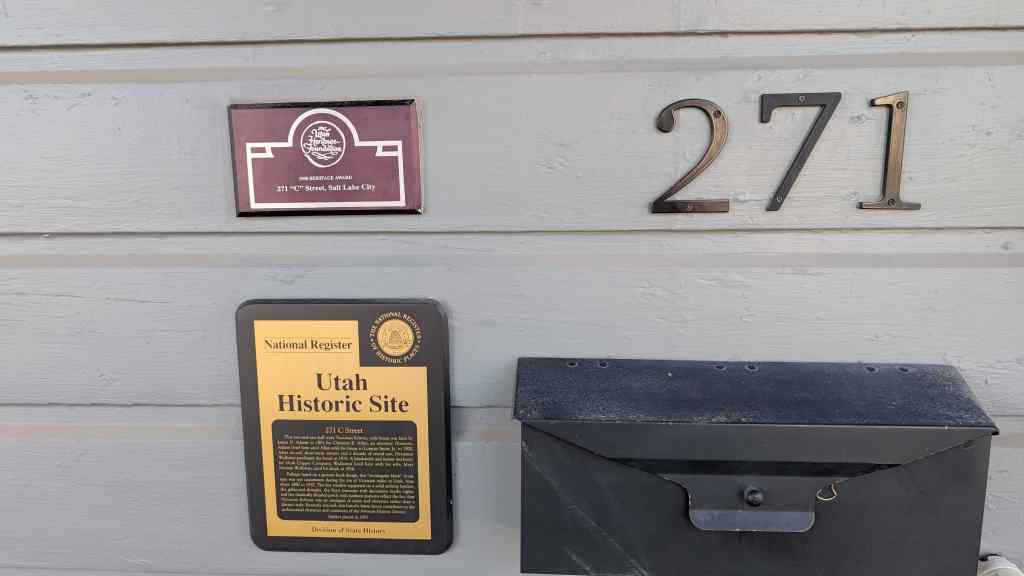
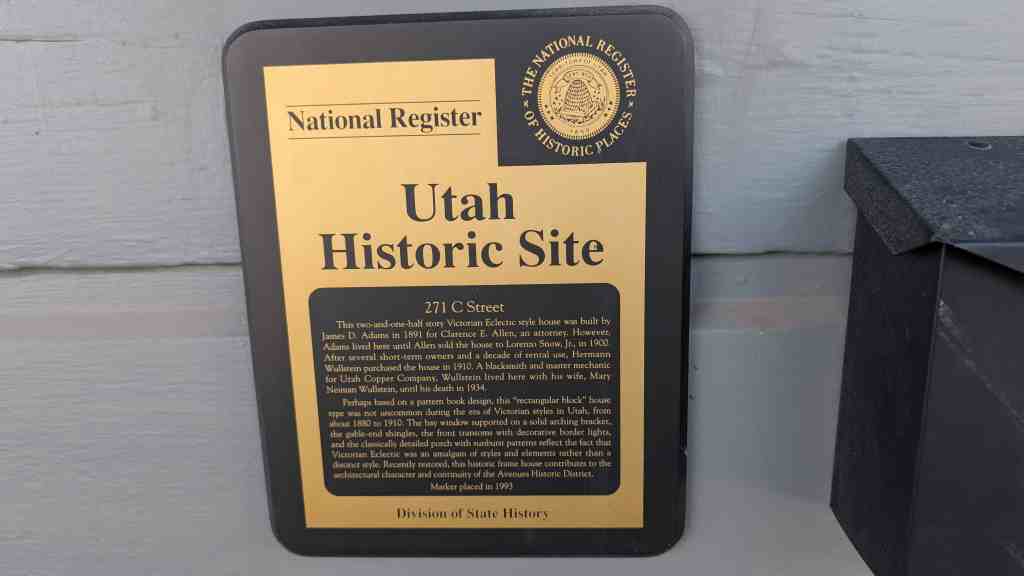
271 C Street
This two-and-one-half story Victorian Eclectic style house was built by James D. Adams in 1891 for Clarence E. Allen, an attorney. However, Adams lived here until Allen sold the house to Lorenzo Snow, Jr., in 1900. After several short-term owners and a decade of rental use, Hermann Wullstein purchased the house in 1910. A blacksmith and master mechanic for Utah Copper Company, Wullstein lived here with his wife, Mary Neiman Wullstein, until his death in 1934.
Perhaps based on a pattern book design, this “rectangular block” house type was not uncommon during the era of Victorian styles in Utah, from about 1880 to 1910. The bay window supported on a solid arching bracket, the gable-end shingles, the front transoms with decorative border lights, and the classically detailed porch with sunburst patterns reflect the fact that Victorian Eclectic was an amalgam of styles and elements rather than a distinct style. Recently restored, this historic frame house contributes to the architectural character and continuity of the Avenues Historic District.
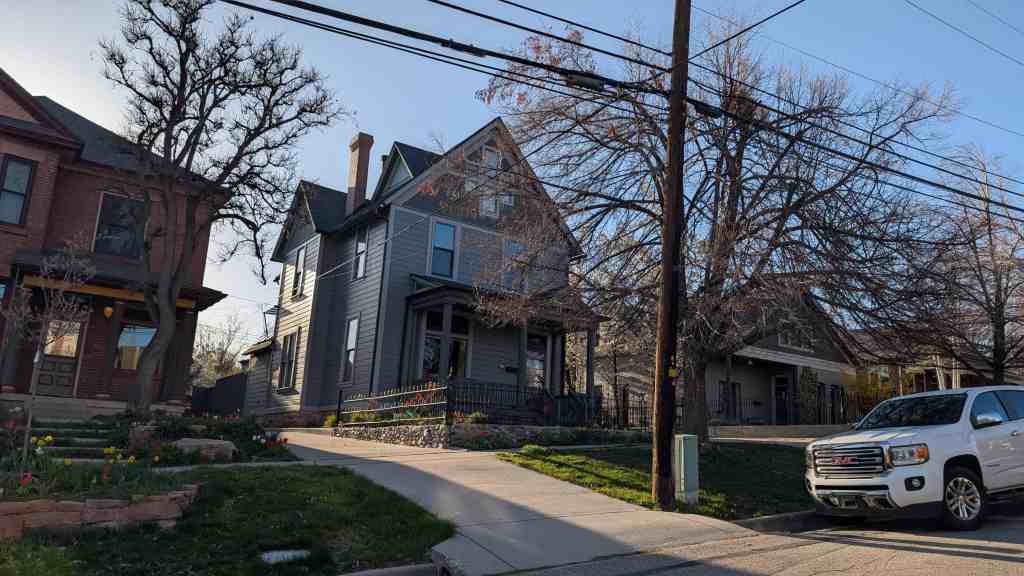
271 C Street is in the Avenues Historic District of Salt Lake City, Utah
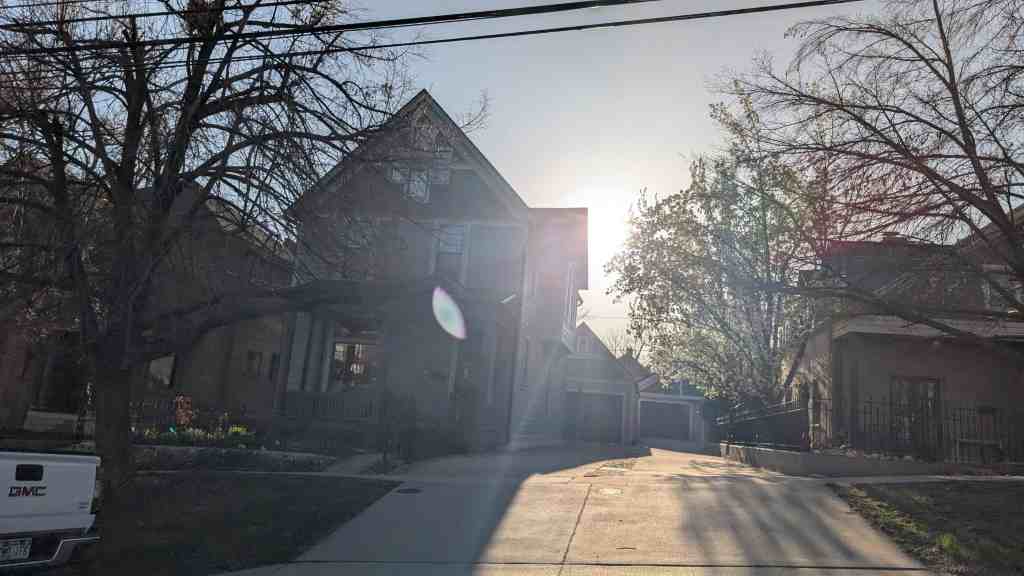
Interesting history compiled by Rachel Quist:
In April 1898 the Rescue Home for “fallen women” rented this house.
Within the next 10 months the Rescue Home had 20 applicants, 5 births, 1 death, 1 marriage, 7 women placed in suitable outside homes, and 2 children were taken to the orphanage.
Neighbors on C Street objected to the Rescue Home and in Sept 1899 they petitioned the SLC Council to have the home removed and stop financial support. Thomas A. Horne, who lived just north at 277 C St, was the primary objector who complained “the women are boisterous, they make noise…and they sing indecent songs. They contaminate the children.”
Not wishing to antagonize the neighbors on C Street, the Rescue Home soon signed a 3-month lease on a larger house at 54 S 1200 East from owner Judge Loofbourow. The neighborhood soon made vigorous objections and Judge Loofbourow cancelled the lease without notifying the Rescue Home first.
In Nov 1899 the Rescue Home found another house in Sugar House area and paid 4 months rent in advance. University of Utah Professor Byron Cummings (Football & Archaeology) led the objection citing the 35 children in the neighborhood. The Rescue Home was given 3 months to vacate.
Frustrated that “respectable communities” disallowed the Rescue Home they looked for a new location in the “slums” of Commercial Street (now Regent St) but they could not find a suitable location, likely due to the high rents that the brothels and other businesses could pay.
After months of looking for a new location, the Rescue Home’s Board of Directors decided that to continue the work would be useless and the entire board resigned in Feb 1900.
A new board was established who vowed to continue the work and even secured additional locations. University of Utah Art Professor Edwin Evans led the protest against the 1458 S 1300 East location in March 1900.
Even after the Rescue Home closed itself to prostitutes and only allowed “reformable” women the neighbors protested so vigorously that the location at 51 S 800 E was also abandoned.
By Jan 1902 the whole organization was turned over to the Salvation Army who operated similar homes throughout the country with much success…. except in SLC.
27 Tuesday Jul 2021
Posted in Uncategorized
Tags
Posts of places in Draper, Utah – sorted by address.
800 East
950 East / Fort Street
13200 South
Axis Creek Cove
Boulter Street
Bridle Trail Road
Canyon Breeze Lane
Canyon Vine Cove
Canyon Vista Lane
Fallow Creek Lane
Fort Street / 950 East
Graystone Lane
Lone Peak Parkway
Pioneer Road
Relation Street (1565 East)
Running Bear Lane
Silver Rock Lane
Winged Trace Court
Other:
15 Thursday Jul 2021
Posted in Uncategorized

The Edward and Harriett Rosenbaum House, built in 1928, is a two-story Colonial Revival and Georgian-style residence. The property is locally significant under Criterion C as a high-end architectural example of the Colonial Revival and Georgian Revival styles with some Federal style elements. The house is also significant for its association with two of Utah’s most prominent architects: Taylor A. Woolley and Clifford P. Evans. Both men were apprentices to Frank Lloyd Wright in the 1910s, but rarely used Prairie-style elements, preferring to work in different styles to satisfy the tastes of their Utah clients. The firm produced mostly institutional buildings and apartment blocks. The Rosenbaum House is the only example of a grand mansion designed by the firm Woolley and Evans whose limited domestic output consisted of more modest houses. The Rosenbaum House has excellent integrity in the qualities of workmanship, and materials.
The design of the house has all of the characteristics of the classical styles (e.g. fanlights, sidelights, multi-light sashes, dentiled cornice and classical pediments). The main floor features a formal hall, living room, and dining room that are particularly well-preserved, which enhances the high artistic qualities of the exterior. The integrity of the original design is somewhat impacted by an early 1990s side addition, but the addition is compatible and is separated from the original house by a breezeway. The period of significance is the period of construction, 1928.
Edward Rosenbaum, a banker, and his wife, Harriet, were the original owners of the house. The family lived there only a few years until Edward’s untimely death in 1930. The second owners, Prescott and Beatrice Dunn, lived there for 25 years, adding a swimming pool and bath house in 1948-1949. The Dunn family owned a large retail enterprise in Salt Lake City. In 1955, the property was acquired by an insurance executive, Frederick Moreton and his wife, Sarah. The Moreton family held the deed until 1992 and made very few alterations, preserving most of the residence’s distinguishing exterior and interior features.
The setting and location of the property also contributes to its architectural significance. The property represents the Bonneville-on-the-Hill development, a one-of-a-kind model for an exclusive suburb of Salt Lake City. The Bonneville-on-the-Hill development was conceived in 1917 with the acquisition of dry bench land above the popular Federal Heights subdivision. In a departure from the norm, a formal plat was never filed for Bonneville-on-the-Hill. Managed by a syndicate of influential men, the neighborhood did not possess the architectural uniformity of contemporaneous subdivisions. The neighborhood grew more organically as individual lot sizes were increased and sold ad hoc as wealthy families vied to build increasingly grander mansions from the 1920s into the 1970s. The Rosenbaum House on Circle Way, built in the late 1920s, represents the early phase of the high-status neighborhood. The addition of a swimming pool and bath house in the late 1940s (although now altered or replaced) enhanced the property’s status in its exclusive upper-class suburb. The property is a significant contributing resource in Salt Lake City’s Federal Heights neighborhood.
1428 East Circle Way in the Federal Heights area of Salt Lake City, Utah
Listed on the National Register of Historic Places (#100005175)
Related:


13 Tuesday Jul 2021
Posted in Uncategorized
Tags
The Mort Cheesman House, built in 1912-13, is significant as one of a very limited number of large scale Craftsman houses in Utah, and as an outstanding and unique example of that type. It is one of two monumental and unique Craftsman homes designed by tie successful Salt Lake architectural firm, Ware and Treganza, the other example being the Knight-Mangum house in Provo. Alberto O. Treganza, the principal designer of the firm, had worked for the famous San Diego firm of Hebbard and Gill, and the design of the Cheesman house may reflect the influence of that experience. It is a distinctive example of the Craftsman style because of its single axis orientation, and its unorthodox point of entry. The combination of stucco and cobble rock as building materials, while not unusual, is not common in Utah, especially in large homes. It was more often reserved for use in Craftsman Bungalows.
Located at 2320 East Walker Lane in Holladay, Utah – it was added to the National Register of Historic Places (#82004137) July 23, 1982.
The Morton A. Cheesman House was designed by the architectural firm of Ware and Treganza in 1912 and the house was completed by 1913. Craftsman elements which tie the house together include: a low pitched roof; ornamentation created by the use of natural materials such as exposed rafters and purlins, bands of casement windows, and cobble rock for the base and chimneys; the use of leaded glass in some windows; and the combination of materials, stucco and cobble rock, to create visual interest rather than relying on the application of ornament to serve that purpose. The house was built on eleven acres of property originally owned by Mr. Cheesman’s maternal grandfather, Joseph R. Walker, a famous Salt Lake banker and businessman. The settlement of the Walker estate resulted in Mrs. Mary Ann Walker Cheesman receiving the property.
The house being nominated belonged to Mary Ann’s son, Morton. From evidence of title, it appears that Mary Ann owned the property on which Morton’s house was built until 1916, at which time she deeded the property to him. Mary Ann’s own house was built in 1912 and is located adjacent to her son’s house. Her house was also designed by Ware and Treganza.
In 1921, Cheesman deeded the property back to his mother and in 1925, Mary Ann mortgaged the house for $15,000 to Malcolm A. Keyser, a friend of the Cheesman family. In 1931, Mary deeded the property and house to Mr. Keyser. The reason for the property loss has been blamed on the stock market crash of 1929 as both Morton and his mother lost large amounts of money in the crash. In 1932, the city directory lists Morton as an employee of the Salt Lake City Water Department and residing at 746 East Second South. In the same year, Keyser and his family moved from their home at 6710 Holliday Boulevard to Mary Ann’s former residence. The Morton R. Cheesman house remained vacant. Mr. Keyser deeded the house to his son M. A. Keyser, Jr. in 1940, and in 1945 the house was deeded to George R. McClure and his wife, Helen Keyser. The McClures were the first people to inhabit the house after the Cheesman’s departure and are the current owners.
Norton R. Cheesman was born June 1, 1889 in Salt Lake City, a son of Martin J. and Mary Ann Walker Cheesman. Morton started his business career in 1910 as a treasurer for Walker Brothers Dry Goods and continued in that position most of the time that he lived in this house. He was also president of Cheesman Auto Company and involved in the Campbell-Cheesman Realty Company. He was later employed for the Salt Lake City Water Department. He was married to Vera Edward and later divorced. In 1940, he married Naomi Brinton. He was the father of two children. Cheesman died November 21, 1963, in Salt Lake City.
30 Wednesday Jun 2021
Posted in Uncategorized
Tags

The Knight Allen house was built for J. William Knight, an important businessman in turn-of-the-century Provo and a son of Jesse Knight. It was subsequently owned by R. E. Allen a son-in-law of Jesse Knight who was also an important businessman and an officer in all the Knight family businesses. The Knight-Allen house is significant historically as the residence of important early businessmen of Provo.
The Knight-Allen house was built about 1899 for J. William Knight. It is probable that it was designed by Richard C. Watkins, a prominent local architect. J. William Knight married in 1899 and this was the couple’s first house. When he and his new wife moved to Canada to manage a Knight concern there, J. William Knight sold the house to his sister Inez and her new husband, Robert Eugene Allen. Because the Knights lived in the house for such a short period of time, the building is more closely associated with the Allen family.
Robert E. Allen was born in Coalville, Utah in 1877. He received his education at Summit Academy, Brigham Young Academy, and Rochester Business College. In 1901 he started teaching at Brigham Young university and in 1902 he married Amanda Inez Knight. Allen was quickly assimilated into the business concerns of the Knight family and became a rather wealthy businessman. He served as manager of the Knight Power Company from 1908 to 1912. From 1907 to 1933 he was secretary of the Knight Investment Company which directed the family’s holdings and was also cashier of the Knight Trust and Savings Bank. He later served as manager of First Security Bank in Provo.
Inez Knight Allen was a woman of note. She was one of the first two women sent as proselyting missionaries by the L.D.S. Church. She later became very active in politics and civic affairs. She was the Democratic National Committee woman from Utah for four years, was a delegate to National Democratic conventions, and ran unsuccessfully for the state senate. She also chaired many local civic groups.
Mr. and Mrs. Allen were very generous with their wealth and contributed heavily to B.Y.U. Several buildings were constructed by the University with these contributions.
Related:
Located at 390 East Center Street in Provo, Utah.


