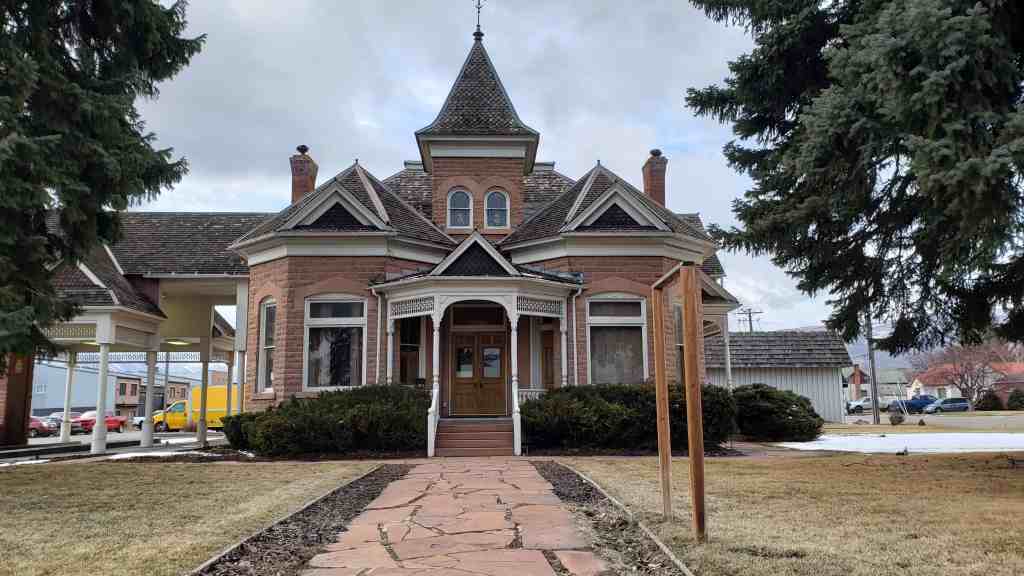
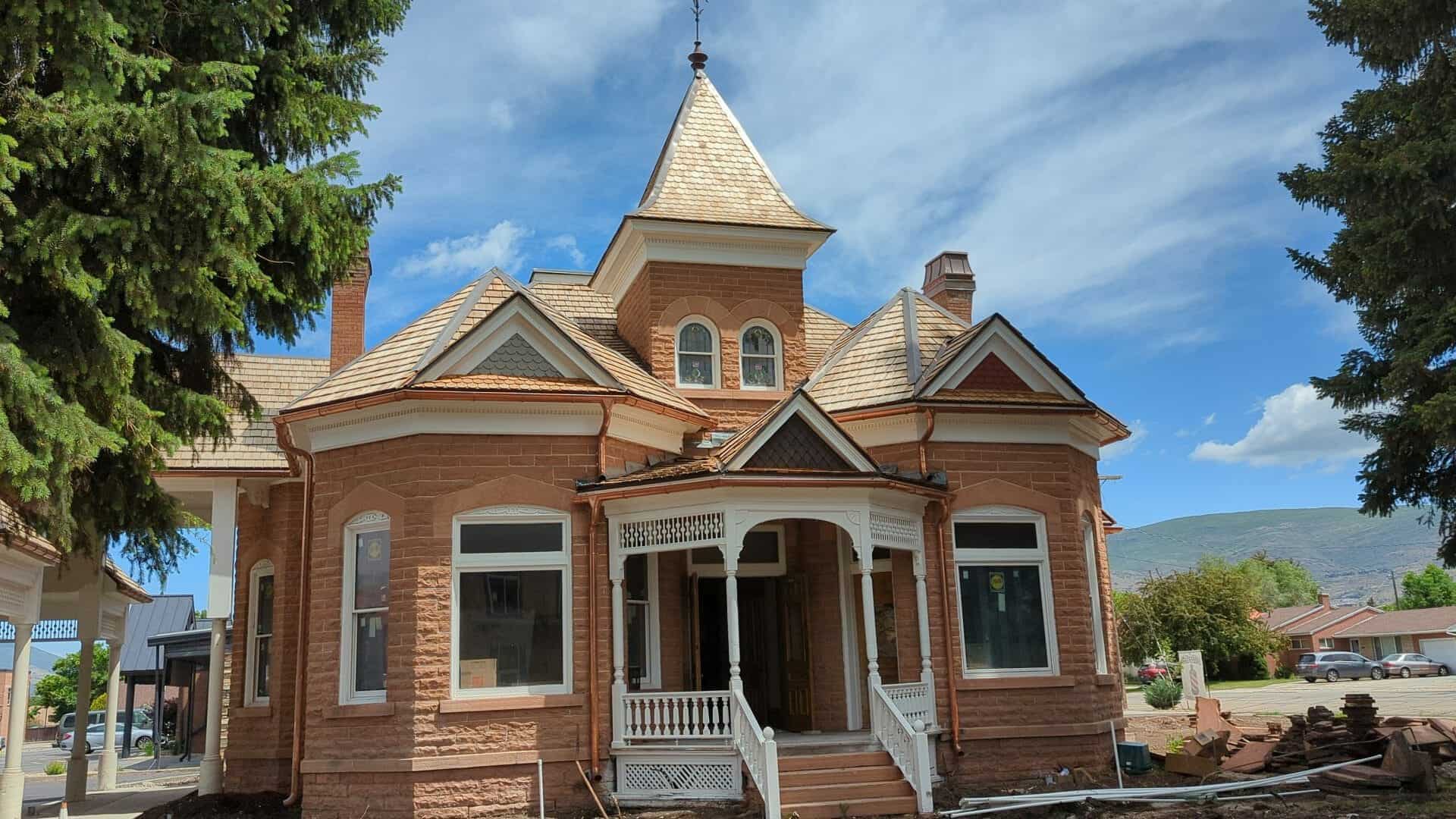
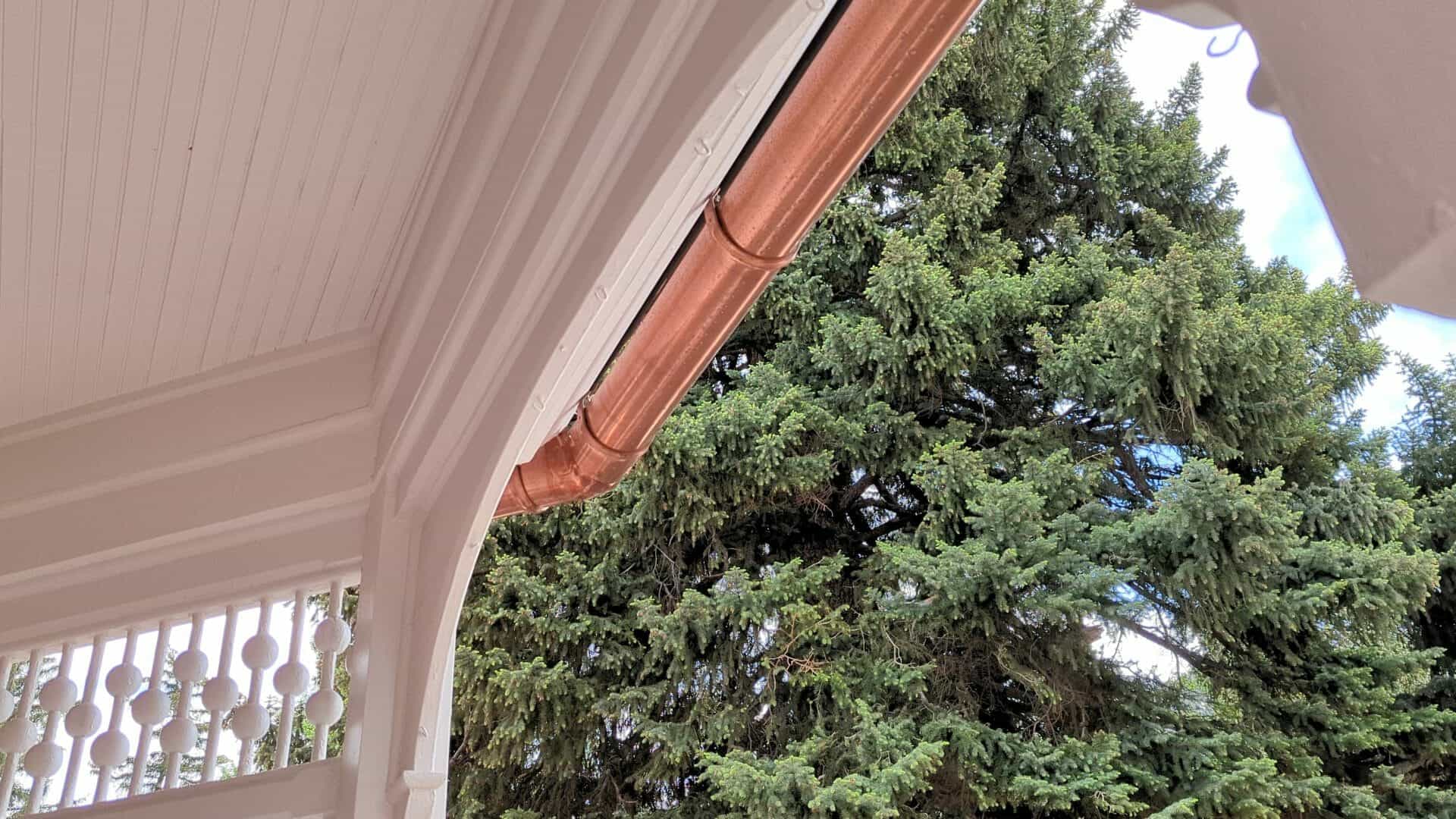
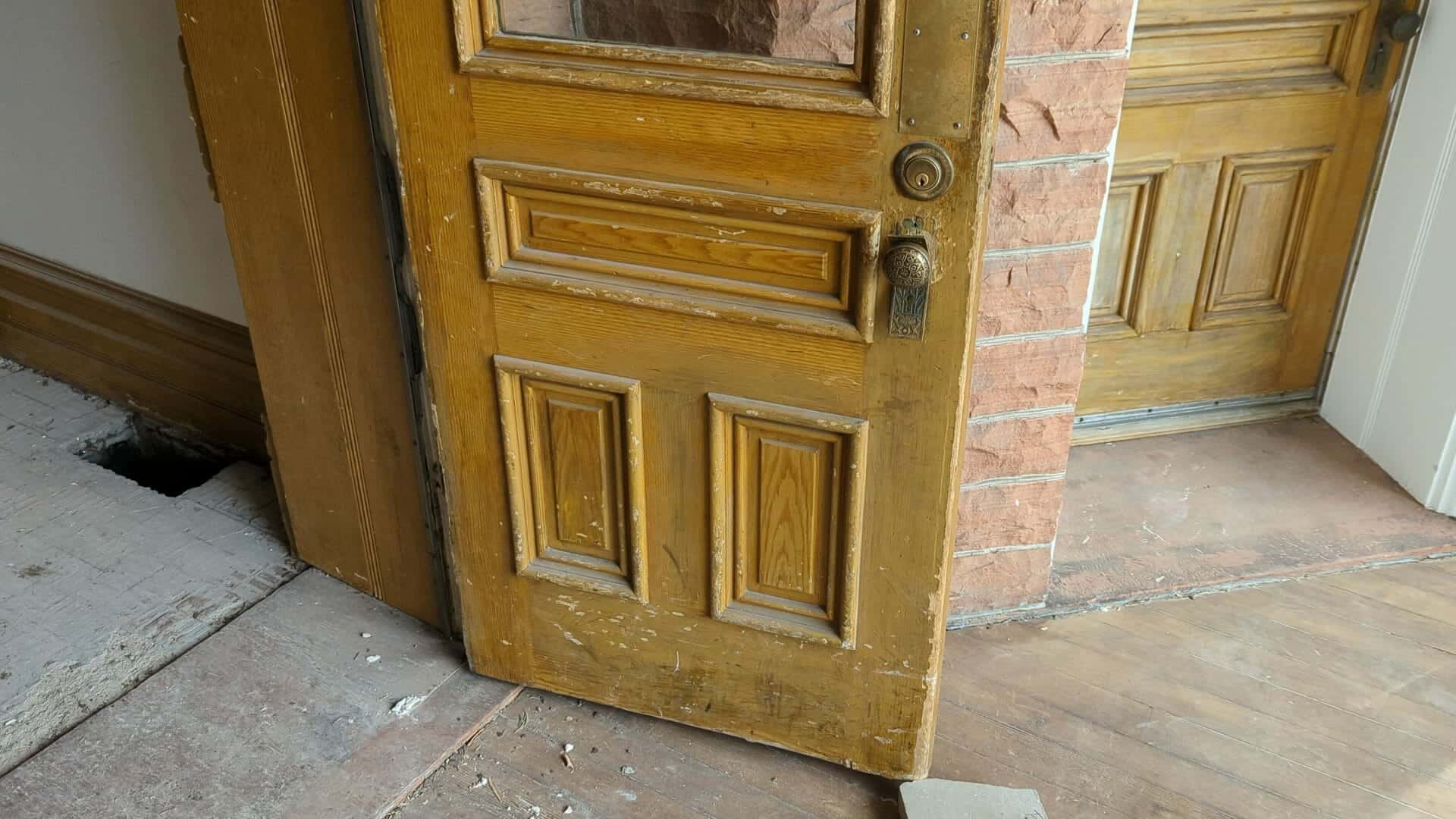
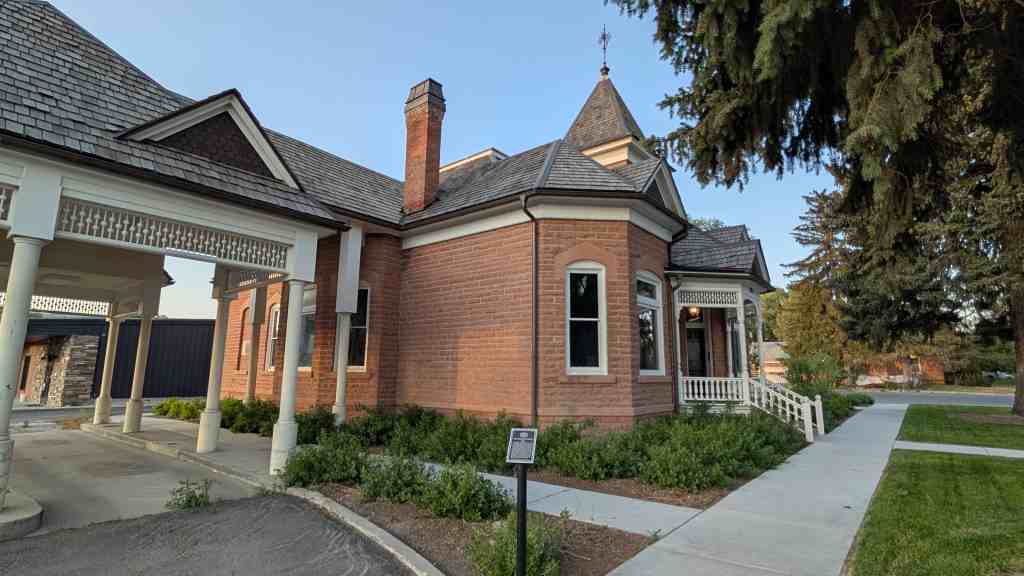
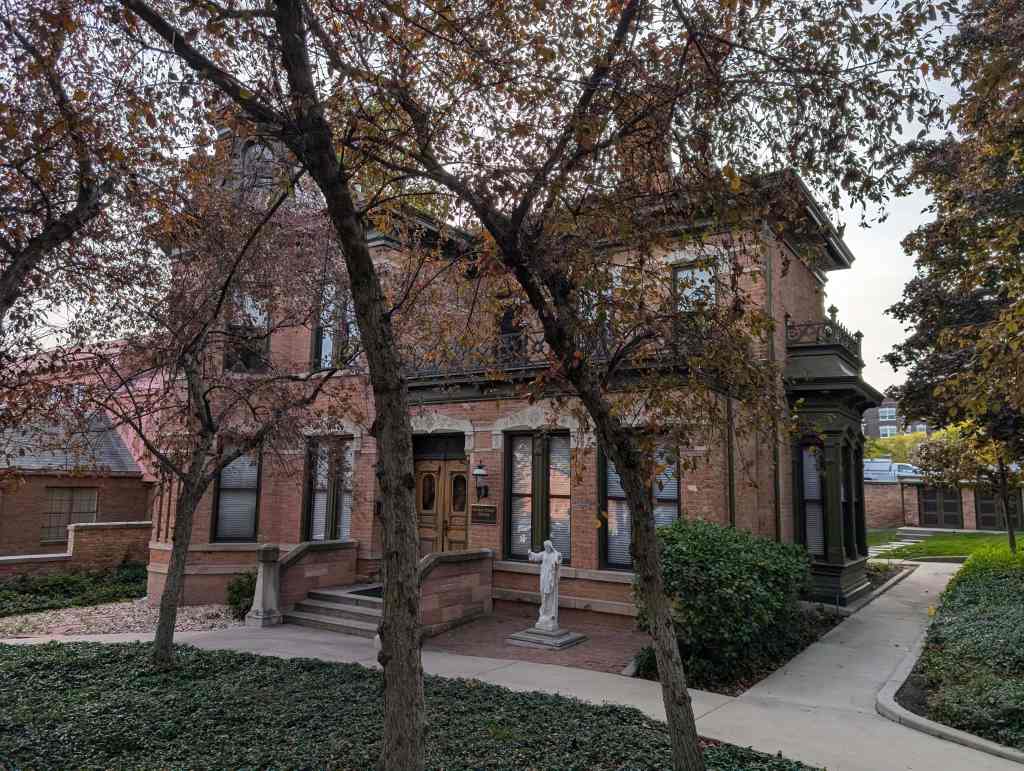
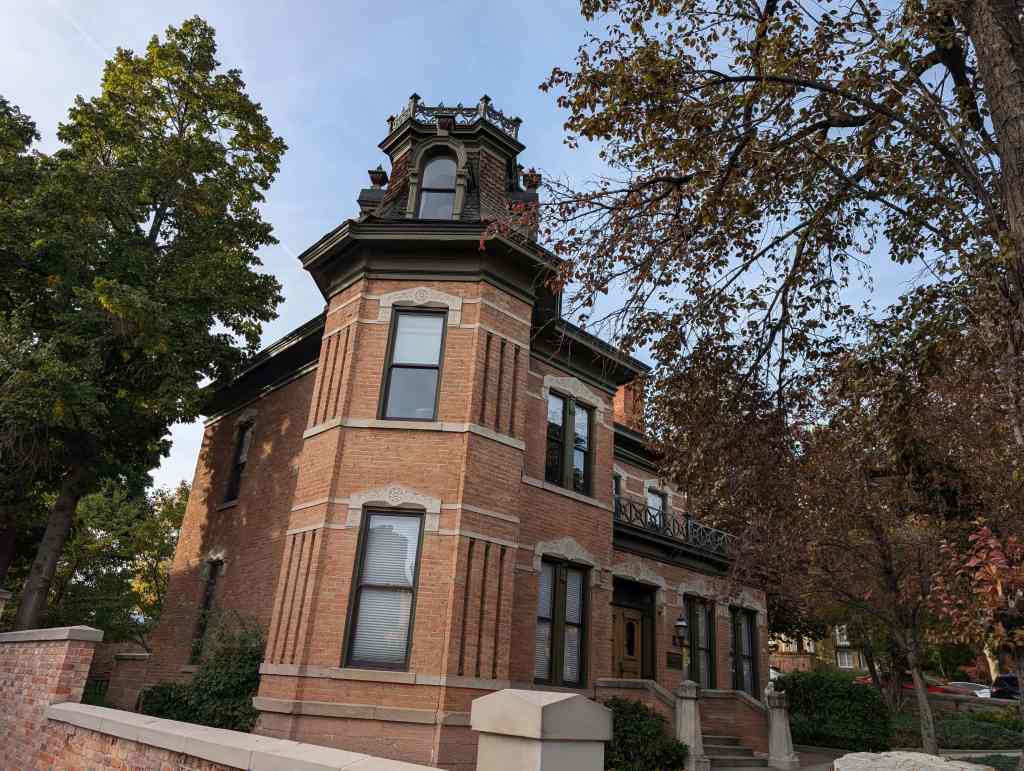
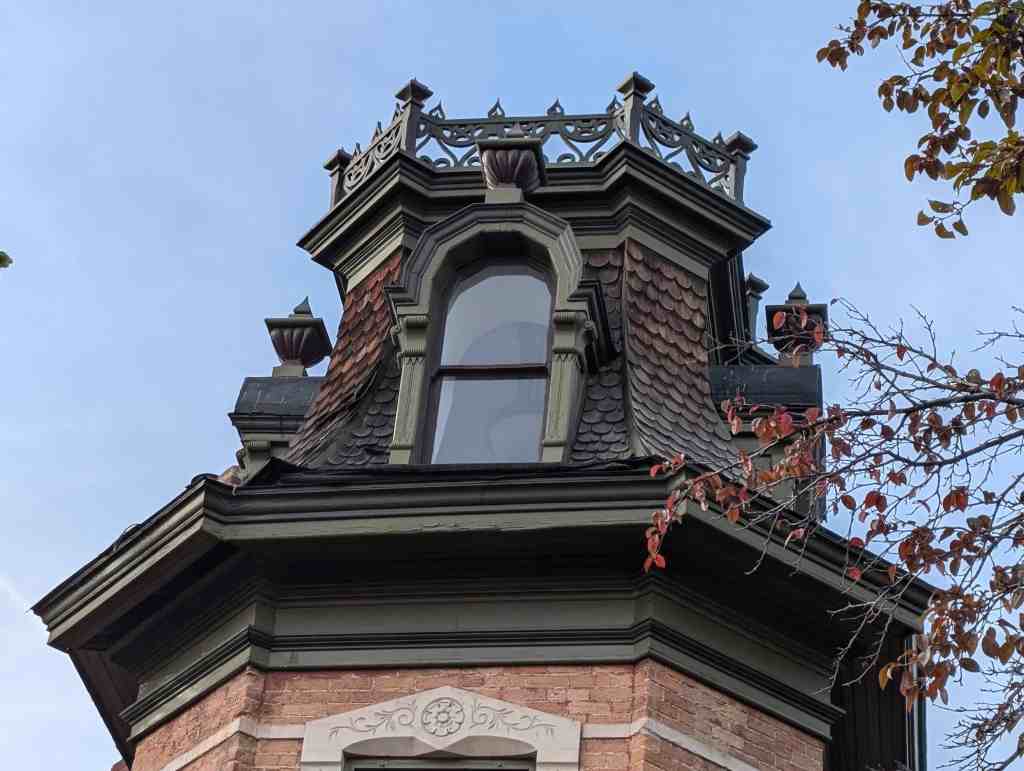
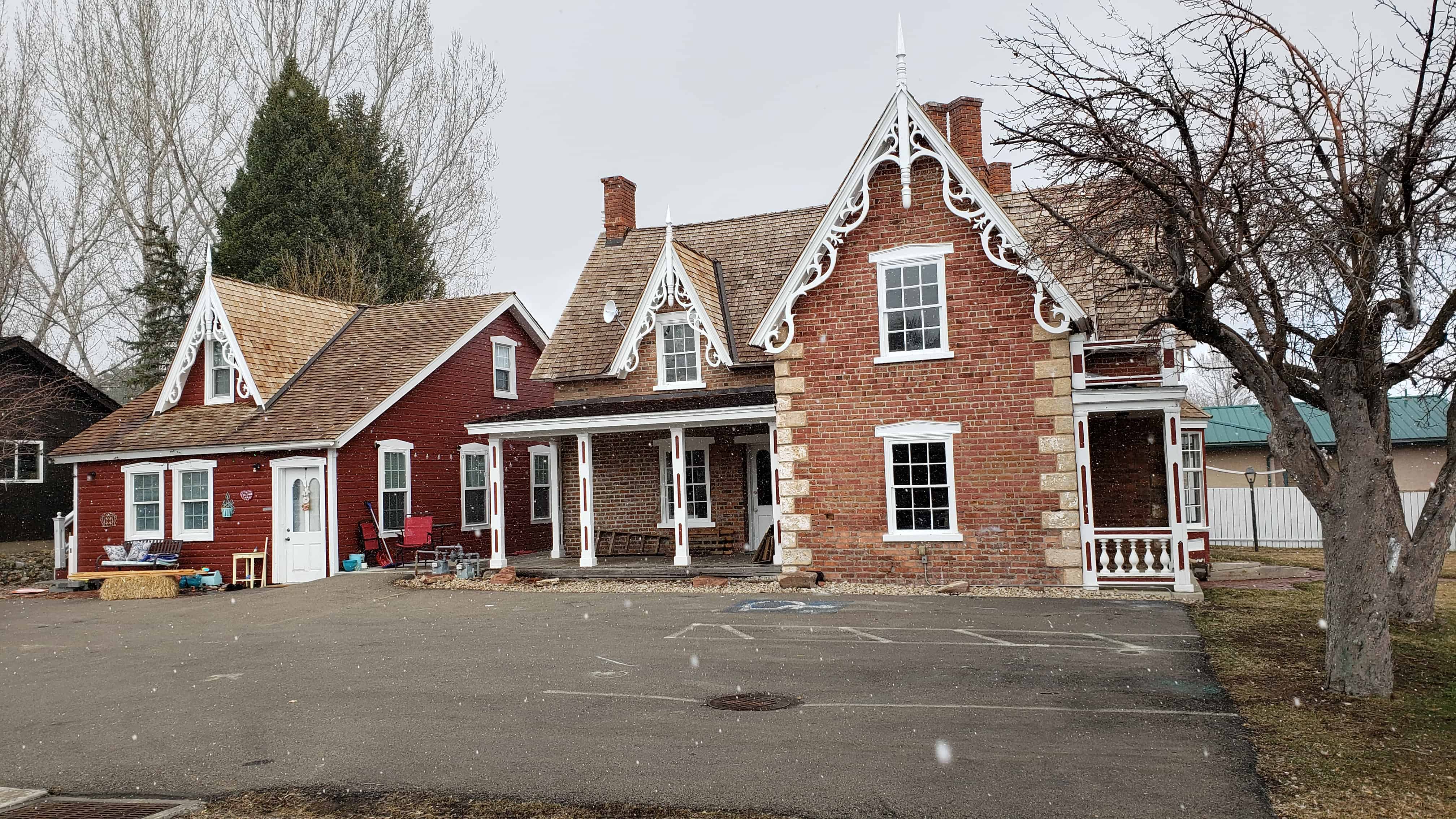
Built in 1893 by Charles E. Loose. Charles Loose was involved in the Grand Central Mining Company as manager, which is where he acquired his wealth. He was probably the most prominent non-Mormon in Provo at the turn-of-the-century. This house is distinct among turn-of-the-century homes of Provo’s other leading entrepreneurs in that it combines the massing of the Shingle Style with a consistent program of Eastlake ornamentation. Its enveloping roof, veranda and pentagonal fanlight gable windows mark its individuality among the City’s architecture.*
Built by Christian Christensen in the 1870’s and occupied by the Bailey family since 1897, it was located at 200 North and 100 West in Ephraim and is now on display in the Pioneer Park.
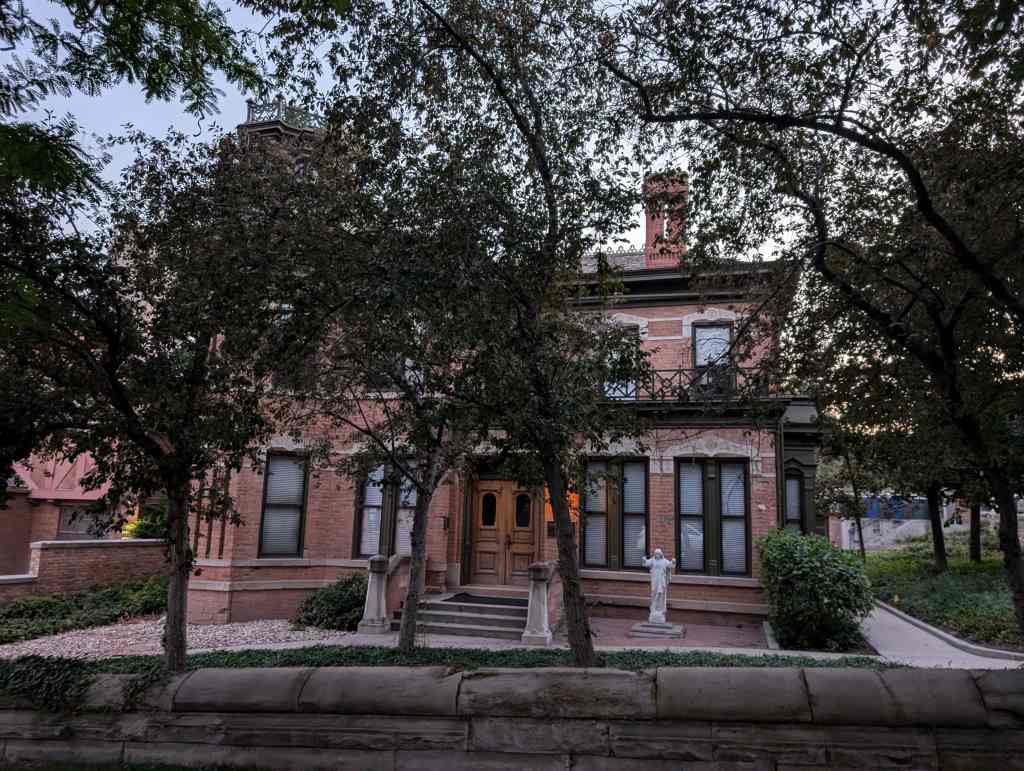
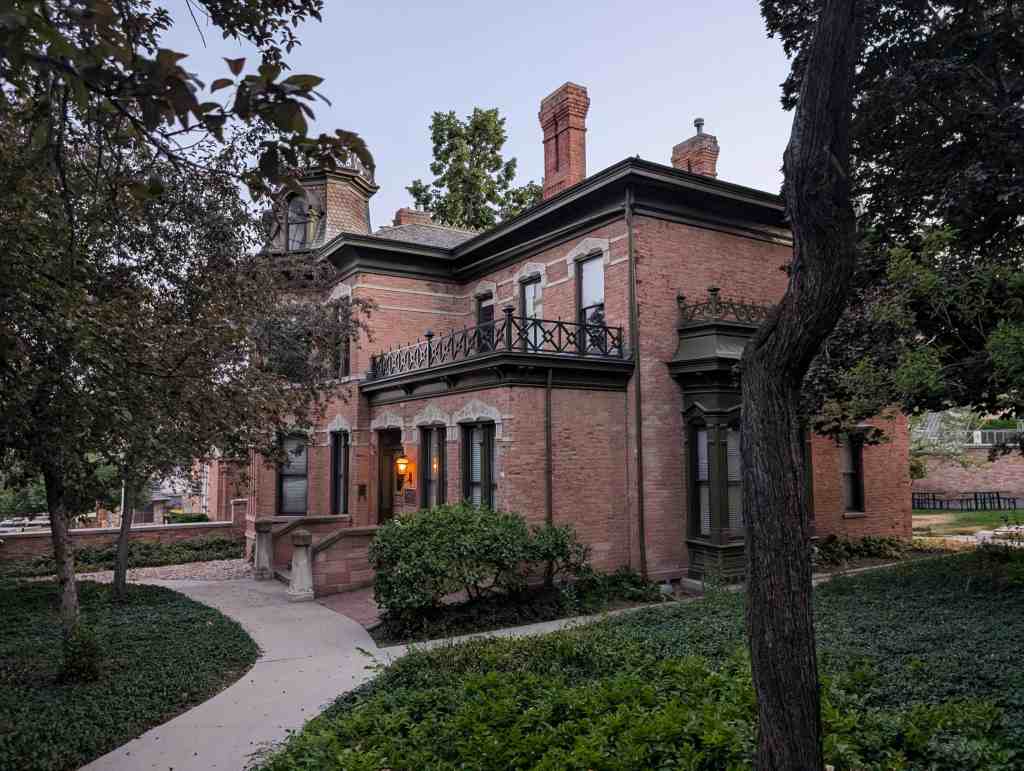
Built c. 1892 of native red sandstone by Abram Hatch — an important church, business and community leader and builder of early Wasatch County.
Adaptive restoration 1973-1974 by Zions First National Bank.
Located at 81 East Center Street in Heber City, Utah and added to the National Historic Register (#75001832) on October 10, 1975.
The Abram Hatch house was constructed circa 1892 of native red sandstone, Abram Hatch was born January 3, 1830 in Lincoln, Addison County, Vermont. In 1840 his family was converted to the Mormon Church and moved to Nauvoo, Illinois, in the fall of 1840. During the Mormon exodus of 1846, Abram captained one of the flat-bottomed ferry boats used to carry the Saints and their belongings across the Mississippi River. He made the journey to Utah in 1850 and settled at Lehi the following year, where he engaged in farming, stock-raising and operating a hotel and store. In 1861 and again in 1863 Mr. Hatch returned east to the Missouri by wagon to help bring immigrants across the plains to Utah and to purchase and freight goods for his store and others. From 1864 to 1867 he served a mission in England and upon his return was ordained by Brigham Young to serve as the Presiding Bishop of Wasatch County. When the area was formally organized as a stake in 1877, he served as stake president from 1877 to 1901, It was under his direction that the Wasatch Stake Tabernacle, now a National Register site, was constructed.
In addition to his church responsibilities, Mr. Hatch operated a mercantile store in Heber City, a farm and ranch and served as a member of the Territorial Legislature, He was, in every sense, a community leader and builder.
The home, constructed under his supervision in the early 1890s, was remodeled for use as apartments. However in 1973 the home was purchased by Zions First National Bank and renovated to house that bank’s Heber City office, The exterior was carefully restored and the interior, although adapted for a modern banking facility, contains much of the original woodwork.
The contribution of Zions First National Bank in restoring the Abram Hatch home has been recognized by a Certificate of Commendation from the American Association for State and Local History in 1974 and an Award of Merit by the Utah Heritage Foundation.
In addition to the building’s significance as the home of Abram Hatch – pioneer, long-time church leader and legislator, freighter, farmer, rancher, merchant, miller, businessman and community builder the home is an excellent example of a tasteful and meaningful adaptive use.
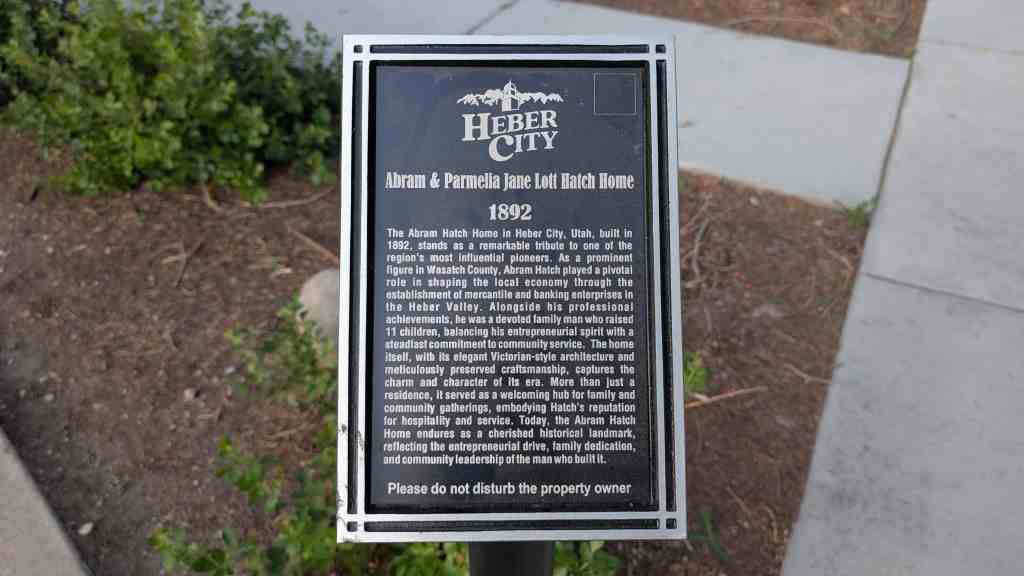
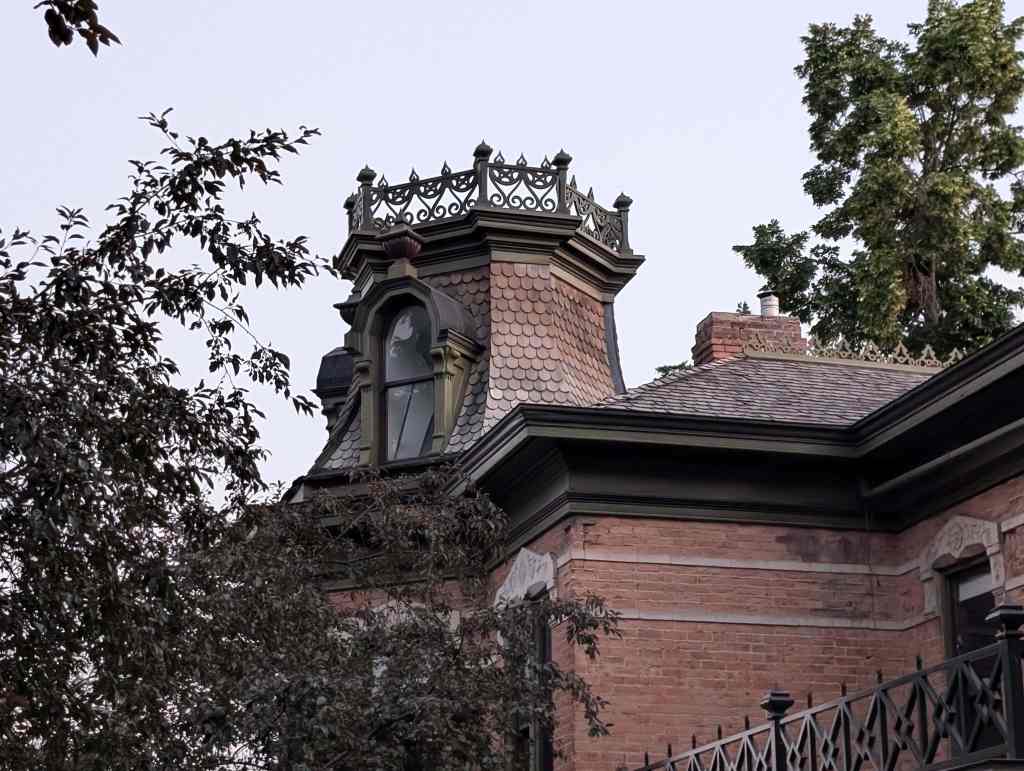
Abram & Parmelia Jane Lott Hatch Home 1892 The Abram Hatch Home in Heber City, Utah, built in 1892, stands as a remarkable tribute to one of the region’s most influential pioneers. As a prominent figure in Wasatch County, Abram Hatch played a pivotal role in shaping the local economy through the establishment of mercantile and banking enterprises in the Heber Valley. Alongside his professional achievements, he was a devoted family man who raised 11 children, balancing his entrepreneurial spirit with a steadfast commitment to community service. The home itself, with its elegant Victorian-style architecture and meticulously preserved craftsmanship, captures the charm and character of its era. More than just a residence, it served as a welcoming hub for family and community gatherings, embodying Hatch’s reputation for hospitality and service. Today, the Abram Hatch Home endures as a cherished historical landmark, reflecting the entrepreneurial drive, family dedication, and community leadership of the man who built it.
historichebercity’s instagram account has an interesting post here:
March is Women’s History Month so we’re happy to introduce some of the women who have played an integral part in the history of Heber. Meet Lavina Elizabeth Averett Murdock. Born in 1867 in Heber City, UT. Lavina was the second child of William and Elizabeth Averett. William and Elizabeth were among the earliest settlers in the valley. Lavina learned responsibility and hard work as a child. In 1894 she married Nelson Murdock and the two quickly became the parents of 5 children. In 1903 tragedy struck the young family when Nelson took his own life by drinking poison. Lavina was left to figure out how to care for her family. Just a few months after her husbands death Lavina found employment as the city recorder and was paid $40 monthly. Even though she had no formal education past 8th grade in 1905 Lavina began her career in local government by being elected treasurer of Wasatch County. She was the first woman to be elected as a county treasurer in the state of Utah. Lavina successfully continued in what was then a man’s world by holding the treasurer’s office from 1905-1917. In 1913 she was chosen to be the first woman to serve on the school board as trustee. In 1920 she was chosen to be the school board treasurer. In 1905 Lavina and her family moved into a home on the corner of 2nd E and 2nd N. She worked hard to pay for her home and often would rent rooms to help pay for the home. At one time she provided rooms in her home to be used as hospital rooms by Dr. Hatch since there was no hospital in town. Lavina raised and supported her 5 children on her own. In her later adult years she visited and lived with her adult children around the country. She lived to be 90 years old. She is buried in the Heber City Cemetery.
In 1847 pioneer Isaac Chase built a one-room shanty and a sawmill on Emigration Creek. A few years later he joined with Mormon leader Brigham Young, owner of the adjacent allotments, and together they built a flour mill and this house, the centerpiece of a 110-acre pioneer-era farm now known as Liberty Park.
Construction on the house began in the winter of 1853 and the Chase family lived here until 1860, when Young gave Chase land in Centerville in exchange for his interest in this property. The Brigham Young Jr. family, followed by other millers and their families, subsequently lived here. In 1881 the farm was sold to Salt Lake City for use as a city park, and for eight decades park employees lived in the house. In 1964 the Daughters of Utah Pioneers opened the house to the public as a museum, and in 1983 it became a gallery and later a museum for the Utah Arts Council.
The Chase home is one of a few remaining houses in Salt Lake City that date from the 1850s. Its symmetrical façade, smooth stucco, and boxed cornices with gable-end returns are all hallmarks of the Greek Revival style that was popular with early Mormon builders. The distinctive two-story front porch was a later addition, having been built sometime after 1916. In 2000 the home was renovated with donations from Salt Lake City, the State of Utah, and the LDS Church.
The William H. Culmer home was built in 1881. William and his brothers, George and Henry, immigrated with their parents from England to America in 1867. A year later they arrived in Utah. While still a boy in England, William became good friends with Charles Dickens. In the last years of his life, William Culmer wrote an account of his life as “one of the Dickens Boys.” This account was published in 1970 under the title Billy the Cartwheeler.
In Utah, the Culmer brothers organized their own firm, G.F, Culmer and Brothers, and were successful in several areas: Wholesale and retail distribution of paints, oils, varnishes, window and art glass, manufacturers of mirrors and show cases; workers in art and stained glass, and manufacturers of galvanized iron work. In addition, they were officers and managers of the Wasatch Asphaltum Company which paved many of Salt Lake City’s streets; The Wasatch Marble Quarries, The Mountain Stone Quarries, and The Kyune Sandstone Quarry which produced the stone for several of Utah’s important historic sites including the Salt Lake City and County Building, the Cathedral of the Madeleine, and the First Church of Christ Scientist building in Salt Lake City.
William Culmer died in 1939 at the age of 87. During the period of much of Utah’s industrial development, he and his brothers played an important part.
Despite the importance of William Culmer the significance of his home is that it is a prime example of Victorian architecture and, most important, the art work inside the home was executed by his nationally known brother Henry Culmer.
Henry Culmer found the painting of Seccos and stencil work to be a relaxing weekend pastime.
The Culmer Home also represents a distinct period in Utah history. Built in 1881, it represents an intermediate period of luxury home construction. It was built between the earlier Bee-Hive House and Devereaux House, built by the ecclesiastical and economic leaders of the Mormon community, and the later period of mining magnate mansions at the turn of the century built primarily by non Mormons.
Though somewhat more modest than either the early Mormon mansions or later mining mansions, the Culmer home was built for one of Utah’s most prosperous businessmen at a time when the polygamy issue hampered this kind of construction for most of Utah’s devout Mormons and at a time when the mining industry was still in its infant stage.
This cross-wing Gothic Revival house was built in 1877 for George Bonner, Jr. It was designed and built by John Watkins, an accomplished Utah builder who constructed many of the first homes in Midway. It was built at the same time as his brother William’s house across the street to the east. Both houses were reportedly completed and furnished in time for both their weddings in January 1878.
George Bonner, Jr. was born in 1850 in Scotland. His family emigrated to Utah and settled near Midway in 1861. In 1874, he and his brother William established a successful mercantile business, which George eventually took over. George and his wife Phebie lived in this house until their deaths in 1913 and 1914, respectively.
Located at 90 East Main Street in Midway, Utah and added to the National Register of Historic Places (#86001357) on June 17, 1986.
Built in 1877, the George Bonner, Jr., House is one of seven houses contained in the ARCHITECTURE OF JOHN WATKINS THEMATIC RESOURCE NOMINATION, having been designed and built by John Watkins, an accomplished early Utah builder. John Watkins 1 work effectively illustrates the dynamic role the professional builder played in shaping Utah’s early architectural landscape. While it has been customary for historians to explain Utah architecture from the time of first settlement in 1847 up to about 1890 as the simple extension of eastern folk styles or the replication of popular pattern-book designs, John Watkins’ houses suggest a more generous appraisal. Slave to neither tradition nor pattern-book, Watkins found useful ideas in both, ideas that formed the basis of essentially new if nevertheless familiar designs. From two-room cottages to elaborate Gothic Revival houses to houses intended for multi-family polygamous living, Watkins drew upon his broad building experience to create not copies of other houses, but new ones designed to meet his client’s functional, aesthetic, and symbolic needs.
John Watkins was born in Maidsone, Kent, Kingland in 1834. He received training in the building trade in his native England before joining the Church of Jesus Christ of Latter-day Saints and emigrating to Utah in 1855. Watkins’ skills were welcomed in the nascent Mormon towns of, first, Provo, and then Midway. In Provo, Watkins helped build the original LDS Tabernacle (1856) and the Opera House (1859), and after moving to Midway in the upper Provo River Valley in 1862, Watkins’ familiarity with picturesque design produced 5 of the best and most significant examples of the Gothic Revival architectural style in the state of Utah.
George Bonner, Jr., had this house built in 1877 at the same time that his brother William was having a house built across the street to the east. Both George Jr. and William were married in January 1878, and their houses were reportedly built and completely furnished in time for their weddings.
Their father, George Bonner, Sr., who had purchased the property upon which his sons’ houses were built, lived across the street at 103 E. Main. The intersection at 100 East and Main Street in Midway became known locally as “Bonners 1 Corners” because the Bonners owned all four corner lots, three of which had houses on them and the other was occupied by the Bonner Mercantile. All three houses those of George Sr., George Jr., and William were designed and built by their neighbor, John Watkins, whose own house at 5 E. Main exhibits some of the same Gothic Revival features that are found on the Bonner houses.
George Bonner, Jr., was born August 4, 1850, in Glasgow, Scotland, to George Bonner Sr. and Margaret Edmundston Bonner. The family converted to the Church of Jesus Christ of Latter-day Saints (Mormon Church) in the early 1850s and came to the U.S. soon after to join the Saints in Utah. After spending a few years in Pennsylvania, where George Sr. worked in the coal mines, the family arrived in Utah in 1861 and settled near Midway. As a young man George obtained a contract to provide timber for the Ontario Mine in Park City, which proved to be a successful venture. In 1874, he and his brother William opened a small store in one room of their father’s house. That business prospered to the point that they built a separate store building on the corner lot west of their father’s house in 1879. The brothers ran the store together for a number of years, then George took over complete operation. George and William were also involved in the livestock business, and they are credited with operating the first grist mill in Midway.2 On January 4, 1878, George married Phebie Annette Alexander. Phebie was born in East Mill Creek in 1857 and had moved to Midway with her parents around 1871. George and Phebie had six children, five of whom lived to adulthood. They lived in this house until their deaths in 1913 and 1944, respectively.
Constructed c. 1876, the George Bonner, Sr., House is one of seven houses contained in the Architecture of John Watkins Thematic Resource Nomination, having been designed and built by John Watkins, an accomplished early Utah builder. John Watkins’ work effectively illustrates the dynamic role the professional builder played in shaping Utah’s early architectural landscape. While it has been customary for historians to explain Utah architecture from the time of first settlement in 1847 up to about 1890 as the simple extension of eastern folk styles or the replication of popular pattern-book designs, John Watkins’ houses suggest a more generous appraisal. Slave to neither tradition nor pattern-book, Watkins found useful ideas in both, ideas that formed the basis of essentially new if nevertheless familiar designs. From two-room cottages to elaborate Gothic Revival houses to houses intended for multi-family polygamous living, Watkins drew upon his broad building experience to create not copies of other houses, but new ones designed to meet his client’s functional, aesthetic, and symbolic needs. This house is significant not only as an important example of the Gothic Revival style in early Utah, but also because it demonstrates Watkins’ ability to deftly manipulate basic picturesque design concepts. Drawing upon a set of ideas embodied in the basic cross-wing house form, Watkins was able to generate a rich variety of housing designs.
John Watkins was born in Maidsone, Kent, England in 1834. He received training in the building trade in his native England before joining the Church of Jesus Christ of Latter-day Saints and emigrating to Utah in 1855. Watkins’ skills were welcomed in the nascent Mormon towns of, first, Provo, and then Midway. In Provo, Watkins helped build the original LDS Tabernacle (1856).
Constructed c. 1876, the George Bonner, Sr., House is one of seven houses contained in the ARCHITECTURE OF JOHN WATKINS THEMATIC RESOURCE NOMINATION, haying been designed and built by John Watkins, an accomplished early Utah builder. John Watkins’ work effectively illustrates the dynamic role the professional builder played in shaping Utah’s early architectural landscape. While it has been customary for historians to explain Utah architecture from the time of first settlement in 1847 up to about 1890 as the simple extension of eastern folk styles or the replication of popular pattern-book designs, John Watkins’ houses suggest a more generous appraisal. Slave to neither tradition nor pattern-book, Watkins found useful ideas in both, ideas that formed the basis of essentially new if nevertheless familiar designs. From two-room cottages to elaborate Gothic Revival houses to houses intended for multi -family polygamous living, Watkins drew upon his broad building experience to create not copies of other houses, but new ones designed to meet his client’s functional, aesthetic, and symbolic needs. This house is significant not only as an important example of the Gothic Revival style in early Utah, but also because it demonstrates Watkins’ ability to deftly manipulate basic picturesque design concepts. Drawing upon a set of ideas embodied in the basic cross-wing house form, Watkins was able to generate a a rich variety of housing designs.
John Watkins was born in Maidsone, Kent, Kingland in 1834. He received training in the building trade in his native England before joining the Church of Jesus Christ of Latter-day Saints and emigrating to Utah in 1855. Watkins’ skills were welcomed in the nascent Mormon towns of, first, Provo, and then Midway. In Provo, Watkins helped build the original LDS Tabernacle (1856) and the Opera House (1859) and after moving to Midway in the …. best and most significant examples of the Gothic Revival architectural style in the state of Utah.
George Bonner was born January 8, 1822, at Kiliver, Monaghan County, Ireland, to George and Ann Travers Bonner. He left his native land at the age of 14 and went to Scotland, where he married Margaret Edmundston on October 22, 1849. They were baptized into the Church of Jesus Christ of Latter-day Saints (Mormon Church) soon after their marriage, and in 1856 they sailed to America to gather with the Saints in Utah. After spending a few years in Pennsylvania where George worked in the coal mines, they reached Utah in 1861, settling in Wasatch County. George Bonner was probably one of the first settlers in Midway, Wasatch County, which was established in 1867 after the Black Hawk Indian War was peacefully resolved. It is unknown where Bonner*s first house was located in the town, perhaps on this same property.
Around 1876, Bonner hired John Watkins to design and construct this two-story Gothic Revival house. Watkins had built his own similarly styled house at 5 E. Main c. 1869, and Bonner apparently liked that house well enough to have his own house built in a similar style. Watkins also built houses for Bonner’s two sons, George Jr. and William, in 1877 on the corner lots across the street to the south from their father’s home. George and Margaret Bonner lived in this house from the time of its completion until their deaths in 1905 and 1920, respectively.
George Bonner was a farmer and for a time was involved in a commercial grocery business with his sons. Their first store was located in the west front room of this house until 1879, when a store was constructed on the corner across the street to the west. (This store was designed by John Watkins, but it has been altered to the point where it is no longer eligible for inclusion in this thematic nomination.)
One of the rooms in the house served at times as a hideout for John Watkins who, as a polygamist, was subject to capture and trial by federal officials. Since Watkins’ own house was not a safe place to hide when the officials were in town, the Bonners offered a room in their house for his use at any time. It was stocked with provisions and reading materials to sustain Watkins until it was once again safe for him to venture out. Either the west or east front room apparently served as the hideout, since they fit the description of the room as “a cheerful front room with an outside door with large windows looking onto the highway….”
This house remained in the Bonner family until 1970, when it was sold to Rulon M. Huntington. John Told purchased the house from the Huntingtons in 1985 and is currently in the process of renovation and restoration.
By the 1950s, however, very little of this elaborate garnishment remained. In fact, only the quoins and the window heads were left to suggest the decorative quality of the original design.
In 1985, working from historic photographs and early photographs of Watkins’ other Midway houses, the present owner began to refurbish the house. Plaster was removed from the exterior walls and chimneys, the asphalt roof was replaced with a wooden one, bargeboards and finials were carefully copied and remounted, and the original porches were painstakingly reconstructed. The large garage that was built on the rear of the house in 1974 was detached, exposing the original rear wall of the house. The garage, now a separate building, does not contribute to the significance of this property. The Bonner house today has regained much of its original appearance. This work, accomplished with the aid of ample documentation, does not adversely affect the historic integrity of the house.
Built in 1877 for William Bonner, this is one of several Gothic Revival style houses in Midway that were designed and constructed by John Watkins, an accomplished local builder. Watkins, an emigrant from England in 1856, demonstrated his considerable architectural knowledge and skills by combining variations of the cross-wing house form with Gothic Revival stylistic elements to create houses which, though similar to each other, are each unique. Watkins’ houses are among the best examples of Gothic Revival style in Utah. William’s father’s house, located across the street to the north, and his brother George’s house on the corner to the west, were also built by John Watkins. This house and George’s house were reportedly built and completely furnished in time for both their weddings in January 1878. Together, William and George operated the Bonner Mercantile for a number of years, then William devoted full time to his livestock operations, raising purebred horses and cattle. William and his wife Sarah Eliza Bronson remained in this house until their deaths in 1925 and 1946, respectively.
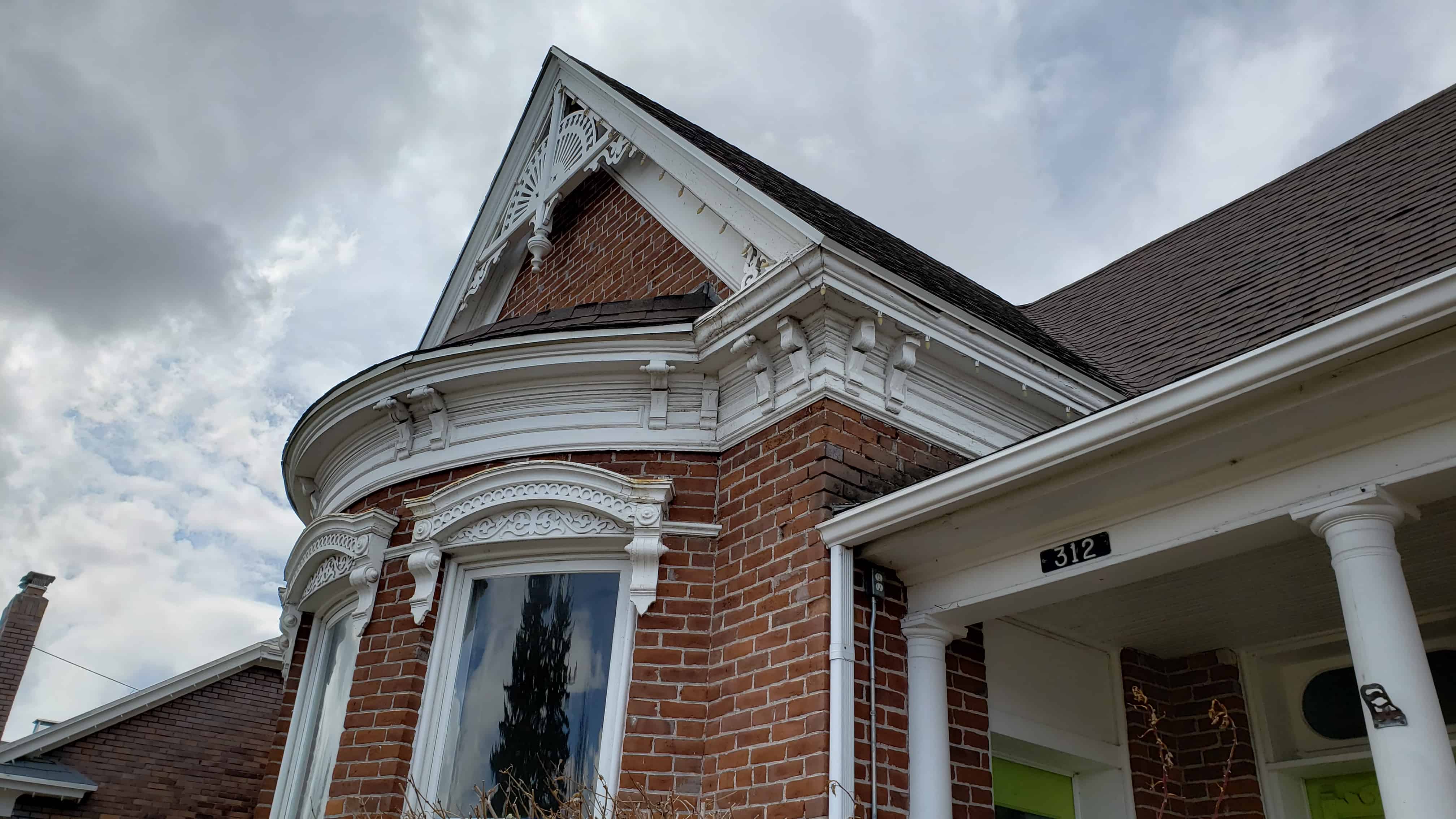
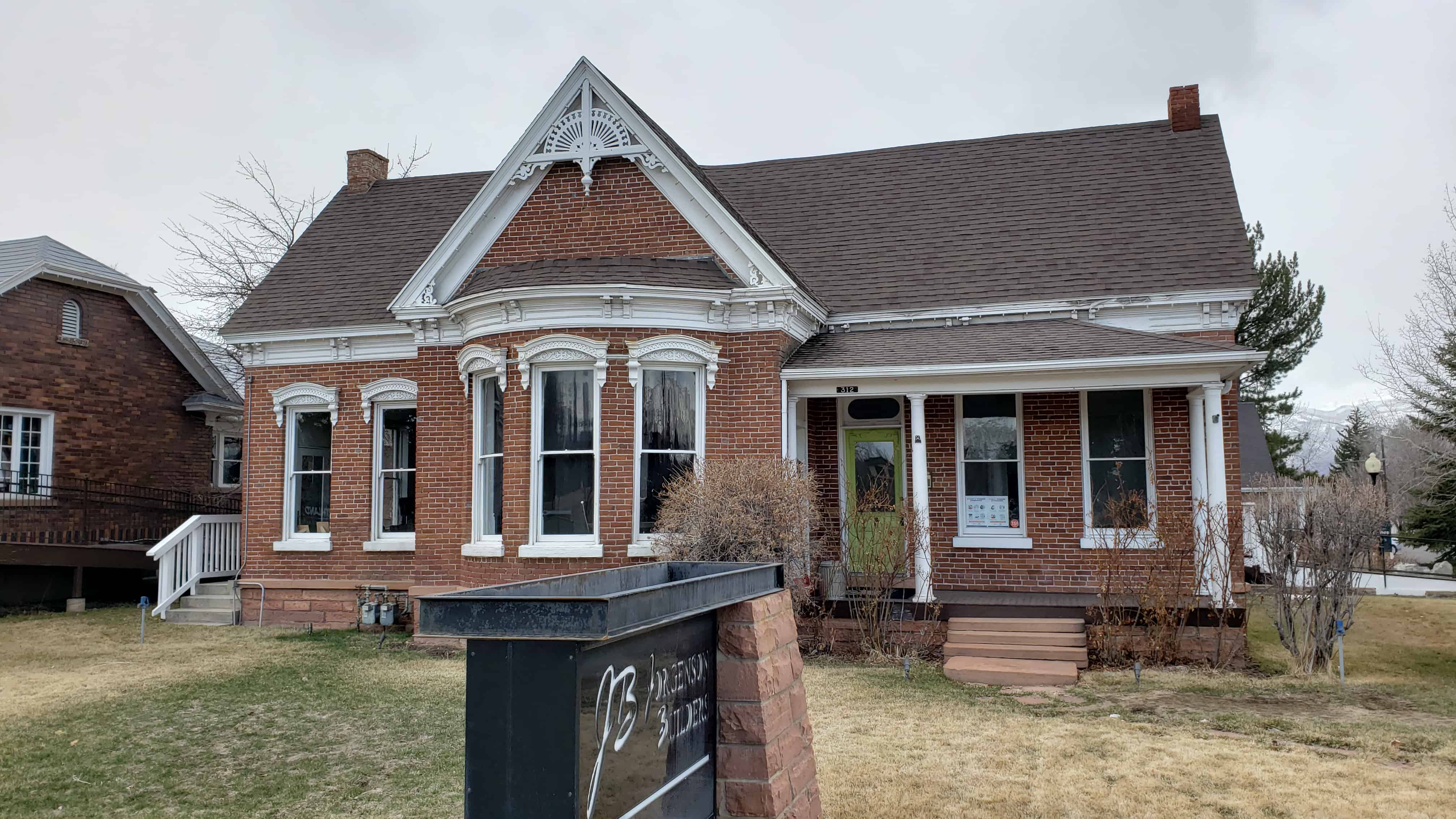
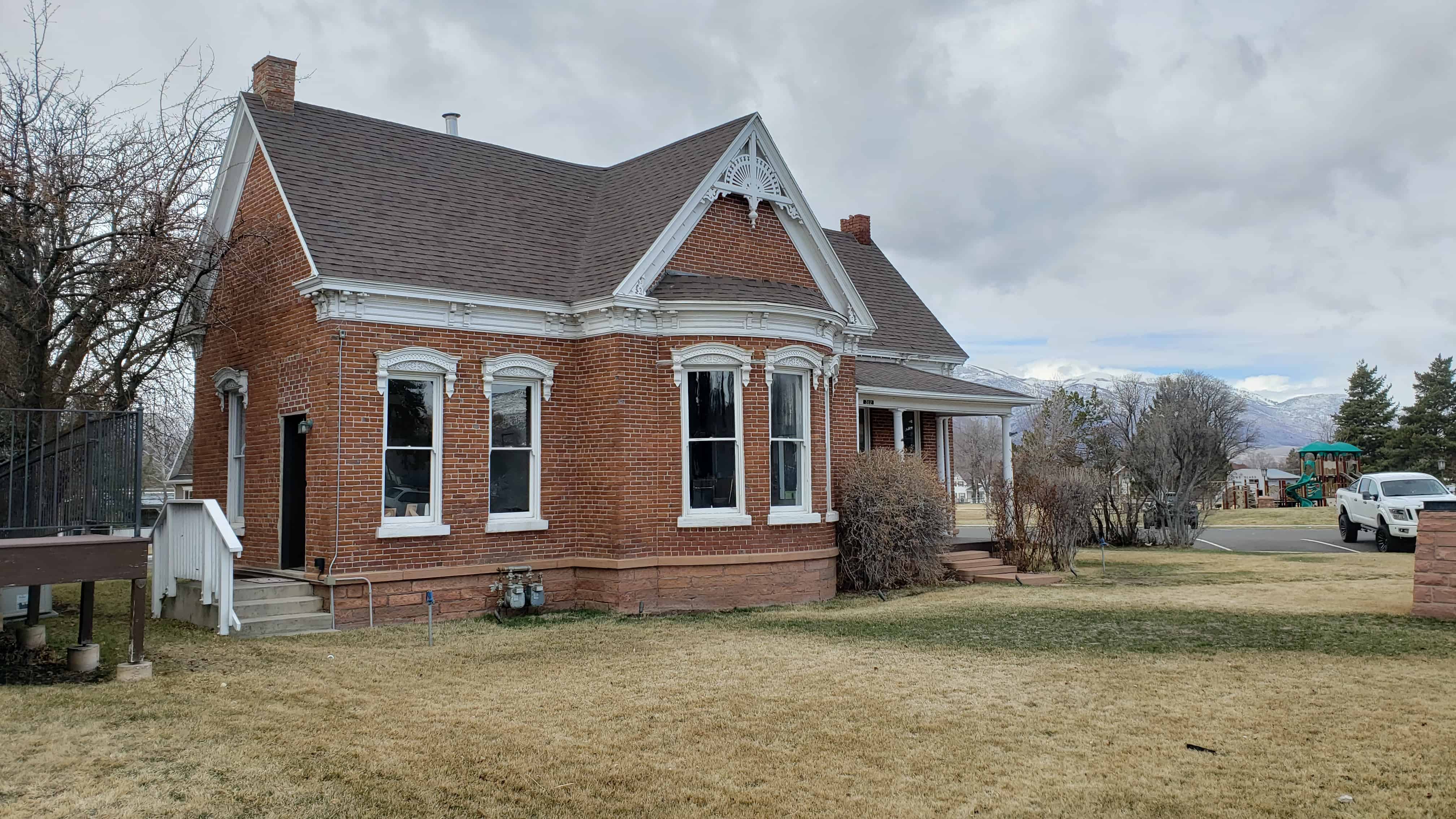
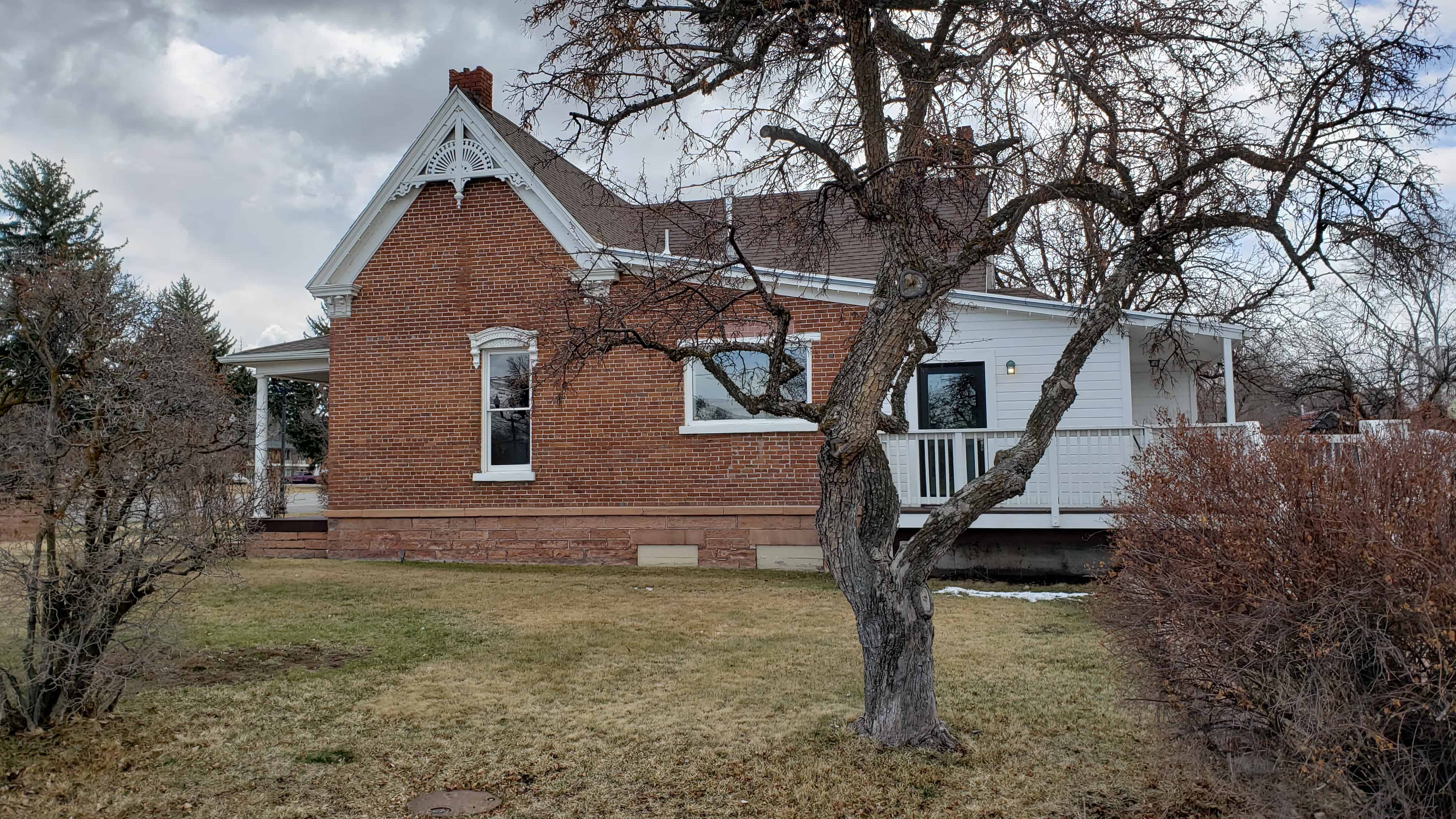
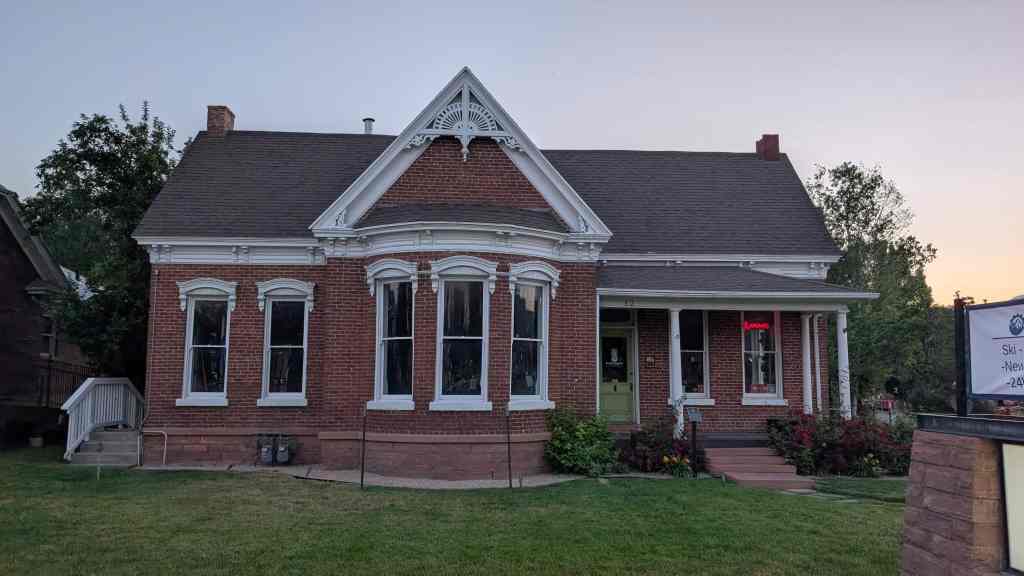
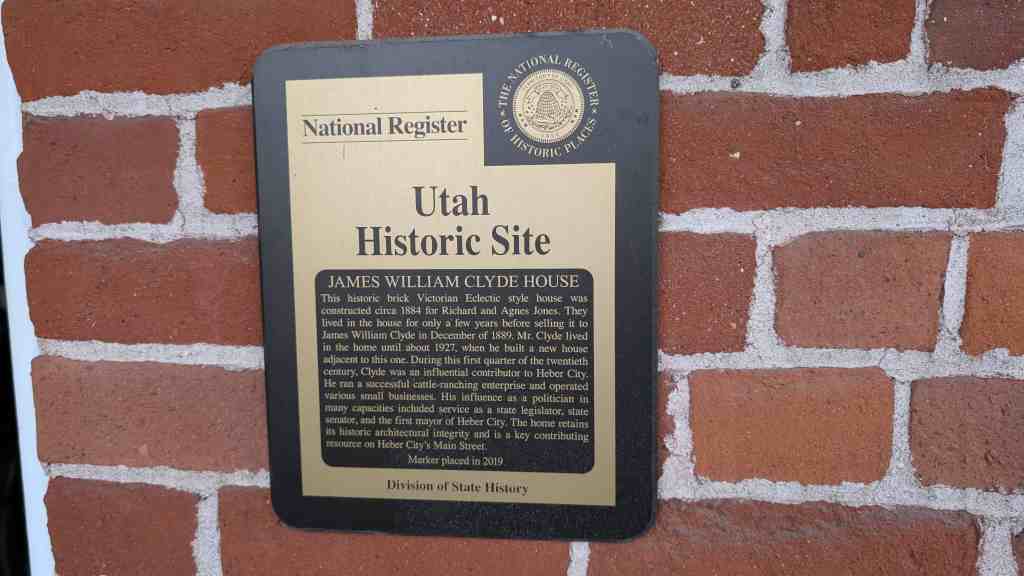
This historic brick Victorian Eclectic style house was constructed circa 1884 for Richard and Agnes Jones. They lived in the house for only a few years before selling it to James William Clyde in December of 1889. Mr. Clyde lived in the home until about 1927, when hw built a new house adjacent to this one. During this first quarter of the twentieth century, Clyde was an influential contributor to Heber City. He ran a successful cattle-ranching enterprise and operated various small businesses. His influence as a politician in many capacities included service as a state legislator, state senator, and the first mayor of Heber City. The home retains its historic architectural integrity and is a key contributing resource on Heber City’s Main Street.
Located at 312 South Main Street in Heber City, Utah.
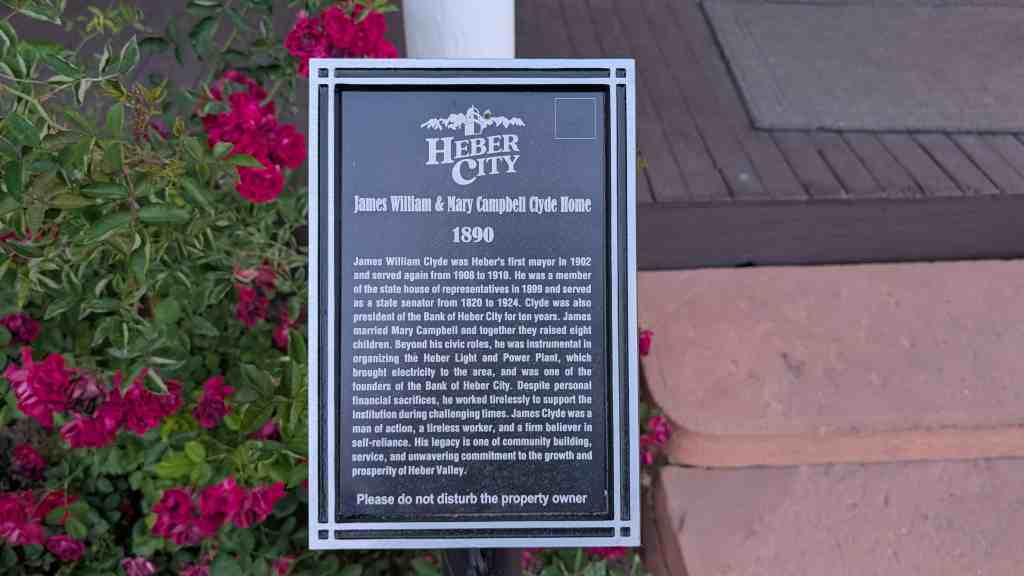
James William Clyde was Heber’s first mayor in 1902 and served again from 1908 to 1910. He was a member of the state house of representatives in 1899 and served as a state senator from 1820 to 1924. Clyde was also president of the Bank of Heber City for ten years. James married Mary Campbell and together they raised eight children. Beyond his civic roles, he was instrumental in organizing the Heber Light and Power Plant, which brought electricity to the area, and was one of the founders of the Bank of Heber City. Despite personal financial sacrifices, he worked tirelessly to support the institution during challenging times. James Clyde was a man of action, a tireless worker, and a firm believer in self-reliance. His legacy is one of community building, service, and unwavering commitment to the growth and prosperity of Heber Valley.