• About JacobBarlow.com
  • Cemeteries in Utah
  • D.U.P. Markers
  • Doors
  • Exploring Utah Email List
  • Geocaching
  • Historic Marker Map
  • Links
  • Movie/TV Show Filming Locations
  • Oldest in Utah
  • Other Travels
  • Photos Then and Now
  • S.U.P. Markers
  • U.P.T.L.A. Markers
  • Utah Cities and Places.
  • Utah Homes for Sale
  • Utah Treasure Hunt

JacobBarlow.com

~ Exploring with Jacob Barlow

JacobBarlow.com

Tag Archives: Historic Markers

Pendleton Rock House

14 Sunday Aug 2022

Posted by Jacob Barlow in Uncategorized

≈ Leave a comment

Tags

Historic Homes, Historic Markers, summit county, utah, Wanship

Pendleton Rock House

Traveling mason and plasterer George Dunford built at least three rock homes in Wanship as well as the rock schoolhouse (ca 1879-1912) and the original brick LDS church (1887-1958). He apparently built his home in three sections beginning about 1860 with the rear single-room house. A front addition and cross-wing turned the home into the L-shaped house evident today. Each section was constructed of local stone with 18-inch thick walls. Joshua and Delpha Stewart Pendleton purchased the stone house in 1890 for eleven hundred dollars. By 1880, Wanship had become a crossroads for east/west railroad traffic and wagon traffic south to the Kamas Valley. Augmenting his blacksmith business, Pendleton added a wooden structure to the home’s street façade to serve as a store, post office and restaurant. During summer months, Delpha cooked meals for travelers on an outdoor wood stove. One month before she died in 1937, Delpha sold the home to her oldest son, William, who continued to live in the home with his wife, Millie Irene Lee. In 1987 Dale Nelson purchased the homestead including the house, outbuildings and blacksmith shop, to provide storage for his many historic stagecoaches, hay wagons, fire engines and other large artifacts. It became affectionately known as “Dale’s roadside attraction” on the old Lincoln Highway.

Located at 30049 Old Lincoln Highway in Wanship, Utah

Goldfield

10 Wednesday Aug 2022

Posted by Jacob Barlow in Uncategorized

≈ Leave a comment

Tags

Esmeralda County, Goldfield, Historic Markers, Nevada, Nevada Historic Markers

Goldfield

For a 20-year period prior to 1900 the mining in Nevada fell into a slump that cast the entire state into a bleak depression and caused the loss of a third of the population.

The picture brightened overnight following the spectacular strikes in Tonopah and, shortly afterwards, in Goldfield. Gold ore was discovered here in December 1902 by two Nevada-born prospectors, Harry Stimler and Billy Marsh. From 1904 to 1918 Goldfield boomed furiously. The city had a railroad that connected into Las Vegas and a peak population of 20,000. Between 1903 – 40 a total of $86,765,044 in metals was produced here.

This is Nevada State Historical Marker #14, located outside the Esmeralda County Courthouse in Goldfield, Nevada. See others on this page:

  • Nevada Historic Markers

Union Pacific Depot

02 Tuesday Aug 2022

Posted by Jacob Barlow in Uncategorized

≈ Leave a comment

Tags

Caliente, Historic Markers, Lincoln County, Mission Revival, Nevada, Nevada Historic Markers

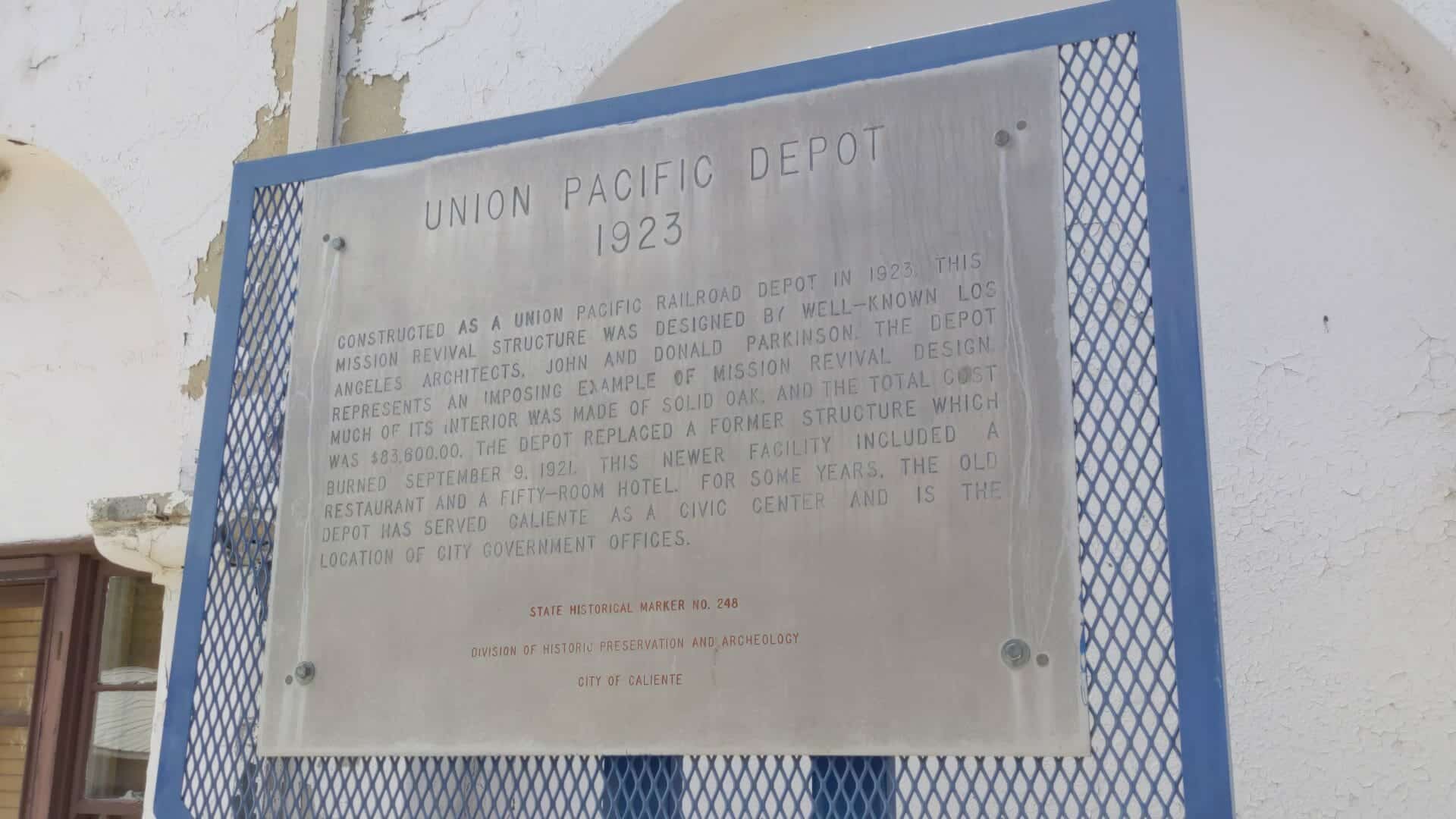
Union Pacific Depot
1923

Constructed as a Union Pacific railroad depot in 1923, this mission revival structure was designed by well-known Los Angeles architects, John and Donald Parkinson. The depot represents an imposing example of mission revival design. Much of its interior was made of solid oak, and the total cost was more than $80,000. The depot replaced a former structure which burned on September 9, 1921. This newer facility included a restaurant and fifty-room hotel for some years. The structure has served Caliente as a civic center and is the location of city government offices.

This is Nevada State Historical Marker #248, located at the Caliente Railroad Depot in Caliente, Nevada. See others on this page:

  • Nevada Historic Markers

Note, there are two markers numbered #248, the other is: Virginia & Truckee Railroad Right of Way

Caliente

31 Sunday Jul 2022

Posted by Jacob Barlow in Uncategorized

≈ Leave a comment

Tags

Caliente, Historic Markers, Lincoln County, Nevada, Nevada Historic Markers

Caliente
(Culverwell’s Ranch)

Caliente was first settled as a ranch, furnishing hay for the mining camps of Pioche and Delmar. In 1901, the famous Harriman-Clark right-of-way battle was ended when rancher Charles Culverwell, with the aid of a broad-gauge shotgun, allowed one railroad grade to be built through his lush meadows. Harriman and Clark had been battling eleven years, building side-by-side grades ignoring court orders and federal marshals.

The population boom began with an influx of railroad workers, most of them immigrants from Austria, Japan, and the Ottoman Empire. A tent city was settled in August 1903.

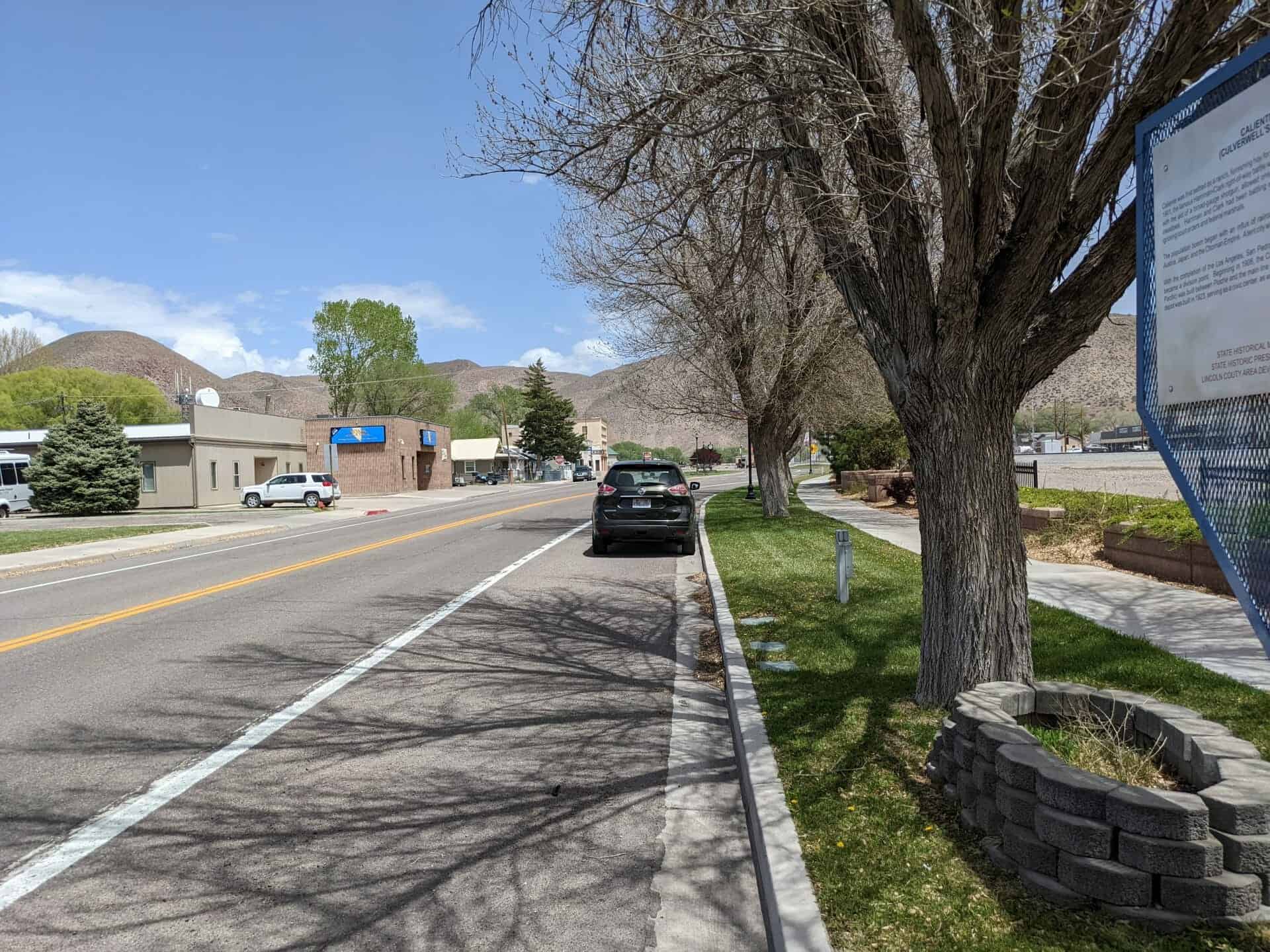
With the completion of the Los Angeles, San Pedro, and Salt Lake Railroad in 1905, Caliente became a division point. Beginning in 1906, the Caliente and Pioche Railroad (now the Union Pacific) was built between Pioche and the main line at Caliente. The large Mission Revival-style depot was built in 1923, serving as a civic center, as well as a hotel.

This is Nevada State Historical Marker #55, located in Caliente, Nevada. See others on this page:

  • Nevada Historic Markers

Tragedy and Triumph: Emergency Landings

28 Thursday Jul 2022

Posted by Jacob Barlow in Uncategorized

≈ Leave a comment

Tags

Airline History, Bryce Canyon, Historic Markers

Tragedy and Triumph: Emergency Landings

“Tail is going out. We may get down… and we may not.”

On October 24, 1947, Captain Everett L. McMillan of United Flight 608 relayed these chilling words. The mid-section of his DC-6 engulfed in flames, McMillan was attempting to steer the disintegrating craft to Bryce Canyon Airport for an emergency landing. Moments later, the plane – carrying 47 passengers and 6 crew members – crashed in Bryce Canyon National Park, 1.5 miles short of the runway. Local residents witnessed the crash and rushed to the scene to help. Tragically, there were no survivors.

In the weeks following the accident, investigators gathered thousands of charred pieces of the aircraft to reconstruct the wreckage. During this time, on November 11, 1947, another DC-6 caught fire in flight, but quickly landed without casualties. By examining this plane and the remains of Flight 608, investigators uncovered a critical design flaw. As a result, the entire fleet of 80 DC-6 planes was grounded and repaired, including President Truman’s plane, “The Independence.”

Piecing the Story Together

The crash of flight 608 marked the first time in aviation history that a plane was reconstructed to determine the cause of the accident. By piecing together the main fuselage, investigators discovered that the fire began after a routine mid-air fuel transfer. Unwittingly, the #3 fuel tank leaked fuel out of its air vent. The fuel then streamed into the intake for the cabin heating system, where it ignited. Reconstructing aircraft wreckage is now standard procedure in airline crash investigations.

A Happier Ending

On October 6, 2000, American Airlines Flight 2821 from Denver to Los Angeles reported smoke in the cockpit and loss of cabin pressure while cruising at 33,000 feet. The MD-82 airline was immediately redirected to Bryce Canyon Airport. The aircraft and all 75 people on board landed here safely.

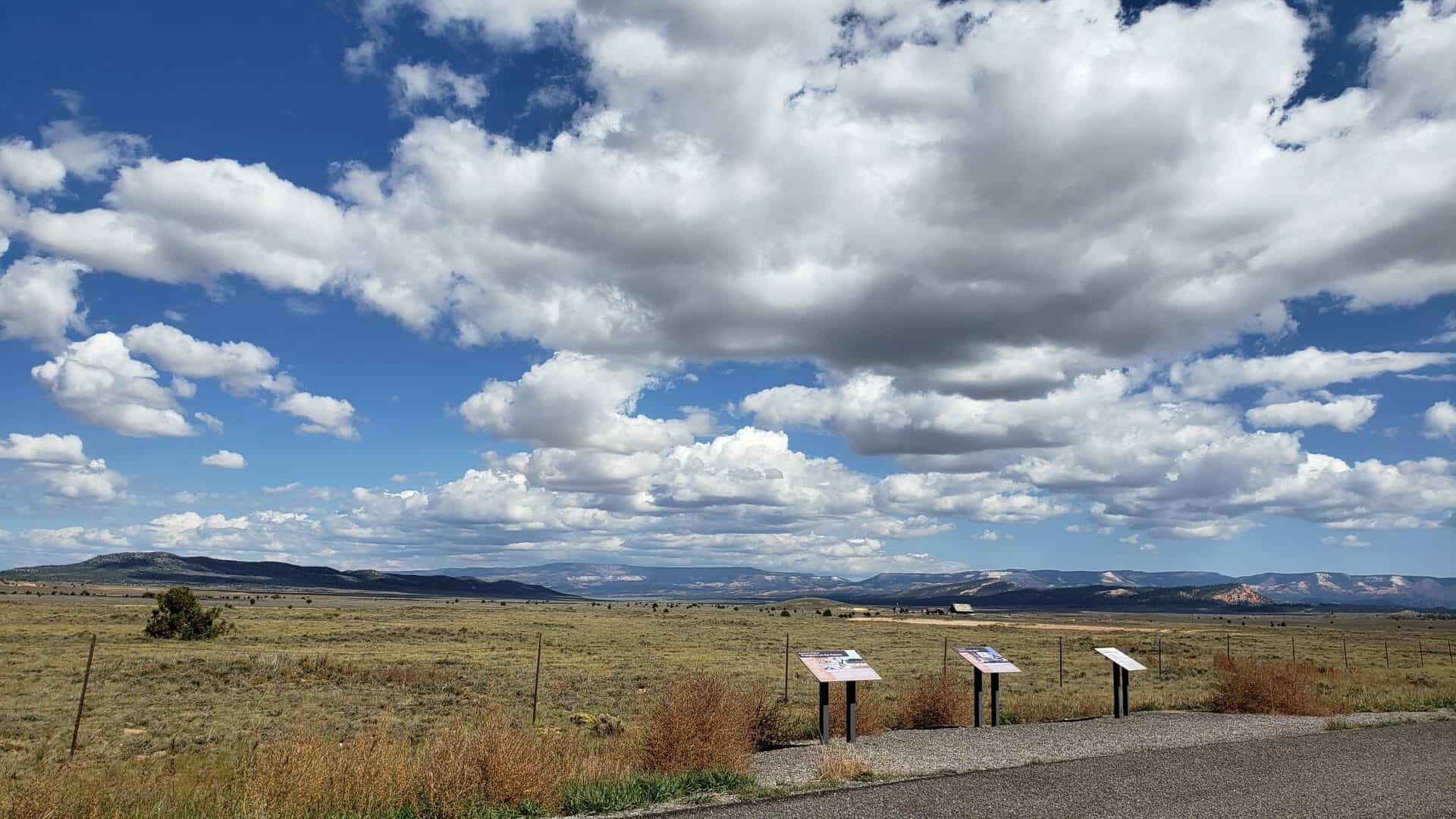
(Plaque located near the Bryce Canyon Airport in Bryce Canyon, Utah)

American Original: Pronghorn on the Plateau

28 Thursday Jul 2022

Posted by Jacob Barlow in Uncategorized

≈ Leave a comment

Tags

Bryce Canyon, Historic Markers, Pronghorns, Wildlife

American Original: Pronghorn on the Plateau

Though its genus name, Antilocapra, means “antelope goat,” the pronghorn is neither antelope nor goat. It is, instead, the sole surviving member of its genetic family, an American original. The fastest animal in the Western Hemisphere – clocked at 60 miles per hour – the pronghorn has few natural predators, though coyotes and golden eagles may prep on fawns. But by the late 1800s, hunting and overgrazing had reduced Utah’s pronghorn population to an estimated 700 individuals.

Reintroduced near Cannonville in the late 1960s, pronghorns soon migrated to the Paunsaugunt Plateau and have remained here ever since. The plateau’s open meadows and ponderosa pine forests provide ideal pronghorn habitat. Winter winds sweep snow from the meadows, so pronghorns can continue to browse sagebrush, grasses, and other plants.

Plaque located near the Bryce Canyon Airport in Bryce Canyon, Utah

Railway Depot Built, But No Train Arrived!

28 Thursday Jul 2022

Posted by Jacob Barlow in Uncategorized

≈ Leave a comment

Tags

Gilsonite, Historic Markers, Narrow Gauge Railroad, Railroad, Uintah County, utah, Vernal

Railway Depot Built, But No Train Arrived!

The leading area industry of the late 1800s and early 1900s was mining Gilsonite, a glossy black hydrocarbon-resin. Henry Ford used it to produce the lustrous black paint on his Model T, and Anheuser Busch lined beer barrels with the tar-like substance. Today it is used in inks, building products, and protective coatings. The Uinta Basin lays claim to the only commercial mining of this substance. This industry sparked the construction of a narrow gauge railroad in 1904 to ship Gilsonite to the world market.

In 1905 the Uintah Railway and Freight Company constructed its railroad station, directly across from you, for the purpose of housing a railroad depot, freight station, and telegraph office. Despite the fervent efforts of the community, the rails never reached Vernal. The freight station continued to ship produts such as local wool. Until the 1940s, when modern highways and the trucking industry took over, the freight station also provided service to and from the rail line, located 57 miles southeast of the now-deserted ghost town of Watson.

Freight and passengers were transported from Vernal to the railway on a daily basis in wagons and, later, in modern motor coaches. This building now serves as a warehouse.

This is #19 of the 21 stop history walking tour in downtown Vernal, Utah. See the other stops on this page:

  • Vernal’s Walking History Tour

This marker is located at 90 North Vernal Avenue in Vernal, talking about the location across the street at 89 North Vernal Avenue.

Nicholls Bank

27 Wednesday Jul 2022

Posted by Jacob Barlow in Uncategorized

≈ Leave a comment

Tags

California, Dutch Flat, Historic Markers, Placer County

Nicholls Bank

In 1860, brothers William and Philip Nicholls started their bank. IT was one of the longest running businesses in Dutch Flat. The building was torn down in the 1930’s.

In 1883, when Congress passed the Anti-Debris Act, hydraulic mining virtually ceased and the bank ended up owning many mining claims abandoned by their owners.

The second generation of Nicholls, John (son of William) and William (son of Philip), ran the bank until closing in 1912. In order to do business with Chinese citizens of Dutch Flat, John Nicholls learned to speak Mandarin.

This plaque is located on Main Street in Dutch Flat, California.

A Struggle for Water, West of the Jordan River

25 Monday Jul 2022

Posted by Jacob Barlow in Uncategorized

≈ Leave a comment

Tags

Historic Markers, SUP, utah, West Valley City

The settlement of the valley west of Salt Lake City was linked to the availability of water. The first settlers to the area came in the fall of 1848. Joseph Harker built a dugout in bluffs along the west bank of the Jordan River at about 3300 South. The following spring, he moved with a dozen other families to the 45th South and Redwood Road area where water was more attainable. Those who followed ranched or farmed along the river bottoms. Acquiring drinking water was a constant concern through the years.

Plans to extend canals from the Jordan River through the dry western two-thirds of the Salt Lake Valley circulated as early as 1860. But those early ventures were stymied by inadequate financing and technical obstacles. In 1872, Salt Lake County began an eight year, $70,000 investment in a series of canals to funnel water to the barren lands. A dam was built at Jordan Narrows, and the South Jordan Canal, excavated between 1870 and 1875, brought the first water to Granger.

The North Jordan Canal was enlarged in 1881 and extended from Gardner’s mill (7800 South) to Granger. Also in 1881, Hunter was provided its first water from Salt Lake County’s longest and largest canal, the Utah and Salt Lake Canal. This canal, 32 miles from Jordan narrows to Magna and 246 cfs, took years to construct. By the turn of the century, the U.S. Census counted 354 residents in Hunter and 617 in Granger (4800 West divided the two districts).

Minor growth followed the canal building, but so did problems. Adding more water to the shallow aquifer caused underground salts and minerals to rise to the surface, forming and alkali crust which was deadly to crops and trees, Between 21st and 27th South, water accumulated into a number of shallow saline lakes which were used for swimming and ice skating. The Riter Canal, first used as a drainage ditch, connects now to the North Jordan Canal at about 3800 South and delivers water to Kennecott Utah Copper Company.

In 1949, the Granger-Hunter Improvement District was established to provide residents with water from Deer Creek Reservoir. Hookups began in 1953, and the area grew as much in 1954 as it had in all the years since the pioneers arrived.

Efforts to incorporate as a new city were defeated in 1978; however, in 1980 West Valley City became Utah’s second largest city.

The master list of the S.U.P. Markers has this at N 40.69690 W 111.99980, just outside the West Valley Animal Shelter at West Valley City Park (4522 W 3500 S in West Valley City) but I do not see it in that area and have been trying to figure out where it is now.

Goshute Tribe

23 Saturday Jul 2022

Posted by Jacob Barlow in Uncategorized

≈ Leave a comment

Tags

Historic Markers, Ibapah, Tooele County, utah

Goshute people were one band of many Shoshone Indians living in the Great Basin Region.

The term “Gosiute” means, Kusiutta” describing their original dusty, well-traveled look. Goshute people inhabited the lush riparian areas of the region including Deep Creek Valley long before the coming of settlers. Other tribes conducted raids on the Goshutes to acquire slaves for trade, which contributed to the depiction of the Goshute’s deprived state. In this environment, Goshutes were resourceful and cunning.

Living in small family groups, they ate berries, pinenuts, pickleweed, insects and small game, and lived in roofless, brush windbreaks or cedar bow wickiups. Clothing was scare, consisting of fur pelts made into capes, breech cloths, leggings or moccasins, and woven fiber skirts for the women.

By the 1860s, the Goshutes were seriously threatened by an influx of settlers which diminished their food resources. The Indians eventually adapted many of the white mans ways on government and church farms established in Deep Creek Valley in 1914. Today, the Goshutes have tribal government promoting various forms of industry.

Early Goshute heads of families:

  • Chief Antelope Jake
  • Annie’s Tommy
  • Wes Johnson
  • Wilson Bonnemont
  • Alex Clover
  • Commodore
  • Tommy Muggins
  • Johnny Pete
  • Webb Pete
  • Johnny Syme
  • Trim Thicket
  • Egan Jack
  • Sleepy Jim
  • Tom Egan
  • Dick Egan
  • Joe Lucky
  • Chief White Horse
  • Chief Toobuka
  • Fish Springs Charlie
  • Joe Trim

This historic marker is located in Ibapah, Utah

← Older posts
Newer posts →

Follow Jacob

Follow Jacob

Come wander with me on Youtube.

Blog Stats

  • 2,095,421 hits

Social and Other Links

BarlowLinks.com

Recent Posts

  • Scout Monument
  • Provo High School Seminary Building
  • 821 E 100 S
  • 820 E 100 S
  • 817-819 E 100 S

Archives

Loading Comments...