In 1898 Dr. Charles F. Osgood came to Morgan, 1900 was the earliest record of the Francis-Osgood Store. Arthur W. Francis and Dr. Osgood established a business of wholesale and retail sales in merchandise and farmer’s produce in this two-story store.
In 1904 the partnership dissolved and A.W. Francis was the sole owner.
In 1928 they rebuilt the store and made it one-story.
In 1933 they closed for 3 years due to the depression.
In 1937, after Arthur’s death, his son Harold and wife Vesta took over.
George Heiner stated, “In 1890, my brother Daniel and I built a three story brick hotel…”
Charles Turner recorded in his journal, “1890, this year I have sold to the Heiner Company over One-thousand dollars worth of brick, line and rock for their new hotel.”
Thomas C. West from Round Valley plastered the interior of the hotel.
The hotel flourished and contributed to the economic growth and development of the community. It provided rest and comfort to many weary travelers.
Emma Staples Stuart, a renowned cook, operated the hotel for approxximately 20 years. During that time she hired many local young women to help.
Moroni and Harriet Clawson bought the hotel in 1912. The theater with a stage provided an excellent place for silent movies.
In May 1917 Clawson applied for a picture show license. Milton Fry ran the hand-operated movie projector.
In 1935 the hotel was sold to Mr. and Mrs. Virgil Stewart. The theater was modernized with comfortable air-inflated seats, and a modern sound system.
In 1937 Mabel Horsefield Welsh and Viola Porter Whitesides were contestants to rename the hotel. They submitted the name “Vallis” which means “Valley” and the name has remained until the present day.
Alva and Cecil Dearden leased the Vallis Theater in 1945 and showed movie pictures there until 1949.
Built in 1903, the First National Bank of Morgan started with a capital stock of $25,000. It was remodeled in 1937 and 1956 but the 1936 vault door remains.
In 1972 assets reached $5,000,000 and in 1973 the bank moved to State Street.
Sons of Utah Pioneers Marker #118 – Richville Cemetery
This monument was erected by the National Society of the Sons of the Utah Pioneers, Morgan Utah Chapter, to remember those buried here in unmarked graves. This is the final resting place for early residents who settled in Richville, Morgan County, Utah.
There are seventeen unmarked graves with no identification.
There is at least one Native American grave.
There are ten known burials with no identifying headstones.
is named after Jedediah Morgan Grant, a leader in The Church of Jesus Christ of Latter-day Saints. As of the 2010 census, the city population was 3,687. It is the county seat of Morgan County.
Devil’s Slide is an unusual geological formation located in Weber Canyon, Morgan County, Utah.
The sides of the slide are hard, weather-resistant limestone layers about 40 feet high, 25 feet apart, and several hundred feet in length. In between these two hard layers is a softer limestone that is slightly different in composition from the outer limestone layers. This middle layer is softer, which makes it more susceptible to weathering and erosion, thus forming the chute of the slide. Looking like a large playground slide fit only for the Devil, this site is a tilted remnant of sediments deposited in a sea that occupied Utah’s distant geologic past. Approximately 170 to 180 million years ago, a shallow sea originating from the north spread south and east over areas of what are now Montana, Wyoming, and Utah. This sea extended as far east as the present-day Colorado River and south into northern Arizona. Over millions of years, massive amounts of sediment accumulated and eventually formed layers of limestone and sandstone. In northern Utah, these rocks are known as the Twin Creek Formation and are approximately 2700 feet thick. About 75 million years ago, folding and faulting during a mountain- building episode tilted the Twin Creek rock layers to a near-vertical position. Subsequent erosion has exposed the near-vertical rock layers and created Devils Slide.*
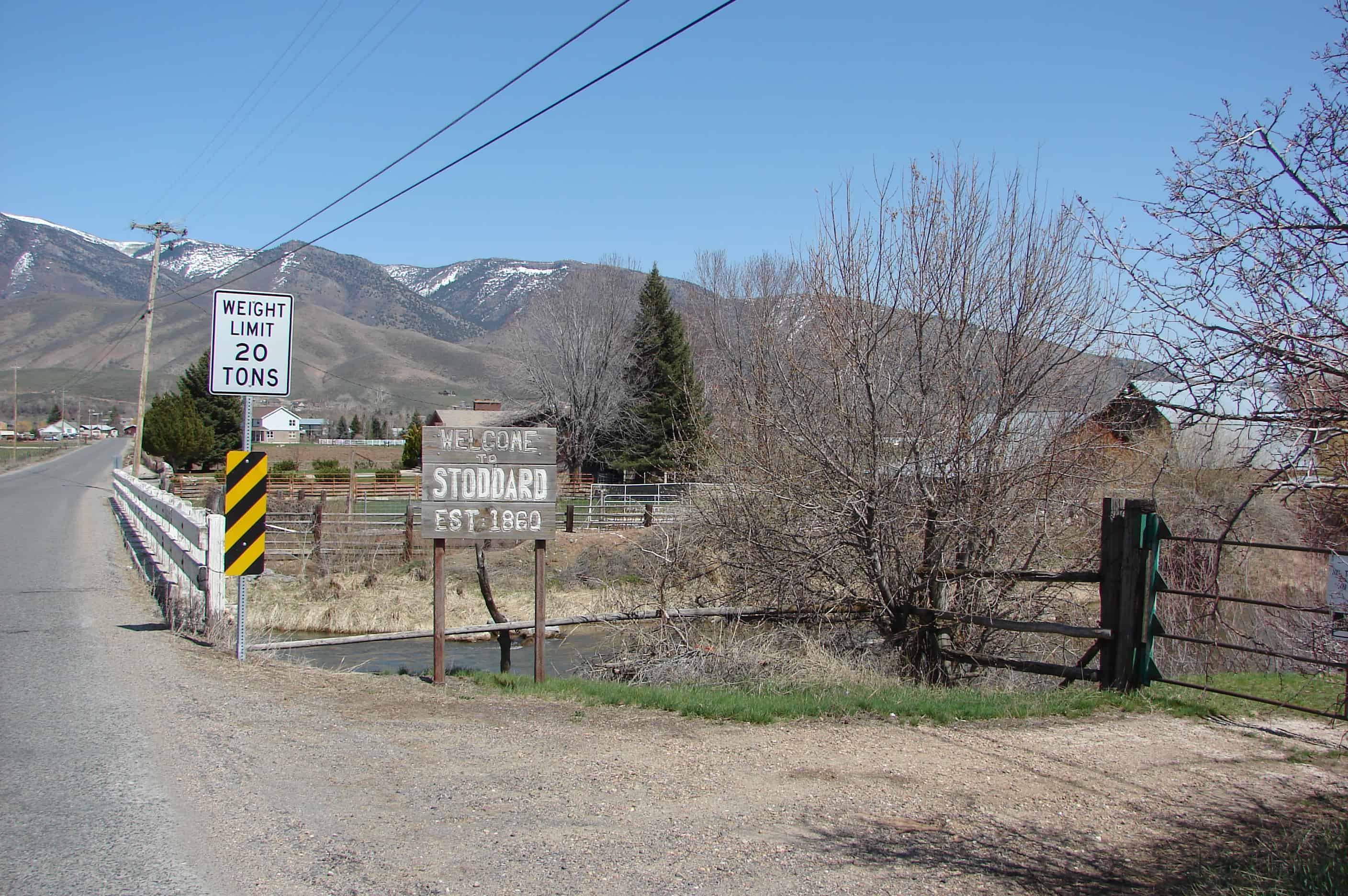
Stoddard is in the Morgan Valley three miles northwest of Morgan near I-80. This small agricultural community was settled in 1860 by the Judson L Stoddard family.
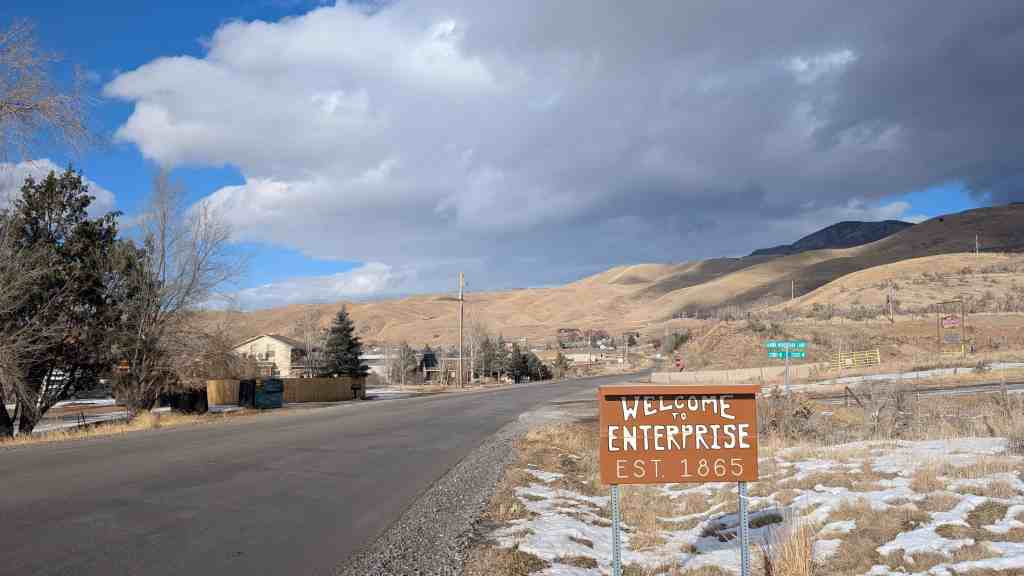
The first settlers in Enterprise were Henry and Stephen Hales, who arrived in 1861. They found fertile land on the bench, but little water for irrigation. They dug a 2-mile ditch from the Weber River to water their farmland. A canal company was organized in 1863 to irrigate the whole area, but Enterprise was short on water for many years as thieves diverted water upstream. The first schoolhouse was built in 1863. A townsite with official blocks was surveyed and laid out in 1865. A sawmill operated in Roswell Canyon in the 1870s. Although it was not an official census precinct, the 1880 census enumerated 81 residents in Enterprise.
(Not to be confused with Enterprise, Utah in Washington County)