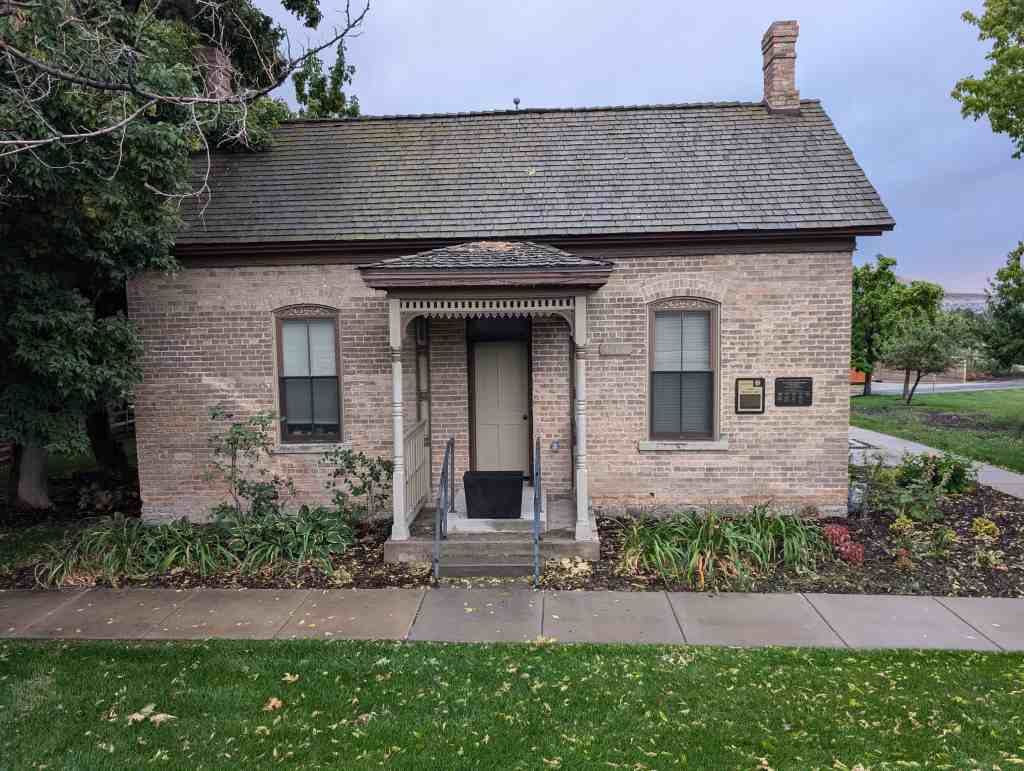
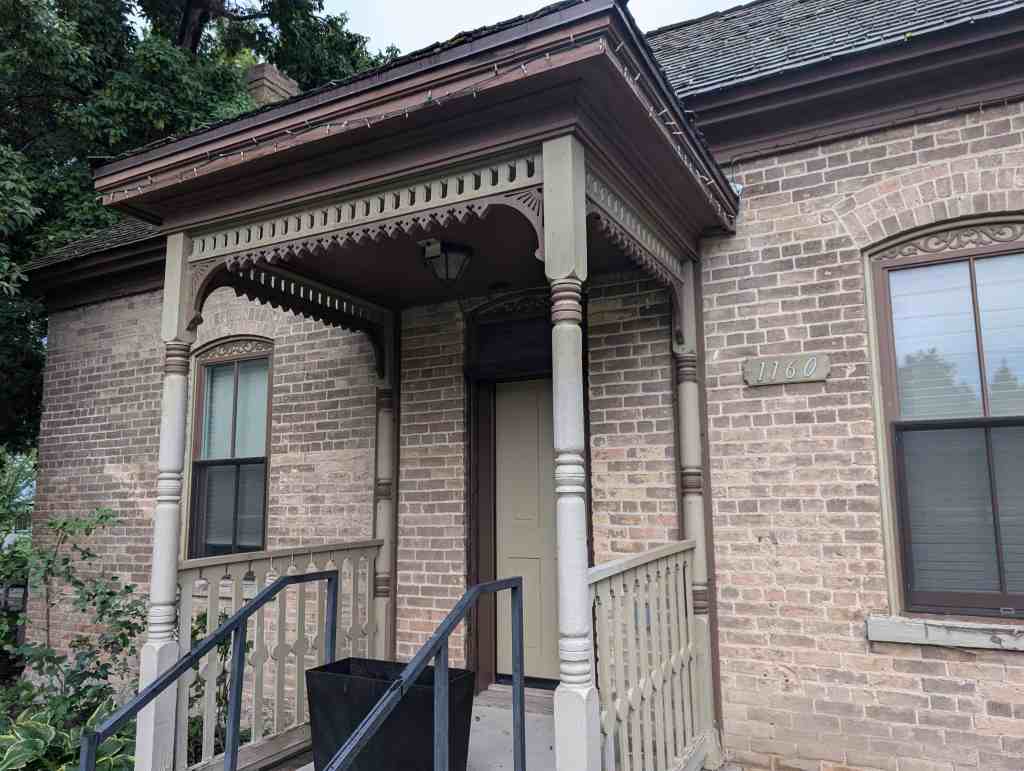
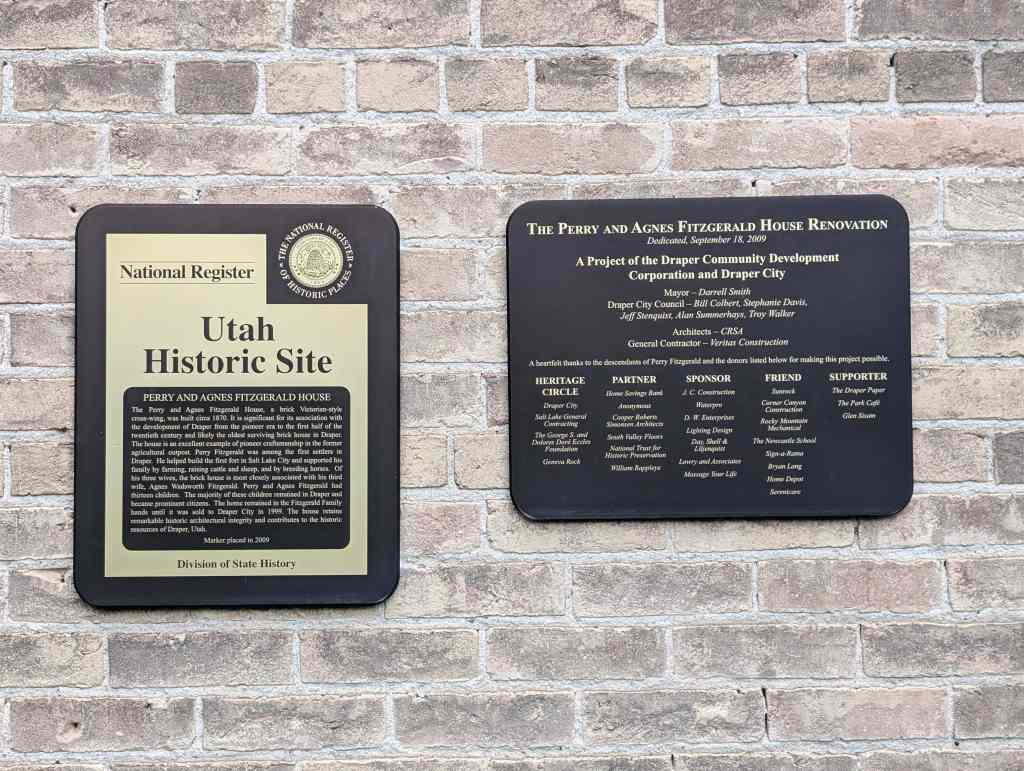
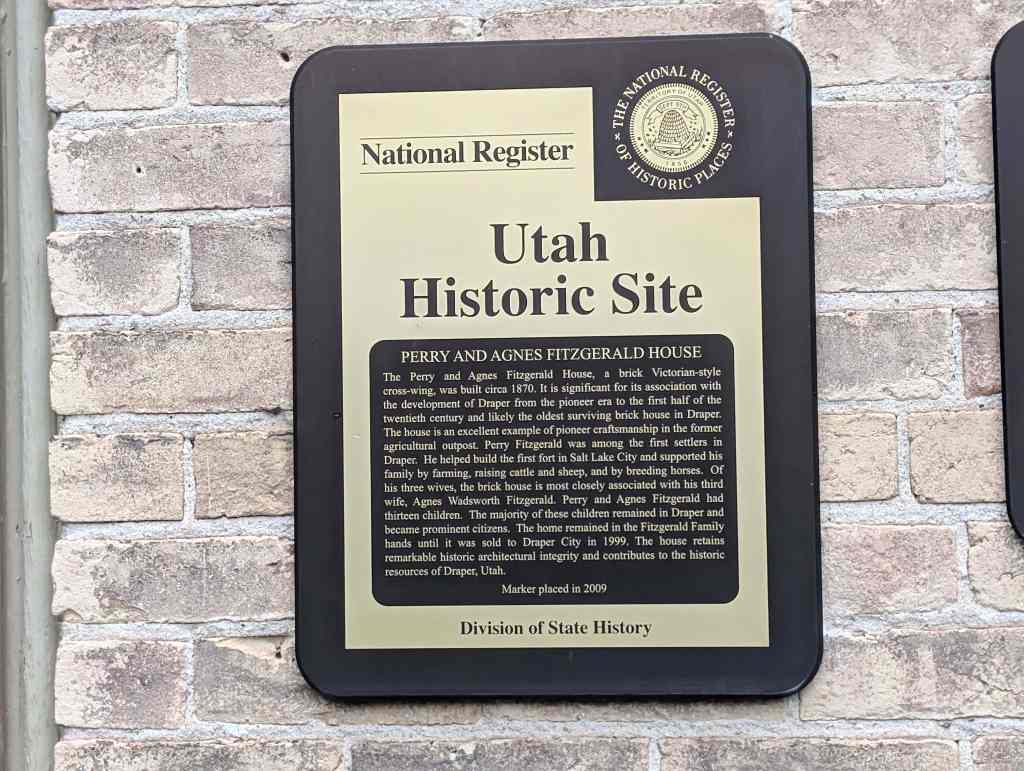
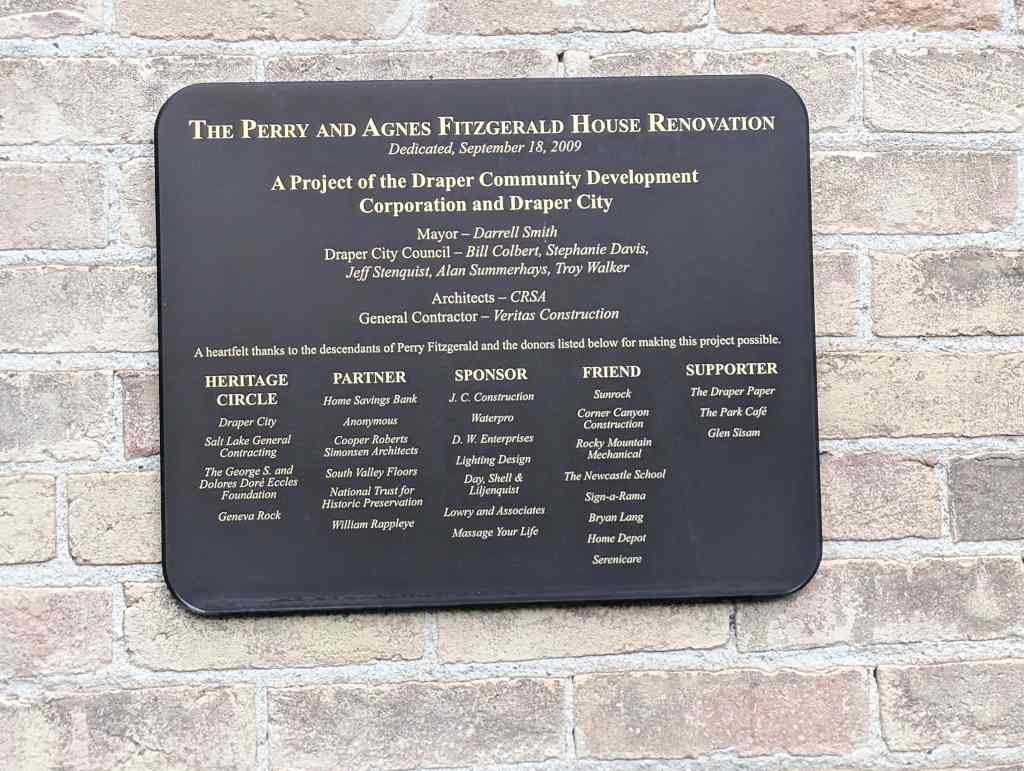
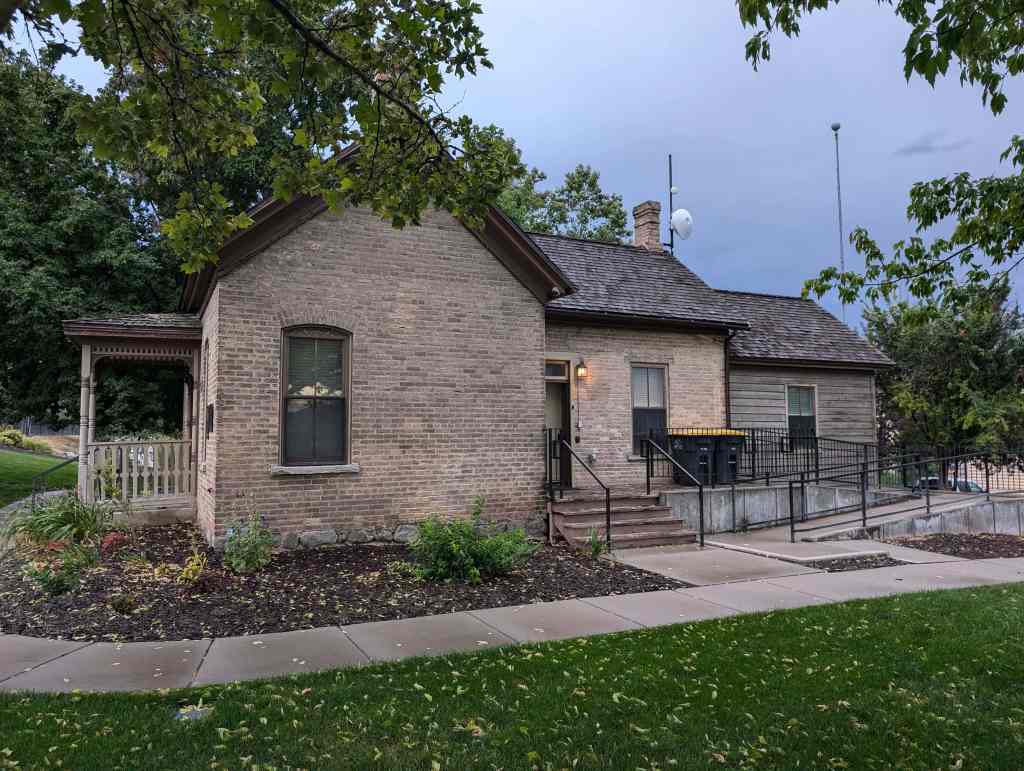
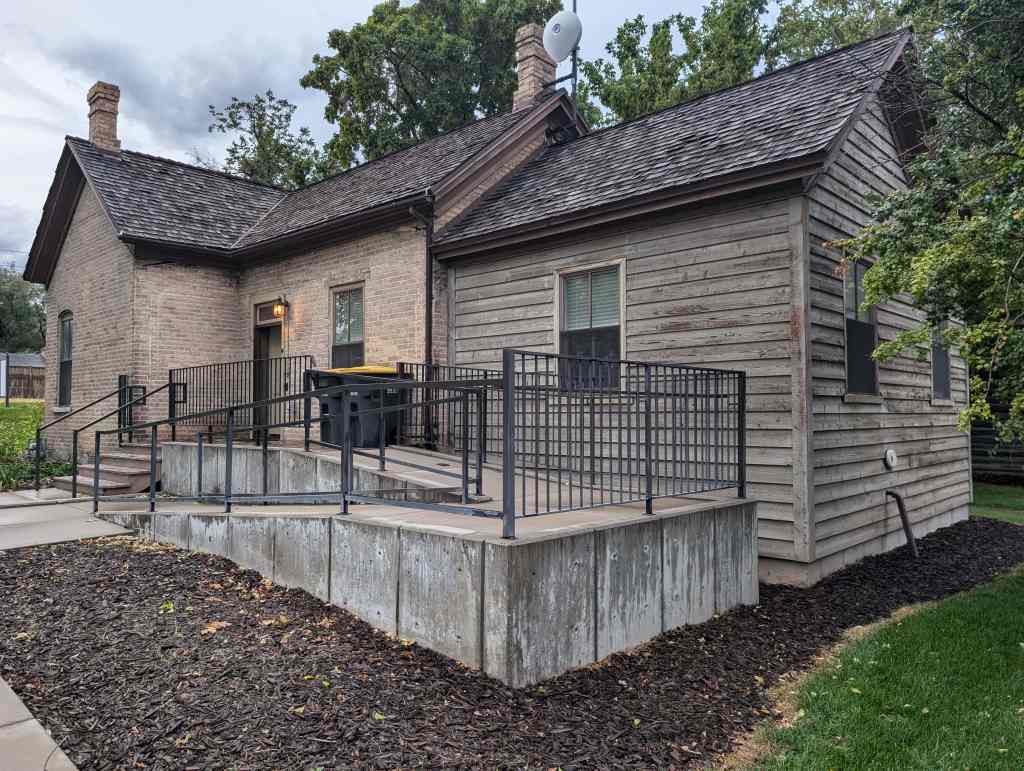
The Perry and Agnes Fitzgerald House, a brick Victorian-style cross-wing, was built circa 1870. It is significant for its association with the development of Draper from the pioneer era to the first half of the twentieth century and likely the oldest surviving brick house in Draper.
The house is an excellent example of pioneer craftsmanship in the former agricultural outpost. Perry Fitzgerald was among the first settlers in Draper. He helped built the first fort in Salt Lake City and supported his family by farming, raising cattle and sheep, and by breeding horses. Of his three wives, the brick house is most closely associated with his third wife, Agnes Wadsworth Fitzgerald. Perry and Agnes Fitzgerald had thirteen children. The majority of these children remained in Draper and became prominent citizens. The home remained in the Fitzgerald family hands until it was sold to Draper City in 1999. The house retains remarkable historic architectural integrity and contributes to the historic resources of Draper, Utah.
The home is located in Draper Pioneer Square at 1160 East Pioneer Road in Draper, Utah and was added to the National Register of Historic Places (#04000404) on May 6th, 2004.
Narrative Statement of Significance
The Perry and Agnes Fitzgerald House, a brick Victorian-style crosswing, built circa 1870, is significant under Criterion A for its association with the development of Draper from the pioneer era to the first half of the twentieth century. It is also significant under Criterion C as the oldest surviving brick house in Draper and an excellent example of pioneer craftsmanship in the former agricultural outpost. The house is eligible under the Multiple Property Listing, Historic Resources of Draper, 1848-1954. The primary associated historic context is the “Early Settlement Period, 1848-1876.” Perry Fitzgerald was among the first settlers in Draper. Of his three wives, the brick house is most closely associated with his third wife, Agnes Wadsworth Fitzgerald. Perry and Agnes Fitzgerald had thirteen children. The majority of these children remained in Draper and became prominent citizens. The house retains remarkable historic integrity. The Fitzgerald House contributes to the historic resources of Draper, Utah.
History of the Perry and Agnes Wadsworth Fitzgerald House
Perry Fitzgerald was born in Fayette County, Pennsylvania on December 22, 1815. When he was about 20 years old, he moved to Vermillion, Illinois, where he met and married Mary Ann Casot in 1839. Mary Ann was born in Kentucky on September 30, 1821. In 1842 the couple became members of the Church of Jesus Christ of Latter-day Saints (LDS or Mormon Church). They moved to Nauvoo where the church had its headquarters. When the church members began their exodus from Nauvoo to the Salt Lake valley, Perry Fitzgerald was chosen by church leader Brigham Young to serve as a guide in the first pioneer company. Perry left Mary Ann and his oldest son, John, to follow with the main body of the church. Two other sons had died from cholera.
Perry Fitzgerald helped to build the first fort in Salt Lake City. After the family was reunited, they moved from Salt Lake to the Millcreek area, ten miles south and east of Salt Lake City where they spent two winters. Two more sons, Manesseh, and Perry Jr., were born there. The family is listed on the 1850 census in Draper, a settlement at the southeast end of the valley known as Willow Creek. Mary Ann Fitzgerald died on April 19, 1851, probably in Millcreek, Utah. Elizabeth Shipley took the boys to care for at her home in Draper. Family tradition states that, after Mary Ann’s death, Perry Fitzgerald moved permanently to Draper. He built a three-room log cabin on the north banks of the Willow Creek and homesteaded a parcel of farmland in the area between what is now 12400 South and 13100 South. In late 1851, Perry Fitzgerald married Ann Wilson (the exact date is unknown). Ann Wilson was born in England on November 10, 1812. Ann Fitzgerald had two daughters, Mary Ann (born in 1852 and probably named for Mary Ann Casot) and Alfreda (born in 1854).
Around 1852, Agnes Wadsworth, a young convert to the LDS Church, moved to Draper and worked as a nanny in the Fitzgerald home. Agnes Wadsworth was born in Manchester, England on July 30, 1836. Perry Fitzgerald married Agnes Wadsworth on March 21,1853, within the then church-sanctioned system of polygamy. Agnes Fitzgerald bore thirteen children between 1854 and 1879, and remarkably for the time period, all lived to maturity, married and had children of their own. Indeed, Agnes was considered to have some healing powers in the community, due to the fact that her children survived several epidemics. During the late 1850s, Perry Fitzgerald and his son John, assumed military duties during the Utah War and the Walker Indian War. The Fitzgerald household is all under one roof, the log cabin, on the 1860 census enumeration. The log cabin had three rooms, a loft and a fire pit. After a particularly fierce storm in the early 1860s, the cabin was flooded by the creek and moved to higher ground close to where the brick house would be located. The log cabin later was used as a barn and outbuilding. According to various sources, Perry Fitzgerald built the brick house either during or just after the Civil War. The family claims it was the first brick home built south of Midvale. While this claim is uncertain, the Fitzgerald house is one of the oldest surviving brick homes in Draper.
Perry Fitzgerald supported his large family by farming and raising cattle and sheep. He was also a horse breeder. He had a large holding that required hired hands (two are listed on the 1860 and 1870 census enumerations) as well as his grown sons. The 1870 census enumeration taken in September records Perry, Agnes and her children in the household Ann Wilson Fitzgerald and her teenage daughters do not appear in the census records, and it is unclear whether Ann had her own dwelling by the time the brick house was built. If not, she lived in the brick house only for a few years. She died on November 21, 1870, in Draper. Agnes Fitzgerald’s third son, born in 1864, was given Wilson as his middle name, so it is presumed the two wives had a good relationship.
Agnes Fitzgerald was associated with the house through most of her life and bore probably half her children in the home. The Fitzgerald home was known as a haven in the community. One evening, Orrin Porter Rockwell, a bodyguard to Brigham Young, rode to Draper pursued by a posse. Porter asked his friend Perry Fitzgerald to hide him, so Perry turned his back on Porter and pointed with his hand to a thicket where Porter could safely hide. Minutes later Perry Fitzgerald truthfully informed the posse that Porter had been there, but didn’t see which way he went. 3 Though Perry Fitzgerald was a faithful church attendee, many of his children were more relaxed and numerous young people in Draper would congregate at the Fitzgerald home on Sundays. One writer records “there were more wagons and horses at the Fitzgerald’s than at church. If Agnes would insist on taking all those who would come to her home and lead them down to church, it would fill the meeting house.”
After suffering from back pain for several years, Perry Fitzgerald died in his home on October 4,1889. The property was deeded to Agnes Wadsworth Fitzgerald in December 1889. She remained in the home with several of her children until her death on March 23, 1902. The estate was divided among her children and the house was eventually deeded to Royal T. Fitzgerald on June 8,1907. Royal Truth Fitzgerald was bom on October 28,1879. He was just shy often years old when his father died. Royal T. Fitzgerald married Alice Snow on December 10, 1902. Alice Snow was born in Draper on December 24, 1881. The couple lived in the Fitzgerald house their entire married life. The couple had one son and three daughters. Royal T. Fitzgerald continued to operate the family farmstead. Alice Snow Fitzgerald died on July 12, 1954. Royal died on December 1, 1971.
The property passed to Royal and Alice’s daughter, and then to her brother Royal Snow Fitzgerald in 1972. It was then sold to Royal Snow’s son and daughter in-law, R. Dale and Jolyn S. Fitzgerald. The family lived in California and used the old home as a rental property. The house was sold to the City of Draper in 1999. It has been sitting vacant since. Feasibility studies are currently underway to determine if the house can be rehabilitated for use as a restaurant.
Architecture
The Fitzgerald house is architecturally significant as a very early brick home in the south end of the Salt Lake Valley. In the mid-1860s, brick kilns were relatively rare, even in the more populous Salt Lake City, and most homes were built using adobe brick. 5 According to local histories, there were several adobe yards in Draper in the 1860s and 1870s, and numerous adobe and part-adobe homes are still standing. There is no record of the first brickyard, so it is likely the Fitzgerald bricks were hauled to Draper from Salt Lake City, to provide the exterior face of the house with adobe lining the inner walls. The hall-parlor configuration of the Fitzgerald further suggests a construction date in the 1870s. The roughly shaped brick and the common bond masonry also suggest an early construction period. However, some of the details such as the segmental relieving arches of brick and the lathe-turned posts may date from the 1870s. One possible contemporary of the Fitzgerald house is the Andrew and Harriet Burnham house at 12735 South Fort Street. The Burnham house is a central-passage house constructed of brick facing with an adobe lining. The Burnham house has been modified somewhat on the interior and exterior. Another is the Lauritz Smith house at 1230 Pioneer Road was also built around the same time. It is a brick saltbox with Greek Revival details.
The Fitzgerald house is more of a transitional house than either the Burnham or Smith houses. During the 1860s and 1870s, the most common house types were classically styled one-story adobe dwellings with vernacular Greek-Revival details. The same was true in communities throughout the Salt Lake Valley. Though there were several brick kilns in operation, fired brick residences became ubiquitous only in the 1880s. The early brick houses of Draper represent a measure of early prosperity in the isolated community. The Fitzgerald house combines an early and basic brick masonry tradition with the more sophisticated Victorian details found primarily on houses near the more urbanized Salt Lake City in the 1860s and 1870s.
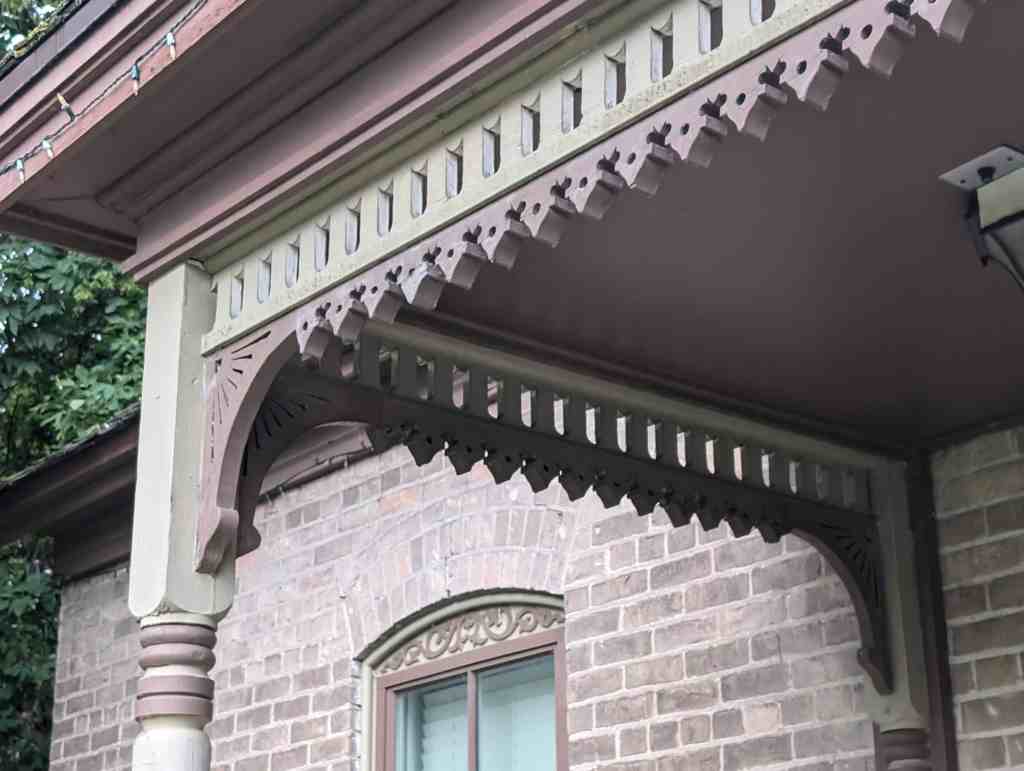
If the Fitzgerald house cannot lay legitimate claim to being the oldest brick house in Draper, it is certainly the best preserved. With the exception of the newer roofing and siding on the rear addition, the house maintains a near pristine integrity. Architectural features such as the Victorian porch details are rare in homes of the period. Most remarkable are the interiors of the front rooms, which have not been altered, and including extant plaster moldings and Mormon oak finishes. The proposed rehabilitation and adaptive reuse of the Fitzgerald house, thereby opening it to the general public, will be a significant contribution of the historic resources of Draper.
Narrative Description
The Perry and Agnes Fitzgerald House, is a one-story brick crosswing, built circa 1870. The house is classically styled with Victorian Eclectic details. The crosswing house appears as a hall parlor on the fa9ade (north elevation). It also has a small rear addition (circa 1915). The residence sits on a foundation of coursed granite rubble. The roof is covered with composition shingles (circa 1980). The house faces north and is located at 1144 East Pioneer Road (12400 South) in Draper, Utah. The original 6.91-acre parcel was once a large farmstead with numerous outbuildings, including a circa 1850 log cabin. The log cabin was moved from the property to the Draper City Park, and the rest of the outbuildings were demolished in the 1980s. The City of Draper currently owns the land and a new library branch will be built at the rear of the property. Feasibility studies are being conducted on the house to determine if the house can be preserved and rehabilitated for use as a restaurant. If feasible, the house will be rehabilitated using the federal rehabilitation tax credit project. The project is tentatively scheduled for completion in late 2004.
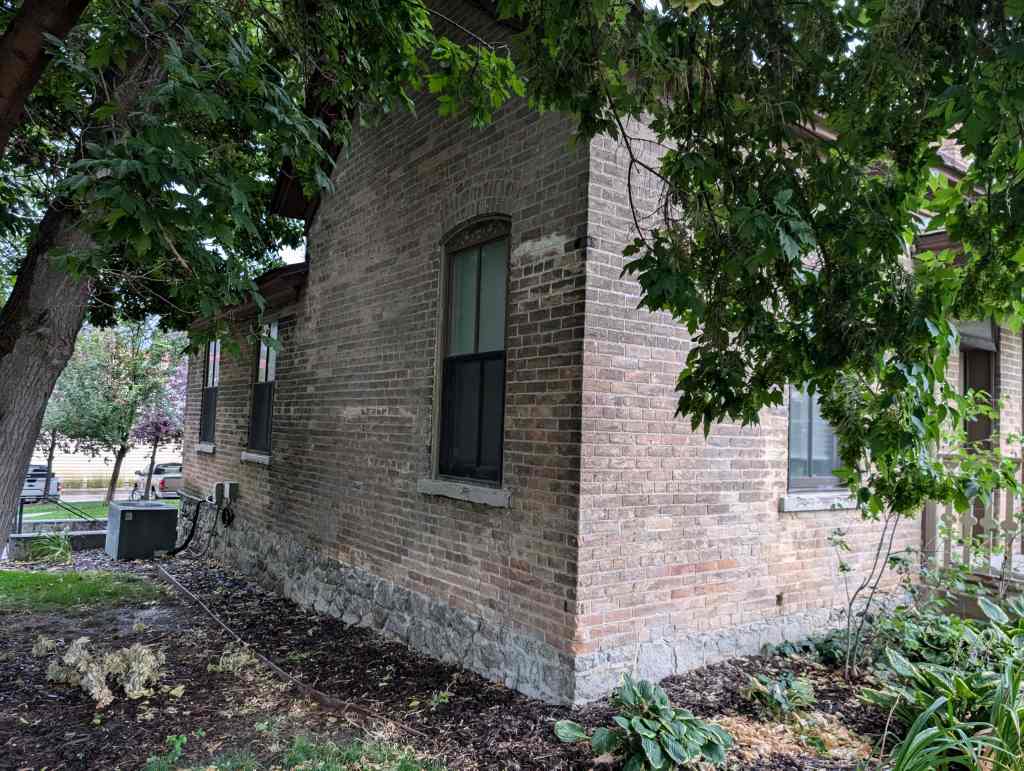
Family tradition suggests that the home was constructed just after the Civil War, but some elements of the house such as the segmental arched windows, and Eastlake-style trim more-likely date the house from the 1870s. The red brick masonry, which is laid in American or common bond with headers every seventh course, is consistent throughout the structure and appears to have been built as a single unit. However, each elevation is distinct. The facade (north elevation) appears similar to a symmetric hall-parlor with a main door flanked by windows. The ridge is parallel to the street with brick chimneys at either end. A small concrete porch (probably circa 1915) projects from the front door. It has a hipped roof supported by lathe-turned posts with decorative brackets. The porch trim and balustrade is original and painted a light yellow. The cornice boards are also painted yellow. They are fairly plain and narrow with a single bead. The windows are two-over-two double-hung windows in a wood sash. The windows feature segmental relieving arches of rowlock brick and stone sills with a decorative inset under the arch. All windows on the home are currently boarded up. Some glass has been broken, but most window features are intact.
The crosswing is visible on the west elevation. The elevation features a recessed porch with trim similar to the front porch. The porch deck is mainly concrete with rubble stone at the foundation level. Concrete steps were poured and block lines on the concrete were scored probably around 1915. The porch shelters the west entrance and one window. Another window is located in the west end of the north wing. The brick masonry is built to the apex of the gable at both ends of this wing. On the east elevation, the masonry continues to the rear to form an original lean-to making the footprint of the original house roughly square. There are three windows, one in the front wing and two in the lean-to, on this elevation. The rear windows have flat wood lintel rather than relieving arches.
The rear (south) elevation is partially obscured by a rear addition to the west, built circa 1915. This addition is a simple gable structure of frame and siding on a brick and concrete foundation. The addition sits four feet above grade on the slightly sloping site and appears to have been part of an original root cellar. Part of the foundation has been compromised with a large hole at the southeast corner. The addition was originally covered in drop siding and later covered with rust-colored aluminum siding, probably in the 1960s. The structure features a small aluminum window (circa 1960) on each of the three elevations. There are doors on the west and east elevations. No steps are extant, and were perhaps demolished at the same time an attached utility shed on the south elevation was demolished (sometime after 1996). On the south elevation of the original house, the foundation is covered with scored cement. There is a large patch of stucco on the rear elevation, probably a repair although the exact reason is unknown.
On the interior, the house is laid out as a typical crosswing. The north portion is divided into a living room and a parlor. Many original features of the interior are intact. The nine-foot ceilings have not been lowered. There are decorative plaster features on the molding and in the center of the largest room. The faux oak finish (locally called Mormon oak) on the baseboards and window casings is original. Most of the wallpaper is at least fifty years old. Unfortunately, there has been some damage by vandals, including damage to the original four-panel front door. The crosswing is one large room with some built-in cabinetry (probably 1920s or 1930s). There are two small bedrooms to the east (in the lean-to). To the rear, the addition houses a kitchen and bathroom.
As noted previously, there is very little remaining of the original landscape for the 6.91-acre parcel. The outbuildings have all been removed or demolished. The most significant of the outbuildings was a circa 1850 log cabin, the first home of the Perry Fitzgerald family in Draper. The three-room log cabin was disassembled (circa 1980) and reassembled in the Draper City Park (circa 1990). Other outbuildings included a barn (circa 1880), a brick granary (circa 1880) and a Butler-type round metal silo (circa 1940). The farmland around the house has been graded for the construction of a new library. Only a few mature elm trees are left near Pioneer Road and the house. With the exception of some vines near the front porch, no other landscaping remains. There are remnants of concrete sidewalk around the house.
The house sits just off Pioneer Road in Draper not far from where the railroad crosses the street. The house is just east of the Draper City center. To the southeast is the Willow Creek stream and the city park where the log cabin is located. The Pioneer Road area is a mix of Victorian and twentieth-century residences, industrial plants, and the new Draper municipal building. The library complex and a rehabilitated Fitzgerald house are part of planned economic development in the area. The Perry and Agnes Fitzgerald house retains its historic integrity and contributes to the historic resources of Draper.
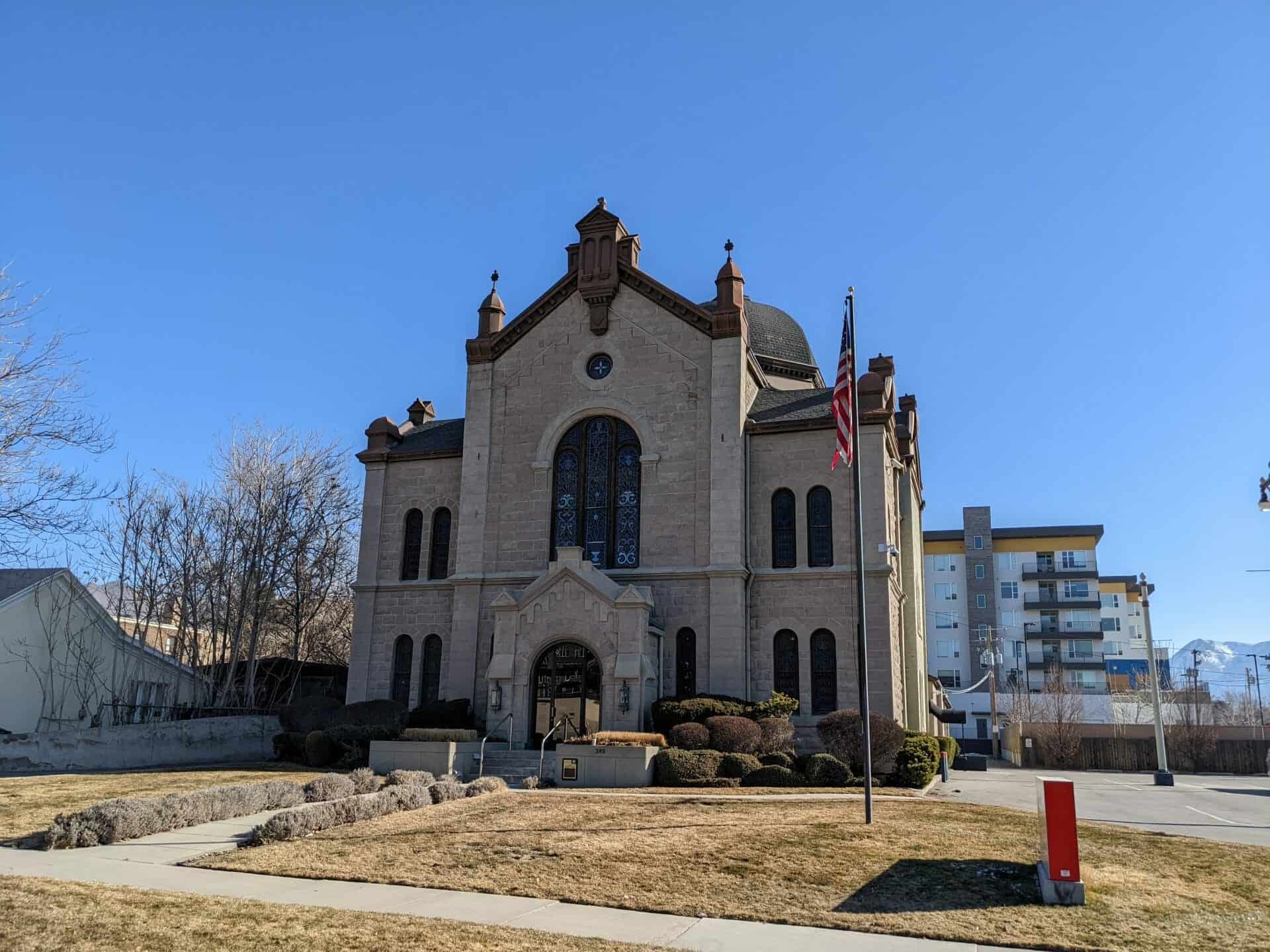
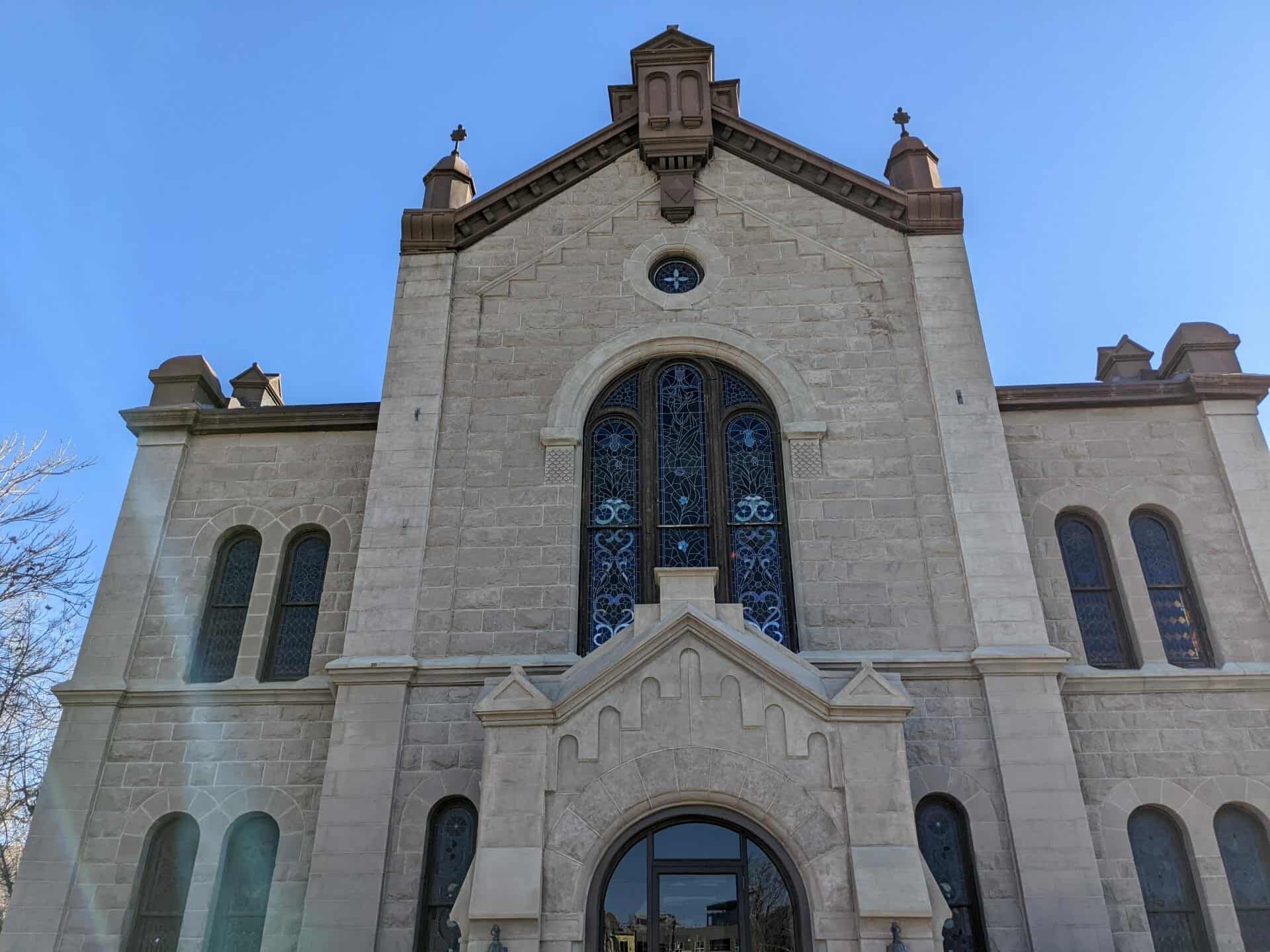
Designed by Philip Meyer, a native of Germany and a nephew of local retail magnate Frederick Auerbach, the B’nai Israel Temple was constructed in 1890-91. Henry Monheim, a local architect, supervised the construction. It is one of the few remaining structures built by Utah’s early pioneer Jews and reflects their importance in the development of the economy, government, and educational institutions of the state. The design of this Romanesque Revival style building was reportedly based on the Fasanenstrasse Synagogue, a famous Jewish temple in Berlin. While the main elevation is rusticated Kyune sandstone, the side walls and the drum beneath the dome are brick.
The Congregation B’nai Israel was organized in 1881 and built a small synagogue in 1883 at First West and Third South. Following a division in the synagogue, the orthodox Congregation Montefiore built a new synagogue at 355 South Third East, and the reform B’nai Israel congregation built this temple. It was sold in the early 1970’s when a new temple was built for combined local Jewish congregations. It has since housed several commercial enterprises including a restaurant and offices.
Ross Hame, also known as the historic William Harvey and Sarah Seegmiller Ross House, was constructed 1922-1923. William Harvey Ross was president of the Gunnison Valley Sugar Company and a business partner to famed chewing gum industrialist William Wrigley, Jr.
Ross Hame and its grounds are locally significant as they represent a rare collaboration between three important Utah architects, namely Walter Ware, Alberto Treganza, and Georgius Cannon. Ross Hame was designed during the final year of Ware and Treganza’s eighteen-year partnership and was a project its architects were particularly proud of as evidenced by their submittal of the home’s plan to a 1924 exhibition in Los Angeles sponsored by the American Institute of Architects. Although such estates continue to shape Holladay’s twenty-first century identity, very few of Holladay’s first-generation estates have survived excessive alteration or outright demolition and even fewer have retained much of their historic landscape. In the case of Ross Hame, however, the house, its adjacent stable/caretaker’s cottage, and much of its landscape convey the original intent of their designers, and grants the passerby a rare glimpse into Holladay’s rural past which contrasts greatly with the city’s twenty-first-century redevelopment.
Located at 4769 S Holladay Blvd in Holladay, Utah and listed on the National Historic Register (#100002703) July 23, 2018.
Constructed in 1914 by the community. The wood frame hall contains a gymnasium, stage, kitchen and basement. As a community recreation center, the hall was used for dances, plays, basketball games, programs, and movies. It served as the annual meeting place for the Koosharem Old Folks Party, a well-known traditional town reunion.
The Weber County Main Library in Ogden, Utah, is significant at the local level under Criterion A for its association with events that have made a significant contribution to the history of Weber County, Utah, in the area of Education, as the first public library serving the consolidated city and county library system in Weber County, Utah, and under Criterion C in the area of Architecture as a building that embodies the distinctive characteristics of its historic period. The library’s period of significance is 1968, when it was constructed. The building reflected, on the local level in Weber County, a growing national emphasis on the construction of public libraries. The library also represents a high-style example of New Formalism in Utah and incorporates early elements of Brutalism. As a result, the Weber County Main Library is significant under both Criteria A and C at the local level.
Located at 2464 Jefferson Avenue in Ogden, Utah and added to the National Historic Register (#100004395) September 13, 2019.
The Weber County Main Library is significant under Criterion A in the area of Education because of its role as the first and, for a period, only) public library serving the consolidated city and county library system in Weber County, Utah. The library, which replaced Ogden’s Carnegie Library (the first public library in the city), was designed to serve the growing community and to unify the city and county library systems to serve a broader geographic area than the individual systems could. The library, which received federal grant funding under the Library Services Act of 1956 and the Library Services and Construction Act of 1964, as well as support from local taxes and bonds, is also representative of how the national push to build public libraries during the mid-twentieth century played out at the local level in Weber County, Utah. As a result, the Weber County Main Library represents an important point in the history of education within Weber County.
The period of significance for the Weber County Main Library is 1968, the year it was built. However, to provide necessary background information, the context begins in 1892 with the initial establishment of a public library in Ogden.
Ogden Carnegie Free Library (1892–1961) Ogden has a long history of leadership in Utah in the area of public libraries. In 1864 the Legislative Assembly of the Territory of Utah formed the Ogden Library Board, which was supported by Ogden’s citizens and local businesses because the territory’s laws did not allow local governments to levy taxes to support public libraries (Weber County Library 1964-1969, 1892-1903, 1894-1894-1897, 1895, 1901, 1903, 1904-1930). The Ogden City Library Society, which took over fundraising and organizing for the proposed library, struggled for support and even a permanent location to keep the books. Although the society worked to increase public interest in their fledgling library and offered access to the collection, it continued to struggle through the 1860s and 1870s, and no records exist about it after 1876 (Hunter 1966:500-510)
The next attempt to establish a public library was made by the Ogden Public Library Association, which established a free library and reading room in 1892 (Stauffer 2007:391). This pattern of local support for libraries continued into the twentieth century. In 1901, W. L. Maginnis, Minnie Kiesel, and the Reverend E. L. Goshen sent a letter to Andrew Carnegie requesting financial assistance to build a permanent library in Ogden (Weber County Library n.d. [ca. 1980s]:2; Stauffer 2007:392). Carnegie offered $25,000 toward the library if “the city would arrange an annual maintenance fund of ten percent of that amount and furnish a suitable site.” The city agreed to Carnegie’s offer, and the new library was completed in 1903 at the corner of 26th Street and Washington Boulevard (Weber County Library n.d. [ca. 1980s]:2). It was the first of 23 Carnegie libraries to be built in Utah and was the first building in Utah to be used exclusively as a library (Jones 1997; Work Projects Administration 1941:208).
The Ogden Carnegie Free Library served the region for more than 60 years, by which time the collections had outgrown the space and the building required extensive repairs (Friends of Weber County Library 1998a:13; Marchant 1998:8). In 1960, the Junior League of Ogden sponsored a questionnaire regarding library service satisfaction and found that 60 percent of respondents wanted to expand the existing building. In 1961, a proposal to use sales tax revenue to build an extension to the library was considered but was never approved (Friends of Weber County Library 1998b:13).
Preparing for a County Library, 1962–1965 In 1962, a plan to create a consolidated city and county library system was introduced to the Ogden City Council, which led to discussions about updating Utah’s library laws and building a new library that could serve the significantly larger local population (Friends of Weber County Library 1998b:14). This consolidated city and county library system would increase the geographic area served by the library. The Weber County Main Library was the first planned library for what was intended to be a much wider-reaching library system. In June, Mrs. Paul (Cissy) Seeger, president of the library’s Board of Directors, requested funds from the Ogden City Council to retain an architect for preliminary design of a new main library large enough to serve the area for 20 years (Friends of Weber County Library 1998b:14). In August, the County agreed to build the new library after the City Council approved the request (Friends of Weber County Library 1998b:14). “After interviewing every architect in Weber County,” the board selected John Piers, an Ogden architect, to prepare the plans for the new library (Friends of Weber County Library 1998b:14).
Also in 1962, the board established the Friends of the Library organization. With Frank M. Browning, a state senator and founder of the Bank of Utah as its first president, the Friends were instrumental in supporting the library and shepherding the design and construction of the new building to completion (Marchant 1998:8–9). Importantly, in 1963, Browning successfully co-sponsored a bill in the Utah legislature that changed state laws to allow for the creation of countywide library systems and the levy of a countywide tax to pay for library operations (Friends of Weber County Library 1998b:14–15).
Initial plans for the new library called for constructing it on the site of the existing Carnegie Library; because the parcel was already owned by the library, its reuse would considerably reduce the project expense. Due to a lack of adequate parking at that location, however, two alternative locations were proposed: in Lester Park or on 25th Street between Kiesel and Grant Avenues (Friends of Weber County Library 1998b:15). Ultimately, the board approved the initial plan, and Piers presented the specifications for a proposed $1.15 million library on the Carnegie site in December 1963 (Friends of Weber County Library 1998a:15–16). In the same month, the Weber County Commissioners and the Ogden City Council adopted a motion that the new library be a countywide facility with its construction financed through a county bond issue (Friends of Weber County Library 1998b:14). The $1.5 million bond was approved by voters on December 8, 1964, although there was some opposition from voters in rural areas and in Roy, Utah (Ogden Standard-Examiner 1964a).
A major source of opposition came from two new county commissioners who were elected in November 1963: Maurice Richards and Bud Favero. The two men called a meeting with Maurice Marchant, then the Carnegie Library director, and informed him that $1.5 million was too much to spend on a library and that no architect would be needed because Richards “had a friend in the construction business who could design and build it” (Marchant 1998:10). Richards and Favero thought the library could be built for one third of the $1.5 million and that the remaining money could be used for other projects, such as a quarter horse racing facility (Marchant 1998:10). Without consulting the city library board, the commissioners also announced their intention of changing the location of the new library and converting the Carnegie Library into a pioneer museum (Marchant 1998:10).
The location disagreement would drag into 1965 with suggestions for a variety of solutions, such as building the library on “25th Street across from the federal building or combining it with a public safety building” (Marchant 1998:11). As a compromise, the Ogden City Council recommended building the new library in Lester Park and, in July 1965, the county commissioners approved that location. Lester Park, originally known as Liberty Square, had been set aside for public use when the original Ogden city grid was platted; it appears on maps as early as 1875. The park encompasses the entire block bounded by 24th Street to the north, Madison Avenue to the east, 25th Street to the south, and Jefferson Avenue to the west. The park was in the midst of a residential area, with the highest housing density located to the west of Jefferson Avenue. In fact, the chief objection to the Lester Park location had been its residential nature and its removal from the heavy pedestrian traffic of the downtown area, where many users combined visits to the Carnegie Library with work and shopping (Marchant 1998:9).
The park site was finally chosen, but the dispute and the actions of the county commissioners had proven so contentious that Marchant resigned from his position as city and county library director in June 1965. He was replaced by Guy Schuurman, a Salt Lake City resident who had been working for the Utah State Library (R.L. Polk & Co. 1965:742). Schuurman was born in the Netherlands in 1931 and emigrated to the United States in 1949, receiving an undergraduate degree from the University of Utah and a “master of librarianship” from the University of Washington in 1961 (Ogden Standard-Examiner 1971). He served as Weber County Library director until 1971, when he became the director of the Salt Lake County Library System, a position he held until his retirement in 1987. Schuurman was likely a good fit: during his career, he was remembered as “exuberant” and was described as a visionary and a motivator who “could sell ice to an Eskimo,” a skill he may have needed to get the new library built (Deseret News 1989).
In 1965 or 1966, the city and county received a $243,000 federal grant to supplement the bond and help fund construction of the new library (Ogden Standard Examiner 1971). Two pieces of federal legislation played a significant role in the increase of public library construction in the 1960s: the Library Services Act of 1956 (LSA) and the Library Services and Construction Act of 1964 (LSCA). The LSA, signed into law by President Eisenhower, provided the opportunity to expand library services to areas that had limited or no public library access, which accounted for nearly 76 million rural residents in the United States (Fry 1975:7–9). The LSA was to provide $7.5 million annually for “the extension and improvement of rural public library service” (Fry 1975:10). In 1960, the LSA was extended until 1966 (Fry 1975:14). In 1963, “President Kennedy sent to Congress a special education message” which recommended an amendment to the LSA to authorize “a three-year program of grants for urban as well as rural libraries and for construction as well as operation” (Fry 1975:14–15). The bill, which would become LSCA, was signed into law by President Johnson in 1964 and was designed to expire June 30, 1966 (Fry 1975:16). The LSCA would provide funding “to include construction of new buildings; expansion, remodeling and alteration of existing buildings; initial equipment; and architects’ fees and land acquisition costs” (Fry 1975:16). Both the LSA and the LSCA provided the push to increase access to libraries and were considered a success by many in Congress.
Another public library that was built to accommodate a growing population was the Salt Lake City Main Library. The library was completed in 1964, but planning of the new building began in 1960 (URS Corporation 2007:3–4). While the project did not receive funding under the LSA, the library was built in much of the same spirit as the Weber County Main Library would be several years later, and is similar in massing, architectural style, and interior open space. In addition, the design for both structures appears to have been influenced by the existing library planning concepts and literature produced by the American Library Association.
Post Construction Period, 1968–present On March 4, 1968, the new Weber County Public Library opened its doors to the public; it was dedicated on April 4, 1968 (Ogden Standard-Examiner 1968). The library was given an award “for its striking use of brickwork” by the Utah Bricklayers and Masons Association (Ogden Standard-Examiner 1968). A few early changes were made to the interior, including the addition of light fixtures that descended from the ceiling and the construction of a glass-and-metal partition wall between the foyer and the south reading room. And unfortunately, despite the involvement of professional librarians and consultants in the design of the library and the use of American Library Association standards, the organization and shelving of materials has long been a problem. “Materials were shifted many times during the late 1960s and early 1970s, then the staff finally gave up and left things as they were” (Wangsgard 1996:14).
The original vision for a Weber County-wide library system had included the construction of branch libraries, which would replace the Bookmobile program currently in use. These were slow in coming and funding was a perpetual issue, not only to construct the buildings but to fund operations and collections acquisition (Petterson and Burton 2001). The existing historical collection from the original Carnegie Free Library served as an important core of the new county-wide system (the first such system in Utah) (Weber County Library 1964-1969, 1892-1903, 1894-1894-1897, 1895, 1901, 1903, 1904-1930).
Eventually, the Weber County Public Library system added four new branches: the first was the Southwest Branch in Roy (1976), and the second was the North Branch in North Ogden City (1983). However, “The opening of a second branch library, without an appropriate adjustment in the tax rate to support operational costs, caused an almost total collapse of the Weber County Library System” in 1984 (Petterson and Burton 2001:3).
To make matters worse, the consistent neglect of the infrastructure at the Main Library, now sixteen years old, left the facility severely compromised and in need of major repairs to the roof, heating and cooling systems, sewer system, and elevators. Carpeting was worn through to the cement floor, ceilings were streaked with soot from lack of money to purchase air-stream filters, and the front doors no longer closed properly because they had been worn off their hinges. (Patterson and Burton 2001:3)
The Library Board considered closing the library temporarily but instead hired a new director, created a detailed financial plan, and conducted an internal audit; the county commissioners also granted a modest tax increase in 1985. This allowed for maintenance and repairs at the Main Library (including carpet replacement, the installation of automatic doors at the main entrance, and upgrades to the cooling system) and brought a return to financial stability, but provided no means to construct additional branch libraries (Piers at el. 1966; Petterson and Burton 2001:3). A tax rate adjustment in 1993 allowed for construction of the Ogden Valley branch in 1995 on a site donated by the town of Huntsville, and “the new funding was also stretched to refurbish the Main Library and the North and Southwest branches” (Petterson and Burton 2001:4).
Despite improvements and the addition of branch facilities, in 1996 the library director estimated that the main library contained 50,000 more items than it was designed to hold (Wangsgard 1996:13). In 2001, a $22 million bond to upgrade the existing libraries and build two additional branches was proposed but defeated. Another tax rate adjustment, combined with fundraising efforts and a land donation, allowed for construction of the Pleasant Valley Branch in 2009 (Weber County Library System 2014). This was followed by a $45 million bond proposal to upgrade and further expand the county library system, which was approved by voters in 2013. The bond was used to fund major renovations to the Main Library from 2014 to 2018 (Salt Lake Tribune 2013). As part of the work, a historic preservation plan was developed to guide rehabilitation work at the library, ensuring that its character-defining historic features were retained while allowing for important upgrades and improvements.
Criterion C: Architecture
The Weber County Main Library is significant under Criterion C at the local level in the area of Architecture as a building that embodies the distinctive characteristics of its historic period. The building is a high-style example of New Formalism, and its construction occurred during a period of increasing urban construction in the state that reflected mid-century modern architectural trends (Huffaker 2007:2). The Weber County Main Library comfortably fits into this stylistic period, but it also represents a sophisticated and up-to-date library design based on national architectural trends and thought, putting it in contrast with the comparatively unsophisticated mid-century modern buildings built in Utah during the preceding decades (Goss 1975:236).
During the late 1950s and early 1960s, Utah experienced an economic recession. As a result, little new construction of large buildings occurred. One of the first buildings to be built after the recession was the Salt Lake City Main Library, constructed from 1962 to 1964. The library building was intended to spur new construction in the city and to inspire Salt Lake City’s residents. The Salt Lake City Main Library was progressive in Utah as its first example of New Formalism (Huffaker 2007:1–2).
The introduction of New Formalism to Utah and its use in the Salt Lake City Main Library represented a significant change in the state’s architectural trends. Although buildings in mid-century modern styles were certainly being built in Utah after World War II, the designs were often lackluster. “Even after World War II the new designs of the late 1940s and early 1950s were pale imitations of the sources that inspired them, and this continued to occur even as late as the 1960s, despite the fact that many buildings reflect a desire on the part of the design profession to keep abreast of styles in other parts of the country” (Goss 1975:236). This was the result of several factors: the economic recession, the stylistic preferences of in-state designers, and the lack of competition with out-of-state architects to stimulate better design (Goss 1975:236). The design of the Salt Lake City Main Library represented one of the first serious efforts to fully express national architectural trends (Huffaker 2007:2).
Based in part on its successful use for the Salt Lake City Main Library in 1962 to 1964, the New Formalist style quickly became popular in Utah. Numerous examples of New Formalist buildings in Utah date to the mid-1960s to the mid-1970s. The Weber County Main Library is an example of a building originating in that trend and is particularly significant because it was designed by a native Utahn, John Piers. Piers made a distinct effort to collaborate with architects and design teams outside of the state and to incorporate national architectural trends into his design. In the case of the Weber County Main Library, this included working with Galvin-Van Buren Associates, a design team based out of North Carolina that specialized in libraries, and traveling to Chicago to learn about library design (Galvin and Van Buren 1959; Friends of Weber County Library 1998b:15).
John L. Piers (1922–1997) was born on May 11, 1922, in Ogden, Utah, to Eber Francis and Mary Rae Keck Piers (Deseret News 1997). He attended Weber State College and the University of Utah, and served in the Navy Air Corps during World War II. After the war, he lived in Los Angeles, California (Deseret News 1997; Ogden Standard-Examiner 2005). While there, Piers earned degrees in business administration and architecture from the University of Southern California. In 1952, he returned to Ogden to practice architecture with his father, Eber Piers (1889–1961), a well-known local architect and inventor.
John Piers would have learned a great deal about architectural design and practice from his father, but he was also a formally trained architect of the modern kind, a member of the American Institute of Architecture who worked in Utah for 35 years. He had “a special interest in education and developed innovative and progressive designs for primary and secondary schools in Utah and Wyoming,” including the Weber High School (Deseret News 1997). In addition, Piers designed numerous commercial and institutional buildings, among them St. Benedict’s Hospital (now Ogden Regional Medical Center) (Deseret News 1997). After retiring, Piers and his wife moved to St. George, Utah, where they lived until Piers’ death in 1987 (Deseret News 1997; Ogden Standard-Examiner 2005).
When the first building was designed for the Carnegie Library site, then-library director Marchant recalled: “We wrote a program to give direction to John [Piers]’s work, relying on the [American Library Association] public library standards for much of our information. It contained standards for such factors as minimum seating and collection size” (Marchant 1998:9). The Ogden City Council also obligated funds in 1963 to send Piers and one member of the Library Board to Chicago, where they visited a “library building institute” and attended a design conference (Friends of Weber County Library 1998b:15).
In 1965, when the Lester Park site was approved, Piers created an entirely new design to take advantage of the larger space. Preliminary plans were unanimously approved by the Weber County commissioners in February 1966.
The three commissioners called the preparatory work by the board building committee and architect John Piers, an “outstanding job.” Their sentiments were echoed by Russell Davis, director of the Utah State Library, who said today that the physical plant as envisioned in the schematic drawings will be the best in the state.
“Complete flexibility is built into the building so if library services are modified from present ideas the building will not restrict them. Also, the whole approach of the design by Mr. Piers is patron-oriented. The interest and concern of the building is for the library user and not just for the librarian or staff,” Mr. Davis said.
In the architect’s opinion, the new facility should provide all necessary uses for about 30 years before expansion will be required. It will be exceptionally attractive with the roof and first floor spanning 80 feet without any columns. This type [of] construction is made possible by a pre-cast method. The roof is designed with a slight upward curving that also is reflected in the rounded walls, according to the architect, and there is a continuous plane from ceiling to the eaves. (Friends of Weber County Library 1998a:14)
Assisting John Piers in the new design were Donald W. Mathewson, associate architect, and Kenneth E. Hasenoehrl, associate. Mathewson earned his bachelor’s degree from the University of Utah where, in 1959, he wrote a thesis titled “A Central Public Library for Ogden, Utah, with Facilities for Serving County and Region.” The thesis provides evidence that a new county library had been under discussion for a number of years before the proposal was presented to the City Council in 1962. Mathewson acknowledges Maurice Marchant and his predecessor, librarian Therma Scoville, for their assistance, and goes on to provide a description of the deficiencies of the Carnegie Library, a consideration of various sites (he too favored the Carnegie Library site), and a discussion of the programming and design features important in a modern public library. He concludes with drawings for a library that are stylistically similar to the 1963 design proposed by Piers, and he was no doubt hired by Piers because of his undergraduate work.
Ken Hasenoehrl attended the University of Idaho in Moscow, Idaho, where he was awarded a $30 second place prize in a student design competition (Spokane Daily Chronicle, June 1, 1955).
The structural engineer for the project was Edmund W. Allen (Piers et al. 1966), who graduated from the University of Utah with a degree in civil engineering in 1952. His firm went on to participate in the design of many prominent buildings in state, including the Matheson Courthouse in Salt Lake City and the seismic base isolation system for the Utah State Capitol, the first of its kind in the United States. He is only one of 20 graduates to receive the Distinguished Alumni Award from the University of Utah’s Department of Civil and Environmental Engineering (University of Utah 2014). Edward T. Case provided mechanical and structural engineering services.
Piers also worked with the library consulting team of Galvin-Van Buren Associates, who were based out of Charlotte, North Carolina. In 1959, the United Nations Educational, Scientific, and Cultural Organization (UNESCO) published a manual written by Hoyt Galvin, Director of Libraries, Public Library of Charlotte and Mecklenberg County, and Martin Van Buren, an “interior architect,” on the design and construction of the small library, written in general terms so that it could be applied internationally and published in three languages (Galvin and Van Buren 1959). The pair collaborated on numerous modern public library designs throughout the United States in the 1960s and 1970s.
The result of this collaboration was a building based on the architectural principles of New Formalism. Architectural historians and theorists have yet to agree upon the stylistic terminology for the multitude of movements following the post–World War II hegemony of Modernism and its heralded “death” in 1959. Indeed, “architectural movements are complex affairs, part stylistic and part ideological, part unconscious practice and part conscious convention, and any transition from one era to another is bound to be a flowing thing, an evolution, fast or slow” (Jencks 1980:6). But it is agreed that the mid-1960s began an era of pluralism (or ended an era of Modernist prohibitionism) that continues to this day. In the later 1960s and 1970s, particular styles like Formalism and Brutalism are commonly recognized, and the library presents an interesting combination of these two styles.
New Formalism was popular from about 1960 to 1975 and is sometimes called “neo Palladianism;” it was applied mainly to public buildings such as banks, auditoriums, museums, and libraries.
The style represents yet another 20th century effort to enjoy the advantages of the past while adapting technology and popular features of the present. As such, New Formalist buildings embraced many Classical precedents such as building proportion and scale, classical columns and entablatures (which were highly stylized), and the use of a colonnade as a compositional device. However, in contrast, they used the newly discovered plastic-like qualities of concrete with the use of umbrella shells, waffle slabs and folded plates. . . Buildings designed in the New Formalism style have a carefully organized hierarchy of space, and an emphasis is placed on the structure or construction grid of the building. A single volume structure is preferred, and the buildings are often separated from nature by being set upon a raised podium or base. Many have an exotic “Near Eastern” flavor and exterior wall surfaces of cast stone, brick and marble can be found. New Formalist civic buildings. . . used grand axis and symmetry to achieve a monumentality to the structure. (Docomomo 2014)
The Weber County Main Library exhibits distinct elements of New Formalism, in particular its siting on a raised plinth, grand axis, simple rectangular volume, symmetry, adherence to a unitized construction grid, and plastic use of concrete for the eave. The building lacks the typical use of delicate columns and colonnades, however, its curved corners, recessed windows, and sweeping eave hint at the more massive, sculptural qualities typical of the early Brutalist buildings, in particular those designed by Le Corbusier (e.g., the Secretariat Building in Chandigarh, India [1953] and Notre Dame du Haut at Ronchamp, France [1954]).
The use of New Formalism for the Weber County Main Library places it within a stylistic trend in Utah during its period of construction in the 1960s. It represents the work of an important local architect, but unlike many earlier mid-century modern buildings in Utah, its appearance reflects the influence and full expression of national architectural trends. It utilizes the New Formalist style popular at the time, as well as elements of the Brutalist style that was just gaining popularity. While the library typifies the architectural trends of the time for public and institutional buildings in Utah, it also represents a particularly sophisticated attempt to incorporate new architectural styles and to use resources on the national level to create a building best suited to the needs of its patrons.
Exterior Description
The two-story, rectangular Weber County Main Library was built at the corner of 25th Street and Jefferson Avenue in downtown Ogden, Utah. The building is a public library built in the New Formalist style dating to 1968. The building measures 230 feet by 80 feet. The surrounding park provides an expanse of open lawn and mature trees to the north and east that is an important part of the view from the building interior. The building was constructed on a raised plinth defined by low concrete retaining walls on most sides and is strongly volumetric. The main entrance is located toward the north end of the long axis on the west side, and the building exterior is symmetrical around the north-south axis. A compatibly designed parking lot lies north of the building, and the original site design includes ramps and stairs, pebbled concrete sidewalks, a matching brick book depository and water tower enclosure, concrete benches, brick planter boxes, light standards with globe fixtures, and a flag pole. The service area is located at the northeast corner of the building and includes an approach ramp to the basement level, a concrete retaining wall, a metal fence, and loading dock. There are no other buildings on the property.
The Weber County Main Library is a west-facing, rectangular-plan public library; the building is in the style of New Formalism but also incorporates elements of Brutalism, which was still developing at the time of its construction. The building’s façade faces west. The exterior walls are built on a low, poured concrete foundation that is largely obscured by plantings. The walls themselves are clad in pale brown bricks laid in a vertical, stacked bond with recessed mortar joints of matching color. The bond creates a regular geometric pattern for the walls and enables the brick to “flow” around the curves of the wall. The result is a homogeneous surface that seems to organically sheath the building. The brick walls are divided into eight bays by narrow, vertical bands of recessed windows. A wider, recessed bay with entry doors on the main level and windows above defines the short axis of the building. The metal-framed, fixed-pane windows have tinted glazing and panels of ridged, bronzed metal separating the first and second floors. The recessed main entrance originally had pairs of side-hinged glass doors with dark metal frames that have since been replaced. The walls are capped with a recessed band of ridged metal, from which extends a massive, swooping soffit finished in smooth stucco. The roof is flat and not visible from street level, and the roof-mounted mechanical systems are only visible from across the park.
The south side of the building is similar in design to the west façade but has only two brick bays separated by a wide band of windows, which define the second major axis of the building. The south side is accessed by a single door for emergency use only that is inconspicuously incorporated in the window band.
The east side of the building is a mirror image of the west side, and (aside from surrounding landscaping and site features) is functionally identical. The doors are automatic, metal-framed, sliding-glass doors. The north side of the building is identical to the south side of the building (aside from surrounding landscaping and site features). This visual symmetry contributes to the highly volumetric, sculptural form of the building, further emphasized by its corner location and siting on a raised plinth.
Interior Description
The interior of the building has three levels: the first and second stories and a basement level. The first and second stories are very similar in design, layout, and materials and hardware. In plan, the first and second floors comprise a series of modular bays with curved corners, each measuring 26 feet east-west by 22 feet north-south; these are separated by 4-foot spans that are filled by recessed, full-height windows. Each floor is arrayed in a series of nine modules (north to south) by three modules (east to west). The main entrance and window band on the west side, the window bands on the east side, and the window bands on the north and south ends take the place of one module and two window spans. The first and second floors have open plans that are arranged into reading areas and rows of free-standing shelving, with small, enclosed service and meeting rooms arranged around the central foyer on each floor. A secondary staircase and a small conference room are located in the southwest and southeast corners of the building, respectively. Four enclosed service modules form the four corners of the foyer. The basement level is divided into meeting rooms, administrative offices, staff work areas, and storage.
The first floor of the Weber County Main Library is approached through the main entry on the west side of the building. The metal-framed, glass exterior doors are replacements, as are the sidelights and transoms. The sliding double doors lead to a short vestibule with glass walls. The matching, non-original, interior automatic doors lead into an open foyer.
Throughout the building, the window bands provide vistas of the surrounding park, with low furnishings and bookcases allowing for unobstructed views to the outdoors. The building was originally furnished with Eames-designed Herman Miller furniture. Many of the original furniture pieces remain in use in the library today, including molded plastic chairs, tables, sofas, and Barcelona chairs; additionally, some furniture was replaced in kind ca. 2015 (personal communication with Lynnda Wangsgard, February 13, 2019). The powerfully horizontal space of the interior, amplified by relatively low, flat ceilings and a dark interior, is relieved by a nearly square atrium that opens above the cross axis to the floor above. The connection between inside and outside is strengthened by the stacked brick walls and curved corners of the enclosed modules, which continue uninterrupted from the building’s exterior. And in all locations around the first floor, the full-height windows and minimal window framing give the impression that the floor and the flat, plastered ceiling move fluidly to the exterior.
The second floor of the Weber County Main Library is accessed by the main staircase on the east side of the building and the elevator in the southwest service module, as well as a secondary staircase at the southwest end of the floor. Both the staircase and elevator open into a spacious foyer, with the atrium immediately to the north. The second-floor plan is very similar to the first-floor plan, comprising an array of nine modular bays (north to south) by three bays (east to west) separated by recessed, full-height windows. The pre-teen areas to the east and west of the atrium and the long window walls on the north and south ends take the place of one module and two window spans. Four enclosed service modules form the four corners of the second-floor foyer. As with the first floor, this is a powerfully horizontal space with a strong visual connection between the inside and outside.
The service modules on both the first and second floors have a number of additional design details. Windows, when present, are metal-framed and extend from floor to ceiling. Doors are of solid, dark finished wood. The ceilings are dropped to the height of the door and window lintels. The original circulation desk in the northwest module has been replaced, but all of the other modules remain relatively unaltered, including the main elevator and the carpeted staircase with its closed baluster and raised, curving wood handrail. On the second floor, all of the modules remain relatively unaltered, including the main elevator and the carpeted staircase, although the two conference rooms in the northwest module have been combined to form one larger room; another module on the second floor has been altered for use as a restroom, although the original window and door openings were retained.
Generally, the floors on both levels are covered with carpet as they were originally (although the carpet has been replaced). The building underwent rehabilitation between 2014 and 2018; as part of that project, closed cell foam insulation was applied to the previously uninsulated exterior walls. The overall design of the walls remains the same, however, including the character-defining curves that visually connect the interior to the exterior. Perforated gypsum board has also been installed on the ceilings to replace the original acoustic plaster.
The lower level of the Weber County Main Library is accessed by the main staircase on the east side of the building and the elevator on the west side, as well as a secondary staircase at the southwest end of the floor. Both the main staircase and elevator open into a lobby, with administrative offices and work spaces to the north and public meeting rooms to the south. The lower level is rectangular in plan and retains the modular array of the upper floors, but this is not expressed on the interior walls in part because the floor is devoid of the windows that define the modules in the upper floors. South of the lobby, along the east side of the building, are mechanical, electrical/data, and storage rooms. Along the west side, separated from the east side by a long hallway, are a board conference room, two meeting rooms, and a special collections area. Restrooms flank the elevator on the west side of the lobby. Access to the administrative area is through two sets of doors on the north side of the lobby. The east door leads to a delivery area and storage. The west door leads to an open staff area and restrooms; two enclosed offices and a training room open from the hallway leading to the west door. A loading dock is at the north end of the building.
Generally, the floors on this level are covered with carpet as they were originally, although the carpet has been replaced. Acoustic tiles have been added to the ceilings. The layout of the north half of the lower level has undergone alteration since its construction through the addition of walls to create new rooms. The south half of the lower level has not been altered, with the exception that a previously unfinished storage room was finished and converted into a multi-purpose room for the public. An addition has also been added to the east side of the building to provide space for mechanical equipment and electrical and data rooms. This addition is entirely underground and has not resulted in any changes to the exterior appearance of the building.
Building Rehabilitation
When originally designed, the Weber County Main Library was created with modification in mind. John Piers, the architect, intended that changes in library services could be made without being restricted by the physical layout or design of the building (Friends of Weber County Library 1998a:14). The building underwent rehabilitation in 2014–2018, but this rehabilitation work did not result in the loss of the building’s character-defining features. Key exterior alterations consisted of the construction of a below grade seating area/amphitheater on the east side of the building and the replacement of original light fixtures and the installation of custom LED light fixtures in the parking lot (based on the original lighting design). Interior alterations included the installation of a secondary entry on the east side, modification of interior walls (such as the application of closed cell foam insulation on previously uninsulated exterior walls), and the replacement of windows. The original textured metal panels on the exterior walls were replaced with a custom textured metal composite panel system that closely matches the original panels’ appearances. The new entry on the east side resulted in alterations to the design of the building, but it reinforced the design intent for first floor circulation by leading visitors into the same open central space where the building axes cross.
Most interior materials were replaced as part of the rehabilitation, including the original flooring (which was replaced with new carpet), wall coverings, and the acoustic plaster on the ceiling (which was replaced with perforated gypsum board). Throughout the building, a limited number of interior light fixtures were replaced, but most were retained. The location of the first-floor restroom was changed to occupy one of the modules that define the interior space, but the module features (such as the door and windows) were retained to preserve the appearance of the space. Finally, an addition was made on the southeast side of the building on the basement level to provide additional space for mechanical, data, and heating, air conditioning, and ventilation equipment. However, this addition is underground and has resulted in no visual impact to the exterior of the building.
Although extensive, the alterations have not resulted in changes to key features of the building such as its exterior massing, its fenestration patterns, the horizontal flow of the interior, the visual connection between the interior and exterior spaces, its setting in an open park area, and the use of modules in dividing the interior spaces. Significant interior materials and features have also been retained, such as furnishings, wood paneling, and light fixtures. Other alterations (such as the application of acoustic plaster to the building’s structural concrete tees) were designed to reduce the visual impact of the changes.
Because these alterations and the addition have had only a limited visual impact on the building and its site, the library retains integrity, particularly in the aspects of design, setting, workmanship, and feeling. It continues to function as a public library and is in its original location, and therefore integrity also remains in the aspects of association and location.
Site/Setting
The building’s site is original and has been landscaped. Significant original site features include the building’s prominent and isolated location at the corner of 25th Street and Jefferson Avenue; the open space of Lester Park to the east; the building’s construction on a raised plinth; the location of the main entrance, book depository, and parking lot access on Jefferson Avenue and the resultant activity on the street front; the compatibly designed parking lot to the north (including brick screen walls, light standards, and plantings); the location and appearance of hardscaping features like the ramps and stairs, pebbled concrete sidewalks, and battered concrete retaining walls; the brick book depository and water tower enclosure; the concrete benches, brick planter boxes, and light standards on the entry plaza; the flag pole; and the dramatic nighttime illumination scheme. The service area at the northeast corner of the building is of secondary significance but retains its original configuration and features, including the approach ramp, concrete retaining wall, metal fence, and loading dock. The only significant alteration to the building’s site is the modern installation of a sunken exterior seating area/amphitheater on the east side of the building that consists of a sunken lawn accessed via various sets of concrete paths and stairs.
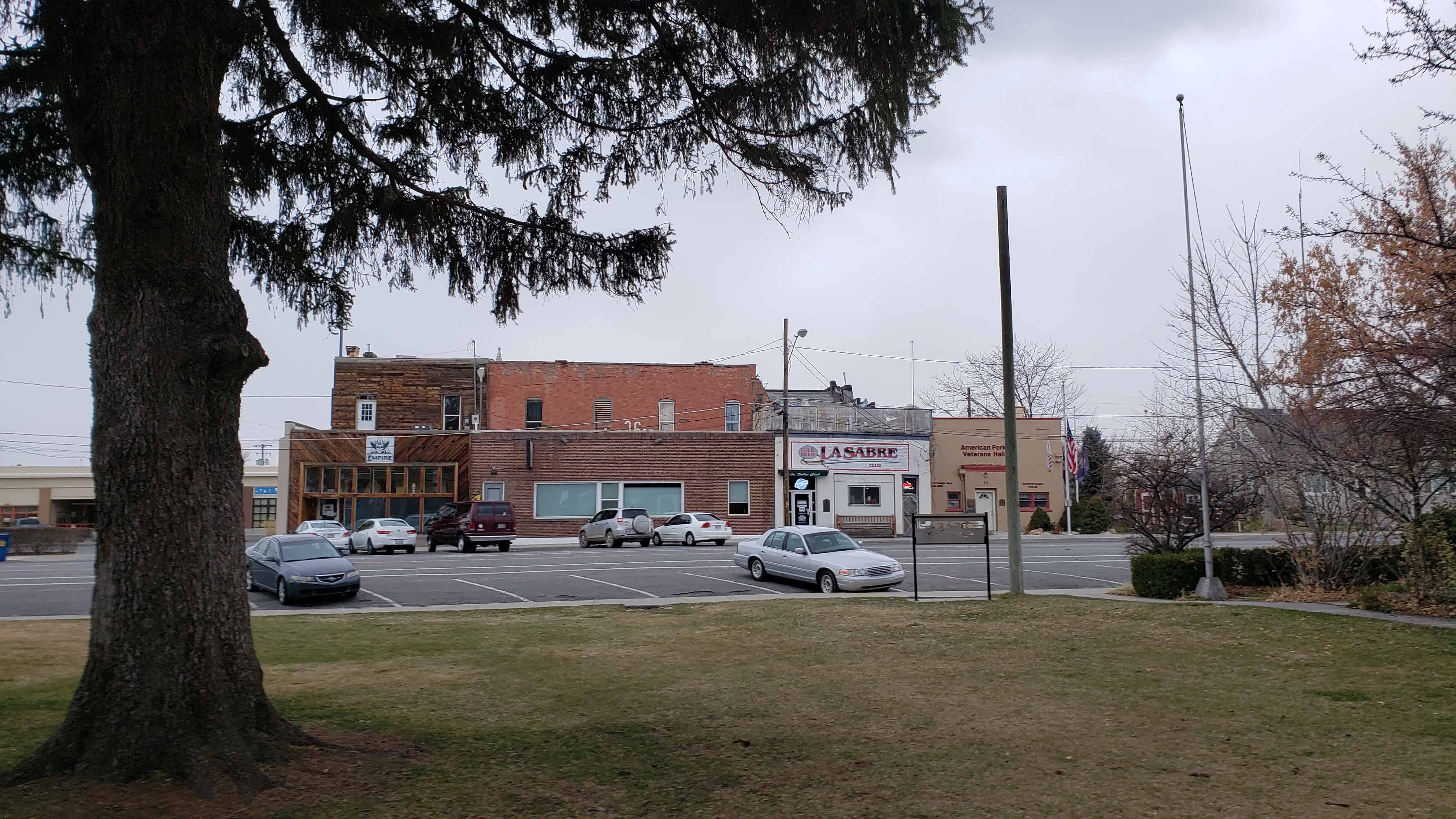
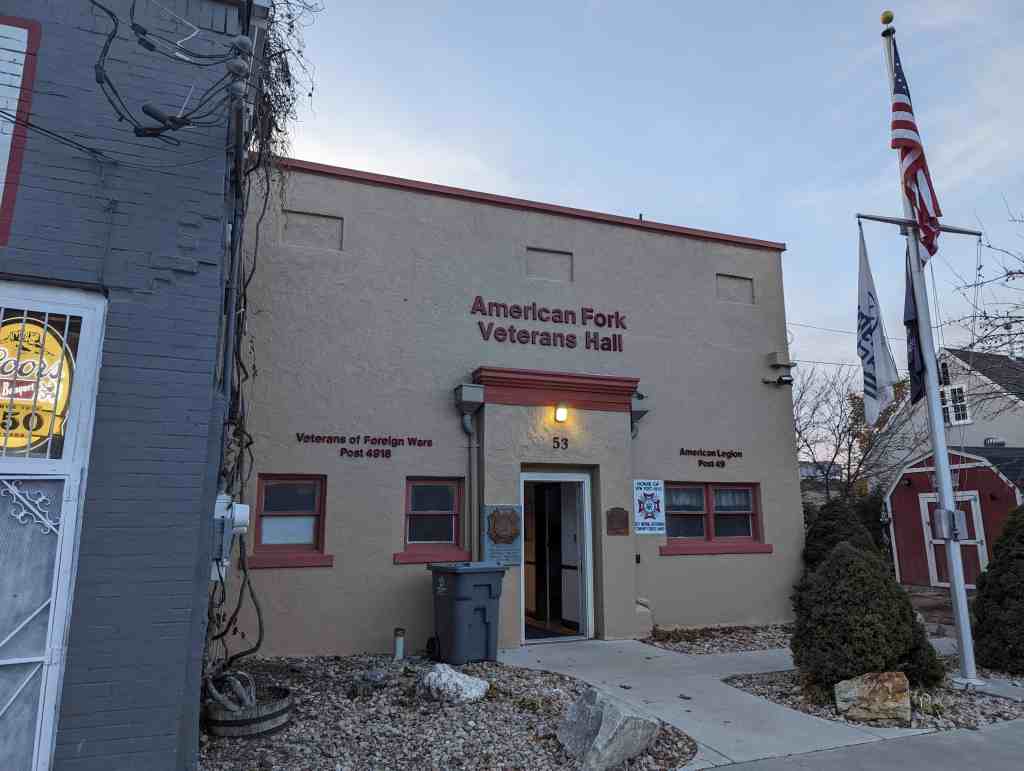
The Veterans Memorial Building, also known as the Legion Hall, was originally constructed as a commercial building sometime before 1932. In 1934 it was extensively remodeled as an early Public Works Project funded by three sources: A Civil Works Administration Grant (part of the New Deal Era Legislation), American Fork City, and the American Legion Post 49. American Fork Veterans, wanting to bolster public remembrance of their comrades who served and died in WW1, organized a small group of men and women who worked for years to establish a suitable memorial. Their efforts resulted in the remodeling of this structure to honor WW1 servicemen. As a result of their support and its use as a Legion Post it was commonly known as the Legion Hall.
The Building is a well-preserved local example of the “PWA” Moderne Style of architecture, which was used extensively during the 1930’s on government-funded buildings. It features smooth wall surfaces, flat roof, plain, narrow cornice, framed entrance, and metal sash windows. The interior maintains much of its original fabric such as wainscoting, staircases, crown molding, wall sconces, and 1930’s kitchen with elaborate cabinets, glass cupboard doors, and chrome plated hardware.
Located at 53 North Center Street in American Fork, Utah
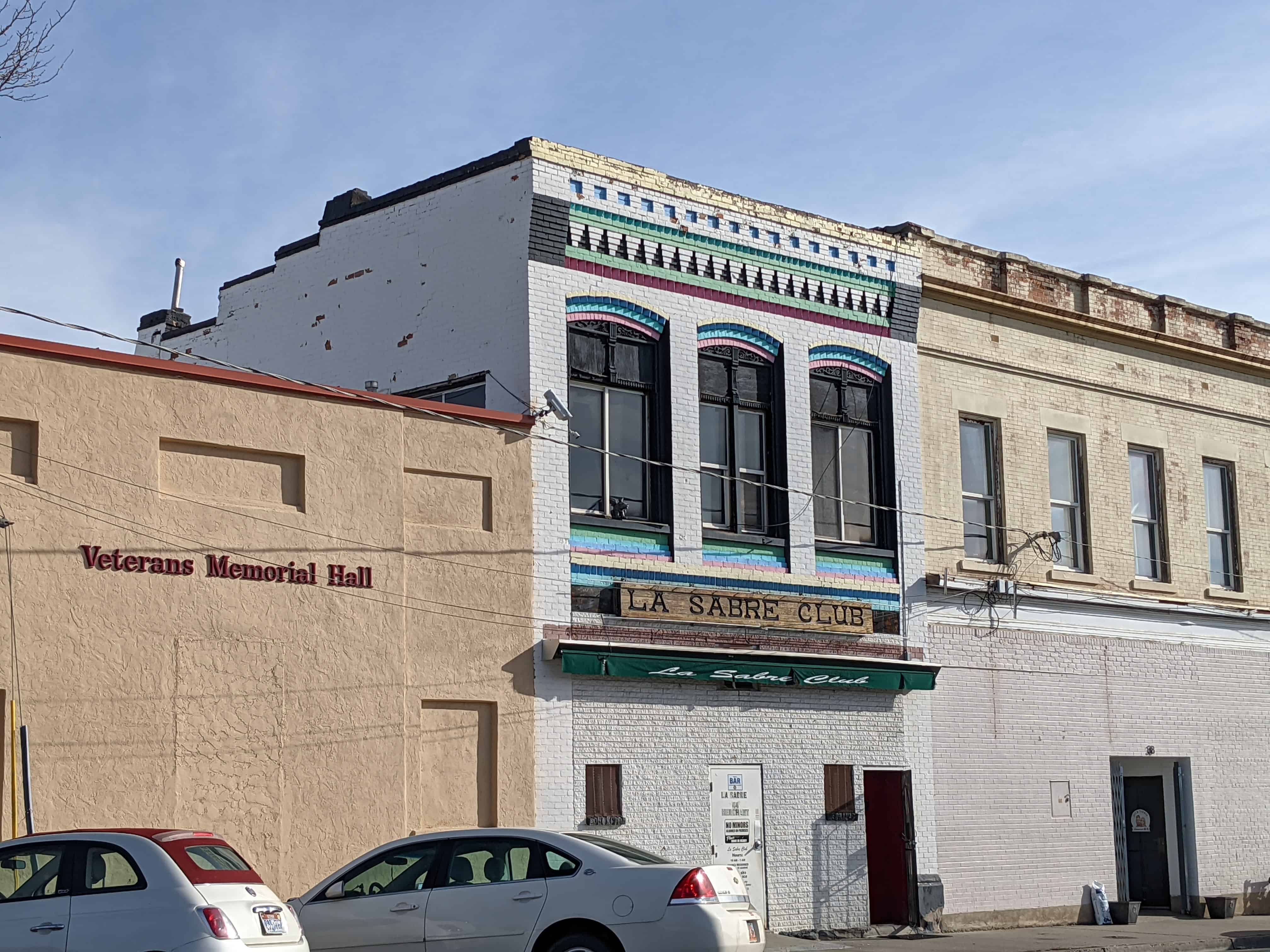
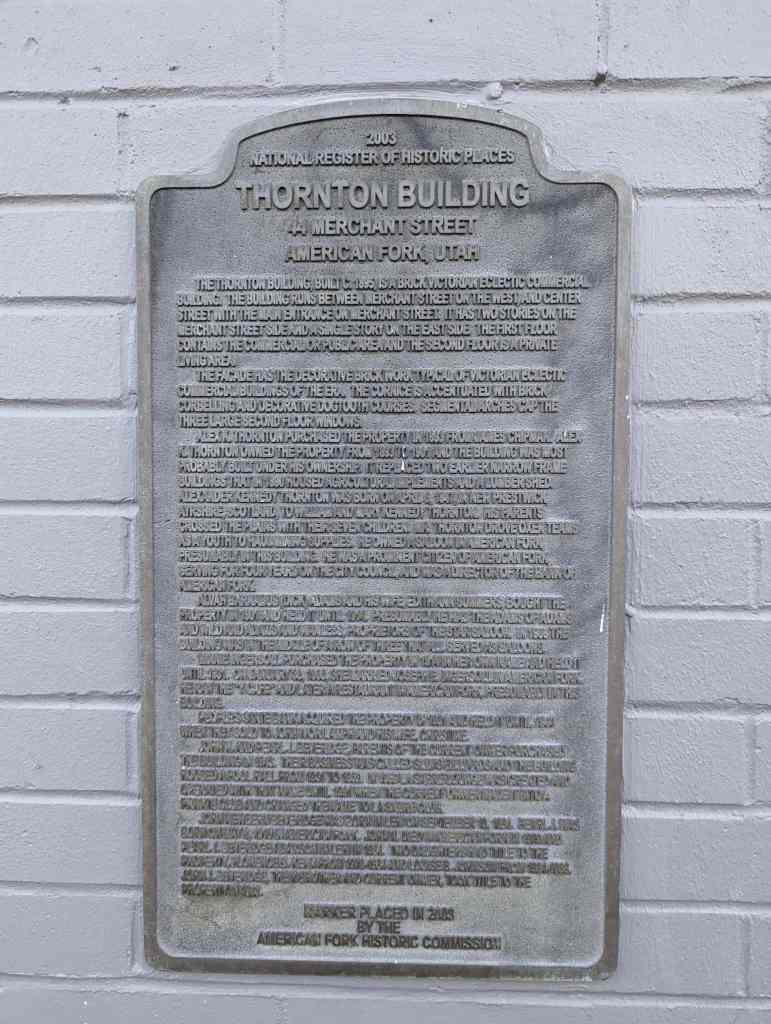
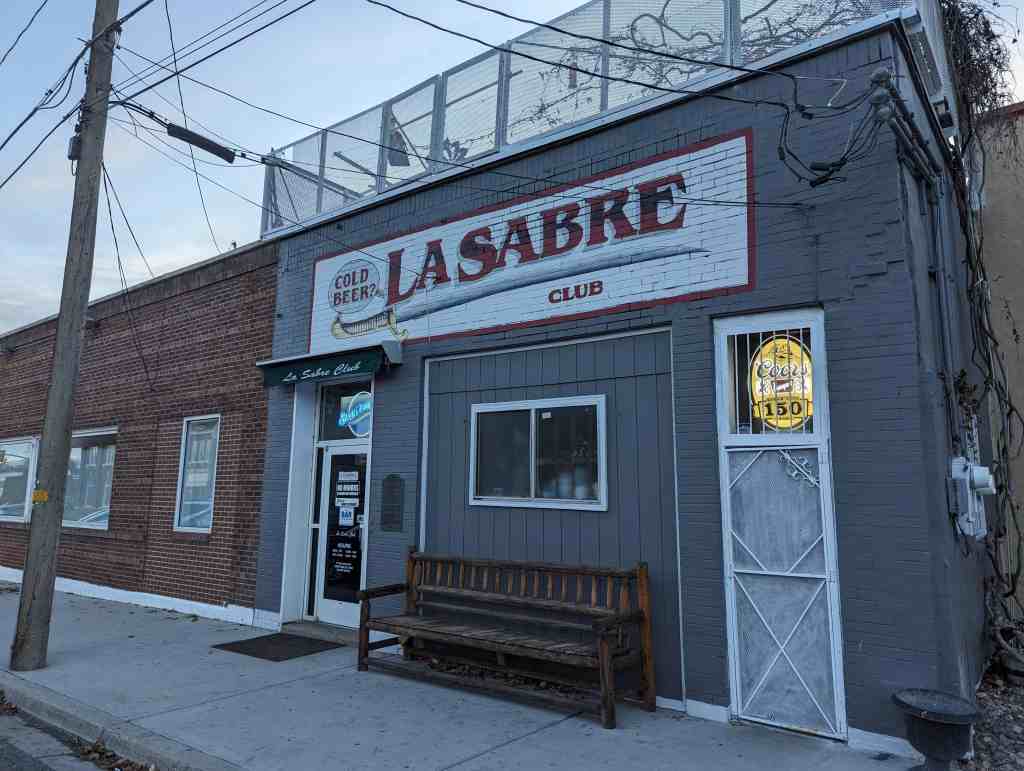
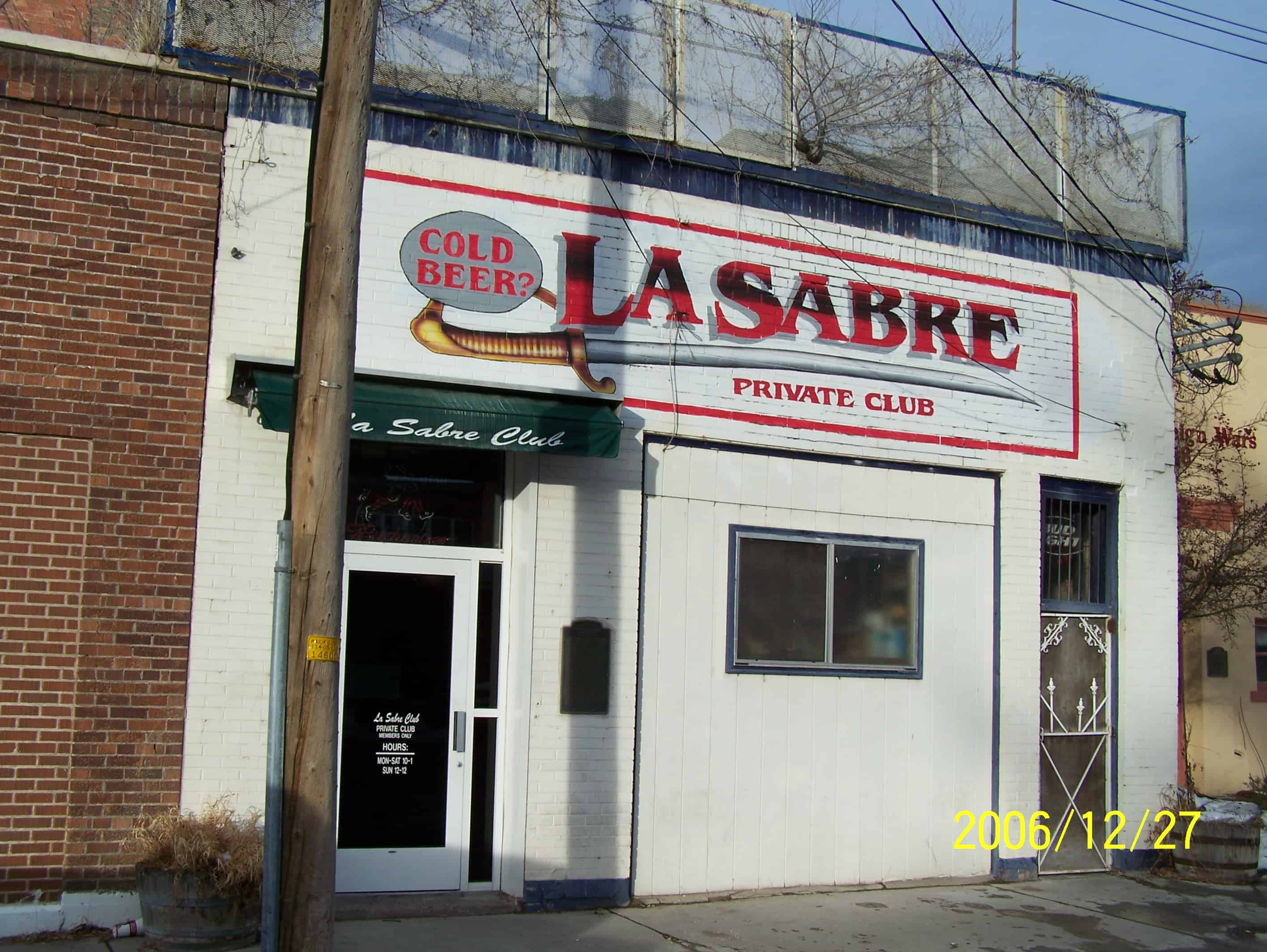
The Thornton Building built c. 1895 is a brick Victorian eclectic commercial building the building runs between Merchant Street on the west and Center Street with the main entrance on Merchant street it has two stories on the Merchant street side and a single story on the east side the first floor contains the commercial or public area and the second floor is a private living area.
The façade has the decorative brick work typical of Victorian eclectic commercial buildings of the era the cornice is accentuated with brick corbeling and decorative dogtooth courses segmental arches cap the three large second floor windows.
Alex K. Thornton purchased the property in 1893 from James Chipman Alex K. Thornton owned the property from 1893 to 1901 and the building was host probably built under his ownership it replaced two earlier narrow frame buildings that in 1890 housed agricultural implements and a lumber shed. Alexander Kennedy Thornton was born on April 6, 1847, in New Prestwick Ayrshire, Scotland to William and Mary Kennedy Thornton. His parents crossed the plains with their seven children. Mr. Thornton drove oxen teams as a youth to haul mining supplies. He owned a saloon in American Fork presumably in this building, he was a prominent citizen of American Fork, serving for four years on the city council and was a director of the Bank of American Fork.
Alvah Barnabus (Dick) Adams and his wife, Edith Ann Summers, bought the property in 1901 and held it until 1914. Presumably he was the Adams of Adams and Wild and Adams and Wanless, Proprietors of the Star Saloon in 1908. The building was in the middle of a row of three that all served as saloons.
Minnie Ingersoll purchased the property in 1914 in her own name and held it until 1931. On January 30, 1900, she married Joseph E. Ingersoll in American Fork. He ran the ‘Y Café’ and later a restaurant in American Fork, presumably in this building.
People’s State Bank acquired the property in 1931 and held until 1944 when they sold to John Ivor Lamph and his wife, Christine.
John W. and Pearl J. Beveridge, parents of the current owner purchased the building in 1943, their business was called Slim’s Billiards and the building housed a pool hall from 1931 to 1959. In 1953 La Sabre Lounge was created and opened with that name until 1991 when the current owner made it into a private club and changed the name to La Sabre Club.
John Newbern Beveridge was born in Lehi on September 19, 1894. Pearl J. was born on May 6, 1910 in American Fork. John N. died in American Fork in 1979 and Pearl J. Beveridge Adamson in Lehi in 1984. Two daughters had title to the property, Florence S. Kerr from 1979-1984 and Louise B. Johnson from 1984-1988. John J. Beveridge, their brother and current owner (2003) took title to the property in 1988.
Located at 44 North Merchant Street in American Fork, Utah
The photos below are borrowed from the county records:
The house was built c. 1877 for Joseph Tattersall, an early settler of Beaver City. It is one-and-a-half-story tall building constructed of black rock – a hard, dense volcanic stone that is commonly found in the nearby foothills in small outcroppings; it was a fairly common historic building material used in Beaver. The house features a steeply pitched roof, end-wall chimneys, two dormer windows, center gable with a door, and two bay windows that are located on the main façade. The home is the work of Thomas Frazer, a Scottish pioneer stonemason who did a lot of building in Southern Utah, particularly in Beaver.
The First National Bank of Layton, built in phases between 1905 and 1945, is a one-part commercial block in the Victorian Eclectic style. The bank building is significant under Criteria A arid C for its association with the development of Layton, and for its association with Davis County’s most prominent and prolific architect at the turn of the century, William Allen. In 1905, the First National Bank was the third bank to be established in Davis County and during 2005 celebrated its centennial as the oldest continually operating business in Layton. For a century, the bank has been an integral part of the Layton City and Davis County economies. The bank building includes a 1915-1916 expansion, which provided office space for the Layton Sugar Company, the area’s largest employer at the time. During the 1940s, the bank building expanded again mainly due to the rise in population associated with the development of Hill Air Force Base (Hill Field). Between 1905 and 1916, the bank building was designed, constructed and expanded by Davis County’s most respected architect, William Allen. William Allen began his career as a brick mason and ended it as a contractor and self-taught architect. He was among the first architects licensed by the State of Utah, and the only licensed architect in Davis County for many years. Of Allen’s over one-hundred documented works, six are listed on the National Register of Historic Places and another is pending. The First National Bank of Layton is a contributing historic resource in Layton, Utah.
Located at 50 West Gentile Street in Layton, Utah and added to the National Historic Register (#06000232) April 5, 2006.
Layton, Davis County’s largest city, was originally an outgrowth of Kaysville, a Mormon pioneer town first settled in 1854. By 1886, a separate precinct and post office were located in a small business center north of Kaysville. The community was named Layton, for Christopher Layton, a prominent early settler of the area. In 1902, the community of Layton legally severed the ties with Kaysville and became an unincorporated area. With a population of 500, Layton was incorporated as a third-class town in 1920. In 1950, after a decade-long boom period which accompanied the development Hill Air Force Base, the population reached 3,456 and Layton was declared a third-class city.
Layton’s historic business district is clustered near the intersection of Gentile Street and Main Street, which for many years paralleled the track of the original Utah Central Railroad (the tracks were removed in 1953). The Layton business district was also serviced by the Oregon Short Line (later Union Pacific, 1912-present) on the west side of town and the Bamberger Electric Railway (1906-1952, later obliterated by Interstate 15) east of the commercial district. At the beginning of the twentieth century, Layton’s business district included two general stores, a meat market, saloon, coal dealer, blacksmith shop, barber shop, hotel, and the Layton Milling and Elevator Company, which in 1903 shipped more flour than any other Utah mill. Through the first half of the twentieth century, the economy was predominantly agricultural. The most important cash crops were alfalfa, grain, onions, and potatoes. A cannery was built to process tomatoes and peas, and a factory was established in 1915 to process sugar beets. The business district was the support and shipping center for products of Layton fanners.
The First National Bank of Layton was established in 1905. At the time it was only the third bank in Davis County, and one of only two national banks that were established that year. The Layton Bank was established during a period of banking expansion that followed the depression years of the mid-1890s. The bank required a $20,000 minimum of capital in order to comply with Utah’s 1888 Banking Act. The original thirty-nine stockholders raised $25,000 (250 shares of $100). Most of the stockholders lived in Layton with a few living in the nearby communities of Ogden, Kaysville, Plain City and Syracuse. Among the stockholders were several prominent members of the Ellison family, whose descendants own the original bank building. The first officers of the bank were James Pingree, President; E. P. (Ephraim Peter) Ellison, Vice-President; Rufus Adams, Vice President; James E. Ellison, Cashier; and Laurence E. Ellison, Assistant Cashier.
The bank officials selected Kaysville architect, William Allen, to draw up plans for the new bank building. William Allen had designed E. P. Ellison’s Farmers Union store in 1892. The bank was built on land across the street from the store at the corner of Main and Gentile Streets. The land was originally patented to Thomas Sandall in 1875, but was not purchased by the bank until 1911. The one-story brick building first opened its doors for business on May 15, 1905. On October 20 and 21, 1906, an east wind blew through northern Davis County causing hundreds of thousands of dollars in property damage. Among the casualties of the disaster was the Layton Bank Building, which was “completely destroyed roof and walls.” An examination of the building concluded that the “violent wind blew in the bank’s east window, creating intense internal air pressure, which caused the front brick wall to explode onto Gentile Street.”
The bank moved its operations temporarily to the Farmers Union Store, while William Allen redesigned the bank. Though the disaster had occurred just eighteen months after the bank’s opening, the board of directors was determined to persevere. The Davis County Clipper reported on the first annual meeting after the windstorm stating “No quarterly dividend was declared, probably, it had been paid to the east wind that blew the bank building down. It is thought that it will probably take another quarterly dividend to pay for the damage done by the wind.” Another article in the Davis County Clipper described the construction enhancements of the new building: “The Layton bank which is being rebuilt is as strong physically as the Bank of England is financially. Iron anchors, several feet long, were placed in the walls and other irons were put between the courses of brick in such a way as to hold the building together.”
The bank moved from the store back into the new building in the spring of 1907. In October of that year, two burglars broke into the bank vault, but were unable to open the safe where the money was kept. A second attempt in May 1910 was also unsuccessful. By that time, the Layton Bank had a time-locked safe. Frustrated in their attempt, the two thieves locked cashier, Laurence Ellison and night-watchman, Hyrum Evans, in the vault. Ellison and Evans managed to escape and the would-be robbers were apprehended. Laurence Ellison, who had been promoted to Cashier after his brother James left, was the bank’s lone employee, until he was joined by Vird Cook in 1913. Vird Cook, who was nineteen at the time, spent the next forty-six years working in the bank. By 1914, the assets of the bank had grown to $187, 907. During its first decade, the Layton Bank’s stockholders and customers included most of the business owners and farmers of Layton.
Agriculture had been the economic base of Layton since the pioneer era, but by the 1890s many farmers were beginning to specialize. In particular, the sugar beet was an important cash crop in northern Davis County, with many thousands of tons of sugar beets shipped to sugar plants in Lehi, Utah, and later Ogden, Utah. In 1913, Kaysville-Layton area farmers and businessmen organized the Layton Sugar Company in 1913. The company was incorporated in 1915, with E. P. Ellison as one of the founders. By the fall of 1915, the Dyer Construction Company had completed a $500,000 sugar plant on a forty-eight-acre site near the Denver & Rio Grande tracks in west Layton. The first year the plant processed 25,000 tons of beets from farms in Kaysville and Layton. In the next two years, the output doubled. The factory employed approximately 300 men working round-the-clock shifts. James E. Ellison served as manager and president of the company.
On August 25, 1915, the minutes of the First National Bank of Layton record that a committee was organized to “investigate the feasibility of remodeling the bank building and making an addition thereto to be rented to the Layton Sugar Company.” In September, the bank board approved plans for the addition and a charge of $60 per month rent to be paid by the Layton Sugar Company. William Allen was again chosen as architect for the addition and remodeling. The Davis County Clipper reported that expanded bank would have several objectives: “to furnish a larger home for the bank, provide offices for the sugar company as well as for professional men, etc.” 10 The newspaper continued to monitor the progress of the building. According to one report the contractors, Hyde and Sheffield, “have employed all the bricklayers in Davis County that they could get and some few from the outside” for the bank building and another project. As the construction neared completion in January 1916, the Clipper published the following glowing report: “The brickwork on the First National Bank addition is completed and the new metal cornice is in place. The metal cornice was placed on the old building so as to make it harmonize perfectly with the new. The cement trimming about the door and windows gives it a massive and attractive appearance. The mason work has also been done with skill. The building is certainly a credit to Architect Allen.”
The Layton Bank weathered difficult times through the 1920s, including a successful robbery in 1920 in which the robbers made off with several thousand dollars in war bonds. In 1924, the bank installed the security alarm box still extant on the south elevation. Utah experienced several years of depression even before the stock market crash of 1929. However, the First National Bank of Layton thrived, most likely because it had several large depositors, including the sugar company and the Davis and Weber Counties Canal Companies, in addition to its community customers. The bank hired several bookkeepers, including its first women employees, Beth Green and Norma Underwood. In 1922, the Kaysville Weekly Reflex printed this description of the bank’s operations: “The bank does a business extending over the state of Utah and into Nevada and Canada, where Layton people have large interests” 13 In the 1930s, the old system of banks issuing currency was abandoned, and today the few surviving First National Bank of Layton notes are held by collectors. The 1939 remodeling of the bank’s interior utilized the popular Art Deco style of the period. That same year, the decision to build an air depot near Ogden would greatly impact the economy of Layton.
The bulk of the Hill Field base was within Davis County with Layton as the closest established community to the base’s main gate. The base was operational by November 1940, and even before the United States’ entrance into World War II, the economy of Layton was booming. Although the bank benefited from proximity of the base; with so many employed in war-related services, the bank had difficulty finding employees. The Layton Bank even changed its hours to accommodate paydays for Hill Field employees. In 1941, Laurence E. Ellison was elected president of the Utah Bankers’ Association. The bank began planning to expand its facilities and build a new vault in 1944, but wartime shortages of materials postponed the project. Though the exterior of the expansion was almost complete in October 1945, the interior work was not completed until 1946. The addition and remodeling included a new bank vault, new safe deposit boxes, a paneled boardroom, kitchenette and restrooms. The addition also doubled the size of the sugar company offices. When the Layton Sugar Company went out of business in 1959, and the bank operations took over the entire building.
In the post World War II years, the First National Bank of Layton became an even more integral part of the economic community. The bank was one of the first in Davis County to offer loans guaranteed under the G.I. Bill. Many important businesses were started with loans from the Layton Bank. One example was Rufus C. Willey of Syracuse, who was a bank customer and founder of the R.C. Willey Company, today Utah’s largest furniture and appliance retailer. Through the 1950s, 1960s and 1970s, the bank continued to upgrade and modernize. A night depository box was first installed in 1954. The glass vestibule was installed in the 1970s. In 1981, the bank moved across the street to the restored Farmers Union Building, where it currently conducts business. During the move, the marble teller stations and the vault were also moved. The L.E. Ellison Family Company purchased the building in 1985. In the 1980s and 1990s, the building was used for a variety of businesses including a print shop, coffee house, computer store, bridal & photography, beauty salon, and most recently, a jewelry store. The building has been vacant since 2003.
The First National Bank of Layton, built in four phases between 1905 and 1945, is a one-part commercial block, located at 50 West Gentile Street in Layton, Utah. The building is brick masonry with stone and concrete foundations. The current roof is flat and built-up. The original bank building, a one-part Victorian-style commercial block with an angled entrance, was constructed in 1905. In October 1906, the building was partially destroyed by a windstorm. Between 1906 and 1907, the bank building was rebuilt using the surviving stone foundation and two brick walls. Most of the Victorian elements of the 1905 building were replicated during the 1906-1907 reconstruction, but the parapet was built higher and other modifications were made. In 1915, the bank building was expanded to the east and a new entrance was built flush with the south elevation and featured stylized classical elements. In 1945, the building was expanded to the east and in the rear, creating a wedge-shaped east elevation that followed the line of Layton’s Main Street. The interior of the bank has been remodeled several times, with the extant finishes dating from 1939 to the 1980s. The bank building has been vacant since 2003.
The original 1905 building measured approximately forty-three by twenty-two feet. The longest elevation faced south onto Gentile Street with the shorter end on Main Street. The main entrance was angled and faced southeast toward the intersection. 1 The foundation was rock-faced sandstone. The face brick was laid in a stretcher bond. There was a corbelled brick base with a sandstone stringcourse, which also served as the sill. Historic photographs show the south elevation divided into two bays by brick pilasters. Each bay featured a large plate-glass window with several courses of segmental-arched rowlock brick. A decorative stringcourse highlighted the arched windows. A similar bay was on the east elevation. The angled entrance featured stone steps, double wood-sash doors, with transoms and a segmental-arched hood. Above the fenestration were three corbelled brick courses and a brick parapet with a metal cornice. A decorative block with the date “1905” was above the entrance. The west elevation had a small window near the south end (now filled-in), but otherwise the west and north elevations were blank. On October 20-21,1906, a windstorm blew in the east window creating a vacuum, which caused the roof to collapse and the south elevation to explode. Between late 1906 and 1907, the bank building was rebuilt using the original foundation and surviving north and west walls. The rebuilt structure was similar in design to the original, but featured a much higher and stronger parapet. The new parapet was completely brick and featured a dog-tooth course above the original corbelling. The brick masonry was reinforced with iron bars and anchors. The sloped roof was reinforced as well.
Between 1915 and 1916, an L-shaped addition was constructed effectively expanding the building twenty feet to the north and twenty-five feet to the east. The addition created a south facing entrance and an extra bay to the east. The addition was designed by the same architect-builder as the original building, and the brickwork is nearly identical. The main difference between the old and new bays is the use of concrete for the foundation and sills, rather than stone, and vents in the dogtooth course. The new steps are also concrete. The new entrance features a slightly projecting surround of cast concrete. The flanking pilasters were banded, as were a dividing mullion and pilasters (with capitals) in the slightly recessed double doors (the mullion was removed in the 1970s). Above the arched opening is a cast concrete panel with the words “First National Bank.” These elements give the building’s entrance a stylized classical appearance. The brick parapet was also enlarged in 1915-1916, and with accent block appeared as a classical balustrade. The date “1905” is in a block above the main entrance.
The building was expanded again in 1945-1946. During this phase the east elevation was demolished and the façade was expanded by another bay, which replicated the 1915-1916 addition. A similar, but smaller bay faces east. The remainder of the east elevation addition angles to the northwest along the line of Main Street. The angled wall is constructed of brick on a concrete foundation and features a geometric design of corbelled brickwork. The parapet is plain and has been used as a signboard. There is a simple metal coping along the parapet. The brickwork for the north elevation addition is similar. There are windows (now filled with glass block, date unknown) in the north and west corners of the building, but no other openings. The different building phases are best discerned on the west elevation where the joints between additions are visible. There is a double-door service entrance in the center of the west elevation (probably 1980s). Other modifications to the exterior include the installation of an interior alarm box (circa 1924, south elevation), exterior paint (white in the 1960s and currently tan with darker tan and gold accents), and the removal of the double entrance doors to provide a single glass door into a vestibule (circa 1970s).
The interior of the building has been remodeled several times. The original 1906-1907 interior featured a marble lobby with a pressed-tin ceiling. The vault was built out in the northwest corner. During the 1915-1916 expansion the lobby was not altered but additional vault and office space was added to the rear. The addition included office space for the local sugar company to the east, which had its own vault. In 1939, a major interior remodeling included the removal of the original ceiling and a change to the teller cages. The 1939 interior remodeling had some elements of the Art Deco-style. 2 Further remodeling accompanied the 1945-1946 addition. The banking space was expanded to include the 1915-1916 spaces and the vault was moved to the rear. Decorative plaster work was added to the ceiling and walls of the main banking space (extant). The rear addition included an upper-story accessed by a central closed stair. The rear addition has three rooms (currently finishes from the 1980s) and parts of the 1915-1916 building exterior are visible on the south walls. On the main floor, a wood-paneled board room was installed (extant although slightly damaged). In the northwest corner a kitchenette and restrooms were installed (extant). The glass vestibule was installed in the 1970s and a night depository box was added. There is a wall-mounted safe near the vestibule (date unknown, possibly 1980s). The marble teller counter and the vault doors were relocated to the Farmers’ Union Building (listed on the National Register in November 1978) across the street when the bank moved its operations there in 1981. In the bank area, many of 1939-1946 features and finishes have survived. To the east, where the offices were located, most of the current interior finishes date from the 1980s after the bank moved out.
The First National Bank of Layton sits on a wedge-shaped parcel of 0.1779 acres. It is located at the angled corner of Main Street and Gentile Street. There is a sidewalk and planters on Gentile Street, but only a sidewalk on Main Street. A narrow pedestrian alley is located between the bank and the historic building to the west.
There is a small asphalt parking area in the rear (against the north elevation). The bank is one of several historic buildings located in downtown Layton, but most, with the exception of the Farmers Union Building and one general store, have been altered. The First National Bank is in good condition and contributes to the historic resources of Layton, Utah.