Legend has it that three French trappers first noted this unusual spring in the Yampa Valley. The spouting spring, accompanied by a “chugging” sound, reminded them of a steamboat. Henceforth, since the early 1870’s, the trappers, guides, and miners came to recognize and know this future townsite as “Steamboat Springs.”
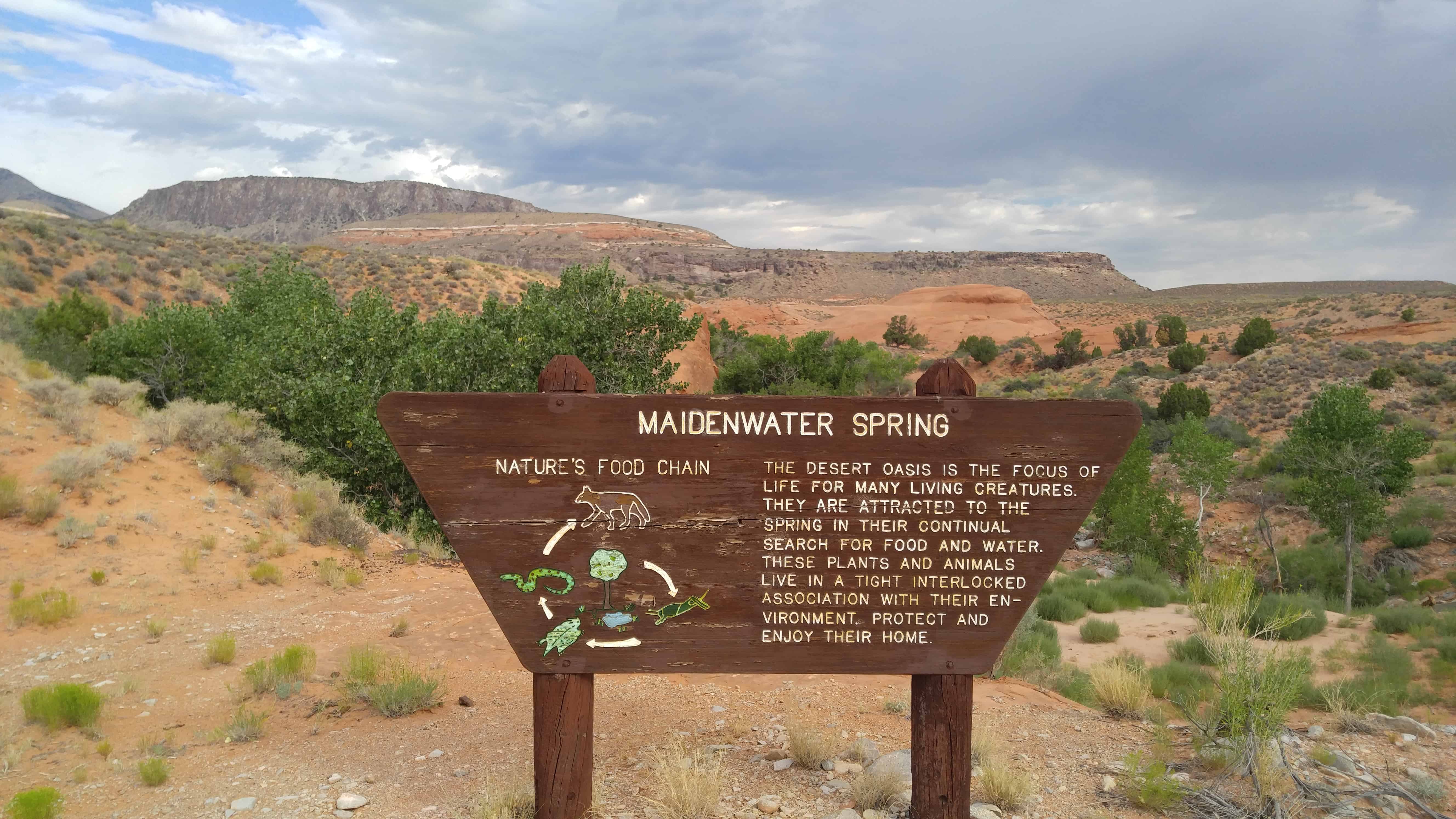
Maidenwater Spring – The desert oasis is the focus of life for many living creatures. They are attracted to the spring in their continual search for food and water. These plants and animals live in a tight interlocked association with their environment. Protect and enjoy their home.
Just south of here is Maidenwater Canyon, slot canyons and amazing areas to explore.
This spring was long used by Indians and early scouts as a camp site. James Allred, directed by Brigham Young on March 22, 1852 led his sons and their families here to build their homes. In 1853 a large colony of Scandinavian emigrants joined them. The waters of Canal Creek and natural springs supplied the settler. Twice, the Indians drove them out, burning their fort and all their possessions; but in 1859, they returned to establish permanently the town of Spring City.
(The marker with the above text on the east side of the monument was placed in 1950, two more were added in 2016 and the text is below)
A long, wooden watering trough (later metal, then concrete) served livestock corralled in town, as well as old highway 89 travelers, from a rocked-in spring on Main Street until 1931 when it was moved to the side. Many children of the town escaped summer’s heat by dangling their warm legs in the cold spring water until those limbs turned blue. The area near the spring and monument was also a youth meeting place after weekly Church meetings, with alleged courtships having their beginnings here.
In early days, baptisms occurred in ponds, deep ditches, or in the Manti Temple font after 1888. Another option became available in 1889; the City granted permission for a 24′ by 26′ cabin to be built here at the request of Lauritz Larsen, local LDS Ward official. It was used until 1914 when the rock chapel was dedicated. It housed a large, square, tin tub filled with cold spring water piped from the William Blain spring in the center of Main Street.
Thomas E. Ricks arrived in Cache Valley with his family In 1859. Between chores such as building a school and a cabin for his family, he explored Logan Canyon In search of timber. During one trek he discovered this spring which was later named for him.
Frontier communities required large quantities of lumber to build churches, businesses, homes, and fences. In 186. Thomas Ricks and other town leaders proposed building a road in Logan Canyon to that timber could be hauled to the valley. As timber supplies close to Login were exhausted, the road was pushed further up the canyon. Brigham Young, President of the Church of Jesus Christ of Latter Day Saints (Mormons), recommended in 1889 that the road be completed to Bear Lake Valley Thomas Ricks and other volunteers accepted the challenge and completed the first twenty-five miles to what is now known as Ricks Spring before winter.
For many years. Ricks Spring was believed to be pure mountain spring water. Visitors drank from the spring and filled jugs with water to take home that is until they became sick. In 1972, an ice jam on Logan River provided the answer to the origins of Ricks Spring.
Ricks Spring usually slows to a trickle in November, and begins to flow again in April as the snow melts. In 1972, however, a severe blizzard caused an ice flow to dam Logan River. Suddenly, Ricks Spring began to flow in January. When the ice jam cleared, the flow slowed. Later, bitter cold weather caused another ice jam on Logan River and the flow of Ricks Spring increased once again. Scientists placed green dye in Logan River and the dye appeared in Ricks Spring indicating that they are directly connected by an underground fracture in the rock.
This spring has always been a “childhood memory” of mine, my dad stopped here once and told us about how he came here when he was younger.