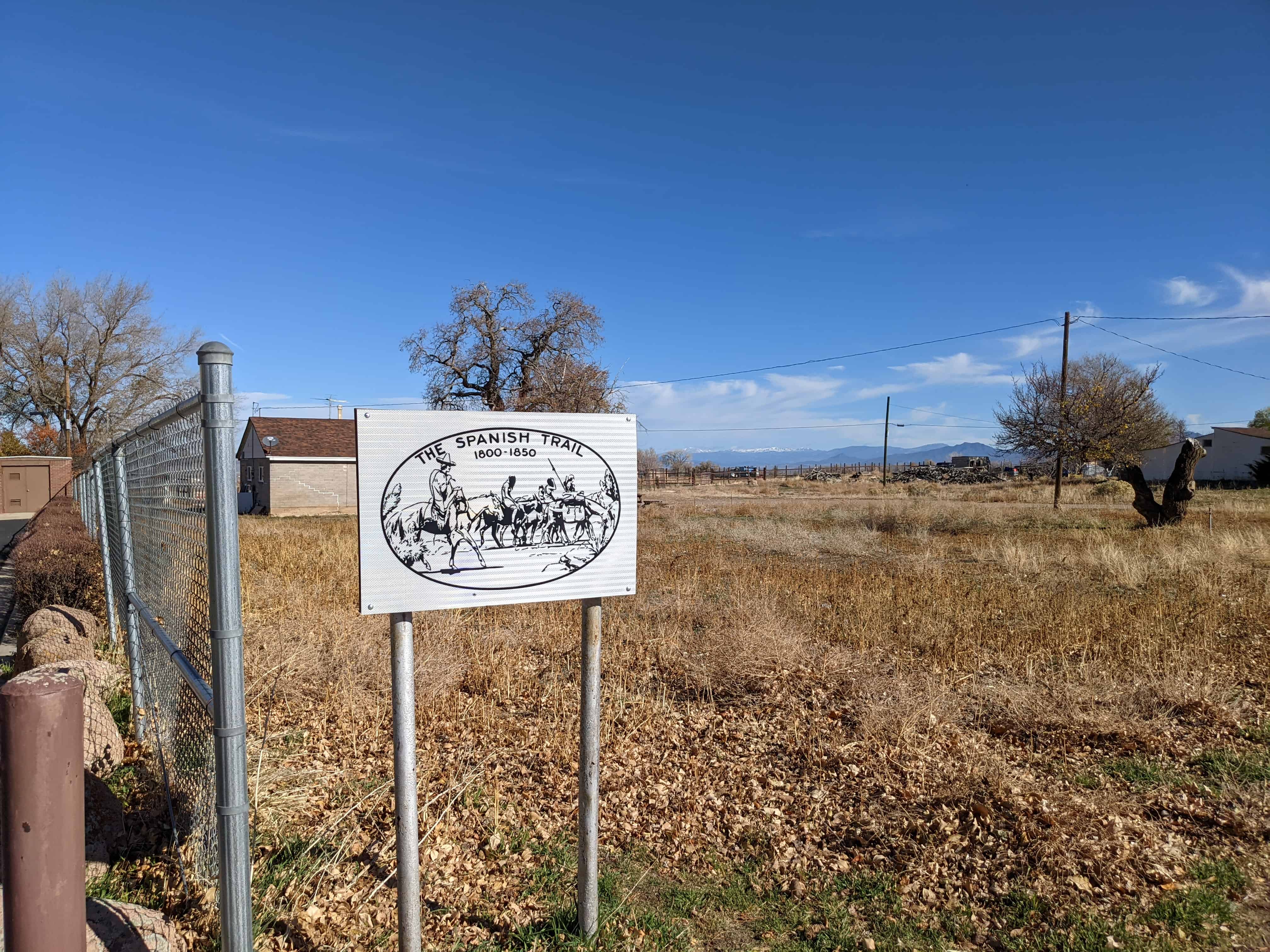
Stretching for 130 miles across Clark County, this historic horse trail became Nevada’s first route of commerce in 1829 when trade was initiated between Santa Fe and Los Angeles. The trail was later used by the wagons of the “49ers” and Mormon pioneers. Concrete posts marking the trail were erected in 1965.
The museum was added to the National Register of Historic Places (#91001527) on October 24, 1991.
From the national register’s nomination form: The Museum/Library Building of Mesquite, Nevada is significant as one of two of the only known surviving examples of National Youth Administration (NYA) activity in Nevada. It is eligible under criteria A arid C for association with this New Deal program and for the method of construction and design. Built in 1941 at the end of the program’s duration, the Museum/Library building is a vernacular adaptation of Pueblo Revival architecture, a style rarely seen in Nevada,
Setting:
Mesquite is situated on the Nevada/Arizona border not far from Utah. The nineteenth-century Spanish Trail cut through the vicinity, and Mesquite was serviced by the twentieth-century Arrowhead-Trail portion of the transcontinental highway. Mesquite was founded in 1880 when ten families, members of the Church of Latter Day Saints of Jesus Christ, moved from St. George, Utah to the north side of the Virgin River of southern Nevada. The Post Office called the community Mesquite from 1880 to 1887 when service was terminated. Unfortunately, the Virgin River was prone to flooding, endangering structures, canals and fields, A severe flood in 1882 caused many of the original settlers to leave the area which was abandoned entirely by 1891. It was, however, reestablished in 1895 by another, smaller group of Mormons who reinstituted cultivation of the fields. Postal service was resumed in 1897 to the community, there after called Mesquite. 1 The population has remained limited throughout most of the community’s history: In 1900 there were only 102 residents there; by 1940 it had grown to 515; and by 1980 it was home to 922 people, many of whom were descendants from the 1895 settlement.
Initially, settlers were attracted to area because of its temperate climate and available source of water from the Virgin River. This made the cultivation of cotton and grapes possible. Eventually, cotton was replaced by alfalfa.
Structures in the valley were originally adobe since the closest lumber supply was 85 miles away and the nearest railroad station was in Milford, Utah, 150 miles away. In 1900 telephone service reached the valley. In 1909 a Mormon temple was erected. About the same time the community constructed a lumber school building. This was replaced in 1923 by “A beautiful cement block building.” By 1923 there were four small stores in town. The community changed dramatically in 1981 with the construction of a major hotel/casino resort.
National Youth Administration – Criterion A:
The NYA was inspired largely by Eleanor Roosevelt who once said that “I have moments of real terror when I think we might be losing this generation.” While the Civilian Conservation Corps was created to care for the most desperate cases, those young people who no longer attended school and were dropping out of society, the NYA was organized specifically to assist young people who were in school and yet were threatened with the need to drop out because of lack of funds. Created on June 26, 1935 by executive order, it was initially attached to the Works Progress Administration.
There were two divisions of the NYA, one of which dealt with student work. This program provided funding for students, chiefly belonging to relief families, who needed support, to stay in school. The second program was designed to assist young people who had dropped out of school. This program provided training to these young people so that they could assume their place in the labor market as qualified workers.
Audrey Williams, who became the head of the new agency, decided that the national office would impose only the most general guidelines on the program to enable state and local officials to tailor the program to fit local needs. John Salmond points out that “By early 1937, more than 400,000 young people were receiving assistance, and the monthly number rarely dropped below 300,000 thereafter. By the time the program was terminated in 1943, more than 2 million young people had received assistance.
Initially the NYA worked on parks projects and community efforts which required little capital but a great deal of labor. This approach was largely abandoned by 1937, replaced by one which called for more technical training, since this was more in keeping with the spirit of the NYA. In 1939 the NYA began yet another transition as it postured itself in the federal effort to prepare for war. Increasingly the youth were trained in the defense industry and as Salmond points out, “From mid-1940, its nondefense function were progressively shed until by 1942 it was involved solely in the war effort.”
Nevada’s participation in the NYA was minimal. Although the New Deal was generally effective in Nevada, minimal participation was generally the rule due to limited population and to the fact that the state suffered less from the Great Depression than others. It consistently ranked at the bottom in the nation for the number of schools and students participating and for the amount of funds expended. The Final Report of the National Youth Administration; Fiscal Years 1936-1943 points out that between 1939 and 1940 only 38 Nevada schools and colleges participated in the NYA Student Work Program. At the same time, Nevada had only 301 students participating 213 in the School Work Program and 88 in the College Work Program. In comparison, Delaware, the next highest state, had fifty schools and 507 students involved. In 1940-41, for further contrast, Illinois had 25,466 students participating and Pennsylvania had almost 30,000. During the fiscal year 1941-42, Nevada’s enrollment dropped to 218 and by the following it diminished to 31, reflecting the national process of phasing out the NYA. Similarly, the Nevada Out of School pi-ogram employed 227 young people in 1940, 268 in 1941 and 187 in 1942. Between 1936 and 1943, $373,742 was distributed in Nevada through the NYA for both programs. This represents the smallest amount given to any state. Delaware, recipient of the next largest amount, received $794,928, while Pennsylvania, which received the most, was awarded $47,998,272.
The NYA in Nevada supported college students at the University of Nevada campus (located in Reno) who were employed to grade papers and to help professors. It appears that the program designed to employ young people not enrolled at the University took a variety of forms, but the specifics of the program are not documented in the state.
The building constructed by the NYA in Mesquite provides an excellent opportunity to understand how the program was implemented in Nevada for non-University students. Although construction of buildings was not a commonly funded goal of the NYA, the program occasionally supported such tasks as a means of employing and training NYA youth. Such buildings were constructed by boys working under qualified supervisors. In this case, Walter Warren Hughes, a local resident, acted as supervisor and builder. There is only one other known example of the NYA building program in Nevada: in Lovelock, Nevada, the NYA funded the construction of a Vocational Agriculture building also in 1941.
The building in Mesquite, Nevada was constructed in 1941. This structure was originally intended to serve the community as a museum and library. It housed the Mesquite Branch of the Clark County Library for about a year after which it was used as a clinic and hospital. The building served in this capacity until 1977 when it was vacated. Following a hiatus of several years, the Boy Scouts assumed control of the building, which in 1985 became a community museum.
The modest size of the Mesquite Museum/Library corresponds to the limited population of Mesquite in 1940 (510 people) and to a sluggish agricultural community. Indeed, no architect was hired for the project and funds for the construction of the building ran out by the time the walls had reached the top of the windows. Volunteers finished the project and lumber was donated for the roof: five students traded their labor at Johnny Bower’s lumber mill, located in the Pine Valley Mountains, for the material. A shift in the size of rocks provides evidence of this break in construction: smaller stones are used to the top of the windows above which larger rocks, which took less time to set in place, are used.
Initially the NYA project employed between fifteen and twenty-five high school students who earned fifty cents a day fqr work. About five worked at a time. The students hauled rock from the nearby Virgin River.
A newspaper article in the Las Vegas Review Journal at the time of the ground breaking in January, 1941 pointed out that “When completed, the building will house old pioneer and Indian relics as well as mounted specimens of insects and birds prevalent in the Virgin Valley. In connection there will be a school library which will be open to the public.” The article also pointed out that the students received training in “rock masonry, carpentry, plumbing, blacksmithing, and landscaping of the grounds.” The fact that the building, which continues to serve the community, was completed stands as testimony to the New Deal program and to the voluntary efforts of Mesquite’s youth who donated their time when funds ran out to make the project a success.
Vernacular Adaptation to Pueblo Revival Architecture – Criterion C
The Mesquite Museum/ Library building is constructed in a vernacular adaptation of Pueblo Revival style architecture. This style is rarely found in Nevada. The only other known example is in the Lost City Museum, constructed by Civilian Conservation Corps (CCC) workers in 1935 in Overton, Nevada, about 25 miles to the southwest. The Lost City Museum was erected to house artifacts gathered from the Anasazi ruins at Lost City overlooking the Colorado River. The site was in danger of flooding caused by the rising waters of Lake Mead, produced by the Hoover/Boulder Dam project. CCC workers were employed to build the museum and to create replicas of the ruins for museum use. The Pueblo-Revival style architecture was considered appropriate for a museum facility designed to house Anasazi ruins since those prehistoric Native Americans, although inhabiting only a small portion of the state, traditionally employed pueblo architecture. Since the Lost City facility was constructed only a few years before the construction of the Mesquite NYA project, and since the Mesquite building was also intended as a Museum to “house [in part] Indian relics,” it seems clear that Hughes, the project supervisor, selected this style of architecture as appropriate. As one of the few historic uses of Pueblo Revival architecture in Nevada, the Mesquite Museum/Library is of considerable significance. That it represents a vernacular adaptation influenced by yet another New Deal project makes it all the more impressive.
The Samuel Singleton House is significant as one of the best preserved examples of a frame Eastlake Cottage in Southeastern Utah, a late-developing area of the state where few architecturally elaborate structures were built. Examples of full-blown Eastlake style occurred infrequently in Utah, which was still relatively isolated at the height of the style’s national popularity. Eastlake ornament on simpler cottages, like Samuel Singleton’s, was often removed later for want of maintenance. The Singleton house is also significant for its association with one of the area’s earliest and most prominent settlers. The house, constructed in 1896, symbolizes the transition from the Castle Valley frontier of the late 1870’s and 1880’s to a community society by 1900. Samuel Singleton, who arrived in Castle Valley in the 1870’s, played an important role in this transition which saw the evolution of housing from dugouts and log cabins, to more substantial brick and wood frame homes. The Samuel Singleton House, constructed in 1896 for one of the area’s most prominent livestockmen, merchants and businessmen, symbolizes the changes that occurred during the twenty-year period that Castle Valley and Ferron evolved from a livestock frontier to a permanent community.
Southeastern Utah including the communities of Bluff, Moab and the Castle Valley settlements of Huntington, Castle Dale, Orangeville, and Ferron was the last large area of Utah to be settled by Mormons. The large area, located on the Colorado Plateau rather than the Great Basin, was separated from the earlier Mormon towns of Sanpete, Iron, and Washington Counties by the Wasatch Plateau. The miles of rugged canyons and deserts offered little promise of settlement and only hard work for the livestockmen who hoped to feed their animals on its land.
Nevertheless, by the mid 1870’s the need for new rangeland, primarily by livestockmen from Sanpete and Utah valleys, brought a small, but important number of herders and cattlemen into Castle Valley, many of whom stayed to make it their home. These herders were, for the most part, sons of first generation Mormons. They had grown up on the Mormon frontier and while there was no question of their loyalty to the Mormon Church, the frontier experience in Utah made their generation distinctly different from that of their fathers – most of whom had grown up in the East or England and Scandinavia. As young men, many of these second generation Mormons, spent many weeks in the wilderness herding cattle and sheep. Not visiting a community of church for long periods, they let their hair grow while their language and mannerisms took on the color and roughness of the cattlemen’s frontier.
This was the world of Samuel Singleton, born November 9, 1859, in American Fork, Utah, to John Singleton and Hannah Binns. John Singleton died in 1865 and Samuel Singleton was required at an early age to assume the duties of helping to support his family. As a consequence, Samuel received little formal schooling, but instead, as soon as he was old enough, began to work for various cattle and sheep men in the American Fork area. At the age of 14, he accepted a job with Billy Grant, a sheepman in the Salina Canyon area. He was offered $25 per month as a cook. He worked for Grant only a short time then took a job with Tom Simpers, a cattleman in the area. Saving most of his $25 a month wage, in a little over a year Samuel earned $300 which he gave to his mother to study obstetrics and children’s diseases under Dr. Pratt. According to family accounts, “This profession made her an independent individual and she became one of prominent women of American Fork”.
After providing his mother the $300, Samuel Singleton continued working with cattlemen in Castle Valley, but began taking his wages in cattle in order to build up his own herd. During this time, he married Clara Bill Lowey, January 17, 1884. They had first met in 1879 when Clara came from Manti to stay with her half-sister Eunice Molen, wife of Mike Molen, a Castle Valley cattleman.
Samuel Singleton’s success in the livestock business became the springboard to other local business ventures. Following the custom in other Mormon communities, church leaders in Ferron decided to open a cooperative store. The Ferron bishopric asked Samuel Singleton to organize the cooperative and travel to Salt Lake City to purchase $250 worth of goods for the store. The $250 was not sufficient to outfit the store and Singleton invested $1600 of his livestock earnings. The cooperative store was successful and Singleton continued as manager for several years until he purchased stock from other stockholders and became the owner of the store.
A roller mill was organized as a cooperative in 1897. Samuel Singleton was one of the principle stockholders of this establishment. A creamery was also needed in the area so he organized another stock company in about 1905 for the establishment of a creamery. In order to make this a more successful enterprise, he and another stockholder, William Killpack, went to Iowa and purchased a carload of Jersey cows which was sold to the dairymen of Ferron.
The Emery County bank was organized in 1906. Sam, an ardent supporter of the bank, was a stockholder and became vice-president; he later became the president and held this position until his death.
It was after he became a merchant the the Singleton House was constructed in 1896. The work was done by local craftsmen, Tom Jones and Will McKenzie were carpenters and Swain Ross the painter. The interior was lined with adobes from an older house in Ferron. Yellow was the original color and the house has not been painted any other color.
Samuel Singleton was also active in local politics running as Perron’s first Mayor after its incorporation in 1900 and as an Emery County Commissioner. He died July 5, 1929. The house remained in the possession of his widow, Clara Bell Singleton until May 1, 1955 when she sold it to her grandson and present owner, Samuel M. Singleton.
Samuel M. Singleton was born in Ferron and is currently (1979) Principal of the San Rafael Junior High School in Ferron. He has been involved in education in Emery County since 1948 teaching at South Emery High School in 1948 then 1952 to 1963 and at Emery County High School from 1963 to 1973 when he became Principal at San Rafael Junior High School. Mr. Singleton is active in the Singleton family organization and was the principal editor of A History of John Singleton of American Fork, Utah, and His Ancestors and Descendants. Mr. Singleton is currently committed to the preservation of the house and its retention by the Singleton family.
The Singleton House is a wood frame pattern book cottage. It is built following an H-plan, the least common of the “alphabet” play types common in early Utah. The front façade is composed of two projecting gabled bays, one hexagonal and one rectangular, connected by a sloped-roof porch. Although the porch balusters are gone, the turned porch columns and full-width spindle band remain. The gables over the bays are covered two-thirds in alternating plain and imbricate shingles, with the upper third in wood siding painted in a brick-like pattern. All of the front and side windows are one-over-one sash, with the upper sash done in round rich glass set in rectangular frames and Eastlake surrounds. Outside doors open from every room but one. The interior includes a cherrywood fireplace. The interior ceilings have been lowered from eleven to eight and a half feet.
On this site was one off the first rest-over businesses in the Virgin Valley. Here an early version of an adobe brick house was used as a small grocery store with a separate wash house that had shower and laundry facilities, and a way station (campground) for freighters and travelers. Hay was also sold to those traveling by horse drawn wagons and buggies.
Mesquite Fine Arts Center – 2003
In 2003 the City of Mesquite broke ground to build this complex as a center of activity for the fine arts in the Virgin Valley. The design won several awards and is a milestone for culture in the community.
This is Mesquite Historic Marker #3 (see others on this page) located at 35 West Mesquite Blvd in Mesquite, Nevada.
The museum building started as a library and was one of only two National Youth Administration (NYA) projects in Nevada. Volunteers finished the building when NYA funds were diverted to the war effort. Clark County operated a branch library at this site for about a year.
Hospital – Circa 1943
Due to rationing and the difficulty of travel during World War II, the building was converted to a hospital and later a medical clinic. It operated under the direction of nurse Bertha Howe until 1977.
Virgin Valley Heritage Museum – 1985
After the City incorporated in 1984, the building became City property and was converted to a museum. Mementos and artifacts from the area were generously donated by Virgin Valley residents. In 1991 the building was listed on the National Register of Historic Places.
Fire House – Circa mid-1950’s
The building northwest of the museum served as the first fire station in Mesquite and was staffed by volunteer firemen. The first fire engine was a four-wheel drive army truck donated by Nellis Air Force Base.
This is Mesquite Historic Marker #1 (see others on this page) located at 35 West Mesquite Blvd in Mesquite, Nevada.
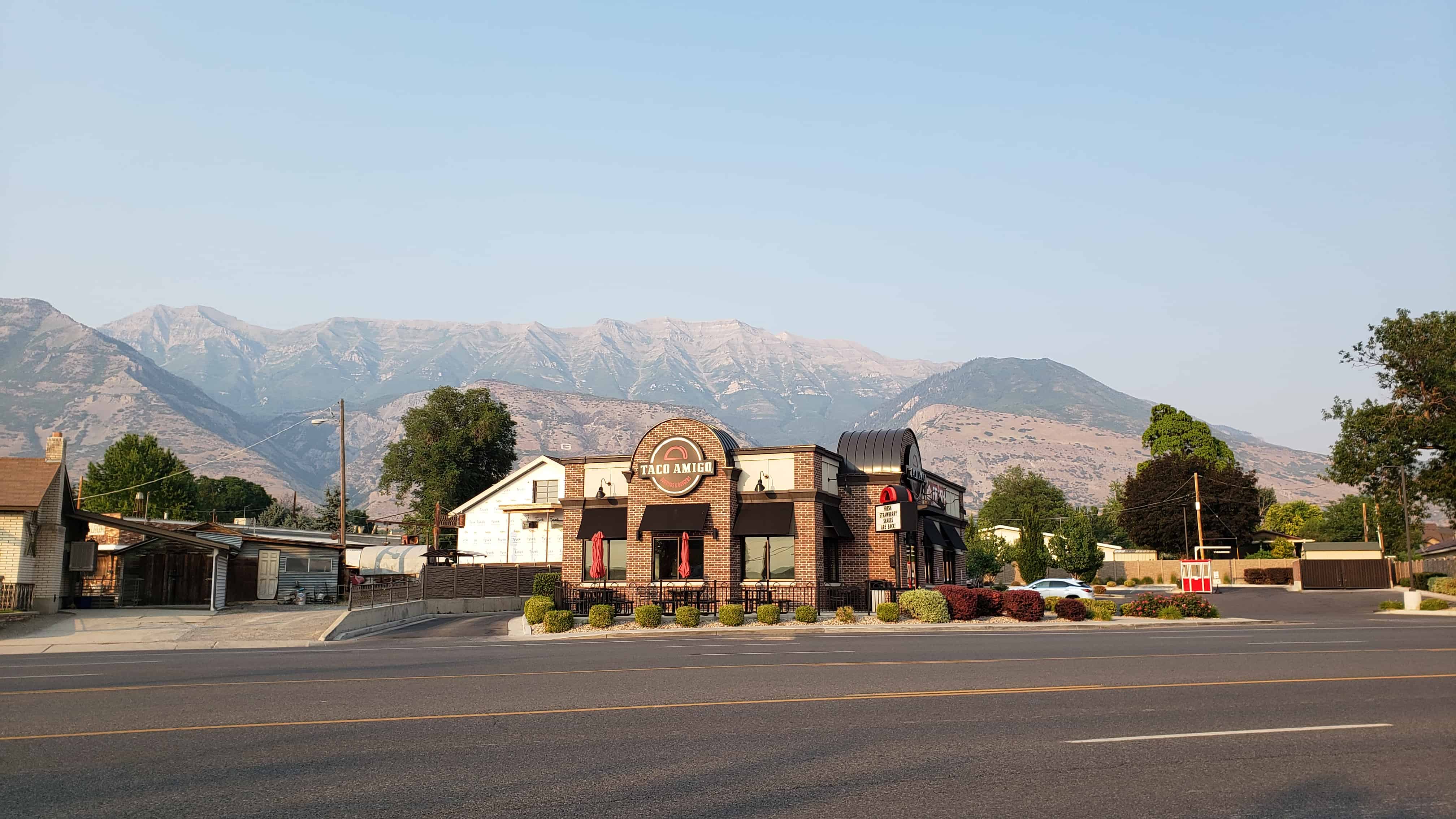
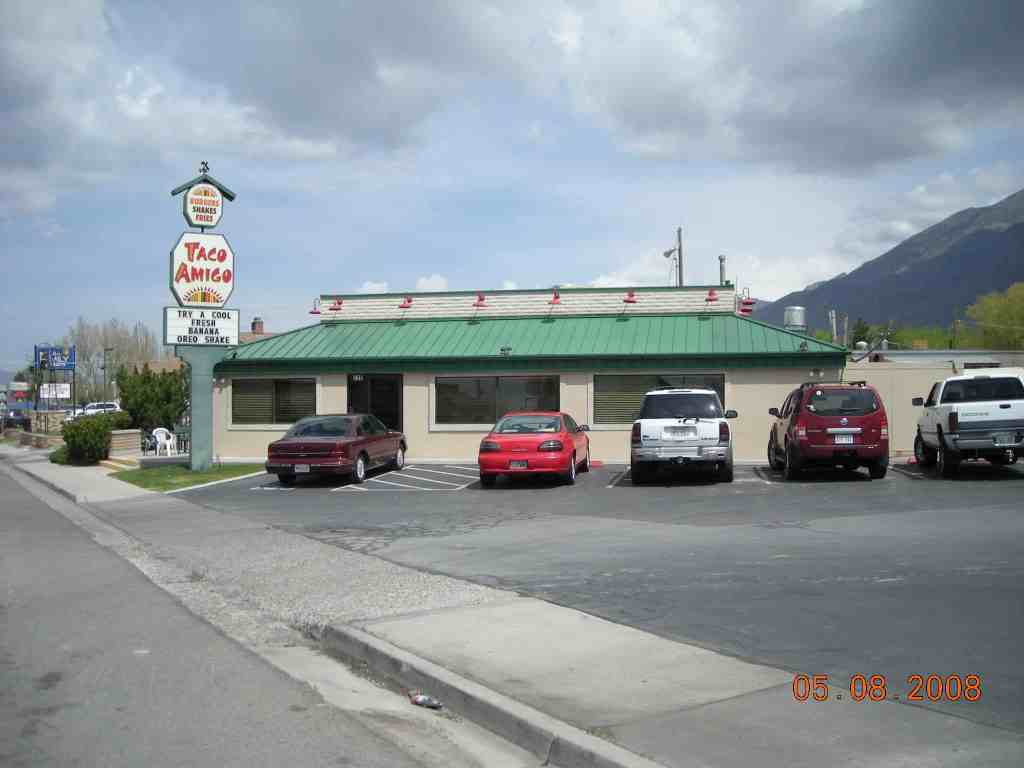
In 1980 Deanne Keetch became the owner of Taco Siesta and changed the name to Taco Amigo, there’s another location at 1395 North State Street in Orem, Utah.