
• About JacobBarlow.com
  • Cemeteries in Utah
  • D.U.P. Markers
  • Doors
  • Exploring Utah Email List
  • Geocaching
  • Historic Marker Map
  • Links
  • Movie/TV Show Filming Locations
  • Oldest in Utah
  • Other Travels
  • Photos Then and Now
  • S.U.P. Markers
  • U.P.T.L.A. Markers
  • Utah Cities and Places.
  • Utah Homes for Sale
  • Utah Treasure Hunt

JacobBarlow.com

~ Exploring with Jacob Barlow

JacobBarlow.com

Tag Archives: Historic Districts

Yalecrest Historic District

31 Saturday Jan 2026

Posted by Jacob Barlow in Uncategorized

≈ Leave a comment

Tags

Historic Districts, NRHP, Salt Lake City, Salt Lake County, utah, Yalecrest, Yalecrest Historic District
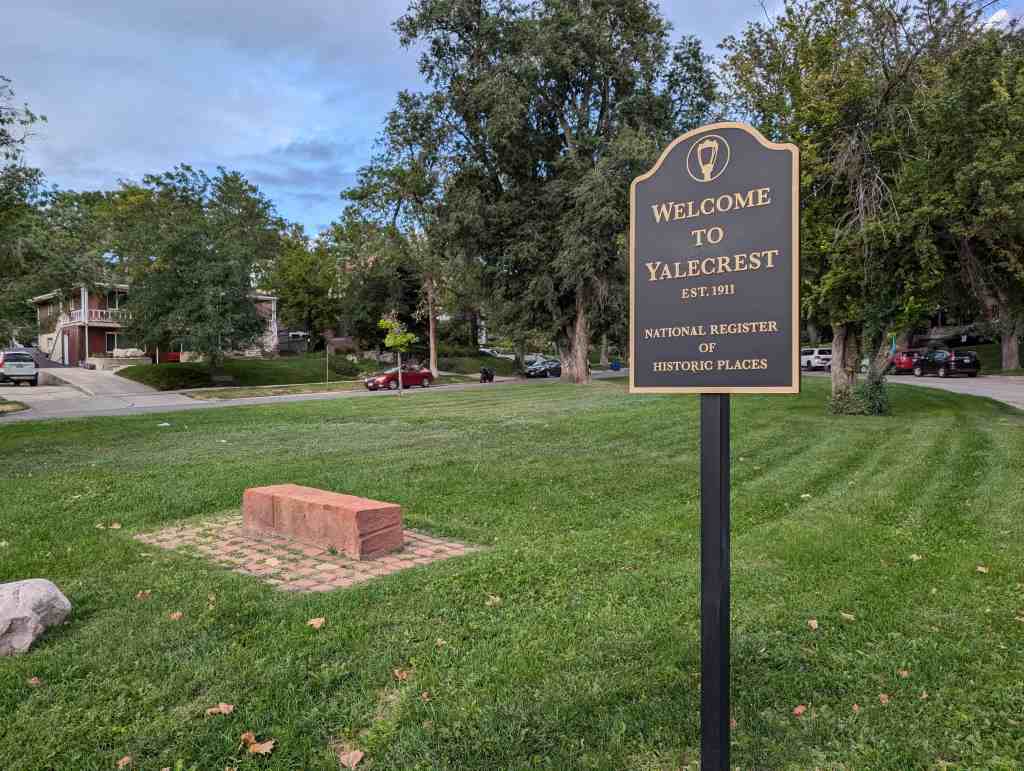
Yalecrest Historic District

The Yalecrest Historic District is located on the east bench of Salt Lake City, southeast of the business and downtown section. It is locally significant both architecturally and historically, under Criterion A for its association with the residential development of the east bench of Salt Lake City by real estate developers and builders in the first half of the twentieth century. Its tract period revival cottages and subdivisions of larger houses for the more well-to-do represent the boom and optimism of the 1920s and 1930s in Salt Lake City. The district is also significant under Criterion C for its intact architectural homogeneity. It was built out quickly with 22 subdivisions platted from 1910 to 1938 containing houses that reflect the popular styles of the era, largely period revival cottages in English Tudor and English Cottage styles. The architectural variety and concentration of period cottages found is unrivalled in the state. Examples from Yalecrest are used to illustrate period revival styles in the only statewide architectural style manual. The subdivisions were platted and built by the prominent architects and developers responsible for early twentieth century east side Salt Lake City development. It is associated with local real estate developers who shaped the patterns of growth of the east bench of Salt Lake City in the twentieth century. Yalecrest was initially and continues to be the residential area of choice for prominent men and women of the city. The district is locally renowned as the “Harvard-Yale area” and its streets lined with mature trees and historic houses are referenced in advertising for twenty-first century subdivisions elsewhere in the Salt Lake Valley. It is a remarkably visually cohesive area with uniform setbacks, historic houses of the same era with comparable massing and landscaping, streets lined with mature shade trees, and a surprising level of contributing buildings that retain their historic integrity. It contains a concentration of architecturally significant period revival cottages and bungalows designed by renowned architects and builders of Utah. The historic resources of the Yalecrest Historic District contribute to the history of the residential east bench development of Salt Lake City.

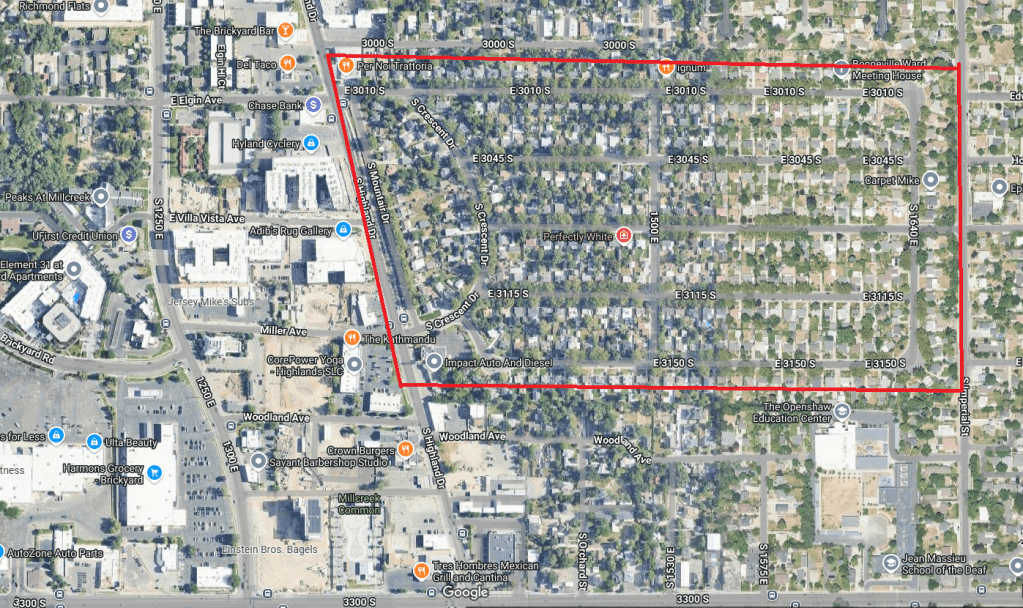
The Yalecrest Historic District has a boundary of Sunnyside Avenue (840 South) to 1300 South and 1300 East to 1800 East in Salt Lake City, Utah and was added to the National Register of Historic Places (#07001168) on November 8, 2007.

Related:

  • Salt Lake City’s Historic Districts
  • Utah’s Historic Districts
  • Yalecrest Neighborhood

Historical Development of the Area (1849-1909)

Salt Lake City was a planned city, laid out in a grid according to the “Plat of the City of Zion,” a town plan proposed by Joseph Smith, founder of the Church of Jesus Christ of the Latter-day Saints (Mormon or LDS), and later used for many Mormon settlements throughout the Utah territory. Within a year of the arrival of the first group of settlers in 1847, Salt Lake City had grown to 5,000 inhabitants. Public buildings were in the center of the city, surrounded by residential lots and farmland to the south and west. The Big Field Survey in 1848 divided the land to the south of the Salt Lake City settlement (900 South today) into five and ten-acre plots to be used for farming for the “mechanics and artisans” of the city. The Yalecrest Historic District is located on the northeastern section of land that was initially set apart as Five-Acre Plat “C” of the Big Field Survey. The land was divided into 100-acre blocks, each of which was again divided into 20 lots of 5 acres each. The Yalecrest Historic District occupies Blocks 28, 29, and 30 which are bordered by the major northsouth streets of the survey area: 1300, 1500, 1700 and 1900 East and the east-west streets of 900 and 1300 South. The property was intended for agricultural use and was distributed by the LDS church authorities to the faithful by lot for use in raising crops and farming.

The earliest identified residents in the Yalecrest area begin to appear in the 1870s. Gutliffe Beck had a ten-acre plot and his early 1870s adobe farmstead was located near the intersection of Yalecrest Avenue and 1700 East. The property was later used as a dairy farm. Paul Schettler’s farm, situated near the intersection 1900 East and Herbert Avenue, had crops that included silk worms and mulberry orchards. David Lawrence had twenty acres of alfalfa located to the south of the Schettlers. On Sunnyside between 1800 and 1900 East Jim Carrigan built a house c. 1876 and farmed forty-five acres. A one-legged man named Wheeler lived at what is now 1372 Harvard and got his culinary water from Red Butte Creek. No remnants of the earlier settlement homes are known to remain.

Streetcars, Subdivision Development and Automobiles (1910-1939)

Rapid population growth of Salt Lake City and streetcar access to the downtown area made the Yalecrest area attractive to subdivision developers in the early years of the twentieth century. The population of Salt Lake City increased at the turn of the century, almost doubling from 1900 to 1910, bringing about a need for more 13 housing for the new inhabitants.19 Air pollution from coal-burning furnaces as well as growing industry in the valley created smoke-filled air in Salt Lake City. Properties on the east bench beyond the steep grade that flattens at 1300 East above the smoky air of the city became attractive for residential development. Land developers from Utah and out-of-state purchased land on the east bench and filed subdivision plats. Early subdivision advertising touted the clean air of the bench, above the smoke of the valley.

Pavement of some of the streets in Yalecrest occurred soon after construction of the first houses. The earliest street pavement project began with Yale Avenue from 1300 to 1500 East in 1913-1914. Developers usually provided the sidewalks, curbs and gutters as they began to lay out the subdivisions. The streets were paved by the city and funded through assessments of the adjacent properties. Most Yalecrest streets were paved in the 1920s with only a few following in the 1930s.

Streetcars made the Yalecrest area easily accessible to downtown Salt Lake City. The lines serving the Yalecrest area traveled from downtown to 1300 East in front of East High, south along 900 South to 1500 East, then south to Sugar House and the prison. By 1923 there were 217 streetcars and over 100,000 passengers a day in Salt Lake City. By that same time, Salt Lake County had 21,000 private cars registered and garages became a popular addition to urban house lots. Ridership on the streetcars began to decline in the later 1920s in spite of a total of 152 miles of streetcar tracks in 1926. A trial gasoline powered bus15 began a route along 1300 East in 1933. Buses soon predominated in public transportation in the latter part of this era.

Subdivisions

The majority of the Yalecrest area was platted in subdivisions; 22 were recorded from 1911 to 1938. The first was Colonial Heights in the southeast corner of Yalecrest in January of 1911, but little was built there until the 1930s. The largest was Douglas Park, laid out across the northern section of Yalecrest later in 1911 by the W.E. Hubbard Investment Company. Hubbard was a medical doctor from Chicago who came to Utah via Los Angeles and became involved in real estate sales, investments and mining. He was active in real estate and by 1919 had platted, developed, and sold 41 subdivisions.

Douglas Park Amended and Douglas Park 2nd Addition comprise a total of 1,158 building lots in an area that includes the ravine surrounding Red Butte Creek and another gully that runs between Michigan and 900 South between 1300 and 1500 East. Initial development consisted of rather large, geographically dispersed bungalows on the western section, overlooking the city. Some of the earliest houses in the area are these scattered bungalows on 900 South, 1400 East and 1500 East. Construction of houses in the Douglas Parks took place over a forty year period from the teens through the early 1950s.

The Leo and Hallie Brandenburger House is an Arts and Crafts bungalow built in 1913 on the north side of 900 South with its lot steeply sloping at the rear into a wooded ravine. It was one of the first houses in the Douglas Park subdivision to be completed and the Brandenburgers had a view of the city to the west from their front porch. Leo Brandenburger arrived in Utah in 1904, the same year that he received his electrical engineering degree at the University of Missouri. He worked at the Telluride Power Company and Utah Power and Light Company before opening his own engineering office in the Louis Sullivan-designed Dooley Building (demolished) in downtown Salt Lake City in 1914.

Don Carlos Kimball and Claude Richards formed Kimball & Richards Land Merchants in 1908 to develop and sell land. They were responsible for over 30 subdivisions between 1900 and 1925. They served as developers as well as builders in Yalecrest. Gilmer Park was a creation of Kimball and Richards in 1919, and consists of 295 building lots, most of which lie outside of Yalecrest in the Gilmer Park National Register Historic District to the west. Thornton Avenue and Gilmer Drive between 1300 and 1400 South constitute the Yalecrest section of Gilmer Park.

The 1920s were a period of tremendous growth in Yalecrest with eleven subdivisions platted by a variety of developers. Upper Yale Park has curvilinear streets with large irregularly-shaped lots, many extending back to the wooded area of the Red Butte ravine and Miller Park. Houses built on the curving streets in Yalecrest have larger lots and tend to be larger scale than those set in the rectilinear grid streets. It was platted by Ashton and Jenkins in 1924.

The Bowers Investment Company, a branch of the Bowers Building Company, filed the subdivision papers for Normandie Heights in 1926. Normandie Heights was the last large (140 lots) subdivision to be platted in Yalecrest and its houses were built primarily from 1926-35. It is distinctive like Upper Yale Park because of its picturesque rolling topography with landscaped serpentine streets, regular newspaper promotions, prominent homeowners, deep setbacks, and large irregularly shaped lots. Much of the sales of its lots and houses were done by the firms of Kimball & Richards, Ashton-Jenkins, Gaddis Investment Company, and Le Grande Richards Realty Company.

Uintah Heights Addition consists of Laird Circle, Uintah Circle and Laird between 1400 and 1500 East and was registered in 1928. Houses were constructed there primarily in the late 1920s and early 1930s, many by Herrick and the Gaddis Investment Company.

The other subdivisions from the 1920s: Yalecrest Park, Upper Yale Addition, Upper Harvard, Upper Yale 2nd Addition, Upper Princeton, Harvard Park, and Upper Yale 3d Addition have streets in a grid pattern. Four subdivisions were platted in the 1930s; Mayfair Park (1930) consists of two culs-de-sac and Hillside Park (1937) has the semi-circular Cornell Street. Upper Laird Park (1931) is both sides of one block of Laird Avenue. The last subdivision to be platted was Yalecrest Heights by Willard and Gwendolyn Ashton in 1938. After its plat was registered no significant vacant space was left in the Yalecrest area.

Architects

A number of prominent Utah architects designed houses and some also made their homes in the Yalecrest area: J.C. Craig designed the two-story Prairie house at 1327 S. Michigan c. 1915. Lorenzo S. Young who later designed the Bonneville LDS Ward Chapel and Stake Center in 1950 most likely designed his own house at 1608 E. Michigan c. 1935. Glen A. Finlayson built his unusual Art Deco house at 973 Diestal Road in 1936. He was a Utah native who worked as an architectural engineer for American Oil and Utah Oil for 33 years and lived in the house with his wife, Mina, until his death in 1969.

Slack Winburn designed the house at 979 South 1300 East in c. 1922. Winburn studied architecture at the Ecole des Beaux Arts et des Sciences Industrielles at Toulouse, France, following his service there in World War I. He moved to Salt Lake City in 1920 and was active designing many buildings in Utah and the Intermountain West including the Sigma Nu fraternity house and Bailif Hall at the University of Utah and a number of apartment buildings in Salt Lake City.

Fred J. Swaner drew the plans for and supervised the building of a fashionable clinker brick bungalow at 871 South 1400 East in 1915 for William R. Hainey who emigrated to Salt Lake City from Grafton, Nebraska, to work for the Hubbard Investment Company, owners of Douglas Park. Dan Weggeland was an architect employed by the Bowers Building Company and responsible for designing many of the houses and apartment buildings constructed by them, including those in Normandie Heights.

Raymond Ashton designed his own house at 1441 East Yale Avenue in addition to a number of other Yale Park houses as well as commercial and institutional buildings. The Jacobethan Irving School and Sprague Library in the Sugar House section of Salt Lake City show his facility with period revival styles. He also designed the Prairie Style bungalow at 1302 East Yale Avenue that was home to George Albert Smith, a President of the LDS Church. He was allied with the Ashton family businesses as well as the Ashton-Parry Company and Ashton and Evans, Architects.

The noted Utah architect, Walter Ware, designed a Tudor Revival house for Lee Charles and Minnie Viele Miller in 1929 at 1607 East Yalecrest Avenue. Walter Ware designed the First Presbyterian and the First Christian Science Churches among many other buildings in Salt Lake City during his long career from the 1890s to 1949.

The Frank Lloyd Wright-trained Utah architect, Taylor A. Woolley, most likely designed the Prairie style house at 1408 East Yale Avenue for William W. and Leda Rawlins Ray, the U.S. District Attorney for Utah as well as another Prairie School Style house at 1330 East Yale Avenue for his uncle, Albaroni H. Woolley, a manager for Zions Cooperative Mercantile Institution (ZCMI). Taylor Woolley was involved with both residential construction and one religious building in Yalecrest. The 1925 red brick Colonial Revival Yale LDS Ward Chapel at 1431 Gilmer Drive was designed by Taylor Woolley at Evans and Woolley and built by Gaskell Romney. Both Woolley and Romney were also residents of Yalecrest. Woolley was a major proponent of the Prairie School style of architecture in Utah.

Builders and Developers

Developers and builders played the primary role in the growth of Yalecrest. They laid out the potential lots, registered subdivisions with the county, arranged for sidewalks, curbs and gutters, arranged financing, involved real estate people, publicized the opening of the subdivisions in the newspapers, built speculative houses, frequently serving as contractors or builders for custom houses, and in many cases, lived in the subdivisions themselves. Most of the builders were active on numerous streets in the area.

There are seventy-three developers and builders associated with the Yalecrest Historic District. The AshtonJenkins Company, one of the largest real estate and mortgage banking companies in Utah, recorded three subdivisions in the survey area: Yale Park in 1913, Yale Park Plat A in 1915 and Upper Yale Park in 1924. The Yale Parks were heavily promoted in the newspapers and attracted prominent homeowners. Several generations of the Ashton family were major developers in Salt Lake City and involved in real estate, development, construction, architecture and allied occupations. Edward T. Ashton and his brother George S. were sons of Edward Ashton, a cut stone contractor who supplied stone for many church and public buildings in Utah, and were partners in the firm of Ashton Brothers, contractors and builders, and later the Ashton Improvement Company. They were responsible for the construction of thousands of houses in Salt Lake City. Edward T.’s sons continued the family involvement with construction: Raymond J. was an architect, Marvin O. was manager of the Rio Grande Lumber Company, and Edward M. was a contractor.

Edward M. Ashton went into real estate by himself in 1900 but soon founded the realty firm of Ashton & Jenkins in 1905 with Edward Elmer Jenkins, a businessman involved in real estate and banking. The Ashton-Jenkins Company was also involved in real estate sales for the Normandie Heights subdivision. Edward M. Ashton lived in one of the earliest houses in Yalecrest, designed by his brother the architect, Raymond Ashton, and built by the Ashton Improvement Company, at 1352 East Yale Avenue in 1913.

Several families of builders and real estate people, like the Ashtons, were involved in Yalecrest. George C., Louis J. and Frank B. Bowers were brothers. The Bowers Brothers constructed over 3,000 buildings in Utah, Wyoming and Nevada by 1946. The builder Gaskell Romney was involved in developing Normandie Heights as well as building houses on speculation. He was active in Utah, Idaho and California and worked in Mexico before coming to Utah in 1921. G. Maurice Romney, his son, also did speculative building in the area. Gaskell Romney and his wife, Amy, lived in Yalecrest at 1442 and later at 1469 East Princeton Avenue.

Fred A. Sorenson, most likely of the Sorenson Building Company, built his own house c. 1927 at 1049 Military Drive. He worked as a builder from 1908 to only a few years before his death in 1988. J.A. Shaffer built several houses on speculation on Laird in 1927. He was briefly involved in Salt Lake real estate before moving to Indiana. H. (Henning) Henderson was born in Denmark in 1887 and worked as a building contractor in Salt Lake City from 1913 until his retirement in 1950. Albert Toronto was the owner and operator of Toronto & Company, a Salt Lake real estate, insurance, and home building firm. He was a Salt Lake native, educated in the local schools and active in building in the 1920s and 1930s. He built speculative houses in the Colonial Heights subdivision.

N.L. Herrick was a partner in the Gaddis Investment Company as well as an individual builder, active in the Upper Harvard and Uintah Heights Addition. Herrick and Company provided design as well as construction services. The Gaddis Investment Company was founded in 1922 to deal in real estate, investments and insurance. Both of its partners lived in Yalecrest; N.L. Herrick at 1603 East Harvard Avenue and Thomas E. Gaddis at 1465 East Laird Avenue in a French Norman house built in 1929. Thomas Gaddis was involved in real estate and investments in Salt Lake City from 1909 to his death in 1967.

Individual developers occasionally built the entire street of speculative houses. The district of small cottages, from 1500 to 1600 East on Princeton and Laird Avenues, was for the most part constructed by Samuel Campbell; Princeton in 1924 and Laird in 1925. Samuel Campbell worked as a contractor/builder in Salt Lake City from 1913 to 1930 and built more than sixty houses in Yalecrest. He built primarily on speculation frequently with financing from the Ashton-Jenkins Company. Many of the houses served as rentals to middle class tenants before being sold. The cottage district was not platted as part of a subdivision. Louis J. Bowers is another example of a single builder constructing buildings along an entire street. He built all of the houses on Uintah Circle in the Mayfair Park subdivision (platted in 1930) on speculation in 1937 and 1938.

Sidney E. Mulcock both owned the property and built speculative houses in Upper Princeton. Mulcock built Duffin’s Grocery Store in 1925 at 1604 East Princeton Avenue, run by Clarence Duffin in conjunction with the William Wood & Sons meat market. Duffin’s was the only market within Yalecrest and was designed to have the same setback and blend in with the surrounding houses. It has since been modified for residential use and is now a noncontributing building.

Alice Felkner was one of the few women involved in real estate in Yalecrest. She was prominent in Utah mining and industrial pursuits as well as owning the land that was platted as Upper Yale Addition and Upper Yale 2nd Addition in 1926 & 1927. She was born in 1854 in Indiana and moved to Idaho with her brother, William H. Felkner, in 1886 to engage in stock, mercantile and mining businesses. The siblings moved to Salt Lake City in 1909. At the time of her death in 1937 she was a director of the Consolidated Music Company, a large stockholder of the Silver King Coalition Mines Company, and director of several large mining companies. The Upper Yale Additions extend along the north and south sides of Yale and Herbert Avenues from 1700 East to 1800 East. Houses were constructed in the late 1920s and 1930s, primarily by Philip Biesinger, another Yalecrest builder and developer.

With the help of mortgages from Ashton-Jenkins and the Romney Lumber Company Philip Biesinger built a model house at 1757 East Herbert Avenue in 1927-8. The Salt Lake Tribune advertisement noted that it is located in “the best residential section this city affords” and is built of “the finest of materials” and “presents a most imposing appearance.” The names of the workmen and suppliers are proudly listed in the model home announcement as are the “electric sink” and “automatic refrigeration.” The property did not immediately sell so Biesinger sold this property to the Romney Lumber Company who used it as a rental property until 1940. The Romney Lumber Company was involved in the construction and financing of a number of houses in the surrounding subdivision as well as a retail operation where they provided “roofing, cement, plaster, (and) wall board.” Philip Biesinger was building on the surrounding lots on Herbert as well as Harvard, Yale and Yalecrest Avenues.

Residents

The subdivisions of Yalecrest were actively marketed by the real estate firms through the newspapers to prominent people. Early inhabitants of the Yalecrest area range from leading citizens active in politics, business, sports and religion to well-to-do professionals, particularly law and medicine, as well as those in middle class occupations.

The Utah Governor Charles R. Mabey lived in an Ashton and Evans English Cottage-style house at 1390 East Yale. He also served on the Bountiful City Council, as Mayor of Bountiful, and as a state legislator. William C. Ray was a Democratic candidate for the U. S. House of Representatives in 1912 and later was the U.S. District Attorney. He lived in a Prairie School-style house at 1408 East Yale with his wife, Leda Rawlins Ray. Wallace F. Bennett owned a 1923 Prairie School-style house at 1412 East Yale Avenue that had been previously owned by David D. Crawford of the Crawford Furniture Company. Bennett served in the U. S. Senate from 1950 to 1974.

Two presidents of the Mormon Church lived in Yalecrest. All of the individual governors of the United States in 1947 visited the home of the then President of the Mormon Church, George Albert Smith, at 1302 East Yale Avenue. The Prairie School style bungalow was built for Isaac A. Hancock who was vice-president of a Utah fruit and vegetable company by Raymond Ashton in 1919. Ezra Taft Benson served under President Eisenhower as the Secretary of Agriculture before becoming the president of the LDS Church. He lived in the French Norman style house at 1389 East Harvard Avenue that was built for Richard Leo Bird, the founder of an outdoor advertising agency.

Many business owners were residents of Yalecrest. John and Bertha Barnes bought the Tudor style cottage at 1785 East Yalecrest Avenue in 1929 and lived there until 1940. John Barnes was the owner and operator of Crown Cleaning and Dyeing Company (NR listed 7/2003) from 1922 to 1962. He was also president of the National Association of Dry Cleaners and the Sugar House Chamber of Commerce. Bryant Crawford and his wife, Carrie Day, purchased 1757 East Herbert Avenue in 1940. He was the president of Crawford and Day Home Furnishings. Lee Charles Miller ran the Miller and Viele Loan Company, first with his father-in-law, then by himself. The firm was the largest farm mortgage company in the intermountain west. He specialized in farm loans and financed a number of irrigation systems and reservoirs in southern Utah. After his death in 1930 Mrs. Miller donated property in his memory along both sides of Red Butte Creek to the city where it became known as Miller Park. Mrs. Miller raised and bred prize-winning Hampshire sheep and Guernsey cattle on her ranch on the Snake River in Idaho. The Millers lived at 1607 East Yalecrest Avenue in a Tudor Revival style house.

The 1930 U.S. Census of Population provides a snapshot of other occupants of the Yalecrest Historic District. The typical residents were often business proprietors or with managerial or professional careers, native born, and owned their own homes. Marie Morrison was a grocery store owner and a widow raising two children by herself at 1437 East 1300 South. Her neighbors on the street were also home owners. Roland Standish owned an advertising agency and lived at 1457 East 1300 South with his wife, Bertha, and their four daughters. Jacob Madsen and his wife, Mary, were immigrants from Denmark and lived with their two grown children at 1463 East 1300 South. Jacob and Mary owned a farm out of state and Sarah and Ilta were a stenographer and grade school teacher, respectively. Other occupations on the street were safety engineer, pharmacist, musician, and newspaper compositor.

Several generations shared the Willey house at 1455 East Gilmer. David was an attorney, his son, David Jr. was a salesman for a paint company, and two daughters, Dorothy and Katherine, were a stenographer and a clerk. Three grandchildren, a daughter-in-law and mother complete the family resident in the house. Several neighbors had servants, not uncommon in the area. Occupations of residents on the street ranged from coal mine operator, food and drug inspector, automobile salesman, mining and electrical engineers, sales manager for a furniture company, hotel proprietor and a son who worked as a gas station attendant.

Two brothers lived next door to each other at 1403 and 1411 East Michigan Avenue. Joshua Summerhays was a hide and wool merchant who had four children with his wife, Mary. Their eldest daughter, Virginia, was a public school teacher as was her uncle, John, next door at 1411. John and LaPrella had four children ranging in age from 1 to 8 years old. The Summerhays’ neighbors had a variety of occupations which included two engineers, electrical and mining, two stock & bond salesmen, a coal mine inspector, a linotype operator, a manager of a storage company and a sales engineer of steel structures.

An optometrist, a medical doctor, a dentist and an apiarist (beekeeper) lived as neighbors on 900 South. Dr. Byron and Mabel Rees lived at 1382 East 900 South with their three children, Ralph, lone and Afton, and Ellen Bybrosky, their Danish servant. Hubert Shaw installed mining equipment for a living and lived with his wife, Edith, at their house at 1434 East 900 South. J.C. Wilson worked in religious education and lived with his wife, Melina, and their four children at 1466 East 900 South.

Leslie Pickering was a general building contractor and lived with his wife, Mina, and daughter, Beverly, at 1464 East Michigan Avenue. He is not known to have constructed any buildings in the Yalecrest area. Pinsk, Russia, was the birthplace of Simon Weiss who worked as a clothing salesman after coming to this country as a child in 1903. His wife, Claire, and daughter, Betty, were both born in Utah. The Weiss family owned their home at 1363 Thornton Avenue. Fred B. and Hazel Provol were early tenants at the model house on 1757 East Herbert Avenue. Fred Provol was secretary-treasurer of the Hudson Bay Fur Company (“furs, coats, dresses, lingerie and costume jewelry”) in the 1930s.

A school, two LDS churches, and a park were built to accommodate the population moving into the area. Uintah School was constructed in 1915 to support the growing elementary school age population of the East Bench. It was built encircled by vacant land but soon was filled to capacity with the rapid growth of the surrounding residential sections. The school was enlarged in 1927. Two LDS ward chapels were built in this era. Taylor Woolley’s firm designed the 1925 red brick Colonial Revival Yale LDS Ward Chapel at 1431 Gilmer Drive. The Art Deco Yalecrest Ward Chapel at 1035 South 1800 East was built in 1936 of exposed reinforced concrete. Miller Park (discussed above) follows the course of Red Butte Creek on both sides of its ravine and originally extended from 900 South to 1500 East.

World War Il and Postwar Growth (1940-1957)

The emergence of the defense industry in the Salt Lake valley in the early 1940s and the return of the Gs after the war caused a great need for housing. The population of Salt Lake City grew by 40,000. The FHA (Federal Housing Administration) estimated at the time that Salt Lake City needed 6,000 more housing units to meet the postwar demand. The district most likely reflects the building trends in Salt Lake in this era. New houses were built on the few vacant lots at Yalecrest and many homeowners took out building permits to finish basement or attic space for more room or to rent out as apartments. Donald and Ruth Ellison purchased their modern house at 1804 East Harvard Avenue soon after it was constructed in 1952. The following year they were living in the house while Donald Ellison was the claims manager for the Intern Hospital Service.

Mass-transit vehicles transitioned from streetcars to buses, but in general began to be supplanted by the widespread use of private cars. By 1940 the 1500 East streetcar was gone and city buses served Yalecrest traveling along 1300, 1500 and 1700 East as well as 900 and 1300 South. Houses began to be designed with attached garages, rather than a separate garage at the rear of the lot.

The growth of the LDS population after the war required the construction of a third facility. A land swap gave the southern section of what was Miller Park to the LDS Church in 1945 in exchange for property that became Laird Park, located on 1800 East between Laird and Princeton. Land that was previously the southern section of Miller Park was used for construction of the Bonneville LDS Ward Chapel and Stake Center. Its red brick Postwar Colonial Revival style building was designed by Lorenzo S. Young and constructed by the Jacobsen Construction Company in 1949. Bonneview Drive was constructed by the church a private road to provide access to the building but was later made a public street.

The few remaining vacant lots and streets on existing subdivisions were filled in during this era. For example, although the Hillside Park subdivision was registered in 1937 by the Anderson Lumber Company, an active builder in Yalecrest, initial construction didn’t begin until 1939 and continued into the 1940s.

1960s and Beyond (1958-2007)

This era was a time of stability for the neighborhood. The Yalecrest area avoided the blight common in many urban neighborhoods during this era and remained a desirable residential area. There was no population pressure in the early part of the period as the population of Salt Lake City actually decreased fourteen percent 22 between 1960 and 1980. No major roads were built through the neighborhood although traffic increased on the border streets of 1300 South, 1300 East and Sunnyside Avenue. A service station was built at 877 South 1300 East c. 1970 to aid the automobile traffic. The original 1915 Uintah Elementary School was demolished and replaced by a new structure in 1993.

The Monster House phenomena surfaced in the Yalecrest neighborhood and mobilized the inhabitants. They worked through their community council to create the Yalecrest Compatible Residential Infill Overlay Zoning Ordinance which was adopted by the City Council on July 12, 2005. Their residents took a leading role in presenting the concepts to the Salt Lake City Council and a city-wide ordinance followed in December of 2005, based on the efforts of the Yalecrest group.

Rising gasoline prices have made living near jobs in the city more attractive, reducing commuting time. As people desire to move from the suburbs back into the city, many want large suburban houses on small city lots. Even with the restrictions of the recent zoning ordinances, the district remains threatened by the trend to larger and larger residences, through demolition of the historic house and out-of-scale replacements or obtrusive additions to existing buildings.

Summary

The Yalecrest neighborhood has mature street trees, well-maintained historic houses with landscaped yards and continues to be a desirable residential area, known throughout the valley as the Harvard-Yale area, and serves as an aspirational model for new subdivisions. The residential buildings within the Yalecrest Historic District represent the styles and types of housing popular in Utah between 1910 and 1957, with the majority built in the 1920s. Because it was developed within a short period of time by prominent developers and architects, the area has a remarkably high degree of architectural consistency and is highly cohesive visually. The collection of period revival styles both of the smaller period revival cottages in the gridiron streets as well as the larger houses on the more serpentine streets is a significant historic resource for Salt Lake City. The variety of period revival and bungalow styles found are literally textbook examples and, in fact, illustrate Spanish Colonial Revival, French Norman, and Prairie School styles in the state architectural history guide. The few noncontributing properties are scattered throughout the district and do not affect the ability of the district to convey a sense of significance. The area retains a remarkable degree of historic integrity.

Narrative Description

The Yalecrest Historic District is a residential neighborhood located on the East Bench of Salt Lake City, eight blocks to the south and thirteen blocks to the east of the downtown business area of the city. It is remarkably visually cohesive with the majority of the houses built in subdivisions of period revival-style cottages in the 1920s and 1930s. The Yalecrest Historic District consists primarily of residential buildings but also contains three contributing churches, three commercial buildings (two noncontributing, one contributing) and two contributing parks. Single family houses predominate but there are also fifty-one multiple dwellings, most of which are duplexes.

There are one thousand four hundred eighty seven (1,487) primary resources within the historic district. The district retains a high degree of historic integrity as the overwhelming majority (91%) of the resources, one thousand three hundred forty nine (1,349), contributes to the historic character of the district. There are nine hundred eighty nine (989) outbuildings which are primarily detached garages set to the rear of the lots, the majority from the historic period. All of the streets in the district are paved with curbs, gutters and sidewalks. Only one building, a Prairie School-style bungalow, the George Albert Smith House at 1302 Yale Avenue, has been listed on the National Register [listed 1993].

The historic district boundaries coincide with those of the Yalecrest Community Council district and are the surrounding major collector streets, Sunnyside Avenue, 1300 and 1900 East, and 1300 South. The district is visually distinctive from the neighboring areas by its cohesive historic-era architecture, unified tree plantings and landscape design that reacts with the natural topography of the creeks and gullies that cross the area. The architecture is remarkable for the concentration of fine period revival style houses; seventy four percent of the contributing resources (74%) were built from 1920-1939. These houses exhibit a variety of period revival styles with the largest portion being English Tudor (240 examples) and English Cottage (313 examples) styles.

Street patterns vary and represent several concepts of city planning: the rectilinear street grid of streetcar suburbs on the low relief sections, undulating patterns following the edges of streams and gullies, and the use of culs-de-sac and semi circles to limit traffic. There are a handful of alleys in the grid sections. Large uniform mature shade trees line the streets and the houses maintain similar setbacks and scale on the street faces. Street lighting is provided by two types of non-historic lamps; one with a cast concrete pole and a metal and glass top and the other, a metal pole on a concrete base. yards have established landscaping with lawns and gardens. Both buildings and yards are well-maintained. Because of its historic residences and the tree-lined streets, the neighborhood was initially and continues to be one of the most desirable residential areas of the east bench of Salt Lake City.

Architectural Styles, Types and Materials by Period

Streetcars, Subdivision Development and Automobiles (1910-1939)

The greatest number of resources (one thousand eighty-six or 81 percent) were constructed during this period, primarily via subdivision development. The principal building types found are bungalows (19 percent) and period cottages (53 percent), both immensely popular in Utah during this era. The bungalow was a ubiquitous housing type and style in the first quarter of the twentieth century in Utah and bungalows were the first houses to appear in Yalecrest. Bungalows have rectangular plans and are low to the ground with lowpitched roofs, either gabled or pitched. Stylistic elements of the Prairie School (110 examples) and the Arts and Crafts movement (26 examples) appear in bungalows and two story houses ranging from high-style architect-designed examples to simplified examples in the early subdivision and developer tracts. The Prairie School Style has a horizontal emphasis with broad overhanging eaves, low-pitched hip roofs, and casement windows. Many Yalecrest houses retain remarkable integrity, like the following Arts and Crafts bungalows: the stucco and cobblestone 1913 Brandenburger House at 1523 East 900 South and the W.R. Hainey House, a 1912 clinker brick example at 871 South 1400 East. The Prairie School vernacular style bungalow designed and built by Raymond Ashton, architect, as his own home was constructed of brick in 1913 at 1441 East Yale Avenue [Photograph 7]. The stucco and brick 1916 example at 1540 East Michigan Avenue is representative of a number of vernacular Prairie School bungalows in the area. It has the horizontal emphasis of the Prairie School as well as a more formal porte cochere. The Taylor A. Woolley-designed William and Leda Ray House at 1408 East Yale Avenue is a twostory brick Prairie School style box house with wide eaves built in 1915.

Two streets of small cottages between 1500 and 1600 East were constructed by a single developer, Samuel Campbell, in 1924 (between 1515 and 1589 Princeton Avenue) and 1925 (from 1515 to 1592 Laird Avenue). The clipped gable brick cottage on 1538 East Princeton Avenue was built in 1924 and is typical of the scale of the houses on the street. A small market at 1604 East Princeton Avenue was built by S. L. Newton in 1926 and later converted to single family use. The 1925 brick clipped-gable cottage at 1522 East Laird Avenue has columns and round-arched windows, characteristic of the distinguishing architectural detail Campbell and other builders supplied to the cottages. The sloping topography of the neighborhood makes garages underneath the house a practical solution to the space issues of a small lot. Samuel Campbell built the side-gabled brick clipped-gable cottage at 1207 South 1500 East with a garage underneath in 1925.

The period revival cottage is the largest category of building type in the neighborhood comprising 714 (53 percent) of the primary structures. Period revival styles were popular in Utah from 1890 to 1940. The most popular styles in Yalecrest are the English Cottage (310 or 19 percent) and the English Tudor styles (242 or 15 percent). Period revival styles are hypothesized to have been made popular in the United States by soldiers returning from World War I who had been exposed to the vernacular French and English historic architectural styles in Europe. The English cottage style refers to vernacular medieval English houses and differs from English Tudor in that the houses are of brick construction and do not typically feature false halftimbering. The English cottage period revival houses were frequently built between the world wars by speculative builders on small urban lots. They are mostly clad with brick and have irregular, picturesque massing, asymmetric facades, and steep front-facing cross gables. Both styles emphasize irregular massing, gabled roofs and the decorative use of various cladding materials. Single-story houses predominate although there are also a number of elegant two story examples.

Most of the prominent builders of the time constructed houses in Yalecrest in the English cottage and Tudor styles. The William Eldredge House at 1731 East Michigan Avenue is a brick and stucco English cottagestyle single-story period cottage built in 1927. A duplex period cottage-type house with rock façade on the twin steep front-facing gables was built in the English cottage style in 1932 at 940 South Fairview Avenue. A simpler English cottage style is a brick duplex at 1474 East Laird Avenue built in 1930. Half-timbering is the most easily recognizable style characteristic of the English Tudor. A number of larger one-and-a-half and two-story Tudors are found in the Military Way area. In 1929 Samuel Campbell built the two-story house at 972 East Military Drive with half-timbering and steep gables [Photograph 17]. A smaller single-story example with half-timbering in its gable ends was built by the Layton Construction Company in 1928 at 1780 East Michigan Avenue. D.A. Jenkins built a number of houses along 1500 East including the Tudor with a basket-weave brick pattern at 1035 South 1500 East in 1927 [Photograph 19]. The 1926 Lawrence Naylor House at 1510 East Yale Avenue has a halftimbered second story wing. Layton Construction Company also built a one-and-a-half story Tudor with an oriel window for John and Bertha Barnes in 1926 at 1785 East Yalecrest Avenue Doxey-Layton built the single-story multicolored brick English Cottage on the corner at 1783 East Harvard Avenue in 1930.

Other period revival style houses in the Yalecrest Historic District range from the chateau-like French Norman (30 examples), gambrel-roofed Dutch Colonial (12), Jacobethan Revival (15), and Spanish Colonial Revival (6) to the eclectic, combining several styles. A number of imposing French Norman style houses are found in the Normandie Heights subdivision area, developed between 1926 and 1935 with large irregularly-shaped lots on serpentine streets and substantial houses. The Leo Bird house was owned by former Mormon Church president Ezra Taft Benson and has a unique sculptured wooden roof. It was built in 1929 at 1389 East Harvard Avenue. An expansive neighboring house, built and owned by the contractor Eugene Christensen in 1933 at 1407 East Harvard Avenue, also has the characteristic French Norman conical tower. The John Lang House is a stucco-covered Spanish Colonial with a red tile roof built in 1924 at 1100 South 1500 East. The eclectic brick one-and-a-half story house at 1757 East Herbert Avenue was built as a model home in 1928 by the prolific builder Philip Biesinger. has the rolled edge roofing imitative of thatch, one of the characteristics of period revival houses.

There are 149 (9 percent) Colonial Revival examples in Yalecrest that vary from large brick two-story houses to smaller Cape Cod cottages. A classic one-and-a-half story frame Cape Cod cottage was built in 1936 at 939 South Diestel Road by G. Maurice Romney for Adrian and Camille Pembroke, owners of a business supplies store. The two-story brick hip-roofed Colonial Revival with shutters at 1547 East Yale Avenue was built in 1924 of striated brick.

A handful of Art Moderne, Art Deco and International style houses provide a contrast to the surrounding steeply gabled period cottages and give variety to the Yalecrest neighborhood. The flat-roofed smooth-walled Art Moderne/International style Kenneth Henderson House at 1865 East Herbert Avenue was built in 1938. The Dal Siegal House at 1308 East Laird Avenue was constructed of striated brick in 1939. Its lack of ornamental details, rounded corners and smooth wall surfaces show the influence of the Art Moderne style in the late 1930s in Salt Lake City.

Towards the end of this era period cottages began to be supplanted by World War II cottages. The house at 1571 East Michigan Avenue is a transition from the steep-gabled period cottages to the boxier minimal traditional styling of the World War II cottage. It was built of brick in 1938 with an attached garage. The Salomon house at 1789 East Hubbard Avenue is also transitional, built in 1939 with less steep gables and the characteristic nested entry gables of a period cottage.

Two of the three Yalecrest LDS churches were built in this era.4 The 1925 red brick Colonial Revival Yale LDS Ward Chapel at 1431 Gilmer Drive [Photograph 33] was designed by Taylor A. Woolley at Evans and Woolley and built by Gaskell Romney. Both Woolley and Romney were residents of Yalecrest. The Art Deco LDS Yalecrest Ward Chapel at 1035 South 1800 East was built in 1936 of exposed reinforced concrete.

Miller Park was given to the city in 1935 by Viele Miller in memory of her husband, Charles Lee Miller. The park follows the course of Red Butte Creek and its ravine, extending from 900 South southwesterly to 1500 East, is heavily wooded and has walking trails on either side of the creek, several foot bridges across the creek, and a small stone masonry bench at the northern end. Two of its sandstone ashlar benches and pillars are visible on the corner of 1500 East and Bonneview Drive. A stone fireplace with a small area of lawn in the southern section of the park is used by neighborhood residents. The southern part of Miller Park is now known as Bonneville Glen and is part of the neighboring Bonneville LDS Ward Chapel and Stake Center property (see below). Miller Park is a contributing resource in the Yalecrest Historic District.

World War II and Postwar Growth (1940-1957)

The World War II and post-war growth period provided twenty percent of the principal contributing structures in the survey area; fifteen percent from the 1940s and five percent from the 1950s. House types encountered range from late period revival cottages and World War II Era cottages to early ranch and ranch house types in a range of wall cladding. Colonial Revival styles still continue to appear as the two-story brick side-gabled house at 1340 East Harvard Avenue was built in 1940. The 1955 brick early ranch at 1762 East Sunnyside Avenue is a transition between earlier period cottages and later ranches. An unusual contemporary or “modern” example is the stylish “butterfly” roof of the Donald B. & Ruth Ellison House built in 1953 at 1804 East Harvard Avenue.

Postwar population growth of 40,000 in Salt Lake City spurred infill development in Yalecrest although there was no vacant land remaining for any additional subdivisions. The LDS Church acquired the southern half of Miller Park from the city and constructed the red brick postwar Colonial Revival style Bonneville Ward Chapel and Stake House in 1949. The building was designed by Lorenzo S. Young and built by the Jacobsen Construction Company. In exchange the LDS Church gave the land that became Laird Park to the city. Now Laird Park provides a small green open area of lawn and playground bounded by Laird and Princeton Avenues and 1800 East. Its open space serves as a soccer field as well as a practice ball field. It is a contributing resource to the area.

A small commercial area developed in the postwar period at the intersection of 1700 East and 1300 South. In an example of adaptive reuse, a service station built in 1951 now serves as a restaurant at 1675 East 1300 South. It is a contributing resource. Across the street is an out-of-period 1961 service station, still serving its original purpose at 1709 East 1300 South. The two other commercial structures across 1300 South to the south are outside of the historic district.

1960s and Beyond (1958-2007)

The late-twentieth century buildings in Yalecrest are infill or replacement structures and constitute only two percent of the total buildings of the district. The Uintah Elementary School at 1571 East 1300 South was designed by VCBO Architects of Salt Lake City and constructed by Layton ICS in 1993, replacing the previous 1915 structure. It is not out-of-scale with the nearby houses with its two floors and its brick masonry walls reflect the most common wall cladding from the surrounding neighborhood.

Modern housing styles predominated in the early part of the era. A ranch/rambler with a projecting double car garage was built of brick in 1976 at 1836 East Sunnyside Avenue. A later frame shed-roofed c. 1990 house is set back from the road at 1384 East Yale Avenue.

The construction of the house on 1788 East Hubbard Avenue in 2000 spurred neighborhood controversy by its out-of-scale massing and three car garage doors on the façade. It led to neighborhood activism through the community council and the eventual development of a new zoning ordinance to prevent the construction of more out-of-scale houses in the neighborhood. Another two-story twenty-first century replacement house can be seen in contrast to its single-story neighbors at 1174 East Laird Avenue.

More recent replacement houses reflect a modern reworking of the predominant styling of the area with NeoTudor styling details such as the asymmetry, brick and stone cladding and steeply gabled roofs but with significantly larger massing than the surrounding houses. Examples can be seen at 1774 East Michigan Avenue under construction in 2007 [Photograph 49] and the 2004 example at 904 South Diestel Road [Photograph 50]. A substantial addition to a 1927 Dutch Colonial style house is under construction in a style similar to that of the original house at 1009 Military Way.

Yalecrest remains a desirable residential area with mature street trees and well-maintained historic houses and yards. It has a significant concentration of historic houses, fifty-nine percent of which are period revival cottages, built by prominent architects and developers in subdivisions from the 1910s through the 1940s with some infill and development in the 1950s. Its historic houses retain their historic integrity to a remarkable degree, ninety-one percent (91%), and contribute to the historic association and feeling of the area.
Eccles Avenue Historic District

28 Sunday Dec 2025

Posted by Jacob Barlow in Uncategorized

≈ 6 Comments

Tags

Eccles Avenue Historic District, Historic Districts, NRHP, Ogden, utah, Weber County

Eccles Avenue Historic District

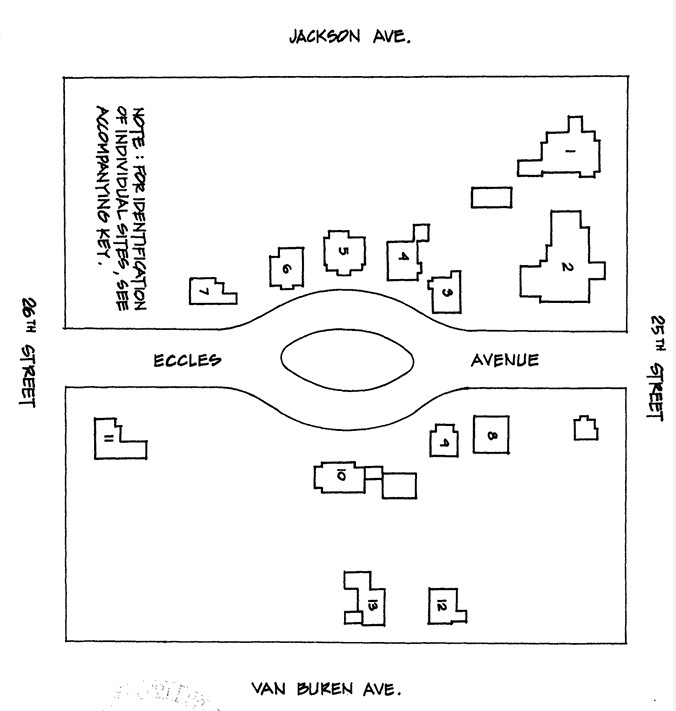
The Eccles Avenue Historic District is located in Ogden, Utah and is one of Utah’s Historic Districts, it was listed on the National Register of Historic Places (#76001840) on December 12, 1976. It is located between 25th Street and 26th Street and Van Buren Avenue and Jackson Avenue.

The below text is from the nomination form for the national register:

Historical Significance:
The historical significance of the Eccles Avenue Historic District is found in the prominence of the families who lived within the district’s boundaries. The Eccles, Browning, Wattis, Kiesel, Houtz and other families whose names are associated with the district’s homes were prominent in the business, civic and cultural affairs of Utah. There are few families who have made a greater contribution to the economic development of the Far West than the David Eccles family. Through the principles of hard work, thrift, and complete independency from outside capital, David Eccles, who came to the United States destitute, founded fifty-four separate businesses and earned the reputation of Utah’s “Wealthiest Citizen.” After the death of David Eccles in 1912, his son Marriner carried on in the same tradition as his father. Yet the depression of the early 1930’s brought a complete change in the economic philosophy of Marriner Eccles. Called to Washington and appointed Governor of the Federal Reserve System by Franklin D. Roosevelt, Marriner became perhaps the strongest leader of a revolution which produced an economic philosophy based on deficit spending during times of depression and government interference to manipulate the economy. This was obviously foreign to the individualistic laissez faire beliefs of his father’s generation. Perhaps the Victorian mansion of David Eccles west of the subdivision, constructed without the modernistic Wrightian characteristics of the Eccles Subdivision area, is symbolic of the difference in economic philosophies of the two Eccles.

Architectural Significance:
The Eccles Avenue District is architecturally significant due to its early development of a regional form of the Prairie Style in the western states. Frank Lloyd Wright, protege of Louis Sullivan, purported “Father of Modern Architecture,” was the originator and master of the Prairie Style. “We of the Middle West,” wrote Wright, “are living on the prairie. The prairie has a beauty of its own and we should recognize and accentuate this natural beauty, its quiet level. Hence, gently sloping roofs, low proportions, quiet sky lines, suppressed heavy-set chimneys and sheltering overhangs, low terraces and out-reaching walls sequestering private gardens.”

Wright’s works were influenced by extra-regional Japanese and pre-Columbian architecture, though Wright was reluctant to acknowledge these precursors. The first Prairie houses, the Bradley and Hickox houses at Kankakie, Illinois, were designed by Wright in 1900. His first masterpiece in the style was the Willits House, designed in 1901 at Highland Park, Illinois. The Robie House (Chicago, 1908), the Beachey House (Oak Park, 1906) and Alien House (Wichita, 1917) were other exceptional Wrightian Prairie houses.

Concurrent with Wright’s work were the designs of several other Prairie School architects, many of whom had worked with Wright, but one of whom rivaled Wright in the mode although several did build some fine houses. Architects who had direct links with Chicago as well as builders who were impressed by Wrightian illustrations in the “Inland Architect” and other magazines quickly spread the Prairie Style throughout the country. Utah seems to have been particularly impressed with the style and indeed led the Western U.S. in adopting the new progressive house form. Architects such as Taylor Wooley, Clifford Evans, Miles Miller, Pope and Burton, and Ware and Treganza introduced Prairie Style buildings to Utah as early as 1909. The LDS Church was the only American religious group to make major ecclesiastical utilization of the style. The Dooley Building (1894, by L. Sullivan) excepted, the first example of modern architecture in Utah was the LDS Park First Ward, recently nominated to the National Register.

While several Prairie buildings were erected in Salt Lake City, the major impact of the style was felt in Ogden where numerous LDS churches and the David Eccles Subdivision composed of homes designed by Eber Piers and Leslie Hodgson, employed Prairie School architecture in a strikingly inno- vative regional manner. Together, these buildings represent the initial inroad of this significant American architectural mode in the Intermountain West.

History:
The settlement of Ogden dates back to 1845 when Miles Goodyear built a log cabin on the Weber River, two miles above the Ogden River confluence to serve as a supply station for California-bound emigrants. In November 1847, James Brown purchased the Goodyear holdings amounting to nearly 225 square miles for $1,950.

In the early spring of 1848, Brown and his family moved to the Goodyear cabin site. They were soon followed by other settlers. Originally called Brown’s fort or Brownsville by the Mormon settlers, the settlement was incorporated into the city of Ogden established in 1850 between the forks of the Weber and Ogden Rivers. Ogden grew rapidly, especially after the coming of the railroad in 1869, and by 1910 Utah’s second largest city had a population of approximately 27,000.

In 1910, construction began on the first homes located on Eccles Avenue. Although not all of the thirteen homes identified as part of the district belonged to members of the David Eccles family, seven did and the remaining six were originally owned by friends and business associates of David Eccles.

David Eccles life could have been the theme for a Horatio Alger novel. Born May 12, 1849, near Glasgow, Scotland, Eccles was forced to begin his business career at an early age when his father, a wood turner by trade, suffered almost a complete loss of sight from double cataracts on his eyes. Supplied with kitchen utensils made by his father and resin sticks used to ignite coal fires, the eleven year old David journied to neighboring towns to peddle his wares. In 1863, at the age of fourteen, David Eccles and his family emigrated to Utah with help from the LDS Church Perpetual Emigration Fund. After working in Utah and Oregon sawmills, and the Almy Wyoming coal mine, David took a contract in 1872 to supply logs to a portable sawmill. This venture led to further investment in the lumber industry first in Utah then Idaho, and by 1887 in Oregon. His success in the lumber industry made possible other investments in railroads, beet sugar refineries, food processing enterprises, construction, coal, land, livestock, banks, and insurance companies. After his death in 1912, his estate was valued at over six million dollars. During his business career he had founded 54 different enterprises. His biographer, Leonard Arrington wrote:

To a poorly educated person from a family with no savings or social status, the only way out of poverty was hard work and careful use of time and resources. Eccles therefore concentrated his efforts toward the goal of accumulation. He did not expend his energies in “church activities,” nor in striving for social recognition, nor in unproductive political debate, nor in the pursuit of pleasure. Every moment, every ounce of energy, every expenditure had to count toward the goal of accumulation and profit. This was not a driving preoccupation but a pattern of life he knew was right. He was neither tense nor humorless; he enjoyed his work and his endeavors to turn a profit. He worked with gusto, relished the attempt to make business succeed, found pleasure in investing in new enterprises. But he was careful, prudent, and shrewd. This was habitual with him and not just a “show” to induce a spirit of economy among his employees. David Eccles, pp. 126-127

In keeping with the standard set by prominent men of good standing in the Mormon Church before 1890 David Eccles married two women. His first wife and her family lived in Ogden and their home, now known as the Bertha Eccles Art Center has been listed on the National Register of Historic Places. It was for three of the older children of Bertha that David built homes on Eccles Avenue in 1911. The other children of Bertha and Ellen had homes of their own or were not married before the death of David in 1912 and therefore did not receive the same wedding presents.

The Eccles family continued to play a significant role in the economic history of Utah, the west, and the nation after the death of David Eccles.

Two separate companies, representing the two families, were organized. The Eccles Investment Company, which represented the interests of Ellen and her children, was managed by the oldest son Marriner Eccles. Although his economic philosophy came to differ greatly with that of his father, Marriner proved his father’s equal and expanded the families inheritance in a manner reminiscent of his father. Under Marriner’s direction, the Eccles Investment Company soon became much more successful than the David Eccles Company. In the settlement of the David Eccles estate, Bertha and her children received approximately 5/7’s of the estate while Ellen and her children only 2/7’s. This led to an apparent rivalry between the two family companies, at least in the eyes of Marriner. On one occasion Marriner visited David C. Eccles, his oldest half brother, to discuss a change in policies for the Oregon Lumber Company, in which both families had an interest. Marriner recounted the discussion in the following manner. “He [David] went on to say that he was getting sick and tired of my interference and he wished I would mind my own business. I was a damned nuisance, he said, and he didn’t want me to cause him anymore trouble. This was climaxed by an invitation to get out of his office at once.” (Eccles, Beckoning Frontiers, p. 46.)

Despite the strained business relations, personal and family relations between the Ogden and Logan group were much more tolerable. In 1923, when Marriner moved from Logan to Ogden, he purchased a house just west of Eccles Avenue. In 1922, Marriner Eccles and Marriner Browning, who lived at 2565 Eccles Avenue and was the nephew of the important Ogden gun manufacturer, John Moses Browning, pooled the Eccles and Browning family resources to form what became the first Security Bank of Utah. It was his experience in this enterprise which trained Marriner for his position as Governor of the Federal Reserve Board and the author of many major New Deal Banking Reforms. Marriner inherited an economic philosophy from his father in which the elder Eccles “…produced his own capital for all his ventures, saying that a business, like an individual, could remain free only if it kept out of debt, and that the west itself could remain free only if it kept out of debt to the East.” (Eccles, Beckoning Frontiers, p. 20.)

The Marriner Eccles home on Van Buren Street was originally one of three homes comprising the Wattis compound. The compound included the home of E.G. Wattis and two matching houses built on adjoining properties for his daughters, Mrs. E.R. Dumke and Mrs. Roscoe Gwilliam. E.O. Wattis, along with his brother William H. Wattis, were owners and business partners of David Eccles and later Marriner Eccles in the Utah Construction Company. The company was responsible for the construction of the Western Pacific Railroad line from Salt Lake City to Groville, California, in the first decade of the 20th Century. In the 1930 Ts the Utah Construction Company formed the nucleus of a six company consortium which built the Hoover Dam on the Lower Colorado River.

The Eccles Avenue Subdivision was created in 1909 by David Eccles who deeded lots to his family and selected other Ogden families. Two Ogden architects, Leslie O. Hodgson and Eber F. Piers, practiced independently but cooperated and coordinated their efforts in the planning and designing of the unique neighborhood. Each architect had previously been attracted to and enamored with the contemporary Prairie Style and the two determined to make the new residential style the dominating architectural theme of the project. The prairie-like setting of the subdivision was appropriate and the selected owners were pleased that the subdivision would have a certain unity and progressiveness designed into it to set it apart from surrounding neighborhoods and their eclectic architecture. Each architect designed approximately half of the significant structures and both proved capable of working within the chosen motif.

Leslie O. Hodgson was a native son of Utah, born in Salt Lake City on December 18, 1879. His father, Oliver Hodgson, a Mormon convert and Utah pioneer of 1850, was a leading builder and contractor in Salt Lake City and introduced his son, Leslie, to the architectural trade. Leslie studied architecture as a draftsman in the offices of two of Utah’s most prominent architects, Samuel C. Dallas and Richard K.A. Kletting. Hodgson then gained valuable exposure to modern residential trends as chief draftsman with the firm of Hebbard and Gill in San Diego, California. Irving Gill had worked in the Chicago office of Adler and Sullivan before moving to San Diego in 1893 and was undoubtedly acquainted with Frank Lloyd Wright who had also worked closely with Sullivan. Upon returning to Ogden to establish his own practice in 1905, Hodgson was well exercised in designing buildings in contemporary American styles. In 1906 Hodgson became the partner of Julius A. Smith, of Ogden. Young Eber F. Piers later became a draftsman for the firm. The firm of Smith and Hodgson was very prolific until its dissolution in 1910, the year the Eccles Subdivision began to materialize. During the initial year of Smith and Hodgson’s existence, the firm published a book, Architecture of Ogden; J.A. Smith and Leslie S. Hodgson, Architects, 1906-07.

The publication displayed photographs of the major works of the firm including Hotel Bigelow (now Ben Lomond Hotel), Peery’s Egyptian Theatre, Union Stock Yards, Elk’s Lodge, Washington School, Lorin Farr School, and numerous other public, commercial, religious and residential buildings. Many of Hodgson’s designs showed a flare for the Prairie Style. The Prairie Style residences designed by Hodgson in the Eccles Subdivision were those for James Canse (1914), John S. Houtz (1910), LeRoy Eccles, later Elijah A. Larkin house (1911), LeRoy Eccles, later Weber Club (1917), William Wright (1911), Hugh M. Rowe (1911), and Patrick Healy, Jr. (1920).

Leslie S. Hodgson was a versatile architect and designed comfortably in several styles. He worked with Neo-Classical Revival, Western Stick Style, Bungaloid and Modernistic (Art Deco) designs. He was the leader in introducing Art Deco to the Intermountain region. His Ogden City and County Building, Ogden High Schook, Regional Forest Service Administration Building, and Tribune Building remain the most significant monuments of the Modernistic Style in Utah. The Healy house on Eccles Avenue was a sensitive “Old English Cottage” design.

Hodgson also employed the Prairie Style in religious and commercial buildings, the LDS Deaf Branch and Nye Building being the best extant examples. Official architect for the Ogden School Board and architect for federal agencies during World War II, as well as for the Eccles and Scowcroft families and their vast financial empires, Hodgson obtained the largest and most prestigious design commissions of his day. As a consequence, much of the modern appearance of Ogden and northern Utah may be attributed to this significant architect. Hodgson served as President of the Utah Chapter of the American Institute of Architects. He died in Ogden the 26th of July, 1947.

Eber F. Piers had only recently entered the architectural profession when he began designing residences in the Eccles subdivision. Piers was not listed as an architect in Ogden business directories until 1910, the year of commencement of buildings in the subdivision. Piers designed homes for Edmund O. Wattis (1914), Mrs. Ruth Wattis Gwilliam (1917), Ezekiel Dumke (1917), Virginia Houtz Green (1914), Royal Eccles (1920), and Marriner Adams Browning (1914). Piersr homes were all completed after 1913, making him a latecomer to the project. Nevertheless, his designs were harmonious with Hodgson*s earlier works and were, in fact, more properly Wrightian or Prairie Style.

A comparison of the works of the two architects seems worthwhile. Hodgson’s homes, while essentially Prairie Style, were often heterogeneous in design. The Houtz residence has, in addition to Wrightian decorative vocabulary, classical brackets in large and small sets under the eaves of the porch, main roof and dormers.

The Week’s house is sheathed with clapboard on the first story and shingles on the second story^ making it the only all-wood residence on Eccles Avenue. The home is devoid of special decoration, is box-like in massing and is only mildly suggestive of Wrightian influence.

The home of LeRoy Eccles is one of the largest structures in the subdivision and later became the house for the Weber Club, a private Men’s Club. The building has Prairie Style features but again deviates from the norm with its tile roof, Tuscan columned front porch and porte cochere, and classically bracketed frieze. The art glass windows with Mediterranean scenes and Roman arched bays also reflect classicist ornamentation.

The William Wright house is a brick structure due south of and nearly identical in design to the Week’s residence. The home is unpretentious, straightforward and common in appearance.

The older LeRoy Eccles home, later the Elijah Larkin House, is one of the oldest and most eclectic residences in the district. It appears to be a hybrid mix of Neo-Classical Revival, Southern Colonial and perhaps Prairie Style. Due to its individualistic expression, the home seems out of character but does not distract from the district. Rather, it enhances the visual variety of the area and provides interesting contrast to buildings such as the Hugh M. Rowe home, the Hodgson design which most closely resembles a Wrightian Prairie Style dwelling.

The one home that definitely seems out of place is the Patrick Healy, Jr. residence, now the Real Estate Exchange Offices. The last home built in the subdivision, the Healy residence has been described by architect, John Piers (son of Eber Piers) in glowing terms: “The Healy home is a masterful work in the development of Old English (Cottage Style) architecture. The house has a high pitched roof punctuated by a series of dormer windows, successfully contrasted with a stucco base to form an attitude of restful domesticity. The rounded arches, the tapered brick chimney, and a canopied entrance door are remindful of an era of English Art Nouveau. This is one of the most sensitive designs in Ogden.”

It is apparent that while Hodgson set the general theme for architectural design in the Eccles Subdivision, he was not intent on copying Wright or following the Prairie Style theme to a fault. His interest seems to have been to provide beautiful, livable homes which, though varied in design, had a familial resemblance. It was left to Eber F. Piers to really give the subdivision its distinct Prairie Style flavor.

Piers approached the task of continuing the thread of Hodgson’s Prairie Style format with greater commitment to stylistic purity than his prede- cessor. None of Pier’s designs were greatly diluted or “enhanced” with Neo-Classical Revival or other alien details. His designs were characteristically Wrightian, featuring two storied, low-hip roofed masses with single- story wings, porches and carports reaching out in several directions, deep eaves, emphasis on the horizontal, (especially through brick banding), oblong chimneys, ribbon windows with wooden casements, 2/3 to 1/3 height relationship of ground story to second story, brick bottom stories and plaster upper stories, heavy rectangular piers supporting porch roofs and verandas, occasional prow roofs on smaller homes, etc. Piers was also fond of Wrightian pier ornamentation and used it tastefully. A few dormers which have been added since initial construction are the only intrusions upon Piers’ carefully conceived Prairie Style designs. Yet his homes were not purely imitative; they were unique in their own ways. The plans, for example, were not as open as Wright’s were. Cantilevered concrete construction and other technological features were not employed. Piers’ architecture met the needs of his clients, as did Hodgson’s. Their contribution was one of regional introduction and development of one of America’s important architectural movements.

Individual Residences (by historic names):

  1. Royal Eccles, 2508 Jackson Avenue
  2. LeRoy Eccles, 2509 Eccles Avenue
  3. James M. Canse/Ottis Weeks, 2529 Eccles Avenue
  4. William Wright/Joseph Morrell, 2533 Eccles Avenue
  5. Elijah Larkin, 2545 Eccles Avenue
  6. Hugh M. Rowe, 2555 Eccles Avenue
  7. Marriner A. Browning, 2565 Eccles Avenue
  8. John Shannon Houtz, 2522 Eccles Avenue
  9. Virginia Houtz Green/William H. Shearman, 2532 Eccles Avenue
  10. Edmund Orson Wattis, 2540 Eccles Avenue
  11. Patrick Healy, Jr., 2580 Eccles Avenue
  12. Ezekiel R. Dumke, 2527 Van Buren Avenue
  13. Mrs. Ruth Wattis Gwilliam/Marriner S. Eccles, 2541 Van Buren Avenue

John S. Park Historic District

01 Wednesday Oct 2025

Posted by Jacob Barlow in Uncategorized

≈ Leave a comment

Tags

Clark County, Historic Districts, Las Vegas, Nevada, NRHP

John S. Park Historic District

The John S. Park Historic District was added to the National Register of Historic Places (#03000412) on May 16, 2003 and is the area roughly between Las Vegas Boulevard, Charleston Boulevard, 9th Street and Frankly Avenue in Las Vegas, Nevada.

Boulder City Historic District

29 Monday Sep 2025

Posted by Jacob Barlow in Uncategorized

≈ 1 Comment

Tags

Boulder City, Clark County, Historic Districts, Nevada

Boulder City Historic District

The Boulder City Historic District is in Boulder City, roughly bounded by the Government Center and Watertank hill on the north, the railroad spur and Date Street on the west, New Mexico and Fifth Street on the South and Avenues B, F and L on the east – it was added to the National Register of Historic Places (#83001107) on August 19, 1983. The text below is from the national register’s nomination form.

The Boulder City Historic District is significant for its historic associations with the Boulder Canyon Project, the nation’s first large-scale, multi-purpose reclamation effort, and the turning point for a new era in the history of Federal reclamation programs and policies. As the town created to house over four thousand construction workers in the harsh Nevada desert, Boulder City was a significant integral part of the successful completion of Hoover Dam and the Boulder Canyon Project.

Constructed at the outset of the Great Depression, Boulder City was conceived by the Federal government as an ideal town, a model city, to which the American people could look for hope of a better future, and subsequently became the first federal effort to construct New Towns in American history.

The Boulder City Historic District holds national significance for its place in the history of American City Planning as the first fully-developed experiment in new town planning as promoted by the Community Planning Movement, a movement which is recognized as the force which most influenced contemporary community planning practices.

The Boulder City Historic District is significant as well for its architectural integrity and ability to convey associations with the events and people that made direct contributions, to the creation of the city plan, its construction and development, and its continued role as a permanent city and successful new town.

The Bureau of Reclamation and the Boulder Canyon Project

The United States Reclamation Service was created by Secretary of the Interior E. A. Hitchcock following the passage of the Newlands-Hansbrough Reclamation Act on June 17, 1902. The event marked the beginning of unprecedented participation by the Federal Government in the reclamation and settlement of arid lands in the Western United States The programs and policies of the Reclamation Act were based on the belief that not only was the National government obligated to dispose of these vast public lands to settlers who would build homes and farms, but that the government was equally obligated to bring the necessary water to within their reach. Dams, reservoirs, and mainline canals needed to assist the homesteaders to subdue the desert should be built by the federal government.

Company Residential Properties; Power Operators Field Operations Properties; Institutional, Public and Semi-Public Properties; Commercial Properties; and Private Residential Properties.

Within each category, resources are grouped by association if they were built as a single construction effort. Individually-built properties of the same category are discussed as well. Commercial Properties and Private Residential Properties are divided into two groups: Pre-1942 construction efforts and Post-1942 construction efforts, Each category description contains an inventory listing of resources within each group as well as the individually-built properties, and includes a discussion of the resources architectural integrity and context. Properties are referenced by an inventory number and street address, which correspond to the district map and individual inventory forms, Historic property names are used wherever possible. In most cases, names associated with residential properties reference only the occupants of the building during the first two years of its existence.

Inventory forms for each property are included in the nomination and contain a group designation and inventory number, which are located in the upper right hand corner of each form, and a photograph. Historic data, property name, and contemporary information are also included, as well as an evaluation of architectural integrity, context within the Historic District, and association with an important event or person,

The Boulder City Historic District contains a total of 514 buildings or structures, Of those 408 were constructed during the first eleven years (1931-1942), which correspond to the initial construction and operations phase of the city’s history. Sixty-six were constructed between the end 40 properties were built after 1950.

Of the 514 properties built between 1931 and the present, 270 remain in their original condition or with a high degree of architectural integrity. One hundred seventy-six of the buildings have modifications which are reversible or sensitive to the property’s original architectural integrity and do not affect the overall character of the district. Sixty-eight properties have irreversible modifications which are incompatible with the architectural setting of the City and do not contribute to the feeling or sense of time and place of the historic district.

Among the 270 properties, an additional 23 properties, which are in original condition, are of recent construction and, have design qualities which are non-contributing to the architectural integrity of the Historic District.

Bureau of Reclamation Residential, Operational and Maintenance Properties

Within the boundaries of the Boulder City Historic District can be found 130 permanent residences constructed by the Federal government between 1931 and 1945. In addition, several buildings or structures were erected to support the operation and maintenance of the town, or which served related functions, Those which still exist within the district include:

502 Government Dormitory Number One (Park Street)
238 Residence Garage (Park Street)
332 Residence Garage (Colorado Street)
576 Residence Garage (Block 9 )
575 Water Storage Tank (Watertank Hill)
576 Water Receiving Tank (Colorado Street)
333 Water Filtration and Purification Plant (RaiIroad Avenue)
334 Bureau of Reclamation Warehouse (400 Railroad Avenue)
335 Bureau of Mines Metallurgical Laboratory (Date Street )
337 Bureau of Mines Engineering Laboratory (500 Date Street)

The Water Storage Tank (#575), a visual landmark in Boulder City, was the first permanent structure built by the Bureau of Reclamation, It is 35 feet high and 100 feet in diameter and is constructed of steel with a concrete foundation. The Water Purification and Filtration Plant (#333) is an exceptional example of industrial architecture, and fs composed of a two-story brick rectangular mass with offset tower, and single-story brick masonry wings extending from each elevation* Its Period Revival style includes elements from Italian Renaissance Revival architecture such as low-pitched red tile roofs, asymmetrical massing, and brick detailing including quoins and dentils. The warehouses are traditional industrial structures, rectangular in plan of frame construction with double-pitched roofs and exterior metal siding. The Bureau of Reclamation Warehouse (#334, the first building completed by the Government In May, 1931? has been covered with contemporary horizontal metal siding and has modifications in door and window openings to accommodate its present function as offices, A masonry and frame addition to the west gable wall has doubled the size of the warehouse. The Bureau of Mines Metallurgical Laboratory (#335), originally built in 1931 as the Six Companies Garage for vehicle maintenance, is a 50′ by 150′ structure located at the edge of the industrial area for Boulder City. Its surfaces are clad in corrugated metal sheeting. The Engineering Laboratory (#336), constructed by the Bureau of Mines in 1941, features two intersecting single-story wings, a double-pitched composition tile roof, and verandahs along the major facades which face a landscaped court.

Government Dormitory Number One (#502) is one of the best examples of Spanish Colonial Revival influenced architecture in Boulder City, Irregular massing, stuccoed surfaces, low-pitched red tile roofs, arcaded facade, and an internal courtyard contribute to its functional and aesthetic success. Three automobile garages (#332, #238, #577) of rowlock brick construction were for common use by some occupants of the Bureau’s residential areas along Denver, Colorado and Park Streets.

Residences were constructed by the Bureau of Reclamation through private construction contracts in groups of buildings ranging from four to sixty units per contract. Those buildings have been similarly grouped as part of the historic district building inventory and are discussed below.

GROUP A: Bureau of Reclamation Engineers’ Housing
Construction Date: October 1931
Architect: USBR engineering staff, Denver office
Contractors:
Louis J. Bowers, Salt Lake City, Utah (104, 108, 112, 127, 230, 232)
W. W. Dickerson, Lehi, Utah (106, 110, 114, 229, 231, 234)

These were the first permanent residences built by the Bureau of Reclamation to accommo- date their field and office engineers during the construction period. Two separate contracts were let simultaneously for these houses in April, 1931, and construction was completed in October of that year. Located along Park Street and on alternating lots along the north side of Denver Street, the group consists of six two-bedroom houses and six one-bedroom houses. Four similar floor plans and facade treatments were used to vary the architectural character of the streetscape. Each plan features a central entry, living room with fireplace, kitchen with built-in dining nook, and bathroom. An open screen porch extends from a bedroom in each house, and all but three one-bedroom houses include a half basement, Designed in a Spanish Colonial Period Revival style, each house is constructed of stuccoed common brick with the pitched roofs covered in red clay tile. Similar design features in this group include round arch entries and multiple-light paired or triple windows at the street facade. Three of the one-bedroom houses have buttressed, parapetted gable walls, unique among the other homes in the Historic District. All houses are well-preserved, with only minor alterations such as porch enclosures or small compatible additions,

  • 104 (1318 Denver)
  • 106 (1326 Denver)
  • 108 Frank C. Lewis House (1334 Denver)
  • 110 (1342 Denver)
  • 112 (1350 Denver)
  • 114 E. A. Felts House (1360 Denver)
  • 127 (304 Nevada Highway)
  • 229 C. M. Jackson House (726 Park)
  • 230 (722 Park)
  • 231 (718 Park)
  • 232 (714 Park)
  • 234 (706 Park)

GROUP B: Bureau of Reclamation Engineers’ Housing
Construction date: December 1931
Architect: USBR engineering staff, Denver office
Contractor: Louis J, Bowers, Salt Lake City, Utah

This second group of permanent residences was built by the Bureau of Reclamation to house additional engineers and government employees. Two of the homes were occupied by Claude Williams (#132), Chief Ranger for the Boulder Canyon Reservation; and Boulder City Police Chief, G. E. “Bud” Bodell, Others were occupied by Bureau Engineers over short periods of time as different phases of the dam’s construction progressed, The construction contract was awarded in July, 1931> and most homes were occupied by January, 1932. All of the houses are located on adjacent lots along the north side of Colorado Street. Again, in the interest of diversification, four floor plans, similar to those in Group A, were built with four façade variations. Three houses of each façade treatment and floor plan were built, ranging in size from 630 to 850 square feet, All homes are constructed of rowlock brick and are suggestive of the Spanish Colonial Period Revival style but exclude tile roofs or stuccoed exteriors.

The massing of the four house variations ranges from rectangular with parapetted roofs or pitched roof with parapetted gable walls, to asymmetrical with intersecting gable roofs and inset entry porches. Architectural details are simple and include steel lintel led openings, casement windows, wrought iron porch railings, clay tile gable ventilators, and in some cases, kneebraced canopies over the entrance. The group as a whole maintains a high level of original integrity with only minor or reversible alterations such as metal porch canopies, infilled screen porches or painted brick. Two (#139» #140) have compatible additions to the rear; one (#116) has a sensitive gabled roof brick addition to the side with a carport attached,, Only one home (#115) in this group has an addition with double carport which is inconsistent with the character of the neighborhood.

  • 132 Claude Williams House (1304 Colorado)
  • 133 John Newel 1 House (1308 Colorado)
  • 134 R. E. Hewes/ O. I. Craft House (1312 Colorado)
  • 135 B. G. Sucher House (1316 Colorado)
  • 136 (1320 Colorado)
  • 137 (1324 Colorado)
  • 138 (1328 Colorado)
  • 139 Harold B. Jenkins/W. R, Nelson House (1332 Colorado)
  • 140 A. A..Brownson/0 s J. Littler House (1336 Colorado)
  • 141 (1340 Colorado)
  • 115 (301 Ash)
  • 116 (1349 Denver)

GROUP C; Bureau of Reclamation Project Department Head Housing
Construction date: March 1932
Architect: USBR engineering staff, Denver office
Constructor: Ferman W. Riddle, Los Angeles, CA

Construction contracts for these four large houses were let in November, 1931, and the structures were completed by March, 1932, Prominently located on Denver, Nevada, and Park Streets, these homes were built for the Chief Construction Engineer, Office Engineer, Field Engineer, and District Counsel for the Boulder Canyon Project, Three houses are similar in plan, measuring 33 feet deep and 53 feet wide, and feature a central living room flanked on one side with a three-bedroom wing, and on the other with a kitchen and dining wing. The fronts of these gable-roofed wings form the sides of a recessed central entry porch, now infilled with glazing. Three sets of French doors provide access to the porch from the living room, The Ralph Lowry House (#102), the J, R. Alexander House (#235), and the John C. Page House (#129) have basement garages made possible by the sloping conditions of their sites, All homes are roofed with red tiles and walls are built of rowlock brick, Similar in design appearance to Group B, the houses feature open eaves, steel casement windows and Spanish tile gable ventilators. The J. R. Alexander House (#235) is a two-story four-bedroom house. Its most distinguishing features are the four-feet deep cantilevered balcony and carved detailing of the porch eaves and exposed deck beams, Windows are discretely-placed steel casements with Mission-style shutters. All four homes contribute significantly to the original integrity of their neighborhoods and have been altered very little.

  • 101 Walker R. Young House (1300 Denver)
  • 102 Ralph Lowry House (1306 Denver)
  • 129 John C. Page House (312 Nevada Highway)
  • 235 J. R. Alexander House (700 Park)

GROUP D: Bureau of Reclamation Engineers’ Temporary Housing
Construction date: August 1932
Architect: USBR engineering staff, Denver office
Contractor: DeCant Hudson Company, Ltd,

Construction of this group was underway in June, 1932, and they were occupied by Bureau employees and their families by August of that year. This group of 30 frame houses was intended to be temporary to accommodate additional Bureau staff and engineering : forces as the construction activity at the Dam increased. Originally, the foundations were composed of timber sills and posts set on concrete footings, but in 1939, deterioration was evidenced and the system was replaced with concrete block foundations, Because the houses were assumed to be temporary, no attempt was made to vary their appearance. The houses are located on consecutive lots on Avenue B, Colorado and Arizona Streets, and on Avenues K and L. These modest cottages are rectangular in plan and surmounted by double-pitched, open-eave roofs covered with asphalt composition shingles. Exterior walls are finished with drop siding. The original plan included a living room, one bedroom and a kitchen and also featured an L-shaped screen sleeping porch extending the length of one gable wall and across half of the front façade. Most screen porches have been converted to bedrooms in various ways during government ownership. Of the 29 houses in this group, 12 have retained their original integrity or have only minor alterations. Thirteen have modifications which are reversible, such as exterior metal siding, window replacement but in original location, or compatible rear additions. Only four houses have been irreversibly altered from their original appearance with either incompatible additions or wall finishes and major modifications of window and door openings.

  • 142
  • 143
  • 144
  • 145
  • 146
  • 147
  • 148
  • 149
  • 150
  • 151
  • 152
  • 153
  • 227
  • 259
  • 273
  • 274
  • 275
  • 277
  • 278
  • 279
  • 280
  • 281
  • 282
  • 283
  • 284
  • 285
  • 377
  • 378
  • 379

Howe Flume Historic District

21 Sunday Sep 2025

Posted by Jacob Barlow in Uncategorized

≈ Leave a comment

Tags

Historic Districts, NRHP, summit county, utah

Howe Flume Historic District

The Howe Flume Historic District was added to the National Register of Historic Places (#78002695) on December 12, 1978.

Related:

  • Utah’s Historic Districts

Mountair Acres Subdivision Historic District

07 Sunday Sep 2025

Posted by Jacob Barlow in Uncategorized

≈ Leave a comment

Tags

Historic Districts, Millcreek, Mountair Acres Subdivision Historic District, NRHP, Salt Lake County, utah

Mountair Acres Subdivision Historic District

The Mountair Acres Subdivision Historic District (hereafter referred to as Mountair Acres) is one of Millcreek’s earliest subdivisions, composed of approximately 75 acres along Highland Drive, a major commercial corridor between Salt Lake City and Millcreek. While the neighborhood started as a rural area, it was acquired and mined for its high natural clay content by the Salt Lake Pressed Brick Co. The subdivision was first platted in 1939 with construction starting in 1940. Several model homes were available for viewing, including a collaboration with Montgomery Ward. Over the next nine years, the subdivision was platted and construction completed in 1952 with all lots built and sold. Design of Mountair Acres added the flair of a curved street, Crescent Drive, as a key focal and circulation point that set it apart from traditional grid subdivisions. Use within Mountair Acres is completely single-family residential. Character-defining features of the district include uniform setbacks, landscaping with mature trees in the park strip, grass lawns, rear garages, and one story buildings. There are a total of 709 resources in the Mountair Acres Subdivision Historic District with three architectural styles within the period of significance (1940-1959). Contributing buildings number 523 (74%), while there are 186 (26%) non-contributing resources, including one (<1%) non-contributing site. The 709 resources break down to 374 (53%) primary resources and 334 (47%) secondary resources. Within the category of primary buildings, the integrity numbers remain strong with 307 (82%) contributing and 67 (18%) non-contributing. Despite limited square footage and location near Salt Lake City, the neighborhood has not been a target for teardowns for larger houses to the present date which has led to a high degree of retained integrity in all seven areas.

The text on this page is from the nomination form for the national historic register.

The Mountair Acres Subdivision Historic District is located in the city of Millcreek, Salt Lake County, Utah. Millcreek is a suburb located immediately south of Salt Lake City. Topographically, Millcreek consistently rises in elevation west to east, from the valley floor, to the east bench, and into the foothills. The city is named for the Mill Creek, which runs east-west and is located south of Mountair Acres approximately one-half mile.

Following the general topography of the community, the original topography of the Mountair Acres subdivision site was slightly sloped rising west to east. It’s ownership and use by the Salt Lake Pressed Brick Company excavated several feet of natural clay deposits from the site, lowering the overall topography and creating a man-made shelf on the eastern boundary of the neighborhood. However, the 75 acres that comprise Mountair Acres today is flat in topography.

The neighborhood was platted with a layout of streets that broke from the earlier typical cardinal grid pattern of Salt Lake City, known as the Plat of the City of Zion. The west boundary of the subdivision aligns with Highland Drive, one of the few early diagonal roads in the valley.1 A linear park that runs parallel to Highland Drive separates the subdivision from the road traffic. Originally, a row of bushes was planted within the park area and grew over 10 feet high, serving as a landscape buffer. Mountair Drive runs parallel to Highland Drive and the park. Behind Mountair Drive is Crescent Drive which is aptly named as it curves north to south. Each of the five east-west streets intersects with Crescent Drive as it serves as the connecting point for the subdivision on the west. On the east, 1640 East is the connecting point with all east-west streets intersecting. In the center of the subdivision, 1500 East serves as a circulation street that runs north-south to break up the east-west blocks. No alleys exist with driveway access coming directly from the street to the side of each house. There are three entry/exit points to the subdivision: Gregson Avenue on the east leading to Imperial Avenue (1700 East), and 3010 South and Crescent Drive on the west leading to Highland Drive.

Development of the Mountair Acres Subdivision was spread out over 12 years and seven separate plats with the majority of construction occurring in 1948 when 126 houses were built. One additional house – 3004 S. Imperial Street – was constructed in 1959 but is located at the edge of the subdivision and is the only resource on Imperial Street. While the first year of subdivision development resulted in 13 houses constructed, there were seven subsequent years when at least 20 houses were built within a year.

Architectural Styles, Building Types, and Materials
In Mountair Acres, the subdivision’s consistent appearance and visual character stems not only from the mature trees that line its streets, but also the use of similar architectural style. Many of the buildings exhibit characteristics of Ranch style buildings, but were not designed as Ranch or Early Ranch buildings; therefore, being categorized as Minimal Traditional in style. A single resource, categorized as Other, is a park.

Minimal Traditional
The Minimal Traditional-style residences, as the name suggests, exhibit an overall simplicity of form and architectural detail, lending these characteristically small houses the appearance of maximum size. McAlester details the style’s additional features to include a “Low- or intermediate-pitched roof, more often gabled; small house, generally one-story in height; roof eaves usually have little or no overhang; double-hung windows, typically multi-pane or 1/1; minimal amounts of added architectural detail; rarely has dormers.” There are 66 examples of the Minimal Traditional style with a range of construction dates between 1940-1952. Fifty-three (80%) of the examples are contributing while 13 (20%) are non-contributing. Examples of the Minimal Traditional style include 1602 East 3115 South and 1387 East 3010 South.

Ranch
The identifying features of the Ranch style according to McAlester include a “Broad one-story shape; usually built low to ground; low-pitched roof without dormers; commonly with moderateto-wide roof overhang; front entry usually located off-center and sheltered under main roof of house; garage typically attached to main façade (faces front, side, or rear); a large picture window generally present; asymmetrical façade.” In the district, there are 308 examples of the Ranch style, including the Early Ranch. Their dates of construction are between 1940-1959. Contributing resources number 253 (82%) examples of the style and non-contributing examples number 54 (18%). Examples of the Early Ranch style include 1625 East 3150 South, 1626 East 3010 South, 3021 S. Mountair Dr., 1424 East 3115 South, 1495 East 3010 South, 1414 East 3010 South, and 1368 East 3010 South.

The single example of the Ranch style rambler is located at 3004 S. Imperial St. and was constructed in 1959. The term rambler is often used interchangeably with the Ranch style, but can denote a derivation featuring an attached garage and elongated façade.

Materials
Much like the architectural styles and building height within Mountair Acres, the construction materials are also overwhelmingly consistent, with brick being the main construction material for 93% (348) of the primary buildings. Veneers compose 21 of the buildings (5%) and there are five wood buildings. (2%).The one Other/Undefined resource is the park.

Common Characteristics and Variations
The houses are roughly the same size, 600-800 square feet on the main level, lending to the visual cohesion of the neighborhood. This size was based on the Federal Housing Administration (FHA) “minimum house” standards developed in the mid-1930s as part of the National Housing Act. The standards also made recommendations for floor plans and stylistic elements. Two years later, new recommendations were added to the standards for construction quality and equipment.

The three styles share common features. Because no original floor plans exist, the primary buildings are compared by their exterior appearances. This includes bay windows, circular windows, corner (or meeting) windows, and picture windows. There are many more asymmetrical forms (331; 89%) than symmetrical (43; 11%). Another method to compare variations is through roof types. Roof types vary greatly from side gable examples and side gable variations (225; 60%) and hipped examples and hipped variations (147; 39%), cross gabled forms (2; 1%).

The roof type or form alone do not distinguish the style as common characteristics were blended between all styles and forms. The evidence of these common characteristics demonstrates how the transition of styles led to blending of ideas. In dozens of examples, multiple features such as these were also utilized together. For example, the house at 3009 S 1640 E is an example with a bay window and circular window with a hipped roof. At 1517 East 3045 South is a house the is symmetrical with two corner (meeting) windows and center door on the main façade with a hipped roof. An example with a bay window and picture window under a side gabled roof is located at 1449 East 3010 South. The unique combination of a circular window, picture window, and corner (meeting) window are included on the house at 1517 East 3010 South.

Variations of styles begin with roof forms and symmetry. Using these as a basis of the design, various arrangements of window openings were applied in over a dozen different arrangements. Some of these may have been based on floor plan while others on personal choice and budget. Symmetrical variations include the side gable version at 3079 S. Mountair Dr. and hipped roof version at 1517 East 3045 South. Asymmetrical variations include the side gable version at 3025 S. Crescent Dr. and the hipped roof version at 3023 South 1640 East. There are a few limited variations that have more complex roof forms including the intersecting hipped roof with front gable accents and attached garage at 3046 S. Crescent Dr., the multiple intersecting hipped roofs of the house at 1415 East 3010 South, and the complex roof form at 1495 East 3010 South.

Outbuildings
There are a total of 364 secondary buildings (outbuildings) within the historic district boundary. Unattached one bay garages are the most numerous at 196 (59%) followed by unattached two bay garages 117 (32%), there are 20 sheds (5%), and one unattached carport (1%). Examples of sheds include 1524 East 3045 South, 1559 East 3010 South, 3026 S. Crescent Dr., and 1424 East 3045 South. Out of the 334 total outbuildings, 216 are contributing to the historic district: unattached one bay garages number 157, unattached two bay garages number 53, and six contributing sheds. Material variations within the single bay are attached, unattached brick, unattached wood, unattached with shed, and unattached with half story above. Material variations within the double bay are brick, concrete block, and wood. Examples of variations within the single bay category include 1443 East 3010 South (wood;, 1560 East 3010 South (brick; Photo 28), 1631 E. Gregson Ave. (stucco;, 1571 East 3010 South (flat roof;, 1639 East 3010 South (with shed;, and 1566 East 3010 South (with carport;. Examples of variations within the double bay category include 3052 South 1640 East (brick;), 1547 East 3150 South (concrete block; Photo 34), and 1583 East 3045 South (half story above;. The single unattached carport is located at 1489 East 3115 South. Examples of flat-roof carports are found at 1526 E. Gregson Ave. and 1524 S. Gregson Ave. Angled carports are located at 3040 S. Crescent Dr. and 3059 South 1640 East.

Change over Time and Historic Integrity
The Mountair Acres Subdivision Historic District retains a high degree of the seven aspects of integrity as detailed by the following:

There were no vacant lots left from the time of the subdivision’s original platting and none exist currently. The block divisions, parcel sizes, and original construction on each lot has remained intact for the majority of properties. Zero intrusions exist as there have not been any teardowns and new construction. Only one house has made an incompatible addition to the top of an original one-story building. Additions, when constructed, have commonly happened behind the house. The majority of garages date to the historic period. New (out of period) garages have typically been placed in the same rear corner lot position as garages have been historically located and remained one story in height. The original park between Mountair Drive and Highland Drive was redesigned and renovated in 2020 with new landscaping and a sidewalk.

Five houses retain one or more original windows. These are located at 1494 East 3045 South, 1505
East 3045 South, 1420 East 3150 South, 1482 East 3150 South, and 1536 East 3150 South.

Location
The aspect of location integrity is intact as the neighborhood remains built in its original location and no buildings have been moved in or out of Mountair Acres. The boundary for Mountair Acres follows the boundaries of the seven original subdivision plats between 1939 and 1948. The streets remain in their original design and lot sizes have remained constant with none being combined or subdivided further.

Design
The overall design of the Mountair Acres Subdivision’s streets, blocks, lots, and yards hold integrity with very few changes since the original platting and construction. Throughout the entire neighborhood, original sidewalks and front yards remain intact. Garages are located at the rear of each property and accessed by long driveways from the street. Except in a few cases when the garage is located on the street for a corner property. Trees in the front yards on every street have matured for several decades creating a natural canopy for the neighborhood. Modest front yards between the sidewalk and the buildings have been maintained and remain contiguous, typically not separated by fences, giving a consistent look along the streetscape.

The design of individual buildings is a narrow representation of styles that were becoming popular nationally at the outset of World War II.

Despite the Salt Lake City area being a strong real estate market over the last 25 years, the neighborhood has resisted the teardown epidemic that other neighborhoods have had to face. However, alterations to individual residences have been frequent in the last 50 years. The most frequent changes have been exterior alterations such as window, roof, and sheathing replacements. Several buildings exhibit additions. While the majority of additions to historic buildings in the district are located at the rear and thus are compatible with both original construction and the context of the neighborhood as a whole, a few non-contributing examples are notable for their poor design and/or location on the building.

Setting
Surrounding Mountair Acres are distinctive neighborhoods of their own. To the west is the Highland Drive commercial district. To the north and south are neighborhoods of later construction dates and varied integrity. To the east is a neighborhood of mixed construction date, between 1920 and 2024, with varied integrity and less distinctive architectural consistency.

Within the physical environment of Mountair Acres, however, is strong integrity of the original buildings as well as the developed setting around the buildings. The original sidewalks remain intact in their original locations and at their original sizes. Trees, front yards, and other vegetation have matured for several decades, creating the garden-like natural environment within the neighborhoods. Few chain link fences are present in front yards.

Materials
The dominant building material within Mountair Acres is brick, utilized for both structure and exterior material. This is a dominant characteristic of contributing buildings and thus retain their integrity in this aspect. These materials have deeper significance as they were created by the Salt Lake Pressed Brick Company from some of the same clay on which the subdivision sits. Other construction materials include wood (structural framing and sheathing). If changes have occurred, most often that was in the form of new windows in aluminum or vinyl materials. While many wood buildings retain their original sheathing, many have been covered with aluminum or vinyl siding. Occasionally, a roof was replaced with new materials that were not historic, such as metal (aluma-lock) or rubber shingles replacing asphalt shingles. Dozens of houses have added a small porch over the original stoop, but in most cases do not detract from the historic appearance or create permanent alterations.

Workmanship
Mountair Acres is unique in Salt Lake County as an example of a neighborhood built over a relatively short period of time with a narrow array of architectural styles that has retained its overall historic character. The workmanship invested in the craftsmanship of the buildings within Mountair Acres remains evident in the styles, forms, and details, even when some materials may have changed.

Feeling
Mountair Acres’ consistent setback and scale, consistency of historic styles, retention of historic outbuildings, and associated landscape elements all contribute to its strong integrity of feeling as an early-to-mid-twentieth century residential neighborhood.

Association
Through the retention of its historic layout, scale, architectural features, and materials, Mountair Acres clearly conveys its historic associations with the early mid-twentieth century architectural development within Salt Lake County.

Logan Center Street Historic District

28 Saturday Dec 2024

Posted by Jacob Barlow in Uncategorized

≈ 6 Comments

Tags

Cache County, Historic Districts, Logan, utah

Logan Center Street Historic District

The Historical significance of Logan and its historic district can best be described by historian Leonard J. Arrington who in an article on Cache Valley (wherein Logan is the commercial, educational, political and religious center) wrote the following:

The economic development of Cache Valley is unique in American history. Virtually all of the United States was settled and developed with “outside” capital. The Atlantic Coast states had extensive commercial connections with England, Northern Europe, and the West Indies, The Southeast, likewise, built its capital fund by exporting to England. The Midwest was developed primarily by eastern capital, while West Coast development was stimulated and financed by exports of gold, lumber, and wheat. Even most of the valleys in the Mountain states were developed by eastern and midwestern capital. Wyoming’s important range cattle business was largely financed by easterners and English-men; and the growth of Montana, Colorado, Nevada, and the Salt Lake Valley was largely induced by the immigration of mining capital from east of the Mississippi. Cache Valley, on the other hand, was settled by people who did not have capital when they came. This is one valley whose development was accomplished without the attraction of significant amounts of outside capital. Its people raised themselves, as it were, by their own bootstraps or rather, by their own bone and sinew. This is perhaps one reason why economic development was so slow. It also explains why the development was so solid and lasting.

The history of Cache Valley is also significant because it was one of the few economies founded for a religious purpose, dominated by religious sentiments, and managed by religious leaders. Some American states were founded for benevolent and religious purposes, and some were influenced for many years by religious attitudes and leaders, but there are few cases in which a church undertook such whole-hearted planning and organization for economic progress as in the case of the Mormon community in the Mountain West. Cache Valley’s settlers believed that God was with them. They regarded themselves as partners with God in subduing the earth and making it fruitful. They believed it was their solemn obligation and privilege to unite in building a Kingdom of God a Kingdom at once comfortable to live in and beautiful to behold. This unity in building a Godly Commonwealth gave flavor and distinction to the economic growth and development of Cache Valley.

The Logan Center Street Historic District is one of Utah’s Historic Districts and is bounded by ……. in Logan, Utah. It was added to the National Historic Register (#74001933) on April 26, 1979. The text on this page is from the national register’s nomination form.

Cache Valley’s history is significant, in the third place, because it illustrates the problems connected with the settlement of a semi-arid region. It is doubtful that any semi-arid region has faced up the particular problems involved in irrigation agriculture more resolutely, and documented the story more completely, than has Cache Valley. As the result, the valley is today one of the best watered in the West; its history and development are objects of study by scientists and technicians from as far away as Africa, Iran, and Australia.

Finally, Cache Valley history is significant because it represents in so many ways the pioneering experience which was typical of America. Dr. Ralph Barton Perry, in his justly famous book, Characteristically American, wrote:

Mormonism was a sort of Americanism in miniature; in its republicanism, its emphasis on compact in both church and polity, its association of piety with conquest and adventure, its sense of destiny, its resourcefulness and capacity for organization.

It was not only a Mormon dream, but the dream of all Americans to build on this continent a Kingdom of God. It was the dream of all Americans to escape, as Goethe said, from the past of European man, and to build a new society a good society. The history of Cache Valley is a kind of summation of American history, a heightening, a more explicit formulation of that history. Cache Valley history is thus a study of American problems, of human problems, of the problems of all individuals making a living on the frontier of civilization, .whether in Siberia, Argentina, or New South Wales.

Logan is the biggest city of the several small communities nestled in a beautiful northern Utah basin called Cache Valley. This “structural valley,” the largest of its kind in the Wasatch Range, resulted from a long period of faulting and breaking of the once level floor. The fault lines can still be seen in the foothills, and though millions of years old, they still have the ability to give the contemporary resident a scare when it decides to find a more comfortable place to rest for another generation or so. This faulting not only created the steep mountains which rise to levels of 9,000 feet and are 5,000 feet above the valley floor, but millions of years ago they became the rim of Lake Bonneville which left its own legacy. This great and ancient lake at one time covered 19,750 square miles and inundated most of Utah, Idaho and Nevada. As the lake began to leave the valley, its gradual decline brought down large amounts of gravel, silt, sand and clay from the mountains and deposited these unknowing passengers on the floor of the valley, thus making it unusually level. As the winds blew and the rains came and time passed, a fertile brown soil of about eight inches was placed on top of this high, but level floor of Mother Earth, and the result was a valley that was most suitable for agriculture if the suitor could only overcome the thorns of a rather stoic sky (when it came to tears) and a few million grasshoppers and crickets.

These two problems, though severe to any man seeking a quick profit, proved not to be so overwhelming to a group of settlers willing to work together closely and to patiently survive the first few desperate years until the groundwork for a successful economy could be laid.

The Settlement of Cache Valley

The Mormons, or members of the Church of Jesus Christ of Latter-day Saints, came to the territory, which is now Utah, in 1847 and first settled in the valley of the Great Salt Lake. They came to find a place in the West that nobody wanted where they could live and worship God as they pleased without conflict with non-Mormons.

Cache Valley is almost unique among Mormon settlements in that the settlers who came to build the cities in this valley were not “called” or assigned to go to Cache Valley by the great Mormon leader, Brigham Young. In the settling of Cache Valley, the pioneers came out of desire and love of the land, although they did get Brother Brigham’s blessing in the venture.

Cache Valley had been visited by mountainmen and trappers for years .before the Mormons came. In fact, Jim Bridger had told Brigham Young that this valley was probably as fertile as any around and certainly better than that of the valley of Salt Lake. But the nineteenth century Moses had already made up his mind on the valley to the south, and that is where the Saints first settled. But Young’s plans were for an empire expanding over the entire mountain west, and as soon as they had arrived, he began sending out explorers to evaluate other possible sights for his communities. Jessie C. Little headed for Cache Valley in August 1847 and reported that the valley was, “beautiful and had more timber than any place… explored. From an area of nine miles to nineteen and one-half miles, there were twelve streams flowing through a good country into the Great Salt Lake.” Fears of the valley’s killing frosts and harsh winters related to them by the trappers and the strength of the Shoshoni Indians, who considered the valley their hunting grounds, left the area free of Mormon settlers for a decade. However, the need for further expansion became more intense and in 1859 Peter Maughan received permission from Brigham Young to settle Cache Valley. Maughan and the several families that came with this seasoned pioneer founded a small community at the southwest end of the valley not far from the mountains through which they entered the valley. The community called Maughan’s Fort (later named Wellsville) immediately became the rendezvous spot for the flood of new settlers that surged into the valley in the late spring and early summer. Maughan encouraged the new settlers to find new sites and start new communities. He also advised them to follow his pattern of settlement– the fort style. This method of settlement was used extensively in the early days of Utah. The log houses and dugouts were very close together, but they were separated by a fence that encompassed a back yard of substantial size for the stock. All the houses were arranged inside a perimeter fence or stockade. One long street divided j the two rows of houses with a gate at each end. The fort style had several advantages. Most important, it aided in protection against Indian raids. The Shoshonis, though basically nomadic, considered Cache Valley their hunting grounds, and they were naturally disturbed to see the settlers come and compete with them for the wildlife and to turn their pristine valley into a civilization they could not comprehend. On numerous occasions, there were confrontations and killings. One Wellsville citizen explained the Indian experience this way:

We had a pretty hard time for three or four years to make a living. We had many times to guard the fort at nights and herd our stock in the day so the Indians could not steal them. In the summer of 1859, the Indians stole every horse that was out on the range.

The fort style protected the settlers from possible intrusions, but it also gavel unity to the town and provided a sense of belonging which most emigrants needed as much as any physical object. One settler explained other advantages of the fort style:

… a splendid lesson had been taught and learned, it being really necessary to love the neighbors, their doors being only half speaking distance apart, which however was quite convenient in one respect, as people had to 5 borrow to quite an extent, it was not a great task to borrow and return.

The influx of new settlers brought on a settlement bonanza in 1859. In just a few months, Providence, Logan, Hyde Park, Smithfield, Richmond, and Mendon were established, creating a chain of closely linked villages instead of one overgrown town. The next year brought three more communities into existence in the valley of the north, making a total of ten village settlements in just two years. All of these communities used the fort style settlement thus rejecting the homestead method of western pioneering so common in all other western territories. This unique form of western settlement also helped the town life so deeply ingrained in the Utah way of life.

Logan’s Rise to Prominence

Logan’s birth came in June when two groups of settlers built their homes in the fort style along present day Center Street for about two blocks. The next year another block was added to the nascent, but burgeoning community. Most of the houses in this vernal village were built of logs with dirt floors and dirt roofs. Despite this terrestrial beginning, Logan became the most prominent town in the valley because oftwo reasons. First, it was about equal distance from the outlying communities which automatically gave it the cardinal position in the valley. Second, because it was settled on the banks of the Logan River, it gave the community the greatest source of water supply of any place in the valley. The chart below shows Logan’s tremendous growth compared to the other communities of the valley.

Population of Cache Valley Communities in Various Years:

1870188018901900
Wellsville8851,1931,045908
Logan1,7573,3964,6205,451
Smithfield7741,1771,3861,494
Hyrum7081,2341,4231,652

Though settled in 1859, Logan and all other communities in Cache Valley were not incorporated for several years after settlement so the Mormon Church’s ecclesiastical leaders fulfilled this political void while maintaining the religious leadership of the communities at the same time. William B. Preston was chosen to be the Bishop of Logan in 1859 by Mormon Church Apostles Orson Hyde and Ezra T. Benson.

By 1864 the threat of the Indians had been minimized by the United States Army which had defeated the Shoshoni Indians in a battle the year before. So that year the county surveyor, James H. Martineau, and the territorial surveyor, Jessie W. Fox, surveyed and platted the town, making it ready for the establishment of city lots. Also that summer, Brigham Young visited Cache Valley and advised the settlers accordingly:

There are a few trees here. Raise orchards, if only for the welfare of your children…. Why not quarry rock and build stone houses and make stone fences? Stone makes a good fence and it will not winterkill. Build good fences, have good gardens and make yourselves happy, serving God…. Build meeting houses, put up the lumber and make bins in which to put up your wheat so that it can be safe for fifty years if needed.

As soon as these faithful followers of the “modern-day Moses” received their city lot (given to them by Bishop Maughan), they did just what President Young had advised. For the Mormons came to Utah and Cache Valley because they wanted a place where they could reside and worship as they pleased and build a kingdom for their God. There was no desire to exploit the natural resources of the area and then take the wealth from that exploitation back east for a prosperous life among the affluent. ( Such ethereal goals, however, would take time and determination. So the Mormons built sturdy rock homes because they were here to stay. Four of these rock homes (#100, 602, 600, 348) are still standing and are important elements of the district because they not only represent the first stage of the city’s developmental process, but they also signify the pioneer’s intentions of permanency. Since the wood and stone used to build the homes was all garnered locally, they are-excellent examples of vernacular architecture.

There is one other aspect of early Mormon culture represented in one of the rock homes in the district, and that is polygamy. Polygamy or plural marriage was a tenant of the Mormon religion until the federal government forced the church to stop the ; practice in 1890. The George L. Farrell home (#100) in the district was a polygamy home, and its survival explains much about that controversial Mormon Doctrine.

Logan and the City of Zion Plan

By 1864 the city had now been surveyed and laid out and the properties deeded, ! though in fact, they were just squatters on public domain since the land still remained officially in the hands of the federal government. But what was the plan of the city? The settlement of the city and its plans for future growth had been worked out long before the pioneers had ever come to Cache Valley. The founder of the Mormon Church, Joseph Smith, had determined the city plans for the “ideal” Mormon community in 1833.

“This ideal city was to be one mile square, with ten-acre blocks, divided .into one-half-acre lots, one house to the lot; a complex of temples was located on two city blocks. The ideal, according to Joseph Smith, was to fill this city then another one next to it, and so on as needed to fill up the world in these last days.”

The plan was modified a little in regards to the number of temples in the area, but the rest of Joseph Smith’s ideal was applied to Logan with great care, thus formalizing the village concept. Each family received a town lot of about an acre and a quarter upon which they were to plant their vegetables and small orchard as I well as their home. In addition to the city lot, each family was given approximately two farm tracts to plant their crops. The tracts were situated on the perimeter of l the city lots just a short distance from their homes. This required a daily ride to their farms, but it also continued the close” relationship of the fort style life that, the settlers had previously known. This village lifestyle allowed for the close contact of the individuals with one another, thus allowing the development of culture through schools, neighborhoods, entertainment, commerce, and, of course, churches. Out of this lifestyle, unique forms emerged which contradicted some of the traditional frontier methods. For example, no one could own the water, though anyone could receive a share providing he did his part in the construction or maintenance of the canals. A similar condition existed with timber and to some extent land. New arrivals to these early communities received land allocations without charge.

The plan of Zion, as mentioned, set aside ground for particular buildings, namely a meeting place and a temple, and in 1865, excavation for the construction of a tabernacle began. However, for several reasons, the construction of the religious and public ediface was delayed and the tabernacle was not finished until 1891. This impressive structure has been used for all the conferences of the Mormon Church as well as many public meetings and performances. The structure is still standing and is an integral part of the district. Once again, most of the material for the impressive building is local, including the rock of which it is built.

The crowning stage of the implementation of the City of Zion Plan was the construction of a temple. Logan began the construction of this magnificent stone structure in 1877. The raw materials for the construction of the temple again came from the local canyons, and the work and the demand for the project created a virtual boom town atmosphere in the valley. The project took seven years of intensive labor and sacrifice from the valley citizens. Today, this beautiful edifice is still the symbolic structure of the valley.

Logan’s central location and its excellent water supply soon made it not only the religious center of the valley, but the economic and financial center as well. By the mid-eighties, the two major streets of the town, Center and Main, became the commercial center of the entire valley. These streets are still the center of the valley’s commercial district with some of the buildings dating back to the 1860’s. Most, however, are late nineteenth and early twentieth century. By the eighteen- nineties, Logan had progressed beyond the pioneer stage and was now entering into the! mainstream of American life. The town began to show the physical effects of the desire to be accepted by the rest of the American society.

Cooperative Economic Activities

It is interesting and significant to see how the basic needs of these pioneer settlers were met. The first problem of the pioneer settlers were those of survival – a thing which proved to be more difficult than most had anticipated. Fortunately, in the compact, well-organized villages, and in the habit of working together cooperatively, the early settlers possessed institutions aptly suited for meeting the enormous difficulties which were to arise. One of the most serious problems was the need to get the water from the many rivers to the land on which the pioneers used as farmland. Since the land immediately adjacent to the Logan River was designated as the townsite, the settlers had to somehow divert the water from the river to their farms some distance away. Irrigation canals were the natural answer, but this large task could not be done by the individual. Therefore, cooperation was used in the solving of the irrigation problems. As early as 1860, canals were in the process of being constructed. It was an immense project, one that took backbreaking efforts and a great deal of time despite the use of cooperation. One pioneer remembers that, “The man who could shovel the most dirt or cut the most hay or grain, or bring the largest load of logs or wood from the canyon was the hero of the community in those times.” Even today the very canals which were built over a hundred years ago are still in use and are a significant part of the district.

Another need of the Logan founders was lumber with which to build their homes, fences, and barns. The valley floor was virtually absent of trees and so were the adjacent mountain sides. The kind of lumber needed for building was far back in the canyons and quite inaccessible, especially for the individual. So once again, the Mormon pioneers relied on cooperation to solve the problem. Together, the settlers first built roads to the canyons and then cooperatively cut down the necessary timber and hauled it to the sawmills that were being established to cut the timber into usable lumber for construction.

The difficulty of this task delayed the use of wood frame houses for some time, do the first homes were either adobe homes or dugouts. Even with this cooperative method,

Homes and building development evolved slowly from the early dugout to the dirt-roofed log cabin, to the shingle-roofed log cabin, to the adobe and rock structures so popular in the 1870’s and 1380’s, to the “gingerbread” frame houses of this century dependent almost entirely on material imported into the valley from the outside.

The Coming of the Railroad

The material from the “outside” had to await the coming of the “iron horse” , which is another example of the cooperation in this Mormon community. Since the coming of the railroad to Utah, Mormon Church leaders immediately began sponsoring construction of interior branch lines to facilitate and expedite transportation through the principle settlements of the territory. The fourth of such projects was the construction of the Utah Northern which ran from Ogden, Utah to Logan. The Utah Northern was organized on August 23, 1871 with Logan Bishop William B. Preston vice-president and assistant superintendent. The directors of the company consisted almost entirely of Mormon bishops along the route the train was to go. The method of construction was as follows:

The plan of construction called for the appointment of superintendents in each of the major areas of construction. Labor was to be recruited directly by these men or through local bishops. Each priesthood-bearer was expected to do his share of the work. The men were to be paid principally in stock in the railroad, but in cases of necessity a certain amount would be given workers in “ready pay.”

The company broke ground at a religiously directed dedication ceremony on August 1871 and by January 1873, the track had been completed to Logan. Virtually all the wards in Logan participated in the construction work receiving only railroad stock for pay.

The citizens of Logan were so excited with the completion of their railroad that when a severe snowstorm stopped the train that winter, several hundred people turned out to break the blockade.

The railroad had a tremendous impact on Logan as it did when it came to other isolated communities, bringing it more into the national picture economically and culturally. But like many early railroads, the Utah Northern soon went bankrupt and its property was sold to the Oregon Short Line in 1877 which in 1899 sold out to the king of railroads the Union Pacific. Five years prior to this last sale, the Oregon Short Line constructed the present beautiful rock depot. This sturdy rock station is still standing and is the western boundary of the district.

United Order Manufacturing and Building Co.

Another good example of the cooperative efforts of Logan’s citizens was their practice of economic cooperation in the business sector also. In 1875, the Logan LDS Second Ward combined two private mills owned by members of the ward into the United Order Manufacturing and Building Company. This cooperative was designed to give employment to the members of the ward and all “good Mormons” were expected to patronize it rather than the gentile store. The store was a huge success and became the biggest lumber mill and building company in the valley. The most prominent structure that it built and which is still standing is the Cache County Courthouse constructed in 1881-82. The building is a beautiful, white brick, Neo-classic structure that today is the oldest functioning courthouse in the state of Utah and is one of the landmarks of the district.

Summary

Logan’s historic district contains most of the elements of the various stages of growth in the town’s past and is, therefore, an excellent microcosm of the colorful past of this northern Utah community.

The first stage of development in the community was the establishment of the fort style mode of village life. The heart of the district is on the very street that came into existence as a result of the fort style pattern and after which the district is named. There are even a few log cabins and adobe structures left depicting the j very earliest elements of beginnings in the town. The next stage of growth and progress is exemplified by the rock homes which are present. These stone structures represent the sense of permanency that was instilled in the minds of the early pioneers despite the serious challenges of Indians, grasshoppers, crickets, and drought. One of the rock homes also symbolizes another aspect of the early Mormon pioneers lifestyle; for it was a polygamy home. These adobe and rock homes represent the ability of the pioneers in the early stages, for they were well built and their use of totally local materials makes them excellent examples of vernacular architecture.

The district is also a superb example of the “City of Zion” plan of town life. The blocks inside the district are ten acres each, and the original plats show that the blocks were divided into eight equal lots which were big enough for a home, barn, vegetable garden, and stock corral. These large lots have since been sub-divided with the growth of the town, but the style of early development is very much present. Further, the central elements of the “City of Zion” plan are still the central elements of not only the district, but the town as well. The temple, sitting high on the east bench still is the structural symbol of the valley. The tabernacle is very prominent as well for it continues to watch over downtown Logan as the early pioneers believed God watched over them.

The canals of the early pioneers that carried the valley’s life blood to the outlying farm lots are still in use and in the district. The canals graphically express the determination, vision and skills of the fathers of Logan City.

Finally, the styles of the later period (1890-1915) which were the styles that were popular in other parts of America and are the ones that now dominate the Center Street are there as if to say, “Accept us America.” We are part of the whole and are here to stay.

Verbal Boundary Description

The northwest corner of the district begins approximately 100 yards northwest of the Union Pacific Depot and runs east to Forth west along backyard properties lines off Center street. At Fourth west it runs north to First North and then east to Third west and then north again to Second north. The boundary then runs basically east to the north east corner of Third East and Second North with some intrusions left out of the district. From the northeast corner of Third East and Second North the boundary runs south to First North and then west to Second East. The boundary then follows the canal to Center Street and then west to first East, then south to First South. The boundary then runs west to a point approximately 100 yards south of the corner of Fourth West and First South. From here it goes north to the back property lines off Center Street and then west to approximately 100 yards southwest of the Union Pacific Depot then runs due north to the point of the beginning.

Logan Center Street Historic District, Cache County, Utah. The northwest corner of the district begins approximately 100 yards northwest of the Union Pacific Depot, and runs east to 400 West along the backyard property lines of the buildings facing south on to Center Street. At 400 West the boundary turns north running to 100 North where it turns east down the center of 100 North to 300 West where it turns north again running approximately three quarters of the length of the block to a point just north of 154 North 300 West where it turns and runs east through the block to the north of 165 North 200 West facing east on 200 West. Continuing across 200 West it makes a quick or short jag back to the south before continuing east again just north of 162 North 200 West where it turns south running along the back property lines of the buildings facing west on 200 South. At the point where it reaches 100 North the boundary turns from the south continuing east to 100 West where it turns north running up 100 West to 200 North. At the corner of 100 West and 200 North the boundary turns east again running along the southern side of the street to the center of the block between Main Street and 100 East. At this point just to the west of a non-contributory building the boundary line turns south running to the middle of the block where it turns east again running through the middle of the block to 100 East Street. At this point it turns up 100 East Street north to the northside of 168 North 100 East where it turns east again running east through the middle of the block to the back property lines of 183, 181, and 165 North 200 East where it turns north again passing on the north side of 183 North 200 East to 200 East. The district boundaries then continue east, then south, then west again around the Logan Temple Block to a point at the intersection of 100 North and 200 East where it turns south to the southern boundary property line of 192 East 100 North, then west to the back (west) property line of 192 East 100 North. It then turns south running along the back property line of the buildings which are all non-contributory facing east on 200 East. The boundary continues south to Center Street where it then turns north again running up Center Street to 100 East, then south down 100 East to 100 South where it turns west up 100 South, then south again and west again around 1420 North 400 West, then north again back to 100 South where it continues along 100 South. Then it runs around 1301 North 600 West on the south side of 100 South and along 100 South to 200 West where it turns south, then west again around the back property lines of 154, 136, 132, and 120 South 300 West and 294, 288, 272, 256, 246, 244, 236, and 226 West 100 South which face north on 100 South. It then turns south along the back property lines of 202, 198, 192, 184, 164, 154, 136, 132, and 120 South 300 West running south along the back property lines of those buildings to 200 South where it turns west along 200 South, then north again along the back property lines of 125, 131, 145, 155, 163, I’ll, 179, and 191 South 300 West which face east along 300 West. The district then turns west again along the back property lines of 394, 386, 368, 374, 362, 350, 338, 326, and 320 West 100 South running west along the back property lines of these buildings facing north on 100 South. The line continues west to 400 West where it turns north up 400 West to a point just south of Center Street where it turns west running along the back property lines of 570, 562, 554, 530, 528, 520, 510, 502, 494, 478, 470, 454, 444, and 432 West Center which face north on Center Street. Running along the back property lines of these buildings, the boundary line goes west to a point approximately 100 yards from the southwest corner of the property lines of the Union Pacific Depot where it turns north back to the point of beginning.

Structures / Sites

  • 120 N 300 W
  • 130 N 300 W – Robert Kewley Home
  • 142 N 300 W
  • 154 N 300 W – Leonard Kearl Home
  • 165 N 300 W – Charles Goodwin Home
  • 155 N 200 W – Joseph Squires Home
  • 123 N 200 W – James W. Quayle House
  • 115 N 200 W
  • 111 N 200 W – George L. Farrell Home
  • 205 W 100 N – Sarah J. Tarbet Home

Willard Historic District

28 Saturday Dec 2024

Posted by Jacob Barlow in Uncategorized

≈ Leave a comment

Tags

box elder, Box Elder County, Historic Districts, utah

Willard Historic District

Willard, located forty-five miles north of Salt Lake City, was settled in 1851. Of these original settlers one home, the Lyman Wells Home, was constructed in the early 1850’s, The original settlement was called Willow Creek because of the numerous willows along the stream which flowed from the steep mountain canyon just east of the settlement westward into the Great Salt Lake. Later, the town was renamed Willard in honor of Willard Richards an apostle of the Mormon Church.

Willard reflected Brigham Young’s concern about Indian attack and on his advice s constructed one of the largest forts in any Utah village. It measured half a mile in length and a quarter mile in width and had walls twelve feet high and two feet thick at the top. The fort proved unnecessary and as the settlers grew more convinced they were at last at their permanent homesite, they disassembled the fort and used many of its rocks in homes nearby and in the foundation for the L.D.S. Meeting House beginning in the 1880’s.

The Willard Historic District is one of Utah’s Historic Districts and is bounded by 200 W, 200 N, 100 E and 200 S in Willard, Utah. It was added to the National Historic Register (#74001933) on June 25, 1974. The text on this page is from the national register’s nomination form.

As the pioneers expanded beyond the confines of the fort, Willard began ;o take on the form of a typical Mormon agricultural village. In many other frontier communities, the move from the fort was to dispersed farmsteads (a pattern encouraged by the Federal Land Acts such as the Homestead Act of 1862) but the Mormons maintained a closely-knit farm-village pattern, Willard’s plan resembled that of the Plan for the City of Zion drawn by the Prophet Joseph Smith in the following respects:

  • All of the people lived in the town, an area approximately one mile square.
  • The grid pattern was strictly north-south, east-west.
  • Blocks were large and those in the center of town were larger than others and set aside for church, school and public use.
  • Houses were set back from the streets at least twenty-five feet and the streets were wide, intersecting each other at right angles.

Other important distinguishing characteristics of a Mormon village manifested in Willard are the presence of barns, granaries, sheds, corrals, and fences in the village proper and the predominance of earth tones in the color of building materials. The abundance of pioneer stone architecture in Willard sets it apart from most other villages not only in terms of sheer numbers but in styles ranging from Gothic to Greek. The ingenuity of the settlers in making such harmonious use of natural stone is uniquely demonstrated in the craftsmanship of the towns’ master-builder, Shadrach Jones, A native of Wales, Shadrach was converted to Mormonism in 1850. After emigrating to Utah, he made his home in Willard. As a stone mason, his work reflects the style of the houses in his native Wales. In 1083, Shadrach was called by L.D.S. Church authorities to return to his homeland as a missionary. He died June 24, 1883 at Swansea, Wales after a three week bout with pneumonia.

The Willard Historic District illustrates several significant facts relating to America’s and Utah’s history and heritage, as follows:

  • The concentration of rock homes reflecting the influence and use of European house styles on the Mormon frontier.
  • The craftsmanship of Shadrach Jones and his helpers who used their tremendous skills with a minimum of hand tools to create some of the most beautiful structures still standing.
  • The Mormon philosophy of building as permanently and beautifully as their resources would allow.
  • The adaptability of these settlers to their environment. Rocks were used in the homes because of their abundance and the ability of the settlers to work with them. In other parts of the Mormon territory adobe and bricks were used in constructing much the same styles of homes.
  • Willard still reflects, in large measure, the design and composition of the typical Mormon agricultural village.

It is believed that Willard’s rock buildings were designed from memories of Wales, since the master stonemason credited with their construction came directly to Willard from Wales. Although northern Utah is endowed with many pioneer rock structures, the greatest concentration existed in Willard. Also, certain features of Willard’s homes differ from those found elsewhere. For example, the rock homes built in Willard between 1861-1881 did not have fireplaces. Although many communities along the Wasatch front had ready access to rocks, the extent and success of this material’s use is especially pronounced in Willard.

The settlers and early residents of Willard were as substantial as their architecture. One of Shadrach Jones apprentices, Evan Stephens, nurtured his musical talents in Willard then went on to direct the famous Mormon Tabernacle Choir. Robert Bell Baird, another accomplished musician, composed many hymns still used in L.D.S. Churches today. John L. Edwards was one of northern Utah’s most prominent cattlemen and entertained Lei and Stanford and Brigham Young in his home. George Mason was a well-todo dairyman and George and Charles Harding were prominent ranchers. Matthew Dalton had the first sailboat on Great Salt Lake and set out the first orchard in northern Utah. It is believed that more residents of Willard per capita achieved college educations than from any other town in Utah. Willard was (and still is) a hub of fruit-growing activity. Some associate Willard most clearly with the devastating floods of 1923 and 1936.

Several Willard residents interested in the protection and enhancement of their heritage have formed a non-profit, educational organization called Historic Willard. They are participating in workshops directed by outstanding restoration architects, landscape architects and planners and legal consultant Their goal is to learn how to preserve and restore their individually-owned buildings at the same time they become advocates for compatible community development. These citizens were instrumental in securing zoning for Willard last year. They are sponsoring educational activities, e.g. the collection of photographs to document Willard’s early history. They are also studying the long range effects of major planning considerations, e.g. curb and gutter, sewer, etc. They hope to influence public opinion on the latter to provide what is considered appropriate for Willard.

Price Main Street Historic District

08 Sunday Dec 2024

Posted by Jacob Barlow in Uncategorized

≈ Leave a comment

Tags

Carbon County, Historic Districts, NRHP, Price, utah

Price Main Street Historic District is a historic district covering Main Street from 100 West to approximately 215 East.

Related:

  • Price Main Street Historic District
  • Price, Utah

The text below is from the nomination form (#08000383) to the National Historic Register.

The City of Price is the county seat of Carbon County in east-central Utah, and is approximately 120 miles southeast of Salt Lake City. The Price Main Street Historic District, with a period of significance dating from 1910 to 1960, contains the greatest concentration of commercial buildings in the city and is the de facto commercial center for both Carbon and Emery counties. In addition, the City of Price is a key regional transportation hub, with the Denver & Rio Grande Western (now merged with the Union Pacific Railroad), US Highway 6 and State Highway 10 all converging in town. Due to its geographic location and influx of immigrants, early development in Price did not follow the pattern established by the early LDS (Mormon) colonies, principally along the Wasatch Front. Consequently, Price is unique in Utah for its early association with the railroad and coal industries and for its sectarian history.

The town of Price did not develop as most early Utah communities had; its growth was not due to an influx of Mormon settlers but was largely the result of industrial development in the region, specifically from the coal and railroad industries. The arrival of European immigrants, especially from Greece and Italy, accounted for much of the community’s early population growth. The earliest commercial district in Price, representing the early period of settlement and growth, from 1877 to 1910, was centered on the railroad yards at the west end of town. The Main Street Historic District began to develop as businesses moved away from the railroad district and concentrated to the east along Main Street, from 200 West to 100 East. These later businesses were often owned or managed by immigrant settlers, and to the present day many of the Main Street buildings and businesses bear the names of their immigrant founders, such as Silvagni, Oliveto, and Georgides.

The Price Main Street Historic District is a concentration of historic buildings on Main Street that are representative of the commercial prosperity and growth that characterized the town of Price through the first half of the 20th century. The district is bounded by 100 West and 200 East, and also includes the United Methodist Church at the northeast corner of Main Street and 200 East. The Price Municipal Building and the Carbon County Courthouse, together with the United Methodist Church , define the eastern end of an otherwise largely commercial district. West of 100 West the early commercial buildings have either been demolished or no longer retain their integrity; East of 200 East the concentration of commercial buildings is far less than the concentration within the district boundaries and includes few buildings from the historic period. The streets immediately north and south of Main Street never experienced the kind of commercial growth that sets apart Main Street. The district boundaries, therefore, include the two blocks with the largest concentration of extant historic commercial buildings in Price, together with the two most substantial public buildings, and an historic church.

Period of Significance 1910-1960

No buildings from the earliest period of development remain on Main Street (1877-1909). Some of these early buildings were destroyed by fire; others were demolished to make way for the structures that we see today. The Period of Significance ( 1910-1960) began with rapid growth and development on Main Street. Although it was destroyed by fire in 1965, the Savoy Hotel, constructed in 1910 at the southwest corner of 100 West and Main Street was representative of this rapid growth. The years from 1910 to about 1915 also saw the construction of many other extant buildings within the district (historic names are given if known):

  • Paternoster Building, 5 East Main (c. 1910),
  • 5 West Main (1912),
  • Eko Theater. 34 West Main (1912),
  • Parker & Weeter Block, 85 West Main (1913),
  • Franks Building (Oliveto’s Furniture), 48 East Main (c. 1913),
  • 63 East Main (c. 1915),
  • 9-17 East Main ( c. 1915),
  • 36 West Main ( c. 1915),
  • 40 West Main (c. 1915),
  • 44 West Main ( c. 1910),
  • 60 West Main (c. 1915),
  • 70 West Main ( c. 1915),
  • 75 West Main (c. 1915),
  • 69 West Main (c. 1915),
  • 67 West Main (c. 1915),
  • 63 West Main (c. 1915),
  • 41-47 West Main (c. 1915),
  • 39 West Main (c. 1915),
  • Boecker Electric Store (Eastern Utah Electric Company), 11 West Main (c. 1915),
  • Silvagni Building, 4-14 East Main (c. 1915).

These 20 buildings account for nearly one-half of the buildings within the district that date from the period of significance.

Based on the Utah SHPO criteria, of the 46 buildings within the district ~ the Price Main Street Historic District contains 28 contributing resources ( 60 percent) and 18 noncontributing resources ( 40 percent). Of the contributing resources, three are individually listed in the National Register. These are:

  • Price Municipal Building (Price City Hall), listing number 78002652 (2/17/1978);
  • Star Theatre, listing number 82004116 (8/9/1982);
  • Parker & Weeter Block/Mahleres-Siampenos Building, listing number 82004115 (3/9/1982).

individual building s within the district consist mainly of a variety of commercial structures, from boarding houses and hotels with ground-floor business or retail space to single-story commercial blocks. The district includes three non-commercial buildings: the United Methodist Church , Carbon County Courthouse , and Price Municipal Building (City Hall), all three of which are significant, contributing resources within the district.

As exterior “windshield” visual survey results only, RLS criteria address the age and historic integrity of the Main Street façade, and do not address other criteria such as structural condition or integrity of historic interiors. A number of resources that date from the period of significance have been remodeled, such as the Silvagni Building , con structed about 1915. The existing aluminum “skin” was applied c. 1960 and has gained significance in its own right. Similarly, exterior alterations such as those on the Elk Theater (Crown Theater) date from the period of significance such that these buildings represent very different styles and dates of construction, yet still retain integrity as examples of the perpetual adaptation of commercial buildings with regard to use and style. The district includes only one out-of-period intrusions, the building at 6 W. Main.

Survey results indicate a variety of styles and periods of construction, from late 19th century varieties to mid- 20th century styles. A handful of earlier buildings show elements of late Victorian eclectic styles, with decorative brickwork , decorative trim and deep, classically adorned cornices. The most common style in the district is also eclectic: early 20th century commercial style with varying degrees of decorative elements and vernacular interpretations of popular styles of the day. These buildings may include Prairie Style influences, Arts and Crafts and/or Art Nouveau influences, or other fanciful or eclectic details However, only where a given style is dominant has the building been indicated as having a given style. The relevant periods , approximate dates of construction and architectural styles include those shown below, have the number of contributing resource s within the district representative of each period /date/style (approximate dates are indicative of the buildings within the district and not necessarily representative of the style itself). A few representative buildings of each style are shown below. Those that are both stylistically significant and retain their historic character are indicated with an asterisk(*):

Victorian Period, Beaux Arts Style:

  • *40 West Main

Victorian Period, Eclectic/Commercial Style:

  • *70 West Main

Revival Period, English Tudor Style:

  • *United Methodist Church, 10 North 200 East

Revival Period, Italian Renaissance Style:

  • *Star Theatre, 20 East Main
  • *Boecker Electric Store (Eastern Utah Electric Company), 11 West Main

Revival Period, Spanish Colonial Revival Style:

  • *Eko Theater, 34 West Main

20th Century Period, Commercial/Eclectic Style:

  • 63 East Main
  • 29-43 East Main
  • 82 West Main
  • *Parker & Weeter Block, 87 West Main
  • 41-47 West Main
  • Redd Building, 21 West Main
  • *Paternoster Building, 5 West Main
  • Franks Building (Oliveto’s Furniture), 48 East Main

Modern Period, Art Deco Style:

  • Price Theater, 30 East Main
  • Lewis Jewelry, 46 East Main

Modern Period, WPA Moderne Style:

  • *Price Municipal Building, 185 East Main

Post WWII Period, Other/undifined Style:

  • *82 West Main
  • *J.C. Penney Company, 78 East Main

Late 20th Century Period, Other/undifined Style:

  • *Carbon County Courthouse, 120 East Main

As indicated above, the Price Main Street Historic District also includes a number of altered, non-contributing resources (17) and one out-of-period building (1).

The estimated date of construction of the earliest building from the period of significance, at 5 East Main Street, is 1910. The earliest buildings with actual documented dates of construction include the Paternoster Building, 5 West Main (1912), Eko Theater, 34 West Main (1912), and the Parker & Weeter Block, 85 West Main (1913).

While 1910 is an estimate for the building at 5 East Main, this year is nonetheless chosen as the beginning date for the period of significance. Additionally, in December, 1910, a successful election was held to upgrade Price’s standing to a third class city. Thus, 1910 was a symbolic end to the period of early settlement and growth that began in 1877 and also heralded the establishment of Price as the comn1ercial center of a larger region.

Narrative Statement of Significance

The Price Main Street Historic District is locally significant under criterion A, and ”is associated with events that have made a significant contribution to broad patterns of our history.” The historic resources within the Price Main Street Historic District represent a period of local economic growth and prosperity that paralleled the expansion of the region’s coal and railroad industries. As described below, under criterion A, the development of Utah’s coal and railroad industries and their relationship to the growth of the city of Price are a significant regional and national historical development of which Price’s Main Street commercial district is an integral part.

The District is also architecturally significant under criterion C. Of the forty six (46) buildings within the district boundaries, twenty eighty (28), or 60 percent, are contributing. At least a dozen of the extant buildings are important examples of distinct architectural periods and styles, including the three that are already listed in the National Register: Price Municipal Building/Price City Hall, listing number 78002652 (2/17/1978); Star Theatre, listing number 82004]] 6 (8/9/1982); Parker & Weeter Block/Mahleres-Siampenos Building, listing number 82004115 (3/9/1982). In addition, under criterion C, the physical development of Price’s Main Street and the types and styles of individual buildings within the district embody the spirit of growth and prosperity that were largely a consequence of the region’s growth and industrial development.

The period from 1910 to 1960 is chosen as the period of significance. Not only is 1910 the estimated date of the earliest building in the district, it was also the date of the establishment of Price as a third class city that commenced a couple of decades of rapid growth, as represented by the commercial buildings on Main Street. This period also saw relatively consistent prosperity for Price, even as other communities in the region suffered through economic downturns such as the Great Depression. Not until the decline of the coal mining industry and railroad traffic in the early 1960s did Price experience any significant corresponding economic decline. This period ended with the construction of the most significant “modern” building within the district, the Carbon County Courthouse, constructed 1958-60.

The commercial sector of Main Street included within the historic district boundaries is the best representation of the growth, both commercially and architecturally, of Price during the early to mid twentieth century. The character and setting of the district retain a high degree of integrity and contribute to the history of Price.

Price Early Settlement and Growth: 1877-1910

The first permanent Anglo settlers in the Great Basin region of the Intermountain West were members of the Church of Jesus Christ of Latter-day Saints (LDS, or Mormons), who first arrived in the valley of the Great Salt Lake in July of 1847. The early leaders and members of the church considered this region their “Zion” and began organized colonization efforts immediately after their arrival. The first settlements were founded along the north-south corridor of the Wasatch Front, but soon communities were established in regions in the central and southern areas of the territory, as well.

As a largely agrarian culture, the LDS settlers preferred areas that were well-watered and advantageous for raising food crops and livestock. The Wasatch Front and central valleys of the territory, such as the Sanpete and Sevier valleys, met these criteria, and early settlements were established in these fertile areas. “Missions” or settlements were also established in less favorable environments, such as the desert southwest comer of the territory and the Uinta Basin to the east, but not until the 1870’s did Mormon pioneers begin settling eastern Utah in relatively large numbers. By the time of the death of the LDS prophet and colonizer Brigham Young, in 1877, the more fertile parts of the territory had been colonized, and the systematic pattern of settlement established by Brigham Young had largely run its course.

For territory residents or later immigrants seeking land or less-crowded conditions than the earlier settlements afforded, opportunities existed mainly in the less-favored regions, and thus it was that some of these adventurous individuals settled in the Price River Valley, beginning in 1877. In contrast to the well-planned grid-like town planning of the earlier Mormon communities, early Price-area residents settled along the Price River, where water could be readily obtained for crops. Within only two years, however, the completion of the first railroad in Carbon County altered the character of the region, and instead of an isolated farming community, Price quickly became a planned community with regular streets, and rapidly rose to also become the dominant commercial center in the area.

The discovery of coal in the mountains north, east and west of Price prompted the construction of the first railroads in the region. The Utah and Pleasant Valley Railroad, organized in 1875 and completed in 1879, connected Utah Valley with Pleasant Valley, northwest of Price. In 1881, the Denver & Rio Grande Western Railroad proposed to construct a line through the area to connect Denver with Salt Lake and Ogden. Consequently, the D&RGW purchased the Utah and Pleasant Valley Railroad, and in May, 1883 arrived in Price with much fanfare. The railroad made the extraction and transportation of coal from the region commercially viable, and Castle Valley Junction, as Price was then known, experienced its first economic boom as an important regional transportation hub. The railroad and coal-mining industries significantly shaped the development of Price as a community, from the early settlement years into the latter half of the 20th century.

With the coal mines and railroad came immigrants from many countries, particularly Italy and Greece. While most lived and worked in the mining towns, or “coal camps,” some became merchants and businessmen and established themselves in Price. Early immigrants also included a number of French, who were mainly sheepherders and wool growers. The business district was the center of activity for railroad workers, coal miners, and other transient inhabitants, most of whom were not Mormons, while the more permanent residents tended to be Morn1on fanners and ranchers. However, the two groups learned very early to tolerate one another, and cooperation became a hallmark of Mormon and non-Mormon relations in Price.

Another early influence in the commercial development of Price was the freighting, or “forwarding” business, as Price residents called it. In 1886 a road through Nine Mile Canyon east of Price was completed, connecting the town to Fort Duchesne, about 60 miles to the northeast, and the lucrative hauling of freight between Price and the Fort began. Prior to 1886 only four general merchandising businesses were known in Price, while by 1888 town businesses included two contractors, four mercantile or general merchandising establishments, a blacksmith, a hotel, two saloons, a butcher, a baker and a restaurant.

Early commercial activities in Price in essence created two distinct communities. The industrial and business district was centered on the railroad yards and depot at the west end of town and also included hotels and saloons, while four blocks to the east were the church, school and town government buildings. As commercial and business activity increased, business interests began to expand west from the railroad district to the east along Main Street, toward the civic and religious center near 200 East. Sanborn insurance maps clearly show this pattern of growth. In 1908 commercial interests were clustered on either side of the railroad tracks and the densest grouping of buildings occurred on Main Street between 100 and 200 West. By 1924 wall-to-wall commercial buildings had been extended along Main Street almost as far as 100 East.

Price residents organized in 1892 to create a town government. By then, the population of Price had grown to 245, with businesses that included an attorney, a bank, two blacksmiths, a butcher, three hotels, two saloons, a livery and stable, four mercantile businesses, and a publisher.

Price was clearly becoming the dominant commercial center in the region, and shortly after the organization of the town, residents tried to have the Emery County seat moved from Castle Dale to Price. Although this attempt failed, the effort helped persuade residents that they should separate themselves from Emery County. With a more diverse population and a very different economy in the northern po11ion of the county, the proposal seemed to make sense, although residents in some communities, sucl1 as Huntington, opposed the plan. Subsequently, petitions were circulated among the communities in the northern part of Emery County to convince the territorial legislature to create a new county. In spite of some opposition, the petition was finally delivered to the legislature, which enacted a bill on February 17, 1894 to create the new county. Territorial Governor Caleb B. West signed the bill into law on March 8, and Carbon County officially came into being, with Price as the new county seat.

As noted above, early business establishments were largely clustered around the railroad depot and yards. In 1892 these included the Mathis Hotel, the Oasis Saloon, the Emery County Mercantile Institution, Price Trading Company and tl1e D.J. Williams General Merchandise. Early Main Street businesses were also located near the railroad, mostly between 100 West and 200 West. By 1908 these included a saloon, office, grocer, printer, cobbler, barber, and the Price Cooperative Mercantile Institution on the north side of the street, and a saloon, general store, drugstore, restaurant. barber and billiards on the south side. The Price Cooperative Mercantile Institution had relocated to Main Street, in 1906, from a building nearer to the railroad. Its relocation was indicative of the growing tendency for businesses during this period to locate on Main Street rather than in the railroad district. The J C. Weeter Lumber Company, located on the opposite corner of 100 West and Main Street, a bank across the street from it to the north and the Price Cooperative Mercantile Institution anchored what was then the east end of the Main Street business district. Three blocks away, at the northwest corner of 200 East and Main Street was the City Hall.

The growing importance of the community and the substantial business and retail activity “downtown” led to improvements in the construction and maintenance of streets, sidewalks, utilities and other community services. Street were at first graded, and then graveled to accommodate horses, wagons, and a gr wing number of automobiles. The 1912-1913 Polk Business Directory predicted that Price would soon have paved streets. By October, 1910, the town had even constructed its own electric power plant, and had extended electric service to both businesses and residences, a major undertaking for a town of only 1,000 residents.

The progressive spirit demonstrated by the settlers and early residents of Price was firmly established in the developing community, and its residents determined to become a third class city. (Third class cities could assess more taxes and could also provide more services.) An election was held in December, 1910, and the measure to change Price’s status easily passed. Price’s residents celebrated its new standing on March 24, 1911.

Main Street Period of Significance: 1910-1960

ln the early years of the period of significance, building construction, especially along Main Street, continued to increase. Although no longer existing, 1910 saw the construction of the Price Commercial and Savings Bank and the First National Bank, both on the north side of Main Street near 100 West. The following year, the Miles Building was completed, and one of the early merchants near the railroad, Louis Lowenstein, relocated to a new business building and hotel, the Savoy, at the southwest comer of 100 West and Main Street. These, too, have since been demolished. Other important Main Street businesses established during this period of growth included the Eastern Utah Telephone Company. Established in 1905, the telephone company constructed its new building in about 1912. On the southeast comer of Carbon Avenue and Main Street, Pietro Silvagni constructed a substantial office building, in 1913. Across the street to the west, the Paternoster Building, consisting of a drugstore and hotel, was constructed, about 1916. All three of these early buildings still exist as contributing resources within the district. Besides the new banks, stores, hotels and office buildings, new businesses also included amusement and entertainment establishments. such as the Eko Theater, at 32 West Main Street, built in 1912 and still standing.

Main Street expansion was not limited to business growth, alone. At the east end of Main Street, near the city hall, the LDS Church built a new tabernacle at 100 East and Main Street; the Methodist Church constructed a new church building across the street east of City Hall; and, a new County Courthouse was built, across the street to the south of the tabernacle. All of this construction had been completed by 1914. 1914 also saw the establishment of a chamber of commerce, organized by about 40 businessmen. Membership applications soon reached nearly one hundred.

The first automobile took to the highway in the United States in 1893. Within just twenty years, even in remote Utah there was a growing need for improved roads to handle automobile traffic. In 1913 the Utah legislature authorized the construction of the Midland Trail, a new highway intended to extend west from the Colorado state line through Cisco and Green River, thence north through Price, Colton, Spanish Fork and Salt Lake City, and finally extend to Brigham City and around the north end of the Great Salt Lake to Nevada. This road was completed through Price the following year. As the railroad had a generation earlier, this automobile link to the north and other regional communities to the south and west enhanced Price’s significance and economic control in the area.

The First World War seems to have barely slowed the consistent and continued growth of Price and its Main Street business district . The 1918-1919 Polk Directory reported a population of 2,000, and noted Price’s importance as “the center of a large livestock, coal mining, agricultural and fruit raising section.” The Directory also provides a glimpse at the cultural diversity for which Price had become known. Surnames in the directory include “foreign-sounding” names (at least to the more established Mormon and Protestant settlers with northeastern U.S., British, and Scandinavian ancestry) such as Bonacci, Broeker, Dragates, Grosso, Klapaki, Kopf, Nakagawa, Pappas, Viglia, Yukawa, and numerous others. Many of these immigrants bad become managers of local businesses or business owners themselves.

By the mid 1920s, Price’s Main Street could boast additional banks and numerous small business buildings. 1924 Sanborn maps show that commercial buildings bad been completed along Main Street to 100 East, with few empty lots in between. The Polk Directory of the same year complemented Price’s business community: “Because Price is the commercial center for a vast territory the business section would do credit to a town of more than twice its size in population.” The Directory also noted that Price had ‘”three good banks… sixteen hotels and a number of practically all kinds of retail business firms.” Buildings of note completed during this time include the Redd Building, at 21 West Main, which John Redd completed in 1921 then leased to the J.C. Penney Company for its first location in Price, and the national-register-listed Star Theatre, built by Angelo, Peter and George Georgides in 1923, which was a popular venue for vaudeville, music, lectures and motion pictures.

The economic collapse of the late 1920s and the Great Depression both had a great impact on Carbon County and Price. As the economic center of the region, Price business, perhaps suffered less, but all were affected. Workers who did not lose their jobs often had their wages and/or hours reduced, anyway, and the effect rippled through the business community. For Price businesses, the result was often a merger of like companies. Businesses that survived this way included the Redd Motor Company, which acquired the Chevrolet Motor Agency in 1928, and the two local newspapers, the Sun and News Advocate, which together became the Sun Advocate, in 1932. In 1932 the Carbon Bank of Price and Emery Bank of Castle Dale also merged, and the bank in Price took over all business of the two for both Emery and Carbon counties. (None of these buildings still exists.)

Even through the Depression, some Price businesses prospered, largely due to its economic dominance of the region. Construction of some private and public projects also helped alleviate the effects of the Depression on the local economy. The most significant of these projects was the replacement of the aging city hall building at the northeast corner of 200 East and Main Street with a new facility, the Price Municipal Building (Price City Hall–individually listed in the National Register). The Work Projects Administration (WPA) funded about one half of the projected cost of $200,000. In November of 1938 the city’s offices moved into the new building and the mayor and city council held their first meeting there. The project also included a new auditorium attached to City Hall, which was completed in February, 1939, and a new gymnasium, finished some time later.

World War II brought new prosperity to Price. Because of the increased need for coal to help fuel the war effort, output at the region’s mines increased, and of course, so did railroad traffic. Improvements in local roads and regional highways contributed to a corresponding increase in automobile traffic, which also brought new business to Price. In 1941 the increased automobile traffic led to the installation or a new semaphore at Carbon Avenue and Main Street, with caution lights at a number of lesser intersections.

Perhaps the most significant change during the war and immediately afterward was the construction of new businesses on the blocks west of the tabernacle and county courthouse as the few remaining empty lots were filled in. The largest of these was a new J.C. Penney store, at 78 East Main Street, Opened in 1947. Some newer buildings replaced older structures, such as the new First National Bank at100 West and Main Street, also completed after the war.

The years after World War II through the end of the historic period also saw the period of greatest economic prosperity for Price. The post-war economic expansion benefited Price, and Main Street thrived. The eastward expansion of the Main Street business district that began during the community’s early years continued, with some businesses also being constructed east of the historic district. Prosperous miners in the area, among others, continued to bring their business to Price, and its importance as the dominant regional commercial/retail/business center was reinforced.

In addition to some new construction, many Main Street businesses changed hands or were otherwise remodeled during this prosperous era. As Ronald Watt recounts:

“From 1948 to 1965 the Price commercial district continued to expand eastward along Main Street. The First National Bank reconstructed its building on the corner of Main and First West. The Eastern Utah Electric Company remodeled its store, forcing Ross Boyack, who had a small shop within it, to move his men’s clothing store to another location. He purchased a lot on Main Street between Carbon Avenue and First East and built a new store that would serve Price for almost half a century. In 1950 the Mahleres and Siampenos block [national-register-listed Parker & Weeter Block] and the Larcher building (which included Houston Furniture, the Price Hotel, and the Walnut Bar) were also remodeled. The old Utah Theater building was thoroughly remodeled both inside and out with new lighting, ventilation, and heating systems. It reopened as the Crown Theater. Mode-O-Day opened a women’s apparel shop on Main Street, and in November 1954 a Brigham City man, Max A. Creer, held a grand opening for Sonoma’s, another women’s clothing store. The J.C. Penney store also remodeled, adding a basement level.” [Of the building cited, the Eastern Utah Electric Cmpany, Mahleres and Siarnpenos Block, Crown Theater and J.C. Penney’s are all extant, contributing resources in the Price Main Street Historic District.]

Besides J.C. Penney’s, other national chains found homes in Price. Both Safeway and Woolworth opened stores in Price, with Woolworth’s opening in 1958 at 100 East and Main Street, and Safeway on Carbon Avenue, one block north of the historic district.

As if to mark the end of the historic period, in 1958 the original county courthouse, completed in 1912, was demolished to make way for a new county complex. Its replacement had been contemplated since the end of the war, but not until 1958 did construction begin on a new building on the site of the original. The new building was completed in 1960, retains its character as a contributing resource, and marks the end of the period of significance for the historic district.

Economic Decline and Recovery: 1961 – Present

In the early 1960s, the fortunes of Price, its residents, and its Main Street district began to decline with the closure of many of the region’s mines. The economic engine that had largely driven Price’s prosperity for 80 years slowed and Main Street businesses suffered. At first, mine closures related more to the accessibility of the coal and/or the economic viability of the mining operations, but this was also combined with a general recession. With the loss of jobs, the population of Price declined by about 4,000 persons. The low point for the community occurred during the middle of the decade, punctuated by the unrelated destruction of the Savoy Hotel, by fire in 1965. During this time, the opening of small industries in Price took up some of the slack so that the declining prosperity was not a death-blow for Main Street.

Concerted efforts by Price’s political and business leaders during the latter half of the 1960s and later were rewarded with additional industries and businesses locating in Price. The energy crisis of the early 1970s also brought resurgence in the coal industry and an increase in mining jobs. However, a trend also began to construct new buildings away from Main Street, as it .vas considered cheaper to build new than to rehabilitate Main Street’s older structures. A mini boom during the 1970s saw the construction of shopping centers and businesses both east and west of town. By 1980 the perception was clear: Main Street was dying and “redevelopment” would be needed to save it from certain death. In the early 1980s the City of Price organized a redevelopment agency to cover an area that included the historic district. A number of Main Street businesses <wailed themselves of the incentives offered by the redevelopment agency to renovate.

Beginning in the 1980s and continuing today, another trend to affect Main Street merchants was the construction of “big box” businesses, mostly east of town. These included a K-Mart, a Smith’s grocery center, and a Wal-Mart “Super Store.” On Main Street, specialty stores and boutiques, in particular, have seemed to successfully survive this new challenge, but even J. C. Penney’s on Main Street continues to serve the community, in spite of the competition.

Today, Price continues in its place as the largest and most important community in both Carbon and Emery Counties. In the years since the period of significance it has weathered considerable economic downturns, but its significance in the region’s history, both past and future, is assured. The Main Street Historic District exemplifies the spirit of cooperation, independence and progress that have characterized the community since its founding.

Provo Downtown Historic District

15 Friday Nov 2024

Posted by Jacob Barlow in Uncategorized

≈ Leave a comment

Tags

Historic Districts, NRHP, Provo, Provo Downtown Historic District, utah, utah county

The Provo Downtown Historic District was added to the National Historic Register (#80003980) on May 1, 1980.

Related posts:

  • Downtown Provo
  • Provo, Utah

The text below is from the nomination form for the National Historic Register:

A central business district conveys the image for a city. The Provo Downtown, Historic District’s “attractive and substantial buildings,” built bylocal craftsmen and builders, reflect business and building booms in the cityin the 1880’s, 1900’s and 1950’s. The structures document the history of thearea and its residents, some prominent (T.N. Taylor, Jesse Knight, O.K. Berg, Alex Hedquist, Ercanbach and Sons, and the Hoover Brothers), some infamous (S.S. Jones, Russel S. Hines), some obscure. The buildings remain as resources to exploit for their visual beauty, style, craftsmanship and as reminders of the past out of which the present is created.

Following Provo’s development in the 1850’s of a commercial center at the corner of 5th West Street and Center Street, business activity moved east to the present Downtown Historic District in the late 19th Century. The earlies buildings in the District, two-story brick Victorian commercial structures, date from the late 1870’s and the 1880’s, the documents of a boom in the rich Tintic mining district to the west. Other commercial and public structures, one to three stories tall in the Victorian, Renaissance and Classical Revival styles, illustrate eras of business prosperity in the 1900’s. Buildings from the 1950’s and 60’s, along with extensive “modernization” of most of the earlier structures, reflects the development of the nearby Geneva Steel mills and the rapid expansion of Provo’s Brigham Young University in the period.

Provo’s downtown historic district is one of the two or three most intact and architecturally significant Main Streets of Utah’s middle-sized cities. Provo’s commercial district is probably the most architecturally legible of these. While most of Utah’s Main Streets developed loosely around a central block with a Mormon tabernacle as the focal point, Provo’s commercial district presents a very distinctive “crossroads” at the intersection of Center and University Streets. Two large Victorian commercial blocks, one with a clock tower, mark the two northern corners of the intersection, the Classical Revival City and County Building and the Gothic Revival Provo Tabernacle (National Register) prominently occupy the southeast and southwest corners. Almost a dozen of the commercial structures on the north side of Center Street are now owned by a partnership who have announced plans to renovate the buildings and restore the facades.

The History:

In March 1849, John S. Highbee led a company of about 150 persons, bringing their goods, cattle, equipment and provisions into the Utah Valley. They formed the nucleus of the tour of Provo City. The company had been sent by Brigham Young, President of the L.D.S. (Mormon) Church, and as part of an effort to secure a territory in which to establish a theocratic hegemony.

In keeping with the ideals of Jeffersonion agrarianism which infused Mormon philosophy and practice, and the necessities of producing food and feed, Provo was surveyed (1850) as a plot one mile square surrounded by several acres of land put into eight lots. This grid pattern was the “Plat of Zion” pattern used repeatedly by the Mormon settlers.

Brigham Young had instructed the settlers, particularly the church and city officials, to establish their homes and farms in the town site. When many chose to build outside the city, those on the townsite petitioned Brigham Young (1852) to appoint church leader George A. Smith to move to Provo and regulate the affairs of Utah County. Smith did so, and with his encouragement the frontier town with its accompanying industrial and commercial enterprises began to emerge.

The first merchant in Provo was Andrew J. Stewart who operated a general store out of his home on what is now 5th West. He later moved his business into a building he had erected on what is now Center Street the street which would become the center of Provo’s commercial district.

By the end of 1852, Provo had several industries and businesses – a pottery for brown ware, two grist mills, one sash factory, three cabinet shops, one wooden bowl factory, three shoe shops, two tailor’s shops, one meat market, two store houses, and two lime kilns. The Deseret Manufacturing Company organized by John Taylor had brought in sugar refining machinery from England and had obtained land for raising sugar beets. Provo also had two hotels.

The hotels and most of the businesses were clustered at 5th West and Center Street. However, other businesses followed and established themselves east along Center Street. These two streets had been surveyed eight rods wide, with other streets five rods. As the demand for city lots increased, Plat 13 of Provo city was surveyed (1856) on the Mormon Tabernacle. It is obvious from the additional placement of the tithing yard diagonally across the street from the Tabernacle, that the city organizers planned for this east end of Center Street to be used for religious activities rather than commercial. Eventually even the county and city governmental buildings were located at this end.

However, commercial establishments did not remain clustered on the west side, but rather pushed into the east – even including on the LDS blocks. The two streets – 5th West and University – were to become the focal point of the west-east commercial development in the City and the conflicts between the west and the east side merchants which would spill over into politics.

The arrival in Utah of the United States Army (1857) in an effort to control the seemingly rebellious Mormons was a stimulation to the economy of Utah and particularly Provo. The several thousand Mormons from Salt Lake City significantly, the soldiers from Camp Floyd needed materials and supplies.
When the army finally left the area in July of 1861, more than $4,000,000 worth of Government property was sold at a public auction for about $100,000.

One of the merchants who had prospered because of the residence of the soldiers was Samuel S. Jones. He had begun his mercantile business in Camp Floyd, first by making adobe bricks for the fort and then in partnership with William Daley by selling vegetables to the men. After the army left, Jones who had bought some of the government property, established a business with a Jewish merchant Benjamin Buchman.

This partnership and its later dissolution are symbolic of the sometimes cooperation, more often competition, between the Mormon and non-Mormon merchants in Provo. The competition intensified with the Mormon cooperative effort.

In a 1867 church meeting, Brigham Young exhorted the Mormons to maintain economic self-sufficiency and to trade only among themselves. He soon afterward suggested cooperative merchandising. Late in 1868, the ever enterprising S. S. Jones organized a group of Mormon merchants including David John and A. O. Smoot, at the “Provo Co-Operative Institution.” Utah’s first cooperative store – the “West Co-Op” was established on Center Street in the building built by Andrew Stewart. S. S. Jones became the manager.

A flood of “Gentile” business never did come into Provo as it did Ogden. Although Provo Canyon was examined as a possible route for the Pacific railroad, the “iron horse” found its way to Ogden rather than to Provo. After 1869, Ogden’s population and commerce increased rapidly in comparison to Provo’s. Provo, as the W.P.A. writers put it, “maintained its identity as a solid Mormon town.”9 There were non-Mormons who came to Provo. Some were successful businessmen – such as the Bee brothers whose twin buildings which housed their harness and mercantile businesses still stand. The entire Bee family – Jane Bee, Jennie Bee Jones, Fred Bee, Cal Bee – was involved in Provo commerce. Earlier than the Bee family was the Freshwater family who began business in Provo in 1871 and continued successful through the 1920’s. Samuel Schwab developed a clothing business which attracted customers from throughout the state.

There was a building boom in Provo in the late 1860’s. Several businesses – many substantial brick buildings of two or more stories – locate along Center Street. The quagmire in the street was eliminated by grading in 1865.10 The Provo Woolen Mills was begun in 1869 on a block just north of Center Street. It would become one of Provo’s major industries.

Some of the early commercial buildings in Provo were built of wood. Man} others, in accordance with advice given by Brigham Young, were made of adobe. Adobe yards were located in what is now North Park. In 1866, Philander Corton built Provo’s first kiln, and by 1874, W. Alien’s brickyard was employing ten people.11 Many of Provo’s commercial buildings built in the 1850’s boom, suet as the West Co-Op, were constructed of adobe and brick.

Samuel Liddiard established a cement business in Provo in 1865. His son – the Liddiard Brothers – continued the operation, building many of the commercial structures on Center Street. (The Cal Bee building). Later, S. H. Belvant established a stone work business (1890) examples of which are still standing (Smoot building). E. J. Ward and Sons (1889) became the Central Lumber Co. (1904), competing with the Beebe and Smooth Lumber Companies (1870). The Provo Foundry and Machine Company (1885) produced much of the heating and plumbing systems included in Provo’s buildings.

The building boom of the 1860’s included the establishment on West Center Street in 1866 of the Taylor Furniture Company.13 Members of the George Taylor family established a number of successful Provo businesses – the West Side Business District.

However, the Provo commercial district had continued to move east along Center Street, and in 1883, Samuel S. Jones erected a handsome store (demolished) on J Street, now University Avenue. The next year the first bank in Provo, the First National Bank of Provo (1882), moved into its own building just down the street from Jones. Although businesses would continue to prosper and new ones would continue to be established on West Center Street, the next years would see the shift in Provo’s Commercial District to the east. The impressive buildings on either side of University Avenue (the Excelsio, the Union Block, the Knight Block) remain as evidence of this shift.

Part of the impetus for new businesses and new buildings in the 1880’s was the spinoff from the mining boom which had been going on in the Tintic mining district since the late 1870’s. Many who made their fortunes in Tintic came to Provo and established businesses and residences, building substantial homes and often extravagant buildings. Russel S. Hines who built the Palace Drug Store and Saloon which is still standing, was but one example. The relationship between Tintic and Provo would continue as other businesses and buildings were established and built in Provo with capital made in Tintic.

Charles E. Loose used his Tintic-made fortune to buy up much of Provo’s commercial property. The Loose Block, though fairly modest, remains as part of that legacy.

Jesse Knight who attempted to establish “clean” mining towns built one of the most impressive of Provo’s buildings – the Knight Block on east center where the East Co-Op had stood in the Mormon tithing yard. He became the symbol and the power of Provo’s east-side in the way Thomas N. Taylor became that for the west side.

for the west side. In 1883, construction began on a new LDS Tabernacle on the same block as the older one, a massive structure of brick and stone. Though the structure was not completed until 1896, its beginnings were part of a new building boom.

In 1888, the Provo Enquirer ran headlines that read, “Boom, Boom, Boom.” Entrepreneurs and real estate investors from the East and the West came to Provo and began paying exorbitant prices for real estate. The Provo Chamber I of Commerce which had been organized the year before to stimulate the growth in the community, published a 50-page pamphlet describing the “Garden City” of Utah.

In 1889, the Rocky Mountain Bell Telephone Company secured a twenty-year franchise and eventually built a building on the east side. The North American Asphalt Company began paving sidewalks, North and University Avenue (then called Academy Avenue). The Provo Lake Resort was established on Utah Lake.

The “Boom” did not last long, however. During the winter of 1891-92, only a few of the new real estate dealers renewed their licenses. The national panic of 1893 further aggravated the situation. Many businesses failed including Samuel S. Jones.

There were those able to rise out of the panic. One was George Startup who began his candy business in 1895. By 1897, the business had grown so much that he and his brother Walter built a little factory on 3rd West which still remains. The large factory built in 1900 on the south side is on the National Register of Historic Places. Candy-making was a popular business in Provo at the turn of the century, with enterprises so numerous, Provo could have been called the “Candy City”, a situation made possible by the large sugar beet industry in the area.

The turn of the century saw a continuation of the West-East side controversy, a culmination in the 1905-11 fight over the location of the railroad depot and the conclusion in favor of the east side as more businesses continued to locate there and north along University Avenue.

The prominence of this section of town was even more emphasized by the building of the public library (1907, since greatly remodeled), the Provo Post Office (1909, since demolished) and finally, the replacement of the Utah County Courthouse (1873, demolished) with an impressive new City and County Building (1902-26). In 1976, Provo City Offices were moved out of this building into a new complex built on block 63, replacing the Provo High School Building and part of a reversing trend of the commercial and public interests building on the west end.

The 1920’s saw the rise of the automobile industry in Provo and brought about one of the last major changes in the commercial district, as automobile repair and service shops established themselves along the south side of Center Street replacing several residences and filling up what had been vacant land. Some of these businesses were the descendants of earlier harness and wagon businesses.

nesses. The post World War II economic boom had a major impact on the business section of Provo. With the completion of the General Steel Plant in 1946, the rapid expansion of Brigham Young University which was only recently leveled, the proliferation of new housing developments to accommodate the many new families which moved into the area, the downtown merchants responded with effort to “modernize” their buildings. These efforts, suing sheet metal and stucco, were the most destructive changes to the architectural character of the district. However, recently there is evident a realization that restoration of the architectural heritage may now be a way to revitalize the downtown whose vitality is being sapped by the development of suburban malls.

Boundaries:

The northwest corner of the Provo Downtown Historic District begins approximately 180 north of the intersection of Center Street and 300 West along the East curb of 300 West. The boundary follows east along the back property lines of the buildings facing south on Center Street (buildings 58-20) to a point at the northeast corner of building # 20 where it turns north to follow along the back property lines of buildings which face east on University Avenue (buildings 16-12).

At the northwest corner of building 12, the boundary turns east again across University Avenue to the northeast corner of building 11 where it turns south along the back property lines of buildings 11 and 10, then east along the back property lines of the buildings facing south on Center Street (building 8-1) to the west curb of 100 East where it turns south following the west to the corner of 100 East and 100 South were it turns west, following the north curb along 100 South to 100 West where it turns north along the east curb of 100 West approximately 200 feet where it turns west and follows the back property line of the buildings facing north on Center Street (buildings 76-59) to 300 West where it turns north along the east curb back to the point of beginning.

Included Sites listed here: Provo Center Street

← Older posts

Follow Jacob

Follow Jacob

Blog Stats

  • 2,002,726 hits

Social and Other Links

BarlowLinks.com

Recent Posts

  • Ellen Ricks Nibley Home
  • Julie Budge Nibley Home
  • Elias and Agnes Beckstrand House
  • Ophir Town Hall
  • John Blanchard Home

Archives


Loading Comments...