Rasmus Justesen was a sheepman and polygamist who built this 1-1/2 story stucco-over-adobe for his first wife, Sarah Shepherd and her family. In addition to his sheep business, Rasmus fought in the Black Hawk Indian War, sat on the Spring City Council in 1876 and was elected mayor twice, in 1880 and in 1897. (text from the marker on the house)
Located at 12 North Main Street in Spring City, Utah
This one and one half story adobe house was originally stuccoed and scored to resemble cut stone, including simulated quoins. The house was built for Rasmus Justesen’s (1842-1917) first wife, Sarah A Shepherd (1842-1933), who raised nine children here. Justesen, mayor from 1898-99, took a second wife, Annie Marie Larsen (1859-1942) who had a house elsewhere in Spring City. Rasmus also homesteaded in Emery County. Artist Susan Gallacher purchased and restored the house in 2002. (text from sanpete.com)
RASMUS & SARAH JUSTESEN HOUSE, 12 N. Main ca. 1875: This one and one-half story adobe house was originally stuccoed and scored to resemble cut stone. One of the better examples of vernacular folk building and one of the few remaining adobe houses along Main Street. Built for Justesen’s first wife. Susan Gallacher purchased and restored it in 2002. Owned by Susan Gallacher. (text from the Friends of historic Spring City tour pamphlet)
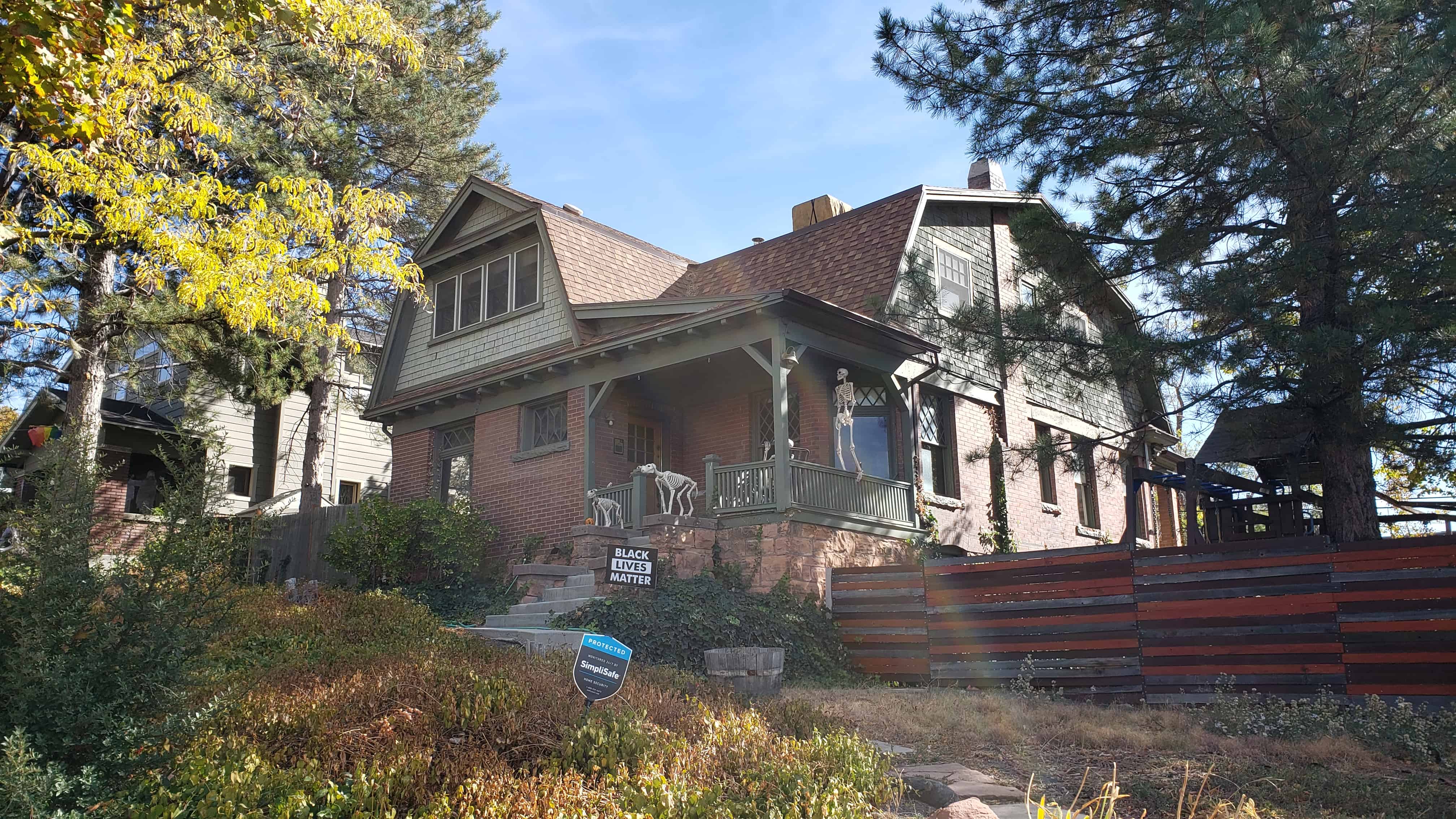
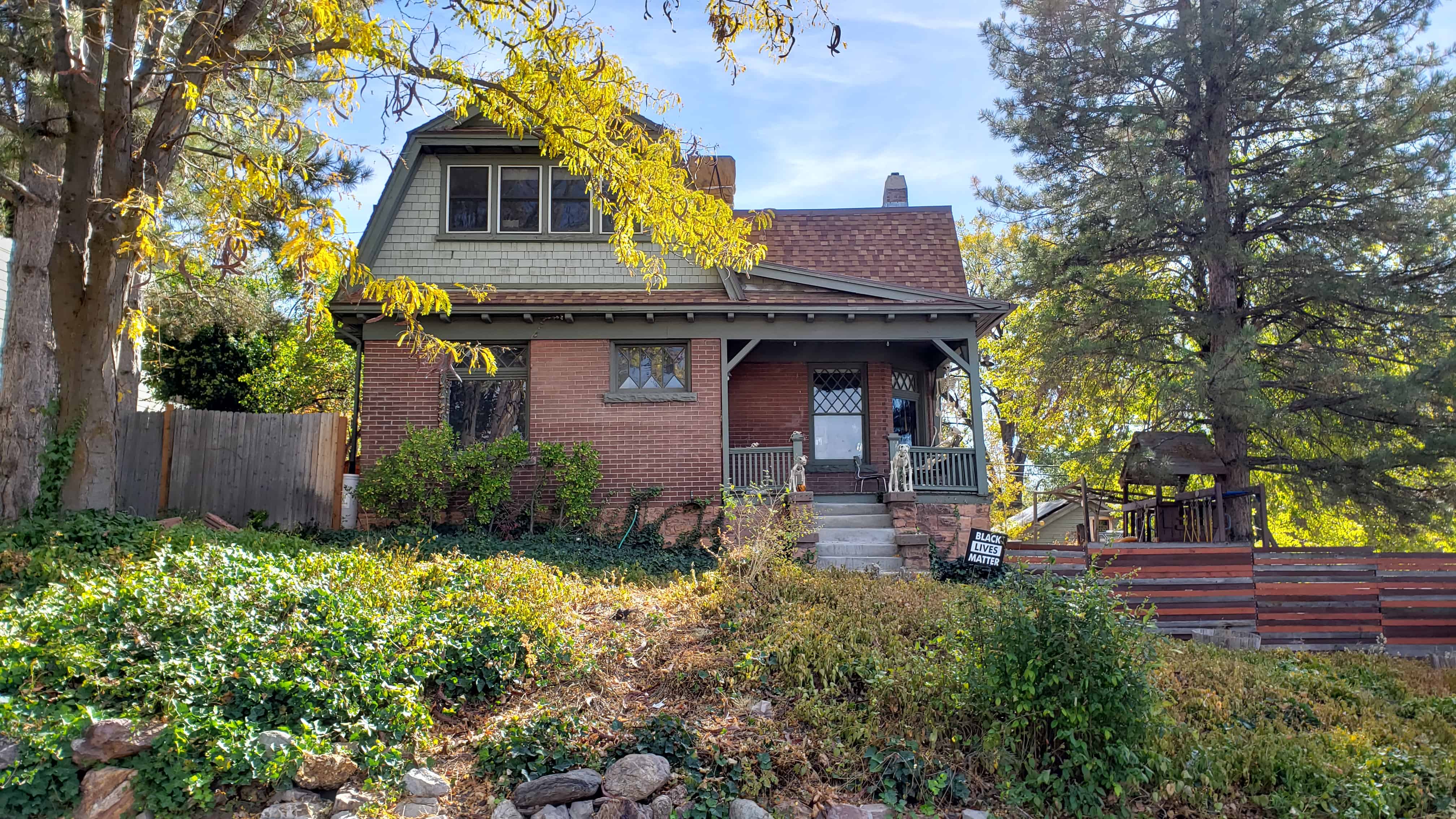
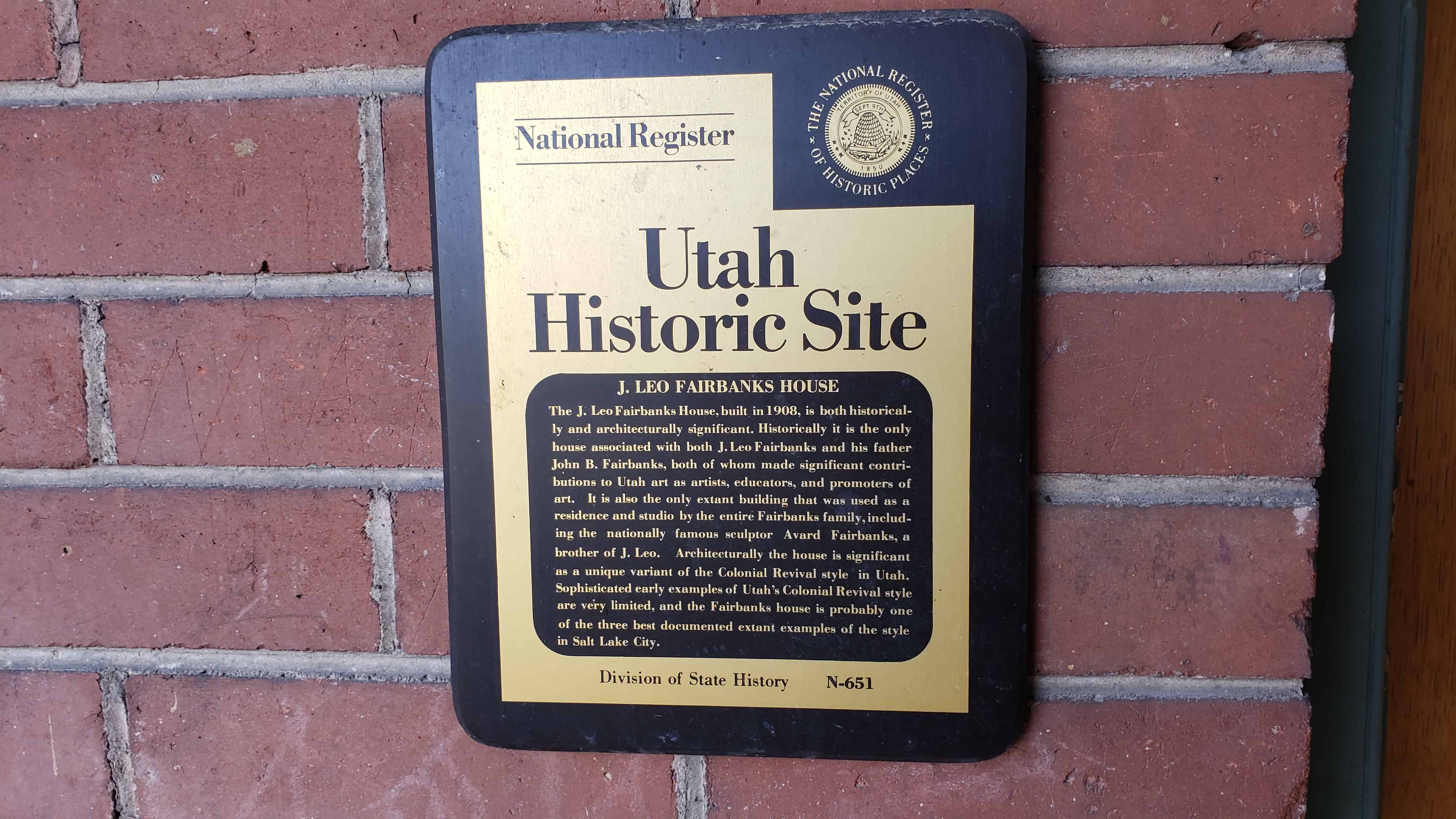
The J. Leo Fairbanks House, built in 1908, is both historically and architecturally significant. Historically it is the only house associated with both J. Leo Fairbanks and his father John B. Fairbanks, both of whom made significant contributions to Utah art as artists, educators, and promoters of art. It is also the only extant building that was used as a residence and studio by the entire Fairbanks family, including the nationally famous sculptor Avard Fairbanks, a brother of J. Leo. Architecturally the house is significant as a unique variant of the Colonial Revival style in Utah. Sophisticated early examples of Utah’s Colonial Revival style are very limited, and the Fairbanks house is probably one of the three best documented extant examples of the style in Salt Lake City.
Built in 1908 for Utah artist J. Leo Fairbanks, this house is both historically and architecturally significant. Historically it is the only house associated with both J. Leo Fairbanks and his father John B. Fairbanks, both of whom made significant contributions to Utah art as artists, educators, and promoters of art. It is also the only extant building that was used as a residence and studio by the entire Fairbanks family, including the nationally famous sculptor Avard Fairbanks, a brother of J. Leo. Both J. Leo and John B. studied in Paris and returned to Utah where they became best known for their work on religious murals in temples of The Church of Jesus Christ of Latter-day Saints (LDS Church), John B. having painted some of the murals, and J. Leo having restored some damaged murals. Both taught art at the LDS University in Salt Lake City and elsewhere, and each held the position of supervisor of art in public schools, John B. in Ogden, and J. Leo in Salt Lake City. Architecturally the house is significant as a unique variant of the Colonial Revival style in Utah. Sophisticated early examples of Utah’s Colonial Revival style are very limited, and the Fairbanks house is probably one of the three best documented extant examples of the style in Salt Lake City. Two other examples listed in the National Register include: the Walter E. Ware House, 1184 First Avenue, built ca. 1905 and listed in 1980 as part of the Avenues Historic District; and the Mort Cheesman House, 2320 Walker Lane, built 1912-13, and listed in the National Register as an individual nomination in 1982.
J. Leo Fairbanks, the designer and original owner of the house at 1228 Bryan Avenue, was born in Payson, Utah in 1878 to John B. and Lily H. Fairbanks. Following the lead of his father, John B. Fairbanks, and having studied under him at the LDS University, he became an artist. In 1901 he replaced his father as a teacher for one year at the LDS University, and then went to study in Paris. He studied with Laurens and Simon, and sculptors Bonn and Verlet before returning to Utah in 1903. He was then employed as supervisor of drawing in the Salt Lake City schools, a position which he held until 1923. He also served as the art director at LDS University and as president of the Utah Art Institute. J. Leo is best known for his many religious (LDS) paintings, and worked on the restoration of damaged mural sections in the Salt Lake City LDS Temple. He devised several successful schemes for mural decoration for the interiors of public halls. In 1924 he moved to Oregon where he became the director of the art department at Oregon State College.
J. Leo was single when he designed and had this house built in 1908. According to his brother Avard, inspiration for the design of the house came from the old family home in Dedham, MA, the famous Jonathan Fairbanks home, built in 1636, and from European sources to which he had been exposed during his years of study. J. Leo invited his father, a widower, and the rest of his family to live with him, and the house served as the Fairbanks family home and studio for over fifteen years. They had previously resided at 1152 East Bryan Avenue.
J. Leo, his father John B., and his brother Avard were all notable Utah artists, and each resided in the house for an extended period of time. Some of the second story rooms were used as a home studio. John B. was born in Payson on December 27, 1855 to Utah pioneers John Boylston and Sarah Van Wagoner Fairbanks. He studied art in Paris from 1890 to 1892 under Rigelot, Constant, Lefebvre and Laurens. Although his work includes some paintings, he is best known for the murals he painted in the LDS temples in Salt Lake City, St. George, Utah, and Mesa, Arizona, and for the Century in Progress exposition in Chicago, the San Diego exposition and the Texas centennial. He was a professor of art at Brigham Young University, Weber Stake Academy, and at the LDS University. He became the first supervisor of arts in public schools in Ogden in 1898. Avard, the most famous of the Fairbanks artists, was a child prodigy, and is the best known among traditional realist sculptors working in Utah.4 He spent his childhood in this house. He too studied in Paris at the Academie de la Grande Chaumier et Colaross and then with Injalbert at the Ecole Moderne. He became the first dean of the School of Fine Arts at the University of Utah.
The house was rented periodically during the later years of Fairbanks occupancy. It was sold to Edward G. Titus, Director of the Utah-Idaho Sugar Co., in 1925, and he owned the house until his death in 1964. The current owners are Michael Treshow and Marilyn Tueller who bought the house in 1982 and are restoring it.
This house was constructed in 1919 to replace the original ranch foreman’s cabin that was built soon after Stewart Ranch was established c. 1902. The builder and first foreman to occupy this house was Randolph Fife, a nephew of the four Stewart brother who founded the ranch. Subsequent occupants include Alex Murphey (1923-c. 1930), Herman Cooley (c.1938-1955), and Arvin and Ardean Anderson (1955 to at least 1986). Stewart Ranch functioned first as a livestock operation (c.1902-1931) then as a dairy ranch (1931-1955). It concurrently served as a recreational retreat for its owners – the Stewarts then the Hewletts – who were successful business and professional men in Salt Lake City. Stewart Ranch was probably the largest and longest lived of the “recreational ranches” that were established in this area during the early twentieth century by prominent families from Salt Lake City.
Part of the Stewart Ranch, the Stewart Ranch Foreman’s House is located off highway 35 near Woodland, Utah and was added to the National Register of Historic Places (#85001135) on May 23, 1985.
The Lars Andersen house in Ephraim is architecturally significant as an example of Scandinavian folk building in Utah. The house contributes historically to the thematic nomination, “The Scandinavian-American Pair-house in Utah.”
Lars S. Andersen was born in 1829 in Denmark. Converting to the LDS Church in 1852, he emigrated to Utah in the winter of 1855. Arriving in Ephraim in the summer of 1856, Andersen soon became a leading citizen of this community. He was primarily a farmer, but also served as tithing clerk, and director of the Ephraim Co-op Store. Active in the Church, Andersen was a counselor to the Stake President, Canute Petersen, and filled a Danish mission in 1873-1875. In 1879 he became bishop of Ephraim.
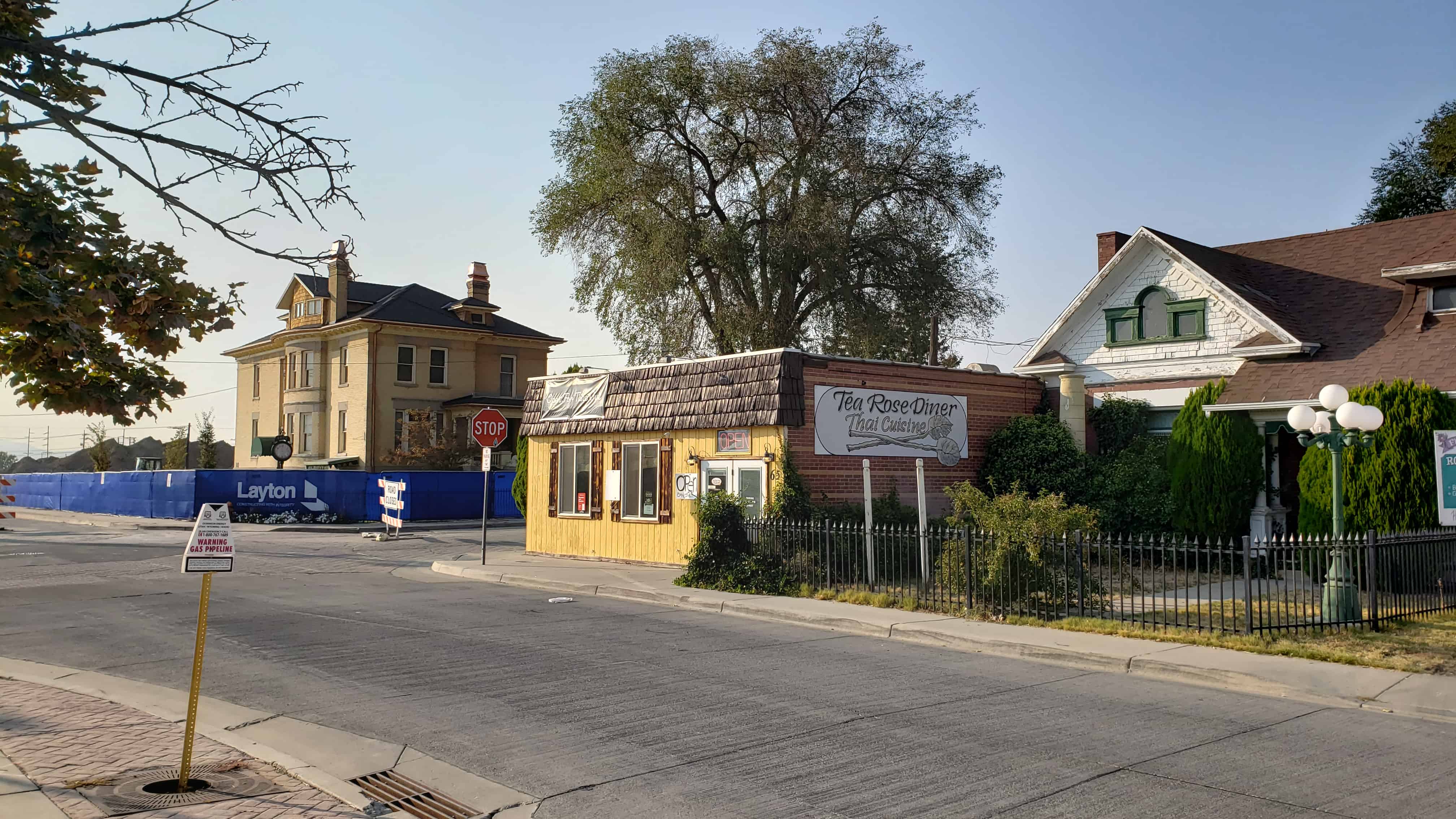
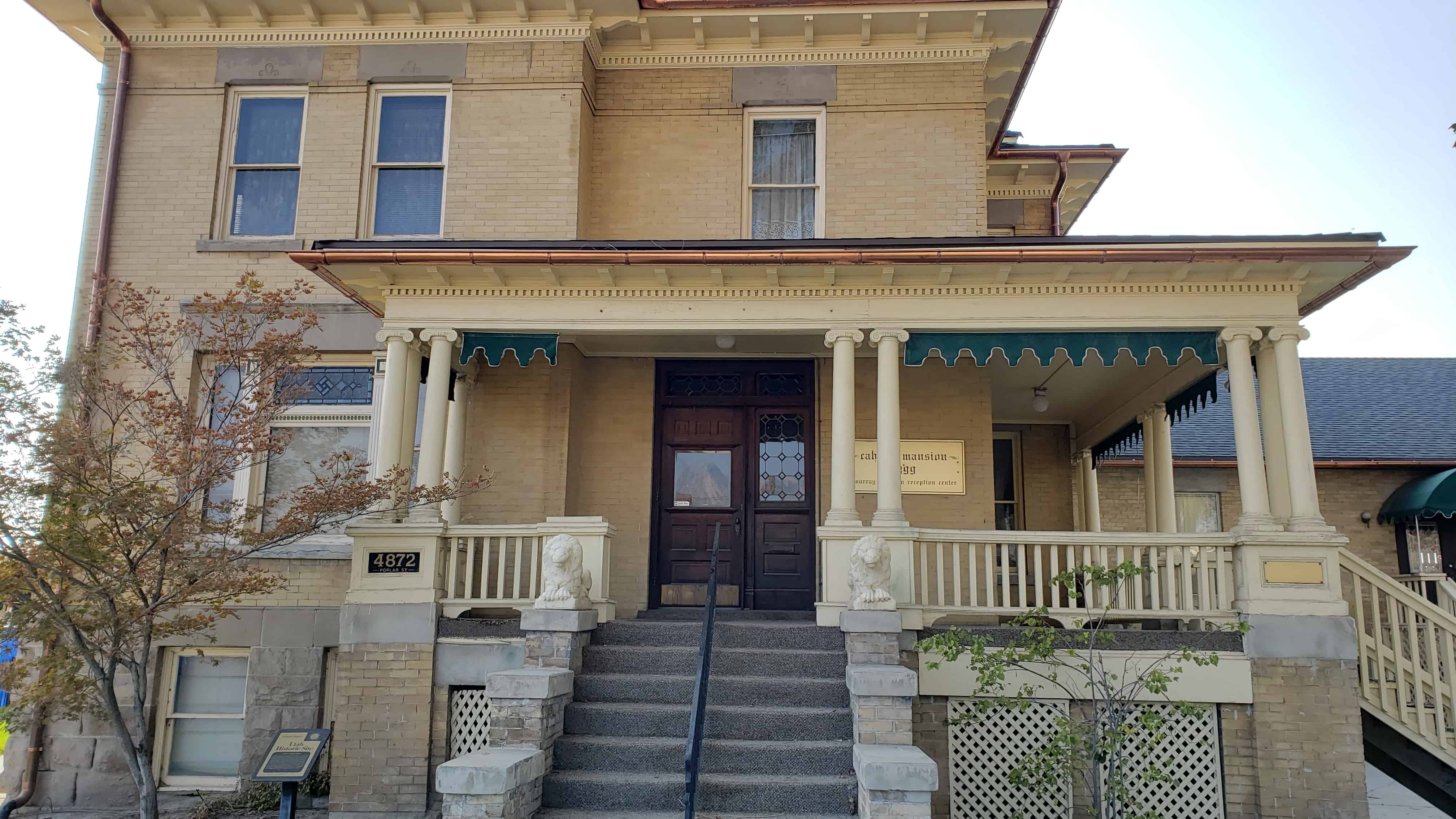
The John P. Cahoon House is significant as the finest example of residential Victorian Eclectism in Murray City and as the home for over twenty years of John P. Cahoon, a pioneer in the brick industry in Utah and the West. The large, two-and-one-half story brick house referred to in 1902 as “easily the finest home in the county outside Salt Lake City,” (Murray is located about five miles south of Salt Lake City) has remained virtually unchanged since its construction around 1900. Although its Victorian styling is more subdued than that found on many houses in Salt Lake City, this house represents the fullest expression of “high style” architecture in its community, where the housing stock consists mainly of smaller scale, modestly ornamented cottages. John P. Cahoon was the principal founder of what is claimed be the first commercial brick manufacturing plant in both Utah and the West in 1878. Brick played an especially important role in the construction business in Utah because of the scarcity of readily available lumber, and by the turn of the century there were several dozen companies competing in the brick manufacturing industry. Under John P. Cahoon’s leadership, his company, incorporated in 1891 as Salt Lake Pressed Brick Company, emerged as one of the most successful in the industry, and Cahoon himself made important contributions to the industry, He was appointed to the War Service Committee on Brick in Washington, D.C. in 1918, and served as an organizer and vice president of the Brick Manufacturers Association of America. Also, under his leadership, his company started the first trade school program in Utah, teaching brick laying to students. Interstate Brick Company, as it was renamed in 1939, has become the largest company of its kind in the Intermountain West and is still directed by members of the Cahoon family.
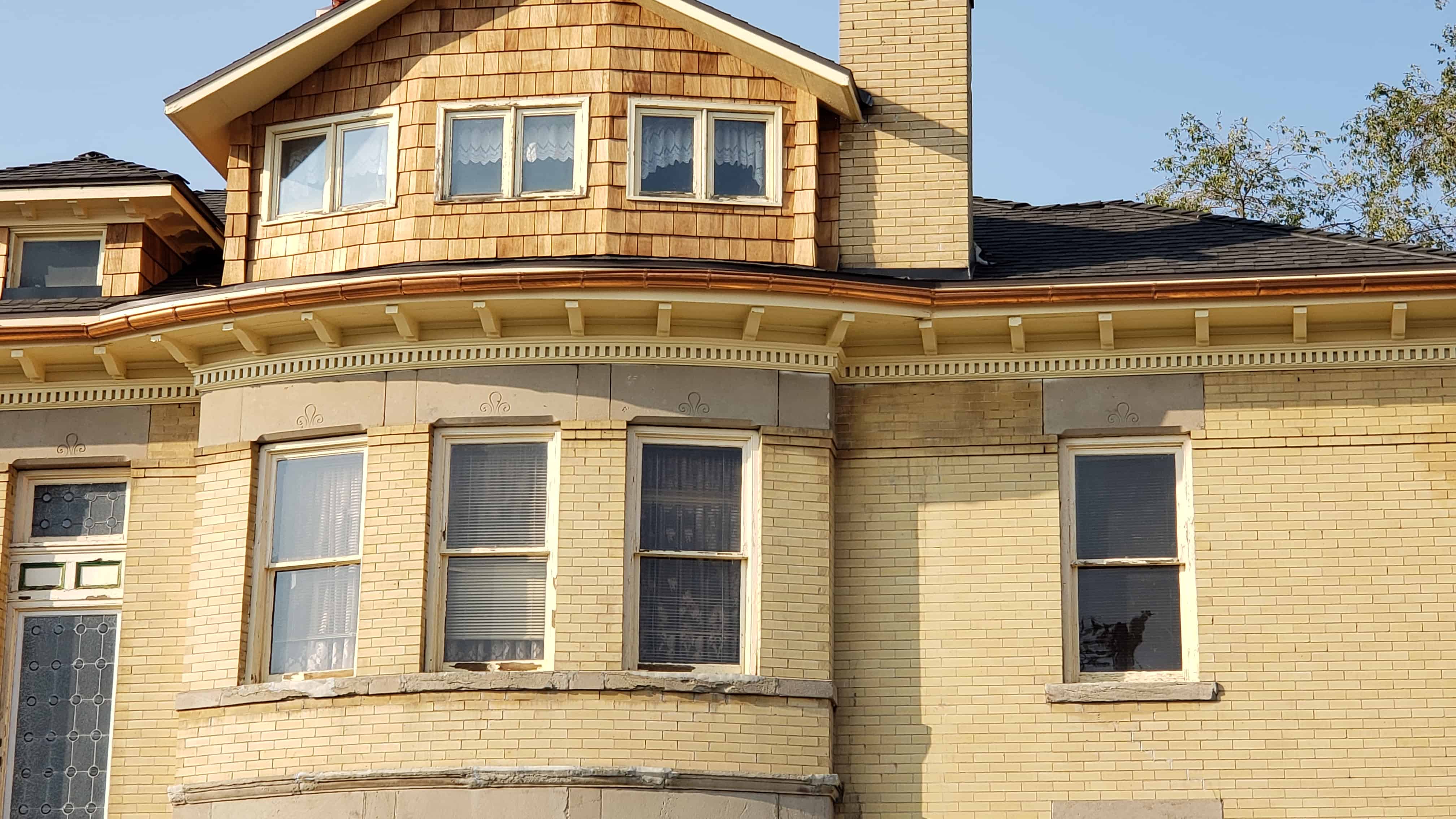
The Cahoon house, build ca. 1900, is the best example of “high style” Victorian architecture in Murray, Although less elaborate than many of the fine homes in Salt Lake City, this two-and-one-half story house features a quality of design and decoration unmatched in the Murray area. The integrity of the house on both the interior and exterior has remained virtually unaltered, and the entire house is in exceptionally good condition.
The Victorian Eclectic styling of the house, most evident in exterior and interior details, reflects the Victorian influence of the late nineteenth century, but the basic rectangular shape and the subdued ornamentation hint of the early twentieth century economy of design that produced the simple Box and Bungalow styles.
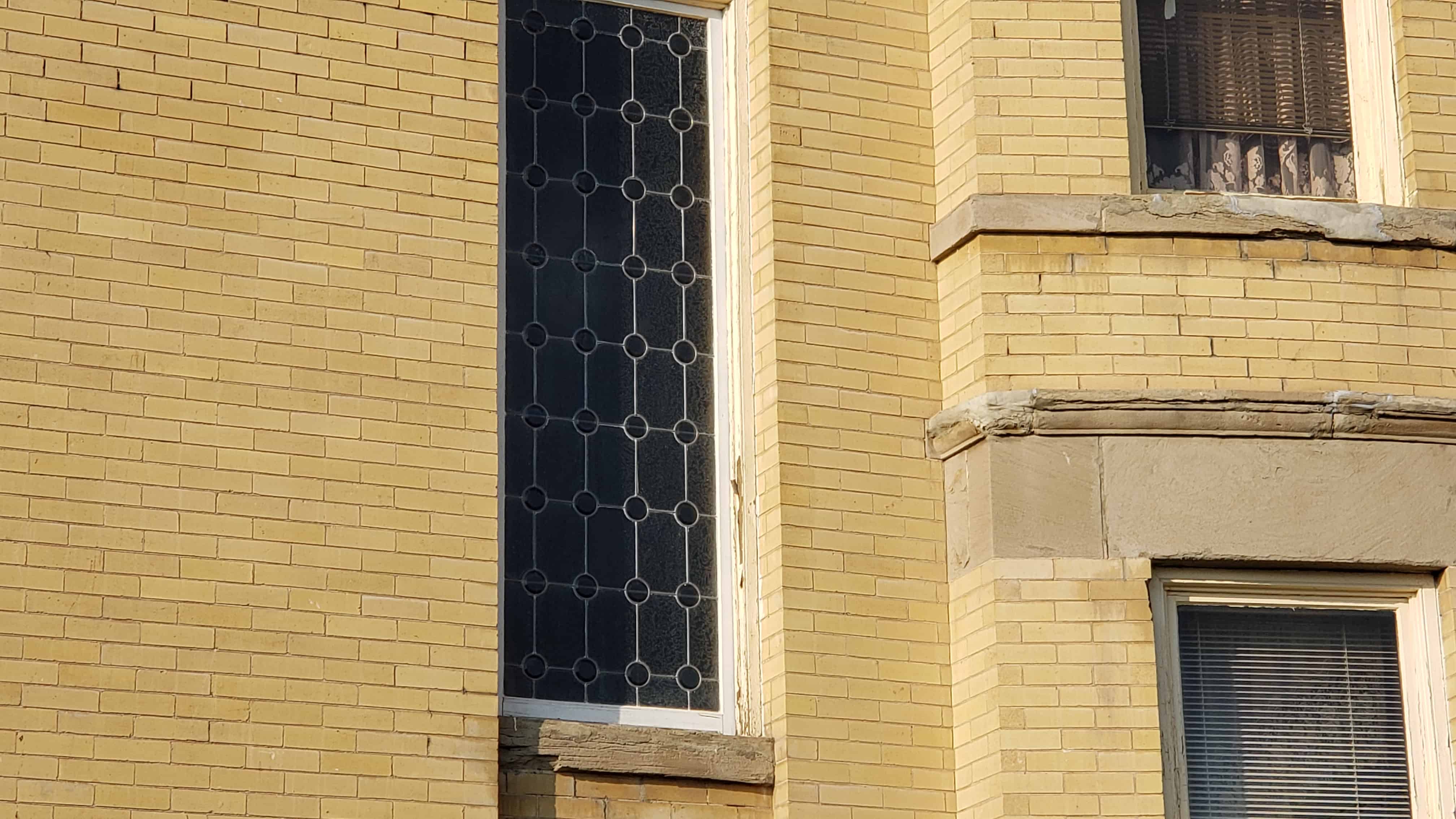
The large, brick house sits on a raised sandstone foundation, which holds a full basement-story. The brick exterior walls are accented with heavy sandstone lintels and sills. A two-story bowed bay window on the south side is the only feature that interrupts the rectangular massing of the house. Victorian detailing such as scroll brackets and dentils decorates the wide eaves. Hip dormers with flared cheeks provide illumination to the attic story. Other decorative features include clear and frosted leaded glass in some windows and transoms, and a heavy paneled front door framed by a transom and sidelights. The large wrap-around front porch features a wooden balustrade, paired Ionic columns on paneled pedestals, and latticework along the base.
The only exterior changes are the addition of a small canvas canopy over the doorway on the south and the application of outdoor carpet on the front steps and porch. Exterior condition of the house is very good overall, with only minor spalling of some of the sandstone blocks, slight deterioration of mortar in some joints, and a few cracked bricks.
The interior of the house has also been very well maintained and remains virtually unchanged from its original condition. Original features include twelve-foot high ceilings, ornate fireplaces (still in use), decorative wood baseboards and trim, and wood paneled doors both hinged and sliding, with classical surrounds. The stairway is lit by a large leaded glass window and features, finely turned balusters and heavy paneled newel posts. Other original interior features are the oval doorknobs, operable transoms, and cast iron radiators. Interior alterations are very minor; no windows or doorways have been covered over, and even though the house was used as a multi-family residence for several years, the original floor plan has remained intact with the single exception of a wall and doorway addition (ca. 1940) in the hallway leading to the stairway and side entrance. The kitchen and bathrooms have been altered only slightly by the addition of newer fixtures and cabinets.
John P. Cahoon was born in the area known as South Cottonwood, on February 1, 1856. His parents, Andrew and Margaret C. Cahoon, who had come to Utah in 1848 as Mormon pioneers, were among the original settlers in that area, which later became known as Murray. John, the second of five sons, attended local schools and married a local girl, Elizabeth Gordon.
In 1878, he and his brothers began manufacturing brick on a small scale with primitive hand-powered tools and equipment on a location near 5300 South in Murray. This brick was used primarily for the construction of their own houses, and John built his first house at 5600 South and Winchester Street (401 West). In 1891 John founded the Salt Lake Pressed Brick Company and moved the manufacturing plant from 4200 South, a later location, to a new location near 1100 East and 3300 South, where there was an abundance of good quality clay for brick manufacturing. The clay beds at that location completely filled the company’s needs until 1921 when clay began to be shipped in from other areas.
The Salt Lake Pressed Brick Company prided itself in the quality of its product and was awarded many prizes for its bricks, including first place for best red brick at the World’s Columbian Exposition in Chicago in 1893. The company also manufactured pipe, tile, and other clay products. It was also involved in the construction of the “mail order” bank in Vernal in 1916, shipping all the brick via parcel post to avoid the higher conventional freight costs.
John Cahoon was also involved in several other businesses including Miller-Cahoon Company (4810 South State Street), a lumber and hardware company, Elkhorn Ranch, and The Progress Company, which installed the water mains in Murray.
In 1888 John and Elizabeth Cahoon and Harry and Jane Haynes together purchased a 17.84 acre tract of land fronting State Street near 4800 South. In the early 1890’s Cahoon and Haynes subdivided the land (Cahoon and Haynes Subdivision) and sold off many of the parcels. Cahoon retained about eight acres of the property and had this large house built on it around 1900. The brick for the house was undoubtedly manufactured by his Salt Lake Pressed Brick Company. John P. Cahoon lived here with his wife, Elizabeth, for the next twenty years, raising most of their ten children here. In the early 1920’s the Cahoons had a new house built at 4882 South Highland Drive (demolished), where they lived until their deaths she in 1931, and he in 1939.
In 1936 John retired, turning over the business to his sons, Chester P. and John B. The company, known since 1939 as Interstate Brick Company, is now headed by a grandson, Harold P. Cahoon. In 1972 the company moved from their location at 1100 East and 3300 South (now Brickyard Plaza, a shopping center) to their new plant at 9210 South 5200 West, which has been called the largest brickmaking facility in the country.
From 1923-25 James C. Overson, a mining man, and his wife, Verenia, lived in the house. During the next fifteen years the house was apparently used as rental property. Around 1941 James P. and Ellen C. Payne moved into the house and lived here for many years. James (1894-1966) had served as pastor of the Murray Baptist Church, located nearby at 62 East 4800 South, from 1926 to 1941 and also as a chaplain in the Civilian Conservation Corps. He later worked as a patternmaker for American Foundry and Machine Company. Mrs. Payne continued to live here after her husband’s death, and for several years she and her widowed sister-in-law, Ruth Christensen, lived in the house together. In 1978 she sold the house to O. LaMont and Shirley Heath, who used it as the office of Heath Realty.
Steven L. Hansen, an attorney, purchased the house in October of 1981 and established his office on the main floor. He is currently in the process of leasing out the basement and upper stories of the house for office use.
John P. Cahoon House
This house, built about 1900 for John P. Cahoon, is the finest example of residential Victorian architecture in Murray City. Cahoon was the principal founder of one of the first commercial brick manufacturing plants in Utah in 1878. Incorporated in 1891 as Salt Lake Brick Company, it is now known as the Interstate Brick Company, one of the largest in the Intermountain West. Cahoon was also important in the brick industry as the organizer of the Brick Manufacturers Association of America, as a member of the War Service Committee on Brick, and as the leader establishing the first trade school in Utah, teaching brick laying to students.
This house offers a view of the range of Spring City’s architectural tradition. Built c. 1875, the original structure was a stone, hall-parlor house. The rear adobe addition was probably completed within just a few years after the main portion. Little is known about Iver Petersen, except that he also built the stone granary located on the property. The granary is one of the best preserved and most substantial granaries of Spring City.
Located at 309 North Main Street in Spring City, Utah
Iver Petersen (1844-1881), a Danish immigrant, built this stone, hall-parlor plan house in the mid 1870s. A rear adobe addition was constructed shortly thereafter. He died at a young age leaving a widow with several young children. A stone granary behind the house has been made into a living space.(*)
Constructed c. 1911, this one-and-one-half-story house is a nice example of large bungalow, the most common house type in Utah during the early twentieth century. The house exhibits characteristics of the transition between the waning Victorian Eclectic style and the then current Arts and Crafts style. These details include wide eaves with classical modillions, large side dormers, decorative iron railing and square classical columns on the large from porch, and the decorative use of multiple materials with the combination of brick and patterned shingles in the gable ends. These elements combine to produce a unique dwelling.
According to the title, Esther Catherine W. Haslam was the original owner of the house and she deeded it to David and Emma Haslam in 1943. Most likely the house was always used as a rental, for city directories indicate that neither of the Haslam families lived here, and residents’ names changed on a regular basis.
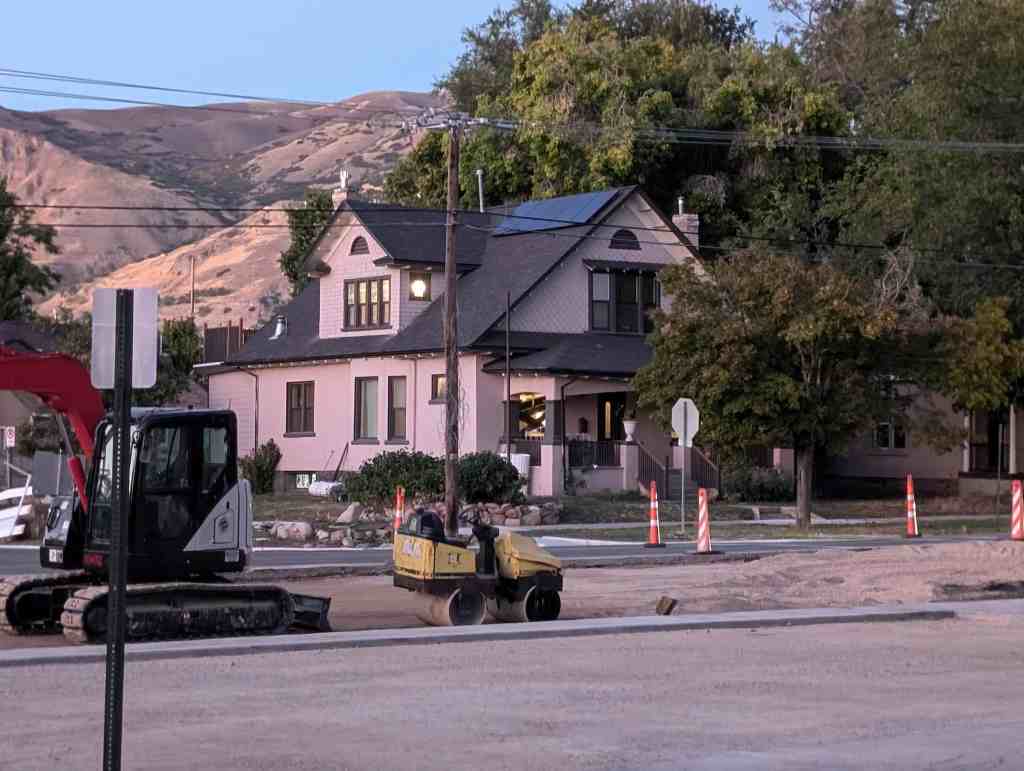
Built in 1908-10 by Patrick J. Moron as a carriage house, this structure was converted into a duplex in the 1930s. Moran operated his own contracting company known as P.J. Moron Contractor Inc., and became president of the Portland Cement Co. of Utah in 1918. He designed this one-and-one-half story building with Arts and Crafts and English Tudor stylistic features such as half-timbering, gabled dormers, stucco walls, exposed rafters, and casement windows.
This building was originally designed as a carriage house to accommodate four electric carriages or three automobiles. An underground gasoline tank provided fuel for the vehicles through a pump inside the south door. A large basement held a coal room and commercial-size furnace that heated the carriage house, the Moran family dwelling to the north, and the bungalow to the northeast, built for Moran’s mother-in-law. A bedroom over the porte cochere (archway) was used at one time by the chauffeur and his wife and, later a housekeeper. When ownership of the property changed c. 1936, the carriage house was remodeled for use as a duplex.
This home is located at 17-19 South 1100 East in Salt Lake City, Utah
Johannes Huber was the catalyst by which hundreds of Swiss immigrants established themselves in Midway and the west. He immigrated by ox train in 1863, overseeing sixty converts to the Mormon church, including his future wife. Brigham Young called Huber to return and serve as President of the Swiss-German Mission, 1871-1874, where he translated and published the Book of Mormon. Maria Magdalena Munz Huber was schooled in the fabrication of textiles and lace. She extended this homesite as a refuge and gathering place for community events, especially in music and the arts.
Huber built this one-story, wood-frame house in 1878. Inner adobe brick walls were covered with board-and-batton in a hall-parlor plan. Two later lean-to additions were used as dining and kitchen work areas. In the gabled attic slept nine of ten children. Travertine limestone was gathered from warm mineral springs to form the two-foot thick walls of the creamery, c. 1885.
John Huber wrote the history of Midway from 1859-1910. He died in the home in 1914, his widow, Mary Huber, in 1935, and their youngest son, Joseph, remained until the inception of Wasatch Mountain State Park.
The Meiling-Seely House, 91 South 500 West, Mt. Pleasant, Utah
A Danish immigrant, Jens C. Meiling, built the first, smaller part of this fine brick home in 1870. the bulk of this one-of-a-kind residence was erected around the earlier house, in 1890 by John H. Seely. Influenced heavily by Neo-classicism, the house has round-columned, classical porches, a bracketed cornice, two-story, square corner tower and extensive ornamental brickwork.
Meiling came from Denmark and in 1859 acquired 20 acres of farmland in Mt. Pleasant. He supplemented his income by making bricks. For many years, Sanpete settlers had difficulty securing clay of sufficient quality to produce fired brick and relied mainly upon sun-dried adobe as a building material. Meiling’s brick yard, located just west of town, was the first in Mt. Pleasant to turn out kiln-fired bricks, probably in the late 1860’s. Meiling sold the house to John H. Seely in 1887 for $1500. Seely was one of the most successful livestock breeders in the Intermountain West. He is credited with introducing purebred French Rambouillet sheep into Utah during the 1890’s. His achievements with selective breeding improved Utah’s range stock, contributing directly to the remarkable success of the local sheep industry during the late 19th and early 20th centuries. Seely helped make Mt. Pleasant the Rambouillet breeding capital of the world, as well as the commercial center of central Utah’s livestock industry.(*)