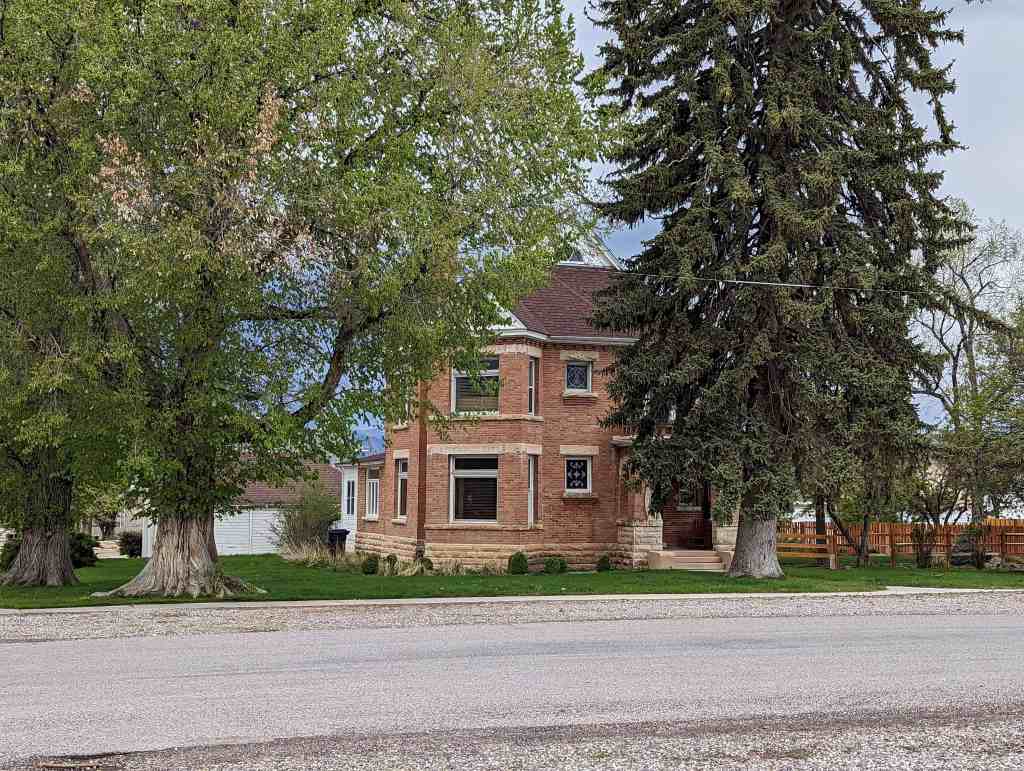
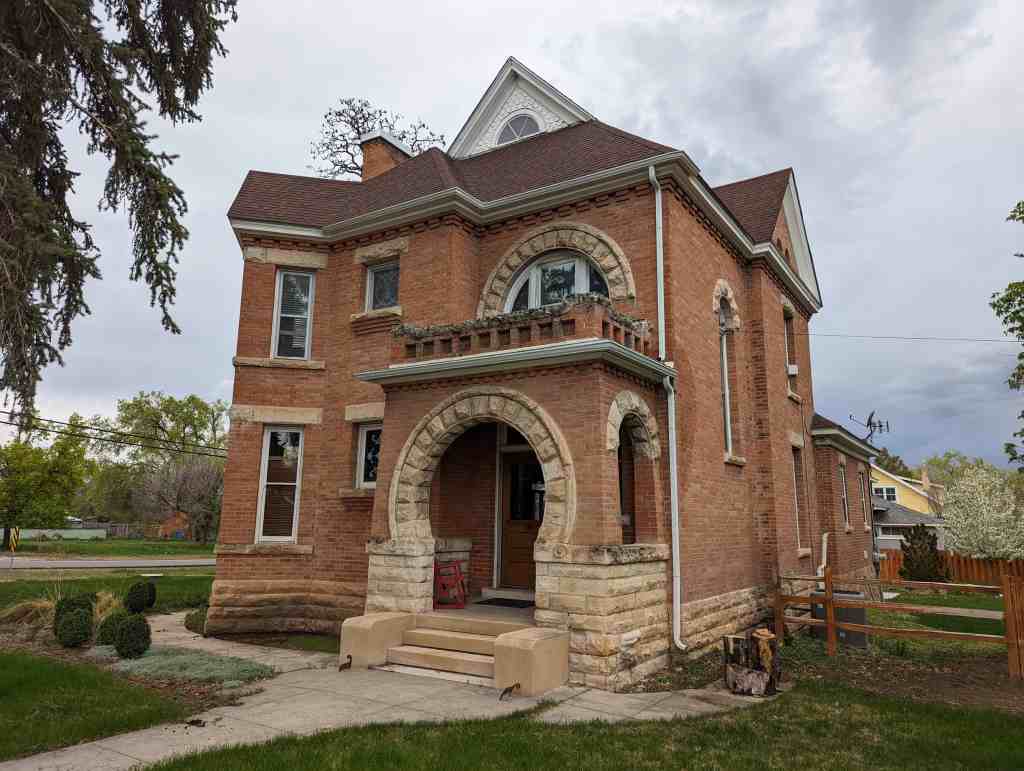
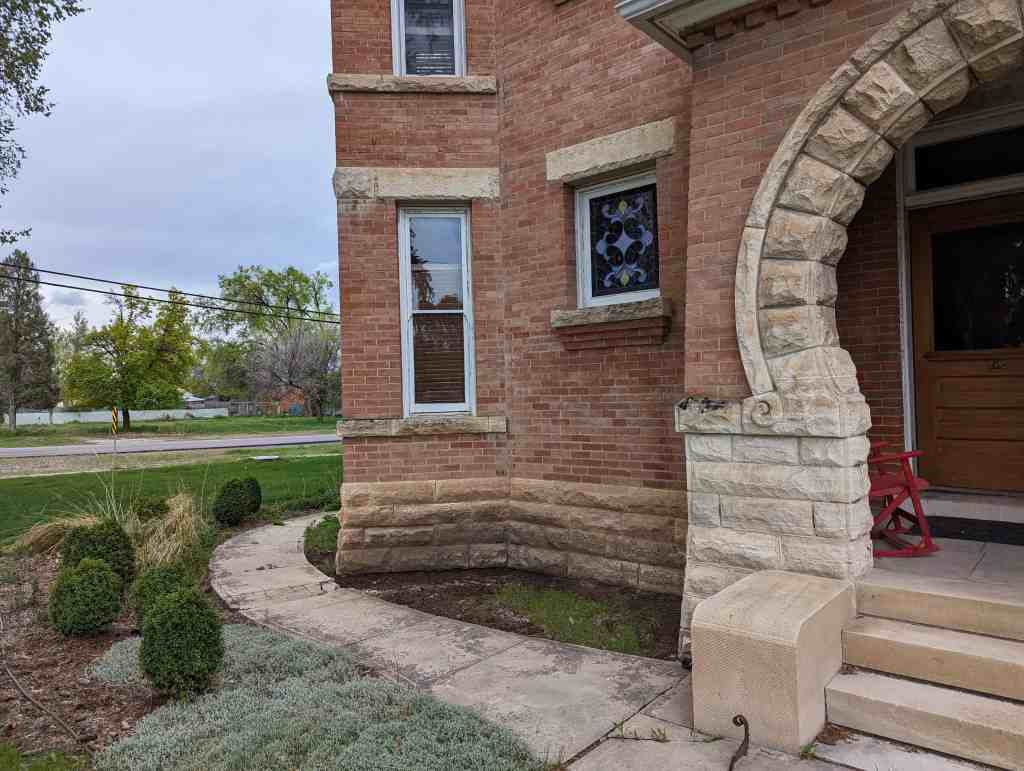
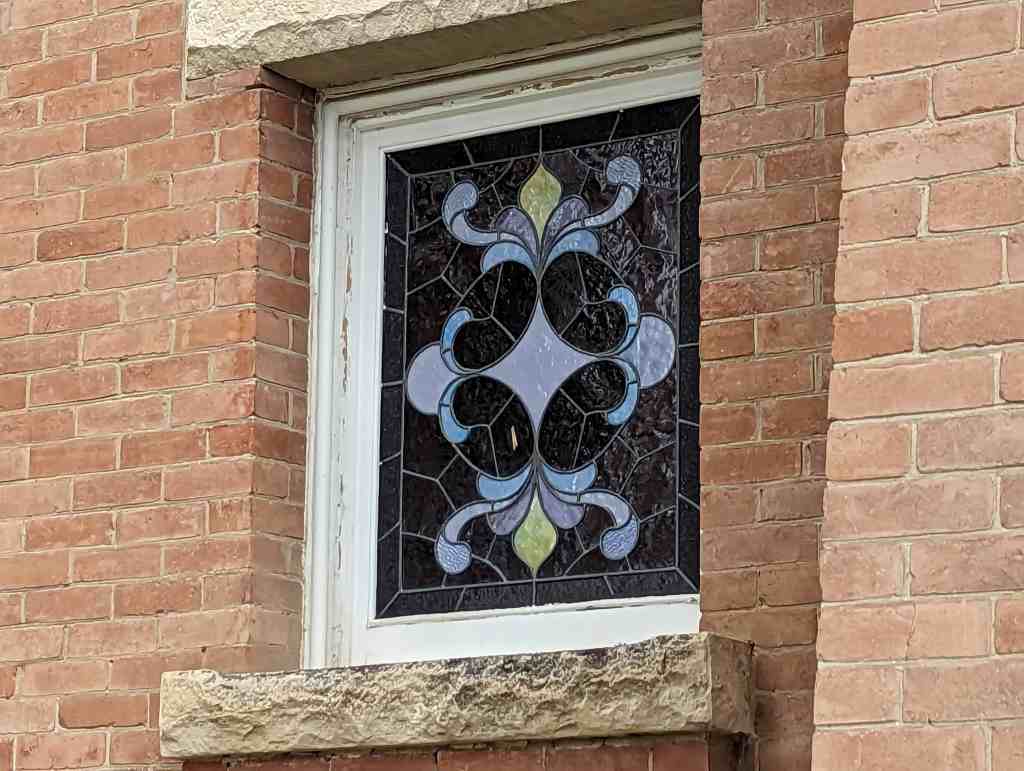
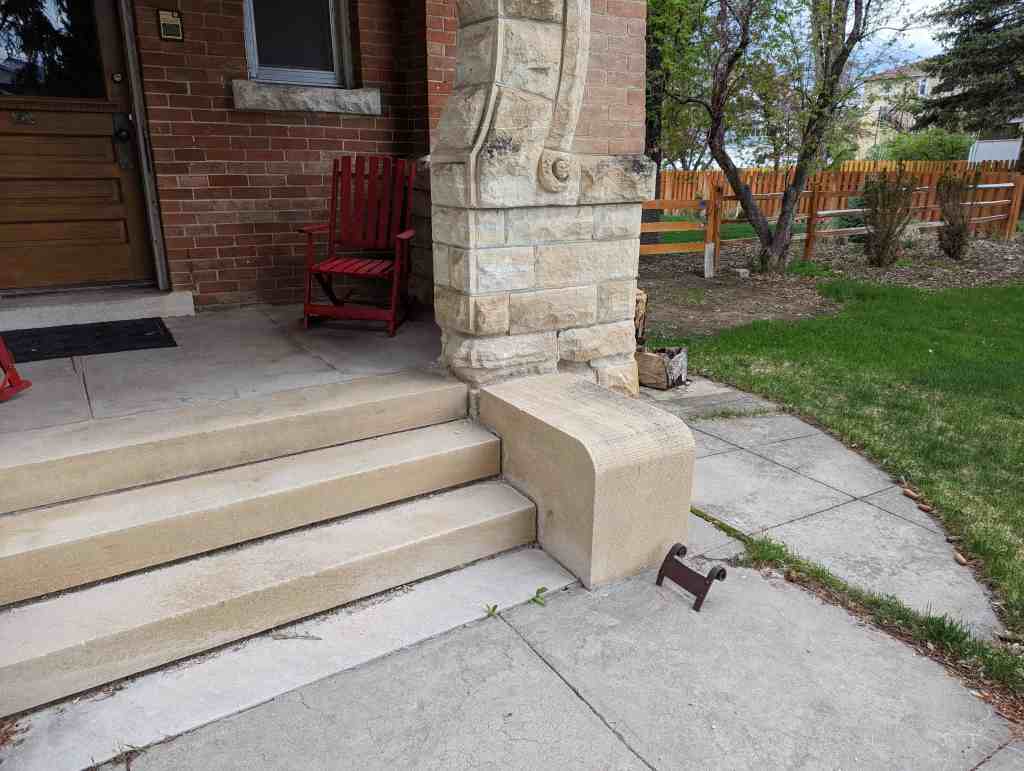
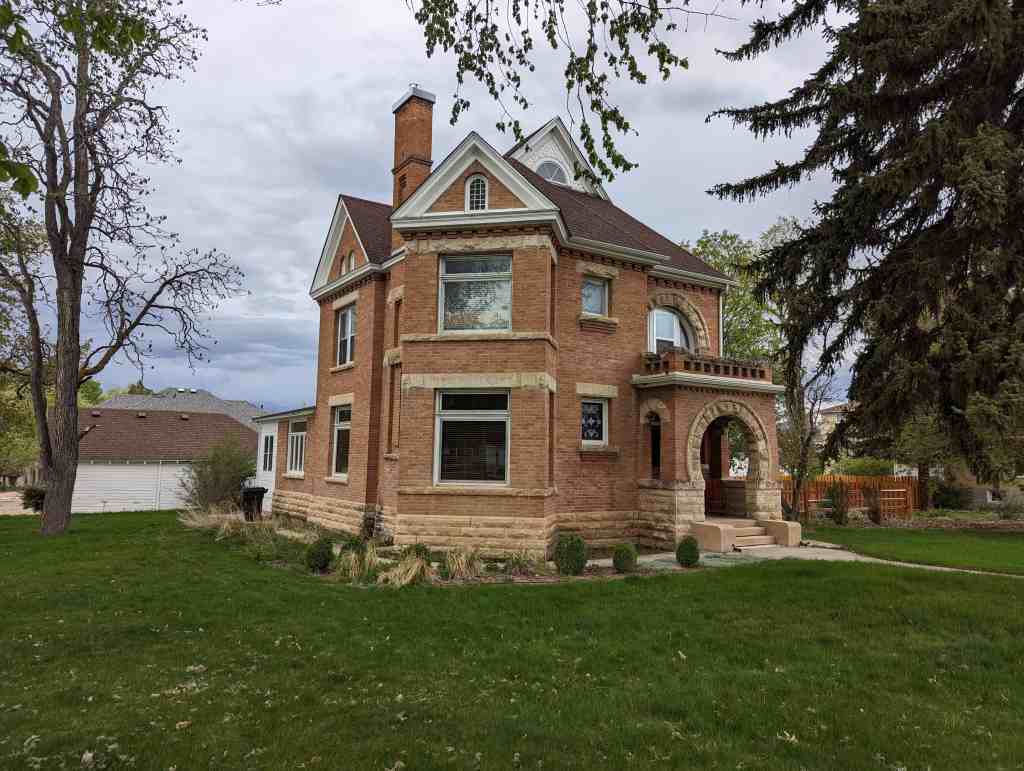
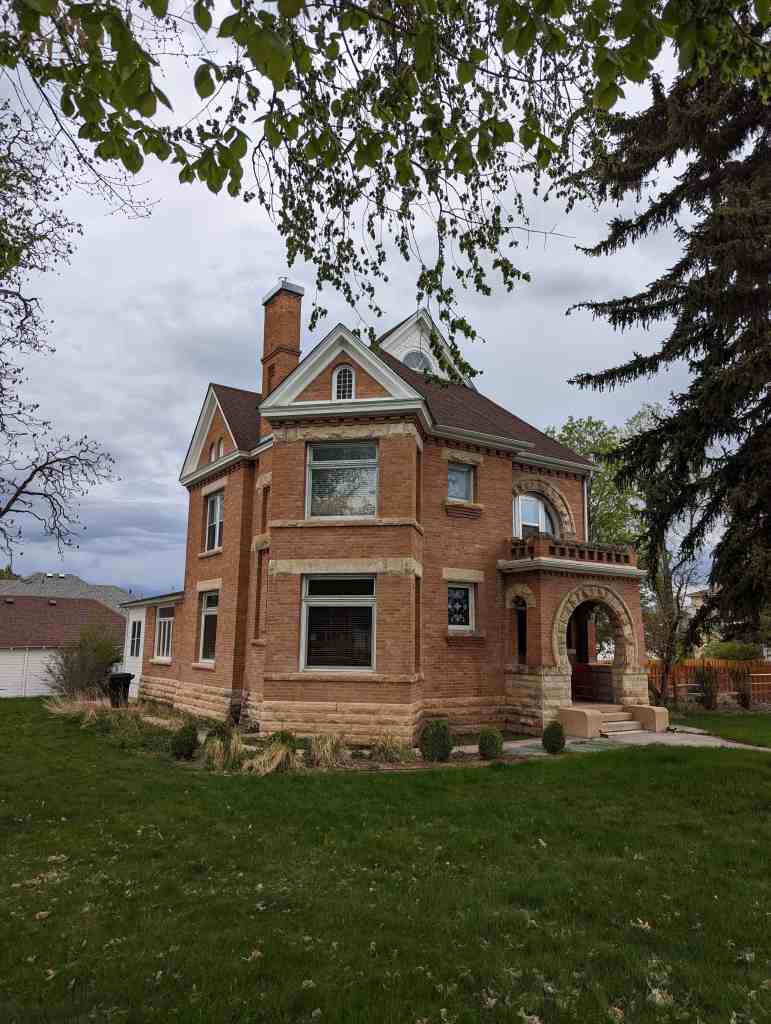
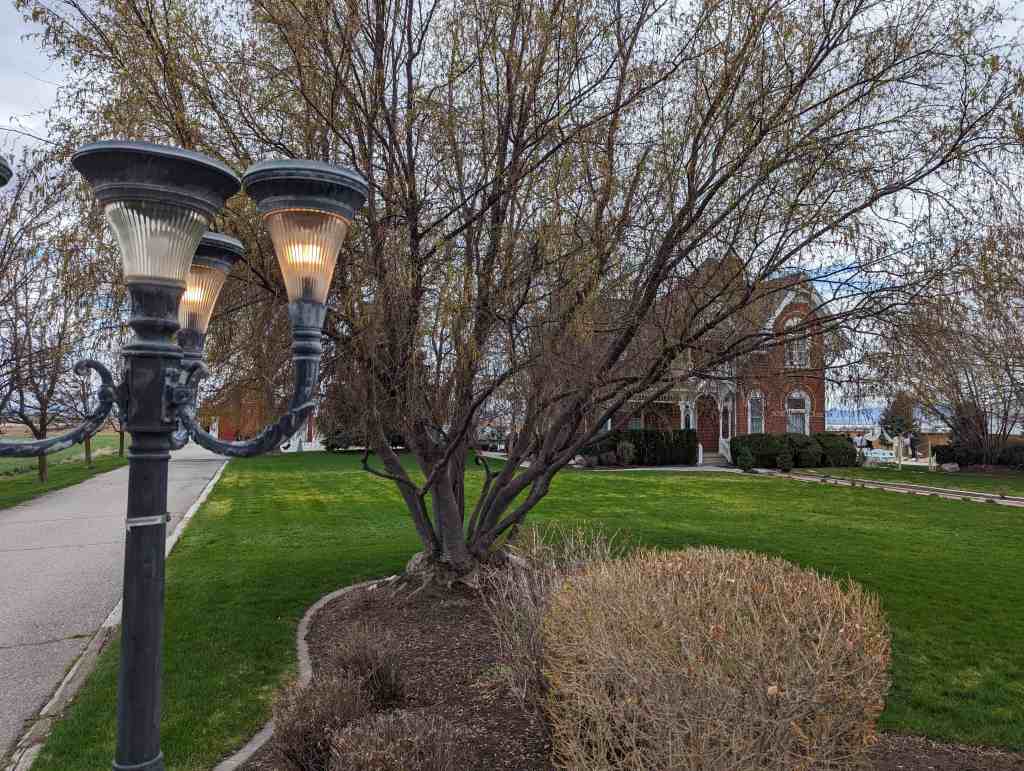
The significance of the McDonald House lies in typifying the values of a middle-class newly emerged from the struggles to establish themselves in pioneer society. The simple dignity of the McDonald House suggests the residence of a hard working, upwardly mobile, skilled tradesman. The very plain house has few stylistically distinguishing details, and the central hall plan is a vestige of earlier vernacular house types. located away from the center of Salt Lake City, it documents the scattered pattern of settlement in the outlaying areas of the Salt Lake Valley. Although the Mormon Church dominated settlement patterns in Utah, the opening of a federal land office in 1869 brought the scattered homestead pattern to the state. The McDonald House exists today in the midst of later twentieth century development, an important remnant of early domestic architecture outside the immediate Salt Lake City area. The house has been carefully restored.
The David McDonald House is located at 4659 South Highland Drive in Holladay, Utah and was added to the National Historic Register (#80003927) on May 29, 1980. The text on this page is from the National Register nomination form unless otherwise noted.
The architect-builders were the owners, David and Arabella McDonald, who lived in the building until their death in 1924. Both were immigrants to Utah in 1869, he from Scotland and she from Northern Ireland, and both were 41 when the home that was the measure of their success in America was constructed.
David McDonald had been educated in Scotland, and served five years of apprenticeship as a blacksmith and millwright. It was not until he was settled in Utah that he met his wife Arabella Anderson, whom he married in the Salt Lake Endowment House in 1874. David and Arabella remained supportive of the Mormon Church and its various programs, although his ambivalence about the Church was cause for comment. His membership in the largely Gentile Liberal party, and the broad and catholic selection of titles in his much-loved library suggest his distance from the mainstream of Mormon thought and practice. The McDonald blacksmithing business, located eventually only 50 feet from the McDonald home, prospered over the years. His increasing stature in the business community led to McDonald’s increasing involvement in politics. With the introduction of national political parties into Utah, he quickly became established as an active Republican.
At the death of both parents in 1924, the home passed into the hands of other members of the family and eventually was converted into a rental property in 1966. The home is now the headquarters of a professional design firm.
The plaque on the building says: The two-story Victorian house was constructed in 1890 or brick and adobe manufactured on the site. It was built by David and Arabella McDonald, immigrants to Utah from Scotland and Northern Ireland in 1869. In 1977 the house was renovated for use as office for Kent S. Topham.
Cabin built c. 1870. House built c. 1876. Garage built c. 1938.
The Johnson/Hansen home is both historically and architecturally significant. The log cabin, brick house, and garage, built between c. 1870-1938, describe settlement patterns and periods of development in Provo. Linking the brick of the historic home with a “modern” garage through the log cabin symbolizes the connection between past, present, and future.
These structures are architecturally significant as excellent examples of local 1870s architecture and as a unique, late 1930s blend of nostalgic and modern influences on residential design. By attaching the structures, the owner was simultaneously preserving the pioneer origin of the community and acknowledging the realities of a more modern lifestyle, one increasingly influenced by the automobile.
Ulbrich House: one-and-one-half story brick, single family residence with frame gables. Eclectic Victorian styling combines irregular massing of common Mormon vernacular forms with Victorian decorative features including a slanted bay window with bracketed cornice; segmentally-arched bays with labeled arches; lathe – turned mouldings and trim of Eastlake character, and ornamental doors, porches and shingled gable ends. Built c. 1895.
Ericksen House: one story brick, single family residence. Modest Bungalow styling features, Prairie style element such as the hip roof, deep eaves and full width front porch. Other elements include a hip-roofed dormer, square porch columns and square window bays. Built c. 1915.
From rachels_slc_history: This house is one of the oldest homes still standing in Salt Lake County and is now threatened by demolition (petition link below).
This is the home of Alwilda Nancy Andrus Brinton and her husband Franklin Dilworth Brinton. The house was built about 1879 (accounts vary), likely a precursor to Alwilda’s marriage to Franklin. Both were 22 years old and both were children of very large polygamous families who were among the first to settle Holladay… Alwilda was the daughter of Milo Andrus and Franklin was the son of David Britton.
The home was built of adobe and finished on the exterior with brick. Square nails, likely made in the Brinton’s family blacksmith shop (now the State Liquor Store) were used in building the house. Many of those are still visible.
When the house was sold out of the Brinton family in 1957, it did not have plumbing, heating, or running water- except for a hand pump in the kitchen that drew water from a natural spring on the south side of the house. Several features of the original home remain, the large pine staircase being the most evident.
In Alwilda’s time, this house was full of music and family. Alwilda’s mother, Ann Andrus Brooks, moved into the house in the 1890s; she was known as the Piano Lady for insisting on transporting a big walnut piano across the plains. Perhaps Alwilda wasn’t that fond of playing piano because after the death of her mother, she donated the piano to the Daughters of Utah Pioneers Museum.
Alwilda was an avid gardener and she grew all kinds of fruit and berries in addition to a flower and a vegetable garden. She dried flowers and herbs in a screened-in porch on the back of the house. Franklin was a farmer and kept some cows and operated a small dairy.
This home is the last remaining piece of Brinton’s Corner. The house sits on a larger size lot so the property is valuable. Preliminary plans have been approved by Holladay City to demolish the home and replace it with 11 townhouses.
Hafen House: one story brick, single family residence with frame gables. Modest Bungalow styling includes square columned porch with pseudo “half-timbering” gable trim; square bays with plain lintels and sills, and broad, shingled gable ends. Built c. 1915.
The Burtch W. Jr. and Susan Beall House is located at 4644 South Brookwood Circle in Millcreek, Utah and was added to the National Historic Register (#100006366) on April 12, 2021.
From KSL.com, The Beall family’s origins in Utah is quite fascinating. Originally from Ohio, Burtch W. Jr. and Susan Beall were heading to San Francisco in 1952 when their car broke down in Salt Lake City, according to a recent obituary. He started work with a local architect as a draftsman and she worked for a phone company to pay for the repair costs; but here’s the funny thing, they never left.
As an architect, Burtch Beall would go on to reshape Utah — and even preserve some of the buildings they came across when they unintentionally moved in. His career work included the Medical Student Housing towers at the University of Utah, the Park City post office, the Trinity Presbyterian Church in Ogden, as well as restorations of other historic buildings, like the Salt Lake City-County Building and the Devereaux House.
“Burtch W. Beall, Jr., was a prolific local architect who designed education buildings and additions, churches, businesses and residences during a career of more than 50 years,” historians noted.
His work also includes the Millcreek home he designed for his family in 1955. Historians noted that it was designed in a Wrightian modern style — a reference to the famous architect Frank Lloyd Wright.
“The foundation is concrete and the gently sloped roof is built-up. The exterior walls are a combination of brick, vertical wood sheathing, and glass. The house features an attached carport and a full-height walk-out basement,” the history report notes.
The Bealls continued to live in the home up until their deaths. She died in 2018 at the age of 91, while he died in 2019 at the age of 93. The building remains a private residence, with new owners.
One of the oldest historic Wasatch Academy buildings, the two-story brick and stone President’s House was constructed c. 1895 by Judge Ferdinand Ericksen for his wife Carrie Lofgren. Prominent architectural features of the Victorian home include its irregular floor plan, hip and gable roof, rusticated stone lintels, art-glass windows, stone-framed entry vestibule, and small stone porch. Retaining its historic and architectural integrity, the house is a contributing element to the Wasatch Academy Historic District.
From the NRHP Nomination Form: President’s House, c. 1895. Two-story brick and stone building, Victorian Style; irregular plan; hip and gable roof; features rusticated stone sills, lintels, and foundation; horseshoe arch of rusticated stone frames the entry vestibule; several rectangular art-glass windows are featured and a small stone porch rests on top of the ground story vestibule.
The George W. Layton house, built in about 1897, is significant as one of a very limited number of houses designed by the Kaysville architect William Allen, that is virtually unaltered. William Allen was the only architect in Davis County at the time that the Layton house was designed, and continued to be the leading architect in the county until the 1920s. The Layton house also documents the use of pattern book house types in the late nineteenth century, and it is the same pattern that Allen used in the John Henry Layton house in West Layton, and possibly in the Joseph Adams house in East Layton. Of the three houses the George W. Layton house received the most ornate program of ornament, and thereby records one extreme of the stylistic possibilities of pattern book design. The complexity of the brick and wood ornamentation, and its unaltered and well preserved condition make the George W. Layton house one of the most distinctive Victorian pattern book houses in Utah. In addition, Layton, who is credited with the resident’s actual construction, served in a number of capacities within the community.
Located at 2767 West Gentile Street in Layton, Utah and added to the National Historic Register (#82004123) on February 11, 1982.
The George W. Layton Farm House, in West Layton, was built c. 1897. According to Vera Louise Layton Merrill, a daughter of Layton, the house incorporated an earlier three-room structure. The house was designed by William Alien, a prominent Davis County architect, and the actual construction of the residence is credited to Layton himself. The George W. Layton house is a two story red brick house with a stone foundation that was designed by the Kaysville architect, William Alien. It is a pattern book design with an impressive program of East lake and Queen Anne ornamentation. The pattern Alien chose for this house is almost exactly the same as the one he used for the John Henry Layton house which is several miles east on West Gentile Street. The John H. Layton house has longer proportions, but in general massing it is the mirror image of the George W. Layton house.
In 1851, Joseph (Cap) Hill “I” homesteaded at the mouth of Kay’s Creek. In 1862, James Sevens built a house on the south side of Kay’s Creek. Seven years later, Christopher Layton and some of his sons and sons-in-law cleared six sections of land to be dry farmed. This dry farm and the adjacent areas became known as West Layton. The early settlers of the area were sons and daughters of people who had settled in Kaysville and other areas of Davis County.
George Willard Layton was born November 11, 1863, in Kaysville, Utah. He was a son of Christopher and Rose Ann Hudson Layton. George W. spent his early years in Kaysville. It was there that he met and married Jeanette Maria Hill on December 18, 1884. Layton purchased 82 acres of land located in West Layton in 1891 from William and Aaron Call. At that time, there was a three room structure located on the site, and in about 1897 Layton had Allen design the present structure, with Layton himself involved in its construction.
Layton’s activities were not limited to farming. He has been characterized as being involved in “everything from baseball diamonds to banking.” He raised cattle and livestock and also grain to provide feed. He was president of the First National Bank of Layton and was a major stockholder in the Layton Sugar Company and the Ellison Cattle Ranch. He is also credited with building eleven other houses, in addition to his own. The Laytons were members of the LDS Church and were active in church activities. The couple had eight children, two of whom died in early infancy.
In the early 1900s the Laytons moved from the farmhouse to a house located nearer to the town of Layton. The farmhouse was used as the residence of the hired farmhand. This enabled George W. to take care of his responsibilities at the farm and in town. The children loved the new location because it was located nearer to the train station which provided transportation to Lagoon, a popular resort.
Mrs. Layton died in 1933. George lived eleven years after her death, passing away on January 10, 1944.
The house was deeded to Glen Seymour Layton and other members of the family in 1931. In 1961, the property was acquired to Sheron Layton Ahlstrom and Patricia Layton Evans, who presently (1980) own the property. The house is being used as rental property.
The John H. Layton farmstead, dating from the 1880s, is significant as one of few well preserved examples of a homestead in Utah, a pattern of settlement that developed after 1869 which diverged from the typical plan of a Mormon community. The house, erected in the late 1890s, summer kitchen, well house, granary, and barn have received few alterations, and as a unit are representative of a way of life, the family farm, that is becoming obsolete. This cluster of buildings is also significant as the physical remains of one of Layton’s prominent farmers, John Henry Layton, son of Christopher Layton, the pioneer after whom Layton was named. The house itself is particularly significant because it was designed by William Allen, the only architect in Davis County at the time of its design, and the leading architect in the county until the 1920s. It is one of a very limited number of houses designed by William Allen that has not been dramatically altered. It is of pattern book design, one that may have been used by Allen in the Joseph Adams House in East Layton, and repeated in the George W. Layton house in West Layton. Because the house has received few major alterations it stands as a well preserved example not only of a type that was preferred by Allen, but also one that was considered suitable for a prominent farmer. With some variation in the treatment of ornamentation this type suited a wide range of tastes. The condition of the interior of the house is particularly noteworthy. It is one of few older houses in Utah in which the original woodwork is completely intact. It is a superb example of the technique of wood graining, a procedure by which an inferior wood, pine, for example, was painted to resemble a more high quality wood.
Located at 683 West Gentile Street in Layton, Utah and added to the National Historic Register (#82004123) on February 11, 1982.
The John H. Layton farmstead was first occupied after 1883 when John Henry Layton purchased the land from his father, Christopher Layton. The family originally occupied a two room adobe house that stood in the location of the present summer kitchen. The two story brick house that is presently the focus of the farmstead was built in the late 1890s. The Abstract of Title does not indicate the exact date of construction, but the house was occupied as early as January of 1898. At that time Frankie Josephine Layton Dickson, the twelfth child of John Henry and Hannah Maria Layton, the original owners, is reported to have been born in the house. The house was designed by William Allen, the only architect working in Davis County at the time.
John Henry and Hannah Layton are reported to have been among the first settlers in West Layton, arriving in 1880. John Henry, son of Christopher Layton and his fifth wife, Isabella Golightly, was born in Grantsville in 1855. He was the eighth of thirty-one sons born to Christopher Layton from ten marriages. Christopher Layton was the pioneer after whom Layton was named, and one who made significant contributions to the establishment and growth of several Mormon communities. John Henry and Hannah were married on January 30, 1879 in Salt Lake City. Hannah was the daughter of Edward Phillips, one of the first settlers in Kaysville. John Henry made a living by farming; growing club barley, hay, and sugar beets, and by raising livestock; cattle, sheep and hogs. He and his wife were members of the West Layton Ward of the LDS Church. Although John Henry was not an active church member, Hannah did much to encourage musical activities in the ward and served as ward organist. She also served as the first counselor to the Young Ladies Mutual Improvement Association of the West Layton Ward, and was a member of the Davis Stake Primary Association for twenty-five years. John Henry and Hannah had thirteen children, ten of which were raised to maturity on the Layton farm.
John Henry’s activities in the business world included participation as one of the organizers of the First National Bank of Layton, serving as the director of the Ellison Ranching Company, and owning stock in the Layton Sugar Company, the Farmer’s Union Store, the Davis and Weber Counties Canal Company, and the Kays Creek Irrigation Company.
The Layton farm can be considered as a late example of a homestead, a pattern of settlement that developed after the Homestead Act was passed in 1869. Homesteading was the first significant development away from the Mormon plan which consolidated homes as a nucleus in a town, and designated fields on the perimeter of the town for farming. John H. Layton’s farm, however, was not the typical homestead in that John Henry did not acquire the typical parcel of 160 acres, but rather purchased his land from his father. He was a homesteader in that he chose to live and farm large areas of land that were remote from the principal area of settlement.
The Layton farmstead was not only a local center of farm activities, but it was also a guest house for those Layton relatives who traveled from Arizona to Utah to be married in the temple in Salt Lake City.
John Henry died in 1920, and Hannah Layton continued to live on the farmstead until her death in 1939. The estate passed from Hannah to her children who divided it among themselves. The house and land immediately surrounding it passed to Lottie Jane Layton and Luella Layton Humphries. They lived in the house until their deaths. Luella left her half interest in the house to her son, Richard Humphries, and Lottie left her portion to other members of the family. Richard Humphries eventually bought Lottie’s half of the property and lived in the house until 1973. At that time lie sold the property to the Lakewood Investment firm. A real estate contract indicates that the house and several acres of land were then sold to Spencer Lynn Nunley for $38,000. Nunley was a house painter from Salt Lake City who bought the house to redecorate and resell. Sharon and E. Keith Slatore bought the property from tile Nunley’s in 1974, and are the current owners. Mr. Slatore is a civil engineer.
William Allen, the architect who designed the Layton House, was originally from London, England. He settled in Kaysville at the age of thirteen and worked as a brick mason. After having completed a correspondence] in architecture he became the leading architect in Davis County. The Kaysville Tabernacle, the Kaysville Presbyterian Church, the Kaysville City Hall, the Kaysville Elementary School, the Barnes Block in Kaysville, and the Davis County Courthouse in Farming ton were among his major works. He also designed a significant number of large brick residences throughout the county.