Built in 1937, the Helper Civic Auditorium was designed by Salt Lake City architects Carl W. Scott and George W. Welch. The building is an excellent example of Art Moderne style also known as “Streamline Moderne.” The style was popular in the 1930s particularly in public buildings. The auditorium features Art Moderne elements such as the flat roof emphasized by concrete coping and coursing, smooth masonry with curved corners, glass block, and pilasters with abstracted capitals.
The Helper Civic Auditorium is part of the Utah Public Works Administration (PWA) and Works Progress Administration (WPA) Buildings Thematic Nomination. The building is significant because it helps document the impact of New Deal programs in Utah during the Great Depression. The Helper Civic Auditorium was one of 226 buildings (two of which were auditoriums) constructed in Utah during the 1930s and early 1940s under the WPA and other New Deal programs. Of those 226 buildings, 130 are still standing. On a local level the construction of the building was a boost to Helper’s economy by providing much needed jobs and funds through the purchase of building materials.
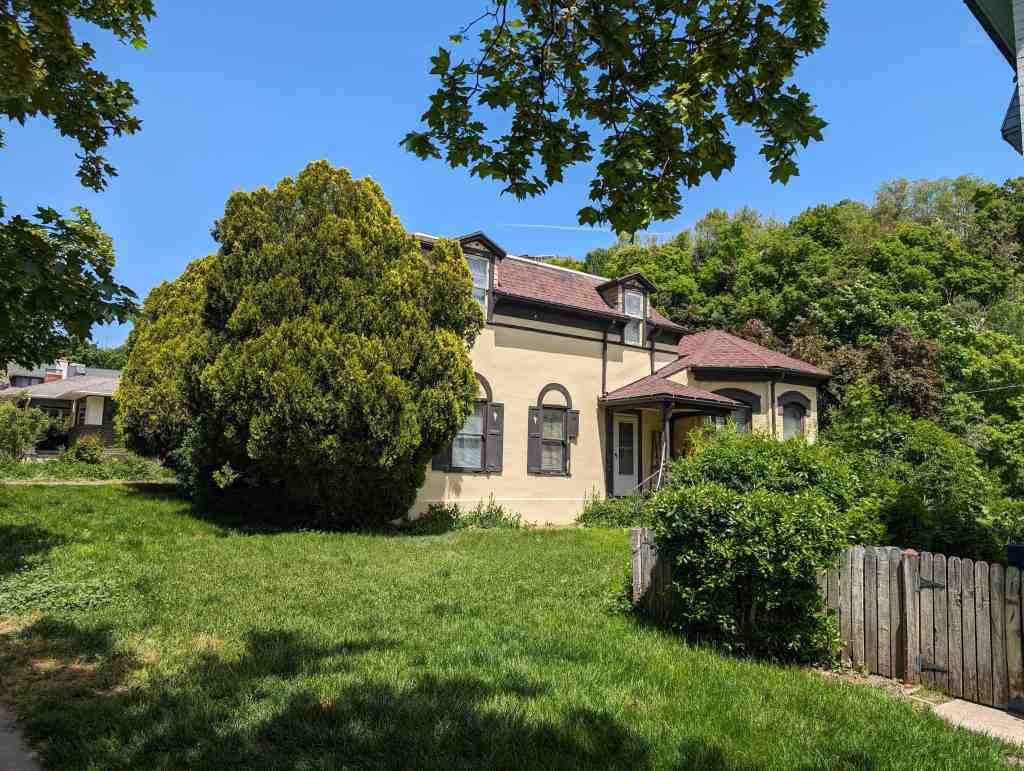
This one and one-half story house follows the French Second Empire style with eclectic variants. It has a mansard roof and two gabled dormer per side. It has a wide frieze with brackets. The Roman arched window bays with transom filled in. The architecture is similar to a style of houses in Ogden and Brigham City. There is an usually wide open wall area between the first and second windows. It is significant because it is an example of the Second Empire architecture.
It is hard to tell the original exterior wall treatment and the windows have phony shutters. The house is worthy of restoration.
This 1880 house is one of the best examples of French Second Empire architecture in Salt Lake. Helaman Pratt, the original owner, was a colonizer in several areas in the West. Later the house belonged to Franklin Richard Snow, a leading Salt Lake businessman.
This was one of the first homes in the City Creek area. It was built before Canyon Road came through so it faced downtown rather than on to a road like the rest of the houses.
Helaman Pratt, the original owner of this house, was born in Mt. Pisgah in 1847 as the Mormons were crossing the plains. He helped settle the Muddy River mission in Arizona and the Sevier area. He served two missions to Mexico, one in 1875 and one in 1883. He was made president of the mission in 1884. Pratt spent the rest of his life after there as a leader of the LDS Church in the Mormon colonies in Mexico.
Pratt acquired the property in City Creek in 1880 from Joseph L. Kinsburg who ran a mill in the area. Pratt lived in the house from 1880 until he went on his mission in 1883.
In the early 1890’s Pratt agreed to sell the house to Franklin Richard Snow, a son of Erastus and Artimesia Beman Snow. Snow had also served a mission to Mexico in 1883 and he might have met Pratt there.
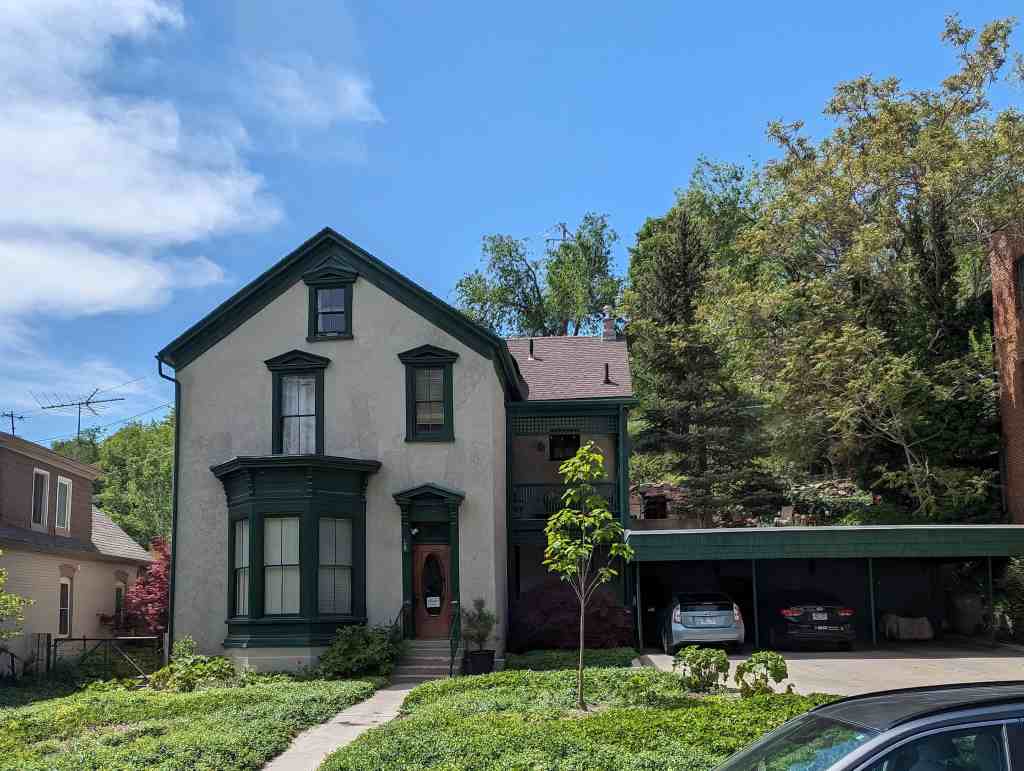
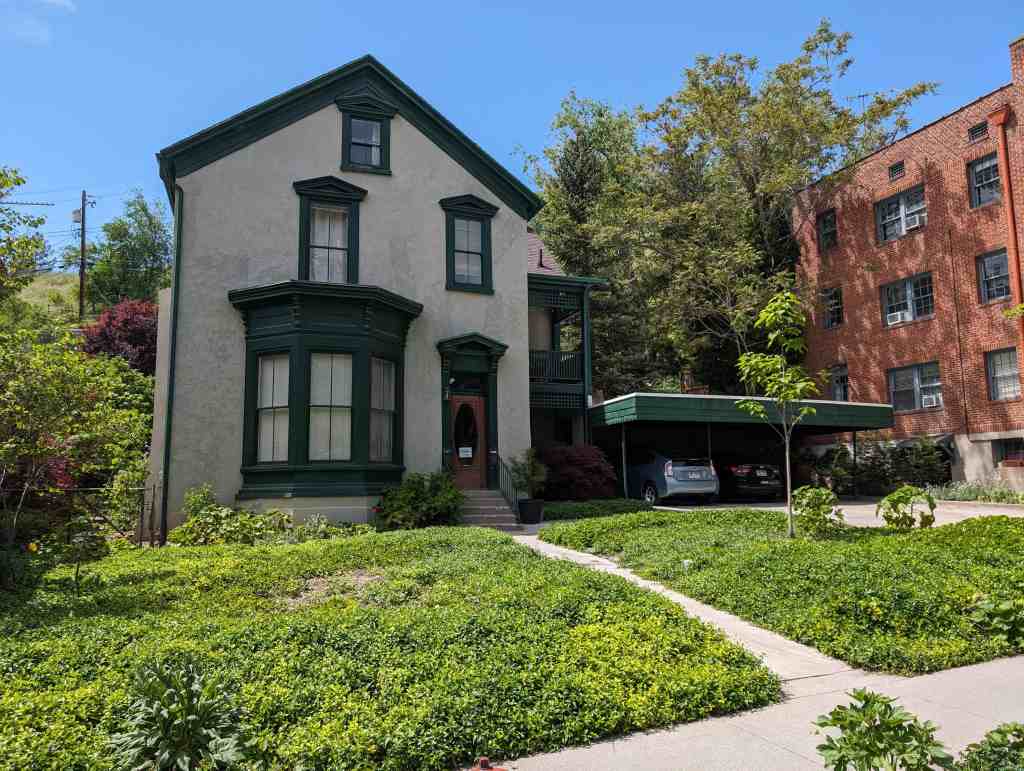
This two and one-half stone house is a good example of pre-Victorian high styled pioneer architecture. It has slanted bay windows with brackets and Greek Revival type wood lintel trim, quarter round windows in attic and plain frieze and cornice. There is an oval pane front door. The roof is gable and the plan is L-shape.
A carport has been added, and the stucco wall and two story porch are intrusions. But despite intrusions it is a good example of design and craftsmanship of the late pioneer period.
Erastus Snow, an early Utah pioneer and LDS Church apostle, built this home for his second wife, Minerva White. She was a close friend of his first wife, Artimesia Beman. The house, which was built in 1888, is a good example of pre-Victorian high styled pioneer architecture.
Minerva Snow was born in Massachusetts in 1822. She and her mother joined the Mormon Church when Minerva was eighteen years old. She married Erastus Snow on April 2, 1844. She came to Salt Lake Valley in 1848. In 1861, she went to Southern Utah with her husband and families. She served in the Relief Society in St. George.
She moved to Salt Lake and Snow built this house for her. She was a counselor in the Relief Society in the Eighteenth ward while she lived here.
Erastus Snow-came to Salt Lake in 1888 and stayed in this house. He was living here when he died May 27, 1888. Shortly after her husband’s death, Snow was called to go to Manti to work in the temple.
Franklin Richards Snow, son of Erastus and Artimesia Beman, lived in this home for a number of years until his home on the other side of Canyon Road was finished.
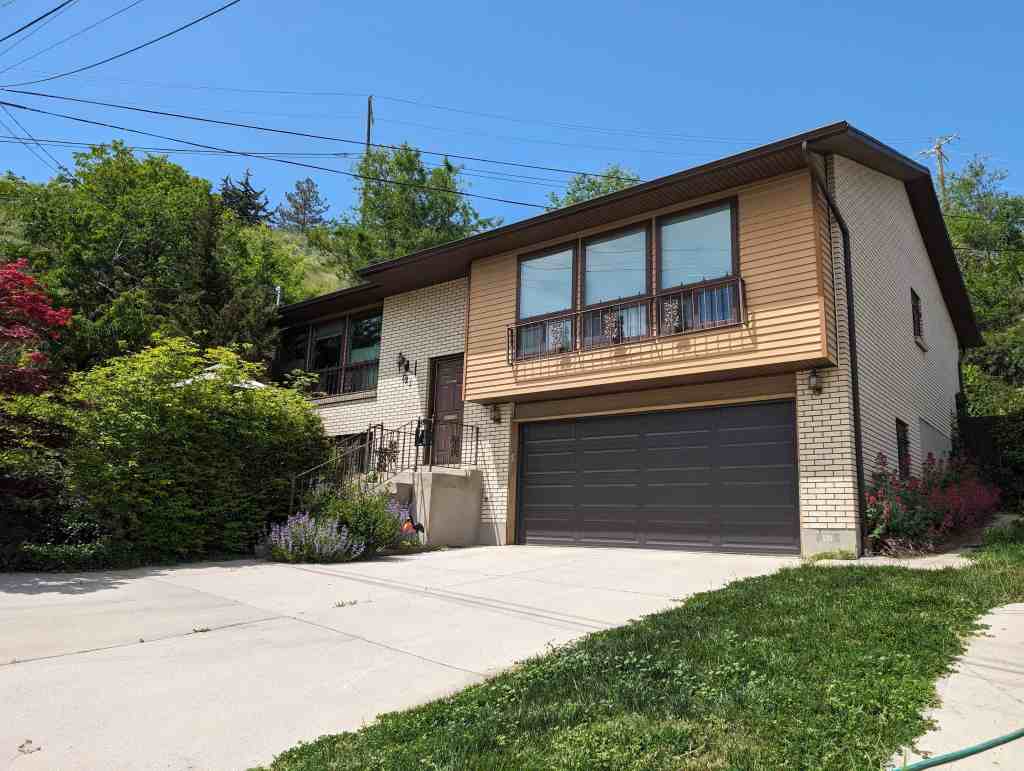
This one and a-half story house has been altered and siding added so it is hard to recognize. The roof is hipped.
This 1897 house pattern book house has been so altered that it is hard to recognize the original character. However, the general style still contributes to the historic character of the district.
Brigamina N. Pratt, the widow of Parley P. Pratt, Jr. lived in this home and rented the one next to it. She was a resident of Salt Lake City for forty years, and a Relief Society worker.
One and one-half story bungalow. The exterior walls have been stuccoed over and it may not be original.
This 1924 bungalow is typical of the houses built in Salt Lake at the turn of the century. Byron Dilworth Nebeker, the owner, was a judge and oil developer in Vernal before he moved to Salt Lake to work for the State.
Byron Dilworth Nebeker was born in Salt Lake City. September 23, 1872. He lived in Vernal and was a judge and oil developer there. When he returned to Salt Lake, he was superintendent of weights and measures. He was on the Utah Industrial Commission from 1932-1939.
The Pike Place Public Market district is of particular significance in several ways. It is a unique living heritage out of the city’s past as a food market begun by farmers in 1907 operated continuously since that time. It is also of special cultural significance as a low cost market place and because of the sociological mixture of all peoples frequenting the market’s shoppers, tourists, merchants and simply persons enjoying the market activity. Many ethnic and racial groups are represented without apparent conflict in the long honored tradition of the place.
It includes the American tradition of the small independent businessman operating with enterprise and with service and with personal involvement. There are approximately 180-200 businesses in the district – many of long duration.
The district was added to the National Historic Register (#70000644) on March 13, 1970, some of the places in the district are:
It is a source of education in several ways. Tours are conducted for children and visitors. Art classes use it as a resource – and a source of inspiration and study. In a larger sense it provides a rich educational experience of people and processes. It is the human environment and the reflection of daily experiences and possibilities for these experiences that is necessary and most important. The process of food preparation and of availability of local produce sold by the farmers who grow it provides an educational experience not to be found elsewhere.
“The Pike Place Market of Seattle is a particularly unique, colorful and justly famous sight that appeals to all of the senses. It is an unusual attraction of civic value to be cherished and guarded, as well as one of the most interesting and richly picturesque shopping places in the country, and it is always worth a visit. Its charm and appeal are undeniable although difficult to identify. People of all sorts, sizes, shapes, and complexions are part of the ever changing pageant of this place both as shippers and as merchants. Some of the nationalities that are united to form the market complex are represented in such places as a Turkish restaurant, Filipino souvenir shop, Italian grocery, Greek restaurant and beer parlor, and Japanese florist. The produce of the countryside is aggressively offered by the farmers themselves, who are mainly Japanese, Filipino, and Italian, still retaining their characteristic accents, and a number of excellent fish markets present an array of fresh sea foods. The various shops and services offer individual attention and at least the suggestion that every purchase is a bargain.” from “Seattle Cityscape”
“The market offers-an urban educational experience in the broadest sense by enabling people, and especially children, to see facets of humanity, activity, and aspects of the city not easily accessible elsewhere. Because there is no better place to shop for the best fresh produce, for out-of-the-ordinary foods and” for inexpensive goods of all kinds, the market is a prime shopping area for low-income people-its primary reason for existence-and for gourmets of eve economic level. Nowhere else is there to be found such a broad social mixture going about its business ‘in a natural and uninhibited way. People of all race all religions, all nationalities, and all income levels come together freely to work and shop, to linger and look and enjoy themselves in an easy atmosphere traditionally and necessarily free of prejudice. Here is the dramatic experience of people acting out their daily existence through face-to-face encounter and involvement, in contrast to the sterile, dehumanizing environment that has grown to be typical of much of our urban world.
The market area is the kind of environment where the new can be allowed to grow up alongside the old, without destroying it; where a variety of forms and functions can be accommodated, to the inestimable enrichment of the city and its people’.”‘ from “Market Sketchbook”
There are a few outstanding architectural buildings such as the Butterworth Building and the Landes Block. Of historic significance is the Union Record (now Alaska Trade) building. The Pike Place Public Market Riding, the Economy Market Building, the Corner Market Building, the Sanitary Market Building, the Market Hotel Building, and a few others form an interesting and varied market core.
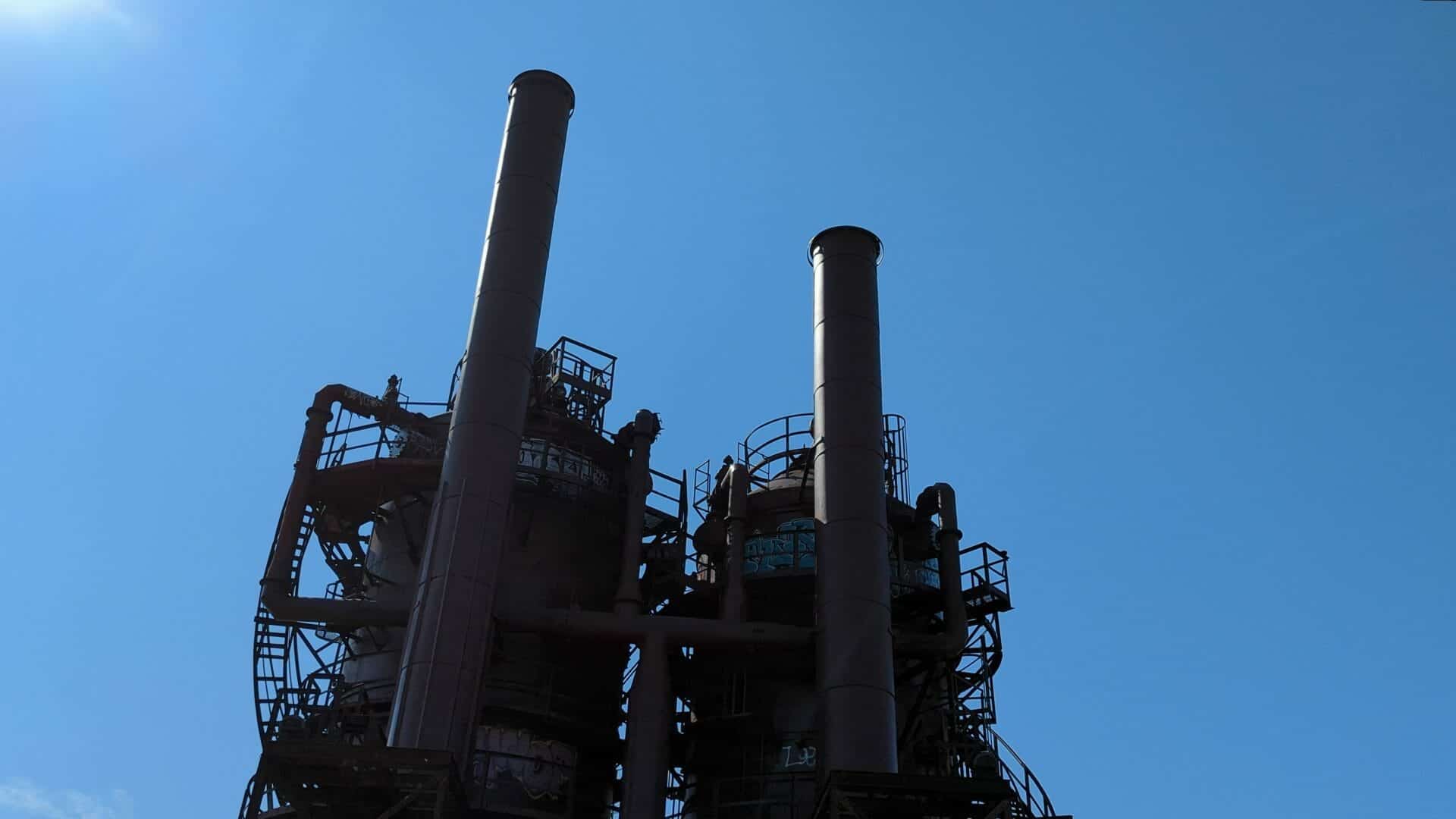
Gas Works Park is a ca. 20-acre public park located on the north shore of Lake Union at the south end of the Wallingford neighborhood. It is recognized in the National Register of Historic Places. Aside from the machines and structures of the former gasification plant, the location offers a stunning panorama of the Seattle skyline. If you can, wait till the lights start coming on at dusk!
History and Transformation
In the early 20th century, Seattle Gas Light Company purchased the land. They built a gas manufacturing plant in what was then a highly industrial area. At the time, it was the largest private utility in Seattle.
The plant produced illuminating gas, so-called because it was used for lighting. Later, the gas was also used for cooking, refrigeration, and heating homes and water. Hence, the origin of the park’s name — Gas Works Park. The gas was originally generated from coal. Production later switched to oil gas generators.
Gas production operations ceased in 1956. In 1962, the City of Seattle began purchasing the area. The transfer was completed and the park opened to the public in 1975.
The Play Barn
The building known as the Play Barn dates to the original coal-gas facility and was constructed of wood. It features the former pump house, ca. 7,340 square feet and boiler house, ca. 5,720 square feet. Their wood frames remain intact and in place on concrete slab foundations.
The former boiler house was turned into a picnic shelter. The tubes of one former boiler remain in place at the eastern end of the building. They are an impressive display of technology from days-passed.
The former pump house showcases most of its machinery still in place. It features pumps, piping and also its old 3,000 hp compressor. An old smoke arrestor hood has been refurbished as a play structure for climbing.
Kite Hill
Kite Hill offers stunning views and a fascinating history to its visitors. Thousands of cubic yards of rubble from old gas plant buildings were covered with fresh top soil, sewage sludge, and sawdust. What sounds gross at first was a successful early attempt of bioremediation. It is a natural way to decontaminate soil and groundwater. The area offered plenty of both from past days of gasification plant operation. Today, Gas Works Park is fully decontaminated and covered with lush green field grass.
Once visitors have reached the top of the hill, they are met by an unexpected artpiece — a sundial. It was created by two local artists, Chuck Greening and Kim Lazare. Their material of choice was concrete, which they delineated with rocks, shells, glass, bronze, and many other materials. The sundial tells time by using the body of the visitor as the gnomon. The viewer’s shadow tells the time of day and the season.
The site was added to the National Register of Historic Places (#02000862) on January 2, 2013 and is located at 2000 N. Northlake Way, Seattle, Washington
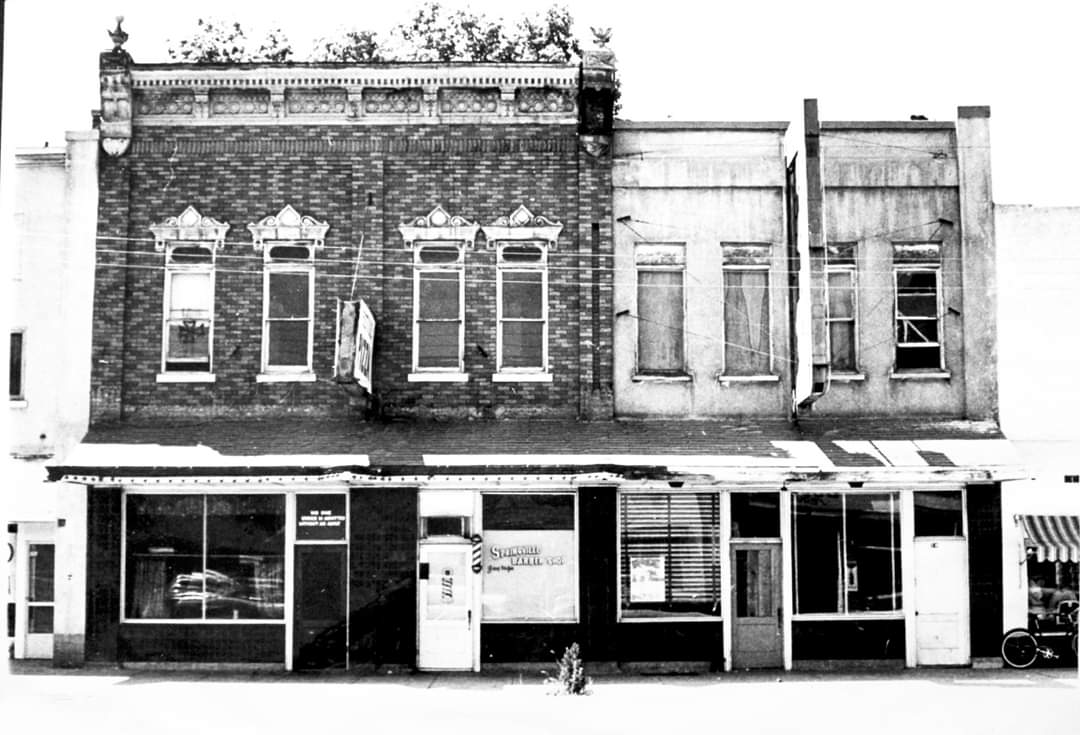
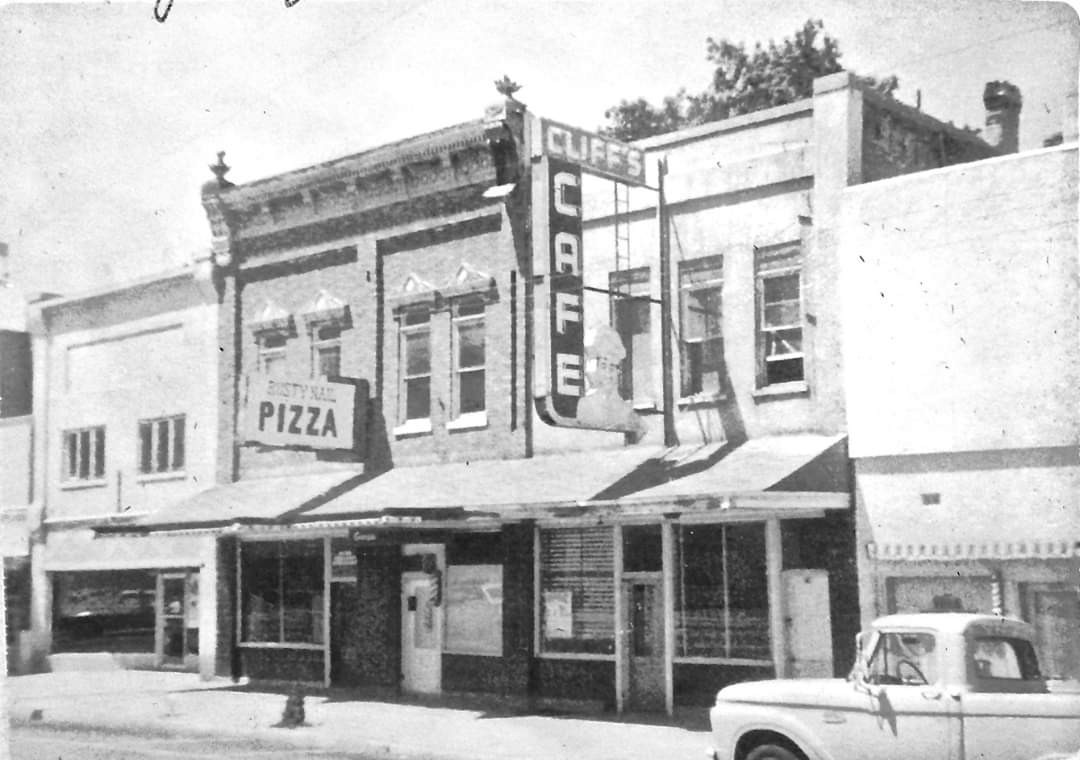
Moroni Miner Block Constructed in 1892, the two-story, two-part commercial block building was built by Moroni Miner following a mortgage of $800 he had taken out in May of that year. Miner was an early prominent citizen of Springville, who engaged in several businesses over the years, including a grocery and meat market, and worked as a farmer and stockman. In 1897 Miner sold the building to William Endar, who in turn sold it to Hyrum Straw in 1899. In 1903 Straw sold the building to Thomas E. Child, along with the building next door at 274 South Main Street. In 1923 the building was acquired by Ellen R. and Maud Peterson and owned by members of the Peterson family until 1977. A variety of businesses occupied the building until it was purchased in 2001 by W. William Brown, Jr., and Marilyn Brown to house Bill Brown Realty.
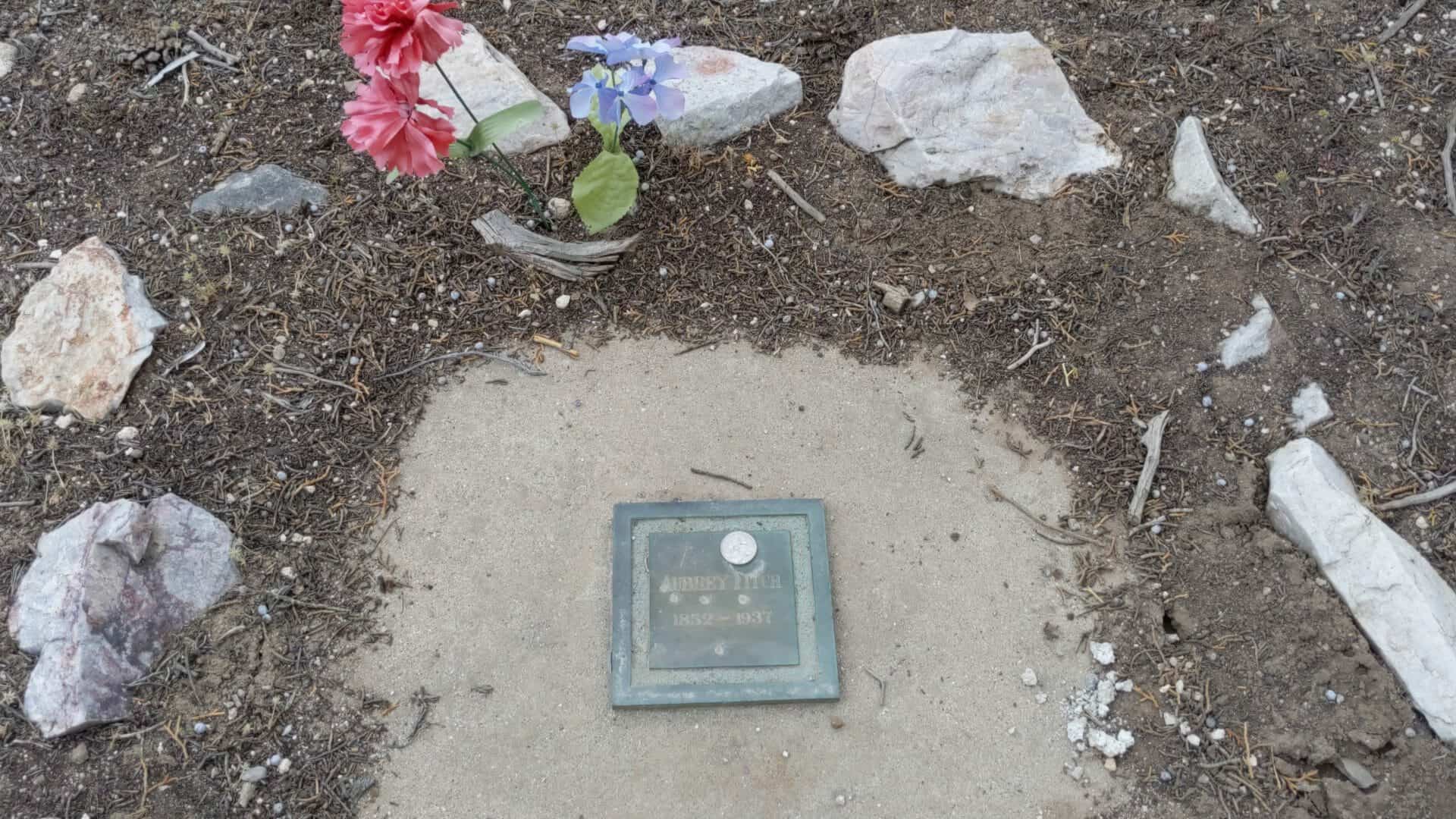
Established in the 1920s, the Fitch family cemetery is unique and significant for its role as a private cemetery for a mining entrepreneurial family and is located near the family’s historic mine, mining headquarters, and residence.
Approximately one-half acre in size, it is designed in the form of a circle and features a wrought iron fence, a stone pathway, and a surrounding rock wall. As members of the Catholic faith, the Fitch family also had an altar for saying Mass and places to kneel built at the cemetery. Several members of the Fitch family are buried at the cemetery, and it continues to function today as the family cemetery.
This cemetery is listed on the National Register of Historic Places. (#79003471)