Tags
Price Theatre
28 Tuesday Feb 2023
Posted in Uncategorized

28 Tuesday Feb 2023
Posted in Uncategorized
Tags
28 Wednesday Dec 2022
Posted in Uncategorized
02 Friday Dec 2022
Posted in Uncategorized
Tags

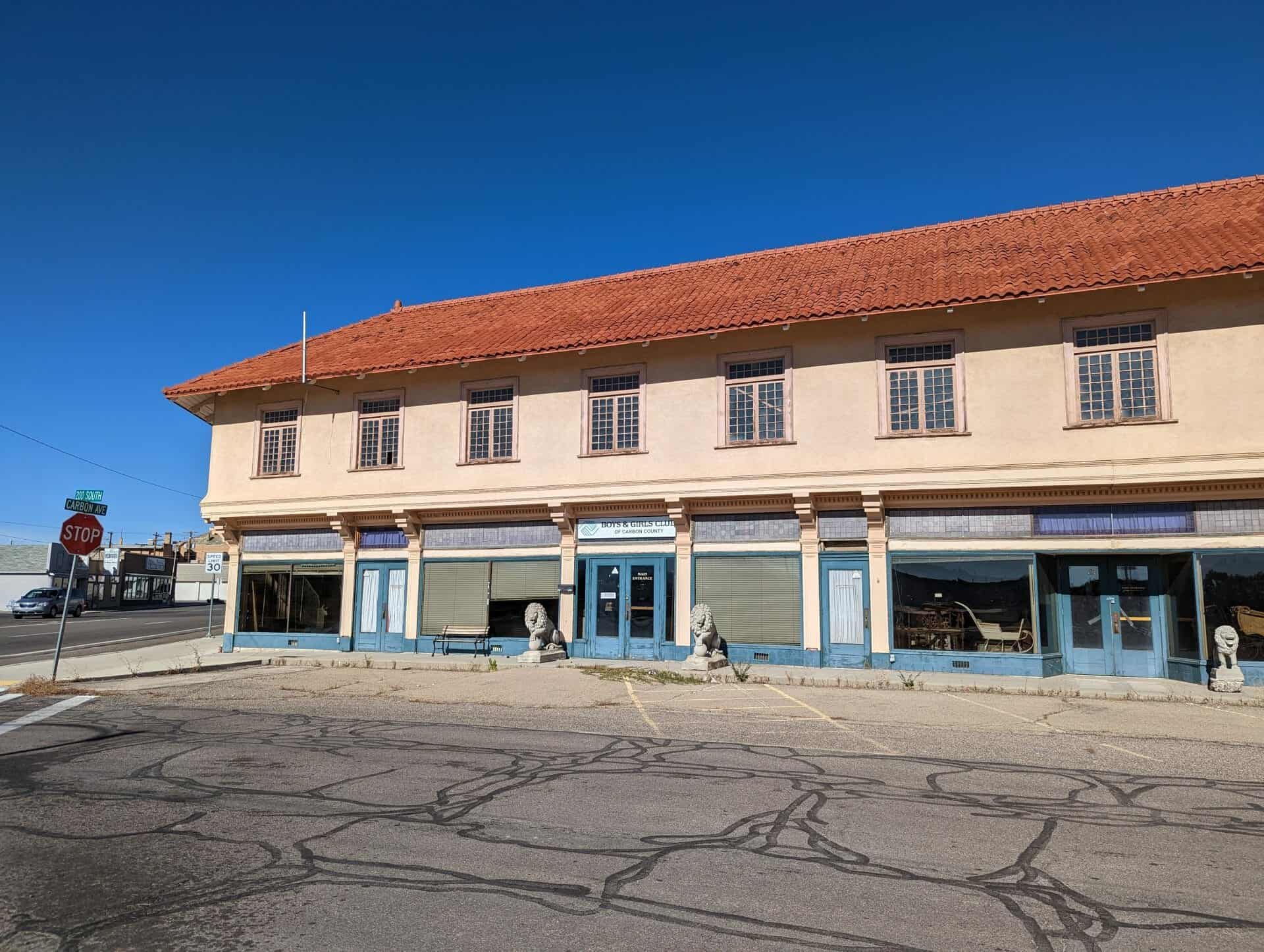
Price Tavern/Braffet Block
The Braffet Block or Price Tavern is important to the history of Eastern Utah for several reasons. Its original owner, Mark P. Braffet, was a prominent Utah lawyer. During its early history, the Price Tavern was one of the most prestigious Utah hotels outside of Salt hake City. The building is also of significance because of its association with the Denver and Rio Grande Western (D&RGW) rail passenger service. As a primary rendezvous point for wholesalers and retail businessmen, the Tavern was also important to the commerce of Southeastern Utah. Architecturally, the building reflects the adaptation to problems posed by an unusual frontage configuration and represents an interesting adoption of the “Mission Style” of architecture.
Located at 107 South Carbon Avenue in Price, Utah and added to the National Historic Register on (#78002653) August 11, 1978. (the text on this page is from the nomination form for the NRHP)

Mark P. Braffet, the original owner of the Braffet Block, was born in Pawpaw, Illinois, April 12, 1870. During his early twenties, he moved west working as a railroad telegrapher. In 1892, he arrived in Utah, eventually settling in Scofield as an agent. Braffet married Hannah Johnson of Spanish Fork in 1893 and became the first person to be elected to the post of Carbon County Clerk. During his term as Clerk, Braffet studied law,,-and was admitted to the Utah Bar. He practiced in-Price-until 1900, when he was employed as attorney for the Utah Fuel Company at Salt Lake City. During his seventeen year association with Utah Fuel, Braffet became known for his handling of the damage claims resulting’ from the Scofield mine disaster of ‘May 1, 1900, and for his defense of the company during the famous land fraud case of the/United States vs. the Utah Fuel Company in 1907 – 1909. It was also during his association “with the company that Braffet commissioned the construction of the Price Tavern Building.
On April 22, 1911, Mark Braffet purchased the land upon which he planned to build his hotel from John and Christine Crockett of Price for $4,200.00. Since Braffet made this purchase at least a full six weeks prior to the public announcement of the location of the new D&RG passenger depot, it is very possible that his association with Utah Fuel (which was a subsidiary of the D&RG railroad) provided him with advance inside information which allowed him to acquire this valuable property before general knowledge of the depot location increased its value. In any event, in August of 1911, Braffet announced his intention to build a new saloon and hotel, stating that with the construction of the new depot nearby, the building should be a very profitable investment.
On September 22, 1911, it was announced that a contract for the construction of the building had been let to Eckert and Holmes, contractors of Price and Salt Lake at an estimated cost of $25,000 to $30,000. Regarding the building from the Carbon County News reported:
“It will be two stories and basement, with high ceilings and airystone rooms on the ground floor. The second floor will be fitted up for a modern hotel with office, parlors and fine sleeping rooms. The building will be equipped with a modern heating plant and all other modern conveniences. That it will be a credit to the city and will be a profitable investment to Mr. Braffet goes without saying.“
The formal opening of the Braffet Building was held on Saturday night, February 17, 1912. The grand opening featured dancing to an orchestra Braffet had brought in from Salt Lake. The pool hall and hotel portions of the building were also opened as well as the “Tavern Café,” and the people of Price “became acquainted with the first really first-class dining room this city has ever had.”
One week after the formal opening, the “Price Tavern Café” began running advertisements in the Carbon County News. According to the advertisements, the proprietors of the café were “Johnson Bros. Athanus Co.”. Lunch counter meals were 35¢, dinners were 50¢, and on Sunday a special chicken and lobster dinner was featured for 75¢. Oysters, clams, lobsters, and trout were shipped in each day on ice by express train.
Because of the connecting north-south wagon roads, the tavern and nearby railroad depot served not only the Price region, but also the Emery County towns to the south and the Uintah Basin region to the northeast. Local informants indicate that the tavern was an important regional rendezvous point. Wholesalers would use the basement of the building to exhibit their merchandise to the retailers who would come in from the surrounding regions. The tavern was also a prestigious overnight stop for train passengers, as well as a favored local meeting point. The fact that Braffet was president of the Salt Lake mining exchange “about 1915” and had extensive holdings of mining properties in Eastern Utah, augmented the popularity of the tavern building as a meeting place for mine owners and operators.
However, within 10 years of the tavern opening, the prestige and importance of the establishment began to decline. In 1925, Mark Braffet and wife, Hannah, mortgaged the Ta ern Hotel and the accompanying tract of land to Audrey Taylor of Moab, Utah for $10,000 for 10 years. On January 2, 1927, Mark Braffet died of pneumonia at his home in the Tavern Hotel at the age of 56. At that time, his son, Robert, was managing the establishment. Braffet willed the Tavern Hotel and accompanying land to his wife, subject to the outstanding mortgage.
of collection and on October 4, 1935, George Franz signed a release of the mortgage. On October 18, 1935, Carbon County purchased the Tavern Building from Hannah Braffet for use as “an infirmary suitable for housing and otherwise caring for indigents who are residents of Carbon County, Utah.” The purchase price was $12,799.49, broken down as follows: $5,299.49 cas , $5,000 to George Franz “as per Braffet-Franz escrow agreement,” and a promissory note to Hannah Braffet for $2,500. In addition, the County agreed to assume “general taxes due and/or delinquent upon said property amounting to the sum of $6,101.35.” When the building was purchased, Mike Pastriakakis was operating a beer parlor in a portion of the first floor. The building is still owned by Carbon County and county officials are formulating plans for its renovation.




01 Thursday Dec 2022
Posted in Uncategorized
Tags

US Post Office-Price Main
The Price Post Office is a well-preserved example of Neo-Classical architecture. Constructed in the early-1930s, the building represents the transition of Federal design from the Beaux-Arts tradition of the early-1900s to the modern and simplified design styles of the mid- to late-1930s. The building also symbolizes the efforts of local citizens in obtaining their first federally-constructed post office. Although the building received an addition to the rear in the late-1960s, the integrity of the original building has been maintained.
Located at 95 South Carbon Avenue in Price, Utah and added to the National Register of Historic Places (#89001998) on November 27, 1989.


The Price Main Post Office is a well-preserved example of a small town single-purpose post office in the Neo-Classical mode. In spite of the addition to the rear in the late-1960s, the original building retains good integrity. Although a Depression-era building, the design is strongly rooted in the Beaux-Arts tradition of the early Twentieth Century. It should be noted that the building was actually given appropriations prior to the onset of the Depression and preceded the massive public works projects of the Depression that were designed to assist local economies in time of eco- nomic emergency. Constructed in the early 1930s, the building retains the richness of detailing which was stripped from the federal buildings of the mid- to late-1930s. Distinguished by its ornate entry, arched window bays and limestone detailing, the building exemplifies the use of quality materials and fine craftsmanship by the federal government. The Price Post Office can be contrasted with the WPA-constructed Price Municipal Building (1938, NHR) and Helper Post Office (12 miles north, 1938) which typify the basic Classical form stripped of significant facade detailing. The building is locally significant under Criterion C.
30 Wednesday Nov 2022
Posted in Uncategorized

About 1000 ft. west of this spot is the site of the first cabin built in this valley in the summer of 1877 by Abraham Powell.
This marker erected by Explorer Troop #284
Nov. 1936 – Wm Campbell, SM.

Vincent Paul Anella Troop 296
Eagle Scout Project
Reestablished marker recognizing the first cabin built in Price by Abraham Powell in 1877. Original marker was at 600 South Carbon Avenue.
December 22, 2011
Price Centennial 1911 – 2011
Chase Greenhalgh, Scoutmaster

This historic marker is located at the 600 South Trailhead of the Price River Trail, approximately 600 South Carbon Avenue in Price, Utah.


30 Wednesday Nov 2022
Posted in Uncategorized

The Nine Mile Road
The road through Nine Mile Canyon was constructed in 1886 by the Buffalo Soldiers of the U.S. 9th Cavalry to connect Fort Duchesne to the railroad in Carbon County. Most of the stagecoaches, mail and freight passed through Nine Mile into the Uintah Basin, which lead to the development of the canyon and the small town of Harper, presently known as Preston Nutter Ranch. Harper’s population peaked by 1910. The arrival of the Uinta railroad rerouted traffic away from the canyon and Harper became a ghost town by the early 1920’s.
This historic marker is located at the 600 South Trailhead of the Price River Trail, approximately 600 South Carbon Avenue in Price, Utah and was dedicated by the Matt Warner Chapter 1900 of E Clampus Vitus on July 9th, 2011 (6016)

30 Wednesday Nov 2022
Posted in Uncategorized

First Cabin on Price Town-Site
This cabin, believed to be the oldest on Price Townsite, was built by Leander Clifford in 1884. The Daughters of the Utah Pioneers purchased the home in 1928 and moved it to the Price Tabernacle site where it was used as an historical relics hall. It was moved to this site approximately 1936.

This historic marker is located in Pioneer Park in Price, Utah and was dedicated by the Utah Outpost Mountain Charlie Chapter No. 1850 of E Clampus Vitus on July 26, 1980.


29 Tuesday Nov 2022
Posted in Uncategorized

Grames Cabin
This cabin, believed to be one of the oldest in Castle Valley, was built on Gordon Creek by Albert Grames in the early 1880’s. It was moved to Price in the year 1900 and used as a Grames family residence until 1964. Albert Grames, in addition to being one of the first settlers in Castle Valley, was also the first mail carrier and worked in many public service capacities including sexton. The cabin was restored on this site by Utah Outpost in 1985.
This historic marker is located in Pioneer Park in Price, Utah and was dedicated by the Utah Outpost Mountain Charlie Chapter No. 1850 of E Clampus Vitus on August 3, 1985.
This historic marker by the D.U.P. is also on the same cabin:


29 Tuesday Nov 2022
Posted in Uncategorized
Tags

Pioneer Park in Price, Utah
Historic Markers in Pioneer Park:


10 Thursday Nov 2022
Posted in Uncategorized

The Assumption Greek Orthodox Church
Organized and built by the Greek immigrants of Carbon County. Dedicated August 15, 1916 by Reverend Mark E. Petrakis. Built in traditional byzantine style.
The Hellenic Orthodox Church of the Assumption is located at 61 South 200 East in Price, Utah and it was added to the National Register of Historic Places (#73001861) on April 11, 1973.


The following is from the nomination form for the National Register:
The Hellenic Orthodox Church of the Assumption at Price, Utah was dedicated August 15, 1916. The Greek immigrant was the last of the Europeans to come to America and the church at Price was the thirty-third Greek Orthodox Church established in North and South America.
In 1900 there were only three Greeks in Utah, During the Carbon County coal miners’ strike in 1903-1904 Greeks were first brought into the Price area as strike breakers. By 1916 there were 3,000 young Greek men working in the coal mines of Carbon County.
“To the Mormons the Greeks were interlopers among the ‘white’ population; they were clannish, would not marry outsiders, and thought they were an exceptional people with the only true religion on earth…. The Mormons were also clannish, would not marry outsiders, and thought they were an exceptional people with the only true religion on earth,” (Helen Zeese Papanikolgs, Toil and Rage in a New Land, p.143.) The result was a clash of cultures which was intensified by the abuses suffered by the Greeks in the coal mines and camps.
Plans were drawn as early as 1912 for a Greek Orthodox Church, however it was not until August 15, 1916 that construction had been completed and the church was consecrated.
The leaders of the movement to construct a church were Stylian Staes, Emmanuel Salevurakis and Gust Pappas. In 1914 a church had been established in Helper. During 1914 the Greeks from Price met with those of Helper in an effort to convince them that there should be a permanent church building erected in Price, (The church services at Helper were held in a Greek Coffee House.) Eventually the Helper Greeks agreed to aid in the construction of a church in Price.
An attempt was made to secure the donation of a plot of land by Price City, however this was voted down by the Price City Council The land was finally purchased from Lars and Sadie Gunderson for $800.00.
On March 7, 1916 bids were opened for the construction of the church, Lars Gunderson had submitted the lowest bid, $11,336,00, for construction of the church without a heating plant, and the bid of $968,00 for a furnace.
On the day of consecration special trains ran from all the coal camps bringing men to Price for the celebration. They were met at the station by the Sunnyside Italian band which escorted the men to the church. The procession to the church was characterized by shouting and the shooting of guns for good luck to the church.
The church was very important to the Greek population of the county. It gave them a sense of security and stood as a symbol that they had made a permanent settlement. This encouraged the Greek men to send for their wives or, for the majority who were single, to request that Greek girls be sent over for them to marry. In the beginning most of the Greek men had come to America with the idea of earning as much money as possible and then returning to their homeland.
The construction of the church was also significant because it came at a time when foreigners, especially Southern and Eastern Europeans, were regarded as an inferior menace to America. In this respect the church served as a sanctuary for the Greeks from both the intolerance of the American public and the abuses of the coal mines.
The immigrants served by the church were an important element in Utah history sharing in strikes, labor wars, attempted lynchings, Ku Klux Klan attacks, mine explosions and accidents, the Depression and war. In their own way the early Greek immigrants who built the Greek Church of the Assumption were just as much pioneers as were the Mormons who came to Utah more than fifty years earlier.
The original church was of traditional Byzantine construction in which the dome rests on a square supported by four pillars with the nave of the church in the form of a cross. It was built of yellow colored brick with a foundation of cement.
In 1940-41 a new entrance, two towers on the outside front, and an inside balcony were added. The original wooden columns were replaced by four cast Corinthian columns.
A fire in 1945 caused considerable smoke and water damage. The altar and environs were badly marred. A new tableau was built and the Rev. Zoygraphos of Texas, a Greek priest and iconographer, was commissioned to paint new icons for the entire church to replace the original ones ruined by the fire.
The icons, religious images painted on panels, have been called the “Bible of the Unlettered.” They cover the iconostasion or altar screen. The central large figure on the middle door of the altar m screen, the Royal Gate, which slides open to reveal the altar, is of Christ the Arch Priest, while other icons always include Christ on the right, Virgin and Child on the left, etc. The second and third rows above show scenes from the life of Christ and the twelve Apostles respectively. There are icons on the two sides of the church, while the four pendentives depict the Evangelists: Matthew, Mark, Luke and John, The most awe-inspiring scene of all fills the concavity of the top of the dome and is a symbolic representation of God the Father, surrounded by an angelic host, holding the world in His left hand. The vertical walls of the dome are covered by portraits of Old Testament prophets and contain numerous round, stained and leaded glass windows; they cast a subdued, even light on the contents of the dome.
Another artifact of singular beauty is the massive brass and crystal chandelier which hangs by a huge iron chain from the center of the dome. It was a feature of the original church and the sum of $560 was raised for it by the Greek miners of Hiawatha, a coal mining camp of southwestern Carbon County. It was also extensively damaged by the fire, but was repaired and restored at a cost close to its original value.
In 1961 the church was again enlarged, however the basic integrity of the church has been maintained in spite of two remodelings and one fire-induced renovation. In fact, these programs have added to and enhanced the structure while producing much-needed space. On each side of the church are three of the original stained and leaded glass windows. Another is in the east end of the church behind the altar. A dozen of the original small, round, stained and leaded windows augment the sides of the dome. The size of the building as it now stands is 87 feet 8 inches long by 43 feet six inches wide.


