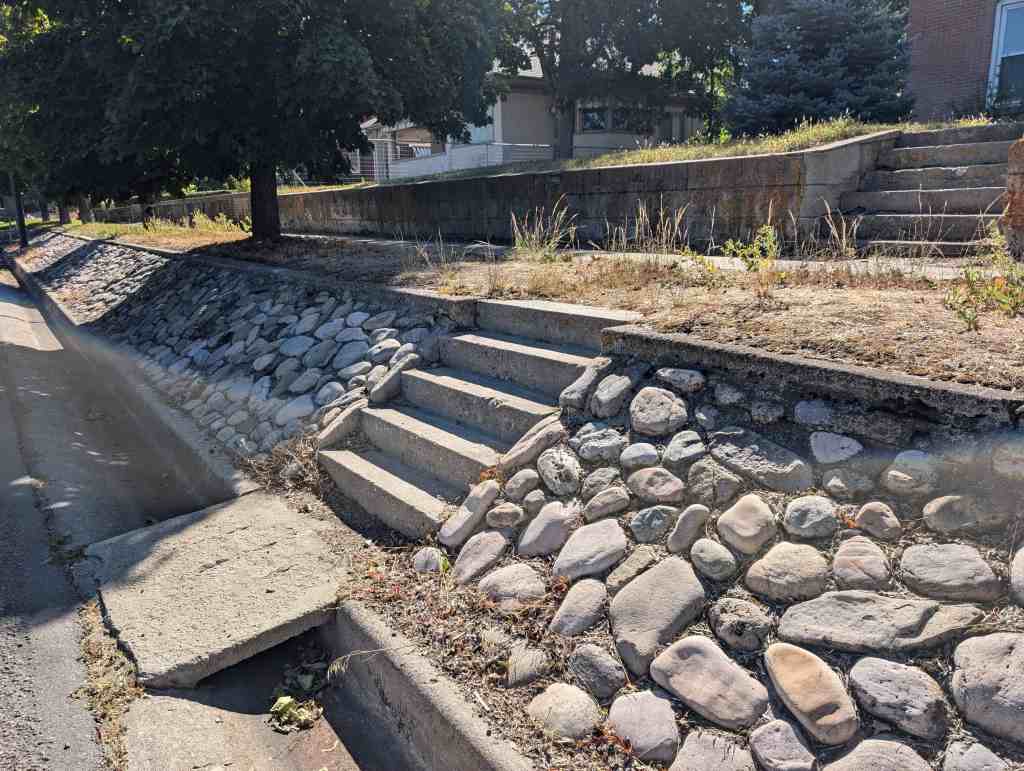
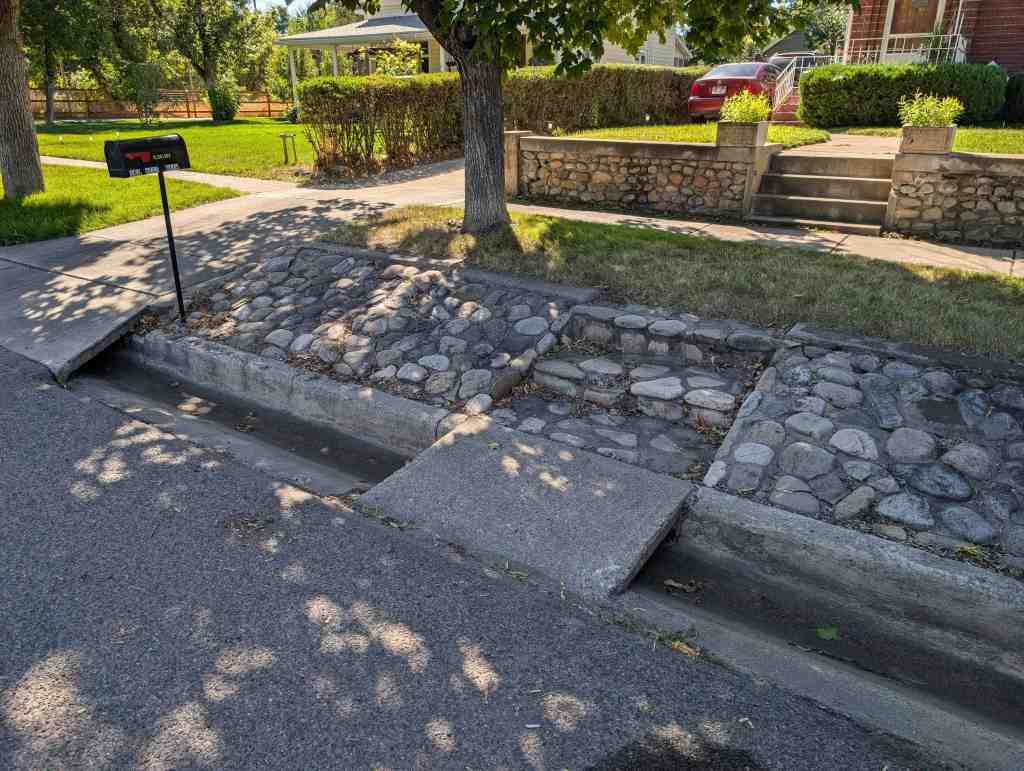
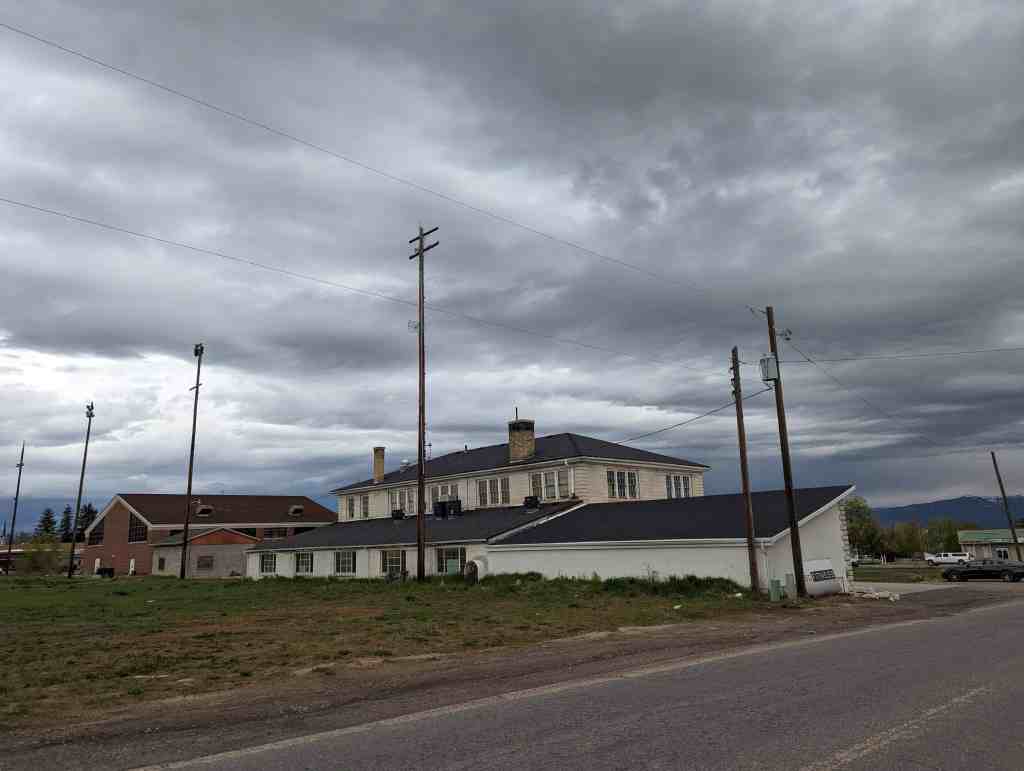
During the 1930s and 1940s, the Public Works Administration provided many projects all over our nation to provide employment for the people. In 1941–1943, Hyrum City took advantage of the opportunity to improve our Main Street and the cemetery under the PWA project. The PWA furnished all expenses and labor, the CCC boys did most of the ordinary work under the jurisdiction of the mayor and city council. The streets were oiled and on Main Street, curb and gutters were installed and the special rock walls were laid. T. W. Petersen hauled all the rock in his truck from Blacksmith Fork Canyon.
200 West to 100 West and 200 East to 300 East Main Street in Hyrum, Utah
Tent Chapel and School, circa 1899. When Mormon settlers came to Mesquite Flats in 1894, they designed the southeast corner of this block as the Public Square. It was a place where the community gathered for many events. At this site a tent was set up circa 1899 for use as a chapel and a school. It was 16′ x 16′ with no windows, no heat, a dirt floor, and only logs to sit on.
Block School, circa 1922.
The Block School, so-named because it was made of cement block, had four classrooms and an auditorium. It stood on the southeast corner of the block until it was replaced with a new campus in the 1960’s. The Church of Jesus Christ of Latter-Day Saints rented the schoolhouse for meetings and gatherings for several years.
Gymnasium, circa 1938.
This red brick gymnasium was built adjacent to the Block School and became the center of recreation for the community. The gymnasium was placed on the National Register of Historic Places in 1992. It represents Italian Renaissance REvival style architecture. Construction of the gymnasium was funded through the federal Public Works Administration (WPA) program.
This is Mesquite Historic Marker #9 (see others on this page) located at 51 East 100 North in Mesquite, Nevada.
The Mesquite High School Gymnasium was added to the National Register of Historic Places (#92000119) on March 10, 1992.
From the national register’s nomination form: The Mesquite High School Gymnasium is significant under Criteria C in the area of significance of Architecture. Built in the Italian Renaissance Revival Style, it is representative of the historic context “Schoolhouse Architecture in Southern Nevada’s Fifth Supervision District, 1870 to 1942.” It is significant as an example of its style as well as its rare use of terra cotta and tinted concrete brick. The Mesquite Gymnasium is illustrative of the School Support Building property type, and possesses the characteristics of that type in terms of its historic use, which reflected the expanding educational curriculums of the 1930s, and its functional design, which incorporated a central gymnasium with classrooms on the perimeter. The building is representative of the Custom Architecturally Designed Schoolhouse property type as well. It embodies the characteristics of that type in terms of the formality of its style, and the special attention paid to the spatial organization of the building’s uses.
School support buildings were important components of the expanding role of education that occurred beginning in the early 20th Century. Their function and necessary large size often required designs and methods of construction quite different from traditional school buildings. Almost always designed by architects, and usually in the formal styles, the school support building became symbolic, not only of educational reform, but also of community stature.
Funded by the federal Public Works Administration (PWA), the Mesquite Gymnasium was designed by Salt Lake City architect Miles E. Miller, and built by Salzner-Thompson, contractors. Miller also designed gymnasiums in the nearby towns of Bunkerville (1939) and Overton (1938) under the PWA program. The Mesquite Gymnasium exemplifies the public architecture sponsored by the federal relief programs of the Depression era. The federal government promoted subdued or minimal versions of the traditional styles associated with public buildings. Those styles were mostly drawn from Italian Renaissance or classical examples. They also promoted the use of modern, fireproof materials, particularly concrete and steel.
The design of the Mesquite Gymnasium illustrates that preference through its incorporation of elements of the Italian Renaissance Revival Style in a simple, straightforward manner. Stylistic features of the Mesquite Gymnasium that typify the Italian Renaissance Revival model are strict attention to symmetry at the principal façade, a division of the façade into three primary bays, and classical detailing of the cornice, entry frontispiece, pilasters, and doorways. The gymnasium entrance bay is designed with a pair of fluted classical pilasters flanking each side of the recessed, round arch doorway. The pilasters terminate at an ornate entablature and cornice that extends the length of the facade. Those elements are built of tan terra cotta. Although a common architectural product, its application on Southern Nevada school buildings is rare. The stylized frieze at the gymnasium eave is also decorated with terra cotta, in the form of medallions.
Aside from the application of terra cotta ornamentation and symmetry of the building, the design makes little additional reference to classical architecture. The balance of the gymnasium’s design is, however, in keeping with the concepts of minimalism, simplicity, and use of modern materials, as promoted by the federal government. Windows along the front of the building, which shed light into classrooms, are organized in groups of five and are tall, steel sash awning windows. Other windows are symmetrically located and also constructed of steel. Tall, arched windows along the rear wall of the gymnasium, now infilled, were also constructed of steel sash.
The use of brick-size, red-tinted concrete masonry units is regionally rare, but reflects the desire to use modern fireproof materials that simulated traditional clay brick. Although briefly popular during the 1920s and 1930s, the use of concrete brick was not economical and was soon replaced with larger concrete block, which required less material to manufacture and less labor to erect. The masonry work at the gymnasium is well detailed, with stepped back reveals at the building corners, and soldier courses at the water table and as a decorative band along the upper walls of the lesser facades.
Built in 1937, the Helper Civic Auditorium was designed by Salt Lake City architects Carl W. Scott and George W. Welch. The building is an excellent example of Art Moderne style also known as “Streamline Moderne.” The style was popular in the 1930s particularly in public buildings. The auditorium features Art Moderne elements such as the flat roof emphasized by concrete coping and coursing, smooth masonry with curved corners, glass block, and pilasters with abstracted capitals.
The Helper Civic Auditorium is part of the Utah Public Works Administration (PWA) and Works Progress Administration (WPA) Buildings Thematic Nomination. The building is significant because it helps document the impact of New Deal programs in Utah during the Great Depression. The Helper Civic Auditorium was one of 226 buildings (two of which were auditoriums) constructed in Utah during the 1930s and early 1940s under the WPA and other New Deal programs. Of those 226 buildings, 130 are still standing. On a local level the construction of the building was a boost to Helper’s economy by providing much needed jobs and funds through the purchase of building materials.
Built in 1935-36, the Hinckley High School Gymnasium is part of the Public Works Buildings Thematic Nomination and is significant because it helps document the impact of New Deal programs in Utah, which was one of the states that the Great Depression of the 1930s most severely affected. In 1933 Utah had an unemployment rate of 36 percent, the fourth highest in the country, and for the period 1932-1940 Utah’s unemployment rate averaged 25 percent. Because the depression hit Utah so hard, federal programs were extensive in the state. Overall, per capita federal spending in Utah during the 1930s was 9th among the 48 states, and the percentage of workers on federal work projects was far above the national average. Building programs were of great importance. During the 1930s virtually every public building constructed in Utah, including county courthouses, city halls, fire stations, national guard armories, public school buildings, and a variety of others, were built under federal programs by one of several agencies, including the Civil Works Administration (CWA), the Federal Emergency Relief Administration (FERA), the National Youth Administration (NYA), the Works Progress Administration (WPA), or the Public Works Administration (PWA), and almost without exception none of the buildings would have been built when they were without the assistance of the federal government.
The Hinckley High School Gym is one of 233 public works buildings identified in Utah that were built during the 1930s and early 1940s. Only 130 of those 233 buildings are known to remain today and retain their historic integrity. This is one of 107 public school buildings that were constructed in Utah, 55 of which remain. In Millard County 10 buildings were constructed. This is one of 6 that remain, and one of 2 school buildings remaining of 5 that were built.
The Hinckley High School Gymnasium was built between 1935 and 1936. It was part of a larger Public Works Administration (PWA) project that the Millard County School District undertook that included, in addition to this building, a mechanical arts building at Delta High School and a gymnasium at Millard High School in Fillmore. Total cost for the 3 buildings was $130,000. Construction on all 3 buildings began in the summer of 1935 and was completed by June of 1936. The architects of all three were Carl W. Scott and George W. Welch, and the contractors were Talboe and Litchfield.
Carl W. Scott and George W. Welch were both prominent Utah architects. Scott was born October 17, 1887, in Minneapolis, Kansas, and graduated in 1907 from the University of Utah with a degree in mining. He was given credit for the idea of the concrete “U” on the hill that is still above the university campus. Following graduation he began a career in architecture as a draftsman for Richard Kletting. In 1914 he became partners with George W. Welch. Welch was born in Denver, Colorado, on May 15, 1886, graduated from Colorado College, and came to Salt Lake City to begin work as an architect. Active in political affairs while here, he was a member of the Utah House of Representatives from 1919 until 1921. Among the buildings that Scott and Welch designed were Salt Lake City’s Elks’ Club Building, South High School, the Masonic Temple, and many public school buildings throughout Utah including Hawthorne Elementary School and Bryant Junior High School in Salt Lake, Park City High School, Tooele High School, Blanding High School, and Cedar City Elementary School. They also designed a number of commercial buildings including the N. O. Nelson Manufacturing Company Warehouse, the Nelson-Ricks Creamery Building, and the Firestone Tire Company Building, all in Salt Lake City.
Built in 1935-36, the Mount Pleasant High School Mechanical Arts Building is part of the Public Works Buildings Thematic Resources nomination and is w significant because it helps document the impact of New Deal programs in Utah, which was one of the states that the Great Depression of the 1930s most severely affected. In 1933 Utah had an unemployment rate of 36 percent, the fourth highest in the country, and for the period 1932-1940 Utah’s unemployment rate averaged 25 percent. Because the depression hit Utah so hard, federal programs were extensive in the state. Overall, per capita federal spending in Utah during the 1930s was 9th among the 48 states, and the percentage of workers on federal work projects was far above the national average. Building programs were of great importance. During the 1930s virtually every public building constructed in Utah, including county courthouses, city halls, fire stations, national guard armories, public school buildings, and a variety of others, were built under federal programs by one of several agencies, including the Civil Works Administration (CWA), the Federal Emergency Relief Administration (FERA), the National Youth Administration (NYA), the Works Progress Administration (WPA), or the Public Works Administration (PWA), and almost without exception none of the buildings would have been built when they were without the assistance of the federal government.
The Mount Pleasant High School Mechanical Arts Building is one of 233 public works buildings identified in Utah that were built during the 1930s and early 1940s. Only 130 of those 233 buildings are known to remain today and retain their historic integrity. This is one of 107 public school buildings constructed in Utah, 55 of which remain. In Sanpete County 18 buildings were built. This is one of 11 that remain and are relatively unaltered.
The building was constructed between 1935 and 1936 as a Federal Emergency Relief Administration (FERA) project. It was a duplicate of the Moroni High School Mechanical Arts Building that was constructed at the same time. The project was approved in November 1934; construction began in January of 1935 and was completed in April 1936.
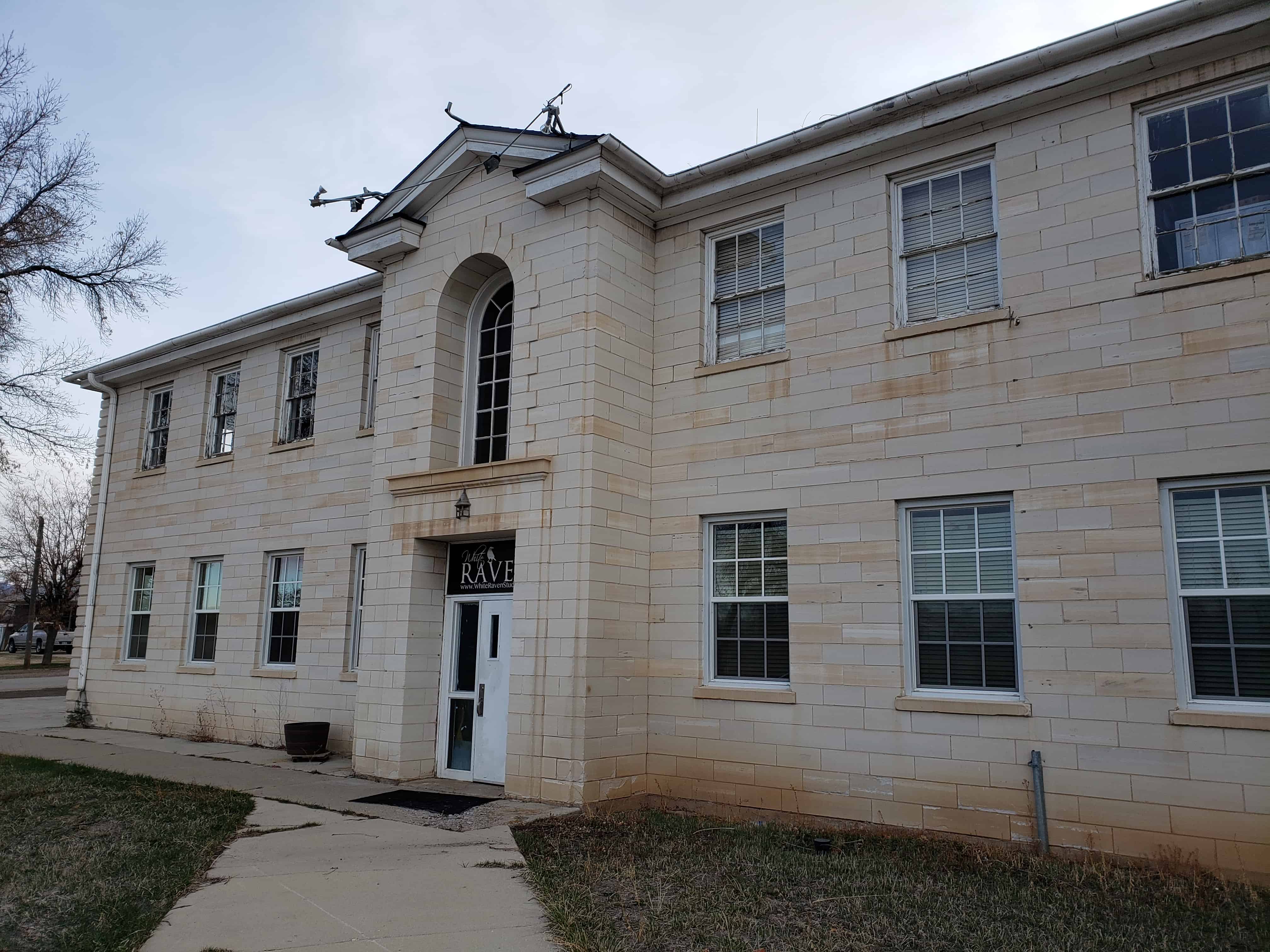
Located at 180 North State Street in Mt Pleasant, Utah
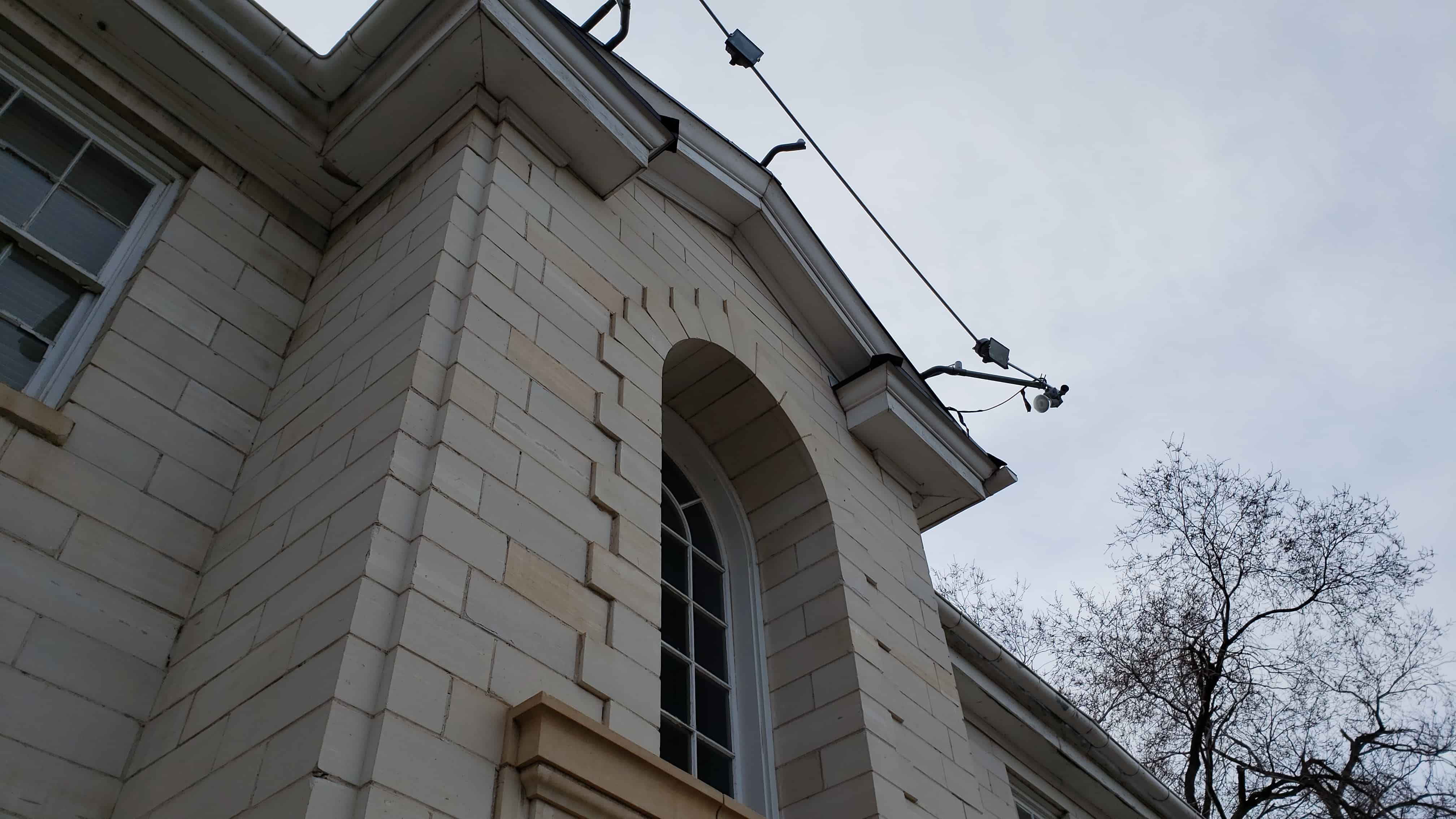
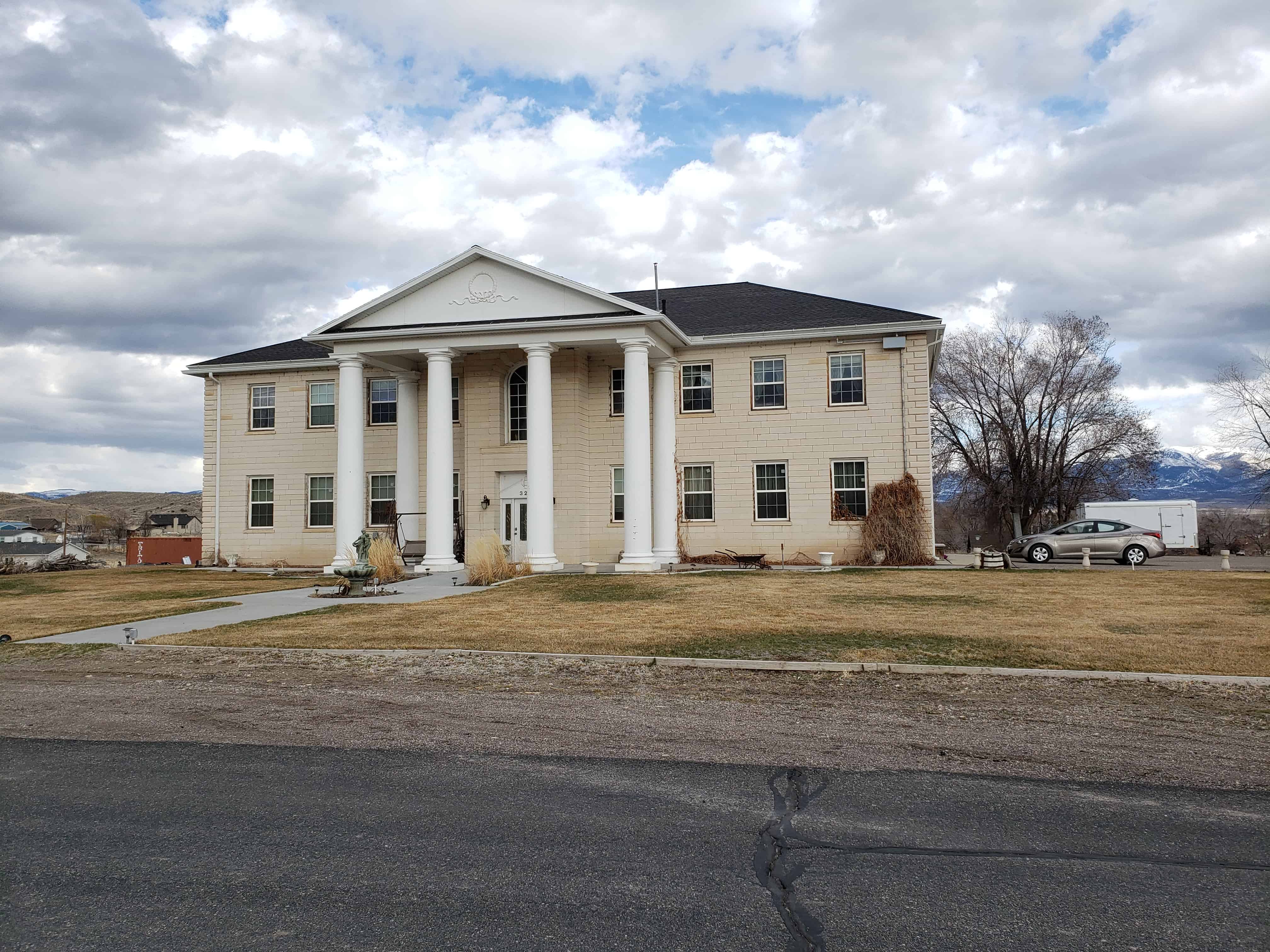
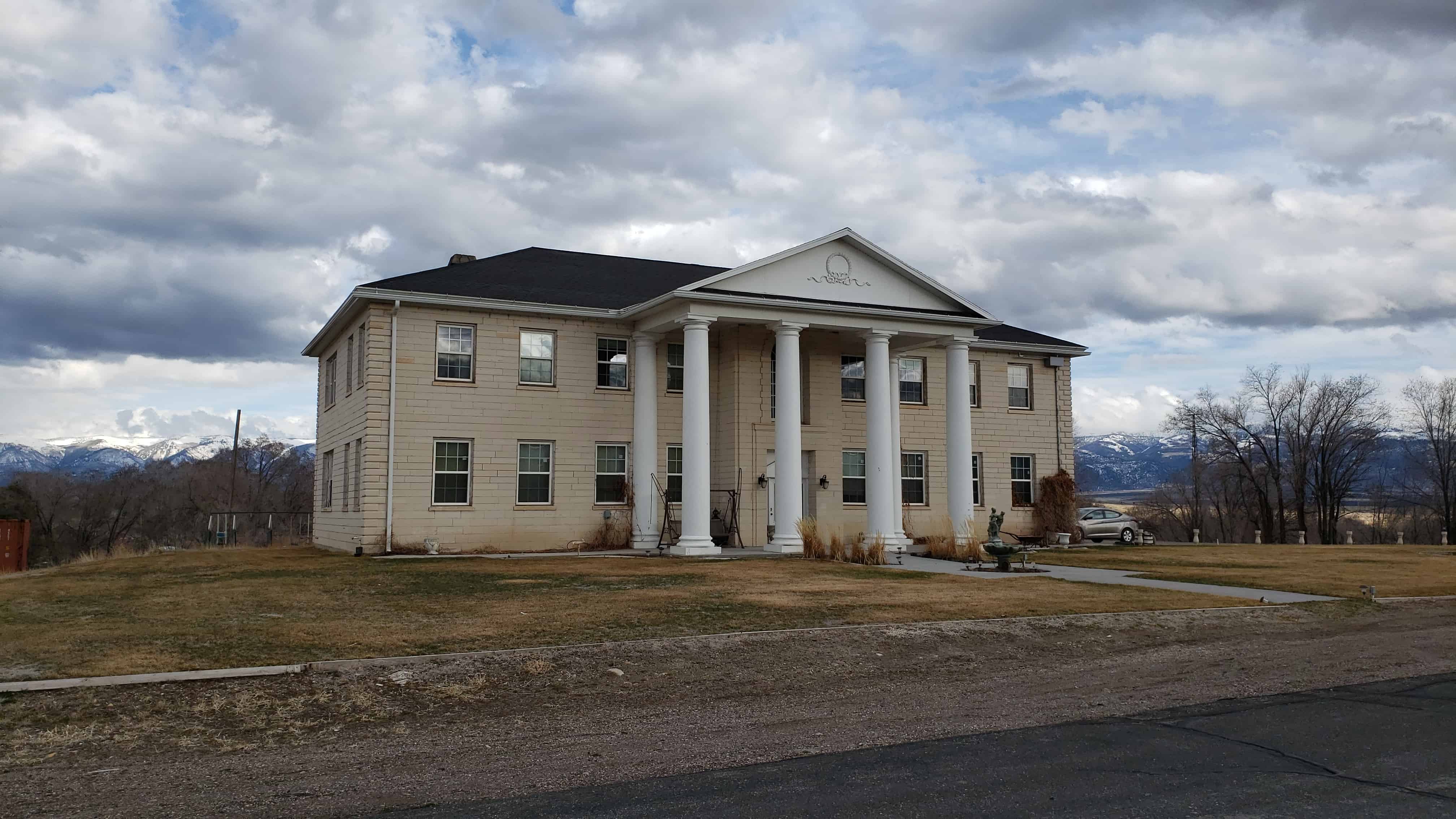
This building is one of three high school shop buildings constructed in Sanpete County using the same basic design. The other two are in Ephraim and Moroni, both of which are still standing and eligible for nomination. All three of these buildings are large, two-story box-like structures with rectangular plans and centrally placed two-story entrance porticos. The Mt. Pleasant building, like the one in Moroni, is built of cream-colored limestone and has a low-pitched hip roof. The openings are arranged symmetrically around the entrance bay which has a gable roof, heavy cornice returns, a round arch upper story window, and a molded cornice over the door itself. There are low-relief quoins at the corners. The building remains in good original condition.
Built in 1935-36, the Moroni High School Mechanical Arts Building is part of the Utah Public Works Administration (PWA) and Works Progress Administration (WPA) Buildings Thematic Nomination and is significant because it helps document the impact of New Deal programs in Utah, which was one of the states that the Great Depression of the 1930s most severely affected. In 1933 Utah had an unemployment rate of 36 percent, the fourth highest in the country, and for the period 1932-1940 Utah’s unemployment rate averaged 25 percent. Because the depression hit Utah so hard, federal programs were extensive in the state. Overall, per capita federal spending in Utah during the 1930s was 9th among the 48 states, and the percentage of workers on federal work projects was far above the national average. Building programs were of great importance. During the 1930s virtually every public building constructed in Utah, including county courthouses, city halls, fire stations, national guard armories, public school buildings, and a variety of others, were built under federal programs by one of several agencies, including the Civil Works Administration (CWA), the Federal Emergency Relief Administration (FERA), the National Youth Administration (NYA), the Works Progress Administration (WPA), or the Public Works Administration (PWA), and almost without exception none of the buildings would have been built when they were without the assistance of the federal government.
The Moroni High School Mechanical Arts Building is one of 233 public works buildings identified in Utah that were built during the 1930s and early 1940s. Only 130 of those 233 buildings are known to remain today and retain their historic integrity. This is one of 107 public school buildings constructed, 55 of which remain. In Sanpete County 18 buildings were built. This is one of 11 that remain.
The building was constructed between 1935 and 1936 as a Federal Emergency Relief Administration (FERA) project. It was a duplicate of the Mt. Pleasant High School Mechanical Arts Building that was constructed at the same time. The project was approved in November 1934; construction began in January of 1935 and was completed in April 1936.