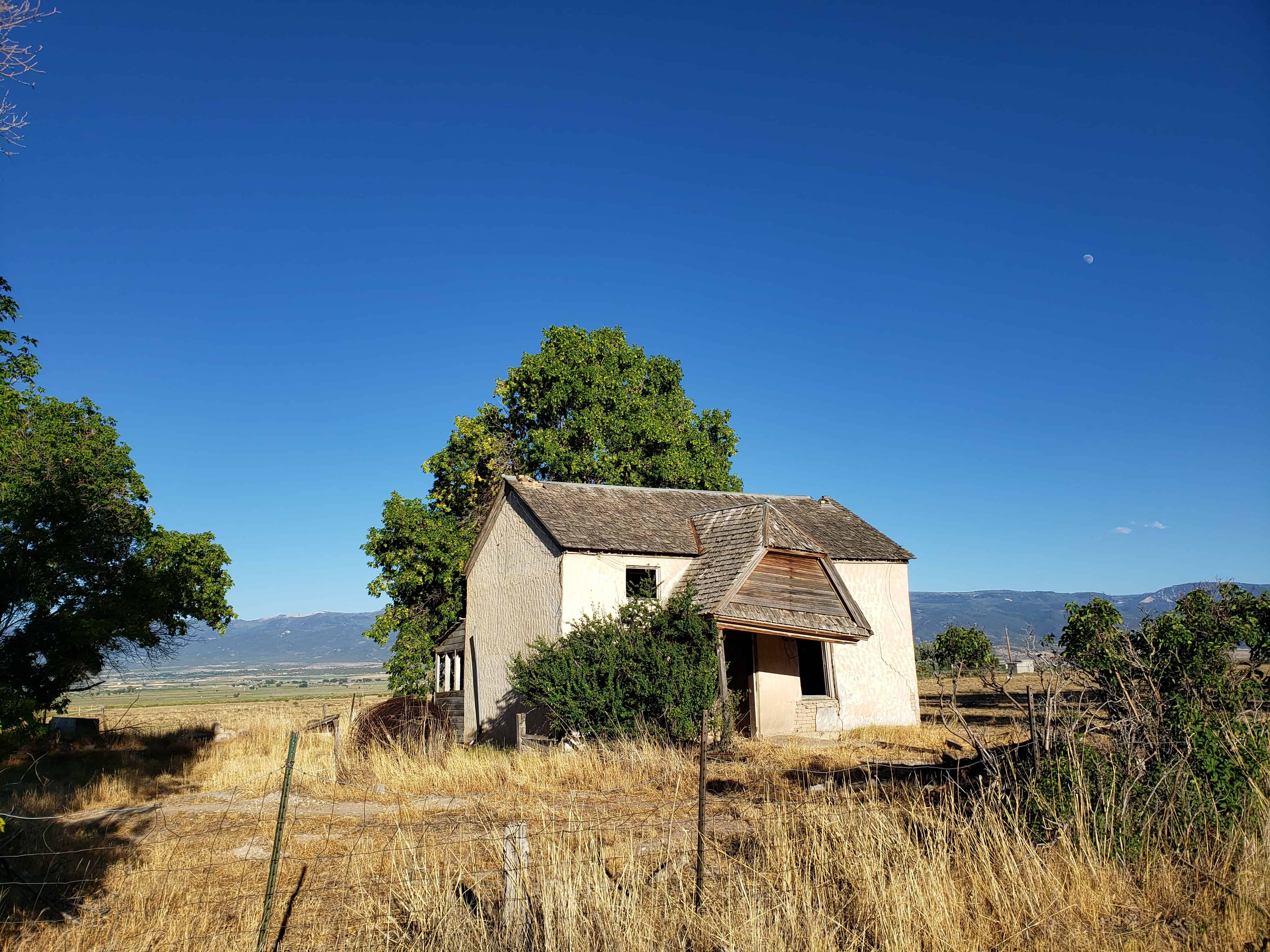
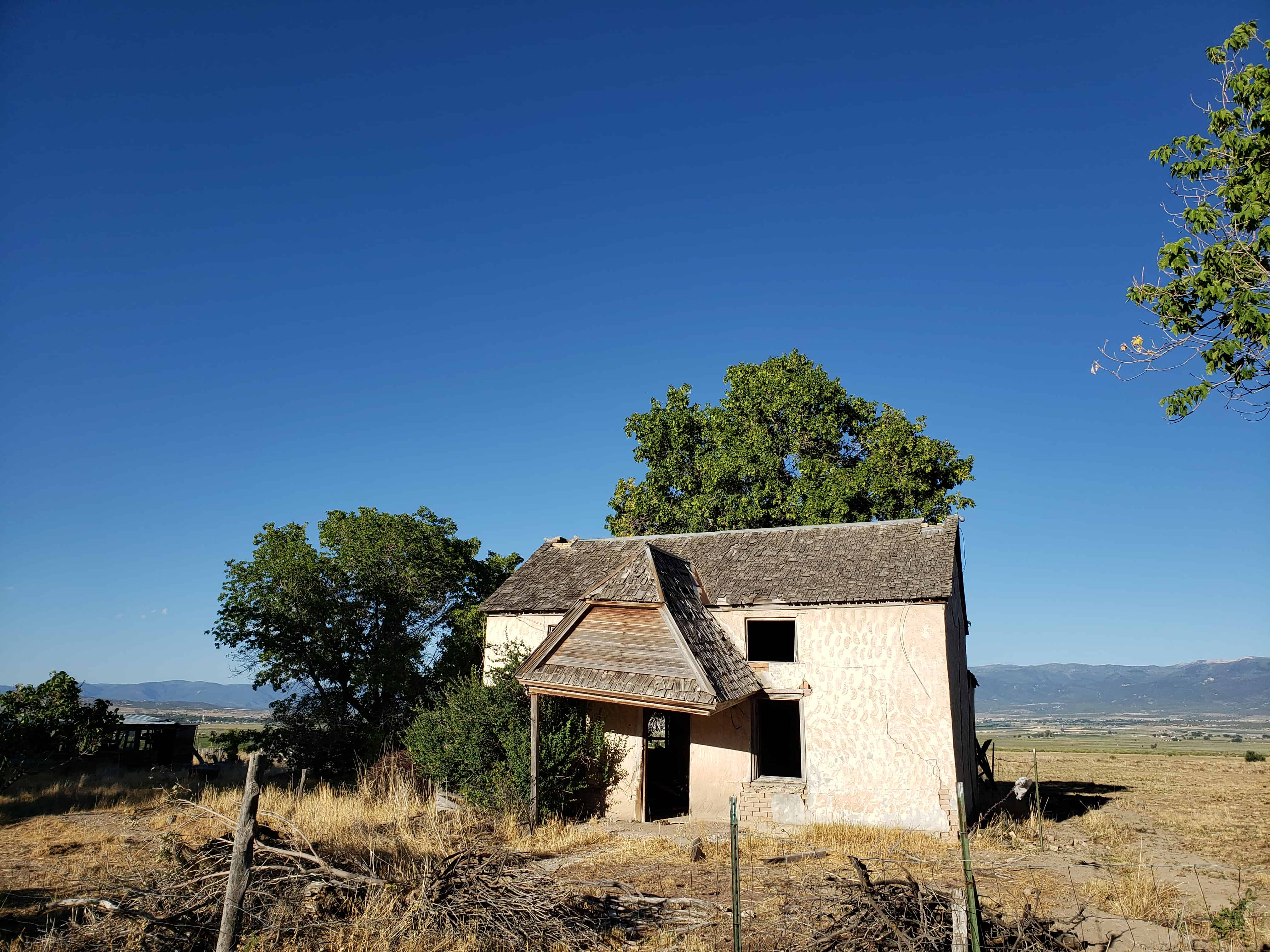
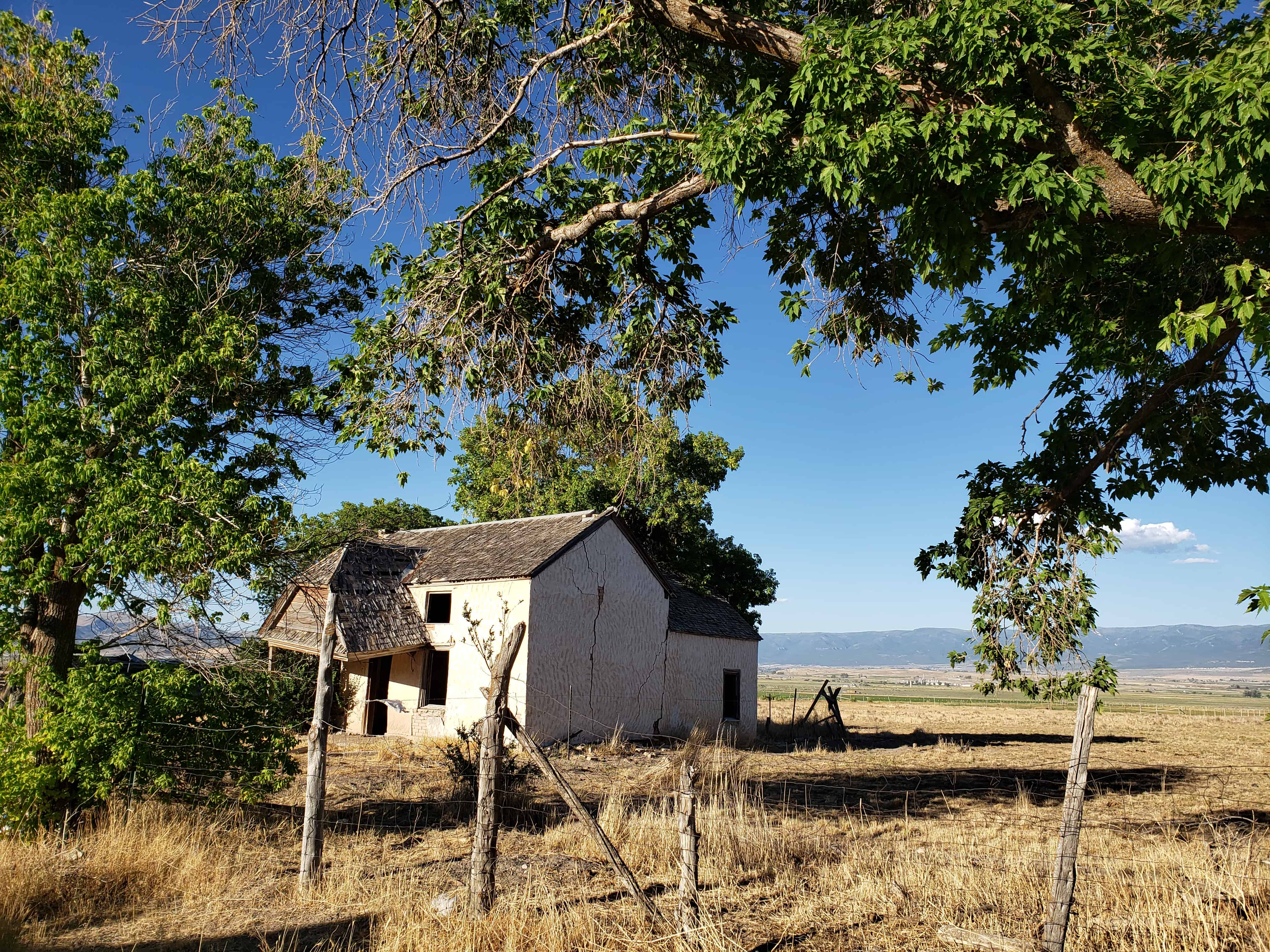
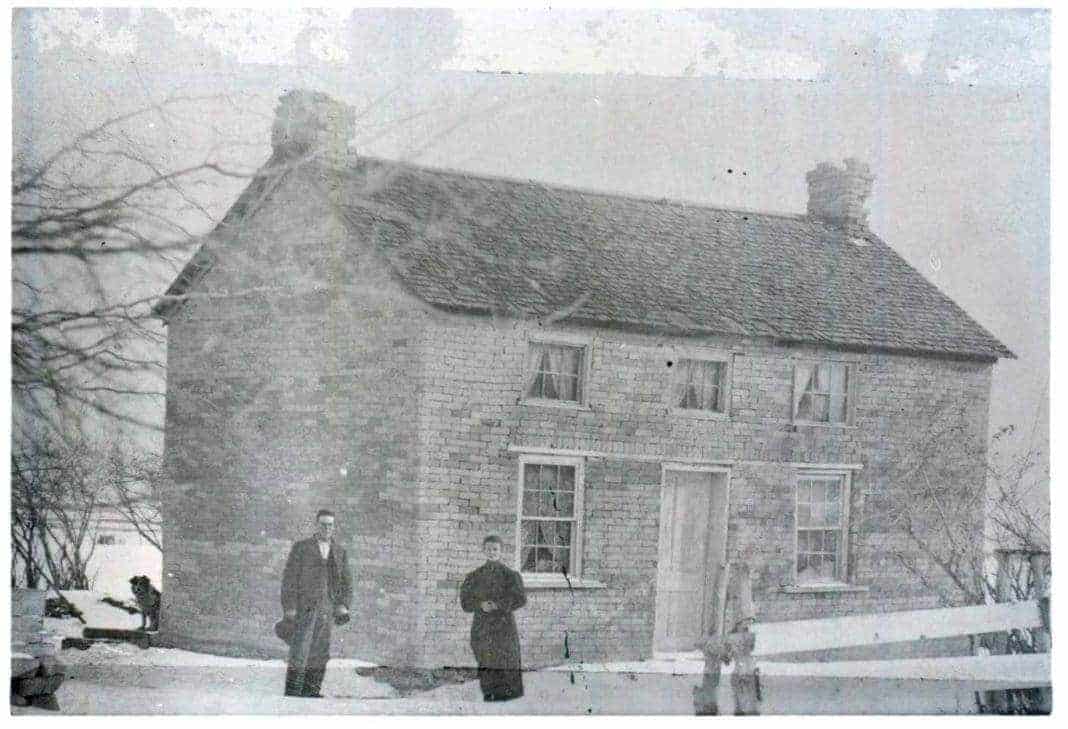
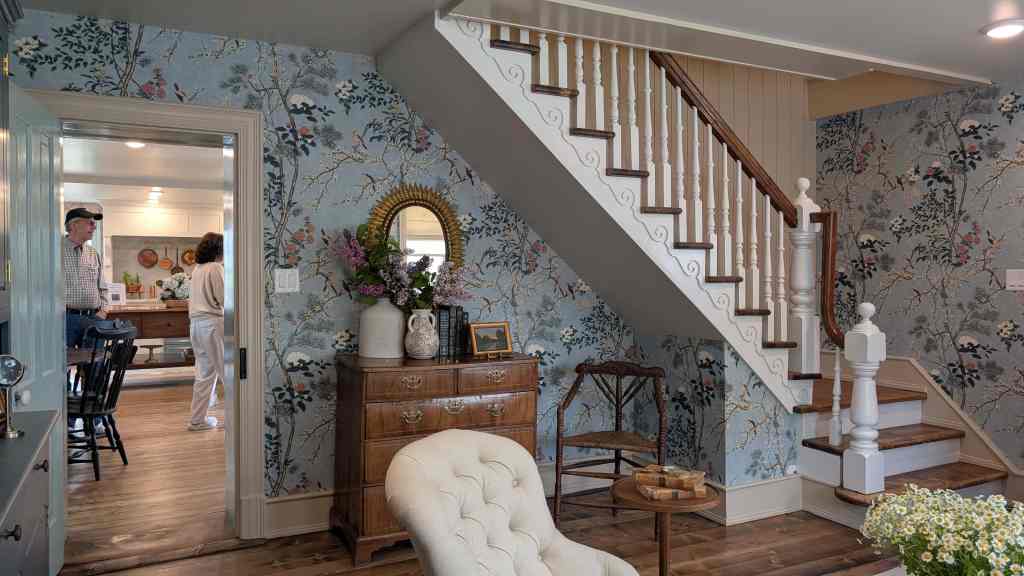
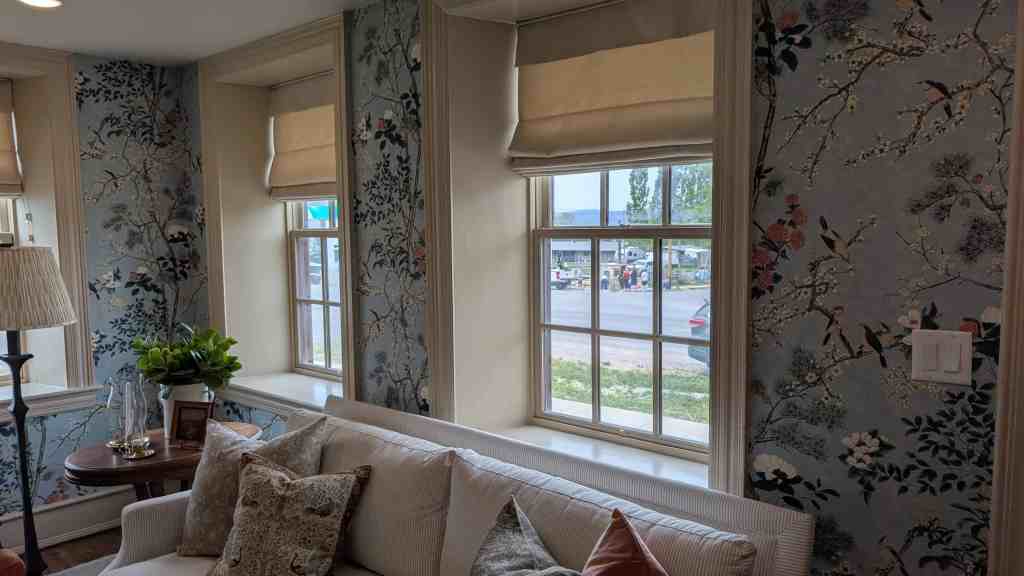
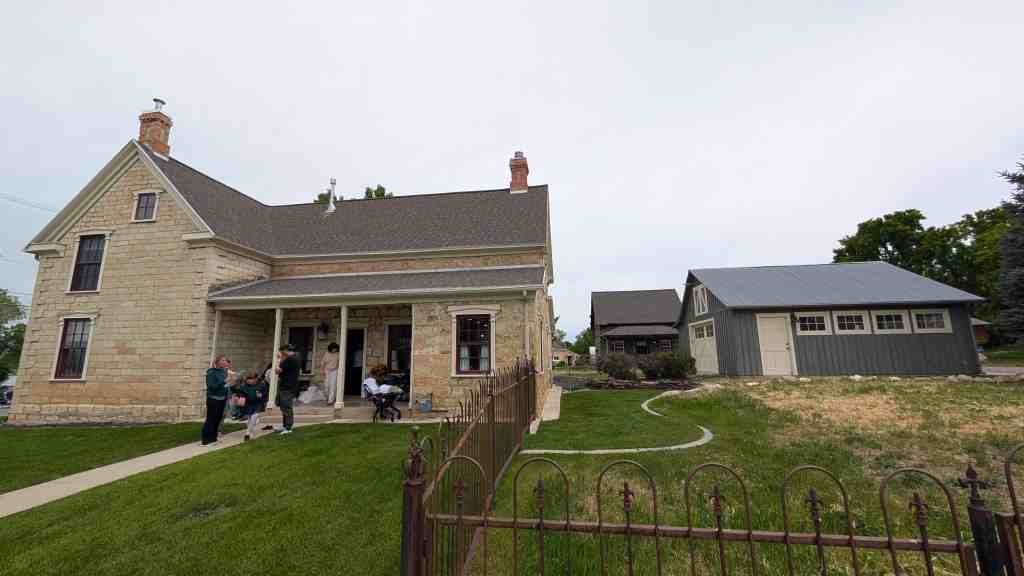
Lauritz Larsen built this one-and-one-half-story adobe hall-parlor house in the 1860s. The house was later stuccoed. Lauritz passed the house on to his son and daughter-in-law, Lauritz O. and Deseret Anderson Larsen. “L.O.” was a merchant, manager of the Young Men’s Co-op, and LDS Bishop from 1904 to 1913. The house was later occupied by the town music teacher Ernest B. Terry. Terry was the LDS Bishop from 1942-1947. The house was owned from the late 1970s to the late 1990s by the notable Sanpete County painter, Ella Peacock.
This small native stone house was built in 1860 for the family of Paul Kofford, a Danish convert to the LDS Church and early pioneer. The mason was Peter Olsen Hansen, who was paid a young steer and two dollars per day to work on the house. The house originally consisted of a large front room with a fireplace and two rooms at the rear. Small houses like this were common in Spring City, but few remain today.
One of Spring City’s earliest stone houses it was built for Paul E. Kofford (1813-1891) (aka Koffoed) by stonemason Peter Olsen Hansen (1850-1926). Kofford, a Dane, was as a translator between Scandinavian immigrants in Spring City and the English speaking pioneers. He had learned English during his early career as a sea captain. The house plan is uncommon with a front facing parlor followed by two rooms at the rear. Paul’s son Charles acquired the house and resided there for many years. The house was renovated and restored in 2005.
One of the better examples of a vernacular folk building in Spring City, this symmetrical one-and-a-half story Hall and Parlor house was constructed in 1873-74 by John Frantzen. An early convert to the LDS Church, Mr. Frantzen emigrated from Norway to Utah in 1857. Frantzen served a two-year church mission in Denmark, was a first counselor to the Spring City LDS Bishop for fifteen years, and he practiced polygamy – marrying two wives.
Located at 73 South Main Street in Spring City, Utah
This one and one half story hall-parlor house was built by John Franzten (1837-1905). It is one of the few remaining adobe houses along Main Street. A Mormon convert, Frantzen immigrated from Norway in 1857, settling first in Lehi, then Spring City in 1860. Active in the LDS church as first counselor to the Spring City bishop for 15 years, he was a practicing polygamist with two wives and served a jail term for cohabitation. It is likely that one room of the house served as the first store in town.*
Local carpenters and stonemasons constructed this building in 1893 to serve as a civic meeting hall. It was also used as a schoolhouse until the big school was opened in 1900. The simple forms, symmetrical facade, and Greek Revival style cornice are typical of nineteenth-century civic buildings in Utah. The building served as the city hall until 1988.
Located at 46 North Main Street in Spring City, Utah.
This is one of the few surviving vernacular civic buildings remaining in Sanpete County. Built in 1893 of oolitic limestone it is a temple form building with Greek Revival influence complete with a bell tower. The builders included masons: Jens D. Carlson (1848-1927), Jens. J. Sorensen , John F. Bohlin (1844-1924), and carpenters: William Downard and Marinus Mortensen. The building was used as a schoolhouse until 1900 when the large public school was opened. Two municipal bands used it as a practice hall. It served as the city hall until 1988 when this function was moved to the old Junior high school. It is now the D. U. P. Museum. Behind the building is an old jailhouse.*
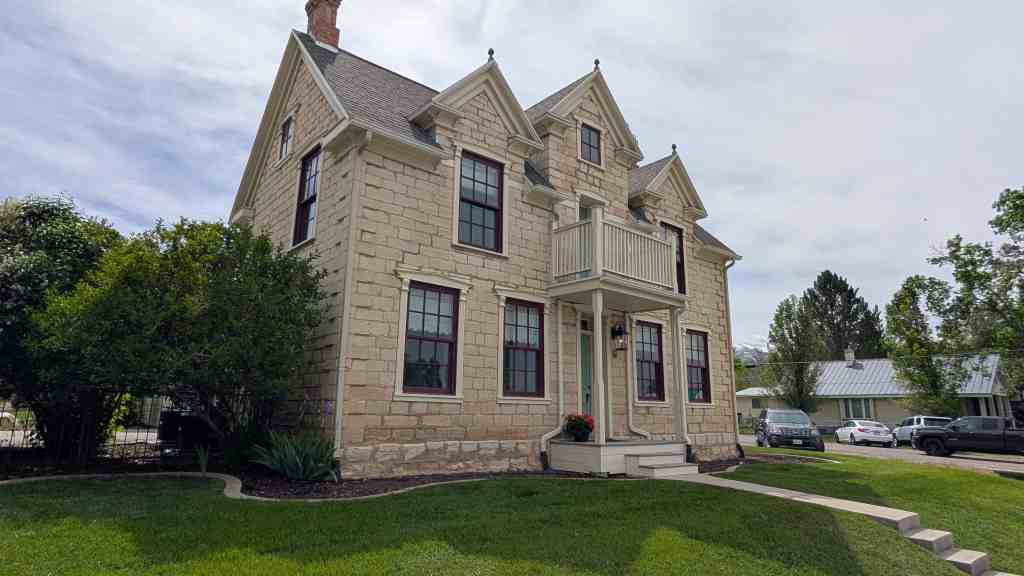
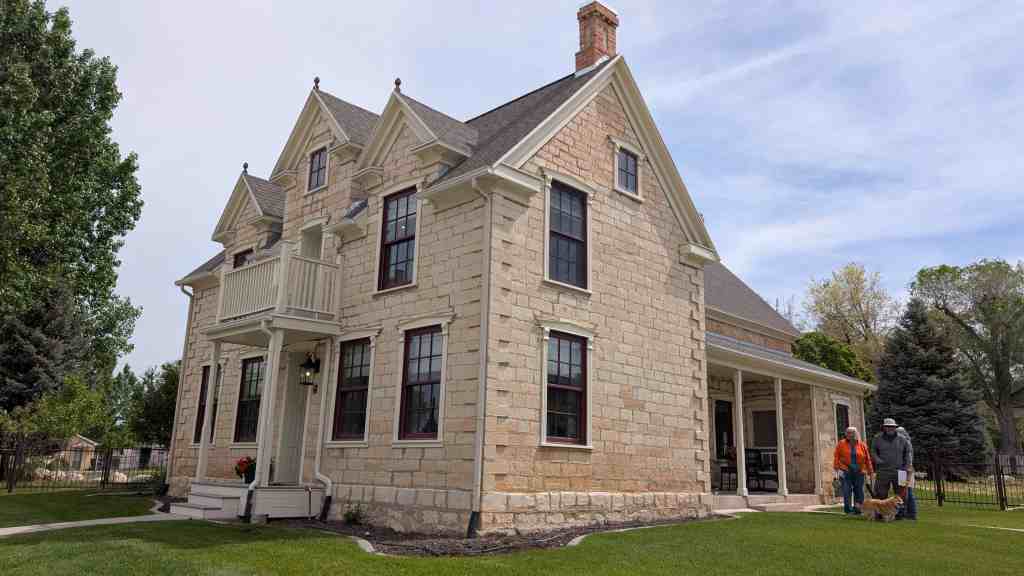
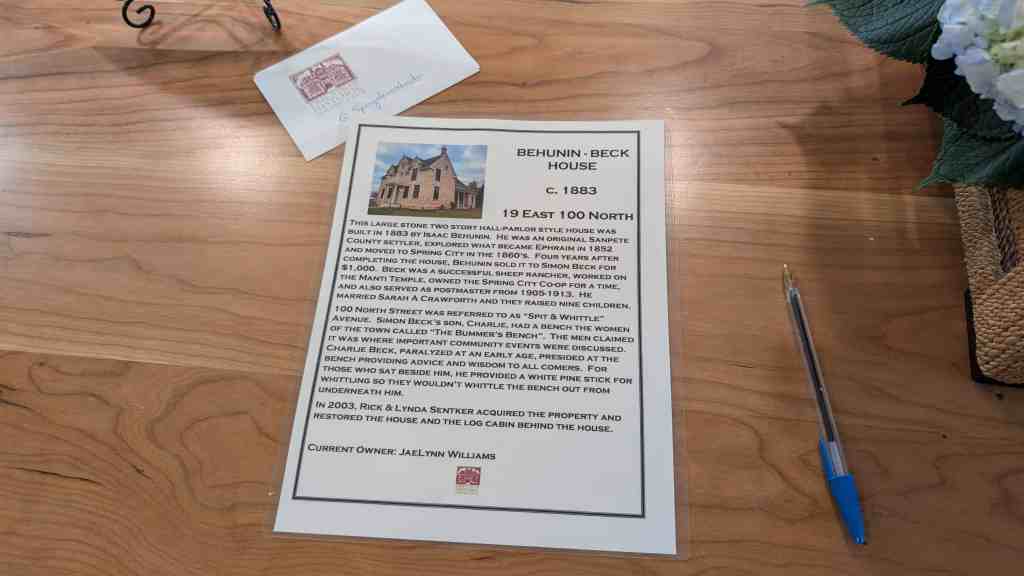
This elegant stone house was built in 1883 for Isaac Behunin, one of the first settlers in Sanpete County. Mixing Gothic style inspired dormers with Greek cornice detailing, the house exemplifies the decorative eclecticism found in Mormon domestic architecture of the period. Behunin sold the house to Simon T. Beck in 1887 for $1,200. Mr. Beck was a wealthy sheepman.
This large stone house was built in 1883 by Isaac Behunin, who explored what became Ephraim. He was an original Sanpete County settler and moved to Spring City in the 1860s.*
The Anthony W. Bessey Home 415 North 300 West in Manti, Utah
Anthony Bessey probably had this small stone house built shortly after his arrival in Manti in 1858. The home has a long association with the Bessey family and certainly construction features indicate an early building date. The house is historically important because as one of the first group of homes built outside the Manti forts, it represents the initial stage of local community development. Architecturally the Bessey House is significant as one of a number of typical house types utilized by the early Utah settlers and becomes an important example of Sanpete vernacular building.
The town of Manti, settled in 1849 by members of the Church of Jesus Christ of Latter-Day Saints, was the first town in the Sanpete Valley Colony. Colonists arrived in the fall of 1849 and after wintering in dugouts and wagon boxes, laid out a city in the spring and summer of 1850.1 By the winter some 20 log homes had been erected and work was beginning on a meetinghouse. One year later travelers to Manti reported seeing “several handsome two-story adobe houses, many one story dwellings, a good grist mill and a sawmill.” Threat of Indian attack caused a general pattern of fort building in the 1852-1854 period. Mormon forts were erected to enclose rows of small dwellings and the Walker War (1853-1855) made the security of protected habitation attractive to Manti residents. Peace in the later years of the decade allowed Manti residents to move out to their city lots and begin again the process of city building It was about this time, in 1858, that Anthony Bessey arrived in Manti.
Anthony Wayne Bessey was born in 1835 in Bethel, Maine. In his early years Bessey followed both the cabinetmaking and shoemaking trades. By the 1850’s Bessey had joined the Mormon church and in 1857 he migrated westward to “Zion” in Utah. At first he made shoes in Salt Lake City but in 1858 he moved his family south to the Sanpete Valley and settled in Manti. Here Bessey farmed and pursued his shoe making trade and by 1870 had a personal value of about $700 in property. For 18 years Bessey occupied a position on the high council of the Sanpete Stake of the Mormon church. In 1873-1875 he served as City Mayor and was elected to the city council in the years 1883-1890. Bessey probably had this small stone house built shortly after his arrival in Manti, c.1860. The house is an excellent example of the sturdy homes the Mormon pioneers built during the early stages of great basin settlement. In selecting a house design, Bessey followed a well-known traditional plan.
The Anthony Bessey House, built c.1860, is a 1-1/2 story square cabin folk/vernacular house type (see plan drawing). Measuring 22’x 17′ on the exterior, the house is one of the larger single unit square homes to be found in Utah. The second story is quite spacious and is reached by a boxed staircase which runs along the south wall. The stairs to the cellar run underneath those leading to the upper floor. On the north wall is the fireplace which is extremely large, more than 6′ in width. The interior has been remodeled to contemporary standards.
Externally the Bessey House is in excellent condition and virtually unaltered. The wall material is oolite limestone most certainly extracted from the “Temple Hill Quarry” several blocks to the east. The façade is coursed ashlar; the mortar is flush with incised lines emphasizing the geometrical coursing. Other walls are less handsomely treated and while they are cut-stone they lack the even coursing present on the façade.
The house has a simple gable roof with stone fireplace at the north located internally in the wall. The stone end walls extend up to the ridge of the roof in the gables. Decoration is minimal with the heavy stone lintels over the façade openings the only suggestion of ornamentation. The façade itself is unusually asymmetrical. The front door is placed centrally, but windows occur only to the right or north side. The upstairs window is a “half” window, typical of 1-1/2 story structures. To the left of the door the wall is blank. This fenestration pattern is distinctive in its unabashed asymmetry but can possibly be partially explained by internal factors. On the south wall, beginning right at the southeast corner, the staircase extends about 3′ into the room. Windows on this end of the façade would be partially blocked by the staircase so were deleted from the overall design.
Alterations which detract from the home’s historic appearance are few. There is a one story plastered adobe room added to the rear. This west room is gabled with a brick stone flue chimney and is undoubtedly a 19th century addition to the original square house. A modern gabled front door canopy is the only serious alteration of the original house.
The square bay (roughly square) evolved as a folk building unit in England during middle ages and was employed extensively in cottage construction. The house appeared as a one-room type (with or without upper loft) as was utilized extensively throughout the English American Colonies.” Advancing westward, the “square-cabin” type house is ubiquitous on the American frontier. Mormon examples have been recorded at Nauvoo, Illinois and the square cabin house was extensively dispersed throughout the IDS western communities. Anthony Bessey most certainly would have been familiar with such a square house plan in his native Maine and opted for this rather modest design in his new western home.
The Bessey House is one of a number of folk building types employed by Manti residents in the first stages of settlement. The house is typical of smaller, more inexpensive homes built by the pioneers. Despite its rather distinctive façade, this house gains its architectural and historical significance through its unexceptional nature, i.e., its ability to define the capabilities of the average. There are both larger and smaller homes in Manti, built by people who had both more and less than Anthony Bessey. Bessey’s home, taken in the larger context of vernacular building tradition of the area, helps expand the historical record to include the total population, not just a small percentage of exceptional individuals.
Rasmus Justesen was a sheepman and polygamist who built this 1-1/2 story stucco-over-adobe for his first wife, Sarah Shepherd and her family. In addition to his sheep business, Rasmus fought in the Black Hawk Indian War, sat on the Spring City Council in 1876 and was elected mayor twice, in 1880 and in 1897. (text from the marker on the house)
Located at 12 North Main Street in Spring City, Utah
This one and one half story adobe house was originally stuccoed and scored to resemble cut stone, including simulated quoins. The house was built for Rasmus Justesen’s (1842-1917) first wife, Sarah A Shepherd (1842-1933), who raised nine children here. Justesen, mayor from 1898-99, took a second wife, Annie Marie Larsen (1859-1942) who had a house elsewhere in Spring City. Rasmus also homesteaded in Emery County. Artist Susan Gallacher purchased and restored the house in 2002. (text from sanpete.com)
RASMUS & SARAH JUSTESEN HOUSE, 12 N. Main ca. 1875: This one and one-half story adobe house was originally stuccoed and scored to resemble cut stone. One of the better examples of vernacular folk building and one of the few remaining adobe houses along Main Street. Built for Justesen’s first wife. Susan Gallacher purchased and restored it in 2002. Owned by Susan Gallacher. (text from the Friends of historic Spring City tour pamphlet)