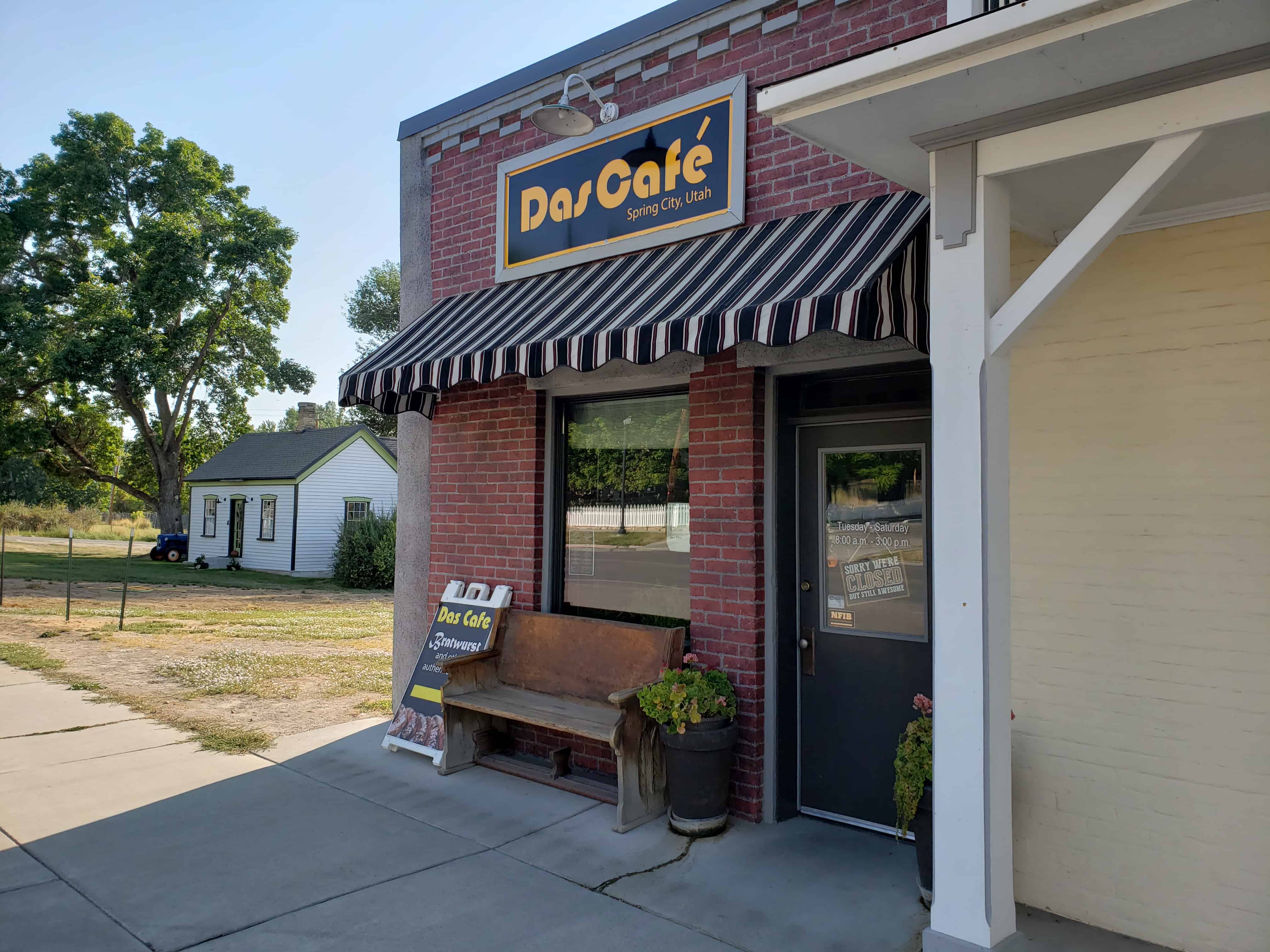
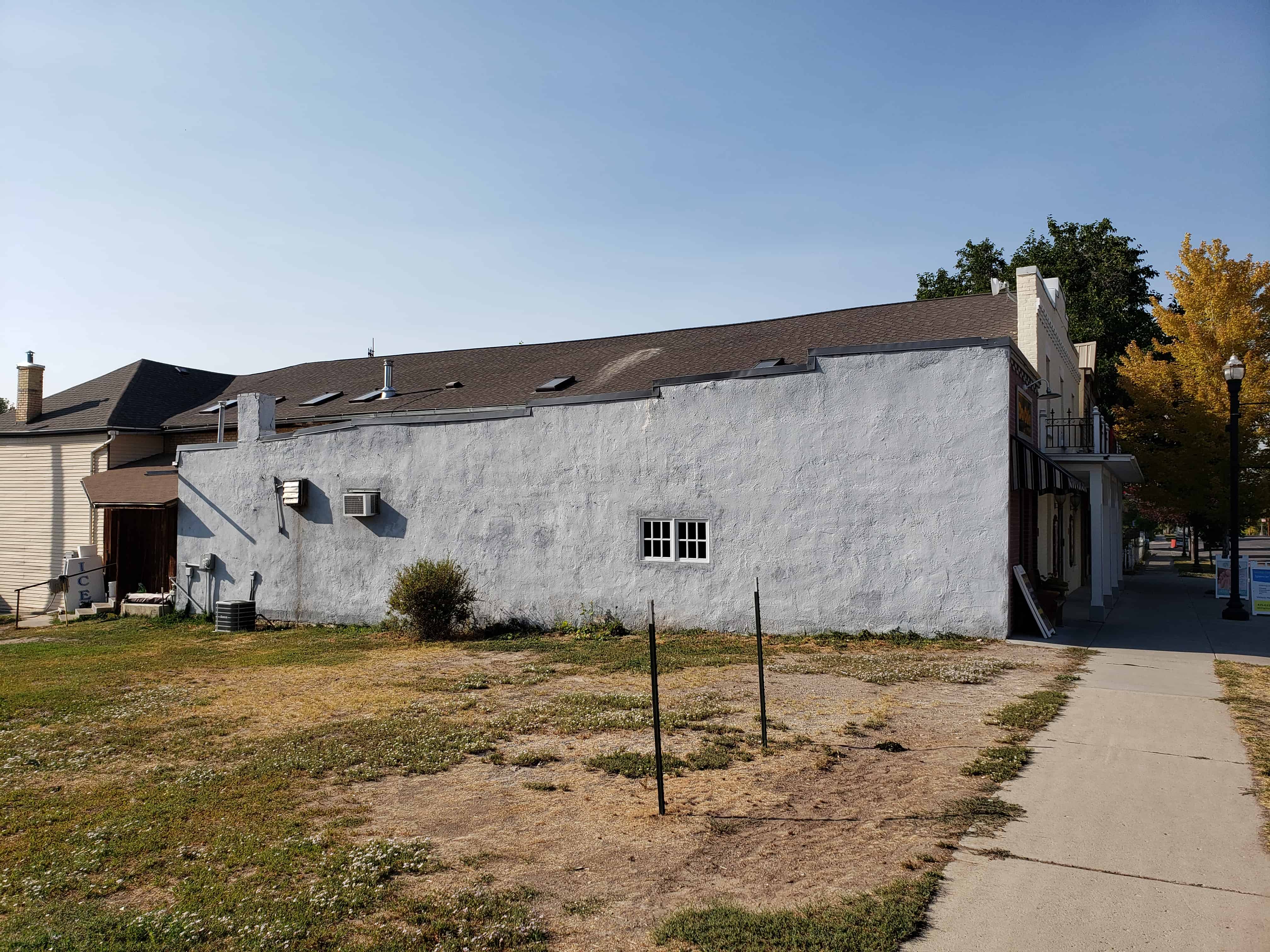
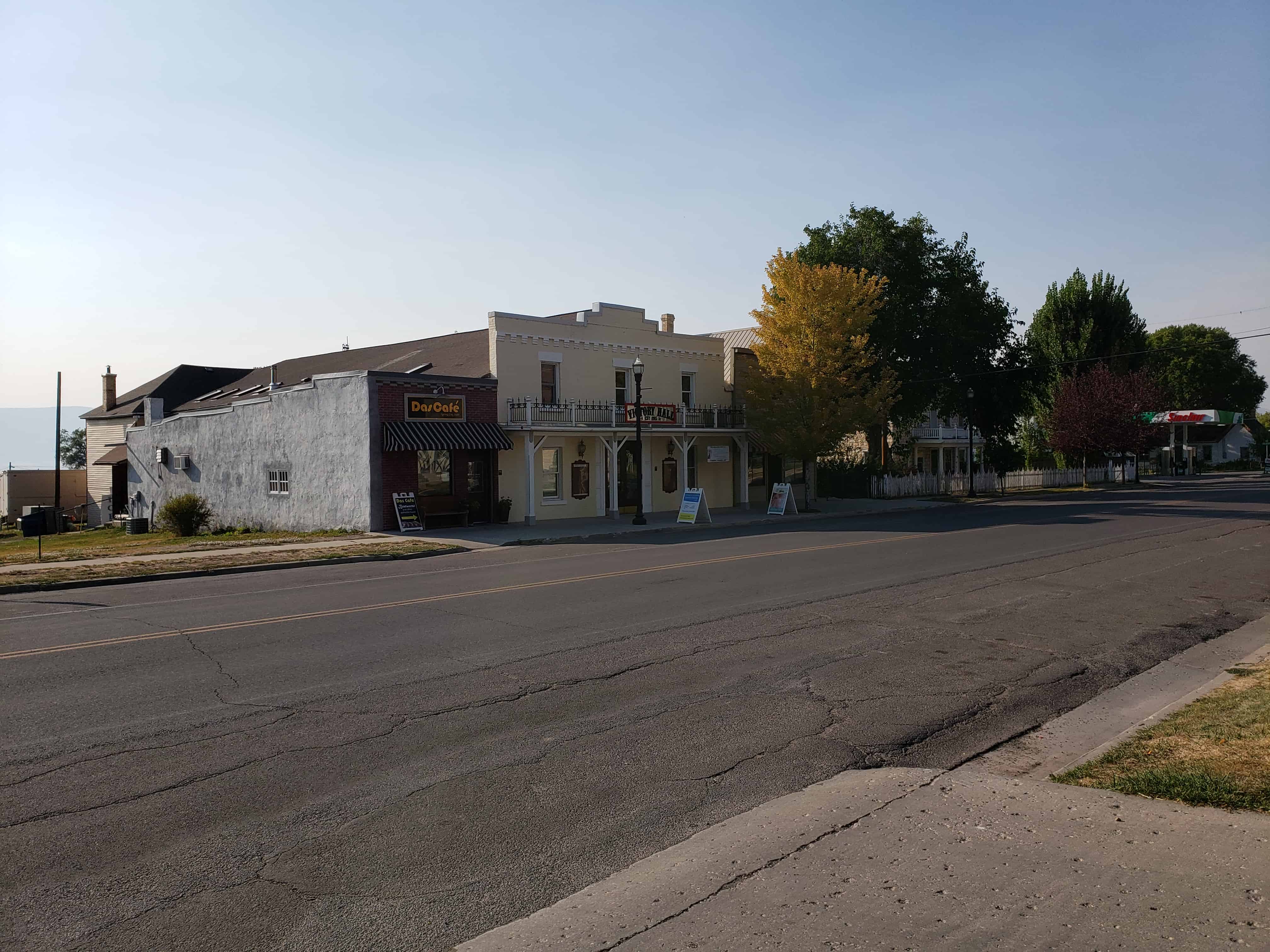
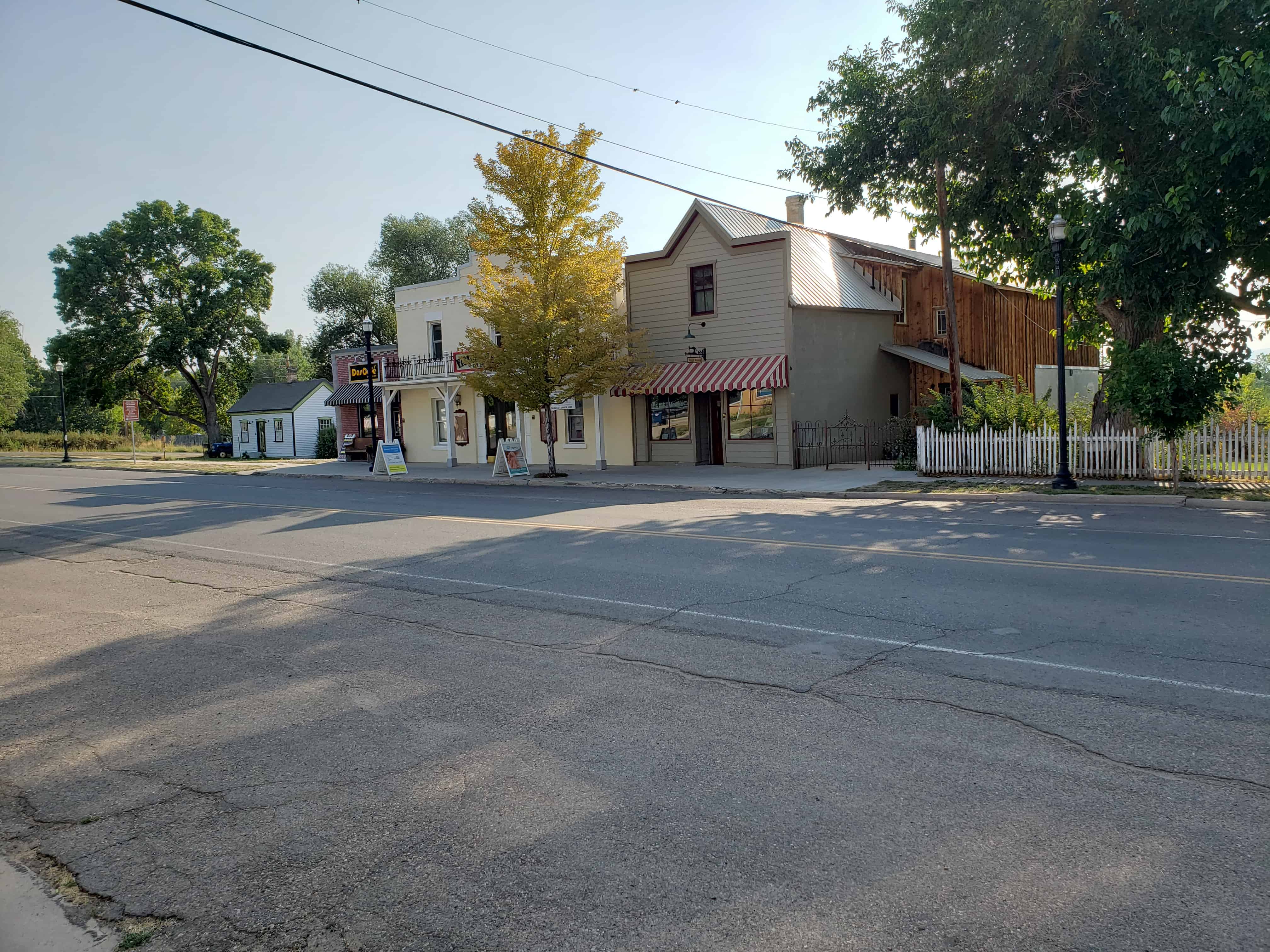
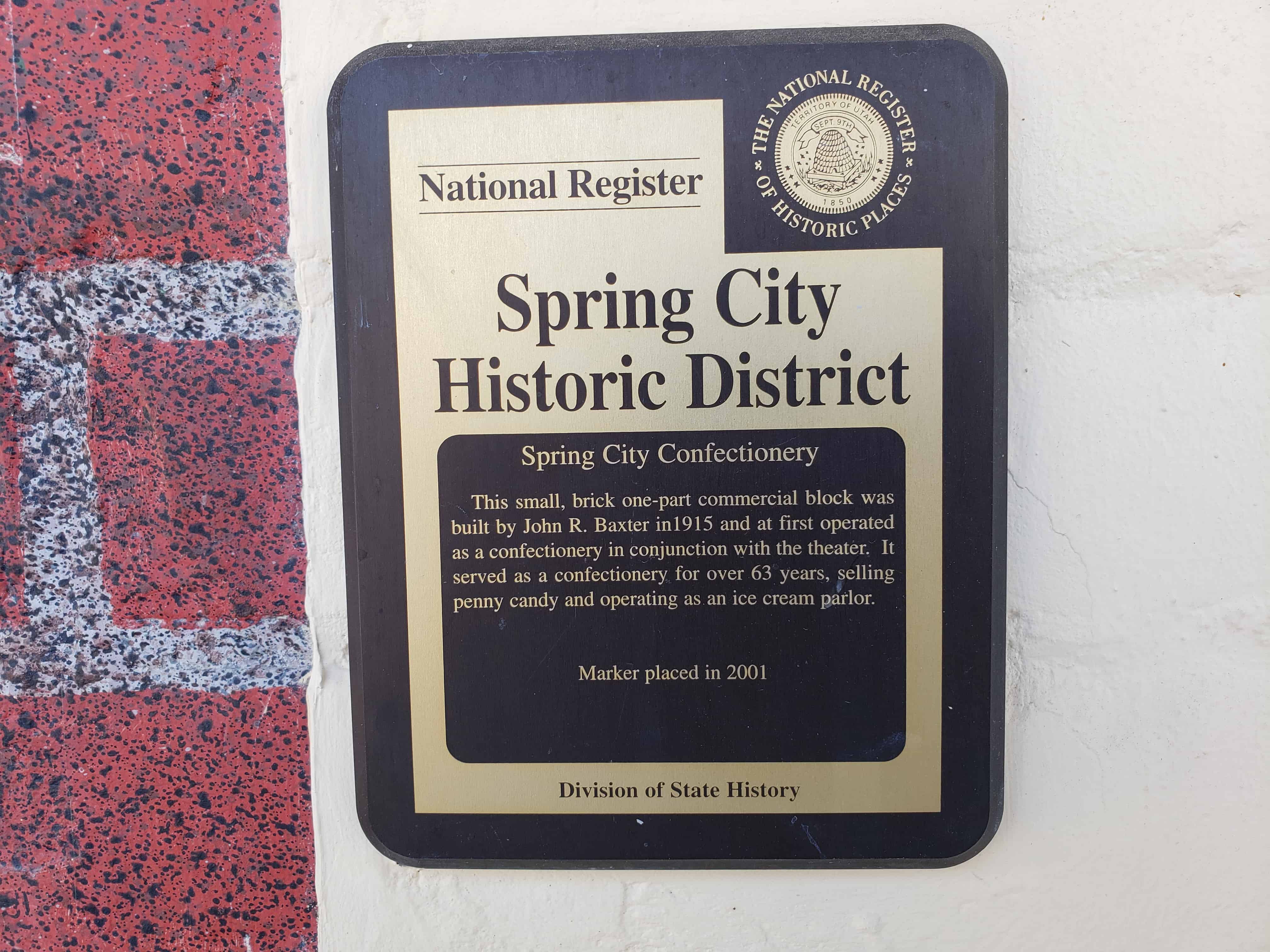
This small, brick one-part commercial block was built by John R. Baxter in 1915 and at first operated as a confectionery in conjunction with the theater. It served as a confectionery for over 63 years, selling penny candy and operating as an ice cream parlor.
From Sanpete.com: This small brick one-part commercial block was built in 1915 and operated as a confectionery until 1973 by John R. Baxter, Jr. (1888-1978) becoming a Spring City institution for several generations of Spring City children. Recently the building has been operated as a café.
The Lars Andersen house in Ephraim is architecturally significant as an example of Scandinavian folk building in Utah. The house contributes historically to the thematic nomination, “The Scandinavian-American Pair-house in Utah.”
Lars S. Andersen was born in 1829 in Denmark. Converting to the LDS Church in 1852, he emigrated to Utah in the winter of 1855. Arriving in Ephraim in the summer of 1856, Andersen soon became a leading citizen of this community. He was primarily a farmer, but also served as tithing clerk, and director of the Ephraim Co-op Store. Active in the Church, Andersen was a counselor to the Stake President, Canute Petersen, and filled a Danish mission in 1873-1875. In 1879 he became bishop of Ephraim.
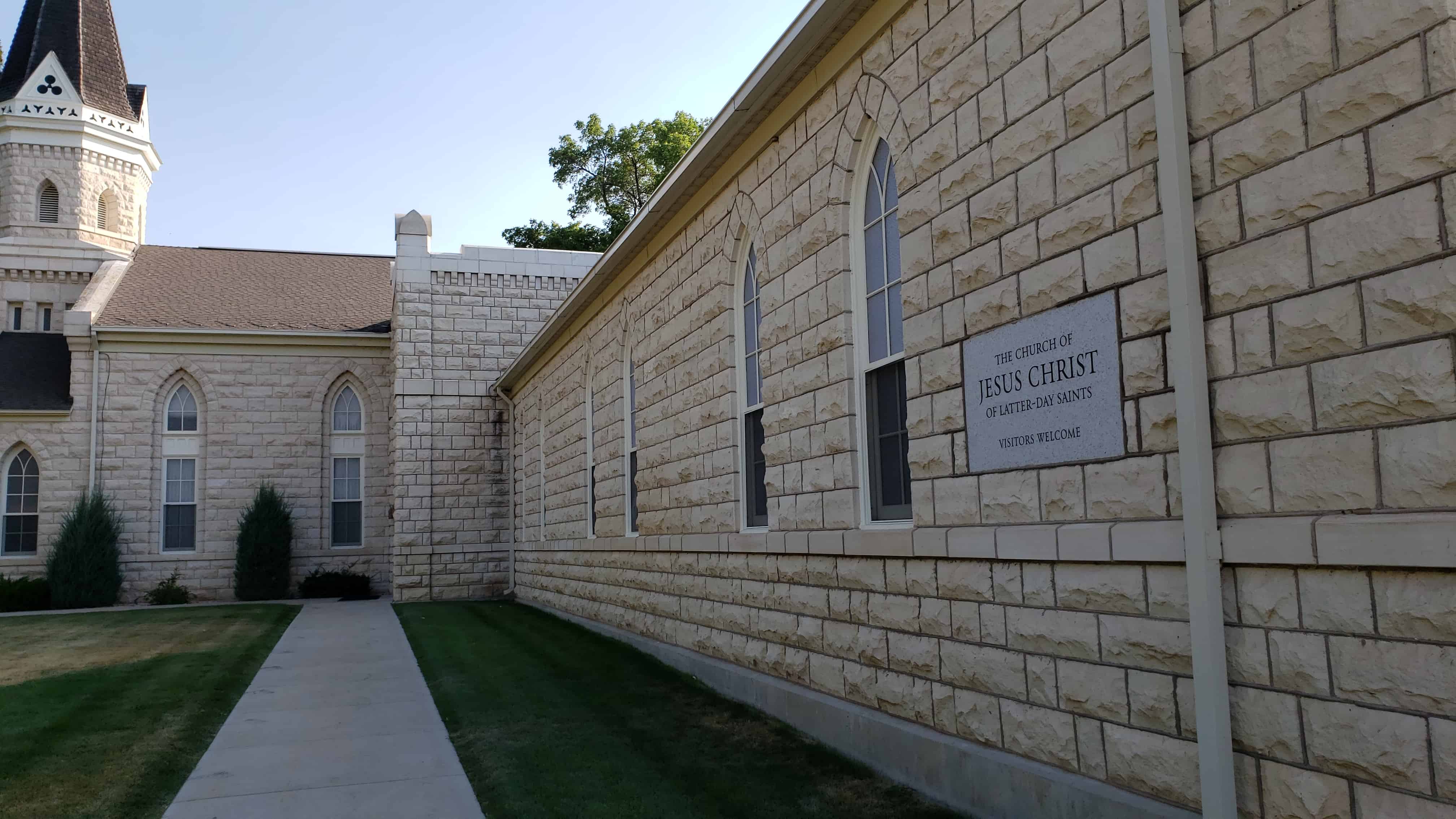
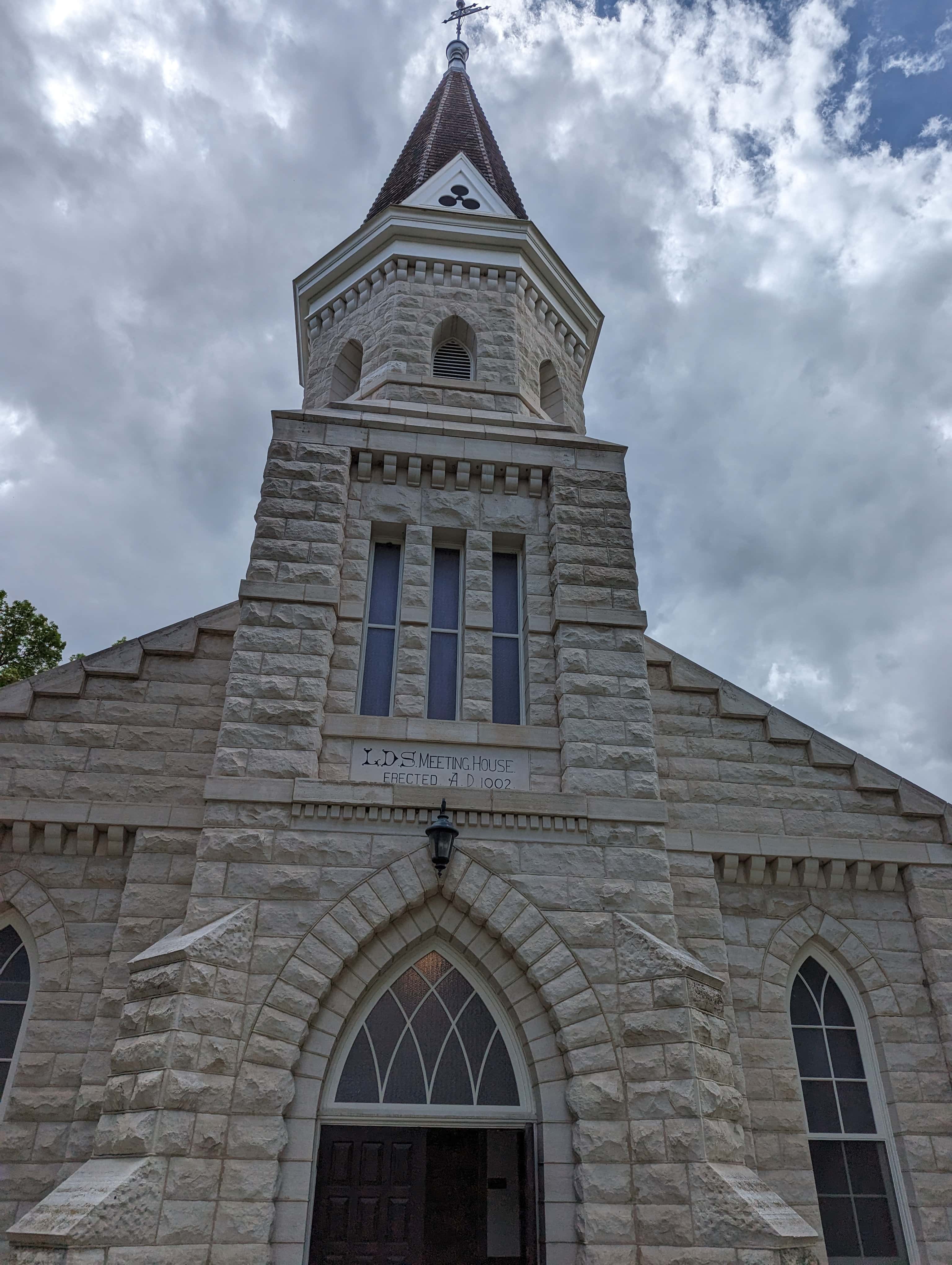
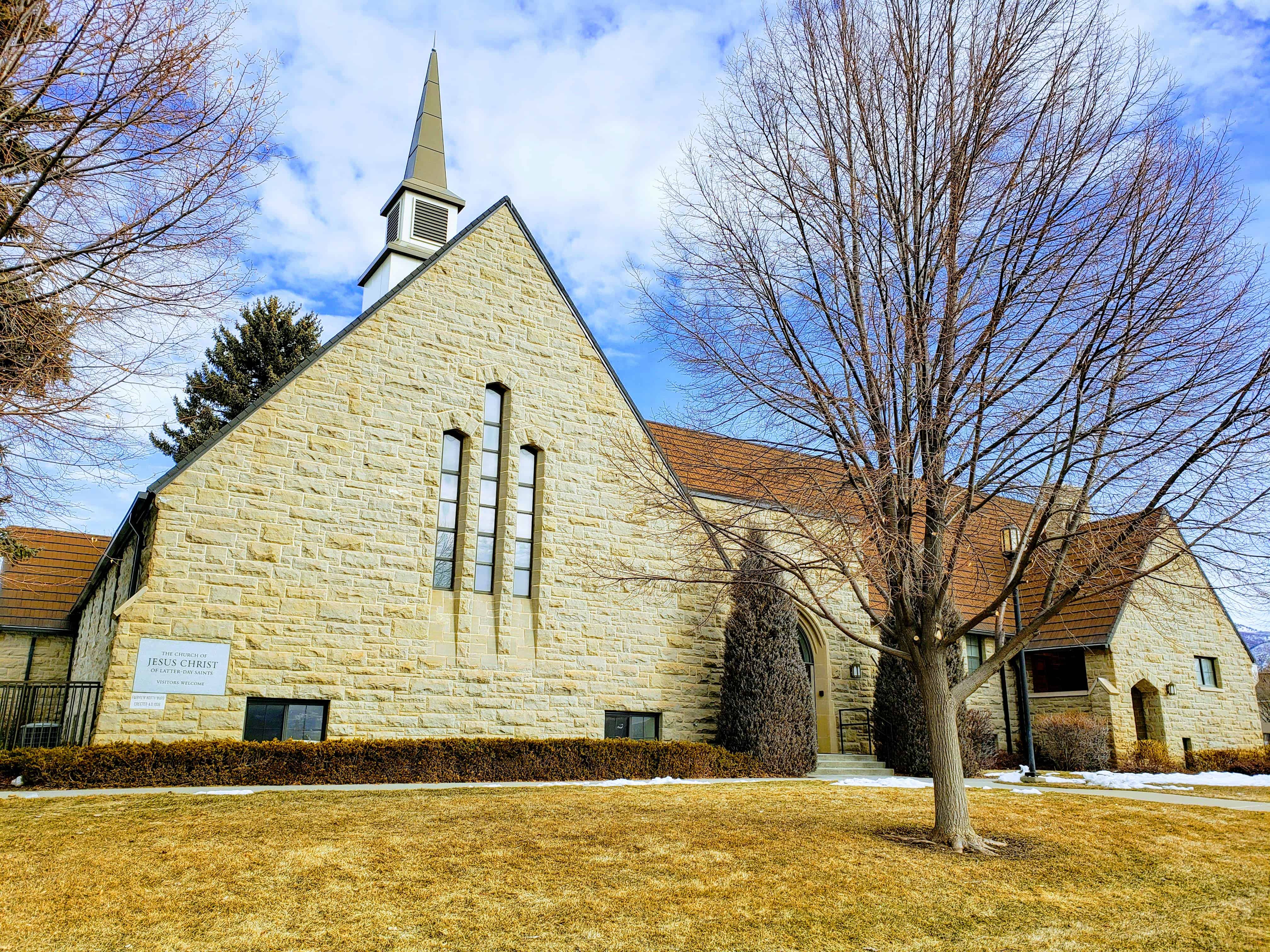
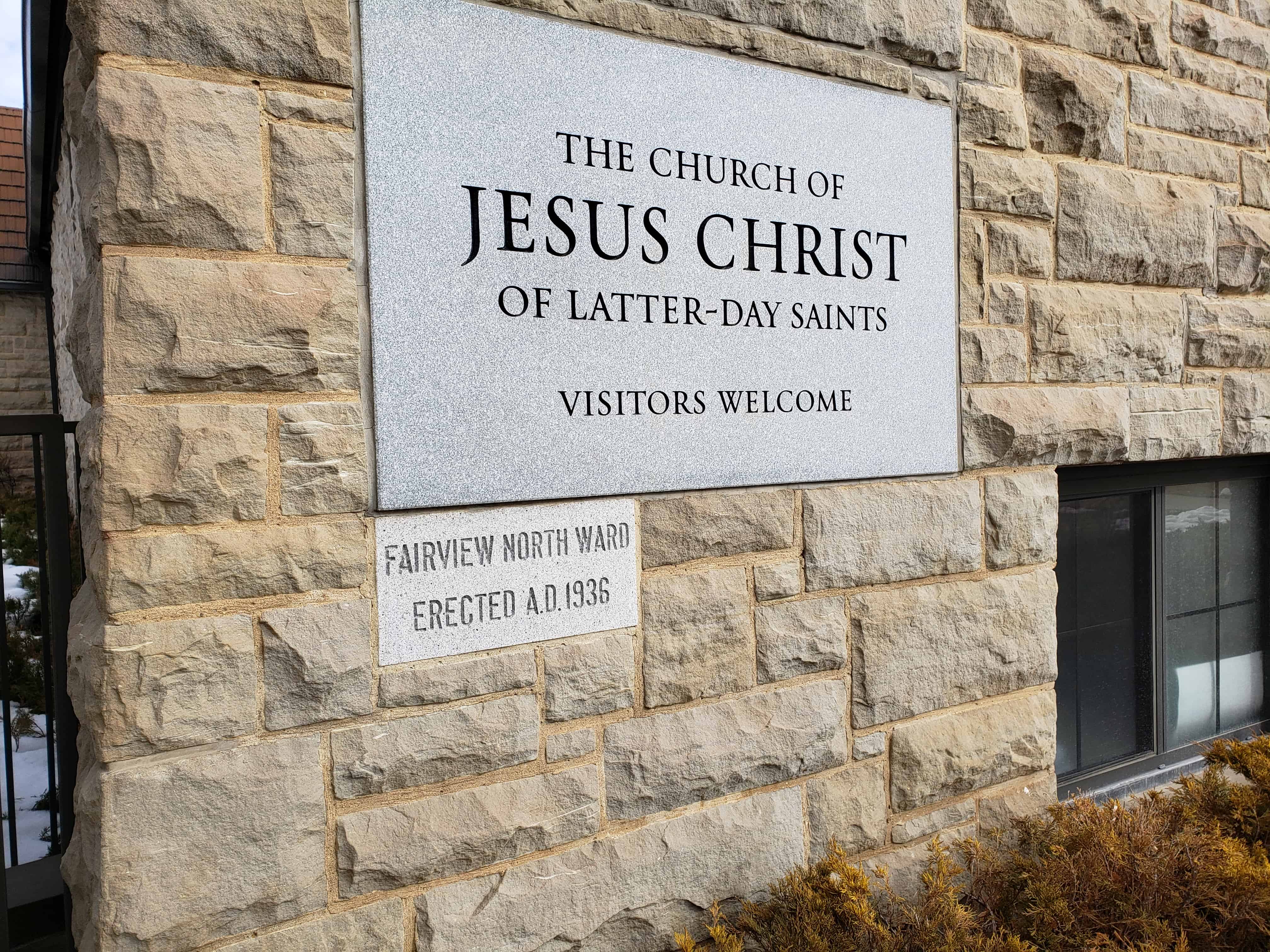
The Spring City Chapel for The Church of Jesus Christ of Latter-day Saints, locally called the old stone church is located at 164 S Main Street in Spring City, Utah.
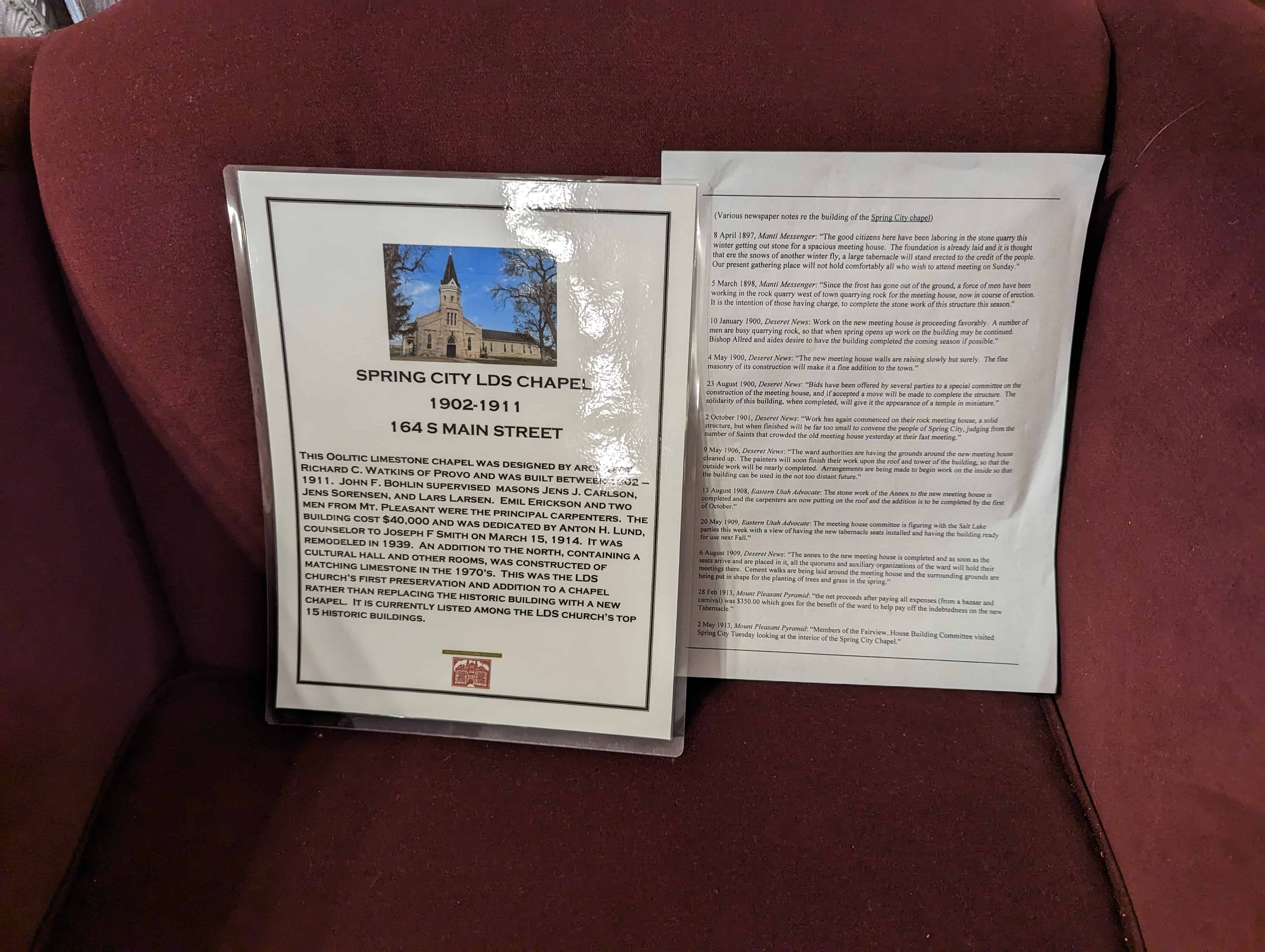
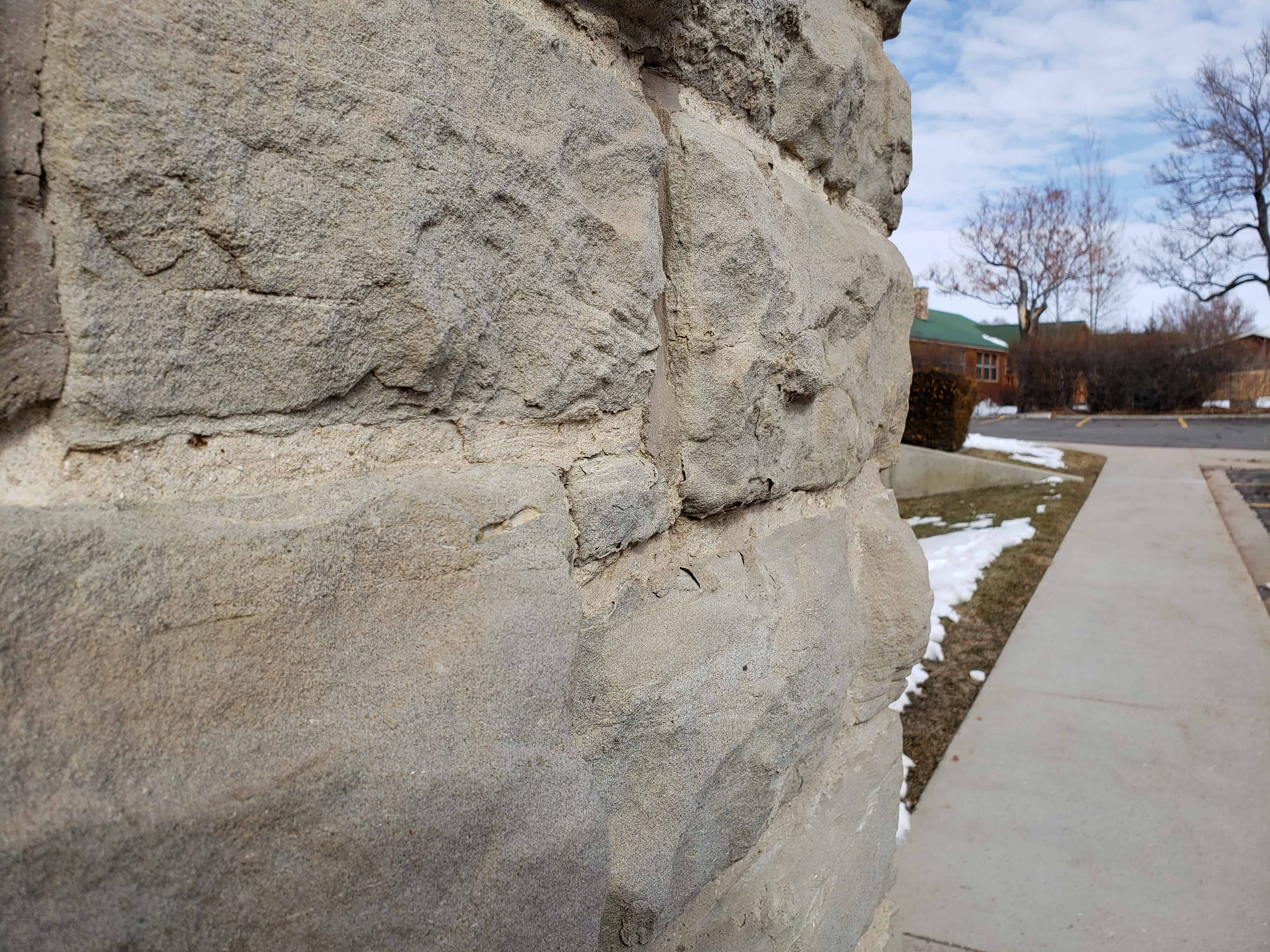
The following is from sanpete.com: This Gothic Revival/Romanesque-influenced stone LDS Chapel was constructed between 1898 and 1914, although an inscription stone bears the date”1902.” Richard C. Watkins was the architect of this spectacular edifice. Scandinavian masons John F. Bohlin (1844-1924), Jens J. Carlson (1848-1927), Lars Larsen (1852-1924) and Jens ‘Rock’ Sorensen did the stone work. The carpenter’s name was Emil Erickson. The building has an elegant, horseshoe-shaped gallery accessible by a stairway in the tower. The chapel features a sloping floor and an ornamental oak pulpit at the west end. Behind the pulpit, hand-grained sliding doors opened into the annex. From the original exposed flooring to the vaulted and beamed ceiling, the interior is replete with beautifully detailed woodworking, all following the Gothic theme. The pulpit and the handmade rostrum chairs for the ward leadership are skillfully carved. The pew ends are decoratively milled, as is the sacrament table. The exterior is equally impressive with its tall, Gothic windows, tall stone tower and buttress and overall massiveness and solidity.
The chapel was conceived in 1882 by LDS bishop James Anderson Allred (1819-1904), who appointed a committee of twenty men to plan the project. It eventually was built at a cost of $40,000, with $6,000 received from church funds, and the remainder being donated by the men and women of Spring City ward. A masterpiece of LDS Church architecture, this chapel was dedicated in March 1914 by Anthon F. Lund, counselor to Mormon Church President Joseph F. Smith. During construction, a classroom annex was added to the rear. A compatible addition was made on the north in 1978, using rock from the same quarry to carefully match the design elements.
This house offers a view of the range of Spring City’s architectural tradition. Built c. 1875, the original structure was a stone, hall-parlor house. The rear adobe addition was probably completed within just a few years after the main portion. Little is known about Iver Petersen, except that he also built the stone granary located on the property. The granary is one of the best preserved and most substantial granaries of Spring City.
Located at 309 North Main Street in Spring City, Utah
Iver Petersen (1844-1881), a Danish immigrant, built this stone, hall-parlor plan house in the mid 1870s. A rear adobe addition was constructed shortly thereafter. He died at a young age leaving a widow with several young children. A stone granary behind the house has been made into a living space.(*)
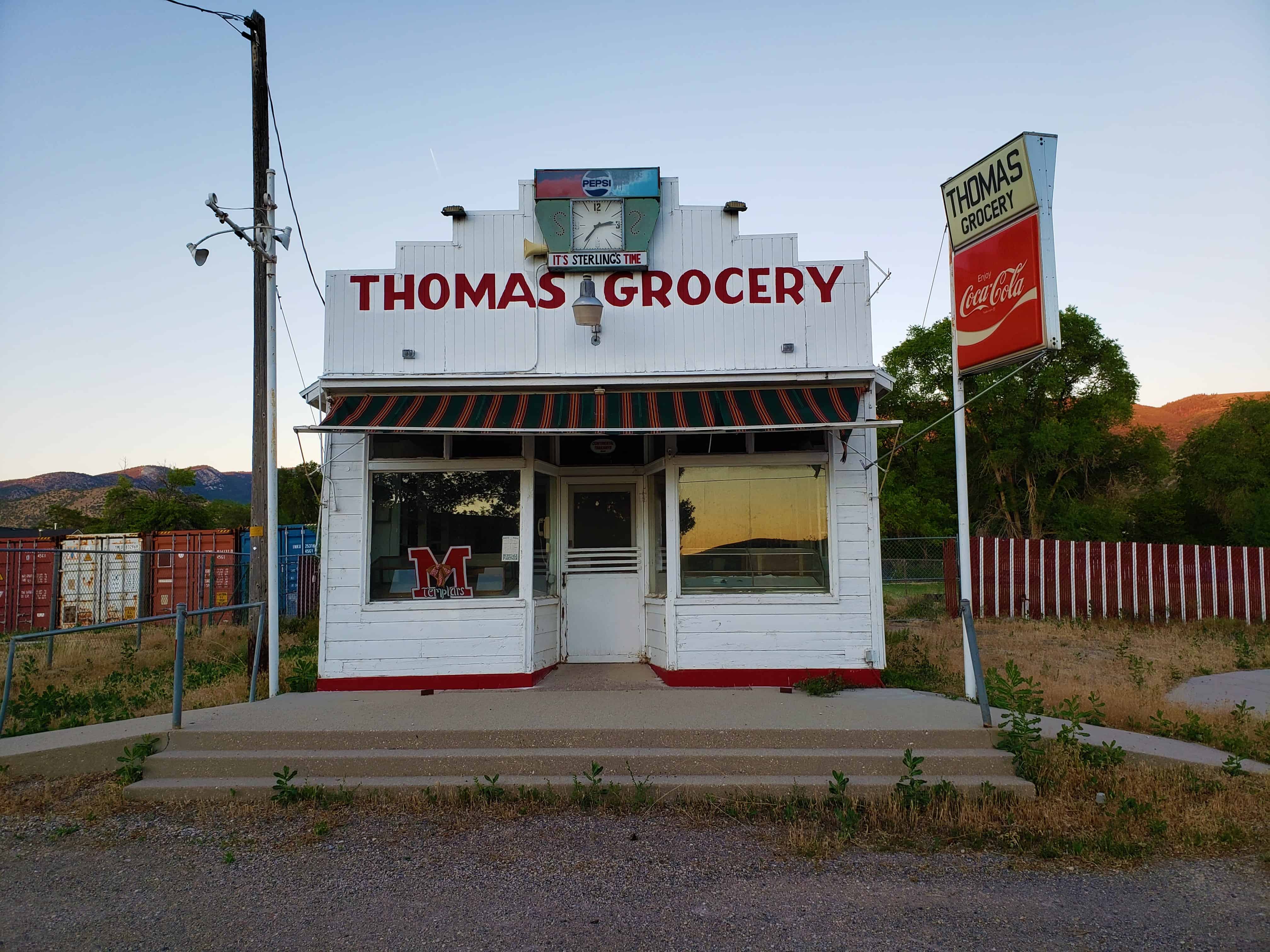
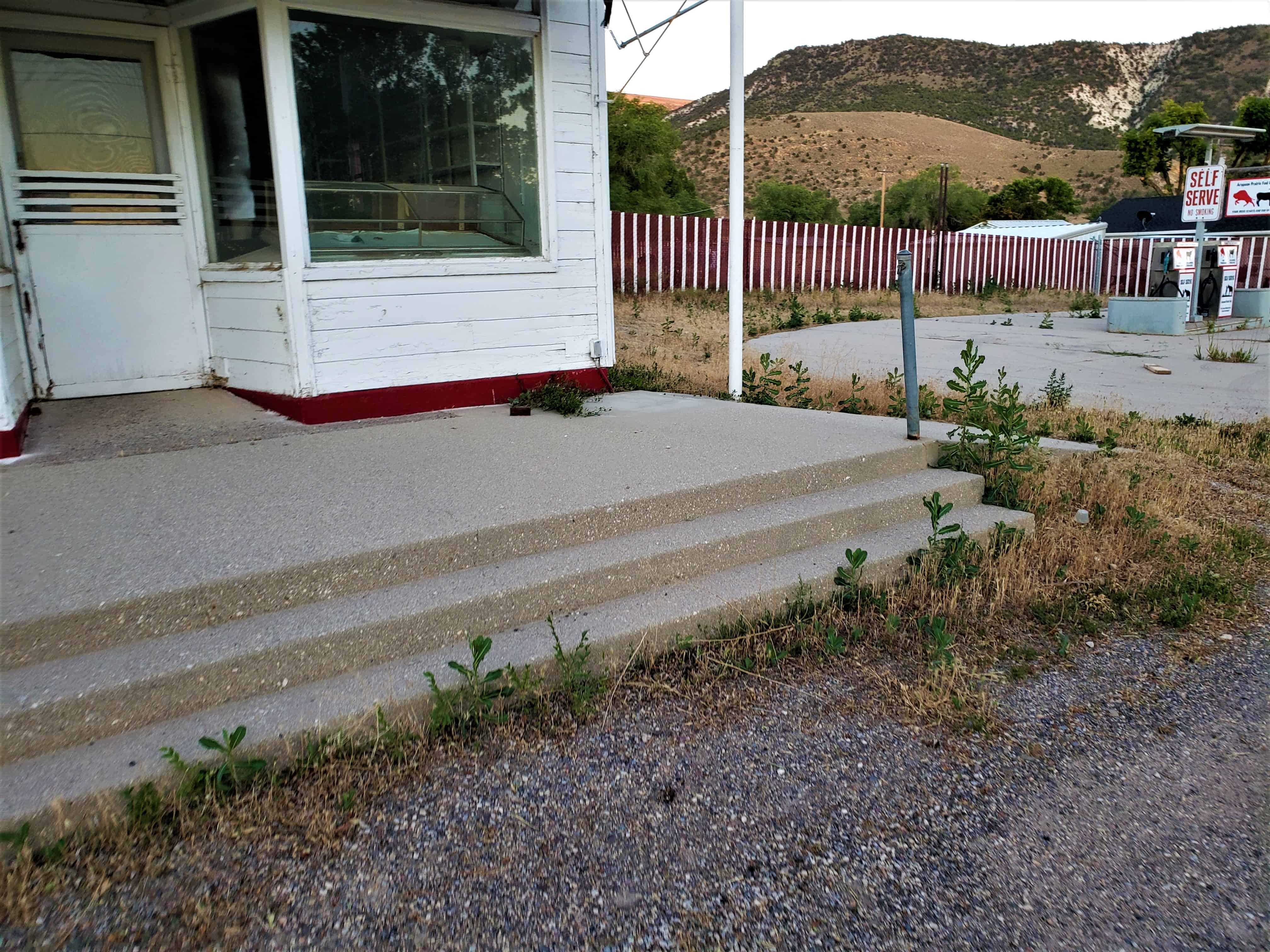
In the 1920’s, N. E. Larsen opened this General Store in the center of Sterling. The painted masonry storefront with its stepped gable and varied collection of colorful signs remains in operation today as one of the few “mom and pop” grocery stores to survive modernization.
The store opened when Larsen’s daughter Lillie was six months old; from that time on Lillie spent her life in the Sterling General Store. The general merchandise store has changed with the times. Originally, the merchandise came in bulk so people bought fifty pound sacks of flour and sugar. A black ring on the floor marks the spot where the old vinegar barrel stood. Kerosene was sold in bulk for lanterns, commonly used in Sterling homes that lacked electricity. Milk and eggs from local farmers were sold here and the children often traded farm eggs for pieces of penny candy. In August of 1945, Lillie and her husband Evan Thomas opened their own business in Lillie’s father’s old store and moved in. The the past 63 years, Lillie has served three generations of Sterling residents and travelers from behind the Counter of the Thomas Grocery. Lillie passed away May 14, 2008 at her home in Sterling at age 93.(*)
The Meiling-Seely House, 91 South 500 West, Mt. Pleasant, Utah
A Danish immigrant, Jens C. Meiling, built the first, smaller part of this fine brick home in 1870. the bulk of this one-of-a-kind residence was erected around the earlier house, in 1890 by John H. Seely. Influenced heavily by Neo-classicism, the house has round-columned, classical porches, a bracketed cornice, two-story, square corner tower and extensive ornamental brickwork.
Meiling came from Denmark and in 1859 acquired 20 acres of farmland in Mt. Pleasant. He supplemented his income by making bricks. For many years, Sanpete settlers had difficulty securing clay of sufficient quality to produce fired brick and relied mainly upon sun-dried adobe as a building material. Meiling’s brick yard, located just west of town, was the first in Mt. Pleasant to turn out kiln-fired bricks, probably in the late 1860’s. Meiling sold the house to John H. Seely in 1887 for $1500. Seely was one of the most successful livestock breeders in the Intermountain West. He is credited with introducing purebred French Rambouillet sheep into Utah during the 1890’s. His achievements with selective breeding improved Utah’s range stock, contributing directly to the remarkable success of the local sheep industry during the late 19th and early 20th centuries. Seely helped make Mt. Pleasant the Rambouillet breeding capital of the world, as well as the commercial center of central Utah’s livestock industry.(*)
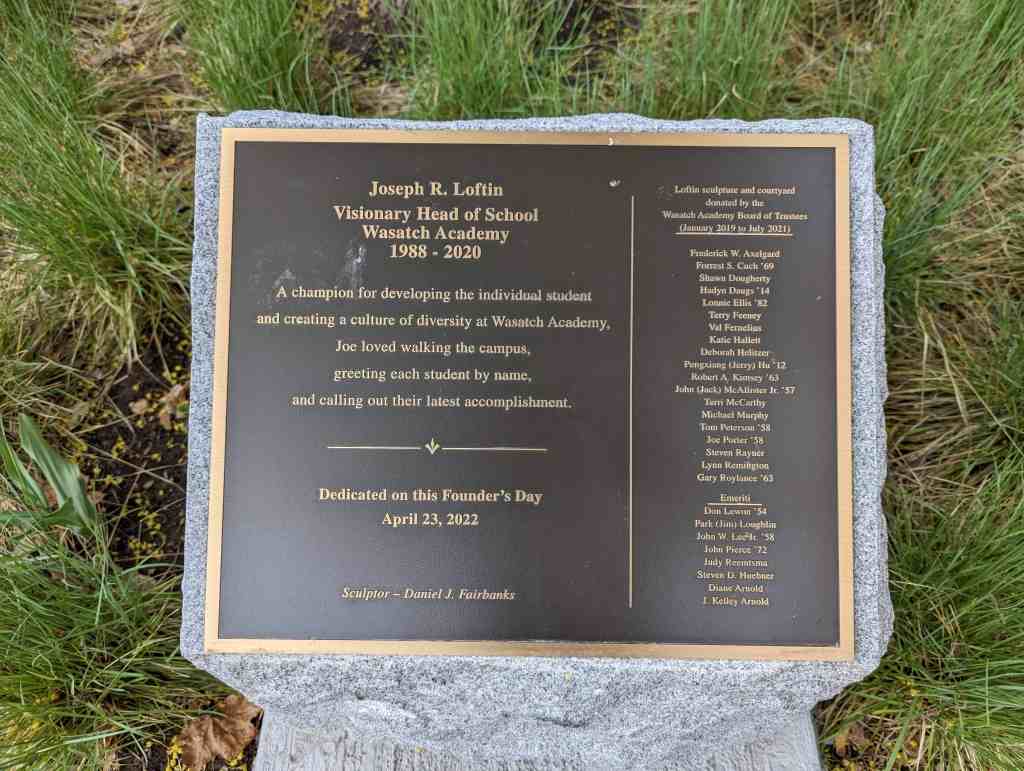
Charles Johns served as principal of Wasatch Academy from 1912 to 1916 and then again from 1918 to 1924.
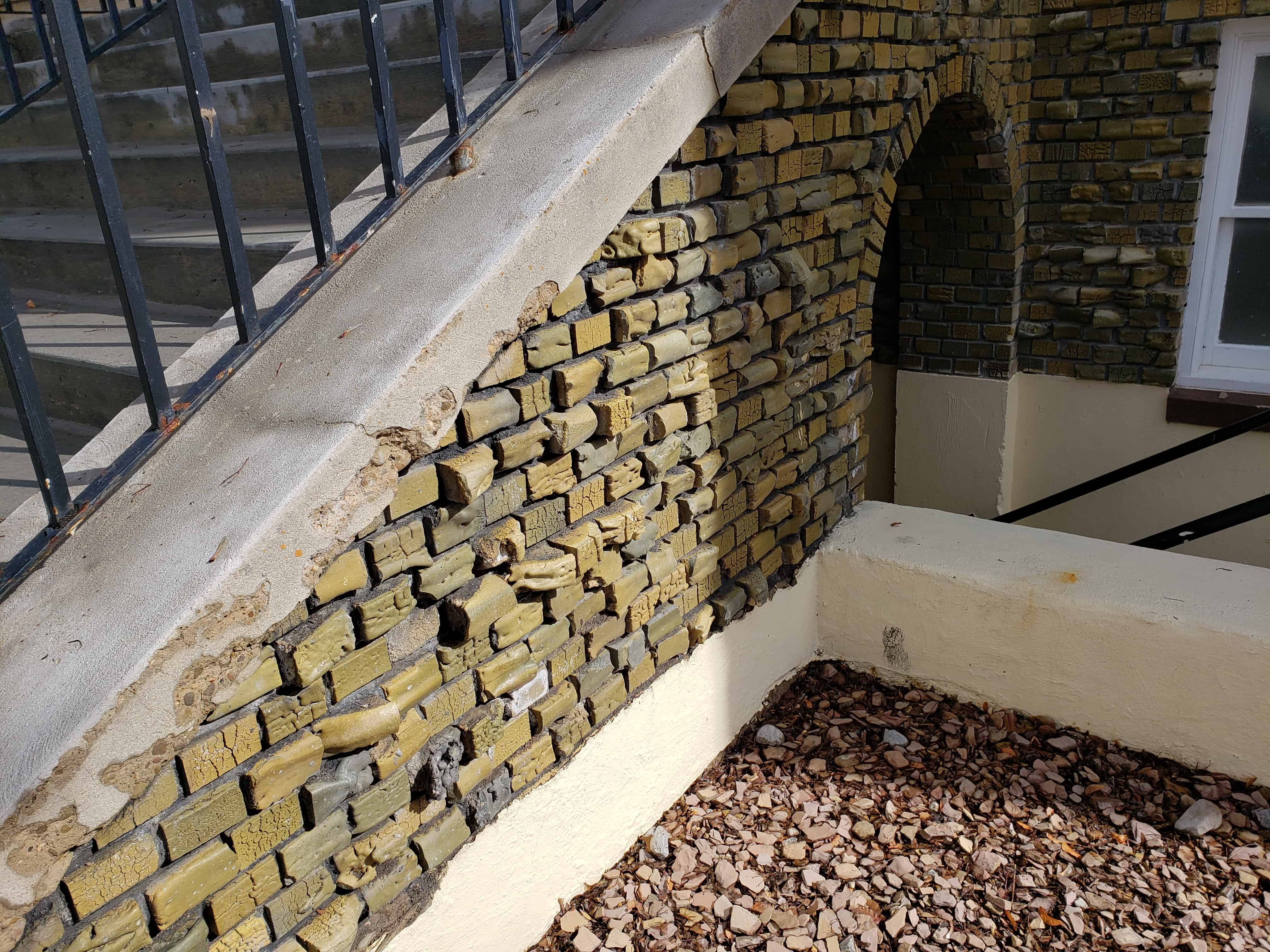
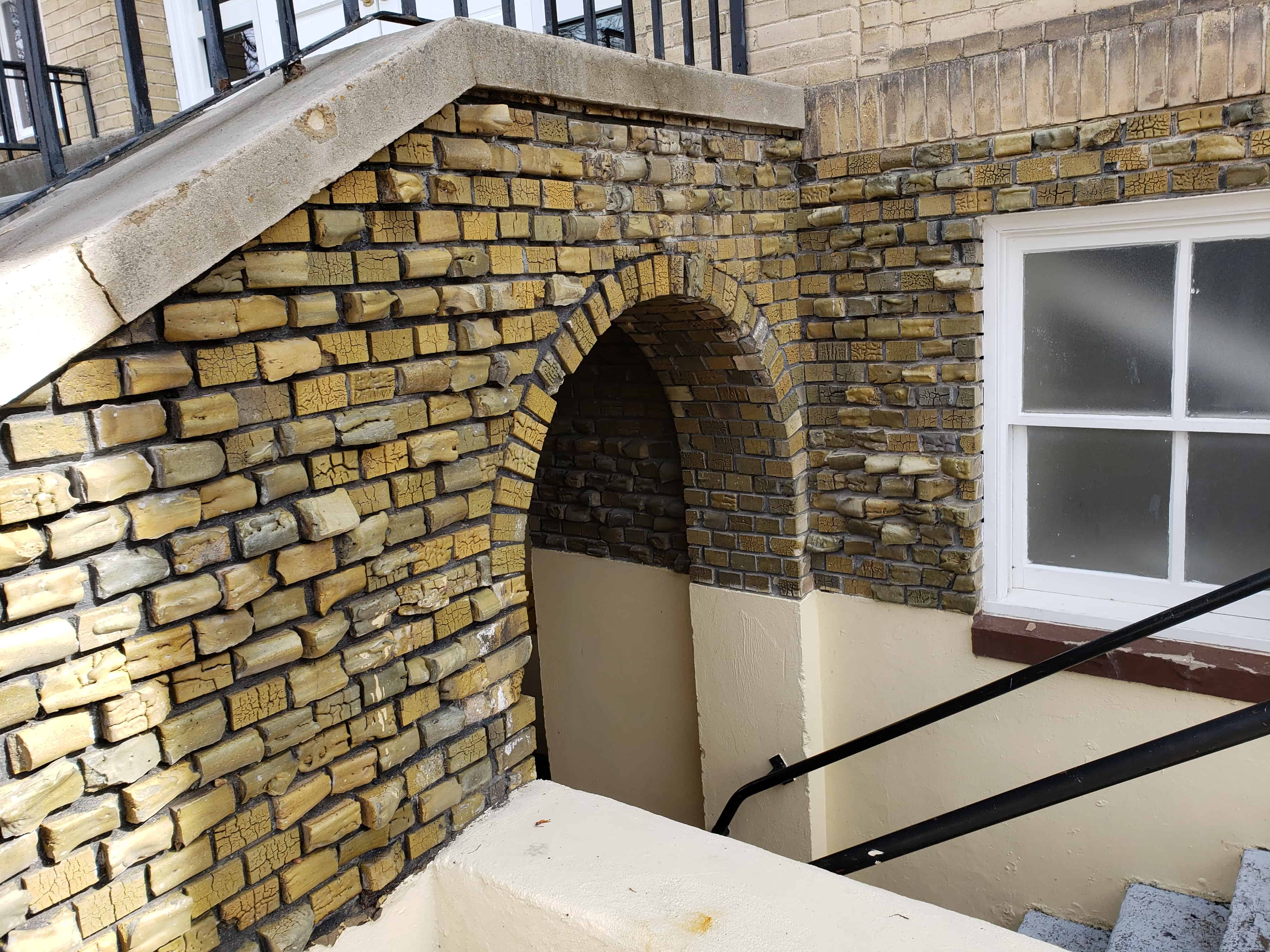
Another example of clinker brick, see others on this page.
From the Wasatch Academy National Historic Register Nomination Form: Johns Gymnasium, 1921. One tall story; brick building has rectangular plan and features a gabled roof; three Roman arches of a darker brick rest on pilasters. There are goins at the building corners.
It is located at ~209 South 200 West in Mt Pleasant, Utah.
“These are the mill stones from the first grist mill in this area”
It was built in 1863 by Elam Cheney, Sr. a pioneer of 1847. At the request of President Brigham Young he quarried & shaped the stones & moved them & his family to Fairview where he also blacksmithed the iron & carpentered the wood. The stones were turned by an overshot water wheel with water from the Sanpitch River. – By the Cheney Family Association – 1965