Hiawatha, about 13 miles NW of this location, was named from Longfellow’s poem “Hiawatha.” It was incorporated in Sept of 1911. In June of 1912, along with Blackhawk & Mohrland, it was purchased by the U.S. Fuel Company. Coal produced by Hiawatha came from Emery County, but the town & the mine portal were in Carbon County. In 1912, 2000 tons of coal were produced in a twelve hour period, 20 single & double housing were built, the first motion picture was shown, & the work force steadily increased. In 1938, U.S. Fuel built a new coal preparation plant at Hiawatha, and began extracting Mohrland’s coal through the Hiawatha portal, this spelled the end of Mohrland. In 1991 U.S. Fuel’s continuous miner sections could not compete with modern longwall technology & it was focred to layoff its miners. After 84 years Hiawatha concluded its mining operations & the town dis-incorporated. The era of Hiawatha ended & one of the last company owned mining towns in America ceased to exist.
The main group of Mormon pioneers camped one mile above the mouth of Echo Canyon on July 16, 1847. They were following the 1846 tracks of the Donner-Reed Party who had taken a “new” route to California proposed by Lansford W. Hastings. The next day, the pioneers entered the Henefer Valley and traveled downstream along the Weber River where they camped July 17 and 18. In the hills north of their camp, they offered a special prayer for Brigham Young who was ill.
Leaving Brigham Young and a few wagons in the Henefer Valley on July 19, the main group crossed the Weber River at present Henefer and turned up Main Canyon to Hogsback Summit. From this point, they stood in awe of the distant Wasatch Mountains, yet to be traversed. The Pioneers proceeded down Dixie Hollow, up Broad Hollow, and through present East Canyon State Park to East Canyon Creek. They camped at a spot now underwater, about ¼ mile upstream from the dam.
On July 20, the pioneers went 7¼ miles south up East Canyon. They forded the creek eleven times in one day. The pioneers camped at Large Spring, ½ mile north of present Mormon Flat. William Clayton said, “The last three miles has been the worst road… it being through willow bushes over twenty feet high… it is yet scarcely possible to travel without tearing wagon covers… The road is one of the crookedest I ever saw…” The next day, the pioneers traveled up Little Emigration Canyon to the summit of Big Mountain, the longest sustained climb of the entire trip. The pioneers paused here with heartfelt gratitude, for looking southwest they saw their destination, the Valley of the Great Salt Lake.
The pioneers proceeded down the extremely steep trail off Big Mountain to Mountain Dell, over Little Mountain, then down into Emigration Canyon. The main group camped 2½ miles from the mouth of Emigration Canyon on July 21. The next day they traveled to a campsite near 17th South and 5th East in what is now Salt Lake City. They had arrived! Brigham Young entered the valley on July 24.
In memory of our Mona School and the dedicated teachers, board members, custodians, students and citizens, who made it great; we have built this monument from the sandstone and brick recovered there from. The bell hereon, signaled the beginning of school from its erection in 1907 until its termination in 1971.
This bicentennial park now situated on these grounds commemorates our devotion to and appreciation of our pioneer heritage.
Coal was first mined on Cedar Creek, about 9.4 miles N.W. of this location in 1906. Four men named Mays, Orem, Heiner and Rice bought the mines in 1908 and Castle Valley Fuel Co. was formed. In 1909 Castle Valley Fuel Co. became U.S. Fuel Co. and the town was named Mohrland using the first letter of each man’s last name and adding land to the end. The town consisted of 7 homes, 1 store, a doctors office, a beanery, and a hospital. The first school was built in 1915. By 1922, 275 men were employed at the mine and the town’s population exceeded 1000. In the boom and bust nature of the coal economy, decline began in the mid twenties with the closure of the store. By 1938 Mohrland was virtually a ghost town. Dedicated July 11, 1992
Five generations of Huntsmans all lived on the land that you see. Three homes were built and lives were spent, togetherness being the key. George and Deby were first to settle, here close by the Molen Ditch. Their children were added one at a time, making them very rich. Cleon and Naone and Nila brought challenges, joys and the rest. Living and learning the values set forth, always doing their best.
Parents of George and his sister, Mae, settled in a house next door. Coming and living by grandkids insured life would not be a bore. Their lives were all spent doing service for neighbors, church and the town. If payment were had for all their deeds, there’d be many jewels for their crowns. Cleon grew up and then married, bringing his Eva from Huntington. She was a very hard worker; together they knew how to have fun.
Since grandparents, Hyrum and Emeline, lived their lives and passed on, Cleon and Eva moved into their home when all the renters were gone. At the CCC camp across the field, a boy named Paul took part. He came visiting with others and made off with Naone’s heart. For Nila, school ended and she moved on, up north to learn and grow The next fifteen years worked and played and on weekends home she’d go.
Cleon’s three sons quickly joined them, but one, little Dennis, died soon. Evan and Howard were good boys, often humming or whistling a tune. Depression times were very difficult, working to make ends meet. George gave some land to help his kids construct buildings on this street. “Cleon’s Service Station” opened soon, pumping gas and making repairs. Cleon was very good at this work, always doing more than his share.
And to Naone and Paul, her husband, also some land did George give. A home they built for their fam’ly, just north on the hill they would live. Cleon bought and sold farm equipment, a help to farmers in need. This business was growing quickly, as cattle and pigs needed feed. Evan married Leona; army service gave them time on their own. Then back to Ferron and fam’ly to help share the load and not roam.
Soon Howard married Evelyn; college degrees they would obtain. To Ferron a while, away for awhile and back to Ferron again. Evan and his fam’ly lived in the home built to the north on the hill. Then back to the west, across the street their family’s needs to fill. Howard and fam’ly moved to the house build on the crest of the hill. The corals on the south in use once again, a need they would fulfill.
Five generations of Huntsmans all lived on the land that you see. Three homes were built and lives were spent, togetherness being the key. Mothers and Fathers with standards high for children eager to learn, Grandmas and Gramdpas glad to help out around almost every turn. They say that it takes a large village, to raise a girl or boy, But these honorable, valiant ancestors did it with great joy.
There were some maple syrup sandwiches given to fill the hole, Or graham crackers and ‘cold cereal’ to fill everybody’s bowl. There were paper scraps a plenty coming from “Cleon’s Service” trash. No purchased toys or playthings could compare, NO! Not even cash. As the youngest of these Huntsmans, we all want to give our thanks. For the Heritage and mem’ries given, no higher could they rank.
This land that you see before you was lived on and thoroughly loved. By the Huntsman Clan and their fam’lies; most now have gone on, above. This land that you see before you was given to Ferron, their town, To be their last act of service, giving up their beloved ground. Enjoy your time as you visit here, the land that the Huntsmans did love. Knowing they want you to do so, it’s a gift as they look from above.
Memories that you will make here will connect with this Huntsman land, Over one hundred years of time and the five generations grand.
by EvaLynn Huntsman Holt, 2006
This historic marker was dedicated August 5, 2006 honoring the 100th Wedding Anniversary of George & Deby and the 75th Wedding Anniversary of Cleon and Eva and it is located at approximately 145 South State Street in Ferron, Utah.
Huntsmans living on this property ~ Service to Ferron & Emery County
Hyrum Ralsotn and Emeline (moved here late in life)
Both were members of the Old Folks Group.
George Albert & Deborah Louisa Cox Huntsman (Married 1906)
George was Water Master (several ditches, Secretary for Priesthood quorums & Ferron Canal & Reservoir Co., Ward Clerk for many years, Treasurer for Ferron Town, Meals and car parking space for the CCC boys, Janitor at the church.
Deby was a member of the DUP, Town News reporter for 15 years, Secretary for the Red Cross (WWI), Old Folks Committee, Multiple church callings at the same time for 13 years, Secretary for the Relief Society for 21 years, President of the Relief Society, Ward Budget Secretary (required taking tickets at the picture shows 4 nights a week for 10 years)., Wallpapered in every existing home in town (during that period of time), Professional seamstress (including altering CCC boys pants to bell bottoms), Harmonica band member, Making & selling quilts (16 one year.)
Cleon and Eva Howard Huntsman (Married 1931)
Cleon – Owner of Cleon’s Service garage and a Massey-Ferguson farm equipment dealership, Custom Combine Service, Sang in Ward Choir, Always the first to donate money for church and community causes. Eva – Held multiple church callings at the same time for almost entire life, including Primary President, Taught family history research & ward examiner for many years, Supervised the first Family History Center located in Ferron Stake Center for several years, Member of the Retired Seniors Volunteer Program.
Paul & Naone Huntsman Fletcher (Married 1935 moved to Layton, Utah 1959)
Paul – Member of the CCC Camp F-11 which built the road to Ferron Reservoir, Contractor and homebuilder. Naone – Organist for every Church and community activity including the silent movies in the Greenhalgh Theater, Secretary for school, church and civic organizations, member of Harmonica band.
Nila Huntsman Mumm
Commuted from SLC on weekends, holidays & as parents needed, 15 years. (Married 1957 and moved to Richland, Washington) Emery Co. Ration clerk (WWII), Multiple church callings at once (5 one year), Decorated Wedding cakes, Gold & Green Ball Queen (twice), Emery Co. Centennial chorus, Stage makeup for plays, attended 100% of all High School reunions (12), Assisted Deby with wallpapering and quilts, Member DUP.
Evan & Leona Spencer Huntsman (Married 1953)
Evan – Worked with the farm machinery sales and repair with his father, Hauled Grade A and Grade B milk, Custom Hay hauling Service, Custom Combine Service, “Huntsman Feed & Supply” Company (hauled cattle feed etc.), Hauled Coal, Hauled Bricks, Janitors of the newly remolded Red Brick church on the hill, Varied Church positions. Leona – Janitor of Newly remodeled Church, Profession seamstress, Town News reporter, President of Primary, Secretary and teacher for ward and stake church organizations, Wrote and preformed comical readings at all ‘Annual Days’ and ‘Peach Days’ programs and many wedding receptions, etc.
Howard and Evelyn Peacock Huntsman (Married 1960)
Howard – Taught Vocational Ag. at Emery High School, Managed ‘Cleon’s Service’, Sold raw mild from his dairy, Served in varied church callings. Evelyn – Emery County Home Extension Agent, Taught piano lessons over 30 years, Varied Church callings, Accompanying singers and singing in quartets, trios, and duets, Refereeing volleyball games and umpiring softball games, Member of DUP, Wrote “A Peach of a Place – A History of Ferron and Molen, Utah”.
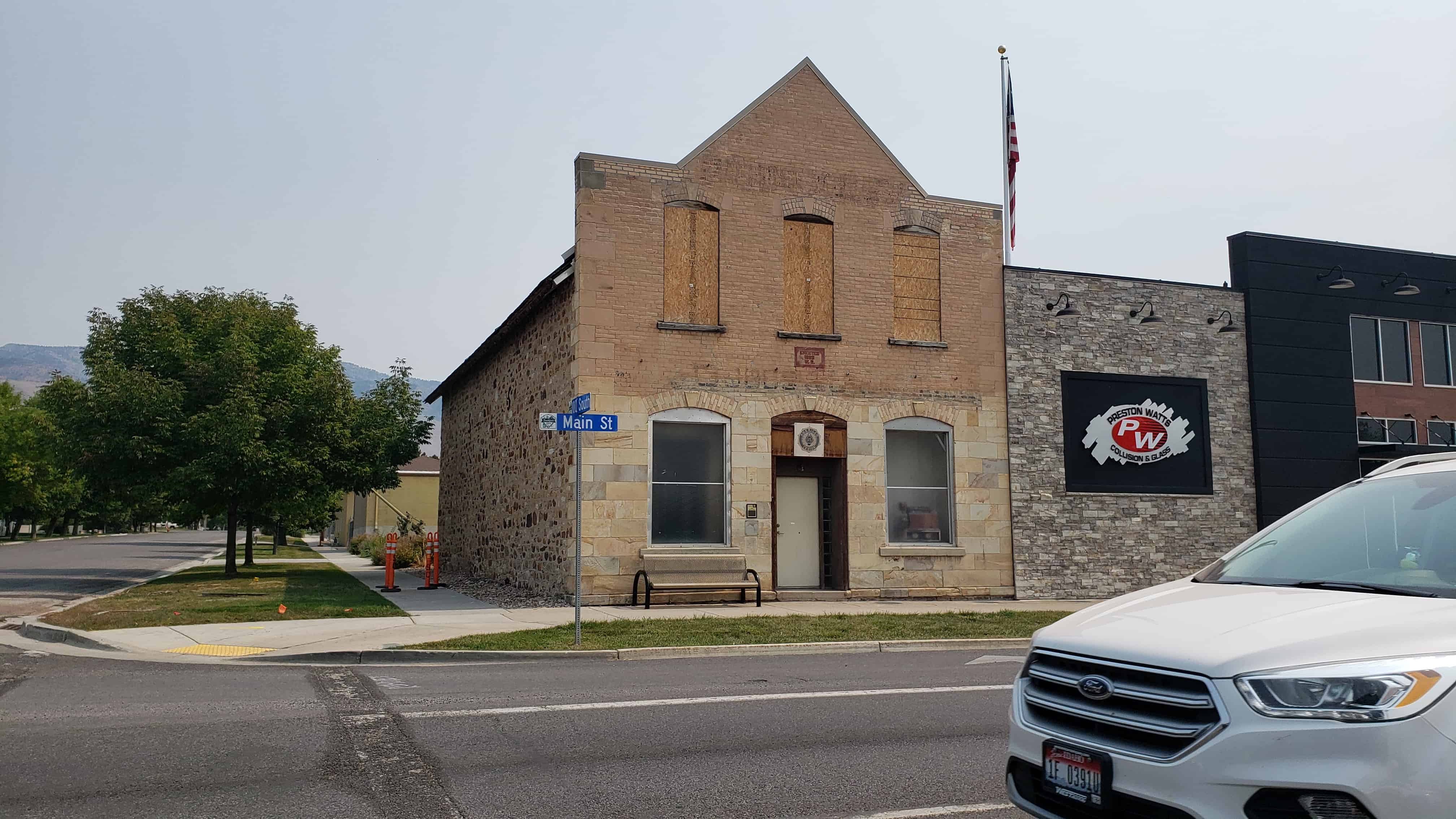
Built in 1883, the Douglas General Mercantile Store is locally significant as the oldest remaining commercial building in the town of Smithfield, Cache County, Utah. The town was founded in October 1859 as part of Cache Valley, which was itself settled in 1856 during the first stage of the Mormon colonization of Utah. William Douglas, who operated the store, began business in Smithfield in 1865, obtaining goods from the East and wholesaling them throughout the area. In 1883, when the building was constructed, it was one of only three such establishments in the town, and remains as the only physical structure tied to Smithfield’s early commercial history. The building has been associated with the commercial activity in the town through the firms of Douglas Mercantile, James Cantwell & Son, and the Union Merc Company since 1883. In addition, the building is the second oldest mercantile building identified to date that is located outside Utah’s heavily populated area known as the Wasatch Front, which comprises four of Utah’s twenty-nine counties. The oldest building is the Ephraim United Order Cooperative Building constructed in 1871-71. Also, the building gains added importance in the history of Smithfield because of its unique construction, the only one of its type in the town. Stone was used for the rear and two side walls in a rubble construction technique, while brick was utilized on the upper half of the façade and coursed sandstone for the lower half. Thus, the building represents the use of four different building materials as wood was also utilized.
Located at 101 South Main Street in Smithfield, Utah and added to the National Historic Register (#82004113) on August 4, 1982.
The town of Smithfield in Cache Valley, Utah, was tied to the early Mormon colonization of Utah. Part of what has been labeled “the inner cordon of settlements,” Cache Valley was itself settled in 1856, and Smithfield in 1859. As an agricultural region in northern Utah, Cache Valley aided in the supplying of goods not only to northern Utah, but also to mining regions in Idaho and Montana. Smithfield, which began as a settlement of dugouts and wagons, in 1860 became a village with houses arranged in “fort style” (forming a square where the rear portions of the buildings constituted the walls of the fort). It had been named Smithfield in 1859 for John Glover Smith, the first Mormon bishop, who exercised power in both church and civic affairs.
William M. and Cyntheann Merrill Douglas arrived in Smithfield in 1862. Douglas was born in Scotland in 1839, came to Utah in 1854 as a convert to the Mormon church, and settled in Salt Lake City. He established a general store in Salt Lake in partnership with Thomas Richardson. It was with Richardson that Douglas operated a store in 1865 in Smithfield. Goods were hauled from Chicago, Illinois to Ogden, Utah (about 35 miles north of Salt Lake), then to Smithfield by team. There, these goods would be wholesaled to nearby towns such as Richmond and Logan (eventually the Cache County seat). According to one local source, the indication was that Douglas and Richardson served as early distributors of general merchandise for the entire Cache Valley area.
William Douglas and Thomas Richardson were both called to serve missions for the LDS church in 1869, closing the store. In 1871 Douglas reopened his business in a frame structure. By 1883 business was such that the merchant could afford to construct the present wood, stone, brick, and sandstone building. Architecturally, the Douglas General Mercantile represents a unique type of construction in Smithfield, utilizing four different building materials–the only one of its kind in town.
In 1897 Douglas sold the structure and business to James Cantwell, who had settled in Smithfield in 1862. Cantwell served as the town’s postmaster and city councilman for nearly 20 years. The store operated as James Cantwell & Son until 1910, when it was sold to William L. Winn and Lorenzo Toolsen, who established the Union Mercantile corporation. Thus, the building served as a main commercial establishment for the agricultural town of Smithfield, and as it is the only remaining commercial building from the town’s early history, gains local significance and importance. Since 1964 the Smithfield American Legion Post has occupied and used the building. No immediate plans have been made to rehabilitate or restore the building.
Desert Lake, about 8 miles east of here, was first settled in 1885 by settlers building an irrigation ditch from Huntington Creek to the townsite and a reservoir to store the water for farming. In 1896 the dam broke, nearly drowning the small town. The dam was rebuilt in 1896-97 and a post office was established on Feb. 16, 1898. Between 1900 & 1910 the town gradually moved to a new site about 5 miles to the N.E. due to the encroachment of alkali ruining the farmland. A school & meeting house was built at the new site in 1910 and in 1912 the post office was officially changed to Victor. Settlers continued to fight the arid climate but finally gave up. Desert Lake & Victor became just a memory.
Dedicated July 13, 1996 Matt Warner Chapter 1900 E Clampus Vitus