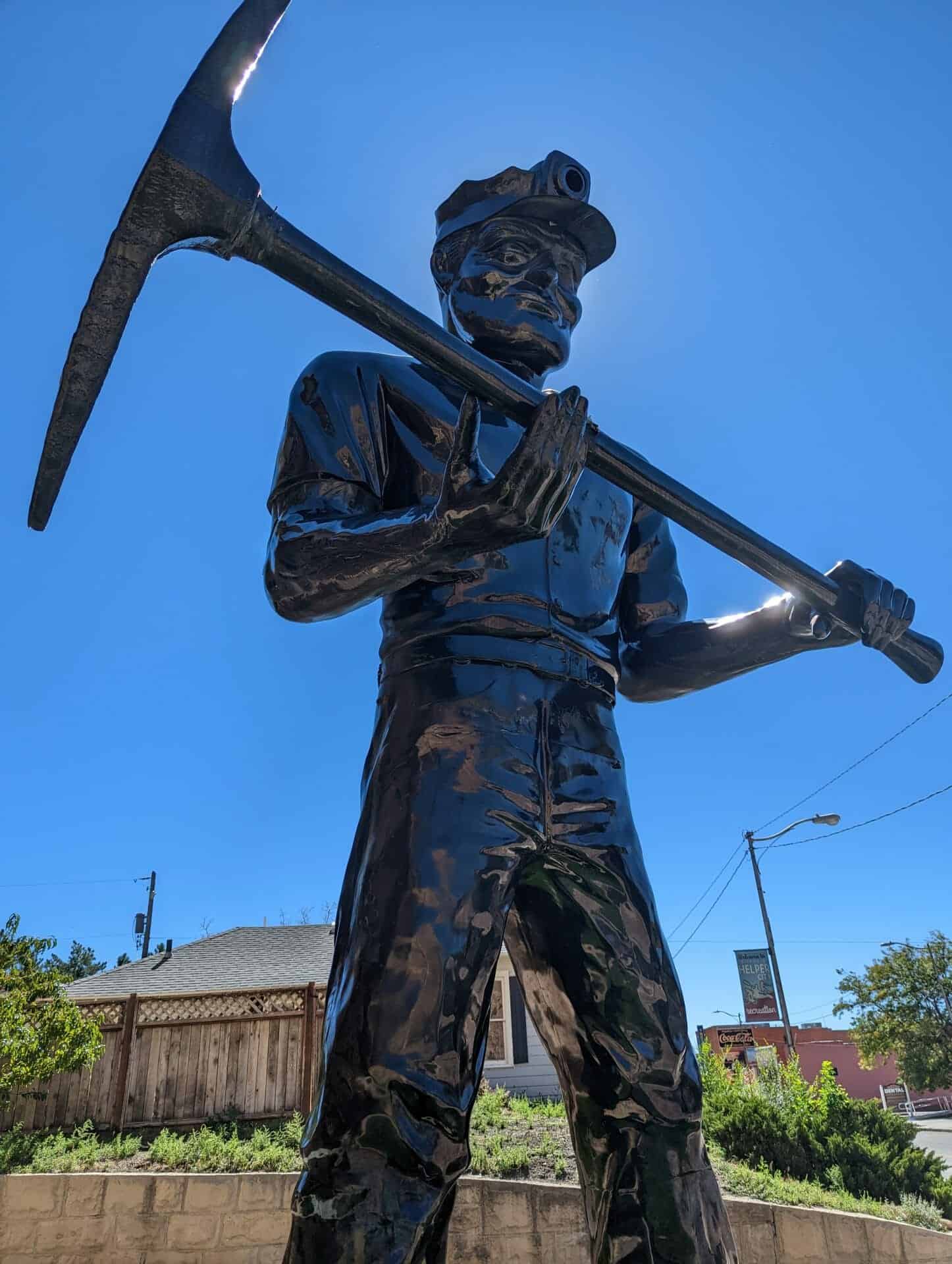
Big John was an original idea, born from the creativity and enthusiasm of Helper citizens, the Mayor and the City Council. In February of 1964, many of the movers and shakers of Helper decided the city needed a civic attraction. On February 27, 1964, the first meeting for the formation of a museum was held, where Councilman Al Veltri was appointed chairman. Things snowballed from there.
By March 12, 1964 the Western Mining Museum was on its way. It was discovered that a firm, – International Fiberglass in Venice, CA. – made large fiberglass figures for promotional purposes. The company was a fiberglass boat builder that had begun making tall advertising figures in 1963. With some discussion, the order went out and created the largest resident of Helper. Paul Bunyan became a miner.
Of course the miner still needed a name, but that didn’t take long. In 1961, the song of fame (the first was “16 Tons”) about mining won the best Country Song and Album of the Year. It was of of course “Big Bad John”. What other name was fitting for the 18 foot miner in Helper except “Big John.”
Big John is a proud symbol of pride for the mining industry. John also signifies the memory of all those who have given their lives in the local mines since the late 1890’s. John is the foundation of civic pride and strong work ethic for a unified community.
Stand was built from rails, spikes, and plates gathered from Castle Gate Mine Tram Way.
Built in 1937, the Helper Civic Auditorium was designed by Salt Lake City architects Carl W. Scott and George W. Welch. The building is an excellent example of Art Moderne style also known as “Streamline Moderne.” The style was popular in the 1930s particularly in public buildings. The auditorium features Art Moderne elements such as the flat roof emphasized by concrete coping and coursing, smooth masonry with curved corners, glass block, and pilasters with abstracted capitals.
The Helper Civic Auditorium is part of the Utah Public Works Administration (PWA) and Works Progress Administration (WPA) Buildings Thematic Nomination. The building is significant because it helps document the impact of New Deal programs in Utah during the Great Depression. The Helper Civic Auditorium was one of 226 buildings (two of which were auditoriums) constructed in Utah during the 1930s and early 1940s under the WPA and other New Deal programs. Of those 226 buildings, 130 are still standing. On a local level the construction of the building was a boost to Helper’s economy by providing much needed jobs and funds through the purchase of building materials.
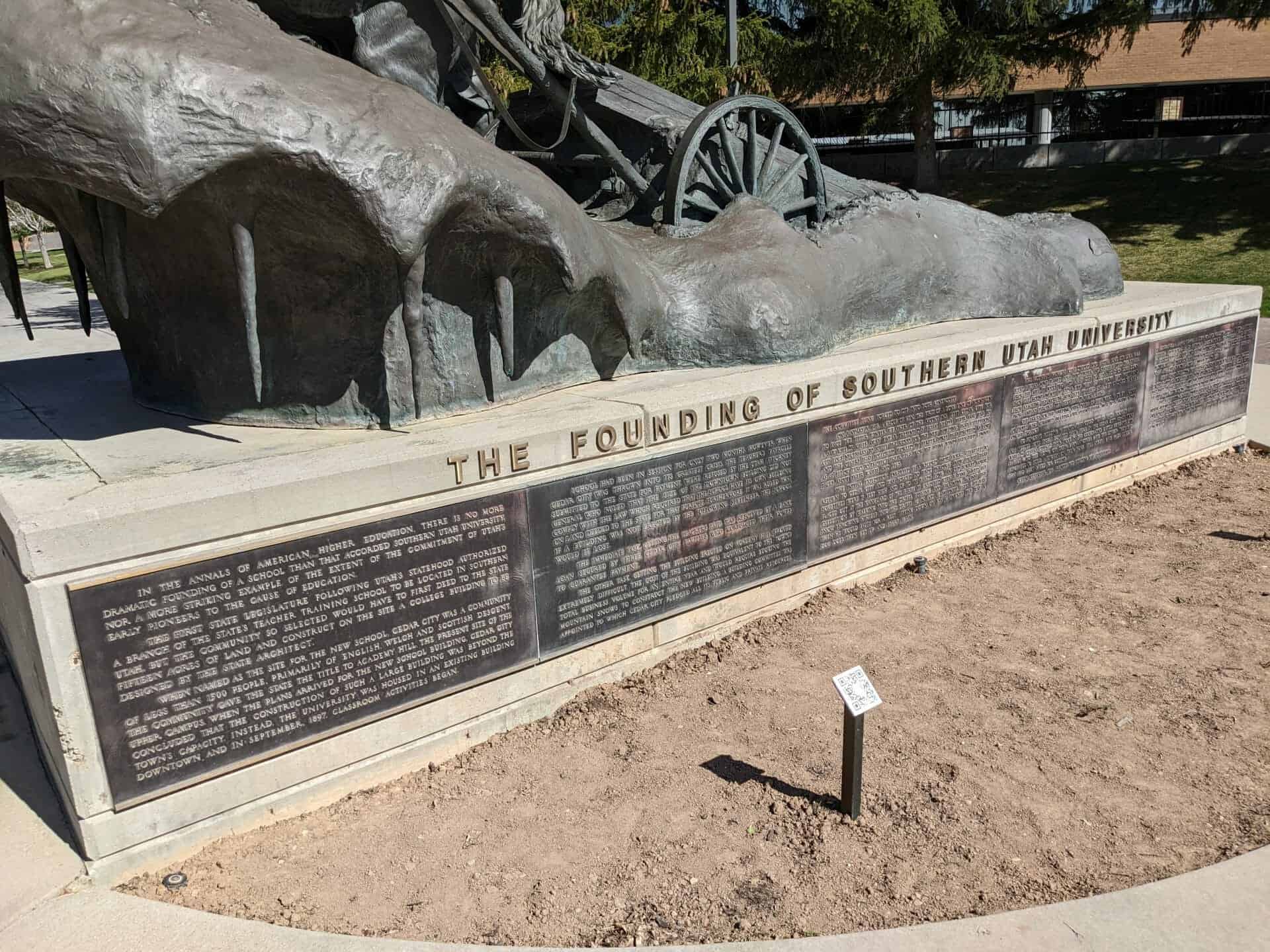
In the annals of American higher education, there is no more dramatic founding of a school than that accorded Southern Utah University, nor a more striking example of the extent of the commitment of Utah’s early pioneers to the cause of education.
The first State Legislature following Utah’s statehood authorized a branch of the state’s teacher training school to be located in Southern Utah, but the community so selected would have to first deed to the state 15 acres of land and construct on the site a college building to be designed by the state architect.
When named as the site of the new school, Cedar City was a community of less than 1500 people, primarily of English, Welch and the Scottish descent. The community gave the state the title to Academy Hill, plans arrived for the new school building, Cedar City concluded that the construction of such a large building was beyond the town’s capacity. Instead, the University was housed in an existing building downtown and in September 1897 classroom activities began.
School had been in session for only two months, however, when Cedar City was thrown into its greatest crisis. The teacher’s payrolls submitted to the state for payment were refused by the Utah Attorney General who ruled that size of the downtown building did not comply with the law which required that the school have its own building on land deeded to the state for that purpose. Furthermore, it was ruled that if a building was not erected by the following September, the school would be lost.
The immediate task, getting the teachers paid, was resolved by a bank loan secured by three Cedar City families who mortgaged their homes to guarantee payment.
The other task, getting the building erected on Academy Hill, proved extremely difficult. The cost of the building was equivalent to the town’s total business volume for an entire year and would require beating the mountain snows to construct the new building. A building committee was appointed to which Cedar City pledged all its public and private resources, the committee being forced to dip into both generously.
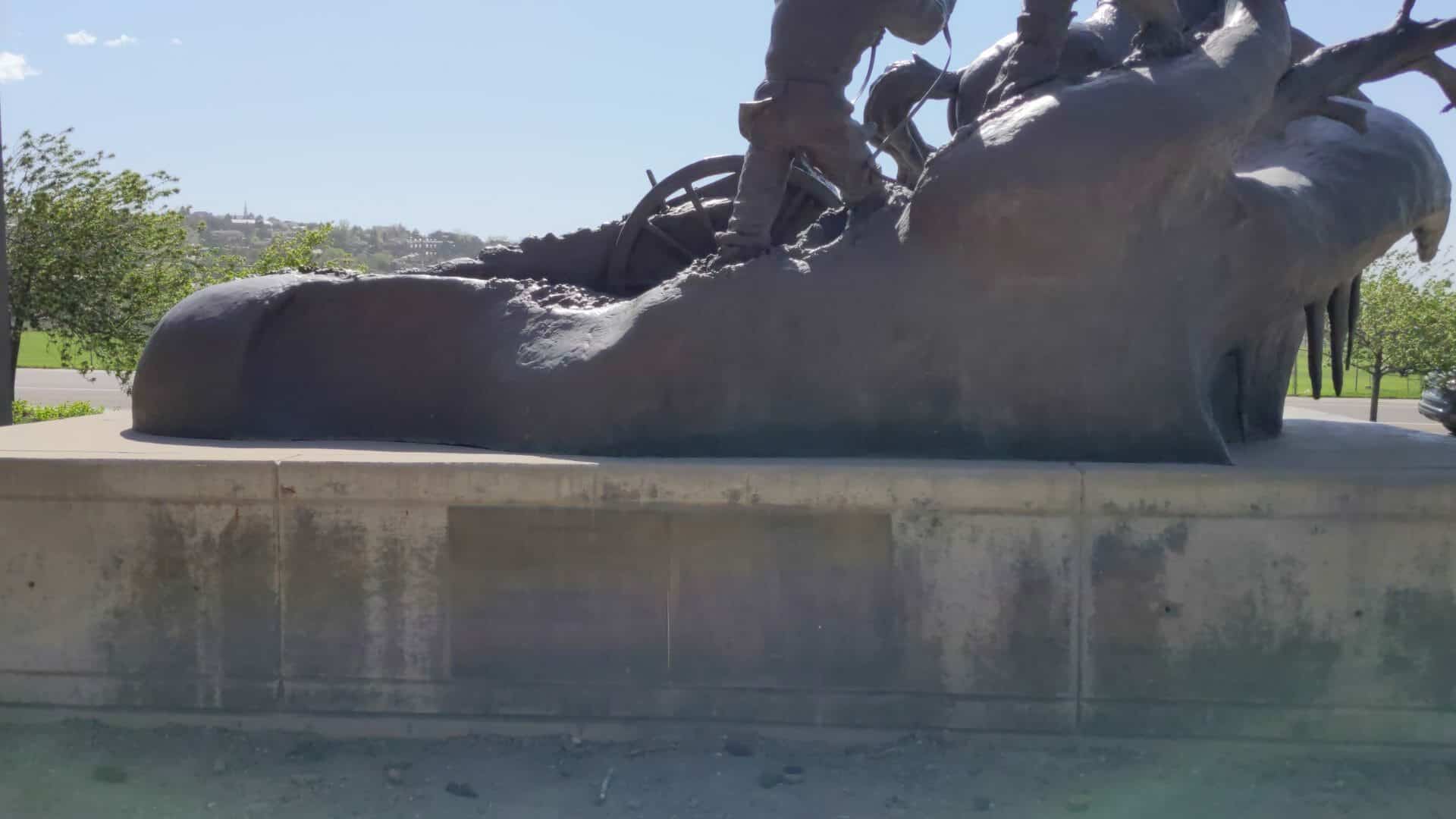
On January 5, 1898, a group of men, the first of a long line of townsmen to face the bitter winter weather of the mountains left Cedar City for a saw mill 35 miles away (near present day Brian Head). Their task was to cut logs necessary to supply the wood for the new building. That expedition, and the others that followed, worked in temperatures that dropped as low as 40 degrees below zero. To protect their legs from the biting winds they tied gunny sacks about their waists and legs.
The initial expedition, engulfed by a record snow storm, attempted to return to Cedar City and was forced to wade through snow drifts that sometimes were 15 feet high and 100 yards long. An old Sorrel horse, placed out at the vanguard of the party, is credited with having saved the expedition by walking into the drifts, pushing and straining against the snow, throwing himself into the drifts again and again until they gave way. Then he would pause for a rest, sitting down on his haunches the way a dog does, then get up and start again.
The mountain workers were divided into groups. Some cut logs, some were sawers, some planed logs into lumber, and others hauled the lumber from the mill. It took two and a half days to get a load of logs down from the mountain tops to Cedar City. When heavy snows kept provisions from reaching the working men, they subsisted on a diet of dried peaches. From January through July they kept up their labors.
The bricks for the building, over 250,000 of them, were made by a corps of people who remained in Cedar City, often putting in 12 to 14 hours a day on the project.
To purchase building materials that could not be made locally, cash was needed. Some people donated their stock in the Cedar City Co-op store while others offered their stock in the cooperative cattle company. One family gave the siding off their barn, another gave the lumber they had purchased to build a kitchen on their home. Still others gave prize lumber that had been saved for coffins.
When September 1890 arrived, the building was completed.
It contained a large chapel, a library, and reading room, a natural history museum, biological and physical laboratories, classrooms, and offices. It stands today at the end of the founders’ walkway, directly east of this monument. Its interior has been remodeled several times but the exterior walls are the original ones constructed in 1898.
That first building was literally torn from icy crags and molded by the hands of more than 100 men and women. The community of Cedar City had met its greatest test, and the University was given a heritage unmatched by any other educational institution in the United States.
The preserving of the University was achieved by people who would never attend it, indeed some of them never had the opportunity of attending any school. They were hardy, rough-spoken, courageous men and women, people of the type without whom the frontiers of the west could never have been conquered.
The Beacon Hotel (or Tavern) was built behind a retired aviation beacon which advertised a Richfield gas station. The building, with 50 rooms, was built soon after the stock market crash in 1929. At that time it was the largest hotel between Los Angeles and Albuquerque. The grand opening was a week long party that started on June 27, 1930.
The swanky rooms had a writing desk, a radio with country-wide stations and their own bathrooms! Cost: three to six dollars.
F. Scott Fitzgerald, Norma Talmadge, Mickey Rooney, Clark Gable the Pittsburgh Pirates and many other big stars stayed at the hotel.
The cactus garden was a big attraction and was the site of many weddings and parties.
In 1970 it was dismantled. The furnishings, appliances and even the books were sold. Many items can still be found in local homes and museums.
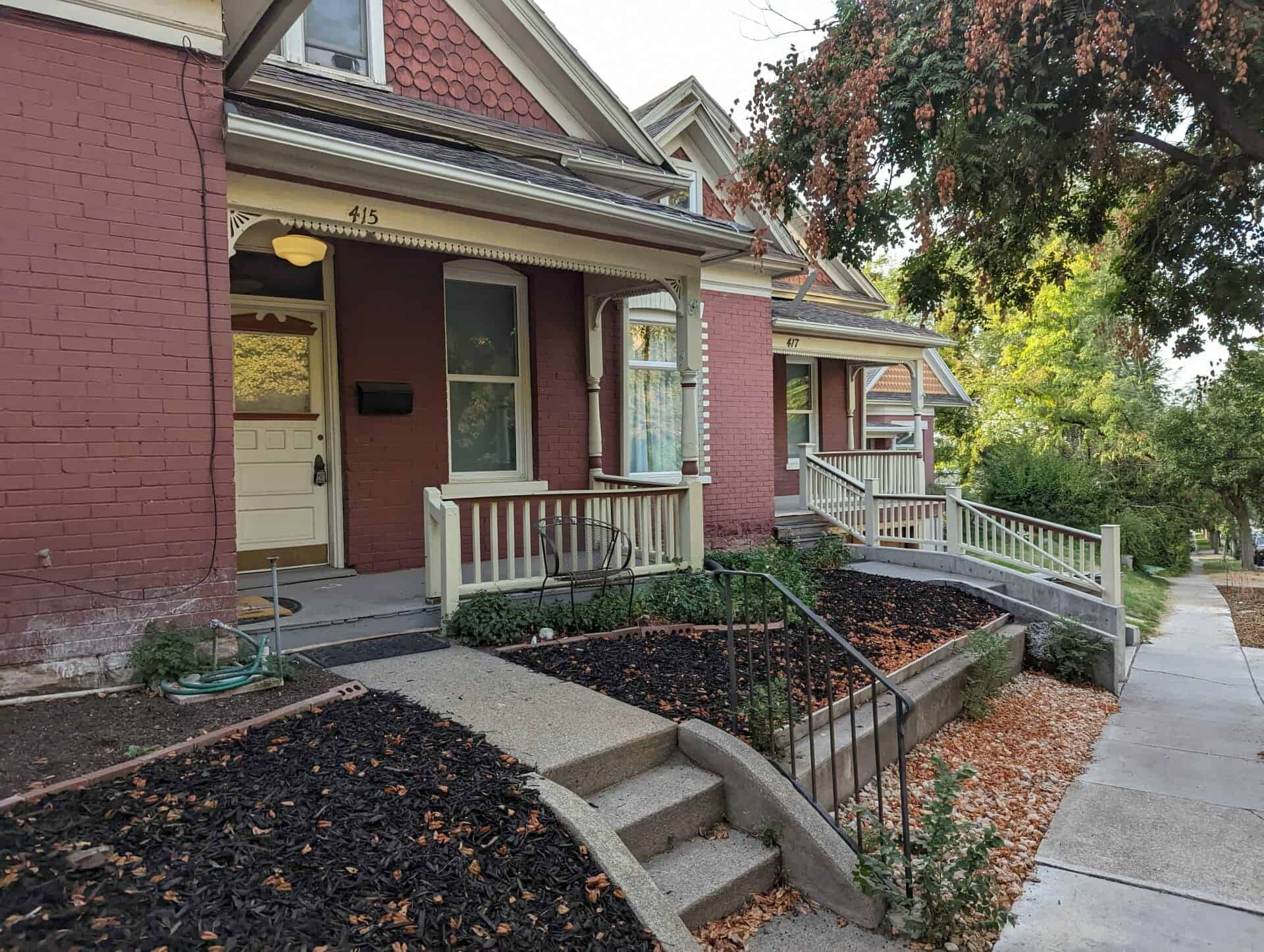
This one and half story house is a three opening façade “hall, and parlor” house type. The flue is on the internal partition. The rear “L” is also stone and was part of the original structure. The stone is cut blocks with some discoloration and does not extend up the gable to the ridge. The gable has been. filled in with aluminum siding.
This house is important as a late 19th Century, extension of an earlier vernacular house plan, indicating that folk house traditions persisted quite late in the Spring City area. The construction details and fine workmanship make this small house quite exceptional in Sanpete County.
The first declaratory statement and mayors deed are to Nicolai Lund, in -1869-1870. Lund sells to James Blaine in 1878 ($100), then to John W. Allred in 1881 (also for $100). The constant and quite low price seems to indicate that no house stood on the lot in 1881. Allred kept the lot through 1899, at which time he transferred it to Mary Nielsen for $1. In 1901, John H. “Miller” Johnson bought the lot for $450 – undoubtedly the house was completed by this date. Local tradition says that the house was built in the 1885-1890 period by Allred – Ida Billington, now 96 (in 1979), went and played her guitar for the house warming when she was young.
Johnson was the miller at the Spring City Roller Mill which opened in 1900. Later Niels Adler (1906) and Margaret Griffiths (1908) owned the property. Herman Hermansen was also, an owner with the Larsens, the present (1979) owners, buying the place in 1936.
This square log granary is typical Spring City outbuilding. The corner notching is a very rough “v” notch type. The logs are hewn and flush at the ends with the interstices chinked.
This granary constructed c. 1875 is important as an example of a typical outbuilding within the Mormon village context.
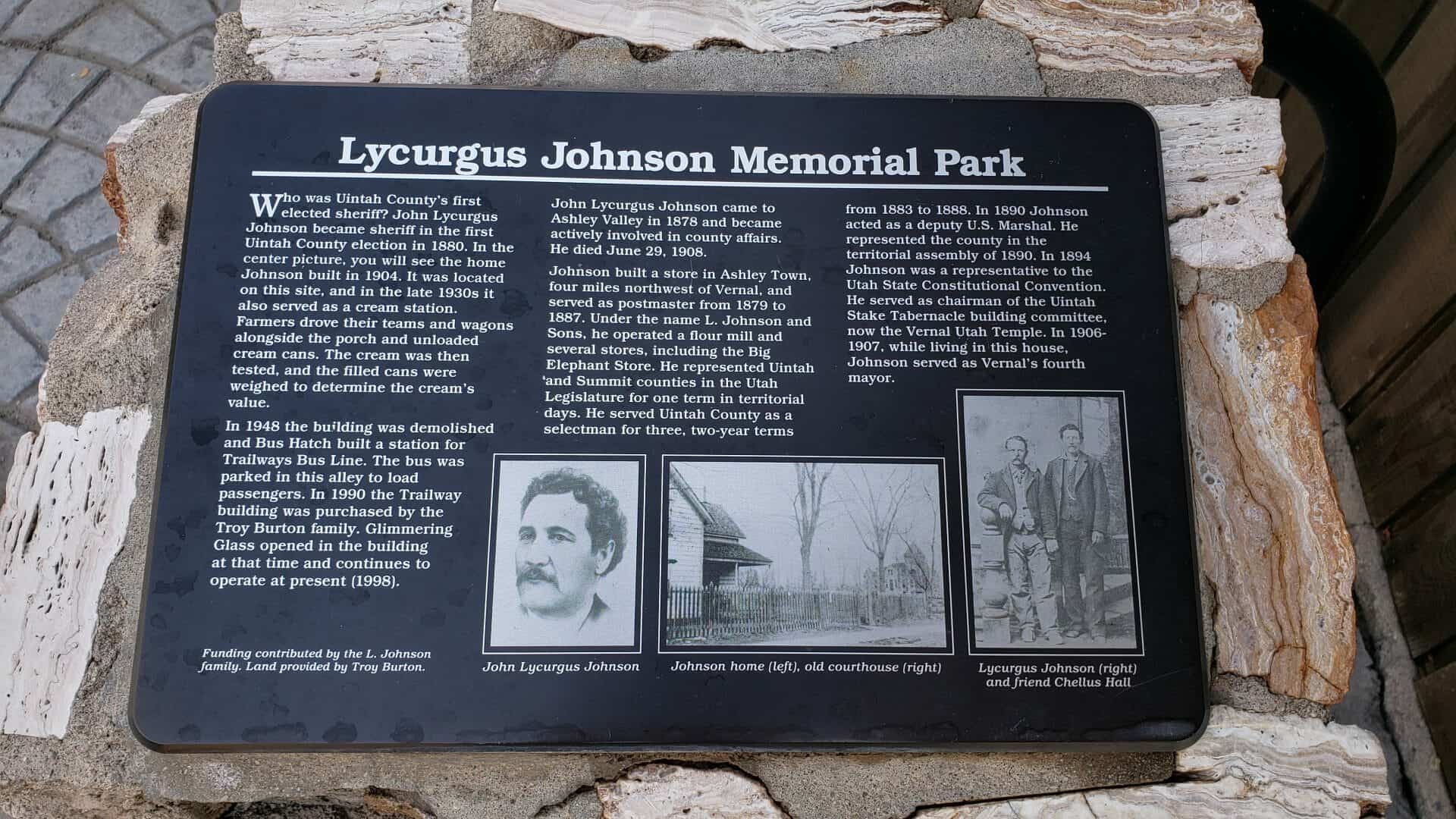
Who was Uintah County’s first elected sheriff? John Lycurgus Johnson became sheriff in the first Uintah County election in 1880. In the center picture, you will see the home Johnson built in 1904. It was located on this site, and in the late 1930s it also served as a cream station. Farmers drove their teams and wagons alongside the porch and unloaded cream cans. The cream was then tested, and the filled cans were weighed to determine the cream’s value.
In 1948 the building was demolished and Bus Hatch built a station for Trailways Bus Line. The bus was parked in this alley to load passengers. In 1990 the Trailway building was purchased by the Troy Burton family. Glimmering Glass opened in the building at that time and continues to operate at present (1998).
John Lycurgus Johnson came to Ashley Valley in 1878 and became actively involved in county affairs. He died June 29, 1908.
Johnson built a store in Ashley Town, four miles northwest of Vernal, and served as postmaster from 1879 to 1887. Under the name L. Johnson and Sons, he operated a flour mill and several stores, including the Big Elephant Store. He represented Uintah and Summit counties in the Utah Legislature for one term in territorial days. He served Uintah County as a selectman for three, two-year terms from 1883 to 1888. In 1890 Johnson acted as a deputy U. S. Marshal. He represented the county in the territorial assembly of 1890. In 1894 Johnson was a representative to the Utah State Constitutional Convention. He served as chairman of the Uintah State Tabernacle building committee, now the Vernal Utah Temple. In 1906-1907, while living in this house, Johnson served as Vernal’s fourth mayor.
This is #20 of the 21 stop history walking tour in downtown Vernal, Utah. See the other stops on this page:
What do you get with a cow, a jug of whiskey, and the city’s “Cat?”
The 7-11 Ranch Restaurant, located directly across from you, is the oldest existing restaurant in Vernal. In 1933, Warren “Fat” Belcher sold a cow and bought a hot dog stand on South Vernal Avenue. Rising to the challenge of getting it moved to East Main Street, he bribed George Ramsey with a jug of whiskey to “borrow” the city’s “Cat,” (bulldozer) and moved the stand in the middle of the night. George took the bribe and the rest is history.
Warren and his wife, Daisy, operated their restaurant as the Grub Box until their new place was built in 1949. The café was named the 7-11 and sported four dice on its marquee, supposedly because Warren liked to gamble and shoot craps. It was also said that the Belchers wanted eleven children, but they only had seven.
One night a couple of men came in and after looking around, asked the waitress where the “Crap Room” was located. She hesitated a minute, then directed them to the men’s restroom. They came out looking very sheepish and left. The 7-11 Café is still owned and operated by one of Warren and Daisy’s daughters, Connie, and her husband, Jerry Pope.
This is #13 of the 21 stop history walking tour in downtown Vernal, Utah. See the other stops on this page:
What do you get with a cow, a jug of whiskey, and the city’s “Cat?”
The 7-11 Ranch Restaurant, located directly across from you, is the oldest existing restaurant in Vernal. In 1933, Warren “Fat” Belcher sold a cow and bought a hot dog stand on South Vernal Avenue. Rising to the challenge of getting it moved to East Main Street, he bribed George Ramsey with a jug of whiskey to “borrow” the city’s “Cat,” (bulldozer) and moved the stand in the middle of the night. George took the bribe and the rest is history.
Warren and his wife, Daisy, operated their restaurant as the Grub Box until their new place was built in 1949. The café was named the 7-11 and sported four dice on its marquee, supposedly because Warren liked to gamble and shoot craps. It was also said that the Belchers wanted eleven children, but they only had seven.
One night a couple of men came in and after looking around, asked the waitress where the “Crap Room” was located. She hesitated a minute, then directed them to the men’s restroom. They came out looking very sheepish and left. The 7-11 Café is still owned and operated by one of Warren and Daisy’s daughters, Connie, and her husband, Jerry Pope.