Tags
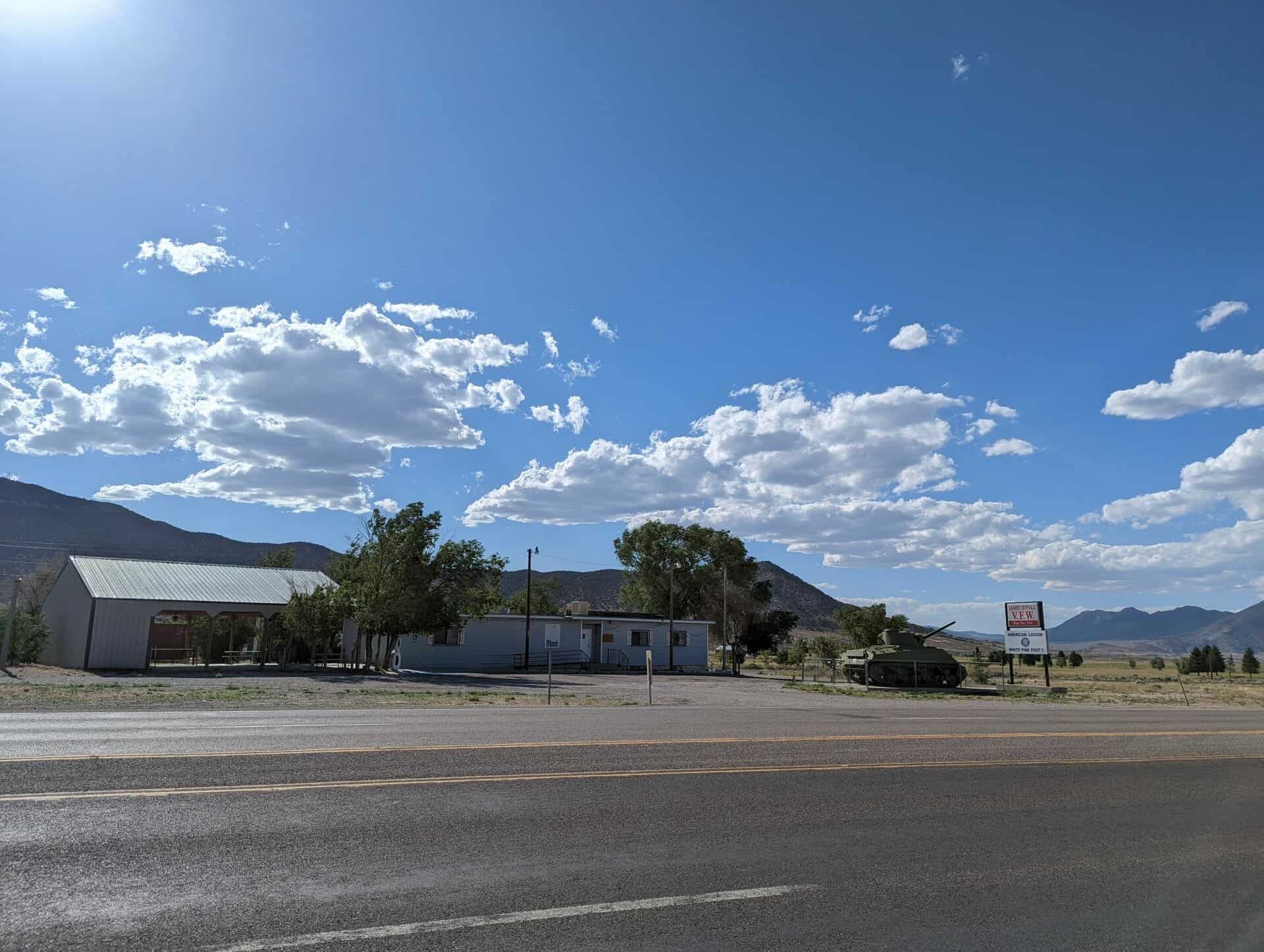
James Jewell V.F.W. Post No. 3547 / American Legion White Pine Post 3
50 North McGill Highway in Ely, Nevada.
Related:


17 Monday Oct 2022
Posted in Uncategorized
Tags
James Jewell V.F.W. Post No. 3547 / American Legion White Pine Post 3
50 North McGill Highway in Ely, Nevada.
Related:
16 Sunday Oct 2022
Posted in Uncategorized
Tags

Land of the Yuta
Historic markers located at the Utah Territorial Statehouse in Fillmore, Utah

Death of a Chief
The winter of 1854-55 found Walkara and his band camped along Meadow Creek just four miles south of this spot. In January, the chief began to feel ill, and by the later part of the month, he was suffering from pneumonia. On January 29, the Hawk of the Mountains died. Carrying out the wishes of his dead brother, Arapene slashed the throats of Walkara’s two wives so that their spirits might walk with that of the Hawk. On the day of their deaths, the bodies of the chief and his wives were securely strapped to horses and carried to the mountain above what is now the town of Meadow. There, in the talus slopes which overlook the western deserts of the Great Basin, Walkara was interred in a tomb of stone.
The chief was placed on his favorite blue blanket, and the still-bloody bodies of his two wives were laid on either side. A young Paiute girl was also killed and put into the grave while another Paiute child, a small boy, was staked alive in the pit to ward off wild animals. Before the tomb was sealed, an ornate saddle with brocaded cherubim, a Book of Mormon, rifles, bows, steel-tipped arrows, Spanish ornaments and food were placed with the dead chief. To seal the ten foot diameter tomb, logs were placed across the top of the grave. Rocks were then stacked on top of the logs to conceal the posts and the burial vault. With the sealing of the tomb, 14 of Walkara’s favorite horses were led to the grave and killed. A Forest Service survey of the burial site in 1983 revealed the scattered skeletal remains of these horses 128 years after they had been killed. This survey also confirmed what had been unofficially suspected for years: Walkara’s grave had been robbed by relic hunters sometime around 1909.
Two hundred yards north of Walkara’s gravesite are a number of Ute burials from the same general time period; that is, the 1850’s and 1860’s. These burials are not as grand as Walkara’s. Generally, they consist of a small vault in the talus just big enough for a single individual accompanied by a small number of grave goods. Of the 20 burials, 13 have been disturbed by grave robbers. Human bones have been scattered indiscriminately across talus slopes while graves have been looted of the goods that accompanied the dead at burial.


The Ute Domain
First described by Spanish explorers as the YUTA Indians (pronounced Ute-ah), the ancestors of the Ute people are thought to have migrated from the deserts of southeastern California over 700 years ago. The Utes moved into predominately two areas and became somewhat distinct because of that geographical division. The eastern Utes (Colorado) migrated to the east of the Colorado River and settled on the Colorado Plateau. On the other hand, the western Utes (Utah) established their camps in the valleys between the rugged mountain ranges on the eastern margin of the Great Basin.
In south-central Utah, one of the earliest camps has been dated to around A.D. 1380 and consists of stone circle 10 to 15 feet in diameter that would have anchored skin or brush shelters called wickiups. Unlike the Fremont and Anasazi Indians who preceded them, the ancestors of the Utes were not farmers but rather relied on hunting and gathering for their sustenance.
When encountered by the Dominguez-Escalante Expedition in 1776, the Utes were found living in “houses of grass and earth” near the shores of Utah Lake. Father Escalante, the chronicler of the expedition, describes the Indians as having good features with most of the men wearing long beards. The Indians called themselves the Timpanohtzis or the “fish eaters” but their diet also consisted of plants, herbs and wild game. Escalante wrote that the Utes were a docile and peace-loving people. Over a half century later, an adventurer by the name of Dan Storm spent the winter of 1839-40 with the Utes in an encampment near Utah Lake. The village consisted of two dozen buffalo-hide tipis occupied by 100 men, women and children. The people kept about 300 horses which they had obtained from the Spanish beginning in the early 1800s. The Utah Lake Utes, according to Storm, were one of the strongest of the six independent bands that made up the western Utes. Storm found the Utes considerably more aggressive than had the Spanish, and he writes of participating in a raid on the Gosiute Indians of western Utah. Many prisoners were taken in this raid with women and children ultimately sold as slaves to the Navajos and the Mexicans.
With the arrival of the Mormon pioneers in 1847, relations between the Utes and the newcomers were at first peaceable and friendly. George A. Smith, of the Utah Indian Service wrote that, “They are virtuous, honest and free from licentiousness; they are humane and kind to one another.” Smith described the Utes as typical mountain Indians. They were wanderers and had seasonal camps all over central and southern Utah including those near Spanish Fork, Payson, Nephi, Manti, Fish Lake, Meadow, Kanosh and Parowan. On occasion, the Utes ventured as far as the plains of Colorado in search of buffalo meat and hides. Marriage was polygamous, and a man might take as many wives as he could afford. Women were expected to raise their children, butcher and process wild game and plants, provide meals, and to move camp. The role of the men, in contrast, was that of hunter and warrior.
The greatest warrior and chief during the early pioneer period was a tall, handsome man named Walkara, the “Hawk of the Mountains.” Born somewhere between 1808 and 1815 on the Spanish Fork River near what is now Provo, Walkara rose to power when he assumed the role of war chief in his father’s band, the Tim-pan-ah-gos Utes. The Hawk quickly increased his prominence as a leader by his skill and prowess as a “procurer” of horse flesh. Raiding as far away as the coast of California near San Luis Obispo, Walkara terrorized western ranches for over a quarter of a century until his death in 1855. According to fragmentary accounts, his raids were conducted between 1825 and 1854. The largest number of horses stolen on any one raid was 3,000 with several raids netting at least 1,000 head. Horses could be sold at a mountain rendezvous for as much as $50 per animal or traded to other tribes for Indian children who were then exchanged for ammunition, blankets, pots and pans, and trinkets at the Santa Fe slave market.
Inevitably, the differences in culture, customs and economics brought the Utes and Mormon Pioneers into armed conflict. The Utes found their hunting and camping grounds increasing crowded with settlements while the Christian values of the pioneers prevented them from ignoring the issue of slavery. In 1853-54 and again in 1865-67, smoldering hostilities were fanned into open warfare. In 1872, with their ranks decimated by both war and disease, 1,500 Utes were removed by treaty to the Uintah Indian Reservation in northeastern Utah. Today, headquarters for the Ute Tribe of Utah or the “Northern Ute Tribe” as it is now called is located near the center of the reservation at Ft. Duchesne.


Walkara’s War
When the Utes welcomed Brigham Young and his party of 143 pioneers in 1847, they offered the Mormons the use of the land but had not given them their streams with their fish and beaver. They had also not reckoned with the fact that the white men would fence the land into little squares and tell them to keep out. And, they had not known that the ever increasing streams of newcomers would build forts as strongholds against them.
In 1853, relations between the pioneers and the Utes were strained to the limits. In July of that year, three Indians from Chief Walkara’s camp on Hobble Creek appeared at the cabin door of James Ivie near Springville to trade fish for flour. An argument followed, and Ivie killed one of the Indians in a hand-to-hand fight with a broken rifle stock. Walkara, upset with this incident and the Mormons’ recent policy opposing his lucrative slave trade, grasped the situation and unleashed a hit-and-run reign of terror that plagued the settlements in Utah, Juab, Sanpete, Millard and Iron Counties for the better part of the next year.
Ironically, the largest “engagement” of the war was not fought by Walkara but by the Pahvant Utes camped at Meadow Creek just south of Fillmore. In the fall of 1853, a wagon train of Missourians enroute to California camped near the Indian village. When a group of Pahvants approached with bundles of buckskin and offered to trade for tobacco and other goods, the settlers surrounded the party and attempted to disarm them. A fight ensued and the father of the Pahvant War Chief Mosnoquap was mortally wounded by a gunshot to his side. In retaliation, Mosnoquap ambushed a United States Army survey team in bivouac near Sevier Lake some 35 miles northwest of Fillmore. Captain John W. Gunnison and 8 of his men died as the Pahvants attacked with a barrage of arrows and bullets as the morning sun rose on the army camp.
When word of the battle reached Fillmore several days later, White officials traveled to the site with Kanosh, Chief of the Pahvant Utes. Kanosh, long considered a friend of the pioneers, was sickened at the sight of the mutilated remains of Gunnison’s men. After ordering the appearance of Mosnoquap, Kanosh admonished the war chief for his actions. Although reproved for his role in the battle, the war chief was never surrendered by Kanosh to either Brigham Young or a U.S. Army detachment which had been sent to the Utah Territory to keep the peace.
With the approach of the spring of 1854, the Utes had grown tired of the fighting, and Walkara found his ranks of supporters growing ever thinner. Governor Young, recognizing the opportunity of the moment, arrived at Walkara’s camp on Chicken Creek near Nephi on May 22 with a contingent of 50 mounted militiamen and 100 wagons filled with gentlemen, their wives and families. The Chief was presented with 16 head of oxen, blankets, clothing, tobacco, whiskey, trinkets, arms and ammunition. During negotiations that lasted into the night, the Utes agreed to cease all hostilities against the pioneers and to give up their slave trade. The Mormons, in return would establish an Indian farm near Utah Lake. The calumet of peace was smoked on the 23rd of May, and thus ended 10 months of violence that had claimed 20 pioneer lives, an undetermined number of Ute deaths, and about $200,000 worth of property damage.


16 Sunday Oct 2022
Posted in Uncategorized
Tags

Rainbows Over The Basin
Northwest of Barstow lies one of the most beautiful and mysterious locations in the Mojave Desert: Rainbow Basin, it’s a mishmash of shapes, colors and fantastic formations, a place where water and wind have worked magic, sculpting layers of sandstone and sediment to expose brilliantly colored formation and paleontological features. It changes moment by moment with the passing day, with shadows falling dep into canyons and cuts.
This mural is one of many that can be found on Barstow’s Main Street.

15 Saturday Oct 2022
Posted in Uncategorized
Tags
Bells, Duchesne County, DUP, Historic Markers, Post Offices, Upalco, utah

Lake Fork
After 1861 this area was an Indian Reservation until opened for settlement in 1905. Homesteaders arrived, cleared land, dug ditches, planted crops and built cabins. Home erected by David Richardson, moved here, became the first post office; Rhoda Barker Post Mistress. Bell adornment hunt in the Church of Jesus Christ of Latter-day Saints building erected on this site, also used for recreation and school, William Neal, first teacher. Lake Fork was renamed Upalco.
This is Daughters of Utah Pioneers markers #355 located in Upalco, Utah
Related:


15 Saturday Oct 2022
Posted in Uncategorized
Tags

Upalco, Utah
Formerly Lake Fork, Utah.
Related:

video
15 Saturday Oct 2022
Posted in Uncategorized
Tags
Grantsville, Historic Homes, NRHP, Queen Anne style, Tooele County, utah, Victorian, Victorian Queen Anne style
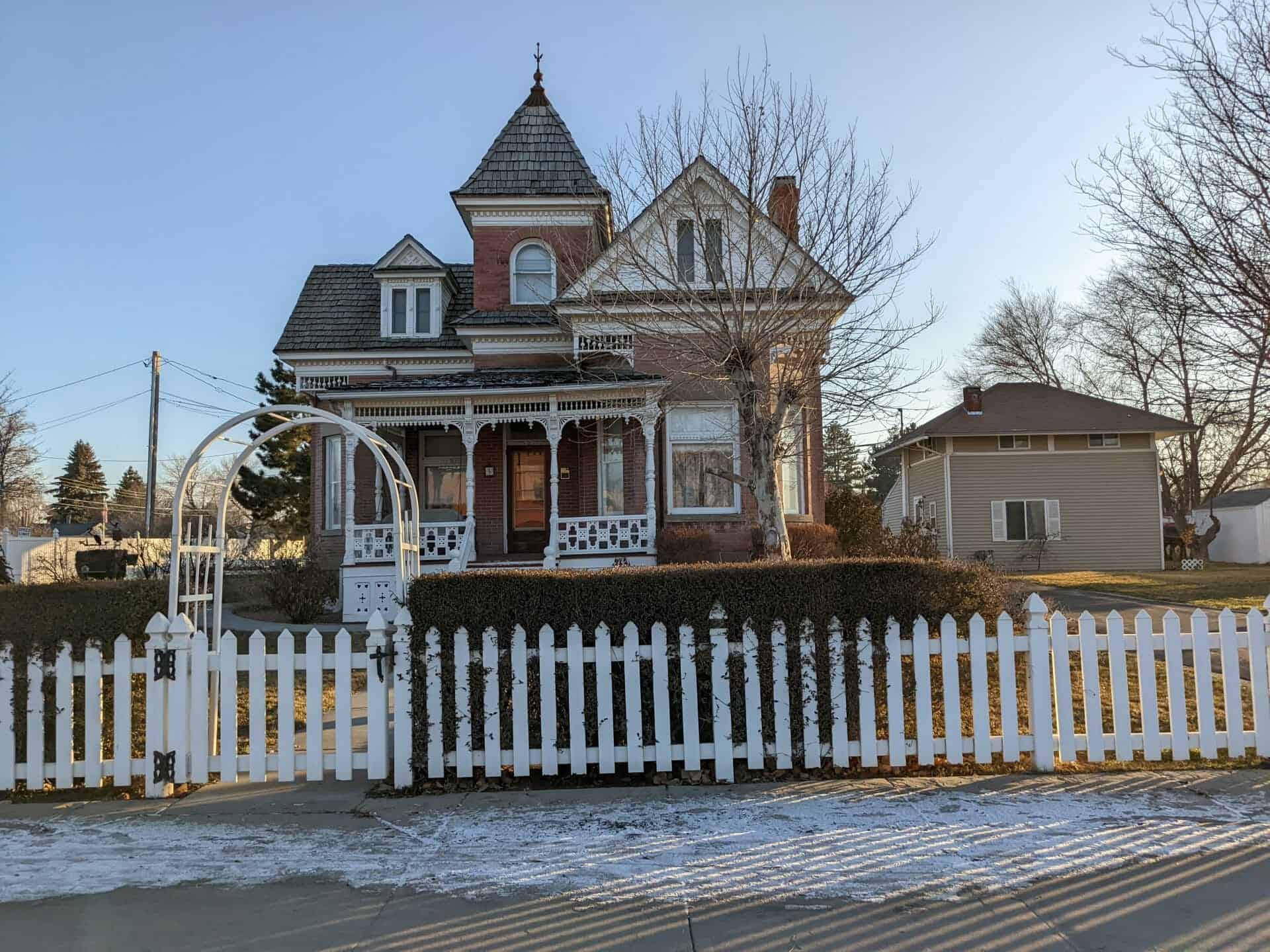
Alex and Mary Alice Johnson House
The Alex and Mary Alice Johnson House is located at the corner of Main Street and Hale Street in Grantsville. It is a one-and-one-half story brick home in the Queen Anne style built in 1900. The plan of the main floor gives the impression of a cross-wing house with a square tower at the intersection of the wings. However, more substantial than a typical cross-wing, it may also be considered a modified central-block with projecting bays. The house is on a one-half acre property with three outbuildings that retain their historic integrity but do not contribute to the historic significance of the house.
The house sits on a coursed rubble foundation. The masonry consists of two types of brick. It is faced with a fired red brick and lined with adobe. The courses are laid in a running bond with 4″ projections at the corners of the octagonal bays. The lintels, sills, and water table are of sandstone. The main floor fenestration is a combination of large fixed sash windows with transoms and smaller double-hung windows. There are paired double-hung windows in each of the four gable ends and the two small dormers. The tower has round arched windows, brick voussoirs, and decorative brick-work at the imposts. The tower’s pyramidal roof is capped with a metal finial.
Probably the most striking part of the house is the decorative woodwork, which according to one source, has always been painted white. The gable trim includes octagonal shingling with lozenge patternwork in the peak. Engaged pilasters with bracket “capitals” flank the windows. Similar details occur on the dormers. Dentils are found on the main cornice completely surrounding the house, as well as on the tower cornice. Corner brackets with lathe-turned spools and spindles occur at either side of the bays. The north and east porches are particularly elaborate. Each consists of lathe-turned columns and console brackets which support a spool and spindle frieze. Other decorative elements on the porches include dentils, fan-shaped brackets, pendants, and paterae. Scroll-cut woodwork is found on the balustrades and the base enclosure.
The principle elevations of the building have remained virtually unaltered since its construction. Minor alterations have been made to the rear, or south elevation, and concrete steps have been added to the east porch. A porch which spanned the length of the rear elevation was enclosed probably within a decade of the original construction. The east half of the porch was screened and the west half was fully enclosed to form a room. A doorway was cut from the main house to this room. In the 1950s, both the room and the screened porch were removed. They were replaced by a concrete porch supported by simple metal columns. Two other changes occurred in 1993: the cellar stair enclosure on the west elevation was repaired and the mid-century asphalt roof was replaced with wood shingles.
( This was added to the National Register of Historic Places (#95001433) on December 13, 1995 and is located at 5 West Main Street in Grantsville, Utah )

The interior of the house consists of several large well-lighted rooms with eleven-foot high ceilings. A small entrance foyer is at the base of the tower and contains separate doors to the dining room and parlor. The two rooms are also connected by a set of double doors. A large kitchen runs the east length of the house, with an enclosed staircase parallel to it. A second set of cellar stairs is found under the main staircase. The west side is separated into two smaller rooms: one was probably used as a bedroom, while the other was the family bathroom (the house was reportedly one of the first to have indoor plumbing in Grantsville). On the second floor there are four bedrooms, a nursery and a small office in the tower. The attic can be accessed from a trap door near the stairs.
Except for some changes in wallpaper and paint, the interior is in good historic condition. Some woodwork has been painted, however, most of the panelled doors, window casings, and other
woodwork are stained and varnished. With one exception, both interior and exterior doors have working hopper transoms and all original hardware. Decorative elements at the doors and windows include corner blocks and paterae. Most of the glass appears to be original.
The house has a full fireplace in the parlor and stove-pipe flues in the kitchen and main floor bedroom. The parlor boasts a tall mirrored mantel with Ionic columns and a carved festoon/wreath. The interior is remarkably well-preserved. In the 1950s the kitchen was partitioned to create a laundry room and new appliances were added. There was also some work done to the kitchen in the 1970s. However, the original wainscotting is still visible on two sides of the room and only the lattice at the top of the partition seems out of period. The bathroom also contains fixtures from the 1950s remodel and includes the blocked door to the missing back room. Other than paint, wallpaper and new flooring, the second floor has seen little modification since a second bathroom was added in the 1950s. The house is still heated by its original boiler and radiators.
The site has three outbuildings which were used by the original household. The small pumphouse at the rear most likely dates to the original construction and supplied water to the house. A small chicken pen has been added to the pumphouse. In the southwest corner of the property sits a large framed three-car garage, built sometime after 1910. The garage also includes a room originally used as an icehouse. A two-story frame summerhouse sits west of the house, and was probably built after the garage (around 1915-1920). The main floor of this building served as a laundry and the upper floor was used for bedrooms. This building has been partially covered with aluminum siding and is currently rented as a residence. An L-shaped asphalt driveway covers a large portion of the property, but the remainder consists of trees, lawns, and flower beds. A rock garden and fountain have been built near the east porch. Sidewalks run from the perimeter to the north and east porches. The property has a combination of picket, post, and chain-link fences.

The Alex and Mary Alice Johnson House, built in 1900, is an excellent example of the Victorian Queen Anne style. This style of architecture documents an important period of growth in Utah. The design, though executed by a local builder influenced by pattern-books, combines a remarkable unity of composition with elaborate decoration. With its prominent position on Main Street, the Johnson House is one of the most distinctive architectural landmarks of Grantsville. Both the exterior and interior details of the home have been extraordinarily well-preserved. The house meets National Register Criterion C in the area of Architecture as the most outstanding example of a Queen Anne house in the community.
Alexander Johnson began construction on the home in 1899, just after his marriage to Mary Alice Anderson. Both were natives of Grantsville, born in 1870 and 1878 respectively. His parents were Charles Johnson and Charlotte Erickson, Swedish immigrants to Grantsville in 1863. Her parents were John Anderson and Mary Ann Clark. Alex and May built their house on the property was just south and across Main Street from the Deseret Mercantile (Johnson Hall) built in 1898, where Alex was engaged in the family business with his father and brothers. During his lifetime Alex also raised sheep, cattle, and horses. A successful businessman, he served as the director of the Grantsville Deseret Bank. He and his wife Alice were both members of the Church of Jesus Christ of Latter-day Saints (Mormon) and served the community in both church and civic positions.
The builder of the Johnson House was Charles Zephaniah Shaffer. He was born in Pennsylvania in 1842, listed as a carpenter in the 1900 business gazetteer, and died in 1904. Shaffer also constructed a Queen Anne home at 5 North Center Street. It is not known whether he was responsible for other Queen Anne homes in the Grantsville area. 2 The Johnson house contains all the characteristics of the style: an asymmetrical plan and façade, a variety of materials and textures, decorative shingling and brick, elaborate woodwork, and a tower.
Great care was taken in the construction of the house. According to Mildred J. Conway, a
daughter of Alex and Mary Alice, each red brick, imported from California, came individually
wrapped in paper. When completed in 1900 at a cost of $4,500, the home was one of the most elegant and modern (with its indoor plumbing) in the community. The ornate mantelpiece cost $75.
Alex and Mary Alice Johnson raised ten children in the home. In addition, they also took in Alex’s three nephews and a niece, who had been orphaned. The already spacious home was augmented by the building of the summerhouse, c.1920. The three-car garage was reportedly built for the four Model-T Fords the Johnsons acquired to transport their large family. Alex’s mother also lived with them and a room was built on the back porch for her. The home was literally at the center of community life in Grantsville. From his office at home in the second floor tower, Alex could view his mercantile business just across the street, known as Johnson Hall, and also used as at various times as the town’s bank, post office, and dance hall.
During the depression, with most of their children grown, Alex and Mary Alice took in boarders. Throughout the thirties and forties, the house was called the Lone Pine Tourist Home after the large pine tree in the front yard. Its distinctive architecture, its proximity to the Lincoln Highway, and a scarcity of housing near the Tooele Army Depot insured the lodge never lacked tenants.
Alex died in 1943 and Mary Alice in 1952. The Johnson’s daughter, Mildred J. Conway, moved into the house after her mother died. The few alterations which have made to the house were done while Mildred was the owner. She lived in the house until 1989 and died in 1991. In November of 1989, the house was sold to Grantsville natives, Gary and Janet Fawson. The Fawsons only lived in the house one month before moving to California. It was then used as a rental property. It was sold to Francis and Betty Menalis in October 1992. Betty had seen the house several years earlier and was determined to purchase it if ever it became available. She and her husband are committed to preserving and restoring the original appearance of the house, including re-roofing the house in 1993 with wood shingles. Betty has also been able to purchase some of the original furnishings and return them to the house.
Despite its use as a boarding house and a rental property, the Alex and Mary Alice Johnson house is in excellent condition and retains its historic integrity. This is due in part to its remaining in the same family for eighty-nine years, as well as the appreciation of subsequent owners of the artistic value of the architecture.
The Victorian Queen Anne style is reflective of changes that occurred in Utah near the turn of the century. The architecture in Utah was founded in American building traditions and the early builders had been, for the most part, isolated from the secular influences of much of the country and used established methods brought with them from their homes of origin. As Utah grew and became more integrated with non-Mormons, the architectural styles that were made popular through pattern books were readily available to Utah builders. The building boom of the 1880s and 1890s corresponded with the growth of the non-Mormon population in Utah and brought with it the opportunity to bring in new building traditions such as those published in the style books, popular in Utah during the late nineteenth and early twentieth centuries. With the introduction of plan books, “the former isolation of rural areas was no longer an obstacle to building due to the widespread dissemination of information and building materials.” Plan book Victorian stylistic features were based upon the use of multiple forms and elements and were probably influential in building the uniquely stylized, eclectic, Alex and Mary Johnson residence. The Queen Anne style is one of the most picturesque of the late-nineteenth-century styles and became the most popular style of the period in America. It was popular in Utah between 1885-1905.
15 Saturday Oct 2022
Posted in Uncategorized
This is one of the oldest houses in Spring City. James Tillman Sanford Allred (1825-1902), a son of James Allred, constructed the original portion of the house from sawn logs. He was an original settler of Manti in 1849. He helped explore the area with his father and moved to the Allred Settlement in 1852. Like many of the earliest settlers he was forced to move to Manti before moving back to what became known as Spring Town. He was an interpreter for the area’s Native Americans some of who visited his home. After 1919 the house was sided and in 1962 a frame addition was added and stuccoed. More recently vinyl siding has encased the dwelling.
Located at 96 East 400 South in the Spring City Historic District in Spring City, Utah
This is a one-story “ship-lap” frame house with a hip roof.
The house is a good example of early twentieth century building styles in Spring City.
Lot originally deeded to Samuel Allred, 1870. Transferred in 1887 to James T.S Allred, Jr. for $15.00. Sterna Allred 1896, $200. James was the son of James T.S. Allred who was one of Spring City’s original settlers.
14 Friday Oct 2022
Posted in Uncategorized

Goldfield Methodist Episcopal Church, built in 1912 and currently the community center.
Located in the Goldfield National Historic District in Goldfield, Nevada


14 Friday Oct 2022
Posted in Uncategorized
14 Friday Oct 2022
Posted in Uncategorized


