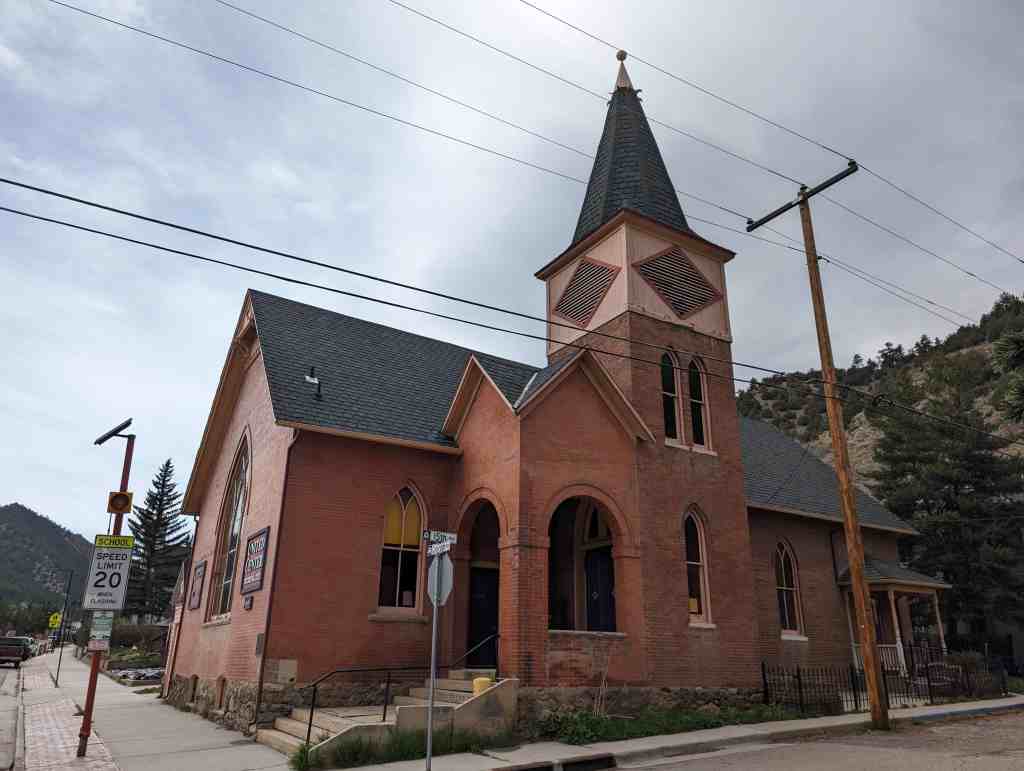
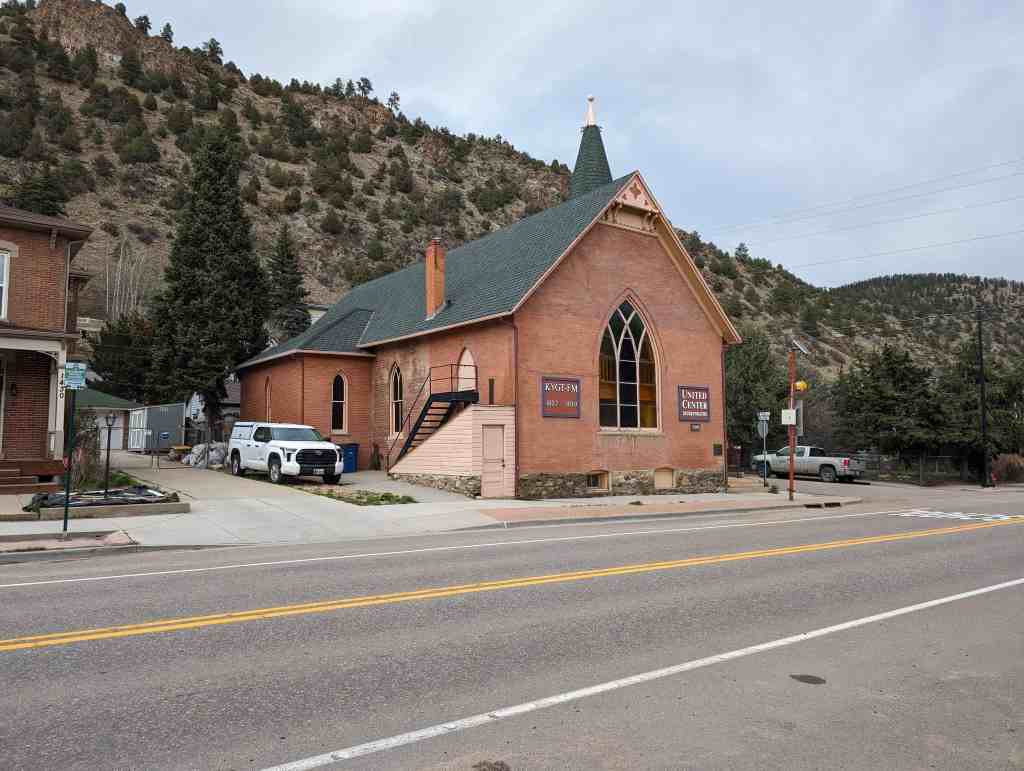
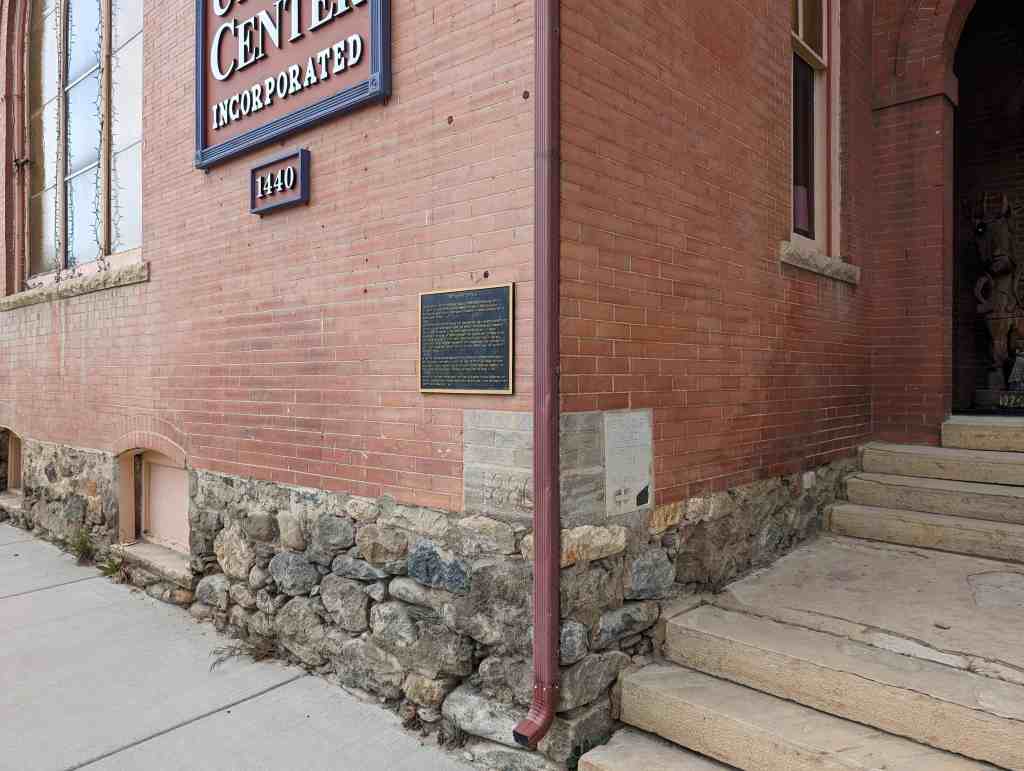
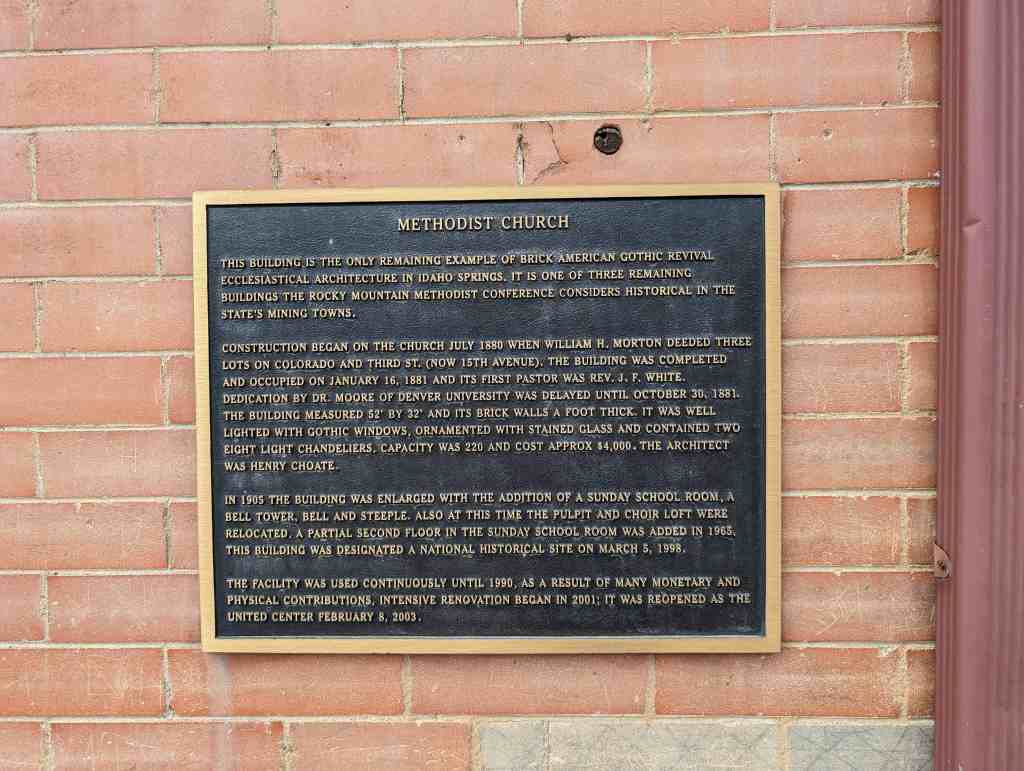
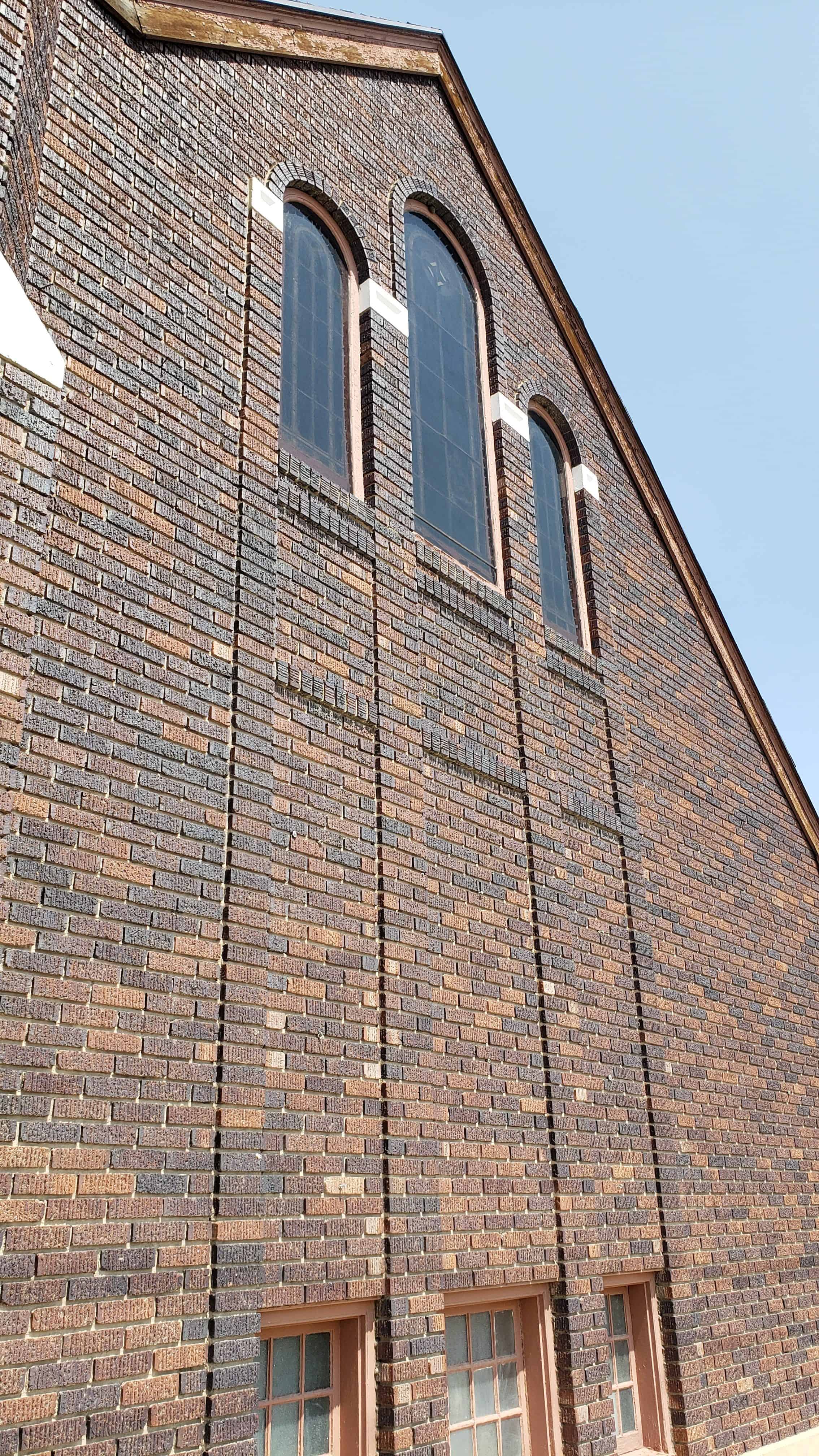
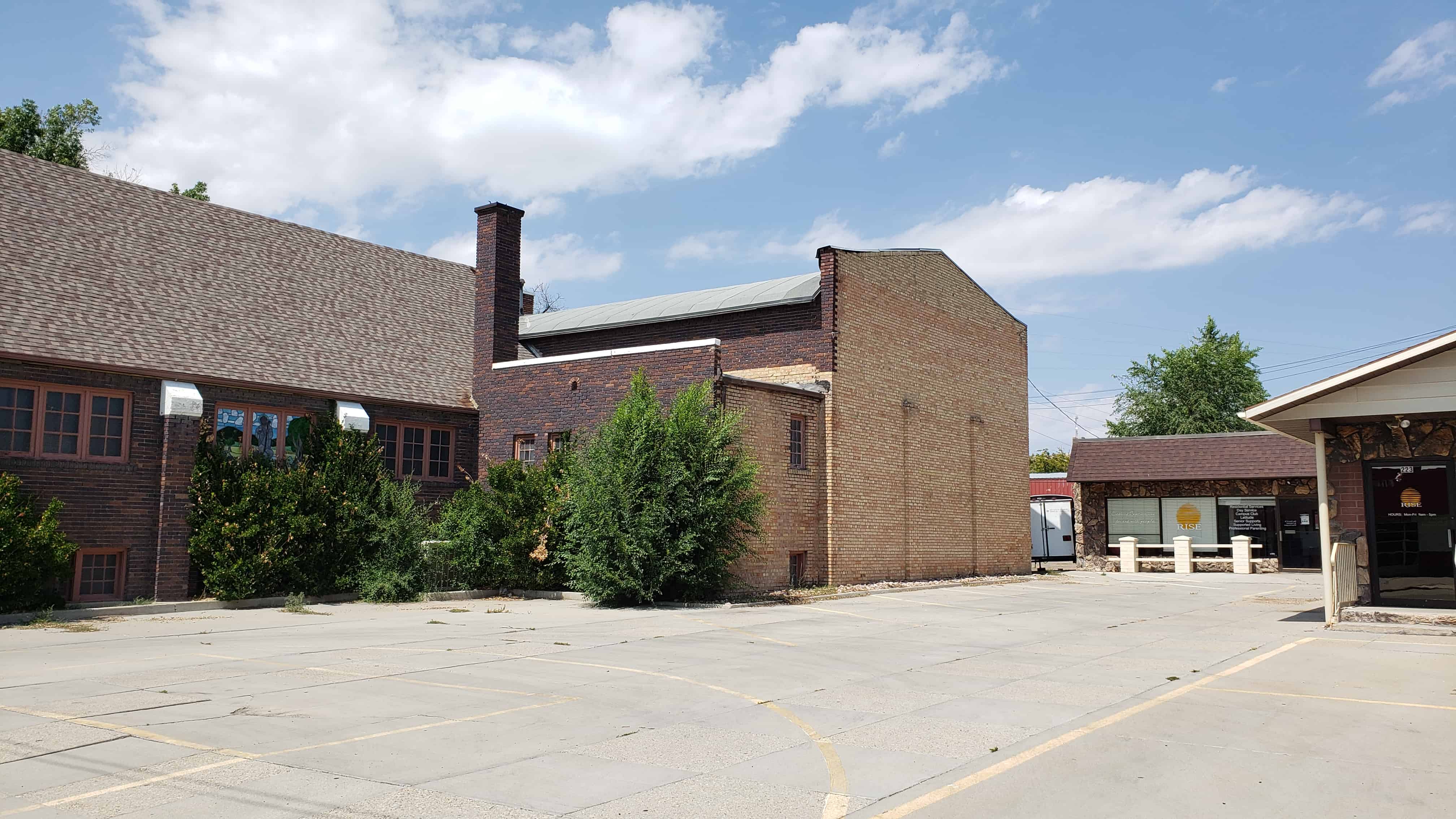
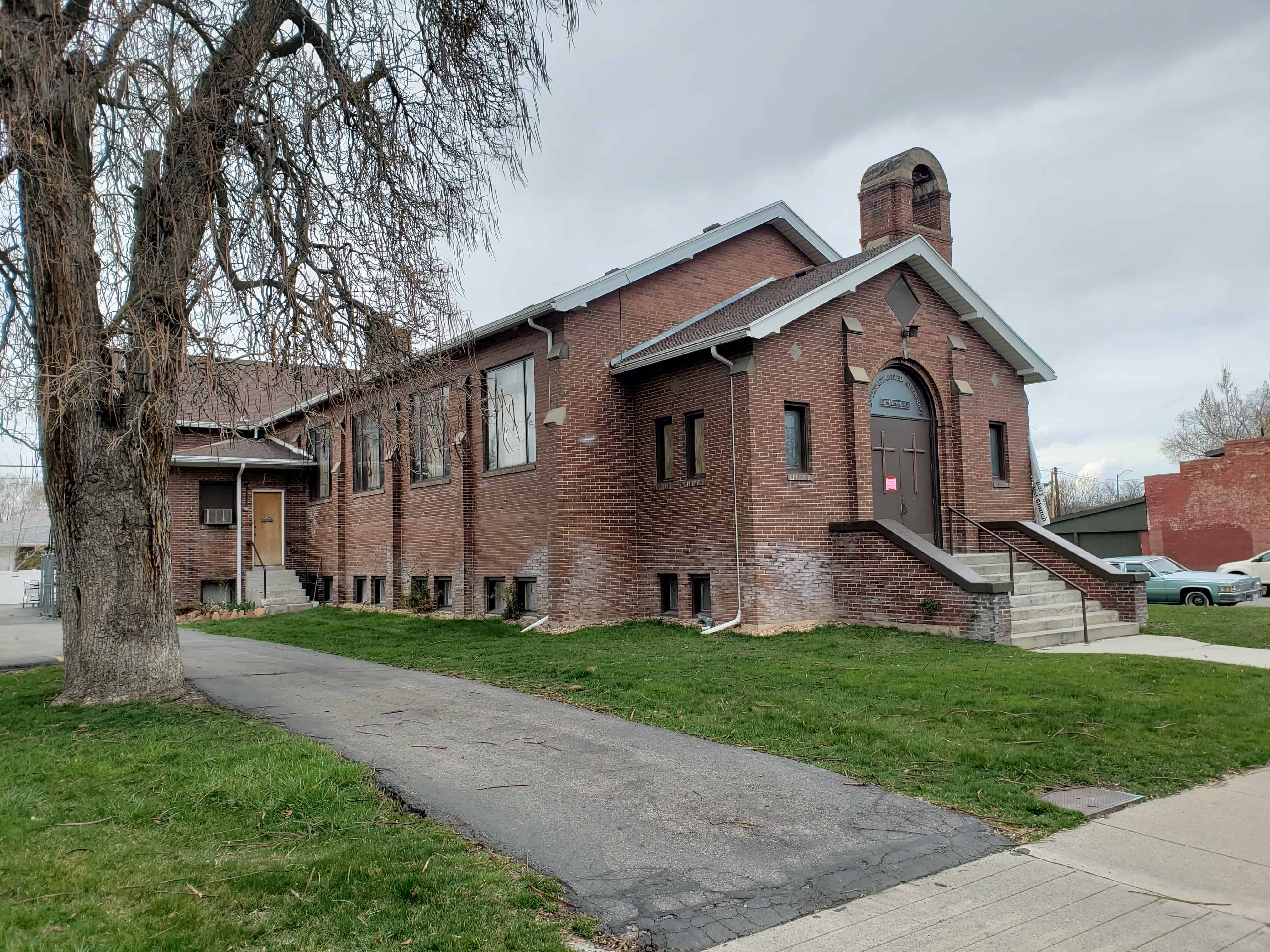
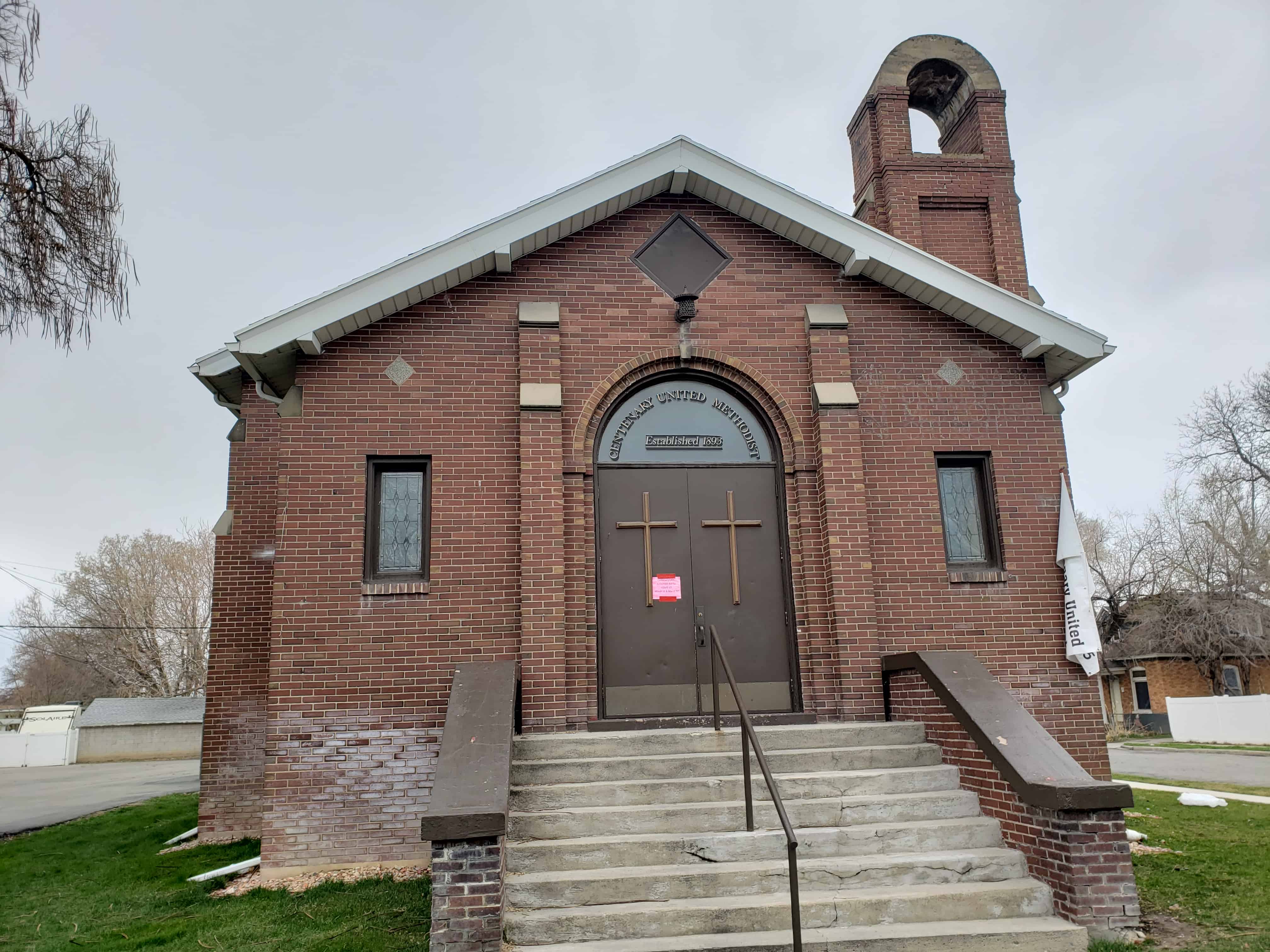
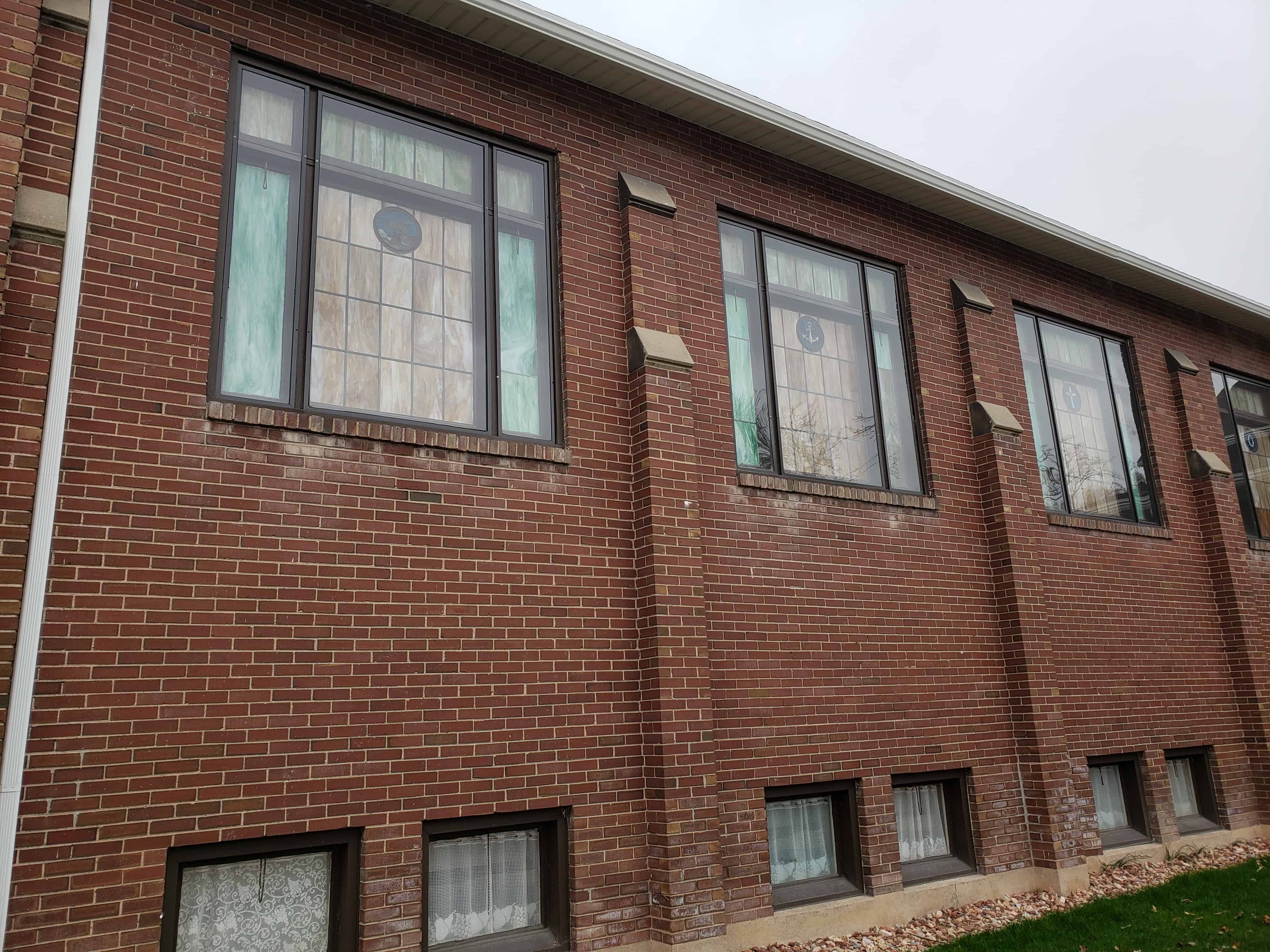
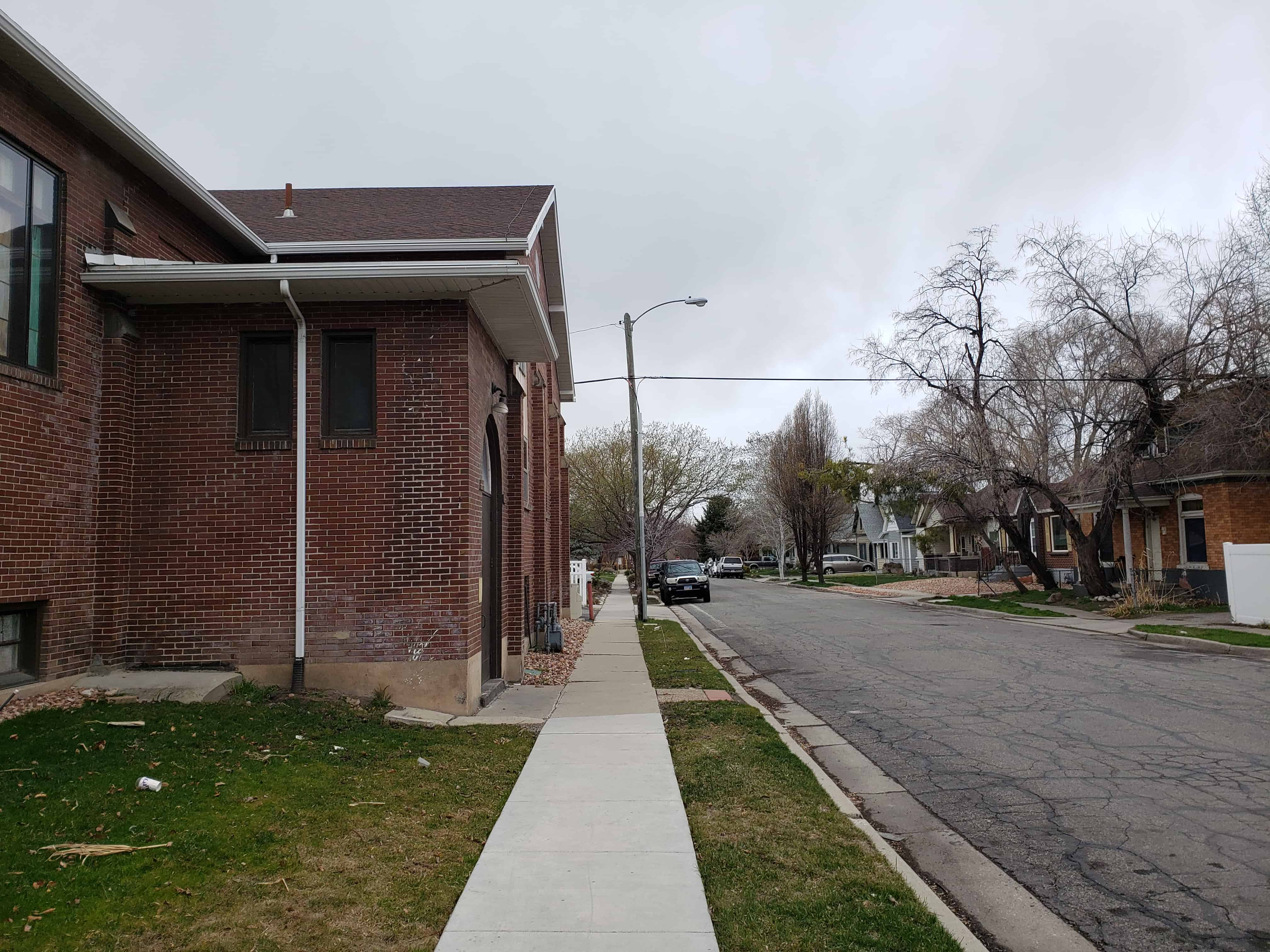
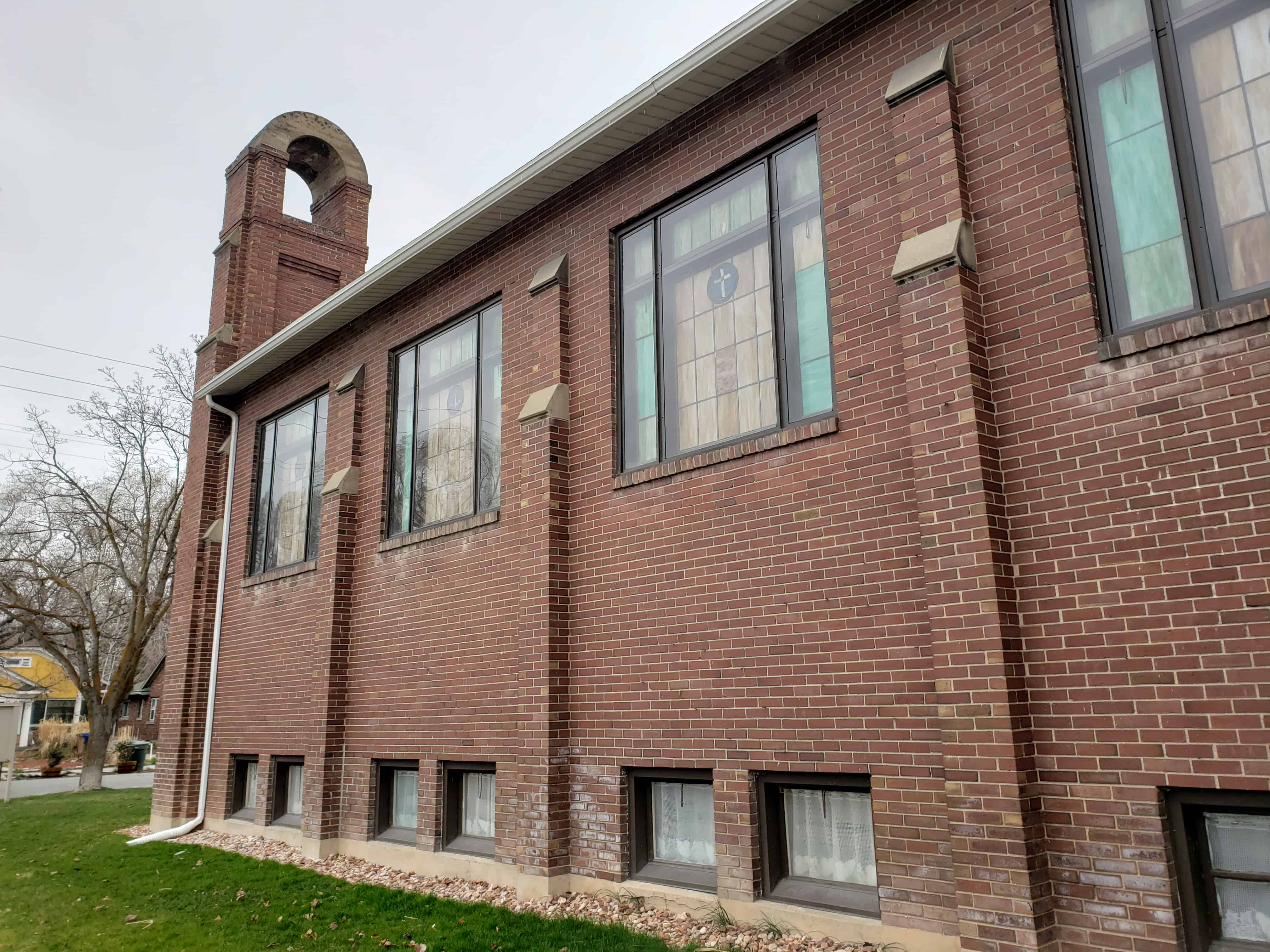
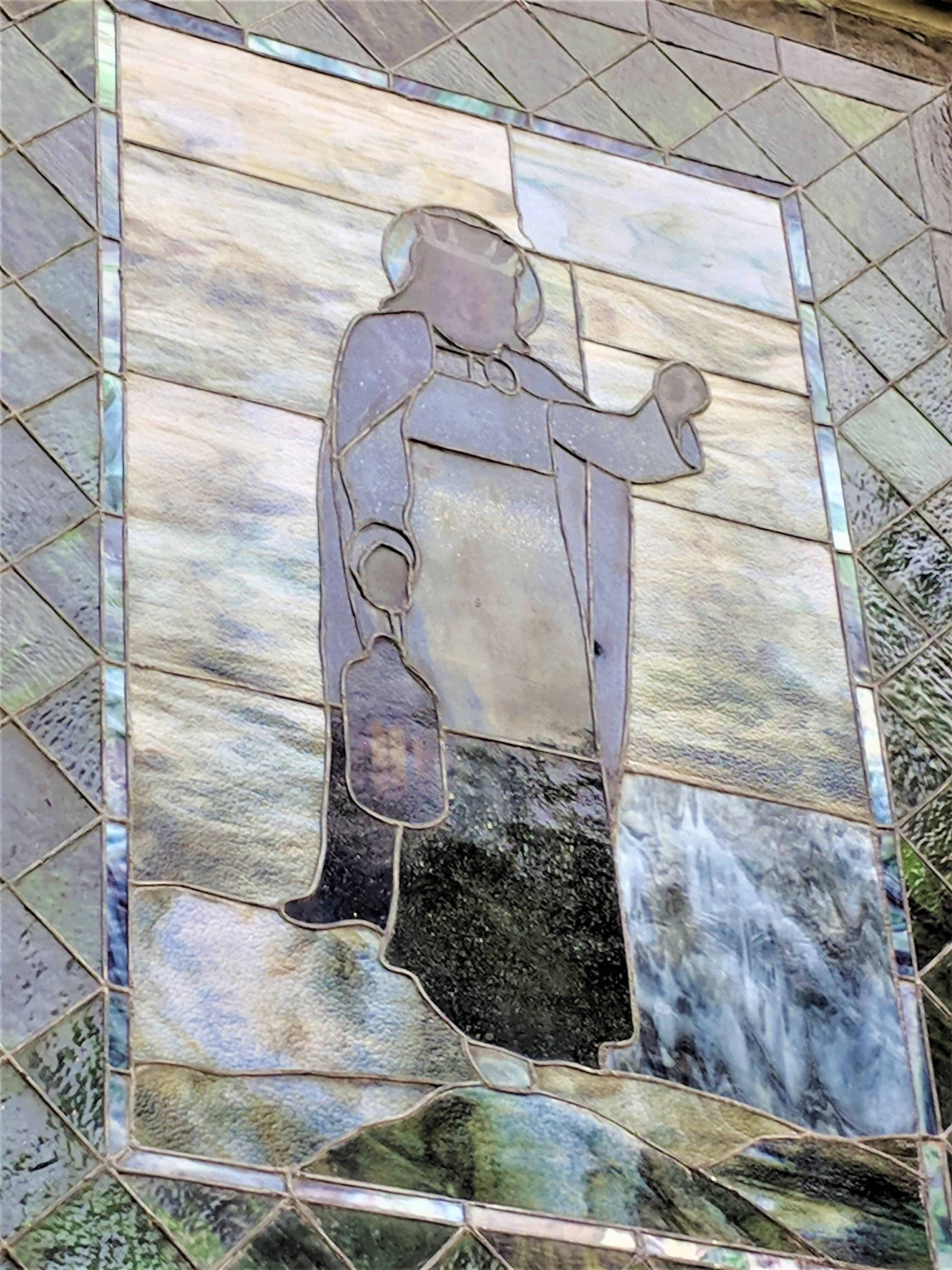
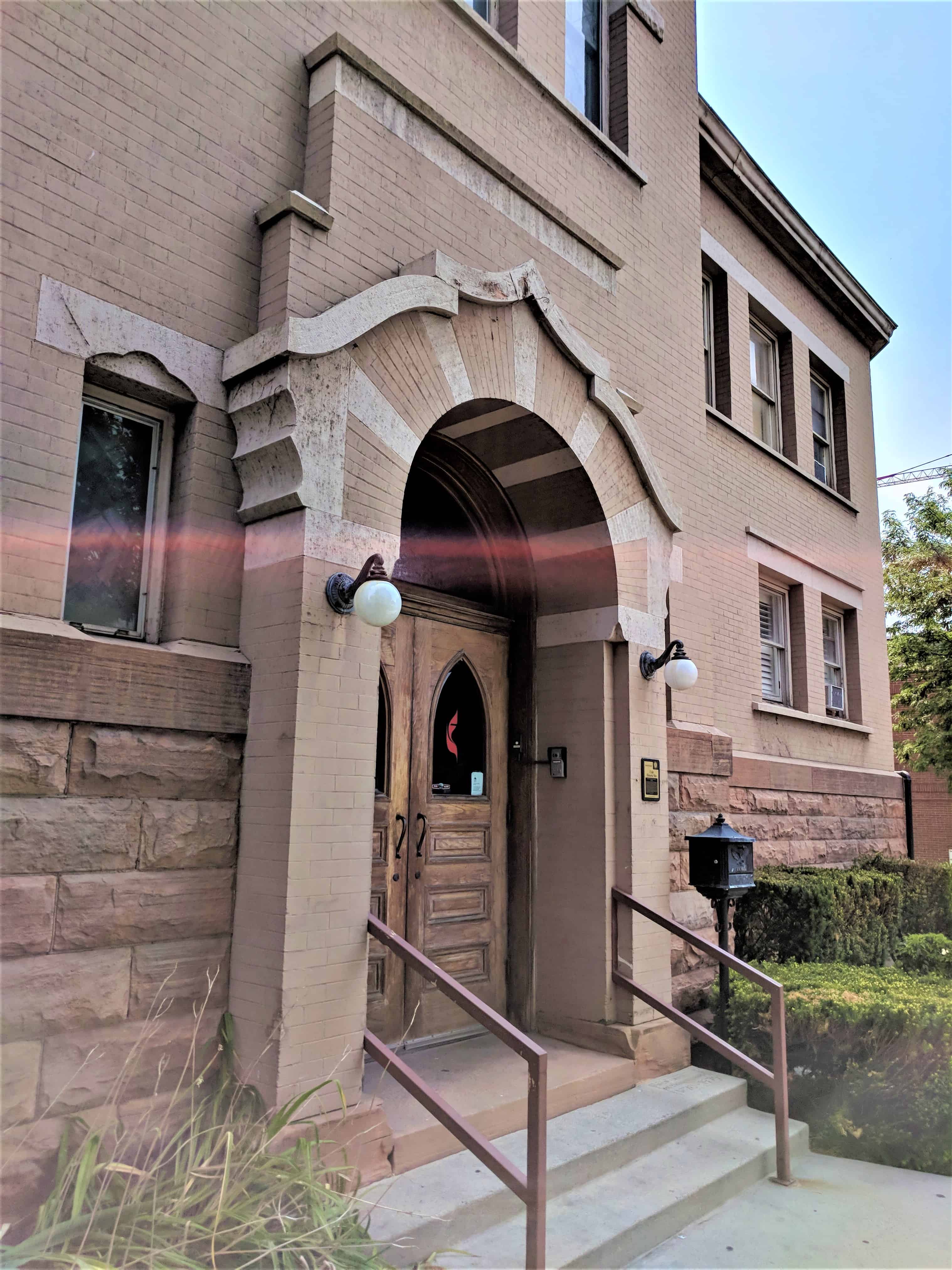
This building is the only remaining example of Brick American Gothic Revival Ecclesiastical Architecture in Idaho Springs. It is one of three remaining buildings the Rocky Mountain Methodist Conference considers historical in the state’s mining towns.
Construction began on the church July 1880 when William H. Morton deeded three lots on Colorado and Third St. (now 15th Avenue). The building was completed and occupied on January 16, 1881 and its first Pastor was Rev. J. F. White. Dedication by Dr. Moore of Denver University was delayed until October 30, 1881. The building measured 52′ by 32′ and its brick walls a foot thick. It was well lighted with Gothic windows, ornamented with stained glass and contained two eight light chandeliers. Capacity was 220 and cost approx $4,000. The architect was henry Choate.
In 1905 the building was enlarged with the addition of a Sunday School room, a bell tower, bell and steeple. Also at this time the pulpit and choir loft were relocated. A partial second floor in the Sunday School room was added in 1965. This building was designated a National Historical site on March 5, 1998.
The facility was used continuously until 1990. As a result of many monetary and physical contributions, intensive renovation began in 2001; it was reopened as the United Center February 8, 2003.
Price Community Methodist Church Built in 1899, rededicated 100 years later in 1999. Grand Lodge F. & A. M. in Utah C. F. Jennings Commandry #6 Carbon Lodge #16 Joppa Lodge #26 10 North 200 East in Price, Utah
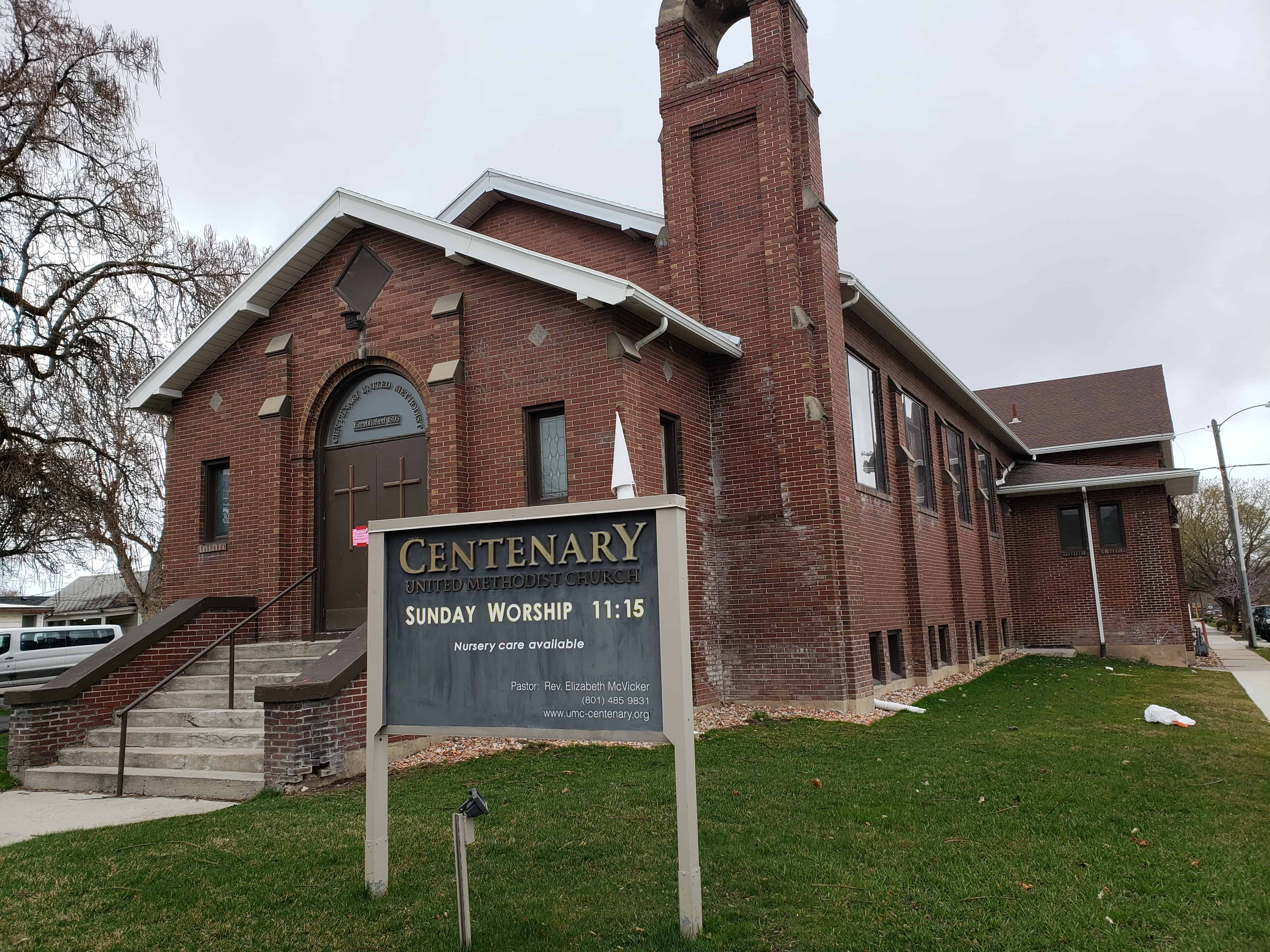
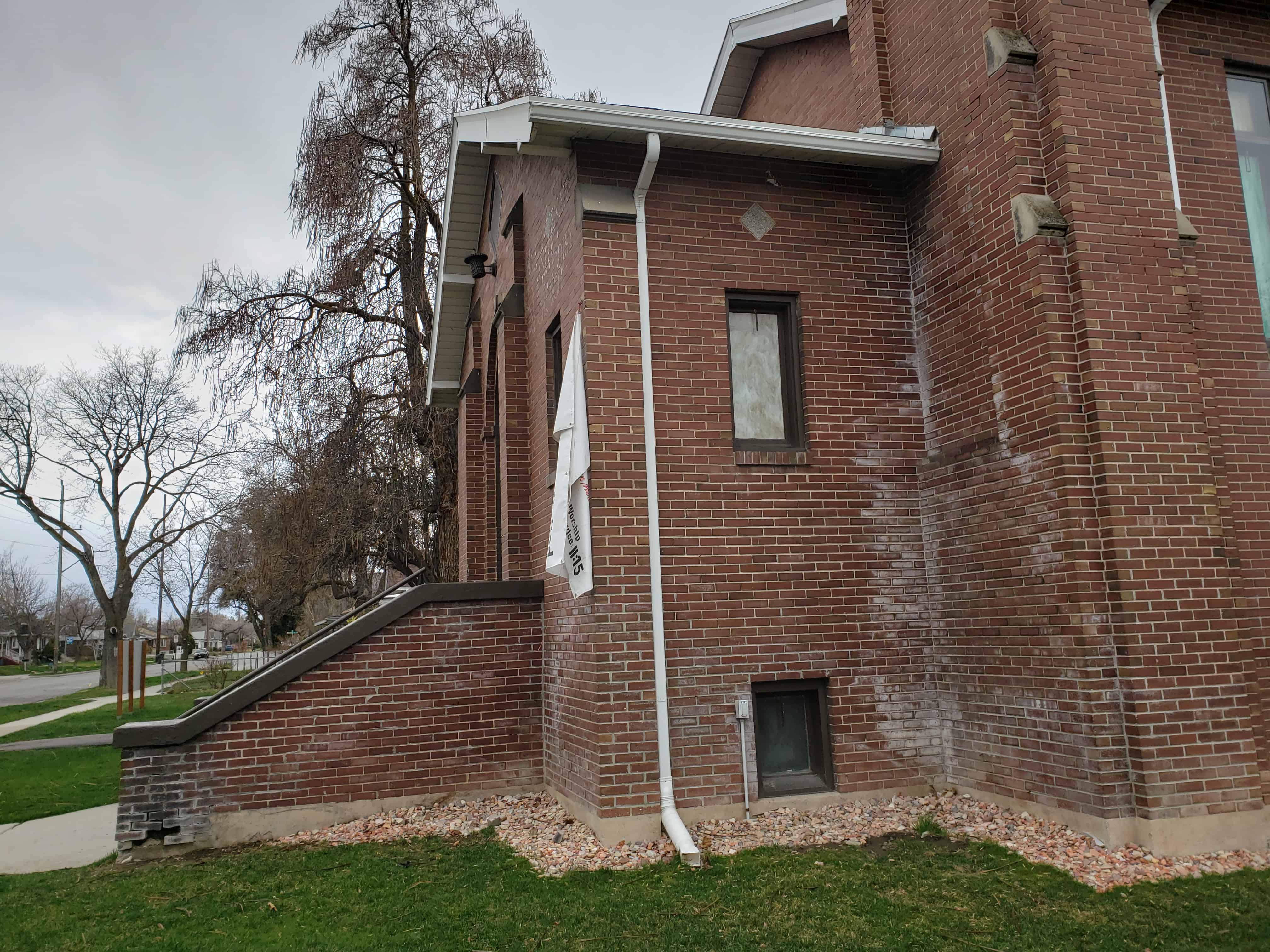
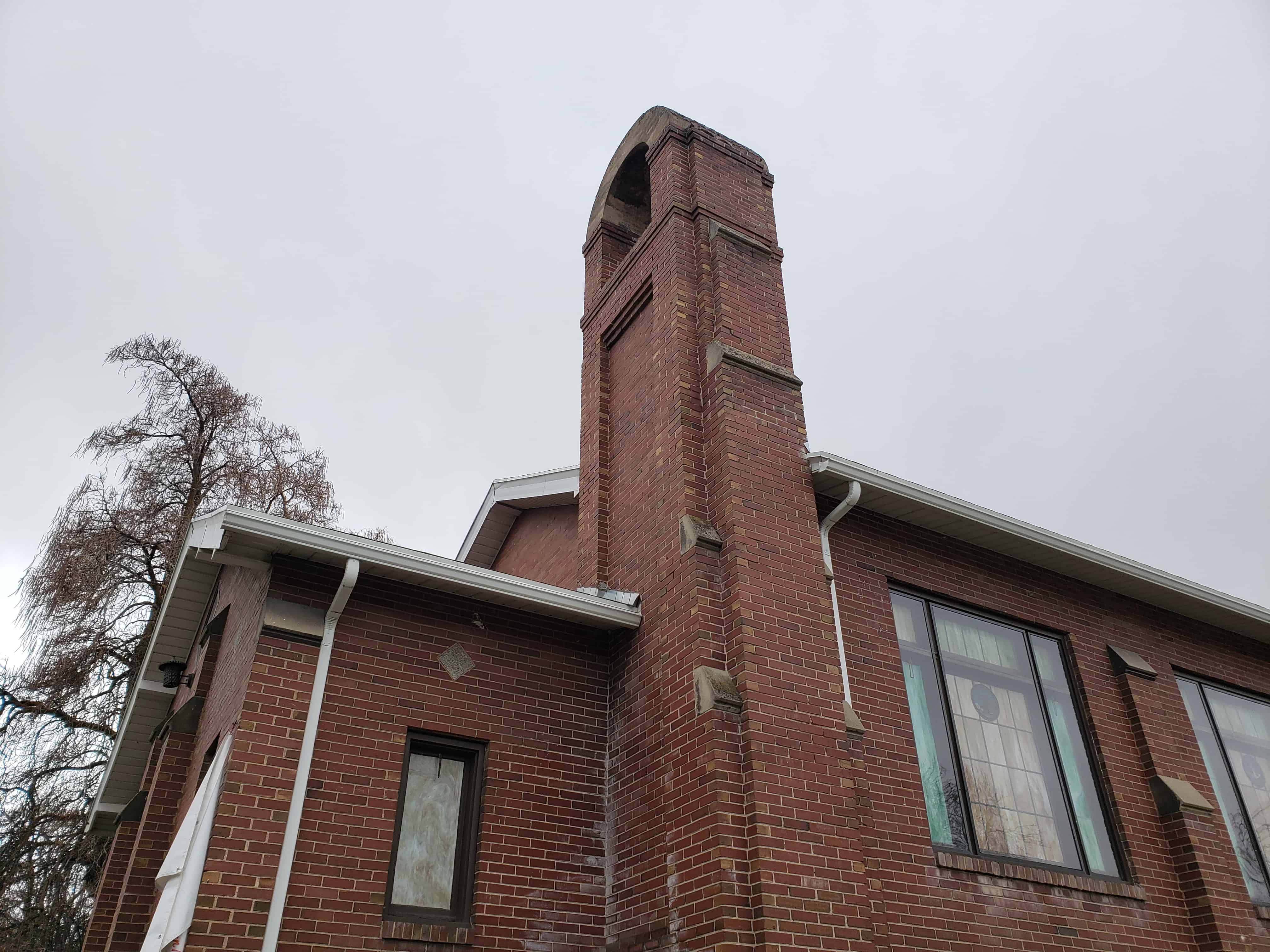
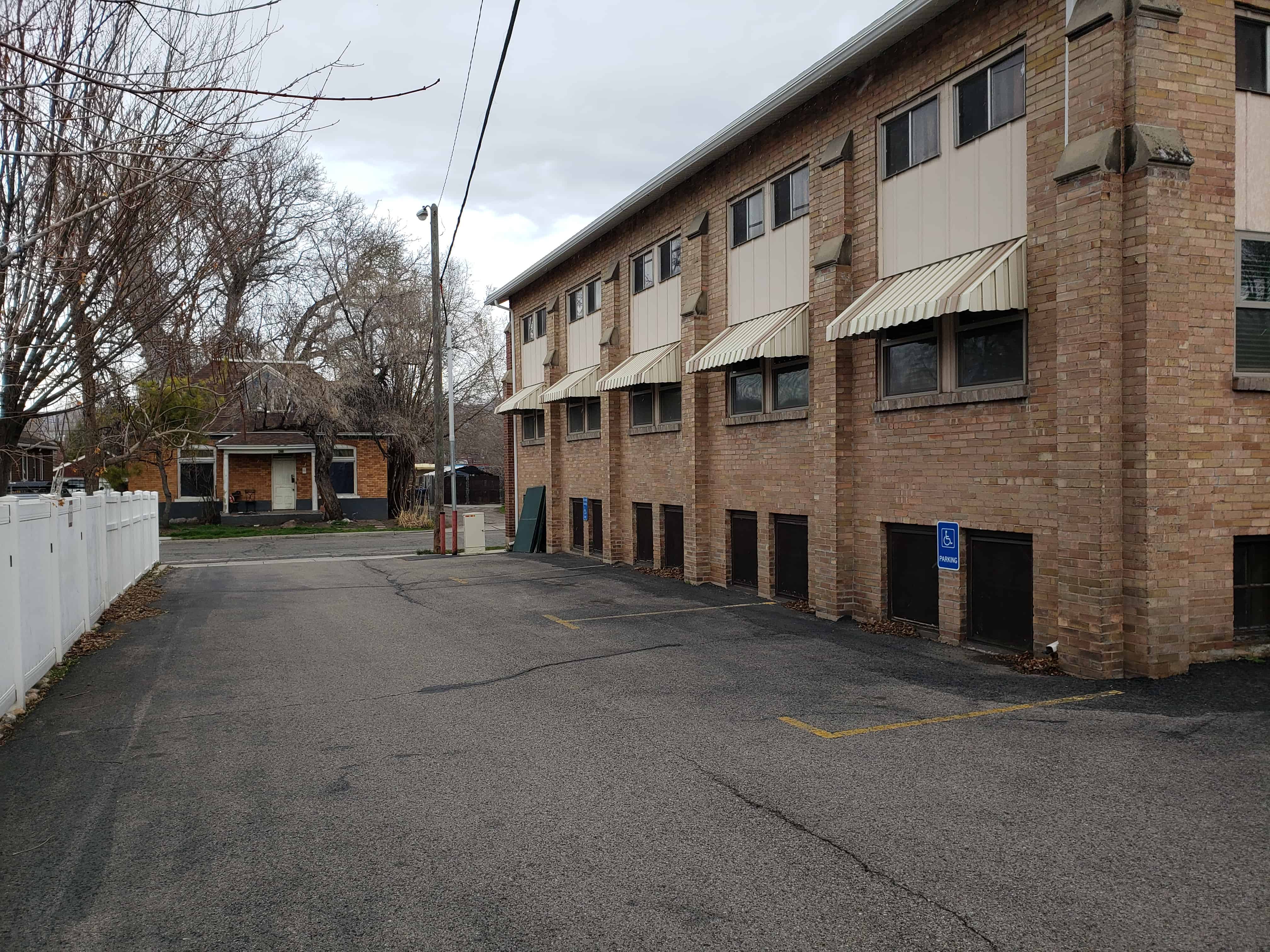
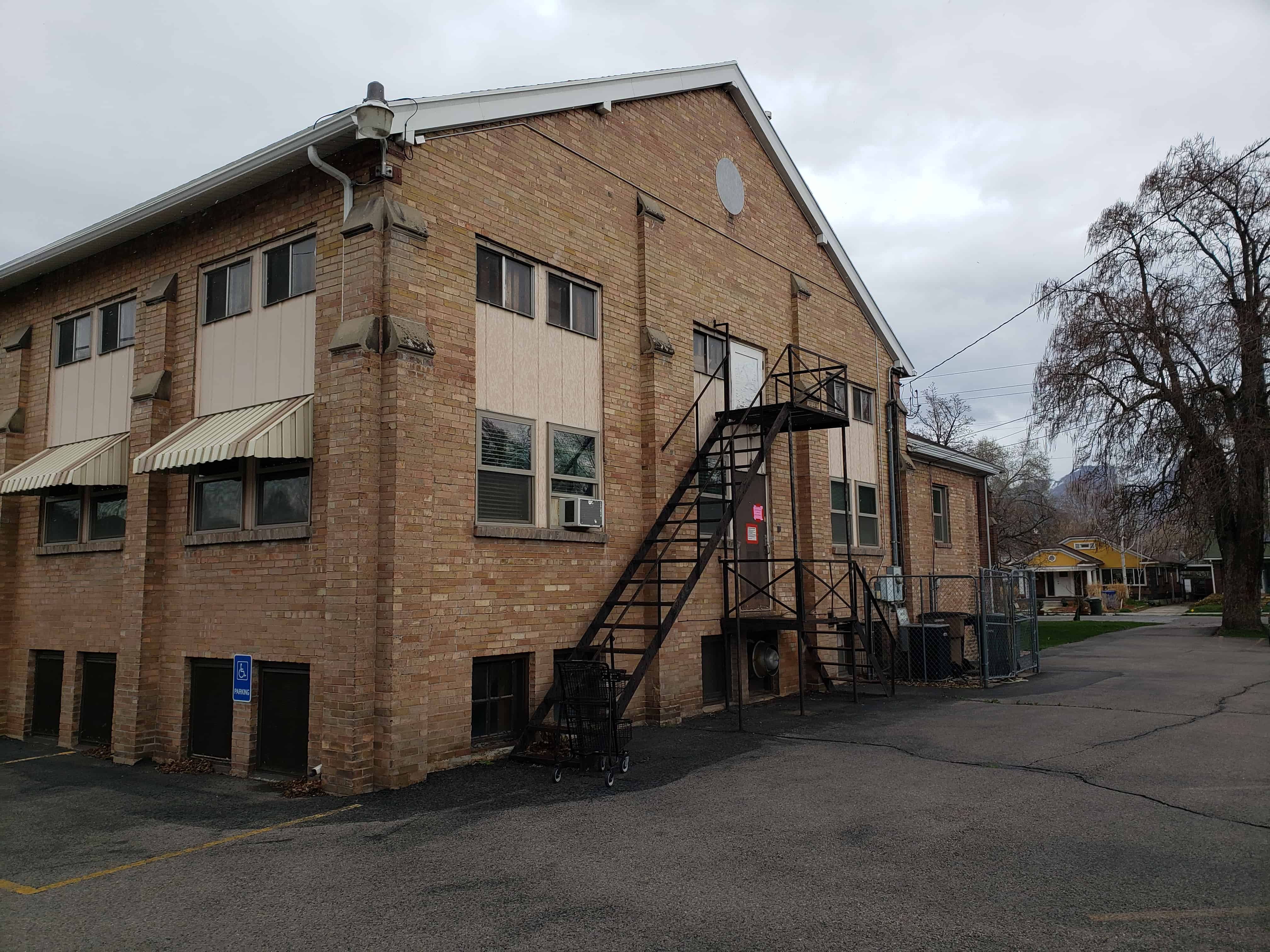
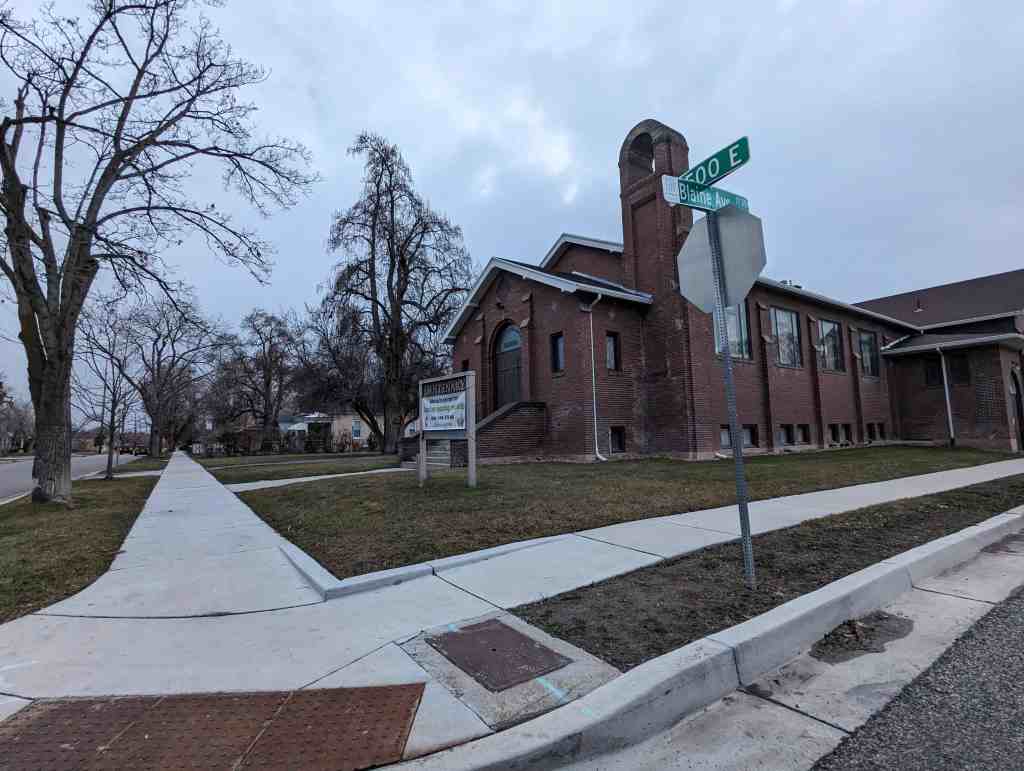
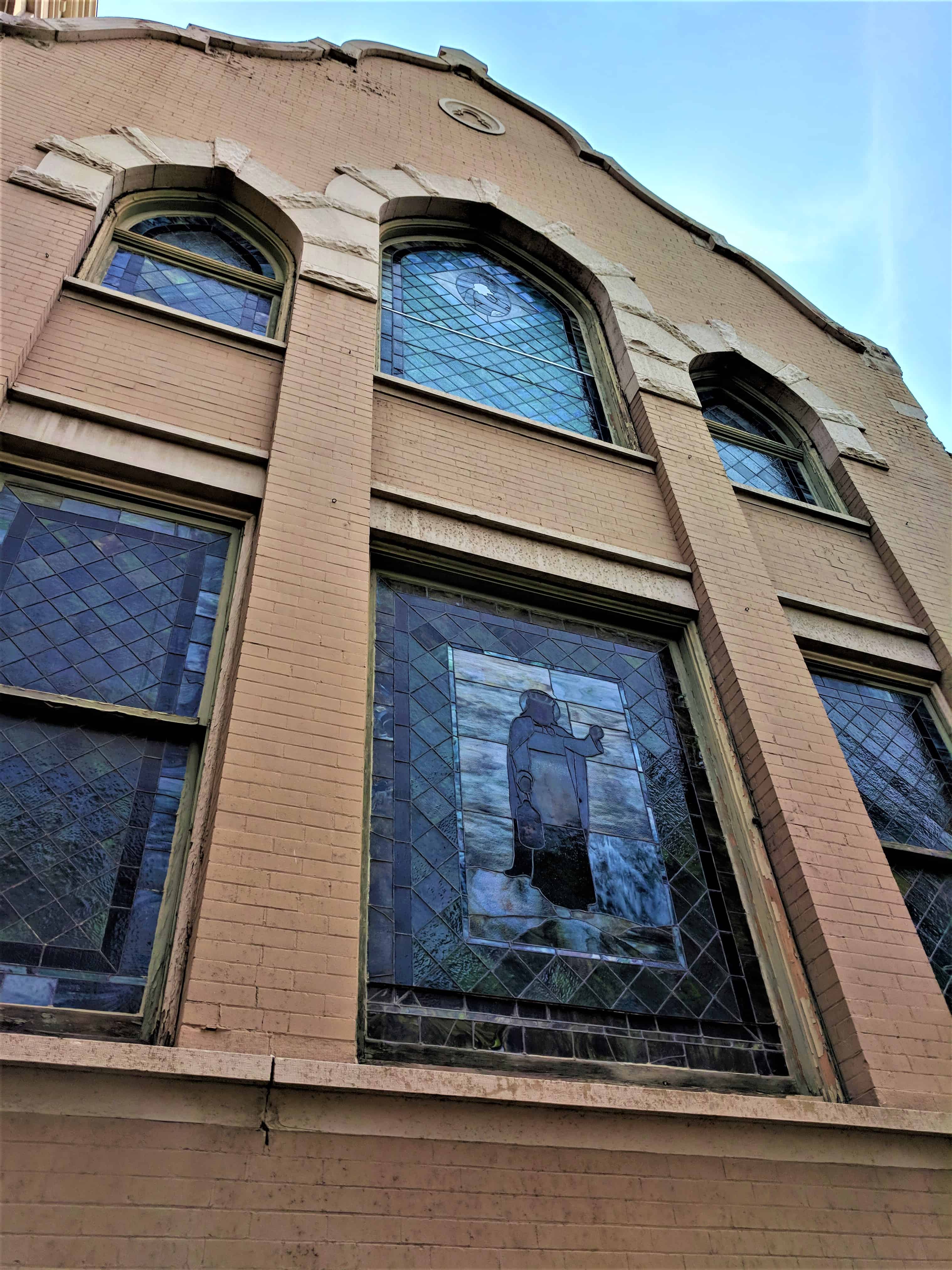
Centenary United Methodist Church, established 1893. Built in 1920.
1740 500 E, Salt Lake City, UT
History from this page: In 1892, The Rev. George E. Jayne was appointed to the “Salt Lake City Mission.” Apparently, his task was to start congregations in the new additions of the rapidly growing city. He met with success in Waterloo Addition, where a lot and building were purchased from the Congregational Church near the southeast corner of what was then Fourth East and Eleventh South (now Seventeenth South). The minutes of the June 1893 annual conference report, “The property there now is worth $1,600, and was purchased and furnished at a cost of $1,000 without help from the Church Extension Society. The Chapel was dedicated, free of debt, May 21st. The membership is 36 and they have been “very helpful in the benevolences.”
The first nine members of the church are recorded as having joined on November 20, 1892, and so we mark our beginning with that date. The church was named Second Methodist Episcopal (M.E.) Church; in a few years it became Waterloo M.E. Church; and in 1921, the name was changed to Centenary M.E. Church. The Methodist Episcopal Church, after going through two mergers, is now known as the United Methodist Church, and so our congregation is Centenary United Methodist Church.
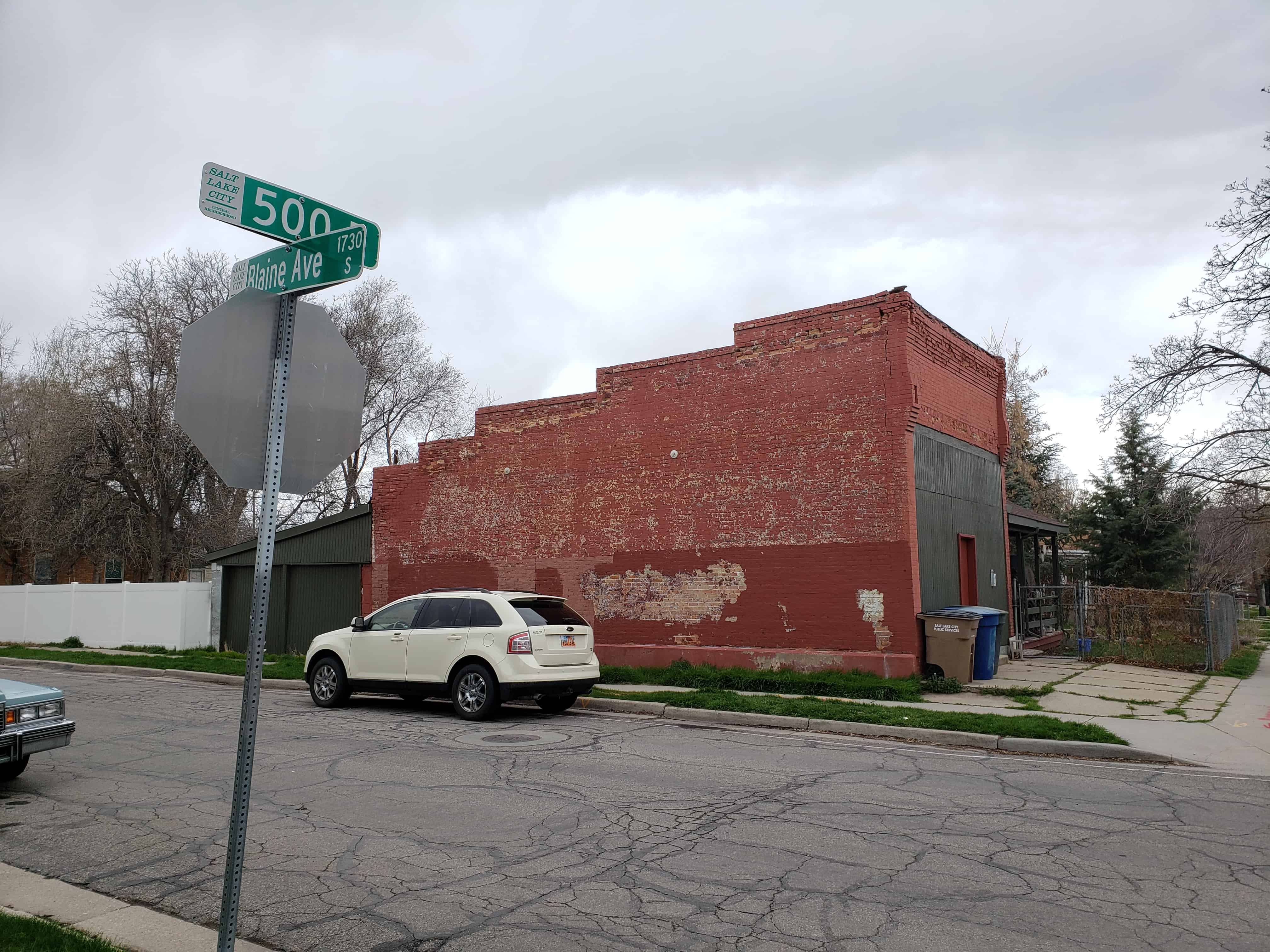
The first building was quickly outgrown and a new building was erected adjacent to it, or nearly so, on the northeast corner of Fourth East and Galena, now Blaine Avenue. In 1920-21, we moved east one block and to the south side of Blaine where the current building was built, funded in part by the Methodist “Centenary” campaign- thus the name, Centenary. Our roots are deep in this neighborhood, having spent the entire one hundred years here.
A few months after Second M.E. church began, Rev. G.C. Waynick was appointed to begin a new work on the west side of the city. After a five week tent revival, nineteen members had joined what was to become Heath M.E. Church, later Grace M.E. Church. In 1975, Grace United Methodist Church was disbanded. Most of its members transferred to Centenary; and we have been blessed by their presence.
We have grown and declined throughout the years in numbers and activity. In 1956, Mrs. C.W. Wrathall remembered that soon after the present building was dedicated, the pastor, Frederick J. Cox, thought it was too large and ought to be sold to the L.D.S. Church, who had offered to buy it. She noted, “There were only 15 people in the congregation, but others felt that the new building should be kept, and that we should try to grow into it.” That growth happened, and throughout its life the church has bustled with energy. Now, with about one hundred members, we are engaged in discovering new life and ministries here.
The church has a solid history of faithful commitment. Two of the original members, Samuel Allison and Charles Campbell, became ordained ministers. In 1916, the church was ahead of 99.8% of all Methodist churches in the country in benevolent collections per member; the standard was a penny per day per member. In recent years, the church has been recognized for its support of various ministries locally and around the world, and individual members have been cited for their discipleship.
We celebrate the soul of this congregation! It is a soul that made Centenary “the church that refused to die.” It can’t be described in a few words or a single concept. It is found in the litany of the stories out of our past and in the confidence with which we face our future. The sign of it can be seen in the faces of our members whenever we meet together; it is alive in the service we do for Christ. We thank God for our church!
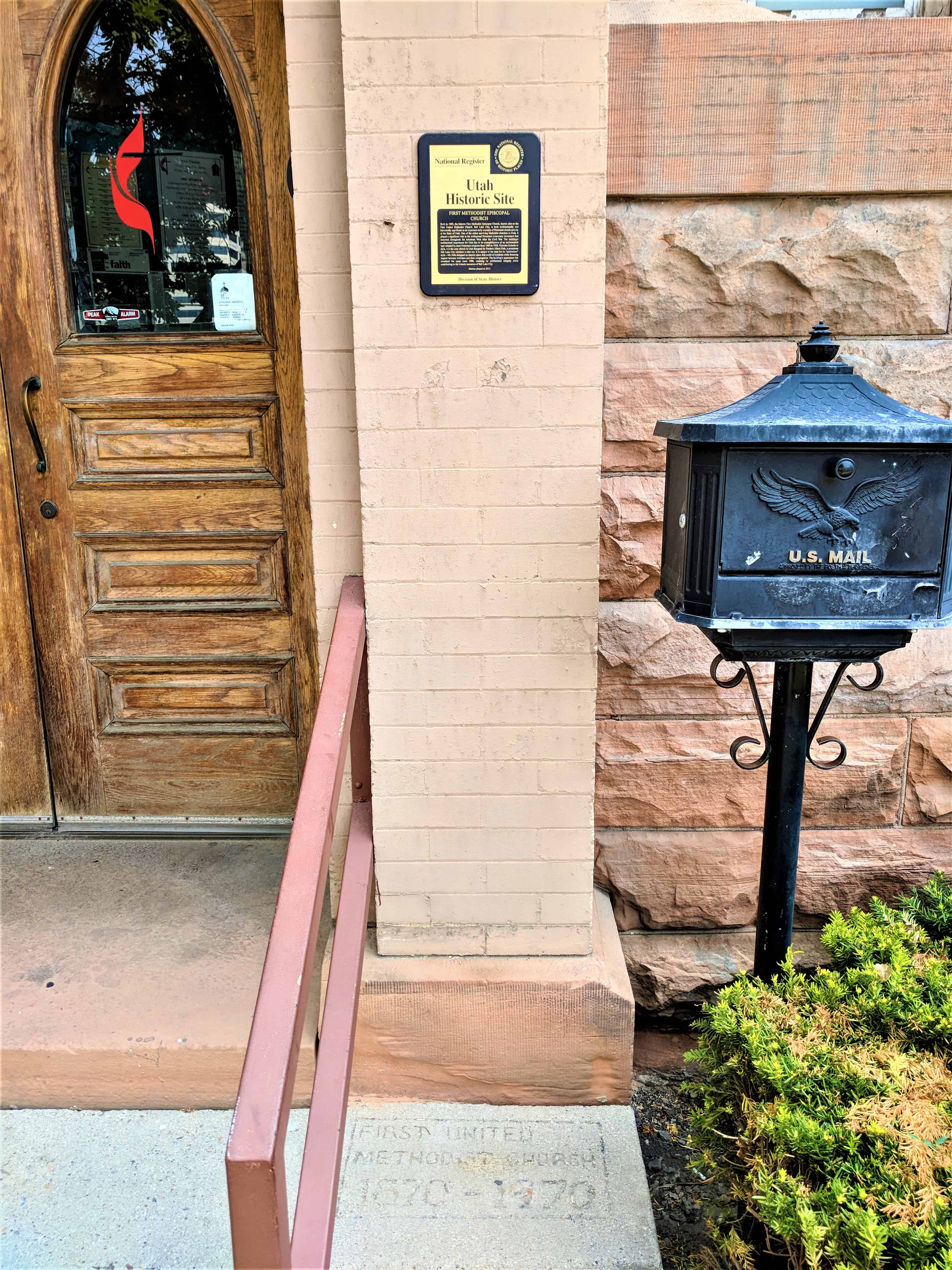
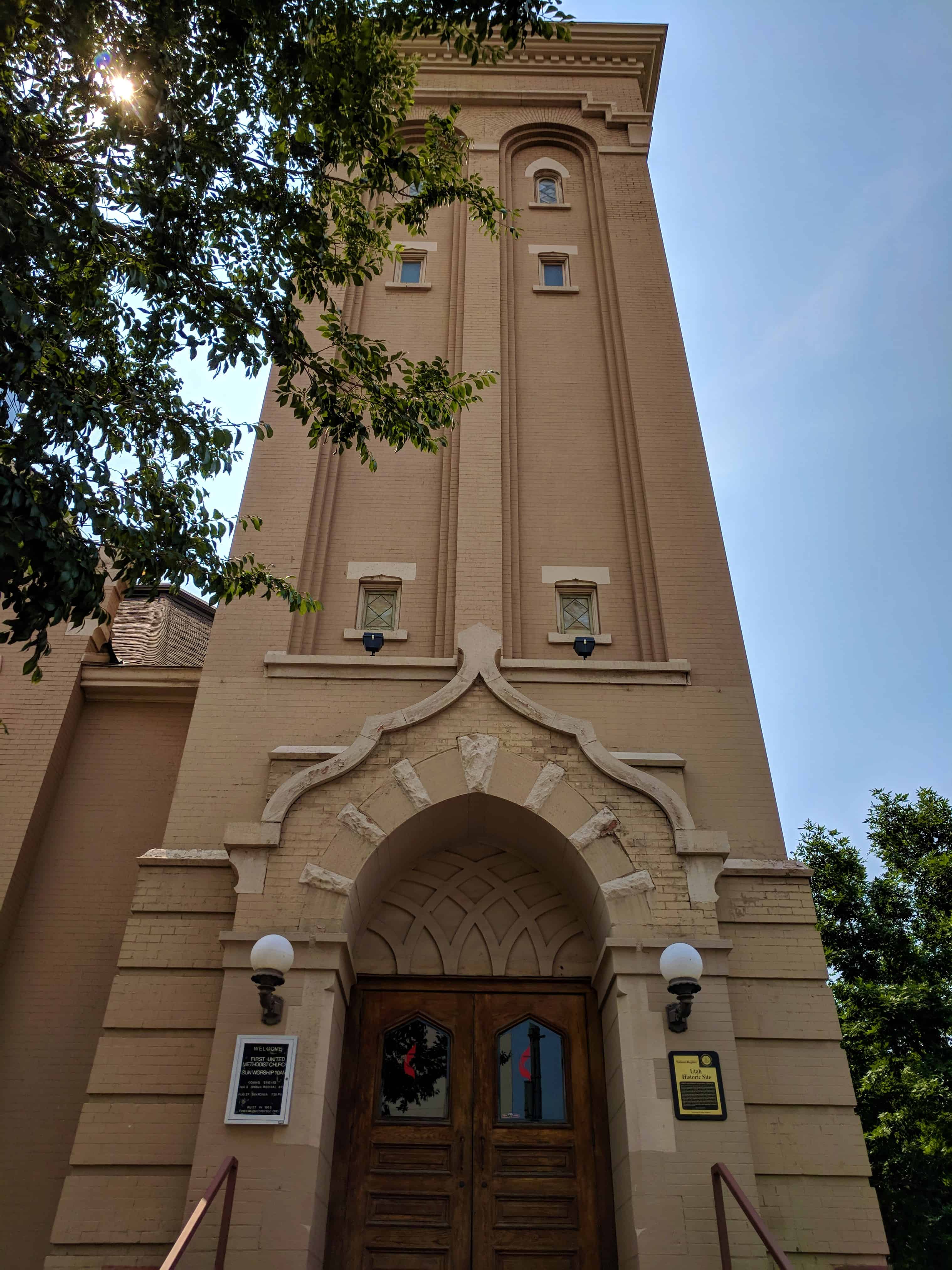
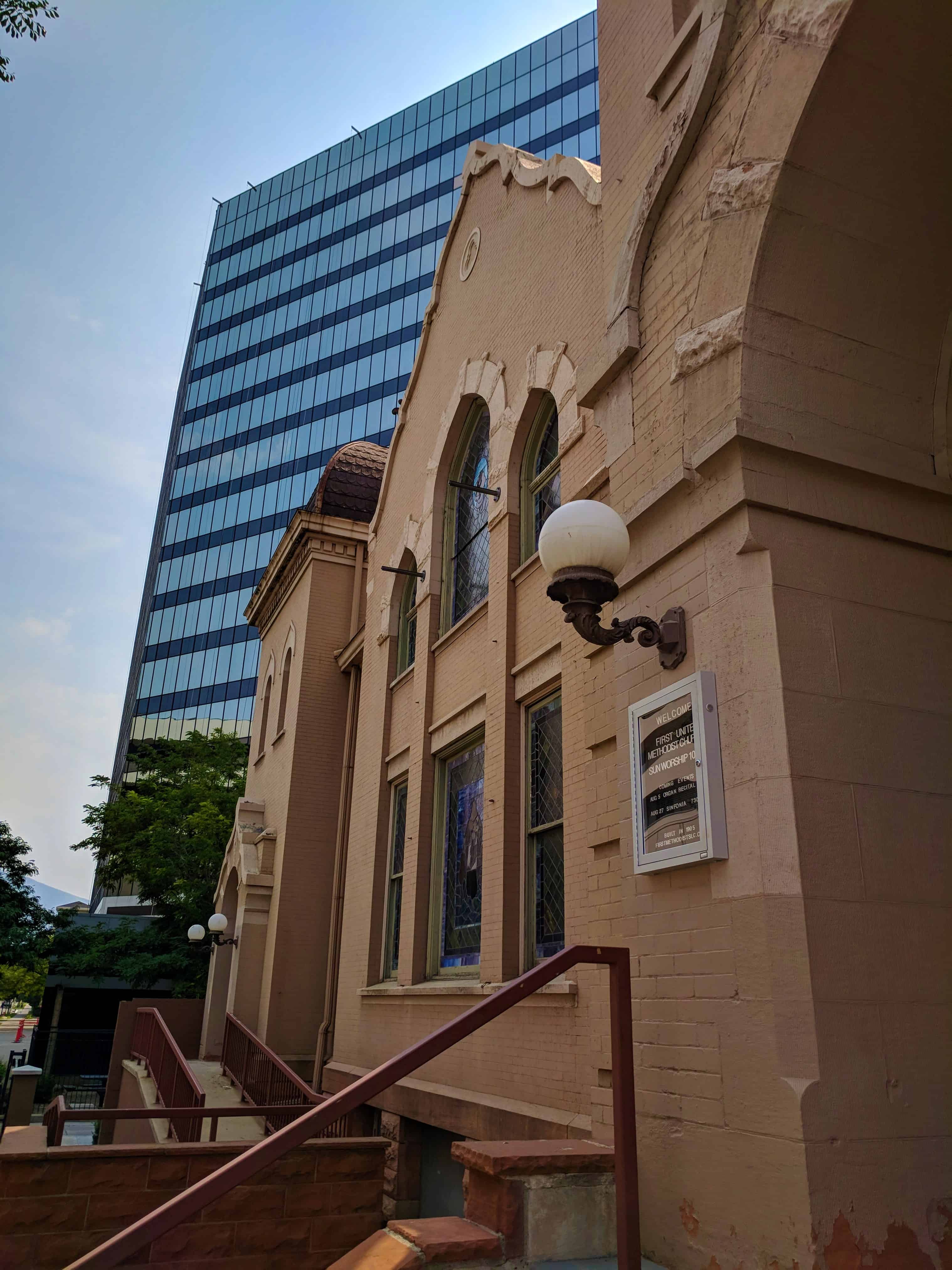
Built in 1905, the historic First Methodist Episcopal Church, known also as the First United Methodist Church, Salt Lake City, is both architecturally and historically significant as an important early example of Protestant church activity in the State of Utah.
One of the oldest surviving Methodist churches in Utah, it played a significant role in the widespread Protestant missionary movement that occurred throughout the American West after the Civil War. The building’s architectural importance for Utah lies in its exemplification of an ecclesiastical type adopted by most Protestant religions from 1880 to 1930. Victorian Eclectic in style, it is the only church in Utah designed by Frederick Albert Hale, a prominent Salt Lake City architect in that era. It is unique in the state for its “auditorium” style – Mr. Hale designed an interior space that could sit hundreds while fostering rapport between ministers and their congregation. The building’s appearance has remained the same since 1906, retaining its architectural integrity while contributing to the historic resources of Salt Lake City.
It was added to the National Register of Historic Places in 1995.
Methodist Episcopal Church Peak Enrollment 127 in 1915 1870 – 1957
This is the oldest extant Protestant church building in Utah. It was dedicated by Chaplain C. C. McCabe and Reverend G. M. Peirce on September 20, 1870.
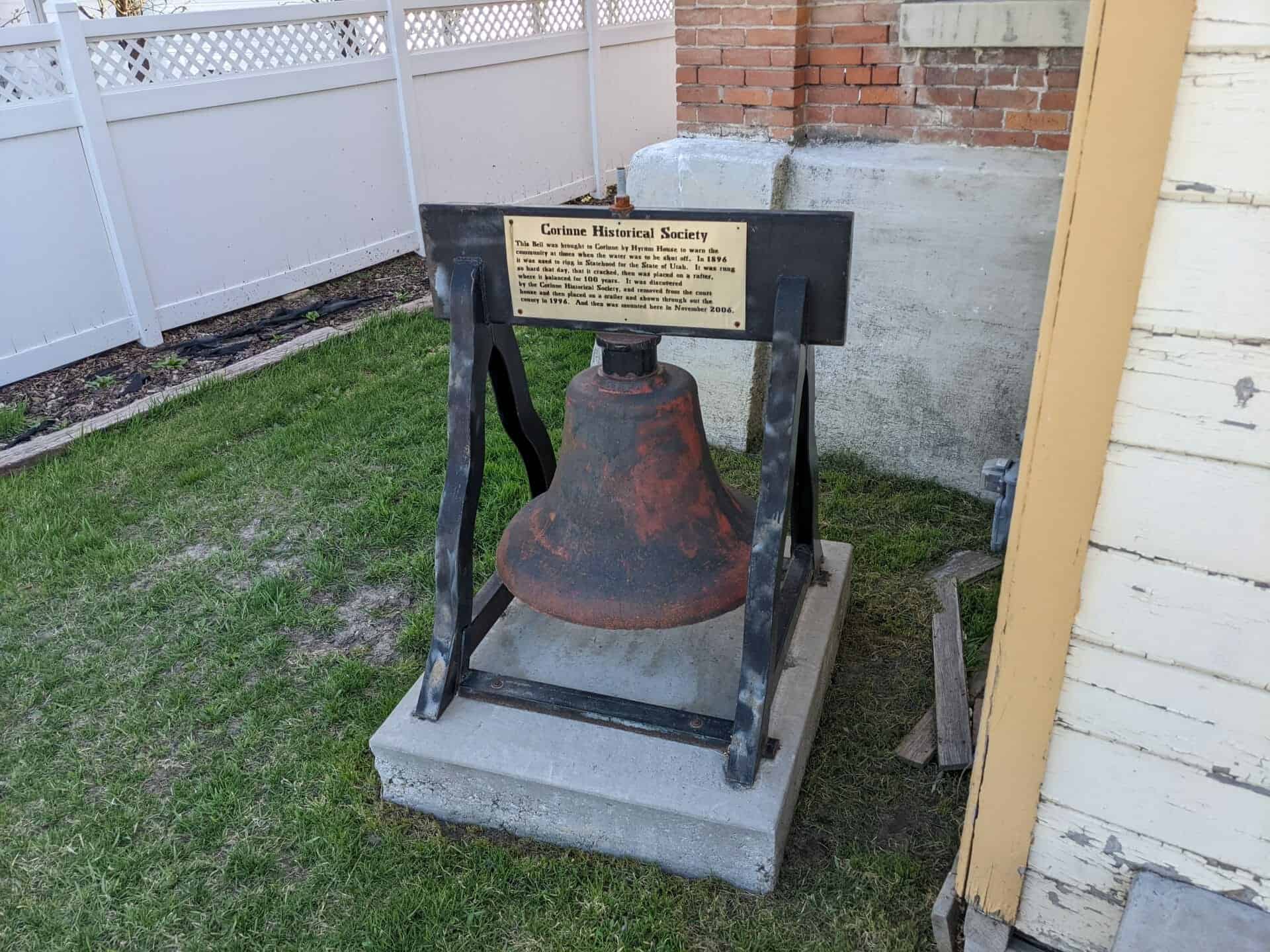
Corinne Historical Society This bell was brought to Corinne by Hyrum House to warn the community at times when the water was to be shut off. In 1896 it was used to ring in the Statehood for the State of Utah. It was rung so hard that day, that it cracked, then was placed on a rafter, where it balanced for 100 years. It was discovered by the Corinne Historical Society, and removed from the court house and then placed on a trailer and shown through out the county in 1996. And then was mounted here in November 2006.
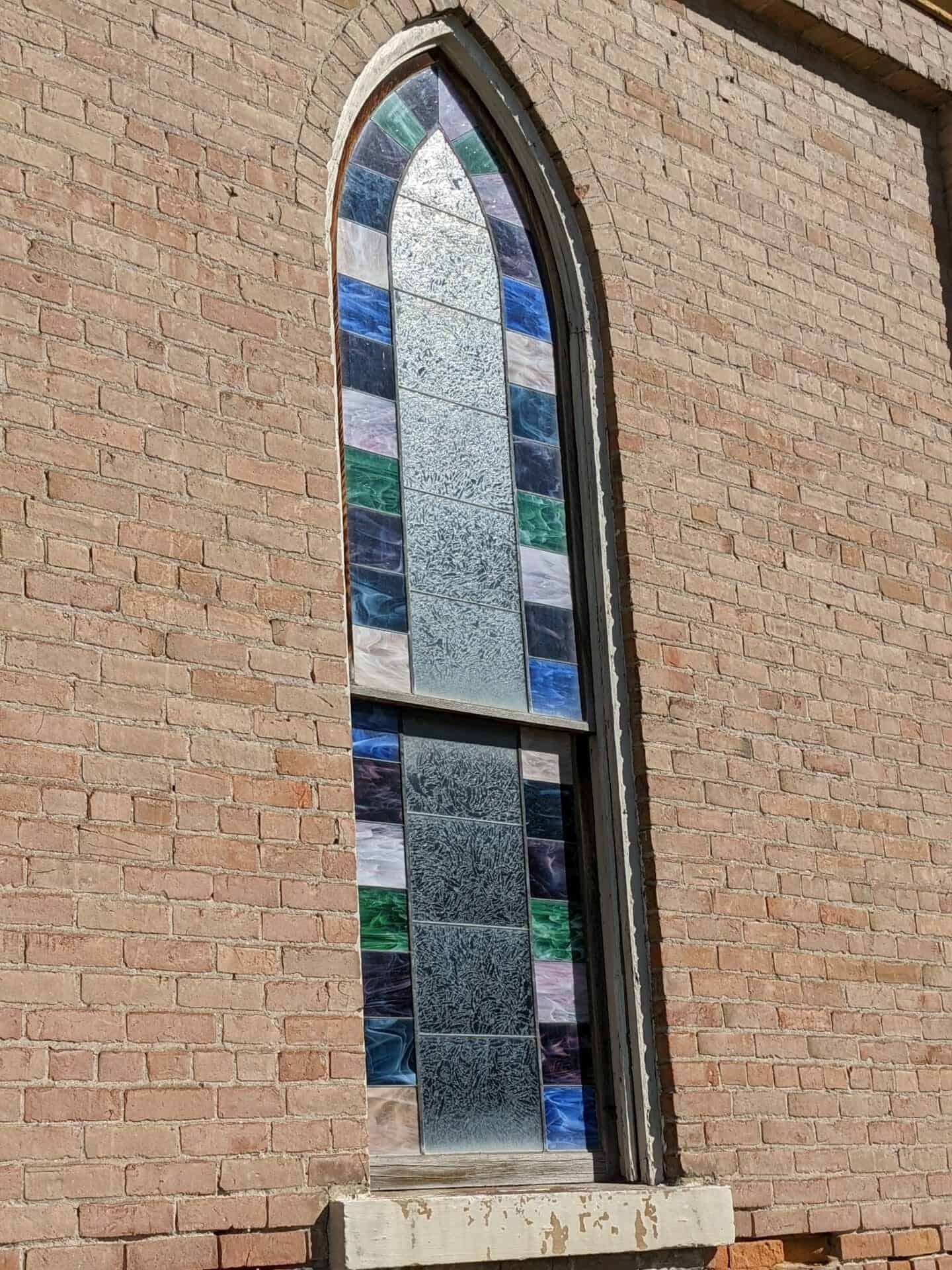
The Corinne Methodist Episcopal Church, located at 3995 West 2300 North in Corinne, Utah was added to the National Register of Historic Places (#71000842) on May 14, 1971. The text below is from the nomination form from when it was added to the register.
Corinne, Utah lays claim to several distinctive features. It was Utah’s First “Gentile” City, having been dreamed of in 1868, but born and built during March and April, 1869, when the Union Pacific Railroad tracks reached there, It was the last U.P.R.R. track town on the transcontinental line, having 1500 inhabitants within a month and 3,000 by the end of April, It was laid out by J. E. Hause, chief engineer for the Union Pacific Railroad. Its name came either from Corinne Williamson, daughter of General J. A. Williamson, and the first white child born in the new town or from the actress who performed there on several occasions, Corinne LaVaunt.
By February, 1870, Corinne had been incorporated. Within another year an all gentile “school,” taught by Mr. A. B. Glockner, reported to have been Utah’s first “free public education” system, was organized. In addition, being a non-Mormon community of size and promise, Corinne is claimed as the birthplace of Utah’s American Liberal Party. The town asked to be made Utah’s capital and later to be annexed to Idaho.
Corinne is distinctive in Utah, because it was settled rapidly by non-Mormons. Within two years three protestant and one Catholic church had been organized. The first church in this “City of the Un-Godly,” probably was the Corinne Methodist Church; Reverend G. M. Pierce delivered his first sermon June 15, 1870, in the opera house, sought donations, and soon raised $4,000 for construction of the church. It was dedicated September 20, 1870.
Corinne retained a prominence as the northern-most point of the transcontinental railroad. However, in time, Ogden became the junction for the Utah Northern Railroad, which replaced the lucrative freighting enterprise centered at Corinne. Later, when Lucin Cutoff crossed the Great Salt Lake south of Promontory, the traffic through Corinne was further reduced.
The town held on and at times has been revived somewhat by mining and irrigated farming booms. Today it is the center of a small farming community.
Corinne was unusual. It represents the first Gentile inroad into Utah. Here the protestants first undertook to “convert” the Mormons. The old church today remains as the only tangible reminder of that role and that era.
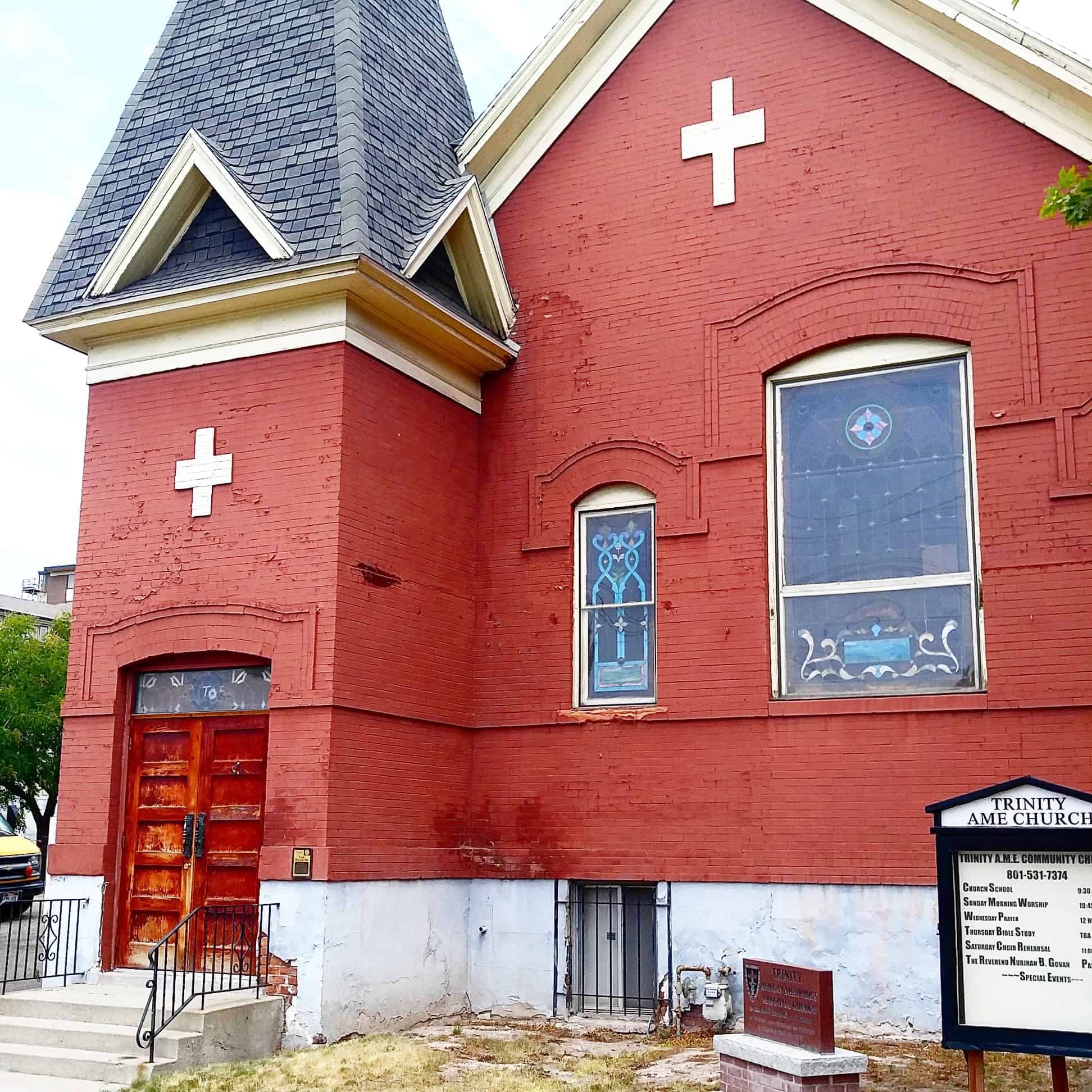
Organized during the 1880’s by the Reverend T. Saunders, this congregation has served as a focus of black religious, social, and cultural activity in Utah from territorial days to the present. In 1907 property at this spot was acquired, and a church designed by Hurly Howell was constructed through the sacrifice and energy of the congregation under the Reverend T. C. Bell. Restoration was begun in 1976 under the Reverend D. D. Wilson.
The congregation met in various members’ homes until it acquired enough funds to buy property to build a church in 1907. The new church was located on 600 South which is now Martin Luther King Boulevard.
From the 1930s and through the 1960s the church congregation numbered around 300 members. Despite the previous strong membership, the church has struggled with declining membership since the 1970s. In 2012 it reported only 50 worshippers a week. Trinity AME now touts itself as a “working class” church that primarily serves widowed senior citizens. It has struggled to attract more youth despite its long history of community involvement. It continues to hold youth activities such as movie nights that partner with the Salt Lake City women’s shelter. It also sponsors interfaith events that involve other religious denominations in the city.(*)