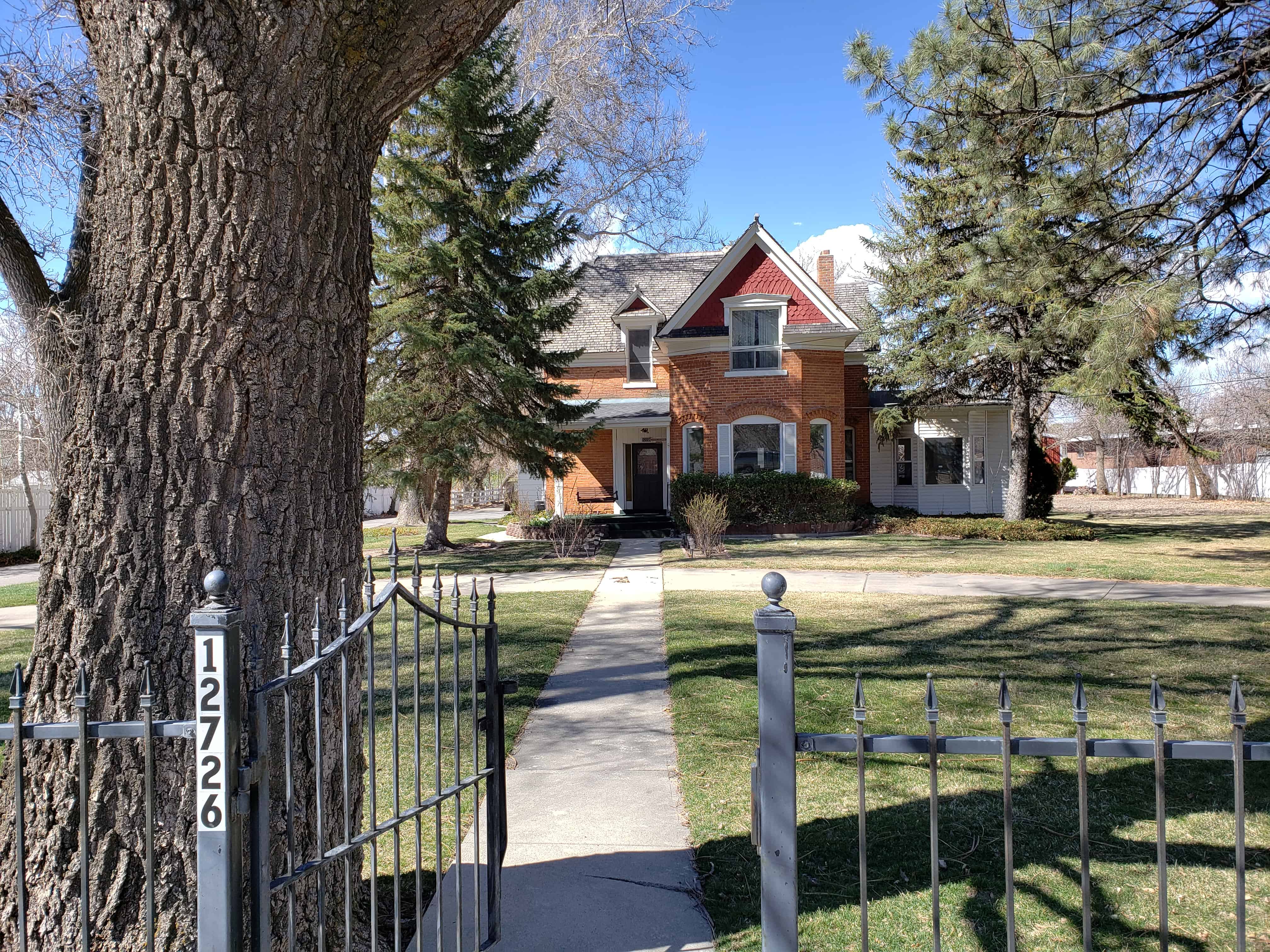
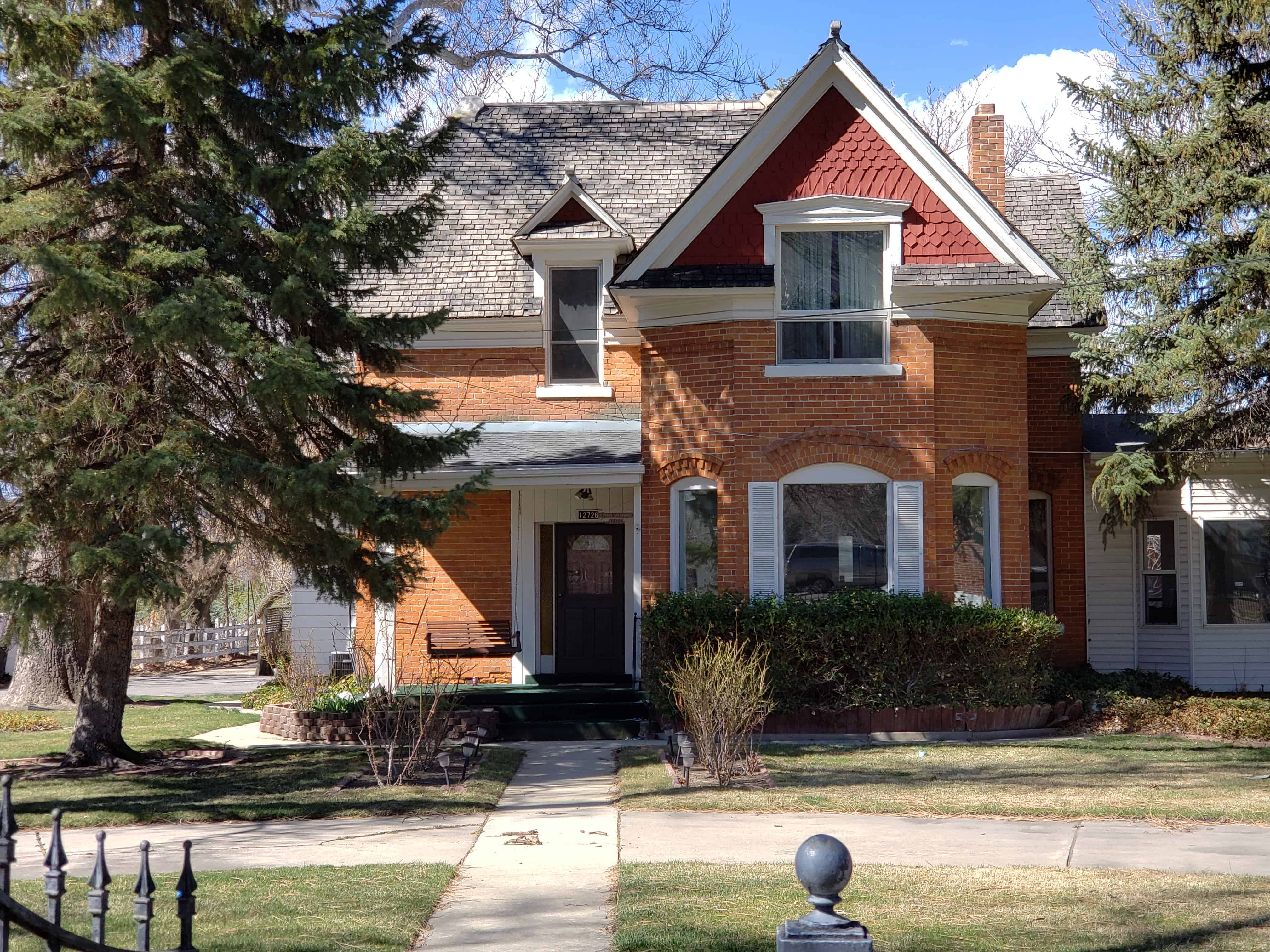
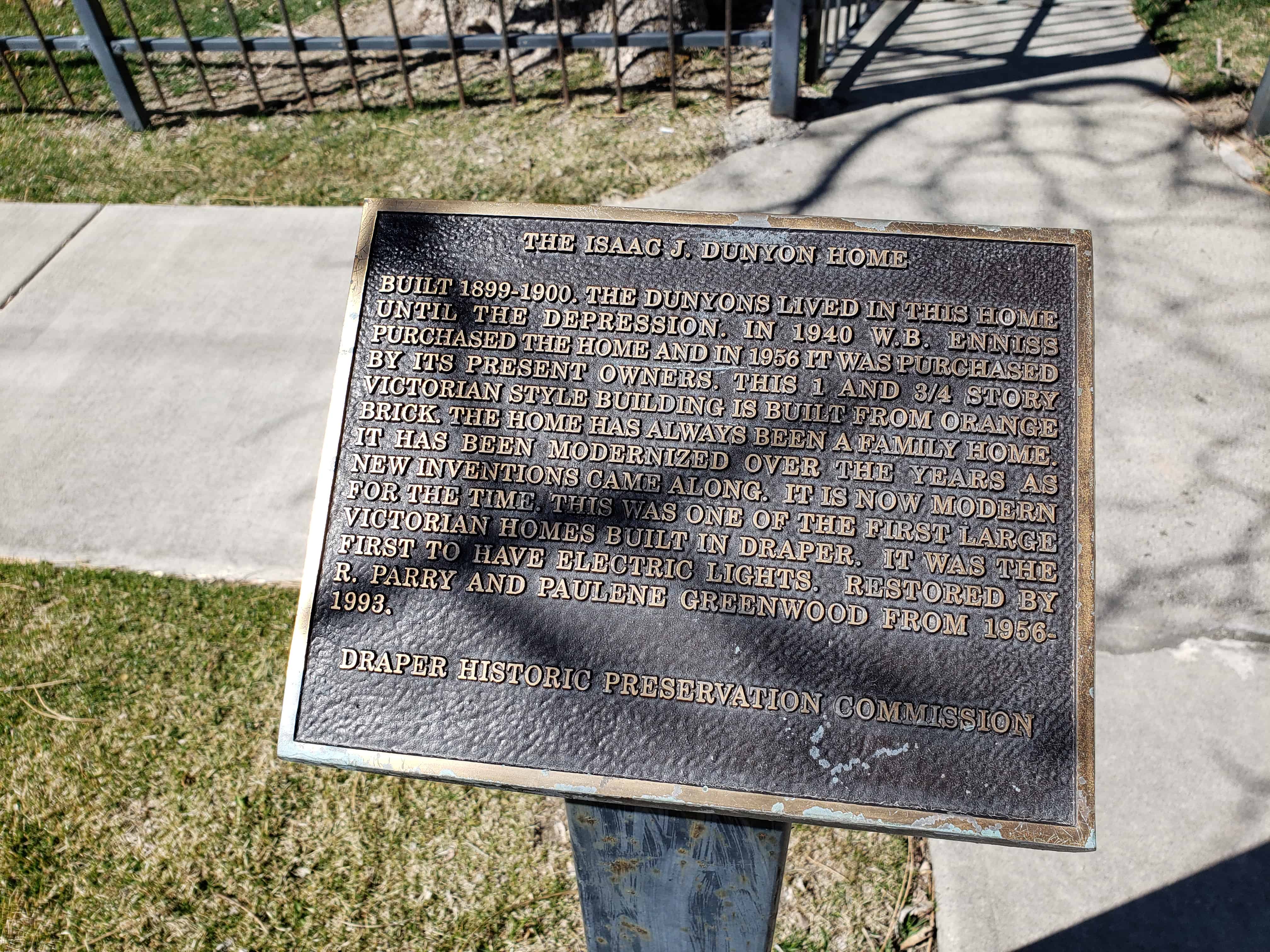
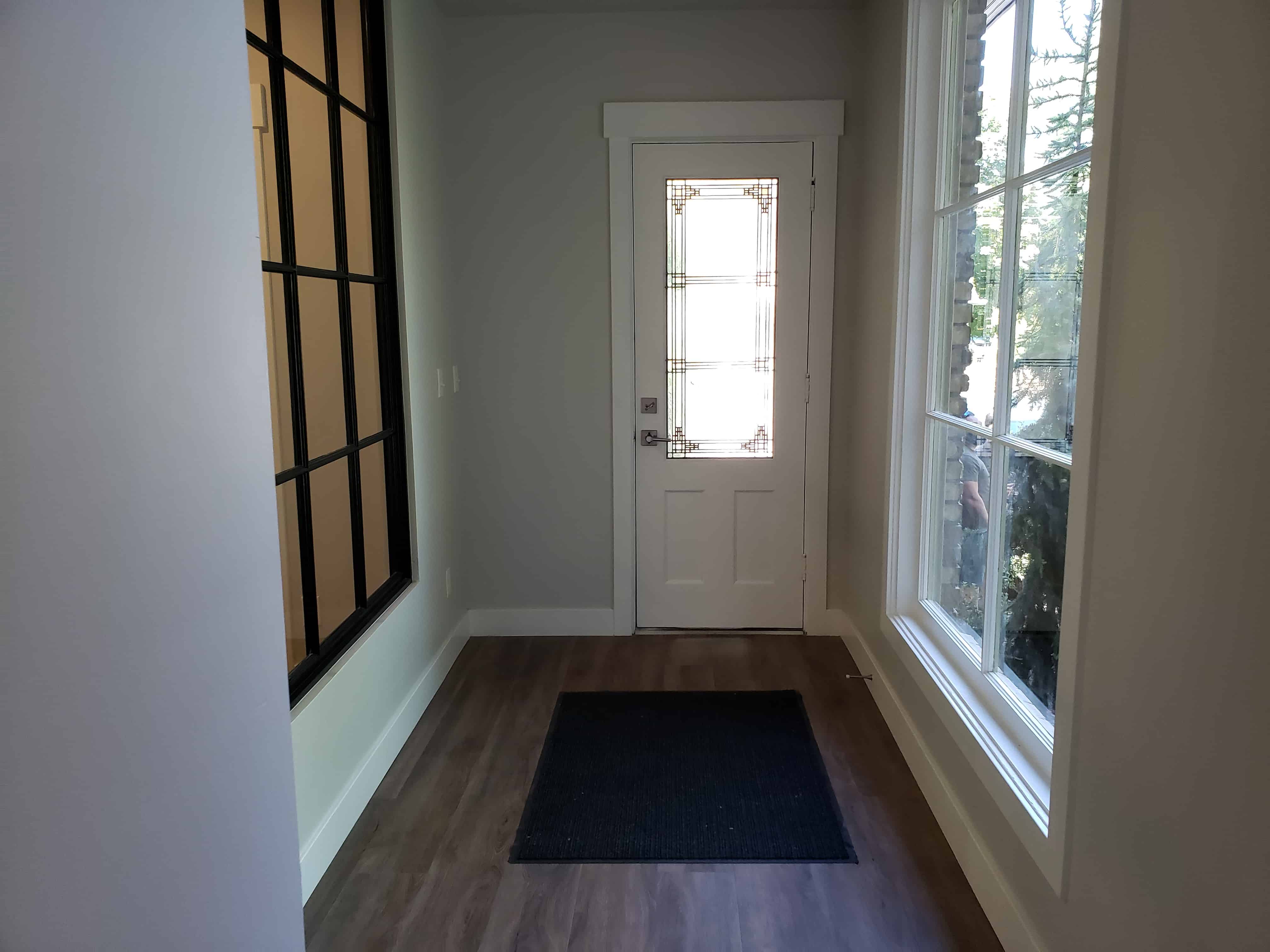
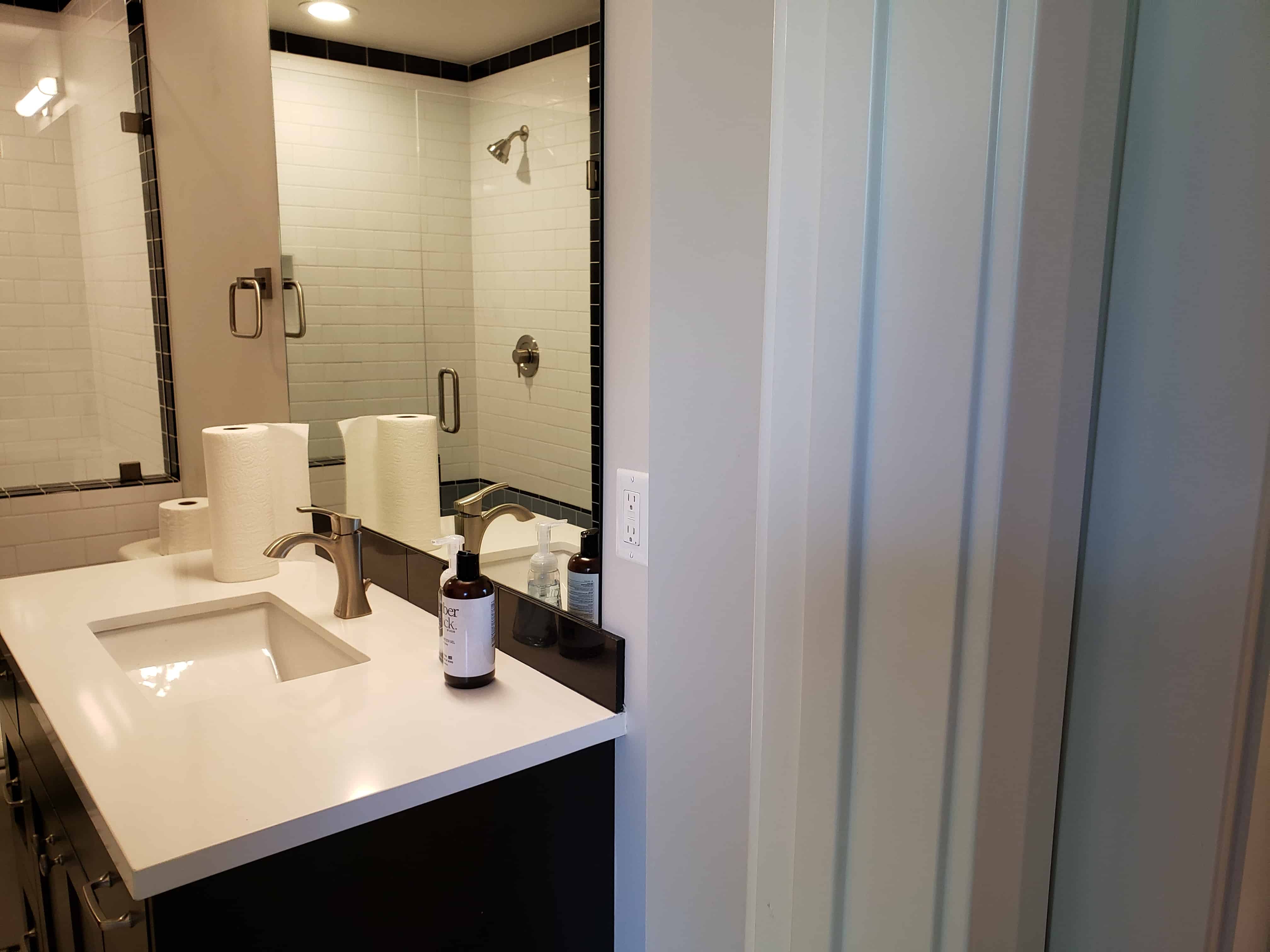
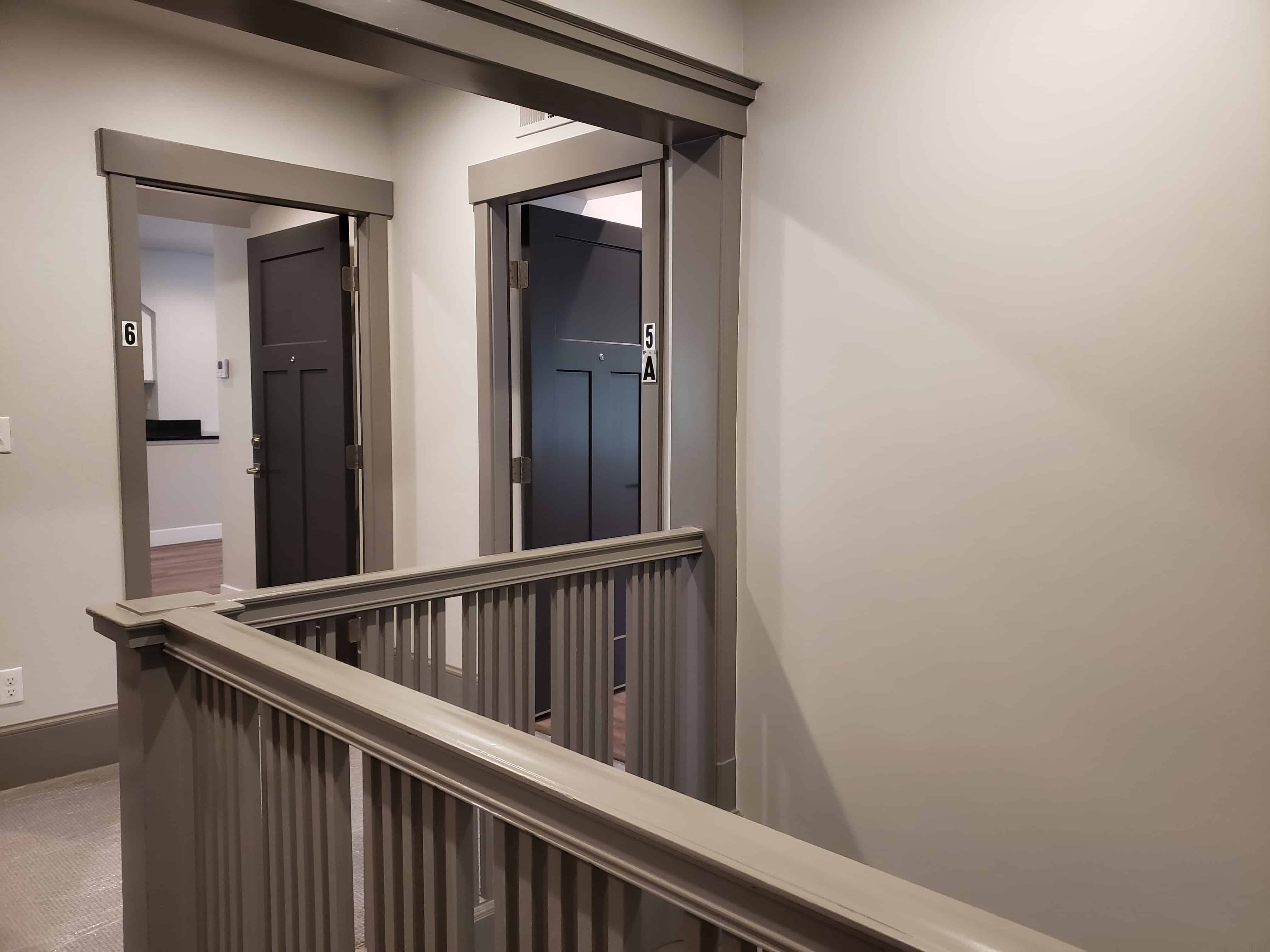
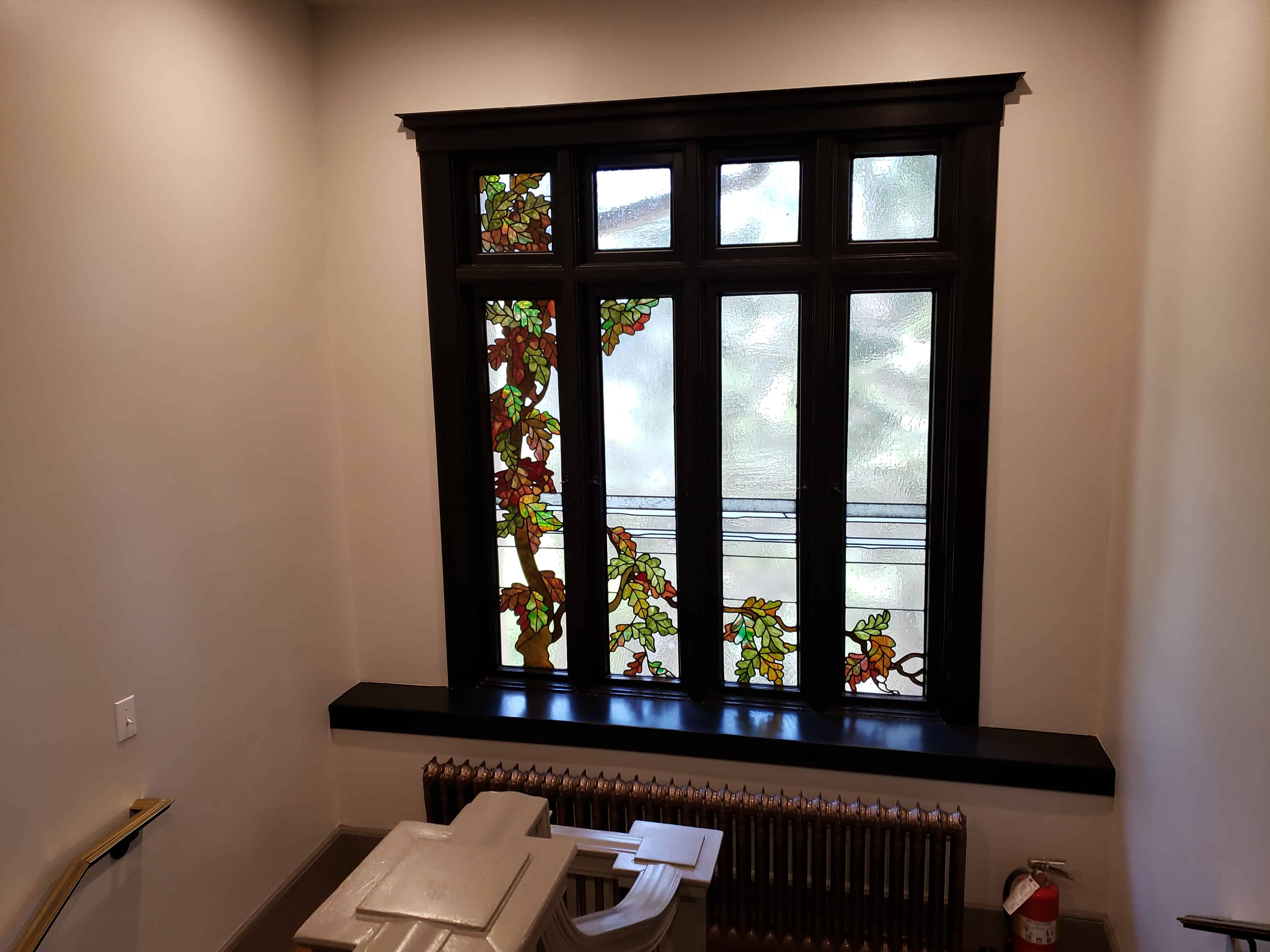
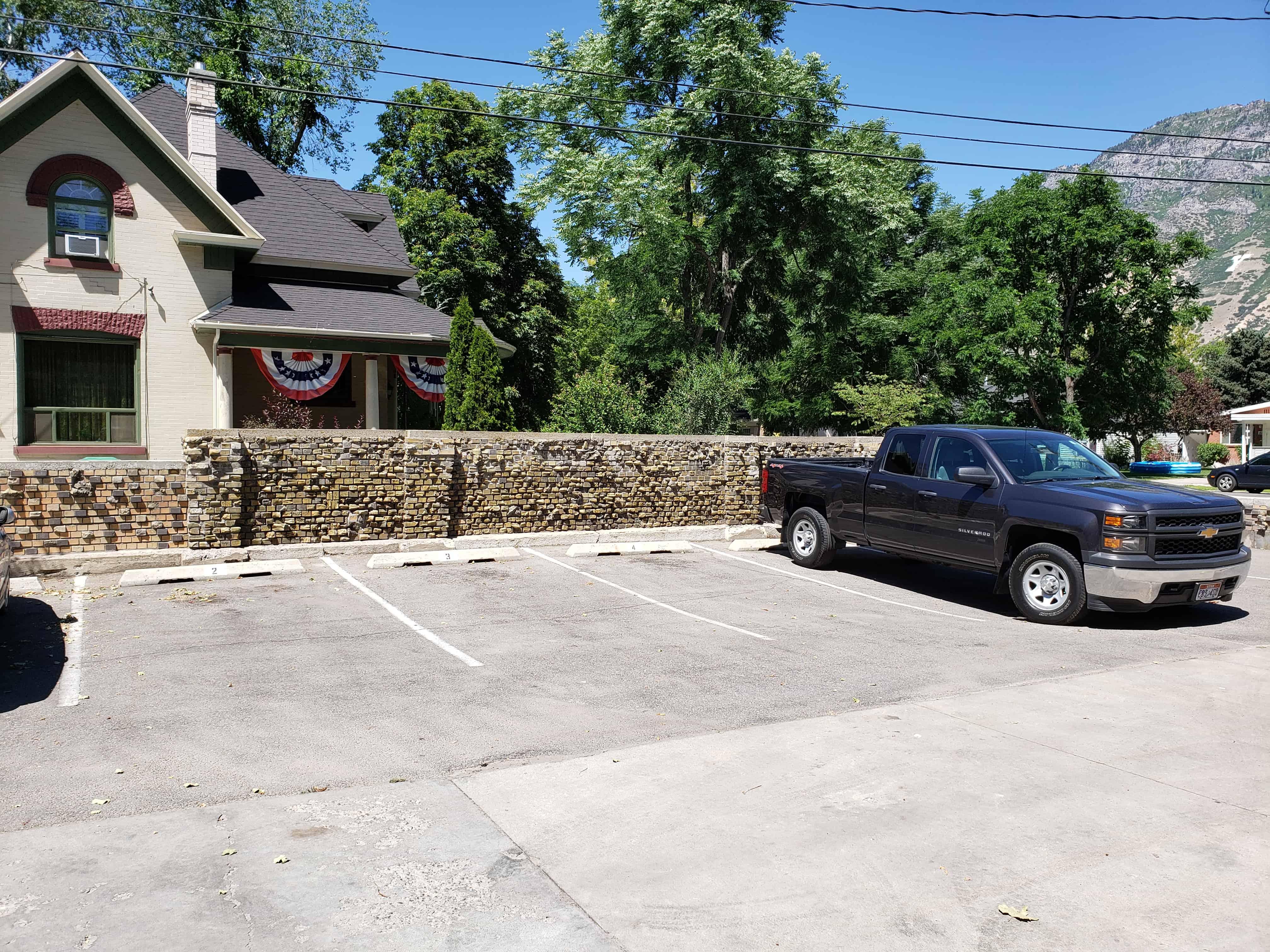
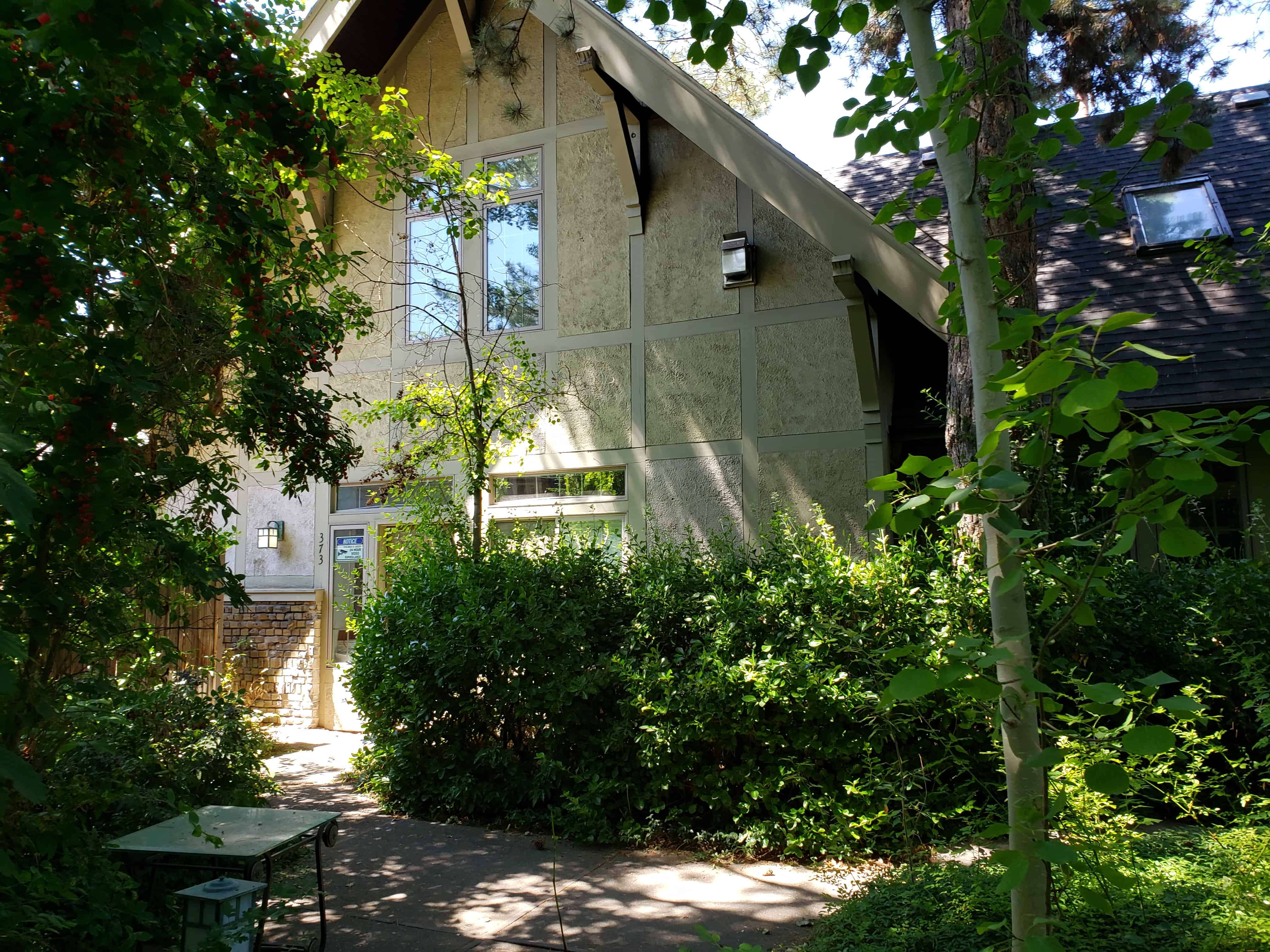
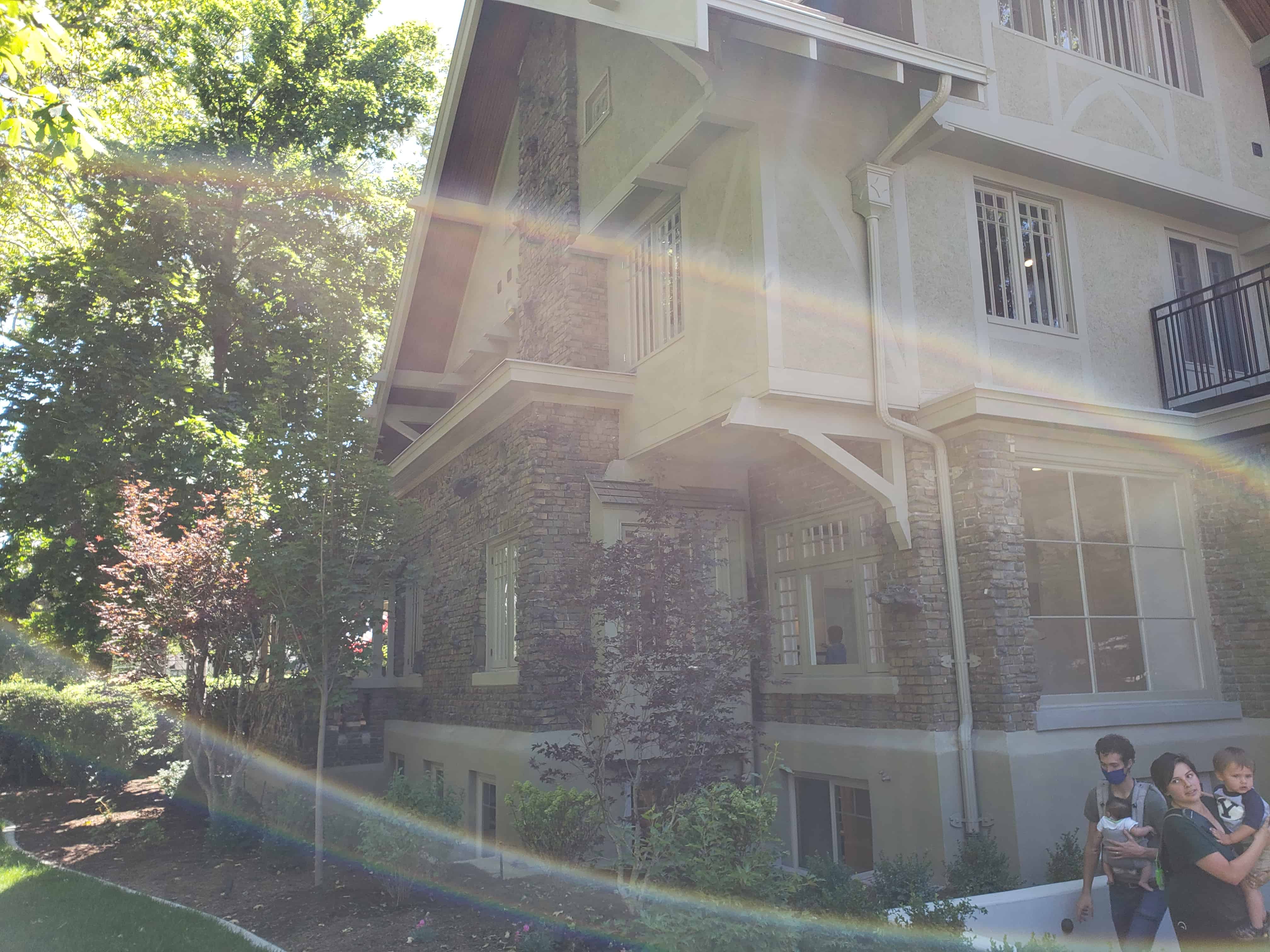
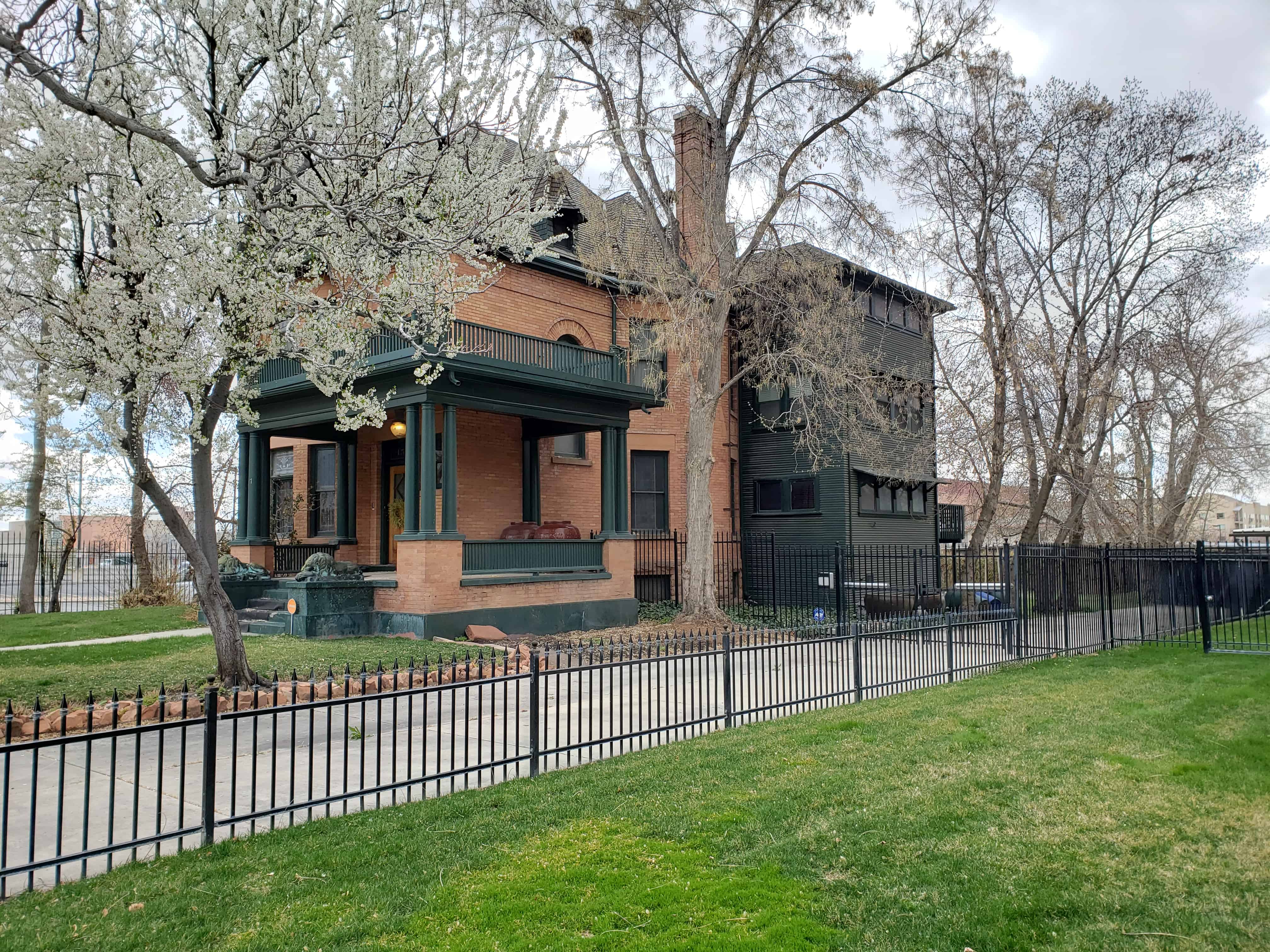
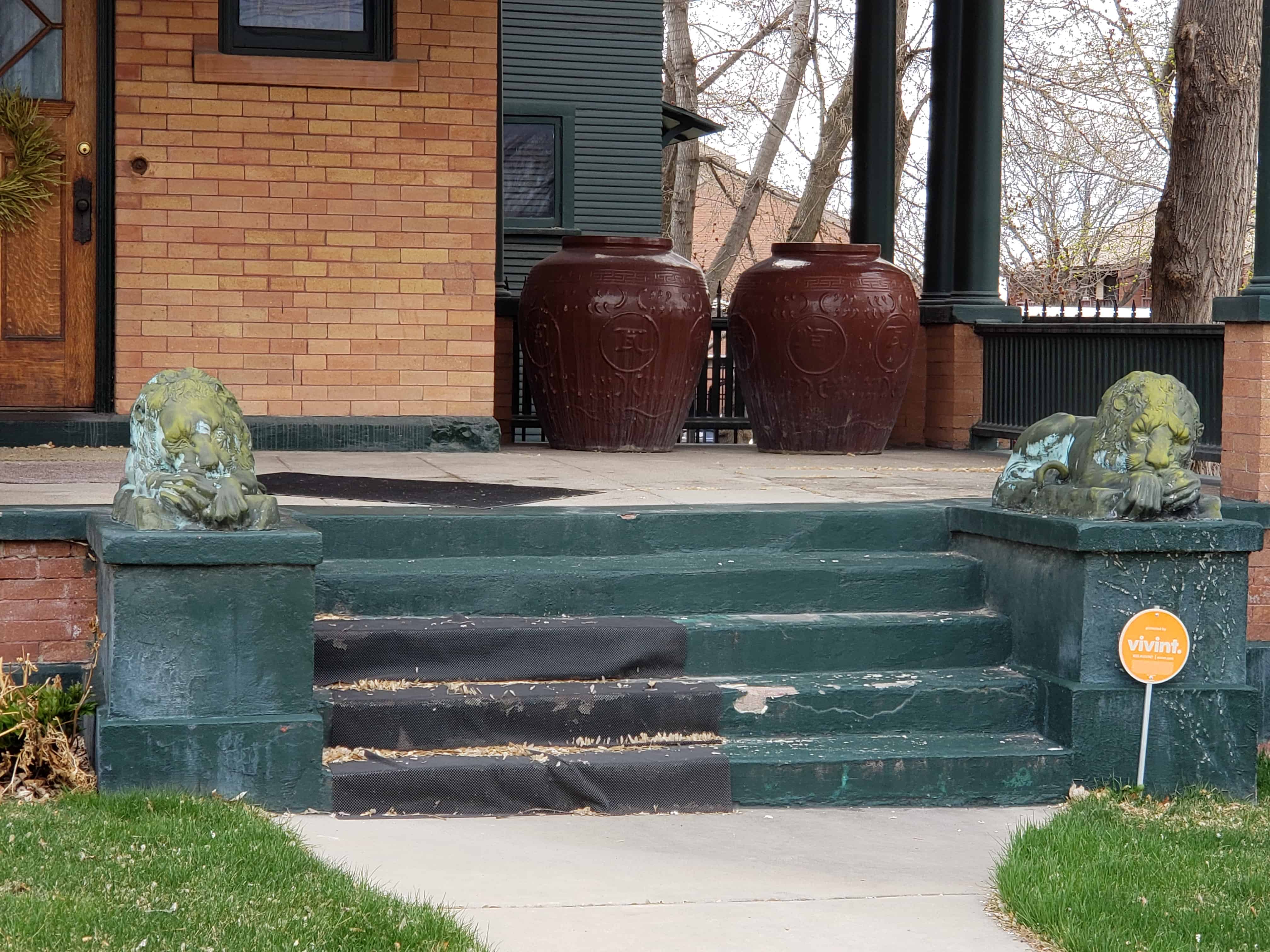
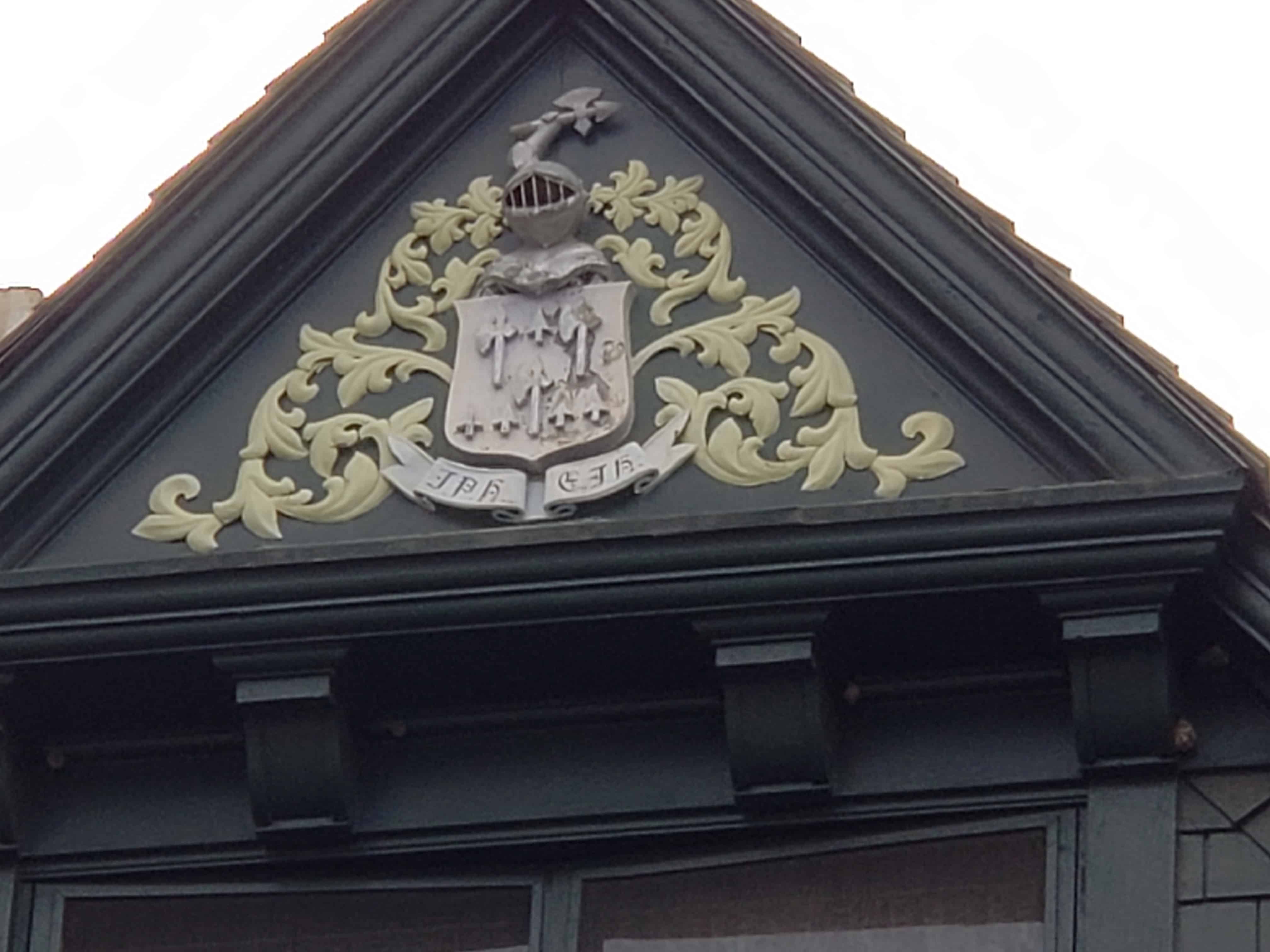
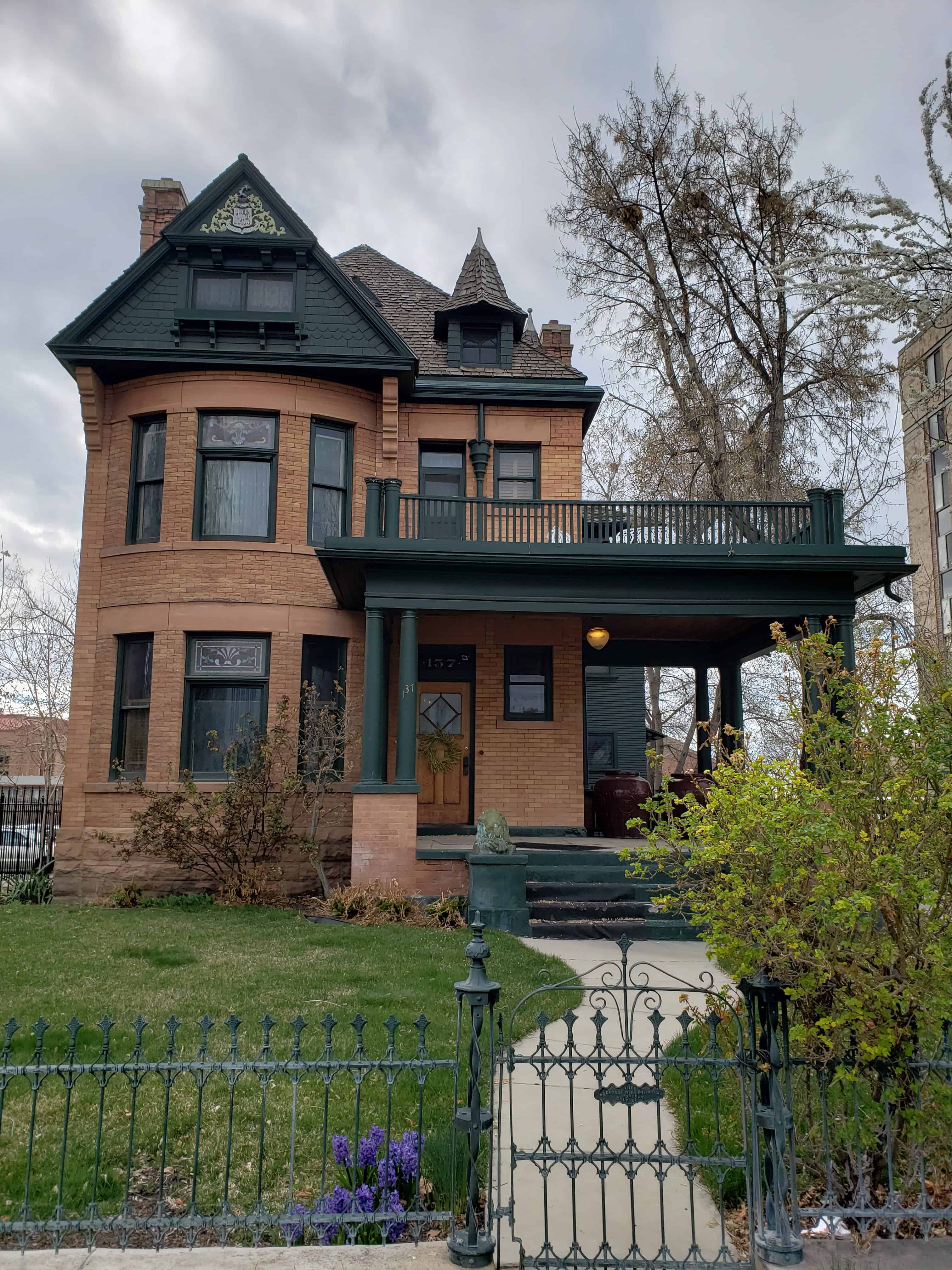
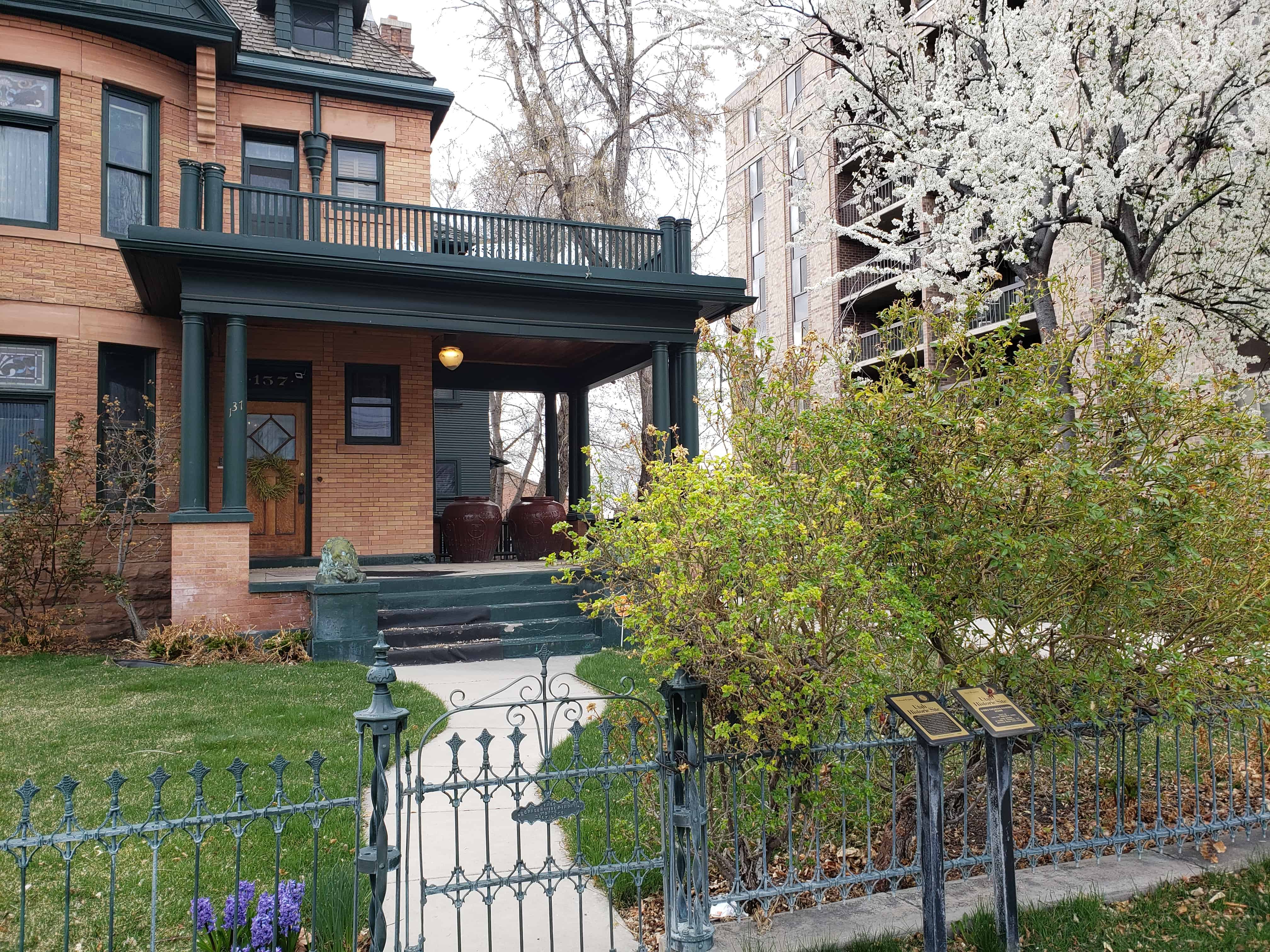
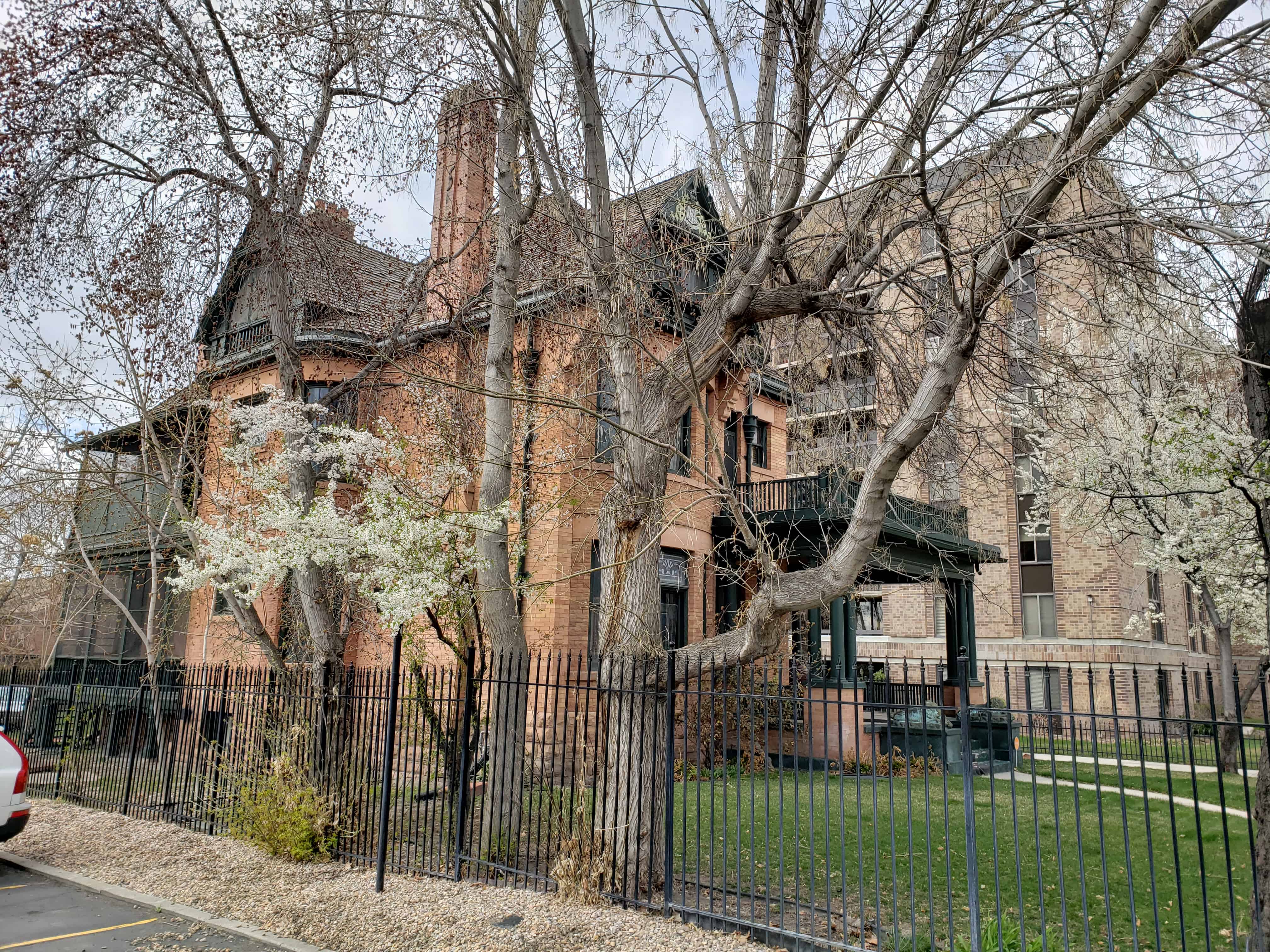
Built 1899-1900. The Dunyons lived in this home until the depression. In 1940 W.B. Enniss purchased the home and in 1956 it was purchased by its present owners. This 1 and 3/4 story Victorian style building is built from orange brick. The home has always been a family home. It has been modernized over the years as new inventions came along. It is now modern for the time. This was one of the first large Victorian homes built in Draper. It was the first to have electric lights. Restored by R. Parry and Pauline Greenwood from 1956-1993.
Built circa 1905. Joseph Neilsen, a school teacher and farmer, his wife May, an accomplished musician and composer, and their 5 children lived in this home. The ownership of the home was transferred within the family for years. After the family sold the home it had numerous owners and renters. At one time it was divided into apartments. It is a Queen Ann 2 1/2 story red brick home with a granite foundation. The home was built on 5 acres with a large orchard, a garden, and an expansive front lawn. Restored by Vincent and Sherry Simmons in 1978.
12825 S Fort St – Built in 1901 One of a number of substantial late Victorian residences along this country road, the Joseph and May Nielsen house is, compared to the typical housing stock of turn-of-the-century rural Utah, an elaborate and stately, near mansion-like, residence built in circa 1901. The house has a central block with a tall hipped roof with two Queen Anne inspired projecting bays, to the left (or north), a wide half-octagon bay with a broad decorative gable, and to the right (or south), a smaller but taller three-quarter, semi-detached octagon tower. The house has a central staircase core that originally had a passageway, between the foyer and rear kitchen, beneath the staircase (now closed and housing a central heating furnace, installed ca. 1950s).
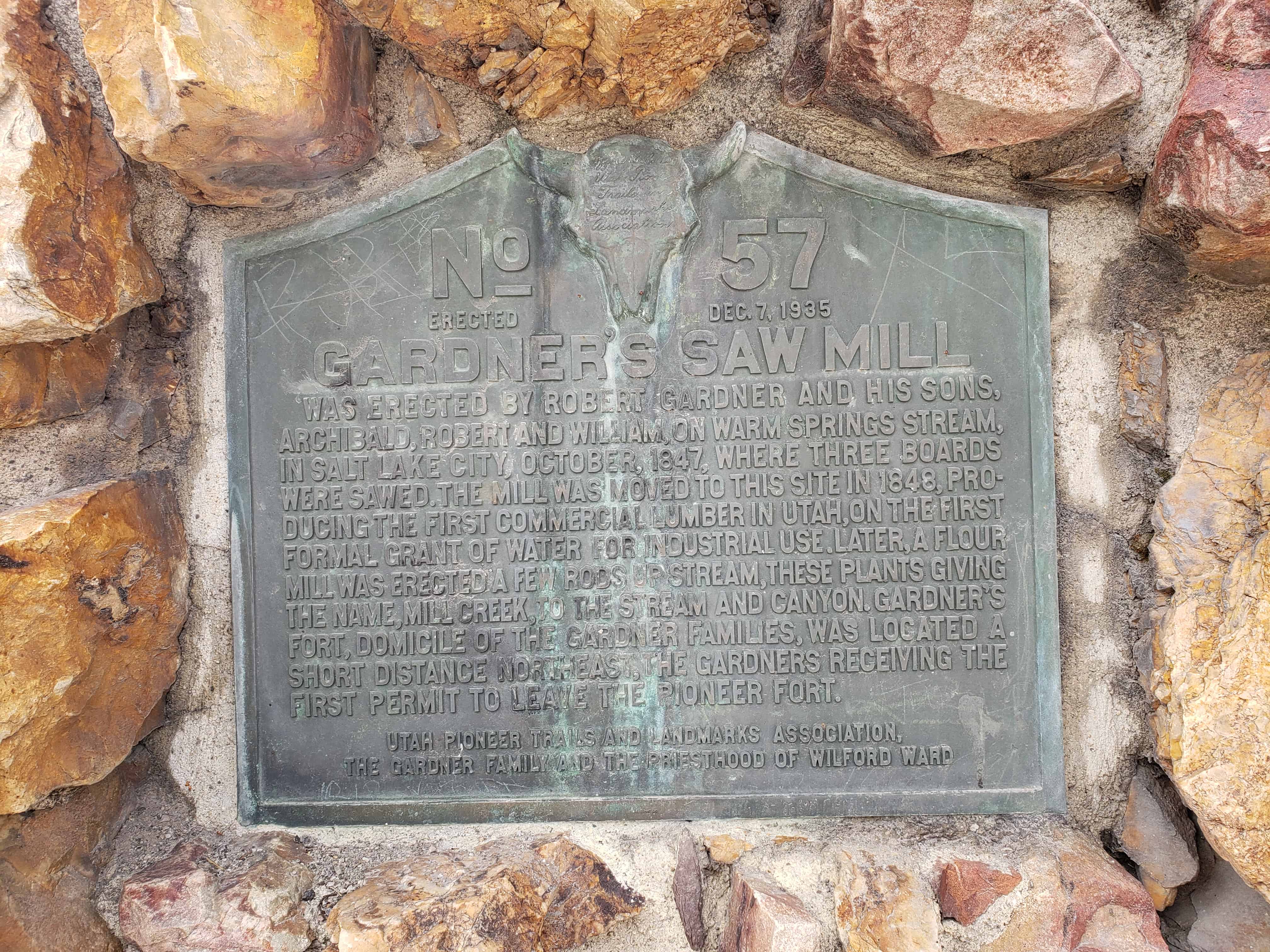
Built in 1848, the residence located at 1475 E. Murphy’s Lane was home to Robert Gardner Jr., one of the first settlers to construct a sawmill on the waterway now called Mill Creek.
It has been continuously occupied since it was first built, though it has not always been in the Gardner family.
The Mortensen/Nelson House, constructed c. 1885, with a c. 1898 addition, is significant under Criterion C. The style and type of construction of the earlier portion of the house is representative of the time period not only in Moroni, but also throughout Sanpete County when local architecture evolved from previously used classical/vernacular styles to the more popular national styles. This evolution was stimulated both by the arrival of the railroad to Moroni, allowing greater access to building materials, and the increasing prosperity brought to the entire county by the booming sheep industry. Earlier architecture in Moroni reflects the simplicity imposed by limited materials and meager incomes. In the Mortensen / Nelson House’s original inception as a classical hall-parlor type, great attention was paid to architectural details such as Flemish bond brickwork, high-pitched roofs, inlaid stone, bull-nose brick, and ornate cornice brackets. The Gothic Revival details combined with the classical hall-parlor form represent the evolution from early classical and Picturesque to the popular styles found outside of the territory of Utah. The addition and remodeling of the original house c. 1898 is representative of the widespread rebuilding of Sanpete Valley during the period of roughly 1890-1910. There was, in Moroni during this affluent era, a great deal of construction of new housing in the Victorian style, but the majority of the activity was seen in the remodeling of existing homes in the Victorian style. While there remain in Moroni many of the houses constructed during this time period, there are few homes left which represent the more common approach of updating existing houses to the then popular Victorian style. This home is a fine example of both the local evolution to more popular national styles and the rebuilding of the Sanpete Valley.
Part of the 1870 land grant to Moroni City, this lot in block 13, plat “A” was deeded to Lars Arnoldsen in January of 1870 along with a larger lot in block 12. The lot was deeded to his first wife, Else Mortensen in November 1884 as a result of their divorce. Else Mortensen was born in 1823 in Maribo County, Denmark. At the age of 25 she married her sister’s husband, Christian Brodersen, her sister having died the previous year leaving three small children. Else had two additional children by Christian. In 1854 they became converts to the Church of Jesus Christ of Latter-day Saints (Mormons) and as with many converts, immigrated to Utah. They crossed the plains of the United States in the Christian Christiansen handcart company in 1857.
Within a year of their arrival in Utah, Else and Christian separated and Else married Lars Arnoldsen. Lars was a native of the same county in Denmark and traveled to Utah in the same handcart company. The Lars and Else, along with Else’s two children, settled in the small town of Fountain Green in Sanpete County. Four more children were born in Fountain Green where they resided until 1865 when all the inhabitants of Fountain Green evacuated to the fort at Moroni. A fifth child was born in 1866 in Moroni.
After the fort was disbanded in 1872, the Arnoldsens remained in Moroni, having acquired (for the sum of $21.75) three acres in two town lots and seven acres of farmland. At this same time, Lars took a second wife in polygamy, Mary Ann Nielsen, by whom he had four children. According to the 1880 Federal Census of Moroni Precinct, Lars and both of his wives, with their children were all living in the same house. Only two of Else’s children were listed, however, as the oldest, Lars had left home, and two children, a son, 17, and a daughter, 15, had both died the previous year.
In 1884 Else and Lars divorced. In the settlement dated November 10th, she received (under the name of Else Mortensen) lot 1 of Block 13 and about 5 acres of farmland. This land was to revert to her three sons upon her death. After the construction of this home Else lived just six more years, dying in November of 1891 .The home was sold by her sons to Ephraim Nelson for $700 in March of 1892.
Ephraim Nelson
Ephraim Nelson, who purchased the home in 1892, was born 1865 in Moroni to Jens C. and Anne M. Nielsen. Shortly after his marriage in 1884 to Kjersten Jensen, the couple moved to Nephi to work in gristmill owned by her father. They moved several times over the next eight years, trying farming in Deseret for a time, but moved back to Nephi again to work in the gristmill.
In 1892, tired of moving from place to place, the Nelsons moved back to Moroni to go into the sheep business with Ephraim’s brother, Joseph. The Nelsons purchased the subject house from the sons of Else Mortensen. The first seven years in this house saw the size of the Nelson family double from four children to eight. A large addition, which included a kitchen, bedroom, bathroom, and laundry room, was built on the back of the house and the original portion of the house was modified to unify the architecture of the building.
In the family photograph taken in front of the house in the summer of 1900, the alterations the Nelsons made to the house are more clearly visible in the shading of the newer brick infill. Two small windows in the center cross-gable on the front of the house were replaced with a door, and there appear to be alterations to the doors and windows on the main level as well, perhaps adding the raised segmental arches to match those in the addition.
Ephraim served two missions for the Church of Jesus Christ of Latter-day Saints, one to the Northern States in 1900, the other to California in 1905. The Nelsons also had four more children, making twelve in all. Ephraim Nelson bought a small farm in Freedom in 1905, leaving his 18-year-old son, Ray in charge of the Moroni property.
Other Homeowners
Ray Nelson purchased the house in Moroni from his father in 1918, but sold it the following year to Martin and Delena Stevens. In the early 1920s the Stevens added a large front porch and converted the side porch to living space, both of which have been removed during the current restoration. In April of 1924 Martin Stevens was gored by a bull in the corral just west of the house. He died as a result of his injuries leaving Delena to raise their small children alone. Inl964 Mrs. Stevens subdivided the lot, deeding the west half to her son, Nevert, where he built a home. The east half was also deeded to Nevert at this time, but Delena continued to live in the home until her shortly before her death in 1992. The house remained vacant for several years and the tax file on the property contains a note dated November 4, 1996. “Nevert Stevens came in. Several people have looked at, but can’t sell the residence. Will likely demolish.” The home was sold to McKay and Pamela Platt in June 2000, who are currently restoring the home.
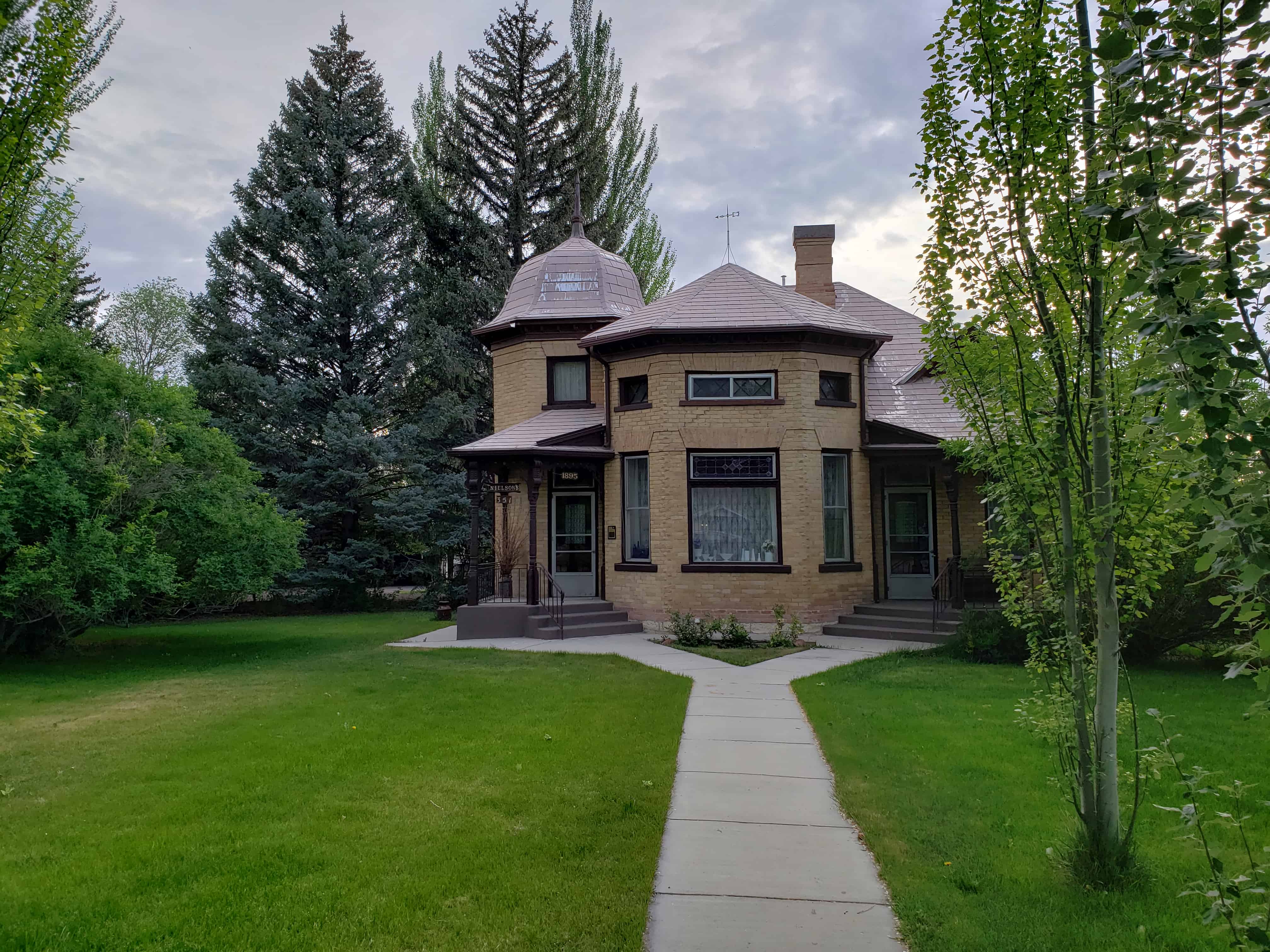
The Johnson-Nielson House at 351 N Main Street in Ephraim, Utah.
The Johnson /Nielson house, built in about 1895, is one of several distinctive Queen Anne brick houses to be constructed in Ephraim, Sanpete County, Utah, during the late 19th century. ( other significant Queen Anne examples are the Larsen-Noyes house and the Dorius-Olsen house) These houses are significant because they represent, first, a dramatic shift in architectural thinking away from the rigid symmetry of earlier vernacular designs, including types transplanted from Scandinavia, and second, the emergence of a local elite who capitalized upon the expanding livestock industry of the 1880s and 1890s. This house was built by Soren Johnson, a Danish contractor who also ran the Union Hotel in Ephraim. Louis B. Nielson purchased the house in 1905 and from here managed one of Sanpete County’s most successful livestock businesses. Nielson raised quality Rambouillet sheep and developed a valuable fine stapled, long fiber, crinkled wool.
The town of Ephraim in Sanpete County was settled in 1853 by members of The Church of Jesus Christ of Latter-day Saints, the Mormons, as part of the larger colonization of the Great Basin region during the second half of the nineteenth century. Like most other early Utah towns, Ephraim’s economy was based upon a rather limited subsistence-oriented agricultural system. Typical farm homes of the pioneer period were generally fashioned around a small number of vernacular house types which were outwardly symmetrical in design. This traditional architectural aesthetic, imported into Utah from the eastern U.S., prevailed in Sanpete County until the closing decades of the century when newly introduced Victorian styles conspired with an emerging lucrative livestock industry to dramatically change the architectural complexion of the area. After 1870 factors such as a favorable climate, the availability of open range land, and the accessibility of eastern markets over the newly completed transcontinental railroad, led to the rapid expansion of sheep ranching in Utah. in Sanpete County, many local businesses flourished in the wake of the livestock boom. New homes erected during this period followed the Victorian stylistic preferences for visual complexity and asymmetry with the Queen Anne and Eastlake styles being particularly popular. Soren Johnson’s Union Hotel profited from the flush times and in 1895 he built a fine new Queen Anne home which reflected the changing architectural tastes of the Ephraim community.
Soren J. Johnson, the original owner of the home, was born in Copenhagen, Denmark in 1860. He emigrated to Minnesota as a boy of 14 and later, probably in the 1870s, arrived in the Danish-Mormon colony of Ephraim. Here he was befriended by Anthon Lund, a local church leader who later became one of the Twelve Apostles of the Church of Jesus Christ of Latter-day Saints. Lund was responsible for converting Johnson to the Latter-day Saint faith. In the 1880s, Johnson married Anna Sophie Dorius, the daughter of one of Ephraim’s leading citizens, C.C.N Dorius. Johnson was a painter and house builder by trade, but also served as manager for Anthon Lund’s furniture business and later was owner-proprietor of Ephriam’s Union Hotel. In the early 1890s, the large Queen Anne brick house on the north side of town was designed and constructed by Johnson himself. The house was completed in about 1895. However, by 1900, Johnson’s main activities were centered around the prosperous Union Hotel, so he moved his family into residence there and rented out the house.
In 1905, Johnson was becoming increasingly worried about the worldly influence of hotel living on his religious family. The rapidly expanding Sanpete livestock industry was drawing considerable outside attention and the Union Hotel was becoming the Ephraim home for many non-Mormon traveling salesmen, drummers, and businessmen. Johnson concluded that a hotel was not the place to instill the proper values in his growing family, so in 1905 he sold both the business and his house and moved to Salt Lake City. In the capitol city he became a successful developer-contractor-builder and is perhaps best known for his work on the Capitol Hill Ward for the LDS Church.
When Johnson moved north in 1905, he sold his fine brick home to Louis B. and Ann Nielson for $1,000. Prior to purchasing this home the Nielsons lived in a two room house that was formerly a chicken coop. They then moved to Second Pigeon Hollow, where they lived in an adobe house supposedly built by Willy Larsen. Four sons were born there.
Louis B. Nielson raised quality Rambouillet sheep, which proved to be of primary importance to the rapidly expanding agricultural base of Sanpete County. The county would eventually became a Rambouillet breeding capitol of the sheep world. In 1897 W. S. Hansen and John H. Seeley purchased pure-bred Rambouillet sheep from France (see John H. Seeley House) In 1907 Mr. Nielson purchased 100 head of these, of which “Old Wood” was one who made the Nielson Sheep Company famous. The ram weighed 350 Ibs. and sheared 42 Ibs. of wool for two years in succession, probably the world’s champion wool producer. Through selective breeding Mr. Nielson developed a fine stapled, long fibre, crinkled wool. He shipped lambs to Nebraska and Missouri, receiving gold as a portion of the payment. Mr. Nielson owned about 1,000 acres of land on the west side of the valley, in addition to extensive grazing permits in the East Mountains. He had about 1,000 head of Rambouillet sheep.
Mr. Nielson, David Madsen and A. C. Anderson devised a plan to excavate a ditch on the East Mountain. They followed a survey along the “Low Pass” to bring needed water to Ephraim and the valley farms. Months were spent on the project. A similar plan, in a similar location, was later adapted by Ephraim City to increase the water supply. The old ditch is still visible.
Glen J. Nielson, and his wife Virginia purchased this home from the Louis B. Neilson estate on January 24, 1938. Glen is the fifth child, and the first one born in this home. He was a pioneer in the now prominent turkey raising industry. His were the first “broad-breasted Mammoth bronze” turkeys. He was successful in this venture. He also had an outstanding herd of Rambouillet sheep. He pioneered the huge, white Charolais industry in Ephraim, and received national awards on his heifers, after following selective breeding procedures. He owned several farms in Sanpete where he ran his turkeys, cattle, and sheep.
Glen Nielson served in various positions in the city, including a term on the City Council, and was a counselor and then Bishop in the Ephraim West Ward. The present chapel was constructed under his jurisdiction. Following his release as Bishop he was sustained as a Patriarch in the South Sanpete Stake.
The Johnson-Nielson house, built about 1895, is one of several distinctive Queen Anne houses constructed in Ephraim during the late nineteenth century. Soren Johnson, the original owner, was born in Denmark in 1860. A painter and house builder, Johnson designed and constructed this house himself. In 1905 he sold it to Louis B. and Ann Nielson, prosperous Ramouillet sheep raisers. Their son, Glen J., and his wife Virginia, purchased the house in 1938. They continued in the Ramouillet and agriculture industry. He pioneered the broad-breasted mammoth bronze turkey and charolais cattle industry in Ephraim.
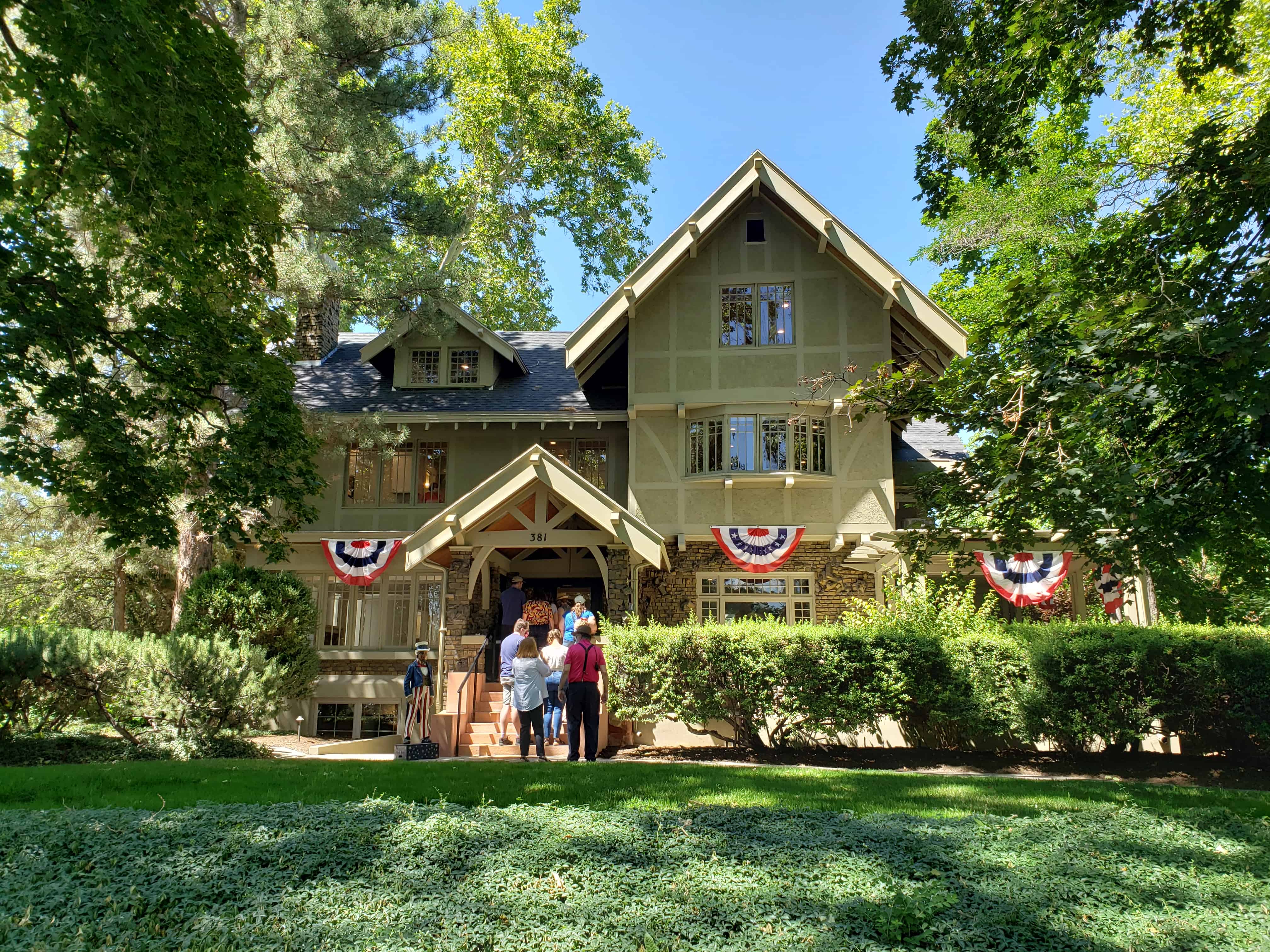
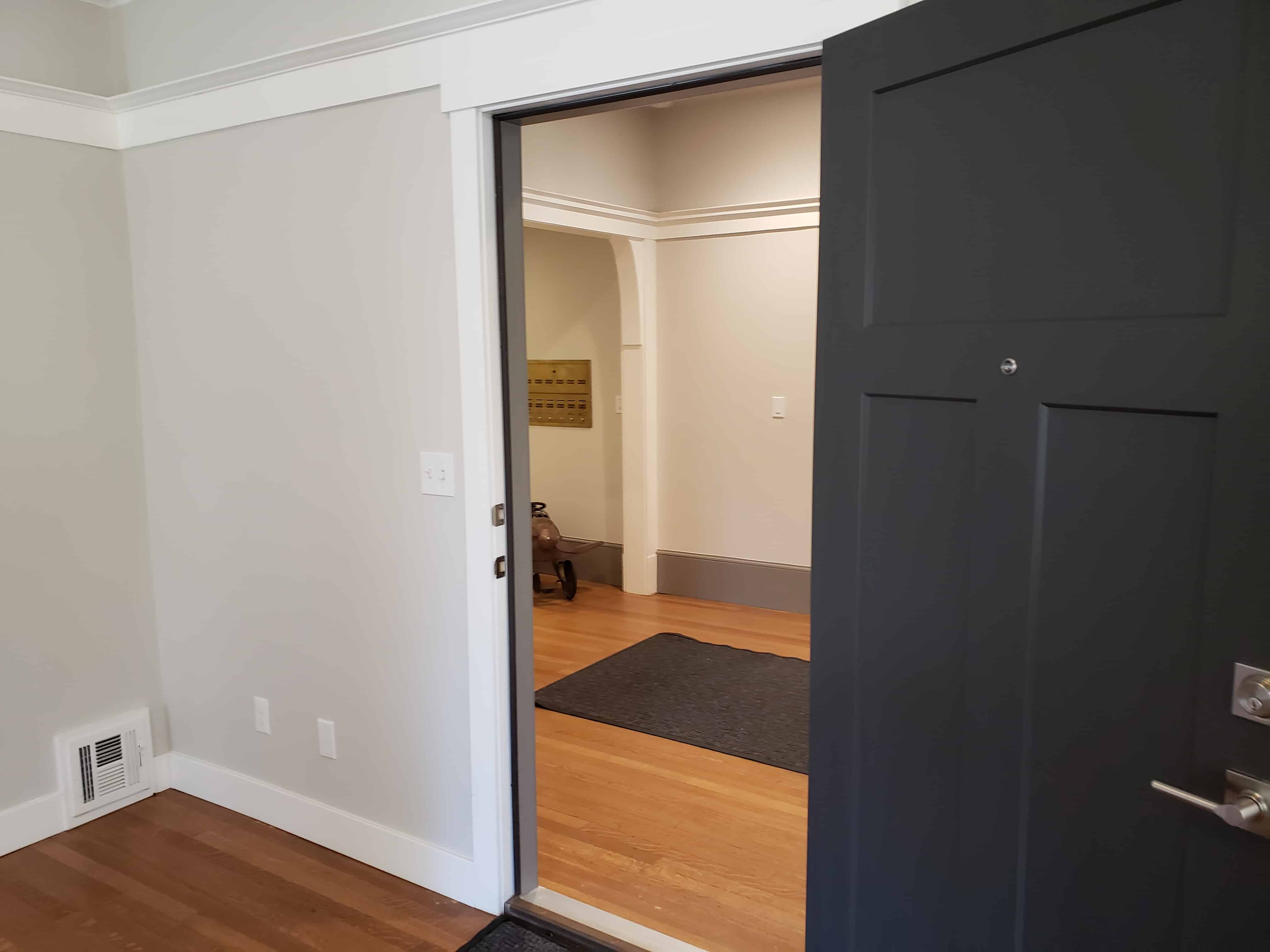
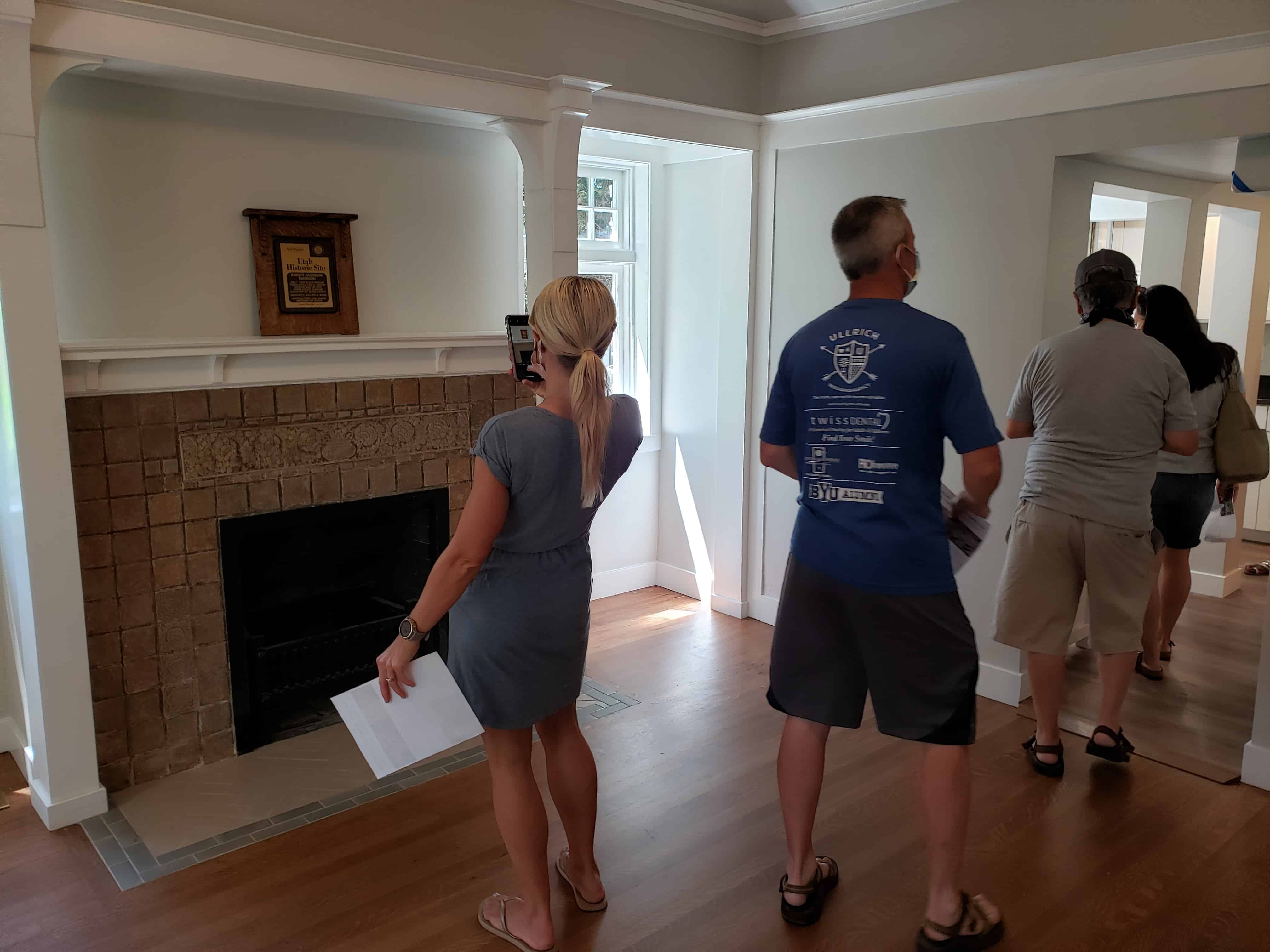
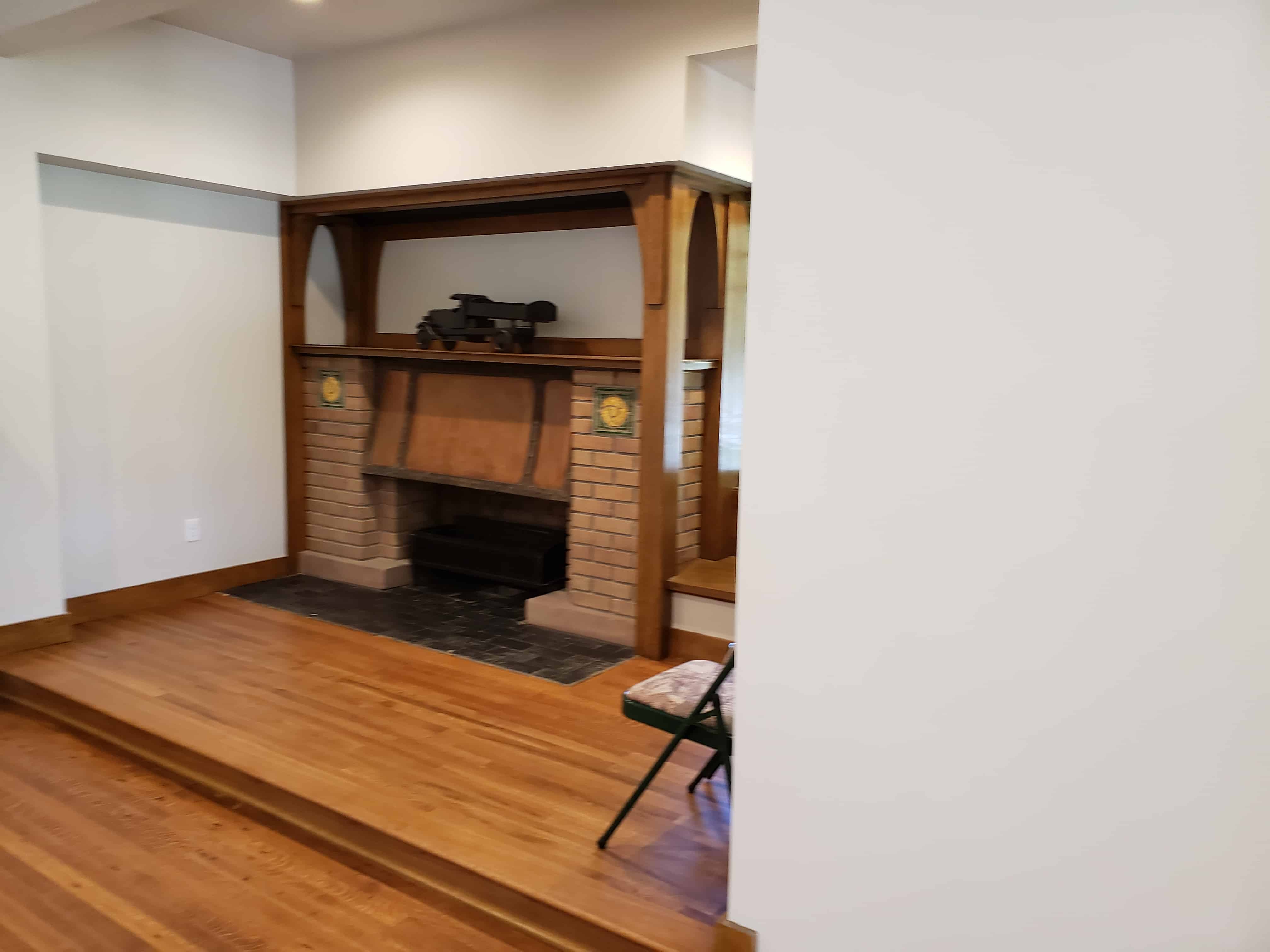
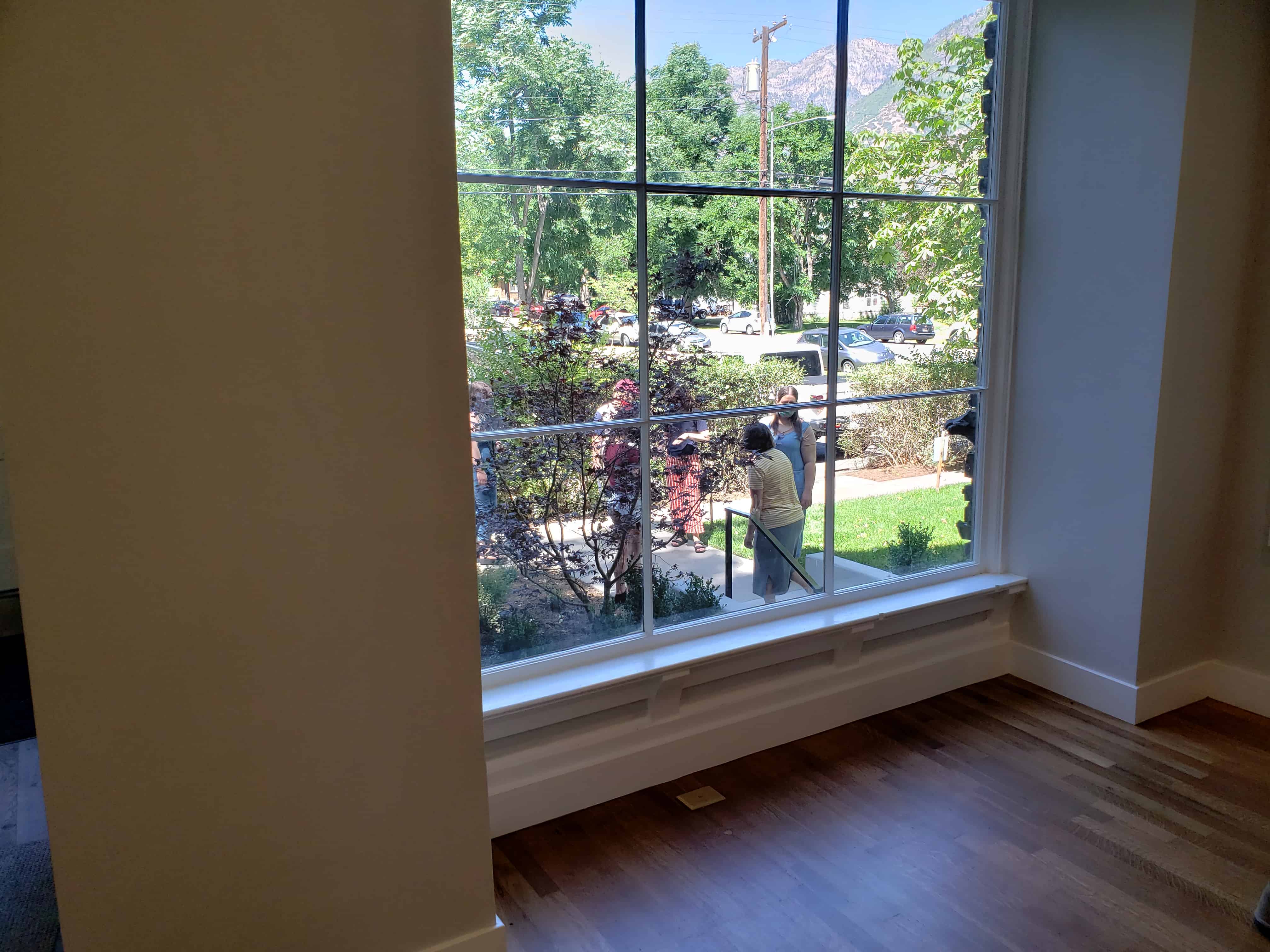
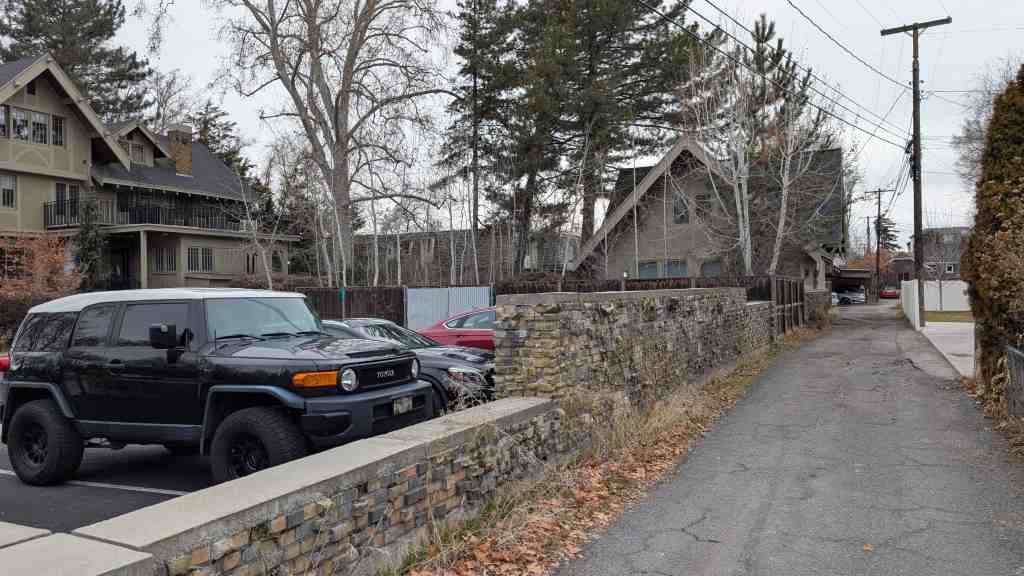
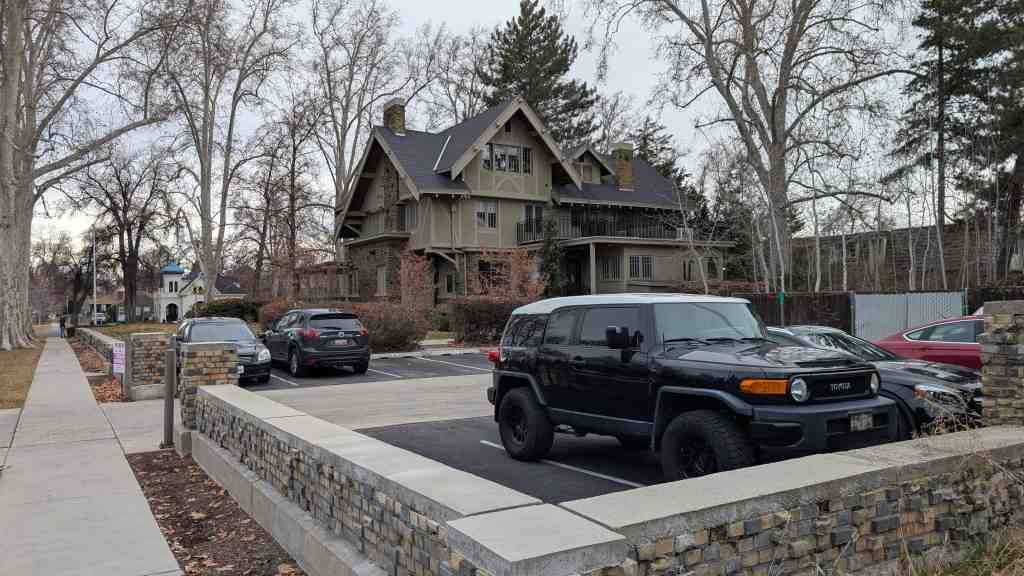
Built in 1908 in Old English Tudor style for W. Lester Mangum and his wife, Jennie Knight Mangum, daughter of Jesse Knight. Architect: Walter C. Ware Contractors: Alexander Brothers of Provo
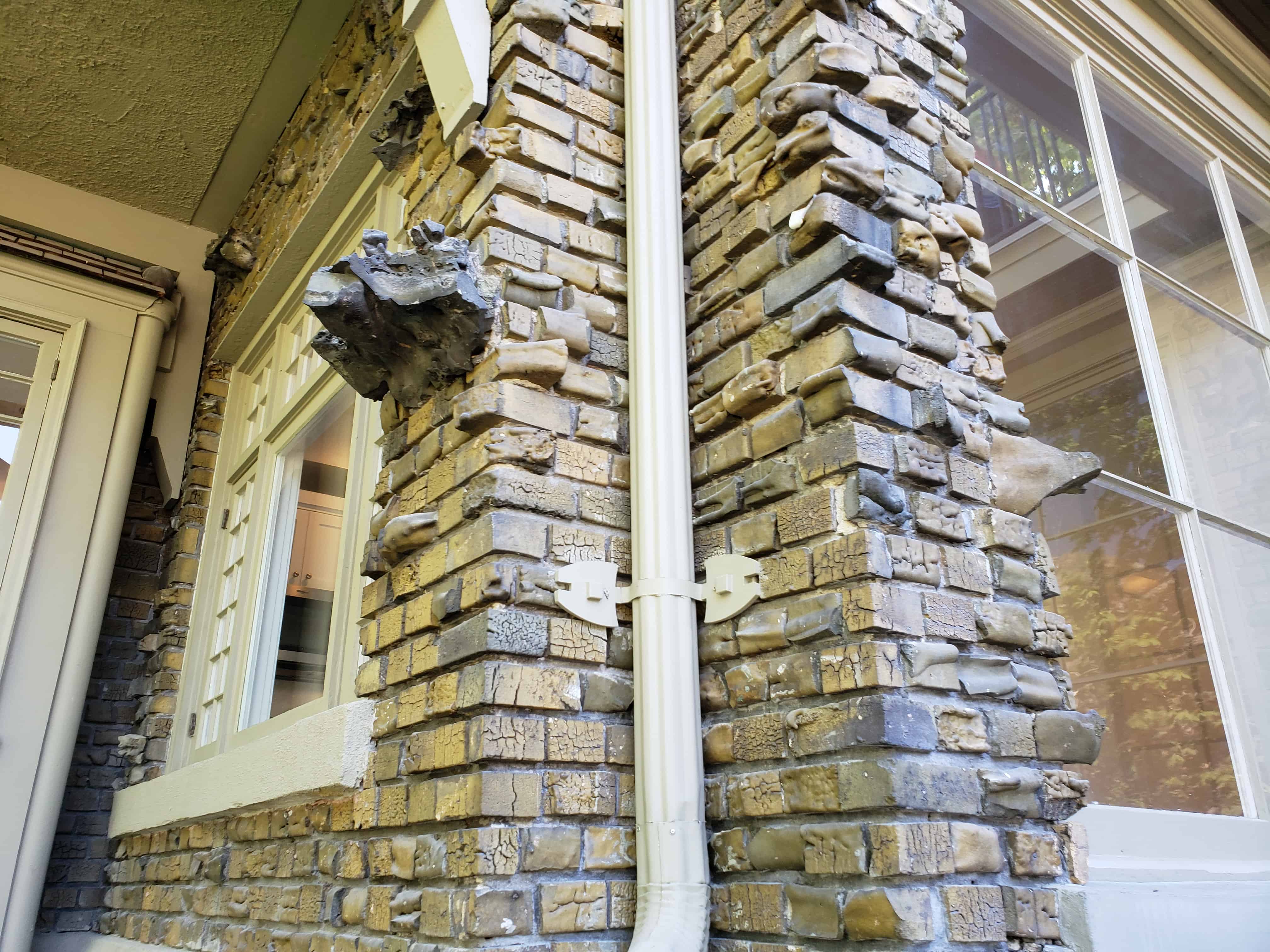
In 1908 Jesse Knight, a local businessman who lived down the street in his mansion built this home for his daughter Jennie and her husband along with the mansion across the street from this one for his other daughter. When they were designing the house Jennie had been out to the Provo Foundry to look at the brick options and saw a big pile of trashed bricks, those that had been distorted in the brick making process, clinker bricks, as they were called are not unheard of in local architecture (see this page) but Jennie decided to use only clinker bricks for this home – she got them for free and it made for a very unique look. It inspired a few other Provo homes to use clinker brick as well.
Lester never could seem to get out of financial struggles, so when the depression came they sold the home to someone who split it all up into apartments. In the 1960s, Mike Baughman (an interior designer and BYU professor) purchased the home, after him was a polygamist minister. He had his family and wives in the different apartments and used the carriage house in the back for the chapel. Later, when the Halladay’s purchased the home in 1983 the baptismal font room was entirely encased in mold. They restored the carriage house and rented it out as apartments.
Reed Halladay had grown up in the area and always loved the home and had many apartment buildings around town so when the chance came up to purchase the home he and his wife jumped on it. They have rented it out and refurbished it, in July 2020 they held an open house after renovations and 25 of the polygamist family came through the open house to see the house they or their parents had lived in 35-ish years before.
(The above story was told to me by the current owner and contradicts some of the information below, but I have included both.)
W. Lester Mangum was a son-in-law of Jesse Knight who was an important businessman in early twentieth-century Provo. Mangum held executive positions in many of the Knight industries and amassed a fortune for himself.
The Knight-Mangum house was built in 1908 for W. Lester and Jennie Knight Mangum at a cost of $40,000. The Mangums obtained the money to build the house by selling valuable Knight mining stocks they had bought for a very small price. Walter E. Ware, a prominent Salt Lake City architect, designed the house and Alexander Brothers was the contractor.
W. Lester Mangum was born in 1873 in Nephi, Utah. He attended B.Y.U. and was subsequently an instructor of English at the school. In 1905 he married Jennie Knight, the daughter of mining magnate and entrepreneur Jesse Knight. Mangum was quickly included in the Knight family businesses and held different executive positions in these businesses. He also served as vice-president and manager of the American Colombian Corporation which owned huge tracts of land in South America. Mangum was active in the L.D.S. Church, and served as a member of his stake’s high council.
Jennie Knight Mangum was born in 1885 in Payson, Utah, the fifth child of Jesse and Amanda Knight. She was very active in civic and church affairs in Provo.
Jennie Knight Mangum sold the house in 1966 to Paul G. Salisbury. Salisbury deeded the house to Mike Baughman in 1972 and Baughman renovated the building.
Architecture:
The Knight-Mangum house is significant as the most sophisticated example of a Craftsman house in Provo and as one of the best examples of that style in the state. It is one of several premier examples of this type that were designed by the successful Salt Lake City architectural firm of Ware and Treganza. Alberto O. Treganza, the principal designer of the firm, had worked for the famous San Diego firm of Hebbard and Gill, and the design of the Knight-Mangum house may reflect the influence of that experience.
This two and one half story house is one of the most outstanding Craftsman style houses in Utah. It has an asymmetrical composition, steep gable roof with exposed rafters, decorative stick work on the top two stories, cross gables and gable dormers, exposed purlins, decorative brackets along the roofline, and a flat roofed single story porch with exposed rafters that wraps around the southeast corner. The house rests on a raised concrete basement.
Clinker brick has been used for the first story, for the posts of the porch, for the chimneys, and for the wall that surrounds the house. The upper stories are wood frame and stucco with stick work. The windows are grouped in various arrangements, including a three part bay window on the second story gable end of the façade, and are casements with decorative wood stripping.
The main entrance is set under an open porch whose gable roof repeats the lines of the cross gable and the dormer. It is supported by clinker brick piers. An all glass door is flanked by side lights which have stained glass stripping around their edges. The craftsman elements which tie the building together include: the variety of materials; the use of natural materials and structural elements for ornamentation; the bands of windows accented by stickwork; the stickwork of the upper stories, exposed rafters, purlins, and brackets; and the irregular massing coupled with an organic balance.
Changes in the fenestration of the west wall and the addition of a two story exterior staircase on the northwest corner are alterations which detract from the original integrity of the building, but are not significant enough to destroy its original effect. A one story rear extension maybe original. The interior of the house has been changed considerably, having been divided into eleven apartments. When it was later converted into office space more changes were made. Those changes, however, except for the ones mentioned previously are not reflected on the exterior of the house.
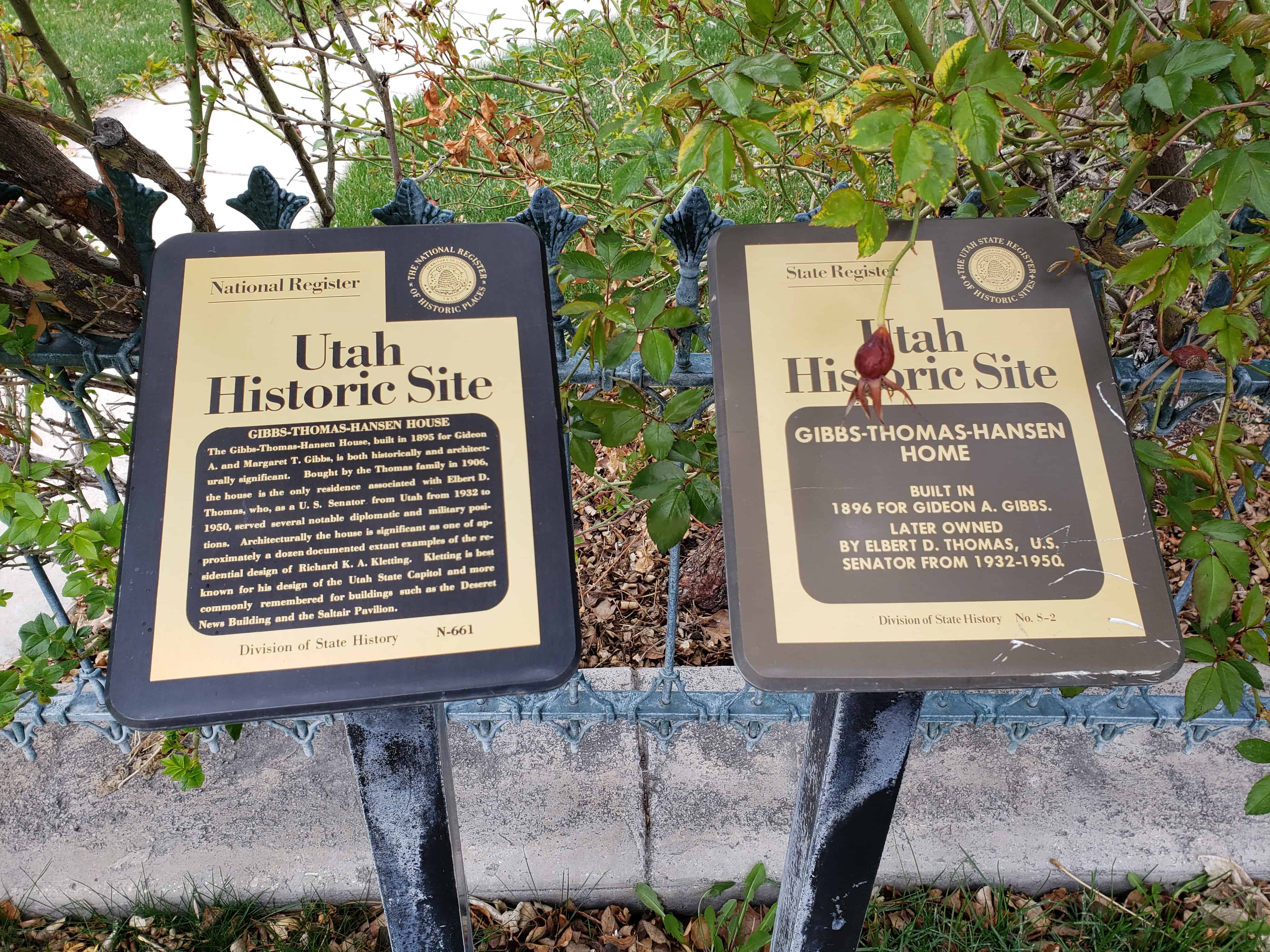
Built in 1896 for Gideon A. Gibbs Later Owned By Elbert D. Thomas, U.S. Senator From 1932-1950
Gibbs-Thomas-Hansen House
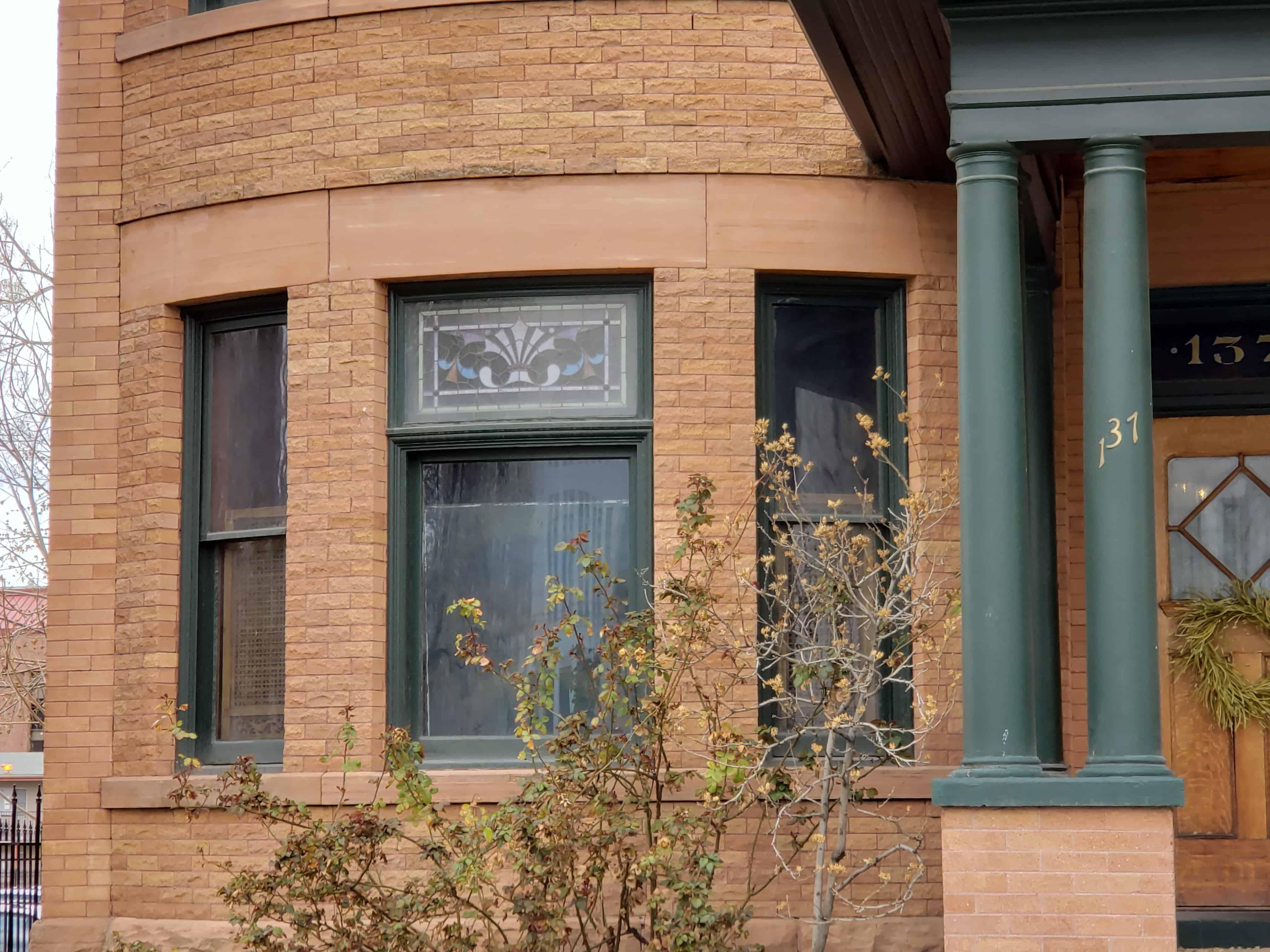
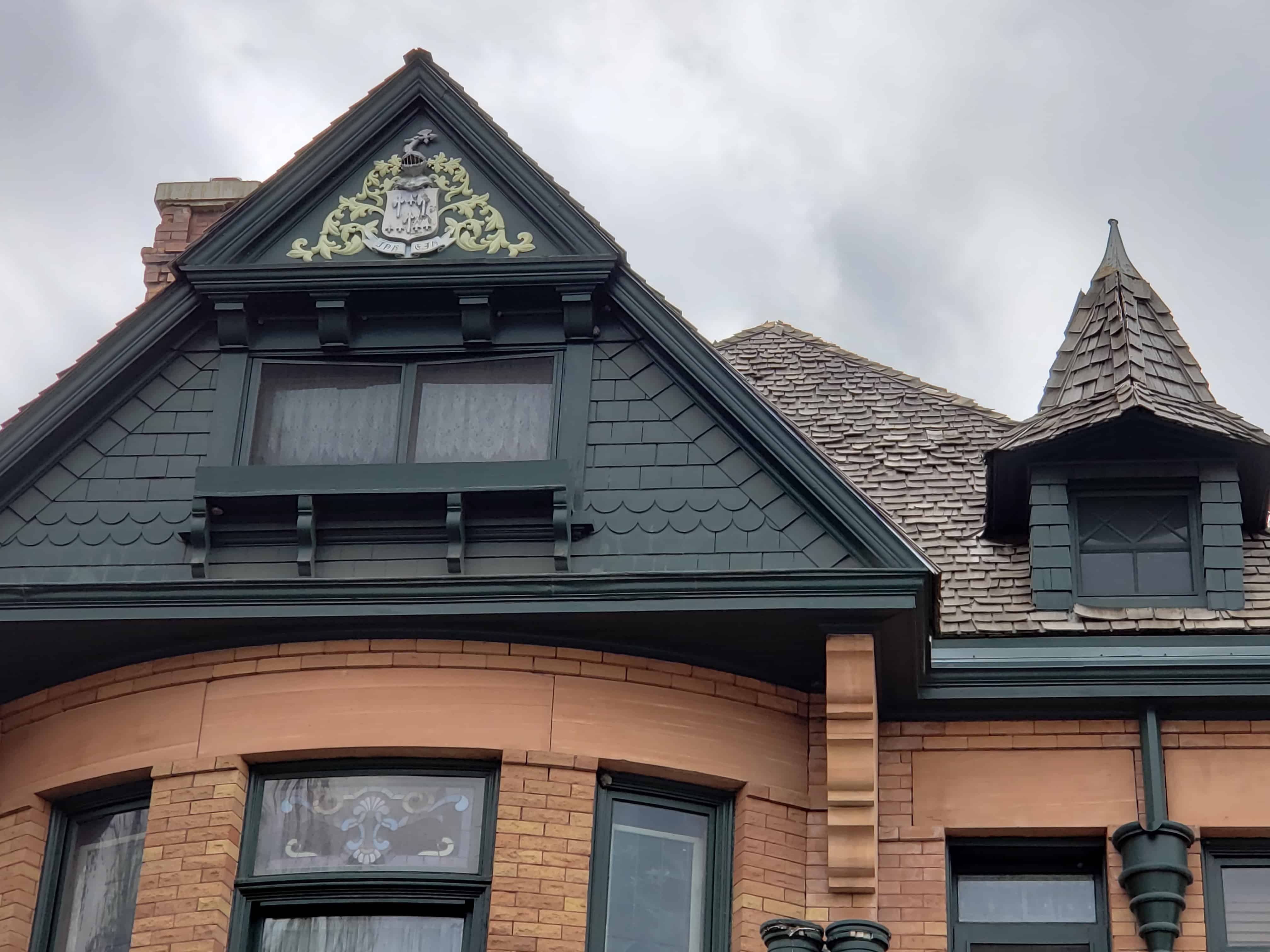
The Gibbs-Thomas-Hansen House, built in 1895 for Gideon A. and Margaret T. Gibbs, is both historically and architecturally significant. Bought by the Thomas family in 1906, the house is the only residence associated with Elbert D. Thomas, who, as a U. S. Senator from Utah from 1932 to 1950, served notable diplomatic and military positions. Architecturally the house is significant as one of approximately a dozen documented extant examples of the residential design of Richard K.A. Kletting. Kletting is best commonly remembered for buildings such as the Deseret News Building and the Saltair Pavilion.
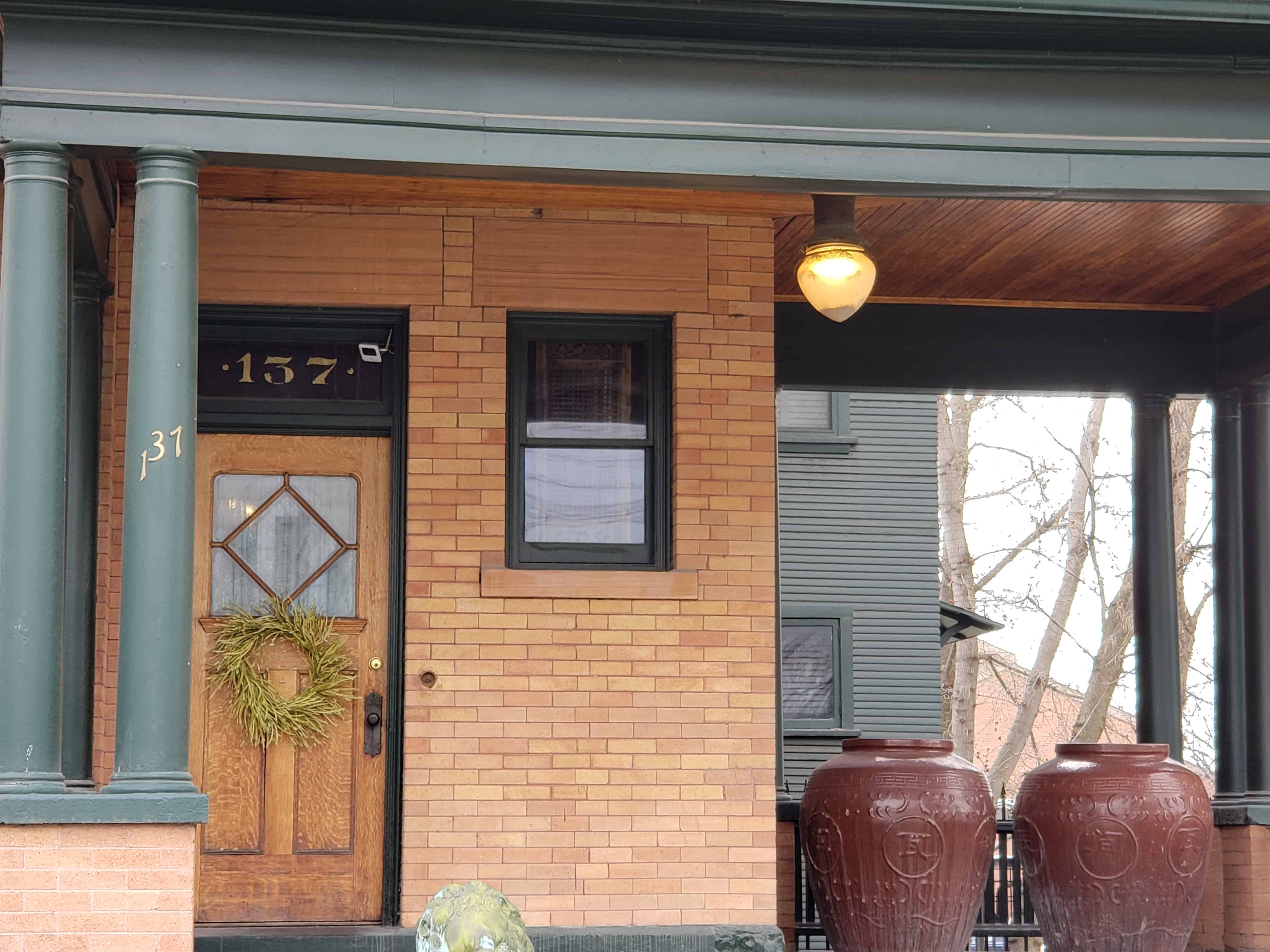
Located at 137 North West Temple in Salt Lake City, Utah
The Gibbs-Thomas House, built in 1895 for Gideon A. and Margaret T. Gibbs, is both historically and architecturally significant. Bought by the Thomas family in 1909, the house is the only residence associated with Elbert D. Thomas, who, as a U.S. Senator for Utah from 1932 to 1950, served several notable diplomatic and military positions. He served as chairman of the senate committees of education and labor, and, because he had resided in Japan and was familiar with the language and culture, he chaired the military affairs and foreign relations committees during WWI I. Following his years as senator he was appointed to be High Commissioner of the United States Trust Territories of the Pacific by President Harry Truman. Architecturally the house is significant as one of approximately a dozen documented extant examples of the residential design of Richard K. A. Kletting. Because Kletting is best known for his design of the Utah State Capitol, and more commonly remembered for commercial buildings such as the Deseret News Building, for institutions and schools, and for the Saltair Pavilion, he is not generally considered to. have made a major contribution to Salt Lake City residential design. However, Kletting actually began his private practice primarily designing houses, and in the 1890s,and early years of the twentieth century designed a number of significant monumental houses for prominent citizens in Salt,lake City. The Enos Wall Mansion, 411 East South Temple, and the Henry Dinwoodey House, 411 East 100 South, are two notable examples. The Gibbs-Thomas House is one of the more restrained examples of the large two and one half story mansions which Kletting designed.
On June 24, 1895 Gideon A. and Margaret Taylor Gibbs received a building permit for a “brick residence 9 rooms, etc.” on North West Temple in Salt Lake City. Gibbs, a pioneer Utah civil engineer and surveyor had married a daughter of John Taylor, third president of The Church of Jesus Christ of the Latter-day Saints (LDS Church). Taylor’s gift of $3,800 to the couple covered the house’s estimated cost of construction.
The Gibbses commissioned Salt Lake City architect Richard K. A. Kletting to draw up plans for their house. Kletting was Utah’s most prominent architect from the late 1880s until about 1910, having designed the State Capitol, the Deseret News Building, the first Saltair Beach pavilion, and many other buildings. Residential architecture was but one facet of Kletting’s output, and the Gibbs-Thomas House survives as one of 9 to 12 documented extant examples, of houses that he designed for prominent citizens in Salt Lake City and Provo. The Gibbses may have been familiar with Kletting’s work for other socially prominent individuals such as Albert Fisher and Henry Dinwoodey, and may have wanted an equally elegant house in the fashionable neighborhood one block north of Temple Square.
Owing to financial reverses Margaret Gibbs was forced to sell the house “by Sheriff” in 1903. Very little is known about the second owner, Mrs. Martin Solomon, other than that she owned the residence for six years.
In 1909 Mrs. Solomon sold the house to Richard Kendall Thomas, a proprietor of a ladies’ clothing store on Main Street. Some time between 1910 and 1913 two additions were made to the original structure: a front porch, attributed to Salt Lake City architect Carl Scott; and a three story tier of sleeping porches on the house’s north side.
During the second generation of Thomas family ownership, the house’s most illustrious resident appeared: Elbert D. Thomas, U. S. Senator for Utah from 1932-1950. After graduating from the University of Utah and subsequently teaching at the university, Thomas received a Ph.D. from the University of California at Berkeley. Thomas remained an active scholar throughout his life, authoring five books and numerous articles on a variety of subjects. After earning his doctorate, Thomas and his wife went on a Mormon mission to Japan for several years. In 1931, a year after Thomas returned from Japan, the house was left to him and a brother Roger by his widowed mother, Caroline Stockdale Thomas. Elbert subsequently assumed sole ownership of the house, which served as his only residence in Salt Lake City and the state.
Elbert Thomas was elected as a U.S. Senator from Utah in 1932, defeating Republican incumbent Reed Smoot. During Thomas 1 18 years in Washington he served as chairman of several important Senate committees, including those of education and labor. During World War II he chaired the military affairs and foreign relations committees, contributing valuable and timely expertise on Japan.
Thomas was defeated for re-election in 1950, and immediately thereafter President Truman appointed him to be High Commissioner of the United States Trust Territories of the Pacific. Three years later he died in Honolulu at the age of 69. In honor of a life of distinguished public service, U.S. Navy warships in Pearl Harbor flew their flags at half-mast for three days.
Thomas retained ownership of the house while tending to his responsibilities as senator in Washington, D. C. Some alterations of the interior were made in 1932 to convert the house into several apartments that were to be occupied by Thomas relatives. Although Thomas sold this house to his daughter, Edna Thomas Hansen, eight years before his death, he apparently continued to live here whenever his governmental duties allowed him to be in Salt Lake City. The house was reconverted into a single family dwelling in 1947 by his daughter soon after she assumed ownership. In addition, a small barn in the rear of the property was razed soon after WWII. The Gibbs-Thomas House has maintained its original integrity despite the changes that were made. It is unfortunate, however, that the West Temple street scape, which previously contained numerous large mansions from the 1880s and ’90s, having been a fashionable residential location near the Salt Lake Temple of The Church of Jesus Christ of Latter-day Saints. Only the Gibbs-Thomas House remains in this neighborhood to give some indication of the former elegance of the West.
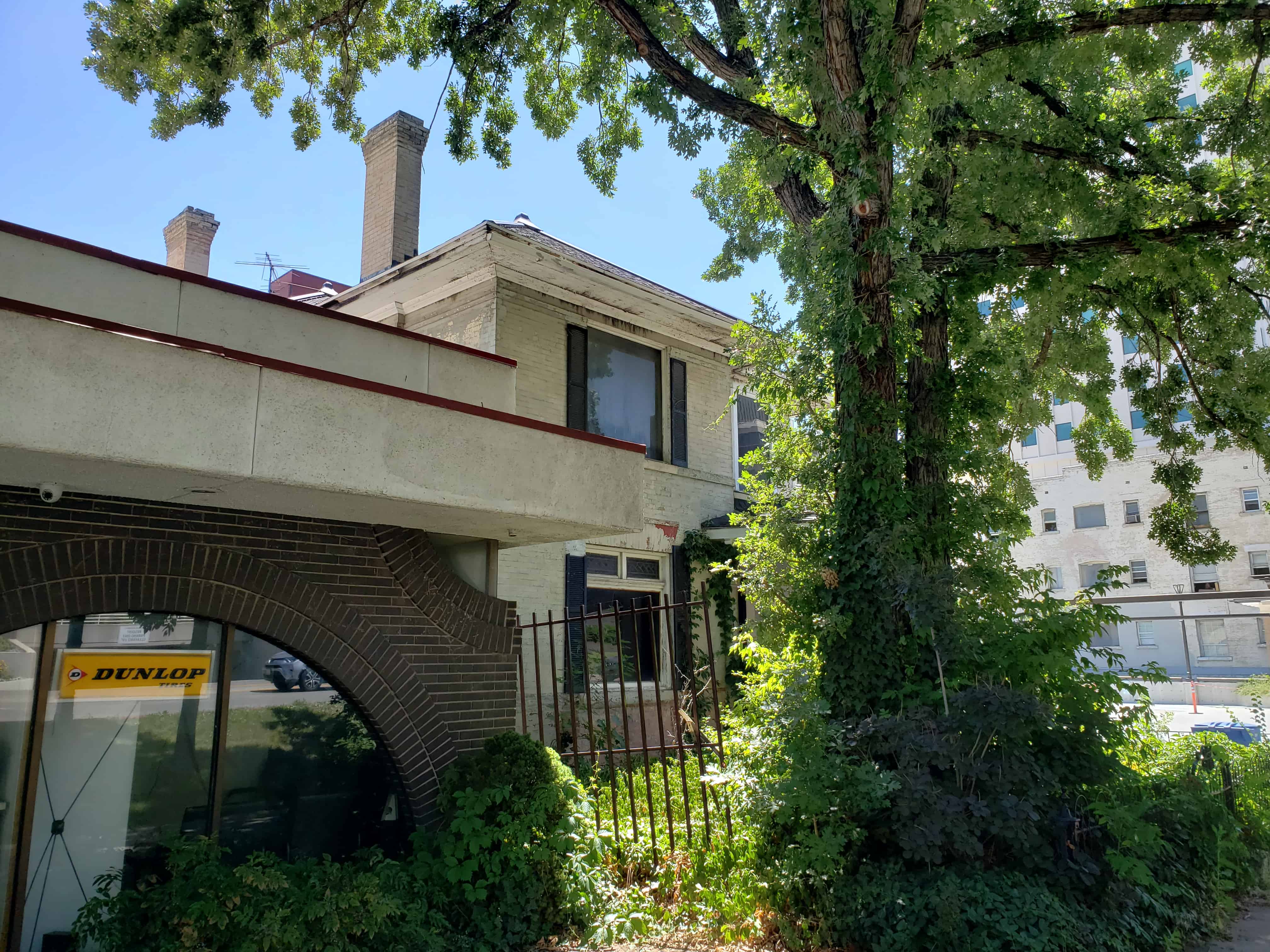
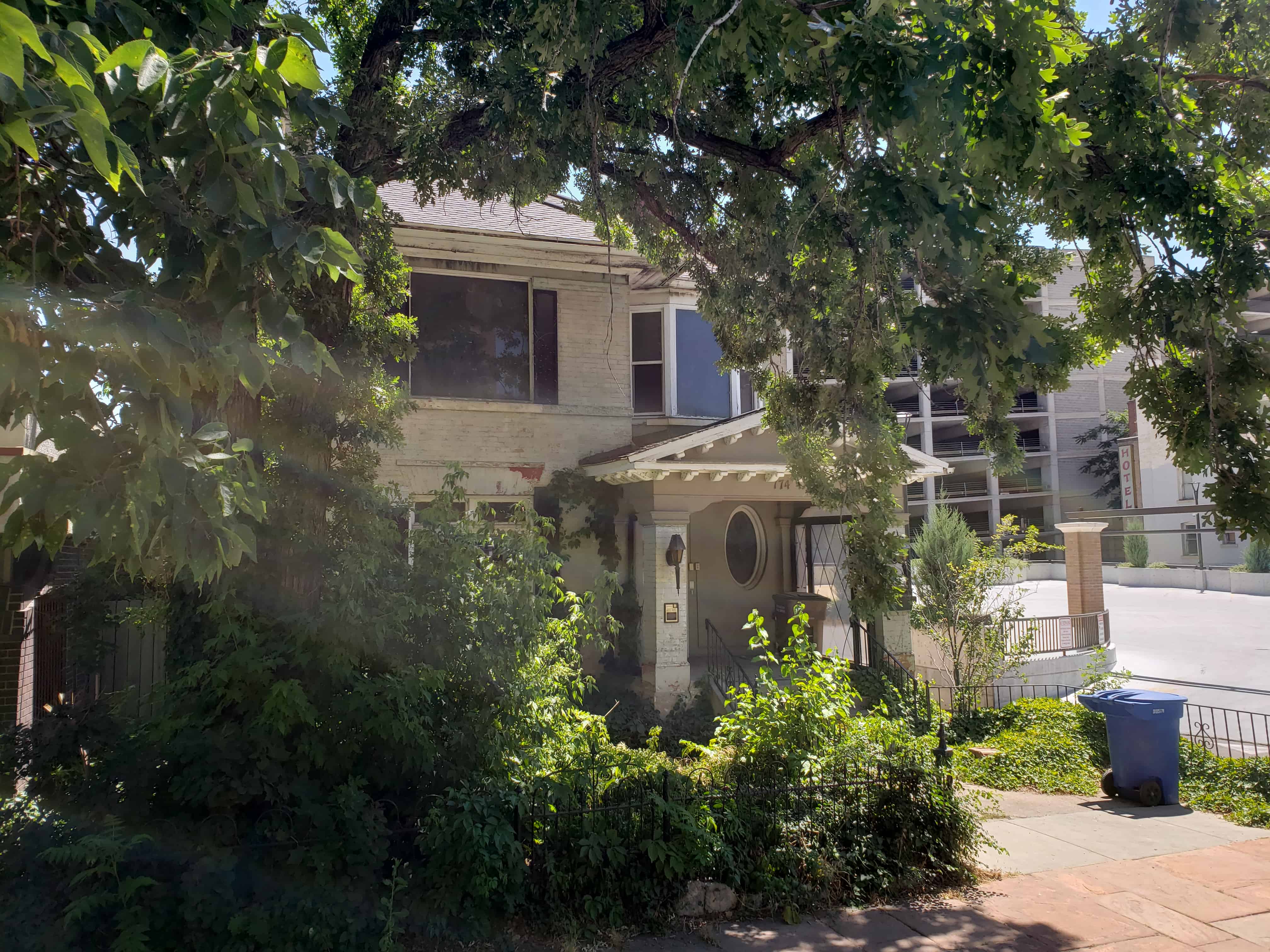
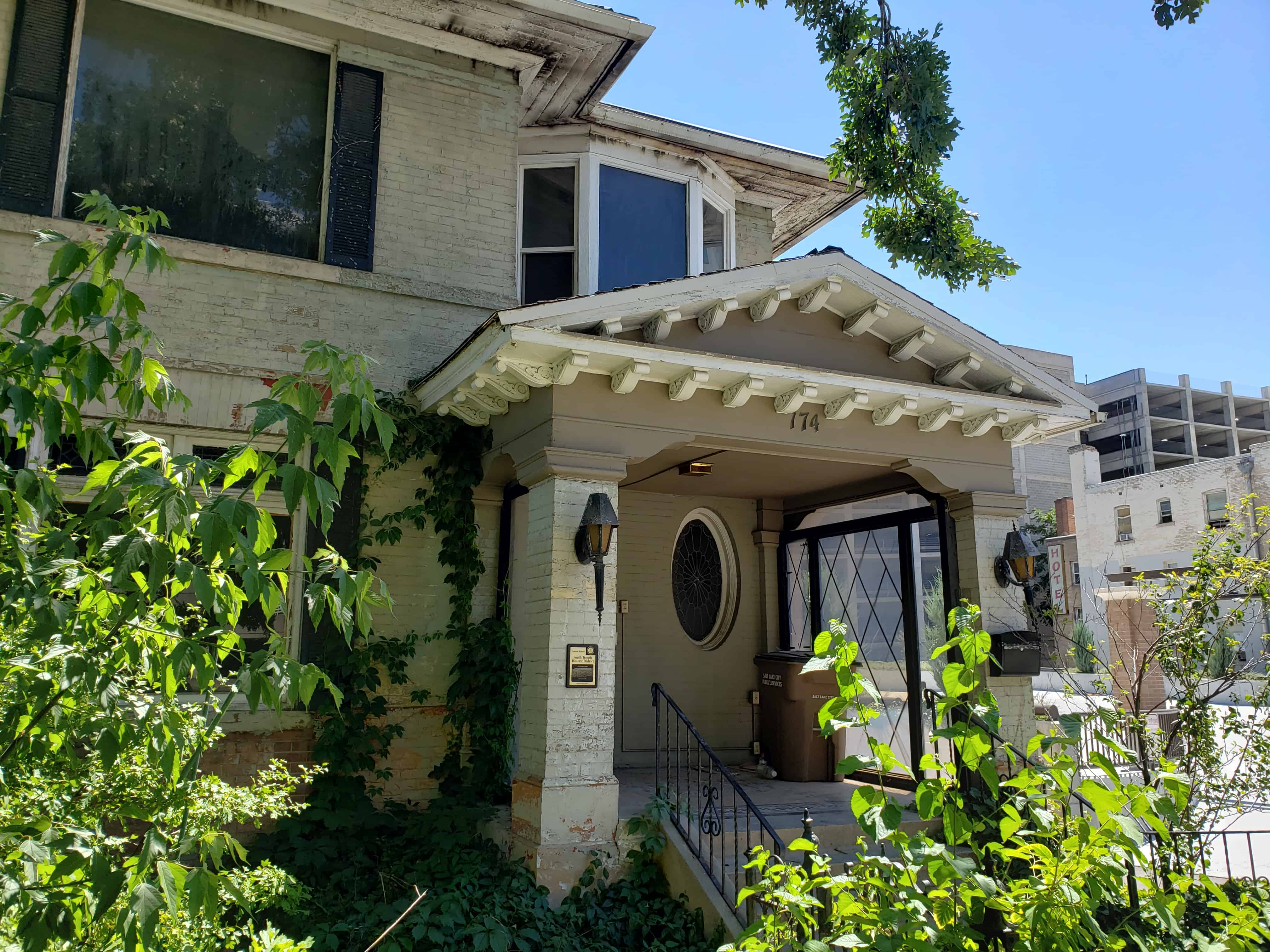
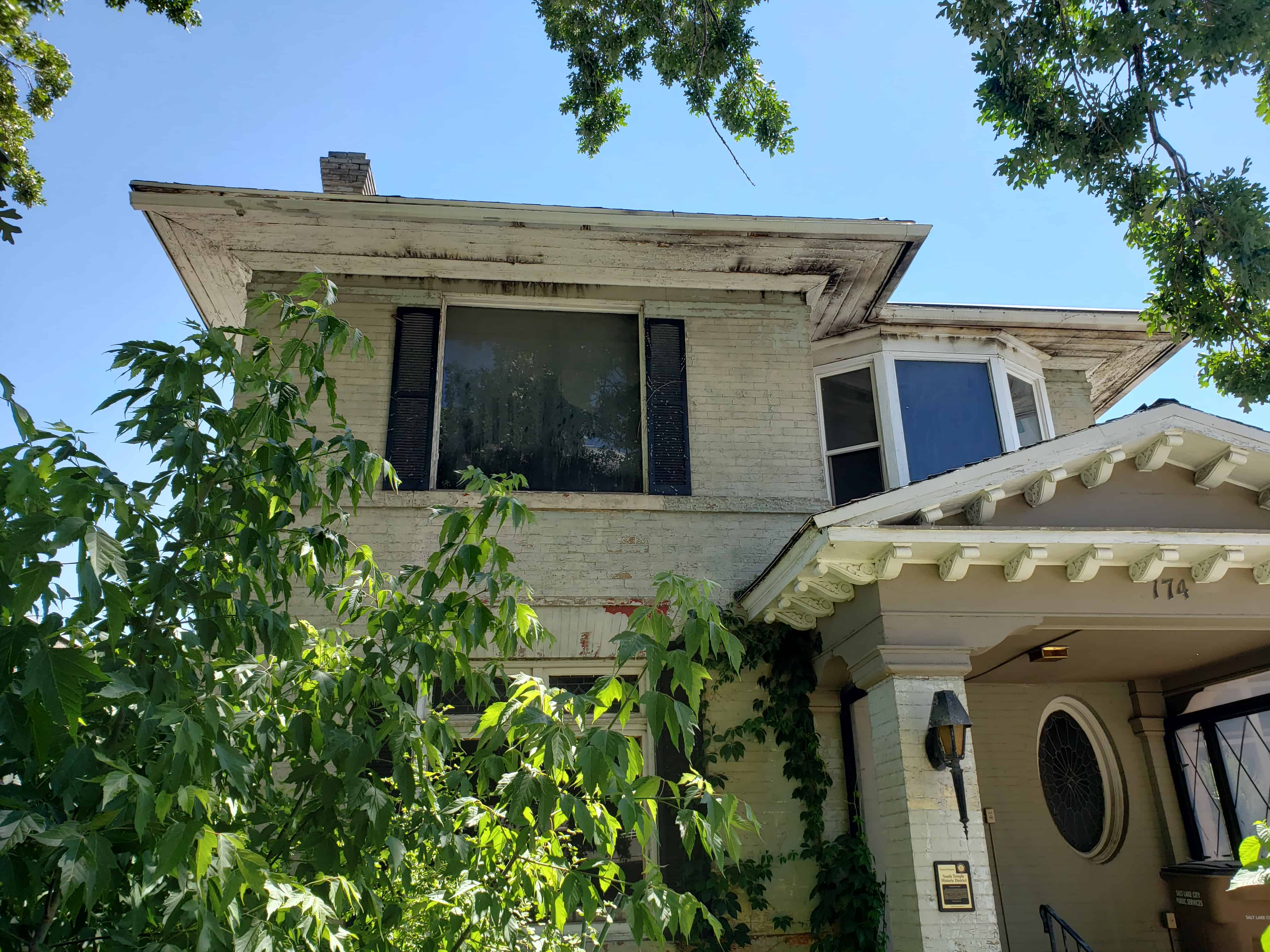
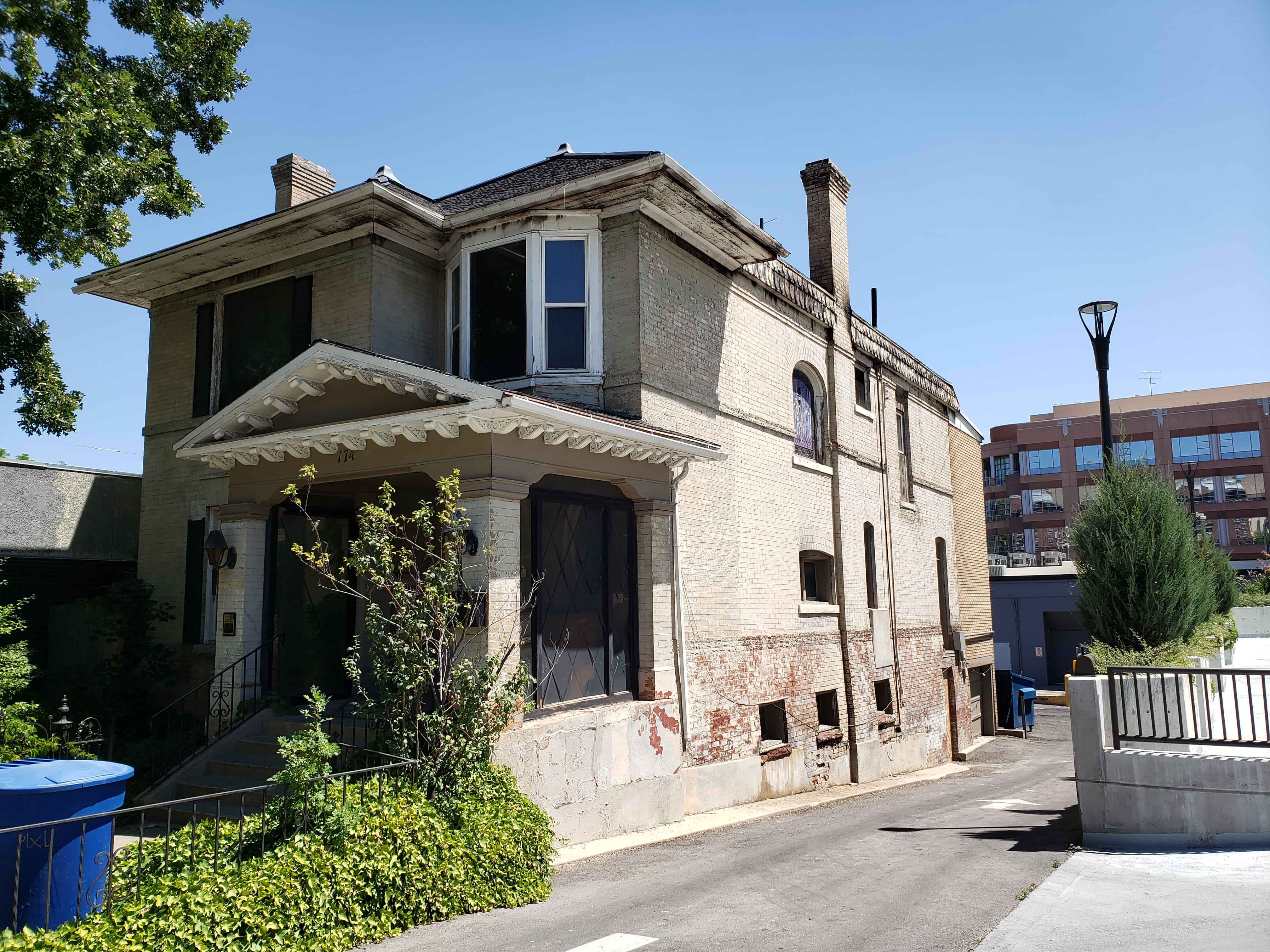
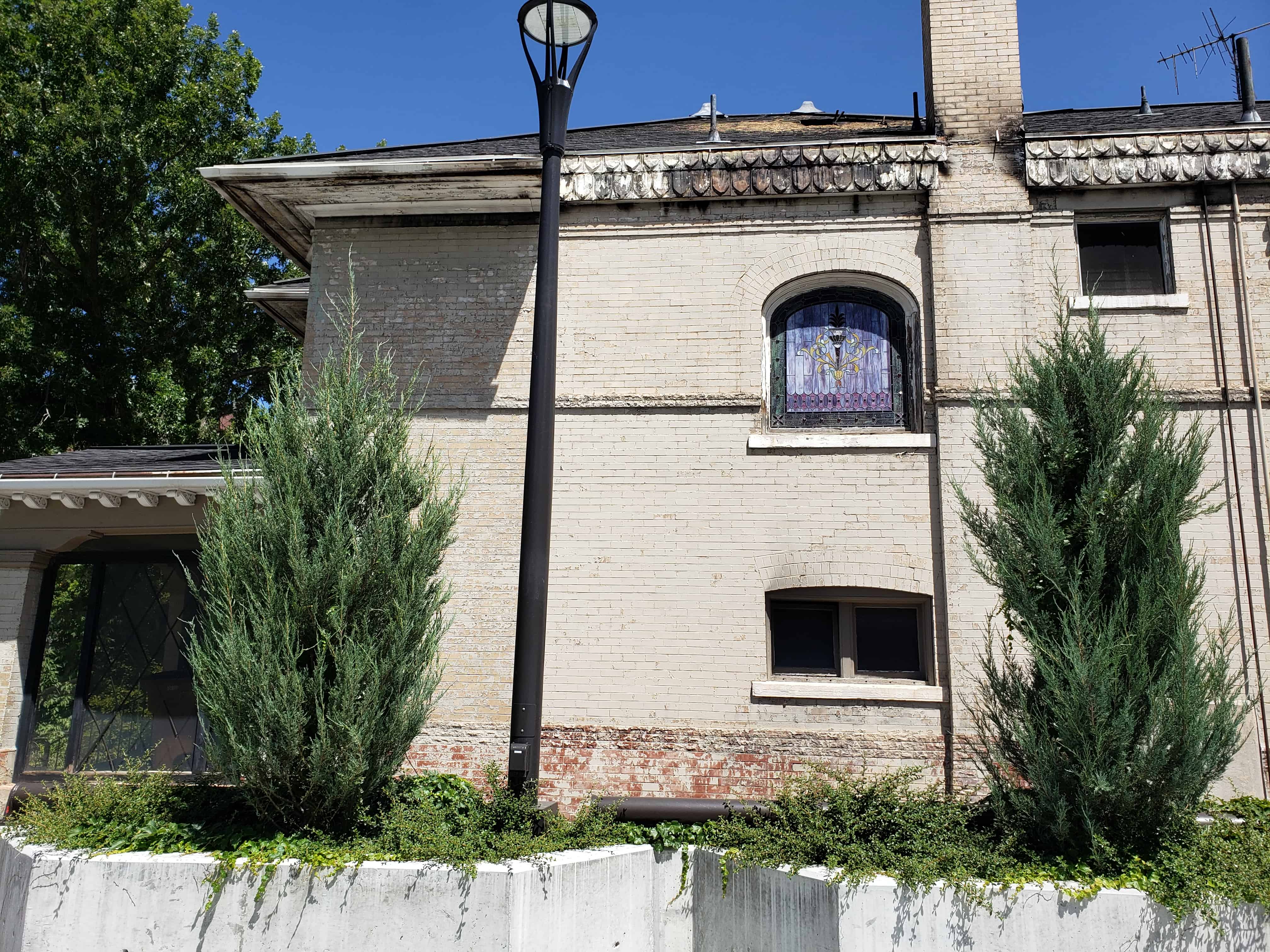
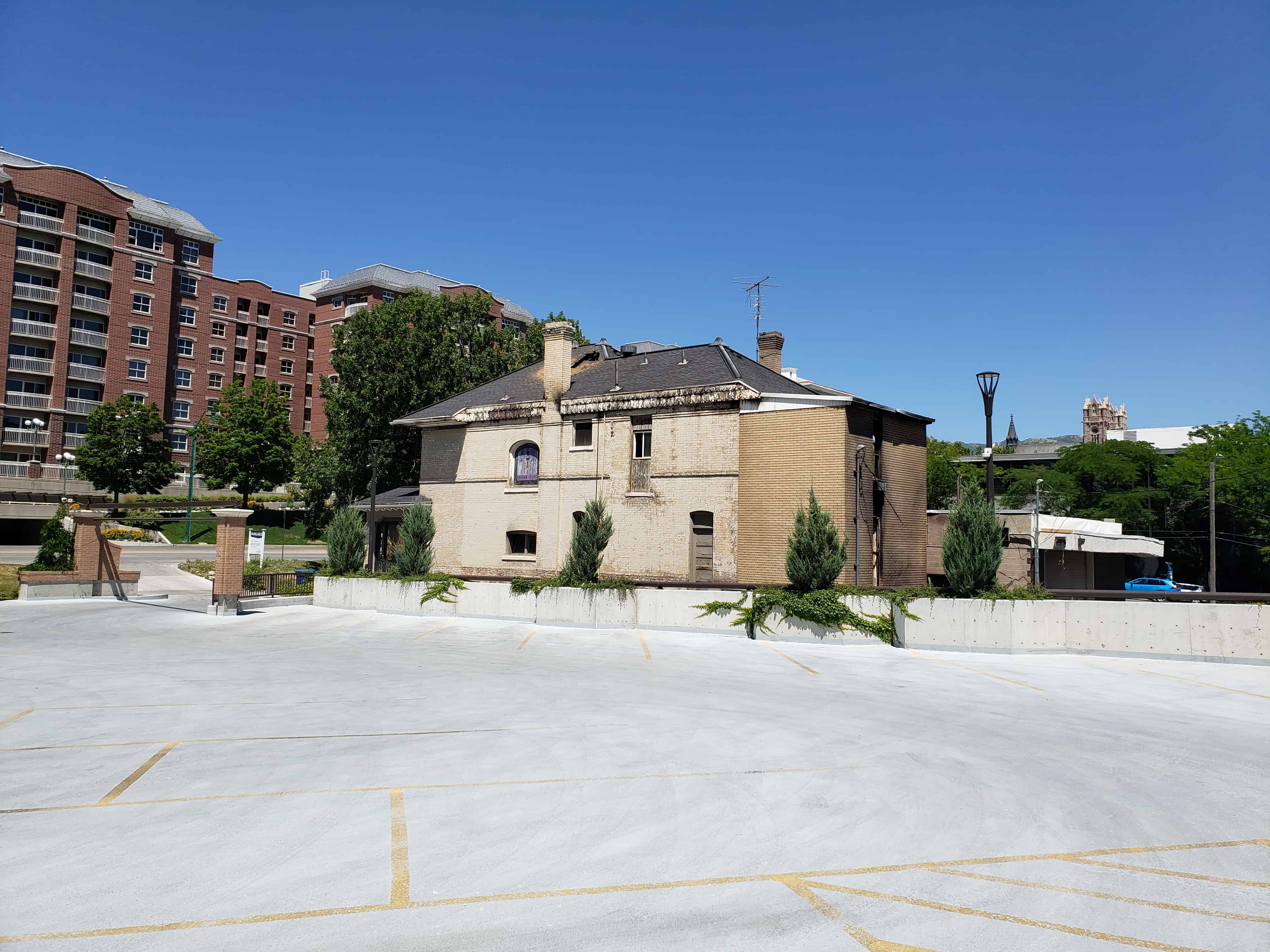
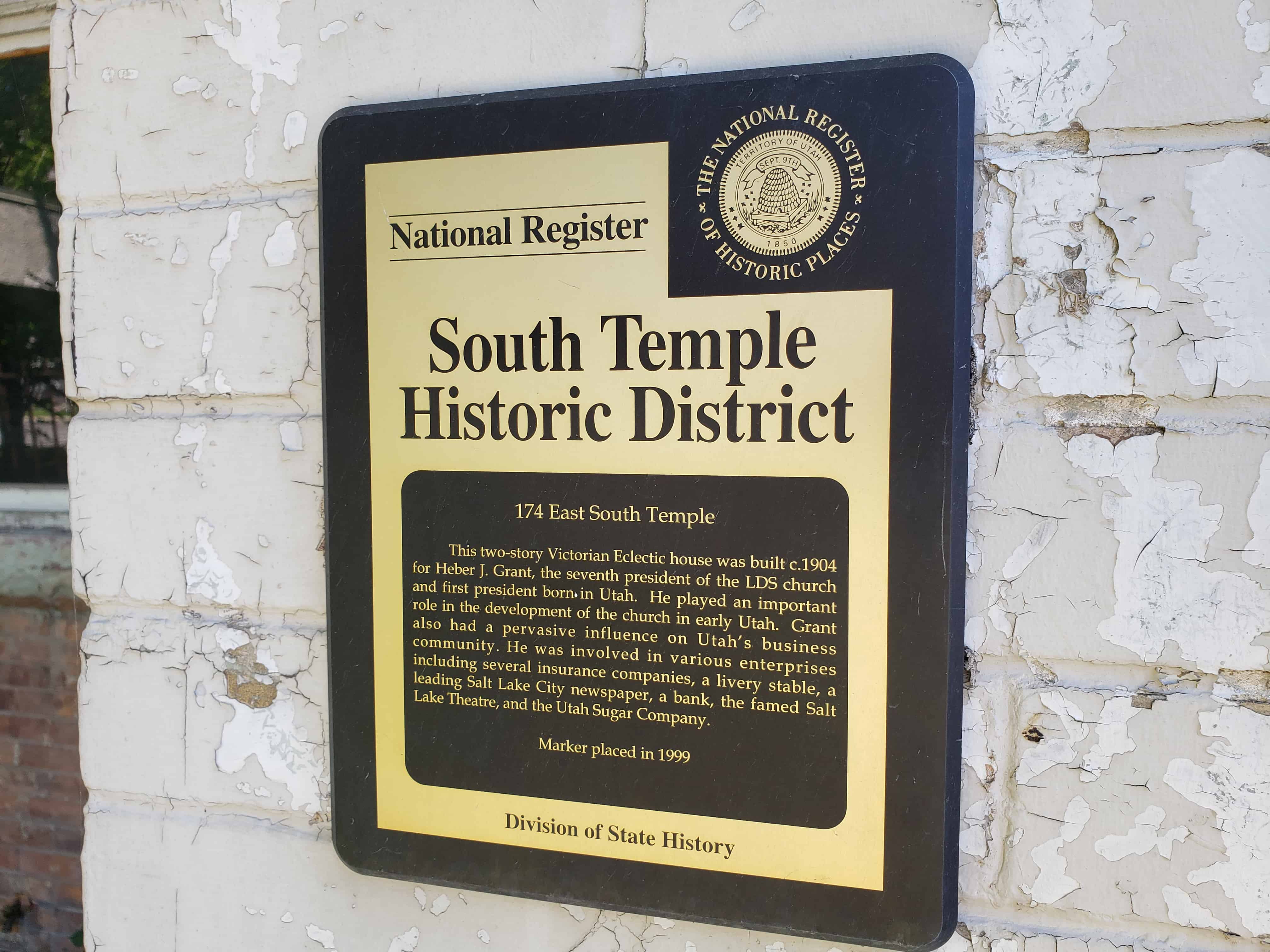
This two-story Victorian Eclectic house was built c. 1904 for Heber J. and Augusta Grant, the seventh president of the LDS church and first president born in Utah. He played an important role in the development of the church in early Utah. Grant also had a pervasive influence o Utah’s business community. He was involved in various enterprises including several insurance companies, a livery stable, a leading Salt Lake City newspaper, a bank, the famed Salt Lake Theatre, and the Utah Sugar Company.
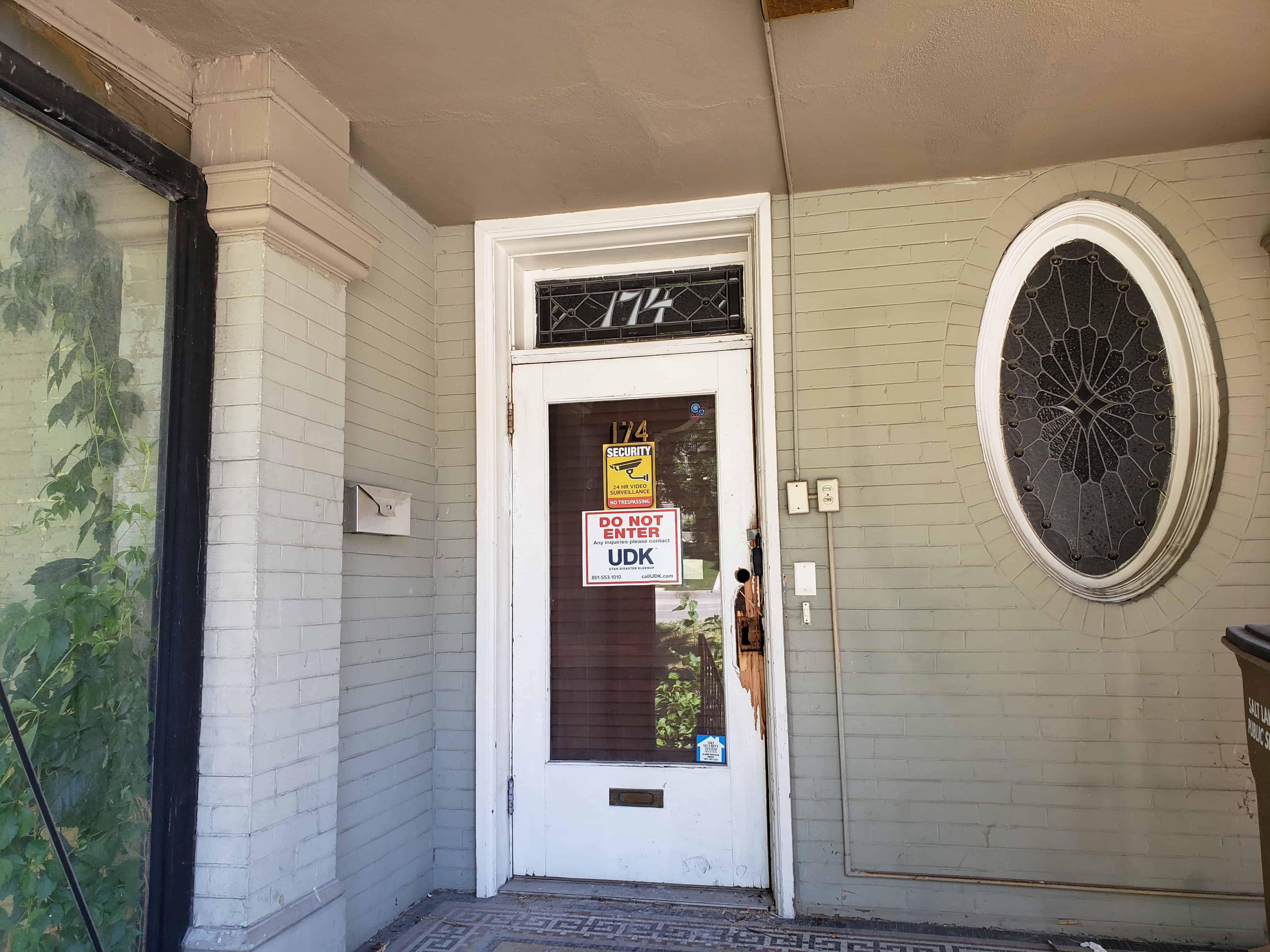
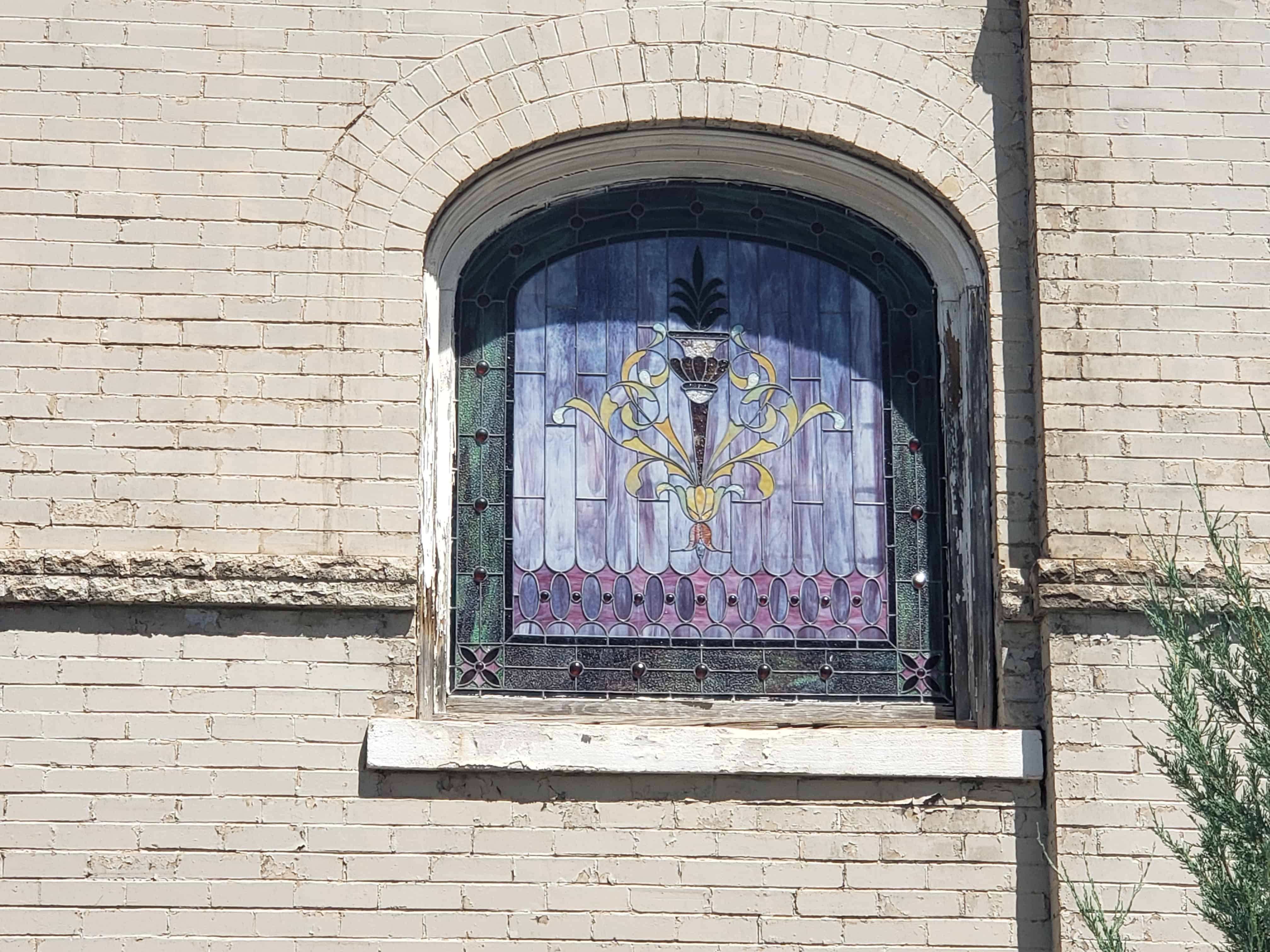
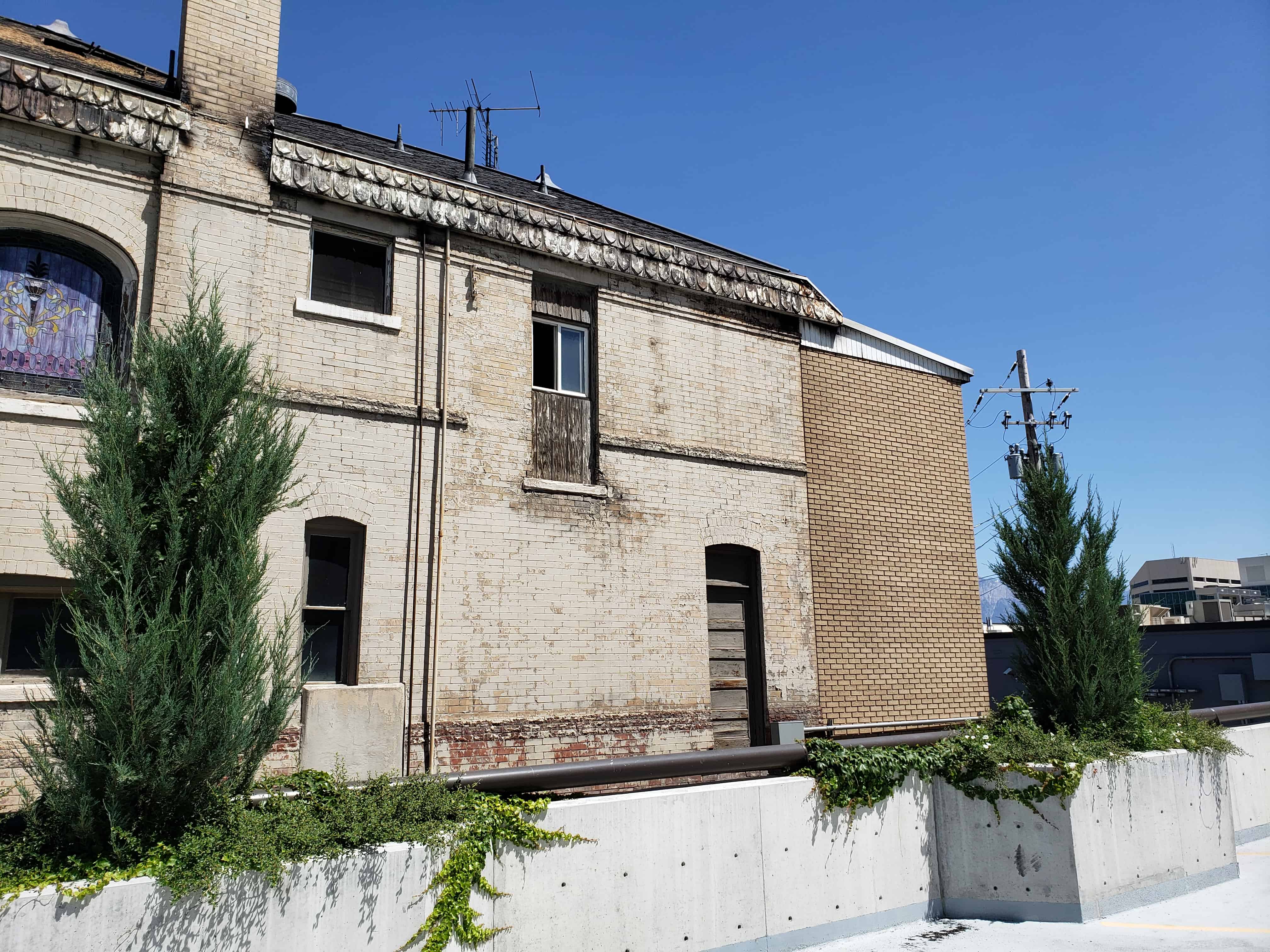
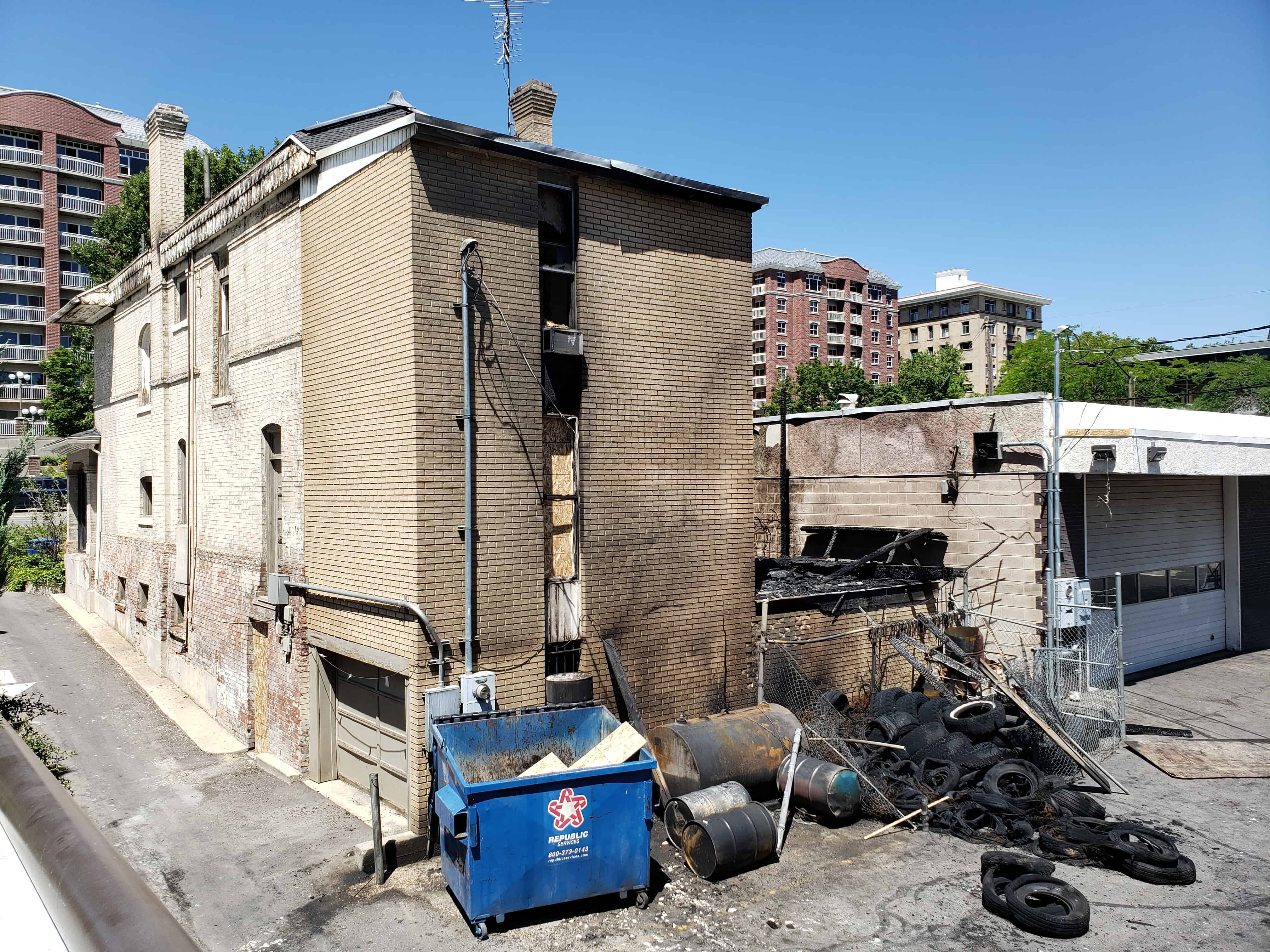
Augusta Grant oversaw construction of the home, Heber J. moved into the home in 1905 after returning from a church mission. It is a rare and classic downtown single family residential home with commercial buildings all around. The grants lived here until 1916, since it has been many things, a law office for one and was vacant for years before a fire in 2020.
Augusta Grant oversaw the construction of this Victorian home in 1904. Her husband, Heber J. Grant, took up residence here in 1905 after returning from serving a mission for the LDS Church. Now surrounded by commercial buildings, the Grant House is a reminder that single-family residences were once the norm on this section of South Temple.
Heber J. Grant was an influential businessman and, in 1918, became the seventh president of the LDS Church. Grant used the financial and political contacts he had developed during his career to maintain the solvency of key Utah industries during the Great Depression.
The Grants lived in this house until 1916. Several alterations have been made to it over the years, including the addition of the pedimented front porch with decorative brackets. Today the building houses law offices.