• About JacobBarlow.com
  • Cemeteries in Utah
  • D.U.P. Markers
  • Doors
  • Exploring Utah Email List
  • Geocaching
  • Historic Marker Map
  • Links
  • Movie/TV Show Filming Locations
  • Oldest in Utah
  • Other Travels
  • Photos Then and Now
  • S.U.P. Markers
  • U.P.T.L.A. Markers
  • Utah Cities and Places.
  • Utah Homes for Sale
  • Utah Treasure Hunt

JacobBarlow.com

~ Exploring with Jacob Barlow

JacobBarlow.com

Tag Archives: History

Provo’s Two Oldest Existing Homes Are Neighbors in Pioneer Village

26 Tuesday Sep 2017

Posted by Jacob Barlow in Uncategorized

≈ 2 Comments

Tags

historic, Historic Homes, Historic Markers, History, Parks, Provo, utah, utah county

2017-09-12 18.48.38

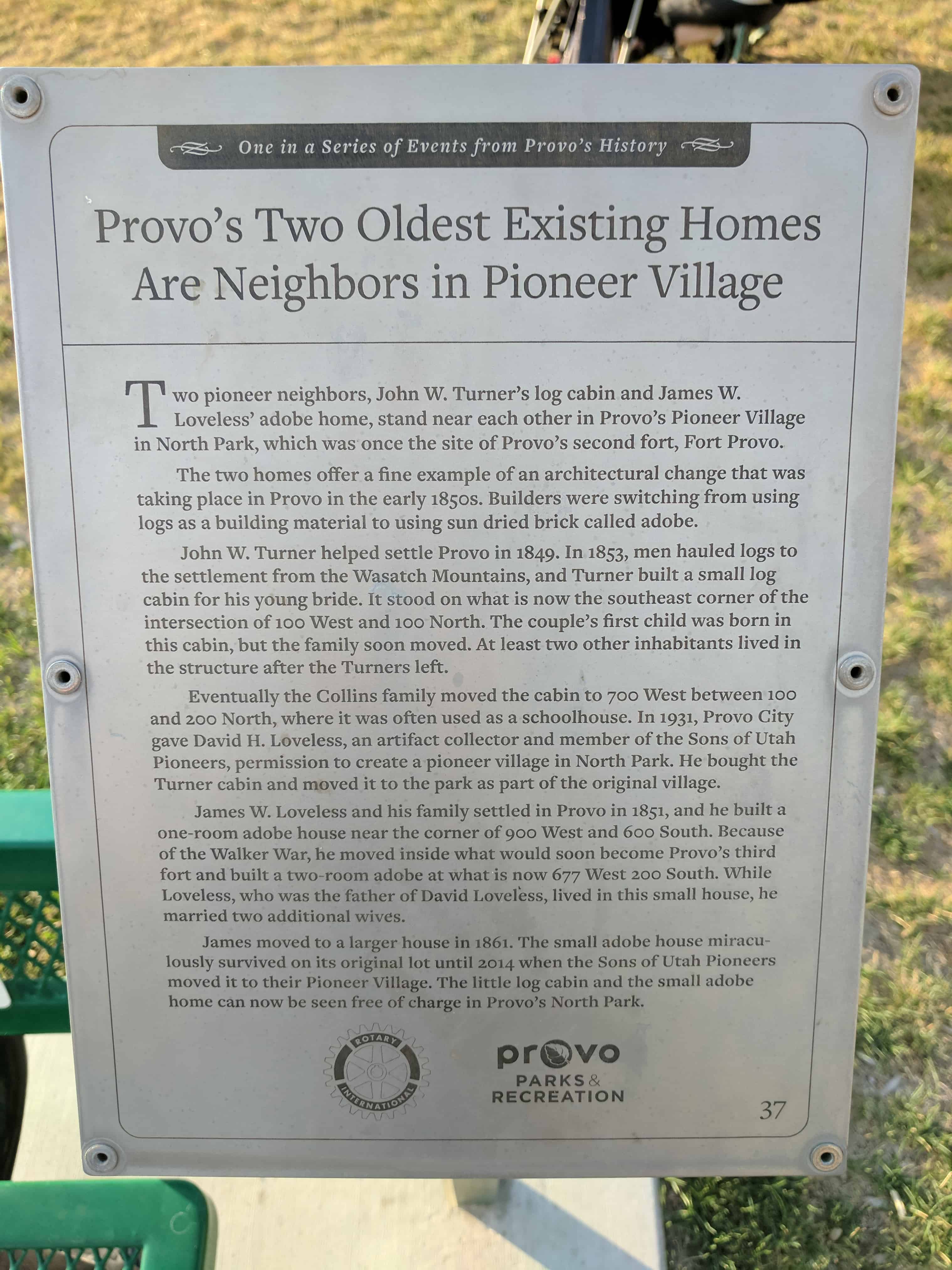
Provo’s Two Oldest Existing Homes Are Neighbors in Pioneer Village.

Two pioneer neighbors, John W. Turner’s log cabin and James W. Loveless’ adobe home, stand near each other in Provo’s Pioneer Village in North Park, which was once the site of Provo’s second fort, Fort Provo.

The two homes offer a fine example of an architectural change that was taking place in Provo in the early 1850s. Builders were switching from using logs as a building materiel to using sun dried brick called adobe.

John W. turner helped settle Provo in 1849. In 1853, men hauled logs to the settlement from the Wasatch Mountain, and Turner built a small log cabin for his young bride. It stood on what is now the southeast corner of the intersection of 100 West and 100 North. The couple’s first child was born in this cabin, but the family soon moved. At least two other inhabitants lived in the structure after the Turners left.

Eventually the Collins family moved the cabin to 700 West between 100 and 200 North, where it was often used as a schoolhouse. In 1931, Provo City gave David H. Loveless, an artifact collector and member of the Sons of Utah Pioneers, permission to create a pioneer village in North Park. He bought the Turner cabin and moved it to the park as a part of the original village.

James W. Loveless and his family settled in Provo in 1851, and he built a one-room adobe house near the corner of 900 West and 600 South. Because of the Walker War, he moved inside what would soon become Provo’s third fort and built a two-room adobe at what is now 677 West 200 South. While Loveless, who was the father of David Loveless, lived in this small house, he married two additional wives.

James moved to a larger house in 1861. The small adobe house miraculously survived on its original lot until 2014 when the Sons of Utah Pioneers moved it to their Pioneer Village. The little log cabin and the small adobe home can now be seen free of charge in Provo’s North Park.

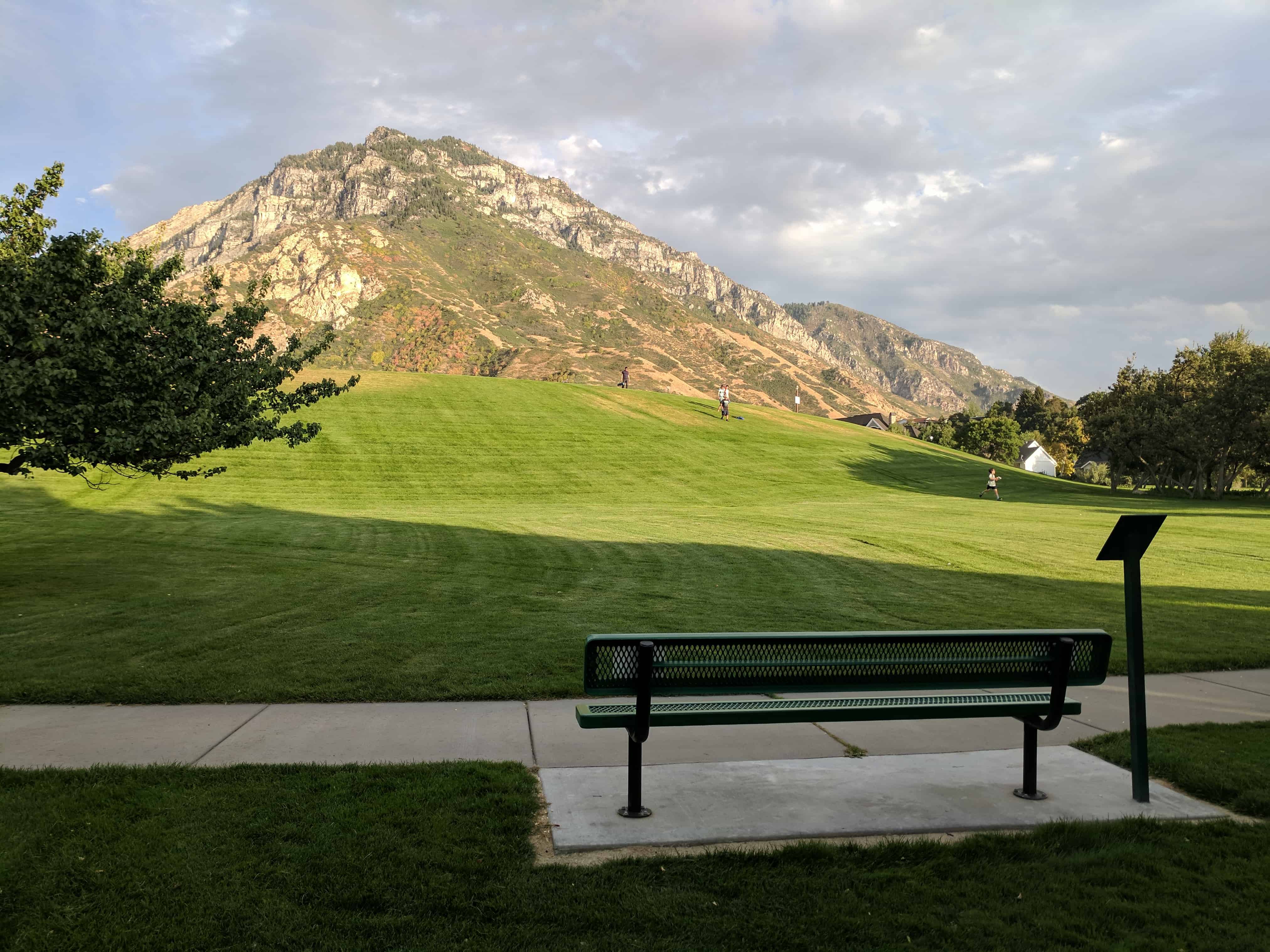
This marker is located in Rock Canyon Park in Provo, for other markers in this series click here.
2017-09-12 18.48.49

Creating the “Y” on the Mountain.

24 Sunday Sep 2017

Posted by Jacob Barlow in Uncategorized

≈ 4 Comments

Tags

BYU, historic, Historic Markers, History, Parks, Provo, utah, utah county

2017-09-12 18.41.40

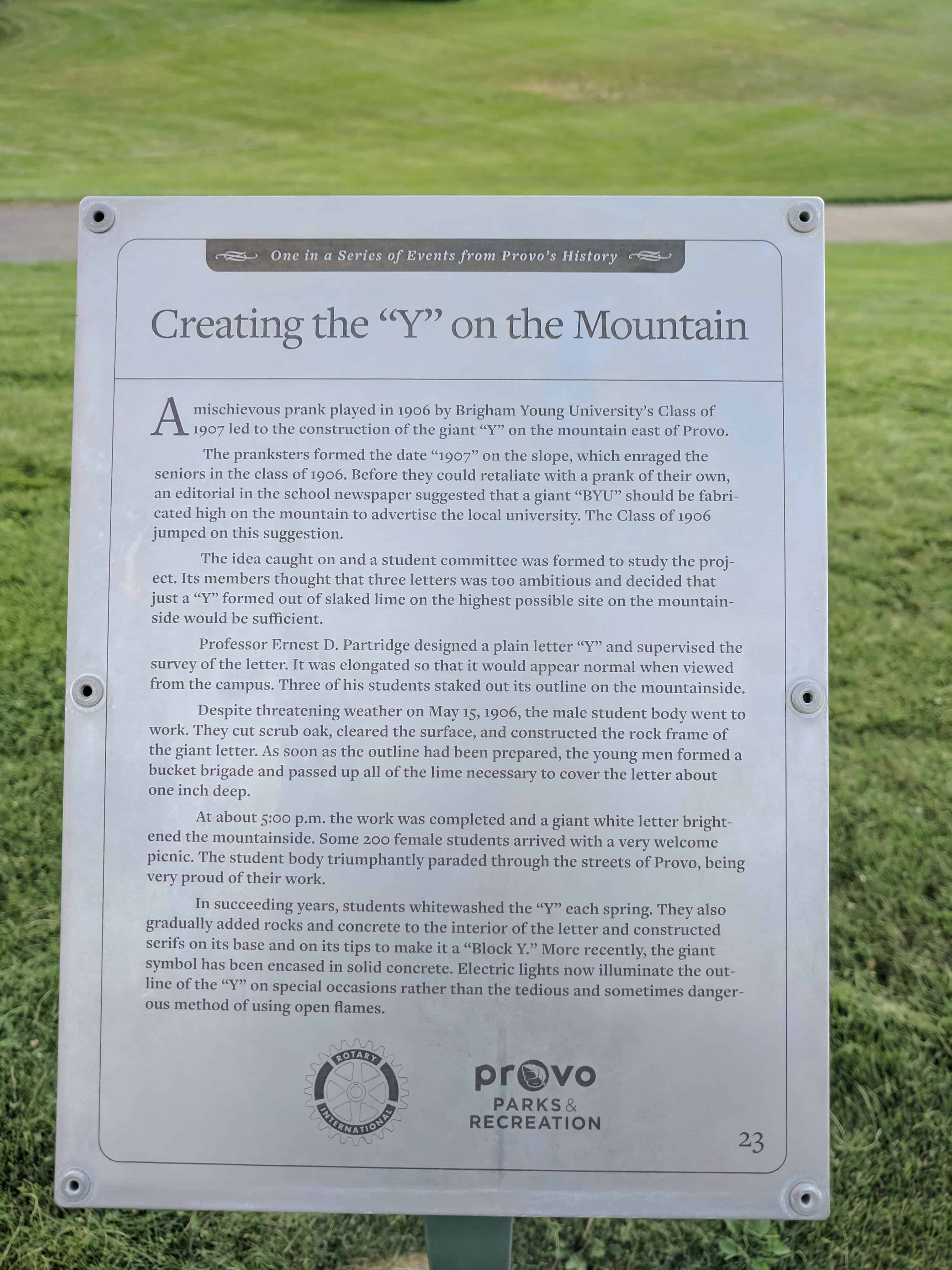
Creating the “Y” on the Mountain.

A mischievous prank played in 1906 by Brigham Young University‘s Class of 1907 led to the construction of the giant “Y” on the mountain easy of Provo.

The pranksters formed the date “1907” on the slope, which enraged the seniors in the class of 1906. Before they could retaliate with a prank of their own, an editorial in the school newspaper suggested that a giant “BYU” should be fabricated high on the mountain to advertise the local university. The class of 1906 jumped on this suggestion.

The idea caught on and a student committee was formed to study the project. Its members thought that three letters was too ambitious and decided that just a “Y” formed out of slaked lime on the highest possible site on the mountainside would be sufficient.

Professor Ernest D. Partridge designed a plain letter “Y” and supervised the survey of the letter. It was elongated so that it would appear normal when viewed from the campus. Three of his students staked out its outline on the mountainside.

Despite threatening weather on May 15, 1906, the make student body went to work. They cut scrub oak, cleared the surface, and constructed the rock frame of the giant letter. As soon as the outline had been prepared, the young men formed a bucket brigade and passed up all of the lime necessary to cover the letter about one inch deep.

At about 5:00 p.m. the work was completed and a giant white letter brightened the mountainside. Some 200 female students arrived with a very welcome picnic. The student body triumphantly paraded through the street of Provo, being very proud of their work.

In succeeding years, students whitewashed the “Y” each spring. They also gradually added rocks and concrete to the interior of the letter and constructed serifs on it’s base and on its tops to make it a “Block Y.” More recently, the giant symbol has been encased in solid concrete. Electric lights now illuminate the outside of the “Y” on special occasions rather than the tedious and sometimes dangerous method of using open flames.

This marker is located in Rock Canyon Park in Provo, for other markers in this series click here. And see this page for more info on the “Y.”
2017-09-12 18.41.48

Provo’s North Park had a Community Ice Skating Rink in the 1930s.

21 Thursday Sep 2017

Posted by Jacob Barlow in Uncategorized

≈ 6 Comments

Tags

historic, Historic Markers, History, Ice Skating, Parks, Provo, utah, utah county, Utah Lake

2017-09-12 18.38.20

Provo’s North Park had a Community Ice Skating Rink in the 1930s.

During the 1940s, ice skating flourished on what was then called the Provo Boat Harbor (Utah Lake State Park). Before there was a harbor, however, there were very few safe places to skate on the lake.
In an effort to keep skaters out of harm’s way, Provo City and the federal government’s Works Progress Administration cooperated to open an ice skating rink in the old baseball park that once stood on the land now occupied by the Provo City Recreation Center.

In November, 1938, the Junior Chamber of Commerce, Boy Scouts of America, and BYU’s Associated Men Students sponsored activities to help raise money for the construction of the temporary rink. The Jaycees sponsored a work day where leveling and banking were completed, and men flooded the rink, which measures approximately 400 by 600 feet.

Men sprinkled water on the rink every night for the remainder of the cold season. Laborers hung roughly 2,000 square yards of canvas over the ice to help protect it from the sun. Warm weather delayed the opening of the rink, but authorities finally sanctioned a limited opening of the outside facility to “children only” on December 14, 1938, and 300 kids attended. Ballpark lights illuminated the rink at night.

Children monopolized the rink until a grand opening on January 3, 1939. Provo City gathered Christmas trees and placed them around the ice to make the rink look “realistic.” So many patrons attended that evening schedules were divided into an early session for those age 12 and under, and a later session for those over 12. A public address system provided music for the skaters.

Children under 15 years old were admitted free. All others paid 10 cents. Skaters could check their shoes for an additional 5 cents. These fees helped pay for lighting and sprinkling expenses. The rink closed on February 23, 1939. It opened again for the next two winters and then was discontinued when safe skating became available on the partially completed Provo Boat Harbor. During its short history, over 23,000 skaters used the rink in North Park.

This marker is located in Rock Canyon Park, for other markers in this series click here.

2017-09-12 18.38.30

Provo Had a “Pest House” for Those with Communicable Diseases.

20 Wednesday Sep 2017

Posted by Jacob Barlow in Uncategorized

≈ 2 Comments

Tags

historic, Historic Markers, History, Provo, utah, utah county

2017-09-12 18.37.11

Provo Had a “Pest House” for Those with Communicable Diseases.

Contagious diseases like measles, diphtheria, and small pox reigned among the most dreaded scourges of frontier life.  No vaccination for measles and diphtheria existed, and the isolation of the patient was one of the only ways to prevent the spread of these diseases. Even though many Provo residents had been inoculated for small pox, travelers sometimes carried the illness into town. They were promptly isolated until they recovered or died.

Provo did not have a specific place set aside for isolating infected patients until the spring of 1873 when a wayfarer, Captain R.C. Thomas, entered the city with little more than the clothes on his back and a case of small pox.

The Provo City Council rapidly authorized the purchase of 50 or 60 acres of land near the mountains and constructed a “pest house,” so called because it was used to confine people suffering from a pestilence, or a communicable disease. Thomas recovered in a little more than two weeks.

In 1877, a transient from California who was also suffering from small pox entered Provo. Workmen added another room onto the pest house for the use of attending nurses, and the new patient moved in. He survived, but a local teenage boy contracted the disease and died.

Increased fear of contagious diseases motivated the city council to pass an ordinance in 1878 that provided for quarantine and sanitary regulations. This ordinance required the appointment of a quarantine physician. The isolation at home of those who were ill with a serious disease and the marking of their residence with a yellow flag were now required by law. The ordinance also levied fines for those knowingly transporting sick people into Provo or for violating any part of the ordinance.

With infected people now confined to their own homes, the use of the “pest house” dwindled and it gradually became dilapidated. Workmen finally razed it in the 20th Century.

This marker is located in Rock Canyon Park, for other markers in this series click here.

2017-09-12 18.37.21

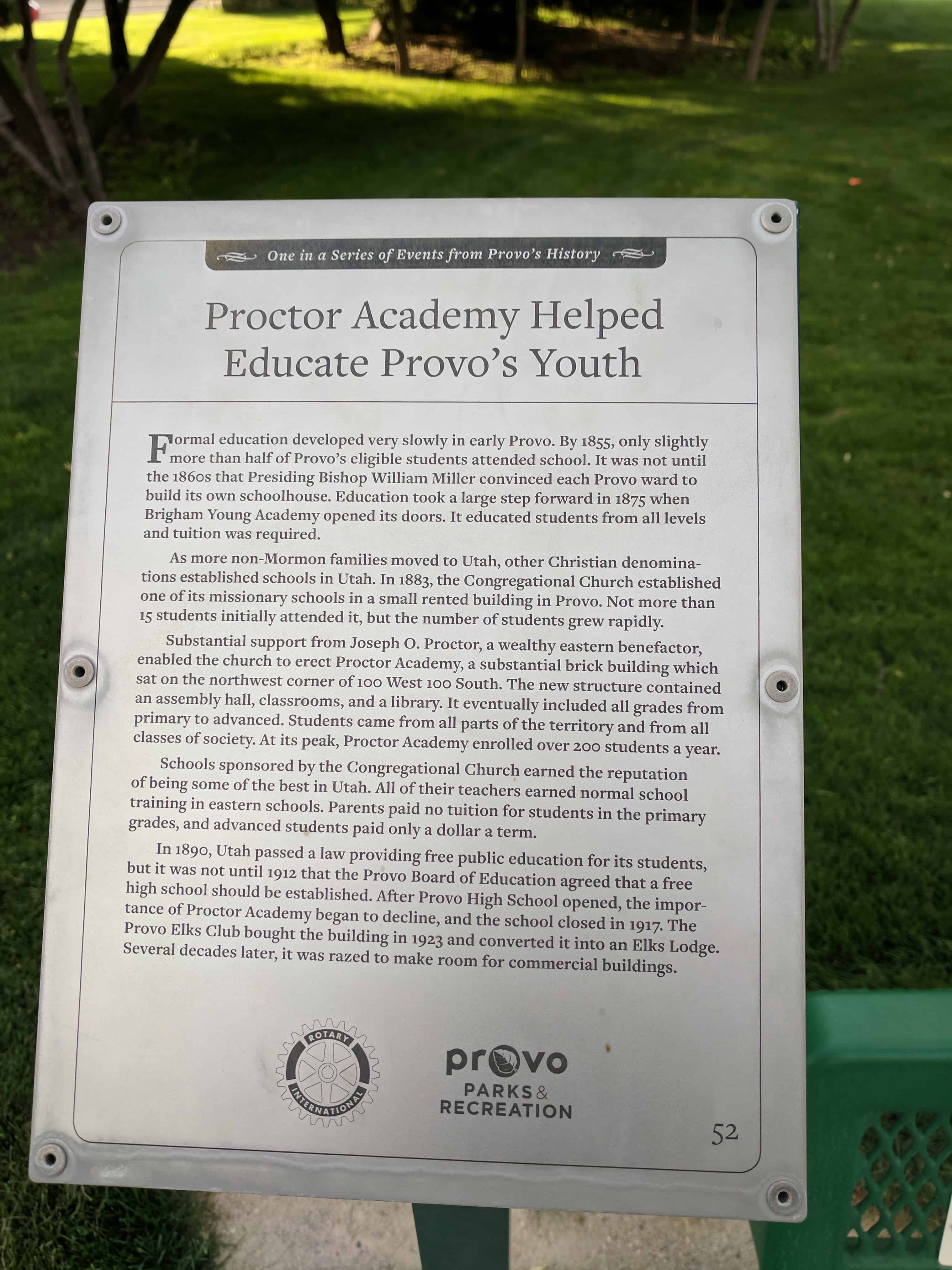
Proctor Academy Helped Educate Provo’s Youth.

19 Tuesday Sep 2017

Posted by Jacob Barlow in Uncategorized

≈ 2 Comments

Tags

historic, Historic Markers, History, Provo, utah, utah county

2017-09-12 18.36.18

Proctor Academy Helped Educate Provo’s Youth.

Formal education developed very slowly in early Provo.  By 1855, only slightly more than half of Provo’s eligible students attended school.  It was not until the 1860s that Presiding Bishop William Miller convinced each Provo ward to build its own schoolhouse.  Education took a large step forward in 1875 wen Brigham Young Academy opened its doors.  It educated students from all levels and tuition was required.

As more non-Mormon families moved to Utah, other Christian denominations established schools in Utah.  In 1883, the Congregational Church established one of its missionary school in a small rented building in Provo.  Not more than 15 students initially attend it but the number of students grew rapidly.

Substantial support from Joseph O. Proctor, a wealthy eastern benefactor, enabled the church to erect Proctor Academy, a substantial brick building which sat on the northwest corner of 100 West 100 South.  The new structure contained an assembly hall, classrooms, and a library.  It eventually included all grades from primary to advanced.  Students came from all parts of the territory and from all classes of society.  At its peak, Proctor Academy enrolled over 200 students a year.

Schools sponsored by the Congregational Church earned the reputation of being some of the best in Utah.  All of their teachers earned normal school training in eastern schools.  Parents paid no tuition for students in the primary grades, and advanced students paid only a dollar a term.

In 1890, Utah passed a law providing free public education for its students, but it was not until 1912 that the Provo Board of Education agreed that a free high school should be established.  After Provo High School opened, the importance of Proctor Academy began to decline, and the school closed in 1917.  The Provo Elks Club bought the building in 1923 and converted it into an Elks Lodge.  Several decades later, it was razed to make room for commercial buildings.

This marker is located in Rock Canyon Park, for other markers in this series click here.

2017-09-12 18.36.29


Early Residents of Provo lacked Land Titles

12 Tuesday Sep 2017

Posted by Jacob Barlow in Uncategorized

≈ 2 Comments

Tags

historic, Historic Markers, History, Provo, utah, utah county

2017-07-11 18.55.27

Early Residents of Provo lacked Land Titles.

For the first two decades after its settlement in 1849, a serious problem bedeviled the people of Provo.  None of the residents – or the rest of the inhabitants in Utah Territory for that matter – possed a legal totle to the land that they were living on.  The United States Congress passed laws that made it possible for homesteaders to gain ownership of a 160-acre plot of land, but this law did not help the typical Utah settler.  Because of the scarcity of arable land in the Great Basin, colonists were forced to intensively farm much smaller parcels of land that were ten or twenty acres in size.

Finally, on March 2, 1867, Congress passed a law that gave the elected leader of a city or town the authority to enter a land claim on behalf of its residents for the farmland and city lots held by members of the community.  After gaining legal ownership of the land, the community leader then transferred the deeds to those in possession of the land.

Brigham Young and Moyor Abraham O. Smoot urged Provo residents to file on their lands before land jumpers from the East files claims on the property.  The citizens of Provo held a mass meeting and appointed Jesse W. Fox to resurvey the city plat, a total of 2,240 acres.  Residents paid $1.00 per lot or $6.50 per five acres to have their land surveyed.

Fox finished his survey in March, 1868.  A year later, Mayor Smoot files on the whole town site with the U.S. Land Office.  This entry included not only private property, but public land like parks and roads.  After Smoot received the titles to this property , he sign them over to the rightful owners.

Some people have lived on their land for decades before they received title to it through usuing this creative process.  All of the original titles to land located on Provo are signed by Mayor Abraham O. Smoot.

This plaque is located in Memorial Park, to see other plaques in the series click here.

2017-07-11 18.55.34

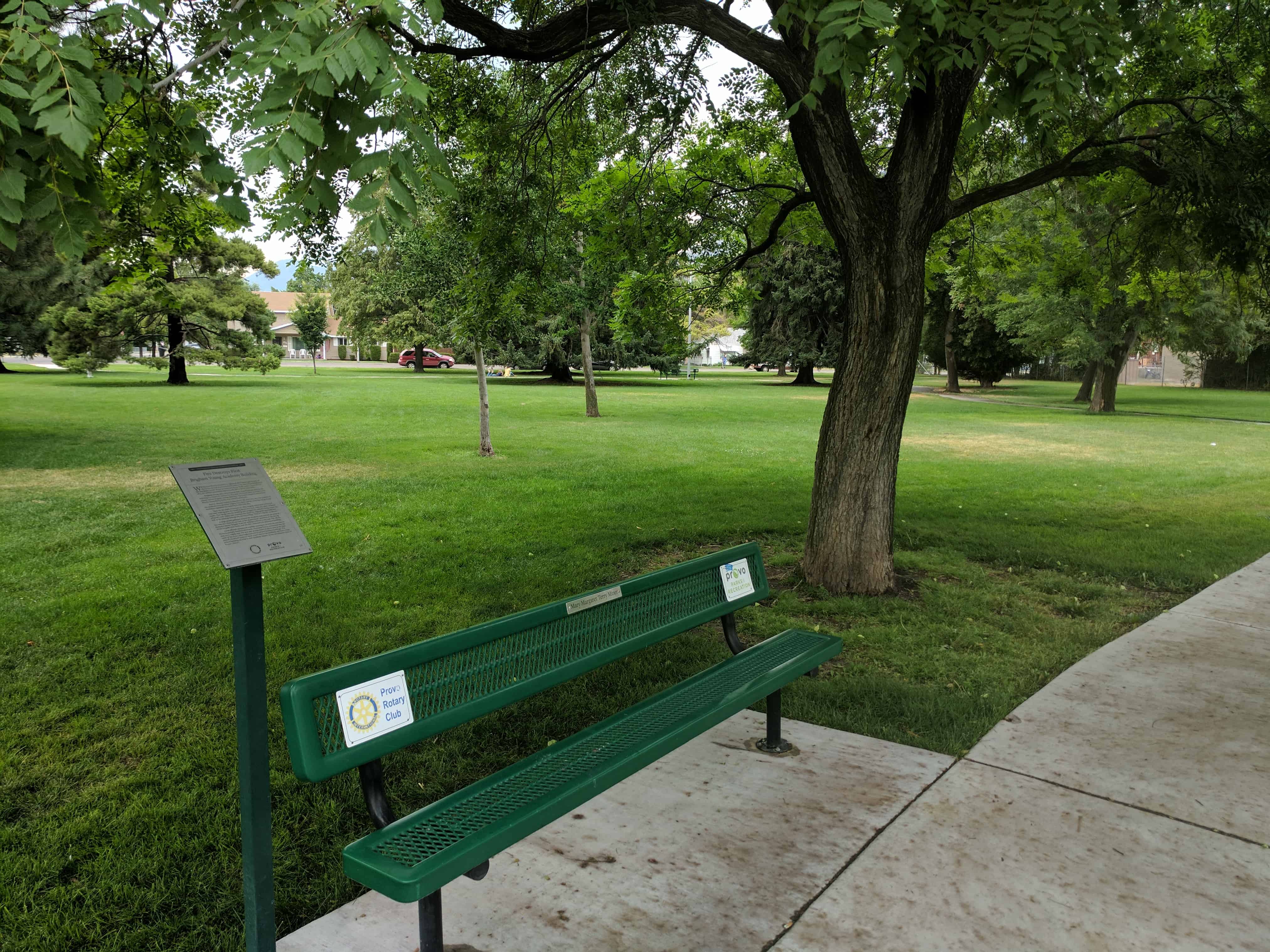
Fire Destroys Brigham Young Academy Building

30 Wednesday Aug 2017

Posted by Jacob Barlow in Uncategorized

≈ 5 Comments

Tags

Historic Buildings, Historic Markers, History, Provo, Schools, utah, utah county

2017-07-11 18.36.20

Fire Destroys Brigham Young Academy Building

William and Warren Dusenberry operated the Timpanogos Branch of the University of Deseret in Lewis Hall, a two-story brick building on the northeast corner of the intersection of 300 West Center.  From 1870 to 1875, the school succeeded educationally, but it failed financially.

Brigham Young, who owned Lewis Hall, transferred the deed to the building to a board of trustees in 1875 and instructed them to create a new school named Brigham Young Academy.  The board complied and elected Warren Dusenberry as the new school’s principal.

Karl G. Maeser replaced Dusenberry the next year, and the teachers of the academy incorporated religion into their courses.  Enrollment grew and workmen expanded the building in 1882 and 1883.

Then on the night of January 27, 1884, tragedy envoloped Lewis Hall.  Two men walking past the building about 11:00 p.m. noticed a glow of flames inside.  They broke into the building and dragged the school’s pump organ out of harm’s way.  Other men sounded the alarm by ringing the meetinghouse bell or by running through the streets yelling, “Fire! It’s the B.Y. Academy!”

A large crowd gathered around the academy and carried out some of its contents.  Since Provo had no fire department, members of the throng formed a bucket brigade from the millrace a block to the east.  The efforts of the brigade were futile, and the fore consumed the uninsured building.

Local officials announced a public meeting to be held the next day in Provo’s partially finished tabernacle.  President Smoot announced that the new term would start the next day as scheduled.  Students met in the basement of the Provo Meetinghouse and in various business buildings.  Te school’s board of trustees chose a new site for the academy and build a large school building on what is now Academy Square.  It has served many years as Provo’s library.

This plaque is located in Memorial Park, to see other plaques in the series click here.

2017-07-11 18.36.27

One in a Series of Events from Provo’s History

29 Tuesday Aug 2017

Posted by Jacob Barlow in Uncategorized

≈ 42 Comments

Tags

historic, Historic Markers, History, Provo, utah, utah county

2017-07-11 18.30.19

When exploring Provo I’ve come across a series of historic plaques Provo City put up around town that say “One in a Series of Events from Provo’s History” across the top and then describe some of Provo’s history and are numbered.  I’d like to eventually locate them all and have them listed here so I’ll create this and add to it as I find them.

  • 001 – The City of Provo was founded in 1849 by Mormon pioneers.
  • 002 – Provo’s North Park Was Once an Adobe Yard for Its Early Settlers.
  • 003 – Memorial Park at 800 East Center Street Was an Unsightly Swamp.
  • 004 – Fish in Utah Lake and the Provo River Saved Utah’s Early Settlers.
  • 005 – Provo’s First Cooperative Opened in 1869
  • 006 – Provoans Built First Railroad in 1873.
  • 007 – How Provo’s Squaw Peak Got Its Name.
  • 008 – Provo’s First Department Store Began in 1866 at 250 West Center St.
  • 009 – Utah’s Largest Indian Battle, Called the “Battle of Provo River.”
  • 010 – Utah County’s Early Courthouses.
  • 011 – Provo’s Early Carding Mill and Machine Shop Were Vital to the City.
  • 012 – The Excelsior Flour Mill Was Crucial to Provo’s Early Settlers.
  • 013 – Provo’s First Bank was Late in Coming but Didn’t Last Long.
  • 014 – Choosing the Site of Provo’s First Tabernacle Caused Controversy.
  • 015 – Provo’s First Tithing Office was South of Provo’s Town Square…
  • 016 – Provo’s Early Colonists Were Caught Between Warring Indian Bands.
  • 017 – Provo’s First Colonizers Moved from the River to Higher Ground.
  • 018 – Brigham Young Used Surplus Labor to Build a New Tithing Office.
  • 019 –
  • 020 – A Captured German Howitzer Stood in Front of the Utah County Courthouse.
  • 021 – Spanish Fathers Visit Utah Valley in 1776.
  • 022 – Brigham Young University Opened in 1875 in Lewis Hall.
  • 023 – Creating the “Y” on the Mountain.
  • 024 – Carp Not Native to Utah Lake; Introduced in 1882.
  • 025 – Deseret Telegraph Line Connected Provo to the Rest of Utah.
  • 026 – Several Brick Manufacturing Companies Once Operated in Provo.
  • 027 – A Tragedy at the Site of the Provo Lime Kiln.
  • 028 – Fire Destroys Brigham Young Academy Building.
  • 029 – Provo’s First Volunteer Fire Department.
  • 030 – First Utah County Fair Held in Provo.
  • 031 –
  • 032 – Provo Hosted Utah’s Largest Trading Fair Between the Utes and Pioneers.
  • 033 – The Forerunner of FrontRunner: Provo-to-SLC Trains Began in 1912.
  • 034 – Pioneers Made Their Initial Boat Trip on Utah Lake in 1847.
  • 035 – Provo Once Thought it Should Be Utah’s Capital City.
  • 036 – Provo’s First Fire Station was Opened Downtown in 1893.
  • 037 – Provo’s Two Oldest Existing Homes Are Neighbors in Pioneer Village.
  • 038 – One of Provo’s Oldest Businesses is the Startup Candy Company.
  • 039 – Sewage Disposal in Early Provo Was the Same as in Other Frontier Towns.
  • 040 –
  • 041 – Two Railroads Moved Coal to Provo in the 1880s.
  • 042 –
  • 043 – A Firebug Bit Provo in 1878
  • 044 – Provo’s First Jail Was Built in 1871.
  • 045 – Provo’s First Radio Station Came in 1939.
  • 046 – A Provo Accident Hastened the Death of President Heber C. Kimball.
  • 047 – Provo’s North Park had a Community Ice Skating Rink in the 1930s.
  • 048 – Utah Territorial Insane Asylum Came to Provo in 1885.
  • 049 – Early Residents of Provo lacked Land Titles.
  • 050 – Provo Had a “Pest House” for Those with Communicable Diseases.
  • 051 – Provo Police Chief Killed in 1873.
  • 052 – Proctor Academy Helped Educate Provo’s Youth.
  • 053 – Army Troops Caused the “Provo Riot” in 1870.
  • 054 – Provo’s Name Has an Interesting History.
  • 055 – Large Showboat Once Sailed on Utah Lake.
  • 056 – Provo Once Had a Silk Industry.
  • 057 – A Curious Craft Once Skimmed the Ice on Utah Lake.
  • 058 – A Wheelbarrow Parade in 1888 Helped Bring Political Parties to Provo.
  • 059 – A Woolen Mill Was Once Provo’s Largest Business.
  • 060 – Early Provo Bridges Across the Provo River Kept Washing Out.

Utah Territorial Insane Asylum Came to Provo in 1885.

29 Tuesday Aug 2017

Posted by Jacob Barlow in Uncategorized

≈ 4 Comments

Tags

Asylums, historic, Historic Buildings, Historic Markers, History, Provo, utah, utah county

  • 2017-07-11 18.30.03

For decades after colonists settled Provo in 1849, the Utah County Court (now called the County Commission) supervised the care of those in the county who suffered from extreme poverty, mental deficiency, or mental illness.  Residents of the community submitted bids to the County Court for the care of these people.  The justices then assigned the care of these disadvantaged individuals to the lowest bidder.

The Utah Territorial Legislature passed a bill authorizing the establishment of the Utah Territorial Insane Asylum in 1880.  This new institution’s board of directors, which included two former members of the Provo City Council, became responsible for choosing a site for the asylum.

Utah, Salt Lake, and Davis counties actively campaigned to become the site of the new institution.  In an effort to sway the opinion of the board of directors, Provo City offered the asylum’s board $500 and Utah County offered another $2,000 to help buy the necessary land for the new buildings.  With this inducement in mind, the board chose Provo in 1881 as the site for the asylum.

A four-man committee selected the location for the new buildings in the foothills east of the end of Provo’s Center Street where a good spring flowed from the mountain.  The money from the city and county paid for the initial 40 acres of land.

There was one major difficulty with the site: no road existed between the location of the future buildings and the east end of Center Street.  The Provo City Council negotiated with landowners, bought the right of way, and extended Center Street to the asylum grounds.

Construction workers finished the south wing of the new building in 1885.  It housed the first 200 patients.  Builders added a middle wing and north wing to the main building later.  Although the old building has been replaced, the current hospital stands on the same site.   A small museum open to the public now occupies the former residence of the superintendent.

This plaque is located in Memorial Park, for other plaques in the series click here.

  • 2017-07-11 18.30.19
  • 2017-07-11 18.30.11

Plum Alley

20 Tuesday Dec 2016

Posted by Jacob Barlow in Uncategorized

≈ 2 Comments

Tags

Chinese, Downtown SLC, History, Salt Lake City, Salt Lake County, utah

picture24nov07-156

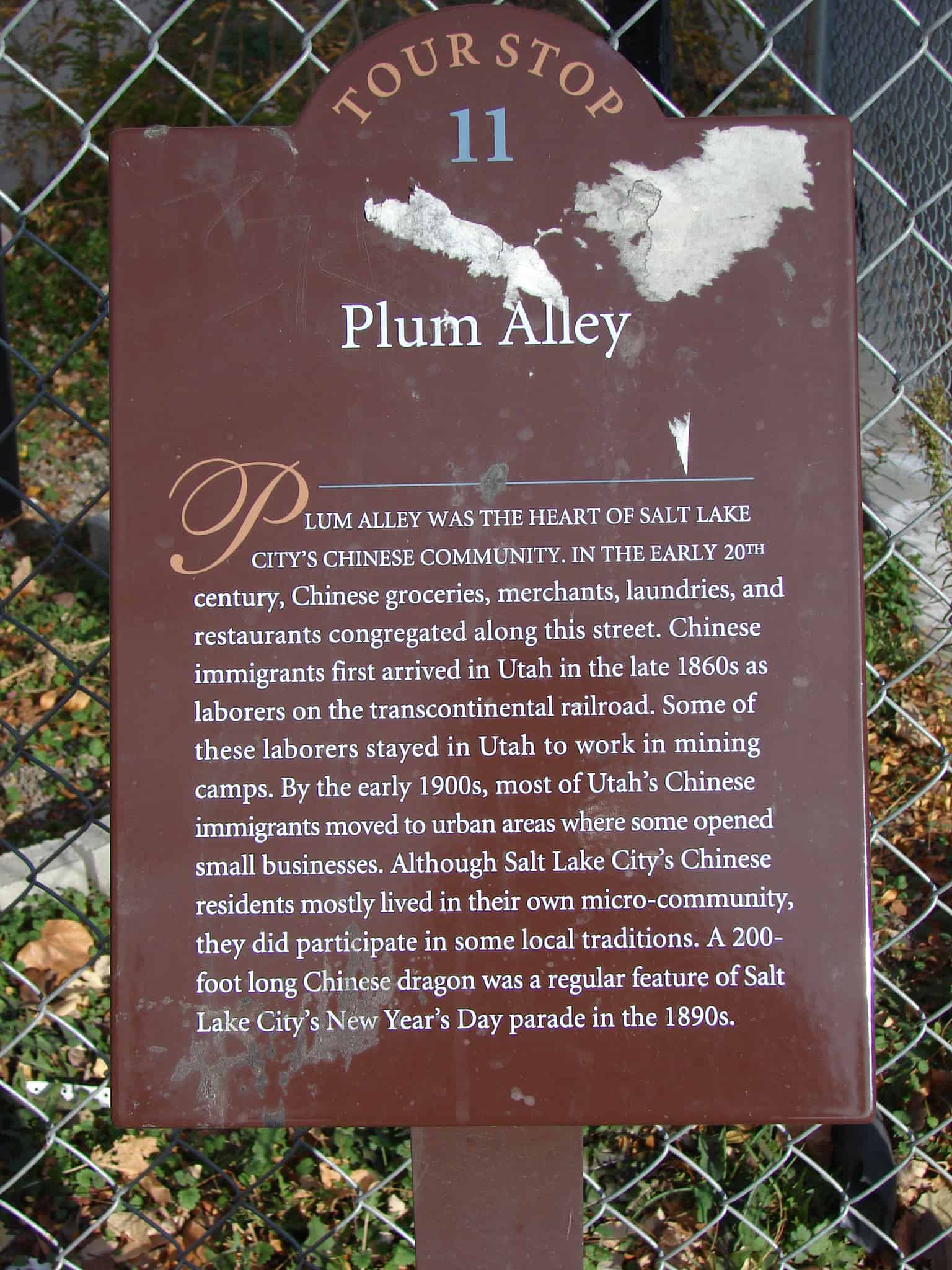
Plum Alley

Plum Alley was the heart of Salt Lake City‘s Chinese community.  In the early 20th century, Chinese groceries, merchants, laundries and restaurants congregated along this street.  Chinese immigrants first arrived in Utah in the late 1860s as laborers on the transcontinental railroad.  Some of these laborers stayed in Utah to work in mining camps.  By the early 1900s, most of Utah’s Chinese immigrants moved to urban areas where some opened small businesses.  Although Salt Lake City’s Chinese residents mostly loved in their own micro-community, they did participate in some local traditions.  A 200-foot long Chinese dragon was a regular feature of Salt Lake City’s New Year’s Day parade in the 1890s.

Other Salt Lake City Tour plaques are listed here.

picture24nov07-155
← Older posts
Newer posts →

Follow Jacob

Follow Jacob

Blog Stats

  • 2,009,638 hits

Social and Other Links

BarlowLinks.com

Recent Posts

  • G.W. Thatcher Home
  • Fort Douglas Commanders House
  • Herbert B. Maw Home
  • Marriner S. Eccles Home
  • William and Grace Ebaugh Home

Archives


Loading Comments...