• About JacobBarlow.com
  • Cemeteries in Utah
  • D.U.P. Markers
  • Doors
  • Exploring Utah Email List
  • Geocaching
  • Historic Marker Map
  • Links
  • Movie/TV Show Filming Locations
  • Oldest in Utah
  • Other Travels
  • Photos Then and Now
  • S.U.P. Markers
  • U.P.T.L.A. Markers
  • Utah Cities and Places.
  • Utah Homes for Sale
  • Utah Treasure Hunt

JacobBarlow.com

~ Exploring with Jacob Barlow

JacobBarlow.com

Tag Archives: Lincoln County

Cokeville, Wyoming

01 Saturday Oct 2016

Posted by Jacob Barlow in Uncategorized

≈ 1 Comment

Tags

Cokeville, Lincoln County, Wyoming

picture7sep07-235

The Shoshone Indians were the first inhabitants of the area. The first Euro-American settler, Tilford Kutch, arrived in 1869. In 1873, he opened a trading post and ran a ferry across Smiths Fork. After the arrival of the railroad in 1882, the town grew, and was incorporated in 1910.

The town was named for the coal found in the area. Following the railroad, sheep ranching became more popular, reaching its peak in 1918, when Cokeville was informally called the “Sheep Capital of the World”.

Related Posts:

  • Cokeville Historic Marker
picture7sep07-236
picture7sep07-230

Panaca Mercantile Store

15 Thursday Sep 2016

Posted by Jacob Barlow in Uncategorized

≈ 2 Comments

Tags

historic, Historic Buildings, Lincoln County, Nevada, Panaca

picture01oct07-023

This building, popularly known as the Panaca Co-op, was constructed of adobe in 1868, by the (Mormon) “Panaca Cooperative Mercantile Institution” comprising more than 100 stock holders—to meet barter, merchandising and marketing needs. Wagons from Salt Lake drawn by six-mule teams, carried stocks to, and produce from, Panaca and way stations.

See other Nevada Historic Markers here.

picture01oct07-022

Miners Memorial Park

25 Thursday Aug 2016

Posted by Jacob Barlow in Uncategorized

≈ 4 Comments

Tags

Diamondville, Lincoln County, Memorials, Wyoming

376c268b-1dfa-4603-a2ba-5f8c5fb8e72b

Miners Memorial Park in Diamondville, Wyoming.

A nice park right off the main road in Diamondville.

Miners Memorial Park was built totally by donations and volunteer labor. It was established to honor the coal miners, both men and women, of south Lincoln County, past, present, and future, who have created a unique culture in our country, many of them losing their lives in the mines. On display in the park is Diamondville’s only memorial statue. The park was dedicated on June 1, 1990 with Wyoming’s Governor, Mike Sullivan, and the United Mine Workers of America President, Cecil Roberts, cutting the ribbon. The dedication coincided with the 100th year commemorations for both Wyoming and the UMWA.

PROCLAMATION

WHEREAS, in 1868 coal was discovered on the hillside, across the Hams Fork River, from the present site of the Town of Diamondville; and WHEREAS, Diamondville’s name was derived from the quality of the coal mined here, as it seemed to resemble black diamonds and was of a superior grade; and WHEREAS, the Miners Memorial Park was built to honor the coal miners of South Lincoln County; past, present and future; the men and women who created a unique way of life in our country; the many who gave their lives in the mines.

NOW THEREFORE, I, MIKE SULLIVAN, Governor of the State of Wyoming, do hereby proclaim June 1, 1990, to be “DEDICATION OF MINERS MEMORIAL PARK” in Diamondville, Wyoming.

1e15f802-822f-460a-b441-cc7c47b0fa2c
9ef2a1d4-c0ab-42c9-b5af-8dd0117a8259
66b29bcd-c551-4c12-88ad-6eba15b367ad
e116b07d-bed5-41fa-a1b0-590944c326a5


Lincoln County, Tennessee

25 Thursday Aug 2016

Posted by Jacob Barlow in Uncategorized

≈ 1 Comment

Tags

historic, Lincoln County, Tennessee

fe54a900-c038-405f-b948-d5ed00e95abe

Lincoln CountyEstablished 1809; named in honor of MAJOR GEN. BENJAMIN LINCOLN of the Revolutionary Army. After service at Saratoga, he was put in Chief Command in the Southern Colonies. Later, he was Secretary of War under the Confederation, 1781-83.

Located on the Tennessee/Alabama State line.

a480d30d-ed5f-44c5-8d19-0ab990b2c3f4

9d9c936c-b6ba-4387-9209-5ddd0e1a8655

Diamondville Mining History

20 Friday Jun 2014

Posted by Jacob Barlow in Uncategorized

≈ 2 Comments

Tags

Diamondville, Lincoln County, Mining, Wyoming

Diamondville got its name from the quality of the superior-grade coal from the local mines that seemed to resemble black diamonds.

In 1868, a man by the name of Harrison church discovered coal near the Hams Fork River. He built a cabin on the hill where part of modern Diamondville now stands. Realizing the area’s potential, he sought financial backing from a group in Minneapolis, who eventually formed the Hams Fork River Coal Company, incorporated in 1884. Later S.F. Fields, a promoter from Salt Lake City, Utah, took over management of the company and with the financial backing of the Anaconda Mining Company, renamed it the Diamond Coal & Coke Company.

Over the course of time the development of a western coal mine evolved from digging out and hauling coal by hand from an outcrop or tunnel to today’s mechanical monsters of the plains.

Draglines and truck and shovel operations now remove up to several hundred feet of overburden in order to expose the coal. Conveyor belts and haul trucks transport hundreds of tons each minute to sophisticated automated silos that evenly distribute carefully measured loads onto unit trains. A man used to be paid by the number of tons he dug; today what took days of back breaking labor to dig can be moved in a matter of seconds by a single shovel operator.

The uses for coal have also changed, chunks of coal used to be burned in old stokers and forges for heating purposes. Today coal is crushed, pulverized and sprayed into furnaces to generate steam which is then used to generate electricity. Synthetic fuels or “synfuels” are also generated from Wyoming coal. Currently only a very small percentage of Wyoming’s coal is used as form coke in steel manufacturing.

In the 1860’s steam engines were starting to use coal instead of wood. The recognition of the western coal resource potential had only begun. Also, coal’s high Btu ( British Thermal Units ) made it more favorable to burn than wood. The benefits of using coal were that it increased horsepower, increased the distance that steam engines of the time could travel and was readily available. Wyoming’s abundance of coal and general topography in conjunction with the ongoing Civil War served as deciding factors on the choice of the northern route across southern Wyoming for the Transcontinental railroad.

There are four main steps to mining coal

Step One

Coal must be broken away from the face of the coal seam.

In the early mines picks were used to break the coal away from the face, then holes were drilled in the face and dynamite was into the hole and detonated (1900 – 1950).

Step Two

Coal must be gathered up and loaded into a conveyance to hual it out of the mine.

In the first mines, coal was gathered up and loaded by hand with a coal shovel into the car.

Step Three

Coal has to be transprted out of the mine.

The first coal cars were pushed out of the mine by hand, then mules were used to pull the cars.

Step Four

The coal is prepared and delivered to the consumer.

In the early mines the coal was brought out of the mine in big chunks and loaded onto a horse-drawn wagon.

ImageImageImageImageImage

Teapot Arch

18 Wednesday Jun 2014

Posted by Jacob Barlow in Uncategorized

≈ 2 Comments

Tags

Arches, Geologic, Lincoln County, Nevada, Panaca

Image

picture01oct07-024
picture01oct07-025

A natural arch is a natural formation (or landform) where a rock arch forms, with a natural passageway through underneath. Most natural arches form as a narrow ridge, walled by cliffs, become narrower from erosion, with a softer rock stratum under the cliff-forming stratum gradually eroding out until the rock shelters thus formed meet underneath the ridge, thus forming the arch. Natural arches commonly form where cliffs are subject to erosion from the sea, rivers or weathering (sub-aerial processes); the processes “find” weaknesses in rocks and work on them, making them bigger until they break through.

The Following is from Wikipedia.com‘s Natural Arch Page :

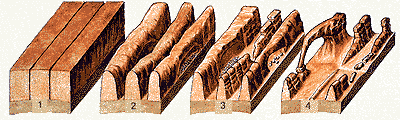
Weather-eroded Arches
Image

  1. Deep cracks penetrate into a sandstone layer.
  2. Erosion wears away exposed rock layers and enlarges the surface cracks, isolating narrow sandstone walls, or fins.
  3. Alternating frosts and thawing cause crumbling and flaking of the porous sandstone and eventually cut through some of the fins.
  4. The resulting holes become enlarged to arch proportions by rockfalls and weathering. Arches eventually collapse, leaving only buttresses that in time will erode.

This arch, is located near Panaca, Nevada, A drive and a short walk allows you to climb up quickly and see the awesome work of nature.

This arch is made of local Bentonite.

Bentonite is an absorbent aluminium phyllosilicate generally impure clay consisting mostly of montmorillonite. There are a few types of bentonites and their names depend on the dominant elements, such as K, Na, Ca, and Al. As noted in several places in the geologic literature, there are some nomenclatorial problems with the classification of bentonite clays. Bentonite usually forms from weathering of volcanic ash, most often in the presence of water. However, the term bentonite, as well as a similar clay called tonstein, have been used for clay beds of uncertain origin. For industrial purposes, two main classes of bentonite exist: sodium and calcium bentonite. In stratigraphy and tephrochronology, completely devitrified (weathered volcanic glass) ash-fall beds are commonly referred to as K-bentonites when the dominant clay species is illite. Other common clay species, and sometimes dominant, are montmorillinite and kaolinite. Kaolinite dominated clays are commonly referred to as tonsteins and are typically associated with coal.

Sodium bentonite
Sodium bentonite expands when wet, possibly absorbing several times its dry mass in water. It is often used in drilling mud for oil and gas wells and for geotechnical and environmental investigations.

The property of swelling also makes sodium bentonite useful as a sealant, especially for the sealing of subsurface disposal systems for spent nuclear fuel and for quarantining metal pollutants of groundwater. Similar uses include making slurry walls, waterproofing of below-grade walls and forming other impermeable barriers (e.g. to plug old wells or as a liner in the base of landfills to prevent migration of leachate into the soil).

Sodium bentonite can also be “sandwiched” between synthetic materials to create geo-synthetic liners for the aforementioned purposes. This technique allows for more convenient transport and installation and it greatly reduces the volume of sodium bentonite required.

Calcium bentonite
Calcium bentonite may be converted to sodium bentonite and exhibit sodium bentonite’s properties by a process known as “ion exchange”. Commonly this means adding 5-10% of sodium carbonate to wet bentonite, mixing well, and allowing time for the ion exchange to take place. Pascalite is a commercial name for the calcium bentonite clay.

Uses for both types
Much of bentonite’s usefulness in the drilling and geotechnical engineering industry comes from its unique rheological properties. Relatively small quantities of bentonite suspended in water form a viscous, shear thinning material. Most often, bentonite suspensions are also thixotropic, although rare cases of rheopectic behavior have also been reported. At high enough concentrations (~60 grams of bentonite per litre of suspension), bentonite suspensions begin to take on the characteristics of a gel (a fluid with a minimum yield strength required to make it move). For these reasons it is a common component of drilling mud used to curtail drilling fluid invasion by its propensity for aiding in the formation of mud cake.

Bentonite can be used in cement, adhesives, ceramic bodies, cosmetics and cat litter. Fuller’s earth, an ancient dry cleaning substance, is finely ground bentonite, typically used for purifying transformer oil. Bentonite, in small percentages, is used as an ingredient in commercially designed clay bodies and ceramic glazes. Bentonite clay is also used in pyrotechnics to make end plugs and rocket nozzles, and can also be used as a therapeutic face pack for the treatment of acne/oily skin.

The ionic surface of bentonite has a useful property in making a sticky coating on sand grains. When a small proportion of finely ground bentonite clay is added to hard sand and wetted, the clay binds the sand particles into a moldable aggregate known as green sand used for making molds in sand casting. Some river deltas naturally deposit just such a blend of such clay silt and sand, creating a natural source of excellent molding sand that was critical to ancient metalworking technology. Modern chemical processes to modify the ionic surface of bentonite greatly intensify this stickiness, resulting in remarkably dough-like yet strong casting sand mixes that stand up to molten metal temperatures.

The same effluvial deposition of bentonite clay onto beaches accounts for the variety of plasticity of sand from place to place for building sand castles. Beach sand consisting of only silica and shell grains does not mold well compared to grains coated with bentonite clay. This is why some beaches are so much better for building sand castles than others.

The self-stickiness of bentonite allows high-pressure ramming or pressing of the clay in molds to produce hard, refractory shapes, such as model rocket nozzles. Indeed, to test whether a particular brand of cat litter is bentonite, simply ram a sample with a hammer into a sturdy tube with a close-fitting rod; bentonite will form a very hard, consolidated plug that is not easily crumbled.

Bentonite also has the interesting property of adsorbing relatively large amounts of protein molecules from aqueous solutions. It is therefore uniquely useful in the process of winemaking, where it is used to remove excessive amounts of protein from white wines. Were it not for this use of bentonite, many or most white wines would precipitate undesirable flocculent clouds or hazes upon exposure to warmer temperatures, as these proteins denature. It also has the incidental use of inducing more rapid clarification of both red and white wines.

Osmond

05 Thursday Jun 2014

Posted by Jacob Barlow in Uncategorized

≈ 2 Comments

Tags

DUP, historic, Lincoln County, Star Valley, Wyoming

picture7sep07-247

Dry Creek, later called Mount Pleasant was settled 1886, the first public building erected in this area, 1891, was a log schoolhouse also used as a church. Students furnished their own desks and stools. George Hardman, Teacher. Osmond Ward, organized September 8, 1901, Andrew M. Neilson, Bishop. Named (sic) honored George Osmond, First President of Starr Valley Stake, Church of Jesus Christ of Latter-Day Saints.

picture7sep07-246

Check out all of the historic markers placed by the Daughters of Utah Pioneers at JacobBarlow. com/dup

First Post Office

04 Wednesday Jun 2014

Posted by Jacob Barlow in Uncategorized

≈ 2 Comments

Tags

DUP, historic, Lincoln County, Thayne, Wyoming

picture7sep07-257

Thayne, formerly called Glencoe, was founded in 1888, at which time mail was brought into Star Valley by Team and Wagon and distributed to the people from a log cabin owned by Joseph Thayne. The building was one room, 12 x 15 feet with a dirt roof. Three years later it was moved to the center of town and Henry Thayne and his wife occupied it. This log cabin, located one and one half rods west of this site, became the first post office May 8, 1891 with Laura Thayne Post Mistress.

picture7sep07-256

Check out all of the historic markers placed by the Daughters of Utah Pioneers at JacobBarlow. com/dup

Star Valley

29 Wednesday Jan 2014

Posted by Jacob Barlow in Uncategorized

≈ 3 Comments

Tags

Afton, DUP, historic, Lincoln County, Wyoming

  • picture7sep07-249

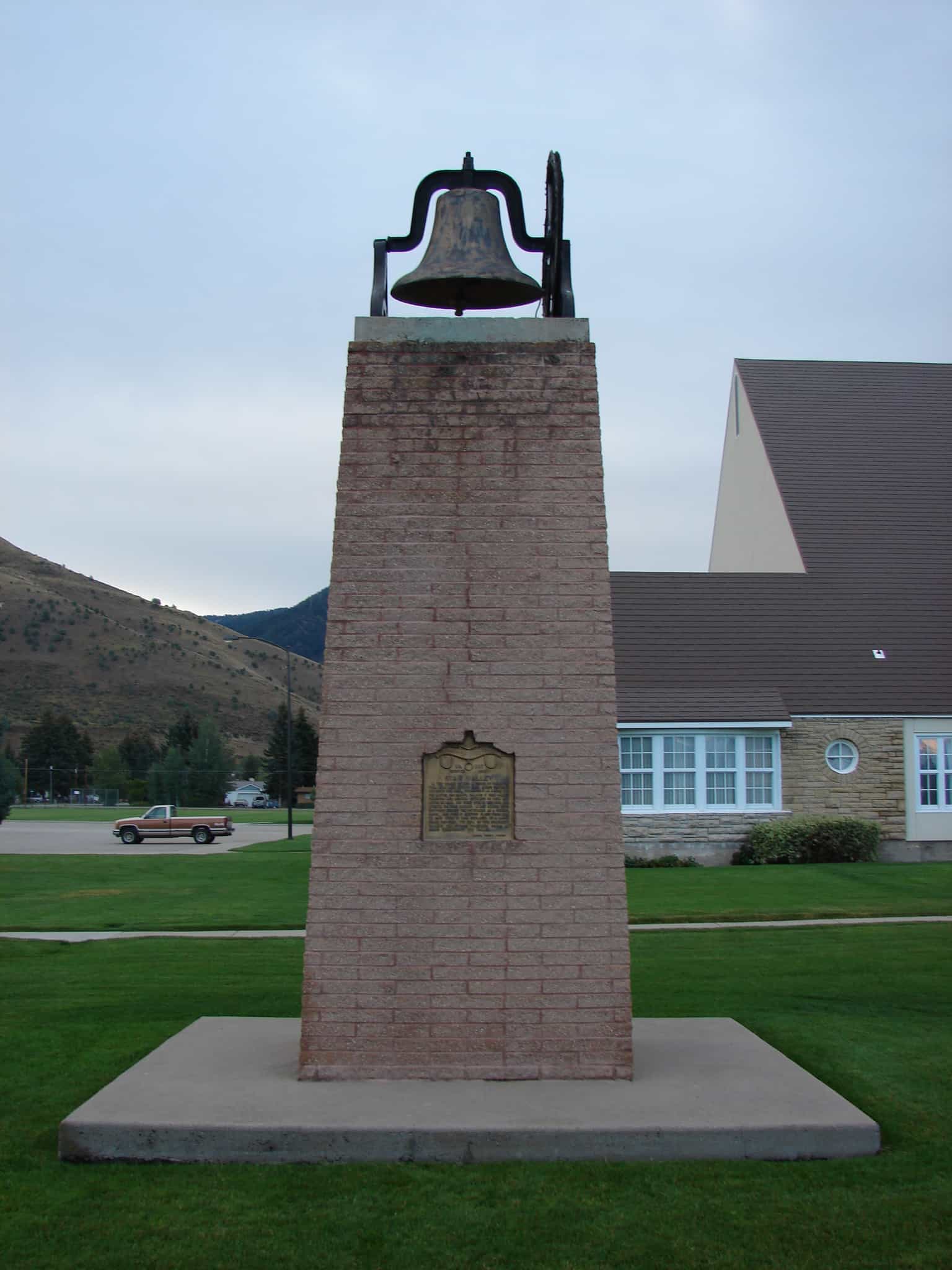
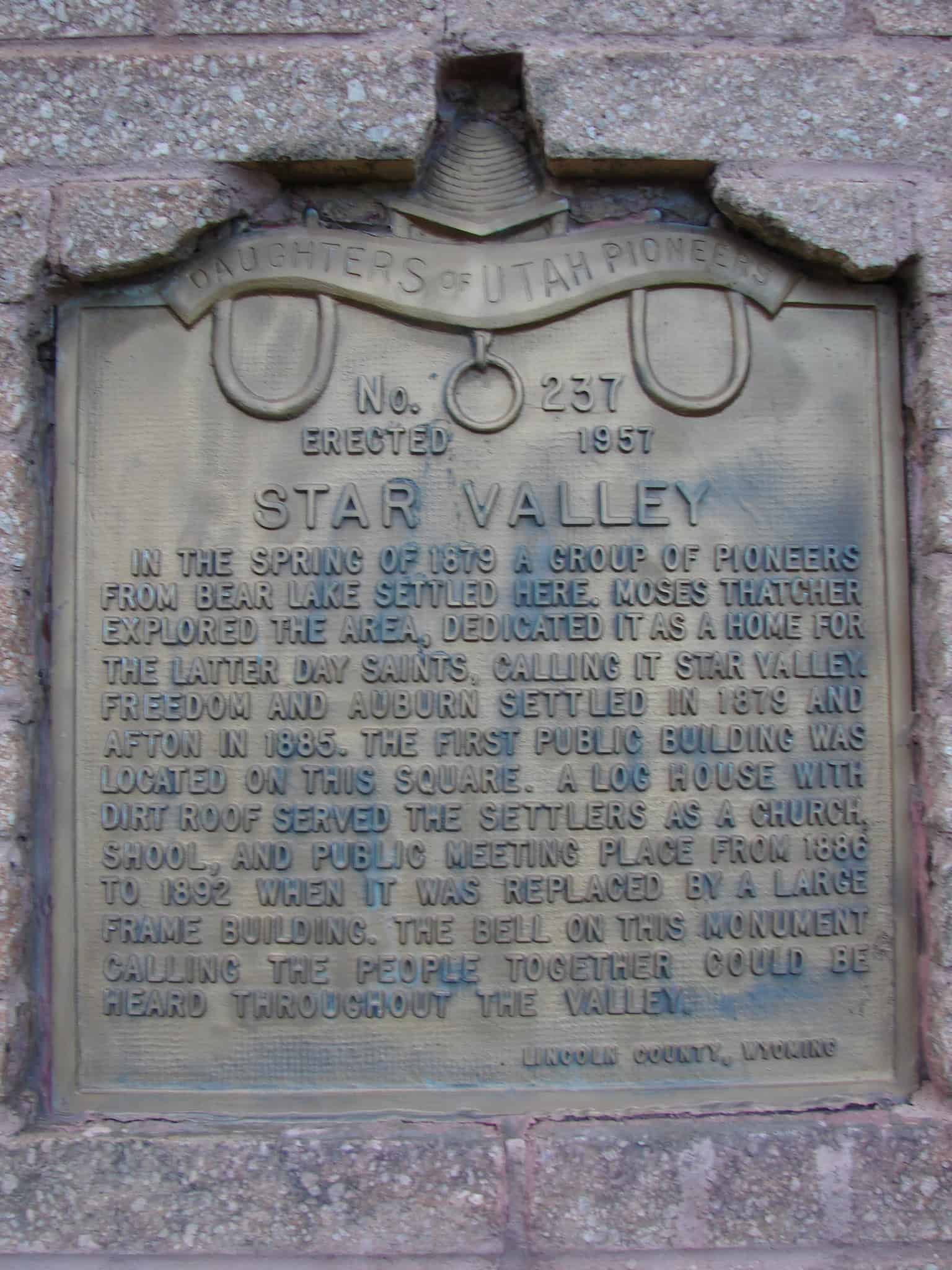
In the spring of 1879 a group of pioneers from Bear Lake settled here. Moses Thatcher explored the area, dedicated it as a home for the Latter Day Saints, calling it Star Valley. Freedom and Auburn settled in 1879 and Afton in 1885. The first public building was located on this square. A log house with dirt roof served the settlers as a church, school, and public meeting place from 1886 to 1892 when it was replaced by a large frame building. The bell on this monument calling the people together could be heard throughout the valley.

Newer posts →

Follow Jacob

Follow Jacob

Come wander with me on Youtube.

Blog Stats

  • 2,091,928 hits

Social and Other Links

BarlowLinks.com

Recent Posts

  • Provo High School Seminary Building
  • 821 E 100 S
  • 820 E 100 S
  • 817-819 E 100 S
  • 814 E 100 S

Archives

Loading Comments...