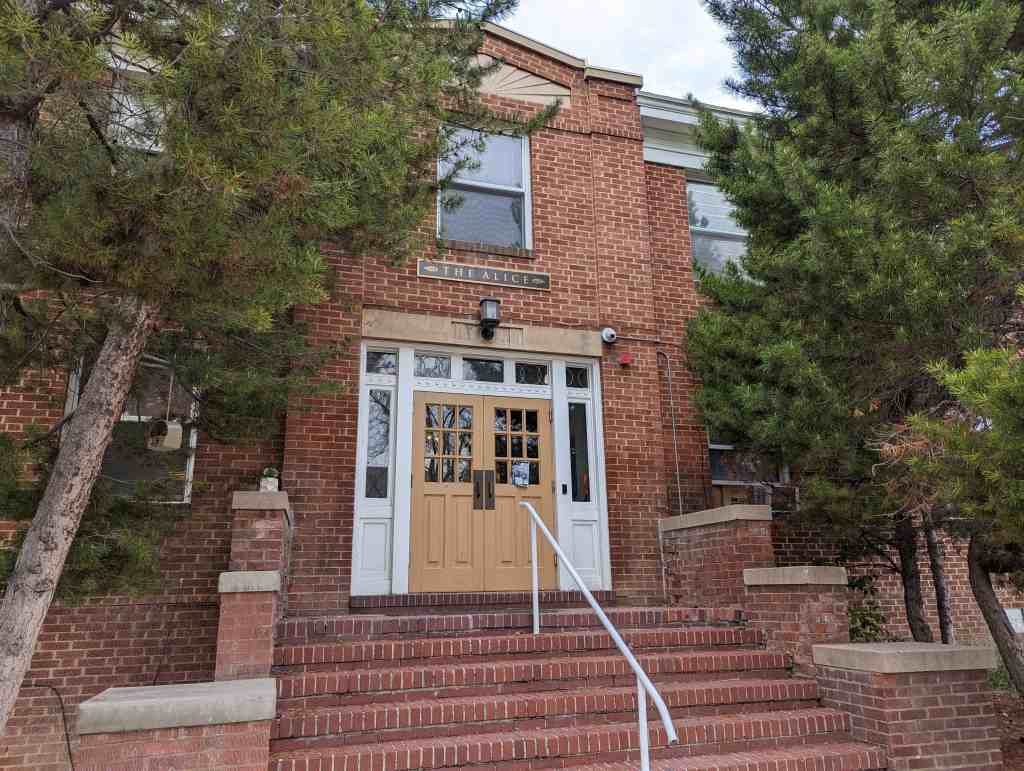
Alice Craighead Dormitory, built in 1938; It is a two-story brick and cast stone trim building; rectangular plan; shows subtle influence of the Georgian Revival Style. The building features square bays with eight-over-eight double hung sash windows, a hip roof and modest detailing.
The Manse at Wasatch Academy, built in 1938, it is a one-and-a-half story brick home; Tudor bungalow style; rectangular plan. It features square window bays, stepped chimney with a high-pitched roof and shed dormers.
Located at ~67 South 100 West in Mt Pleasant, Utah
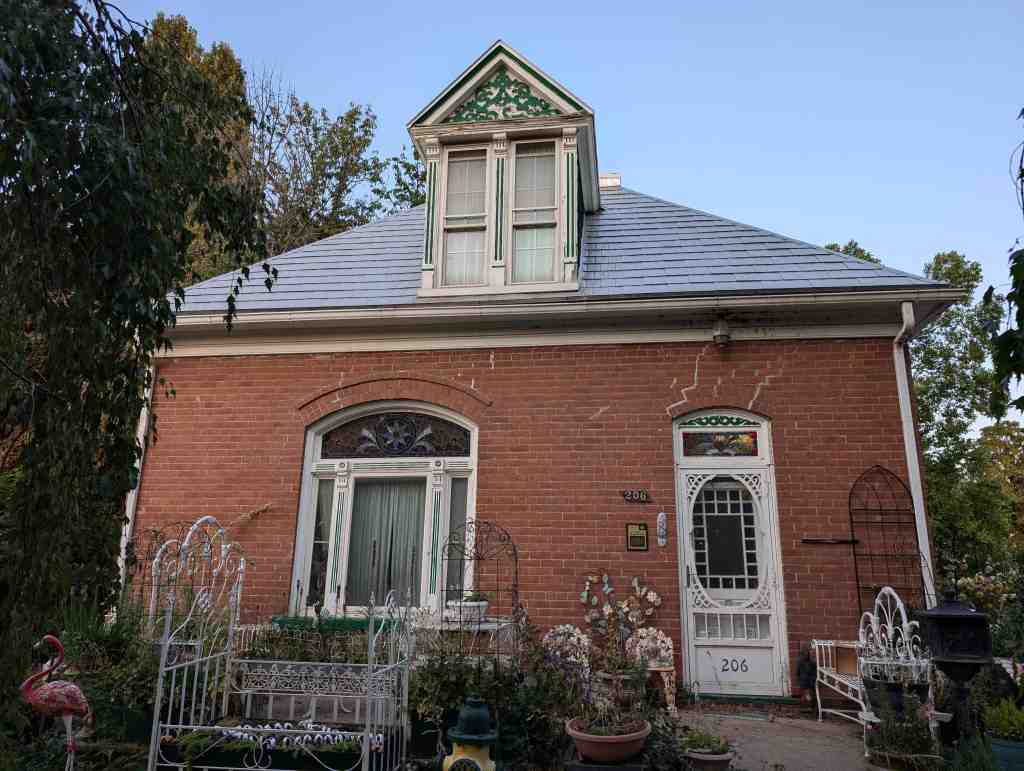
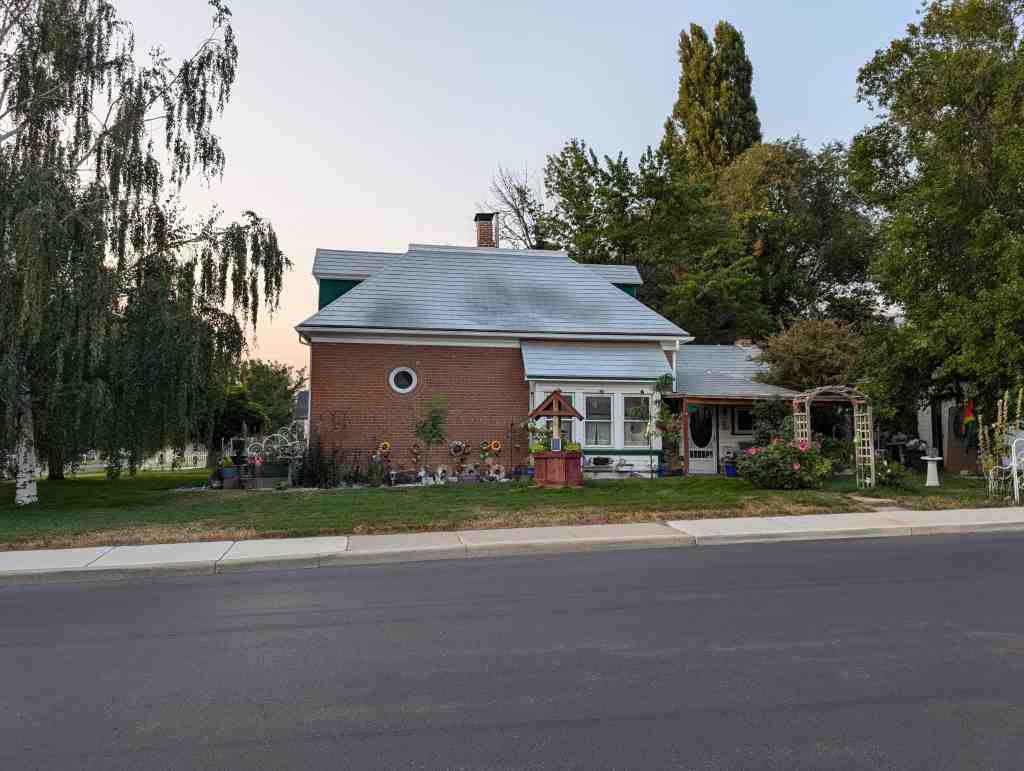
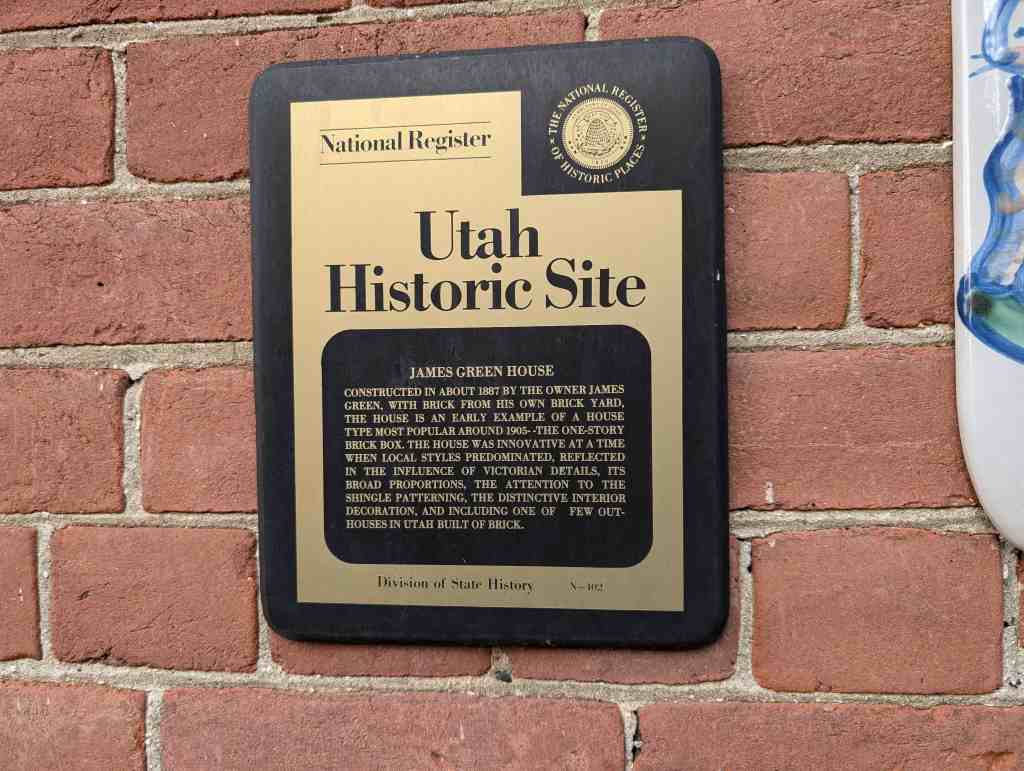
The James Green house, built in about 1887, is significant as an isolated early example of a house type that would reach the height of its popularity at about 1905, the one story brick box. It was built at a time when vernacular house forms still predominated, and reflects the influx of Victorian patterns and details into the vocabulary of the builders of the day. The treatment of the interior of the Green house is particularly significant because it reflects the range of possibilities open to a builder at a time when the use of standard patterns for interior decoration was becoming the norm. Its outhouse is significant as one of few outhouses in Utah that were built of brick. Its broad proportions and the attention given to the patterning of its shingle roof also make it a particularly distinctive example.
The James Green House is located at 206 North 100 East in Bountiful, Utah and was added to the National Historic Register (#82004118) on February 11, 1982.
James Green was born February 22, 1833 at Huntley Hills, Gloucester, England. He was a son of James and Esther Bur low Green. On March 21, 1853, he married Caroline Millington at Parker Row, Gloucester, England. The couple had eight children, the first, Emily Adeline, was born in 1854 and the youngest, John Henry, was born in 1869.
Greens joined the L.D.S. Church while in England and James came to Utah in 1872. One year later, his wife and several of their children arrived here. The family located in Bountiful and James Green purchased land near the tabernacle and built a small home for his family.
After settling in Bountiful, Green began to work as a farmer, but he soon gained interest in the occupation of brick making. The first brickyard in Bountiful was begun by Joseph Holbrook in 1850. Brick making was quite a prosperous business in Bountiful and by the late 1870s there were as many as five brickyards in the town. Of these brickyards were Joseph Holbrook, Angel Bolwell, William Garrett, Parley Hatch, Samuel S. Howard, and James Green. Green’s brickyard was located at Woods Cross and operated from c. 1879 to as late as 1893. Many of the older houses in south Davis County that still stand today are made of brick from Green’s brickyard.
In 1887, Emily A. Green, a daughter of James and Caroline, purchased a building lot on the corner of 200 North and 100 East. Shortly after the lot was purchased, the building of this house was started. Oral tradition credits James Green with building the house. It was to serve as a showplace of his abilities as a builder and also serve as a house for his thirty-three year old daughter, Emily Adeline Green.
By 1893, Emily had married Edward M. Cook and was residing in Anaconda, Montana. The house continued to be owned by members of the Cook and Green families until about 1901, when the house was deeded to Ara William Sabin.
In 1890 Ara William Sabin, his wife Marie, and their two daughters, Birdie and Zara, arrived in Utah from Lincoln, Nebraska. First settling near Vernal, where Ara planned to ranch and raise cattle, the family decided to seek a residence near Salt Lake City, ultimately purchasing the Bountiful house from Green. The Sabins bought the home sometime around 1901 for a relatively small price and moved in promptly. The Sabins, however, were not members of the Mormon Church. Consequently, Marie was not included in social activities as she had been in Nebraska. They soon decided to move, but keep the house as a stop-over place during their frequent trips to Vernal and eastern Utah. Eventually it was decided that it would be wise to rent out the home while the family was away. Zara Sabin remembers no less than ten families living in the house during that time, and stated that they were, “Always good people, but papa made sure they were not Mormons.” The Sabins did eventually retire from the cattle business and settled in their home until they both passed away in the 1940s. Zara never married and continued to live alone in the house. She was active in community affairs and became a member of the L.D.S. Church, as well as the Daughters of the American Revolution, and the Daughters of Utah Pioneers. She attended and graduated from the University of Utah with a degree in English, and became a noted Utah poet.
She died in September 1980. In October 1979 the house was purchased by Alex Lisman, who plans on maintaining the house as a residence.
Description of home:
The James Green house is a simple brick box to which typically Victorian elements have been attached. The brickwork is common bond, tie house is one and one half stories in height, and it has a truncated hip roof. It originally had a railing at the roof edge which recalled a widow’s walk. It has gable dormers projecting from the east and west roof sections. The dormer on the façade has a boxed cornice and a pediment decorated with jigsaw cut ornament. Three pilasters accent the two windows of the dormer. On the façade there is a three part window capped by a stained glass transom and brick relieving arch, and a single long, narrow door with a transom and brick relieving arch. The door is multi-paneled, both in the wooden lower half, and in the upper half of stained glass.
As designed, the house had four rooms on the first floor: a hall, a parlor, a kitchen, and one bedroom. There were two bedrooms on the second floor. The original kitchen was changed into a dining room between 1900 and 1915, but the size of the room was not changed. An addition was made to the rear of the house, and by 1923 it included a porch, a kitchen, a bathroom, and a pantry.
While the design of the exterior of the house is not remarkable, the interior is particularly unique, especially for so small a house. Because the design of the exterior is austere, only hinting at Victorian influences, one necessarily expects the interior of the house to have received the same treatment. The builder, however, chose the interior as the showplace where his skills were to be displayed. James Green took great pains to stock this house with the variety of elements with which he could proficiently design a house. There is an impressive staircase with spools joining the balusters, and a hand carved newel post. The staircase is reported to be all fitted woodwork with no visible nails or reinforcements. Green included the full range of possibilities in the design of doors and moldings. A different style of door was used for each room. The parlor doors have multi-paned glass panels and carved panels, and the bedroom door has two arched clear glass windows. Every room has a different corner motif in the door and window moldings. While the designs he used were common types, the use of more than one type of motif in a house is unusual. Other elements which indicate that Green was interested in advertising the extent to which he could provide a house with visual variety are the door knobs which vary from the intricate brass knob on the front door to the black ebony, knobs with brass plated keyhole covers in the living room. The stained glass transom over the living room window and the plaster cast ceiling medallion in that room to which an intricate lamp was attached both add an extra touch of richness to that central gathering place. The medallion is approximately four feet across.
Major alterations to the interior of the original rooms include the addition of a fireplace to the living room in about 1920, the addition of a bay window to the area that became a dining room, and the lowering of the ceiling of that room. The current owner is in the process of raising that ceiling to its original height, and in the process of doing so uncovered another smaller ceiling medallion.
Visible alterations to the exterior of the building include the removal of the roof railing, the addition of the frame window bay off of the dining room, the change from wood shingles to asphalt shingles, and the addition of a one story rear extension. These changes, however, do not greatly affect the original appearance of the house, and have not affected the integrity of the internal features which make the house particularly unique.
The Green house is an unusual house in that a handful of Victorian elements have been applied to a simple box form without any real attempt having been made to integrate those elements into some kind of distinctive design. The house has the look of never having been finished. A porch across the façade or part of the façade which would have given it some unity was never added. The raised platform in front of the house which was included in the earliest known photograph of 1882 and still exists today, adds to the unfinished appearance of the house, looking like the base for a porch. The contrast between the austerity of the exterior of this house and the variety of the interior too mark it as a distinctive dwelling. It is particularly unusual that there was so much attention to detail on the interior of so small a house. Small houses generally had their notable accents on the exterior, their interior having been simply treated.
There is one significant outbuilding on the property, a brick outhouse. It has generous proportions, having been designed with three seats. It is capped with a patterned wood shingle, pyramid roof, and has a four panel wood door with a porcelain knob.
The Black Rock Site includes some of the ruins of the Black Rock Resort and it was added to the National Historic Register (#100006332) on March 24, 2021.
1910s view of Black Rock surrounded by the waters of Great Salt Lake. (Utah State Historical Society)
The Fruita School house is one of the few remaining early structures in this region of Utah. Because of the geographical isolation of the valleys of Sulphur Creek and Fremont River, this section of the state was the last to be explored and settled. The first permanent settler, Niels Johnson, located a homestead near the junction of the streams in 1880. The tillable land in the narrow valleys could support only 8 to 10 families, and the almost impassable roads isolated the community from the outside world.
As the earliest school house of the area and typical of certain log structures built. at the time, it is a significant building. It is a well constructed building of squared logs; the sturdy structure, and fine detailing of window and door trim is a tribute to the local builders who probably had little professional assistance.
The one-room school building was built by the pioneers of the community who were largely members of the L.D.S. Church. It was constructed on the site where it now stands in the early 1890s. Elijah Cutler Behunin donated the ground before 1892, and inquiries indicate that Behunin and others of the community built the structure in 1892, or possibly as late as 1894. Nettie Behunin, daughter of the above, was the first teacher, and eleven children of Behunin, Pierce and Pendleton families were enrolled early. In 1895 the district was organized and known as the Junction School Precinct. It continued to be used as the grade school of the community until 1941. Since that date it has remained unoccupied.
The Schoolhouse is located in Capitol Reef National Park and was added to the National Historic Register (#72000098) on February 23, 1972.
The Cable Mountain Draw Works is a unique focal point of pioneer activity in Zion Canyon. The design and construction of this structure was the work of one man, David Flanagan of Springdale, Utah. Flanagan saw the need for a local source of lumber for the inhabitants of the area and located an adequate supply of timber on top of Cable Mountain. However, the timber source was inaccessible from the canyon floor at the foot of the mountain and Flanagan devised a system of cable works running from the mountain top to the bottom of the canyon to bring down lumber. Prior to this, lumber was obtained by making a ten-day round trip to the nearest source.
Flanagan’s design encountered much initial skepticism from local people. He had first conceived a cable works in 1885 as a fifteen-year old youth and by 1904, after much experimentation and failures, had the cable: works, in- operation. Flanagan operated the cable works until 1906 when he sold it to Alfred Stout and O. D. Gifford of Springdale. The Cable Mountain Timber Works operation continued intermittently until 1926 when it was abandoned. The cable was removed in 1930. The remains of the draw works represent twenty-two years of adaptive use as the structure was in constant design evolution during its operation.
The structure will be recorded to the standards of the Historic American Engineering Record (HAER) with consideration for long term preservation being a scale model. Visitor access to the very precipitous site, also subjected to severe lightening storms, will be restricted.
The Cable Mountain Draw Works* a braced wooden headframe structure, was fitted with cables used to lower lumber from the summit of Cable Mountain down a 2,000-foot vertical cliff to the canyon floor. The dimensions of the structure, located at the edge of the cliff, are approximately 30 feet in length, 16 feet wide, and 14 feet high.
The supports and framing are partially collapsed, weathered, and generally deteriorated, though the overall outline and form of the origiwi structure is intact. Some of the hardware, including pulleys, -are still at the cable site, but are no longer integrated with the framework of the structure.
During operation, there were two snubbing posts set in the ground at the base of the cliff. They were used to separate the endless cable and provide tracking width for the cable as it carried down lumber on a trolley device. There are no physical remains of this lower portion of the operation.
The Kimball Hotel Stage Stop and Barns remain as one of the few remaining original stations of the Overland Stage. It later served also as a station for both the Holladay Stage Line and the Wells Fargo Express Company. Finally, the condition, particularly the exterior, of the stage stop and hotel is excellent, as are the log portions of each of the barns, and the setting retains much of its isolated flavor.
Located at 318 Bitner Road in Park City, Utah and added to the National Historic Register (#71000855) on April 16, 1971.
The area of Parley’s Park was first explored in 1848 by Parley P. Pratt for whom it was named. Pratt built a road through Parley’s Canyon the Golden Pass Toll Road in 1849-1850, By the 1860’s traffic through the area was quite extensive. Consequently, William H. Kimball, eldest son of Heber C. Kimball, counsellor and confidant of Brigham Young, built the Hotel and Stage Stop in 1862. He also constructed a bridge across Kimball Creek a few hundred yards west of the station. In 1865 Kimball was given a permit to collect a toll of 25¢ on all freighters, but this was revoked about nine months later.
The hotel was famous for its dinners of trout, wild duck, sage hen, beef, or mutton prepared by Mrs. Melissa Coray Kimball. When she moved into Salt Lake City a second wife, Martha Vance, took her place. Guests of note included Horace Greeley, Walt Whitman and Mark Twain.
Kimball finally received patent to the land in 1873. From him and his family the property passed to Brigham Sellers in 1902. Sellers sold it to Milton O. Bitner in 1908. The Bitner family have used it in their livestock operations since that time. Much of the integrity of this historic district remains. Plans for its restoration and development are being made.
The Kimball Hotel, Stage Stop and Barns set next to Kimball Creek in beautiful Parley’s Park, The two-story hotel was built of red and buff sandstone in a modified T form. It served primarily as a hotel, Mr. Kimball had bedroom facilities on the main floor, on the second floor, and probably in the attic as well. The main dining room on the east side, downstairs, boasted a bar to “slack the thirst of tired travelers, “apparently a profitable side benefit to the station. In addition, the store was operated in the east room entered only from the outside. It also housed a post office for a time.
The main structure remains in good condition, modifications have been made on the interior, enlarging the back room into a kitchen, making a living room out of two bedrooms downstairs, and enlarging the bedrooms on the second floor. Fortunately the doors and windows, except for glass panes that have been replaced, are original. The lock on the front door is reported to have cost $11.20 originally. The total price for the station has been given as about $10,000 when it was built. Apparently culinary water was supplied from a well located at the southwest corner of the hotel.
Across the road to the north sets one of two remaining log barns. The basic frame of logs rising to the first story are original. The roof is new and has been modified from a gabled to a gambrel or “Barn” roof. A second log barn, also built in the early 1860’s, sets to the northwest. It has a gabled roof of more recent vintage, resting on the still-standing log frame.
Corrals have been built around these structures for use by the Bitner Land and Livestock Company. However, in general, the flavor of the old Station in this beautiful setting remains.
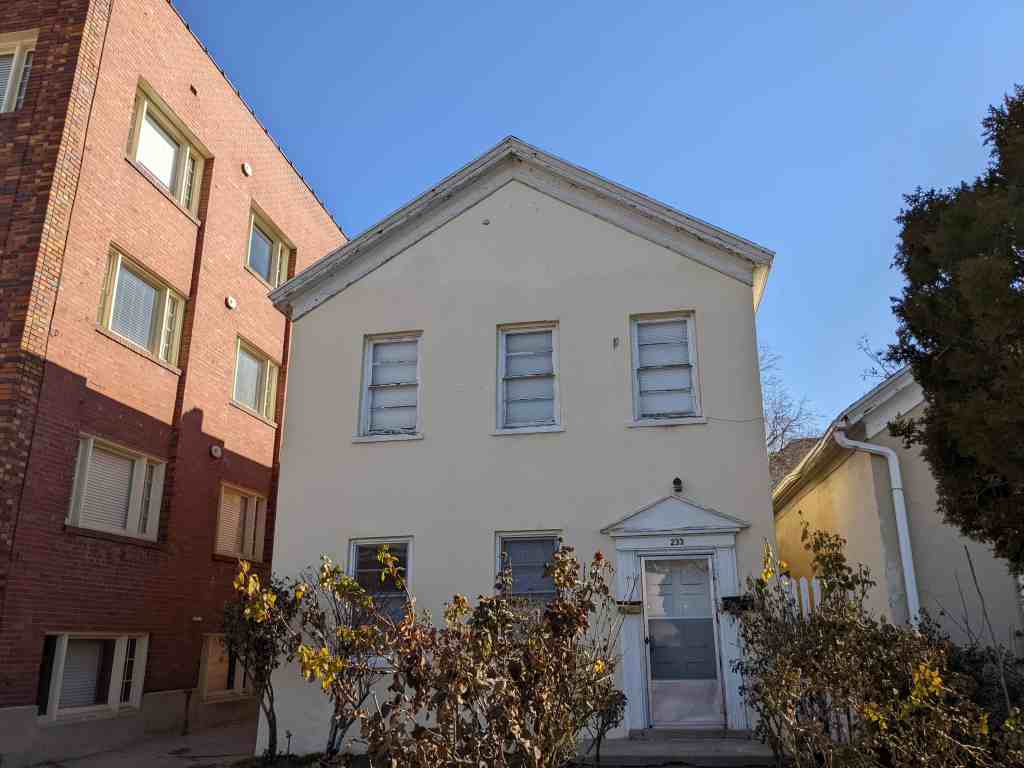
The Malin House, built as investment property in 1889 by Millard F. Malin, a carpenter/builder, is significant as one of only nine documented Utah examples of the Greek Revival inspired temple-form vernacular house type. The temple-form house originated in the Greek Revival period of American building, and typically has its short end to the street and a pedimented gable façade in imitation of monumental classical buildings. In its most common form, the house had symmetrical fenestration with a door placed to the side of center, and an opening leading to a side passage containing the staircase. Popularized by such books as Asher Benjamin’s Builder’s Companion and Minard Lafever’s Modern Builder’s Guide, it became one of the traditional house forms in New England and in the upper Midwest. The temple-form house migrated to Utah with the members of The Church of Jesus Christ of the Latter Day Saints in the years after 1847. The temple-form house type is important because it is one of several early house types in the state, and because it is a type traceable to a New England cultural hearth, it documents the important New England heritage of the early Mormon movement. It is one of seven basic house types that were found in Utah during the early years of settlement. These types are all traditional and include: the square cabin; the rectangular cabin; the hall and parlor house; the central passageway house; the pair-house; and the double pen house. The temple-form house was popular in early Salt Lake City. This fact is supported by early Sanborn Paris insurance maps, early photographs, and a surprisingly accurate “bird’s eye view” rendering of the city in 1870. The temple-form is a rare Utah house type today because most were located in what is now the central business district of Salt Lake City. As the business center grew, most of the homes were razed to make way for development. The basic temple-form type, exemplified by the Malin House, was easily expanded by adding one or two wings to the sides of the house. The most commonly encountered variant is referred to as a “modified” temple-form house and is characterized by the placement of the principle entrance in the side wing. Another variant of the house type has the door centered on the gable façade, does not have a side passage, and may or may not have side wings. The Malin House is a good example of the basic form from which these other variants were generated.
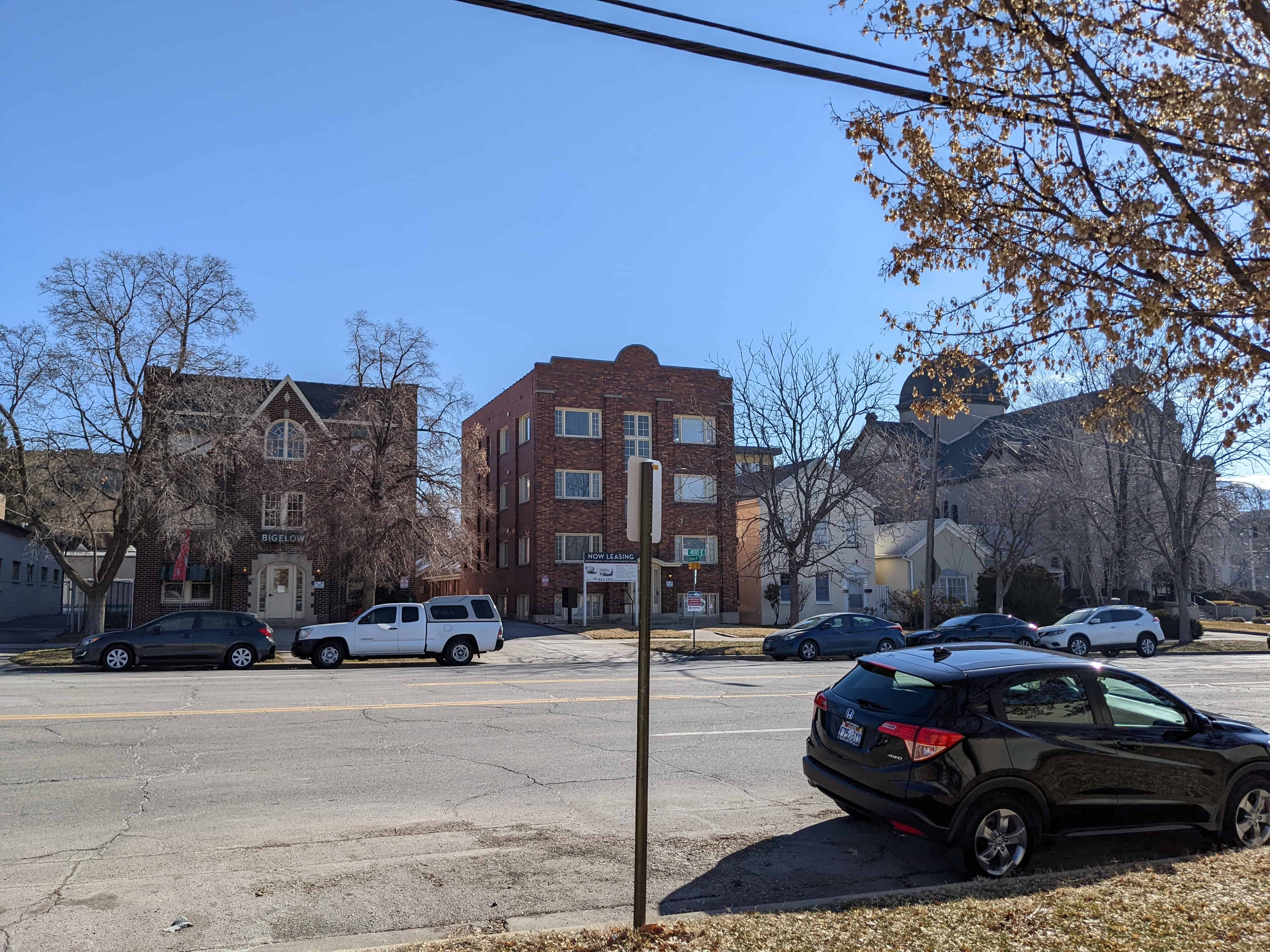
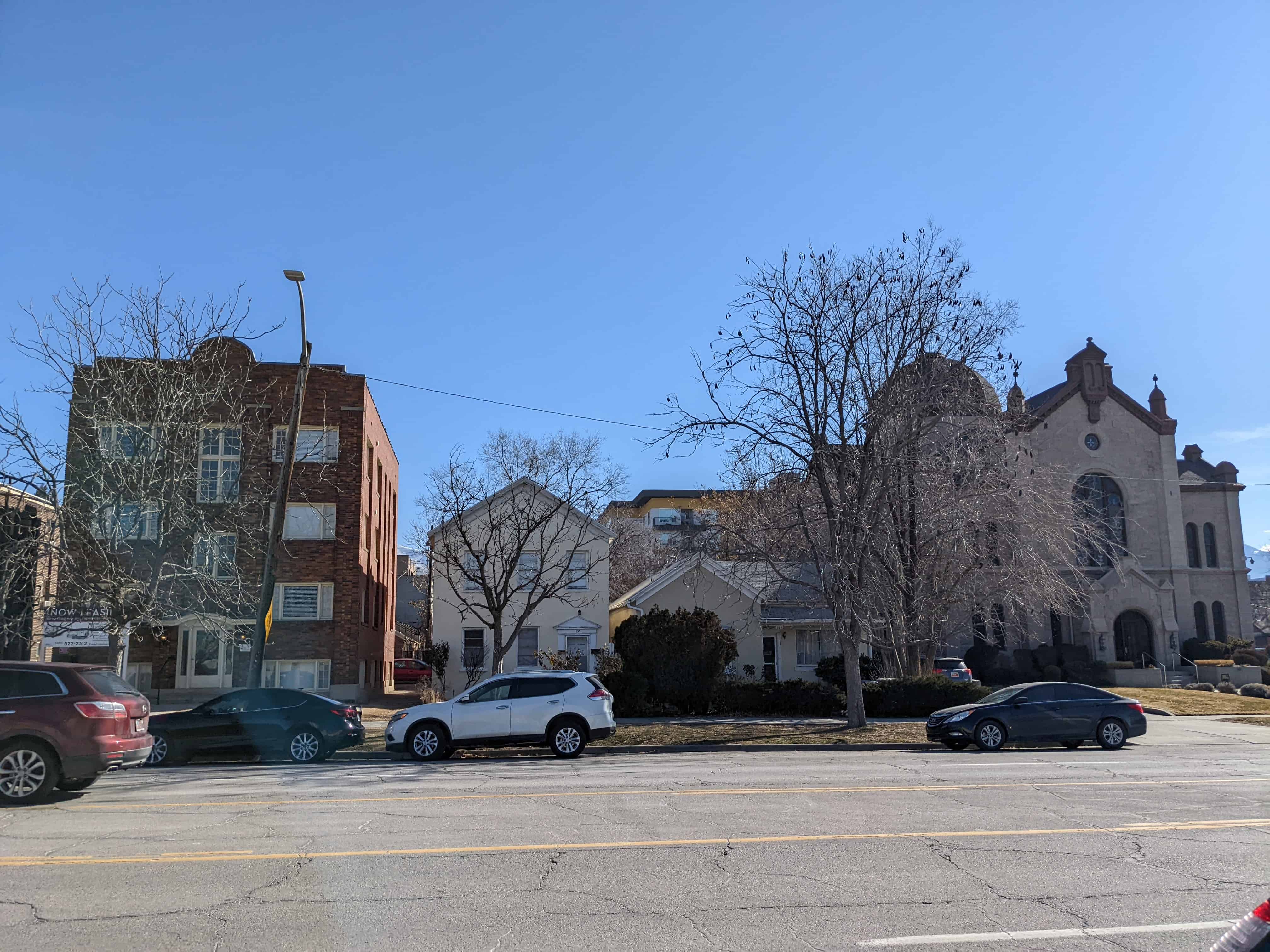
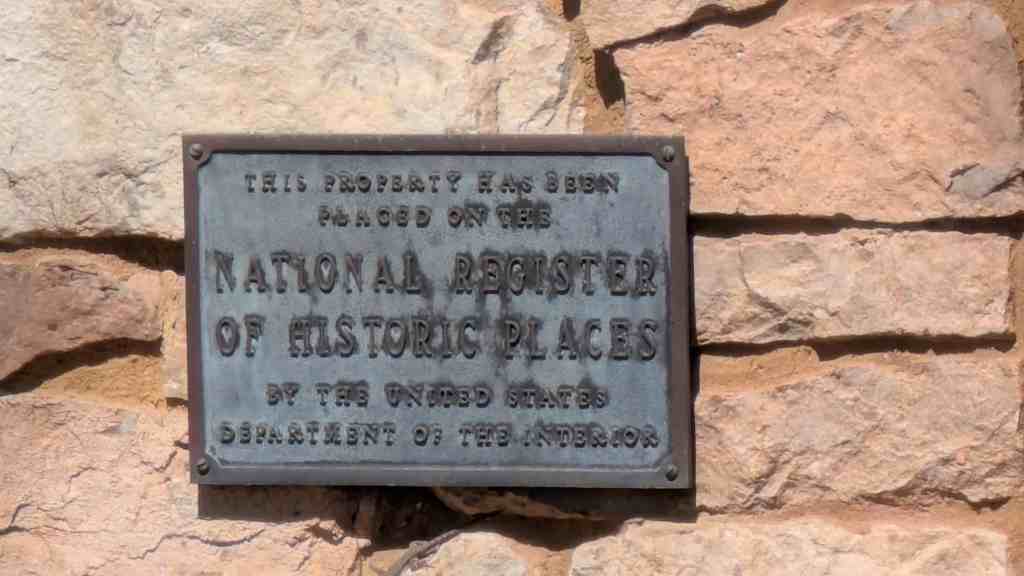
Located at 233 South 400 East in Salt Lake City, Utah and added to the National Historic Register (#83003173) on July 7, 1983. The text on this page is from the nomination form from when it was added to the register.
The Millard F. Malin House was built ca. 1889 as investment property by Millard Fillmore Malin on property he had purchased from his father, Samuel, in 1889. His father’s home, the Malin family home, was adjacent at 225 South 400 East (demolished), and on the other side was the home of his brother, Council B., 237 South 400 East, which Millard had built for him. Millard or “Phil”, and his wife, Annie, lived at 458 South 600 East for many years and rented out this house until 1933 when he turned the property over to his daughter, Laura Malin Everett, who also rented it out until selling it in 1937. Subsequent owners up to the present have continued to use the house as income property.
Millard Fillmore Malin was born in 1852 to Samuel and Mary Ann Bosely Malin and worked as a carpenter/builder his entire life. He performed all the construction tasks himself, including the shaping and laying of the foundation stones, the brickwork, and the rough and finish carpentry. His father was a stonecutter and mason and no doubt taught Millard much about the construction business.
“Phil” constructed many other houses in the city, most of which were modest, single-family residences which generally conformed to local building types and styles. This house is an excellent, but later, example of the temple-form, side hall plan house, which was a popular house style in the early decades of settlement in Utah.
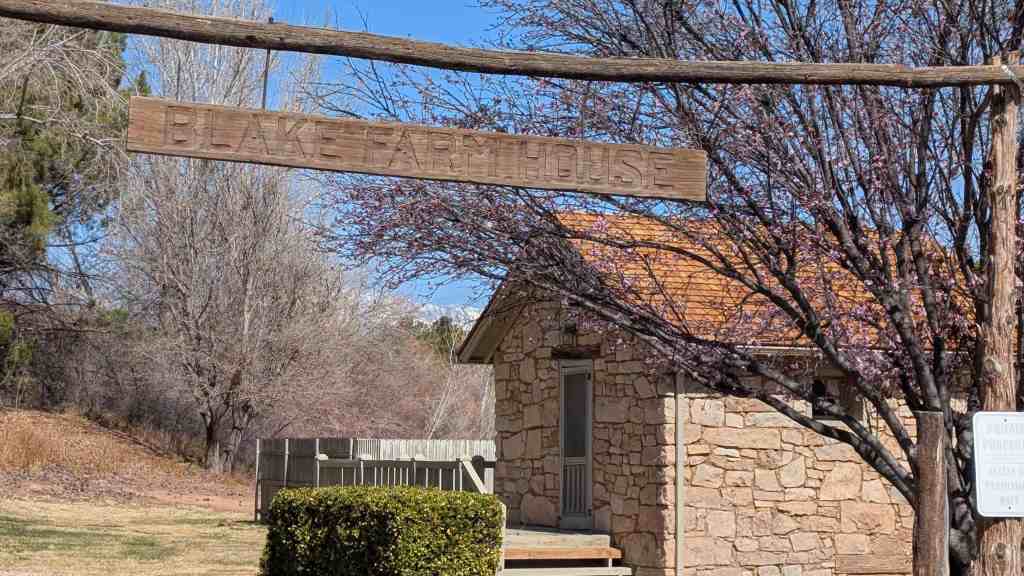
The Wallace Blake House is significant as an excellent example of the vernacular style of architecture using native materials in Utah’s Dixie. Although it was constructed in 1908, more than fifty years after the initial settlement of the area, the Wallace Blake House reflects the style and craftsmanship of houses constructed a half century earlier. In this vein the house stands as one of the last of the pioneer era and marks the transition from house construction characterized by a local style, the use of local materials and local craftsmen to one more general and universal in nature.
The Blake House is located at 965 Manzanita Road in St. George, Utah (coordinates N 37.04631 W 113.60530 )and was added to the National Historic Register on (#78002709) November 14, 1978.
The Wallace Blake house was constructed in 1908 with native stone originally used in the construction of the Price City LDS Chapel built in 1876. The house was constructed by Dode Wirthen a local stone mason who constructed many rock buildings in Utah’s Dixie. Woodwork on the house was done by Brigham Carpenter.
Wallace Blake was born January 31, 1880 at St. George, the son of Frederick and Eliza Barnett Blake. He married Isadore Larsen, a native of Bloomington on October 24, 1901. They purchased the home site and farm in June 1908 and immediately commenced construction of the house. Wallace Blake was initially a farmer and stockman by profession but later turned his attention to mining activities. In 1920 Isadore Blake died shortly after giving birth to the couple’s sixth son. The loss of his wife was a tragic event to Wallace Blake and he soon lost interest in farming or remaining in the house he had shared with his wife for twelve years. On October 31, 1921 Blake exchanged his house and property for a house in St. George owned by James S. Jones.
The Jones family lived in the house until 1928 when they sold the property and house to Albert A. McCain who remained in the house until 1937. Both James S. Jones and Albert McCain continued to farm the land. Albert McCain also helped make brooms with a nearby neighbor, Alfred Carpenter.
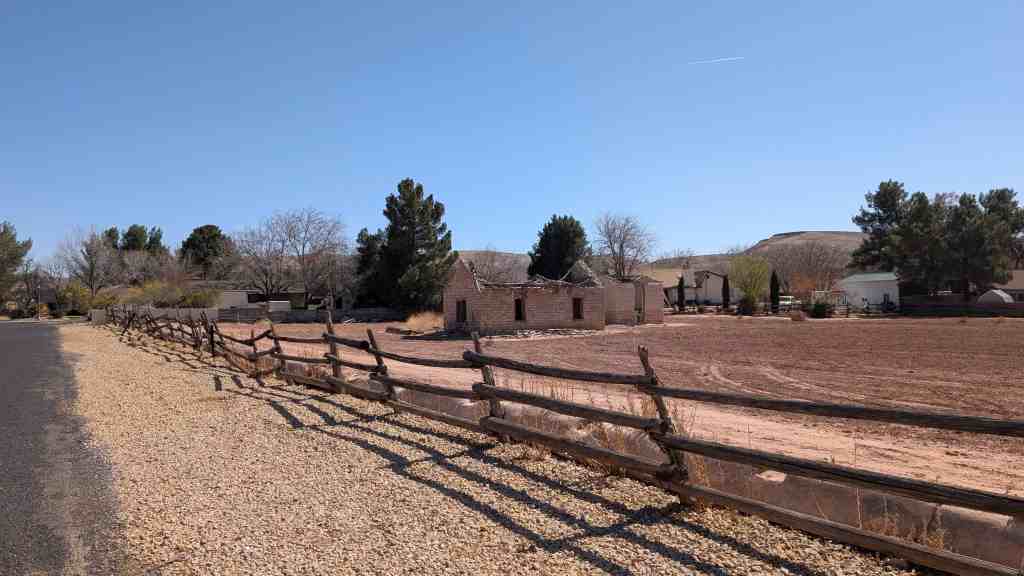
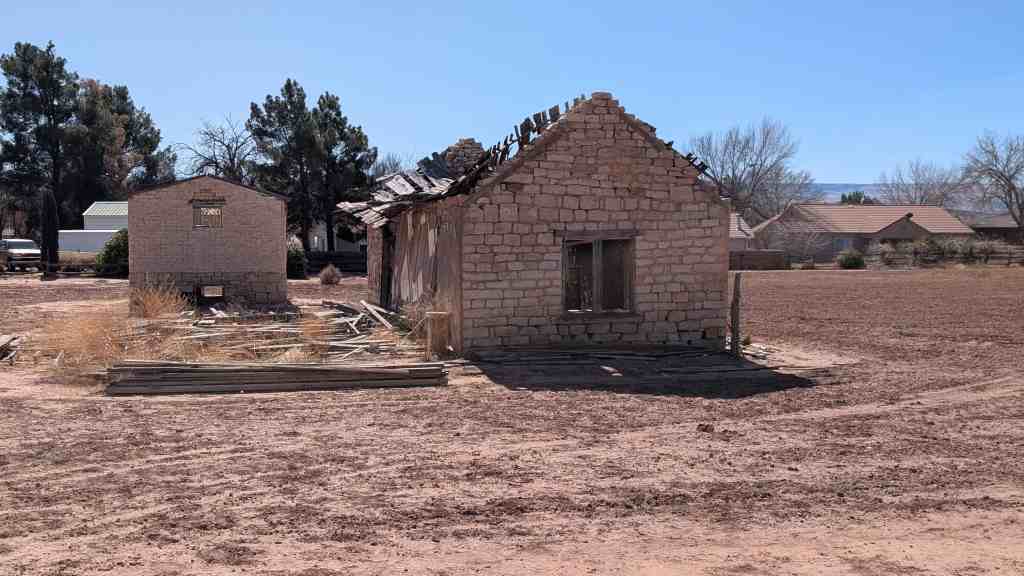
On December 21, 1937, Washington County took over the McCain property and held it until March 26, 1940 when D. H. Heaton redeemed it. The house was used on occasion by Heaton and his sons while they raised cattle and sheep in the area. However during the last quarter century the house has been allowed to deteriorate through neglect and lack of use. ln June 1976 the house was purchased by Mr. and Mrs. Matthew R. Simmons who plan to restore the house. The house is located in the new community of Bloomington and and serves as an important tie to the past for the residents of the modern recreation community of Bloomington.
Description:
The main structure of the Wallace Blake House is a one room, one story three bay front farm house rendered in coursed rubble limestone having one chimney of stone at the east gable end. The massing of the various sections of the structure indicate that the three bay rectangular possibly one room house was built first with a centered rear projecting bay added later to form a ‘T’ shape plan. This rear addition has a hipped roof with an off-centered stone chimney at its rear wall.
The third addition also in stone was added as a wing to the east gable end of the original structure. This addition extends back connecting with the rear bay of the house making the overall plan somewhat resemble an “L” shape. The addition was made shortly after completion of the original structure. A lean-to shed was the last apparent addition to the building, it extended along the east side of the third addition.
Entry portals are to be found on all sides of the building and its various additions. The windows flanking the original entry on the structure are the largest and were probably two-over-two sashes or possibly six-over-six. The remainder of the windows to be found in the structure are somewhat smaller and were most likely two-over-two. The third addition has two sets of windows set side by side into the front wall of the house. All window and door tops are flat supported by wood lintels. All walls are load bearing masonry with the original portion of the house showing some evidence of stucco having been applied to the exterior of the walls. An ancillary out building used &s a granary is set just to the west and has its rear wall in line with the rear wall of the second addition rear wall. This structure has a rectangular shape having a west entry. Stone used in this structure is also covered rubble and is somewhat larger than that found in the adjacent house. The roof is a gable shape having a roof slope less than that of the main house. The windows in this building are set high in the walls, set under the eaves. Their shape is basically rectangular laid out vertically. Basement windows in this structure project about two feet above the ground level with the opening supported by heavy timber lintels.
Both the main house and granary were built approximately at the same time and have walls about 18″ thick, the roofs of the buildings were composed of vertically layed flat sawed lumber with shingles covering the surface. The ridge lines of the roof were capped with one of four inch boards.
The timbers used throughout the house are from Main & Trumbull, Arizona, an important source for lumber for construction projects in Utah’s Dixie. Many of the original shingles remain on the roof. The interior walls are plastered and several rooms covered with wallpaper. Originally there was a fireplace in the living room (later closed and replaced by a stove) and stoves in each of the other three rooms.
This tithing granary was built about 1905 and is on the National Register of Historic Places as one of only a few well-preserved tithing buildings in Utah. The successful “in-kind” tithing system of The Church of Jesus Christ of Latter-day Saints was in place between 1850 and 1910. Tithing lots, which usually included a granary, an office, and several auxiliary structures, were facilities for collecting, storing, and distributing farm products donated as tithing by Church members in cash-poor agricultural communities throughout the state. These tithing lots were a vital part of the community, serving as the local center of trade, welfare assistance, and economic activity. Tithing lots were also important as the basic units of the Church-wide tithing network centered in Salt Lake City.
All of the buildings on the tithing lot were demolished, except the granary, in the 1950s. The Doug and Ruth Clark family later donated it to the Martin Harris Camp of Daughters of Utah Pioneers. The granary was moved to its present site in 2018 and restored. It now houses a DUP satellite museum with artifacts collected from many sources in the area that represent Clarkston’s heritage. Stone from the original foundation was used to create the marker.
This is Daughters of Utah Pioneers historic marker #592 located at 88 West Center Street in Clarkston, Utah. The marker was dedicated in 2022.
The Tithing Granary was moved on September 8, 2018 to this location at 88 West Center Street from 94 South 100 East (10212 North 8700 West), it was added to the National Historic Register (#85000250) on January 25, 1985.
Built c. 1905, the Clarkston Tithing Granary is historically significant as one of 28 well preserved tithing buildings in Utah that were part of the successful “in kind” tithing system of The Church of Jesus Christ of Latter-day Saints (LDS or Mormon church) between the 1850s and about 1910. Tithing lots, which usually included an office and several auxiliary structures, were facilities for collecting, storing, and distributing the farm products that were donated as tithing by church members in the cash-poor agricultural communities throughout the state. Tithing offices were a vital part of almost every Mormon community, serving as local centers of trade, welfare assistance, and economic activity. They were also important as the basic units of the church-wide tithing network that was centered in Salt Lake City.
The Clarkston Tithing Granary was built c. 1905, probably at about the same time as the construction of the nearby tithing office, which was demolished in the late 1950s. This part of the block was owned by the LDS church and was used as the tithing lot where all the farm products that were donated as tithing were stored. This granary is the only building or structure that remains from the tithing yard. The tithing office, which was located on the corner to the west of the granary, was demolished around 1957, the scales for weighing wagons were removed at an unknown date, and corrals and other granaries that may have been part of the tithing lot are no longer there. A frame building in the center of, the block behind this granary is reportedly the old Relief Society Granary. During the late nineteenth and early twentieth centuries, the Relief Society, the women’s organization of the LDS church, took upon themselves the responsibility for collecting and storing grain for emergency or welfare assistance. That program was separate and distinct from the tithing program, therefore that building and others like it around the state are not included in the Tithing Building Thematic Resources nomination.
The design of the Clarkston Tithing Granary is a specific type of granary that is found in other northern Utah communities, especially in Cache Valley, but which was possibly a standard design approved and issued by the LDS church from its headquarters in Salt Lake City. Although no direct reference to the Clarkston Tithing Granary has been found in correspondence from the Presiding Bishopric’s Office, which administered the tithing program, a letter pertaining to a granary of similar construction in Garland substantiates the assumption that this was a standard design. It included the following description:
We prefer that you follow the granary plan sent you herewith, and known as granary No. 6, built of 2×4 lumber, spiked and set on three parallel foundation walls, which we find the best style of granary for tithing purposes.”
That description, though not very detailed, fits the Clarkston Tithing Granary, as well as the Lewiston Relief Society Granary, and is very similar to the Lewiston Tithing Granary. A number of other such granaries featuring walls made of 2x4s stacked on top of each other have been identified in farmyards in Lewiston and other northern Utah communities, indicating that it was a popular type whose origin was not solely the LDS church.