• About JacobBarlow.com
  • Cemeteries in Utah
  • D.U.P. Markers
  • Doors
  • Exploring Utah Email List
  • Geocaching
  • Historic Marker Map
  • Links
  • Movie/TV Show Filming Locations
  • Oldest in Utah
  • Other Travels
  • Photos Then and Now
  • S.U.P. Markers
  • U.P.T.L.A. Markers
  • Utah Cities and Places.
  • Utah Homes for Sale
  • Utah Treasure Hunt

JacobBarlow.com

~ Exploring with Jacob Barlow

JacobBarlow.com

Tag Archives: NRHP

John Henry Layton House

19 Friday May 2023

Posted by Jacob Barlow in Uncategorized

≈ 2 Comments

Tags

Davis County, Historic Homes, Layton, NRHP, utah

John Henry Layton House

The John H. Layton farmstead, dating from the 1880s, is significant as one of few well preserved examples of a homestead in Utah, a pattern of settlement that developed after 1869 which diverged from the typical plan of a Mormon community. The house, erected in the late 1890s, summer kitchen, well house, granary, and barn have received few alterations, and as a unit are representative of a way of life, the family farm, that is becoming obsolete. This cluster of buildings is also significant as the physical remains of one of Layton’s prominent farmers, John Henry Layton, son of Christopher Layton, the pioneer after whom Layton was named. The house itself is particularly significant because it was designed by William Allen, the only architect in Davis County at the time of its design, and the leading architect in the county until the 1920s. It is one of a very limited number of houses designed by William Allen that has not been dramatically altered. It is of pattern book design, one that may have been used by Allen in the Joseph Adams House in East Layton, and repeated in the George W. Layton house in West Layton. Because the house has received few major alterations it stands as a well preserved example not only of a type that was preferred by Allen, but also one that was considered suitable for a prominent farmer. With some variation in the treatment of ornamentation this type suited a wide range of tastes. The condition of the interior of the house is particularly noteworthy. It is one of few older houses in Utah in which the original woodwork is completely intact. It is a superb example of the technique of wood graining, a procedure by which an inferior wood, pine, for example, was painted to resemble a more high quality wood.

Located at 683 West Gentile Street in Layton, Utah and added to the National Historic Register (#82004123) on February 11, 1982.

The John H. Layton farmstead was first occupied after 1883 when John Henry Layton purchased the land from his father, Christopher Layton. The family originally occupied a two room adobe house that stood in the location of the present summer kitchen. The two story brick house that is presently the focus of the farmstead was built in the late 1890s. The Abstract of Title does not indicate the exact date of construction, but the house was occupied as early as January of 1898. At that time Frankie Josephine Layton Dickson, the twelfth child of John Henry and Hannah Maria Layton, the original owners, is reported to have been born in the house. The house was designed by William Allen, the only architect working in Davis County at the time.

John Henry and Hannah Layton are reported to have been among the first settlers in West Layton, arriving in 1880. John Henry, son of Christopher Layton and his fifth wife, Isabella Golightly, was born in Grantsville in 1855. He was the eighth of thirty-one sons born to Christopher Layton from ten marriages. Christopher Layton was the pioneer after whom Layton was named, and one who made significant contributions to the establishment and growth of several Mormon communities. John Henry and Hannah were married on January 30, 1879 in Salt Lake City. Hannah was the daughter of Edward Phillips, one of the first settlers in Kaysville. John Henry made a living by farming; growing club barley, hay, and sugar beets, and by raising livestock; cattle, sheep and hogs. He and his wife were members of the West Layton Ward of the LDS Church. Although John Henry was not an active church member, Hannah did much to encourage musical activities in the ward and served as ward organist. She also served as the first counselor to the Young Ladies Mutual Improvement Association of the West Layton Ward, and was a member of the Davis Stake Primary Association for twenty-five years. John Henry and Hannah had thirteen children, ten of which were raised to maturity on the Layton farm.

John Henry’s activities in the business world included participation as one of the organizers of the First National Bank of Layton, serving as the director of the Ellison Ranching Company, and owning stock in the Layton Sugar Company, the Farmer’s Union Store, the Davis and Weber Counties Canal Company, and the Kays Creek Irrigation Company.

The Layton farm can be considered as a late example of a homestead, a pattern of settlement that developed after the Homestead Act was passed in 1869. Homesteading was the first significant development away from the Mormon plan which consolidated homes as a nucleus in a town, and designated fields on the perimeter of the town for farming. John H. Layton’s farm, however, was not the typical homestead in that John Henry did not acquire the typical parcel of 160 acres, but rather purchased his land from his father. He was a homesteader in that he chose to live and farm large areas of land that were remote from the principal area of settlement.

The Layton farmstead was not only a local center of farm activities, but it was also a guest house for those Layton relatives who traveled from Arizona to Utah to be married in the temple in Salt Lake City.

John Henry died in 1920, and Hannah Layton continued to live on the farmstead until her death in 1939. The estate passed from Hannah to her children who divided it among themselves. The house and land immediately surrounding it passed to Lottie Jane Layton and Luella Layton Humphries. They lived in the house until their deaths. Luella left her half interest in the house to her son, Richard Humphries, and Lottie left her portion to other members of the family. Richard Humphries eventually bought Lottie’s half of the property and lived in the house until 1973. At that time lie sold the property to the Lakewood Investment firm. A real estate contract indicates that the house and several acres of land were then sold to Spencer Lynn Nunley for $38,000. Nunley was a house painter from Salt Lake City who bought the house to redecorate and resell. Sharon and E. Keith Slatore bought the property from tile Nunley’s in 1974, and are the current owners. Mr. Slatore is a civil engineer.

William Allen, the architect who designed the Layton House, was originally from London, England. He settled in Kaysville at the age of thirteen and worked as a brick mason. After having completed a correspondence] in architecture he became the leading architect in Davis County. The Kaysville Tabernacle, the Kaysville Presbyterian Church, the Kaysville City Hall, the Kaysville Elementary School, the Barnes Block in Kaysville, and the Davis County Courthouse in Farming ton were among his major works. He also designed a significant number of large brick residences throughout the county.

Newton Reservoir

19 Friday May 2023

Posted by Jacob Barlow in Uncategorized

≈ 1 Comment

Tags

Cache County, Newton, NRHP, utah

Newton Reservoir

The town of Newton was settled in 1870, Because of the lack of sufficient rainfall for the growing of crops it was necessary to construct a long canal to bring irrigation water from Clarkston Creek, When it appeared that the creek would not provide sufficient water during the dry summer months a meeting was held in March, 1871 and a decision made to build a dam to impound the waters of Clarkston Creek.

The dam was built in 1871 and the resulting reservoir was the first irrigation reservoir built by Americans.

The dam washed out in heavy runoffs in 1874, 1877, and 1888. Each time it was rebuilt. In 1897 the dam was lined with rock and its height raised three feet.

In 1941-1946 a new dam was constructed below the old by the Work Projects Administration and the Bureau of Reclamation, The capacity of the reservoir was increased from 1566 to 5300 acre feet and the irrigable land from 1600 to 2225 acres.

Newton Reservoir is located at Newton, Utah and was added to the National Historic Register (#73001860) on November 30, 1973.

The new dam site constructed in the 1940’s is located 1 and 1/2 miles downstream from the original dam site. After the waters of the new dam backed up to the old dam a portion of a swale on the west of the old dam was cut to allow waters from the new dam to enter the old reservoir and vice-versa. The major portion of the reservoir exists as it was built and rebuilt, 1871-1888. Only the original spillway has been removed.

Lincoln Hall

19 Friday May 2023

Posted by Jacob Barlow in Uncategorized

≈ 1 Comment

Tags

Mt Pleasant, NRHP, Sanpete County, utah

2023

Lincoln Hall, built in 1893. It is a two-and-one-half story brick residence; Victorian style; it features segmentally arched window bays, Eastlake trim on the porches, a paired bracket cornice and dormers. Minor exterior and interior changes have been made.

It was located at ~165 West 100 South in Mt Pleasant, Utah and was part of Wasatch Academy. It was demolished sometime between 2016 and 2022.

It was originally the home of George Howell Marshall and wife Mary Esther Waddell, the timeline shown below was borrowed from this page:

Indiana Hall

19 Friday May 2023

Posted by Jacob Barlow in Uncategorized

≈ 1 Comment

Tags

Mt Pleasant, NRHP, Sanpete County, utah

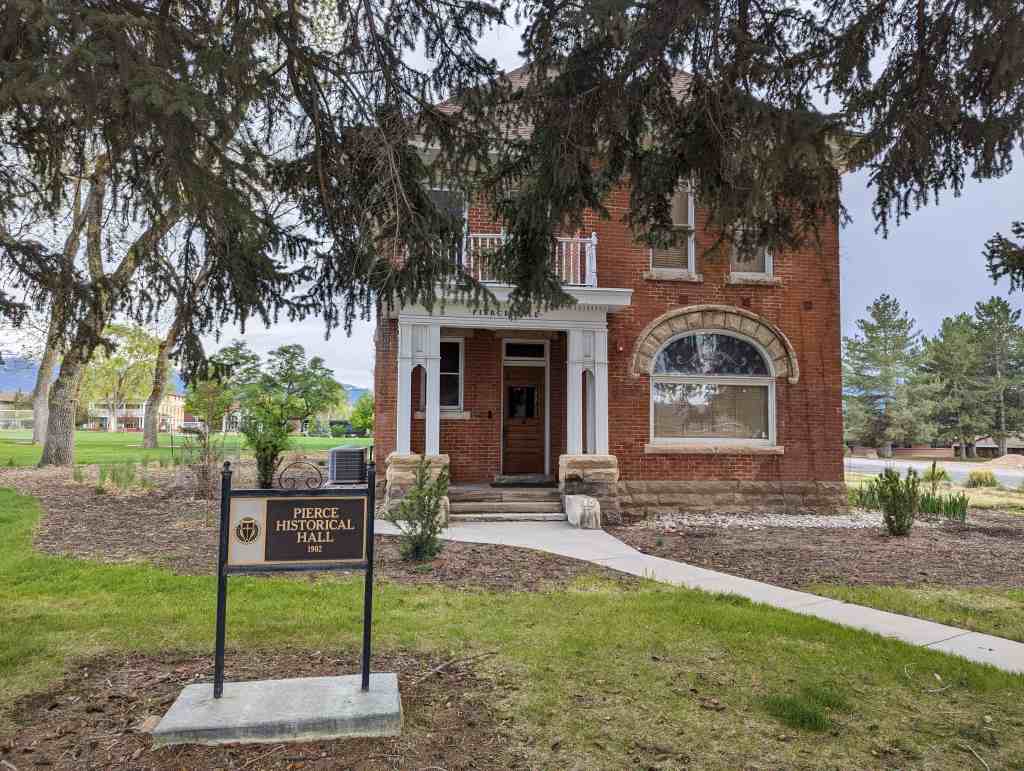
Indiana Hall, built in 1900. It is a two-story brick residence; Victorian style; it features stone trim, Roman-arched window and door bays with rusticated stone voussoirs, art glass transom windows; other windows are straight-arched with rusticated stone sills and lintels; fancy interior stairway, moldings and fireplace are intact; the upper section of the front porch is now enclosed.

It is located on the Southeast corner of 100 South and 200 West in Mt Pleasant, Utah and is part of Wasatch Academy.

Bertha Eccles Community Art Center

19 Friday May 2023

Posted by Jacob Barlow in Uncategorized

≈ Leave a comment

Tags

Historic Homes, NRHP, Ogden, utah, Weber County

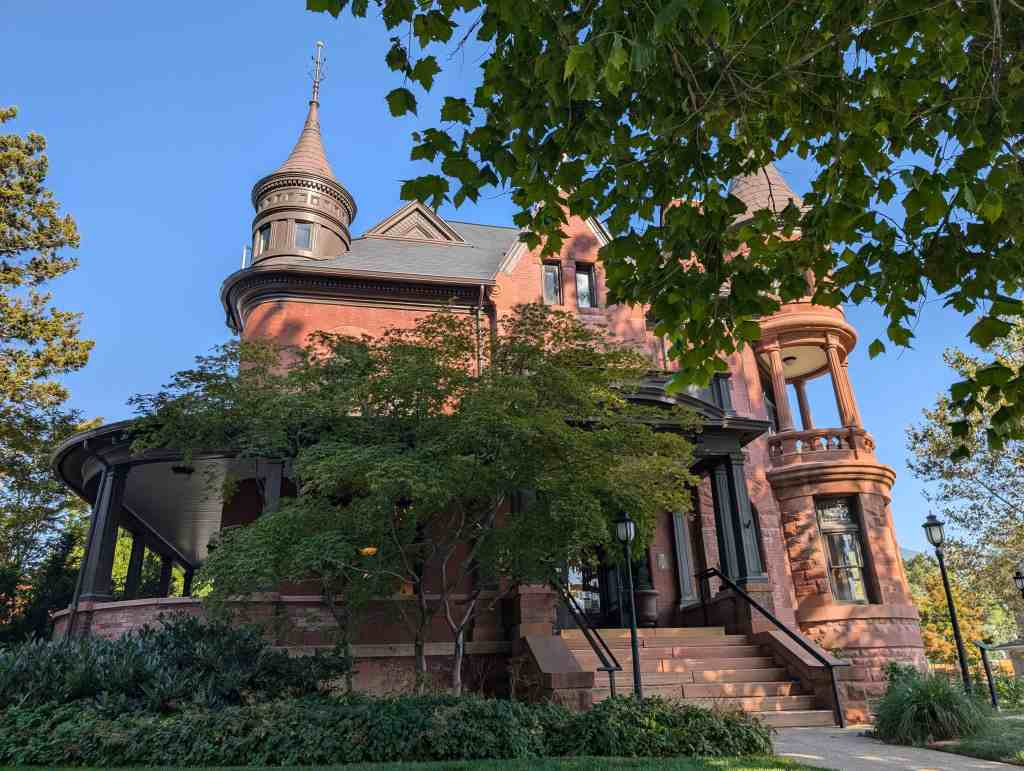
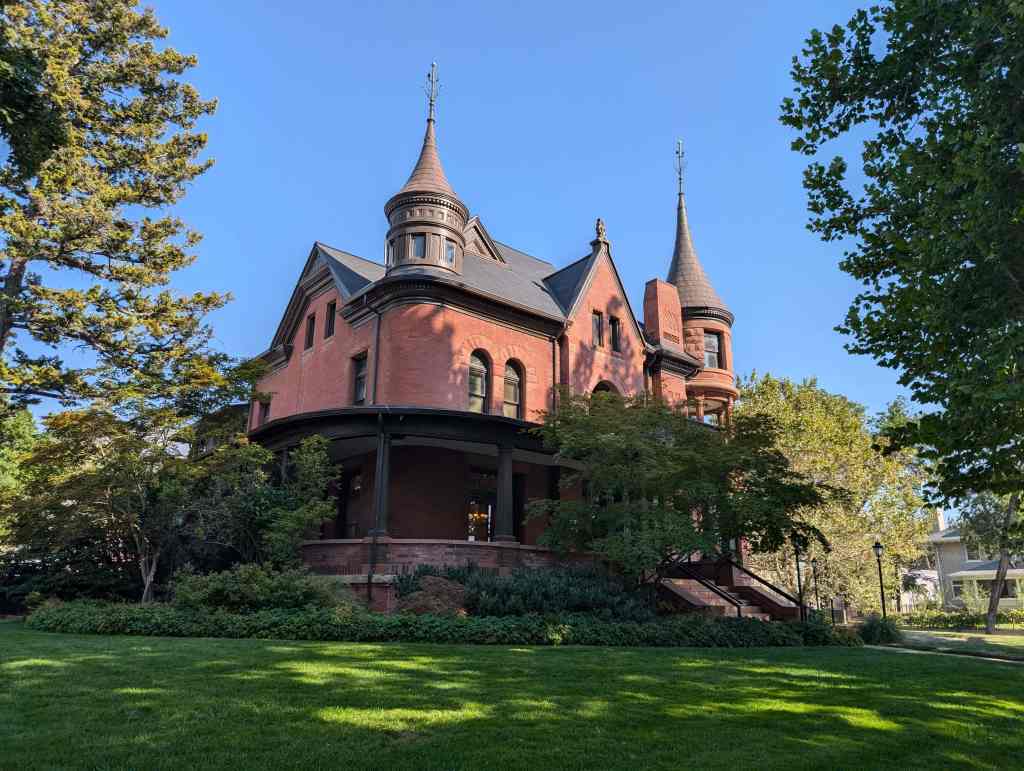
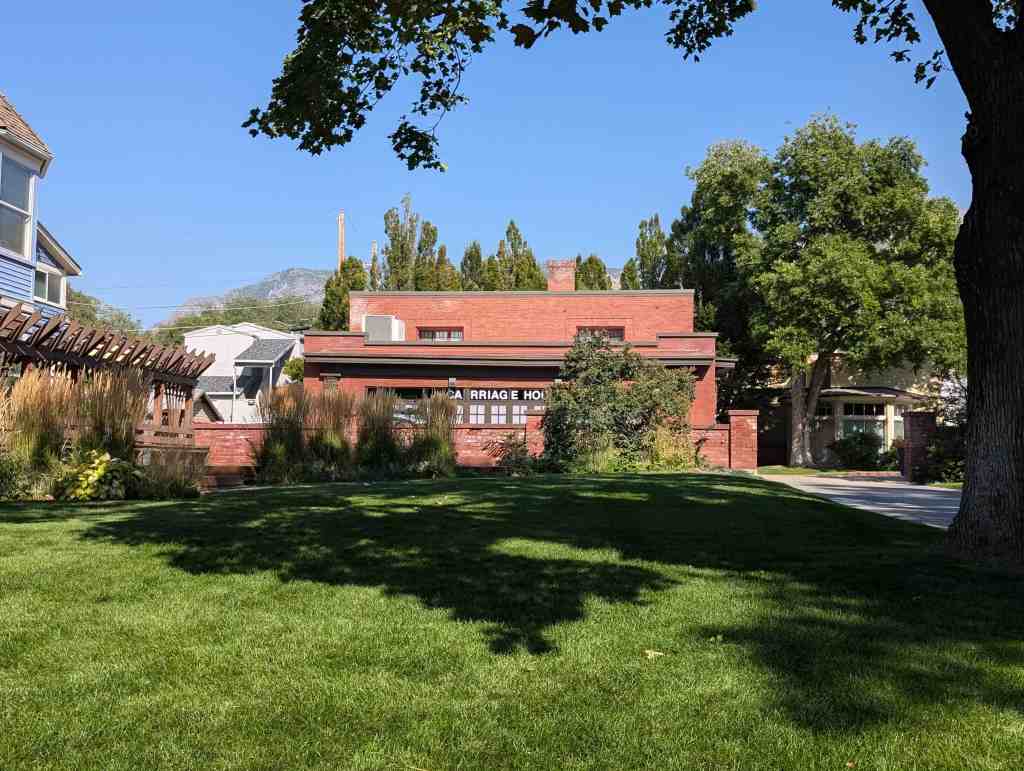
Bertha Eccles Community Art Center / Bertha Eccles Hall

One of the primary sources of wealth in 19th Century Utah was mining. Often this revenue was then invested in banking, commercial and agricultural ventures to multiply the wealth of already successful entrepreneurs. The case of James C. Armstrong is no exception.

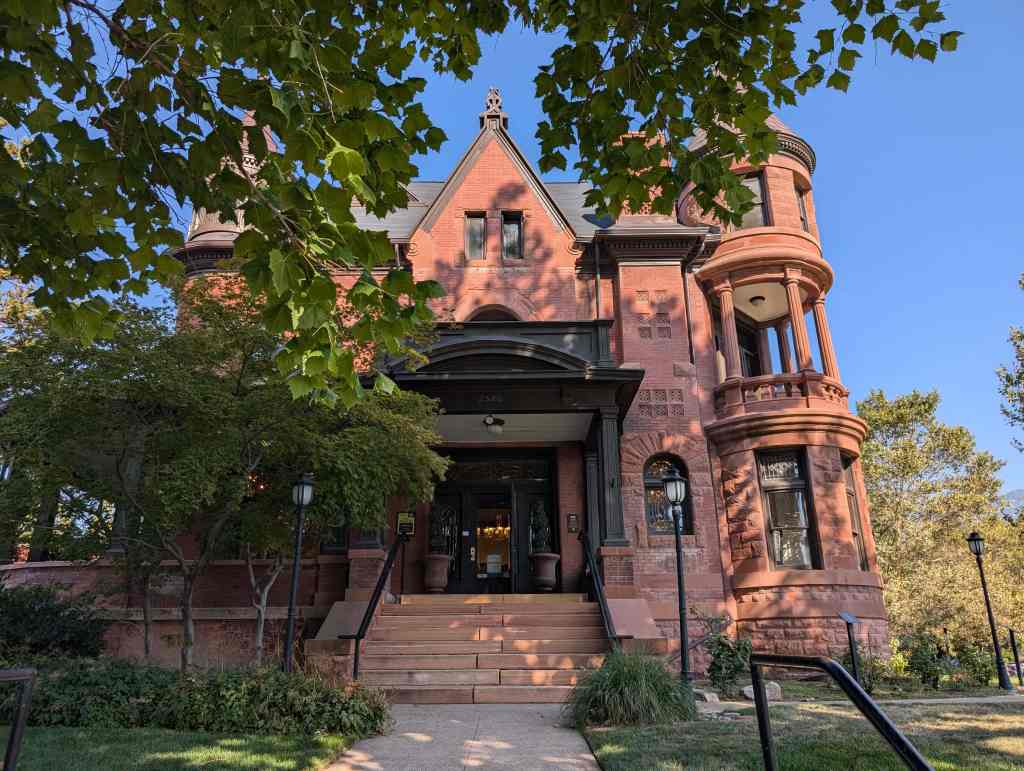
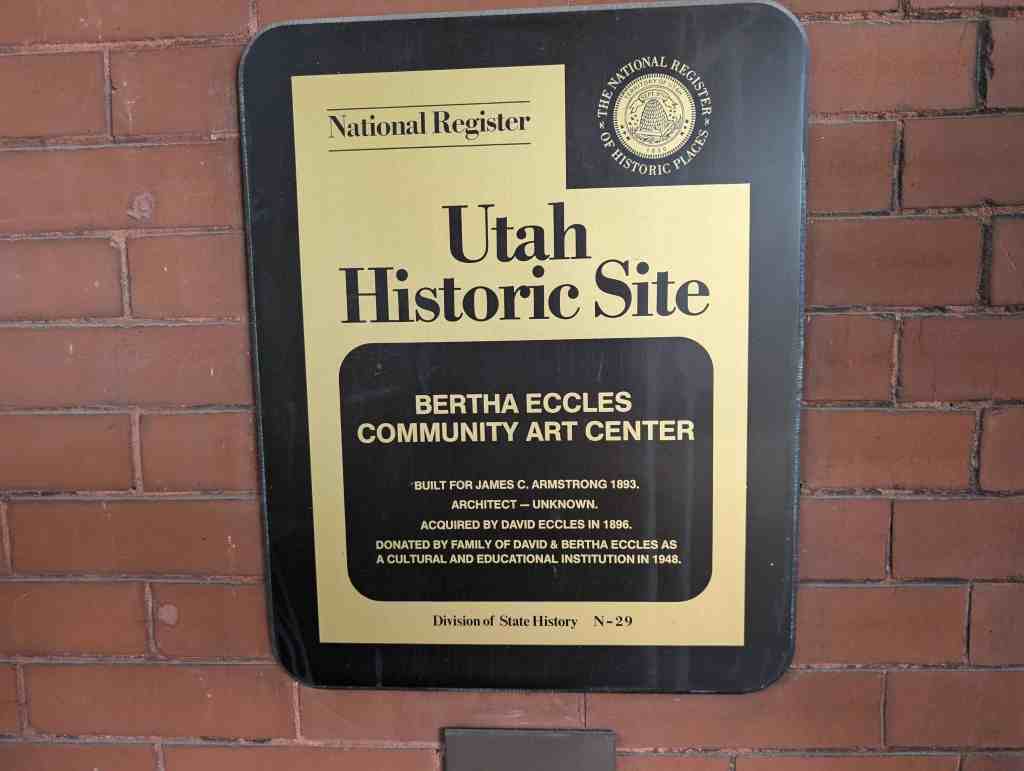
The Bertha Eccles Community Art Center is located at 2580 Jefferson Avenue in the Jefferson Avenue Historic District and in Ogden’s Central Bench Historic District in Ogden, Utah and added to the National Historic Register (#71000865) on May 14, 1971.

  • mentioned in Jefferson Avenue Historic District:
    Two buildings within the district were already listed individually in the National Register prior to the district being listed. These include the Bertha Eccles House, built in 1893, and located at 2580 Jefferson.

    also,
    Some architect-designed homes are known (i.e., 2523 Jefferson was designed by William W. Fife, a prominent Ogden architect), while others show the originality and sophistication that suggest an architect’s involvement (i.e., 2580 Jefferson and 2504 Jefferson).

    also,
    The townspeople built impressive brick buildings and invested in a host of new export industries which were serviced by the railroad: canning, flour mills, sugar beet production. One example of this is David Eccles (2580 Jefferson) who was the president of the Amalgamated Sugar Company and was instrumental in the development of other Ogden industries as mentioned previously. After his death, his son David C. Eccles (607 25th Street) took over as vice-president and general manager.

With wealth from the mines, he invested in the Commercial National Bank of Ogden and became its president. He also served on the Bear River Water Board, as treasurer of the Union Publishing Company and as a Weber County commissioner in 1897 and 1898. Armstrong used part of his money to build a lovely home on Jefferson Avenue in 1893. The architect is unknown. Apparently the contractor was Joseph T. Johnson.

In 1896, Armstrong sold the home to David Eccles, another prominent businessman in northern Utah. His interests extended to lumber, land, railroads, banking and sugar industry. In time he became one of the state’s most significant financiers with his Influence extending far beyond the state’s boundaries.

David Eccles’ story is in the Horatio Alger’s tradition. Born in Scotland, he immigrated to Utah with his family, new converts to Mormon ism in 1863.

After locating in the Ogden area, David’s father, who was blind, made various articles on his wood lathe which his son peddled to people in the Ogden area. From this lowly beginning the young man rose to great financia prominence before his death in 1912.

His first wife, Bertha Jensen Eccles, was born in Denmark in 1857. At age ten, she also came to Utah with her family, walking much of the way. Living in Huntsville also, she grew up knowing the boy she later married. (1875) Their lovely home on Jefferson Avenue was many years removed from that beginning.

Because of her wealth and the opportunities it provided for travelling Bertha Eccles became a prominent influence in Ogden ‘s educational and social life. Not only did her home provide her family with the best in cultural opportunities, but it became a center for Ogden’s cultural festivities and social activities. Mrs. Eccles became one of the founders of the Girl Scout movement in Utah. She requested that her home remain in use as a center for these kinds of activities. After her death it was given to the L.D.S. Church. Then, in June, 1948, the home was presented to Weber Ste College by the Church, where it became a women’s dormitory and College Social Center. When the college moved to its new campus in about 1956, the home reverted to the L.D.S, Church again. About this time (1956-1959), the art council acquired the home for its use, as a gift from the church.

Since that time it has served as the Bertha Eccles Community Art Center. Various groups make direct use of it — the Junior League of Ogden, Ballet West’s Ogden Office, Ogden’s Symphony Guild, the Palette Club, and the Child Culture Club, In addition, art works are constantly on display. Classes in graphics, ceramics, painting, drawing, sculpture, drama, ballet, etc., are taught during nine months of the year. Last season over 35,000 people visited and used the center.

Thus this lovely Victorian home remains an example of early mining and commercial wealth spent on architecture which remains a cultural catalyst for the community. The qualities of Bertha Eccles still permeate the premises. With pride the community now honors her and seeks the preservation of this center.

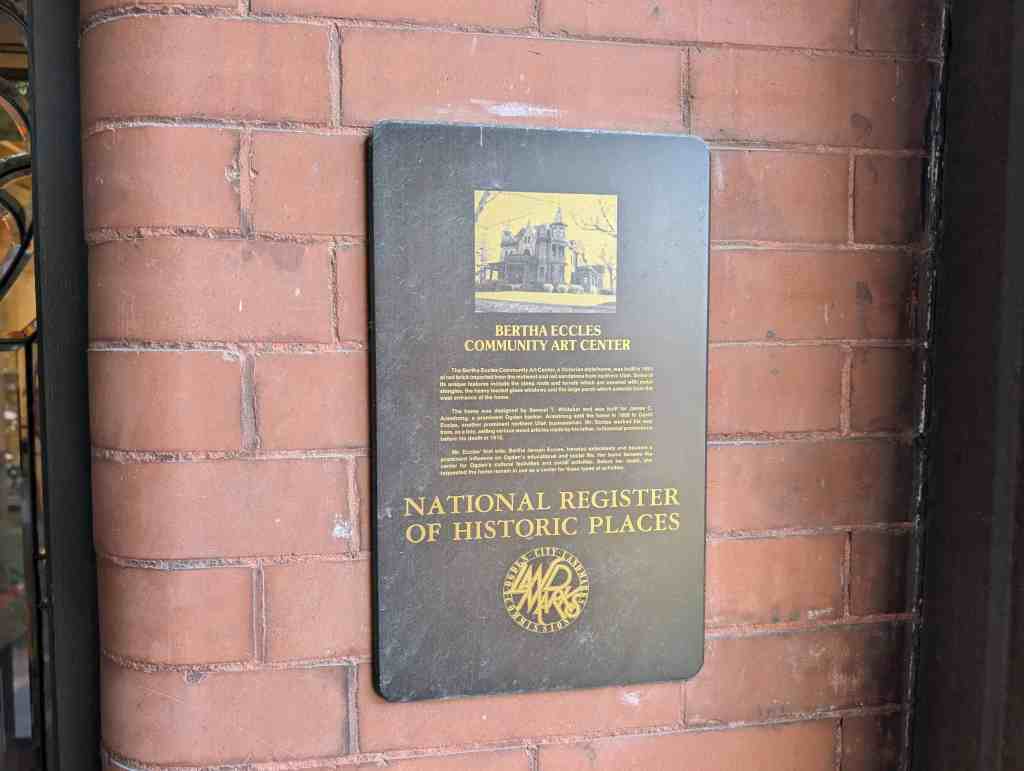
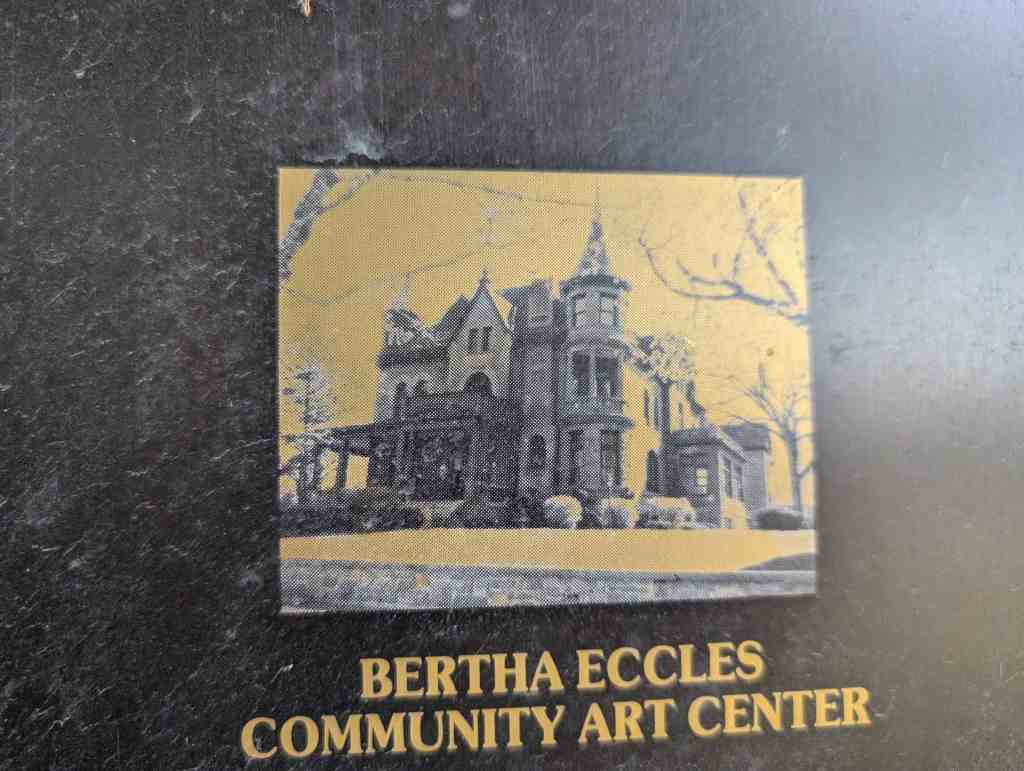
Bertha Eccles Community Art Center

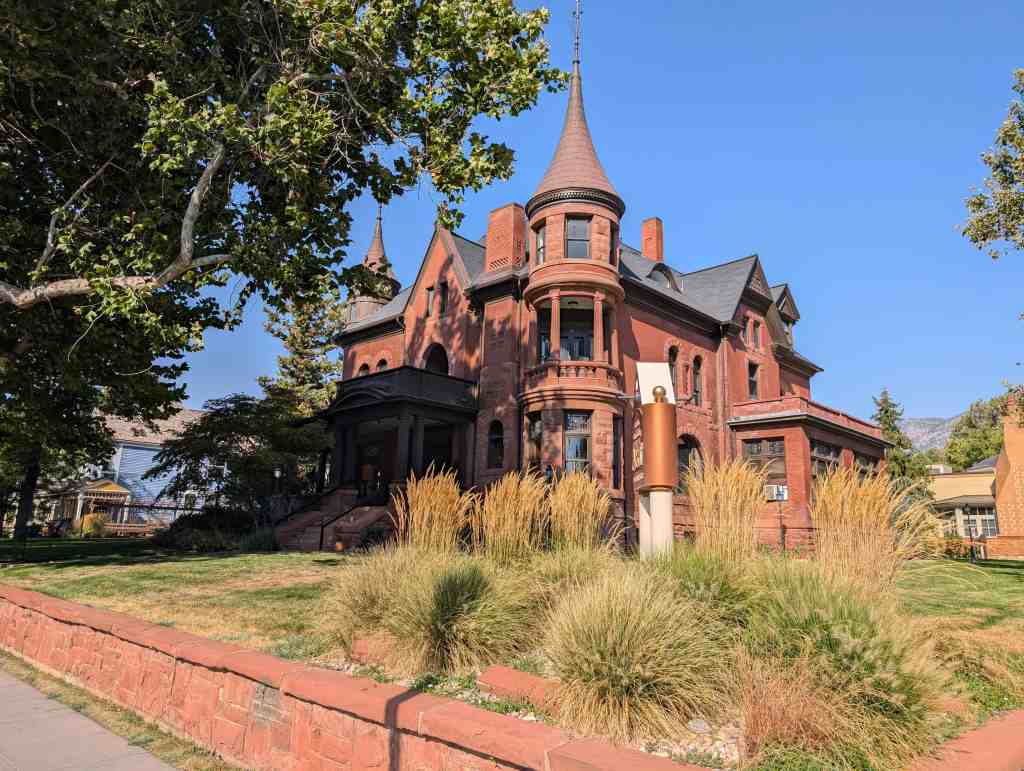
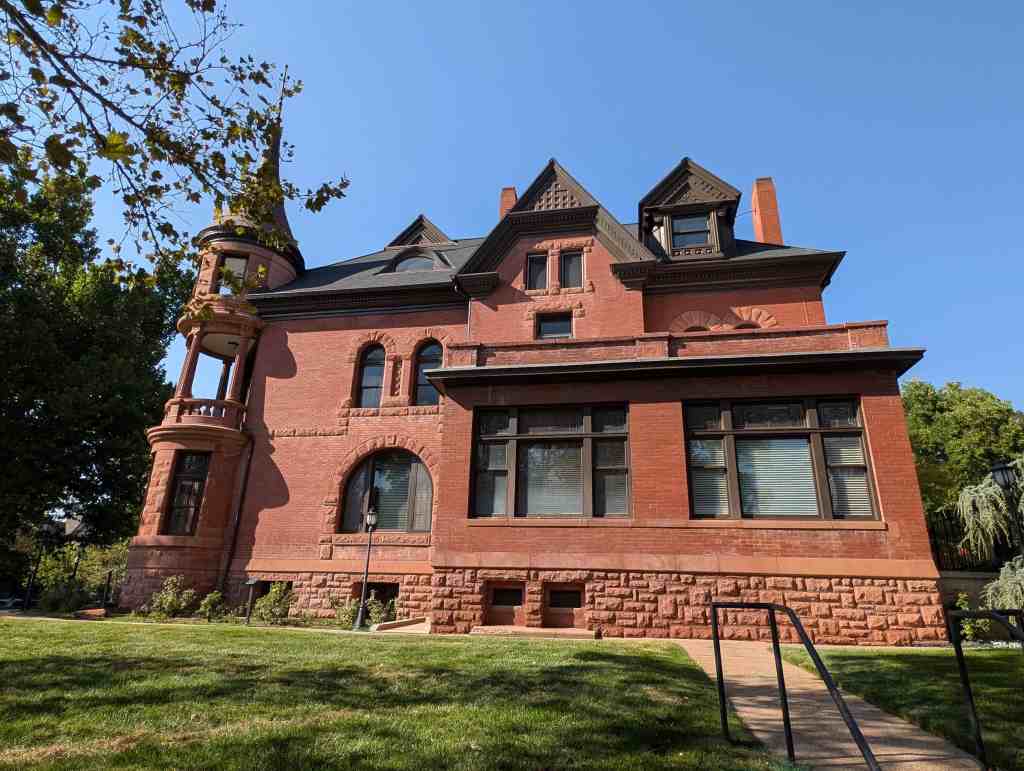
The Bertha Eccles Community Art Center, a Victorian style home, was built in 1893 of red brick imported from the midwest and red sandstone from northern Utah. Some of its unique features include the steep roofs and turrets which are covered with metal shingles, the heavy leaded glass windows and the large porch which extends from the west entrance of the home.

The home was designed by Samuel T. Whitaker and was built for James C. Armstrong, a prominent Ogden banker. Armstrong sold the home in 1896 to David Eccles, another prominent northern Utah businessman. Mr. Eccles worked his way from, as a boy, selling various wood articles made by his father, to financial prominence before his death in 1912.

Mr. Eccles’ first wife, Bertha Jensen Eccles, traveled extensively and became a prominent influence on Ogden’s educational and social life. Her home became the center for Ogden’s cultural festivities and social activities. Before her death, she requested the home remain in use as a center for these types of activities.

Jacob Hamblin House

19 Friday May 2023

Posted by Jacob Barlow in Uncategorized

≈ 1 Comment

Tags

Historic Homes, NRHP, Santa Clara, utah, Washington County

Jacob Hamblin House

Jacob Hamblin arrived in Santa Clara, Utah as early as 1854 with several other young Indian missionaries. Their task was to convert the Lamanites to the Mormon Church, if possible, and develop peaceful relationships with them in any case.

The Jacob Hamblin House is located at 3400 Hamblin Drive in Santa Clara, Utah and was added to the National Historic Register (#71000860) on March 11, 1971.

By 1856 the missionaries brought their wives to Fort Clara where a meager livelihood was obtained by hard work and irrigation. In 1857 Jacob was appointed president of all the Southern Indian Missions by Brigham Young His duties increased greatly with the unrest associated with the Mountain Meadows Massacre in September 1857. Hamblin and Thales Haskell both were in the north courting and marrying young wives, The foursome returned to Santa Clara via Mountain Meadows, one of the first groups to witness the carnage. Hamblin aided in the recovery and return of the surviving children.

The Buckskin Apostle had a difficult time pacifying the Indians toward the Mormons, while seeking their alliance against Johnston’s Army during the Mormon War of 1857-1858. Jacob Hamblin was trusted by the Indians. He believed in absolute honesty when dealing with them, in showing no fear under any condition, but he also demanded justice from them as well.

Life at Fort Clara continued difficult. Tragedy came often. In the fall of 1861 Swiss colonists arrived at the new settlements, but barely in time to witness a large flood in the Clara River wipe out the whole settlement early in 1862. As Hamblin was constantly away exploring or negotiating with the Indians, he was unable to provide for his families. Consequently, in 1863 missionaries were called to build Hamblin a home. His two wives moved in as soon as it was finished.

Jacob Hamblin made several exploring trips across the Colorado between 1858-1863, being the first person to circumnavigate the region of the Grand Canyon. He also explored a wagon route to the Colorado River near Callville (Las Vegas area) in 1864. In conjunction with Henry W. Miller and Jesse W. Crosby, Hamblin took a boat to the Colorado River at the mouth of Grand Wash in 1867, and they were the first white men known to have navigated the river from that point to the Virgin Rivers confluence about 75 miles down stream. Hamblin also assisted John Wesley Powell in his surveys of the Colorado River area. Together they helped negotiate a peace treaty with Navajo at Fort Defiance.

When Hamblin moved to Kanab, the home was leased to a Mr. Bauman who used the home to produce wine. Later his daughter married into the Samuel Knight family, which retained control of it until Clara Hamblin Harmon, a granddaughter of Jacob, purchased it. The home was very de lapidated when the State Parks and Recreation Division took custody of it in 1959.

It is fitting that Jacob Hamblin’s church-built home should be preserved as a monument to this southwestern pioneer. Because he was also a polygamist the Buckskin Apostle, when he died August 31, 1886, was a fugitive from justice. His last years were spent in southern Utah, Arizona, New Mexico and Old Mexico.

Wasatch Academy Commons Area

18 Thursday May 2023

Posted by Jacob Barlow in Uncategorized

≈ 1 Comment

Tags

Mt Pleasant, NRHP, Sanpete County, utah

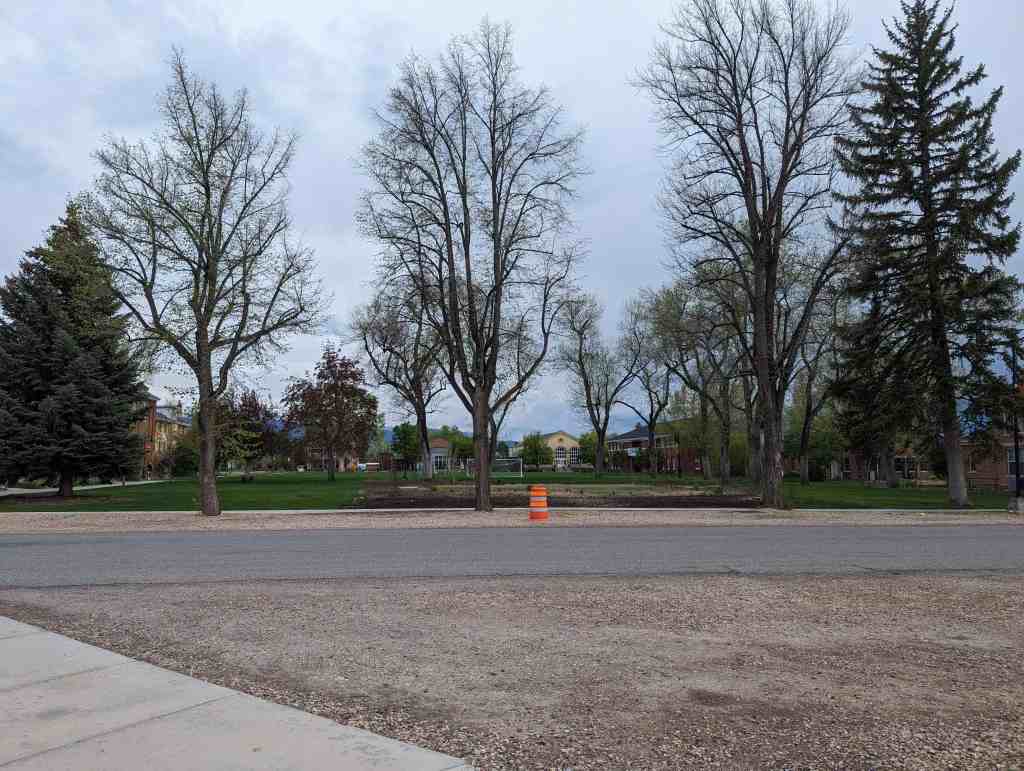
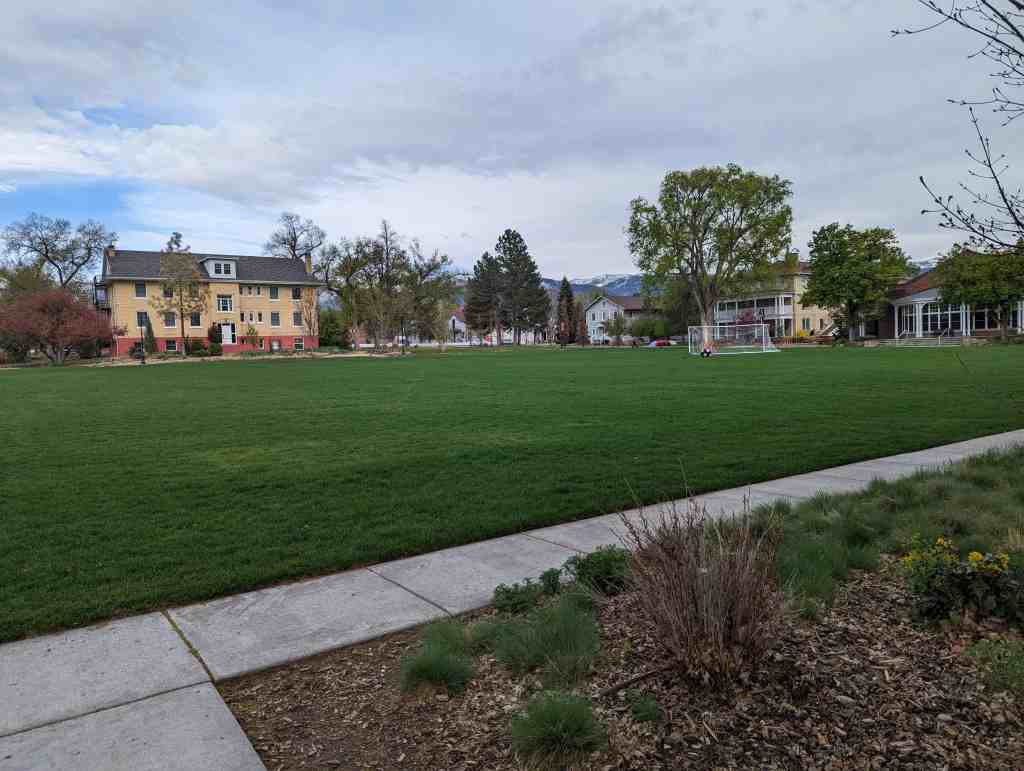
The Commons Area at Wasatch Academy in Mt Pleasant, Utah

Park City Miner’s Hospital

18 Thursday May 2023

Posted by Jacob Barlow in Uncategorized

≈ Leave a comment

Tags

Historic Buildings, Hospitals, NRHP, park city, summit county, utah

Park City Miner’s Hospital

The Park city Mining District, Utah, from its beginnings in the 1860s, quickly rose to a place of prominence among the nation’s silver producers. Large corporate interests and entrepreneurs aided in developing the area into such a position. Of equal importance, however, was the labor force which provided the miners and various skilled positions necessary to operate the industry.

The Park City Miner’s Hospital is located at 1354 Park Avenue in Park City, Utah and was added to the National Historic Register (#78002697) on December 8, 1978.

With miners came organized labor. Western metal miners banded together to form the Western Federation of Miners in 1893. In October 1901 Local No. 144 in Park City was formed. As all labor organizations, the Park City Union was formed by workers who sought, as a collective body, better wages, safe working conditions, and various benefits deemed necessary in the performance of their occupations. The early history of labor is marked by “reform;” that is, the attempt to redress grievances against mining companies and their modes of operating.

Health concerns ranked of paramount interest both to the miners and the community. Isolated from urban areas, Parkites had to be treated at Salt Lake City hospitals. Such a journey of approximately thirty miles induced many hardships, especially in winter months. Miners also objected to the automatic withdrawal of money from their pay which was sent to Salt Lake hospitals, where they felt treatment was not satisfactory.

Spurred by the union, a project was launched in December 1903 to fund a local hospital for the Park. The effort represented a significant form of mutual cooperation, in a social humanitarian field, between miners’ union and local residents. The union meeting in December resulted in a resolution being passed that called for the formation of a company by a committee appointed by the union. This company was to have a capital stock of $20,000 divided into 2,000 shares at the par value of $10.00 per share, with both union and non-union members able to subscribe. However, upon any future sale of the stocks, they were to be transferred only to the Park City Miners Union No. 144. The union acted only as a shareholder, the hospital to be run by the company.

The subscription proved a success as newspaper reports attested to the cooperation of individuals and business houses of the city. Mrs. Edza Nelson donated an acre of ground known as Nelson Hill, upon which to erect the building. This site, located just north of the city, was selected because of its distance both from city noises and dangers of fire, as well as the most suitable spot to insure the maximum of sunshine and fresh air.

Plans and specifications were prepared by Harry Campbell, contractor, and ground was broken in April 1904. Work progressed and by October 1, 1904, the hospital reached completion. Furniture and furnishings were received by various fraternal and social organizations and individuals, adding to the cooperative character of the venture. Dedication services were largely attended, with representatives of several religious denominations offering preservations, and highlighted by an address by Colonel William M. Ferry.

The Park City Miners Hospital now stands as a commercial property, but its significance lies in its place as a social humanitarian cooperative venture between a local of the Western Federation of Miners, a union characterized as radical in nature, and the Park City community. During the 1903-1904 period the W.F.M. embroiled itself in a turbulent strike in Colorado, suffering the stigma of radicalism, while at the same time initiation the building of a community hospital in Park City. Thus, the hospital aids in understanding the union’s complete efforts in the field of labor reform, as well as the cooperative effort necessary to attain its completion.

Borden Company Plant

17 Wednesday May 2023

Posted by Jacob Barlow in Uncategorized

≈ 1 Comment

Tags

Cache County, Logan, NRHP, utah

Borden Company Plant

Built 1904-1945.

Construction of the two-story brick factory building and warehouse began in 1904 but there were five key construction phases between 1904 and 1945. It was a milk factory with large ties to the Cache Valley dairy industry that remains prominent to this day.

“The plant in Logan was one of the two earliest and largest of the five canned milk plants built in Cache Valley in the early 20th century. These plants processed and shipped condensed and evaporated milk throughout the Intermountain West,” historians noted.

While originally local, it was sold to the Borden Company in 1912. It’s still in the hands of Borden Holdings, LLC, and went through a renovation that ended last year. Nonhistoric additions (from eras after 1945) were removed and remaining historic features were preserved.

The Borden Company Plant is located at 290 South 400 West in Logan, Utah and was added to the National Historic Register (#100006935) on September 20, 2021.

Craighead Cottage

16 Tuesday May 2023

Posted by Jacob Barlow in Uncategorized

≈ 1 Comment

Tags

Mt Pleasant, NRHP, Sanpete County, utah

Craighead Cottage, built in 1918; a one-story brick residence; bungaloid style; rectangular plan; it features stone and concrete trim, a columned porch, square window bays and a standing seam metal roof.

It was located where the current Zoe Frost Bonderman Hall is, at approximately ~162 West 100 South in Mt Pleasant, Utah and is part of Wasatch Academy.

← Older posts
Newer posts →

Follow Jacob

Follow Jacob

Come wander with me on Youtube.

Blog Stats

  • 2,087,391 hits

Social and Other Links

BarlowLinks.com

Recent Posts

  • Provo High School Seminary Building
  • 821 E 100 S
  • 820 E 100 S
  • 817-819 E 100 S
  • 814 E 100 S

Archives

Loading Comments...