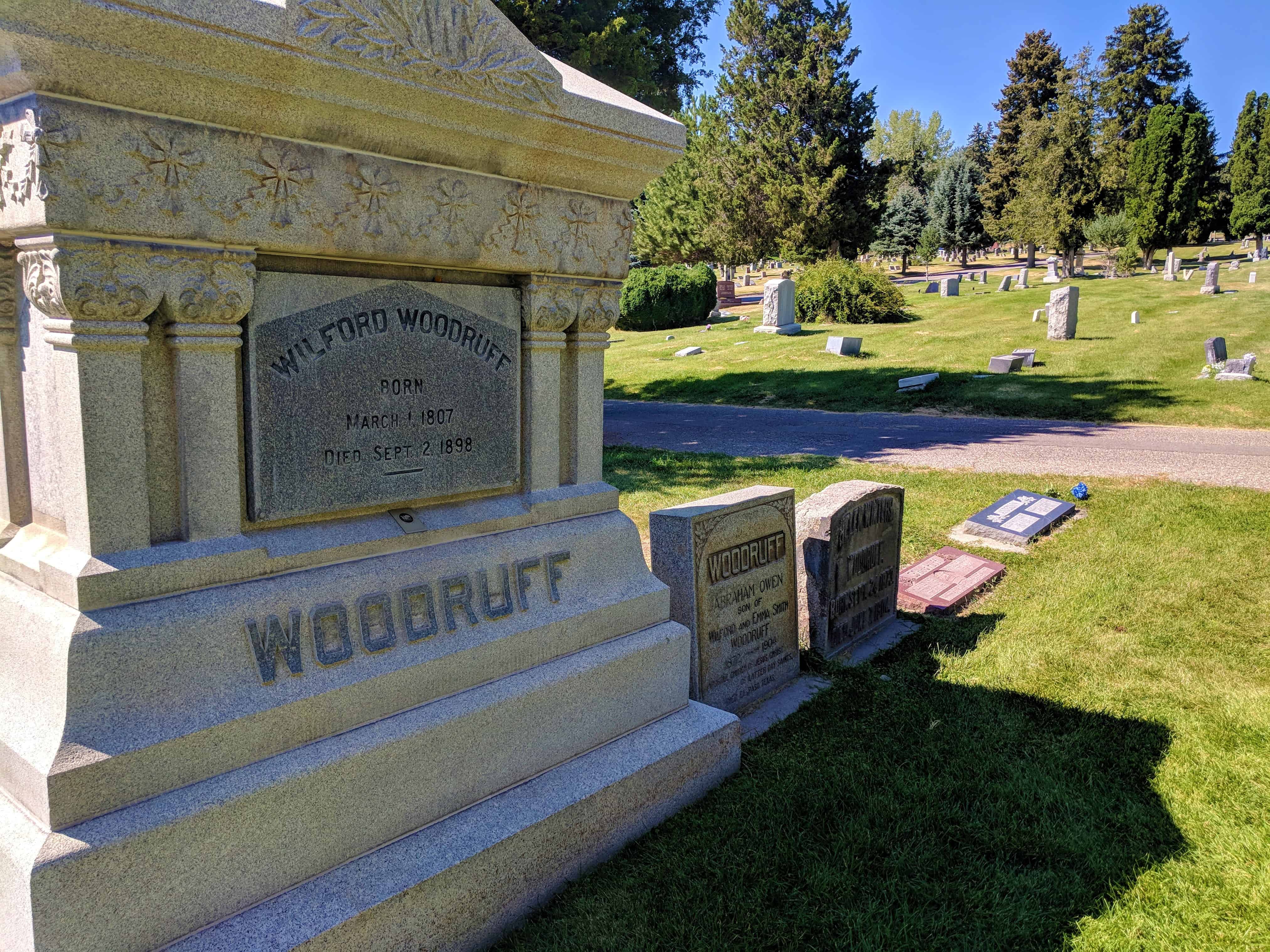
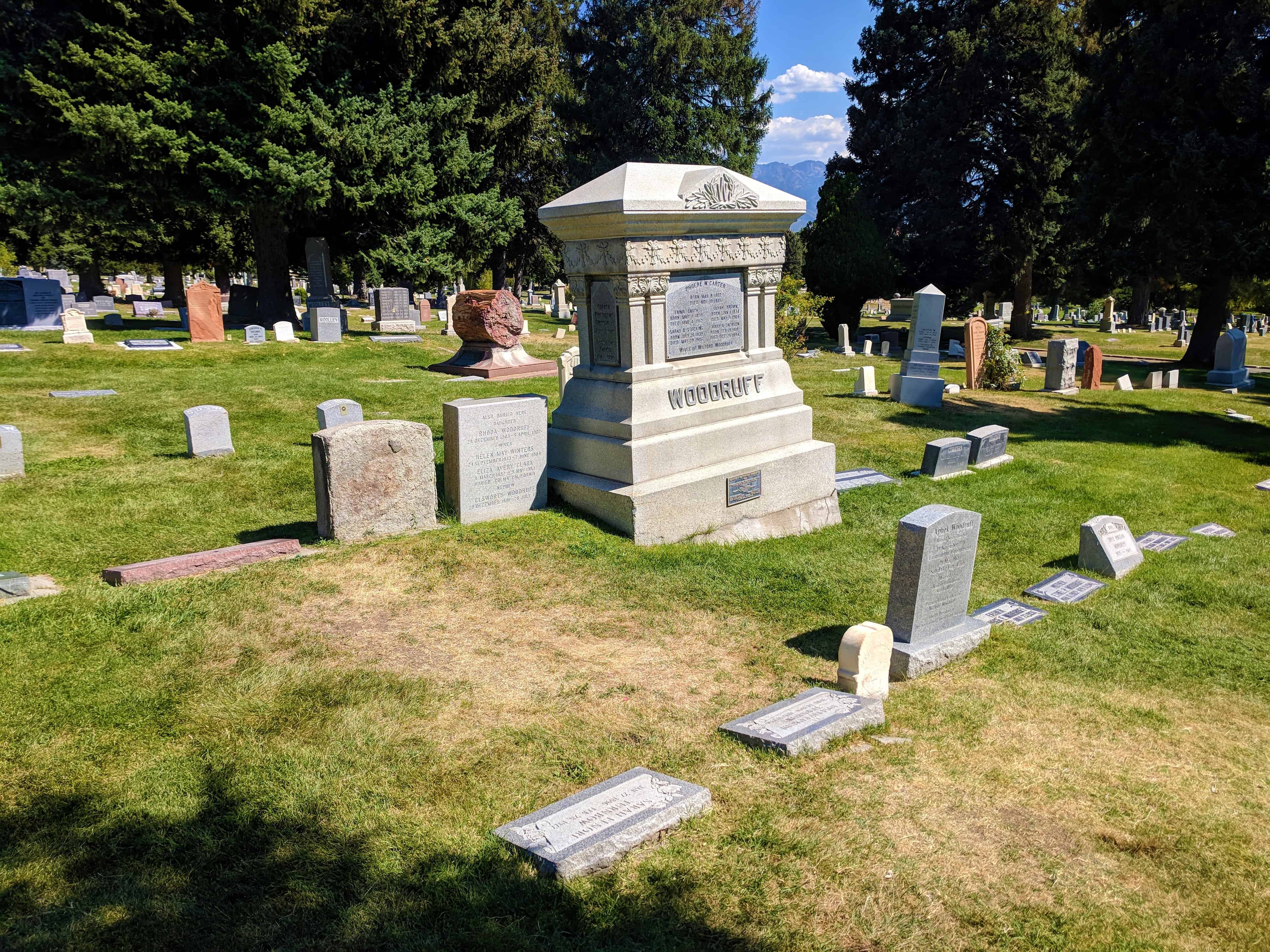
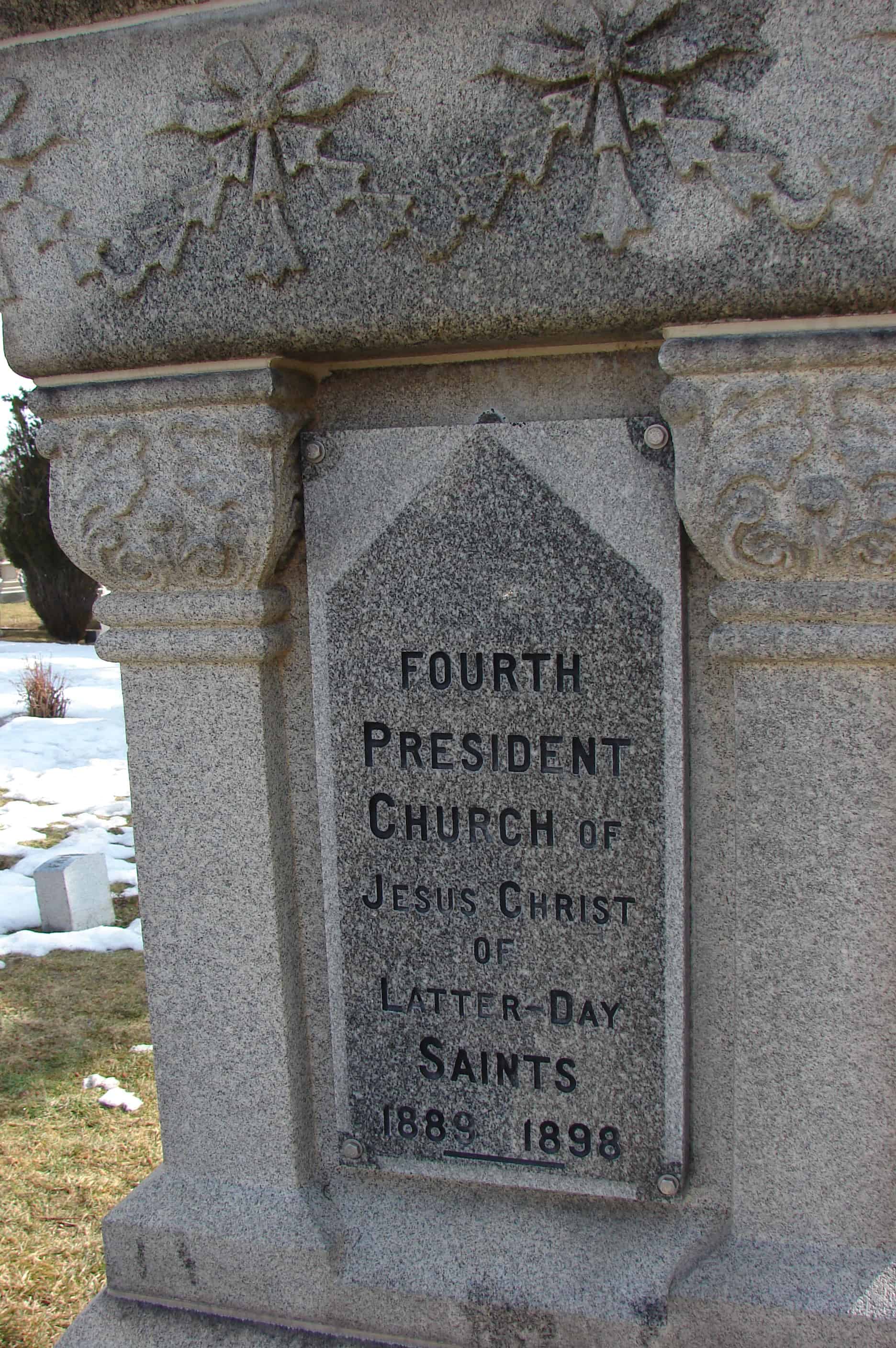
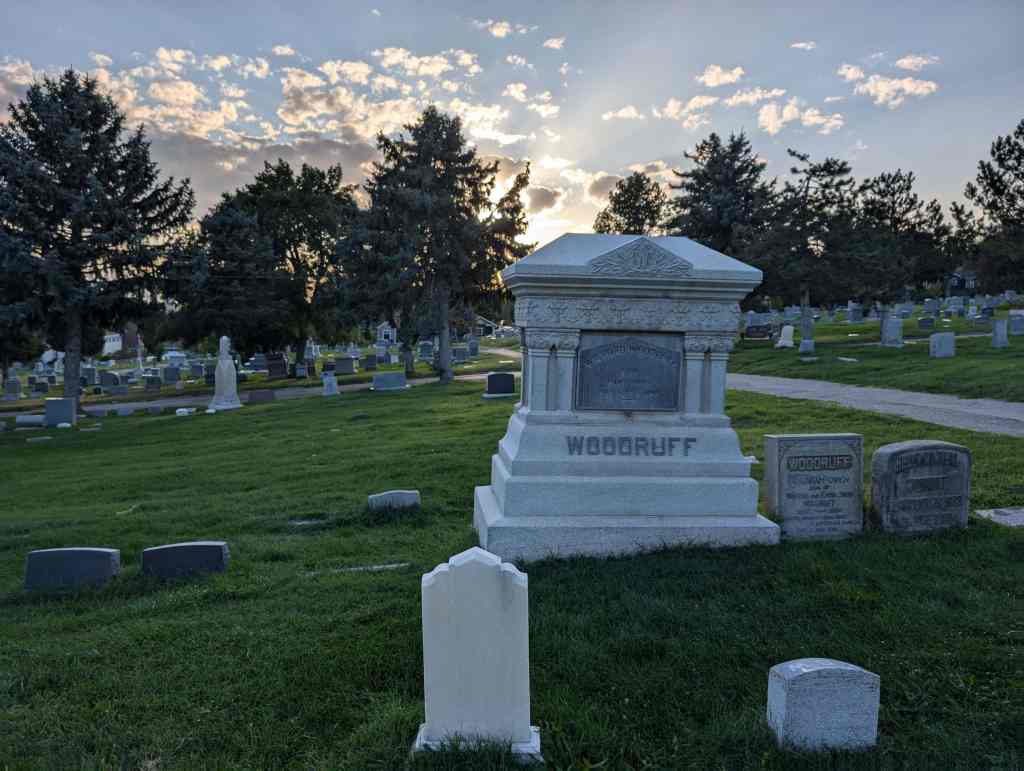
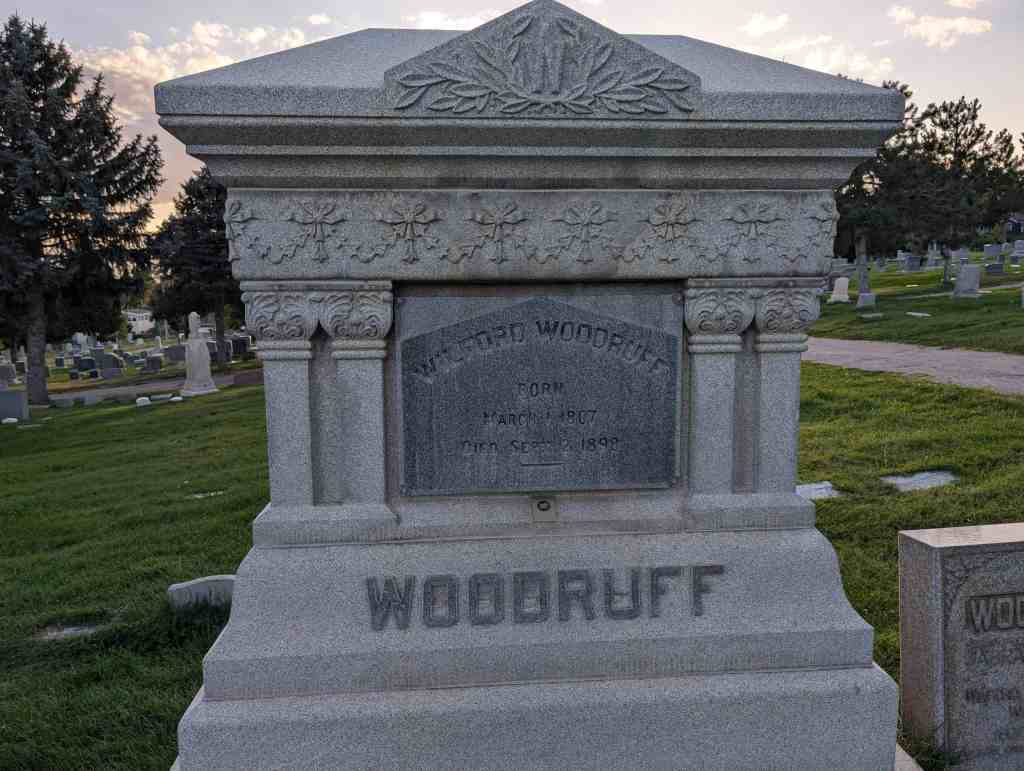
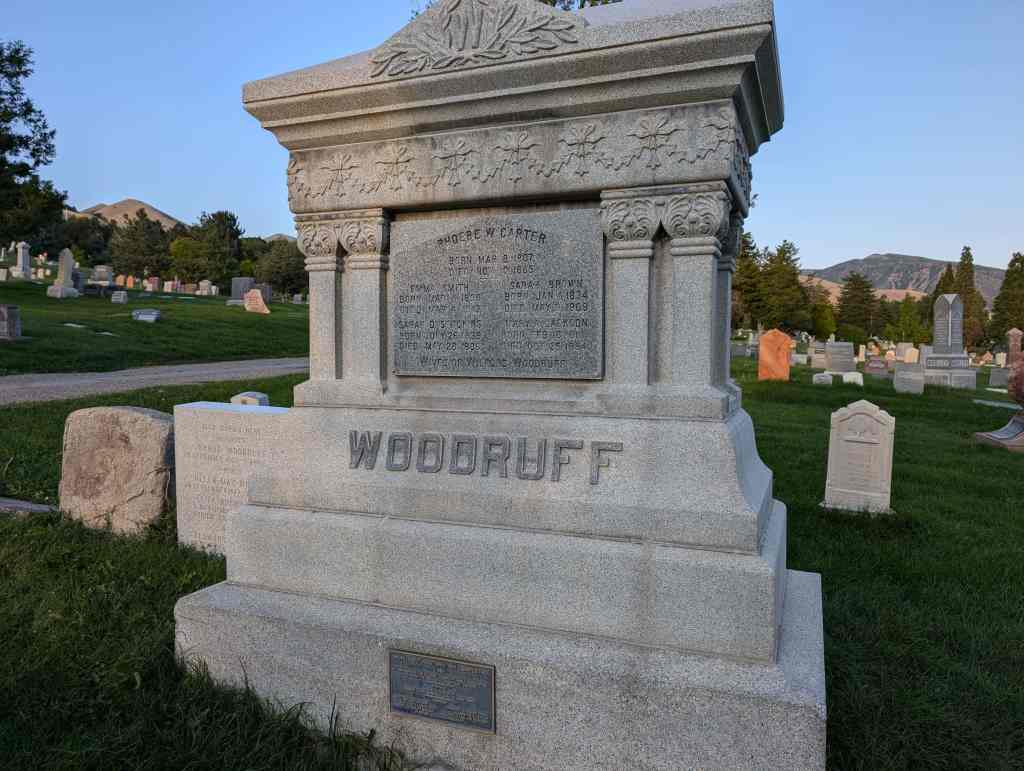
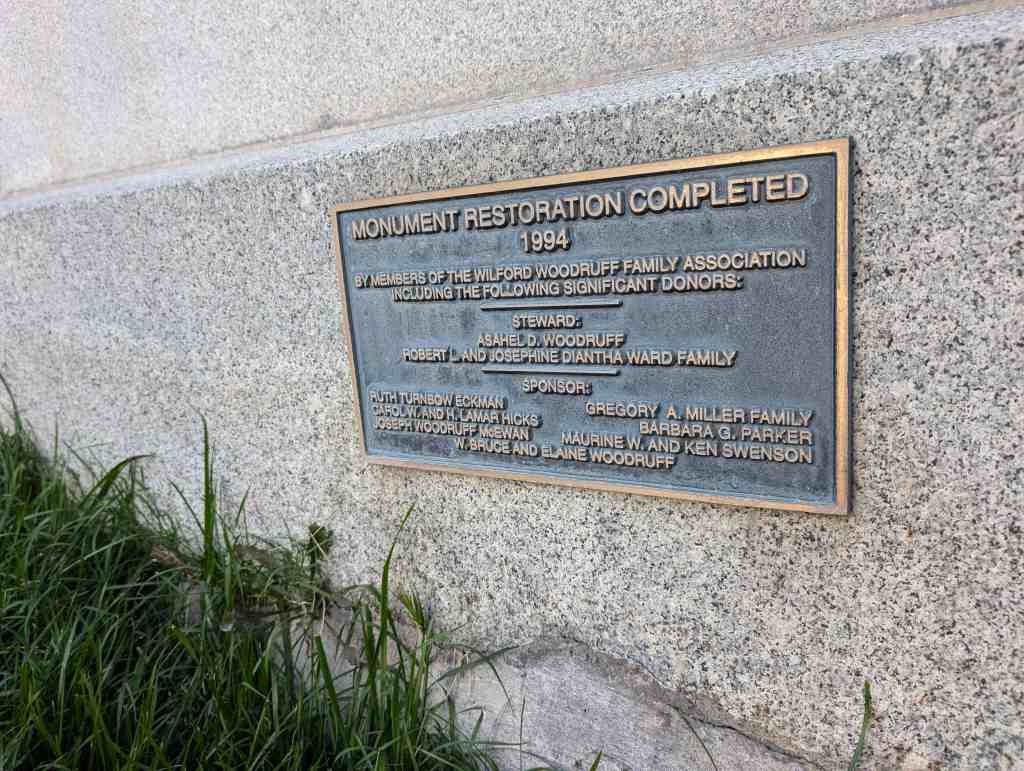
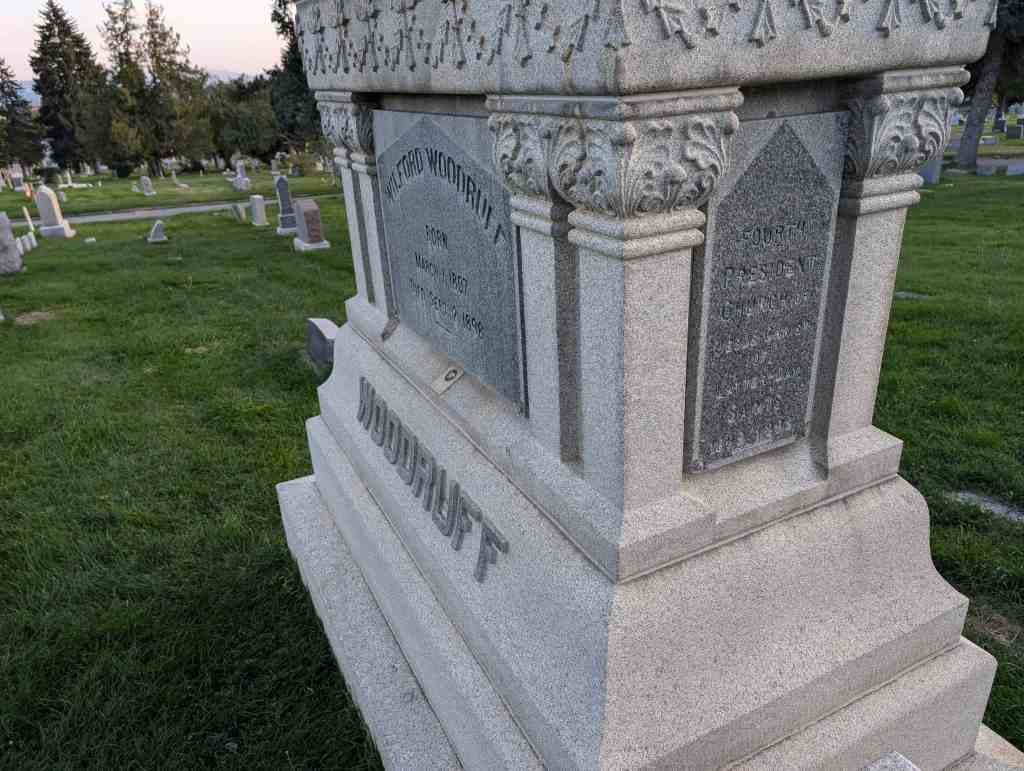
Wilford Woodruff was the 4th President of The Church of Jesus Christ of Latter-day Saints.
This site is located in the Salt Lake City Cemetery in Salt Lake City, Utah.
Related posts:




20 Thursday Sep 2018
Posted in Uncategorized
Wilford Woodruff was the 4th President of The Church of Jesus Christ of Latter-day Saints.
This site is located in the Salt Lake City Cemetery in Salt Lake City, Utah.
Related posts:
20 Thursday Sep 2018
Posted in Uncategorized

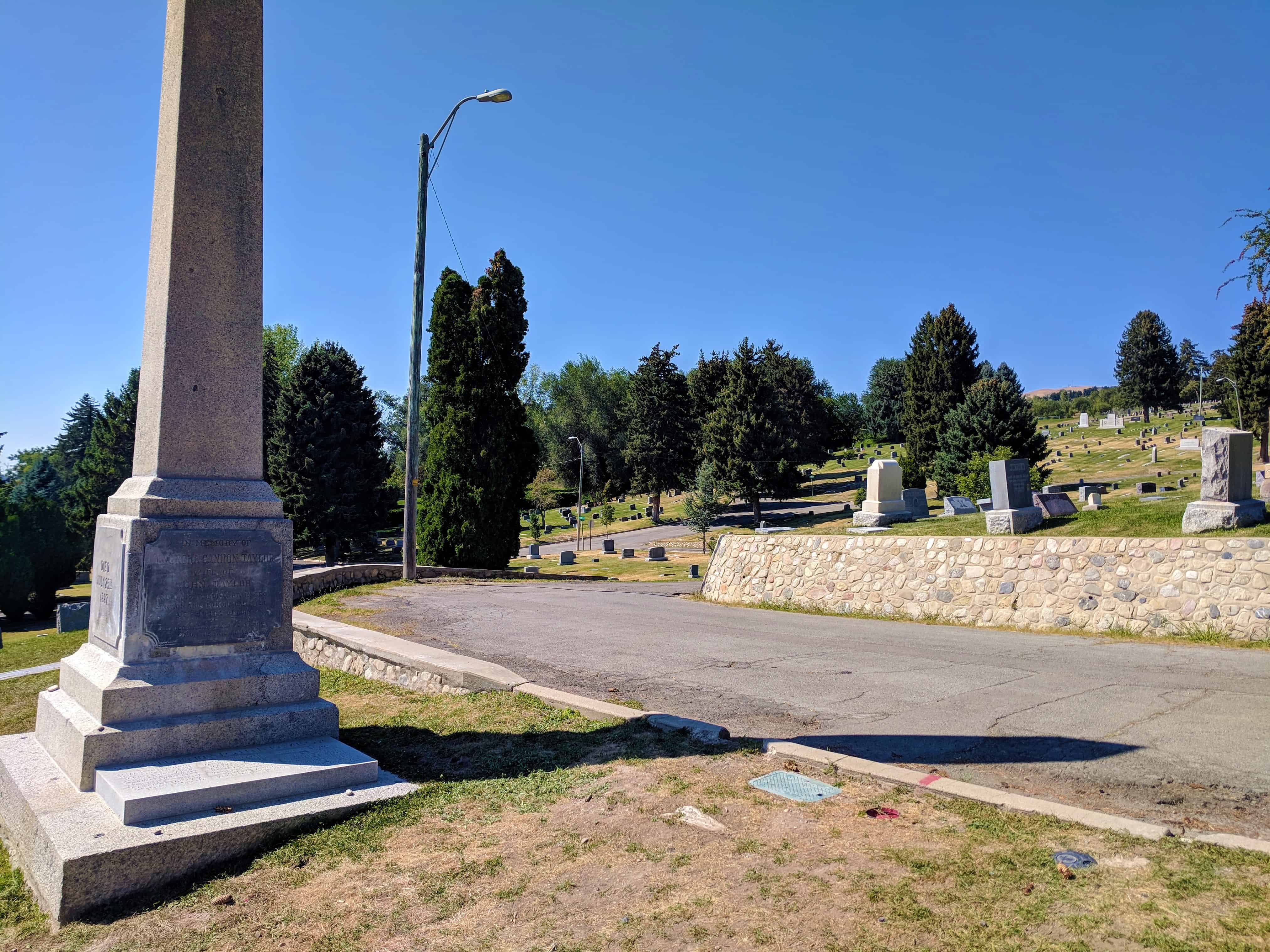
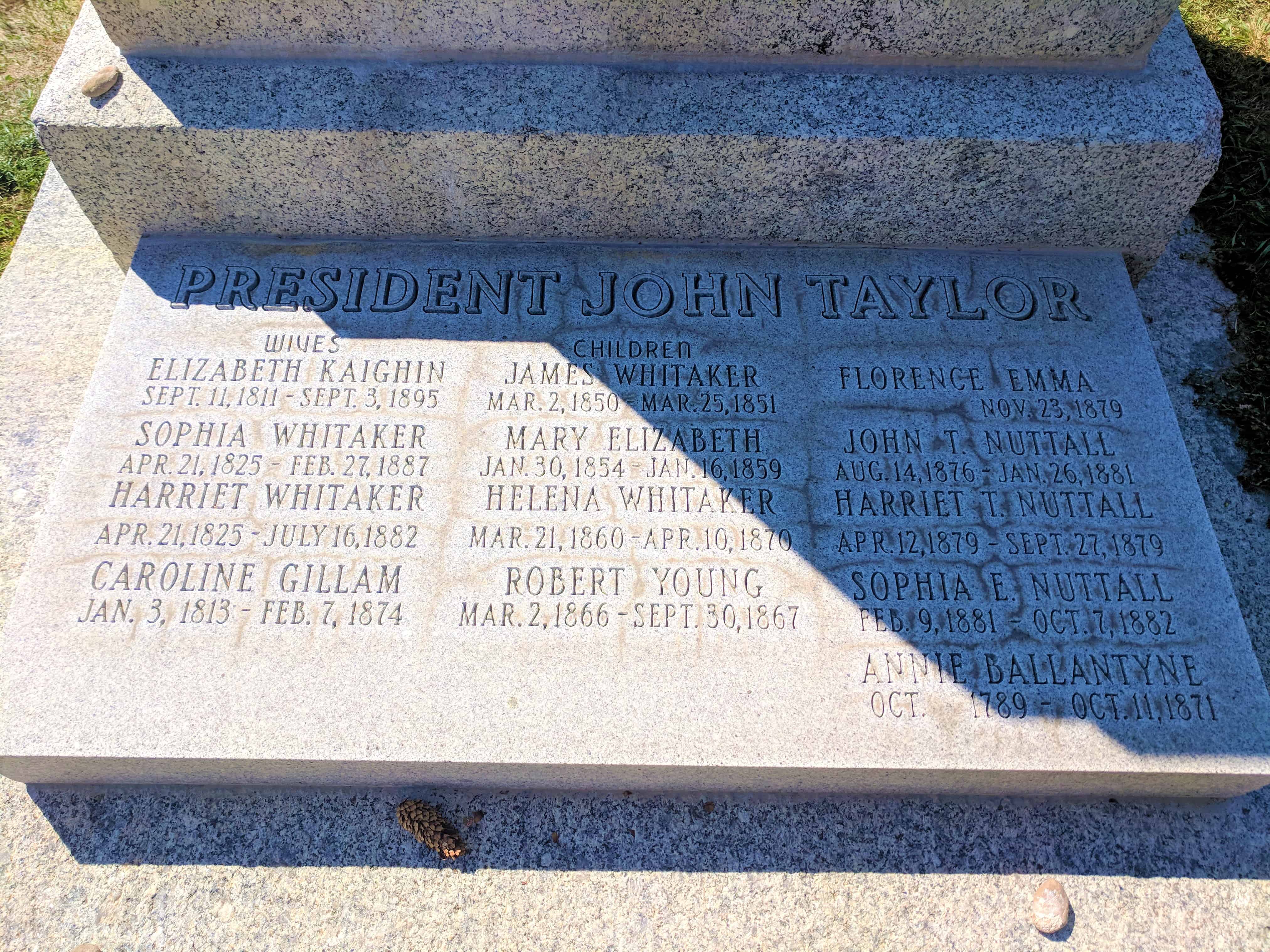
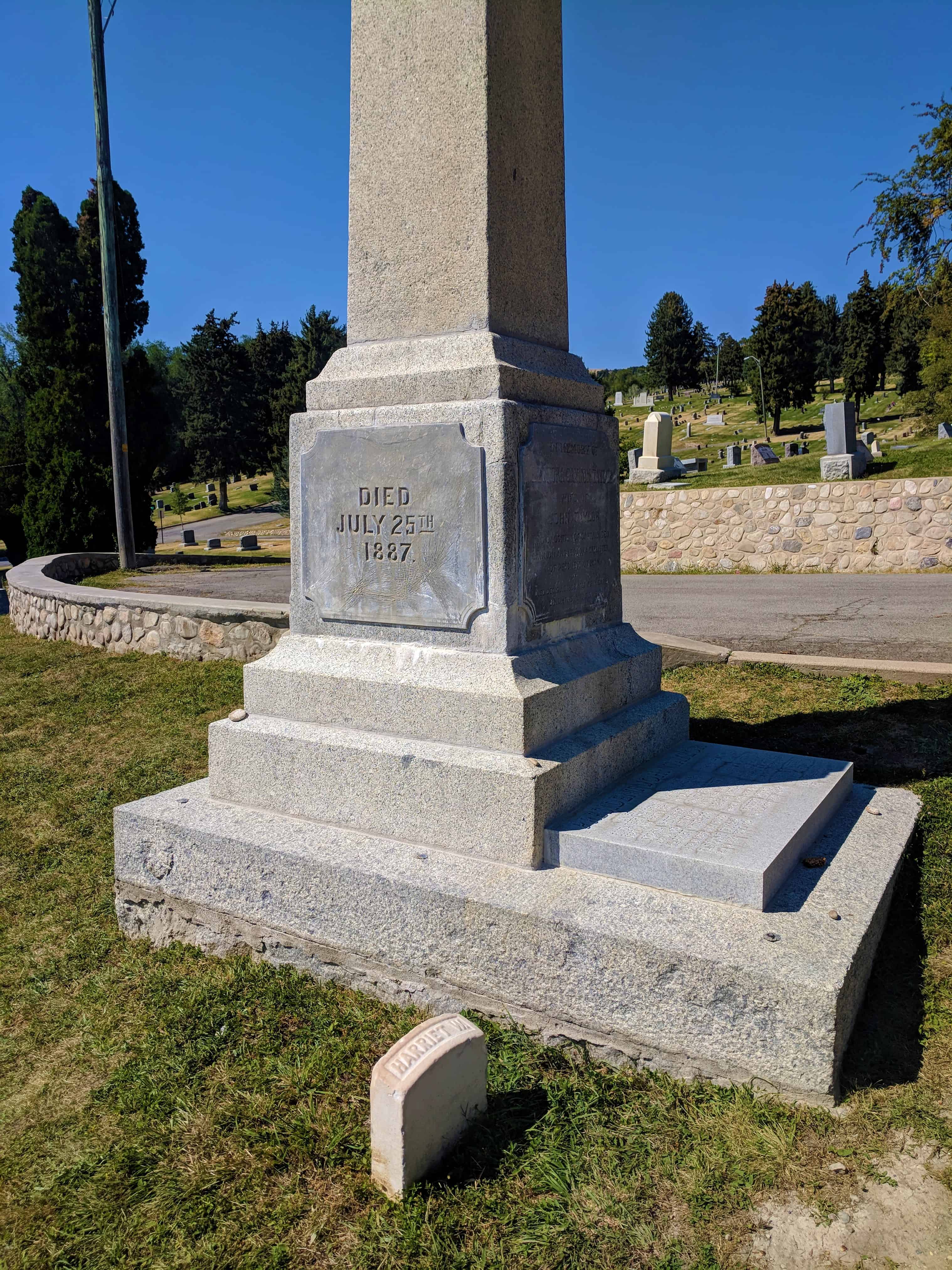
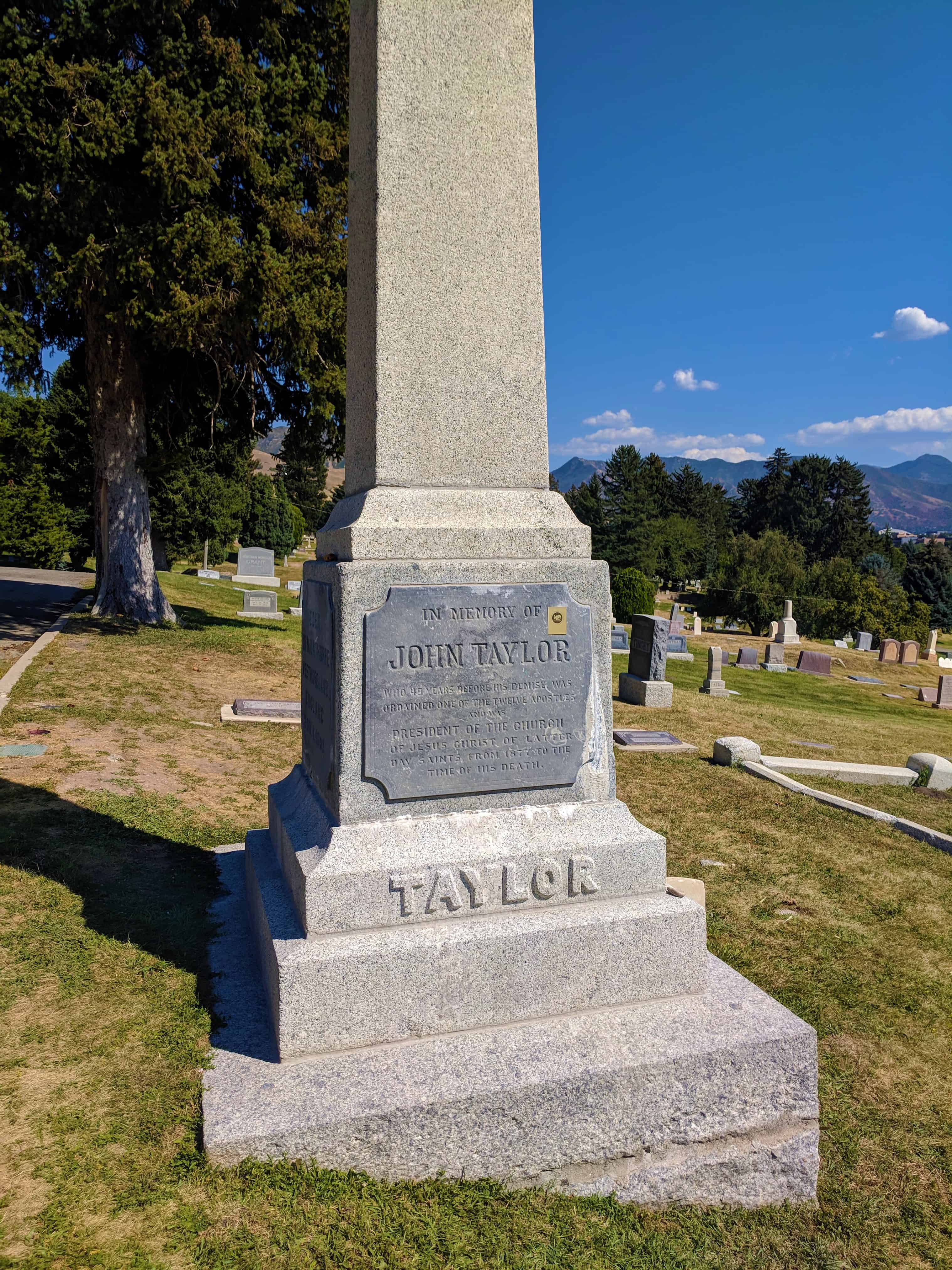
John Taylor was the 3rd President of The Church of Jesus Christ of Latter-day Saints.
For a list of the presidents of the church and links to their gravesites click here.
This site is located in the Salt Lake City Cemetery in Salt Lake City, Utah.



20 Thursday Sep 2018
Posted in Uncategorized
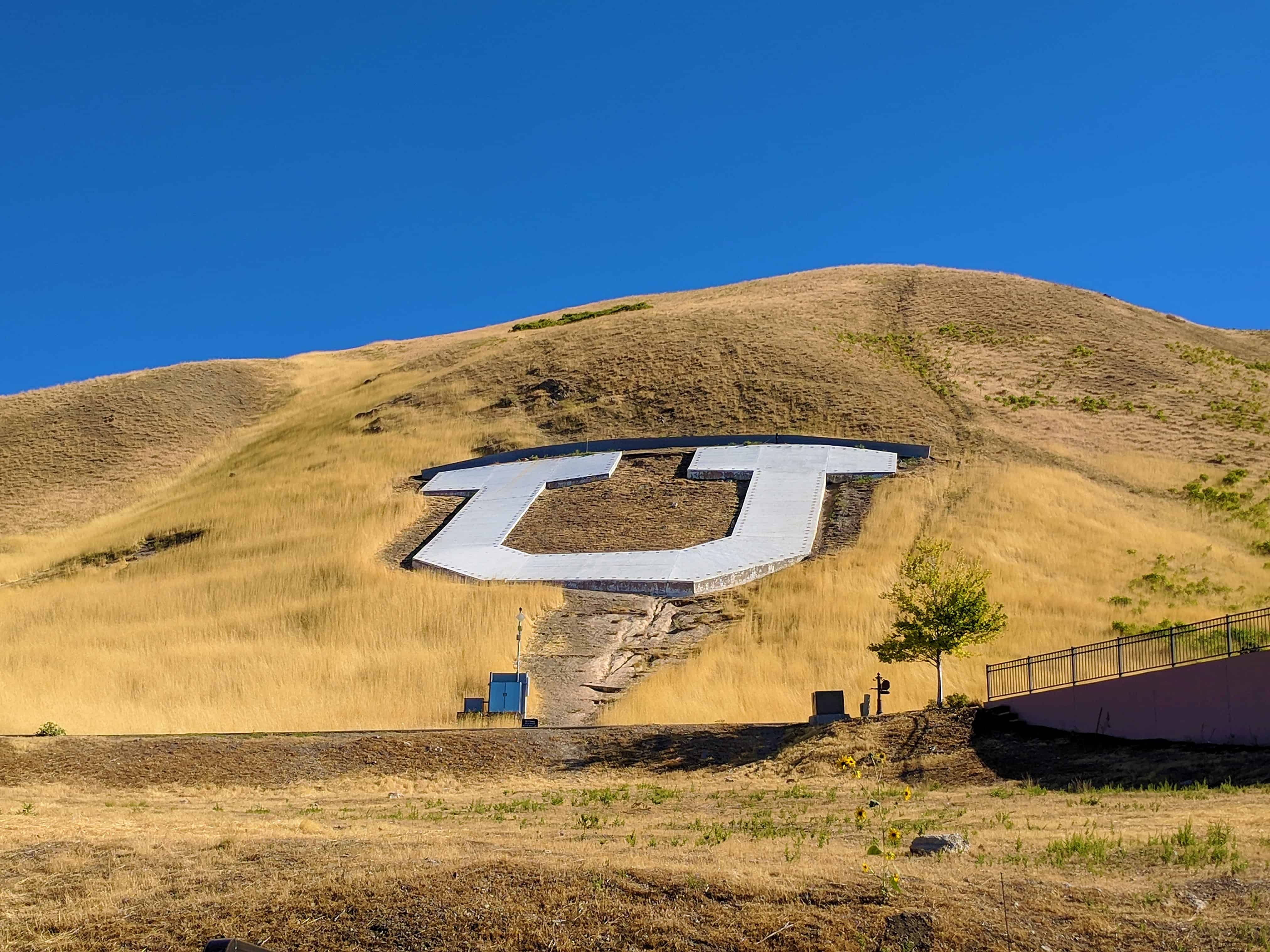
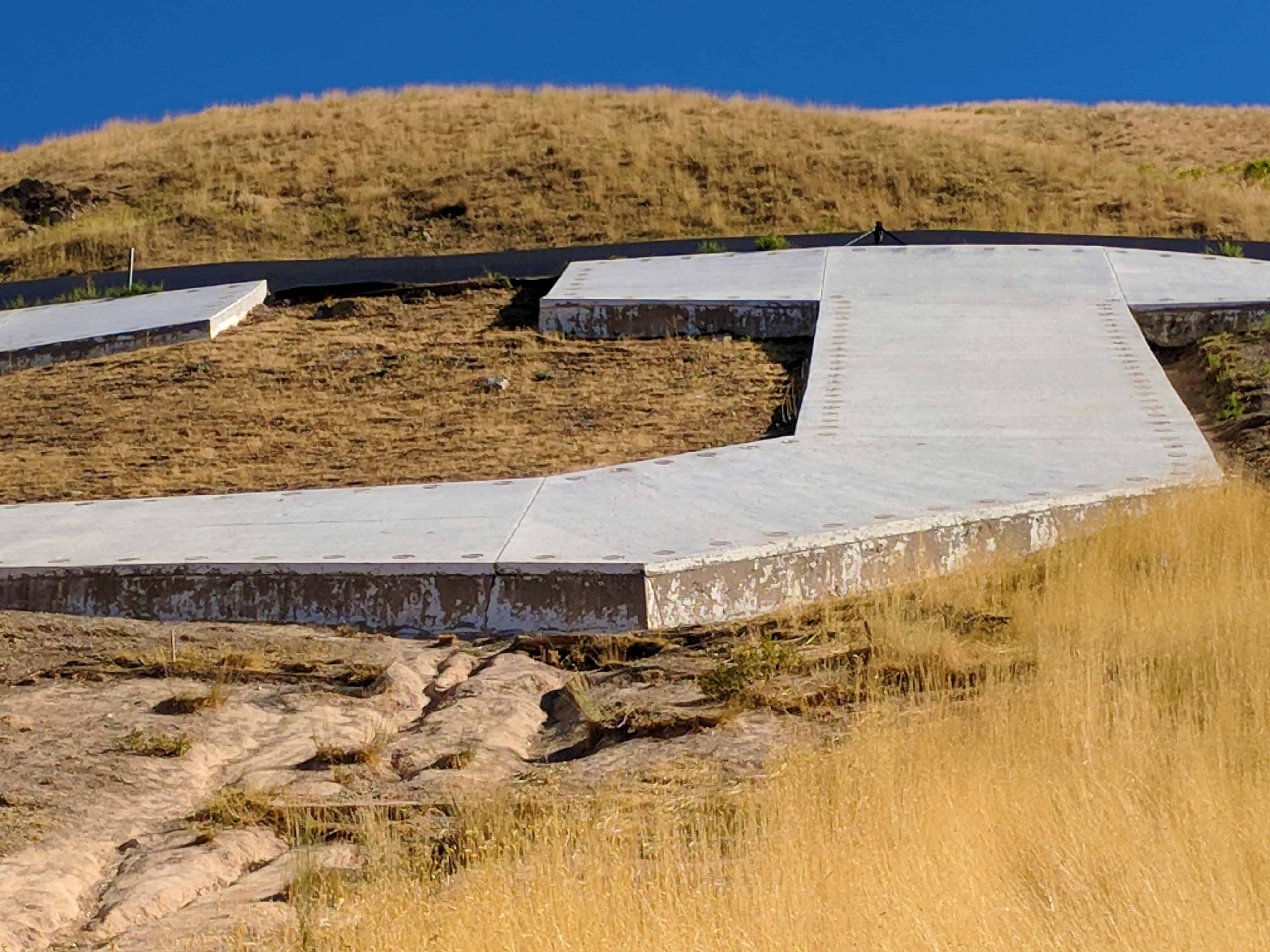
The Block U is a large concrete hillside letter on Mount Van Cott in Salt Lake City, Utah. The stylized “U” is a logo of the University of Utah and is located just north of the university’s campus. It is one of the earliest hillside letters. It sits at 5,249 feet above sea level. Lights outlining the Block U flash when athletic teams from the University of Utah win and burn steady when they are defeated.
The official name is the “Block U” and is a registered trademark of the University of Utah.
The history of the Block U begins at the turn of the twentieth century. Each year, as an unofficial activity, students of the University of Utah would climb “The Hill” (Mount Van Cott) and paint their class year on the mountainside. The administration felt that something more permanent was needed. In 1907 the block U was built with limestone. The U is over 100 feet tall and has a surface area of over 45,000 square feet. It can be seen from many different areas of the Salt Lake Valley. It was later modified in 1967 to include 124 lights. By 2001 the Block U had fallen into a constant state of disrepair. Despite several attempted maintenance by students it was not sustainable without a more thorough renovation.
Related Posts:


19 Wednesday Sep 2018
Posted in Uncategorized
Tags
Byzantine Revival Style, Downtown SLC, Greek Orthodox, Historic Buildings, Historic Churches, NRHP, Salt Lake City, Salt Lake County, utah

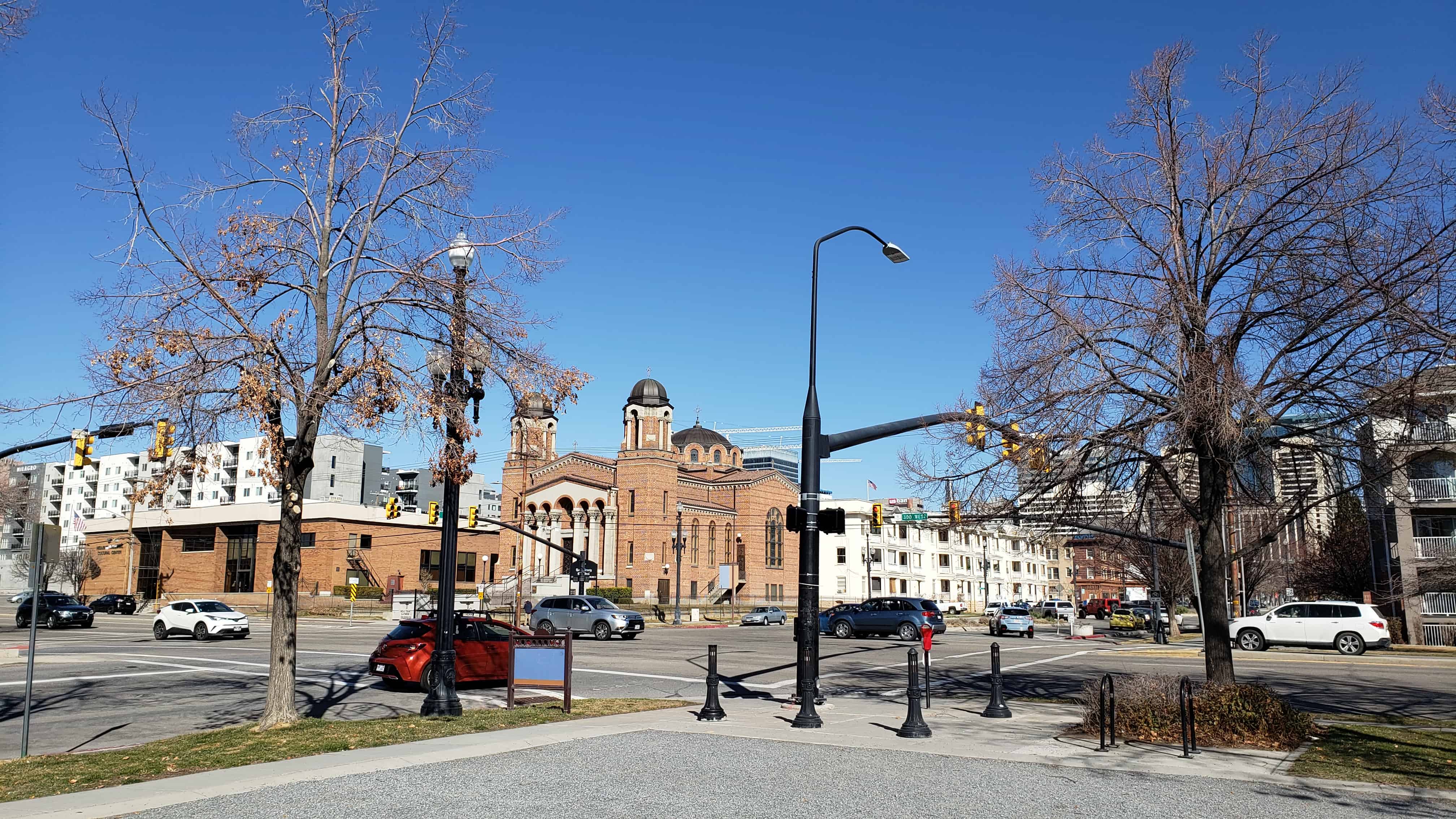
Holy Trinity Greek Orthodox Church
Utah Historic Site
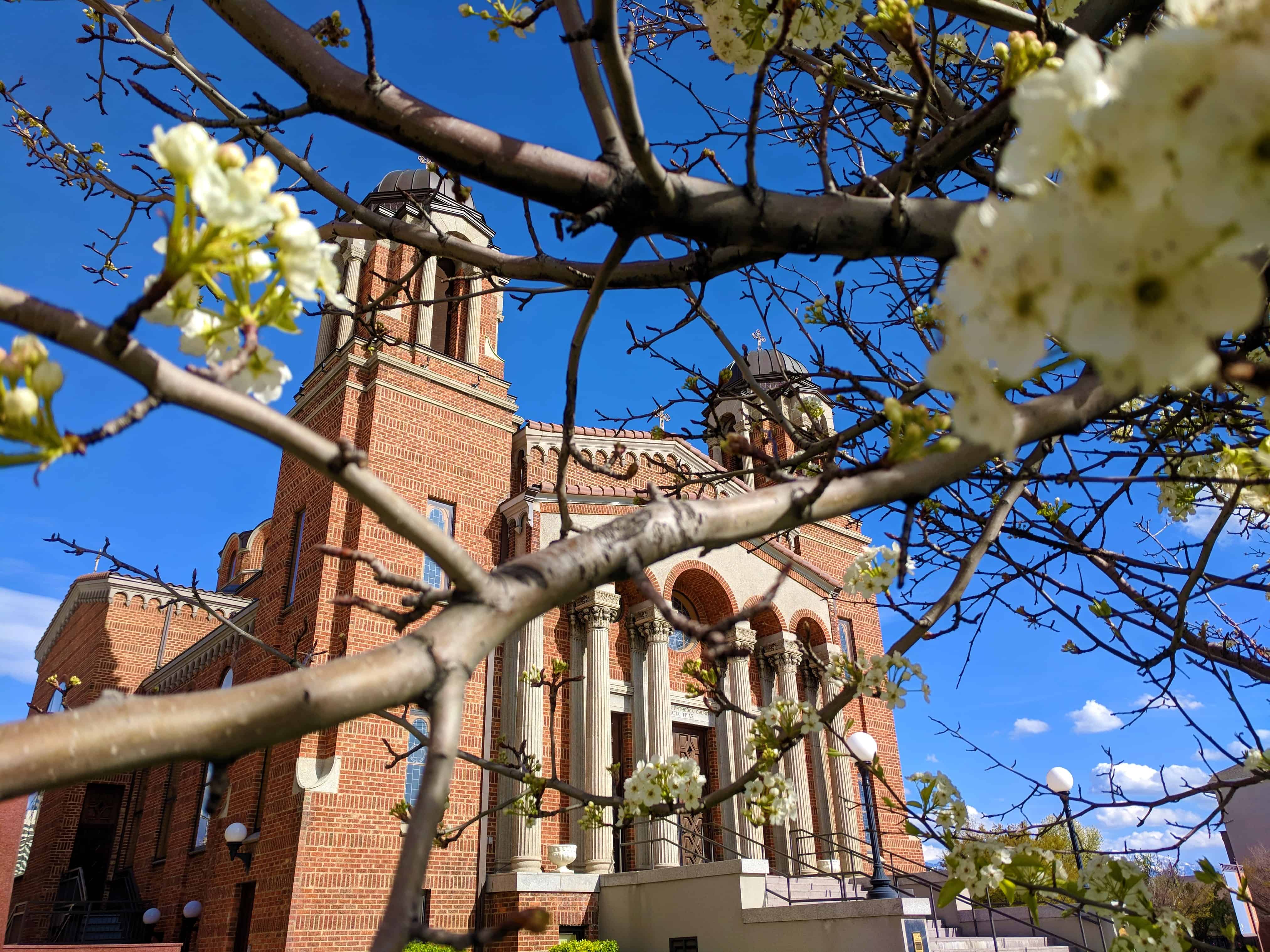
Replaced the First Greek Church in Utah, consecrated in 1905. Designed in the Byzantine tradition, its construction began in July 1923 and was completed in August 1924. Surrounding the church were once many immigrant neighborhoods dependent on the railroads and mines. The church remains a symbol of early Greek life in Utah.
See also: Site of the First Greek Orthodox Church in Utah


Holy Trinity Greek Orthodox Church
1924, Pope & Burton and N. A. Dokas
The Holy Trinity Greek Orthodox Church is evidence of the size and religious devotion of Salt Lake City’s Greek immigrant community. In the early 20th century, Greeks were the largest immigrant group in Utah. Salt Lake City’s Greek community was centered in a “Greek Town” with over 60 Greek businesses located on 200 South between 400 and 600 West. Completed in 1924, the Holy Trinity Greek Orthodox Church is an excellent example of Byzantine Revival style architecture. A large gold dome crowns the building while two domed bell towers with decorative tiles frame the arcaded entryway. The tile roof, patterned brick, and elaborate capitals are also typical of the Byzantine Revival Style.
FOUNDERS OF THE GREEK ORTHODOX GREEK COMMUNITY OF UTAH
Next to family and life itself, the Greek immigrant loved the Greek Orthodox Faith. The discovery of copper in 1903 in Bingham Canyon, coal mines of Carbon-Emery counties and railroad construction, brough a major influx of Greek immigrants to Utah. Despite barriers in their new land, Greek immigrants began to make plans for the formation of a Greek Orthodox Church and Community. The immigrants displayed extraordinary zeal, dedication and leadership in organizing the first Greek Orthodox Church in Salt Lake City. On January 22, 1905 about 200 young Greek men met at the Odd Fellows Building in Salt Lake City for the purpose of organizing the GREEK COMMUNITY OF UTAH. Location of the new church was on Fourth South between the present Fourth and Fifth West Streets. In april (sic) 1905, Archimandrite Parthenios Lymberopolous, arrived in Salt Lake City as the first Greek Orthodox Priest sent from the Holy Synod of Greece. The first Liturgy was held on October 29, 1905. The 1905 Board of Trustees of the Greek Community of Utah included Nicholas P. Stathakos, president; Stravros G. Skliris, vice president; Anastasosios Pappas, secretary; George Christophylou, treasurer; and Trustees George Demetrakopoulous, Michael Litrivas, George Macherias, Konstantinos Papaioannou, Andreas Papanikolaou, George Soteropoulos, Gregory Soteropoulos and Stelios Theoharis. Having outgrown its facilities, after World War I the Greek Community made plans for the construction of the second Holy Trinity Church. This was built on its present site, Third West and Third South. Actual construction of Holy Trinity began in July 1923. The first Liturgy was held on August 15, 1924. Construction cost was approximately $150,000. The Holy Trinity Church of Salt Lake City has served as the “Mother Church” for other Greek Orthodox churches in Utah, including the Assumption Church of Price, the Transfiguration Church in Ogden, and the Prophet Elias Church in Salt Lake City. The plaque is dedicated especially to all those Greek immigrants and clergy who contributed time, effort, money and services to create Greek Orthodox Churches in Utah and whose example of service, vision, faith and leadership provides guidance and inspiration for all of us to follow. *MAY THE MEMORY OF ALL OUR FOREFATHERS BE ETERNAL* AIONIA H MNH AYTON P
CASTLE GATE, CARBON COUNTY, UTAH COAL MINE EXPLOSION MARCH 8, 1924
172 Miners were killed instantly, 49 of the miners who lost their lives were Greeks, 48 of the miners were from the Island of Crete. Andreadakis, Steve…….. list of names ….Zanis, Mike




19 Wednesday Sep 2018
Posted in Uncategorized
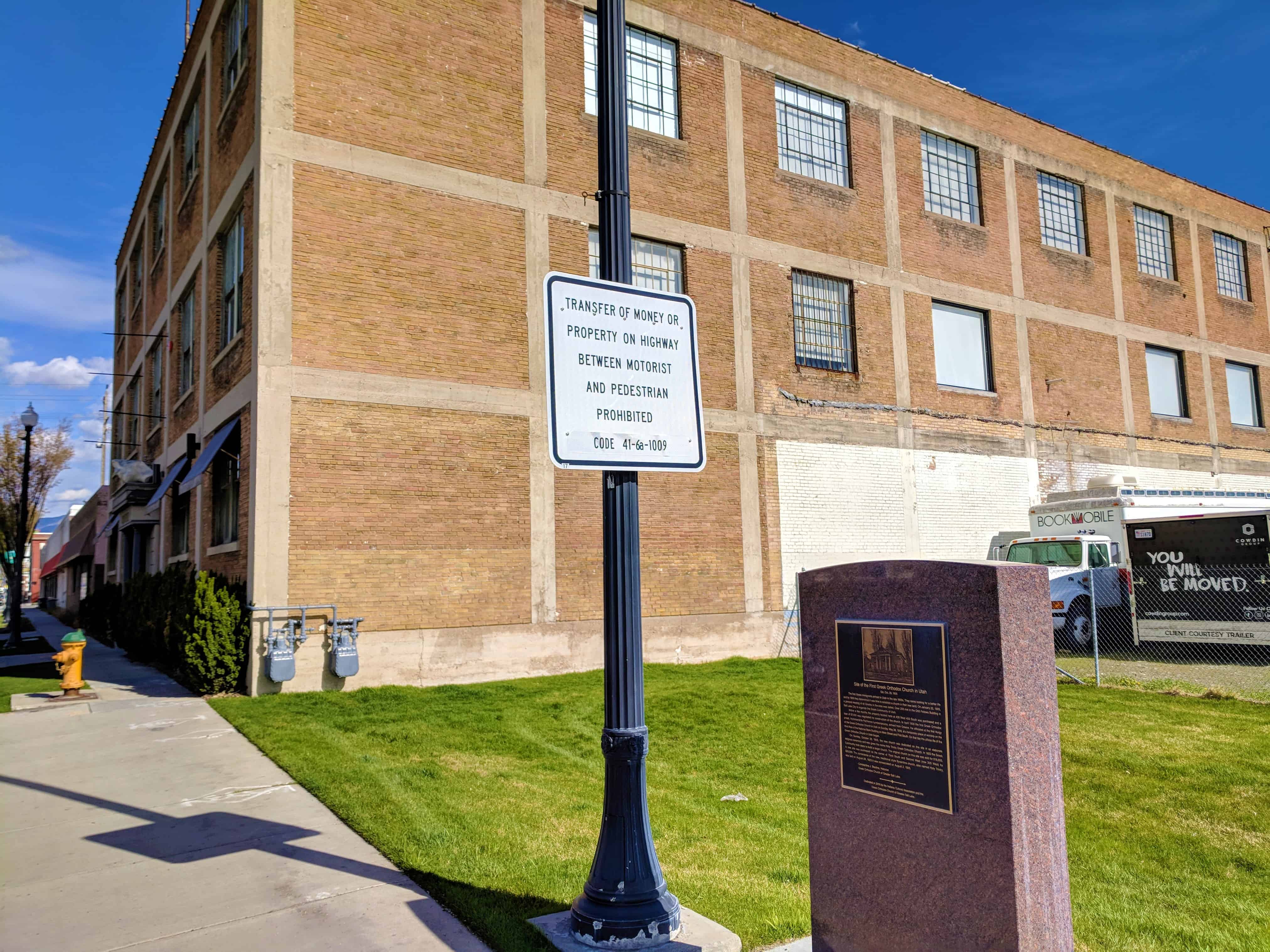
(475 W 400 S in Salt Lake.)
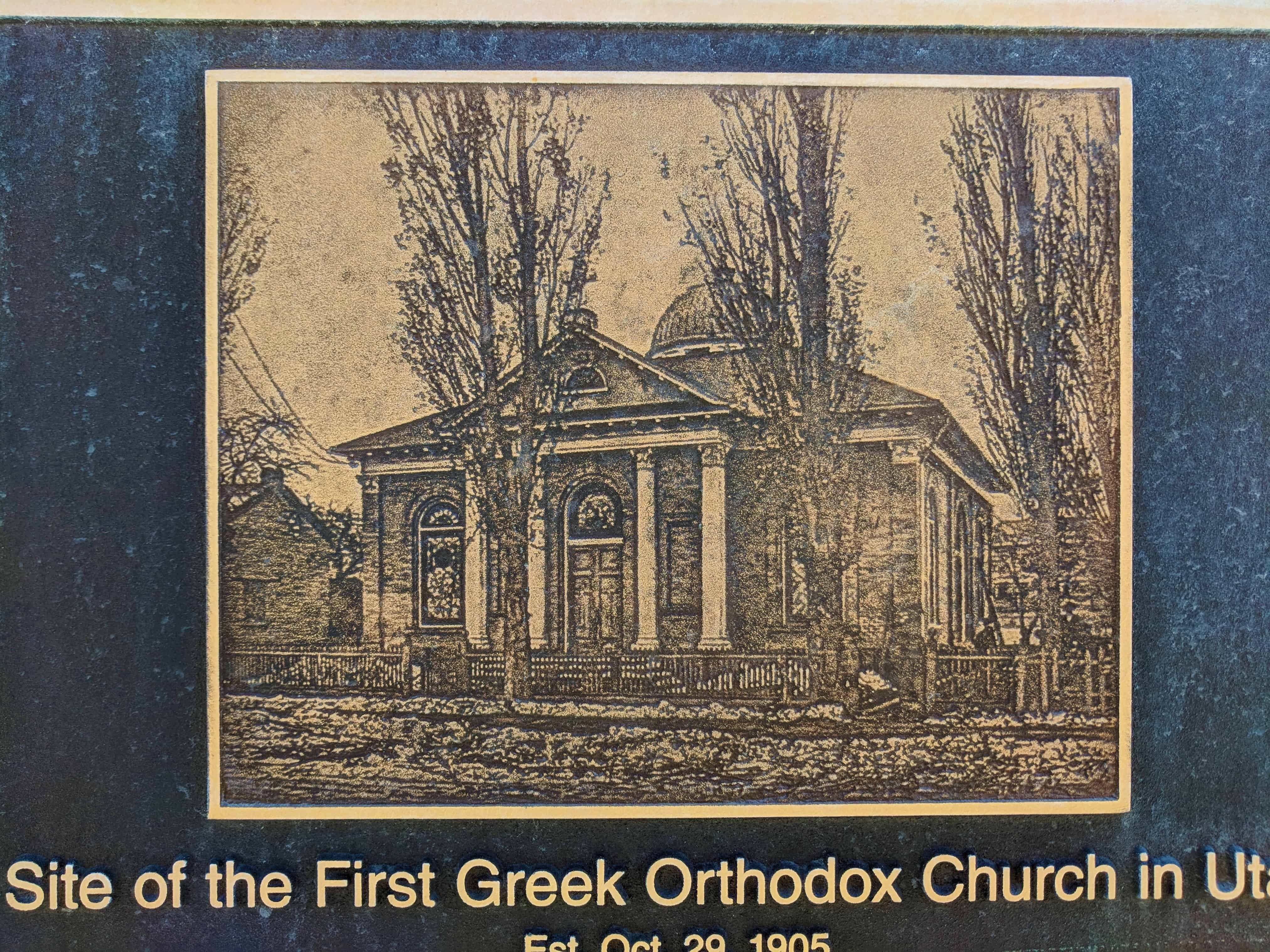
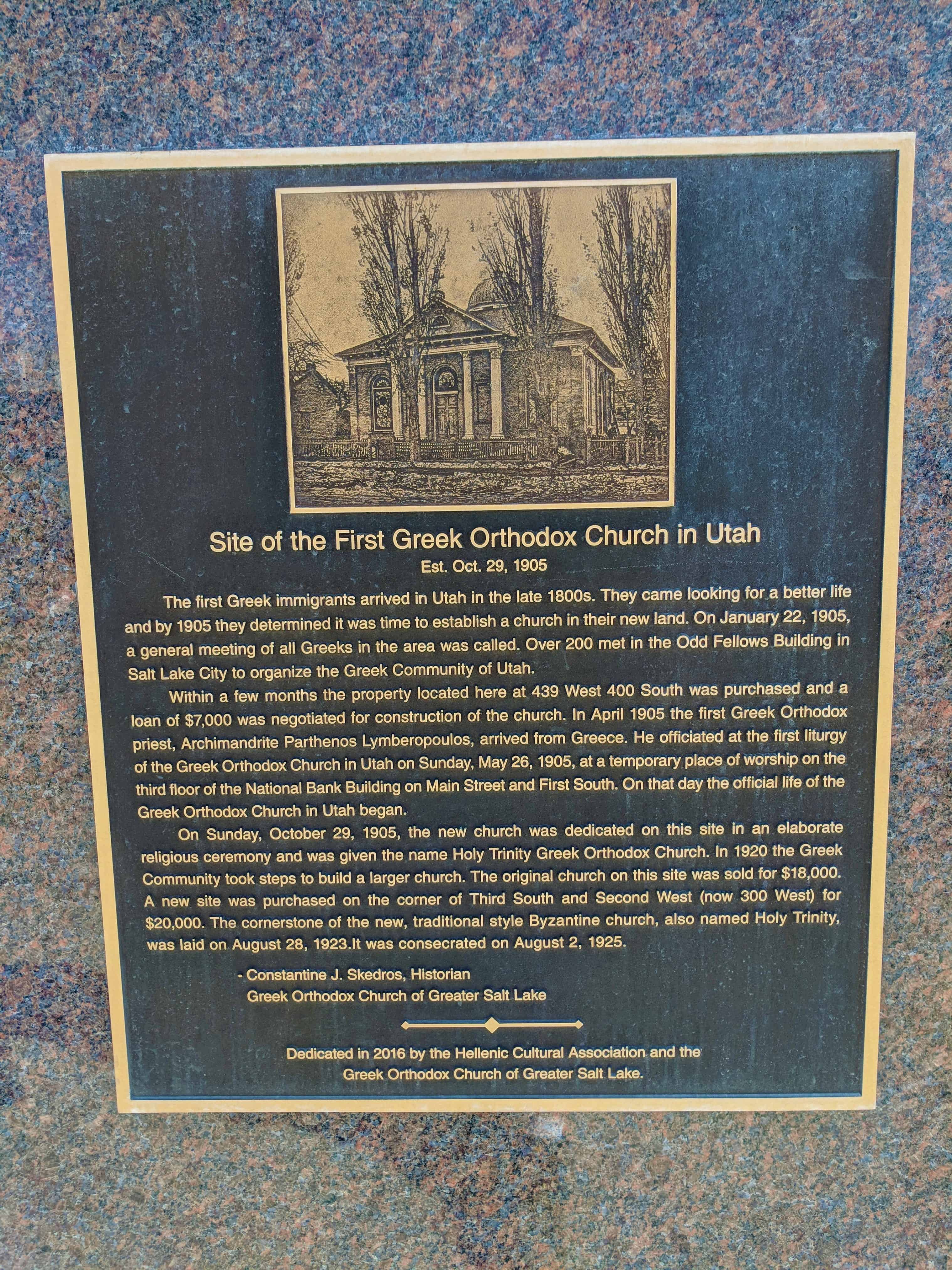
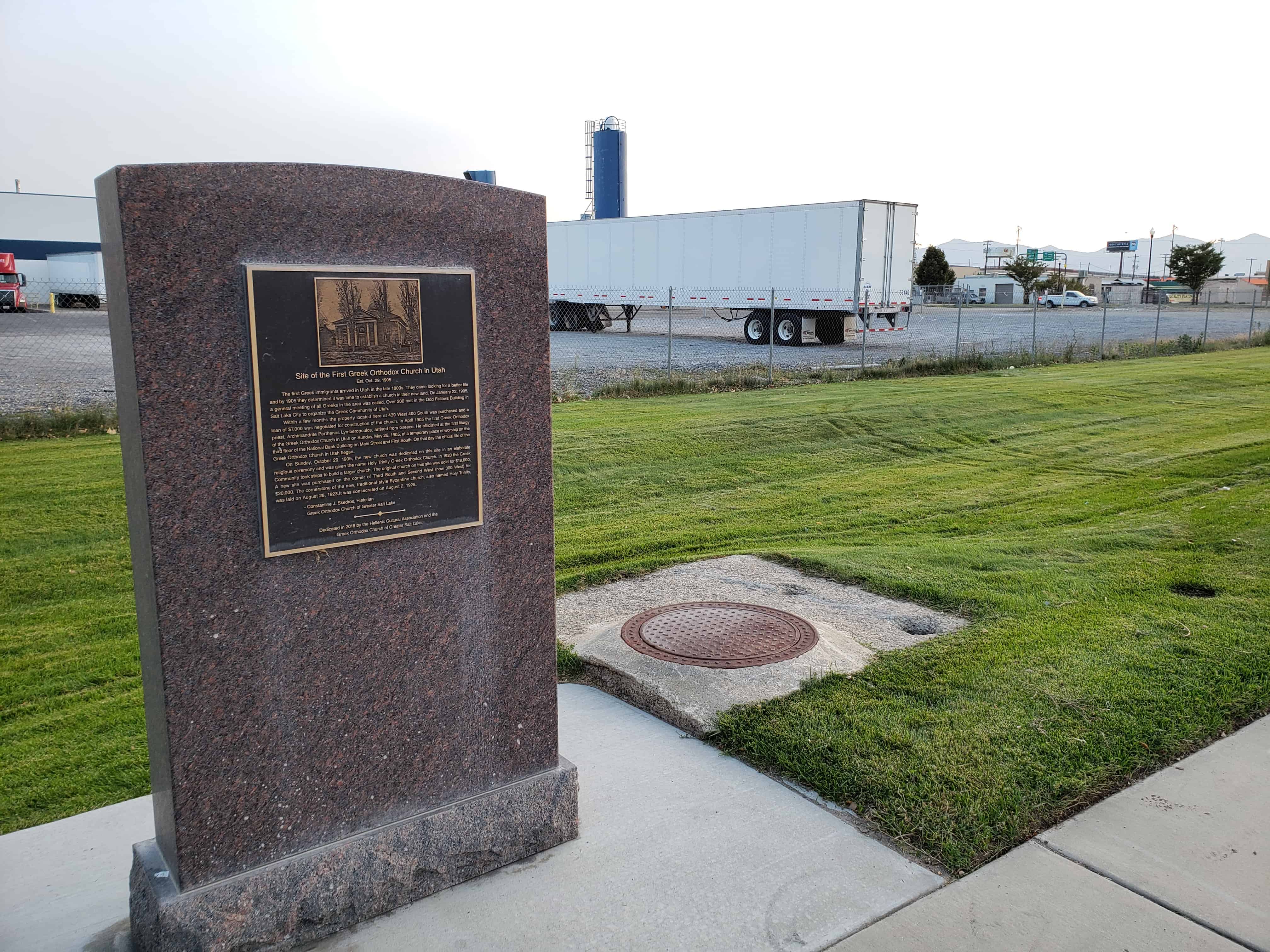
Site of the First Greek Orthodox Church in Utah
Est. Oct. 29, 1905
The first Greek immigrants arrived in Utah in the late 1800s. They came looking for a better life and by 1905 they determined it was time to establish a church in their new land. On January 22, 1905, a general meeting of all Greeks in the area was called. Over 200 met in the Odd Fellows Building in Salt Lake City to organize the Greek Community of Utah.
Within a few months the property located here at 439 West 400 South was purchased and a loan of $7,000 was negotiated for construction of the church. In April 1905 the first Greek Orthodox priest, Archimandrite Parthenos Lymberopoulos, arrived from Greece. He officiated at the first liturgy of the Greek Orthodox Church in Utah on Sunday, May 26, 1905, at a temporary place of worship on the third floor of the National Bank Building on Main Street and First South. On that day the official life of the Greek Orthodox Church in Utah began.
On Sunday, October 29, 1905, the new church was dedicated on this site in an elaborate religious ceremony and was given the name Holy trinity Greek Orthodox Church. In 1920 the Greek Community took steps to build a larger church. The original church on this site was sold for $18,000. A new site was purchased on the corner of Third South and Second West (now 300 West) for $20,000. The cornerstone of the new, traditional style Byzantine church, also named Holy Trinity, was laid on August 28, 1923. It was consecrated on August 2, 1925.



18 Tuesday Sep 2018
Posted in Uncategorized
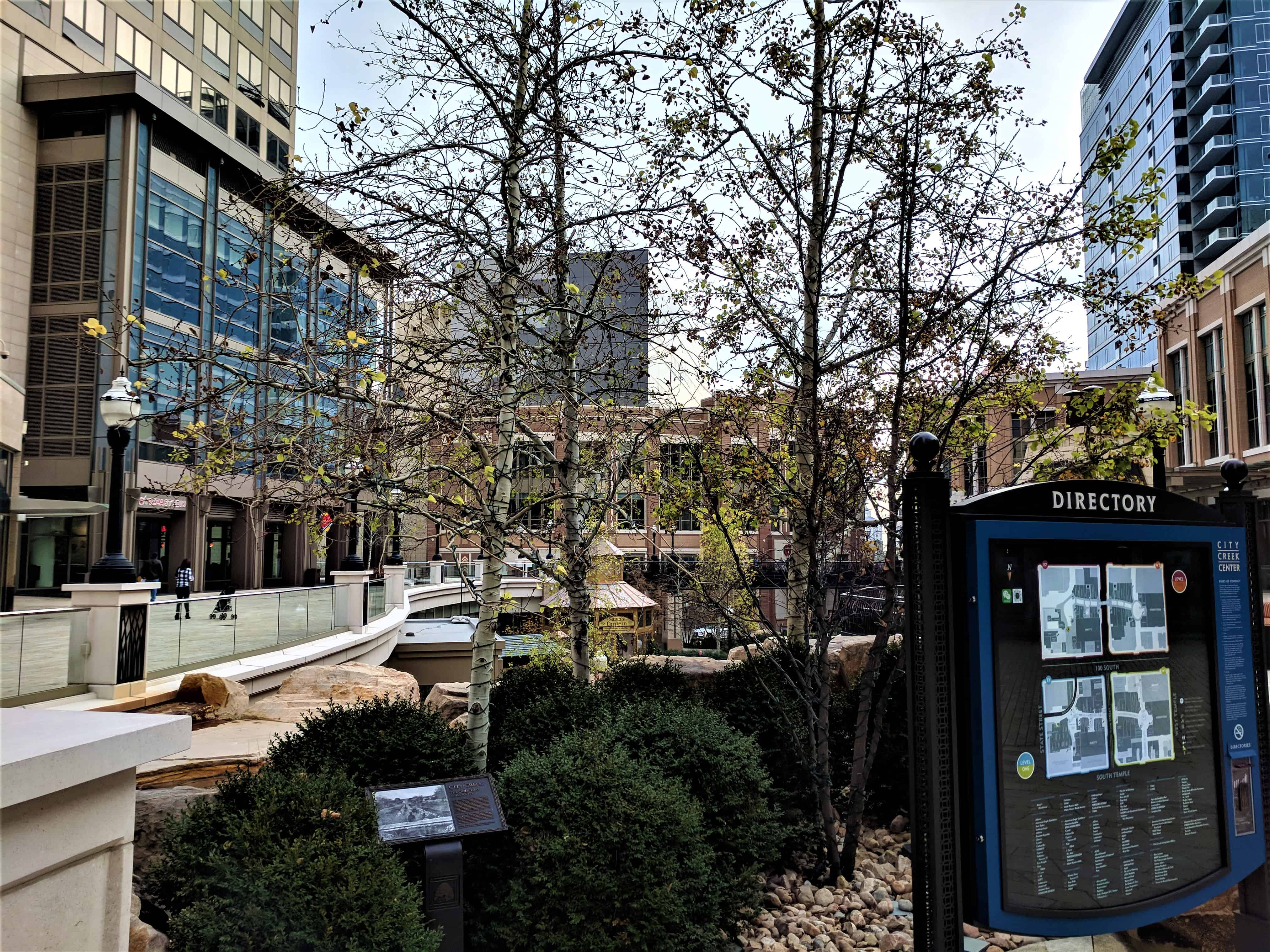
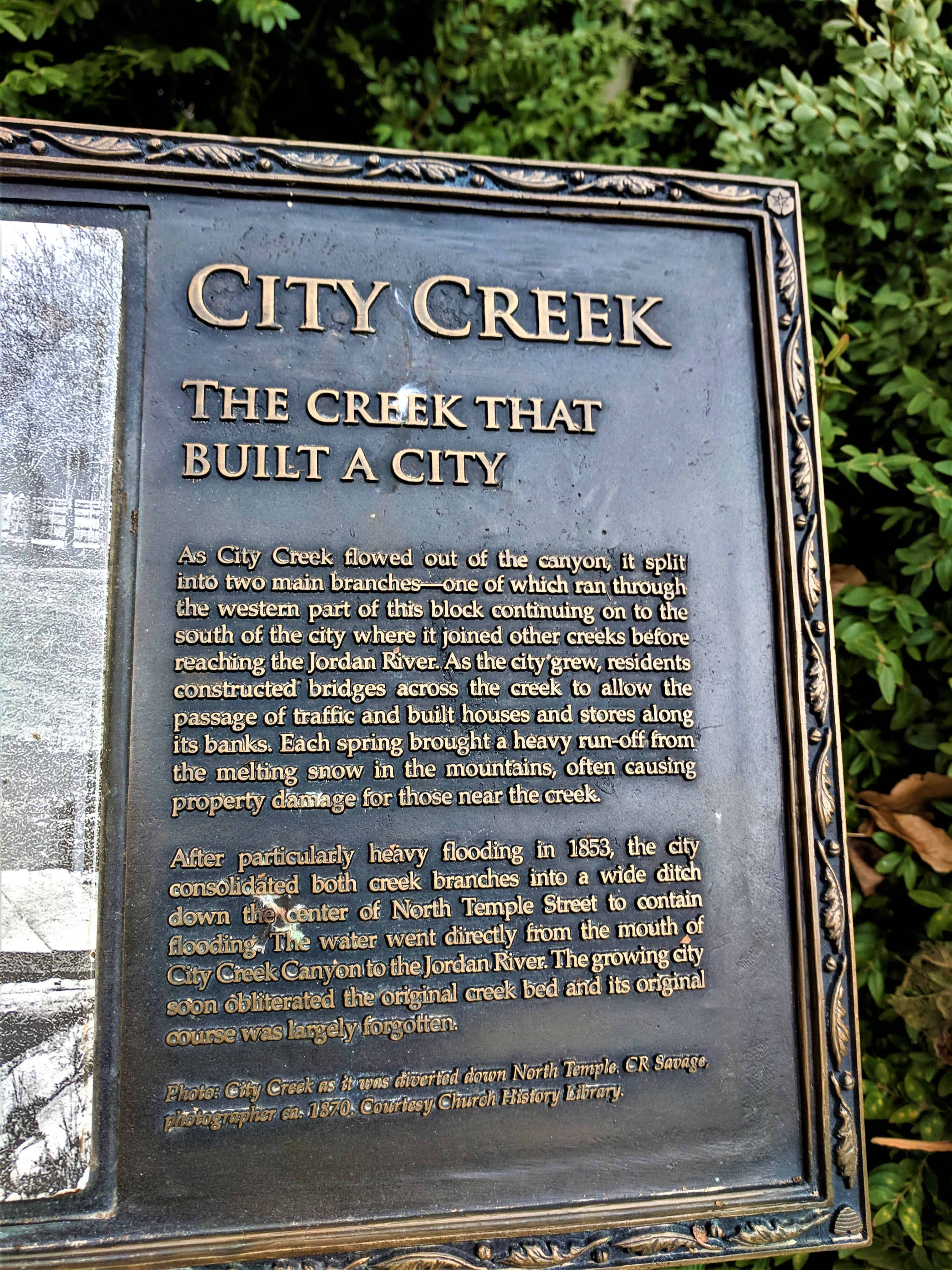
City Creek
The creek that built a city
As City Creek flowed out of the canyon, it split into two main branches – one of which ran through the western part of this block continuing on to the south of the city where it joined other creeks before reaching the Jordan River. As the city grew, residents constructed bridges across the creek to allow the passage of traffic and built houses and stores along its banks. Each spring brought a heavy run-off from the melting snow in the mountains, often causing property damage for those near the creek.
After particularly heavy flooding in 1853, the city consolidated both creek branches into a wide ditch down the center of North Temple Street to contain flooding. The water went directly from the mouth of City Creek Canyon to the Jordan River. The growing city soon obliterated the original creek bed and its original course was largely forgotten.




16 Sunday Sep 2018
Posted in Uncategorized
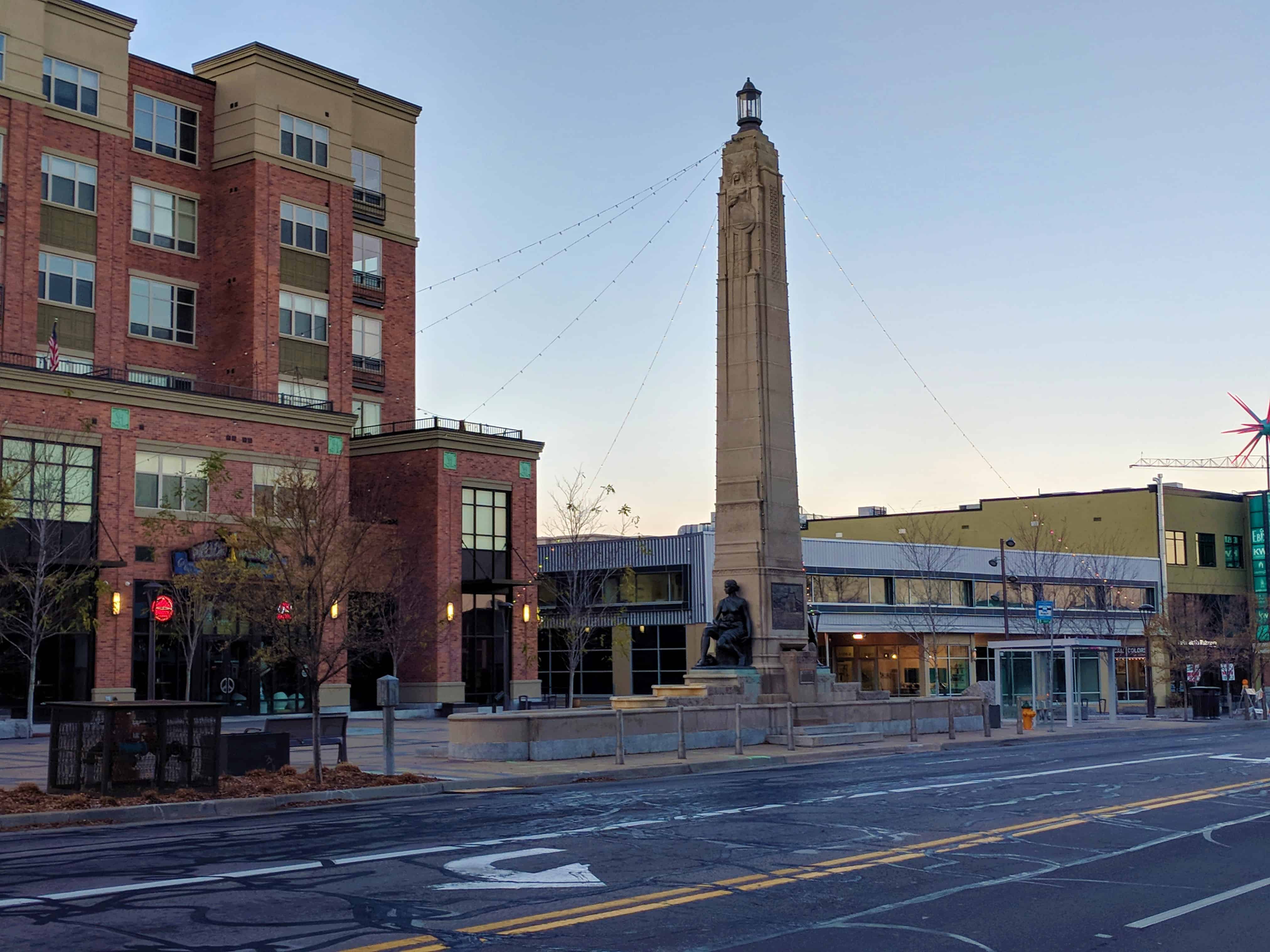
Sugar House Monument
Sugar House Monument
Erected in recognition of the first effort made to manufacture beet sugar in Western America.
With dauntless perseverance through severe hardships the machinery was brought from Liverpool, Eng. To this place, where in 1853 the sugar mill was constructed.
May the spirit of this courageous venture continue to characterize this community.
The Old Sugar House
Home of one of the earliest efforts toward the creation of local industry in Utah.
At these crossroads in 1853-55, a structure was erected which stood for many years as a symbol of pioneer enterprise and courage. Its site was approximately two hundred feet east of this spot.
After the sugar project was abandoned, the old mill served many other useful purposes. Its life ended in 1928.
The Sugar House Mill: How Sugar House Got Its Name
This section of Parley’s Creek contributed to the creation of Sugar House as a thriving business district. Water from the creek powered a sugar mill near the corner of Highland Drive and 2100 South, which ultimately gave Sugar House its name. The mill was built in 1854 by pioneers hoping to produce white sugar from beets. The mill soon failed and by 1856 had been converted to the first paper mill successfully operated in the west. At one time, the Sugar Mill housed a machine shop for the Salt Lake and Utah Central Railway. It was later used as offices for Bamberger Coal Company until it was torn down in 1928.
S.U.P. Marker #39, Jordan & Salt Lake City Canal is located here too.
Related:

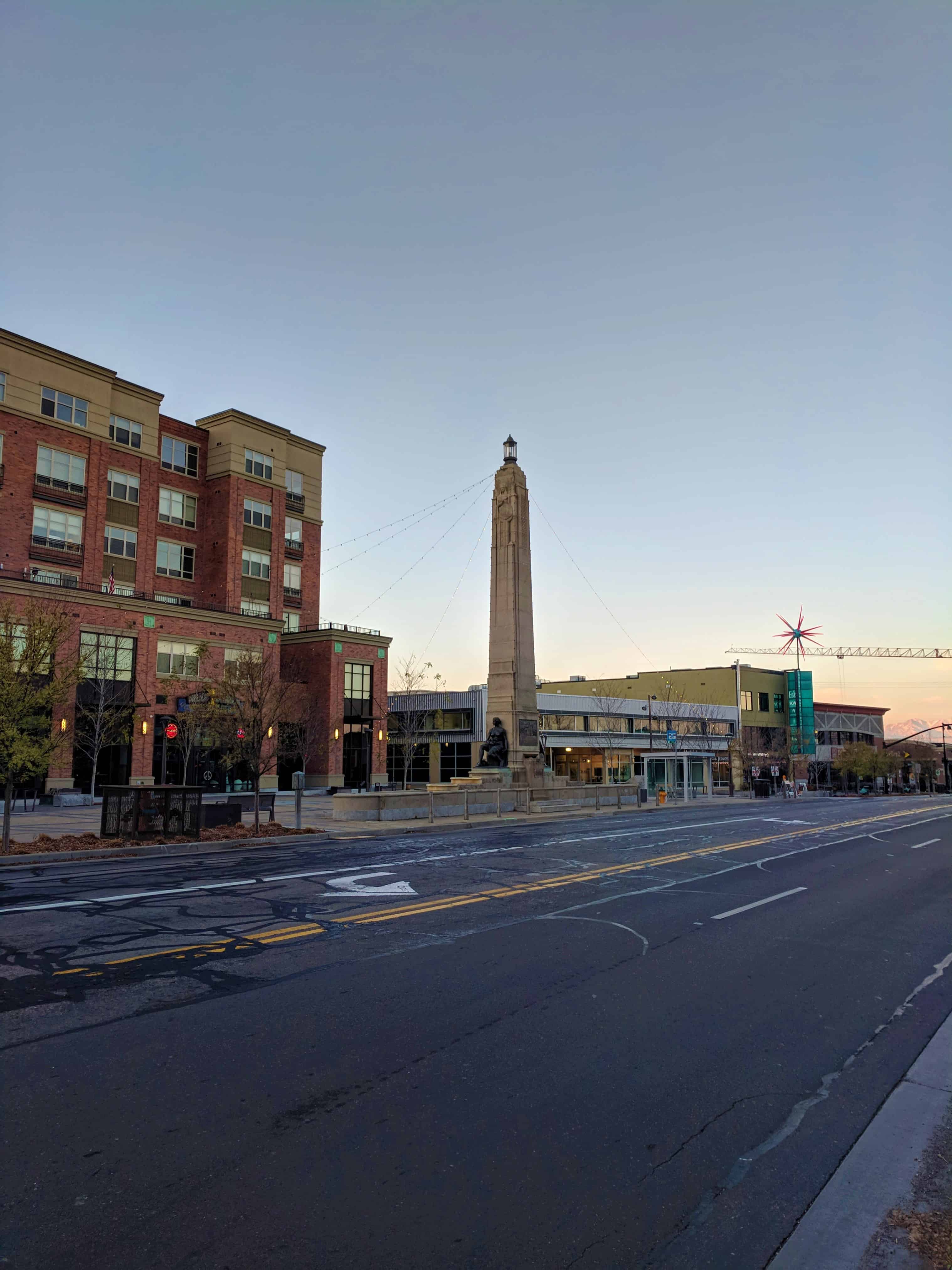


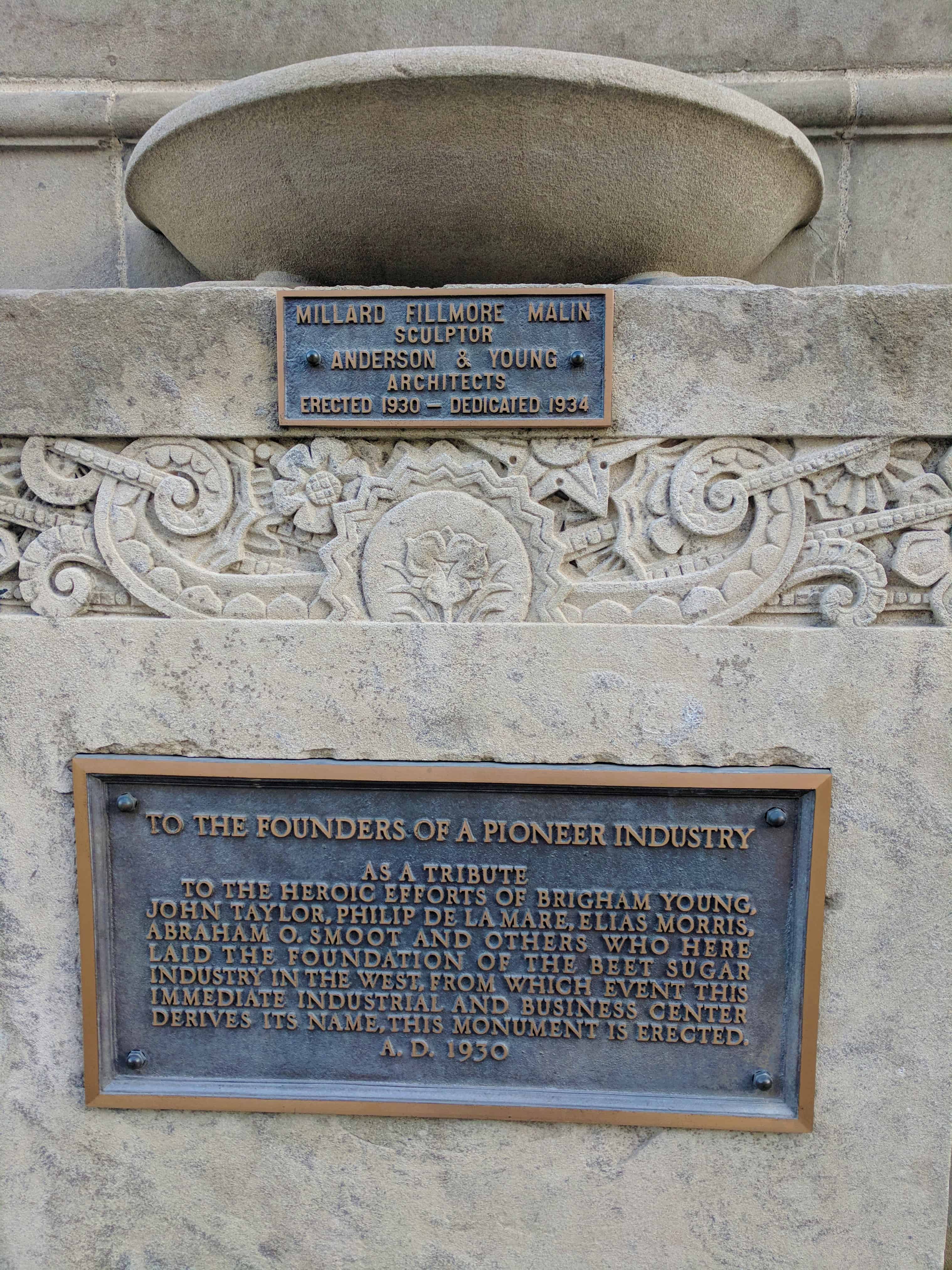


The Sugar House Monument, built in 1930, is significant under Criterion A as a local landmark and the center of the Sugar House business district. The work reflects the cohesiveness of the merchants of the Sugar House business district as it was initially commissioned by the Sugar House Business Men’s League and renovations to it were spearheaded by the Sugar House Business and Professional Women’s Club. The monument was constructed in 1930 during the “A City Within A City, 1910-1954” context to commemorate the founders of the sugar beet industry in Utah. It is also significant under Criterion C as the outstanding work of a local sculptor, Millard Malin, combined with the design of the architectural firm of Anderson and Young. The fifty-foot high shaft retains its historic and architectural integrity and is being nominated as part of the multiple property submission, Sugar House Business District Multiple Resource Area. (*)
History of the Sugar House Monument
The plaza on which the monument stands was built in 1914 as 2100 South was realigned and Parley’s Creek was buried in conduit. It was reconstructed in 1927 by the city at a cost of $5,219. 7 The plan for a monument to be located on the plaza grew out of a suggestion made by Millard Malin, a sculptor, in 1928 to the Sugar House Business Men’s League that they erect a monument to “early Utah industry”8 on the plaza in Sugar House. He also presented a proposed two-foot high model for the statue to the group. The Sugar House Business League and the City of Salt Lake built the monument in 1930, following a competition to choose the winning design. The city share of the cost was $2,000.9 The plaza was dedicated on November 11, 1934.
The Sugar House Business and Professional Women’s Club, the Sugar House Chamber of Commerce and the Salt Lake City Commission joined together to clean up and maintain the monument and plaza in 1947. The clean up effort was part of Sugar House merchants’ efforts at beautification for the centennial of the original Mormon settlers entering Salt Lake City in 1847. The Salt Lake City Engineering Department cleaned the monument itself and replaced the wooden light poles at the ends of the plaza with ornamental steel ones as well as replacing curbs and gutters as needed.
The brass bas-relief plaque at the base of the monument on the north picturing the old sugar mill was added in 1948, using funds raised by the Sugar House Business and Professional Women’s Club. Malin’s original design had the sugar mill plaque on the north and one of fur trading at the Smoot trading post that was located on the site of the monument on the south. The south plaque was never finished.
The Artists
The sculptor of the monument, Millard Fillmore Malin, was born in Salt Lake City in 1891. He studied art at the University of Utah under Edwin Evans from 1914-1915 and later enrolled at the National Academy of Design in New York. He worked under Norman A. MacNeil from 1917-1918 on a sculpture of Ezra Cornell, which is located at Cornell University. He also assisted Gutzon Borglum on the Stone Mountain Memorial in Georgia. After his move back to Salt Lake City in 1923 he concentrated his work on monumental and architectural sculptures. His sculpture is realistic and he is considered one of Utah’s most outstanding sculptors.
His most famous work is the Sugar House Monument but he also completed other public sculptures in Utah. The Utah State Capitol building houses busts of two Native Americans of the Ute tribe, Unca Sam and Chief John Duncan, and a commemorative bronze plaque for the battleship Utah honoring the victims of the Pearl Harbor bombing. From 1950-1960 he completed baptismal fonts and other works for LDS 10 temples designed by Edward O. Anderson as LDS Church architect in Los Angeles; Bern, Switzerland; London, England, and New Zealand. The Dinosaur Monument located at the Utah Field House of Natural History in Vernal, Utah, was completed in 1964. Research astronomy was Malin’s avocation and he published three titles on gravity and the solar arrangement.
After winning the competition for the monument, Millard Fillmore Malin called in Edward Oliver Anderson and his partner, Lorenzo (Bing) Young, to collaborate on the design. 11 Malin and Anderson met while they were both at the University of Utah in 1914-15 and they became lifelong friends. Edward Oliver Anderson was also born in 1891. He was involved in many building projects for the LDS Church such as the Waycross Branch in Waycross, Georgia, the North Afton Ward in Afton, Wyoming, and the Bryan Ward in Salt Lake City. Anderson was the LDS Church Architect and also served on the board of temple architects. He designed the Idaho Falls Temple in 1945 with a team of four others. This temple design began the LDS Church post-war temple-building program that increasingly utilized standard plans. He also did the three-story London Temple in 1958.
Lorenzo Snow (Bing) Young was born in 1894 in Salt Lake City, a grandson of Brigham Young, the second president of the LDS Church. He was a graduate of Pratt Institute in New York and spent forty years practicing architecture in Salt Lake City. During his career he helped to design over 300 buildings including the new Marriott Library at the University of Utah; Olympus and Highland High Schools in Salt Lake City, and the Special Events Center at Brigham Young University. He was also a member of the LDS Church Board of Architects during the construction of the Los Angeles and Idaho Falls LDS temples. Before his death in 1968 he was a partner at Young and Fowler Associates.
Anderson and Young were partners for eight years from 1928 to 1936. During this time the firm of Anderson and Young designed and constructed buildings for the LDS Church in St. George and Richfield, Utah. Other examples of their work include the Granite Stake Tabernacle and Lincoln Ward on 2005 South 900 East in 1929 2 ; the Tudor Revival Milwaukee Ward in Milwaukee, Wisconsin; and the Vernal First Ward in Vernal, Utah. A notable non-ecclesiastical public building of their design is Kingsbury Hall, the University of Utah Auditorium in Salt Lake City, built in 1928 (NR, 1978).
The monument is in a simplified Art Deco style that occurred in Utah primarily from 1930-1940. The ornamentation of the Art Deco style was influenced by the 1925 Paris Exposition des Arts Decoratifs. The monument displays many Art Deco ornamental patterns, like the angular decorative geometric designs on the sides of the vertical shaft and the vertical molded patterns typical of the style. The carved Limestone bands that run horizontally along the north and south sides of the pool beds as well as two bands on the bottom section of the shaft, above the seated statues, have stylized plant and natural motifs. Malin describes the pattern used as “Double Sun.” It has a sego lily at the center and is surrounded by the sun with its corona, stars, planets and a crescent moon.

There are two massive bronze figures seated at the base facing east and west. The female figure to the east represents the fertility of the Salt Lake Valley and is modeled on Marjorie Lewis, a friend of the sculptor. The male figure is modeled on Max Croft, a stone worker who was found by the sculptor as he was heaving rocks to create the monument. He represents a mill builder and is pouring water from an urn over a wheel.


12 Wednesday Sep 2018
Posted in Uncategorized
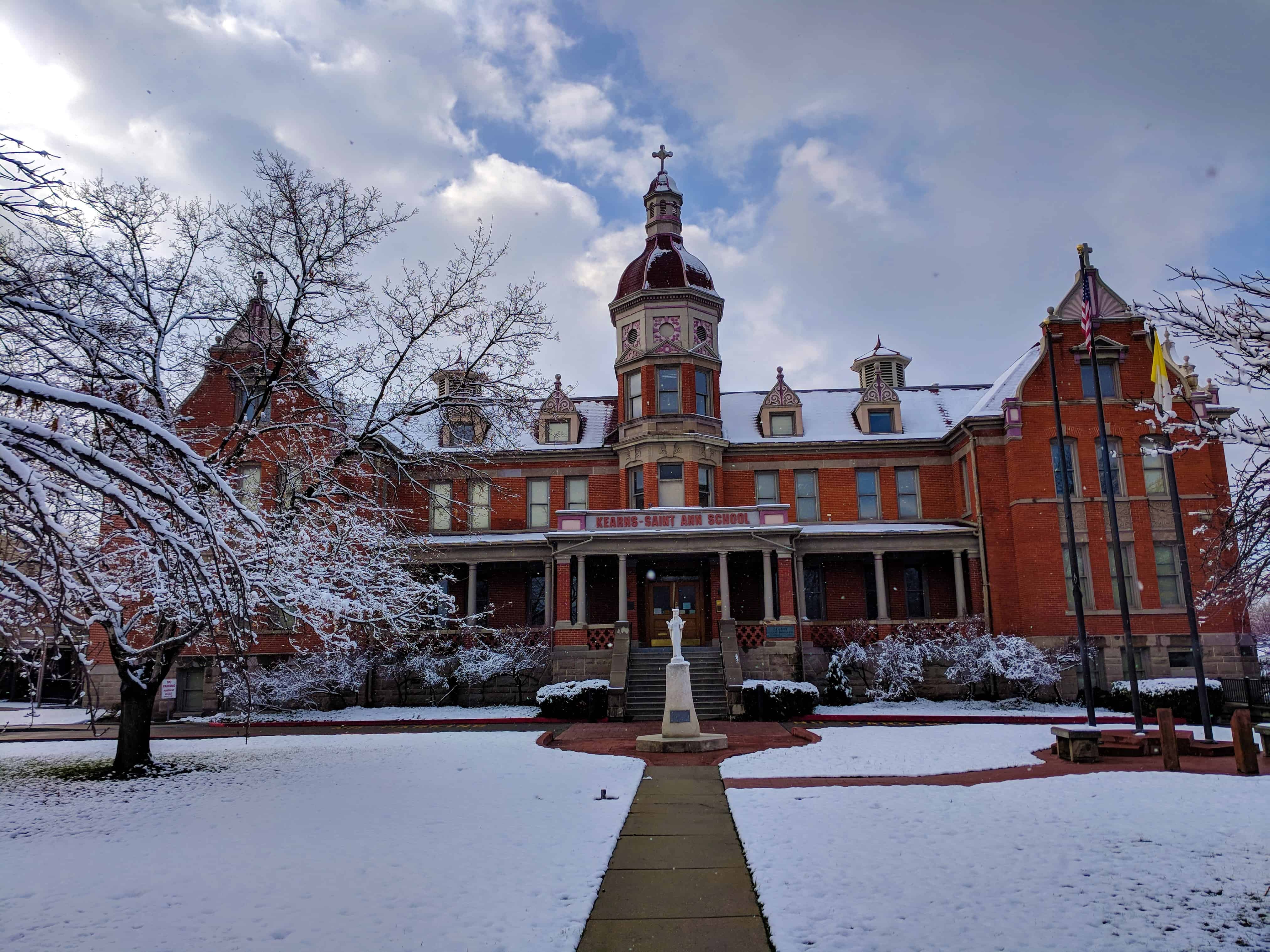
Kearns – St. Ann’s Orphanage
Kearns – St. Ann’s School
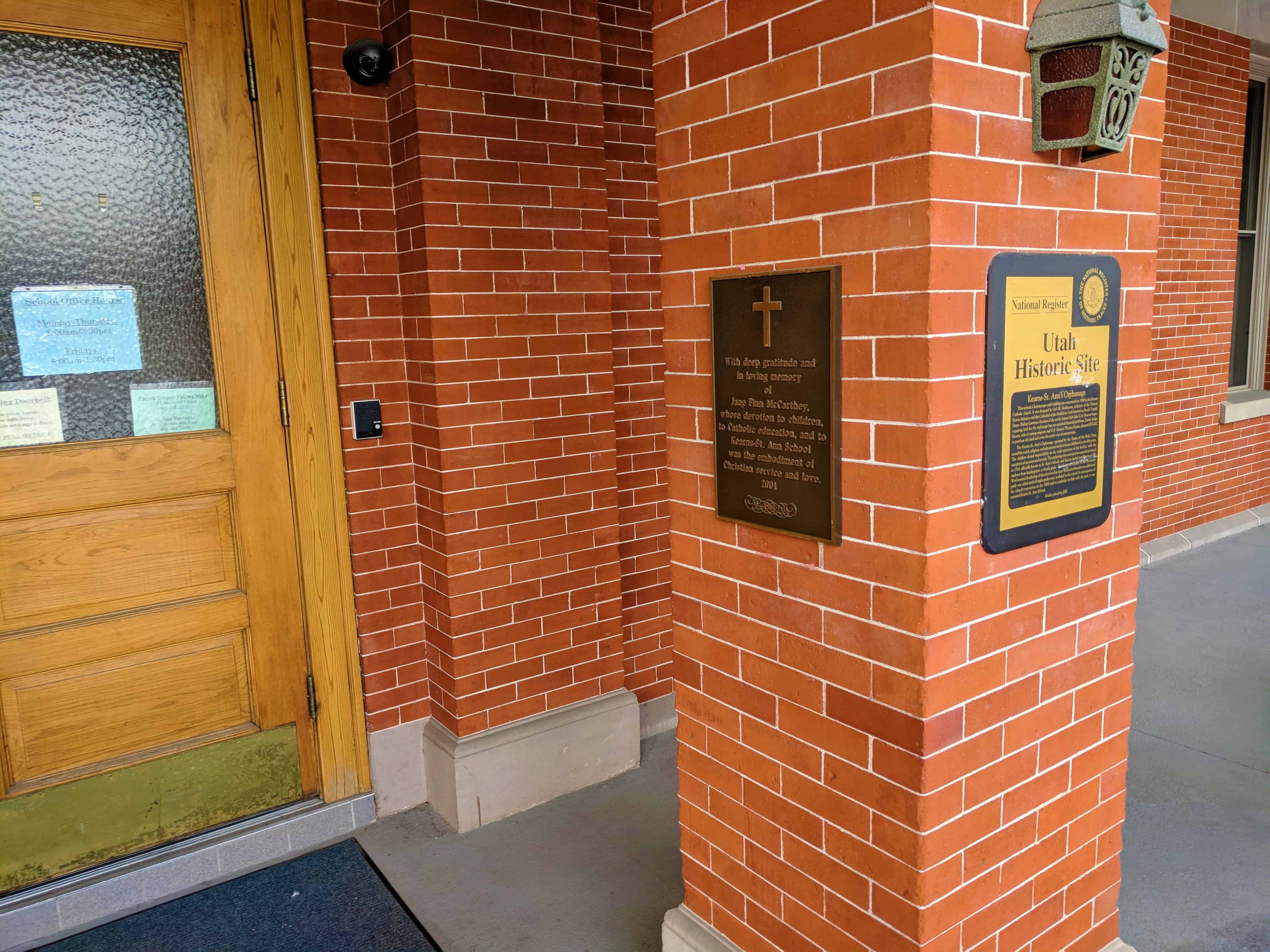
This eclectic Chateauesque style building was constructed in 1899 by the Roman Catholic church. It was designed by Carl M. Neuhausen, architect of the Thomas Kearns Mansion and the Cathedral of the Madeleine, both located on South Temple Street. Bishop Lawrence Scanlan of the newly formed Salt Lake City Diocese began acquiring land for the orphanage but encountered financial problems. Jennie Judge Kearns, wife of mining magnate and U.S. Senator Thomas Kearns, donated $55,000 to purchase the land and cover the entire cost of construction.
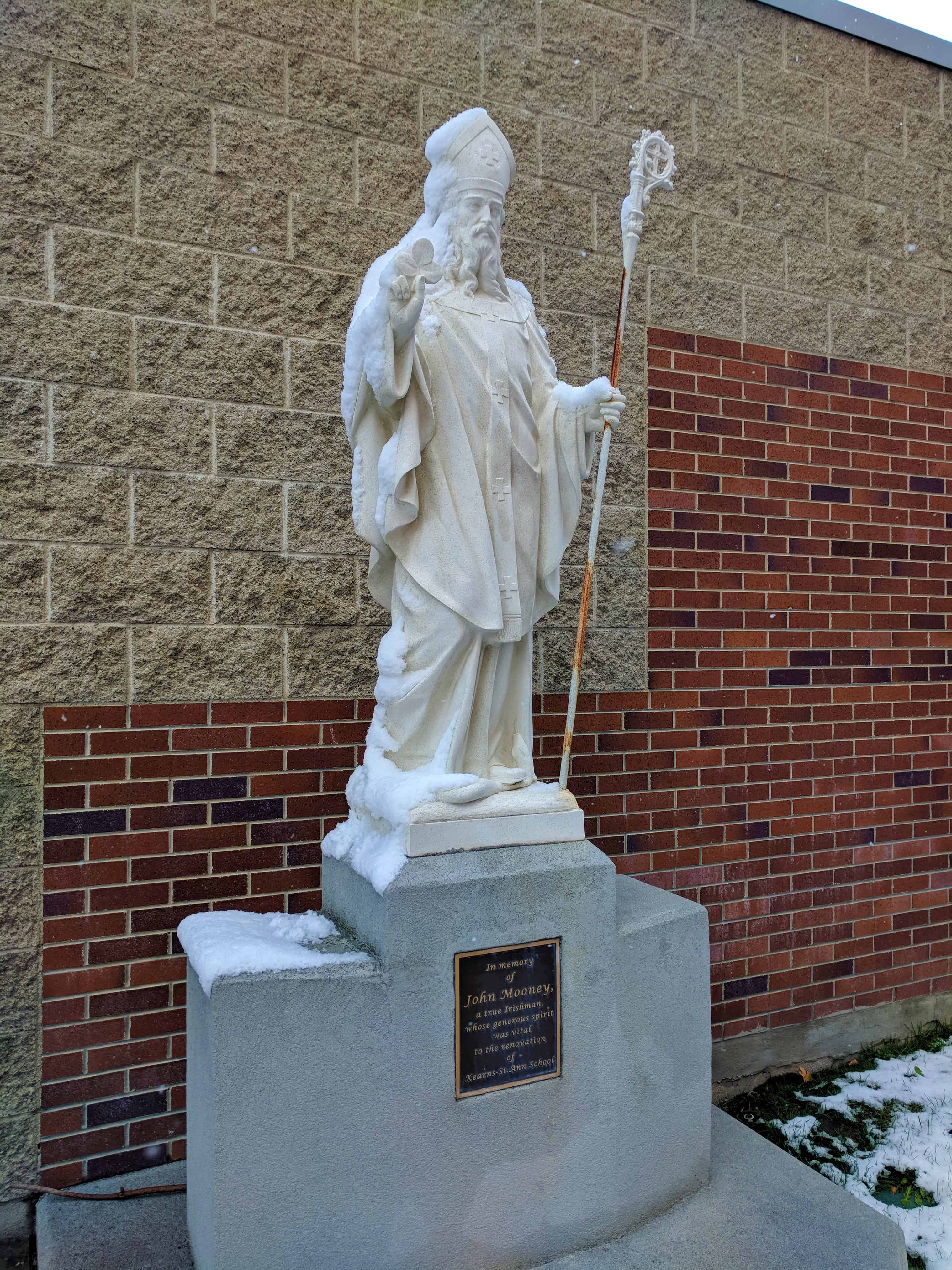
The Kearns-St. Ann’s Orphanage, operated by the Sisters of the Holy Cross, served the social, religious, and educational needs of many children for over fifty years. The children shared responsibility in the total operation of the facility, with the exception of accounts and records. The orphanage was converted to a parochial school in 1954, officially known as St. Ann’s School, and had an initial enrollment of 240 students from kindergarten to fourth grade. The Sisters of Charity of the Incarnate Word assumed leadership of the school at that time. Each year thereafter an additional grade was added until all eight grades were included in the school. In anticipation of the school’s restoration in the 1990s and to symbolize its link with the past, it was renamed Kearns-St. Ann School.
To the Sisters of the Holy Cross whose devotion to St. Ann’s inspired in little children the one and only hope. – Placed here by the descendants of the late Senator and Mrs. Thomas Kearns
Related posts:
Located at 430 East 2100 South in South Salt Lake City, Utah and added to the National Historic Register (#80003925) on October 3, 1980.

The Kearns-St. Ann’s orphanage is a two and a half story brick structure designed by Carl M. Neuhausen, the architect of the Kearns Mansion and the Cathedral of the Madeleine on South Temple. St. Ann’s in its modest decorative elements alluded to Renaissance and Mannerist detailing, as do both the much more elaborate Kearns Mansion and Neuhausen’s own house on First South. Neuhausen’s eclectic style was rare in Utah, and the few buildings by other designers lack Neuhausen1 s skillful use of the Chatesque manner. The orphanage represents the important educational and religious contributions to Utah society of Bishop Lawrence Scanlan and Thomas and Jennie Kearns.

Money for the construction of the school was made available to Bishop Lawrence Scanlan from Mrs. Thomas Kearns. Scanlan had acquired a parcel of land near Eleventh South, however, after one payment he had exhausted the funds. Kearns gave the church $55,000, which was enough to purchase the land and cover all building costs. Two thousand people witnessed the placement of the cornerstone on August 27, 1890.
St. Ann’s brought together several of the most influential Catholics in Utah. Thomas Kearns, the mining magnate, and his wife Jennie changed the social landscape by creating new educational and religious institutions in Utah. Bishop Scanlan was the first Bishop of the newly formed Salt Lake City Diocese (Utah and Nevada). He had served as a missionary in the area since the 1870s, and recognized the need of support institutions to aid the Catholic missionary effort.

The social order found at the orphanage was unique among the many forms of socialism in Utah during the early history of Utah. The children at the orphanage were to share in the total operation of the facility, except the handling of accounts and records. The Sisters of the Holy Cross charged no admittance fee to the parent or guardian .although those who could afford something often paid a monthly fee. After the tragic coal mine explosion at Scofield, Utah on May 1, 1900, the orphanage offered its help to assist children left orphans by the blast. The orphanage served the needy for fifty-two years before it was converted into a school.
Funding for Saint Ann’s has come from a number of sources. First of course was the money from the Kearns Foundation which later withdrew its support. In 1902 Patrick Phelm left his estate, valued at $76,000, to the school. In 1979 the school was still operating from the Phelm estate. Of course the parish has always tried to assist the school and the school has provided its facilities to the Catholic and non-Catholic community as well.
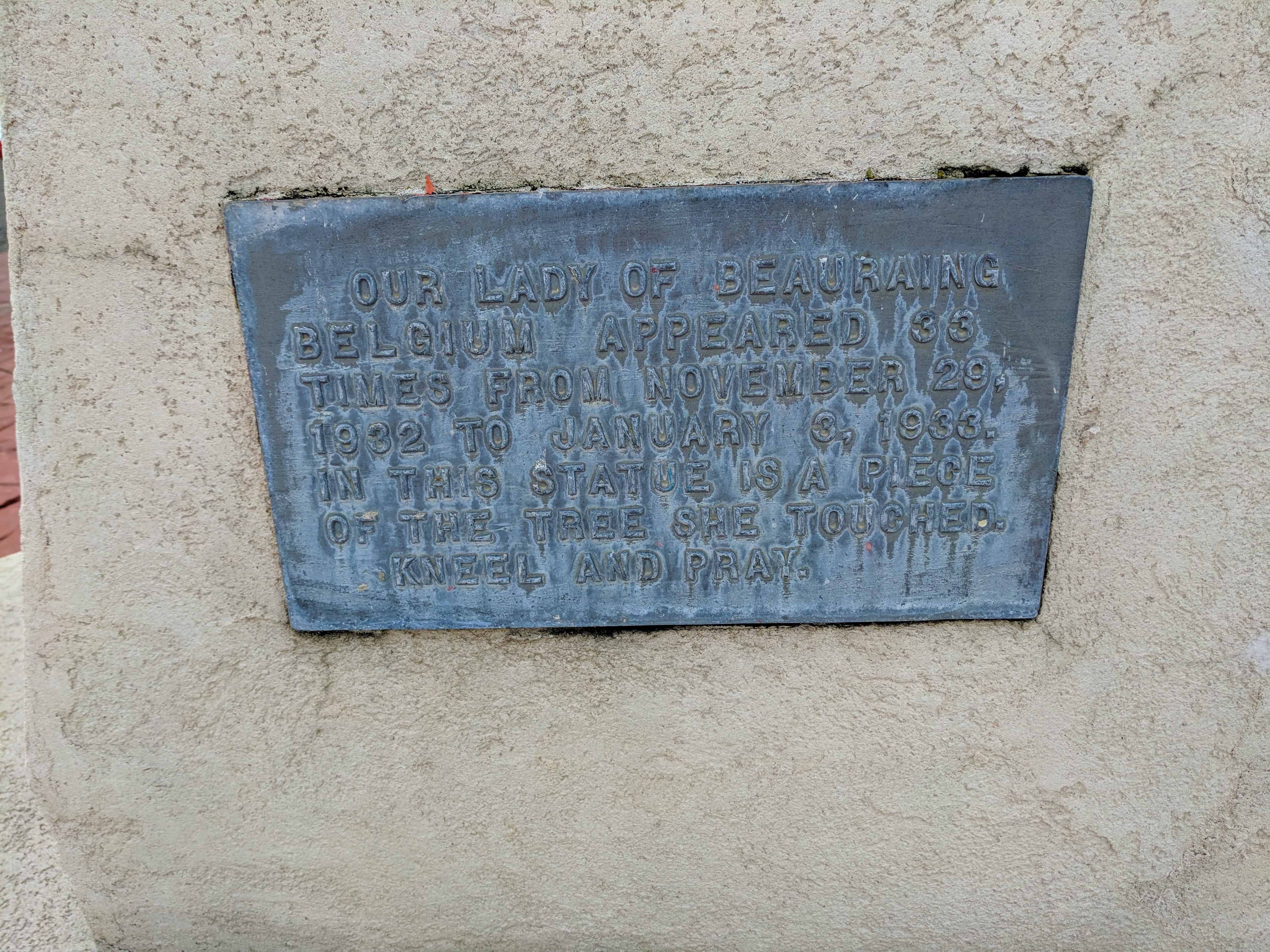
In 1953 Sister Mary McElligott, superior, and two other sisters from Brownsville, Texas, began direction at Saint Ann’s. On September 19, 1954, Kearns-St. Ann’s Orphanage was converted into a parochial school, officially known as St. Ann’s School. The name “Kearns” was dropped and removed from the exterior façade. Shortly afterwards the Kearns family announced they would no longer render financial assistance to the school and removed most of the schools elegant furnishings. The new order of sisters now in charge at the school began the change outlined in the physical description. The lavish abundance of trees, both evergreen and deciduous, that surrounded the school were cut down as was the orchard. These were replaced with lawns and playing fields.


Enrollment has gradually increased from 168 in 1900. When the orphanage was converted into a parochial school in 1954 it enrolled 240 students from Kindergarten to Fourth Grade. By 1966 that number had grown to 460 pupils through eight grades. The enrollment has now stabilized.
In 1955 money became available for the construction of a convent west of the school. Architect B. Bruce Folsom was chosen to design the convent that can house 11 sisters. Twelve years later (1967) a sharply contrasting St. Ann’s parish church with seating for 750 people, was built east of the school. The architect was William H. Louis.




10 Monday Sep 2018
Posted in Uncategorized
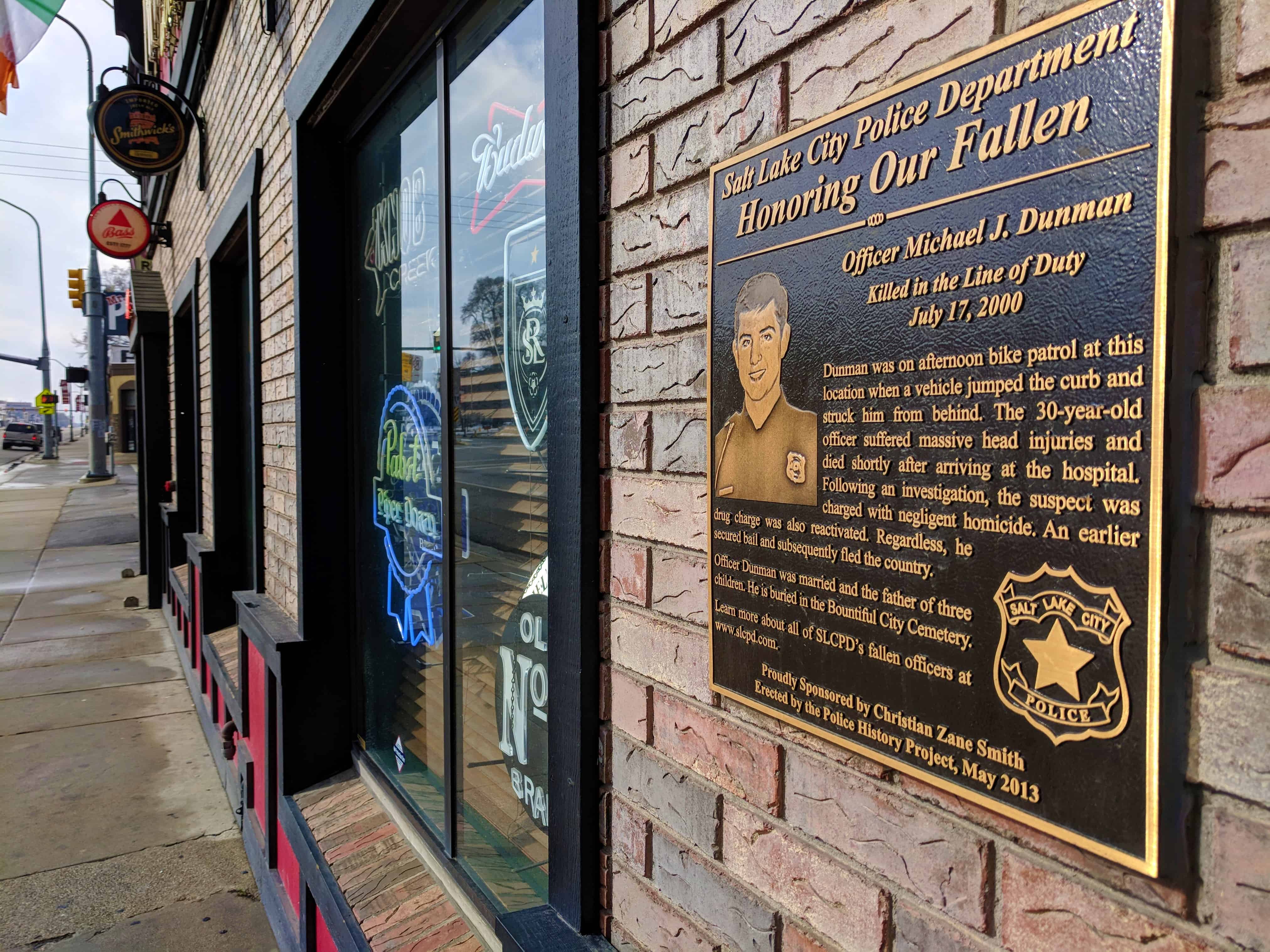
Officer Michael J. Dunman
Killed in the Line of Duty July 17, 2000
Dunman was on afternoon bike patrol at this location when a vehicle jumped the curb and struck him from behind. The 30-year-old officer suffered massive head injuries and died shortly after arriving at the hospital.
Following an investigation, the suspect was charged with negligent homicide. An earlier drug charge was also reactivated. Regardless, he secured bail and subsequently fled the country.
Officer Dunman was married and the father of three children. He is buried in the Bountiful City Cemetery.


The memorial is located outside Piper Down, at 1492 S State Street in Salt Lake City, Utah.
Related:


03 Monday Sep 2018
Posted in Uncategorized
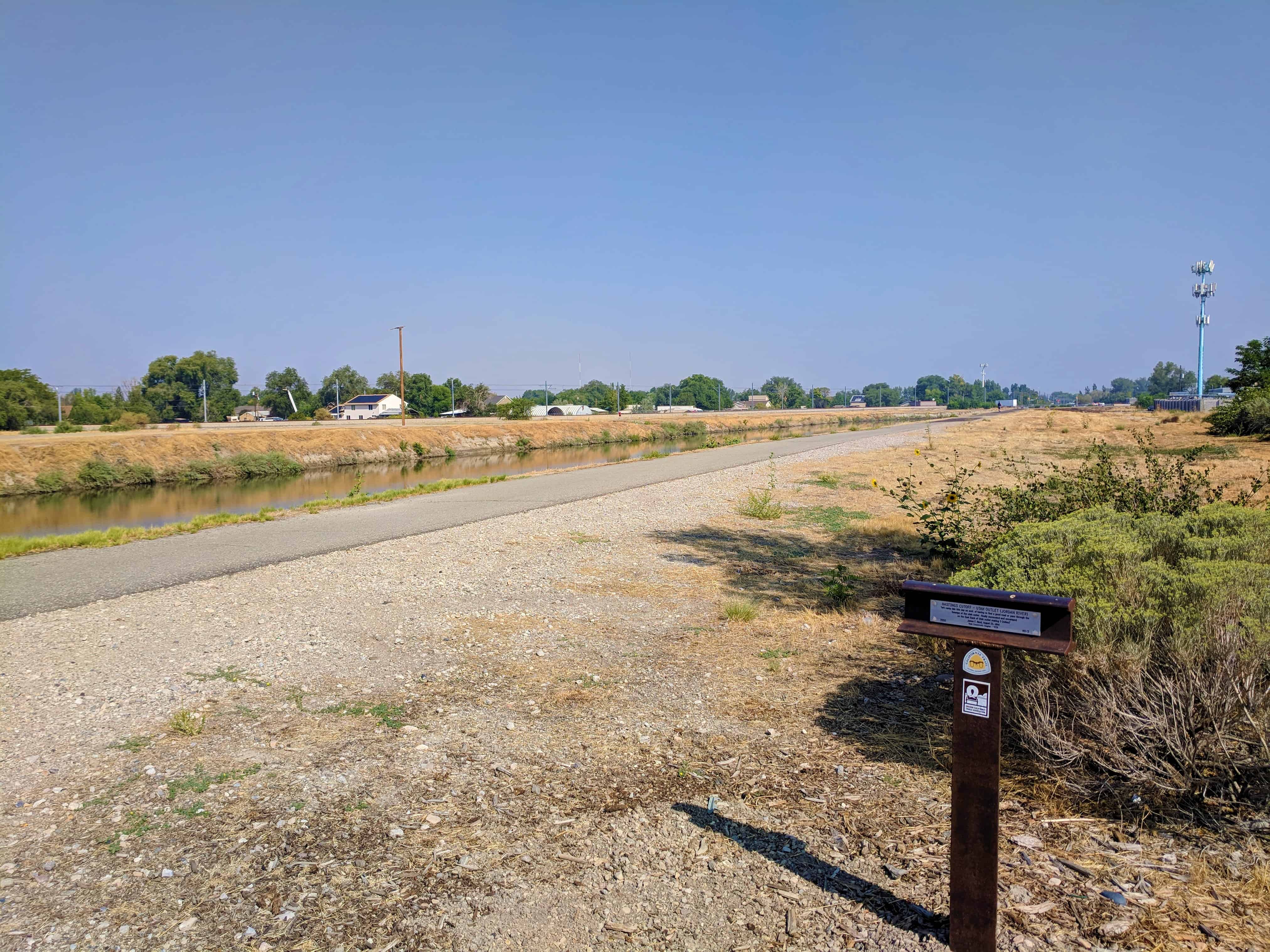
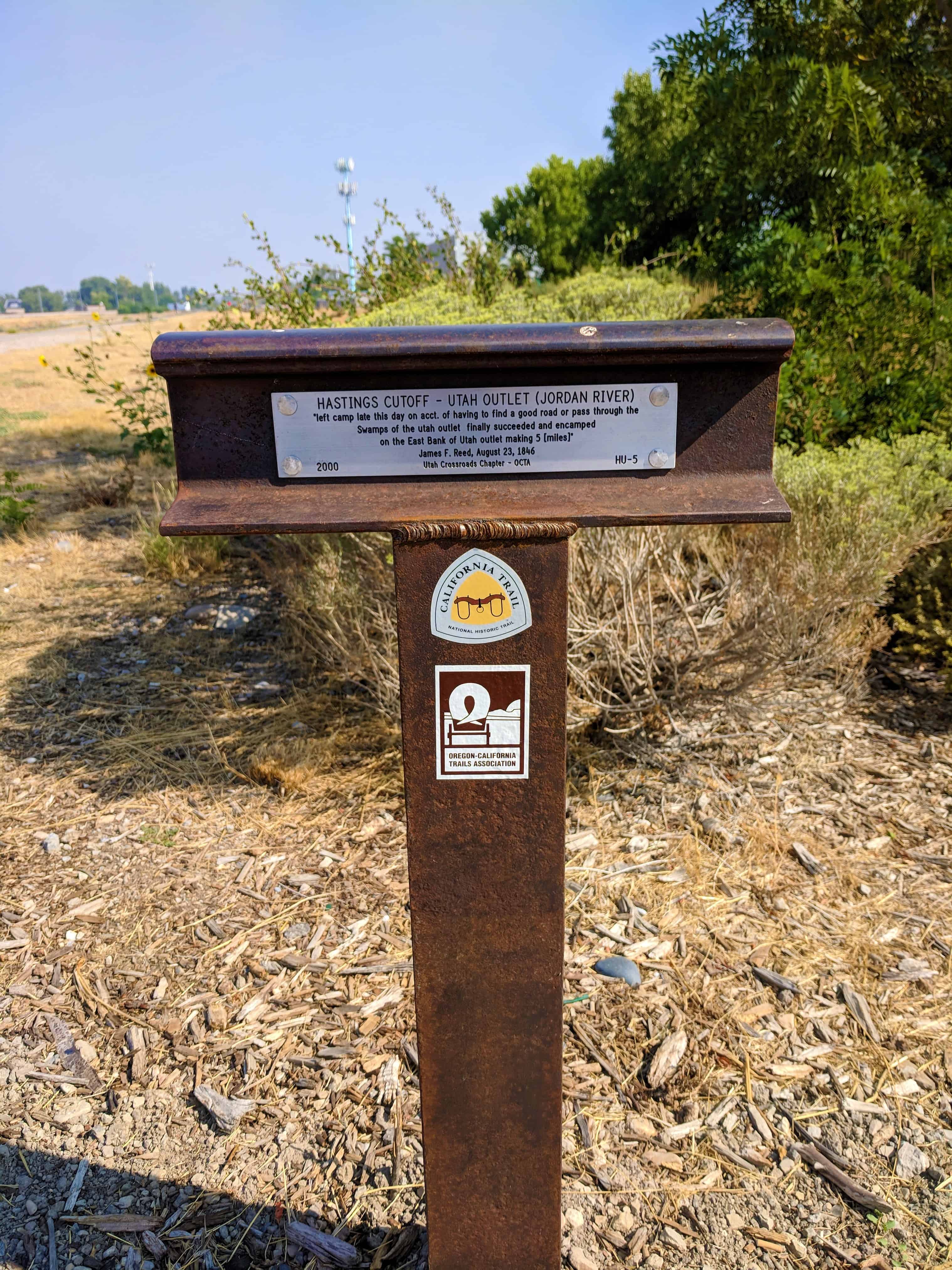
Hastings Cutoff – Utah Outlet (Jordan River)
“left camp late this day on acct. of having to find a good road or pass through the Swamps of the utah outlet finally succeeded and encamped on the East Bank of Utah outlet making 5 [miles]”
-James F. Reed, August 23, 1846
Utah Crossroads Chapter – OCTA
HU-5
This is part of the series of California Trail markers I’ve been documenting on these pages: