• About JacobBarlow.com
  • Cemeteries in Utah
  • D.U.P. Markers
  • Doors
  • Exploring Utah Email List
  • Geocaching
  • Historic Marker Map
  • Links
  • Movie/TV Show Filming Locations
  • Oldest in Utah
  • Other Travels
  • Photos Then and Now
  • S.U.P. Markers
  • U.P.T.L.A. Markers
  • Utah Cities and Places.
  • Utah Homes for Sale
  • Utah Treasure Hunt

JacobBarlow.com

~ Exploring with Jacob Barlow

JacobBarlow.com

Tag Archives: utah

1135 1st Avenue

09 Saturday Aug 2025

Posted by Jacob Barlow in Uncategorized

≈ Leave a comment

Tags

Avenues Historic District, historic, Historic Apartments, NRHP, Salt Lake City, Salt Lake County, utah

In 1938, Albert H. Walsh hired the Fullmer Bros. Construction Company to build this large, three-story brick apartment building, featuring 18 units. Albert Walsh was the founder of the A.H. Walsh Plumbing Company, and the company’s office building was located on the same block as the apartments. Mr. Walsh resided nearby at 1120 East 2nd Avenue. The apartment building retains its historic and architectural integrity and is a contributing resource within the Avenues Historic District.

1135 East First Avenue in The Avenues of Salt Lake City, Utah (technically 61 T Street is the parcel)

The Drayton Apartments

08 Friday Aug 2025

Posted by Jacob Barlow in Uncategorized

≈ Leave a comment

Tags

Avenues Historic District, historic, Historic Apartments, NRHP, Salt Lake City, Salt Lake County, utah


Constructed circa 1908, this three-story, brick apartment building was likely constructed by John H. Hilton and in 1916 was sold to Albert H. Walsh. Albert Walsh was the founder of the A.H. Walsh Plumbing Company. Mr. Walsh resided nearby at 1120 East 2nd Avenue and he owned the apartment building through 1950. The building was constructed at a time when an increasing number of multi-family structures were being built in the Avenues, transitioning away from single-family, owner-occupied residences. It features a prominent, centrally located pedimental bay for the front entry and large balconies.

1121 East First Avenue in The Avenues of Salt Lake City, Utah (technically 61 T Street is the parcel)

1119 1st Avenue

06 Wednesday Aug 2025

Posted by Jacob Barlow in Uncategorized

≈ Leave a comment

Tags

Avenues Historic District, historic, Historic Apartments, NRHP, Salt Lake City, Salt Lake County, utah

1119 East 1st Avenue

Constructed circa 1913, this three-story, brick apartment building was constructed by Albert H. Walsh and named for his wife, Emma N. Walsh. Albert Walsh was the founder of the A.H. Walsh Plumbing Company. The building was built at a time when an increasing number of multi-family structures were being built in the Avenues, transitioning away from single-family, owner-occupied residences. Character defining features of the building include its centrally located stairs and central hallway, sandstone foundation, and its front porch with massive two-story Doric columns and decorative entablatures.

1119 East First Avenue in The Avenues of Salt Lake City, Utah

Heber City Historic Home Tour

28 Saturday Jun 2025

Posted by Jacob Barlow in Uncategorized

≈ 1 Comment

Tags

Heber City, Historic Homes, utah, Wasatch County

Heber City’s Historic Home Tour – the map published by the city says:
Take a step back in time-explore Heber City’s historic homes and uncover the stories, style, and spirit of those who shaped the valley.

  • 100* Wasatch Stake Tabernacle (75 N Main)
  • 101* Heber City Amusement Hall (90 N 100 W)
  • 102* Old Wasatch High School (250 S Main)
  • 103* Old Central Elementary School (301 S Main)
  • 104* North Elementary School (101 E 200 N)
  • 105 Heber Bank Block Building (2 S Main)
  • 106 Heber 2nd Ward Meetinghouse (100 W Center)
  • 107 Abram & Parmelia Jane Lott Hatch Home (81 E Center)
  • 108 Wasatch Saloon (139 N Main)
  • 109 James Hugh & Evelyn Cluff McDonald (362 N Main)
  • 110 John E. Austin – Dr. WM. & Emma Wherritt (315 E Center)
  • 111 James & Elizabeth Barnes McNaughtan (213 W Center)
  • 112 Abram Chase & Maria Luke Hatch Home (105 E Center)
  • 113 James William & Mary Campbell Clyde (312 S Main)
  • 114 George & Elizabeth White Blackley Home (421 E 200 N)
  • 115* Joseph Stacy Murdock & Elizabeth Hunter (115 E 300 N)
  • 116 John Murray Murdoch & Ann Steele (261 N 400 W)
  • 117 Heber Valley Railroad (450 S 600 W)
  • 118 John Crook & Mary Giles Home (188 W 300 N)
  • 119 David IV & Mary Ann McDonald Fisher House (124 E 400 S)
  • 120 Addison & Sophia Hicken Home (212 S 100 W)
  • 121 John McDonald & Mary Lucinda Cole (390 N Main)
  • 122 Wasatch Library (188 S Main)
  • 123 Thomas & Sarah Denton Moulton Home (190 W 200 N)
  • 124 Robert & Anna Josephine Peterson Duke Home (383 N 200 E)
  • 125 Richard Jones Jr. & Agnes Campbell (187 E 100 N)
  • 126 James Dock & Eva Erickson Shanks Home (415 N 100 W)
  • 127* John Ephraim Moulton & Elizabeth Tonks Thacker Home (110 W 200 N)
  • 128 Frederick & Minnie Crook Home (512 S Main)
  • 129* Thomas & Catherine Hicken House (267 N 100 W)
  • 130 Elizabeth Sessions Condon Home (293 N 100 E)
  • 131 John William & Sarah Elizabeth Bond Crook (311 N 100 W)
  • 132 William Forman & Catherine Campbell (181 N 200 W)
  • 133 John & Sarah Crook Carlile Home (315 W Center)
  • 134 William & Sarah Jane McDonald Buys (312 S 100 W)
  • 135 William & Mary Mair Lindsay Home (412 E 100 N)
  • 136 Ideal Theater (113 N Main)
  • 137 Joseph R. and Margaret Wright Murdock (118 S 300 W)

    * these sites I did not see a plaque installed yet.


Bonneville Salt Flats Race Track

28 Wednesday May 2025

Posted by Jacob Barlow in Uncategorized

≈ Leave a comment

Tags

NRHP, Tooele County, utah

A part of the Great Salt Lake Desert, the Bonneville Salt Flats were formed by precipitated salt from Lake Bonneville, an ice-age lake which covered some 20,000 square miles of which the Great Salt Lake is the last remnant.

The text on this page is from the nomination form for the National Register of historic places, the race track was added to the register on December 18, 1975 (#75001826)

The raceway is just north of Interstate 1-80 and three miles ease of Wendover, Utah.

The racing area is approximately 13 miles and consists of hard salt sufficiently thick to support the heavy racing machines.

During most of the year the. racing area is either under water or too moist for racing. However, the dry Utah summer evaporates the moisture and by August and September the flats are ideal for racing. During this time a tent city of several thousand people springs up adjacent to the race area.

In 1939, Ab Jenkins enthusiastically described the quality of the Salt Flats in this manner:

“The salt beds are better than any of the existing board, brick , or cement tracks of the world because none of these is large enough. I made my first 24-hour run on the board track at Atlantic City, New Jersey in 1928, and know that on such a 1 1/2 mile circular course you can’t exceed 145 MPH because the centrifugal force would send the car over the bank unless the track were on a 90 degree grade. Another factor too, is that the pressure of the car may crash it through the timbers. Also, board tracks are seldom over 40 feet wide, which doesn’t give the driver much room to spin should he have trouble.

All of these handicaps are overcome on the salt, where there is plenty of room. The actual racing area on the flats measures about 10 by 15 miles. There would be an even larger area if it weren’.t for the dikes caused by the digging for potash on the beds during the War. [World War I]

Why are the slat beds better, then, than Daytona beach, Florida, where world racing marks were met until a few years ago? Daytona beach has a longer straightaway. It is 25 miles long. But Daytona Beach is only 100 to 200 feet wide. That doesn’t give much room to spin.

Yet, even though Daytona Beach were wider, it wouldn’t offer the safety of the salt. If your tire blows out, the rim of the wheel digs into the comparatively soft sand, and that means your car will likely go into a somersault…Never has a speed car overturned on the salt flats.

Then, too, the concrete-like salt has a cooling effect on tires which is found on no other track. However, because the salt is always a little moist, it does not furnish quite as much traction as does a dry dirt, board, or concrete track.”

There is presently concern that the nearby potash operations by the Kaiser Chemical Company are causing a deterioration of the salt flats as a raceway. Two conflicting conclusions were drawn from a study done in 1967. The Division of State Parks and Recreation is planning another geologic survey to investigate ways of preventing further deterioration.

William D. Rishel is credited with being the man who discovered the Salt Flats as an ideal speedway. In 1896, George Randolph Hearst had just started his New York Journal and felt it would be an exciting publicity stunt to send a message by bicycle from his San Francisco Examiner to his New York Journal. Rishel, then living in” Cheyenne, Wyoming, was hired by Hearst to blaze a bicycle trail from Cheyenne to Truckee, California. Accompanied by his friend C. A. Emise, Bill Rishel crossed the Salt Flats in twenty-two hours. However, their experience nearly rivaled that of the ill-fated Donner-Reed Party of 1846. In many places their bikes broke through the thin salt crust and they were forced to carry their mud-clogged bikes many miles. In addition, they ran out of drinking water and had to contend with sticky marshes and sweeping clouds of mosquitoes.

Rishel returned to the Salt Flats again in 1907. By this time he had envisioned the possibility of a highway across the flats and the opportunity for some racing. Rishel and two Salt Lake City businessmen, Frank Botterill and Wallace Bransford, started out for the Salt Flats in a four-cylinder Fierce-Arrow. As they neared the salt beds, they saw what they thought was a lake of water covering the flats. Discouraged, they returned to Salt Lake City. A short time later Rishel learned from some of the old timers that they had been fooled by a mirage.

Finally Rishel and his friend, Ferg Johnson, succeeded in driving Johnson’s Packard onto the Salt Flats via the railway ties. After driving on the smooth, flat salt beds, Rishel became fully convinced that they would make the world’s best speedway.

The following year, 1912, Rishel took A.L. Westgard, National Pathfinder for the National Trails Association, onto the salt flats and convinced the national automobile figure of the area’s potential for racing.

Westgard did not fulfill his role as a propagandist for the salt flats and it was up to local enthusiasts to seek other ways of publicizing the salt flats as a speedway.

In 1914, Ernie Morass, who had been barnstorming the country with a fleet of several racing cars, arrived in Utah. His fastest car, the Blitzen Benz s driven by Teddy Tezlaff, had set a worlds land speed record for the mile with a 140.87 MPH run at Daytona beach on April 23, 1913.

W.D. Rishel and other Salt Lake City businessmen arranged for an exhibition of the racing cars. They were able to secure the railroads help hauling the cars to the flats after one hundred railway tickets were sold. According to the stop watches of the timekeepers, lezlaff pushed the Dlitzen-Benz passed its earlier world record speed to 141.73 MPH. To the dismay of local promoters, both the American Automobile Association and the Automobile Club of America refused to acknowledge the new record.

In 1925, to commemorate the completion of 40 miles of highway constructed across the salt desert between Knolls and Handover, the Salt Lake City Rotary Club planned a special celebration. One of the events was a race between Ab Jenkins, a local racing enthusiast driving a Studebaker, and the special excursion train traveling from Salt Lake City to Wendover for the official ceremony, Jenkins won the race and in so doing became a stalwart convert to the possibilities of the Salt Flats for a speedway.

Ab Jenkins went on to set several records including the crosscountry record from New York to San Francisco, 76 hours in 1927; and the world’s stock car record of 82.5 MPH average on a board track at Atlantic City, .’Jew Jersey in 1928.

y in 1928. In 1932, Ab returned to Utah to prepare for an attempt at setting the world’s 24 hour record on the Salt Flats. Enlisting the help of the Utah State Road Commission to survey the course and some of his Utah friends, including W. D. Rishel of the Utah State Automobile Club and Gus P. Backman of the Chamber of Commerce, Jenkins set out to break the world’s record.

The course was marked off with four foot stakes placed every 100 feet and was lighted by 20 small oil flares. In describing the race Jenkins recorded:

…I remained at the wheel the full 24 hours without a relief driver. Though I stopped about 12 times to refill the gas tank, not once did I leave the seat of the car. The machine wasn’t equipped with plumbing either!

After I had driven a few hours, I was stone deaf. This, however, did not bother me so much as did other factors. The weather was ideal throughout the run, but the mirages on the salt drove me almost crazy. At night there was a bright moon. Shadows were cast over the sparkling salt. Sometimes they took the form of huge walls. I thought I was steering right into them. I could almost hear the sound of the crash.

On other occasions, the railway tracks on the beds some miles away would teasingly come off and on the course. Every once in a while the locomotive would seem to run across it, directly over my path. There was an airline beacon on a hill about ten miles from the course which seemed to change position every time I rounded the track.

Yes, the beds were like one big haunted house.

The Fierce-Arrow driven by Jenkins traveled 2,710 miles during the 24 hour period; however, the 112.92 MPH average was not officially recognized because it was not clocked by the American Automobile Association.

Mystery Mill Stones

03 Saturday May 2025

Posted by Jacob Barlow in Uncategorized

≈ 1 Comment

Tags

Mill Stones, utah

I’m hoping the collective knowledge of the internet can help with this, I had a lady call me up about these mill stones in her back yard – two are complete and I dug into this pile of stones near the fence and started finding pieces of others. She’s wondering where they might have come from. One person told her they came from somewhere in Utah named after a President, maybe Fillmore. She in a home built in 1960 in Sandy, Utah and the stones along with the stone work all over the house is from the original owner who already gave away some of the millstones.

Hebron, Utah

24 Thursday Apr 2025

Posted by Jacob Barlow in Uncategorized

≈ 1 Comment

Tags

Hebron, utah, Washington County

Old Hebron

Shoal Creek area ranchers and Clover Valley residents built a fort here during the Indian War in 1866. Later a village developed consisting of a church/school house, telegraph office, store and about twelve houses. Most residents engage in freighting and stock raising. Residents sold their water and property to the Enterprise Irrigation Company for building the Enterprise Reservoirs. This, floods, drought, disunity and earthquakes brought an end with most residents moving to Enterprise.

(the above text is from a marker by the Cotton Mission Chapter of the S.U.P.

Hebron is in Washington County, Utah west of Enterprise, Utah.

Related:

  • Cattle, Cotton, and Conflict: The Possession and Dispossession of Hebron, Utah

David L. Murdoch House

09 Wednesday Apr 2025

Posted by Jacob Barlow in Uncategorized

≈ Leave a comment

Tags

Avenues Historic District, NRHP, Queen Anne style, Salt Lake City, Salt Lake County, utah

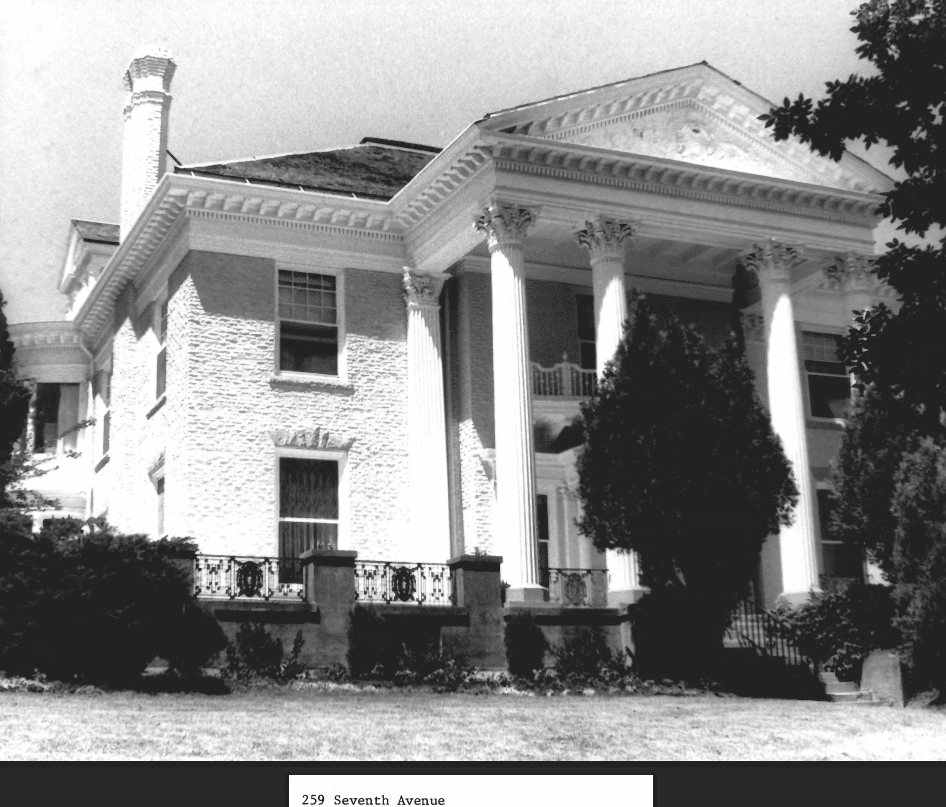
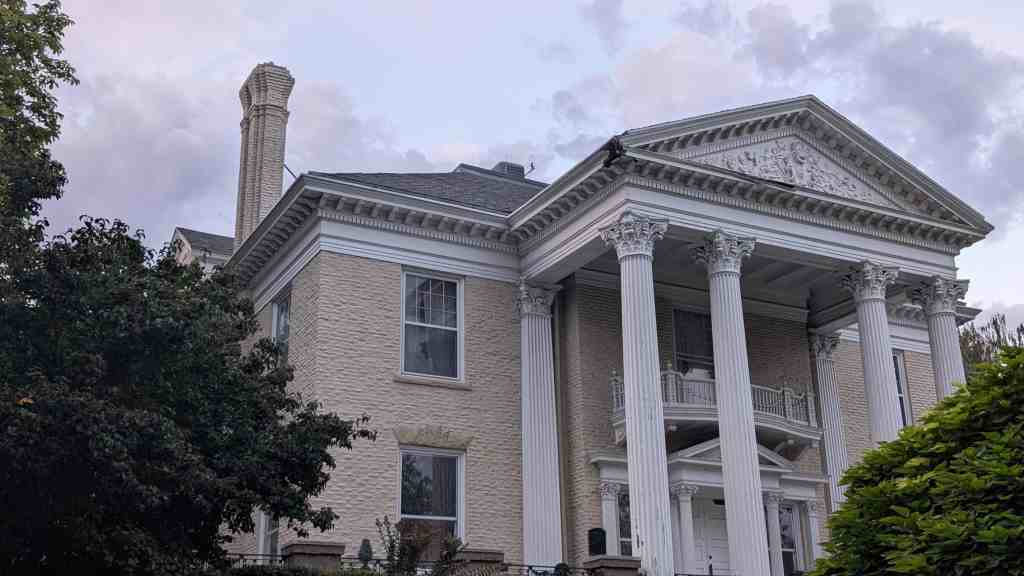
David L. Murdoch House

Completed in 1894 this two-story brick house was constructed for David L. Murdoch. A native of Cronbury, Ayr Scotland, David L. Murdoch joined The Church of Jesus Christ of Latter-day Saints in Scotland and came to Utah in 1878. He and his wife, Elizabeth Pinkerton Thyne, settled first in Heber City then moved to Salt Lake City in 1883. David Lennox Murdoch was the Chief Accountant for Z.C.M.I. and managed the 20th Ward Cooperative Store.

Designed by Herman Holstain Anderson and located at 73 North G Street in The Avenues in Salt Lake City, Utah

The nomination form for the national historic register mentioned the home here:
While they account for less than one percent of all residences, the very large, often architect-designed homes in the Eastlake, Queen Anne and Shingle styles, and later the Prairie and Craftsman styles greatly influence the visual character of the Avenues. Some of the state’s best examples of residential architectural styles were built there, including the William Barton house, 231 B Street, (vernacular/Gothic); the Jeremiah Beattie house, 30 J Street, (Eastlake); the David Murdock house, 73 G Street, (Queen Anne); the E.G. Coffin house, 1037 First Avenue, (Queen Anne); the N.H. Beeman house, 1007 First Avenue, (Shingle style); the Vto. Mclntyre house, 257 Seventh Avenue, (Classical Revival); the James Sharp house, 157 D Street, (Craftsman); and the W.E. Ware house, 1184 First Avenue, (Colonial Revival).
20th Ward Meetinghouse

02 Wednesday Apr 2025

Posted by Jacob Barlow in Uncategorized

≈ 1 Comment

Tags

Avenues Historic District, Historic Chapels, Historic Churches, NRHP, Salt Lake City, Salt Lake County, utah

20th Ward Meetinghouse

Formed in 1856 to accommodate rapid growth in the area, the 20th Ward originally met in a meetinghouse on 2nd Avenue between D and E streets. By 1884 the ward had moved to a new building on the same block, where it met until 1924 when the need for a larger facility and the desire of the school board to use the location for a school playground and auditorium prompted the sale of the property.

When the present site was purchased, Lewis Telle Cannon and ward member John Fetzer, partners in one of Salt Lake’s leading architectural firms, were hired to plan the new building. Designed in the Neoclassical style, it also exhibits Renaissance Mannerist influences, particularly in the double gable, discontinuous cornice, and Palladian style entry. The ground was dedicated and the cornerstone was laid on 18 May 1924 by LDS Apostle James E. Talmage, a ward member. The first use commenced 21 September 1924. The building was dedicated by LDS Church President Heber J. Grant on 17 April 1927. Over the years several compatible additions have been made to the basic L-shaped building. In 1941 the largest addition was completed on the southeast corner, creating a new entry and several classrooms. The stained glass windows were added to the chapel in the mid 1970s.

Located at 107 G Street in The Avenues of Salt Lake City, Utah

  • 20th Ward School
  • Original 19 Wards in Salt Lake

Preservation Utah‘s “Kletting in the Avenues” Historic Homes Tour said:
The design of the Twentieth Ward Meetinghouse reflects a significant shift in how the LDS Church built its meetinghouses. During the 19th century, church buildings were designed and built almost entirely by individual wards with each function (chapel, recreation hall, Relief Society building, bishop’s storehouse, tithing office, et al) occupying its own building. But by the 1920s, when this building was constructed, the design of meetinghouses was becoming increasingly standardized, primarily to consolidate those various functions.
Although its general layout may have been standardized, the design of the Twentieth Ward Meetinghouse showcases the high level of design available in the early 20th century to middle class wards with extra funds.
The meetinghouse was designed by the firm of Cannon and Fetzer, which designed other notable buildings in Salt Lake, including the Park Building at the University of Utah and West High School.

West Desert Sinkhole

26 Wednesday Mar 2025

Posted by Jacob Barlow in Uncategorized

≈ Leave a comment

Tags

Badgers, Millard County, Sinkholes, utah

West Desert Sinkhole is one of the sinkholes in the West Desert of Millard County, Utah

I did see a badger nearby as well.

← Older posts
Newer posts →

Follow Jacob

Follow Jacob

Come wander with me on Youtube.

Blog Stats

  • 2,094,397 hits

Social and Other Links

BarlowLinks.com

Recent Posts

  • Scout Monument
  • Provo High School Seminary Building
  • 821 E 100 S
  • 820 E 100 S
  • 817-819 E 100 S

Archives

Loading Comments...