Fort Pearce was built during the Blackhawk War of 1865-1868, a period of conflict with the Ute Indians in central and southern Utah. This was Utah’s last major Indian conflict. During this time the Navajo Indians also raided the settlements of southern Utah. The Navajos used Fort Pearce Wash as a means of gaining entry into these Mormon settlements. The fort was built in 1866 to keep out the Navajo raiding parties. No battle was ever fought with the Indians at the site.
Also during this period the farmers fields were not fenced and the fort with its large corral was used to hold cattle to keep them from destroying the crops in the fields. This holding of cattle at Fort Pearce was a common practice and continued long after the Indian unrest ceased.
The fort and the wash upon which it is situated is named for Captain John D. L. Pearce, noted military leader and Indian fighter from St. George, Utah, who took part in the Blackhawk War and other Indian conflicts in southern Utah.
At the present time, the area is visited by the local people, scouting groups and historical societies as a means of conveying an awareness and interest in the pioneer heritage of this part of southern Utah.
Fort Pearce was built and occupied by Mormon settlers desirous of maintaining agricultural communities in that part of southern Utah. Although the direct purpose in building the fort was to keep Navajos from raiding settlements, its corral proved to be its most useful asset, in keeping livestock from destroying valuable crops.
Fort Pearce is located in Washington County, Utah and was added to the National Historic Register (#75001834) on November 20, 1975. The text on this page is from the nomination form for the national register.
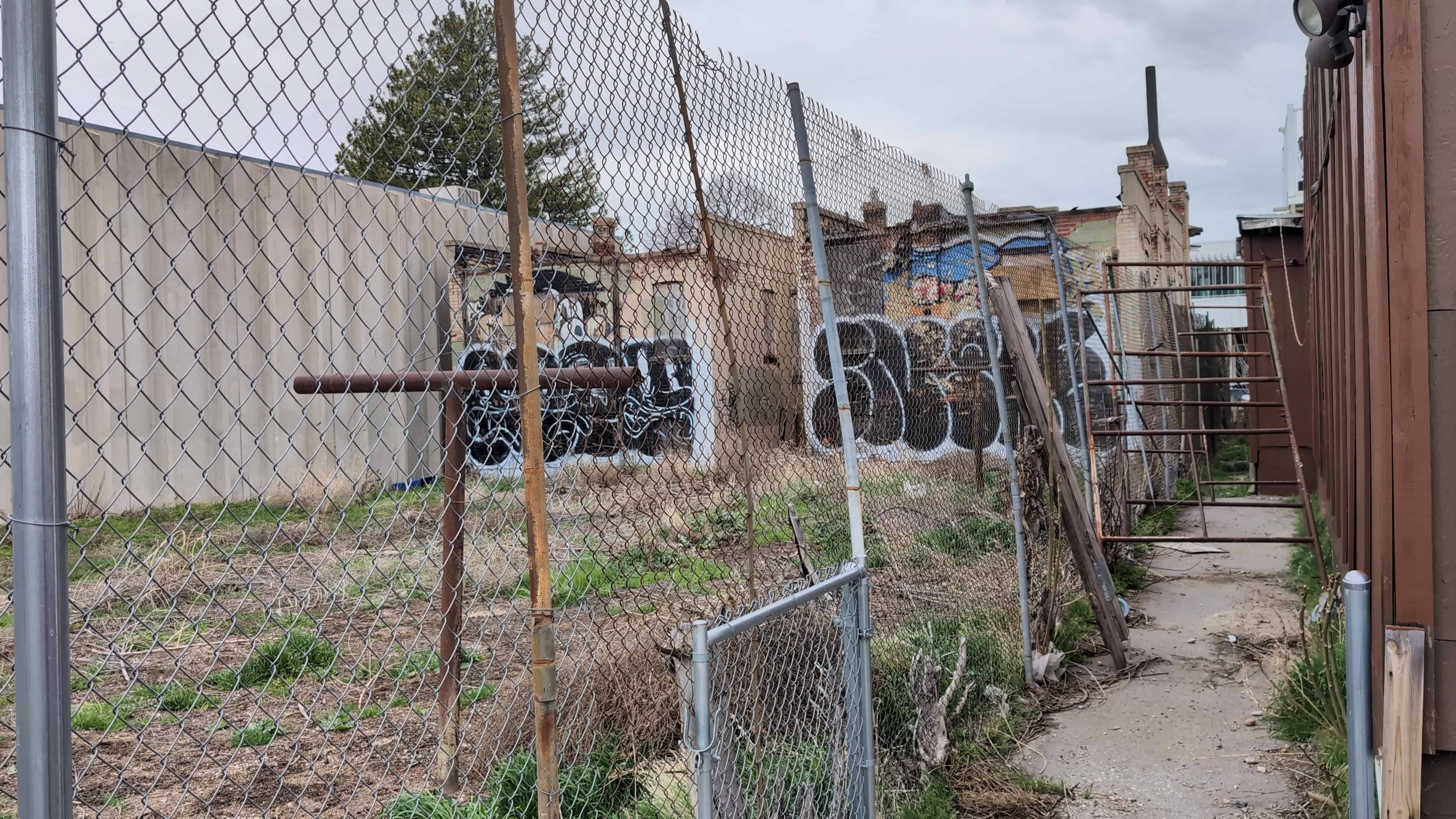
Fort Pearce, situated on the edge of Fort Pearce Wash, is a rock-walled structure that at present has walls standing approximately six feet high. The single story structure is over thirty feet long and the gunports are now a part of the irregular outline of the top of the walls. There are also the remains of a rock corral a short distance to the south of the fort. The walls of this corral are only a few feet high at one corner and usually consist of piles of rock rubble. Much of the corral’s walls has eroded away due to its location in the wash. The fort itself is situated on exposed rock and is not in danger from soil erosion.
In Immortal Pioneers, Albert E. Miller states that originally the walls of the fort were about eight feet high. The structure was never roofed. This fort was fashioned in the shape of a cross with two portholes in the front of each of the four projecting ends, and one porthole in each side of each projection, making in all sixteen portholes. This arrangement gave the guards a crossfire from all directions. From looking at the present outline of the fort, it is doubtful whether the fort actually was in the shape of a cross as stated above.
Building of the fort started on December 4, 1866, as noted in the diary of Charles L. Walker of Washington, Utah. In 1869., the Washington Ward Tithing Ledger indicated that at least six men were given credit for work done on the repair of the fort and the building of corral. It is also noted in the diary of Charles L. Walker that he and other men of the area did repair work on the fort and built a corral in late 1869.
In Red Hills of November, A. K. Larson states that four days of hard labor (December 20-24, 1869) by nineteen men produced a corral with walls five and one-half feet high on a base two and one-half feet wide. This corral is just south of the fort and appears to have crossed the wa;Sb,5.nd included ground on both sides.
The Hall house is one of the best examples of the Spanish Colonial Revival style in Salt Lake City. Especially significant are the tiles of the front entry. They are probably the work of Ernest Batchelder, an important southern California artist of the Arts and Crafts period. The house was built for Nels G. Hall, a prominent businessman, and designed by the architect Slack Winburn and his sons. Hall desired a simplicity and elegance in the exterior design and a functional interior, which are reflected in the house.
The Nels G. Hall House is located at 1340 East Second Avenue in the Avenues of Salt Lake City, Utah and was added to the National Register of Historic Places (#80003923) on October 3, 1980. The text on this page is from the national register’s nomination form.
Nels G. Hall was born on December 29, 1884, in Provo, Utah, a son of Nels and Josephine Bergstrom Hall. He was educated in Provo and graduated from Brigham Young Academy’s School of Business. He married Hazel Greaves at Ephraim on September 5, 1910. They had three children; Katherine, Jeanne and Nels G. Hall.
Hall’s business career began in 1905 when he moved to Salt Lake City to accept a position with the Utah Savings and Trust Company. He then became assistant to Heber M. Wells, who later became the first governor of Utah, in 1914 Hall helped create the Columbia Trust Company and became vice president. In 1920 he left to become secretary-treasurer of the Panama Sugar Company. He soon returned to Salt Lake City to become manager of the Utah Wholesale Grocery, and at that time lived at 275 llth East. He then assumed vice presidency of the Columbia Trust Company and entered into the mining business with several business associates, forming the South Mountain Mining Company at Jordan Valley, Oregon. It was during this period of Mr. Hall’s life that he began the plans for the house. He had visited California and resolved to build a Spanish Colonial or Mission style similar to houses he had seen, and eventually decided on the Spanish Colonial Revival plans. In 1945 Hall sold the mining company and devoted his time to personal investments and business. l He was active in the Church of Jesus Christ of Latter-day Saints in the Federal Heights Ward, and he was also active in civic affairs.
Nels G. Hall lived in the house from the day it was ready to occupy until his death at the age of 80 on December 31, 1964. His widow, Hazel, remained in the house until her death some six years later. Their only son, Nels, lived in the home a short time until his untimely death in 1971. The house remained vacant as such for five years and later occupied by Dr. Alien S. McGaughey. The Thomas Buranek family are the current residents.
Nels G. Hall hired the architect Slack Winburn and his son to design a house similar to Spanish-style houses he had seen in California. According to Hall’s daughter, he wanted simplicity and elegance in the exterior design and a functional and warm interior. The builder was J.H. Johnson.
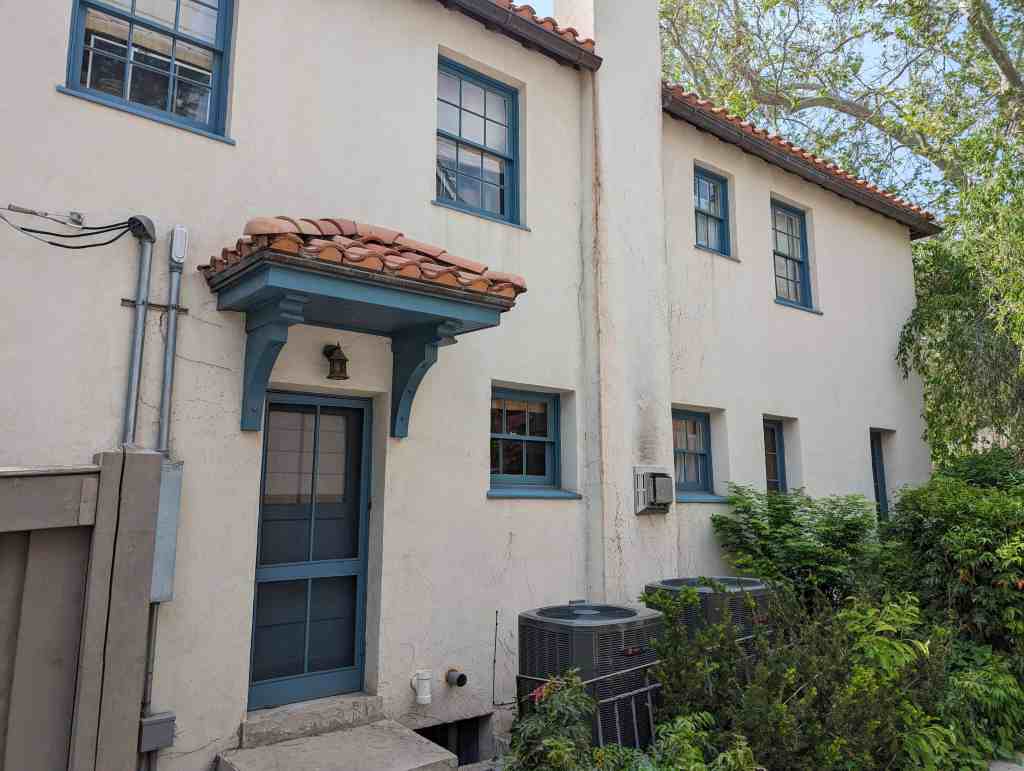
The exterior appearance of the house is in keeping with the simplicity and elegance desired by Mr. Hall. The principal building material is brick, with a stucco finish. The house has a very solid appearance, with the windows recessed from the exterior façade about six inches. One exception to the brick construction is a frame extension of the master bedroom in the rear of the house. This is also covered with stucco.
Wood was used on the exterior of the house mainly for the cornice and the openings. Doorways, window frames, balconies and support posts in the rear of the house are wooden. There is also a small wooden deck extension in the rear. Simple wooden posts support a roof over a sun porch located above the concrete garage. The garage is partially underground, and was built at the same time as the original structure.
In the Spanish Revival style chimneys were commonly placed in the interior of the house. The Hall house, however, has both its chimneys located on the exterior walls, one on; the east and one on the west façade. The physical appearances of the two chimneys are in keeping with popular designs used for this style. One chimney is used for two fireplaces, one below the other.
The wooden posts which support the rear extension of the second floor (the master bedroom) are designed in the style of the Spanish Colonial Revival. Two posts are placed very close together, as if to resemble a single post. A common feature of the Spanish Colonial Revival style is the balcony. Typical balconies are long and extend around a portion of the exterior. Two balconies are situated on the Hall house on the street façade, second floor. The first is made of wood, with panels having a cutout sun motif in the center. These panels of wood were quite common for privacy as well as for wind protection. The second balcony, around the corner from the other, is ornamented with wooden spindles.
One of the loveliest features of the house is the front door surrounded by beautiful ceramic tiles. These tiles were probably the work of Ernest Batchelder, an artist of the Arts and Crafts period who lived and worked in southern California. The tiles depict popular Spanish motifs. Extra tiles were purchased in case tiles were damaged by weather or age. These tiles were ordered, as were the roofing tiles, through the Cahoon Brick Company.
The Hall house main floor plan consists of a living room, dining room, breakfast room, study, kitchen and one-half bath. There are two fireplaces on the main floor. On the second floor, there are three bedrooms, a full bath, and the master bedroom is in the rear of the house. The lower level consists of an amusement room, a bedroom, a laundry room and a three/quarter bath.
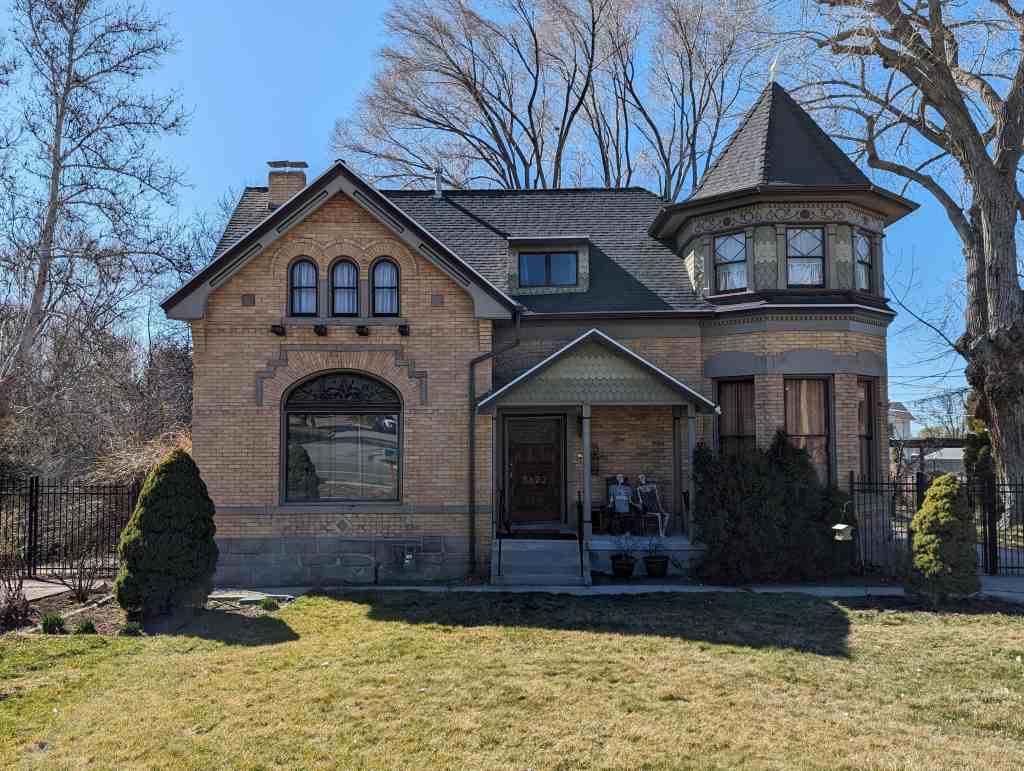
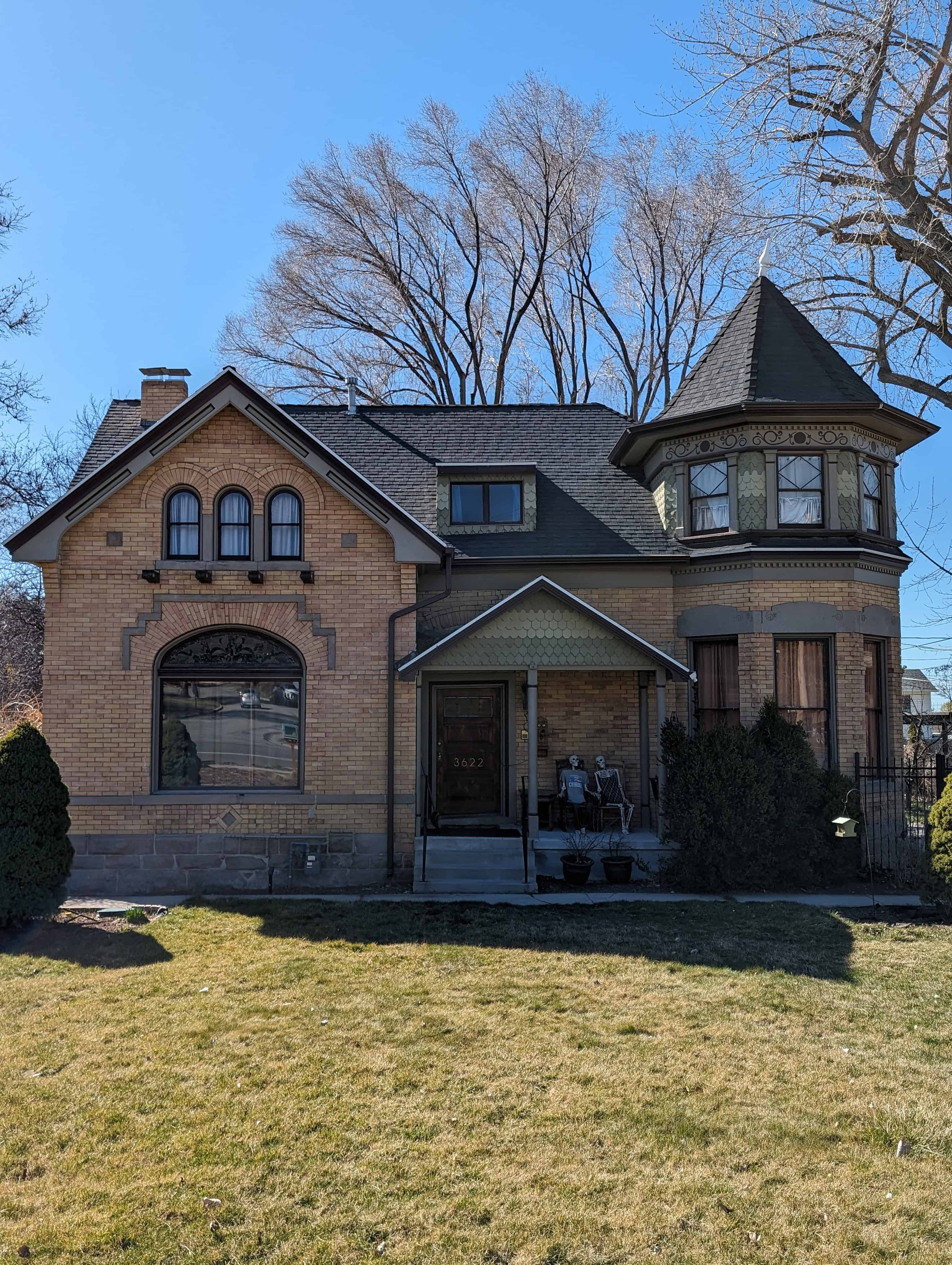
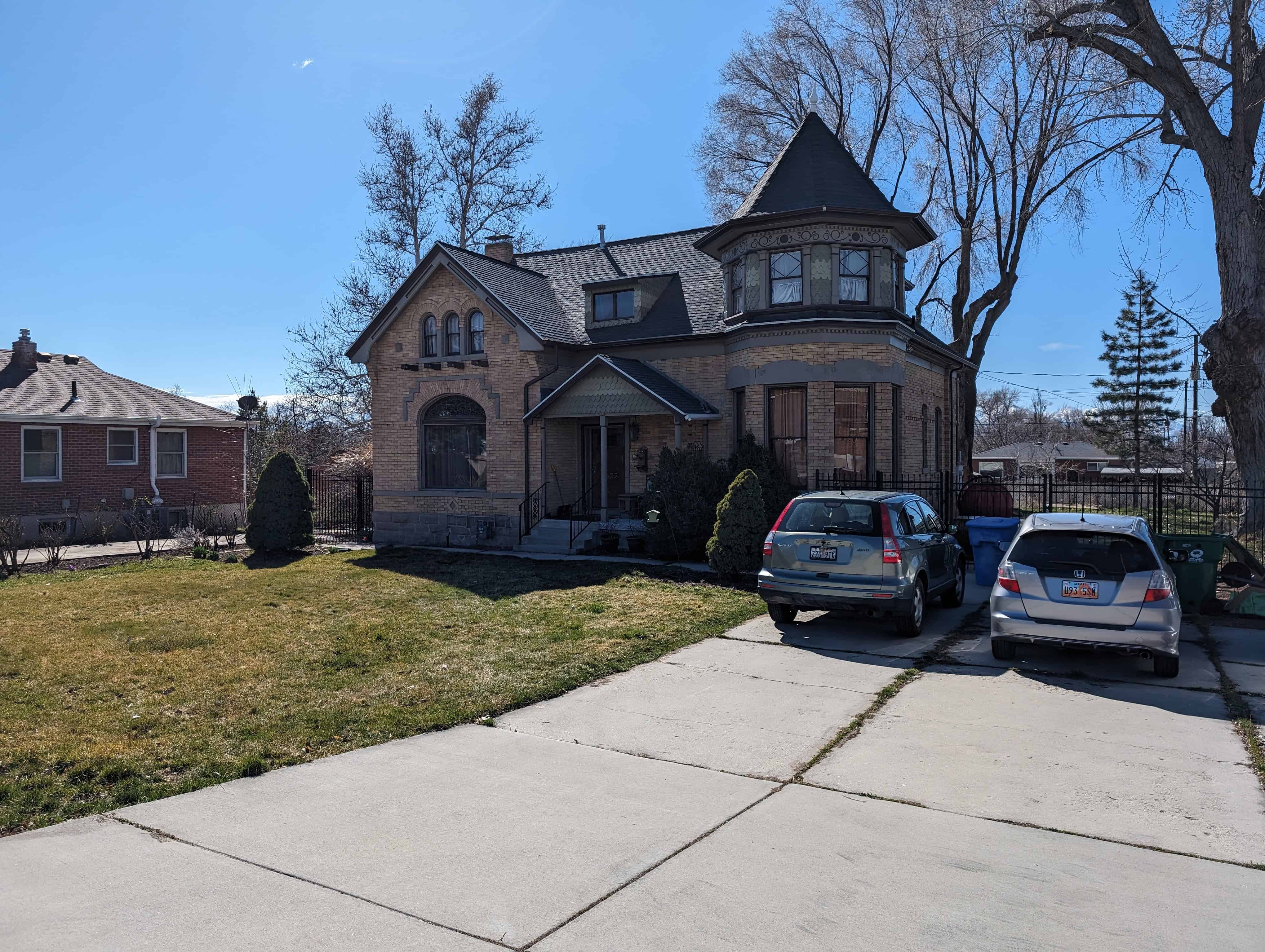
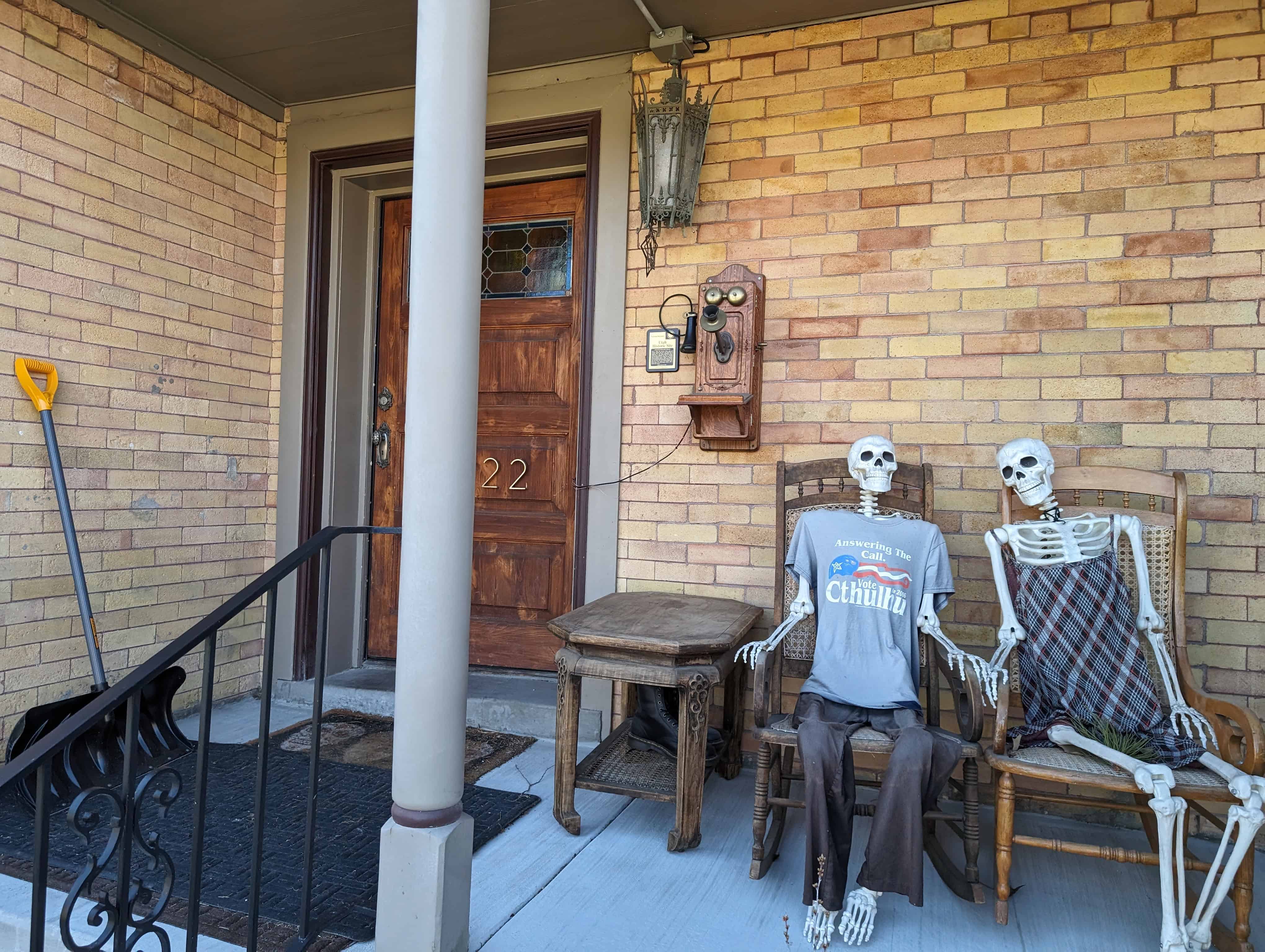
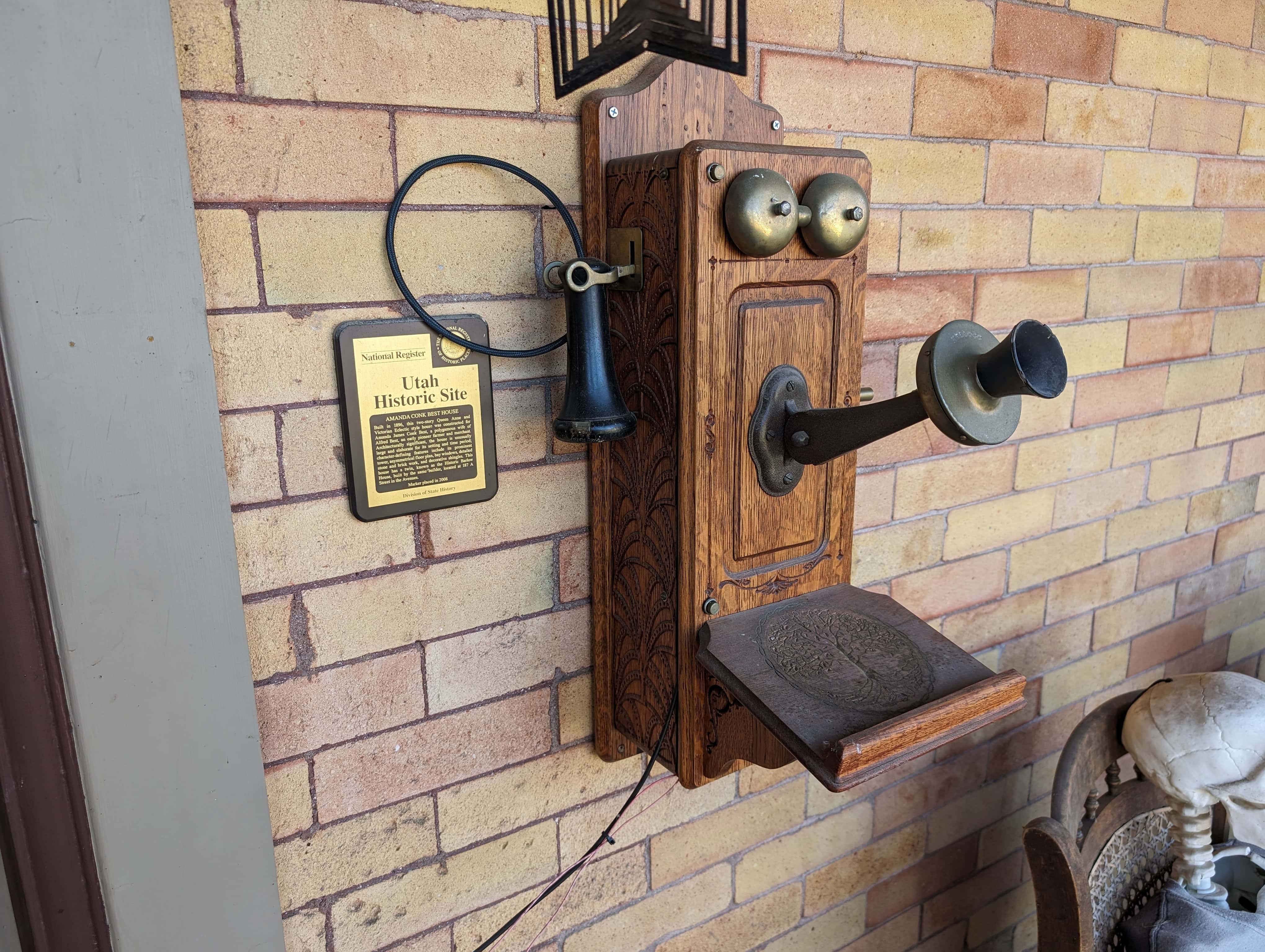
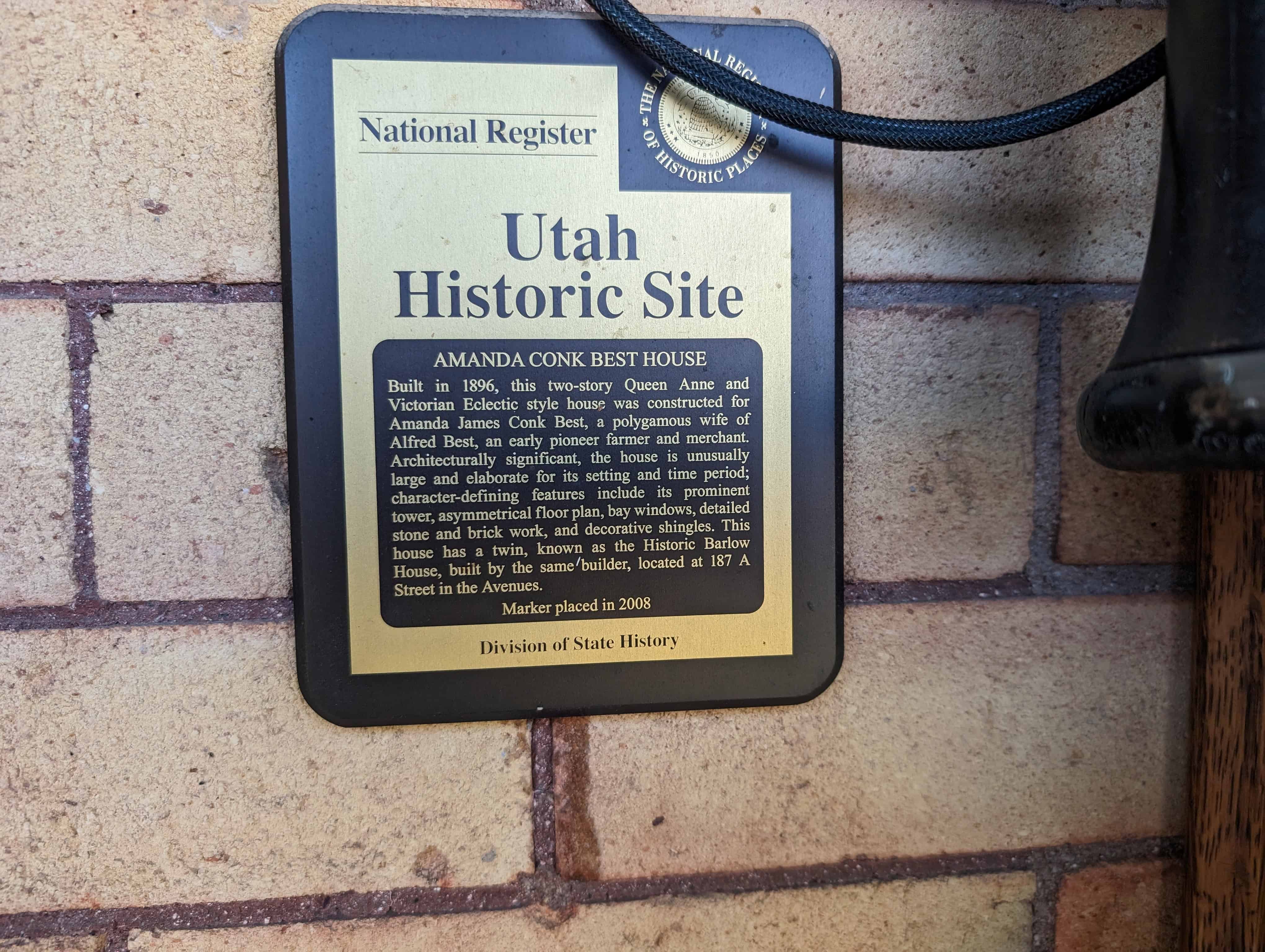
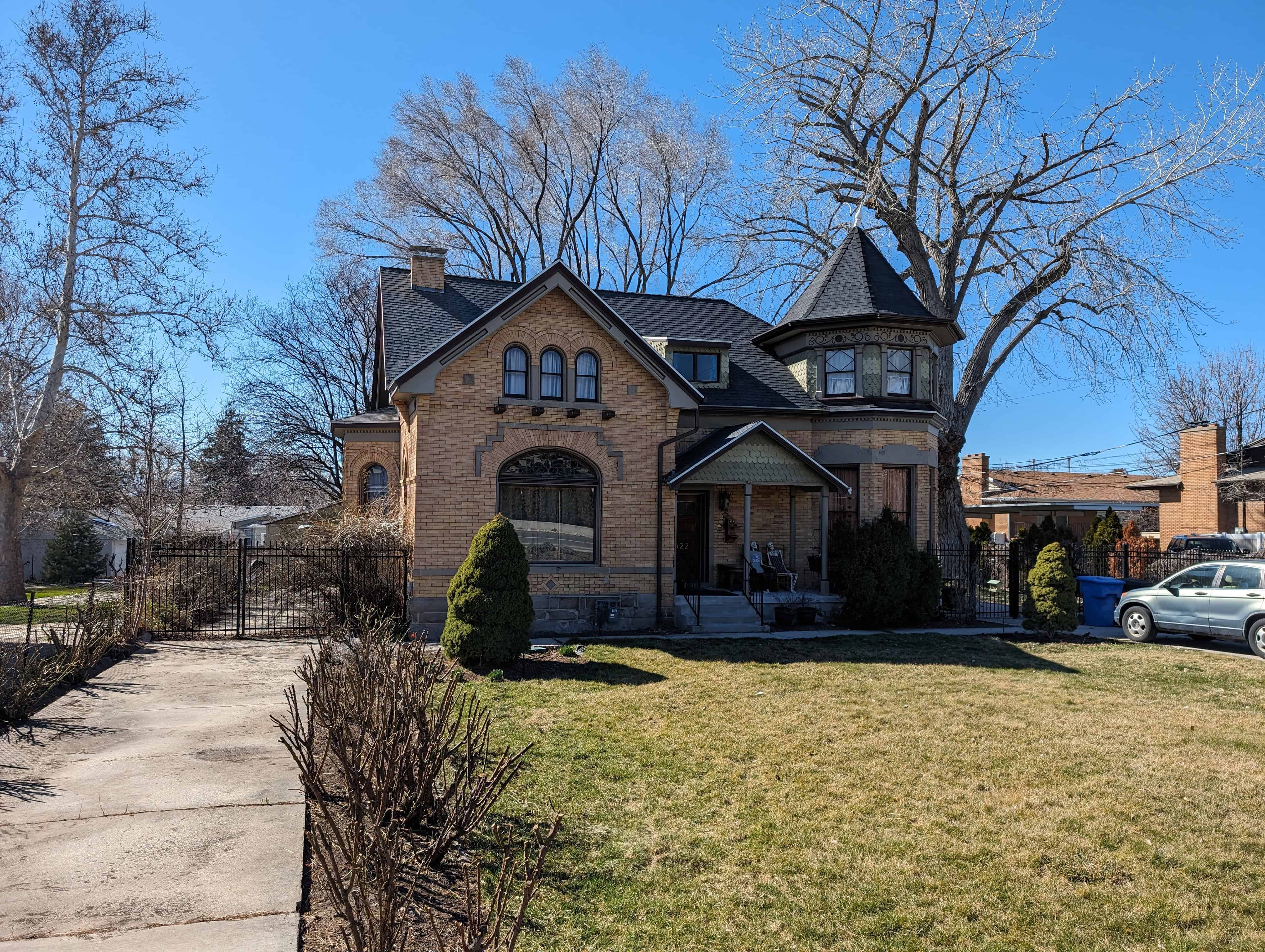
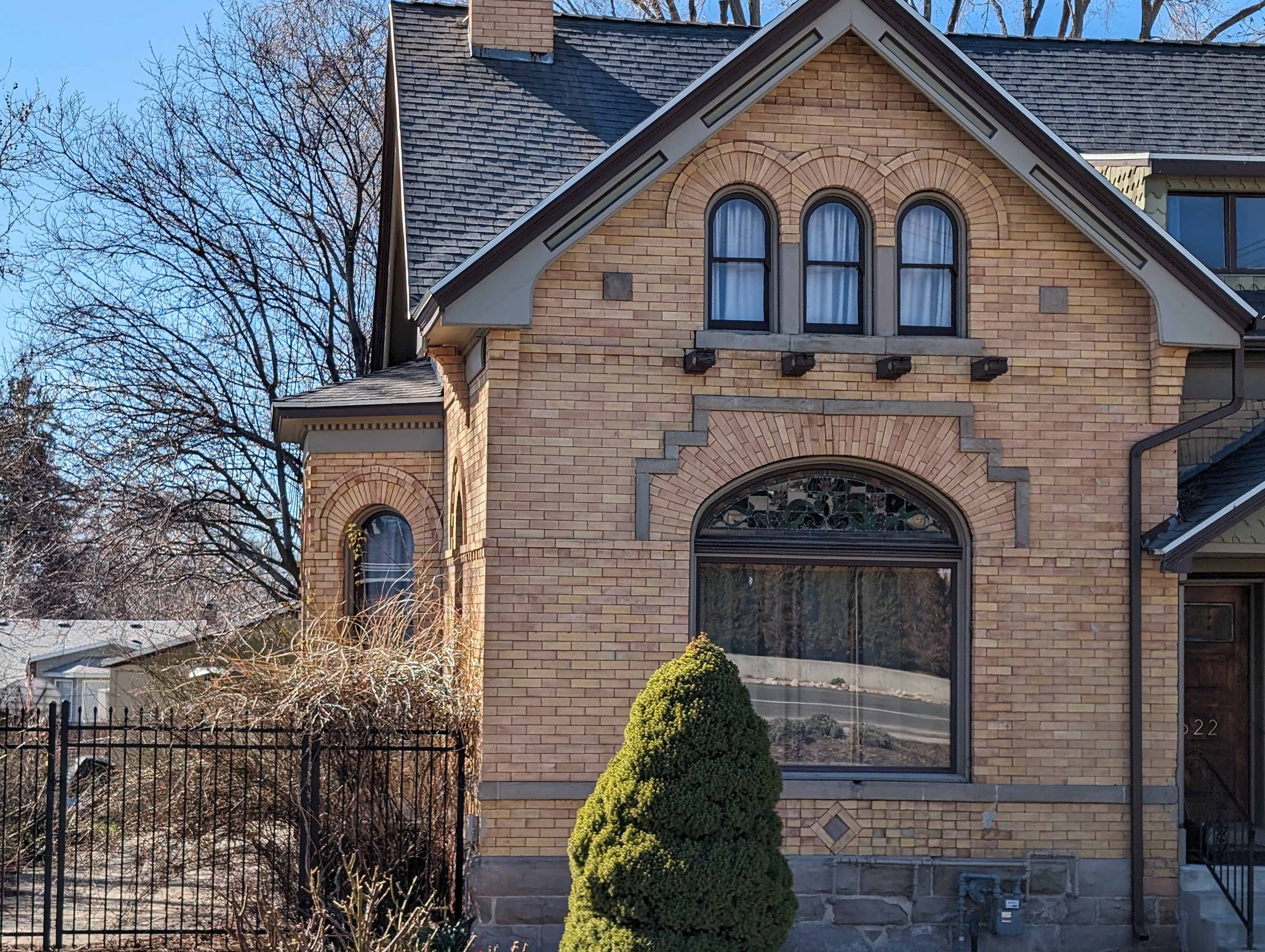
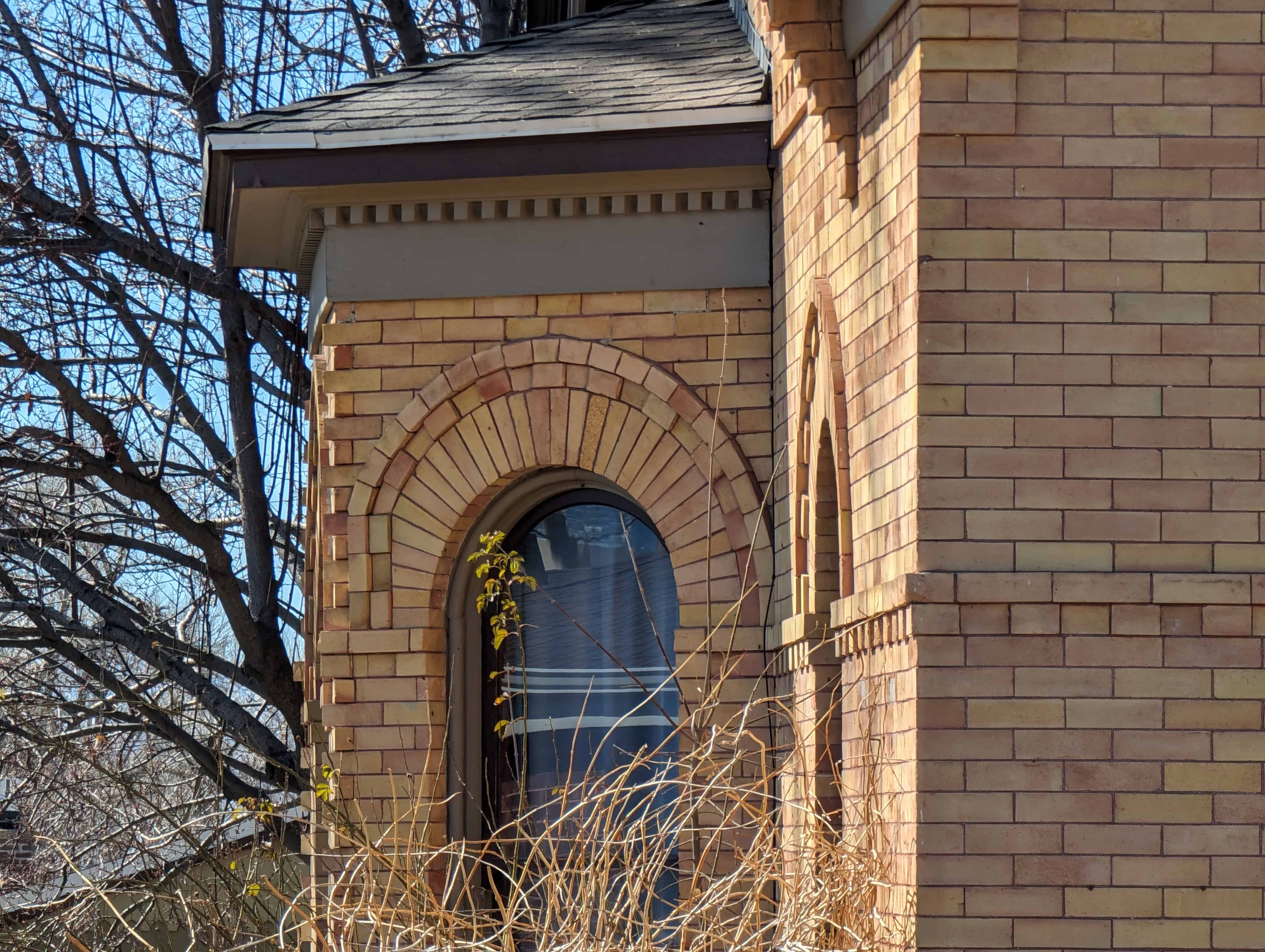
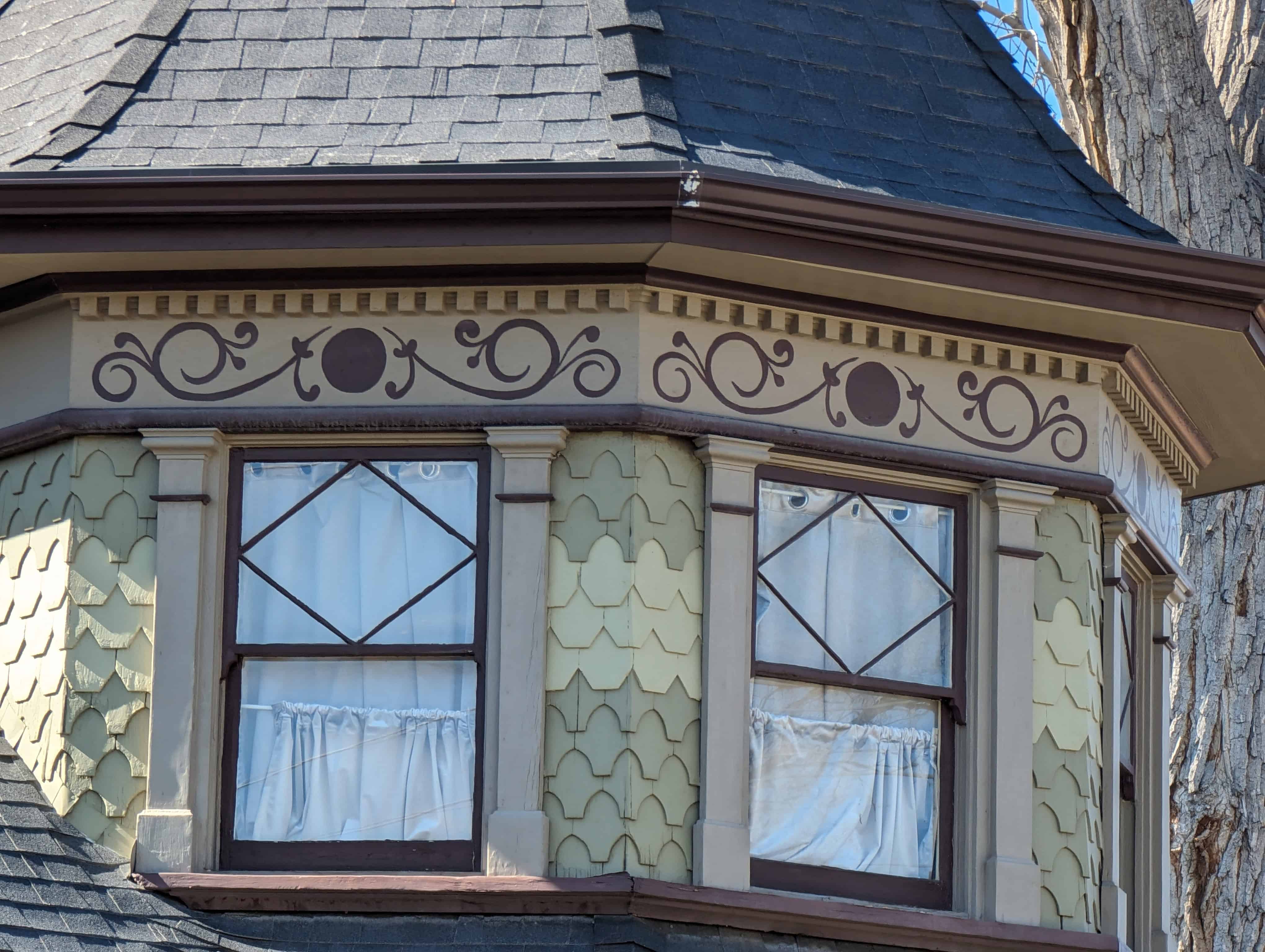
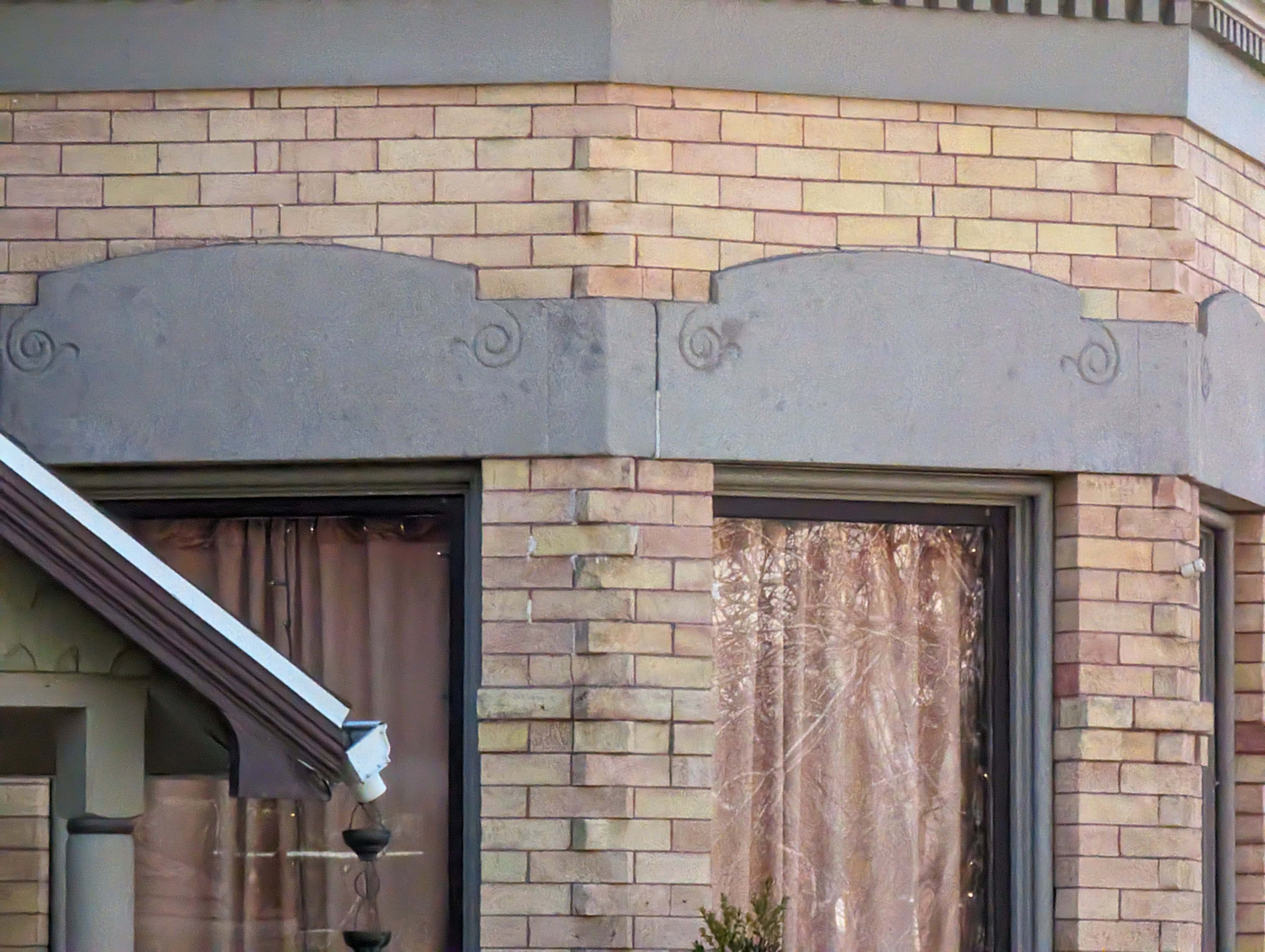
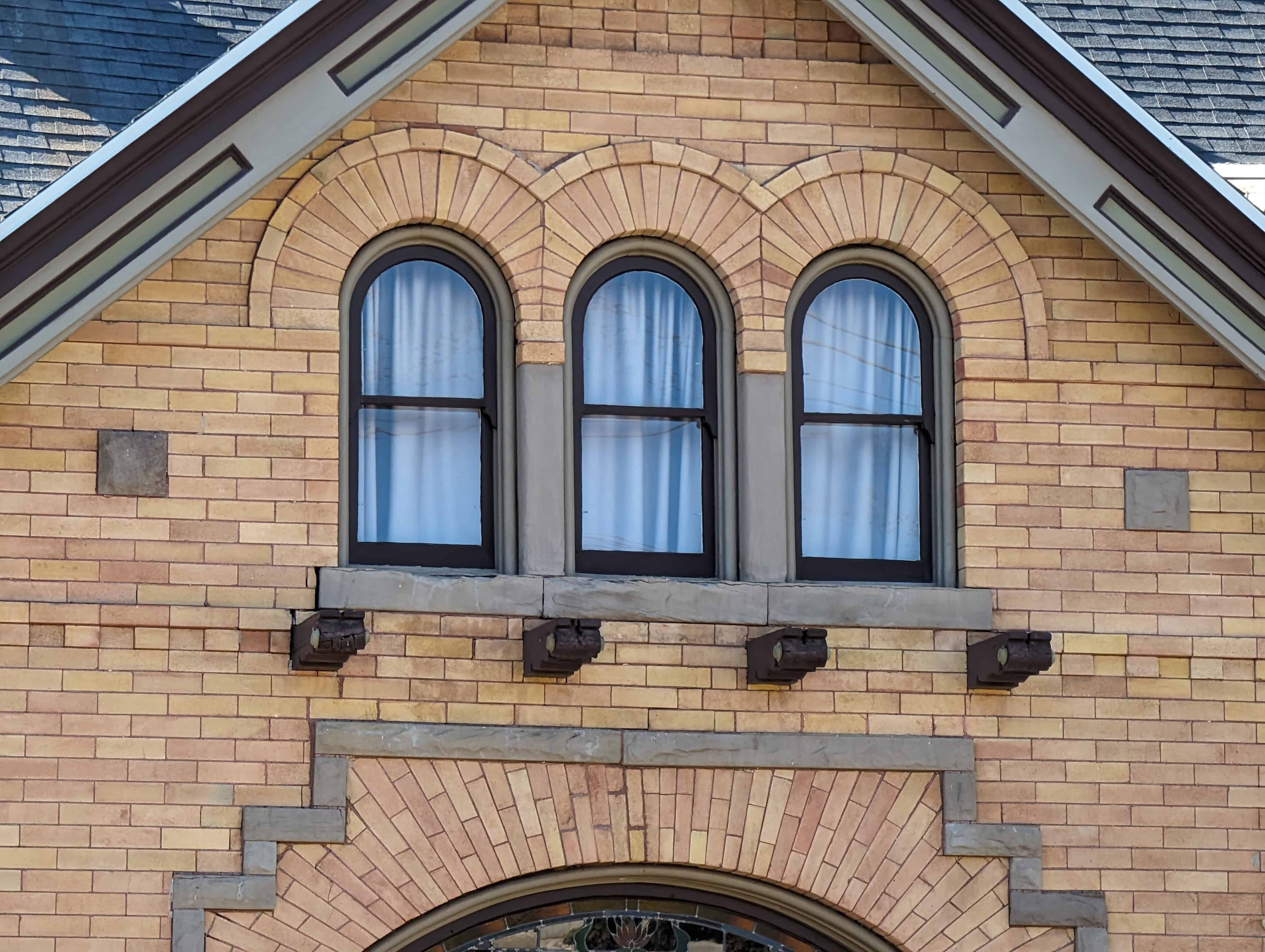
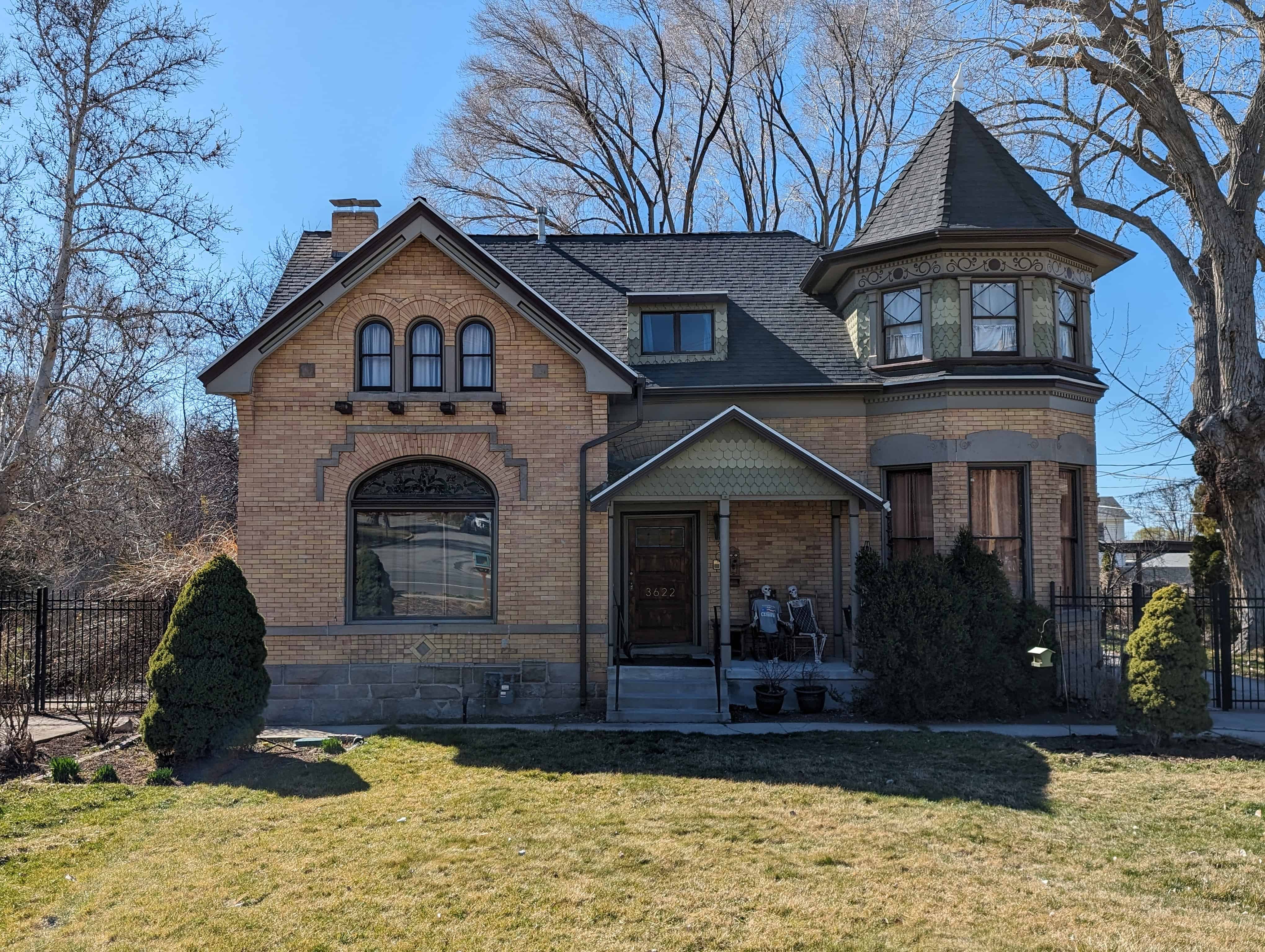
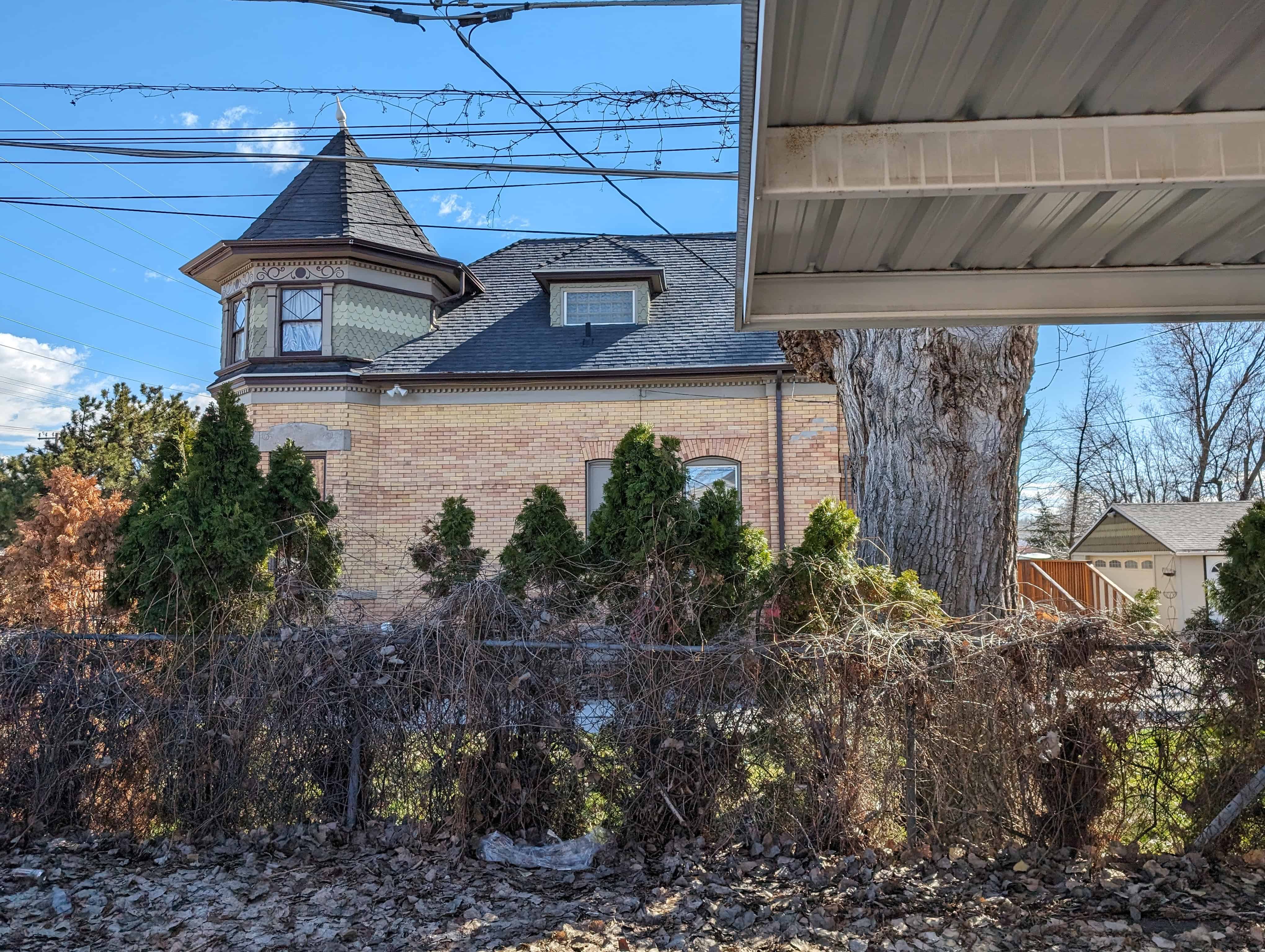
Built in 1896, this two-story Queen Anne and Victorian Eclectic style house was constructed for Amanda James Conk Best, a polygamous wife of Alfred Best, an early pioneer farmer and merchant. Architecturally significant, the house is unusually large and elaborate for its setting and time period; character-defining features include its prominent tower, asymmetrical floor plan, bay windows, detailed stone and brick work, and decorative shingles. This house has a twin, known as the Historic Barlow House, built by the same builder, located at 187 A Street in the Avenues.
Located at 3622 South 1100 East in Salt Lake City, Utah and added to the National Register of Historic Places (#08001154) on December 4, 2008.
The Zion Lodge Historic District is significant for its historic association with the development of the “Rustic Style” architecture in the National Park Service during the 1920’s. The complex was designed by one of the leaders of “Rustic Style” architecture, Gilbert Stanley Underwood. In 1919, the Mukuntuweap National Monument was enlarged and the name changed to Zion National Park. Previous to gaining park status, accommodations for tourists were provided by Wylie Camping Company. The Wylie Camps, popular in other western national parks, gave the tourists a “camping experience” complete with tent-style living. The Union Pacific Railroad secured the concessions contract for Zion National Park and formed the Utah Parks Company to plan, build, and maintain the concession developments. The Union Pacific Company retained Gilbert Stanley Underwood to design the Zion Lodge Complex. Underwood is credited with the design of Timberline Lodge on Mount Hood, the Ahwahnee Hotel in Yosemite, the Grand Teton Lodge, Wyoming, the Bryce Canyon Lodge, and the Williamsburg Lodge in Williamsburg, Virginia.
Between 1900 – 1940, the use of “Rustic Style” architecture was popular in the western national parks. The style was characterized by the use of native materials to blend with the rugged landscapes, and the careful use of scale and design to make the building compatible with the natural environment. The “Rustic Style” of architecture of Gilbert Stanley Underwood is one of the most important and lasting contributions of the Utah Parks Company to Zion National Park. The “Rustic Style” of Underwood served as a model for the later construction in the park, particularly during the New Deal of the 1930’s. The Male Dormitory in the Zion Lodge Complex is an example of Underwood’s style being followed.
The original Zion Lodge Complex consisted of the Zion Lodge, the Bathhouse and Swimming Pool, the Female Dormitory, Comfort Station, Linen Cabins, Deluxe Cabins, and the Standard Cabins. The original Zion Lodge burned in 1966 and was replaced in 1966 by a prefabricated building placed on the original lodge’s foundation. The Bathhouse and Swimming Pool were removed in 1976. The Standard Cabins were the first attempt by the Utah Parks Company for accommodations in the lodge complex and were augmented by the Deluxe Cabins over the following four years. The Standard Cabins were designed for a 20 year structural life.
In 1937, the Male Dormitory was built following the design set by Gilbert Stanley Underwood in the previous decade. The “Rustic Style” architecture of Gilbert Stanley Underwood as exemplified by the Zion Lodge complex can also be seen at Bryce Canyon National Park.
The Zion Lodge Historic District is located in Zion National Park in Washington County, Utah and were added to the National Historic Register (#82001718) on August 24, 1982.
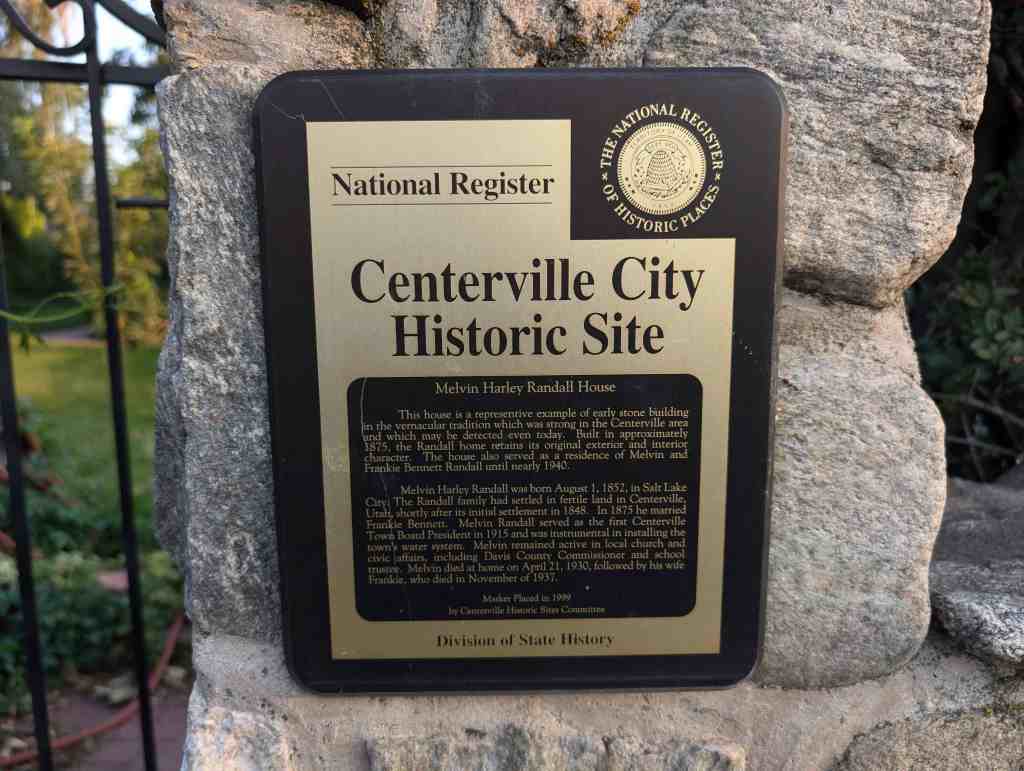
The Melvin Harley Randall House is a representative example of early stone building in the vernacular tradition which was strong in the Centerville area and which may be detected even today. Unlike other parallel stone dwellings of the period which are extant, however, the Randall home retains its original exterior and interior character. The house also served as the residence of Melvin Harley and Frankie Bennett Randall until 1940. Melvin Randall served as the first Centerville Town Board President, and remained active in local church and civic affairs.
Located at 390 East Porter Lane (400 South) in Centerville, Utah and added to the National Historic Register (#80003896) on June 20, 1980.
Melvin Harley Randall was born August 1, 1852 in Salt Lake City, Utah, the son of Alfred Jason and Margaret Hawley Randall. In 1875 he married Frankie Bennett. Randall’s family had settled in the fertile land in Centerville, Utah shortly after its initial settlement in 1848. Centerville, originally called Cherry Cheek, became an important agricultural area, located some twelve miles north of Salt Lake City. As other early Mormon communities, Centerville contained a strong church organization headed by a bishop and counselors who presided over all church affairs. Civil matters also became of concern on the local level.
By 1880 Melvin Randall was listed in local directories as a farmer, with his stone home having been built around 1875. Randall was active in church, political, and educational affairs of Centerville, gaining recognition in various sources as among the prominent pioneers of the town. In 1888 Randall became a First Counselor to Centerville Ward Bishop Aaron B. Porter, and in 1899 he was ordained Bishop, serving in that capacity until 1911.
In 1915 Centerville organized into a town in order to issue bonds to install a needed waterwork. The Davis County commissioners granted the petition by Centerville residents seeking town stature, and resolved that,” the following named persons are hereby appointed as the Board of Trustees of said Centerville Town: M.H. Randall, President of the Board, and as additional members Don Major, William Barber, Joseph E. Williams and F.W. Walton.” Thus, Randall became the first Centerville Town Board President, heading the town from May 15, 1915 to December 31, 1915, and helped to install the Centerville water system. He continued active in civil affairs by serving as a Davis County Commissioner and school trustee.
Melvin Harley Randall died at his home on April 21, 1930, followed by his wife Frankie, who died in November, 1940. The home is cited in the Smoot and Sheriff history of Centerville as one of the historic homes in Centerville, recognizing it as locally significant.
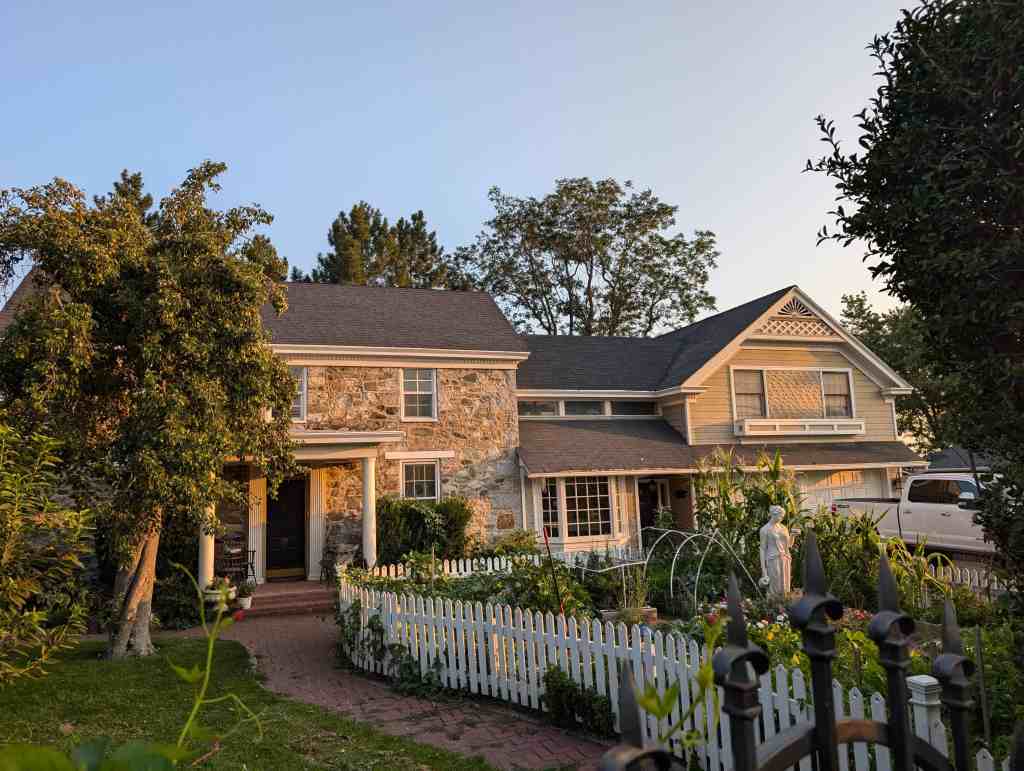
The Randall House is a two-story stone hall and parlor house, two rooms wide with symmetrical door-window-door façade piercing on the first floor with matching six-over-six windows but no center opening on the second floor. A one-story frame addition has been added to the rear, which made the house into a simple “H” plan. The cornice is undecorated, as are the lintels. The door surround is done with very plain pilasters. The wall beneath the cross gable connecting the one and two story sections of the house is set back below the roof, creating a narrow porch.
A later addition containing a utility room and bathroom was built on the west façade of the original house. The interior of the house retains most of the original door, window and baseboard moulding.
A very early twentieth century photograph of the house shows ornamental pediments over the windows of the frame section. The pediments were probably removed when aluminum siding was added.
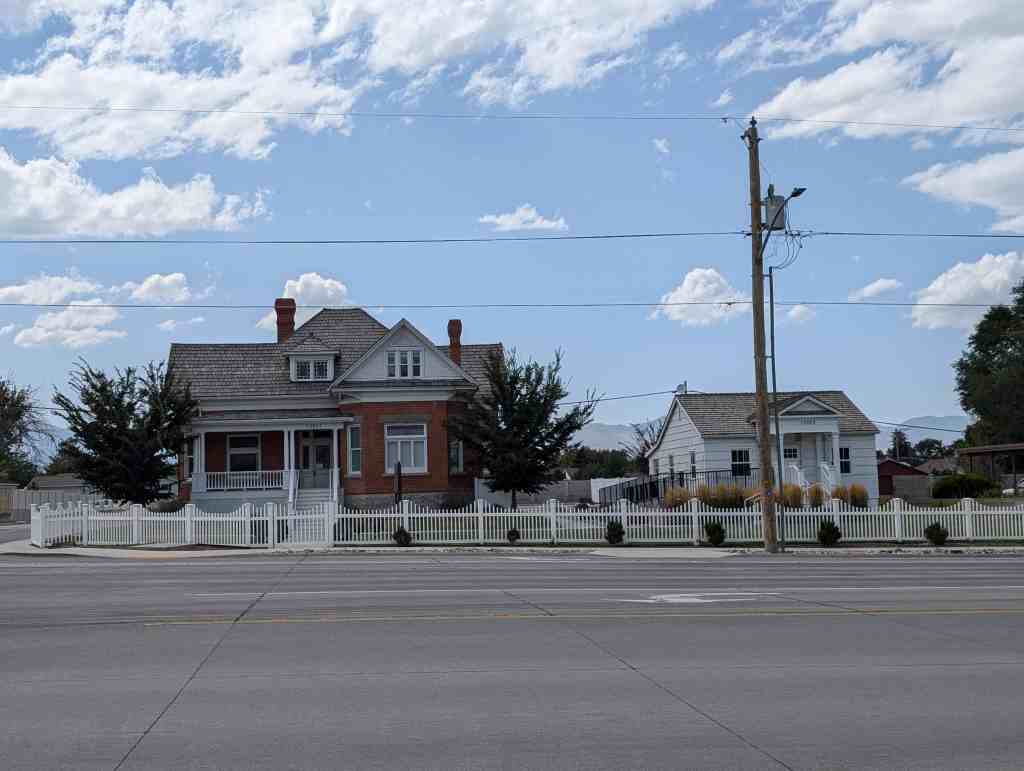
The Beckstead-Butterfield House, constructed in 1897, is a 1½-story brick Victorian Eclectic residence on Redwood Road in Riverton, Utah. The house is locally significant under Criterion C in the area of Architecture as the most ornate and largest surviving example of a Victorian Eclectic-style central-blockwith-projecting-bays type house in Riverton. Although not a fully realized Queen Anne-style house, the Beckstead-Butterfield House has many Queen Anne details such as octagonal bays, an asymmetrical façade, irregular floor plan and colored glass sashes in the upper windows. The house was associated with three members of the Beckstead family, who were sheep ranchers in Riverton. The longest owner/occupants were members of the Butterfield family, who operated one of the largest farms in Riverton on the property between 1906 and 1950. The historic name has been chosen to reflect the ownership by both the Beckstead and Butterfield families. Both names are still associated with the house as a landmark in the local community. The farmhouse property has been reduced to 0.52 acres by late-twentieth-century development in the area. In the area of Architecture, the period of significance spans the original construction in 1897 to 1900 when the matching rear addition was believed to have been constructed. The construction of both the original house and the addition is attributed to the local builder, Carl Madsen. The exterior of the house has good historic integrity with some minor alterations that were reversed during the recent rehabilitation using state and federal tax credits.
Located at 13032 South Redwood Road in Riverton, Utah and added to the National Historic Register (#100006389) on April 12, 2021.
The Beckstead-Butterfield House is locally significant under Criterion C in the area of Architecture as the most ornate and largest surviving example of a Victorian Eclectic-style central-block-with-projecting-bays type house in Riverton. Riverton is located approximately 30 miles south of Salt Lake City and remained a sparsely settled farm community until the 1990s when a population boom and suburban sprawl reached the town. Only about a dozen central-block type houses are estimated to have been built in the community. In 2004, a survey prepared for the Utah State Historic Preservation Office’s database found only five extant farmhouses identified with the Queen Anne style. Four of the five houses in the database were on or near Redwood Road, the main north-south corridor through Riverton and the prime location for commercial development. Two of the houses were recently demolished when the street was widened. Another house was remodeled into a commercial space with new windows, doors, and a façade ADA ramp. The fifth house is still eligible but does not appear to have had any Queen Anne details. A sixth house was not identified as Queen Anne style in the 2004 but was identified as Queen Anne in a 2016 survey of Redwood Road in Riverton. None of the six had towers or turrets, and of the five, only the Beckstead-Butterfield House has any other salient characteristics of the Queen Anne style.
The Beckstead-Butterfield House, built in 1897, is the last surviving Victorian-era central-block-withprojecting-bays type house in Riverton with Queen Anne-style details. The Beckstead-Butterfield House is more elaborate than most Victorian Eclectic-style houses in Riverton. The Victorian period marked two important changes in domestic architecture in Utah. The first was an end to Utah’s relative isolated as the coming of the railroad brought new materials to Utah. The second was the introduction of architectural style books that popularized the complexity and irregularity of the Victorian Eclectic domestic architecture. While the cross wing introduced asymmetry into Utah’s domestic architecture, the central-block house with its projecting bays produced the desired external irregularity while making the principal rooms larger and brighter (i.e. more window area). The floor plan of the original Beckstead-Butterfield House is an unusual variation by a local builder that had projecting bays on all four elevations, but no window openings in the south elevation bay.
The Victorian Eclectic was popular in Utah between 1880 and 1910. The Queen Anne style, as a variation of the Victorian Eclectic was popular between 1885 and 1905. Domestic examples are characterized by asymmetrical façades, tower/turrets, irregular floor plans, octagonal bays, dormers, and ornate woodwork. The Beckstead-Butterfield House is not a true Queen Anne because it lacks a tower. The house originally has a variety of materials, textures, and even colors, as seen in a 1906 photograph. The most distinctive characteristic of the Queen Anne style found on the Beckstead-Butterfield House are the multilight sashes. Surviving Queen Anne sashes are rare, particularly in rural communities like Riverton. The Beckstead-Butterfield House features three varieties of Queen Anne sashes: 1) multi-light upper sash, 2) perimeter square lights in a traditional window, and 3) a unique example of perimeter lights in a semicircular window.
As noted in the Riverton Multiple Property Submission (MPS), within the Enterprise and Rural Development Period, 1882-1899, Riverton dairy farmers and wool growers became the most prosperous families in the community and were able to build more substantial and elaborate homes than most area famers. Most were located along Redwood Road. Local builder, Carl Madsen, built two large brick houses at 13217 S. Redwood Road (1893) and 13030 S. Redwood Road (1897) for the Charles Nokes (a dairyman) and George Beckstead (a sheep herder), respectively. Carl Madsen also built a massive brick barn for George Beckstead that was more ornate than the house.
The exterior of the Beckstead-Butterfield House has good historic integrity in the qualities of design, materials, and workmanship. Minor alterations such as the front porch enclosure and missing south porch were reversed during the 2019-2020 rehabilitation. Although the interior was substantially modeled over the years, the recent rehabilitation preserved as many extant historic features as possible. During the rehabilitation, the missing Victorian fireplace, staircase, and pocket doors were replaced with historically appropriate features. The property has good location, feel and association integrity, but the original farm setting has been somewhat compromised by recent development in the neighborhood. For this reason, the property is being nominated for Architectural, but not Agricultural significance.
Additional Historic Context: History of the Beckstead-Butterfield House
Riverton was settled in the 1850s by members of the Church of Jesus Christ of Latter-day Saints (LDS or Mormon Church). The first residents lived in dugouts or crude log cabins near the Jordan River. A communal water project, the South Jordan Canal (begun in 1870 and completed in 1876), opened up the bench lands for agriculture. At the time the settlement was named Riverton in 1879, there were about one hundred residents living in scattered farmsteads on a bluff west of the Jordan River. After the completion of the larger Utah and Salt Lake Canal in 1881, as more settlers arrived, the community coalesced and expanded along Redwood Road. Redwood Road was the community’s main thoroughfare, in addition to being one of only two north-south transportation routes linking the north and south ends of the Salt Lake Valley at the turn of the twentieth century (the oldest route is the former Territorial Road, today’s State Street). It was named for the redwood stakes used to survey the road. In the late 1890s and early 1900s, a small commercial district developed at Redwood Road and 12400 South in Riverton.
The first owner of the land where the Beckstead-Butterfield House is located was James C. Hamilton, who received the first patent in 1883. A 30-acre portion of the homestead was acquired by Christian and Minnie Peterson, who sold it to W. W. and Mary Jane Beckstead in 1896. William Warren Beckstead was born in Riverton, on March 26, 1870. His parents were early settlers of Riverton, George Wesley and Eleanor Davis Beckstead. George W. Beckstead was a prosperous sheep rancher, whose assets were divided between his children at his death in 1890. In December 1891, W.W. Beckstead married Mary Jane Berg, who was born in Provo, Utah, on March 2, 1871. The Becksteads constructed a large brick eight-room home on Redwood Road in 1897. On November 22, 1897, Riverton’s local correspondent for the Deseret News reported on the progress of the new house:
W.W. Beckstead of Riverton has moved into his new residence. It is hardly yet completed—just enough to accommodate his family for the present. When finished it will no doubt be one of the finest in the vicinity. We want to see a few more such residences erected by our better able townsmen in the near future, as it adds greatly to the appearance of our settlement and displays the faith of its inhabitants in its future prosperity.
W.W. Beckstead farmed on his property in Riverton and managed sheep ranches in Idaho and Wyoming with his eldest brother, George F. Beckstead, and their sister, Mamie’s, husband Ed Harding. Two children were born to Mary Jane and W. W. before they built the brick house and two were built while they lived in the house. After just three years in the house, they decided to move to Rexburg, Idaho, to be closer to the ranches. The property in Riverton reverted to Christian and Minnie Peterson, who sold 10 acres to W.W.’s brother, George F. Beckstead. W.W. and Mary Jane Beckstead moved to Logan, Utah, in 1923. William Warren Beckstead died on February 2, 1954. Mary Jane Berg Beckstead died in California on July 18, 1968. They are buried in Logan.
Within the community of Riverton, the Beckstead house is more often associated with its second owners, George F. and Charlotte Beckstead. This is due to the fact that George F. Beckstead had a large brick barn built on the property soon after they acquired the house in 1900. The two-story barn sat slightly south and west of the house. It was built of brick with an ashlar granite foundation. The elaborate architecture of the barn included round towers at the front corners, a wide arched entrance, a stained-glass rose window, castellated parapet, and hard wood floors. The initials “G.F.B.” were installed above the entrance [Figure 3]. The castle-like, brick barn was a landmark in the community until its demolition in 1968. The George F. Beckstead barn was built by Carl Madsen, the most prolific Riverton builder of the period. Madsen is also believed to be the builder of the Beckstead house a few years earlier, and probably built the 1900 addition to the house for George and Charlotte.
Carl Madsen was born in Denmark in 1857. As a young man, he was apprenticed to a carriage maker. In 1881, Carl immigrated to Utah. Carl began working for a home builder in South Jordan in 1884. Carl and his wife, Anne Crane, moved to Riverton in 1889. His career as a builder lasted almost sixty years. Carl made was one of the building supervisors of the Riverton LDS Ward meetinghouse, designed by Richard Kletting, the architect of the Utah State Capitol. The building was nicknamed the Riverton domed church. It was built in 1899 and demolished 1940. Carl Madsen died in Riverton in 1947.
George Francis Beckstead was born on March 25, 1860 in Provo, Utah. He married Charlotte Emeline Hamilton in 1881. Charlotte was the sister of James C. Hamilton. George and Charlotte were the parents of nine children. Soon the death of George W. Beckstead in 1890, George and Charlotte moved into his father’s house in Riverton. In 1900, they moved one mile south on Redwood Road to W.W. and Mary Jane’s house. George F. had acquired a number of sheep herds by then. In her biography, Charlotte describes her husband as “the biggest sheep man in the state.” George F. also raised horses and the elaborate barn was built as a showcase for his horses. Charlotte brought George’s mother back from Salt Lake City to live with them in Riverton because they had “plenty of room.” Eleanor Davis Beckstead lived with them until her death in 1902. In 1906, the Beckstead family decided to move to Provo to help further the education of their almost grown youngest children. George Francis Beckstead died on January 5, 1916. Charlotte Emmeline Hamilton Beckstead died on June 7, 1953. They are buried in the Provo Cemetery.
Although the Becksteads did not move to Provo until 1906, on December 2, 1902, George and Charlotte deeded 80 acres of property, including the house, to Edward T. Harding, George’s sheep business partner and the husband of his sister, Mary Elizabeth Beckstead Harding. Edward Thomas Harding was born in Provo in 1860. Mary Beckstead was also born in Provo in 1866. They were married in 1886. It appears the Harding family remained in Provo and never lived in the Riverton house. On September 8, 1906, they sold the Riverton property to Almon T. Butterfield, a Riverton farmer. Edward T. Harding died in 1922. Mary Beckstead Harding died in Salt Lake City in 1944.
Though the early occupants of the house were members of the Beckstead family, the family of Almon T. Butterfield owned the property between 1906 and 1950, making them the longest owners. Most Riverton residents old enough to remember the landmark brick barn, also remember Almon replacing the initials “G.F.B.” with his own “A.T.B.” over the barn’s entrance. Almon Thomas Butterfield was born in Herriman, Utah, on July 5, 1868.
As a boy, Almon Butterfield herded sheep and later went into the sheep business. Almon married Sarah Jane Crump in 1896. Sarah Jane Crump was born in Herriman on September 2, 1873. They had four children in Herriman before moving to Riverton where four more children were born. While Almon was serving a mission for the LDS Church between 1908 and 1911, Alvin Miller helped run the farm for Sarah Jane. In addition to the 80 acres of property around the house and barn, Almon T. Butterfield had 500 acres of irrigated land, making him one of the largest farm holders in Salt Lake County. Almon T. Butterfield was among the founding members of a number of corporations in Riverton: Riverton Pipe Company, Riverton Canning Company, Riverton Drug Company, and the Riverton Livestock Company. He was the president of the Jordan Valley Bank for 26 years. Almon T. Butterfield served a term in the Utah state legislature.
Almon T. Butterfield died on September 18, 1940. Around this time, the frame cottage was built to the north of the brick house. Sarah Jane may have lived there until 1950 when the property was sold to Decker Farms. Sarah Jane Crump Butterfield died on March 14, 1963 in Riverton. Almon and Sarah Butterfield are buried in Herriman, Utah. Between 1950 and 1953, the property was owned by Decker Farms. In the 1960s, the agricultural land was divided for subdivision development and changed hands several times. In 1979, the house was sold to R. L. and Beth Webster. The Websters had a large extended family and ran a home school in the house. The current owner, Barbara Catron, acquired the vacant house and property in 2017. Between 2019 and 2020, a full rehabilitation was completed as a mixed commercial-residential use.