• About JacobBarlow.com
  • Cemeteries in Utah
  • D.U.P. Markers
  • Doors
  • Exploring Utah Email List
  • Geocaching
  • Historic Marker Map
  • Links
  • Movie/TV Show Filming Locations
  • Oldest in Utah
  • Other Travels
  • Photos Then and Now
  • S.U.P. Markers
  • U.P.T.L.A. Markers
  • Utah Cities and Places.
  • Utah Homes for Sale
  • Utah Treasure Hunt

JacobBarlow.com

~ Exploring with Jacob Barlow

JacobBarlow.com

Tag Archives: Box Elder County

Park Valley, Utah

15 Saturday Nov 2014

Posted by Jacob Barlow in Uncategorized

≈ 1 Comment

Tags

Box Elder County, Park Valley, Rosette, utah

L2FkL2RiMjFkMmUzLTJjZWUtNDgyZi1hNWM0LWRmYjFlM2RiNjg0Ny5qcGc=

Park Valley is an unincorporated community in Box Elder County.

While the Transcontinental Railroad coming to Utah did not pass directly through the valley, its proximity played an important part in the settlement and development of the area. Settlement was apparently a result of surveys conducted for several miles on either side of the railroad right-of-way. Even before the rails were joined at Promontory on May 10, 1869, the effect of the railroad on Park Valley had begun. The first permanent settler was William P. (Cotton) Thomas, who migrated from Brigham City in 1869, and developed a cattle ranch near Dove Creek. The heavy growth of trees along the creek and the view of the valley inspired the name.

Related Posts:

  • Central Pacific Railroad Grade Historic District
  • Chapel
  • Historic Bell
  • Historic Cabin and Veteran Memorial
  • Hogup Cave

Penrose, Utah

03 Friday Oct 2014

Posted by Jacob Barlow in Uncategorized

≈ Leave a comment

Tags

Box Elder County, Penrose, Tremonton, utah

picture16aug07-103

The community was named for Charles W. Penrose, an apostle for the Church of Jesus Christ of Latter-day Saints.

The first permanent settler to the Penrose area was C.S. Rowher, in 1890. He, along with others, farmed beets, wheat, corn and hay.

picture16aug07-102

Penrose is a collection of homes situated along the last seven miles of Highway 102.  Everyone lives between Mile Marker 1 and Mile Marker 7 on the road from Tremonton to Promontory.  It was named for Mormon Apostle Charles W. Penrose in 1911, and is a place of refuge and safety.  Anciently, it was part of large grassland ranging from the Snake River to Promontory Point.  The lush, tall grass supported great herds of deer and tribes of Indians that sought out the many watering places located at the base of the mountains.

After Spanish Exploration, it supported great bands of wild horses that made trails from watering holes to highland pastures.  Penrose ranchers were amazed when the sky would become darkened, so large were the dust clouds when the great numbers came to Connor Springs for water.  As the grass died out and was replaced by scrub sagebrush and June grass, the land was ready for farming. 

It was not until 1890 that C.S. Rowher, a dry farmer from Park Valley, became the first permanent settler to locate on the slopes of the valley with its excellent view of the majestic Wasatch sunsets.  He and those who followed knew that the parched, overgrazed land would be turning into an oasis as soon as clear water from the Bear River was diverted to the sloping community.  They fought alkali soil, snakes, mosquitoes, gnats, and coyotes.  They delighted in the ample supply of muskrat, ducks, and pheasants.  They cultivated beets, wheat, corn and hay, and they prospected for gold, oil, coal and diamonds.  The first L.D.S. bishop in Penrose, P.N. Pierce, owned a sand and gravel company that he used to make road beds for the county.  In all, they strove to provide for their families and provide a better life for their children, including higher education and an appreciation for culture.  Travel didn’t appear to present a great problem, as early farmers walked to Brigham and back in a single day.  With horses, several trips a month were not uncommon, and with cars, it could be done daily.  To the question:  “Can anything good come out of Penrose?”  Our reply:  “Only the best!” (*)

Golden Spike

11 Monday Aug 2014

Posted by Jacob Barlow in Uncategorized

≈ Leave a comment

Tags

Benchmarks, Box Elder County, historic, Historic Markers, Promontory, Railroad, utah

NATIONAL HISTORIC SITE GOLDEN SPIKE

“The last rail is laid. The spike is driven. The Pacific Railroad is completed.” Here at Promontory, Utah at 12:47 p.m. on May 10, 1869 the driving of a golden spike completed the first transcontinental railroad climax of a dramatic railroad-building race between the Union Pacific building from the east and the Central Pacific building from the west. This event symbolized attainment of a long sought goal – a direct transportation route to the Pacific Ocean and the China trade and it achieved the great political objective of binding together by iron bonds the extremities of continental United States. A rail link from ocean to ocean.”

Located at Golden Spike National Historical Park at Promontory, Utah.

  • 2f3d7cdf-d76f-4350-b106-09e44278bc61
  • b4828136-d5df-46d2-9744-ecb2053d236a

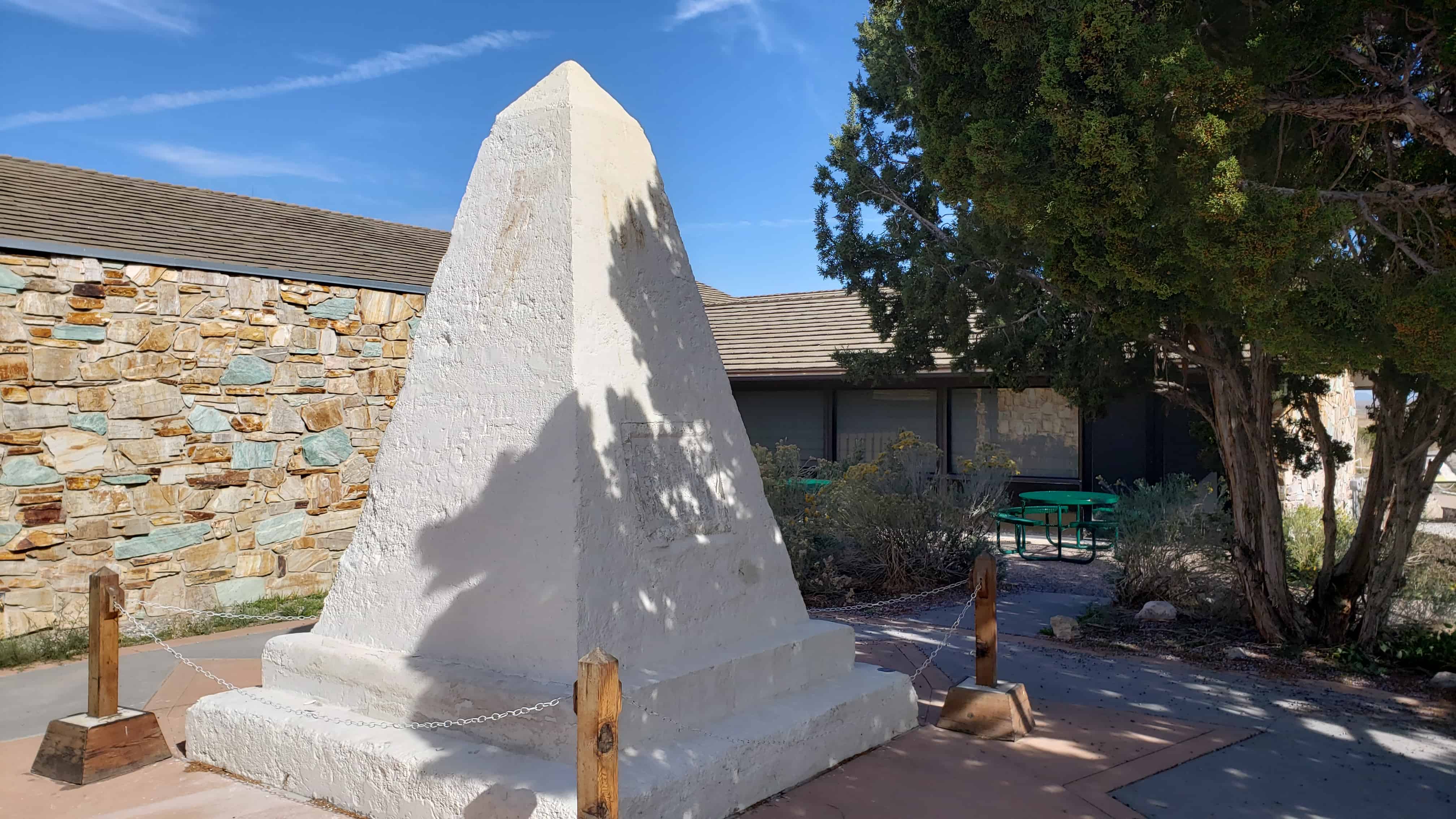
The Southern Pacific Monument

An Icon Restored

In 1954, the National Park Service assumed ownership of the aging monument, which had been damaged by years of weathering and vandalism. The interior had also been severely damaged by ground water that had wicked up into the monument through its buried base. Early restoration attempts unintentionally contributed to the damage by using materials that did now allow for evaporation of water trapped inside the monument. Based on state of the art technology, the National Park Service began a new repair process in 2001.

  • Removing the concrete monument from the ground to prevent further moisture absorption and allowing it to dry.
  • Transferring the monument to its present location.
  • Replacing old stucco, paint, and patches with a new breathable masonry coating.
  • Protecting the monument through regularly scheduled maintenance.

Significance of the Monument

In 1916, the Southern Pacific Railroad (formerly the Central Pacific Railroad) placed the monument near the site where the nation’s first transcontinental railroad was completed. For decades, it stood there, a lonely reminder of the driving of the last spike on May 10, 1869 at Promontory Summit, Utah Territory. Today, the handsomely restored monument remains an icon of westward expansion, the settlement of northern Utah and commemorates an historic event that transformed America.

A Pioneer Home

10 Tuesday Jun 2014

Posted by Jacob Barlow in Uncategorized

≈ 1 Comment

Tags

Box Elder County, Brigham City, DUP, historic, utah

2018-10-20 09.59.54

The Knudsen Cabin, built by Porter Squires for Wilhelm and Laura Amelia C. Knudsen. In 1855 was one of the first permanent structures in Brigham City. Located on the corner of First East and First South, the original cabin was 14 feet x 16 feet. It had a lot running the full length of the inside walls and was entered by means of a small square outside door just below the gables. Six of their thirteen children were born in the cabin during the years from 1856-1865.

The Cabin was moved to Rees Pioneer Park in 1929 where it could be preserved as a typical pioneer dwelling. The move cost $15.00. Charles Squires, son of the original builder, was hired to do some restoration work for $221.00. It was dedicated September 8, 1929.

In 1993 Box Elder South Company Daughters of Utah Pioneers made arrangements to lease enough land to form a yard around the cabin permitting removal of the 1948 cover which had largely obscured it from view. Renovation and restoration followed including installation of a clay floor, cedar roof and half-loft; and planting of old fashioned flowers in the yard and furnishing the cabin with pioneer originals and replicas – all combining to create more fully the atmosphere of a 1855 pioneer home. Bronze plaque on chimney of cabin: Pioneer Cabin built by Porter Squires 1855 for Wm. Knudsen moved to this location 1929 by Box Elder County Daughters of Utah Pioneers.

This historic marker is located in Brigham Young Park in Brigham City, Utah. It is #3 in the Brigham City Historic Tour and #482 of the D.U.P. historic markers.

2018-10-20 10.00.34
2018-10-20 10.00.20
2018-10-20 10.00.49
picture7sep07-270

Three Mile Creek Settlement

06 Friday Jun 2014

Posted by Jacob Barlow in Uncategorized

≈ 1 Comment

Tags

Box Elder County, DUP, historic, Perry, utah

picture7sep07-272

Three Mile Creek, later named Perry, originated in 1853 with the arrival in the Three Mile Creek Valley of the William Plummer Tippetts family and Lorenzo and May Perry.

They were soon joined by William Walker, Thomas C. Young, Alex Perry, and Robert Henderson and their families. Earlier the land had been claimed by Orrin Porter Rockwell and was an important camp site for Indians and pioneers passing through.

Ashael Thorne and Hyrum Tippetts built a saw mill at the mouth of the canyon in 1860. Other mills in the area were a shingle mill and a molasses mill. A cooperative store was founded in 1865 with Henry Perry president. The Union Pacific Railroad was built here in 1869.

Elizabeth Osborne was the first recorded teacher; school was held in her home. The first school building was built of logs in 1863. Here all community meetings and dances were held.

The Three Mile Creek Branch of the Church of Jesus Christ of Latter-day Saints was established in 1854, with Gustavus Adolphus Perry as Presiding Elder. The Three Mile Creek Ward was organized August 19, 1877, with Orrin Alonzo Perry as Bishop and his wife Jane as Relief Society President. In 1898 the name of the settlement was officially changed to Perry in honor of Bishop Perry.

picture7sep07-271

Located at 2419 South Elm Grove Drive in Perry, Utah.

Related:

  • D.U.P. Historic Markers

Curlew Valley

06 Friday Jun 2014

Posted by Jacob Barlow in Uncategorized

≈ 2 Comments

Tags

Box Elder County, DUP, historic, Historic Markers, Snowville, utah

Curlew Valley, named after the curlew snipe that nests here, extends from Snowville, Utah, to the Idaho towns of Stone and Holbrook. The first recorded white men were Peter Skene Ogden‘s large party of trappers, who camped on Deep Creek December 27, 1828.

Some of the discharged members of the Mormon Battalion, on their way from California to Salt Lake City on September 18, 1848, camped on Deep Creek and also in a cave one mile east called Hollow Rock.

The beginning of Deep Creek is a large spring at Holbrook which runs through the center of the valley and has never varied even in dry years. About one mile southwest is Rocky Ford, where the pioneers were able to cross on solid rock. In 1869 William Robbins, Thomas Showell, and William M. Harris settled at the Curlew Sinks, ten miles west of here, where Deep Creek sinks into the ground. The old pioneer trail and the stage line went through their ranch.

The first townsite in Curlew Valley was Snowville, named in honor of President Lorenzo Snow, and laid out August 14, 1876.

This monument is located in Snowville Park at 70 North Stone Road in Snowville, Utah

Image
Image

Boise Ford

05 Thursday Jun 2014

Posted by Jacob Barlow in Uncategorized

≈ Leave a comment

Tags

Box Elder County, DUP, historic, Tremonton, utah

  • Image

A natural ford on Bear River, first used by Indians, trappers and explorers, was selected by John Hailey in 1863, as the crossing point for his new stagecoach road from Salt Lake City, Utah to Boise, Idaho. Unknown hands carved “Boise Ford, 1853” on a large stone on each bank of the river. Located approximately three quarters of a mile south and two miles east of this marker, the ford was used until bridges were built.

DUP Marker # 400, see others here.

  • Image

Hansen Cooperative Dairy

05 Thursday Jun 2014

Posted by Jacob Barlow in Uncategorized

≈ 2 Comments

Tags

Beaver Dam, Box Elder County, DUP, historic, utah

picture16aug07-082

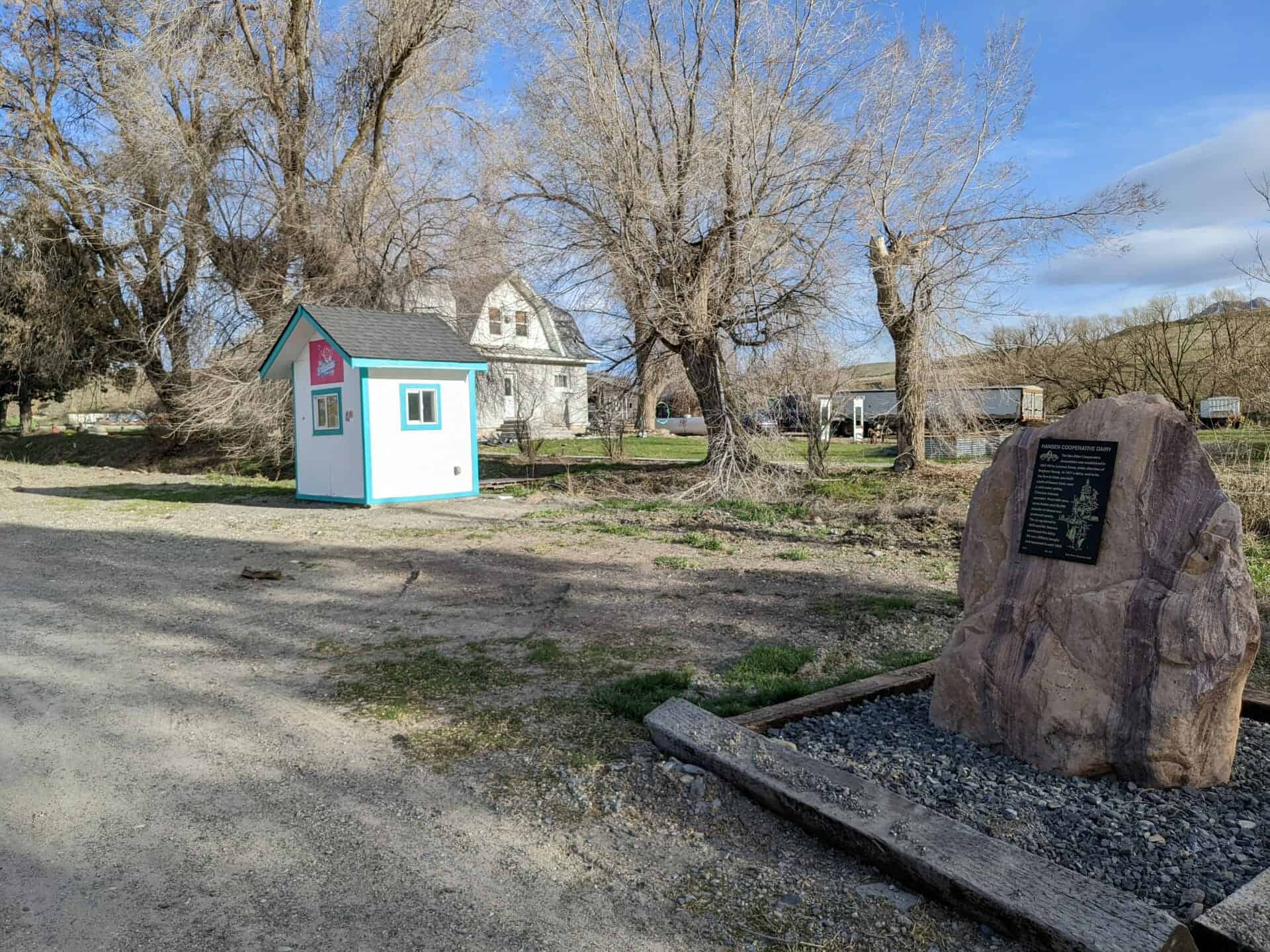
The Box Elder Cooperative Association was established in 1867-68 by Lorenzo Snow, under direction of Brigham Young. In 1871 a dairy, said to be the first in Utah, was built south of Beaver Dam, near a cold water spring. Christian Hansen, operator. From 600 cows, some butter and 50,000 pounds of cheese was produced yearly. The co-op closed in 1878 and Mr. Hansen purchased the dairy. His son, Willard, bought and operated it until 1893.

picture16aug07-081

This monument was erected in Beaver Dam, Utah in 1967 and is #334 of the Daughters of Utah Pioneers historic markers.

Related:

  • Hansen Dairy (S.U.P. historic marker)
  • D.U.P. Markers

The monument was replaced in 2018 and now looks like this:

Corinne Opera House

03 Tuesday Jun 2014

Posted by Jacob Barlow in Uncategorized

≈ 1 Comment

Tags

Box Elder County, Corinne, DUP, historic, utah

On this site the Corinne Opera House, for many years the largest recreation center in Utah outside of Salt Lake City was erected in 1870. Built of red pine lumber with square nails. The leading stock companies, California bound on the new railroad, stopped over and played to capacity houses. Among the players were Tom Thumb and Corinne Lavaunt. Maude Adams also played here. The building served as church, dance hall, public auditorium, first non-sectarian school in Utah, and picture shows. Was in constant use until 1952 when it was razed.

Related Posts:

  • D.U.P. Historic Markers
  • Utah Social Halls, Opera Houses, and Amusement Halls

This is Daughters of Utah Pioneers historic marker #229 located at 2335 North 4000 West in Corinne, Utah

picture04oct07-021

Check out all of the historic markers placed by the Daughters of Utah Pioneers at JacobBarlow. com/dup

picture04oct07-022

North Willow Creek Fort

22 Thursday May 2014

Posted by Jacob Barlow in Uncategorized

≈ 1 Comment

Tags

Box Elder County, DUP, historic, utah, Willard

picture7sep07-274

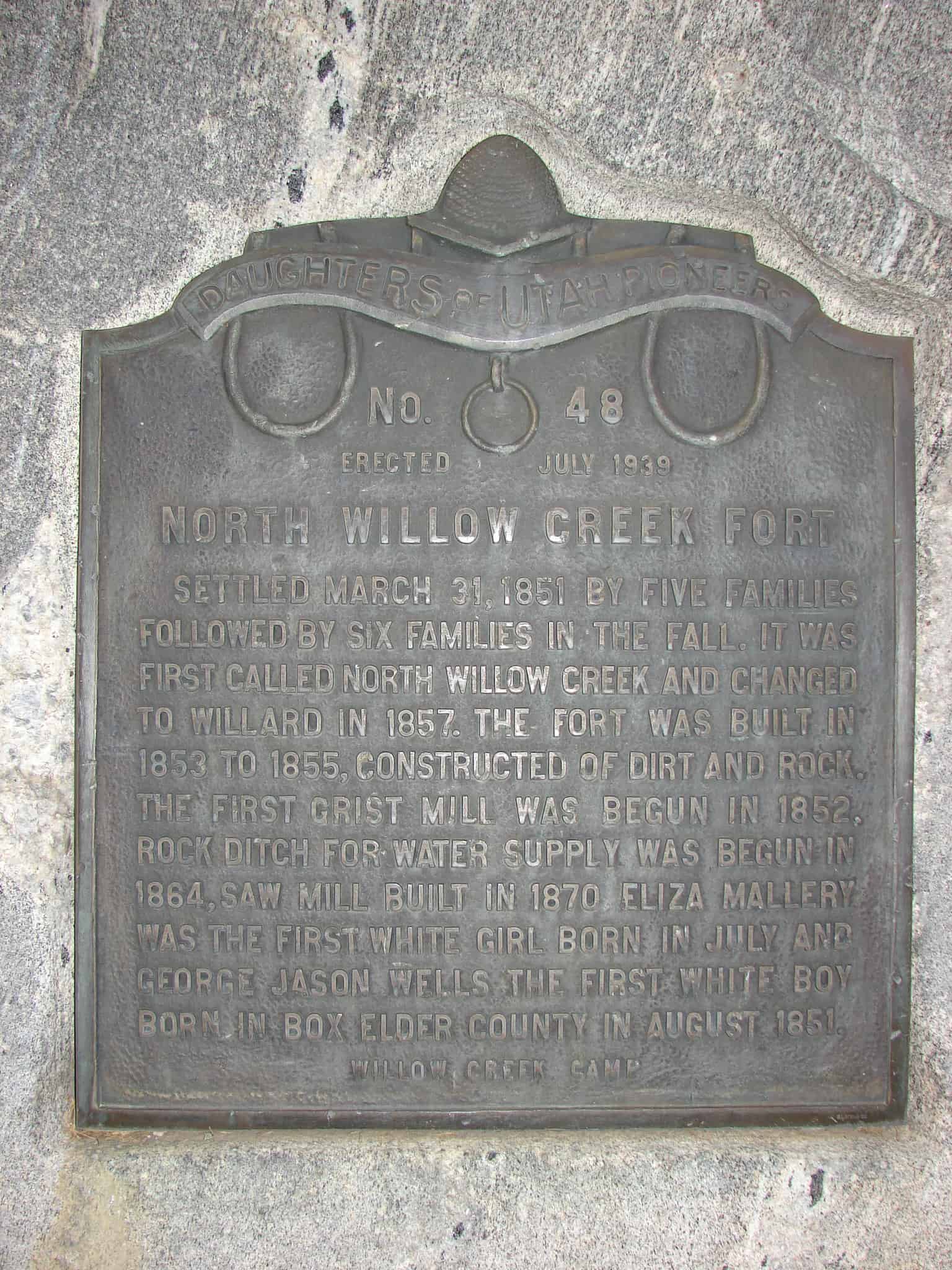
Plaque A: (East) NORTH WILLOW CREEK FORT

Settled March 31st, 1851, by five families followed by six families in the fall. It was first called North Willow Creek and changed to Willard in 1857. The fort was built in 1853 to 1855, constructed of dirt and rock. The first Grist Mill was begun in 1852. Rock Ditch for water supply was begun in 1864. Saw mill built in 1870. Eliza Mallery was the first white girl born in July and George Jason Wells the first white boy born in Box Elder County in August, 1851.

Plaque B: (Engraved in rock, North) 1851 WILLARD 1939

This native Granite is dedicated as a symbolic tribute to the Mormon Pioneer and early settlers of North Willow Creek – now Willard. They were faithful, honest and brave. We are grateful for thier (sic) leadership. We honor them and their children who have contributed to the Religious, Cultural, Educational and Civic progress of the commonwealth. We shall carry on. Erected by the Daughters of Utah Pioneers of North Willow Creek Camp, citizens and former residents. Located 226 feet east of old Fort Wall.

picture7sep07-273

Check out all of the historic markers placed by the Daughters of Utah Pioneers at JacobBarlow. com/dup

← Older posts
Newer posts →

Follow Jacob

Follow Jacob

Blog Stats

  • 2,018,727 hits

Social and Other Links

BarlowLinks.com

Recent Posts

  • Blue Base – The Stand Filming Location
  • 926 E South Temple
  • 969 E South Temple
  • 1001 E South Temple
  • 211 W Truman Rd

Archives


Loading Comments...