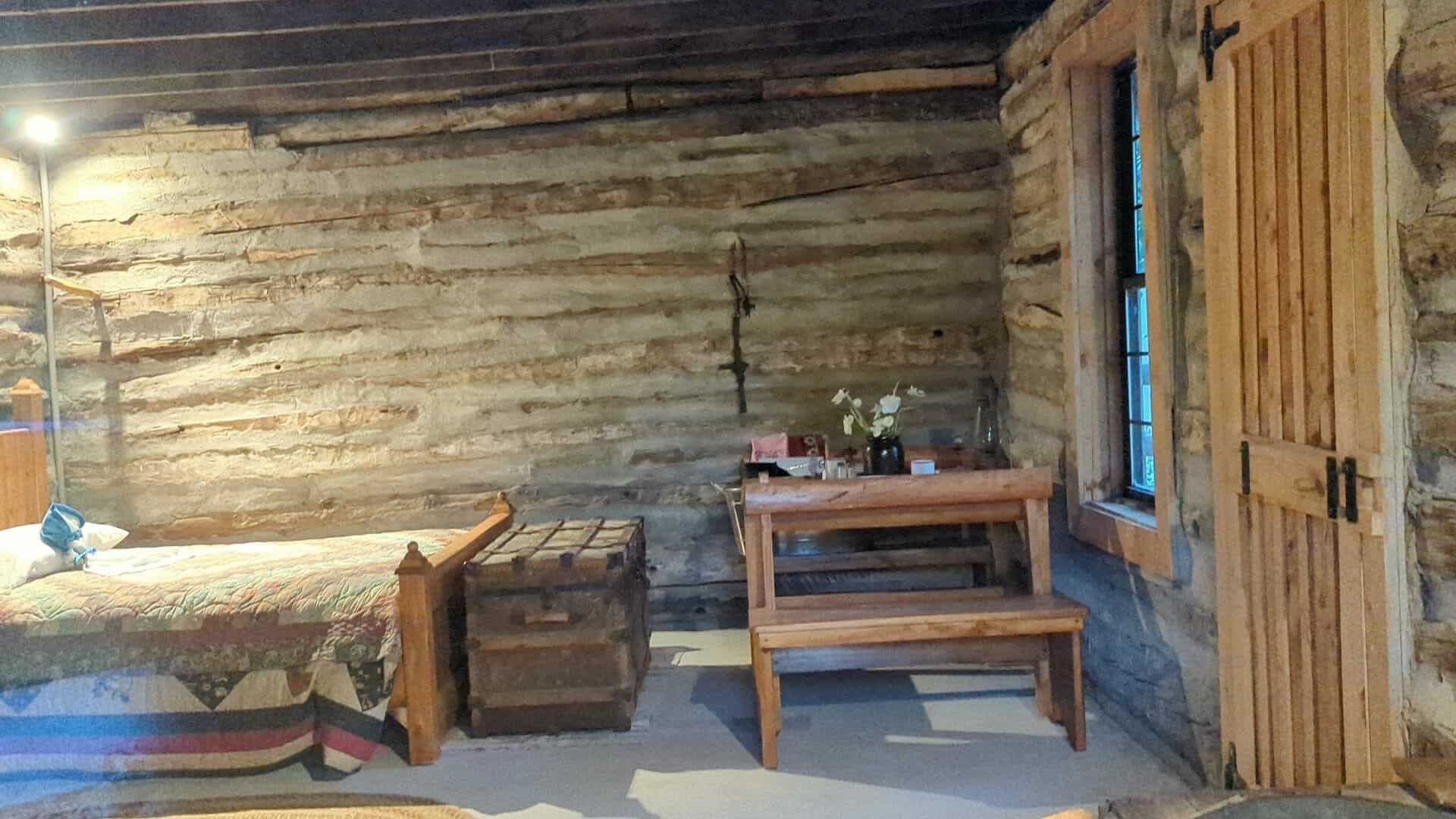
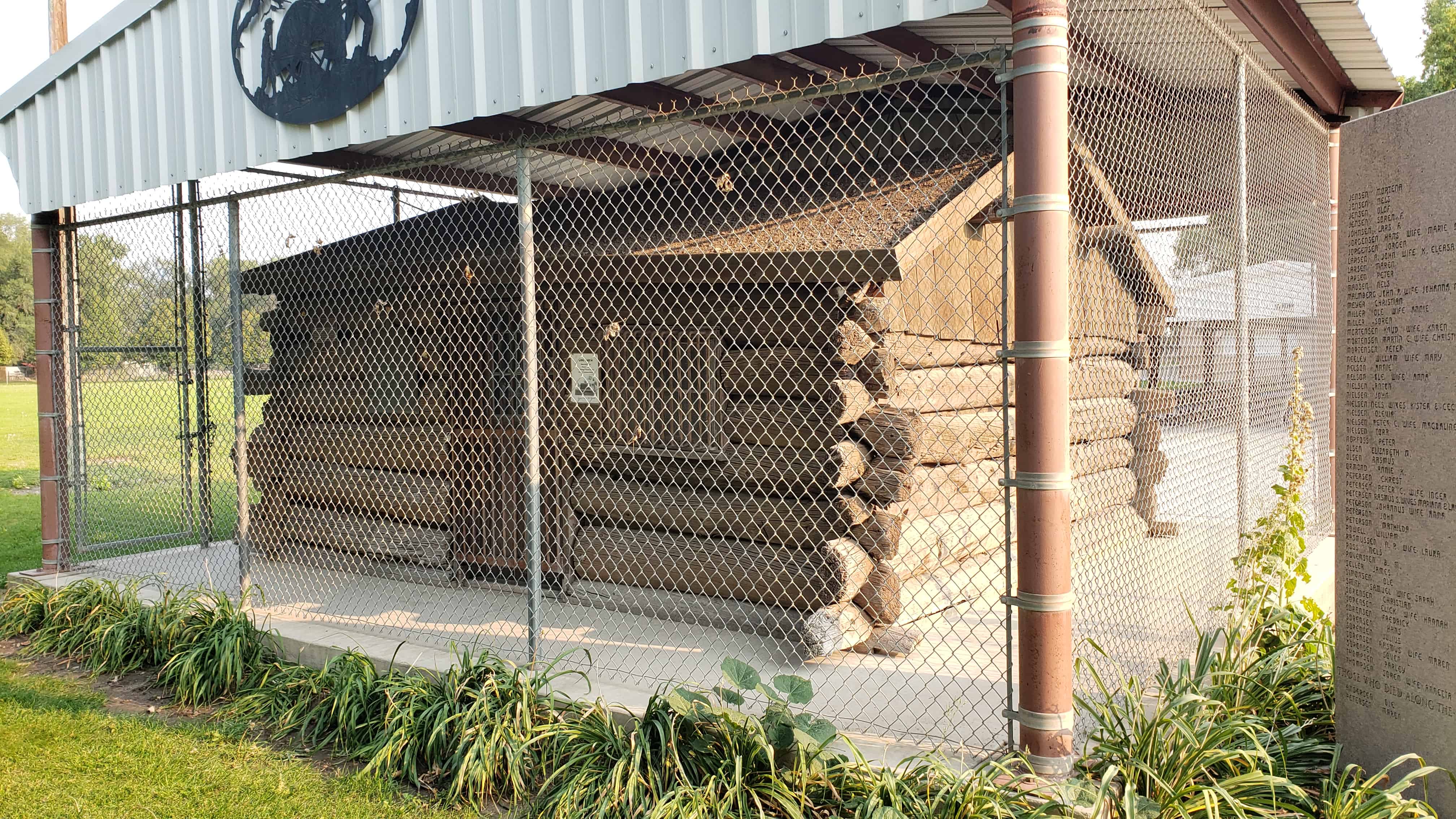
This cabin, believed to be one of the oldest in Castle Valley, was built on Gordon Creek by Albert Grames in the early 1880’s. It was moved to Price in the year 1900 and used as a Grames family residence until 1964. Albert Grames, in addition to being one of the first settlers in Castle Valley, was also the first mail carrier and worked in many public service capacities including sexton. The cabin was restored on this site by Utah Outpost in 1985.
This historic marker is located in Pioneer Park in Price, Utah and was dedicated by the Utah Outpost Mountain Charlie Chapter No. 1850 of E Clampus Vitus on August 3, 1985.
After sitting 161 years on its original building site, the Joseph “Cap” Hill cabin was moved to Layton Commons Park in 2017. This cabin is one of the oldest pioneer buildings in Davis County. It was built by Joseph Hill Sr. and his family between 1851 and 1854 and has been in the possession of the Hill family for over five generations.
Joseph “Cap” and Edith Ann Hill
Born in Gloucestershire, England, Joseph and his wife Edith Ann Marsden Hill, joined The Church of Jesus Christ of Latter-day Saints and immigrated to America in the 1840s with their three children – John C., Joseph Jr. and Alice Ann. They lived in Nauvoo, Illinois for a time and then moved to Utah Territory in September 1850. After arriving in Salt Lake City, the Hill’s move to the Kay’s Ward (later Kaysville) settlement to establish a permanent home. During this exodus across the plains, Joseph served as a captain of 10 wagons, under the direction of Mathew Caldwell, a captain of 50. For the rest of his life, Joseph would be remembered as “Cap” or “Captain” by his many friends and neighbors.
Joseph Sr. and his family worked hard to build a new homestead in what is now West Layton, on the west side of Angel Street. Once the cabin was built, the family established a farm where they raised hay, grain crops and cattle. In the late 1850s, Joseph Sr., hoping to seek his fortune in the gold fields, moved his family briefly to Sacramento, California; however, they returned to Utah in 1862. While passing through Carson City, Nevada, Edith Ann was critically injured in a wagon accident and died on July 4, 1862. After burying his wife, Joseph Sr. returned to Kay’s Ward and took up residence once again in the cabin he had built. He lived there until his death on august 21, 1889; and he was buried in the Kaysville City Cemetery. Following his death, the cabin was used for a variety of purposes until it fell into disrepair.
Eventually, the cabin passed into the possession of Joseph Sr.’s 2nd great-granddaughter, Odessa Webster Hill Harris and her husband Robert Jay Harris. The couple restored the cabin to its current condition in 1990. In 2000, the Harris’ built a beautiful home on the Hill property next to the cabin and cared and looked after the property until their passing in 2017. After their deaths, the cabin was moved to its current location where it serves as a reminder to Layton citizens as well as to all visitors who see it of those who came before us.
The Joseph Hill Family Cabin, built sometime between 1851 and 1858, is a one-story single-pen log cabin, located at 2133 W. 1000 South in Layton, Davis County, Utah. After a period of vacancy and deterioration, the cabin was rehabilitated around 1990 when it was raised and placed on a concrete pad. The rehabilitation included replacement logs from a derelict barn on site, re-chinking, replacement windows and interior casings, gable trim, an interior brick chimney, drop ceiling, and a new roof with wood shingles. Despite these modifications in some materials and workmanship, the Hill Family Cabin retains its historic integrity in terms of location, design, feeling and association of a pioneer-era log cabin. Although the immediate setting of the cabin has been compromised by the landscaped yard, the wider setting is still rural as much of the original farmstead remains agricultural. A new home built on the 1.53-acre property in 2000 is non-contributing. There is also an associated historic outhouse near the log cabin, but the outhouse has been modified and moved, and is therefore considered non-contributing. The Joseph Hill Family Cabin is one of four extant log cabins in the Layton area and the only example that still retains its domestic appearance. The cabin is a contributing resource in its Layton neighborhood.
The Joseph Hill Family Cabin sits on roughly rectangular property of 1.53-acres, a combination of two descriptions into one legal parcel. The cabin is located at the southeast corner of the property in the backyard of the non-contributing house, built in 2000, facing north to 1000 South. The new house was built where a one-story red brick Victorian-era cottage was located before it was destroyed by fire in the 1970s. The property is mostly lawn with pasture on the three adjoining sides. There is one mature elm tree located north of the cabin. This tree is the only remnant of the copse that surrounded the cabin prior to the rehabilitation. There are newer trees with decorative boulder plantings scattered in the backyard. A non-contributing gazebo structure is in one of the plantings. Just south of the cabin in one of the plantings is a wood outhouse. Although historic and associated with the cabin, the outhouse was recently moved and does not retain sufficient integrity to be contributing. There is also new gazebo west of the cabin.
The West Layton neighborhood at the intersection of 2200 West and 1000 South retains a rural feeling despite recent construction activity in the area. There are newer homes on either side of the cabin property, but there is pasture between. A new barn sits southwest of the log cabin on a separate legal parcel. There are onion fields to the north of 1000 South. To the south is undeveloped open pasture, further south and west are marshes at the edge of the Great Salt Lake. The path of the abandoned Bluff Road is visible in aerial photographs in the vicinity of the Joseph Hill Family Cabin.
The Joseph Hill Family Cabin in Layton, Utah, is locally significant under Criterion A, in three distinct areas: Exploration/Settlement, Commerce, Transportation, and Ethnic Heritage. The log cabin built by the Hill family is a rare extant example from the early settlement of the area formerly known as West Layton. The exact date of construction is unknown. In local histories, the construction of the cabin has been attributed to either Joseph Hill Sr. upon his arrival in 1851 or his son, Joseph Hill Jr., prior to his marriage in 1858. Both families are considered important early settlers of the Big Field area of West Layton. The Hill cabin was never moved from the family farmstead along the Bluff Road contributing to the cabin’s significance in the areas of Commerce and Transportation. Bluff Road was the preferred route for California-bound gold seekers leaving Salt Lake City to travel around the north end of the Great Salt Lake. The Hill family raised cattle on the flats below the bluff and sold beef and other commodities to the travelers. The family also represents the small minority of Mormon settlers who were lured to California by the promise of gold and silver. Joseph Hill Sr.’s extended family left Layton in 1860 and returned in 1862 after an unsuccessful and tragic journey, which resulted in the death of his wife, Ann Edith Marston Hill. After their return, Joseph Hill Jr. built a red brick house for his wife, Ellen Sheen Hill, and family. During that time Joseph Sr. may have lived in the cabin behind the brick house. The Hill Cabin is the only extant log cabin in Utah that is linked to the Bluff Road and it is the only known cabin in Layton to have continued a residential use into the twentieth century.
The Hill Cabin is also the only documented building in Davis County to be associated with the Japanese soaking tub practice (known as ofuro), which gives the building significance in the area of Ethnic Heritage. The continued maintenance of the log cabin as a residence likely contributed to its easy conversion to a bathhouse/dressing room in the 1940s and 1950s for one of the many Japanese families that rented farms in West Layton. Beginning in the 1920s and continuing into the 1950s, several Japanese families moved to Davis County to become farmers. Because the immigrants were discouraged from owning land, the immigrants share-cropped or rented the farms of older residents. Despite modifications that occurred during a circa 1990 rehabilitation, the building retains many of the characteristics that it had during an exceptional long period of significance that represents a century of productive use. The Joseph Hill Family Cabin is a contributing resource in its West Layton neighborhood.
The history of Layton begins with the history of Kaysville, Utah. In the winter of 1847-1848, just a few months after the arrival of members of the Church of Jesus Christ of Latter-day Saints (LDS or Mormon Church) to the Salt Lake Valley, Hector C. Haight kept a herd of cattle in the area, and in April 1850, William Kay and Edward Phillips raised wheat near what became known as Kay’s Creek. They were later joined by several families. By 1853, the population of Kaysville, which included present-day Layton, was 417. Among the settlers who came in 1850 was the family of Joseph and Ann Hill. Joseph Hill Sr. was born in 1806 in Sandhurst, Gloucester, England. His wife, Ann Edith Marston, was born in 1808 in Norton, Gloucester, England.34 They were married in 1828 and had three children, John Calvert (born 1835), Joseph Jr. (1837) and Alice Ann Marston (1839). The family immigrated to the United States before 1850. Joseph Hill Sr. was designated a captain over a team of immigrants while crossing the plains and was known as Captain or “Cap” Hill for the rest of his life. The family was living in a log cabin on “the salt flats near or on the dividing line between Kaysville and Layton” by time of the 1850 census enumeration. This area was known as the “Big Field.” A hand-drawn map of the early settlement places the Joseph Hill Sr. home north of Kay’s Creek in the northwest quarter of Section 31, Township 4 North, Range 1 West.
Unlike many of his contemporaries, Joseph Hill Sr. did not file for a homestead patent for his land. The first recorded claim to the land was when his son, Joseph Hill Jr., obtained a deed for 159 acres in the west half of Section 31 from the Union Pacific Railroad Company in July 1880. While the exact location of the first home of Joseph Sr. and Ann Hill is unknown, historic records agree that by the time of his marriage, Joseph Hill Jr. lived in a log cabin at the present-day intersection of 1000 South and 2200 West, although neither street existed prior to the 1880s. Joseph Hill Jr. married Ellen Sheen on December 28, 1858. Ellen Sheen Hill was born in 1837 in Berrow, England. She came to Utah in a handcart company in 1856 and settled in west Kaysville with her family. Joseph Jr. and Ellen Hill had two sons and five daughters. They lived in the log cabin until they were able to build a red brick house that faced north to a lane along the north line of Section 31 (today’s 1000 South). The 1870 and 1880 census enumerations show that after Ann Hill’s death in 1862, Joseph Sr. lived next to Joseph Jr. and Ellen. The juxtaposition combined with the Victorian-style windows added to the cabin suggest that Joseph Sr. may have lived in the log cabin on the property until his death in 1889.
By the 1880s, residents of the Layton area wanted to separate from Kaysville, which had been in incorporated in 1868. They questioned Kaysville’s authority to tax their property without providing municipal services. The Layton Ward of the LDS Church, named for early settler Christopher Layton, was established in 1889. The West Layton Ward of the LDS Church was organized in 1895, one year after a court case was decided in favor of the residents. Layton became an independent unincorporated area in 1902 and an incorporated town in 1920. By the time of incorporation, roads along the section lines (e.g. 2200 West) were created to connect to Gentile Street, the main east-west road to the Layton’s growing commercial district and the railroads.
Only a tiny fraction of the thousands of log cabins built by Mormon pioneers exist today. Of the twenty-seven log cabins built before the coming of the railroad that appear in the Utah SHPO’s database of historic resources, seventeen have been moved to museums or city parks for display. For example, the circa 1865 Levi Roberts cabin originally built on Kay’s Creek was moved to This is the Place State Park on the east bench of Salt Lake City in 1977. The Layton area is current represented by only four extant log cabins: the Hill cabin, the Higgs cabin on Fort Lane in East Layton, the Webster cabin on Angel Street (moved 500 feet), and the Kay cabin (moved to Syracuse). More importantly the Hill Cabin is the only surviving cabin that sits on its original farmstead and was associated with the emigrant trail along Bluff Road.
Orin Porter Rockwell was born on June 28, 1813 in Belcher, Hampshire county, Massachusetts to Orin Rockwell and Sarah Witt Rockwell. Known as the “Destroying Angel” he was bodyguard to the prophet Joseph Smith and later to Brigham Young. Porter had a ranch west of Cherry Creek, known as Rockwell’s Ranch. It is from this ranch that we obtained the cabin. Porter was said to have lived in the cabin south of the ranch house hear a big pond and lots of water. During winter, blocks of ice were cut from the pond and stored in an ice house, built with thick walls filled with sawdust for use in the summer months. Porter had a nice orchard and grew cantaloupe and watermelons. Rumor has it that at night he would walk around the cabin and orchard talking to himself. Some say he talked to ‘ghosts’. Orin Porter Rockwell died on June 9, 1878 in Salt Lake City of natural causes and was buried in a Salt Lake City cemetery.
This cabin was used as a family home from 1876 to 1956. It was the home of George and Hannah Wheeler and their ten children.
George Walton Wheeler headed west in 1854 with his father, Levi, bringing the first steam engine and sawmill west of the Missouri River. George was ten years old.
Hannah was born December 18, 1846, in Gloucester, England, daughter of George and Harriet Harding Humphries. The family came west with the Willie Handcard Company in 1856. Walking alongside the handcart were six children, ages eighteen, fourteen, twelve, nine, six and one. Hannah Humphries and George Walton Wheeler were married in 1862.
Logs were cut at the Wheeler Sawmill where they were floated miles down the Cub River. There the logs were taken from the river and hauled to the homestead. When Hannah and George moved into their little home in 1876, there was only enough flooring to go under the bed. A fresh water spring was near the cabin. A granary and a barn were also built. George Walton Wheeler made each building with full dovetail corners. Each square nail was made in his own blacksmith shop. From the cabin’s location, all of Cache Valley can be seen.
This original log home was first constructed as a part of the Mendon Fort in 1859. It was owned by Ole Peder (Peter) Sorensen (from Denmark), one of the first settlers of Mendon.
The two rows of 25 log homes in the fort were built close together, facing each other. Peter with his wife, Fredrrika (Rikke) Andersen Sorensen, and three children lived in this home and then moved it to a lot one block south of here when the Mendon Fort was dismantled in 1864.
The logs came from the mountains west of Mendon and were hewn by hand, utilizing a 90 degree V notching system. Small wood branches were tightly wedged between the large logs, and the remaining gap was filled with a lime and clay daubing mortar. The top two logs on the east and west ends of the home were spliced with wooden dowels, as the constructors apparently ran short of logs of sufficient length.
Originally the home had a dirt floor and a sod roof. The home served for 130 years as the kitchen/cooking area for the Sorensen’s framed home. The last person to live in the log home was Peter’s daughter, Hannah (Ann), who moved out in 1964. In 1992 the home was dismantled and the logs were stored. In 2013 the original logs were carefully assembled in their correct order on the present location.
Three of the original logs had to be replaced, and a new roof was built to replace the earlier that had been altered over the years.
In 1866, a group of Mormon Scandinavians were called by the Latter-day Saints Church to establish this settlement and develop an irrigation project from the waters of the Malad River. Their first homes were dug-outs built in the west bank of the Bear River north of the steel bridge, which now spans the river. In the fall of 1867, they built homes in a fort for protection from the Indians. This cabin was built there by Lars C. Christensen and his wife, Christiane, handcart pioneers of 1859.
This is DUP Marker #99 located at Bear River City Park at 4549 West 5900 North in Bear River City, Utah
Built by Christian Christensen in the 1870’s and occupied by the Bailey family since 1897, it was located at 200 North and 100 West in Ephraim and is now on display in the Pioneer Park.
The Hawk cabin was built in the period between 1848 and 1852. Family tradition has suggested that it was built in 1848 within the walls of the fort that sheltered the original settlement of Great Salt Lake City, Later the cabin was moved onto the property distributed to William Hawk as his “inheritance in Zion.” Multiple use of cabins in the early settlement period in Utah seems to have been a common economy practiced by Mormon pioneers. Whatever its origins, the cabin is most closely associated with William Hawk who lived there between 1852 and his death in 1883. The property then descended through his heirs, one of whom briefly used the cabin as a milk house, to the present owner, Clarence Booker.
The cabin’s primary interest lies in its long association with William Hawk, who, despite his modest circumstances during his life and at his death, had a life rich in adventure. In this one individual is found a reflection of the historical development of Mormonism and the West; an ordinary life filled with some extra-ordinary incidents.
“Father” Hawk, as he was widely known in his later years, was born in 1799 in a border area of Virginia that was later incorporated into the state of Pennsylvania. As he grew into a young man he began wandering through the region then thought of as the Western territories. Generally he followed the occupation of farm laborer as he would following his settlement in Utah. Married and with children, he was residing in Ohio when he heard the missionaries of the Church of Jesus Christ of Latter-day Saints. He and his family were baptized into the Church in 1834, and in the years that followed their travels mirrored the changing fortunes and development of the Mormon Church. After moving to Kirtland, Ohio, and then on to Far West, Missouri, and finally to Nauvoo, Illinois, the Hawk Family enjoyed little permanence before being forced to join in the hegira from Nauvoo.
During the flight west William Hawk and his son Nathan (or Nathanial or Nathaniel) enlisted in the Mormon Battalion, Company ‘B’ , to serve in the War with Mexico. After trekking through the Southwest with the Mormon Battalion, William and his son were released from U.S. Army service when they reached California. They did not leave immediately for Great Salt Lake City, but worked for a period in California. It is possible that they were either at Sutter’s Mill or close by when gold was discovered. However, it was to William and Nathan Hawk and eight others that the delivery of the news to the east and to the world was entrusted. Hired by prominent Mormon and Californian Samuel Brannan to carry special editions of his California Star to Independence, Missouri, Hawk and the others passed through Great Salt Lake City with the news that would be responsible for stimulating the economy of the struggling settlement as it catered to the needs of gold-hungry throngs passing through to California. However, Hawk and his companions found the rest of the journey from Salt Lake to Independence something of a let-down from the royal treatment they had received from the Mormon settlers. Weather and Indians combined to make the journey to Independence unusually hazardous, and Hawk himself was wounded in a skirmish somewhere along the Platte.
Hawk’s family joined him in Independence and he worked there fore one year before moving the entire group to Utah. Unfortunately, on the Wyoming plains, Hawk’s wife was trampled to death by wagon oxen. Son Nathan did not stop in Great Salt Lake City with his father, but moved on to California, Hawk with the rest of his family resolved to make Utah his home.
On his arrival Hawk received his “inheritance” from the Church. This was an assignment of land distributed according to need and ability to use. Hawk received a city lot and a farm lot located in what was called the “Big Field” just to the south of the city. It was on the city lot, located in the 19th Ward (an ecclesiastical division of the city), that the cabin was built or relocated. Hawk promptly became active in Church activities, with his name appearing in Church and city records from 1852 on. His second marriage had some difficult periods, notably when Hawk himself appeared as a witness against his wife in a Bishop’s Court proceeding. The wife, Ann Reese Hawk, was disfellowshipped from the Church having been found guilty of blasphemy, bad conduct, and being a bad neighbor.
Later in the year of his testimony against his wife, 1856, Hawk accepted a Church call to assist in the settlement of the mission at Las Vegas, Nevada. This was one of a string of settlements that had been originally designed to connect the core settlements in Utah to the sea by means of a settled corridor running from Cedar City through Las Vegas and Rancho San Bernardino to the sea north of San Diego, But with the advance of Johnston’s Army in 1857, Hawk and other settlers in the corridor were recalled to assist the defense of the Church’s heartland. He arrived in Salt Lake City just as Church leaders decided against military defiance on a large scale, and had switched their tactics to preparations for a scorched earth policy. Hawk was involved in the setting-up of “torching” squads who were instructed to set fire to everything of value, both property and foodstuffs, should the U.S. Army enter the valley in force. Hawk moved his family south to the community of Payson during this emergency.
Following the diplomatic resolution of the Utah War Hawk moved back to his 19th Ward property and remained there until his death in 1883, His obituary in the church-owned Deseret News, lengthy and complimentary, was a measure of the community esteem of a humble pioneer whose life had been touched with the excitement and adventure that was already making the early west a legendary period.
The Hawk cabin is a one-room log structure probably constructed from native lumber between 1848-1852. The building documents the technology and social status of a particular strata of Mormon society of which little is known. Records and cultural artifacts abound in relation to the socially mobile portions of Mormondom, but the materially less successful and their lifestyle remains largely undocumented. It is known that the early log cabins used as residences in Salt Lake City were quickly replaced with adobe structures, and that most log cabins were relegated to use as ancillary buildings. However, among the economically less vigorous, such as William Hawk, these buildings appear to have been continued in use as residences for a considerable period. The earliest Sanborn maps (1884), dated just one year after Hawk’s death in his log cabin home, show a fair number of these cabins in use as residences in areas known to have a working class population (the 19th and 5th Ecclesiastical Wards). Without exception these other log cabins can no longer be found within the Salt Lake City limits, so the William Hawk cabin remains as a vernacular log structure that documents the material culture housing available to Salt Lake City residents on the lower rungs of the socio-economic ladder. We are advised that the notching and other details of construction points to a builder with knowledge of the Pennsylvania style of cabin construction. It retains much of its original appearance despite several small fires that have charred some of the timber. The door and window areas have been modified slightly over the years, but the only change since around 1900 has been the cutting of the north facing wall to permit the installation of wooden garage doors. In terms of workmanship the very survival of the building is testimony to its rugged strength. The cabin exhibits very little technological sophistication in construction, which together with the visible adze work suggests that the date of construction is probably before saw mills were in full operation in the valley (1849-1850), : The summer kitchen that was originally attached to the building was probably destroyed at the time it was moved from the front to the back of the lot. The present roof is a 40 to 50 year old tarred flat type in poor condition.