Coal was first mined on Cedar Creek, about 9.4 miles N.W. of this location in 1906. Four men named Mays, Orem, Heiner and Rice bought the mines in 1908 and Castle Valley Fuel Co. was formed. In 1909 Castle Valley Fuel Co. became U.S. Fuel Co. and the town was named Mohrland using the first letter of each man’s last name and adding land to the end. The town consisted of 7 homes, 1 store, a doctors office, a beanery, and a hospital. The first school was built in 1915. By 1922, 275 men were employed at the mine and the town’s population exceeded 1000. In the boom and bust nature of the coal economy, decline began in the mid twenties with the closure of the store. By 1938 Mohrland was virtually a ghost town. Dedicated July 11, 1992
Five generations of Huntsmans all lived on the land that you see. Three homes were built and lives were spent, togetherness being the key. George and Deby were first to settle, here close by the Molen Ditch. Their children were added one at a time, making them very rich. Cleon and Naone and Nila brought challenges, joys and the rest. Living and learning the values set forth, always doing their best.
Parents of George and his sister, Mae, settled in a house next door. Coming and living by grandkids insured life would not be a bore. Their lives were all spent doing service for neighbors, church and the town. If payment were had for all their deeds, there’d be many jewels for their crowns. Cleon grew up and then married, bringing his Eva from Huntington. She was a very hard worker; together they knew how to have fun.
Since grandparents, Hyrum and Emeline, lived their lives and passed on, Cleon and Eva moved into their home when all the renters were gone. At the CCC camp across the field, a boy named Paul took part. He came visiting with others and made off with Naone’s heart. For Nila, school ended and she moved on, up north to learn and grow The next fifteen years worked and played and on weekends home she’d go.
Cleon’s three sons quickly joined them, but one, little Dennis, died soon. Evan and Howard were good boys, often humming or whistling a tune. Depression times were very difficult, working to make ends meet. George gave some land to help his kids construct buildings on this street. “Cleon’s Service Station” opened soon, pumping gas and making repairs. Cleon was very good at this work, always doing more than his share.
And to Naone and Paul, her husband, also some land did George give. A home they built for their fam’ly, just north on the hill they would live. Cleon bought and sold farm equipment, a help to farmers in need. This business was growing quickly, as cattle and pigs needed feed. Evan married Leona; army service gave them time on their own. Then back to Ferron and fam’ly to help share the load and not roam.
Soon Howard married Evelyn; college degrees they would obtain. To Ferron a while, away for awhile and back to Ferron again. Evan and his fam’ly lived in the home built to the north on the hill. Then back to the west, across the street their family’s needs to fill. Howard and fam’ly moved to the house build on the crest of the hill. The corals on the south in use once again, a need they would fulfill.
Five generations of Huntsmans all lived on the land that you see. Three homes were built and lives were spent, togetherness being the key. Mothers and Fathers with standards high for children eager to learn, Grandmas and Gramdpas glad to help out around almost every turn. They say that it takes a large village, to raise a girl or boy, But these honorable, valiant ancestors did it with great joy.
There were some maple syrup sandwiches given to fill the hole, Or graham crackers and ‘cold cereal’ to fill everybody’s bowl. There were paper scraps a plenty coming from “Cleon’s Service” trash. No purchased toys or playthings could compare, NO! Not even cash. As the youngest of these Huntsmans, we all want to give our thanks. For the Heritage and mem’ries given, no higher could they rank.
This land that you see before you was lived on and thoroughly loved. By the Huntsman Clan and their fam’lies; most now have gone on, above. This land that you see before you was given to Ferron, their town, To be their last act of service, giving up their beloved ground. Enjoy your time as you visit here, the land that the Huntsmans did love. Knowing they want you to do so, it’s a gift as they look from above.
Memories that you will make here will connect with this Huntsman land, Over one hundred years of time and the five generations grand.
by EvaLynn Huntsman Holt, 2006
This historic marker was dedicated August 5, 2006 honoring the 100th Wedding Anniversary of George & Deby and the 75th Wedding Anniversary of Cleon and Eva and it is located at approximately 145 South State Street in Ferron, Utah.
Huntsmans living on this property ~ Service to Ferron & Emery County
Hyrum Ralsotn and Emeline (moved here late in life)
Both were members of the Old Folks Group.
George Albert & Deborah Louisa Cox Huntsman (Married 1906)
George was Water Master (several ditches, Secretary for Priesthood quorums & Ferron Canal & Reservoir Co., Ward Clerk for many years, Treasurer for Ferron Town, Meals and car parking space for the CCC boys, Janitor at the church.
Deby was a member of the DUP, Town News reporter for 15 years, Secretary for the Red Cross (WWI), Old Folks Committee, Multiple church callings at the same time for 13 years, Secretary for the Relief Society for 21 years, President of the Relief Society, Ward Budget Secretary (required taking tickets at the picture shows 4 nights a week for 10 years)., Wallpapered in every existing home in town (during that period of time), Professional seamstress (including altering CCC boys pants to bell bottoms), Harmonica band member, Making & selling quilts (16 one year.)
Cleon and Eva Howard Huntsman (Married 1931)
Cleon – Owner of Cleon’s Service garage and a Massey-Ferguson farm equipment dealership, Custom Combine Service, Sang in Ward Choir, Always the first to donate money for church and community causes. Eva – Held multiple church callings at the same time for almost entire life, including Primary President, Taught family history research & ward examiner for many years, Supervised the first Family History Center located in Ferron Stake Center for several years, Member of the Retired Seniors Volunteer Program.
Paul & Naone Huntsman Fletcher (Married 1935 moved to Layton, Utah 1959)
Paul – Member of the CCC Camp F-11 which built the road to Ferron Reservoir, Contractor and homebuilder. Naone – Organist for every Church and community activity including the silent movies in the Greenhalgh Theater, Secretary for school, church and civic organizations, member of Harmonica band.
Nila Huntsman Mumm
Commuted from SLC on weekends, holidays & as parents needed, 15 years. (Married 1957 and moved to Richland, Washington) Emery Co. Ration clerk (WWII), Multiple church callings at once (5 one year), Decorated Wedding cakes, Gold & Green Ball Queen (twice), Emery Co. Centennial chorus, Stage makeup for plays, attended 100% of all High School reunions (12), Assisted Deby with wallpapering and quilts, Member DUP.
Evan & Leona Spencer Huntsman (Married 1953)
Evan – Worked with the farm machinery sales and repair with his father, Hauled Grade A and Grade B milk, Custom Hay hauling Service, Custom Combine Service, “Huntsman Feed & Supply” Company (hauled cattle feed etc.), Hauled Coal, Hauled Bricks, Janitors of the newly remolded Red Brick church on the hill, Varied Church positions. Leona – Janitor of Newly remodeled Church, Profession seamstress, Town News reporter, President of Primary, Secretary and teacher for ward and stake church organizations, Wrote and preformed comical readings at all ‘Annual Days’ and ‘Peach Days’ programs and many wedding receptions, etc.
Howard and Evelyn Peacock Huntsman (Married 1960)
Howard – Taught Vocational Ag. at Emery High School, Managed ‘Cleon’s Service’, Sold raw mild from his dairy, Served in varied church callings. Evelyn – Emery County Home Extension Agent, Taught piano lessons over 30 years, Varied Church callings, Accompanying singers and singing in quartets, trios, and duets, Refereeing volleyball games and umpiring softball games, Member of DUP, Wrote “A Peach of a Place – A History of Ferron and Molen, Utah”.
Desert Lake, about 8 miles east of here, was first settled in 1885 by settlers building an irrigation ditch from Huntington Creek to the townsite and a reservoir to store the water for farming. In 1896 the dam broke, nearly drowning the small town. The dam was rebuilt in 1896-97 and a post office was established on Feb. 16, 1898. Between 1900 & 1910 the town gradually moved to a new site about 5 miles to the N.E. due to the encroachment of alkali ruining the farmland. A school & meeting house was built at the new site in 1910 and in 1912 the post office was officially changed to Victor. Settlers continued to fight the arid climate but finally gave up. Desert Lake & Victor became just a memory.
Dedicated July 13, 1996 Matt Warner Chapter 1900 E Clampus Vitus
Weber Canyon has always been the most important gateway into the Great Salt Lake Valley. Through its portals passed many notable persons of early Utah history including John Weber, a trapper, who is supposed to have been killed by Indians in the winter of 1828-29, Etienne Provost, who in 1824 reported one of the first explorations of the river, Osborne Russell, who reported exploration in 1841.
In 1846 California emigrants took the first wagons down into Weber Canyon encountering many hardships and suffering severe losses. They included the James Hudspeth, Bryant Russell, Young and Harlan parties.
In this vicinity, the Donner-Reed party of 1846 which later met a tragic fate on the east slope of the Sierras in California turned southwest and blazed a trail through the mountains to the Salt Lake Valley. This trail was followed by the Mormon Pioneers in 1847, the California Gold Rush emigrants in 1849-50, the Mormon Handcart Pioneers and Overland Stage in 1856, and the Pony Express 1860-61.
Founded by Summit County Restaurant Tax and Summit County Historical Society. Built in 1990 by Boy Scouts of American Troop 681 and restored in 1999 by D. H. Evans Varsity Scout Team 523 Eagle Scout Project. The aging wood was replaced with steel in 2015 by Summit County Historical Society.
From the late 1840s through the 1860s, an exodus of more than 70,000 Mormons passed by here on their way to their “New Zion” in Utah. Starting from Nauvoo, Illinois in February 1846, the first group of at least 13,000 Mormons crossed into Iowa to escape religious persecution, then spent the next winter in the area of present-day Council Bluffs, Iowa and Omaha, Nebraska.
In 1847, Brigham Young led an advance party of 143 men, 2 women, and 3 children along the Platte River. At Fort Bridger, Wyoming they departed from the Oregon Trail to head southwest to the Great Salt Lake. Thousands of other Mormons soon followed. Today, a marked 1,624-mile auto tour route closely parallels their historic trek.
From 1856-60, many European converts walked more than 1,200 miles to Salt Lake City pushing and pulling handcarts loaded with 500 pounds of supplies. After 1860, the Mormon church sponsored oxen-drawn wagons to bring emigrants to the “New Zion.”
This approach to Big Mountain Pass was the steepest sustained climb on the Mormon Trail. From the mouth of the canyon, across the creek to your left, the pass rises 1,400 feet in elevation over a distance of 4 miles.
At the suggestion of Lansford W. Hastings, the California-bound Donner-Reed Party of 1846 became the first wagon train to make the difficult ascent. They camped at springs which fed several beaver ponds one mile up the narrow canyon. Four nights (August 14-17) were spent at “One-Mile Camp” for the purpose of blazing a trail. Since then, thousands of travelers have rested at this popular spot.
In July 1847, the first group of Mormon Pioneers, led by Brigham Young, followed the tracks of the Donner-Reed Party up the canyon and on to the valley of the Great Salt Lake. For the next 22 years, emigrants, forty-niners, freighters, stage coaches, and pony express riders used the trail, traveling both east and west.
Today, the area around you is called Mormon Flat. But, in the mid-1800s it was known by another name. In the fall of 1857 (October 29-November 9), the Mormon Militia, under the command of Lt. Gen. Daniel H. Wells, built two large rock walls on the ridges flanking the entrance to Little Emigration Canyon. The wall closest to you was known as the “Duke Battery” and the other the “Hyde Battery,” after the officers who directed their construction. These fortifications are the largest and best preserved built for a war that never happened.
On Friday morning, June 25, 1858, the U.S. Army splashed through the creek and passed beneath these batteries. Private Charles Scott noted in his journal that the “two breastworks of stone” were “dignified with the title Fort Wells.”
This historic marker is #67 of the Sons of Utah Pioneers historic markers and it is located at the Mormon Flats Campground in Little Emigration Canyon.
In 1854 Anson Call of Bountiful erected a Grist Mill on the south side of Deuel Creek, just southeast of this marker. The mill was a three-story building made from Centerville Canyon rock, with the machinery on the top floor. The people brought their grain to be ground into flour, and the miller kept a portion of it as his pay. The power to turn the grinding wheels was generated solely by water flowing down Deuel Creek, which was run into two holding ponds on the hillside above the mill and then piped to a water wheel which turned the drive shaft.
The larger pond also served as a baptismal font for many of the pioneers. In the winter, when the water was frozen solid, ice was cut into blocks and stored in sawdust for use in the spring and early summer.
The first miller of record was a Mr. Southworth, followed by Messrs. Symns, Winn, McKinney, and Miller. For 15 years the mill lay idle until 1890 when Alwood Brown took it over. He renovated it and installed new machinery.
After Alwood Brown left, the mill was run by several others, including Mr. Everett, Mr. Hancock, and finally by Jim Brown. At one time Mr. Everett ran a wholesale bakery in the basement and drove a bakery wagon all over Davis County. He also had an ice-cream parlor, and so on warm summer evenings the young couples of the town would stroll up here for refreshments – and a little spooning. The place was romantic.
The mill was last operated in about 1905. The lumber was removed in the 1930s and the building fell into decay. The walls were blown in by east winds and the structure became dangerous, so it was completely torn down in 1944.
Davis County purchased the site and constructed a storm water debris basin here following the flood of 1983.
The marker has been removed, hopefully temporarily and I didn’t get photos of it but the text was:
This commemorative monument, erected at the Last Spike site by the Southern Pacific Railroad Company in 1919, was relocated for more conspicuous display by the Daughters of Utah Pioneers, 1980. The twenty-two years preceeding the coming of the railroad (1847-1869) is remembered for the most spectacular migrations in American history, with 86,000 emigrants leaving their homes in foreign countries and the United States. The majority walked beside their loaded wagons; about 6,000 lost their lives and are buried along the trails. It is these pioneers we are pledged to commemorate.
The Transcontinental Railroad opened a progressive era, with speed and ease of transportation from East to West, and signaled the end of the slow, torturous travel.
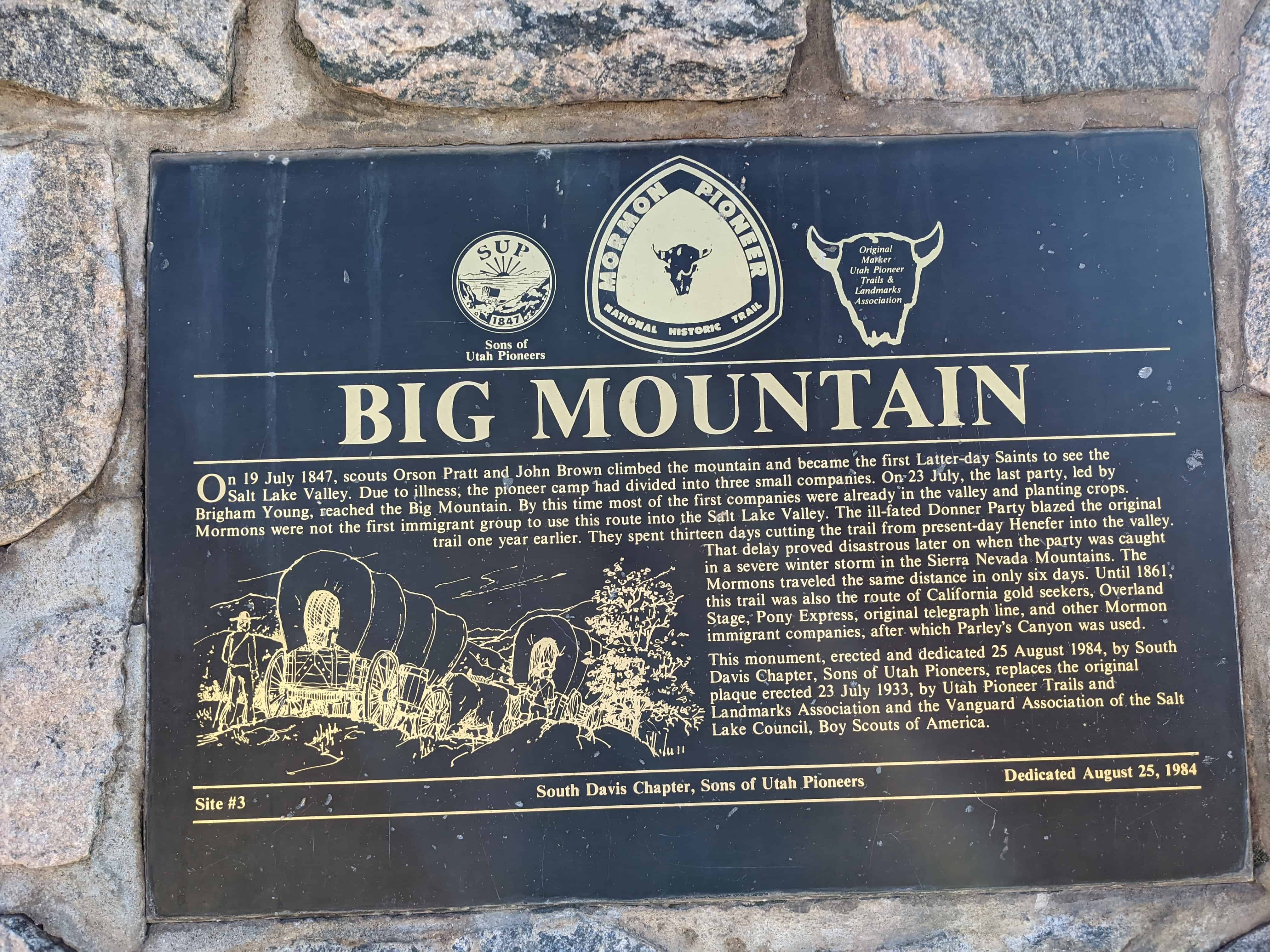
On 19 July 1847, scouts Orson Pratt and John Brown climbed the mountain and became the first Latter-Day Saints to see the Salt Lake Valley. Due to illness, the pioneer camp had divided into three small companies. On 23 July, the last party led by Brigham Young reached the Big Mountain. By this time most of the first companies were already in the valley and planting crops. Mormons were not the first immigrant group to use this route into the Salt Lake Valley. The ill-fated Donner Party blazed the original trail one year earlier. They spent thirteen days cutting the trails from present day Henefer into the valley. That delay proved disastrous later on when the party was caught in a severe winter storm in the Sierra Nevada Mountains. The Mormons traveled the same distance in only six days. Until 1861, this trail was also the route of California gold seekers, Overland Stage, Pony Express, original telegraph line, and the other Mormon immigrant companies, after which Parley’s Canyon was used.
This monument, erected and dedicated 25 August 1984, by South Davis Chapter, Sons of Utah Pioneers, replaces the original plaque erected 23 July 1933, by Utah Pioneer Trails and Landmarks Association and the Vanguard Association of the Salt Lake County, Boy Scouts of America
This original log home was first constructed as a part of the Mendon Fort in 1859. It was owned by Ole Peder (Peter) Sorensen (from Denmark), one of the first settlers of Mendon.
The two rows of 25 log homes in the fort were built close together, facing each other. Peter with his wife, Fredrrika (Rikke) Andersen Sorensen, and three children lived in this home and then moved it to a lot one block south of here when the Mendon Fort was dismantled in 1864.
The logs came from the mountains west of Mendon and were hewn by hand, utilizing a 90 degree V notching system. Small wood branches were tightly wedged between the large logs, and the remaining gap was filled with a lime and clay daubing mortar. The top two logs on the east and west ends of the home were spliced with wooden dowels, as the constructors apparently ran short of logs of sufficient length.
Originally the home had a dirt floor and a sod roof. The home served for 130 years as the kitchen/cooking area for the Sorensen’s framed home. The last person to live in the log home was Peter’s daughter, Hannah (Ann), who moved out in 1964. In 1992 the home was dismantled and the logs were stored. In 2013 the original logs were carefully assembled in their correct order on the present location.
Three of the original logs had to be replaced, and a new roof was built to replace the earlier that had been altered over the years.