Tags
Fairfield Cemetery
29 Saturday Aug 2020
Posted in Uncategorized

29 Saturday Aug 2020
Posted in Uncategorized
Tags
27 Thursday Aug 2020
Posted in Uncategorized


The White Meeting House
Daughters of Utah Pioneers Marker #587
The White Meeting House stood on this site from 1856-1927. It was built just six years after the settlement of Springville, constructed of adobe, and first used as a school. Once the city was divided into four wards, the school was remodeled and expanded into a beautiful Latter-day Saint meetinghouse.
The White Meeting House was a cherished landmark used primarily for religious services. The addition of a stage and three upper seating galleries increased the seating capacity to 500, making it the location of many social and community functions as well. Notable speakers addressed the audience from its pulpit, including Brigham Young and other presidents of The Church of Jesus Christ of Latter-day Saints up to Heber J. Grant.
The White Meeting House stood as a monument to pioneer skill, craftsmanship and good taste for over 70 years, undergoing several major remodeling efforts until it was finally demolished in 1927.
On September 18, 1937 a marker was installed which read: “Site of the First L.D.S. Meeting House, A.D. 1856. This Marker Erected by Sons & Daughters of Springville Pioneers.” The marker was removed in 2010 when the Springville Public Library was built.
This marker was dedicated September 19, 2020, on Springville’s 170th birthday by the Springville/Mapleton Company of the Daughters of Utah Pioneers.
Related:


Some images I’ve come across for the White Meeting House in Springville, Utah.


25 Tuesday Aug 2020
Posted in Uncategorized
Tags

Located at 117 E 200 N in Springville, this 1876 home was formerly owned by Thomas Mendenhall, the co-owner of Deal Bro’s and Mendenhall Mercantile and the owner of the first bank. His family was one of the 8 original families to settle Springville.
See other historic homes in Springville here.


11 Tuesday Aug 2020
Posted in Uncategorized
Tags
01 Saturday Aug 2020
Posted in Uncategorized
Tags

Town of Cedar Fort Old Pioneer Cemetery
This old pioneer cemetery was established in Cedar Fort soon after the settlers came to this valley in 1852. It is impossible to identify all those buried here as many graves have been left unmarked, and records are no longer available. At one time this cemetery has a high fence but it has long since been removed.
The remaining visible tombstone is adjacent to this monument. The writing is obliterated, but residents recall it saying, “Remains of Ann Dodd Butler Hodge, who died 1855.” To the west, almost opposite the Hodge marker, there were at one time two 4 x 4 wooden markers where William and Warren Weeks were laid to rest on August 8, 1854 after they were killed by Indians.
It is possible that some of Johnson’s Army men, Indians, and mine workers from Mercur, Sunshine and Manning were also buried here.
Related:


01 Saturday Aug 2020
Posted in Uncategorized
Tags

The cemetery in Cedar Fort, Utah.
The old pioneer cemetery in Cedar Fort can be seen here.
Some buried here:




31 Friday Jul 2020
Posted in Uncategorized
Tags
Fires, Indianola, Sanpete County, utah, utah county, Wildfire
29 Wednesday Jul 2020
Posted in Uncategorized
Tags

I enjoy hunting for and documenting benchmarks, for others click here.
These one is located in Fairfield, Utah behind this historic marker.

29 Wednesday Jul 2020
Posted in Uncategorized

Built in 1858 by John Carson as a family home and Inn.
Used as a Pony Express and Overland Stage stop during the 1860’s.
Built on the site oh John Carson’s original fort.

Stagecoach Inn
Because of its proximity to Camp Floyd r the old “Stage Coach Inn” served as a stopping place for visitors to/the camp and travelers enroute to California. The station served as one of the Overland Stage Stops until the coming of the transcontinental railroad in 1869. It was also used as a pony express stop between 1860-1861.
Related:
The Stagecoach Inn is located in Camp Floyd / Stagecoach Inn State Park at 18035 West 1540 North in Fairfield, Utah and was added to the National Historic Register (#71000857) on May 14, 1971.

John Carson had settled in Cedar Valley with four brothers as early as 1855. Their first protection from the Indians was a stone fort four rods square, within which they built their log and adobe living quarters. The north wall of the old fort was about where the south wall of the inn now stands.
With the “Mormon War” an influx of military personnel arrived in Utah. Colonel Albert Sidney Johns ton located his command of 3,500 men, 586 horses, 3,000 mules and 500 wagons, near Fairfield in Cedar Valley and where he established Camp Floyd. As a result, the population of Cedar Valley burgeoned in 1858, to more than 7,000 souls.
The old stone fort was torn down and John Carson built a two- story adobe and f rams hotel and inn. Mr. Carson, an “Elder” in the Mormon Church, would permit no liquor to be served in his inn, nor would he permit “round dancing,” then frowned upon by the more pious in his church. Thus the inn became an oasis of decency for prominent visitors and dignitaries, including Louis Greeley, a nephew of Horace Greeley, who occupied it for some time.
Both passengers and freight moved along this central route to California in the late 1850’s. Captain J. H. Simpson surveyed and mapped a route through the region in 1859. During the era of the pony express, the inn became a mail stop between Salt Lake City and Faust, further west. In addition, the “Carson House” served as the first Overland Stage Station west from Salt Lake City.
With the coming of the Civil War troops from Camp Floyd were recalled. Colonel Philip St. George Cooke replaced General Johns ton and renamed the post Fort Crittendon. However, on May 17, 1861 he was ordered east with his command. Camp Floyd was gone. By September of 1861 only 18 families remained Jn the little community of Fairfield.
John Carson remained and raised his family in the inn. After his death Carson’s widow and children continued to operate it as a hostelry, it finally closed in 194?. In 1959 John Carson, a son, turned the property over to the Utah State Parks and Recreation Department who have restored it and opened it in 1964 as a museum.
It sets today in an historic setting little changed from 1858.

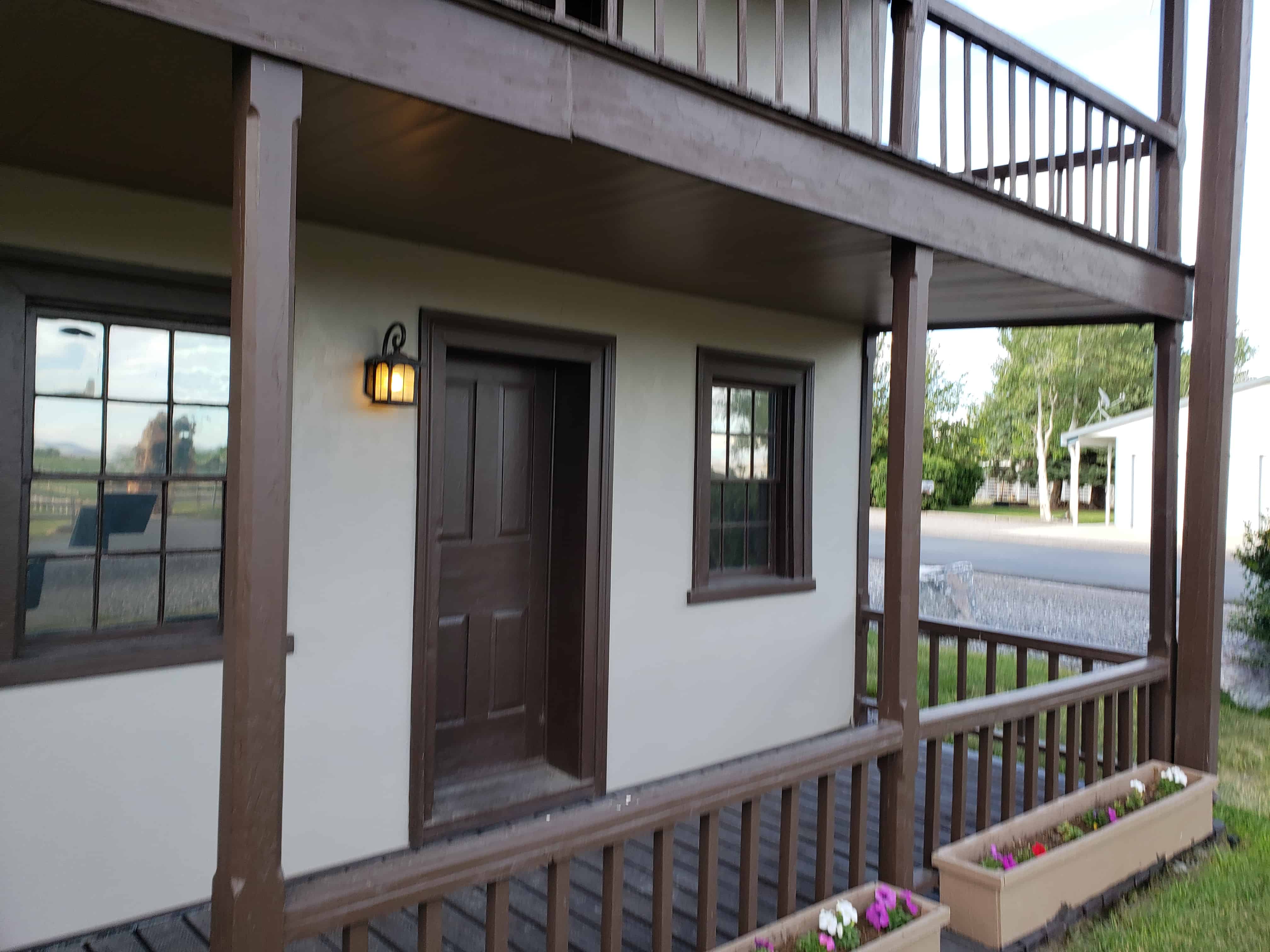
The Stage Coach Inn was originally a large family residence built for the Carson family before conversion to an Inn. It had 14 rooms, seven of them bedrooms. The building is “L” shaped with two stories 52’*’ 8″ x 59′ 6″. It is made of brick and plaster except for the two-story addition at the west which is frame with ship lap cove siding. Some of original pine flooring and glass windows remain. The fireplaces have been restored, although they are no longer used for heat.
The first floor, behind the front gallery, has two square rooms, each with outside doors. The single story wing extends to the rear with two square rooms, each with a door to the east porch. Four small square rooms in a line adjoin the rear room and occupy the lean-to. The frame addition has a single large room on the west front but does not open to the rest of the inn. The second floor has two square rooms in the masonry portion and one front and two rear bedrooms in the rear addition.
Heating was done originally with four fire places. Two stairways in the northeast and west portions allow ascent from the first to second floors.
The restoration has attempted to return the structure to as near its original condition as possible. The furnishings are consistent with the period.
Across to the south the old commissary building of Camp Floyd has also been restored; however, it will be treated later as a part of the historic site of Camp Floyd.




29 Wednesday Jul 2020
Posted in Uncategorized
Tags

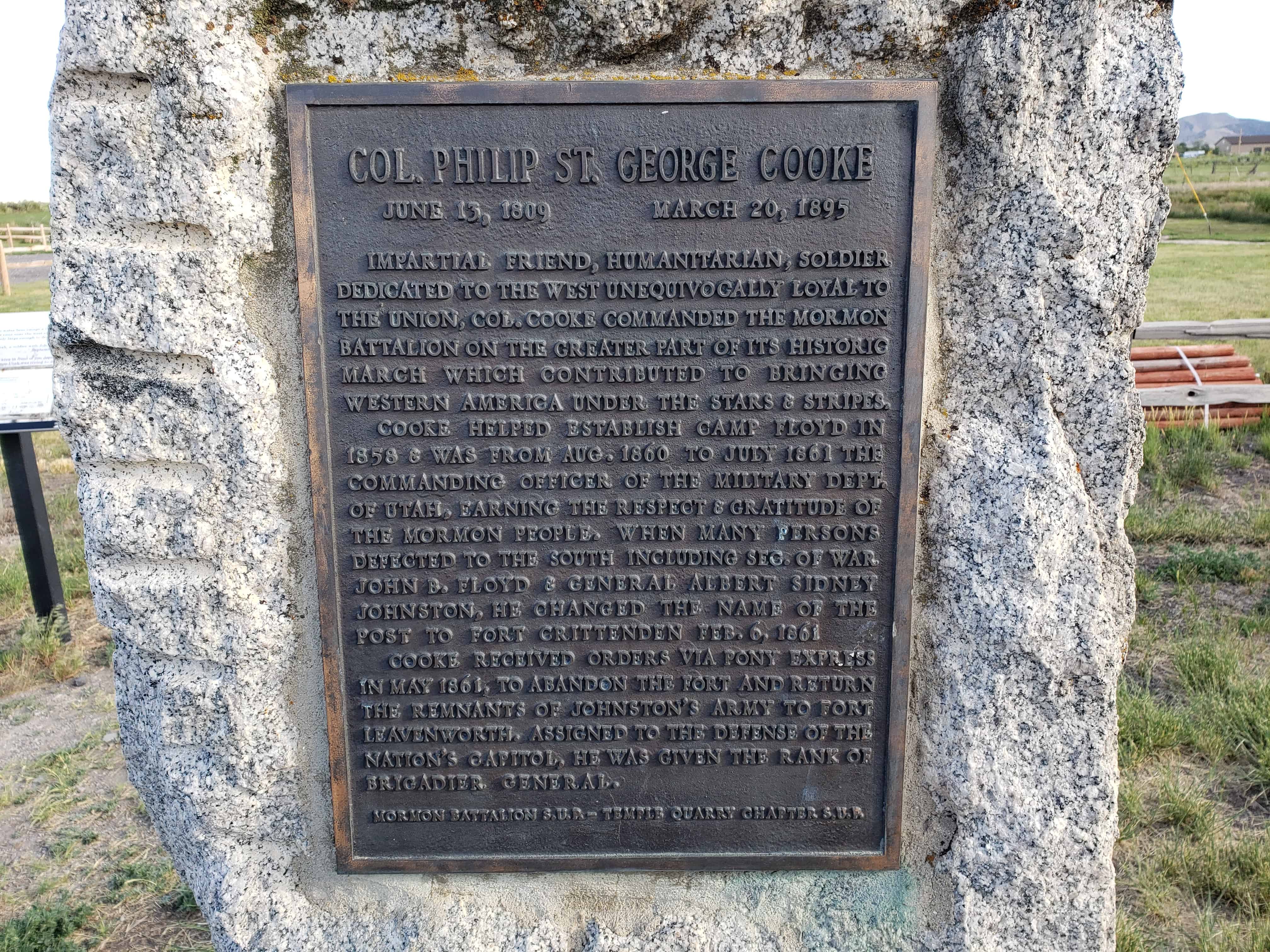
Col. Philip St. George Cooke
June 13, 1809 – March 20, 1895
Impartial friend, humanitarian, soldier, dedicated to the west unequivocally loyal to the Union, Col. Cooke commanded the Mormon Battalion on the greater part of its historic march which contributed to bringing Western America under the Stars & Stripes.
Cooke helped establish Camp Floyd in 1858 and was from August 1860 to July 1861 the commanding officer of the Military Department of Utah, earning the respect and gratitude of the Mormon people. When many persons defected to the south including Sec. of War John B. Floyd and General Albert Sidney Johnston, he changed the name of the post to Fort Crittenden February 6, 1861.
Cooke received orders via Pony Express in May 1861, to abandon the fort and return the remnants of Johnston’s Army to Fort Leavenworth. Assigned to the defense of the Nation’s Capitol, he was given the rank of Brigadier General.

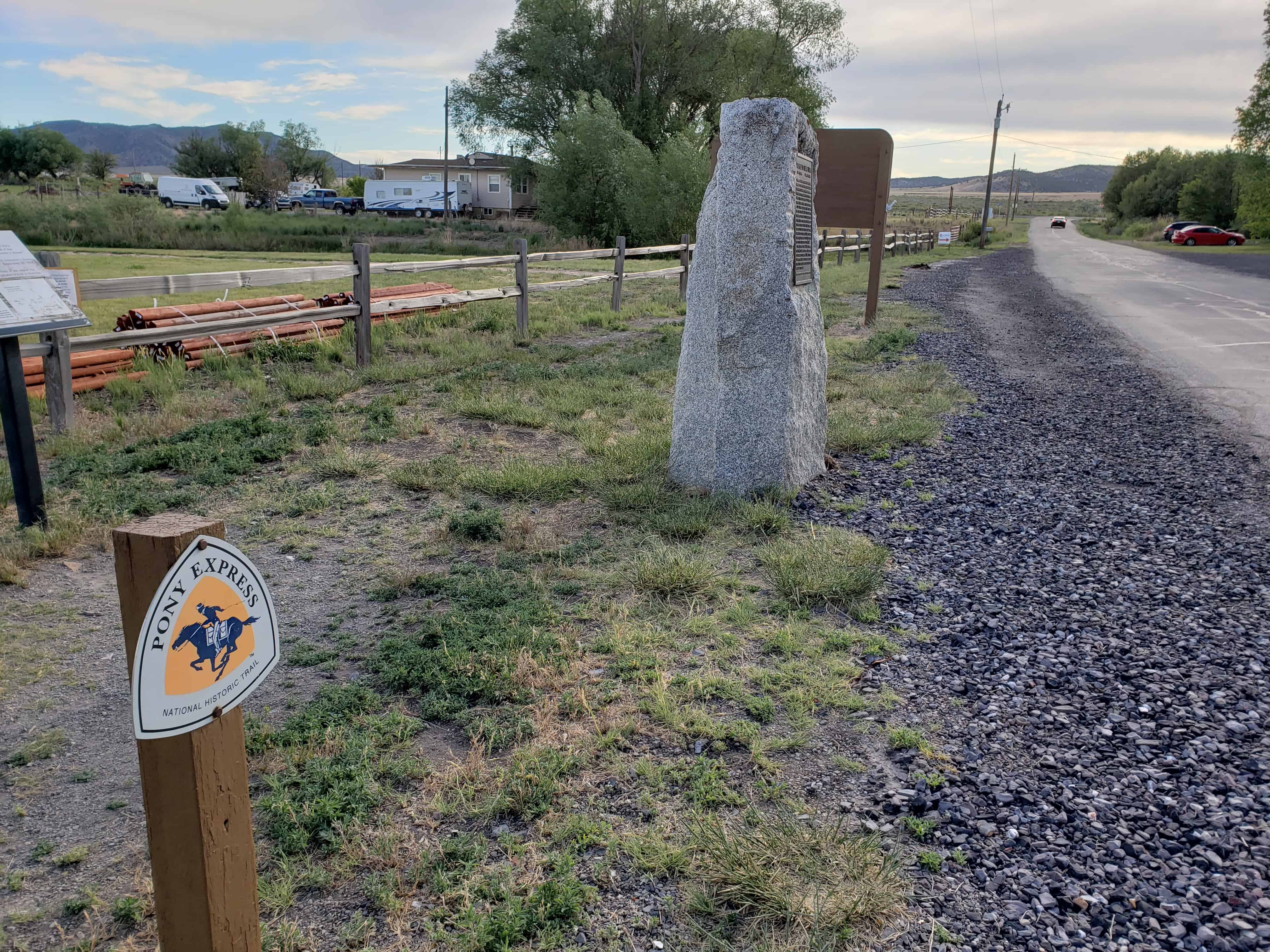
This historic marker was placed by the Sons of Utah Pioneers (see their other markers here) in Fairfield, Utah.