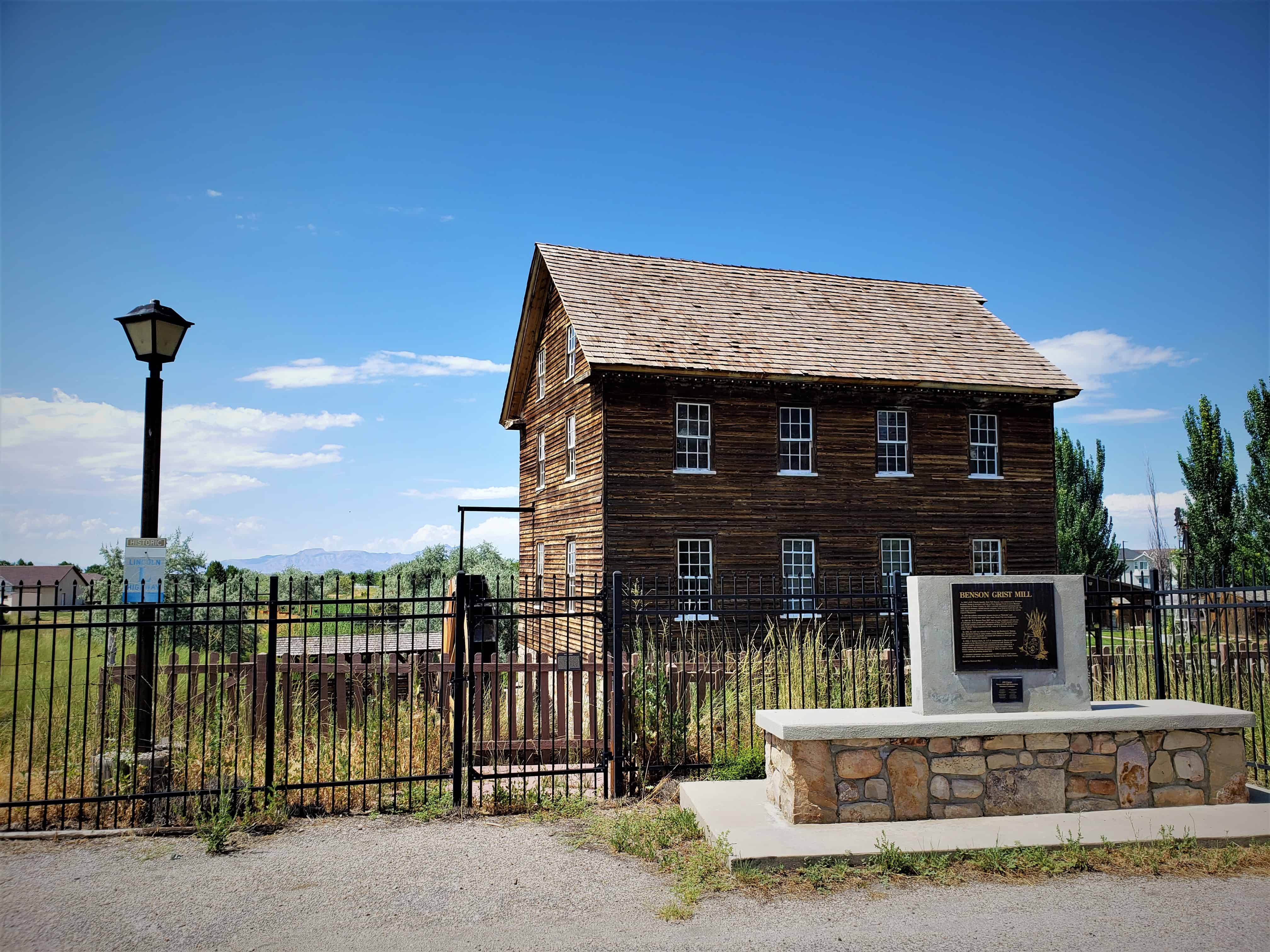
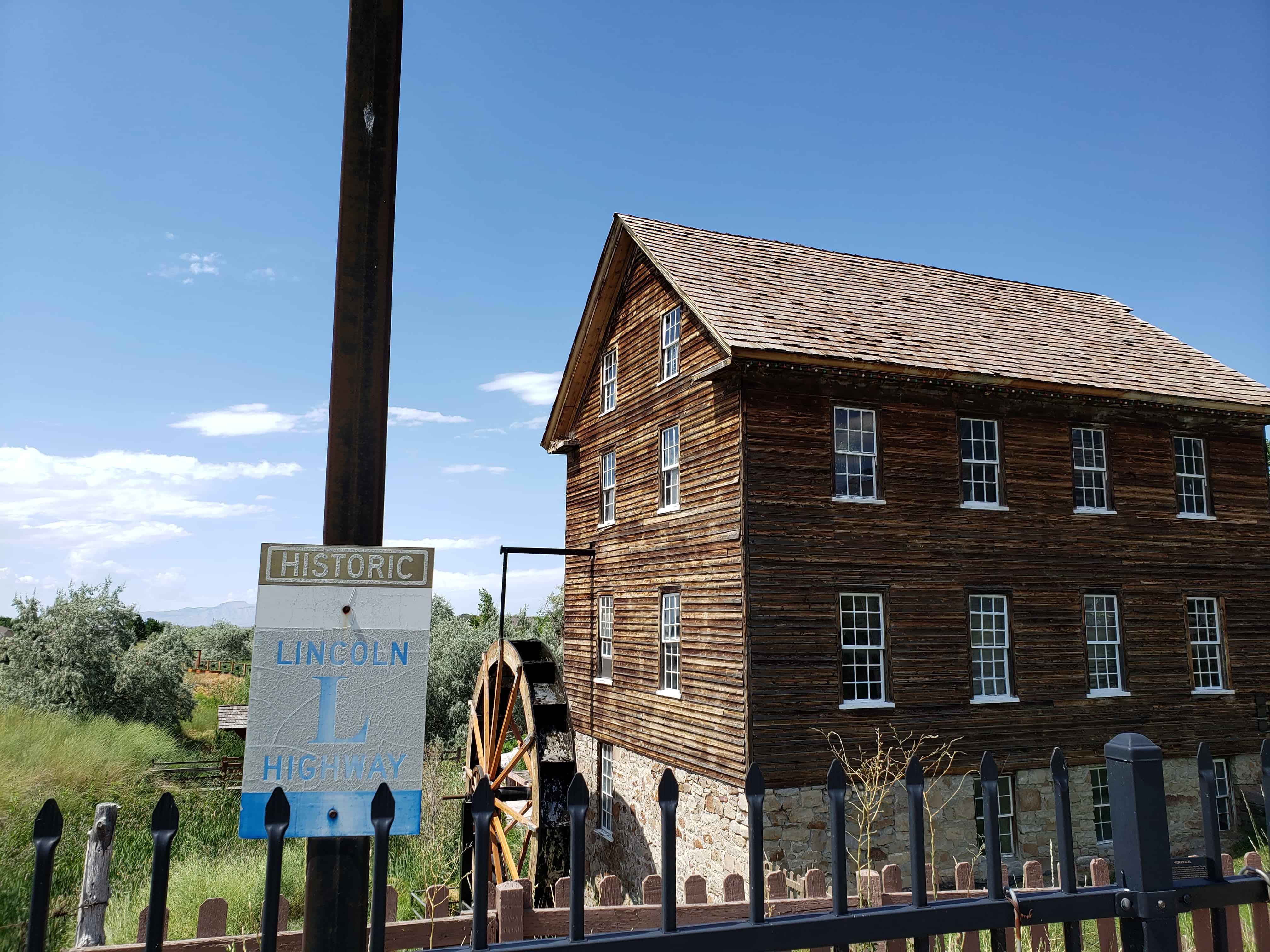
In 1851 L.D.S. Church Apostle, Ezra Taft Benson, was authorized by President Brigham Young to develop a mill site at Twin Springs Creek to serve Mormon communities in Tooele County. In 1851 a sawmill commenced operating and in 1854 the Lee brothers, skilled pioneer artisans, were hired to build the mill. The mill’s large mortised timbers were hauled by team and wagon from the nearby Oquirrh Mountains.
In 1855 the millsite community became known as “Richville” and served as the County Seat until 1861, when Tooele City was designated.
In 1860 the “E.T. Benson Flour Mill” had one male employee and one run of millstones which produced 1,200 barrels of flour, 72,000 pounds of bran and 56,000 pounds of corn meal, together valued at $17,000. In the same year, Brigham Young acquired the mill, when E.T. Benson moved to Cache Valley.
By 1862, the mill was referred to as “Young and Rowberry’s,” Bishop John Rowberry being an early resident of the Milltown (Richville) area. The mill that year reportedly processed 200 bushels of wheat per day under a 250 horsepower capacity.
In 1922, J. Reuben Clark, Jr. (A U.S. Ambassador to Mexico and later an apostle in the Mormon church) purchased the mill. Earlier it’s original wooden waterwheel and millstones had been replaced by metal turbine and imported free-standing “grain breakers.” After finally ceasing flour-milling operations in 1938, the mill was used several years for grinding animal feed.
A volunteer committee was organized in 1883 to acquire and restore the historic mill, which was donated by Terracor Corp. to Tooele County.
The Benson Mill is located at 325 South Highway 138 in Stansbury Park, Utah and was added to the National Historic Register (#72001260) on April 14, 1972.
In September 1849 the first settlers entered Tooele Valley. In their search for water power sites, a place on Twin Springs Creek was selected. A saw mill was completed by the spring of 1851 and was known as Ben son’s Saw Mill. The saw mill was destroyed several years after its construction.
In 1854 a grist mill was built on Twin Springs Greek and located near the saw mill. The grist mill was built by Thomas Lee who was hired by a church corporation among whose members included Ezra T. Benson, Benjamin Grosland and John Rowberry. The mill remained in the hands of the church corporation until June 1866 when Ezra T. Benson paid Brigham Young the sum of $3,333.33 for all claim to the grist mill known as Benson’s Mill located on Twin Springs Greek.
Sometime before January 1878 the grist: mill once again returned to the hands of a church corporation which was headed by Stake President Francis M s Lyman. In 1900 the Richville Milling Company, with a Mr. Wrathal as president and Mr. Rowberry as secretary, took over the grist mill. The Richville Milling Company operated the mill until 1922, when J. Reuben Clark Jr» bought the mill. An attempt was made by President Clark to produce flour to be sold commercially, but the small mill was unable to compete with the larger grist mills throughout the State. In 1936 a hammer mill was installed to grind feed for turkeys arid dairy cattle which belonged to the Clark Family, The mill served this function until 1960 when it was abandoned.
The E. T. Benson Mill is of significance for several reasons, It is one of the oldest buildings still standing in Tooele County and in Western Utah, According to many travelers, it is regarded as the most significant structural landmark between Salt Lake City and Reno, Nevada. Its successful operation for more than seventy-five years indicates its importance to the area. The economic evolution of the mill represents a similar experience of other business ventures in early Utah, Initially, in the 1850’s, it was built as a church cooperative effort. During the 1860’s it was acquired by a private individual, and during the 1870’s, the heyday of the cooperative movement of the church, the mill was obtained and operated by a church corporation. By 1900 the mill had returned to the control of private individuals. The survival of the mill, while most of the other early Utah grist mills have been destroyed, has been because of its long-time service to the area.
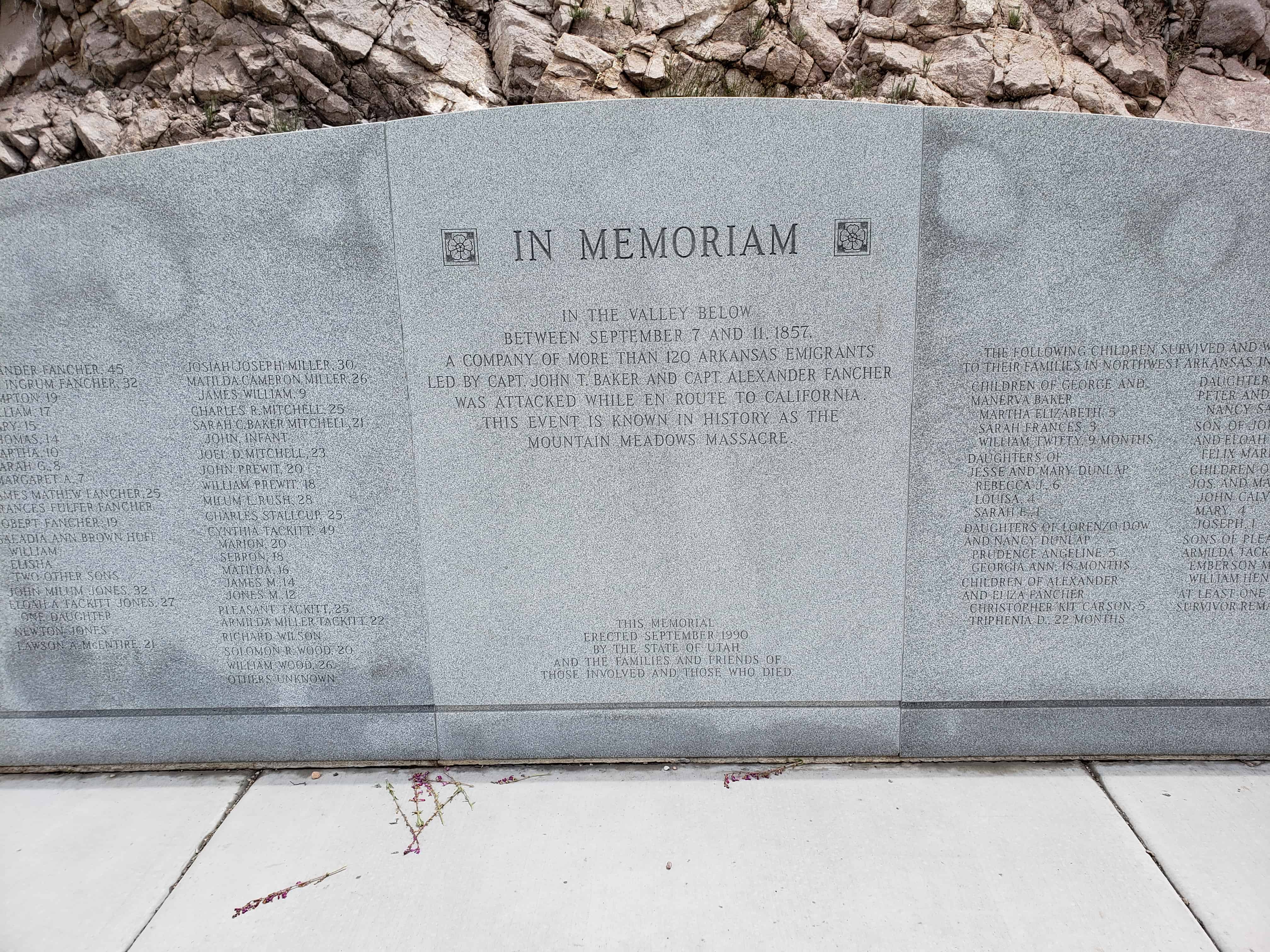
In early September 1857, about 140 people camped in this valley. Most of them were families from northwest Arkansas. Led by Captains John T. Baker and Alexander Fancher, they were headed to new opportunities in California. Their worldly possessions included about 35 wagons, several hundred cattle, and many mules, horses and oxen.
Beginning on September 7, the camp was attacked by a group of Mormon militiamen and the Paiute Indians they had recruited. In a five-day siege fueled by complex hostilities, the attackers killed at leave 10 men who fought valiantly to defend family and friends.
The emigrants fought off their attackers until September 11, when Mormon militiamen entered the encampment under a white flag of truce. The militiamen deceived their victims into surrendering weapons and property in exchange for protection and safety.
The militiamen separated the emigrants into three groups and marched them from the camp. The wounded and some small children rode in wagons, followed by women and older girls on foot with other children. Men and older boys walked some distance behind, each escorted by a Mormon militiaman.
At a prearranged signal, militiamen shot the men, older boys, and some of the wounded. Mormons and Paiutes surged from their hiding places and, in a matter of minutes, massacred most of the remaining emigrants, including the courageous women who were attempting to protect the children and flee. The victims’ voices fell silent, except for the sobbing of 17 small surviving children. The dead were stripped of their clothing and left without decent burial. Their wagons, livestock, and other property were plundered.
In 1859, soldiers in the United States Army buried the victims’ scattered, scavenged remains.
Seventeen years after the massacre, a federal grand jury indicted nine Mormon militiamen for crimes related to the siege and massacre. About 50 other militiamen were involved, along with an unknown number of Paiutes. Only one, John D. Lee, was brought to trail and convicted. He was executed near the massacre site on March 23, 1877.
The Mountain Meadows Historic Site was added to the National Register of Historic Places (#75001833) on August 28, 1975.
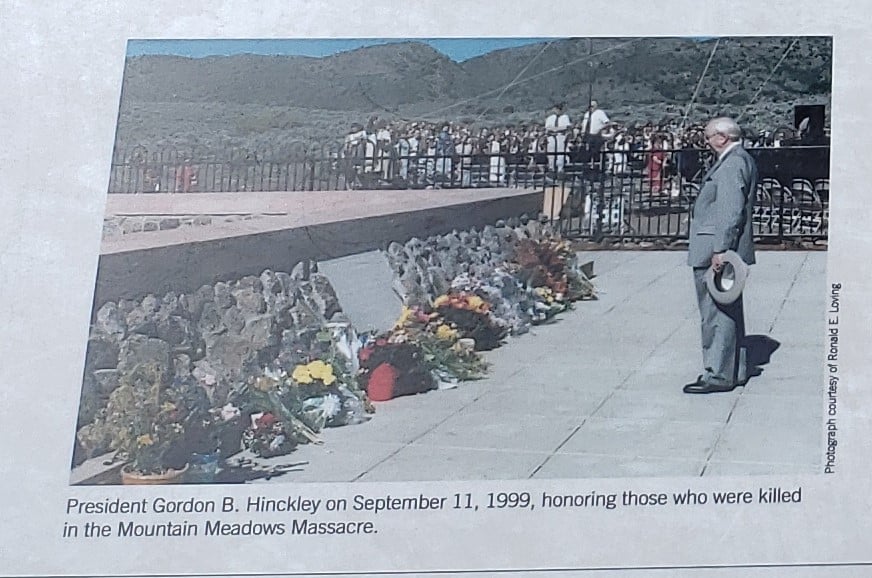
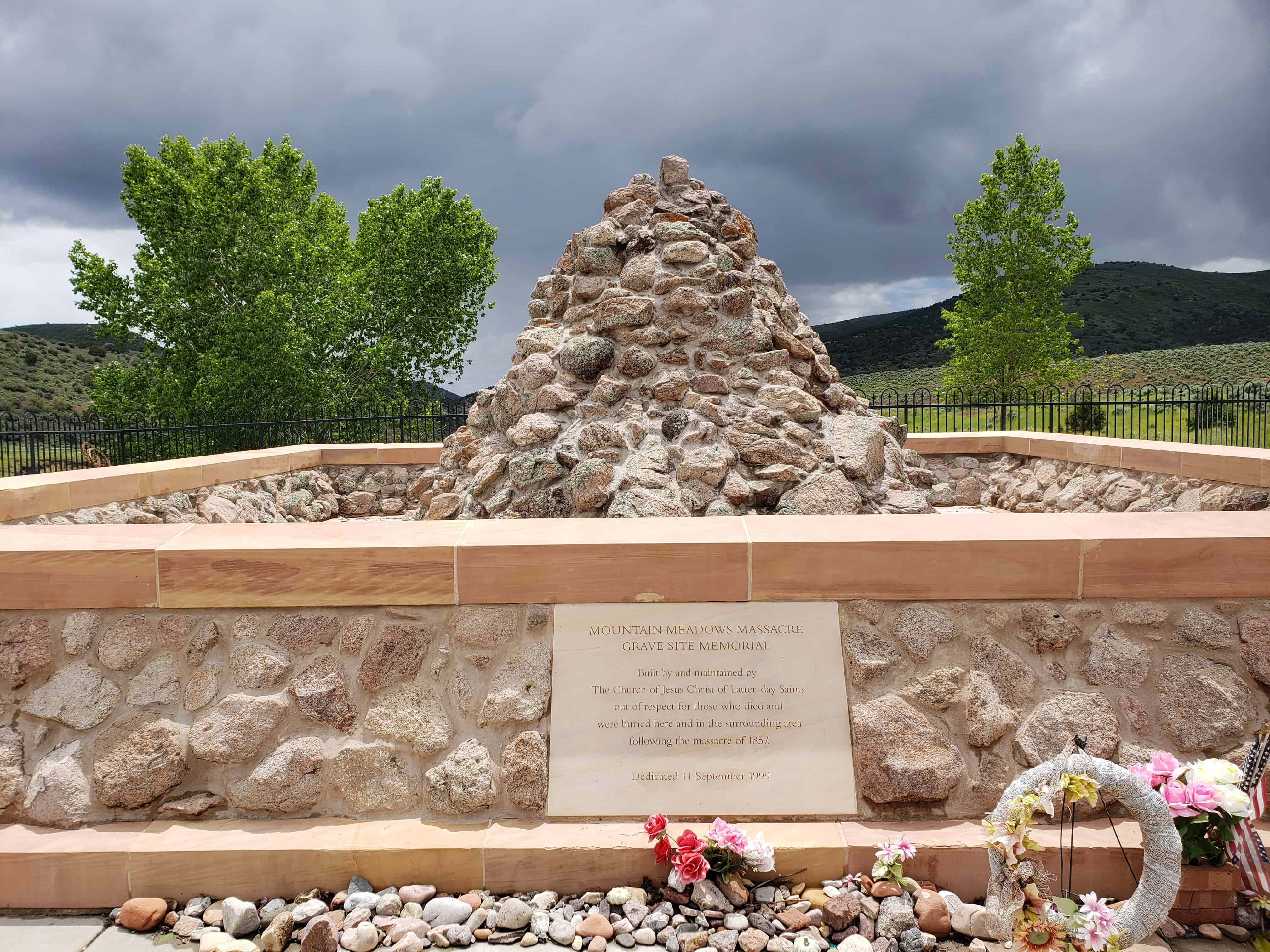
The Mountain Meadows Massacre Site has 4 memorials:
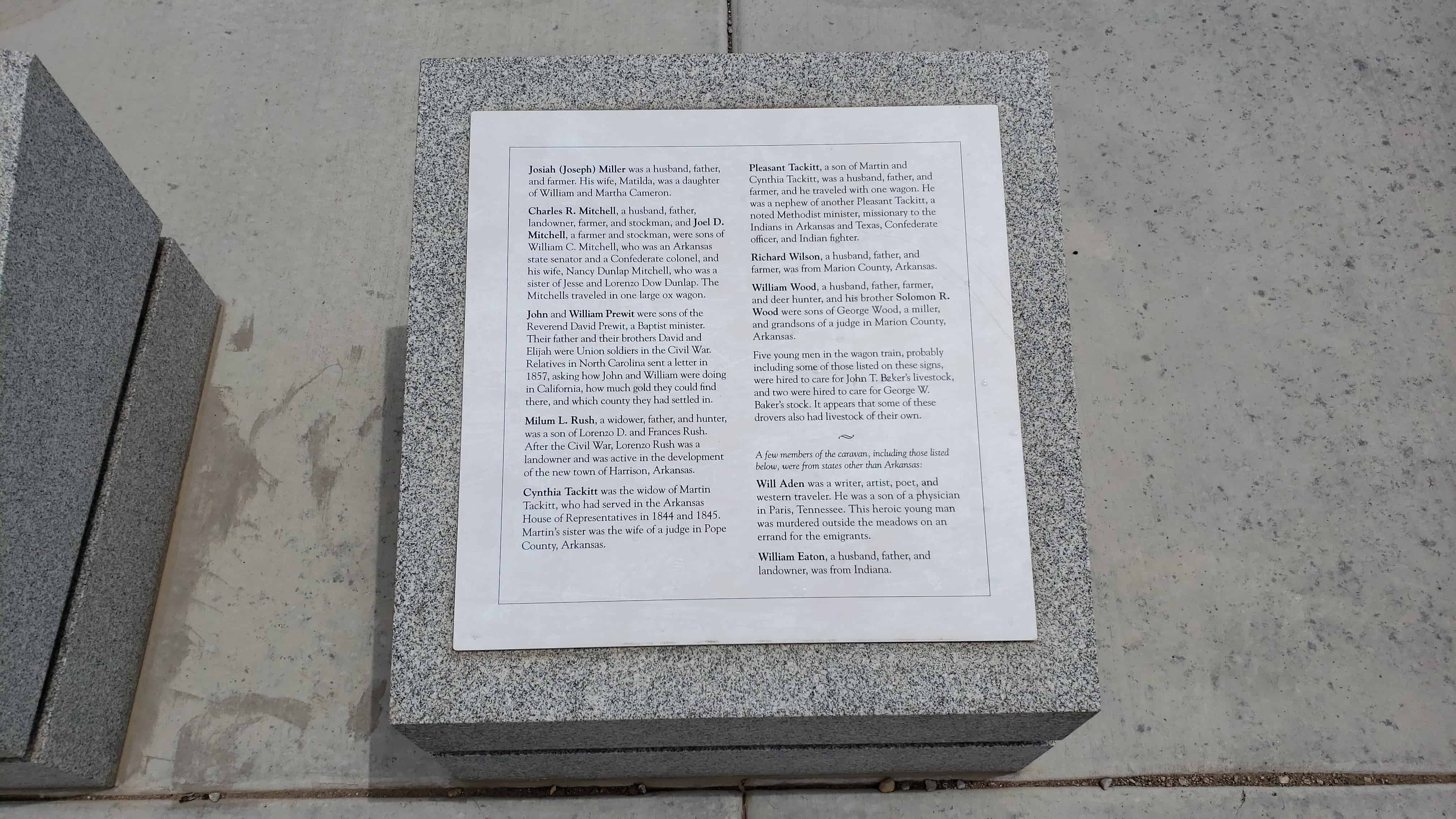
The Overlook Memorial where a trail leads to a memorial wall at the top of a small hill. Etched in the granite wall are names of victims in the Mountain Meadows Massacre.
The Gravesite Memorial, where a rock cairn marks the resting place of at least 30 victims in the massacre. Another monument nearby honors some of the emigrants who were killed in the initial siege.
On September 16, 1859, 17-year-old James H. Berry witnessed an event that he would never forget. He saw 15 children return to relatives and friends in Carrollton, Arkansas. Those children were survivors of the Mountain Meadows Massacre. They were escorted by a group of their relatives, led by Arkansas Senator William C. Mitchell. Two other children would return in January 1860.
On February 11, 1907, James H. Berry stood before the United States Senate in Washington, D.C. By that time, he was a senator himself, and he had also served as governor of Arkansas. He was a veteran of military battles, including one in which he had lost his leg. His fellow senators listened as he shared his personal connection to the victims of the Mountain Meadows Massacre:
“In 1857 I lived in the county of Carroll, in the State of Arkansas. In the spring of that year there left that county and two adjoining counties between a hundred and forty and a hundred and fifty, including men, women, and children, emigrants for California. They consisted of the best citizens in that country. It was a large train. It excited large interest throughout the section of the country from which they went. They had about 600 head of cattle, several mule teams, a number of wagons, and each head of a family had more or less money…. Late in the fall or the early winter the news came back that the train had been assaulted… far out West, and every soul had perished.
“Later on there came news that some of the children, how many we did not know at the time, were saved, and that they were in the hands of the Mormons in Utah. Our Senators and Representatives here called upon the Interior Department. An agent… was sent there by the Commissioner of Indian Affairs. He gathered those children together… who had been preserved from the massacre….
“I was a boy 17 years old on that day when they were brought to the village court-house. I saw them as they were lined up on the benches, and [Senator] Mitchell told the people whose children they were, at least whose he thought they were…. One little girl, I distinctly remember, had had an arm broken by a gunshot wound. It had not united and the arm hung dangling by her side. I have seen much of life since that day; I have seen war along the lines of the border States in all its horrors; but no scene in my life was ever so impressed upon my mind as that which I saw there that day presented by those little children, their fathers, mothers, brothers and sisters dead on the far-off plains of Utah and they, absolutely without means.”
The Surviving Children
In 1859, Major James H. Carleton interviewed Mrs. Rachel Hamblin, who lived a few miles north of the massacre field. Major Carleton carefully recorded her account of the surviving children, who were brought to her home on September 11, 1857, after witnessing the murder of their parents:
“At length between sundown and dark of the last day, I heard a firing greater than before, and more distinct. This is the time when the last of them were killed…. In about an hour, a wagon drove up to our house containing seventeen children in it, the most of them crying; one, a girl about a year old [Sarah E. Dunlap], had been shot through the arm; and another girl, about four years old [Sarah Frances Baker], had been wounded in the ear; their clothes were bloody…. The little girl who was shot through the arm could not well be moved. She had two sisters, Rebecca and Louisa, one seven and the other five [records show they were ages six and four], who seemed to be greatly attached to her. I persuaded [John D.] Lee not to separate them, but to let me have all three of them. This he finally agreed to, and the children stayed with me, and I nursed the wounded child…, though [she] has lost forever the use of [her] arm. The next day…, Lee and the rest started up the road with all the rest of the children in a wagon; and the Indians scattered off.”
Leaders of the Arkansas Wagon Train
Accounts of the Arkansas wagon train list two leaders: John T. Baker (1805-1857) and Alexander Fancher (1812-1857).
John T. Baker was a farmer and cattleman, described as a shrewd trader, a warm friend, and a bitter enemy. He and his family lived along Crooked Creek, near the southern border of present-day Harrison, Arkansas.
In 1857, Baker led a group of relatives, acquaintances, and others in a wagon caravan headed to California, where he and his son John H. Baker had previously spent some time. He took 138 head of “fine stock cattle,” nine yoke of oxen, two mules, one mare, one large ox wagon, guns, saddles, bridles, camp equipment, and provisions for himself and five workhands. Three of his adult children went with him. His wife, Mary, and the other children remained in Arkansas, planning to go west later.
Before Baker left Arkansas, he wrote his will. He acknowledged that he knew “the uncertainty of life and the certainty of death” but not the time of his “dissolution.” He said, “First, I will at my death my body a decent burial in the bosom of its mother Earth and my spirit to the God who gave it.”
Alexander Fancher was a farmer and cattleman and a veteran of the Black Hawk War in Illinois. In the 1840s he and his wife, Eliza, moved with their children to Carroll County, Arkansas, and so did his brother John and his family. In 1850 the two brothers and their families moved to southern California. Soon after that, Alexander and his family returned to Arkansas. He obtained a land patent on Piney Creek in Carroll County in 1854 and settled in southern Benton County, where he acquired more land and became a justice of the peace.
Tradition suggests that Alexander, like John T. Baker, recruited family members, neighbors, and perhaps others to go to California in 1857. He and Eliza and their nine children set out on the adventure together. They took six toke of oxen, eight mules, three horses, four wagons, and as many as 200 head of cattle.
All these emigrants crossed the plains and went through the Rocky Mountains. They journeyed together from the Salt Lake City area, southward through Utah Territory.
In September 1857, the massacre at Mountain Meadow cur their journey tragically short and denied John T. Baker’s request for a decent burial. Baker was brutally murdered, along with his three children who were with him, one grandchild, a son-in-law, and a daughter-in-law. Alexander and Eliza Fancher were also murdered, as were seven of their children. Three Baker grandchildren and two Fancher children survived. Two years later, they and twelve other surviving children were returned to the care of relatives in Arkansas.
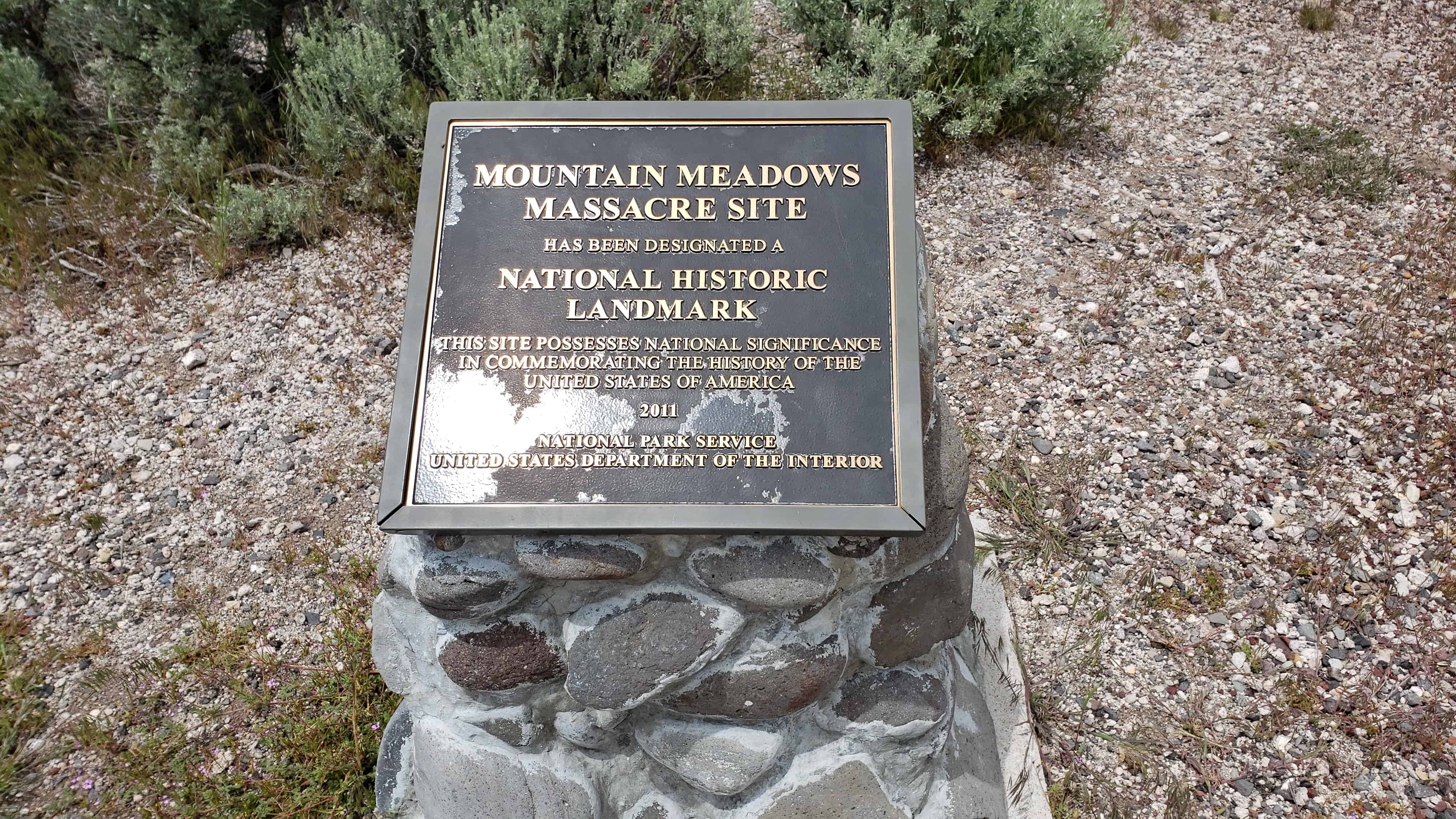
Mountain Meadows Massacre Site has been designated a National Historic Landmark. This site possesses National significance in commemorating the history of the United States of America.
Execution at the Scene of the Crimes
In September 1874, a federal grand jury indicted nine Mormon militiamen for crimes related to the siege and massacre. Some of those men immediately went into hiding as fugitives from justice. About 50 other militiamen were involved in the massacre, along with an unknown number of Paiute Indians. Only one, John D. Lee, was brought to trail and convicted.
On March 23, 1877, almost 20 years after the massacre, federal officials took Lee to the scene of the crimes. Not far from this very spot, he was executed by firing squad. He was buried about 120 miles from here.
Emigration Canyon National Historic Landmark derives its historical significance primarily from association with the original “Mormon emigration of 1847. Brigham Young led the trek westward from the Missouri Valley through the rugged Wasatch Mountains. Threading his way down Emigration Canyon, tradition holds that Brigham Young first obtained an unobstructed view of the valley from the grassy knoll where the native stone monument now stands. Upon ascending this small hill, he is purported to have declared, “this is the place.” The route pioneered by Young and his followers later became known as the Mormon Trail, and was the path followed during future migrations to the Great Salt Lake Valley until 1850 when Parley Pratt pioneered the Golden Pass Trail south of Emigration Canyon.
The landmark boundaries envelope a thin belt of unspoiled landscape punctuated by small grassy knolls within Pioneer Monument State Park. Upon the tallest knoll, Mormons erected “Pioneer Monument” in 1947 to commemorate the early Mormon emigrants. The native stone monument features a 60′ pylon surrounded by bronze figures of Brigham Young, Heber C. Kimball and Wilford Woodruff. Bas-relief scenes in bronze around the 86′ base illustrate numerous historical events associated with the Mormon exodus from the Missouri Valley. .From the small promontory, one can obtain, an unimpeded panorama of the magnificent Salt Lake valley. The tone monument,. was designed by Mahonri M. Young, grandson of Brigham Young.
A sign in Allen Park tells of some of the history of Emigration Creek and Canyon:
In 1847, the first party of Mormon Pioneers entered the Salt Lake Valley through what we now know as Emigration Canyon. Tradition holds that this is where Brigham Young first views the valley unobstructed and said “This is the right place, drive on.”
Within days of settling in the Salt Lake Valley, the water of Emigration Creek was diverted for irrigation. The diversion established the first water right in the valley.
The hydrology of Emigration Canyon attracted pioneers to take up residence along the creek, clearing dense vegetation in favor of fields and pastures. Pollution from livestock deterred the City from protecting Emigration Canyon as a watershed, opening the area to development.
An early 1800s building boom prompted the extraction of red and white sandstone in Emigration Canyon. An electric railway system was installed in 1907 to meet the high demand but was dismantled a decade later as concrete became the preferred foundation material.
In 1931, Mr. & Mrs. Hogle donated land near the mouth of Emigration Canyon to became the new site for Salt Lake City zoo, now known as Hogle Zoo.
Record snowpacks in 1952 and 1983 caused hundreds of Salt Lake City blocks to be flooded. Excessive spring runoff in 1983 cased 10 million dollars of damage in Parleys, Emigration, and Red Butte Creeks.
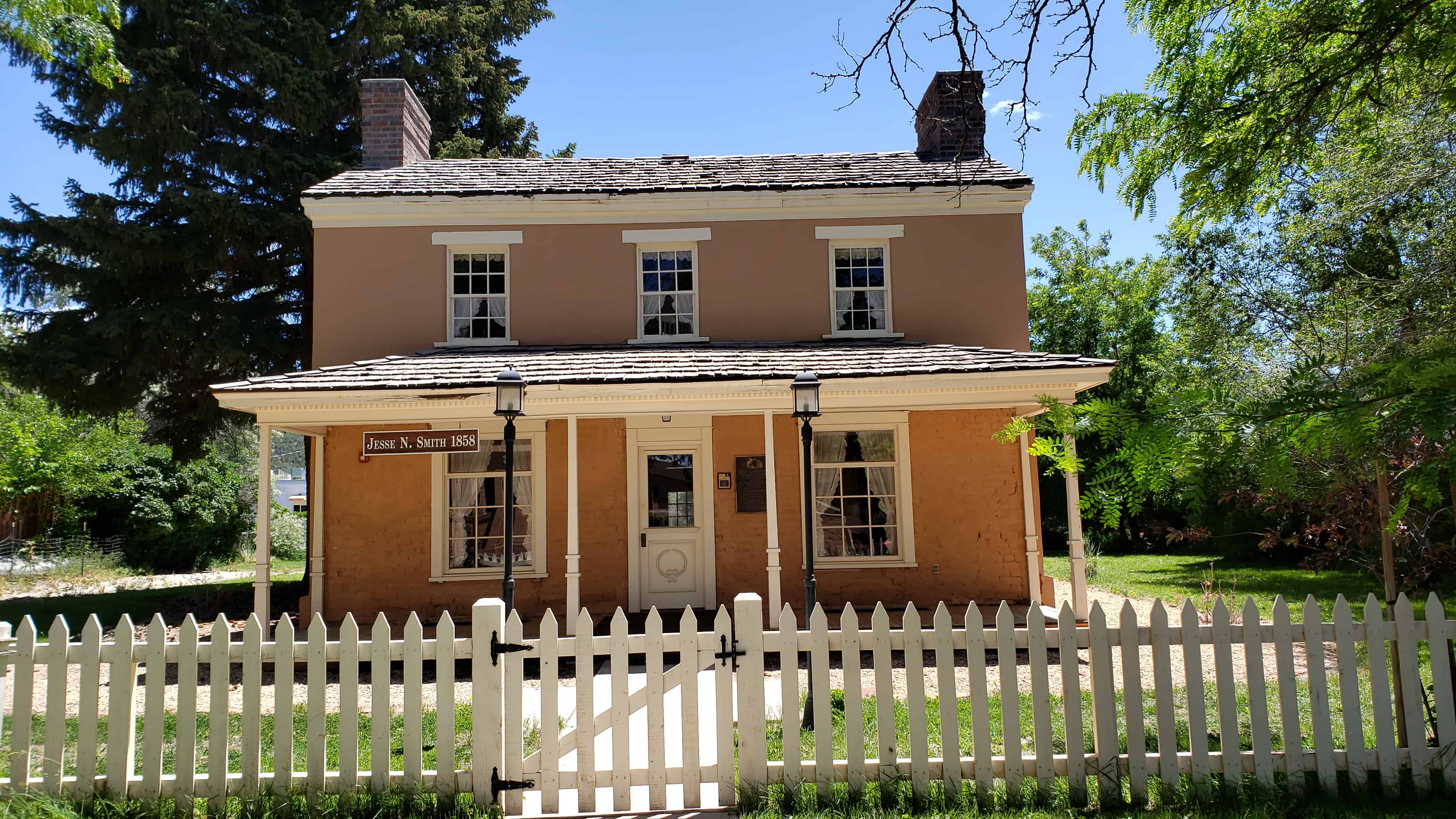
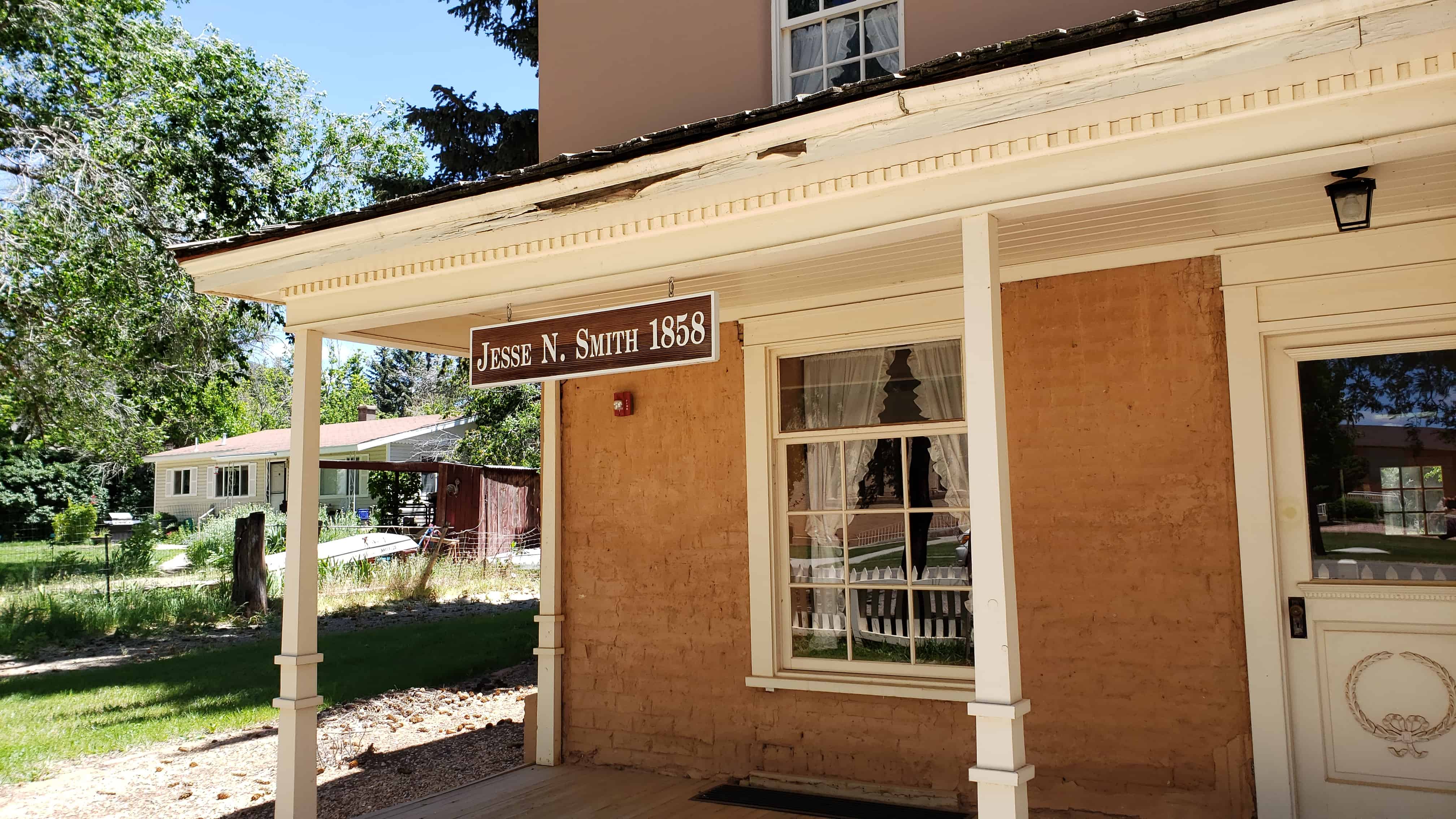
Located in Parowan, Utah – this is the oldest adobe structure in Utah. Jesse also discovered the first lead mine in Utah.
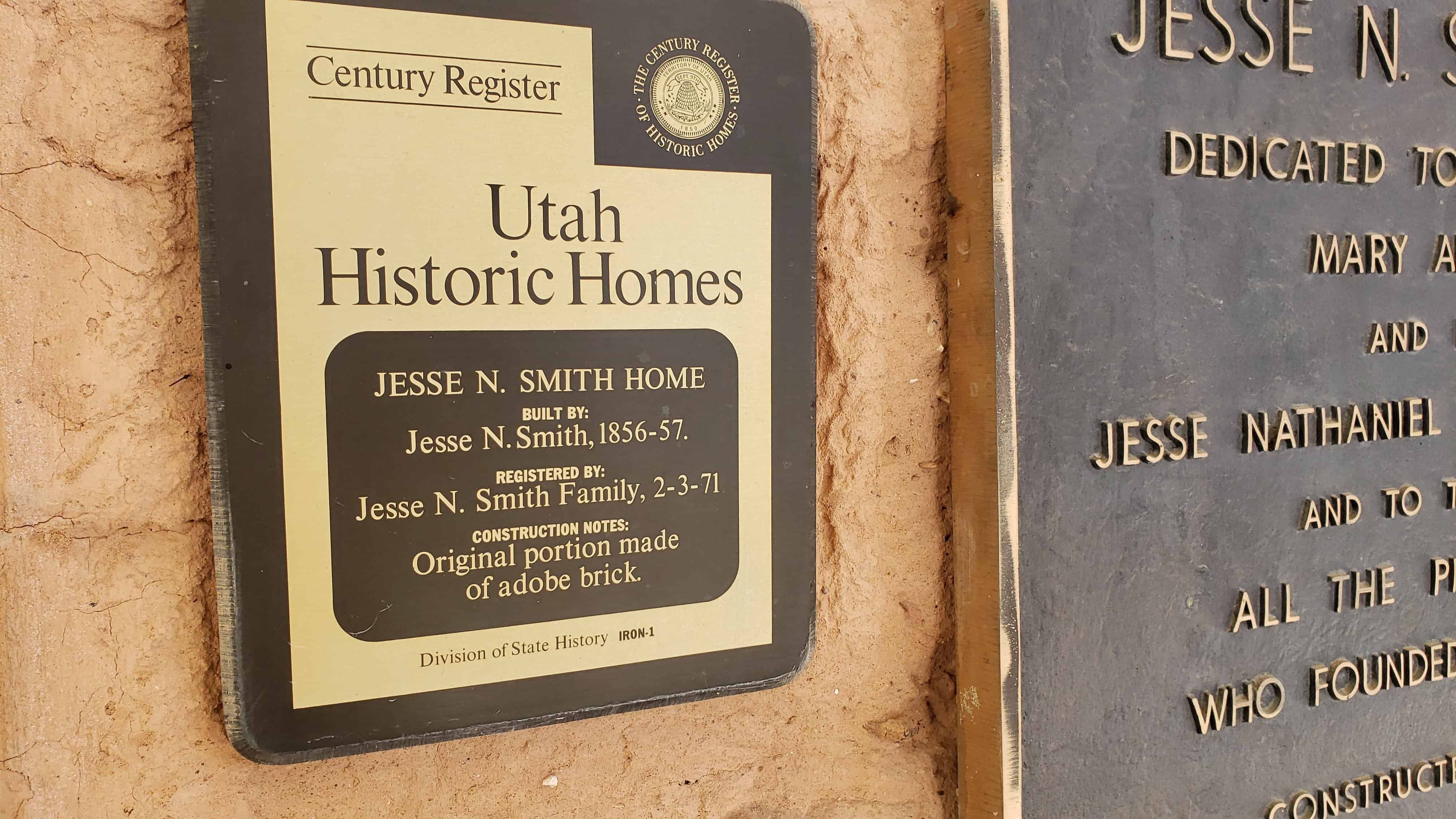
Dedicated to the memory of Mary Aikens Smith and her sons Jesse Nathaniel and Silas Sanford and to the memory of all the pioneer settlers who founded Parowan in 1851.
Constructed 1856-58 by Jesse N. Smith
Restored 1967 by Jesse N. Smith Family Assn.
Plaque provided by National Society Sons of the Utah Pioneers
Utah Historic Homes
Jesse N. Smith Home
Built by: Jesse N. Smith, 1856-57
Registered by: Jesse N. Smith Family, 2-3-71
Construction notes: Original portion made of adobe brick
Located at 45 West 100 South in Parowan, Utah and added to the National Register of Historic Places (#75001807) on June 20, 1975. The following is from the nomination form when it was added to the register:
The Jesse N. Smith hone derives its significance from two factors. It is an excellent and well preserved example of an early Mormon Pioneer lone built of stuccoed adobe. Secondly, it was the home of one of Southern Utah and Northern Arizona’s most prominent pioneers, Jesse W. Smith. According to family records,. Jesse N. Smith, born December 2, 1834, in Stockholm, St. Lawrence County, New York, was the youngest cousin of the Mormon founder Joseph Smith. As a boy Jesse lived in Kirtland, Ohio, and in 1839 his family moved to Missouri. Intending to settle at Far West, word of Governor Bogg’s Extermination Order caused a change of plans and eventually the family made their way to Illinois. At the age of thirteen Jesse traveled to Utah with the Parley P. Pratt Company, reaching the Great Salt Lake Valley on September 25, 1847.
Four years after his arrival in Utah, Jesse N. Smith was called to help with the establishment of the Iron Mission. Making his home in Parowan, lie soon became one of the leaders in church and political affairs in Southern Utah. In 1855. at the age of 21, he served as a Representative to the Territorial Legislature and three years later was elected Mayor of Parowan.
It was during this period that work on his Parowan home began. In his journal Smith notes that in the spring of 1856 he made adobes to build a house. The June 28, 1856, journal entry offers some insight into the hazards of house-building, “While quarrying rock for my house, I fell and rolled down the face of a steep cliff, some thirty feet, wrenching one of ray ankles so severely that I could not work for several days. The events of the Utah War in 1857 delayed completion of the home until March 1858 when, the Smith diary notes, the family moved into the new home. In 1860 Jesse was called to serve a mission to Denmark. Me proved a successful missionary and in May 1862 he assumed responsibility as President of the Scandinavian Mission and served in that position for more than two years before returning to Utah in 1864. Pour years later in 1868 he was again called to return to Scandinavia where once more he presided over the Scandinavian Mission until 1870. Although Jesse N. Smith had provided his family with a modest but comfortable home, the five years lie was away from his family serving missions for the Church were undoubtedly a difficult time for his two wives and their children. One of his daughters, recalling the Christmas of 1862 in their Parowan home, wrote: “All of us children hung up our stockings. We jumped up early in the rooming to see what Santa had brought, but there was not a tiling in them. Mother wept bitterly. She want to her box and got out a little apple and cut it in tiny pieces and this was our Christmas.
Nine months before Jesse Smith returned home from his first Scandinavian mission his second wife Margaret died leaving two children to be raised by his first wife Emma. Jesse married a total of five wives and fathered 44 children. The Smiths remained in Parowan until 1878 when Jesse was called to help lead the Mormon colonization efforts in Arizona. Apparently this call came in response to a controversy which developed between the Smith brothers, Silas S. and Jesse H. , and William U. Dame in something of a power struggle for the position of ecclesiastical leader in Iron County. Jesse N. Smith was nominated as Stake President in a meeting presided over by Brigham Young but was not sustained by a majority of Saints because of objections to Smith’s arbitrary and tyrannical nature. In the end Dame was successful in becoming Stake President and the Smith brothers left for other areas Silas to the San Juan Mission and ultimately the San Luis Valley of Colorado and Jesse to the Little Colorado Region of Arizona. Here he did become the spiritual leader of the Snowflake area serving as President of the Fast Arizona Stake from 1879 to 18S7 and President of -the Snowflake Stake from 1887 to his death in 1906. In addition to his church responsibilities, Smith was President of the Arizona Cooperative Mercantile Association. He was active in railroad construction and a leading figure in water development on the Little Colorado River. His 1 1/2 story brick home in Snowflake, Arizona, was listed on the National Register in 1972.
In the Forward to the 1970 edition of The Journal of Jesse Nathaniel Smith, Charles Peterson outlines the significant role of Smith in Utah and Mormon history:
Of all the Latter-day Saint causes of Smith’s time none were more important than those of the gathering to Zion and the extension of the physical bounds of the Kingdom. Like many Mormons, Jesse N. Smith devoted his life to these causes, but, more than most of his contemporaries, he played roles which cut across the full fabric of the Mormon experience. He was in the truest sense of a church leader one who may be classified accurately as a field commander. Directing the preaching and convert migration of a proselyting mission abroad and directing the water development and homebuilding of long-term colonizing missions in the West, he at once shared the attitudes and experiences of the church’s top hierarchs, yet worked, aspired, and sacrificed with rank-and-file pioneers in opening new frontiers.
Style and significance: During the period from June, 1856, to March, 1858, Jesse N. Smith constructed, a two-story home facing the town square in Parowan. He quarried the rock, baked the adobes and, hewed the timber himself. The original building consisted of four rooms, two upstairs and two downstairs and a rock basement. As originally constructed, it an “I” house, i.e., it had a one-room deep rectangular plan, two stories high. In 1865, Smith built a lean-to addition on the rear of the house consisting of four rooms, two upstairs and two downstairs. The front façade of the house was also plastered at that time, In 1879, Smith sold the house to a William Bentley for $2,700. For several years the building was unoccupied, but in 1962 the Jesse N. Smith Family Association purchased the building and began to raise money for its restoration. This restoration took place between 1967 and 1969 and cost $12.000. The roof was repaired and the adobe walls, which because badly eroded due to the defective roof, were repaired and replastered. The front wall on the main story had lost its original plaster, but because of protection from the long front porch the wall had not eroded and was left with its adobe bricks exposed.
In profile, the building is a modified saltbox. Though the lean-to was added later, its roof has the same pitch as the original gabled roof.
The front façade of the house is symmetrically arranged with a centered door and two large flanking windows on the lower floor and three double-hung sash 6 over 6 paned windows on the upper floor, The windows have wooden lintels and sills and are trimless. The cornice is moulded and skirted and returns slightly along the gable-ends. Two gable-end chimneys complete the Federal style façade. The large porch which extends along “the entire length of the home is supported by decorative lathe-turned posts. The porch entablature is simple and the porch soffit is boxed. The porch is believed to have been added later, as was the front door with its glass pane and the small window to the right of the door. The windows on the lower floor are fixed with transoms above. These, too, were doubtlessly modified after initial construction.
The interior features the same room arrangement as the original plan, The staircase is centralized and in the lean-to. There are six fireplaces in the home.
Despite the few alterations that have been made to the building, its general form-and simple detailing continue to reflect its 1856-58 construction and styling. It is typical of old Colonial American houses and is thought to be the oldest home in Southern Utah.
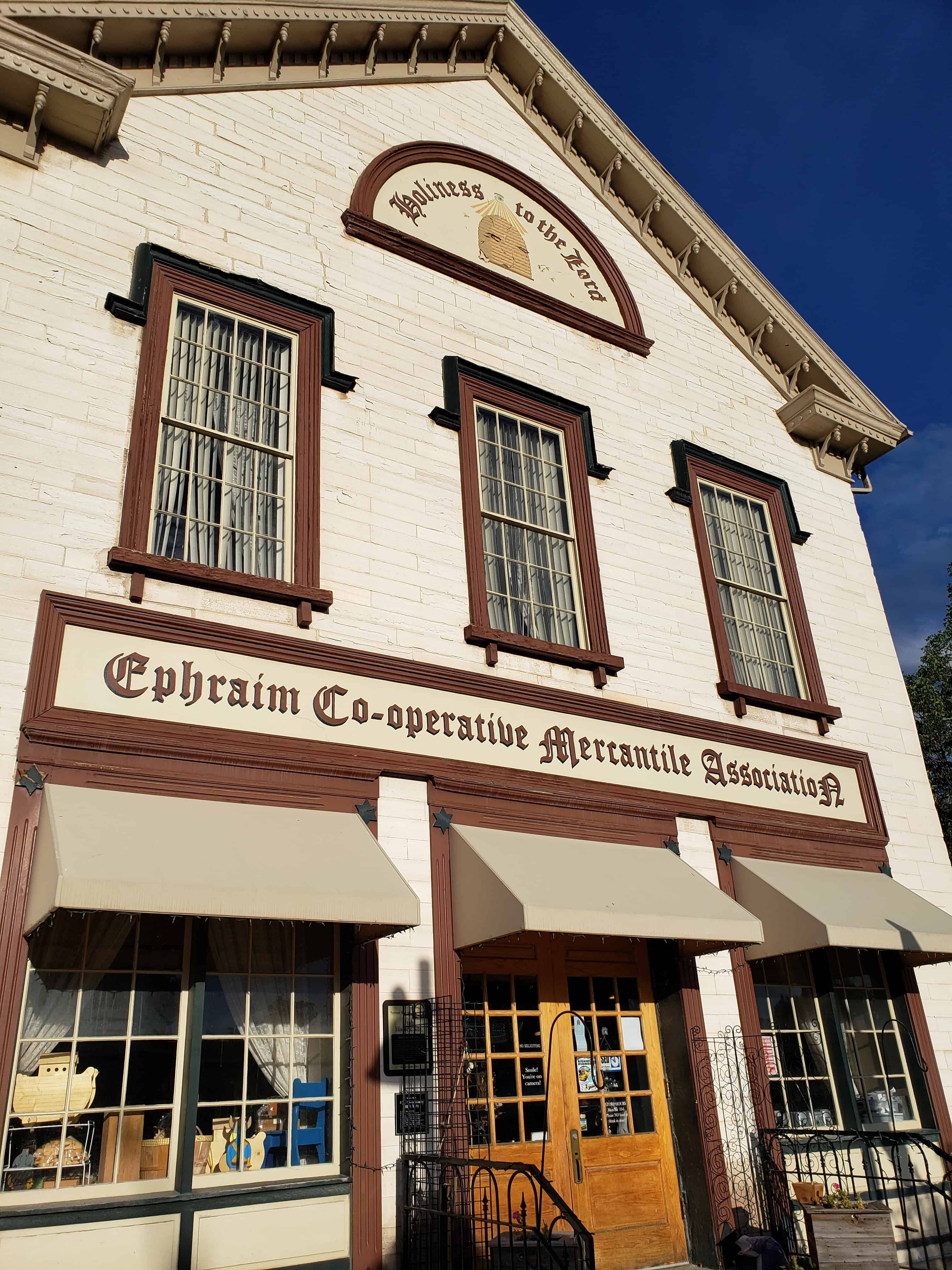
Constructed in 1871-72 of local oolitic limestone, this Greek Revival style building is one of the remaining examples of the more than 120 cooperative mercantiles that were established by the LDS church between 1868 and 1878. The first floor was a strong part of Ephraim’s economy beginning as a co-op, then as a United Order store, later used for farm implement sales, a car repair garage, and finally as part of Ephraim Roller Mill when a new addition connected it to the Relief Society granary to the south. That use continued into the 1950s, then, after decades of neglect, the building was restored in 1989-90. The second floor also served many purposes including a social hall, theater, Relief Society hall, and the first home of Sanpete Stake Academy, predecessor of Snow College when it began in 1888.
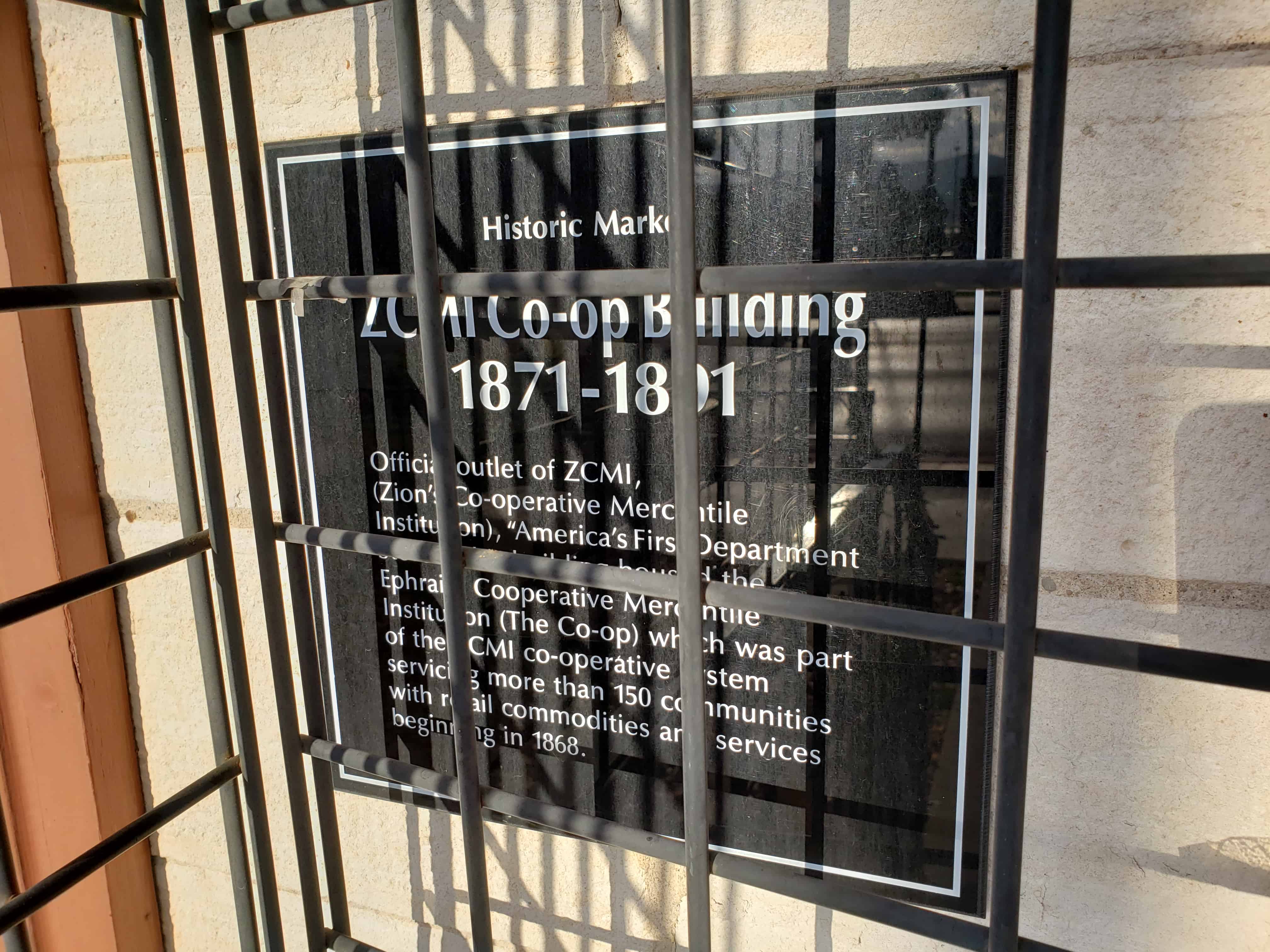
ZCMI Co-Op Building 1871-1891
Official outlet of ZCMI (Zion’s Co-operative Mercantile Institution), “America’s First Department Store”. This building housed the Ephraim Cooperative Mercantile Institution (The Cop-op) which was part of the ZCMI co-operative system servicing more than 150 communities in the intermountain area with retail commodities and services beginning in 1868.
The Ephraim United Order Cooperative Building is located at 96 North Main Street in Ephraim, Utah and was added to the National Historic Register (#73001862) March 20, 1973.
In the late 1860’s Mormon communities were faced with the challenge of an ever increasing number of “gentile merchants” settling in Zion. The coming of the railroad in 1869 threatened to enslave the Mormons with an economic bondage that had not been possible before. In response to these challenges church officials developed plans which culminated in the cooperative movement. The basic philosophy of this movement was that Latter-day Saints should not trade with “outsiders” but instead with local cooperative establishments which would be supplied by a “Parent Institution.”
The first step in the cooperative movement was the organization of the Parent Store in Salt Lake City, Zion’s Co-operative Mercantile Institution, on October 24, 1868. Within the next ten years more than 150 local cooperatives were founded.
Perhaps the best remaining example of a local cooperative store is the old Ephraim United Order Go-operative Building. Construction on the building began in 1871 and was completed in 1872. The building was constructed of Sanpete oolitic limestone and its front had two distinguishing features which branded it as a co-op store. The name “Ephraim U. O. Mercantile Institution” and a beehive encircled by the words, “Holiness to the Lord.” Signs for the parent establishment in Salt Lake City contained the inscription “Holiness to the Lord.” Nearly all of the local co-op stores used the name “Cooperative Mercantile Institution” in association with the name of the location.
The cooperative movement, as symbolized by the Ephraim Cooperative Building, was an important part of the Mormon story. According to Leonard Arrington, prominent Mormon historian, “Cooperation, it was believed, would increase production, cut down costs, and make possible a superior organization of resources. It was also calculated to heighten the spirit of unity and ‘temporal oneness’ of the Saints and promote the kind of brotherhood without which the Kingdom could not be built.” (Leonard Arrington, Great Basin Kingdom, p. 309.)
The cooperative store occupied the first floor of the two-story structure. The second floor was constructed as a recreation hall and as a Relief Society meeting hall. Dances and parties were held in the second story. The building became not only an economic but also a social center for the community.
In 1888 plans were made for the establishment of the Sanpete Stake Academy. Funds were not available for the construction of a building and so the Relief Society Hall above the Co-op store was secured. Furniture and equipment were purchased and on November 5, 1888 the Sanpete Stake Academy was opened. The hall was used by the Sanpete Stake Academy until about 1900. In 1902 the name Sanpete Stake Academy was changed to the Snow Academy. This was in turn changed to Snow Normal College in 1917. As the first home of the school which be came Snow College, the old Co-operative Building is also of important historical significance.
This building is a Neo-Classical style and was built before 1905. H.P. Larson owned it and he sold it to D.W. Anderson in 1910. It has been the Anderson Drug Store ever since. If you have time walk inside and note the original ceiling and the two old signs on the back wall.(*)
This historic marker is located in front of the US Bank building at 170 S Main Street, Salt Lake City, Utah.
On this corner, in 1865, the four immigrant Walker brothers, (Samuel, David, Joseph, and Matthew) built the first permanent home for their Walker Brothers Dry Goods retail and wholesale store.
A large iron safe at the back of the original store led these brothers into the banking business when it became a depository for the gold dust, coins and other valuables of the early settlers.
According to legend, receipts were never exchanged. The word of the Walker Brothers was good enough for the early pioneers.
From these humble beginnings, the retail store which became a bank, is today First Interstate Bank.
Across the street to the east is the Walker Center with the iconic Walker Tower on the top, changing lighting colors based on the weather.
In 1850, the Matthew Walker family left England for the promise of a better life in America. The tortuous ocean voyage and cross-country trek claimed the loves of Matthew and two of his daughters. His wife Mercy and four young sons survived, arriving by wagon in the Salt Lake Valley in 1852.
The Walker Brothers earned a reputation as enterprising young salesmen. When Johnston’s Army was recalled by President Lincoln to fight the Civil War, the Walker brothers bouht enouhg of their supplies to form a wholesale and retail store – Walker Brothers.
Since 1859, the Walker brothers had maintained a bank within the store, one of the first banks established West of the Mississippi. It was formally chartered in 1871 as Walker Brothers Bank. The bank then became Walker Bank & Trust Company in 1931, and in 1981 First Interstate Bank.
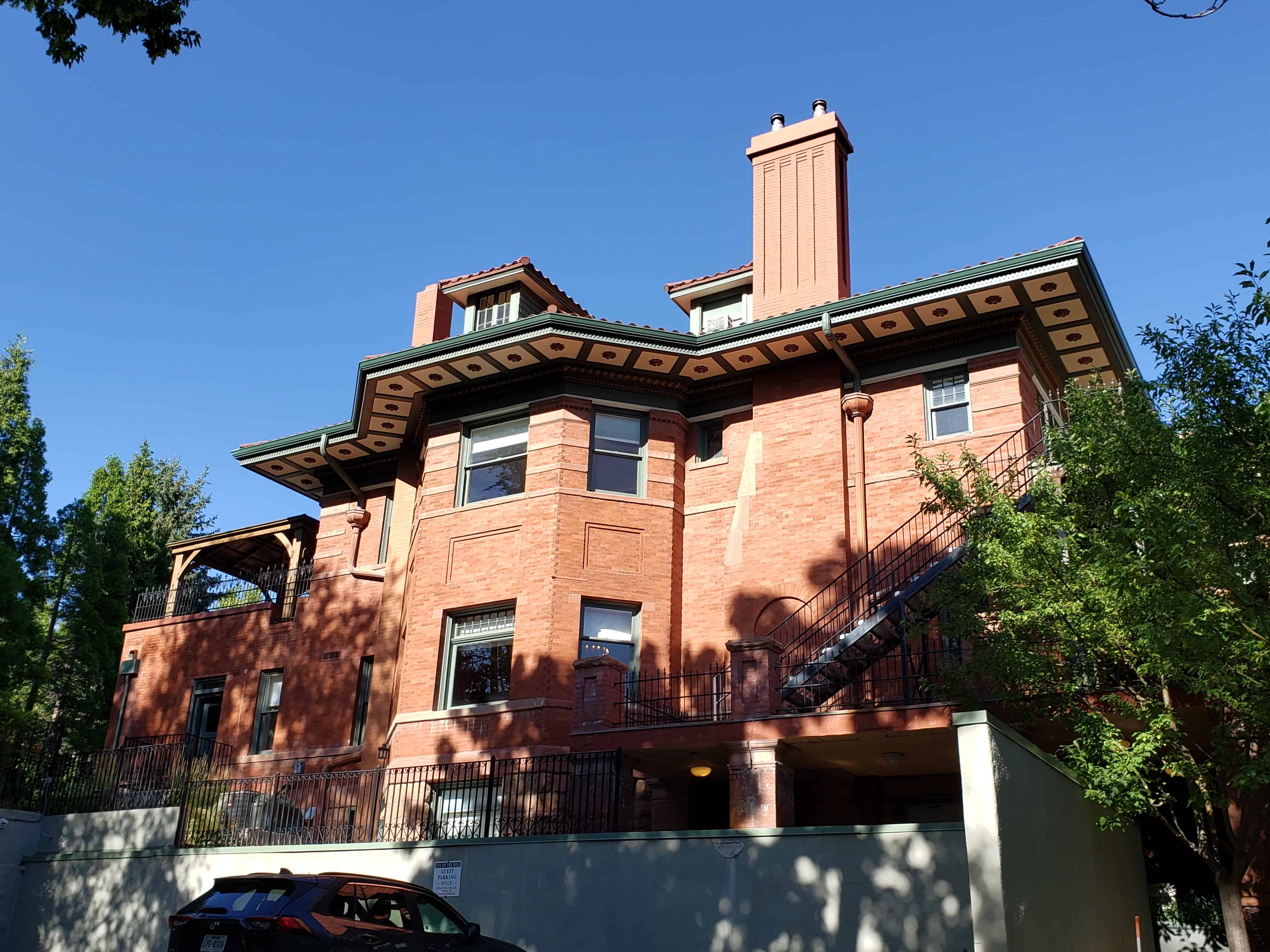
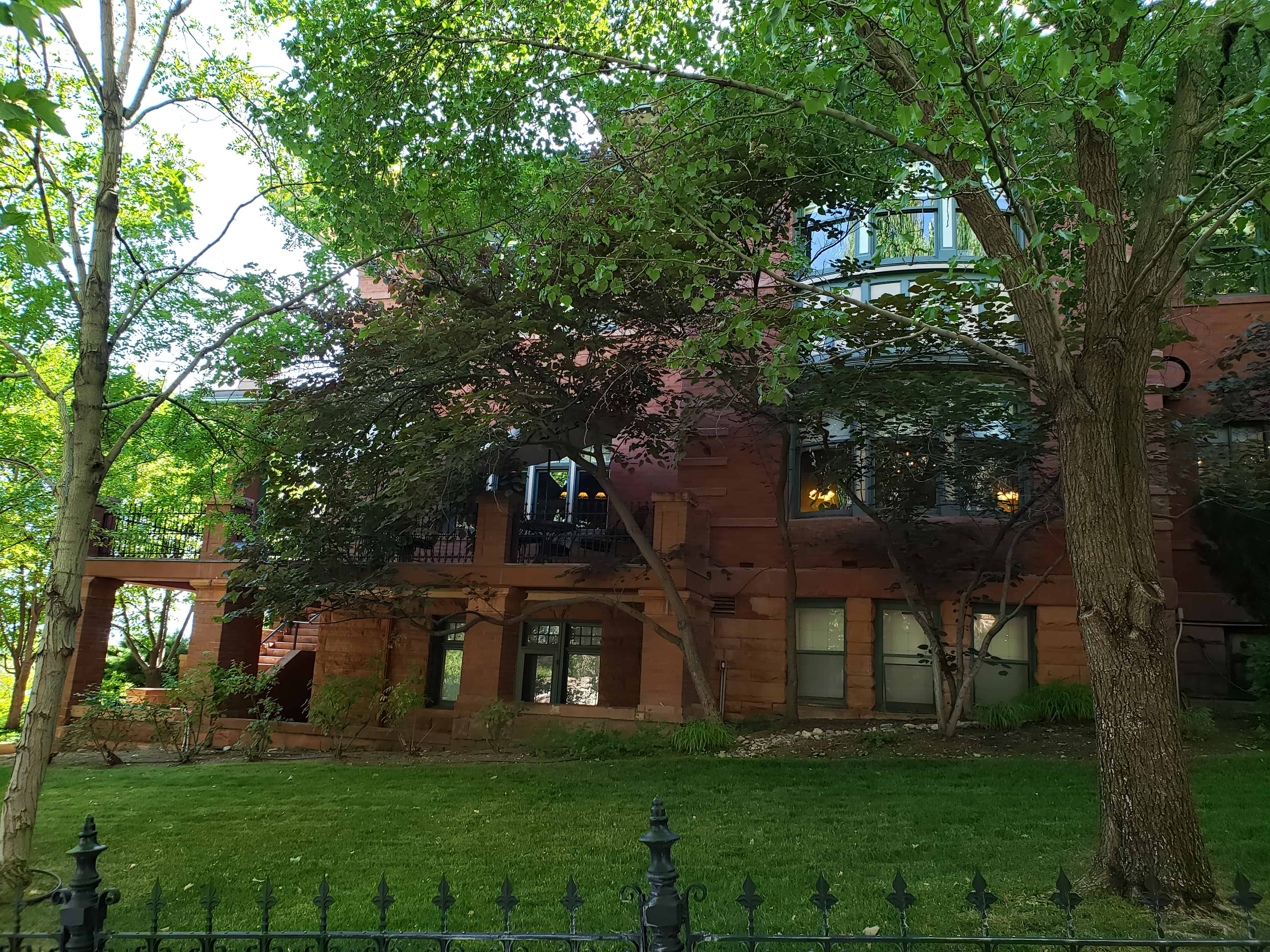
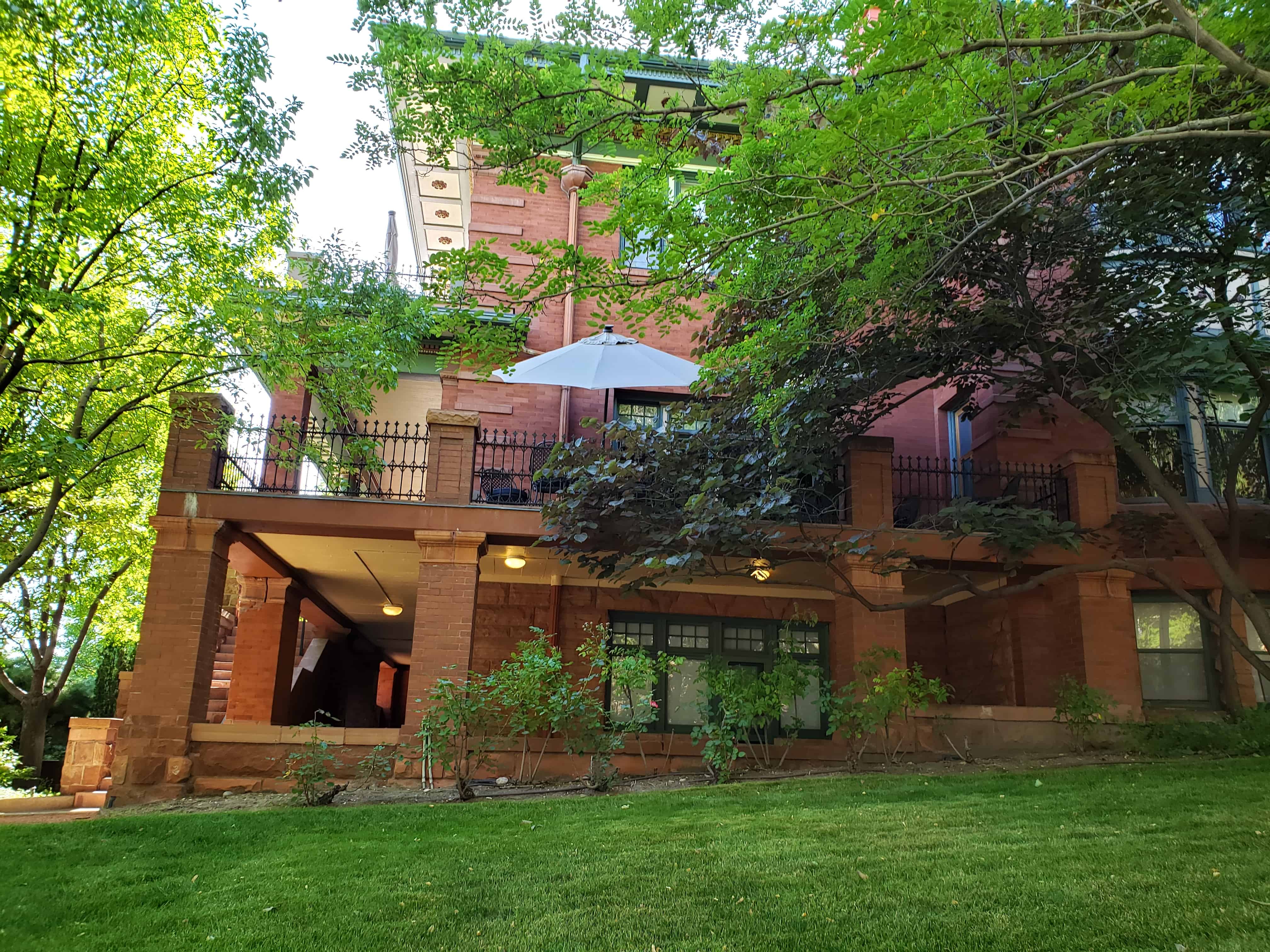
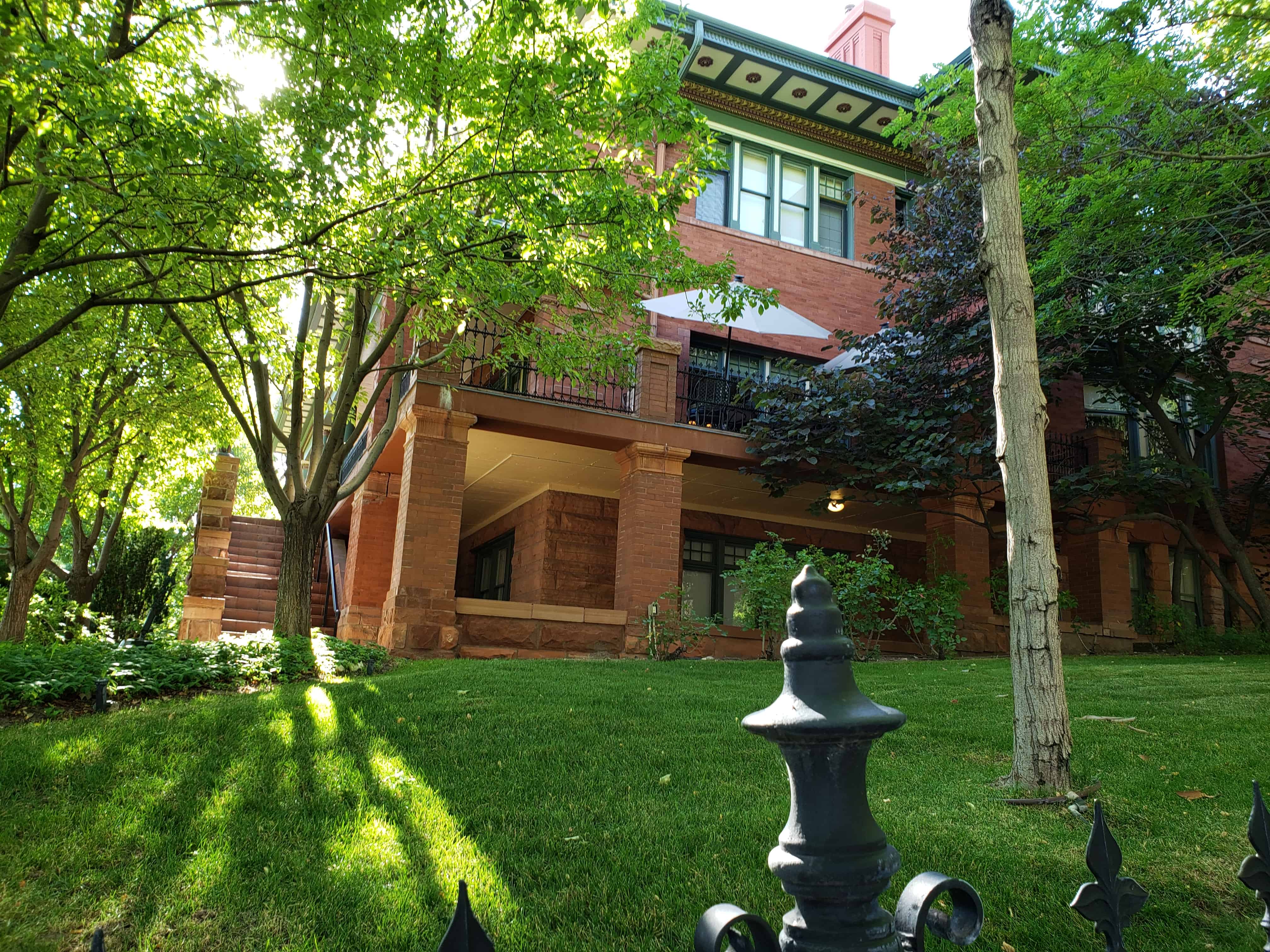
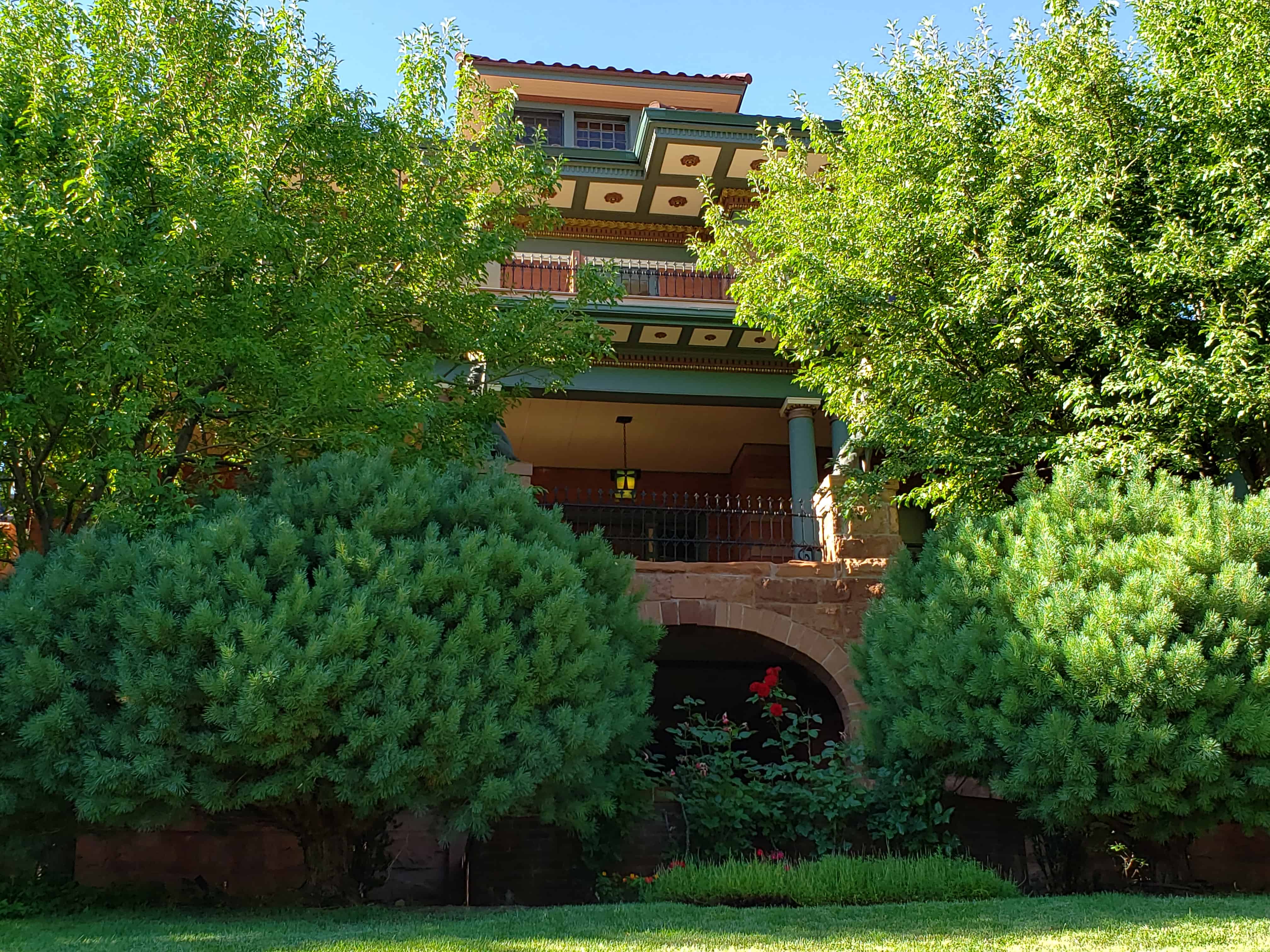
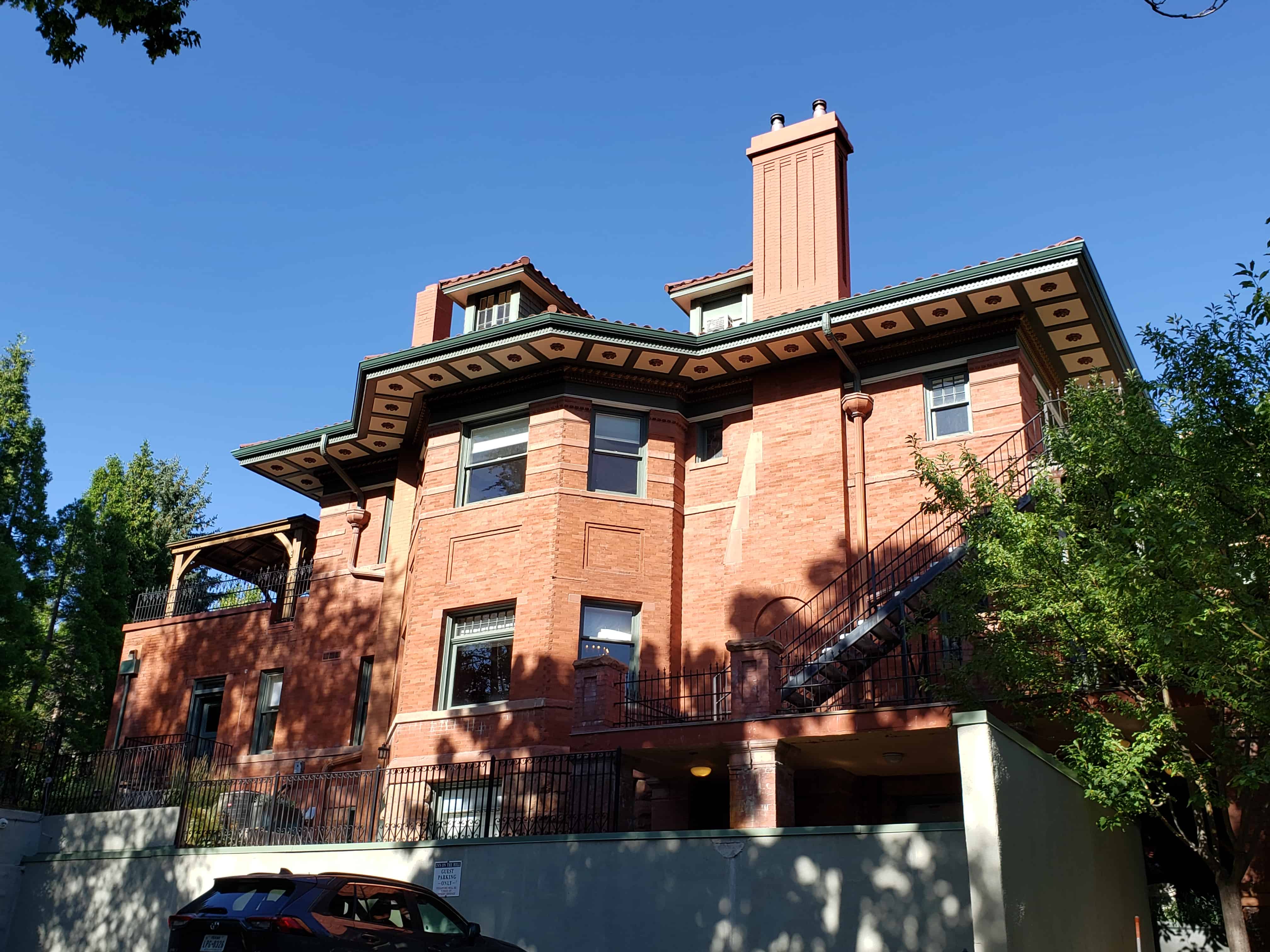
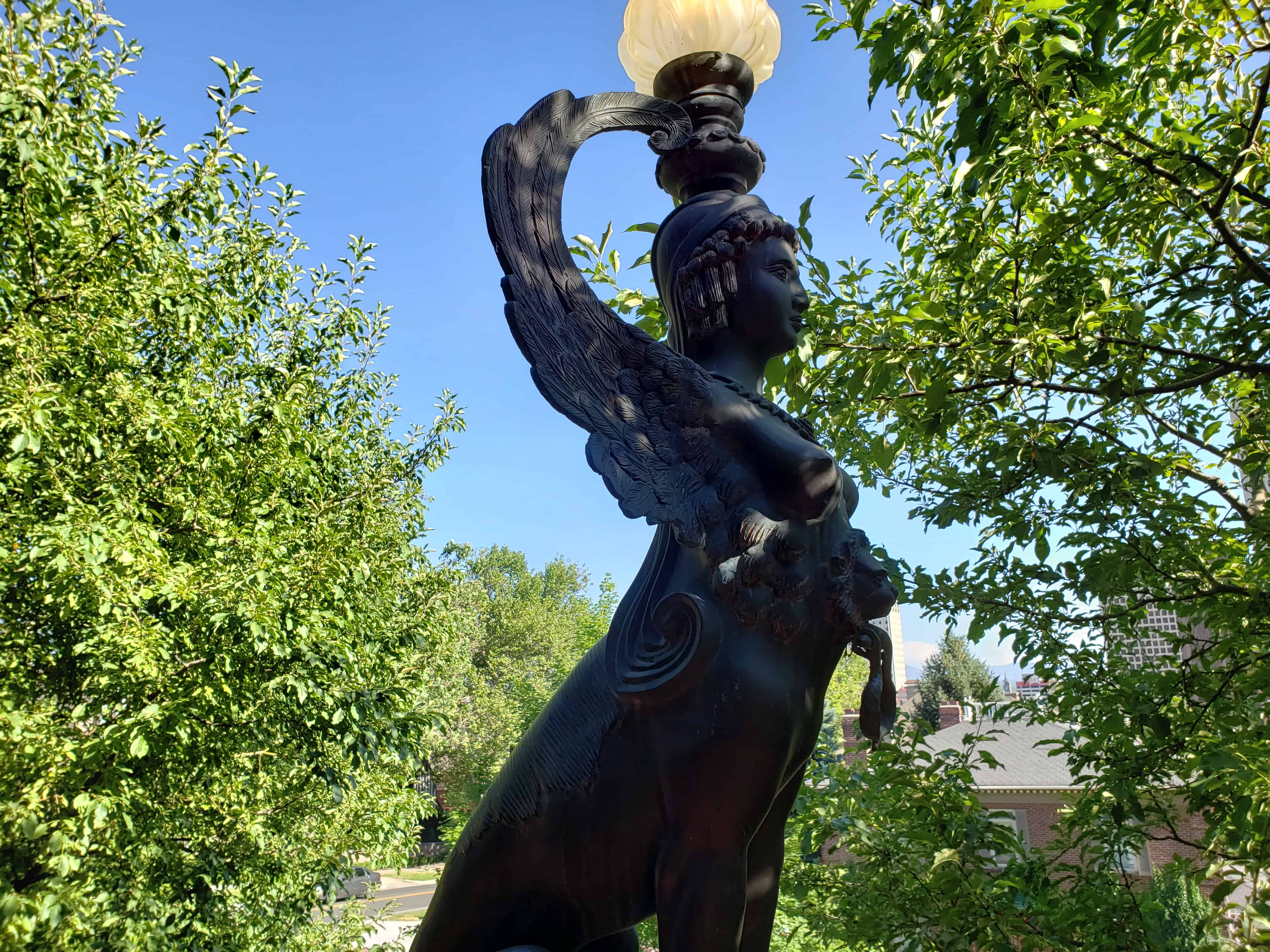
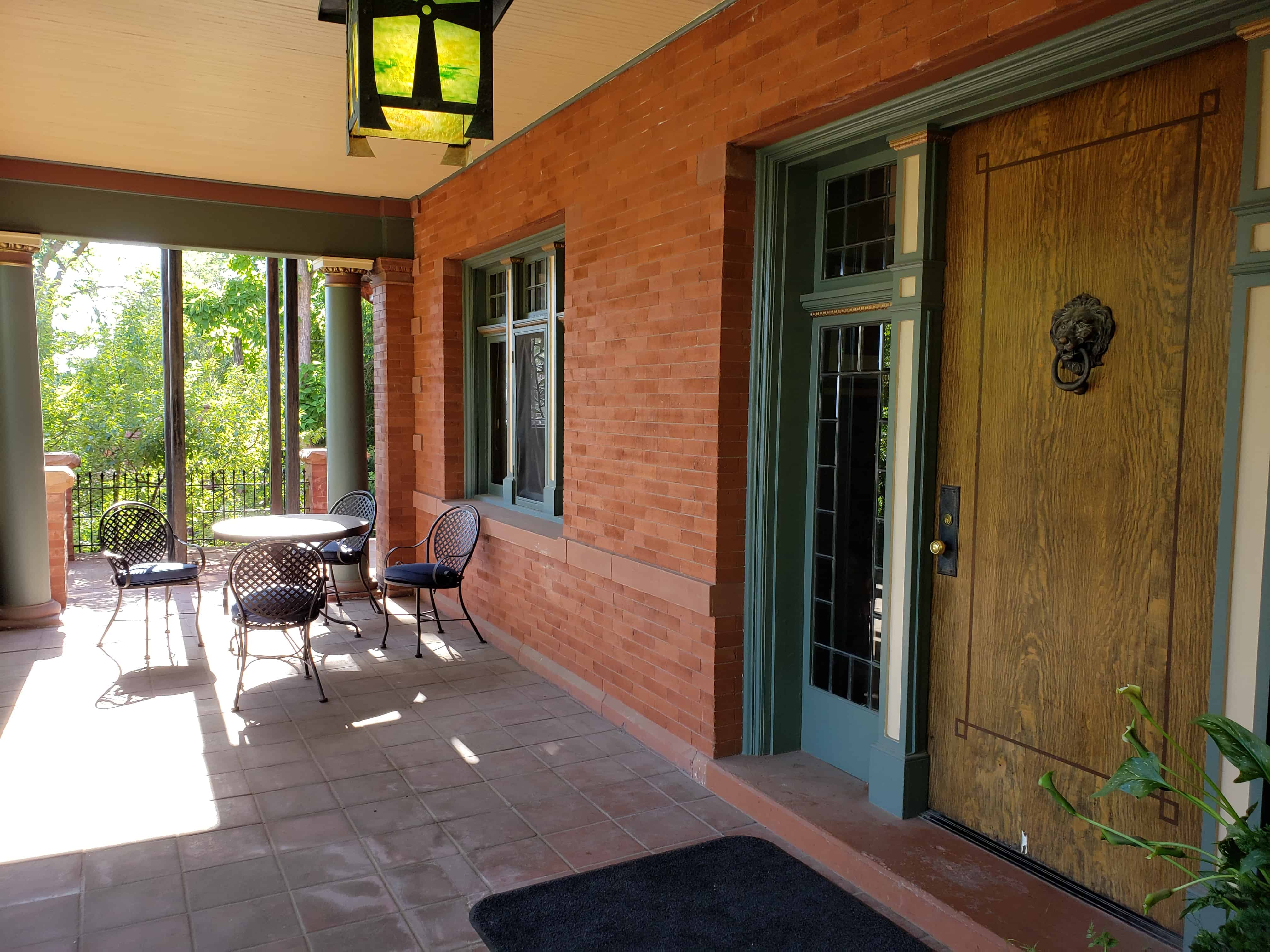
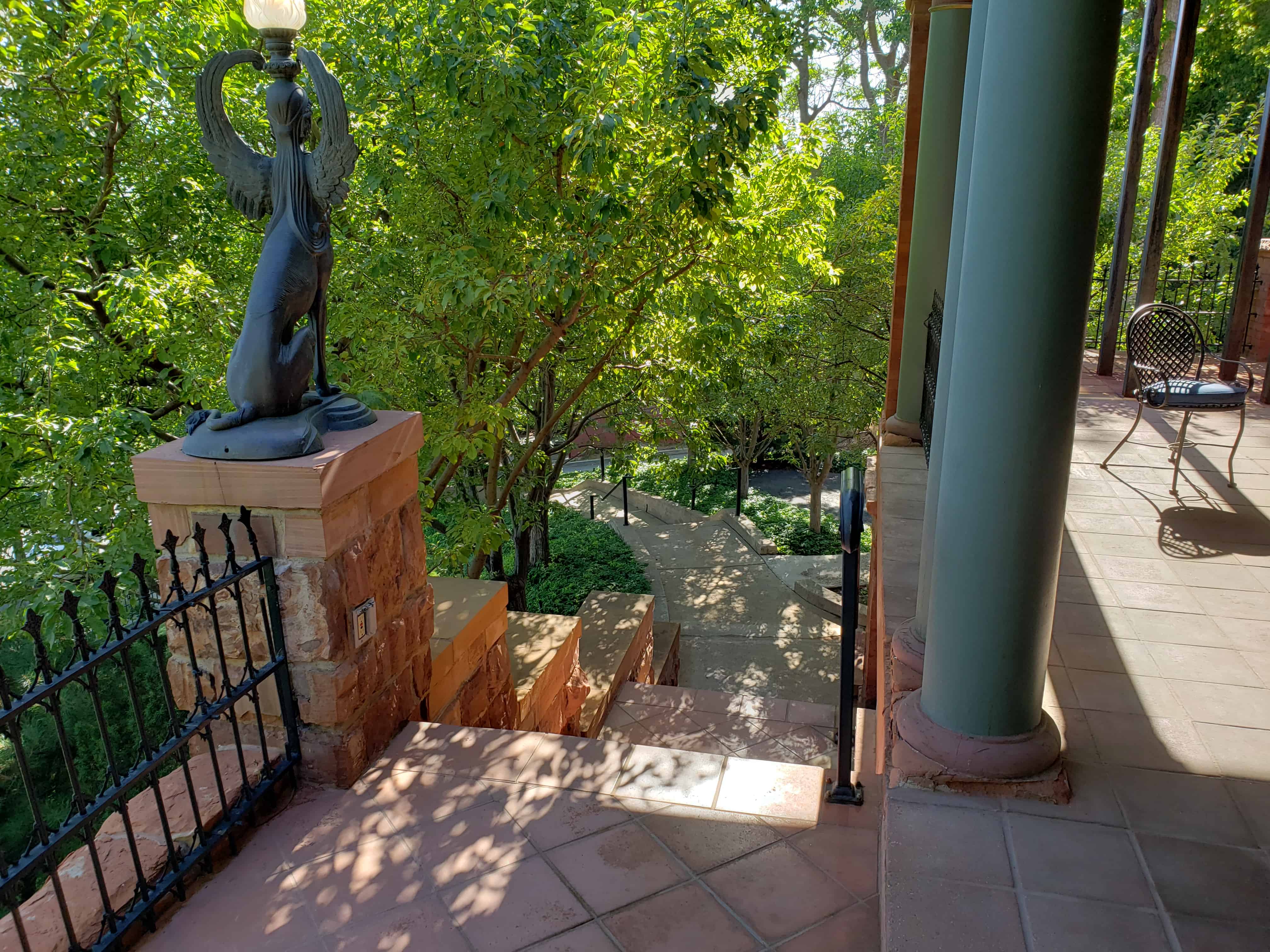
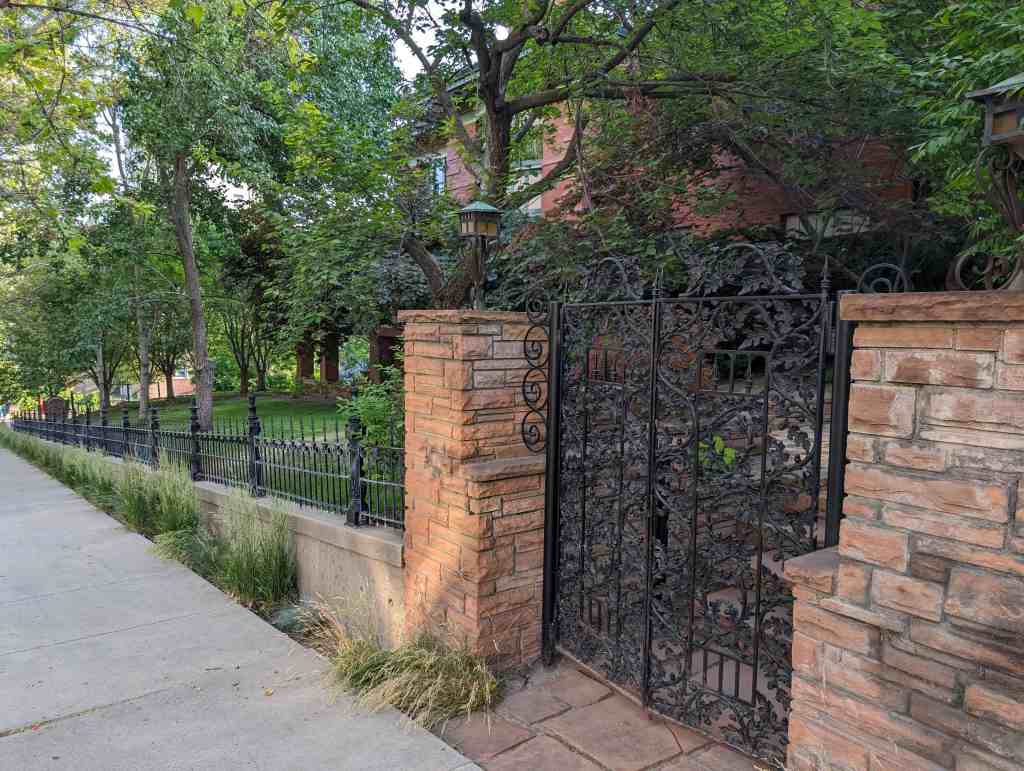
This gorgeous bed and breakfast was the historic Woodruff-Riter Mansion, it has rooms to stay in that are made to look like famous parts of Utah like Bryce Canyon, Sundance and Kings Peak.
It was constructed in 1906 for Dr. Edward Day Woodroff, President of the Brown, Terry and Woodruff corporation. The home was inherited by his son-in-law, Brigadier General Franklin Riter, who served as head of branch office, the board of review of the judge advocate general of the army, European theater of operations during World War II. In 1950, the mansion was acquired by Devirl B. Stewart, President of the Stewart Distributing Company, and used as a family residence until 1974. Renovated for offices in 1975 by R.J. Hollberg, Jr.
Edward D. Woodruff, born in Rock Springs, was a Union Pacific medical doctor who had established his practice in Rock Springs, Wyoming. On moving to Salt Lake City, Woodruff abandoned practice as a medical man and instead entered into commerce and was immediately successful in a number of speculative enterprises. He eventually became president of the Brown, Terry, Woodruff Corporation, which owned many commercial enterprises in Utah.
In 1906 he built this mansion at the height of his fortunes, and as befits an entrepreneur of his eminence, he chose the prestigious firm of Headlund and Wood of Salt Lake City to execute the design in a suitably baronial style. The interior was tiled to resemble an English manor house with the living room handsomely decorated with leather stretching three-quarters of the way up the walls and topped by canvas backed murals on the rest of the walls and ceiling that were painted by the prominent Utah artist William Culmer. The rest of the home was similarly marked by style and craftsmanship of the period.
The house passed into the hands of Woodruff’s daughter, Lesley Day, and her husband Franklin Riter. Riter, a lawyer, was called into active service during World War II, and as Brigadier General Riter was Head of the European Branch Office of the Judge Advocate General Army. In this role and as chief of the Army Board of Review in Europe, General Riter was deeply involved in the Private Slovik case. General Riter’s papers, on deposit at the archives of the Utah State Historical Society, are a valuable body of information on this case and on many other matters pertaining to legal and military matters in World War II. The architects’ rendering of the design for the Woodruff-Riter mansion is also part of the Historical Society collections.
Subsequent to the death of the general the house was divided up into apartments and stripped of its elegant decoration. It has now been acquired for use as commercial office space and restoration work is being contemplated.
Description of physical appearance & significant architectural features:
The Woodruff-Riter House is a large 2 1/2 story mansion that sits up on the hillside above the corner of 200 North and State Street. The home was designed by the well-known local architects Headlund and Wood and shows influence of the Second Renaissance Revival, a style popular at the turn of the century for public buildings and homes of the wealthy.
The massing of the mansion consists of a box-type hip-roofed cube which has projecting south (front), east, and west bays and a rear wing, all with hip roofs slightly lower than that of the main block. Roofs are of tile, painted blue. There are six dormer windows—two on each side, one in front and one in back—as well as three large chimneys that have vertical panels of corbelled brick. On the underside of the wide eaves are square panels with a plaster rosette in each square. There, is a cornice that has dentil and egg-and-dart molding. There is also a band of dentil molding along the edge of the roof.
Walls of the mansion are brick, now painted white. Corbelled quoin-like stone or brick trim with simple egg-and-dart capitals accents the corners of the house. Below the second story windows is a corbelled belt course. The house sits high off the ground on a walk-in basement built of red sandstone blocks.
The front façade facing 200 North Street has a center dormer window and central first floor and basement entries. To the east of the entries is the projecting front bay. A first story porch runs across the front of the house. It has “wrought” iron railings, and wide eaves with panels and rosettes. Its cornice has dentil and egg -and – dart molding, with panels at the corners. The porch roof is supported by square corner pillars that have egg-and-dart capitals. They are supplemented by single doric columns next to the pillars and two pairs of doric columns flanking the main entry. The first story porch rests on a longer basement porch, supported by heavy pillars that extend around the southeast corner of the house. A symmetrical double stair leads from ground level to the main entry on the first floor. Under the stairs is an arched opening leading to the basement door.
The east and west sides of the house have projecting bays near the centers of their facades. The bay on the east, facing State Street, has a curved bay window with wood paneling between the second and first stories and rough-faced brick below the first story windows. The west bay is segment al and has corbelled brick panels between the second and first stories. At the rear of the mansion is the original northeast wind with its one-story enclosed porch topped by a wrought iron railing, plus a one-story northwest addition.