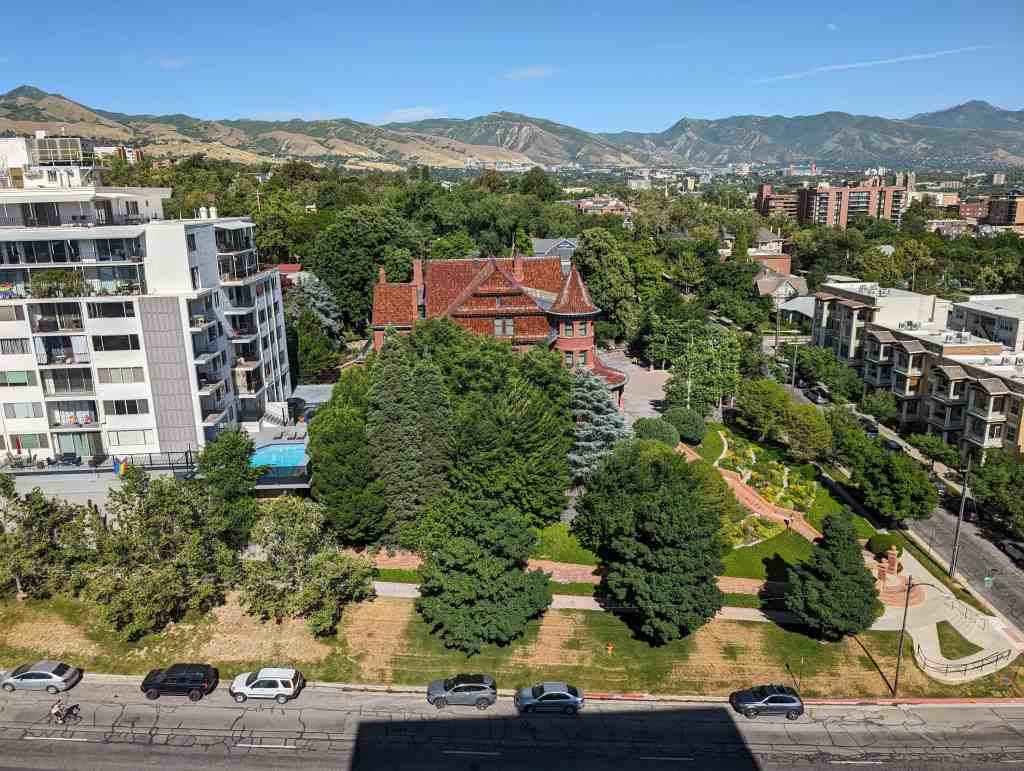
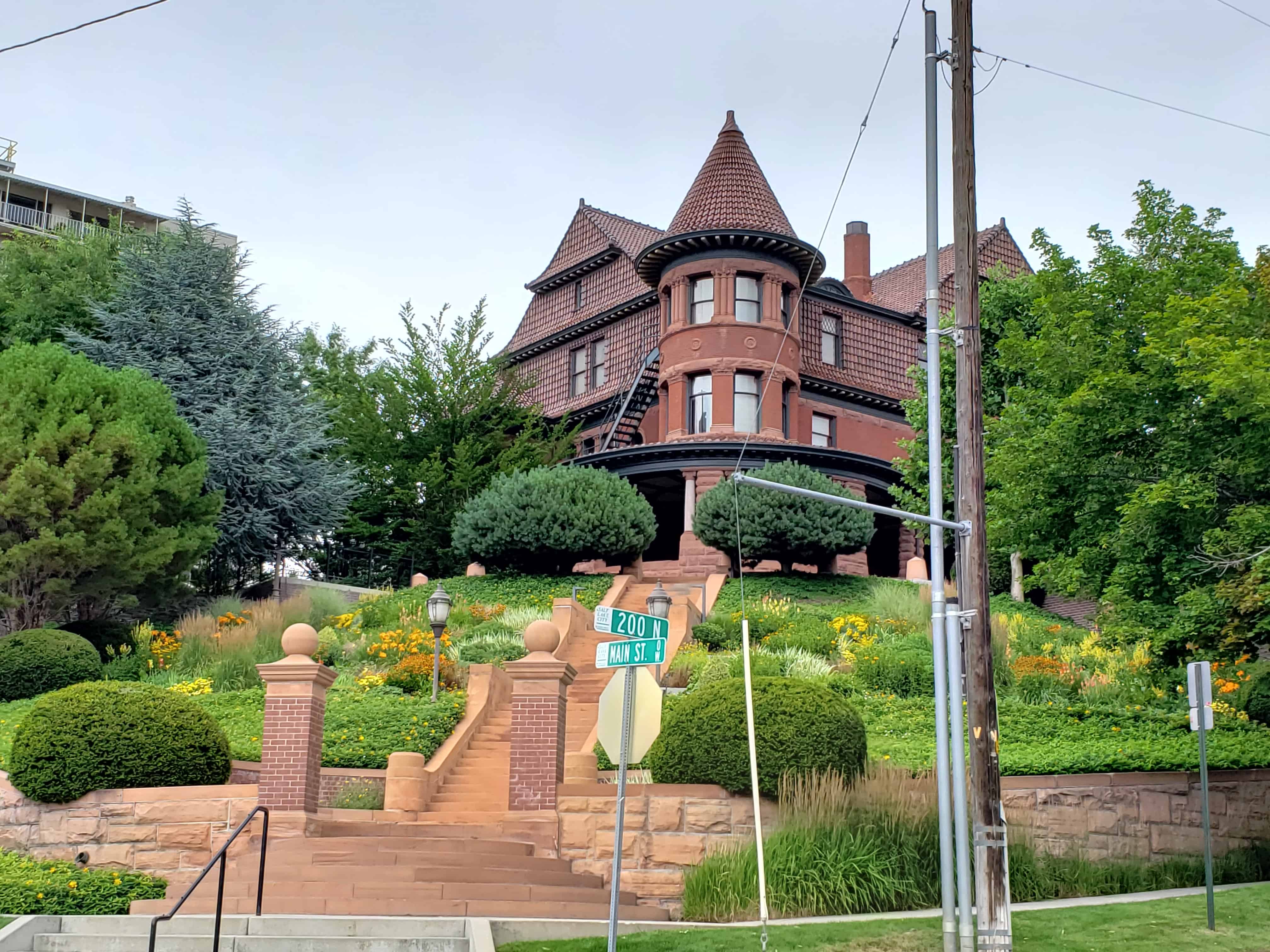
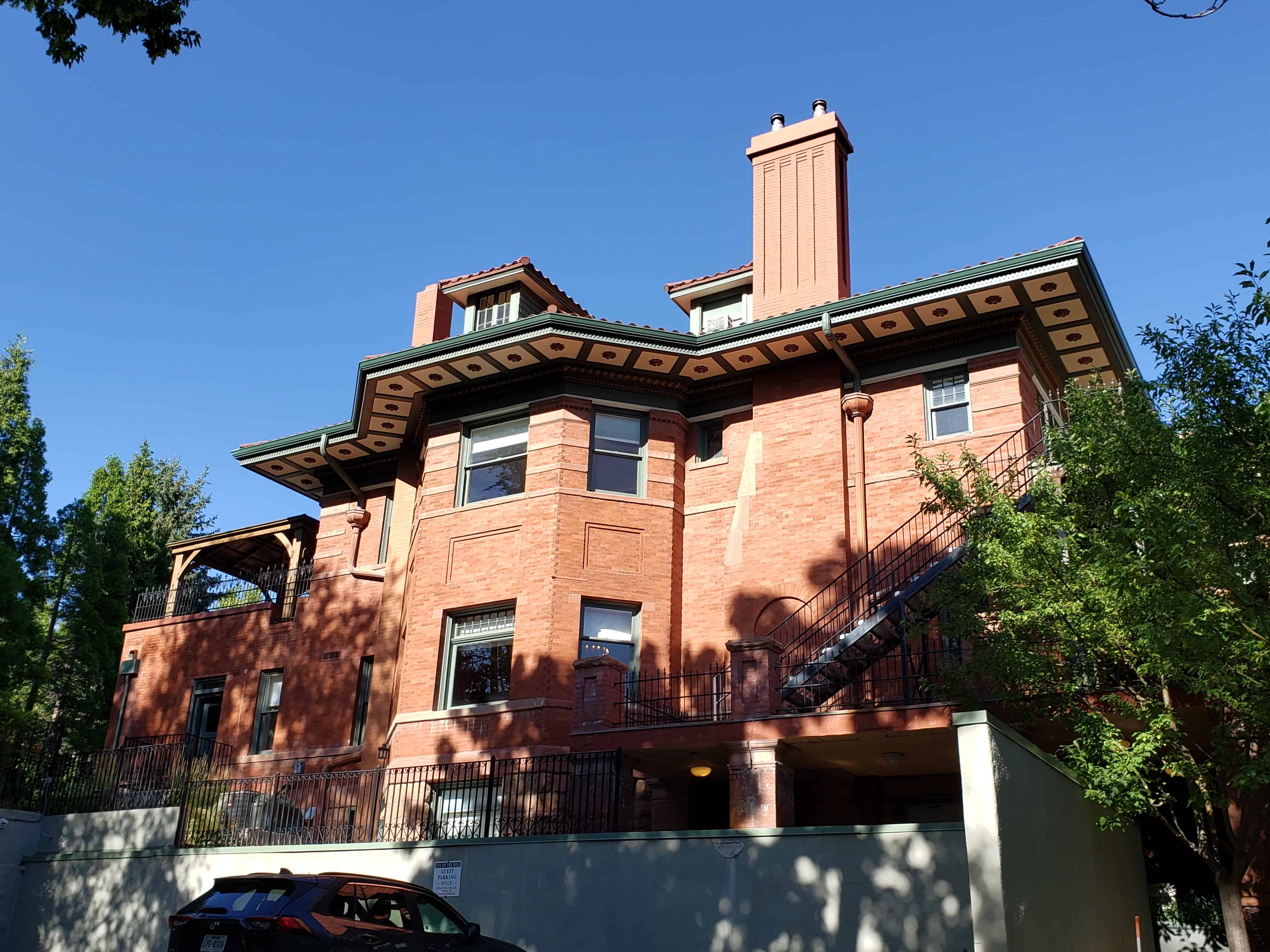
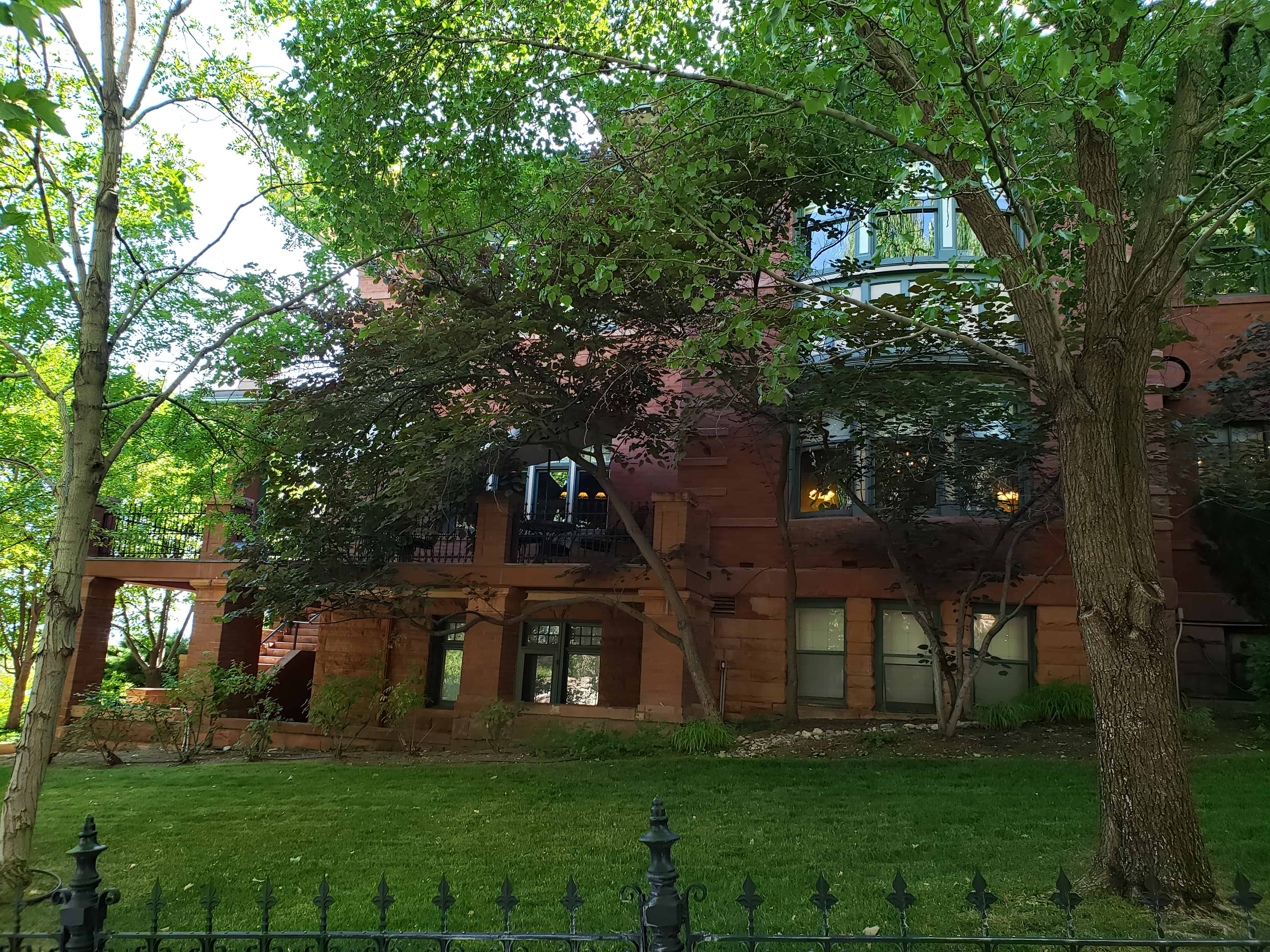
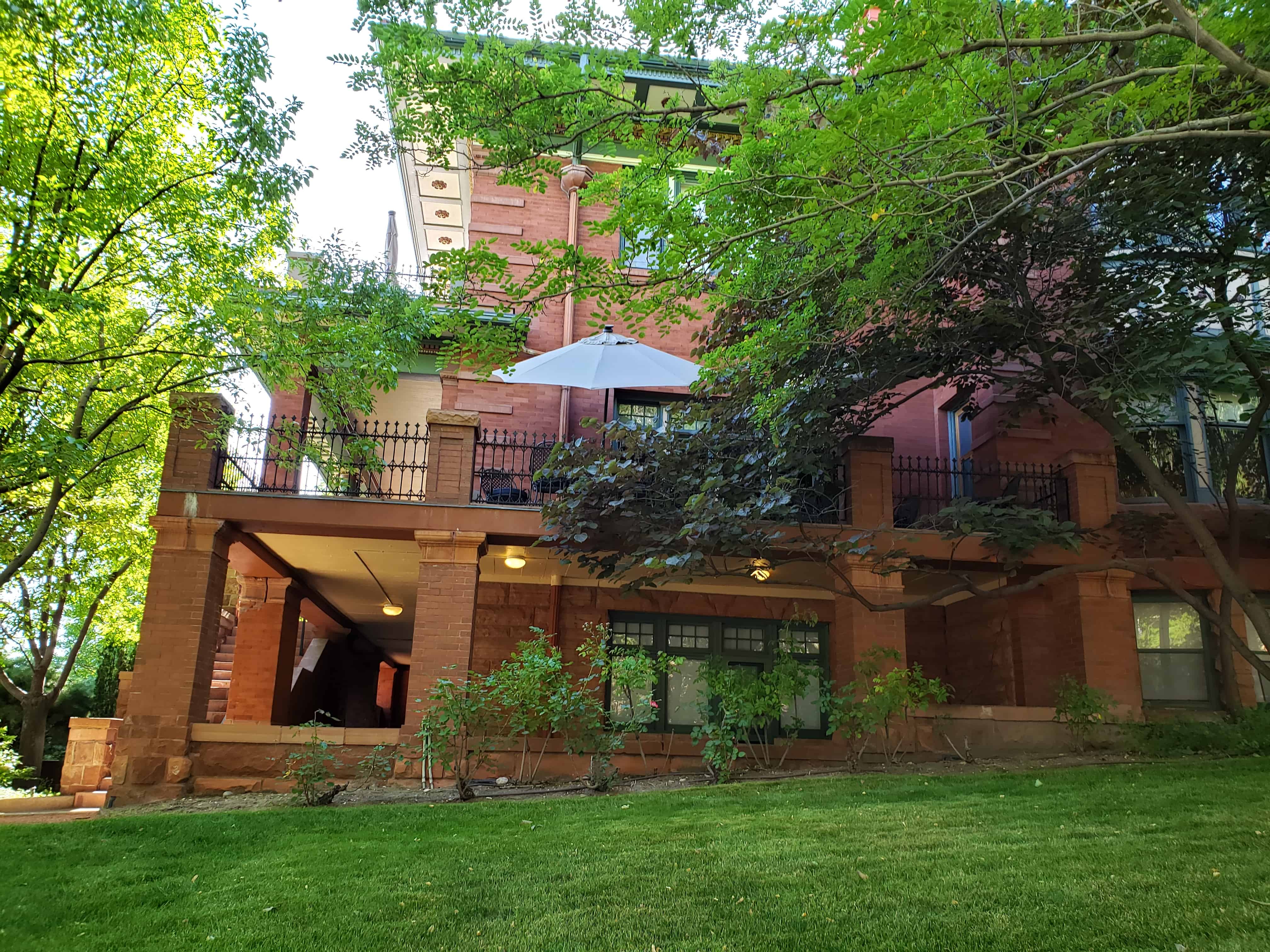
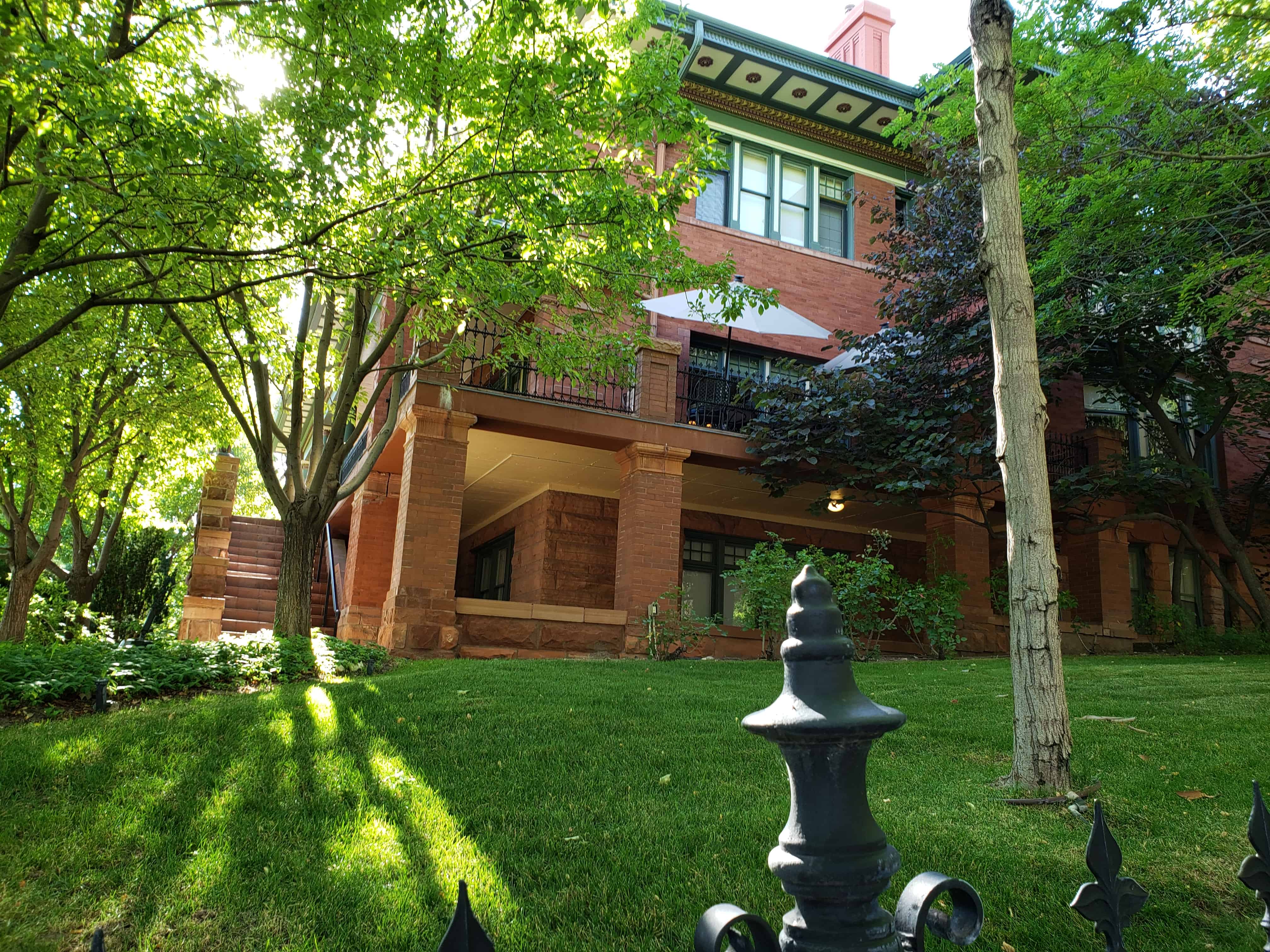
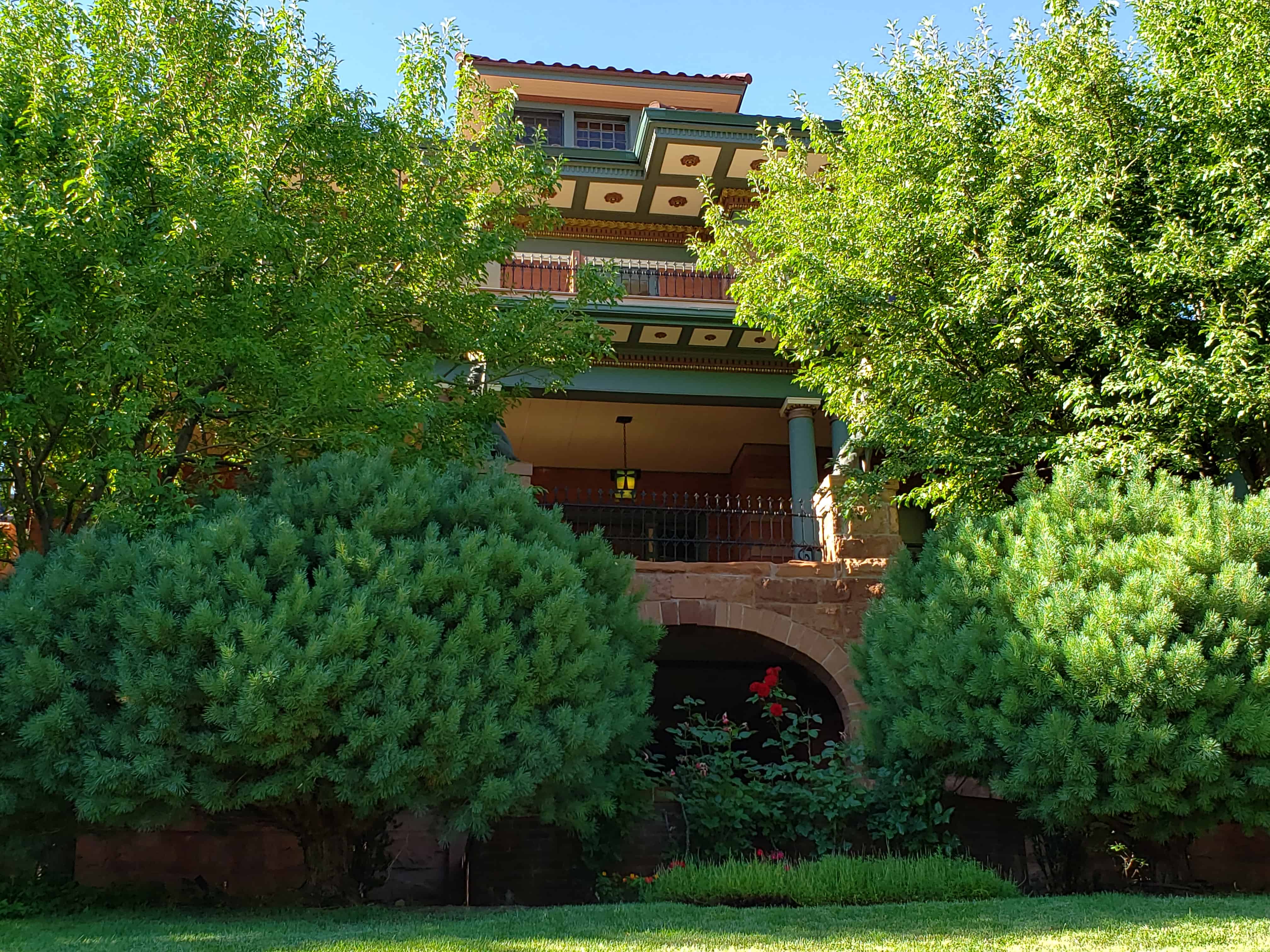
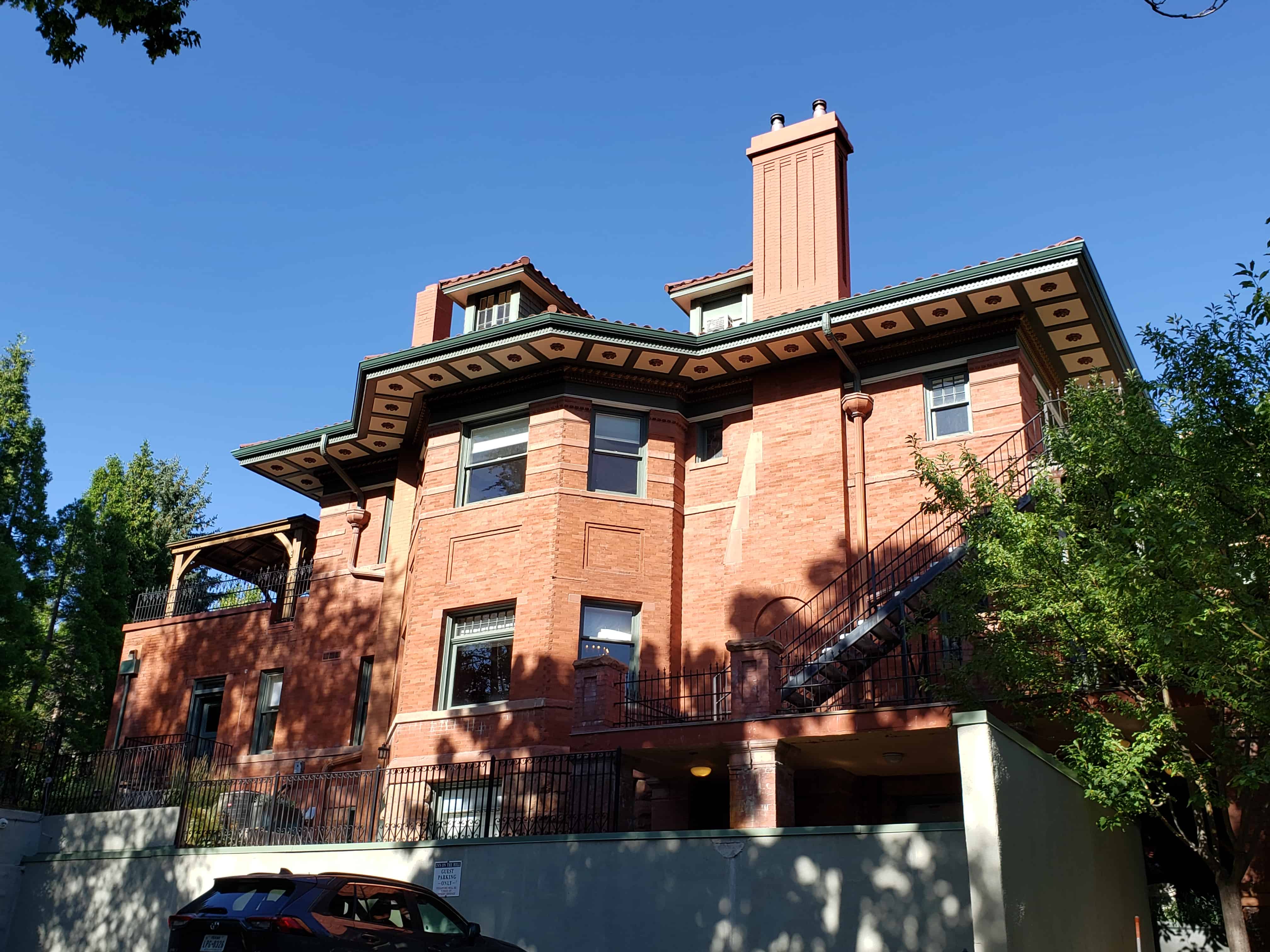
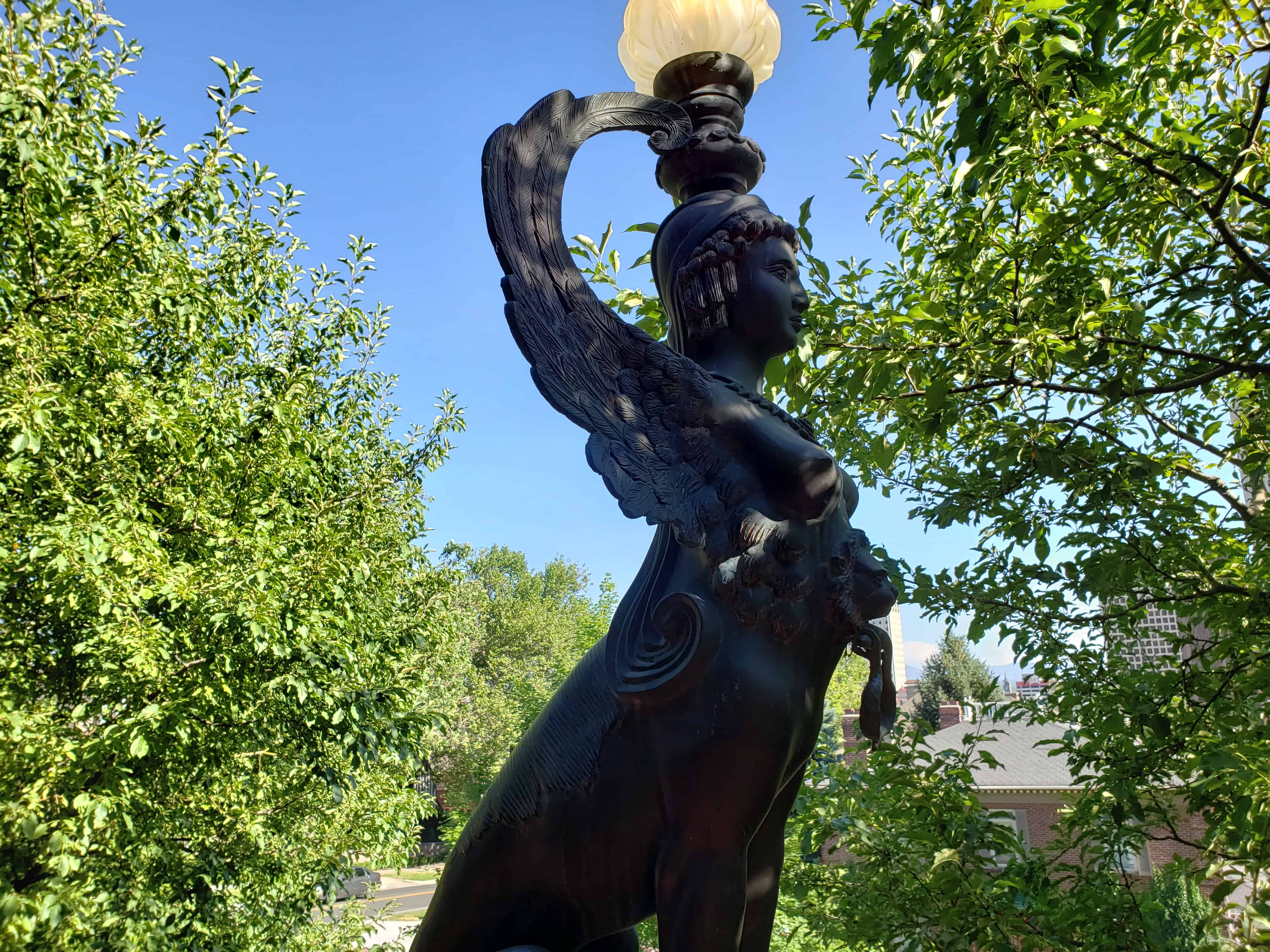
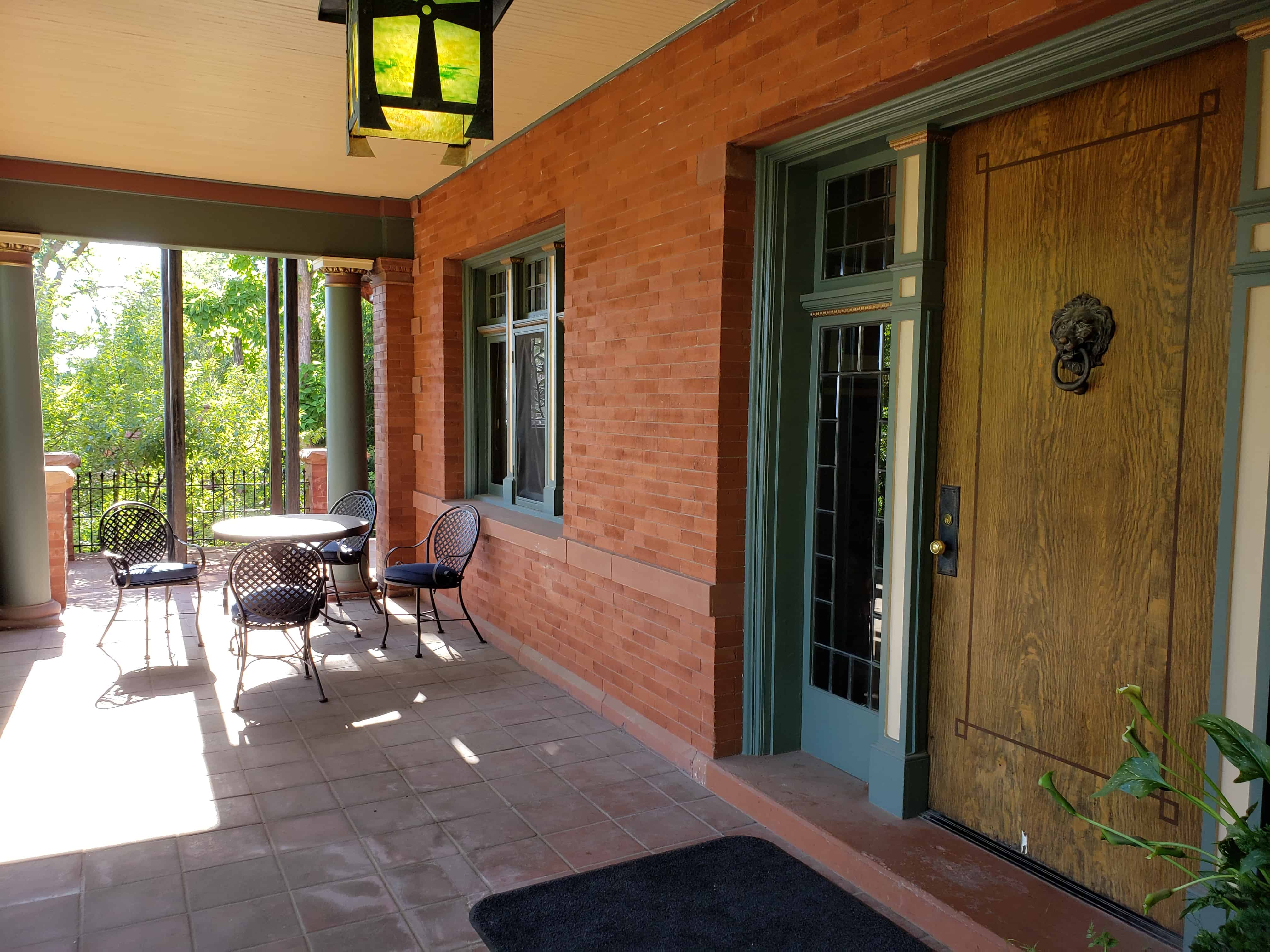
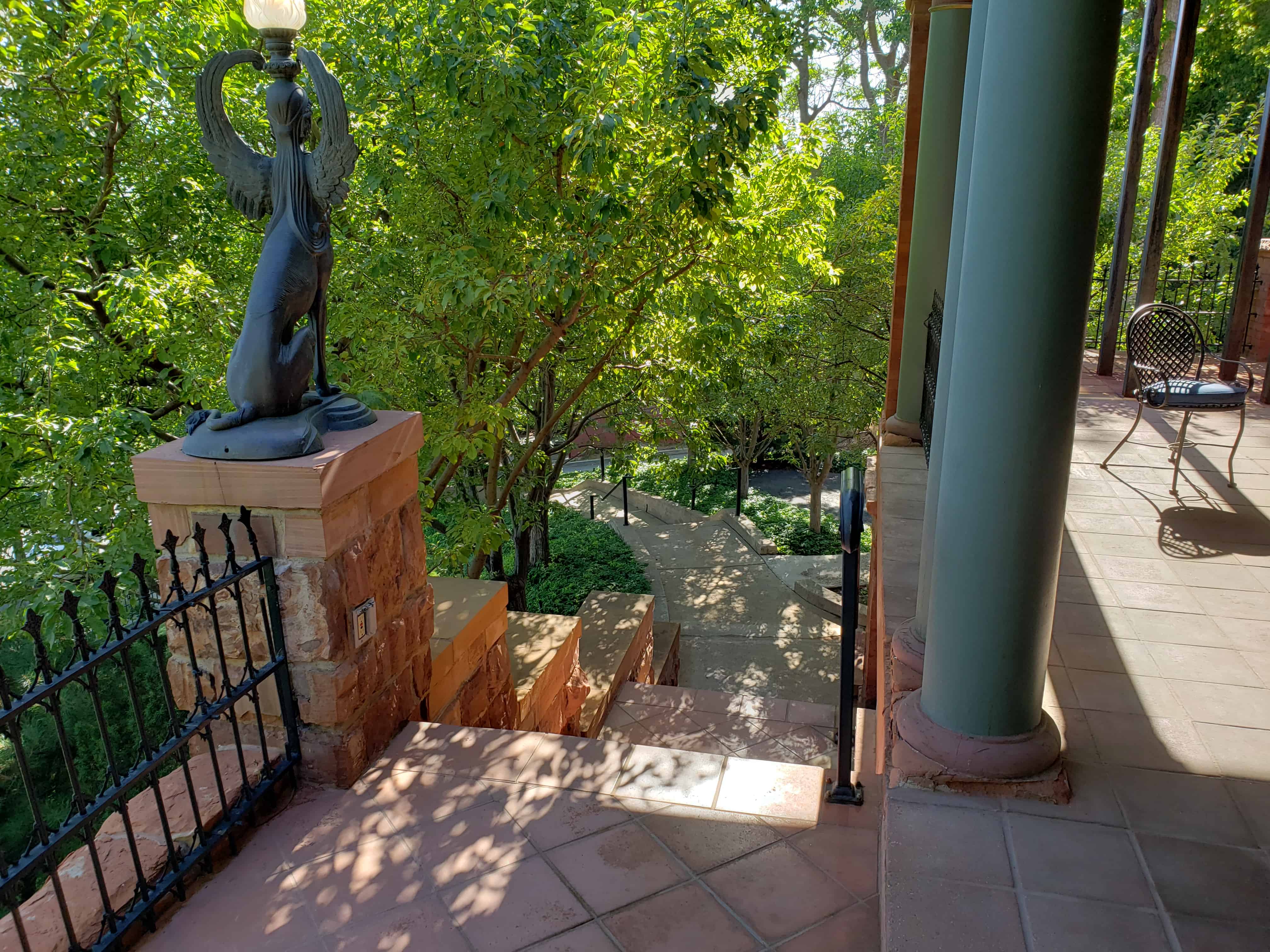
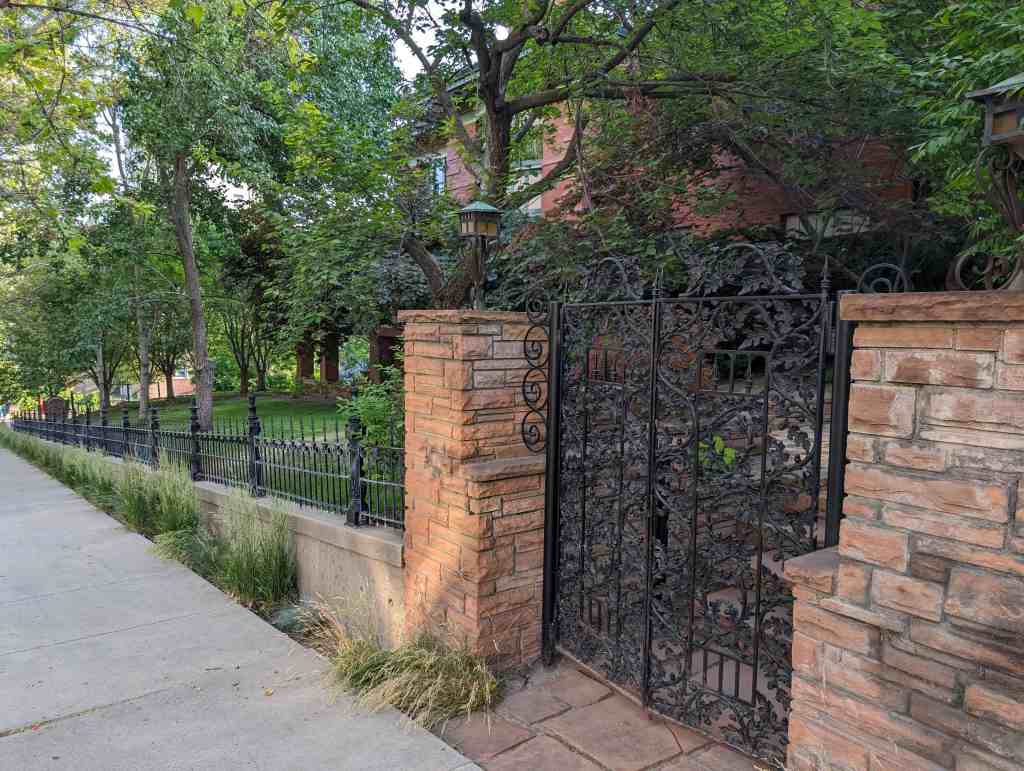
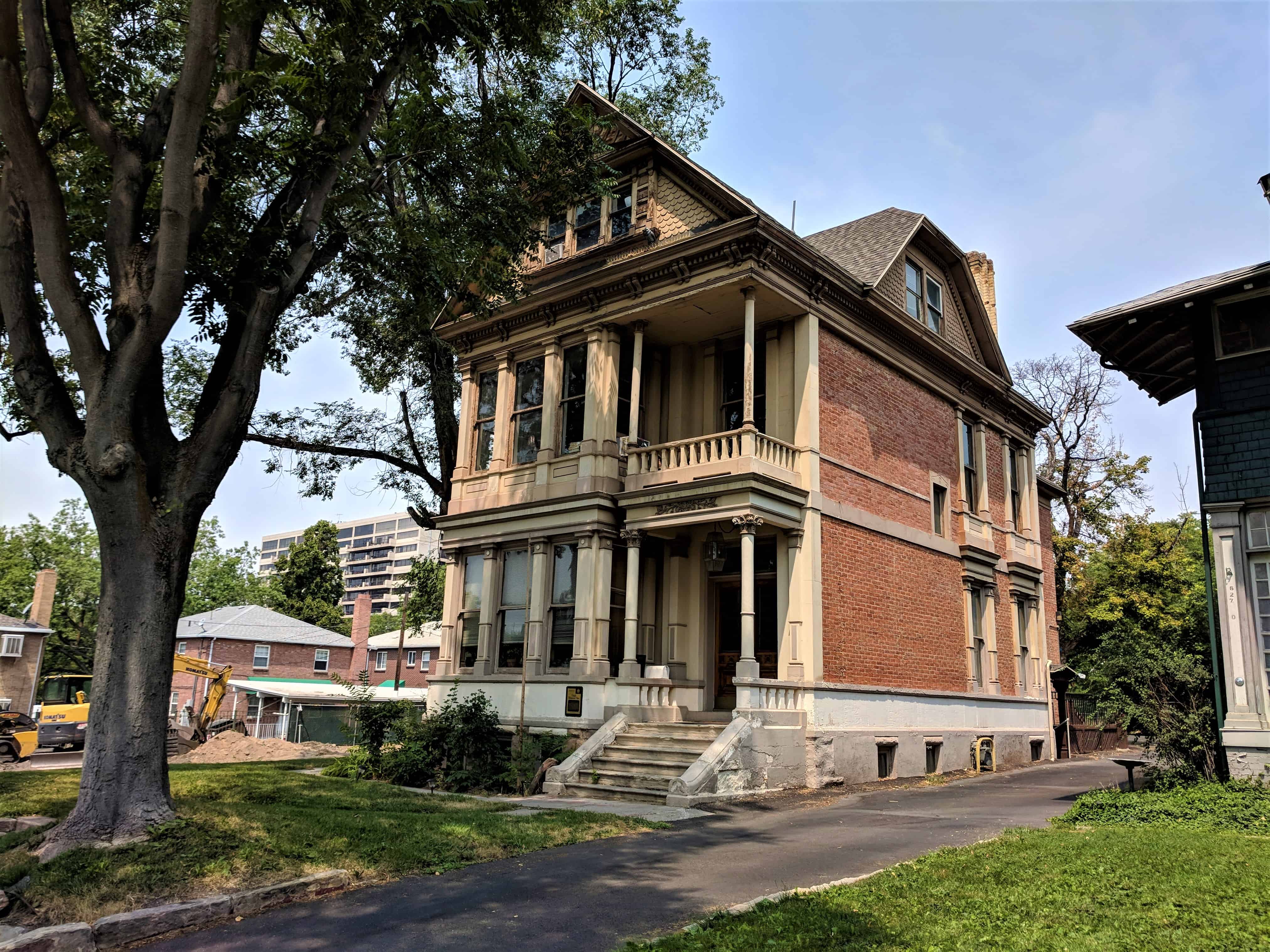
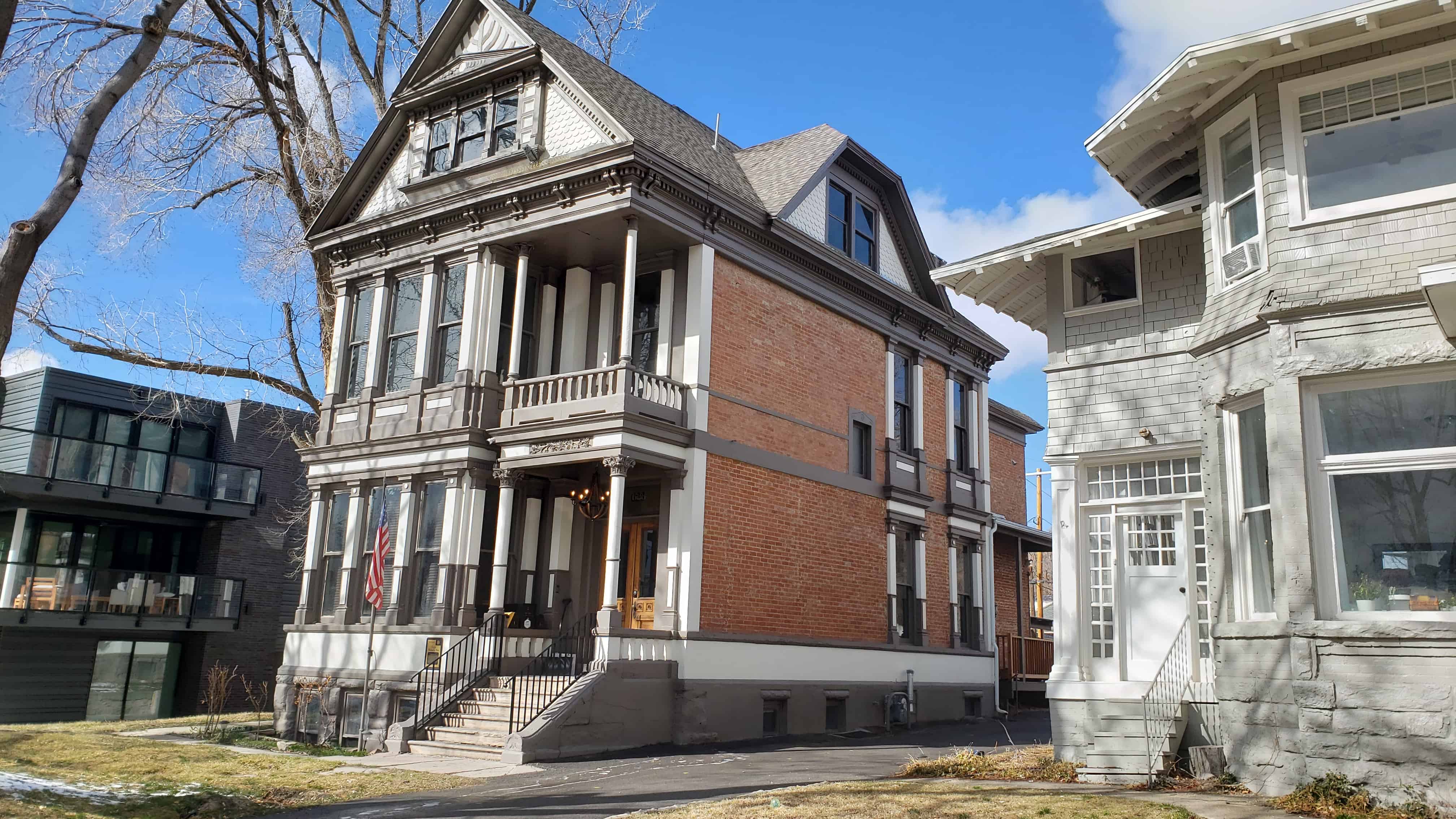
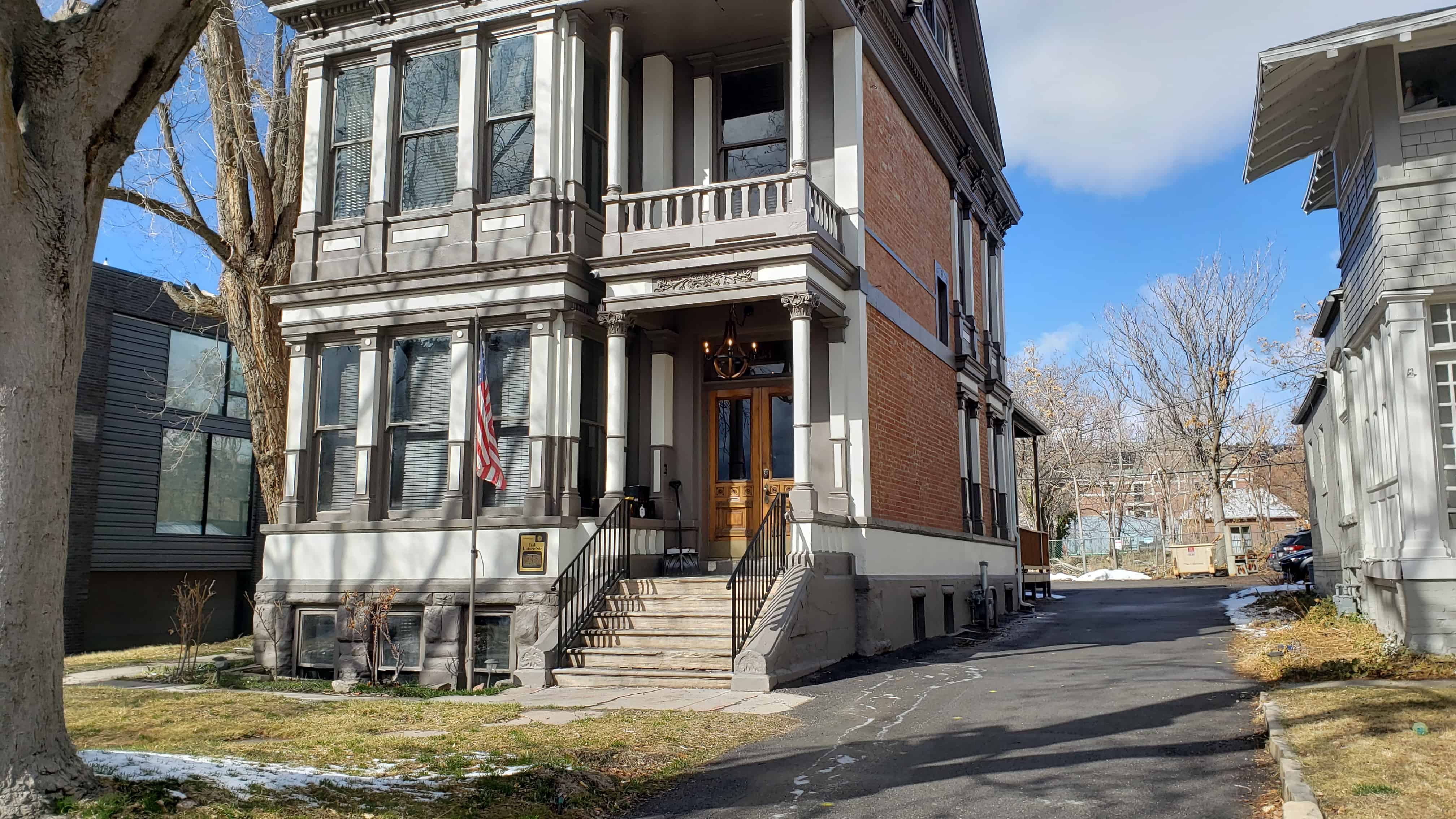
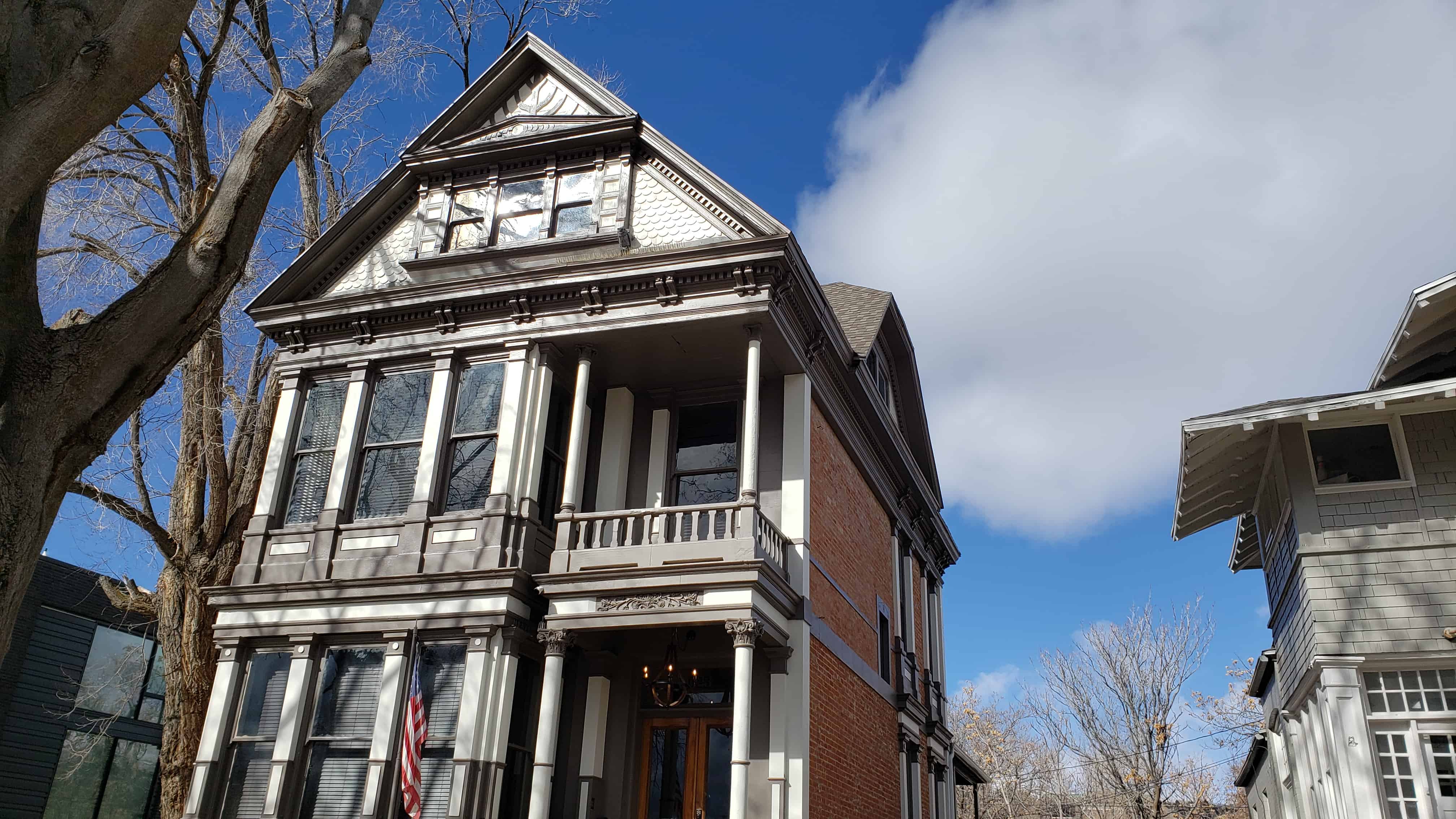
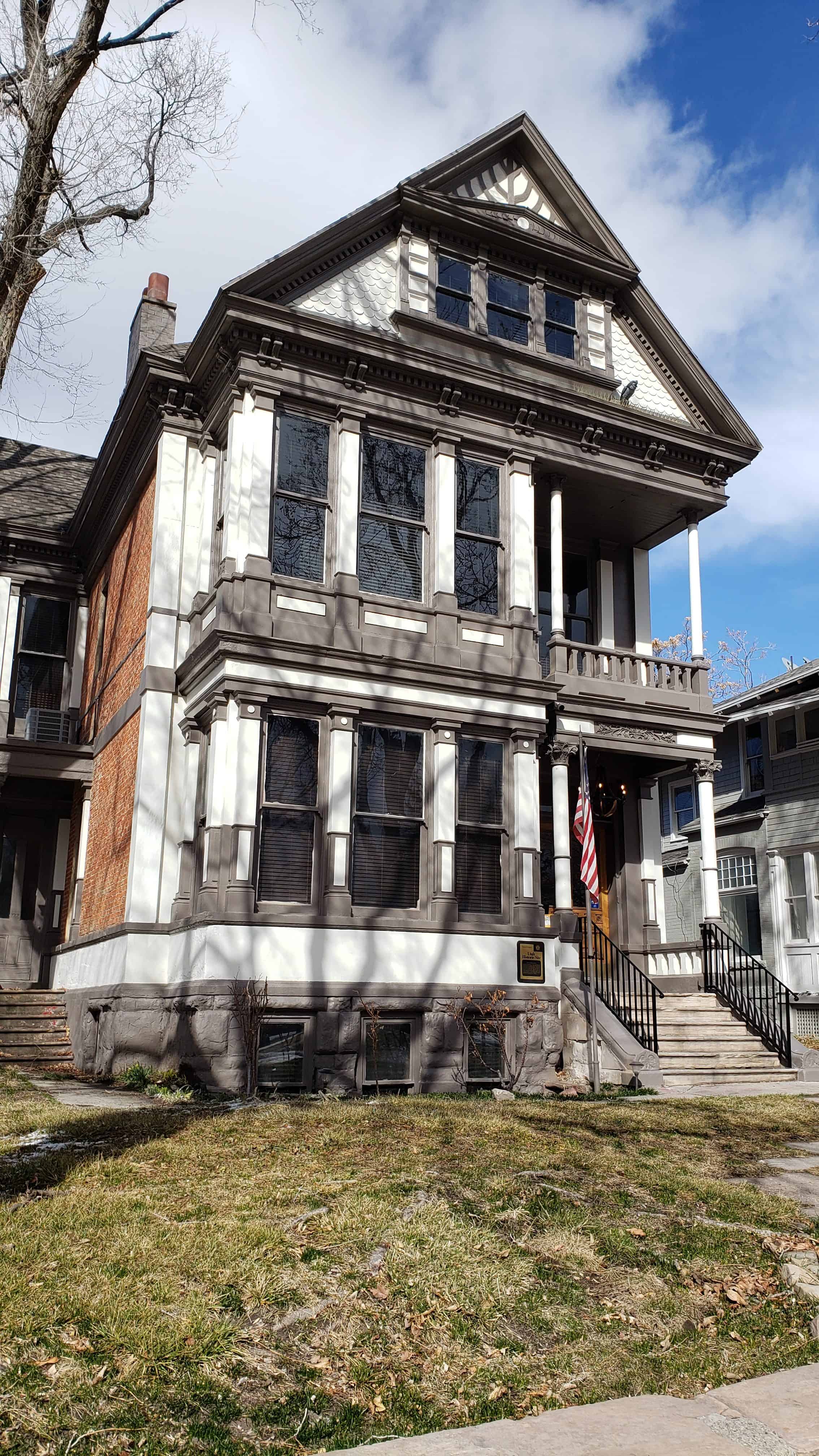
The McCune Mansion was designed by architect S.C. Dallas for Alfred W. McCune and wife Elizabeth. The McCunes financed a two year tour of the United States and Europe for the architect to study architectural styles and techniques before plans were drawn for the home. Working closely with Mrs. McCune, the home was designed by S.C. Dallas and the construction completed in 1901.
Alfred W. McCune was born July 11, 1849 at Fort William, Dum Dum, Calcutta, India. His father, Major Mathew McCune was an officer in the British Army Division Survey in East London. The McCune family was converted to the Mormon faith in 1851 and in November of 1856 they left India for Utah and arrived in Salt Lake City, September 21, 1857.
Choosing the railroad for business rather than farming, Alfred began taking contracts to build portions of the Utah Southern Railroad in 1870. During the next decade he became one of the largest railroad contractors in the Rocky Mountain area.
In 1880, McCune left railroad building and entered the timber and mining business in Montana. Again he was unusually successful, and after eight years in Montana the McCunes moved to Salt Lake City in 1888. Mr. McCune entered into numerous mining ventures in the United States, Canada, and South America. Locally he purchased the Salt Lake City Streetcar system.
In 1920 they moved to Los Angeles and the home was given to the church of Jesus Christ of Latter-day Saints. It housed the McCune School of Art and Music until 1958 when the Brigham Young University SLC Center moved into the building. The mansion has recently been vacated and a private individual has purchased the former school for use as architectural offices and a showroom for handmade furniture.
The home is one of the most elaborate and beautiful mansions in the state. The story of Alfred W. McCune, symbolized by the magnificent structure, indicates that the Horatio Alger tradition could be found also among the Mormons of Utah even at a time when the church was emphasizing a somewhat socialistic cooperative movement (1968- 1880).
Since 1920, the mansion’s use as a school illustrates the feasibility of and enjoyment from adaptive use.
The Alfred W. McCune carriage house was built for Judge R. N. Baskin in connection with his home which was designed by Henry Monheim and built in 1872. The home was built of stone in a Greek cross plan, had a square tower on the roof at the crossing of the ridges, had fifteen rooms, cost $40,000, and was similar in design to homes illustrated in Alexander Jackson Downing ‘s THE ARCHITECTURE OF COUNTY HOUSES. The substantial carriage house was built to the north of Judge Baskin ‘s residence and was retained by the McCune family after razing the Basking home prior to erecting the McCune Mansion. The carriage house has historic associations of its own, having been remodeled in 1926 and used for two years as the Mormon meetinghouse of the Capitol Hill Ward.
Architecturally, the carriage house was patterned after Judge Baskin ‘s residence and was constructed of the same cut red butte sandstone and featured similar massing. Built on a hillside, the carriage house varies from one story tall on the north to two stories on the south. The roof is gabled, the cornice is moulded and returns, all bays are square. When converted to a church use, a one-story addition was made to the southwest corner of the building and the stone was covered with stucco. It is the intention of the owners of the McCune Mansion to restore the carriage house as well as the mansion which is currently undergoing NFS -ass is ted restoration.
This gorgeous bed and breakfast was the historic Woodruff-Riter Mansion, it has rooms to stay in that are made to look like famous parts of Utah like Bryce Canyon, Sundance and Kings Peak.
It was constructed in 1906 for Dr. Edward Day Woodroff, President of the Brown, Terry and Woodruff corporation. The home was inherited by his son-in-law, Brigadier General Franklin Riter, who served as head of branch office, the board of review of the judge advocate general of the army, European theater of operations during World War II. In 1950, the mansion was acquired by Devirl B. Stewart, President of the Stewart Distributing Company, and used as a family residence until 1974. Renovated for offices in 1975 by R.J. Hollberg, Jr.
Edward D. Woodruff, born in Rock Springs, was a Union Pacific medical doctor who had established his practice in Rock Springs, Wyoming. On moving to Salt Lake City, Woodruff abandoned practice as a medical man and instead entered into commerce and was immediately successful in a number of speculative enterprises. He eventually became president of the Brown, Terry, Woodruff Corporation, which owned many commercial enterprises in Utah.
In 1906 he built this mansion at the height of his fortunes, and as befits an entrepreneur of his eminence, he chose the prestigious firm of Headlund and Wood of Salt Lake City to execute the design in a suitably baronial style. The interior was tiled to resemble an English manor house with the living room handsomely decorated with leather stretching three-quarters of the way up the walls and topped by canvas backed murals on the rest of the walls and ceiling that were painted by the prominent Utah artist William Culmer. The rest of the home was similarly marked by style and craftsmanship of the period.
The house passed into the hands of Woodruff’s daughter, Lesley Day, and her husband Franklin Riter. Riter, a lawyer, was called into active service during World War II, and as Brigadier General Riter was Head of the European Branch Office of the Judge Advocate General Army. In this role and as chief of the Army Board of Review in Europe, General Riter was deeply involved in the Private Slovik case. General Riter’s papers, on deposit at the archives of the Utah State Historical Society, are a valuable body of information on this case and on many other matters pertaining to legal and military matters in World War II. The architects’ rendering of the design for the Woodruff-Riter mansion is also part of the Historical Society collections.
Subsequent to the death of the general the house was divided up into apartments and stripped of its elegant decoration. It has now been acquired for use as commercial office space and restoration work is being contemplated.
Description of physical appearance & significant architectural features:
The Woodruff-Riter House is a large 2 1/2 story mansion that sits up on the hillside above the corner of 200 North and State Street. The home was designed by the well-known local architects Headlund and Wood and shows influence of the Second Renaissance Revival, a style popular at the turn of the century for public buildings and homes of the wealthy.
The massing of the mansion consists of a box-type hip-roofed cube which has projecting south (front), east, and west bays and a rear wing, all with hip roofs slightly lower than that of the main block. Roofs are of tile, painted blue. There are six dormer windows—two on each side, one in front and one in back—as well as three large chimneys that have vertical panels of corbelled brick. On the underside of the wide eaves are square panels with a plaster rosette in each square. There, is a cornice that has dentil and egg-and-dart molding. There is also a band of dentil molding along the edge of the roof.
Walls of the mansion are brick, now painted white. Corbelled quoin-like stone or brick trim with simple egg-and-dart capitals accents the corners of the house. Below the second story windows is a corbelled belt course. The house sits high off the ground on a walk-in basement built of red sandstone blocks.
The front façade facing 200 North Street has a center dormer window and central first floor and basement entries. To the east of the entries is the projecting front bay. A first story porch runs across the front of the house. It has “wrought” iron railings, and wide eaves with panels and rosettes. Its cornice has dentil and egg -and – dart molding, with panels at the corners. The porch roof is supported by square corner pillars that have egg-and-dart capitals. They are supplemented by single doric columns next to the pillars and two pairs of doric columns flanking the main entry. The first story porch rests on a longer basement porch, supported by heavy pillars that extend around the southeast corner of the house. A symmetrical double stair leads from ground level to the main entry on the first floor. Under the stairs is an arched opening leading to the basement door.
The east and west sides of the house have projecting bays near the centers of their facades. The bay on the east, facing State Street, has a curved bay window with wood paneling between the second and first stories and rough-faced brick below the first story windows. The west bay is segment al and has corbelled brick panels between the second and first stories. At the rear of the mansion is the original northeast wind with its one-story enclosed porch topped by a wrought iron railing, plus a one-story northwest addition.
The Best-Cannon house is an excellent example of a Queen Anne Victorian cottage in Salt Lake City. It was designed by the firm of Monheim, Bird and Proudfoot, architects for the Salt Lake City and County Building, and built in 1893 by W.A. Wright for Elliot M.S. Best and his family. Best, an agent for the Morse Coe Shoe Company, built the west addition in 1897 for a cost of $85 as a dance studio for his daughter. The Bests lived here until 1906 when Angus M. Cannon, Jr., and his wife, Kate Lynch, bought the house.
The Arthur Taylor House documents and illuminates some of the social and economic aspects of ranching in Southeastern Utah. Its size and sophistication, in comparison with the crude homes of most of Moab’s citizens, clearly marks the importance of ranching in the area during the late 19th century. Equally important are the home’s associations with members of the Taylor family who were pre-eminent in the promotion of ranching in Grand County. The Old Taylor Homestead is one of the few remaining historical and architectural assets of the town of Moab, which has suffered the baleful effects of uranium booms and tourist infestations, It is an essentially intact late nineteenth century farm complex, with a two story, T-plan main house of brick.
Located at 1266 U.S. Highway 191 in Moab, Utah and added to the National Historic Register (#80003908) on February 28, 1980.
The Taylor family arrived in Moab in 1881, and with their arrival, large scale cattle ranching got under way. The industry suffered from a grat deal, of lawlessness in the area, and cattle rustling was a continual problem. Amusingly, and accurately, local lore recalls that many local ranchers actually got their start in cattle ranching by establishing their herds with cattle stolen from longer established neighbors. The Taylor’s were the principal targets 6f much of this rustling, and the losses they were suffering contributed to their decision to switch to sheep ranching. The first to introduce sheep into Grand County, they were inevitably involved-in the range war that followed.
It was profits from sheep that enabled the construction of the Taylor Homestead to begin in 1894. The bricks were made in Moab by another member of the family, Elmer Taylor, while paints from the interior walls came from the Carter Brothers of Prove. When the Arthur Taylor’s moved into the house, the GJ:and Valley Times reported,, “Mr and Mrs Arthur Taylor had a parTy on Monday evening to celebrate the occupancy of their new mansion.” The Taylors were thus established as the leading family of Moab, and the object of considerable envy by the residents of the log cabins that constituted most of the dwellings in town.
Following Arthur Taylor, the home passed to his brother Lester Taylor and later went through a succession of hands residence, it is now used for refrigerated storage. Materials and building techniques place this structure at a date close to that of the main house. Of brick on a rough faced, ashlar foundation (now stuccoed with concrete), the gable areas are shingled. Segmental arches and wooden segmental insets complete the two-over-two windows treatment. A screened frame porch was part of this structure originally, resting on the same stone foundation.
Though adapted for use as a restaurant, the present owners have restored the interior of the Taylor home to its original character as much as possible. Woodwork was refinished and missing millwork has been reproduced and replaced. Facsimile wallpapers and paint colors were made after consulting a surviving early resident, Lydia Taylor Skewes.
The home has been rewired and period fixtures used. A second floor bathroom added ca 1945 was left intact. The first floor bathroom was divided into men’s and women’s sections in accordance with the restaurant code.
Outbuildings formed an integral part of any farm complex. At the Taylor farmstead the many extant outbuildings contribute to preserving the character of the original site.
Three original, rough-faced sandstone outbuildings survive, all with gable roofs. For the one story smoke-house, sandstone was used for the lower elevation level, while yellow brick was used on the upper portion. Dug partly into the hill is the icehouse. The creamery also remains, though the stone has been stuccoed. Frame storage sheds, corrals and chicken coops dot the complex.
The Taylor home exemplifies a common approach to domestic architecture in America. An established vernacular form with comfortable associations socially and historically was chosen. Yet in desire to keep up with current taste, details were applied which were not integral to the overall form.
The social and economic conditions which allowed the Taylor family to prosper and build are gone, but the home that was the result remains as a landmark of later nineteenth century architecture in rural Utah.
The Taylor Farmstead in Moab, Utah, remains as an essentially intact late nineteenth century farm complex. Begun in 1894, the farmhouse is similar in form and detail to other domestic architecture of the period. The T plan, one of the popular pattern book plans, was used extensively during this era throughout the West. Applying period ornament to a vernacular architectural type in order to update the appearance was a popular move – a comfortable step – embracing the vogue and the traditonal at once. Substantial scale and materials added to the pretentious detail crate an imposing result.
A full two stories, the Taylor home is large in comparison to other homes in the region. Brick for the walls was made locally by a family member. The lighter colored quoins may have been from another source. Rough faced, regular coursed sandstone was used for the massive window sills and the foundation (now stuccoed with concrete).
Window treatment for the Taylor Home is arranged around double hung, sash windows. Brick segmental arches with archivolt bands, and wooden segmental insets with an incised scroll motif seen commonly in Utah architecture are uniform. In the double unit window configurations, a classical vernacular pilaster divides the windows. Surrounds are of a plain, moulded style.
A porch and balcony in the Eastlake Style mark the main façade. The original arrangement (see ca. 1896 photo) was later modified by the addition of a roof over the second story balcony. Originally polychromed, the porch is now painted white. Scalloped shingles on the pent roof complimented the vergeboard drapery of quatrafoil motif, which is now missing. Later modifications were made to include the roof over the second story balcony. Here, square posts with milled bracketing replaced the turned balusters. Rafter ends have decorative rounded shapes.
Rear extensions and interior modifications began ca. 1943 and continued until the present ownership, under which a readaptive restoration was launched. The original rear porch has been enclosed. To accommodate the home’s present use as a restaurant, a kitchen has been added at the rear.
This modern kitchen connects the farmhouse to a one-story, rectangular brick structure. Probably originally a three-room before finally ending up as a prize to be carefully restored to its former grandeur. The present owners are making a worthwhile effort to rescue the building from dilapidation and to make it once more a showplace of Moab, and a reminder of the colorful ranchers who built Moab and Grand County.
The house is a good example of an English Tudor period cottage. The steep roof pitches, large front chimney, round arched entry and multicolored brick are elements of this style. The property has been owned by members of the Pierpont family since 1962. The Pierpont name is well known due to Thomas Pierpont, who was prominent in the steel and foundry business. Other owners of this home include Albert and Pauline Taylor (1937 to 1953) and Ralph and Elaine Bringhurst (1953 to 1962).
The adobe (center) section of this home was built in 1877 by David Branson Brinton.
The east and west additions were constructed by Brinton of brick and were completed in 1896.
Located at 1981 E. Murray–Holladay Road in Holladay, Utah – This home was added to the National Historic Register on May 22, 1978 (#78002665)
The David Branson Brinton House is significant for its association with the lives of three locally prominent historical figures: David Brinton, David Branson Brinton, Sr. and David Branson Brinton, Jr., all of who played important roles in the growth and development of Holladay, Utah, one of the state’s earliest settlements. The three were particularly noted as religious leaders but were involved in a variety of community building roles. The Brinton Home is one of the oldest surviving structures in the Holladay area and is architecturally representative of the pioneer period during which it was constructed. The home and much of its rural setting is intact. The Brinton Home is locally considered an historic landmark.
Following the arrival of the first party of Mormon pioneers to the Great Salt Lake
Valley in July 1847, Salt Lake City was founded and built. The following spring,
groups of settlers were sent north and south of the city to establish other communities
The first permanent settlement made outside of Salt Lake City was Holladay’s Burgh,
(later Holliday) named after the founder, John Holladay, which was established on
Spring Creek, a tributary of Big Cottonwood Creek, three miles north of the mouth
of Big Cottonwood Canyon.
Among the settlers of 1848-49 was David Brinton (1814-1878) and his family. The Brintons had historically been builders and blacksmiths. William Brinton, David’s great-grandfather, built a three-story house in 1704 in Delworth Town, Pennsylvania, and Brinton’s Mill at Chadds Ford, Pennsylvania, both National Register sites. David Brinton was a well-known colonizer, missionary and church leader. He was sent on various scouting missions by Mormon leader, Brigham Young, and was among those to select and establish the site of Parowan, an important central Utah settlement in 1851, and was part of the first party to investigate possible settlement areas near Fort Bridger, Wyoming.
As an early pioneer of Holladay, David Brinton obtained lots five and six of the
Holladay Field Plat of 1849. To these properties he added several others and eventually controlled valuable commercial and agricultural land in the center of the
community. A blacksmith by trade, David built a blacksmith shop on the southeast
corner of 4800 South and lower County Road (Highland Drive) where Utah’s first major
shopping mall was later built. On this same land, he had a large farm on which he
raised produce and meat for the consumption of the military at Fort Douglas.
In the late 1860’s, Brinton saw the need for a supply station or store closer to the community than Salt Lake City. Consequently, in 1868, he and his sons built the first store in the area, the Big Cottonwood Co-Operative Store, on his property. In 1869 following the establishment of the Zions Co-Operative Mercantile Institution (Z.C.M.I.) system in Utah Territory, the store became a church-owned and operated venture. In later years, following the demise of the co-op store network, Brinton took over private ownership of the facility.
David Brinton was an important religious leader in Holliday. In 1856, he was ordained
Bishop of the Mormon congregation there and maintained that position, despite serving
as a missionary in England in 1857-58 and 1870-71 until released in 1873. He promoted
education by having a school built on his property in 1852 and had his daughters
teach at the school.
Brinton was somewhat of a controversial figure, being involved in local issues which
resolved only after the intervention of Mormon Church President, Brigham Young, and
some of the Mormon apostles. In one instance, Bishop Brinton disputed with James
Spillet over whether or not a liquor distillery should be allowed to be built in the
ward (ecclesiastical district). The distillery for making whiskey was subsequently
built and “caused considerable drunkeness” according to one account. In 1870, a group
of people sent a petition to Brigham Young requesting the removal of David Brinton
as Bishop. Three Apostles came to Holladay and met with the disgruntled faction and
after much deliberation, convinced them to sustain their leader.
Despite these difficulties, Brinton was known as the area’s “most prominent person.” The main intersection of town was named “Brinton’s Corner” and a new Latter-day Saint ward created in 1911 was named the Brinton Ward.
David Branson Brinton, Sr. (1850-1929) was one year old when his family came to Utah
and helped settle Holladay f s Burgh. He followed his father’s profession of blacksmithing and also helped his father build and run the Co-Op store. David Branson
attended college at the University of Deseret and became a prominent builder in the
state. He constructed numerous school houses and roads in Salt Lake County and the
0. B. Dam on the Sevier River, the Hatch Dam and the Grace Power Plant in Idaho.
Like his father, David Branson served in several community capacities including
Mormon Bishop from 1877 to 1900 and County Postmaster, Constable and Librarian.
David Branson Brinton married Susan E. Huffaker in 1874 and according to family
records, commenced building their brick home in 1877. It is claimed that the central
section of the present house was built first followed by the eastern and finally
the western sections. A close examination of the home suggests, however, that the central and eastern section were built at the same time and possibly as early as the
late 1860’s. The home was built on the old Brinton homestead where the earliest
family residences were erected in or after 1848. It may be that the home in question
was actually built by David Brinton after 1865 and was taken over by his son following
his marriage in 1874. In any event, the last part of the home built, the western wing,
was erected in 1896. The home is well-preserved and has not been significantly altered over the years. Its architecture combines an “L”-shaped vernacular structure,
trimmed with Federal lintels, with a later Victorian wing with Eastlake trim. The
home is one of the oldest remaining in the Holliday area.
The third significant figure to be associated with the Brinton Home was David Branson
Brinton, Jr. (1882-1956). He was raised in the home and became the third member of
his family line to occupy the position of Bishop in Holladay. Counting his service
from 1914-1926, the three generations of Brinton’s served as Bishops for a total of
52 of the community’s 70 years from 1856 to 1956.
David Branson Brinton was educated at the University of Utah from 1902-1906 and served as a Mormon missionary to New York in 1907-09. He became associated with the development of the electrical power industry as result of his knowledge of the hydraulic potential of Big Cottonwood Creek. After serving as manager of the Progress Company, an early Utah power company, he became owner and proprietor of the Brinton Electric Company, founded in 1920. Brinton’s later years were accepted in Church service as he became the Stake President (leader over several “wards” or congregations) of the Cottonwood Stake in 1946, and Stake Patriarch in 1950. Since David B. Brinton, Jr., three more generations, each represented by a son named David Branson Brinton, have become associated with the old Brinton Home, a building which is locally considered an important historical landmark.
The Brinton House was built in at least two stages, beginning in the late 1860’s or early 70’s and ending in 1896. The home has an irregular plan and features two distinctly different architectural styles or periods.
The oldest part of the building consists of its central and eastern sections. These appear to have been built at the same time as the exterior brickwork is integral at all corners and across all walls. Some bricks taken from a wall are stamped “1869” and the patent date on extant box-locks is “1866”, perhaps indicating an original construction date earlier than 1877.
The central part of the building contains four major spaces while the eastern part, which runs laterally to the central section, has two rooms considered together, this “L”-shaped structure represents the original Brinton Home. It is built upon a gray, granite foundation and has a brick superstructure. The brick appears to be handformed and kiln-baked and is not uniformed shaped, i.e., does not appear to have been made commercially. The bricks are laid in common bond with a lime mortar and flush or slightly concave joints. The brick varies in color from cream to light salmon. The one story structure has ten-foot tall ceilings and simply moulded interior trim, including picture rails and four-panel doors. Exterior trim is plain, excepting the decorative scroll-sawed porch brackets, Federal lintel caps and foliated scroll bargeboard.
The original porch which runs across the full width of the central section of the
home is intact, including the rounded columns and wooden floor. The roof ridge of
the “L”-shaped roof is at one level. The two identically designed, corbeled brick
chimneys are intact.
The western wing of the Brinton Home is two stories tall and features pressed dark
salmon or red brick and peut corners on the front facade. This added laterally to
the central part of the old home in 1896, the newer wing has a hip roof, segmentally
arched window bays and extensive interior Eastlake trim. The wing contains a large
living room and dining room on the first floor and three bedrooms on the second
floor. The stairway to the second floor was built in the western end of what is
now the central section. Ornate Eastlake doors, newell posts, railings and balusters
were added to that part of the original building in 1896.
The exterior of the Brinton has not been altered since 1896, excepting the addition
of a screened porch to the rear of the building which appears to date from the
1920 T s. The major interior spaces are basically unaltered, although a modern kitchen,
bathroom and utility room have been created within the existing back rooms of the
home. The original parlor fireplace, moulded ceiling cornice, box-locks and Victorian trim are intact in most areas. The interior walls are believed to be adobelined and are lathed and plastered. Original paint and wallcovering are not extant.
Built in 1934, this residence is a one-and-a-half story, brick Colonial Revival style house. The Superintendent’s Residence is historically significant because it helps document the impact of New Deal programs in Utah. The Superintendent’s House is one of 232 buildings constructed in Utah during the 1930s and early 1940s under the Works Progress Administration (WPA) and other New Deal programs. In 1933 Utah had an unemployment rate of 36 percent, the fourth highest in the country. For the period between 1932-40, Utah’s unemployment rate averaged 25 percent. Because the depression hit Utah so hard, federal spending in Utah during the 1930s was ninth among the 48 states, and the percentage of workers on federal works projects was far above the national average. During the 1930s virtually every public building constructed in Utah, including courthouses, city halls, fire stations, and a variety of others, were built under the direction of federal programs.
This house was built in 1890 at a cost of $2,500 and is typical of Victorian houses built in the Avenues in the late 19th century. The first resident was Charles H. Brink, manager of Joslin and Park Jewelers, one of the earliest such businesses in Salt Lake City. Subsequent owners include stockman Howard H. Lawson, 1906-21, and cabinetmaker Peter Moss, 1927-early 1940s.
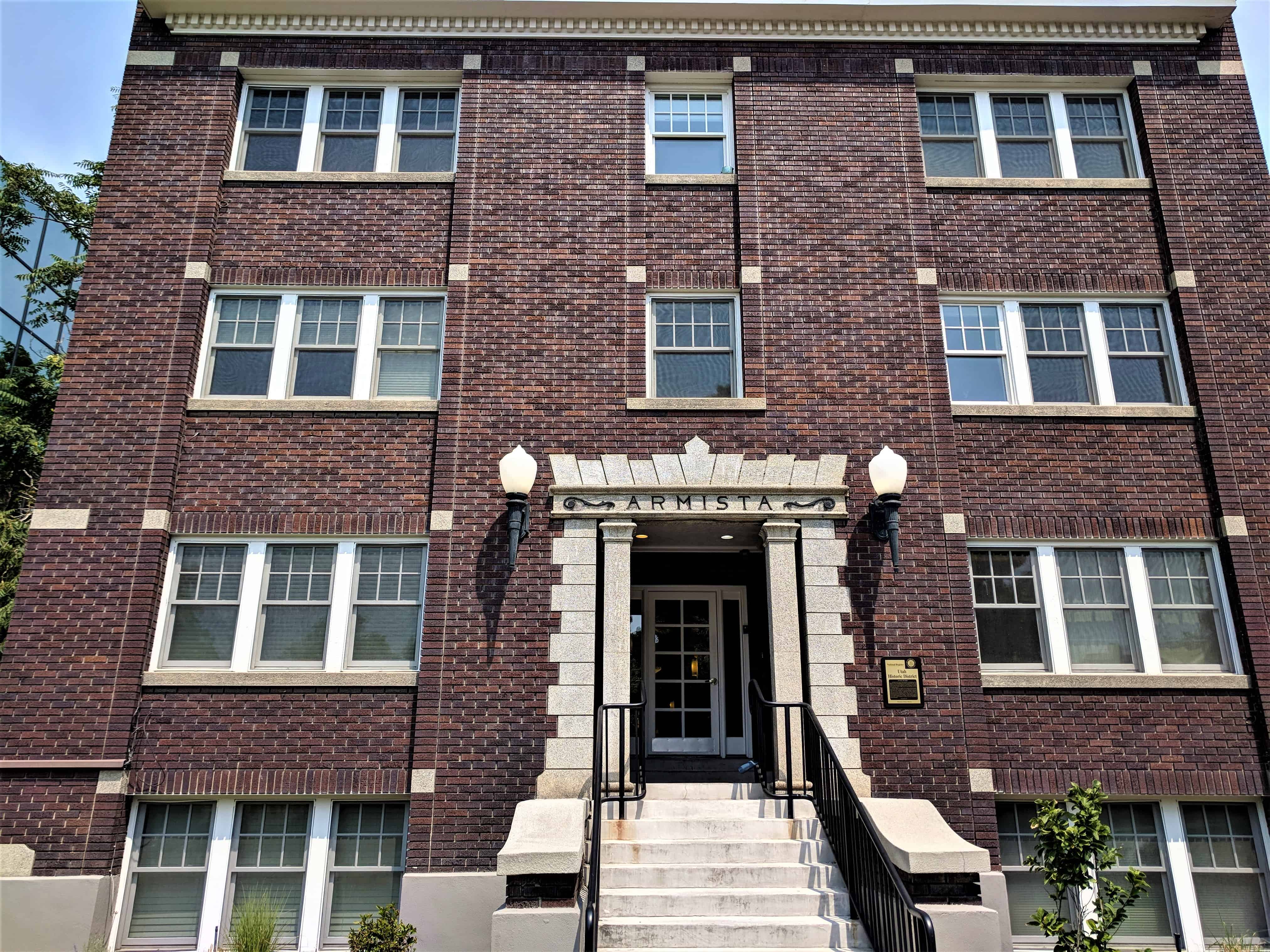
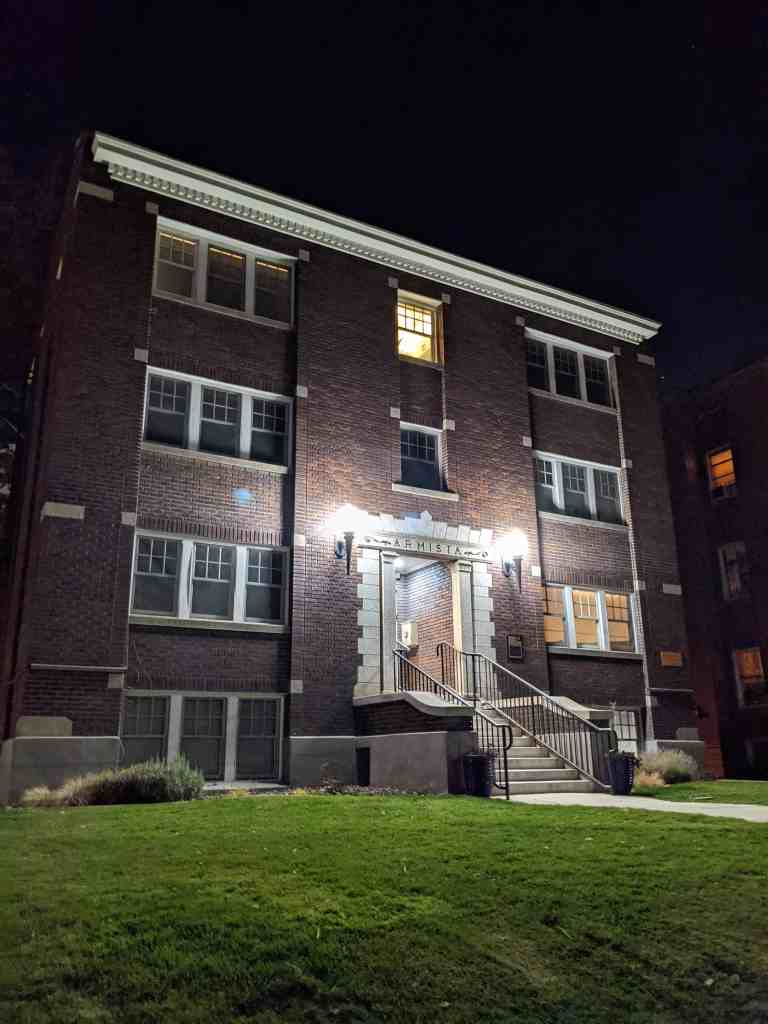
Constructed in 1927, the historic Armista Apartments, now condominiums, is one of many historic urban apartment buildings built in Salt Lake City during the early 1900s. The building is a three-story rectangular-shaped structure with a parapet roof, brick exterior walls, windows that are recessed in vertical spandrel bays, concrete foundation with a basement, symmetrical facade, and modest Colonial Revival styling. It is an example of the double-loaded corridor type of apartment building, which has a main central hallway with living spaces opening off either side.
The Armista Apartments were originally built and owned by Herrick and Company, headed by Nelson L. Herrick. The company was active in development in the Salt Lake City region during the 1920s, this building being one of at least eight apartments that they built between 1925 and 1930. The original cost of constructing the building was approximately $80,000. It was advertised in local papers as:
“splendid three-room apartments, equipped with electric ranges and electric refrigeration. $40.00 to $42.00. One of the most modernly equipped and conveniently located apartments in the city. Make reservations now.”
In 1931, Herrick and Company sold the building to Stanley D. and Valaite Decker, who conditioned to own the building until the mid-1940s. The building was renamed the Waldorf Apartments in 1933 and continued under that name for many decades. Listed on the National Register of Historic Places, in 2007 the building was converted to the Armista Condominiums by Metaview Development.
See other historic apartment building in Salt Lake City here.
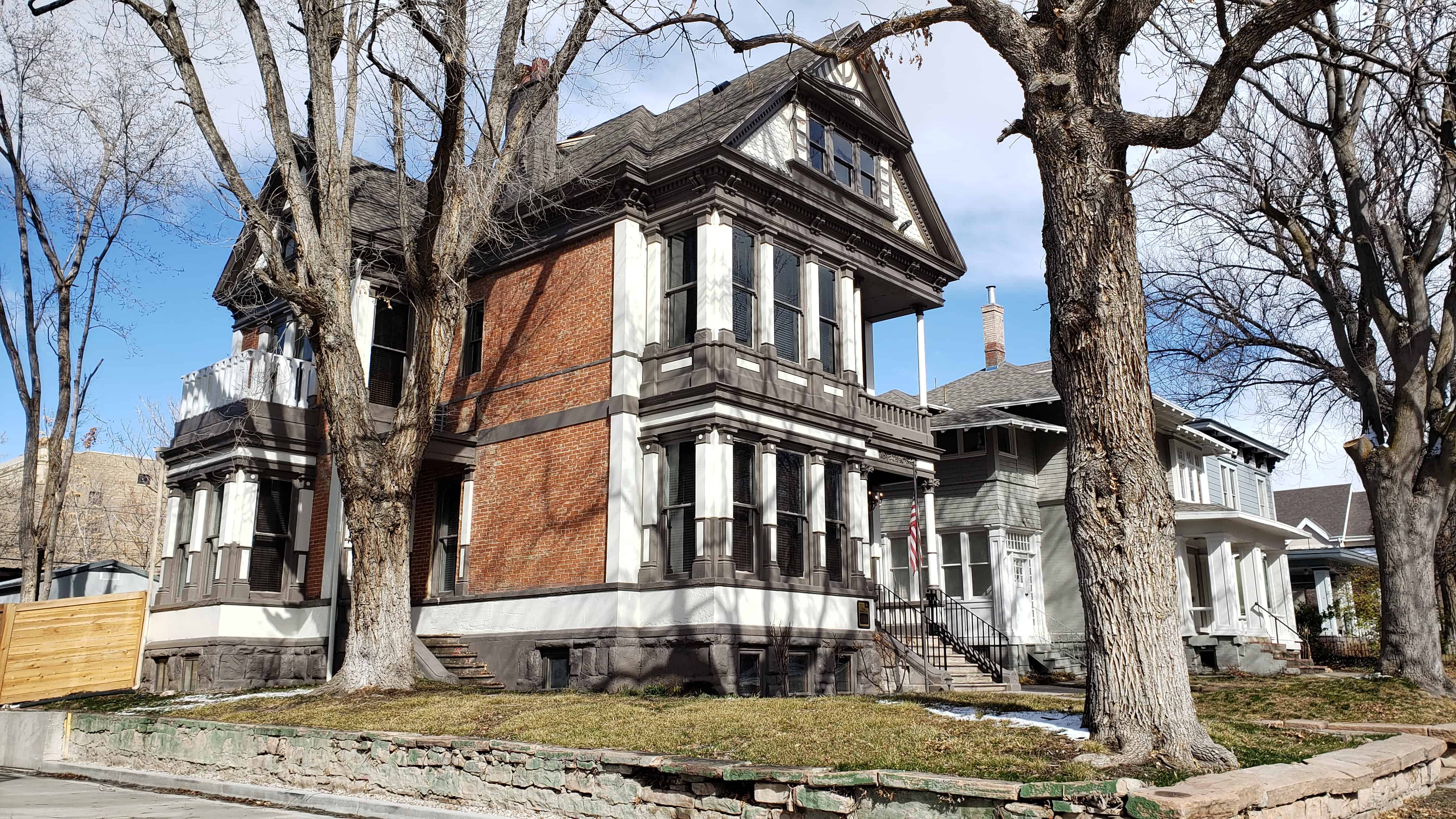
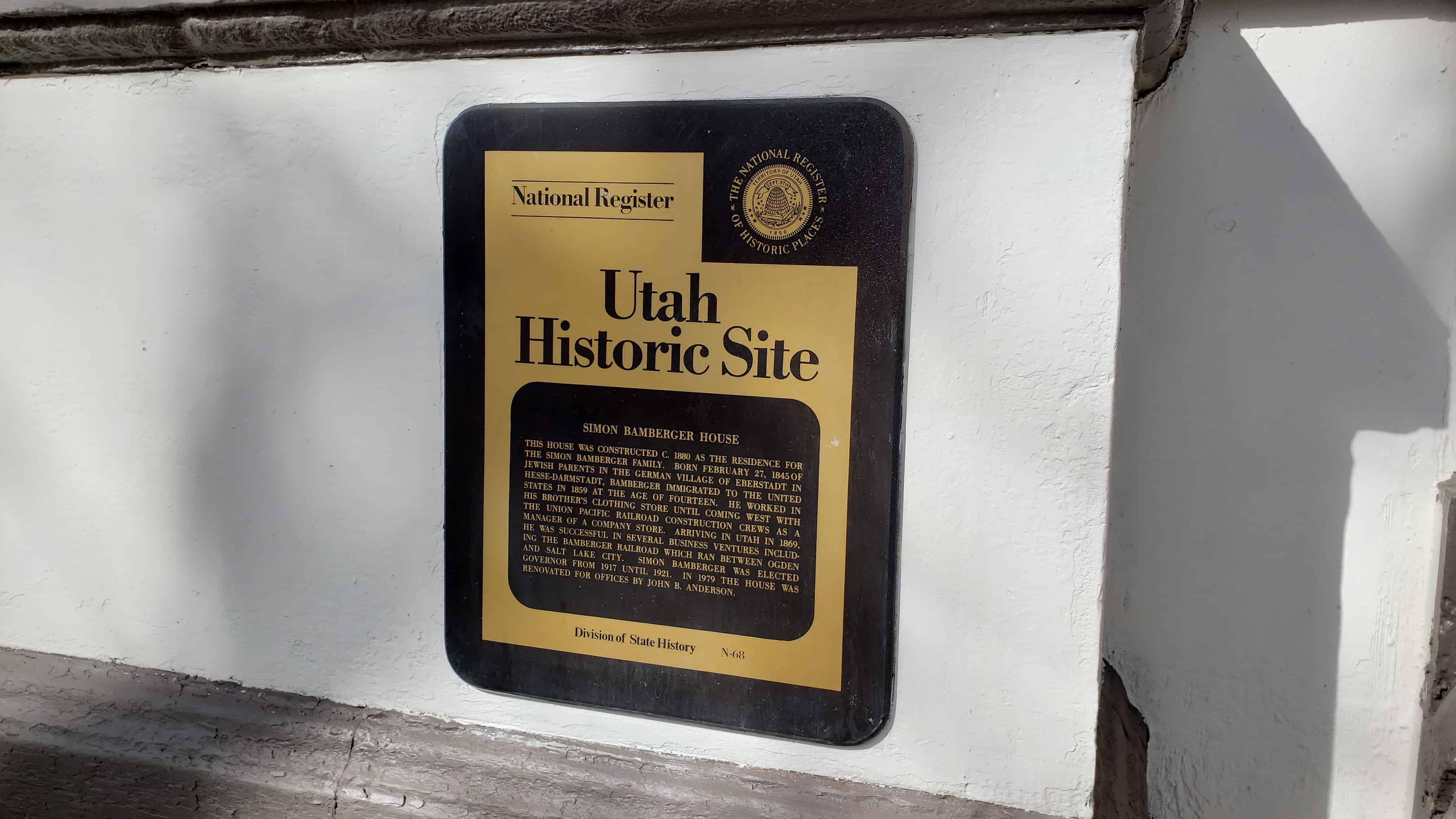
This house was constructed c.1880 as the residence for the Simon Bamberger family. Born February 27, 1845 of Jewish Parents in the German Village of Eberstadt in Hesse-Darmstadt, Bamberger immigrated to the United States in 1859 at the age of fourteen. He worked in his brother’s clothing store until coming west with the Union Pacific railroad construction crews as a manager of a company store. Arriving in Utah in 1869, he was successful in several business ventures including the Bamberger Railroad which ran between Ogden and Salt Lake City. Simon Bamberger was elected Governor from 1917 until 1921. In 1979 the house was renovated for offices by John B. Anderson.
Located at 623 East 100 South in Salt Lake City, Utah – the house was added to the National Register of Historic Places (#75001814) on May 30, 1975.
This home derives its primary significance from its original owner, Simon Bamberger, one of the most significant figures in Utah political history. It was his election as governor in 1916 which served to bridge the chasm between Mormons and non-Mormons which had cut through Utah politics for nearly a half century.
Born February 27, 1845, in the small village of Eberstadt, Hesse-Darmstadt between Frankfurt and Heidelberg, Germany, Bamberger journeyed to the United States in 1859 at the age of fourteen. He worked in his brother Herman’s small clothing store in Wilmington, Ohio, and later moved with his brother to St. Louis where they greatly enlarged their business. Simon came west with the Union Pacific Railroad managing a company store and aiding with the erection of tents and shacks of the “Hell on Wheels” construction camps. Because of his honesty and sobriety, gamblers, dancehall girls and laborers, not trusting their own weaknesses, would ask Simon to hold checks and money for them. By early 1869 he had arrived in Ogden, Utah, and a short time later moved, to Salt Lake City to begin a prosperous business career.
In partnership with a fellow Jew, Briner Cohen, Simon purchased the Delmonico Hotel, renamed it “the White House” and catered to a clientele of mining men. From his contact with Utah’s mining element, Bamberger invested in several Utah and Nevada ventures which proved financially successful. His other business enterprises included the construction of the Bamberger Railroad, originally named “The Great Salt Lake and Hot Springs Railway” which was started in 1892 and by 1908 reached Ogden. The railroad operated until 1952. The Bamberger Railroad served another important enterprise, the summer resort of Lagoon which was established by Bamberger after his railroad reached Farmington in 1395. The resort is still in operation as Utah’s most popular amusement park.
Bamberger’s political career began in 1098 when he was selected to fill a vacant position on the Salt Lake City Board of Education. In 1902 Bamberger was elected to the State Senate as only one of three Democrats in tie entire Utah Senate. He served only one term. In 1915 he announced his availability for nomination to the U.S. Senate and after some consideration decided instead to seek the position of governor.
In the 1916 election, Bamberger had great support from the Mormon Church. His personal abstention from alcohol and tobacco and support of prohibition was also enhanced by the report from Joseph L. Rawlins, Democratic Senator from Utah (1897-1903) that Bamberger had strongly protested the movement to disfranchise certain Mormons and escheat church property. Bamberger’s popularity with the Mormon element is humorously expressed in the following which has become part of Utah’s folklore:
“On a visit to Sanpete County, Bamberger alighted from the train and was met by a local delegation headed by a tall, robust Norwegian with a flowing beard. In contrast, Bamberger, who was short and stubby, heard this towering Norwegian greet him with a menacing threat:
‘You might just as veil go right back vere you come from. If you think we lat any damn Yentile speak in our meeting house, yure mistaken! ‘
Bamberger looked up into the face of the determined, looking leader and slowly replied: ‘As a Jew, I have been called many a bad name, but this is the first tine in my life that I have been called a Damn Gentile! ‘
Instantly the menacing attitude of the leader of the committee relaxed, and, throwing his arm around Bamberger ‘s shoulders, he exultingly exclaimed- ‘You a Yew, an Israelite! Hear him, men, he’s not a Yentile; he’s a Yew, an Israelite! and then to Bamberger : ‘Velcome, my friend; velcome, our next Governor. ‘ “
The campaign was dirtied by anti-Semitic overtones when a caricature of Bamberger accentuating his nose and ears in an obvious effort to call attention to his Jewish heritage was circulated allegedly by the Republican State Committee.
During his administration a Public Utilities Commission was established and a Workmen’s Compensation Act was passed. Social and educational programs were developed and a state-wide prohibition law was passed. Politically Bamberger served as a worthy example to the State’s majority population of Mormons that a non-church member could effectively serve and promote their interests.
As a member of the Congregation B’nai Israel, Simon Bamberger was active in his own church affairs, serving as president of the congregation for several years. He was instrumental in prorating the construction of the B’nai Israel Synagogue which was completed in 1891. He also supported the Jewish Agricultural Colony at Clarion in Sanpete County which was founded in 1911 when a group of eastern Jews, tired of city life and anxious to return to the soil, made their exodus to the Mormon Zion. Bamberger interceded several times to help avert the inevitable financial failure of the colony.
Simon Bamberger died in 1926. His home serves as an excellent reminder of his personal accomplishments and role in Utah history.