This squared limestone block building likely was constructed in the 1870’s or 80’s. The upper floor served as the City Hall, with a raised front entrance and tall plastered ceiling. The lower floor was the City Jail with its separate front and side entrances and two iron-barred jail cells. The front porch has been altered but otherwise, the broadside-facing structure is architecturally intact including the six over six windows and their Federal style lintel caps.
Old-timers claim there were more than two jail cells, but this is not structurally indicated. Most inmates were vagrants or drunks from the train, who disturbed neighbors with their loud complaints from the jail. One elderly gentleman remembered the police arresting some young miscreants (he was one of them) for disobeying the curfew law, and locking them up for a few hours to persuade them to be law-abiding. The building is now a house, but the exterior is largely unchanged from the days when it was a jail; iron bars still remain on the basement windows. The prison cells in the basement are now a guest room and storage room; the jail entry area is a study and bookshelves and a fireplace. The main floor has a kitchenette, dining area, and a living room.(*)
Although there have been lawbreakers in Provo ever since the city government passed its first ordinances in 1850, city authorities did not consider building a large jail in the small community for nearly twenty years.
Utah County built a small jail in 1854: a room in the basement of the Seminary located at 100 North and 500 West that served as a lockup. In 1867, Utah County built a small, brick courthouse on the west side of 100 West between 100 and 200 North, and made a small jail in the basement. None of these jails could house more than a few people at the same time.
Late one night in the fall of 1870, between 20 and 30 federal troops held a wild party in Provo. Over half of them soaked up an excessive amount of locally made beer and whisky and ran through the streets of downtown Provo on a liquor-fueled orgy. They broke down doors, smashed windows, shot into houses and even tried to burn down the meetinghouse.
When these soldiers were taken into custody, there was no place to house them, and military authorities had to keep them in custody. The so-called “Provo Riot” made it painfully clear that the community needed a larger jail. Late in 1870 and early in 1871, Provo City and Utah County cooperated to plan and begin work on a new city and county jail located behind the current historic Utah County Courthouse on University Avenue.
Masons used brick to build the two story, 20-by-32-foot building. Workmen installed cells on the ground floor, and the building opened during the fall of 1871. Two years later, carpenters constructed a tall fence around the jail in order to discourage easy interaction betweein prisoners and the outside world.
This jail served the community until shortly after the Provo City Council and the Utah County Court met in a joint session late in 1929 and voted to raze the old building.
Run by a citizen constable whose wife cooked for prisoners, this jail held suspects, often involved with whiskey and/or fists, for trial and, if found guilty, for short terms imposed by the Justice of the Peace. Long terms were not served here. Designed and built for the county of San Diego for $1075 plus $62 extra for overlooked grating and door, this reinforced site mixed concrete jail ended the escapes common to the three wooden jails that previously existed on this site since 1872. County ownership ended in 1952.
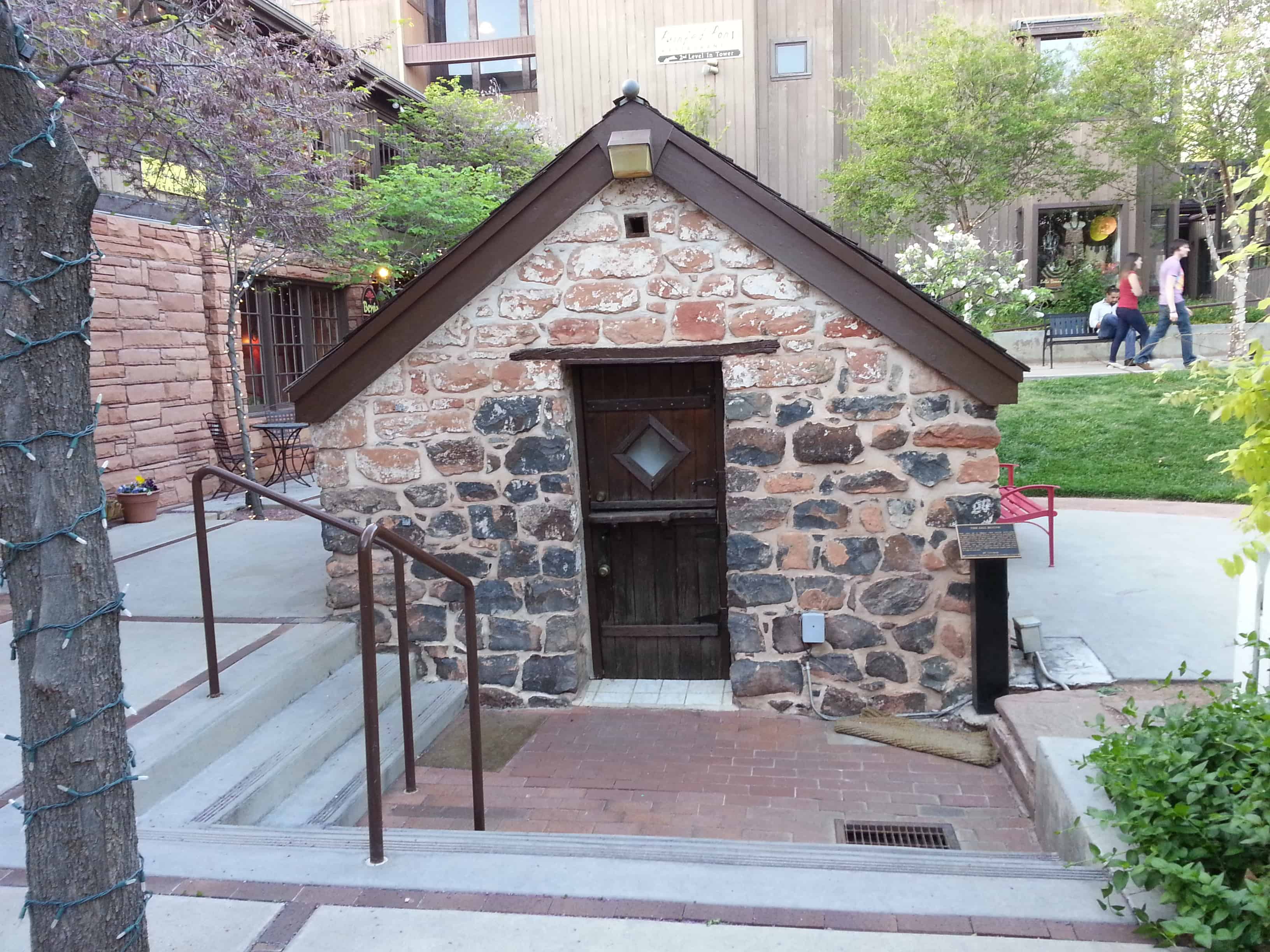
The jail is a small one room building constructed from black lava rock gathered in the nearby foothills. The exact date of construction is not known, however, it is assumed to be built by Sheriff Hardy around 1880. Though used as a granary after the new County Jail was built in the late 19th century, it was apparent that it at one time was a jail in that the original bars are still in the windows.
The text on this page is from the nomination form (#85000965) for the National Historic Register, the school was added to the register on May 9, 1985 and is located at 38 West Clark Street in Stockton, Utah.
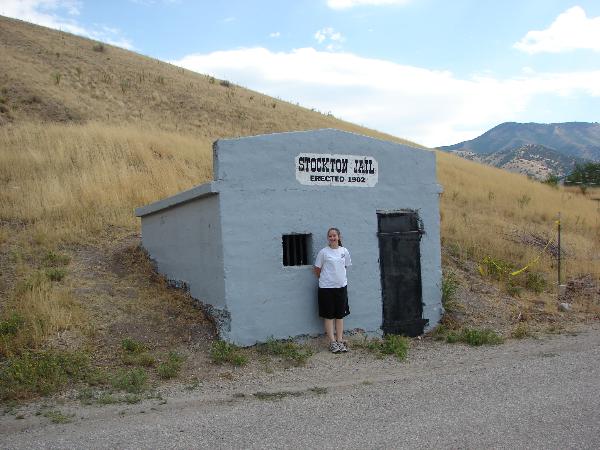
Built in 1902, the Stockton Jail is historically significant as the only building associated with early law enforcement activities in Stockton and as the best preserved public building dating from the early years of the community. The jail was constructed just one year after the town was incorporated, which was a time of considerable community development that saw a number of civic improvements, including the extension of the railroad lines into the town, construction of a railroad depot, the installation of electricity, surveying of the city cemetery, and dedication of a public square.
The decision to erect a jail in Stockton was made at the town meeting held on September 3, 1902. At that same time Town President E.J. Raddatz appointed James H. Spaulding to serve as Marshall and Street Supervisor, with a salary of fifteen dollars per month. The site selected for the jail is located in the northwest part of town at the base of Tabernacle Hill. The property was purchased in November of 1902 and construction began soon after.
Specifications for the building called for a concrete structure measuring 12 x 14 x 8, with three interior compartments, a metal door, and one small window with iron bars. A stove was installed in the outer or south compartment of the building open its completion. Through the years the building has been used primarily either for detoxification or as temporary shelter for hobos passing through on freight trains.
The Stockton Jail was one of a number of civic improvements that were undertaken in the years immediately following the incorporation of the town in 1901. The Oregon Short Line Railroad extended its tracks into the town in 1902. and in 1904-05 a large depot was built. In 1902 the town Board of Trustees set aside a plot of land as a public square and that same year paid five dollars to A.F. Stookey for surveying the cemetery plot. Electricity was brought to Stockton in 1903 by the Clark Electric Power Company and several street lights were installed at that time. The large, brick and adobe IOOF Hall was erected in 1902, and for many years its upper story was used by the town for recreational purposes, including dances, Christmas parties, and even some school functions. The Stockton Jail is the only building to have survived to the present from that era of intensive community development.
Although Stockton was not incorporated until 1901, it was first established as a community in 1864 when precious ores were discovered in the adjacent mountains by U.S. Army soldiers. The Army had established a camp, Camp Relief, at this site in 1862, and under the direction of Col. Patrick E. Connor the soldiers stationed there began prospecting in the surrounding mountains. Their discovery was probably the first significant mineral discovery in Utah and launched the important mining industry in the state. The town of Stockton, though never the nucleus of mining activity in the area, was one of several important mining towns on the west slope of the Oquirrh Mountains. The town was named after Stockton, California, the one-time home of Col. Patrick Connor.
Because only a few older jails have been identified in Utah, little is known about them – their prevalence, range of sizes and architectural styles, or whether they were generally detached buildings or part of a city hall or county courthouse. Jails that have been identified include the Juab County Jail, a separate building located behind the old courthouse, the Park City Jail, located in the basement of the old city hall, and the Garfield County Jail, adjacent to the county courthouse. The Stockton Jail, unlike those, is in an isolated location at the edge of town and is constructed of concrete.
Just below the Old Lime Kiln you can see the first County Jail.
The first County Jail was built in 1879, and was located on Third North and Main Street. It joined the County Court House on the East. The Jail consisted of two cells build by spiking 2×4’s and nailing them together. The cells were plastered. The rood was shingled and was supposed to be rainproof. A high board fence was built around the lot. The bed ticks were filled with straw and a board served as a bed.