What used to be called Lakeview is now just know as part of Orem, is a nice area near Utah Lake.
Related Posts:

20 Monday Oct 2014
Posted in Uncategorized

What used to be called Lakeview is now just know as part of Orem, is a nice area near Utah Lake.
Related Posts:


17 Friday Oct 2014
Posted in Uncategorized
Tags
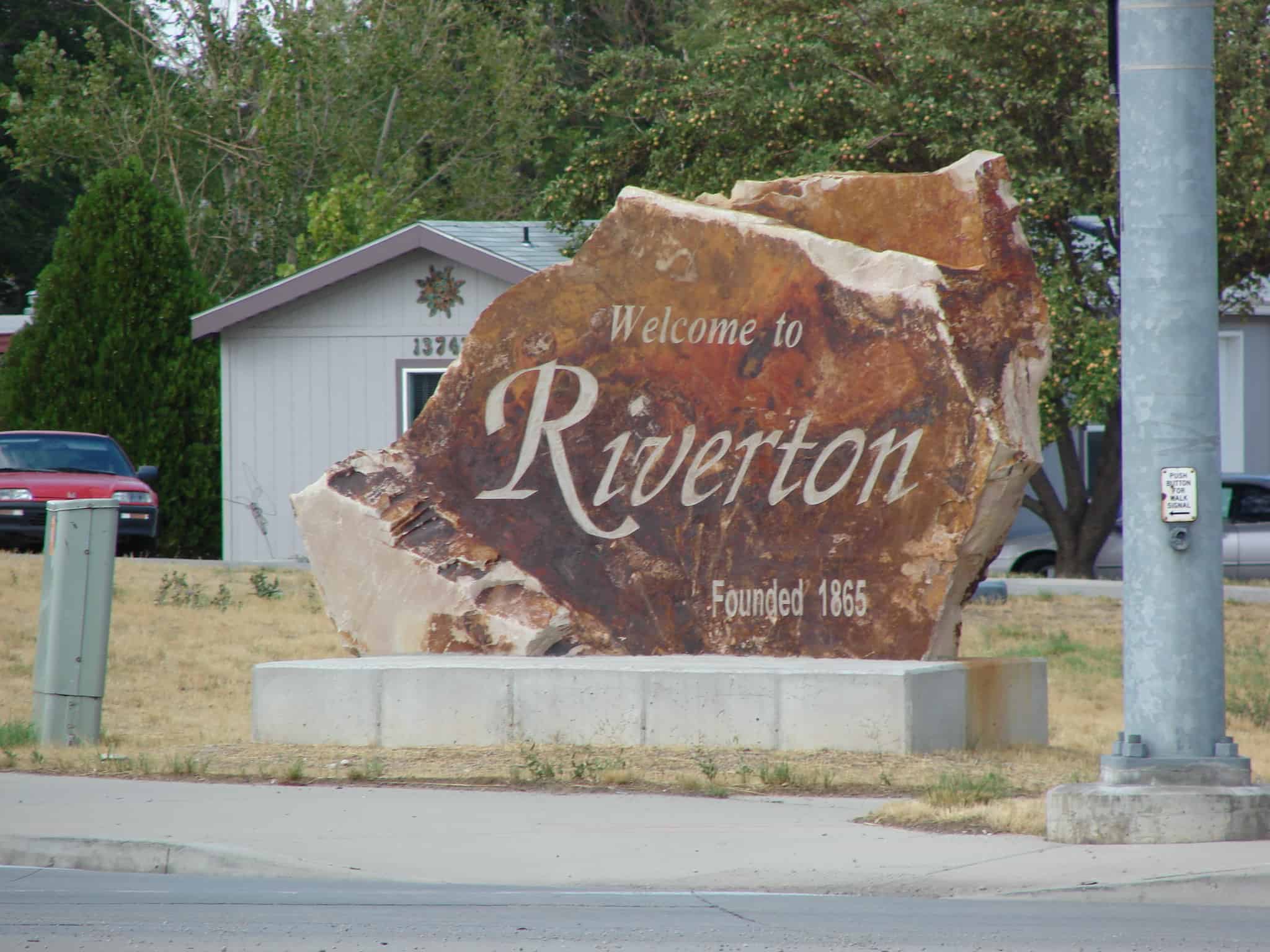
Riverton Posts:
Situated near the southern end of the Salt Lake Valley, Riverton is located on a low plateau west of the Jordan River approximately twenty miles south of Salt Lake City. For most of its history Riverton was an agricultural community, but widespread residential development that began in the late 1960s has largely transformed it into a bedroom community.
The earliest area settlers lived in scattered dugouts and primitive log houses bordering the river on the bottomlands. Archibald Gardner was the first person to live in Riverton, and early settlers paid tribute to his pioneering efforts in the mid-1850s by calling the area Gardnersville. The size of the settlement long remained small because water was available for the bottomlands only near the river. Begun in 1870 as a local cooperative undertaking, the South Jordan Canal, when completed in 1876, opened up the benchland to farming and settlement. The community expanded again when the larger Utah and Salt Lake Canal, financed wholly by Salt Lake County, was finished in 1881. Construction of these canals, which are still in use, was undertaken with only basic tools and contracted manual labor.
Riverton came under the jurisdiction of the West Jordan Precinct in its early years. In 1867 the settlement politically became part of the South Jordan Precinct. A judicial precinct was established locally in 1879, and the name of the small settlement, boasting little more than a hundred people, was officially changed from Gardnersville to Riverton.
Riverton’s residents reflected the predominant religious affiliation characteristic of most rural Utah towns. Much of the cultural, educational, and community life revolved around activities sponsored by the local wards of the Mormon Church. In the early years, Mormons met in the dugouts and log homes of members, often in the home of Nicholas Thomas Silcock, the community’s first branch president (called in 1870). Many of the activities and traditions in the community were initiated in a church setting during years when it was principally an agricultural community. As in other predominantly Mormon Utah communities, there was an overlapping and mixing of ecclesiastical and civic roles and actions. In 1886, with 233 members in thirty-five families, Riverton was organized as a ward with Orrin Porter Miller as its first bishop. Members met in a combination meetinghouse/schoolhouse which had been built in 1879. By 1900 there were 517 members (ninety-two families) and construction was begun on a new meetinghouse. Completed in 1908, this domed structure in the Romanesque style was designed by Richard Kletting and was generally recognized as one of the finest LDS meetinghouses in a rural setting. It was demolished in 1940.
Public schools in the community had their beginnings in private homes and in a one-room schoolhouse which was built in 1879. A two-story brick school was built in 1892 on Redwood Road; it served students through the eighth grade. In the mid-1920s a new elementary school and junior high school were constructed on this site. As population increased in the 1970s and 1980s, the Jordan School District constructed additional elementary schools and a middle school within the boundaries of the community.
In the decade of the 1890s, farming in Riverton underwent a transformation, shifting from simple farms supplying family needs to commercial farming. This paralleled a similar development in Utah agriculture. Although the farmer normally still owned his land, he specialized in what he grew or raised and used his cash profits to buy most of the things he needed. The local agricultural economy was severely tested during two extended periods of drought–one at the turn of the century and another in the early 1930s. Crops that were grown by commercial farmers in Riverton included alfalfa, sugar beets, tomatoes, and wheat. The livestock industry in Riverton was represented by sheep, dairy cows, and poultry. Commercial production and marketing of these agricultural and livestock products was accomplished through the establishment of various businesses, including an alfalfa feed mill, a canning factory, an egg-processing plant, and a dairy cooperative.
A central business district developed which was centered at the intersection of Redwood Road and “Herriman Road” (12,600 South). On the northeast corner of this intersection, a two-story commercial building was constructed by sheepman/developer Daniel Densley in 1893. Several businesses were accommodated on the first level of this building and the upper floor was used for dances, plays, and large community gatherings. Another sizable business was a retail store built by Thomas P. Page about the turn of the century. It was regarded for many years as the largest concern of its kind in the county outside Salt Lake City. The Page-Pixton (later Page-Hansen) store sold everything from building materials, coal, and dry goods to groceries, grain, and housewares. The Jordan Valley Bank was started in 1905 as a community bank. This bank was a casualty of the Great Depression, and many people suffered financially when it closed its doors. For a time, the town also housed many automobile dealerships.
Although the move was controversial, in 1946 Riverton incorporated, operating under a town board form of government. The most pressing problems which city officials have dealt with in the latter part of the twentieth century have been those associated with the rapid increase in the city’s population. To illustrate, in 1970 the city had a population of 2,820, a figure which expanded to 11,700 in 1992. This has made a tremendous difference in land use as farmland has been converted to residential use. This change is great in view of the fact that approximately 94 percent of Riverton’s land was agricultural in 1960. Riverton has increasingly become a popular country-style suburb, an inevitable development as a consequence of the Salt Lake Valley’s expanding population.
17 Friday Oct 2014
Posted in Uncategorized
Tags
Bear Lake, Cache County, historic, Logan, Oregon Trail, utah

The first covered wagons came into the Rocky Mts. in 1830, they made their way as far west as Fort Washakie in Wyoming. Efforts were made to find passable wagon trails through the Mountains to the Pacific Coast, which goal was finally reached. At that time, the entire northwest Mt. area was known as Oregon Country & western travel was either to the “Oregon” or the “California” regions. While early maps give the probable location of the first Oregon Trail north of here, well marked wagon ruts & stories of Indians & Settlers indicate that the first wagon migration to “Oregon” followed the Southwesterly shores of Bear Lake. Leaving this valley through a canyon to the Northwest, then to the upper reaches of the Bear River. Additional color is given this belief because this was the site of an important trappers’ rendezvous as early as 1827, & well marked trails were followed for many years in & out of this valley.

17 Friday Oct 2014
Posted in Uncategorized
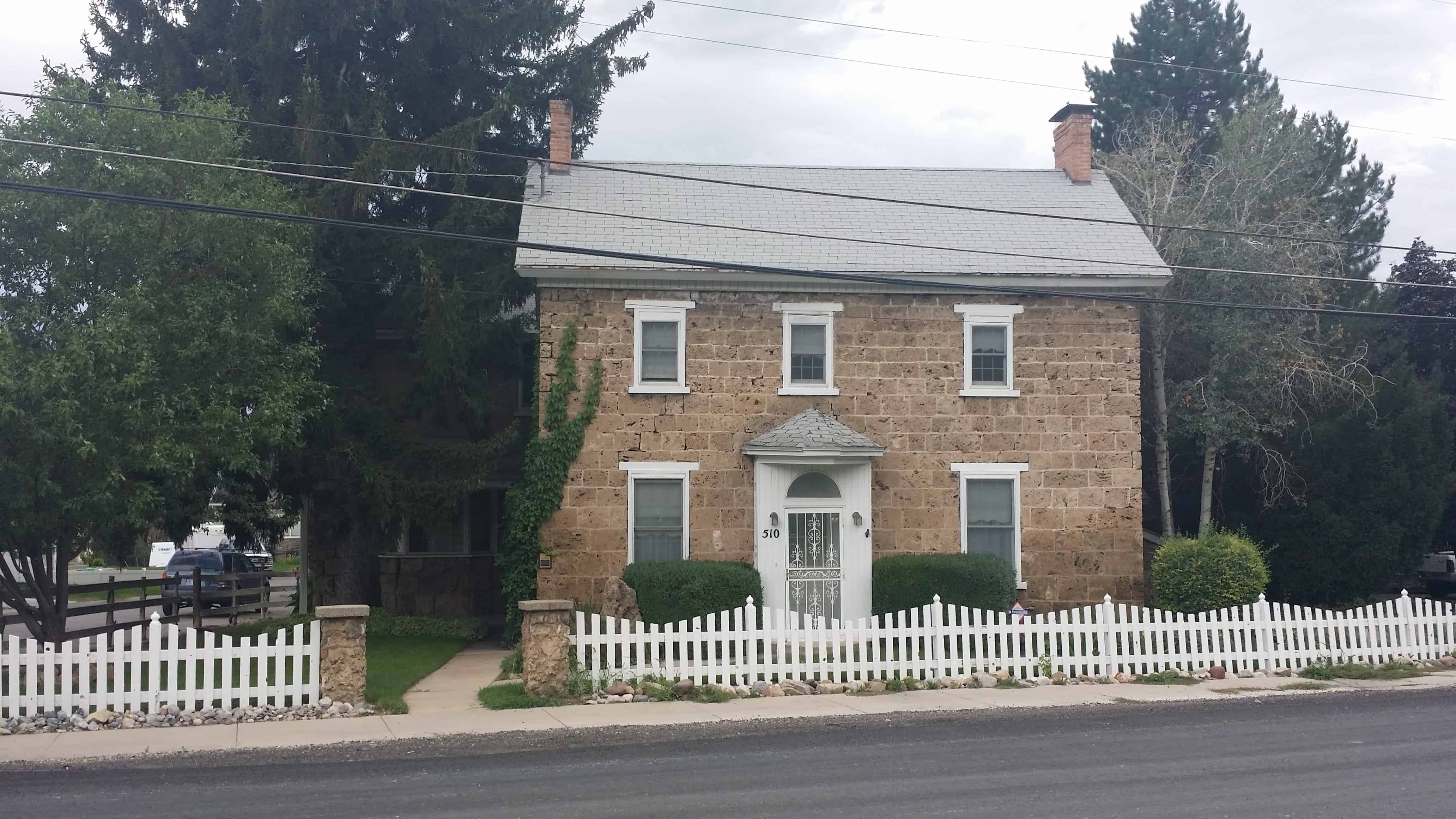
The Joseph Olpin House, which replaced a one-room log house, was constructed in two phases, beginning with a two-room adobe house in 1867. In 1875, the vernacular Classical-style two-story soft-rock section was added to the front, creating a new primary façade. Joseph, a skilled stonemason, built this house and several other stone houses in Pleasant Grove.
Joseph and his wife, Ann, moved to Pleasant Grove in 1867 and received this property as payment for construction of a house for Joseph Wadley, his brother in law. Joseph died of Rocky Mountain fever in 1880; Ann continued living here until her death in 1893. Albert Henry Olpin, their youngest son, inherited the house and lived here with his wife, Alvira, and eight children. Albert was a carpenter who added many custom touches to the interior wood-work of the house. He also rebuilt the small brick section at the rear c. 1910. Albert passed away in 1923, and Alvira continued to live here until 1950, when she moved in with a daughter, but the house remained in the family for several years after her death in 1958.
Located at 510 Locust Avenue in Pleasant Grove, Utah and added to the National Register of Historic Places (#77001320) on November 7, 1977.
Related:
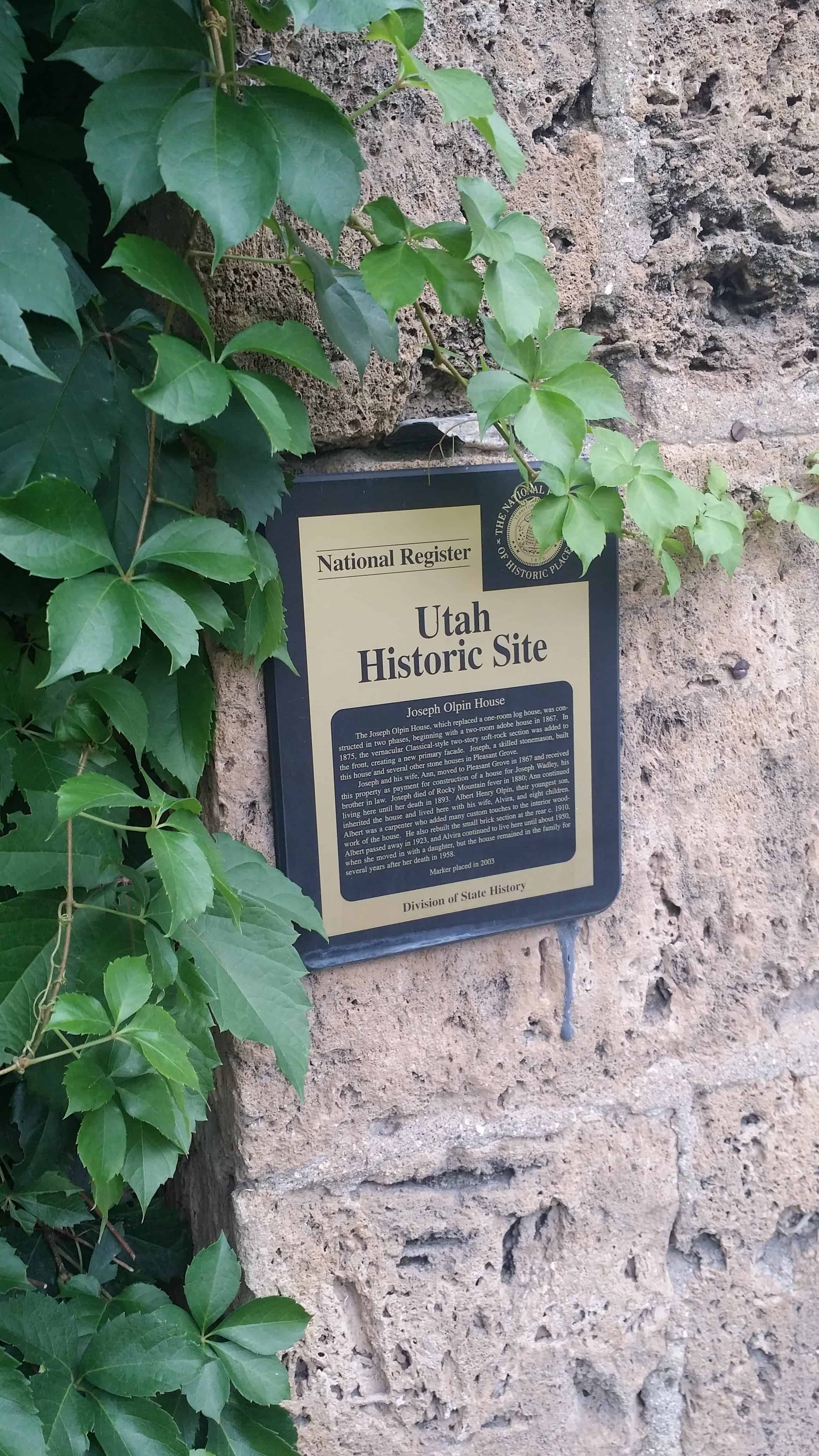
The Joseph Olpin House, built ca. 1875 by the owner, a stone mason, is one of the early pioneer homes of Pleasant Grove. It is a fine example of Utah vernacular architecture and has historic associations with the Mormon religion and the development of education in the State.
Joseph Olpin was born in Gloucester, England, in 1839. His father joined the Mormon Church in that country, and Joseph was baptized by him in 1845. Joseph Olpin came to Utah in 1856 at the age of 17.
Olpin lived in Salt Lake City, until 1863, when he moved to Rockport. He remained there until moving to Pleasant Grove in 1867 at the suggestion of Joseph Wadley, his brother-in-law. Olpin received the land on which the house stands from Wadley as payment for construction of a house for him. Olpin originally built a one-room log house on the site, later replaced by a two-room adobe. Olpin’s skill as a stone mason was widely sought by residents of Pleasant Grove, and he built many of the stone houses still standing in the area.
Olpin built the two-story soft stone house in 1874 or 1875. He died January 17, 1880, in Pleasant Grove. The house passed to Albert Henry Olpin, the youngest of his four sons. Albert Olpin was a carpenter by trade and was responsible for much of the woodwork in the house, including the curving wooden staircase in the central hall. He also built the brick addition at the rear ca. 1908-1910.
While on a church mission to South Carolina in 1901-1903, Albert Olpin was severely beaten by a mob. This incident is symbolic of the anti-Mormon tensions which continued into the 20th Century.
Dr. A. Ray Olpin, past president of the University of Utah, is the oldest son of Albert and Alvira Olpin. He was born in the house in 1898. Dr. Olpin headed the University from 1946 to 1964. During these years the institution experienced tremendous growth, enrollment increasing from c. 7,000 to c. 18,000 over the period.
The house remained in the Olpin family until 1943, when the President’s mother sold it. The home is currently the private residence of Mr. and Mrs. Edward Platt who wish to complete its restoration.
The Joseph Olpin Home is a two-story rectangular building of stone with a one-and-a-half story rear addition of brick. The front and sides are coursed ashlar, while the foundation and back are of nibble construction. The front is symmetrical, three bays wide, with wooden lintels above six-over-six windows. Two single stack, banded brick chimneys, recessed slightly from each gable end, straddle the ridge.
At the rear of the original stone building is a one-and-a-half story brick broken salt-box addition, with a hipped roof porch. The addition is of stretcher bond. The rear door and window bays of the ground floor of the addition have segmented arches. The rear bays have corbeled voussoirs. The two smaller windows of the upper story of the addition have plain wooden lintels which break into the frieze. Both the addition and original building have a plain boxed cornice with simple mouldings and a plain frieze. The addition has two single stack brick chimneys, one at the peak of the ridge, recessed from the gable end, and the other on the shallow slope of the roof.
Both the original structure and the addition are of vernacular styling. The condition of the building is good and the integrity is excellent. The plan consists of two rooms flanking a central hall on the first floor of the main building. The addition houses a kitchen and pantry area. The original curving wooden staircase still stands in the hall. The upper floor served as bedroom space.
10 Friday Oct 2014
Posted in Uncategorized
Tags
Harris Home
310 North State Street
This is one of the original “Stringtown” homes built along State Street around 1865. The builder and original owners are unknown. The house was owned by Harriet and Joseph Harris during the first half of this century and this small home was often the site of dances and other social events. At one time the house was slated for demolition. The bulldozers were on the site. Pam Dain, a Lindon resident with an interest in historic architecture and antiques, was driving her school bus (with no children aboard) when she saw the demolition crew at the home. She pulled the bus between the house and bulldozers and asked the operators to wait until she could make a few phone calls. Pam single-handedly saved one of Lindon’s few remaining examples of architecture of the earliest period of Lindon’s history.
The home was eventually dismantled and the stones were used to construct the pioneer home that sits in Pioneer Park at 150 South 500 East.

The old Harris Home


10 Friday Oct 2014
Posted in Uncategorized
Tags
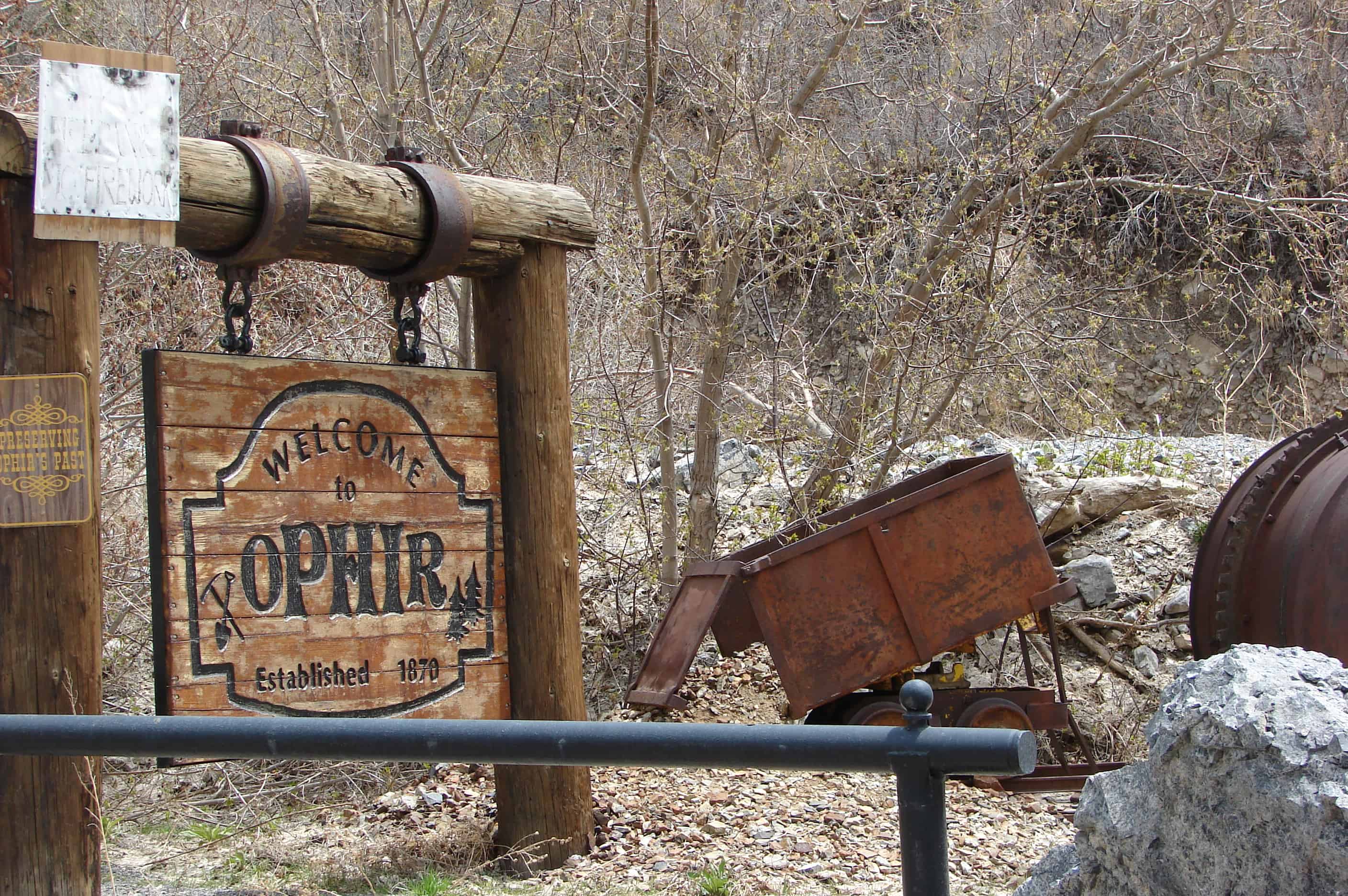
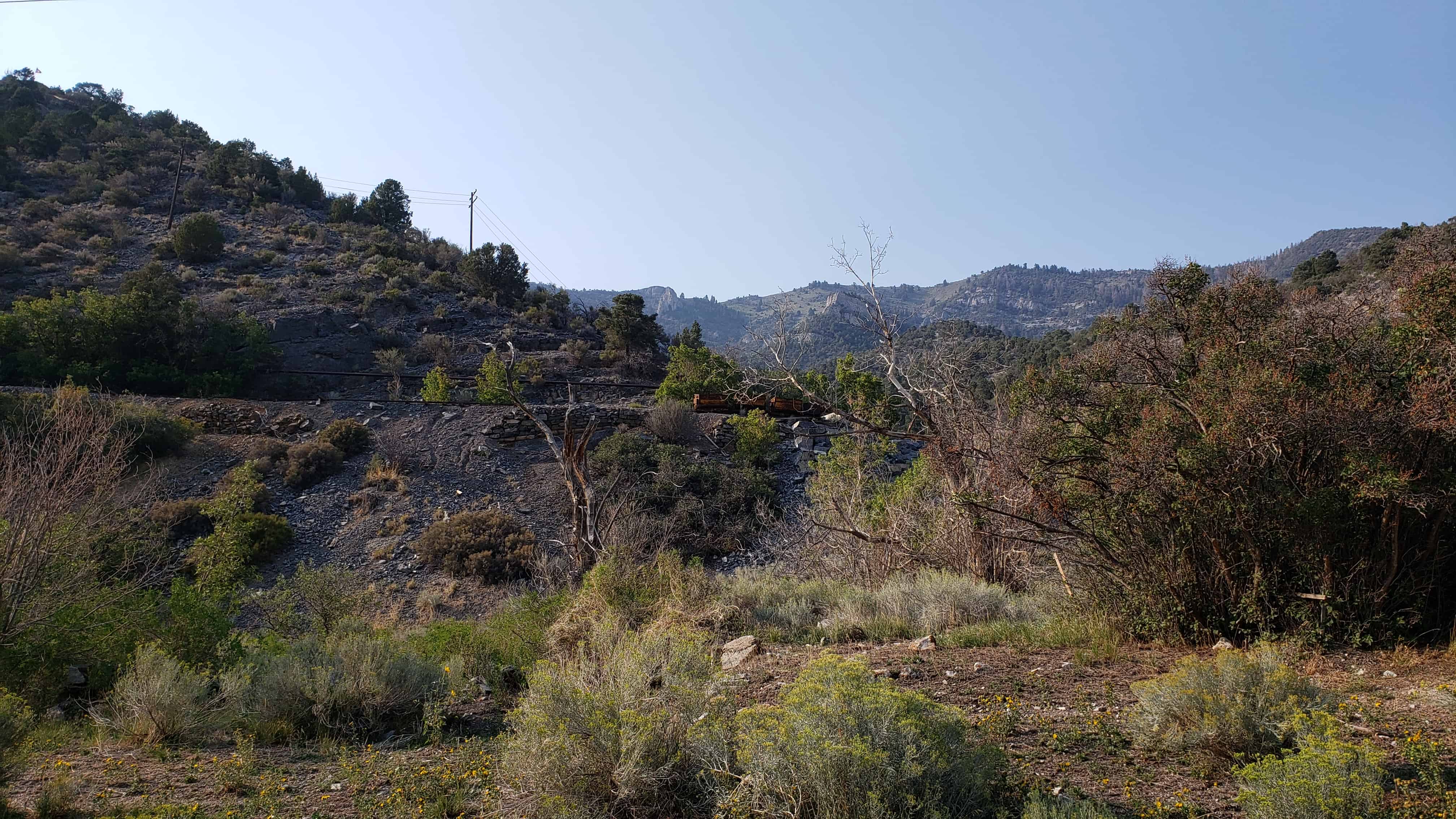
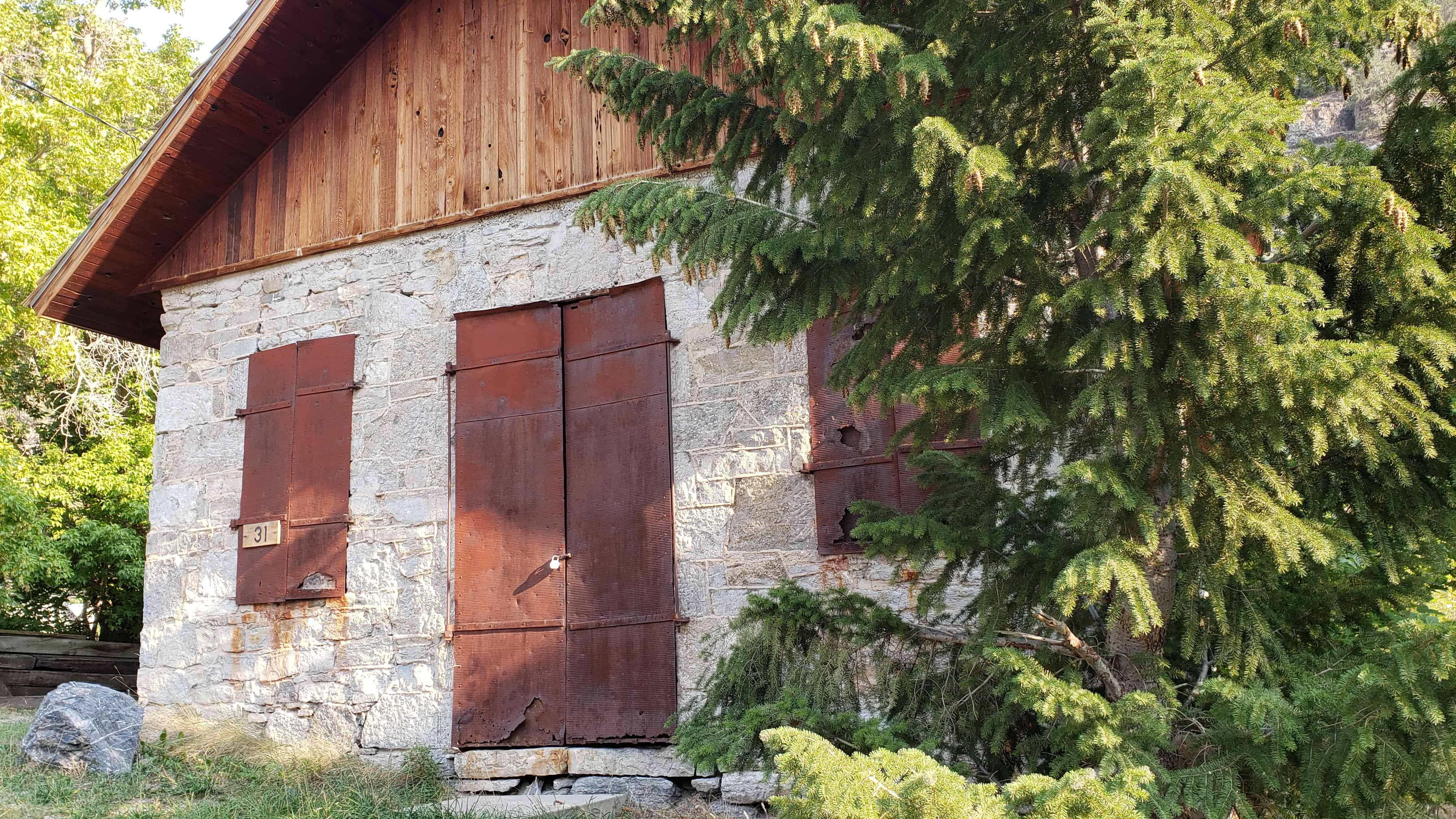
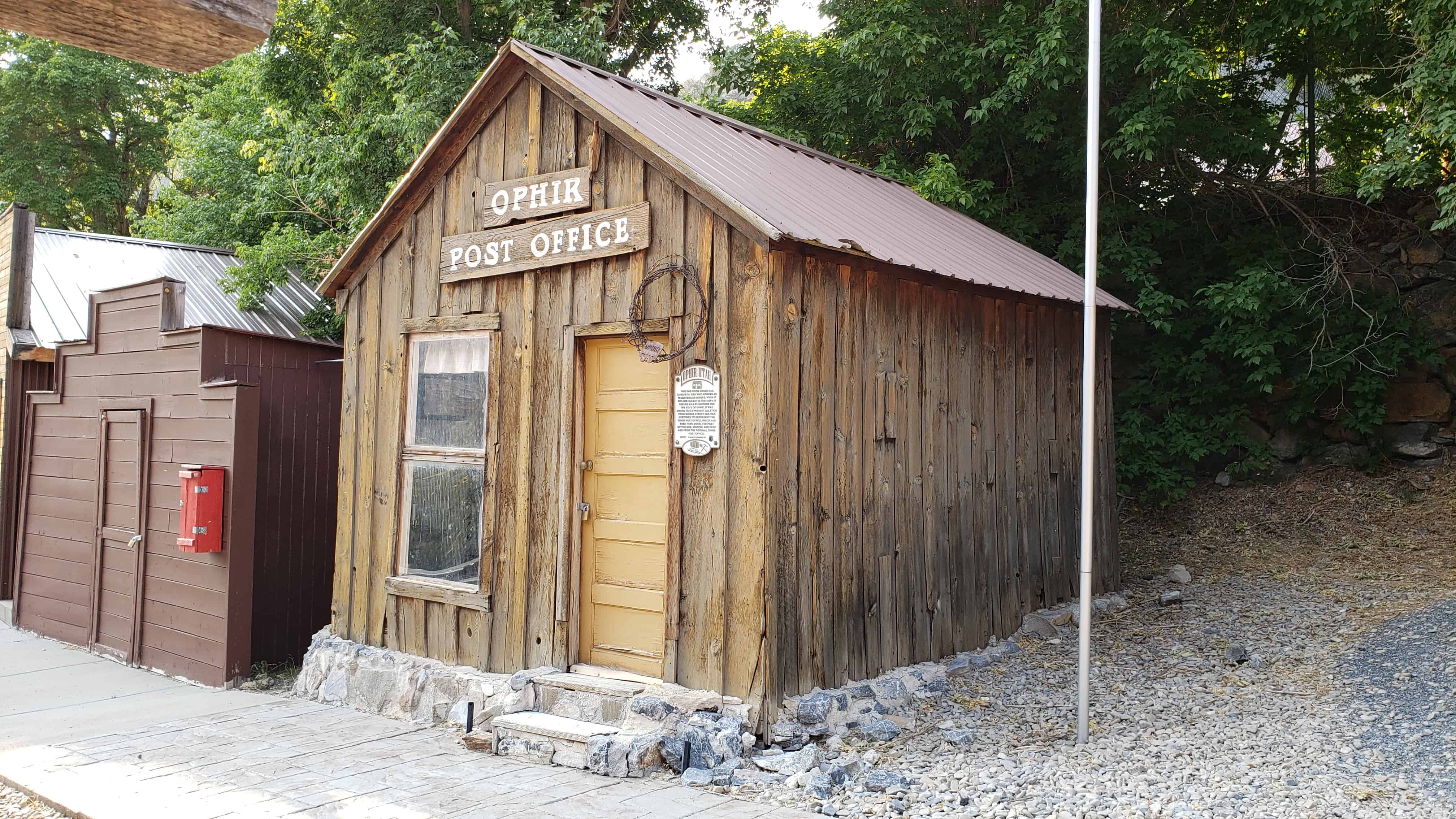
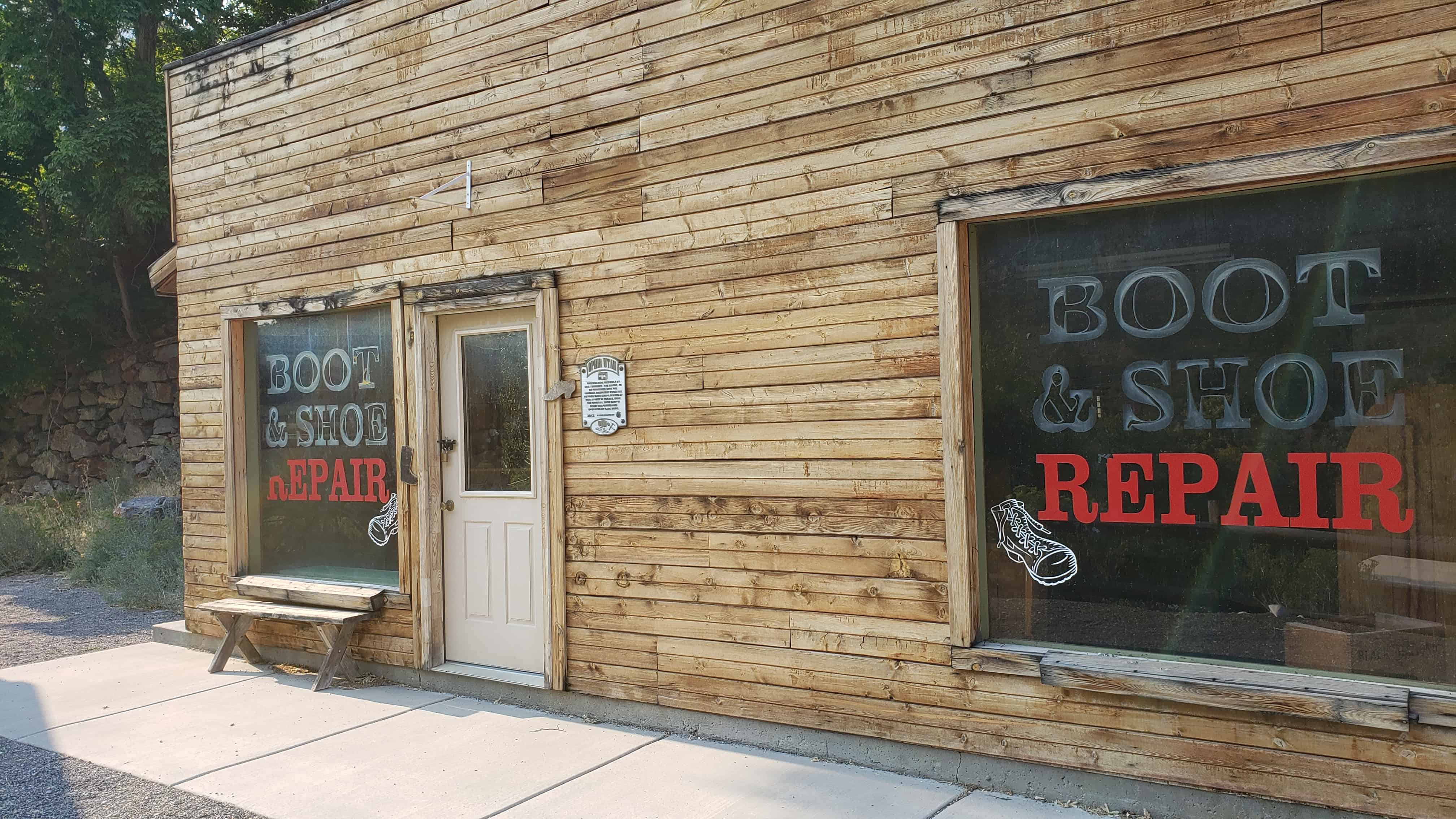
Ophir is a small mining town in Tooele County, Utah.
Related:









05 Sunday Oct 2014
Posted in Uncategorized
Alfred Harper built this house in 1876 of honeycombed limestone quarried from nearby American Fork Canyon. It is said that he traded his homegrown vegetables and flowers for the rock. Before the building was completed, Harper had to leave his family and home to serve a three-year mission in New Zealand for the LDS church. On his return he finished the house and planted vines he’d brought from New Zealand. The vines eventually grew to surround the building.
Locals called it “The Big House,” and it became a gathering place for community and church activities.
One of the most notable features of the property was a well, complete with bucket and dipper, that passers-by were welcome to use to quench their thirst. Church-goers, children, and even the occasional tramp made good use of the clear, cold water.
In 1987, the Harper House was listed on the National Register of Historic Places, the nation’s official list of cultural resources worthy of preservation. The register recognizes the accomplishments of all peoples who have contributed to the history and heritage of the United States.


03 Friday Oct 2014
Posted in Uncategorized
Tags


The first Lindon church building was completed in 1891 on land donated by Joseph W. Ash. In the fall of 1941, the original building was condemned and was torn down. On May 31, 1947 a building lot was purchased where a new and larger church could be constructed. It was located immediately west of what is now the Lindon Elementary School.
The ground breaking ceremony was held on April 6, 1949. Ward members sacrificed their time and money to help build this new church. Through the continued efforts of ward members and the stake building committee, work was completed on the chapel and it was dedicated on March 23, 1952.
Over the years, as Lindon grew and the needs of new wards put more demand on the Main Street chapel, renovations were made and additions were added.
In 2010, the LDS Church constructed a new chapel on 500 North in Lindon and relocated the wards that were meeting in the Main Street chapel to the new chapel. The LDS church intended to demolish the Main Street chapel as it was too small to be used for the large Lindon wards and had limited capacity for the parking demands of multiple wards.
Lindon City became aware of the plans to demolish the building, and adter some negotiations, purchased the property from The Church of Jesus Christ of Latter-day Saints in July of 2010. Upon condition of the sale, the old steeple and church signs were removed from the chapel. After some minor remodeling of the building, the City reopened it to the public in June 2011 as the new Lindon City Community Center and the Lindon Senior Center. The building now houses the Lindon City Parks & Recreation Department, as well as the Lindon City Historical Society. It also provides a place for community gatherings and events.
03 Friday Oct 2014
Posted in Uncategorized
Tags

Terra is over the pass west of Clover Creek.


03 Friday Oct 2014
Posted in Uncategorized
Tags

The community was named for Charles W. Penrose, an apostle for the Church of Jesus Christ of Latter-day Saints.
The first permanent settler to the Penrose area was C.S. Rowher, in 1890. He, along with others, farmed beets, wheat, corn and hay.

Penrose is a collection of homes situated along the last seven miles of Highway 102. Everyone lives between Mile Marker 1 and Mile Marker 7 on the road from Tremonton to Promontory. It was named for Mormon Apostle Charles W. Penrose in 1911, and is a place of refuge and safety. Anciently, it was part of large grassland ranging from the Snake River to Promontory Point. The lush, tall grass supported great herds of deer and tribes of Indians that sought out the many watering places located at the base of the mountains.
After Spanish Exploration, it supported great bands of wild horses that made trails from watering holes to highland pastures. Penrose ranchers were amazed when the sky would become darkened, so large were the dust clouds when the great numbers came to Connor Springs for water. As the grass died out and was replaced by scrub sagebrush and June grass, the land was ready for farming.
It was not until 1890 that C.S. Rowher, a dry farmer from Park Valley, became the first permanent settler to locate on the slopes of the valley with its excellent view of the majestic Wasatch sunsets. He and those who followed knew that the parched, overgrazed land would be turning into an oasis as soon as clear water from the Bear River was diverted to the sloping community. They fought alkali soil, snakes, mosquitoes, gnats, and coyotes. They delighted in the ample supply of muskrat, ducks, and pheasants. They cultivated beets, wheat, corn and hay, and they prospected for gold, oil, coal and diamonds. The first L.D.S. bishop in Penrose, P.N. Pierce, owned a sand and gravel company that he used to make road beds for the county. In all, they strove to provide for their families and provide a better life for their children, including higher education and an appreciation for culture. Travel didn’t appear to present a great problem, as early farmers walked to Brigham and back in a single day. With horses, several trips a month were not uncommon, and with cars, it could be done daily. To the question: “Can anything good come out of Penrose?” Our reply: “Only the best!” (*)